Entanglement geometry separates circuit cutting, classical hardness, and trainability
July 20, 2026
Abstract
Circuit cutting promises to scale quantum computations beyond current hardware, but variational quantum advantage also requires low cutting overhead, classical hardness, and trainability. We show that these properties are strongly constrained by entanglement geometry. Matrix product state (MPS) and tree tensor network (TTN) circuits with constant seam bond dimension can be cut with \(O(1/\varepsilon^2)\) sampling overhead, but remain efficiently classically simulable, ruling out asymptotic quantum advantage within these families. By independently controlling seam and intra-block entanglement, we construct a two-block circuit family that remains cheaply cuttable while requiring a super-polynomial global MPS bond dimension, as supported numerically up to \(n=100\). However, MPS hardness and trainability require incompatible depth regimes, \(d=\omega(\log n)\) and \(d=O(\log n)\), respectively. Using magic rather than entanglement as the hardness resource avoids this conflict: shallow Clifford+\(T\) circuits remain cuttable and trainable while their stabiliser-simulation cost grows exponentially with the \(T\)-count.
Circuit Cutting, Circuit Knitting, Distributed Quantum Computing, Quantum Machine Learning
1 Introduction↩︎
Circuit cutting [1]–[4] distributes a wide quantum circuit across small devices by replacing cross-device gates with local operations and classical post-processing. Quantum links would enable lower overhead [2], [5], but are not yet broadly available. Assuming the devices are connected by classical channels only, the sampling overhead grows exponentially in the number of cuts but stays independent of circuit size [2], so cutting is practical only when the seam, i.e., the bipartition between sub-circuits, carries bounded entanglement. Bounded seam entanglement is, however, precisely the structure that implies classical simulability [6]. This raises the question of whether any circuit family is simultaneously cuttable at constant overhead and classically hard.
We establish three structural results. Proposition 1 shows that matrix product state (MPS) and tree tensor network (TTN) circuits with constant seam bond dimension are simultaneously cuttable and classically simulable. Proposition 2 shows this failure is not inherent: a two-block circuit with fixed seam width and increasing intra-block depth remains cheaply cuttable while its global simulation cost grows super-polynomially in \(n\), confirmed by MPS simulation up to \(n=100\). Proposition 3 shows that the three-way question is provably negative for the brickwork family: the depth regimes required for MPS-hardness and for trainability are mutually exclusive. Section VI identifies the structural conditions for a positive answer and presents partial evidence via Clifford+T circuits. Recent work has demonstrated that cutting-based distributed quantum learning models [7], [8] and variational algorithms [9], [10] are operationally viable, and has incorporated cut-count into circuit architecture search [11], but none addresses whether the resulting circuits possess quantum advantage, which Propositions 1 and 2 are the first to answer structurally.
2 Background↩︎
Circuit cutting works by replacing each nonlocal gate \(\mathcal{U}\) at the seam with a signed mixture of local operations, \(\mathcal{U} = \sum_i a_i \mathcal{F}_i\), where each \(\mathcal{F}_i\) acts entirely within one sub-circuit [2]. The expectation value of any observable is then reconstructed by Monte Carlo sampling; the sampling overhead to achieve additive error \(\varepsilon\) is \(\#\text{shots} = \mathcal{O}\!\left(\gamma^{2k}/\varepsilon^2\right)\), where \(k\) is the number of cuts and \(\gamma\) the per-cut \(\ell_1\) factor, with \(\gamma\!=\!3\) for a CNOT gate cut and \(\gamma\!=\!4\) for a wire cut under local operations alone [2]. Classical communication between sub-circuits reduces wire-cut overhead from \(\mathcal{O}(16^k)\) to \(\mathcal{O}(4^k)\), approaching the teleportation limit [2]; non-maximally entangled auxiliary states interpolate smoothly between these regimes [5]. The cost grows exponentially in \(k\) but is otherwise independent of circuit size: for fixed \(k\), the overhead is \(O(1)\).
The minimum number of wire cuts at a bipartition equals \(\lceil\log_2\chi_{\rm seam}\rceil\), where \(\chi_{\rm seam}\) is the Schmidt rank of the state at the cut. Cutting is therefore cheap if and only if the seam carries a bounded number of ebits, i.e., \(\chi_{\rm seam} = O(1)\). MPS- and TTN-style ansätze satisfy this by design: every inter-block bond has bounded rank, so every bipartition aligned with a bond has \(\chi_{\rm seam} = O(1)\) [12], [13]. For circuits where \(\chi_{\rm seam}\) grows with system size, cutting overhead scales accordingly and is no longer \(O(1)\).
In that vein, the same bounded entanglement that makes circuits cuttable also makes them classically simulable. For MPS and TTN circuits with bond dimension \(\chi\), standard sequential tensor-network contraction evaluates any local expectation value in \(O(n\chi^3)\) time [14]. More broadly, Ref. [6] shows that every standard barren-plateau-free architecture lives in a polynomially sized subspace of operator space, making its loss function efficiently computable either classically (CSIM) or after a polynomial quantum data-acquisition step (QESIM). The Lie-algebraic framework of [15] gives exact loss-variance formulas for deep parameterized quantum circuits and unifies expressivity, locality, entanglement, and noise as sources of barren plateaus. Bounded cuttability and bounded classical simulability share a common root: both trace back to the Schmidt rank at the seam. A small Schmidt rank limits both the information that must be communicated during cutting and the number of Schmidt values needed to represent the global state classically. Cut-compatibility therefore introduces a structural bias toward classical simulability.
The literature on circuit-cutting-based quantum learning architectures asks whether non-classically-simulable circuits can simultaneously be useful for learning and cheaply cuttable [16]. Adding the requirement of trainability, for which absence of barren plateaus serves as a standard proxy, turns this into a three-way question that is explicitly identified as open. The analysis in the preceding subsections suggests the answer is negative for all standard cuttable families; the propositions below make this precise and identify the structural condition that must hold for the answer to become affirmative.
3 Negative Baseline↩︎
MPS- and TTN-style circuits are natural candidates for circuit-cutting-based learning models: each tensor-network bond is a seam with bounded Schmidt rank, guaranteeing cheap cutting at any depth. One might therefore expect these architectures to be good vehicles for quantum advantage in such a setting. The following proposition shows the opposite: the global bounded-rank property that enables cheap cutting also enables efficient classical simulation.
Proposition 1 (Negative baseline). Let \(C\) be an \(n\)-qubit MPS or TTN variational circuit with uniform bond dimension \(\chi = O(1)\) (i.e., the Schmidt rank at every contiguous* bipartition is at most \(\chi\)). Then:*
The circuit can be cut at any bipartition with sampling overhead \(\mathcal{O}(\chi^{2\log_2\gamma}/\varepsilon^2) = \mathcal{O}(1/\varepsilon^2)\), independent of \(n\) [2].
Expectation values of local observables are computable classically in \(O(n\chi^3)\) time, placing \(C \in \mathrm{CSIM}\) [6], [14].
Proof. (i) The Schmidt rank at any contiguous bipartition is at most \(\chi\) by the MPS/TTN structure, so \(m = \lceil\log_2\chi\rceil = O(1)\) wire cuts suffice. Each cut multiplies the sampling overhead by \(\gamma^2\), giving total overhead \(\gamma^{2m}/\varepsilon^2 = O(1/\varepsilon^2)\), independent of \(n\) and circuit depth. (ii) An MPS (or TTN, via tree contraction) with bond dimension \(\chi\) has at most \(\chi\) Schmidt values at every bipartition. Evaluating \(\langle O\rangle\) for any local observable costs \(O(n\chi^3)\) operations by sequential contraction [14], giving \(O(n)\) for constant \(\chi\) and placing \(C\) in CSIM. ◻
Remark 1. At depth \(d = O(\log n)\) with area-law initial states and local observables, these circuits are additionally free of barren plateaus [6]: the loss variance is \(\Omega(1/\mathrm{poly}(n))\), which is equivalent to the canonical gradient-variance and cost-concentration criteria [17]. At shallow depth the architecture is therefore simultaneously cuttable at \(O(1/\varepsilon^2)\) overhead, efficiently classically simulable, and free of barren plateaus.
The key assumption in Proposition 1 is that \(\chi=O(1)\) holds globally, across every bipartition. Bounding the bond dimension only at the seam while allowing high internal entanglement can preserve cheap cuttability without efficient classical simulability. We exploit this geometric insight to construct a cheaply cuttable circuit family with super-polynomial global MPS bond dimension.
4 The Two-Block Wedge↩︎
We realize the separation between bounded seam entanglement and growing intra-block entanglement using a two-block circuit in which we can independently control the amount of seam gates across the \(A\)–\(B\) boundary, and the intra-block gates acting entirely within each block, as formalized in Definition 1.
Definition 1 (2-Block Circuit). \(C(n,d,k)\) is an \(n\)-qubit circuit with:
**Block \(A\): qubits \(1,\ldots,n/2\), a depth-\(d\) 1D brickwork with nearest-neighbour two-qubit gates;
**Block \(B\): qubits \(n/2{+}1,\ldots,n\), same structure;
**Seam: \(k\) two-qubit gates on the \(A\)–\(B\) boundary, applied after all block-\(A\) gates and before all block-\(B\) gates. The seam width \(k\) is fixed; it does not scale with either \(n\) or \(d\).
Proposition 2 (Two-block wedge). Let \(C(n,d,k)\) be as in Definition 1 with generic (hence non-Clifford) two-qubit intra-block gates and fixed \(k\). Then:
The circuit-cutting cost at the seam is \(\mathcal{O}(\gamma^{2k}/\varepsilon^2)\), independent of \(d\) and \(n\) [2].
With high probability over the intra-block gate choices, the entanglement entropy at any fixed internal bipartition of each block satisfies \(S_{\rm block}(d) = \Theta(\min(d,\,n/4))\) [18]. Any MPS approximation to the global state at fixed precision requires \(\chi_{\rm global} = \Omega(2^{\Theta(d)})\) [14], [19].
For \(d = \omega(\log n)\): \(\chi_{\rm global} = n^{\omega(1)}\), so global MPS contraction costs \(\omega(\mathrm{poly}(n))\), while the seam cutting cost remains \(O(1/\varepsilon^2)\), independent of \(n\). The two-block wedge is non-empty.
Proof. For (i), prior to the seam gates the state is a product across the \(A\)–\(B\) bipartition with Schmidt rank 1. Each seam gate raises this rank by at most one bit, giving \(\chi_{\rm seam} \leq 2^k\). After the seam, block-\(B\) gates act unitarily within \(B\); they transform Schmidt vectors on the \(B\)-side but leave Schmidt values unchanged, so \(\chi_{\rm seam}\) is bounded at \(O(1)\) for all \(d\). Thus \(k\) wire cuts suffice, with overhead \(\gamma^{2k}/\varepsilon^2 = O(1/\varepsilon^2)\).
For (ii), consider the bipartition \(\{1,\ldots,n/4\}\) vs.the rest, a cut strictly inside block \(A\). The seam gates act on qubit \(n/2\) and adjacent pairs; block-\(B\) gates act entirely within \(B\). Neither touches this internal bipartition, whose entanglement is therefore determined solely by the block-\(A\) brickwork. By [18], the middle bipartition entropy satisfies \(S_{\rm block}(d) = \Theta(d)\) with high probability for generic SU(4) brickwork with \(d \leq n/4\). For \(d = O(\log n)\) this gives \(2^{O(\log n)} = \mathrm{poly}(n)\) bond dimension and polynomial contraction cost. For \(d = \omega(\log n)\), any \(\varepsilon\)-accurate global MPS requires \(\chi_{\rm global} \geq 2^{\Theta(d)} = n^{\omega(1)}\) [14], [19], so contraction costs \(\omega(\mathrm{poly}(n))\). The seam and the internal-\(A\) bipartition are geometrically disjoint, so the two conclusions are independent. ◻
Proposition 2 makes depth \(d\) an independent lever for classical hardness at fixed cutting cost, while Proposition 3 asks whether that depth still preserves a navigable loss landscape.
Proposition 3 (Three-way impossibility). For \(C(n,d,k)\) as in Definition 1 with area-law initial state \(\rho\) and local observable \(O\), the three conditions
cheaply cuttable: overhead \(O(\gamma^{2k}/\varepsilon^2)\),
not efficiently simulable via global MPS, and
trainable: loss variance \(\Omega(1/\mathrm{poly}(n))\),
cannot all hold simultaneously. Condition (i) holds for all \(d\) by Proposition 2(i). Conditions (ii) and (iii) require \(d = \omega(\log n)\) and \(d = O(\log n)\) respectively; no single depth satisfies both.
Proof. Condition (i) holds unconditionally by Proposition 2(i). Condition (ii) requires \(d = \omega(\log n)\) by Proposition 2(ii). Condition (iii) requires \(d = O(\log n)\): Ref. [6] proves that shallow 1D brickwork with area-law \(\rho\) and local \(O\) satisfies loss variance \(\Omega(1/\mathrm{poly}(n))\)—equivalent to absence of exponentially vanishing gradients [17]—while at \(d = \omega(\log n)\) the same entanglement growth that drives hardness also causes exponential gradient concentration [6], [17]. The threshold \(d^* = \Theta(\log n)\) is where both transitions occur simultaneously; no single depth satisfies both (ii) and (iii). ◻
Condition (iii) characterises trainability via gradient concentration at random initialisation; it rules out gradient-based training in the standard operational model, but does not preclude structured initialisation or non-gradient optimisers.
5 Numerical Evidence↩︎
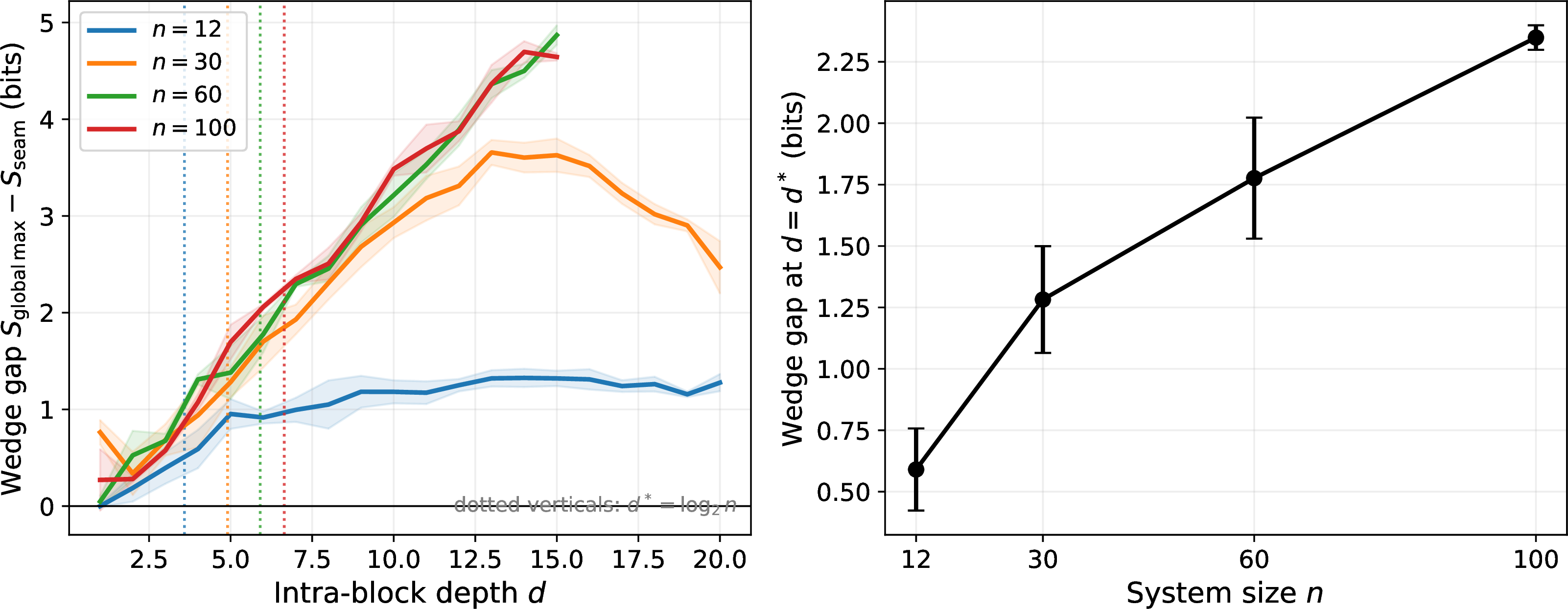
Proposition 2 predicts \(S_{\rm seam} \leq k\) bits for all \(d\) and \(n\), while \(S_{\rm global\,max}\) grows with \(d\) inside each block. To verify this at operationally relevant scales we simulate \(C(n, d, 1)\) via MPS (quimb [20]), sweeping \(n \in \{12, 30, 60, 100\}\) and \(d = 1, \ldots, d_{\rm max}\), with bond dimension truncated at \(\chi \leq 256\); this gives a lower bound on \(S_{\rm global\,max}\) while leaving \(S_{\rm seam}\) unaffected (its true rank is at most \(2^k = 2\)).
Figure 1 confirms both predictions at all scales. \(S_{\rm seam}\) saturates near \(1\) bit at each \(n\), independent of depth, while \(S_{\rm global\,max}\) grows continuously with \(d\) [18]. At the trainability threshold \(d^* = \log_2 n\), the measured gaps are \(0.59\), \(1.28\), \(1.78\), and \(2.35\) bits for \(n = 12, 30, 60, 100\) respectively — growing as \(\Theta(\log_2 n)\), consistent with \(S_{\rm global\,max}(d^*) \approx d^* = \log_2 n\) and \(S_{\rm seam} \approx 1\). The right panel makes this scaling explicit: the gap at \(d^*\) is not a finite-size artefact but a structural consequence of the geometric decoupling proved in Proposition 2.
6 Stabiliser Hardness and Open Questions↩︎
Proposition 3 rules out all three conditions when hardness means MPS-hardness, a resource tied to depth. Clifford\(+T\) circuits at shallow depth carry low entanglement but accumulate magic as the \(T\)-count grows. Two regimes must be distinguished here. In the fault-tolerant setting, \(T\)-gates are expensive: they require magic state distillation, a substantial overhead absent from Clifford gates. In the NISQ setting, \(T\)-gates are native hardware operations with no additional cost over any other single-qubit rotation, so the quantum execution overhead is zero. The \(\Omega(3^t)\) lower bound below is a classical-simulation complexity statement (it measures the cost of classically simulating the circuit) and applies in both regimes; the NISQ/fault-tolerant distinction affects only the cost of running the circuit on quantum hardware. Because stabiliser simulation cost scales with \(T\)-count rather than depth, the depth conflict no longer applies.
Corollary 1 (Stabiliser-hardness instance). Let \(C(n,d,k)\) be as in Definition 1 with Clifford\(+T\) intra-block gates at fixed depth \(d = O(\log n)\), area-law initial state \(\rho\), and local observable \(O\). As the \(T\)-count \(t\) per block grows with \(n\), conditions (i) and (iii) of Proposition 3 hold simultaneously, and the stabiliser-simulation cost of the global state grows at least as \(\Omega(3^t)\).
Proof. Condition (i) holds for all \(d\) by Proposition 2(i). Condition (iii) holds because \(d = O(\log n)\): the argument of Proposition 3 applies to Clifford\(+T\) circuits since the trainability guarantee of [6] depends on circuit depth and observable locality, not on the specific gate set. For the hardness claim, Ref. [21] proves that the stabiliser \(\ell_1\)-norm of \(t\) independent \(T\)-gate magic states is exactly \((\sqrt{3})^t = 3^{t/2}\), and that this quantity is a lower bound on the \(\ell_1\) norm of any quasi-probability stabiliser decomposition of those states. Any stabiliser simulation via quasi-probability sampling therefore requires at least \((3^{t/2})^2 = \Omega(3^t)\) samples. ◻
Figure 2 and the accompanying data verify Corollary 1 numerically on \(C(12,d{=}3,k{=}1)\) (50 seeds, 200 parameter samples each), sweeping \(t \in \{0,2,\ldots,18\}\) \(T\)-gate injections per circuit. \(S_{\rm seam}\) stays in \([0.83, 0.90]\) bits throughout (well below the \(k{=}1\) bit ceiling) confirming condition (i) is independent of \(T\)-count. The loss variance \(\mathrm{Var}[\langle Z_5\rangle]\) remains in \([0.13,\,0.21]\), confirming condition (iii) is likewise unaffected. Meanwhile the theoretical stabiliser sampling overhead grows as \(3^t\): from \(3^0{=}1\) to \(3^{18}{\approx}3.9\times10^8\), an eight-order-of-magnitude increase invisible to the cutting and trainability metrics.
![Figure 2: Corollary 1 verification on C(12,d{=}3,k{=}1); 50 seeds \times 200 parameter samples each. Left: conditions (i) and (iii) vs.T-count — S_{\rm seam} (blue, right axis) stays below the k{=}1 bit ceiling for all T-counts, while loss variance (green, left axis) remains in [0.13,\,0.21], both flat. Right: stabiliser hardness grows with T-count — sampling overhead 3^t rises by eight orders of magnitude while cutting and trainability metrics are unchanged, confirming magic as the independent hardness lever. Mean \pm 1 s.d.over 50 seeds.](/article/2607.17872/fig_corollary1.png "fig:")
One gap remains: shallow Clifford\(+T\) circuits retain \(\chi_{\rm global} = \mathrm{poly}(n)\) since \(d = O(\log n)\), so they are efficiently MPS-simulable. Obtaining universal classical hardness at shallow depth is an open problem in quantum complexity theory.
New trainability arguments that survive the deep regime of Proposition 3 would yield a positive answer. Note that \(T\)-count \(t\) and depth \(d\) are not fully independent. Each \(T\)-gate occupies at least one gate slot, so a circuit of depth \(d\) on \(n\) qubits can accommodate at most \(O(dn)\) \(T\)-gates. The decoupling behaves more like a step function: for \(t \ll dn\), \(T\)-gates can be injected within the existing depth budget and the independence is genuine; once \(t = \Omega(dn)\), additional \(T\)-gates force \(d\) to grow, eventually re-entering the barren-plateau regime of Proposition 3. Corollary 1 is therefore best read as holding in the regime \(t = o(dn)\), where \(d = O(\log n)\) is maintained. It remains open whether circuit-cutting-based quantum advantage requires seam–interior decoupling.
7 Conclusion↩︎
This paper asks whether a variational circuit can be cheaply cuttable, classically hard, and trainable at the same time. The answer is set by entanglement geometry. Seam gates and intra-block gates act on disjoint parts of the circuit, making them independent knobs. MPS and TTN architectures lose this independence by imposing a global bond-dimension bound, making them simultaneously cuttable, simulable, and trainable by Proposition 1. The two-block family of Proposition 2 restores it and exposes a two-tier hardness picture. When entanglement is the hardness resource, depth is the lever, but the depth that pushes interior entanglement past the MPS threshold also induces barren plateaus, so by Proposition 3 hardness and trainability cannot coexist. Switching to magic breaks this coupling. Shallow Clifford+T circuits stay MPS-simulable and trainable while their stabiliser-simulation cost grows as \(\Omega(3^t)\) in the \(T\)-count, independent of depth, so Corollary 1 sidesteps Proposition 3 by changing the resource. Magic supplies a hardness lever free of the depth conflict but not of cost. In the fault-tolerant regime it needs \(T\)-gate synthesis and magic-state distillation, and in the NISQ regime it rests on the classical intractability of stabiliser simulation, whose near-term resource-theoretic status remains open.
Acknowledgments↩︎
MGG is funded by the EPSRC UK Quantum Technologies Programme under grant EP/T001062/1 and VeriQloud. SD is funded by the ETH Zurich Quantum Center. LP is supported by the National Research Foundation, Singapore through the National Quantum Office, hosted in A*STAR, under its Centre for Quantum Technologies Funding Initiative (S24Q2d0009).