Retain or Consolidate? Budget-Dependent Operator Selection for Language Agent Memory
July 20, 2026
Abstract
Language agents depend on memory across interactions. However, the limited context windows of large language models (LLMs) and their inference costs constrain how much memory can be used at once. Existing systems mainly follow two strategies: memory retention and memory consolidation. Retention keeps raw records and preserves exact details, but relevant evidence may not fit under a tight budget; consolidation compresses and combines records, improving coverage per token but risking the loss of query-critical details. Neither strategy is universally preferable. This raises two central questions: when should consolidation replace retention, and which operator—Merge, Abstract, or Rewrite—should be selected? We formalize this decision by decomposing each operator’s utility into a coverage effect on evidence omitted by retention and a signed replacement effect on raw evidence that already fits. Their balance explains why the preferred action changes with relative budget pressure. We implement this mechanism with Offline Abstraction-Safety (OAS), a lightweight learner that estimates action utilities from pre-generation features with held-out harm calibration. The public LongMemEval and LoCoMo benchmarks show the same budget-dependent pattern. On LongMemEval, consolidation improves absolute accuracy by up to \(48\%\) under tight budgets, whereas retention is preferable under loose budgets; LoCoMo replicates this crossover at a smaller budget, consistent with its shorter evidence. On both datasets, cross-note abstraction and merging generally outperform local rewriting when compression is necessary.
1 Introduction↩︎
Language agents built on large language models (LLMs) often operate beyond a single prompt. They accumulate observations, dialogue, and retrieved facts to support later decisions, but this history cannot grow without consequence. An LLM has a finite context window, and longer inputs also increase inference cost and latency before that limit is reached; relevant evidence can also be used unreliably within long contexts [1]. A token budget is therefore a practical deployment constraint. The memory system must fit useful evidence into that budget without unnecessarily degrading the answer.
Existing systems commonly manage this constraint through two strategies: memory retention and memory consolidation. Retention selects raw records and leaves their contents unchanged. It preserves exact wording, provenance, timestamps, and corrections, but uses tokens inefficiently when evidence is redundant or distributed; under a tight budget, a relevant record may not fit. Prior systems mix raw-record storage with hierarchy, forgetting, summarization, or reflection [2]–[4]. [5] further formulate long-horizon retention as constrained stochastic optimization and learn which raw notes to preserve under delayed miss, reacquisition, and staleness costs. Consolidation instead generates a compact replacement for one or more records. Summarizing, merging, or rewriting can remove redundancy and increase evidence coverage per token, but generation may omit a decisive detail, blur temporal order, discard a correction, or introduce unsupported content. Mem0 and A-MEM generate structured memories, while RecMem and TrustMem study recurrence-triggered consolidation and reliable transitions [6]–[9].
These research lines establish both strategies, but they do not resolve their joint decision. Retention research asks which original records to keep, whereas consolidation research largely asks how to construct compact memories. It remains unclear when generated compression should replace raw evidence and which consolidation operator should be used. The answer depends on budget pressure. If relevant raw evidence does not fit, consolidation may recover otherwise omitted information. If that evidence already fits, replacing it may sacrifice exact details without adding useful coverage. This tradeoff motivates our central questions: when should an agent consolidate, and which operator— Merge, Abstract, or Rewrite—should it choose? We isolate this comparison by holding the query, candidate evidence, retriever, answer model, and answer-time budget fixed while changing only the memory representation.
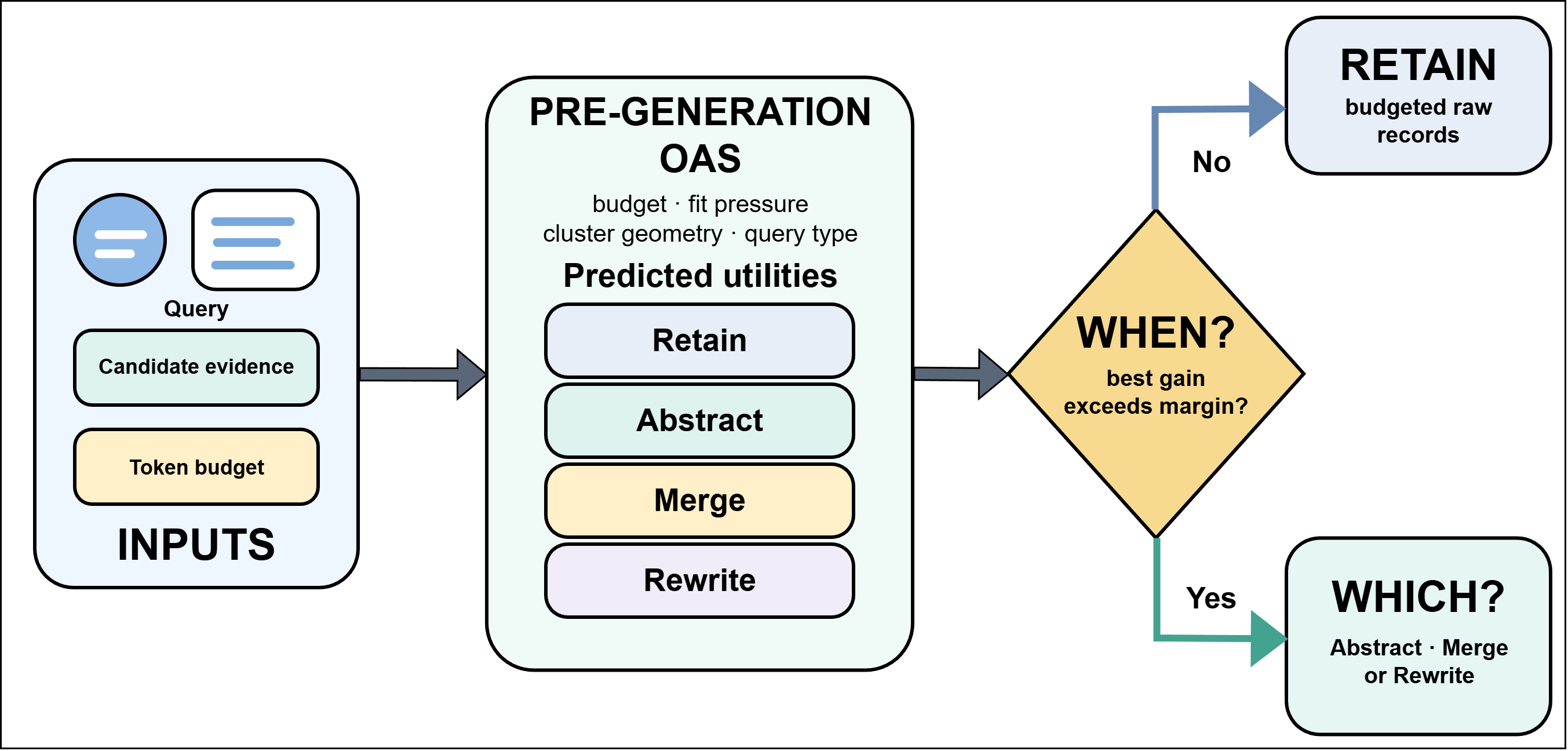
We formulate retention and the three consolidation operators as a finite, budget-dependent action set. Each action has a well-defined conditional expected answer utility. The optimal action would be obtained by comparing these four utilities, but the utilities of unexecuted actions are counterfactual and hence unavailable at deployment; the obstacle is missing utility information, not a difficult combinatorial solver. To explain how the preferred action changes, we introduce an idealized mechanism model that decomposes each operator’s value into two terms: a coverage effect on evidence omitted by retention and a signed replacement effect on raw evidence that already fits. Their balance changes with relative budget pressure and determines both when consolidation is beneficial and which operator provides the greatest expected utility.
We operationalize this formulation with Offline Abstraction-Safety (OAS), a lightweight multi-action utility learner. OAS estimates the unavailable action utilities from features observed before generation, including budget scale, evidence-fit pressure, cluster geometry, and query type, and then applies a plug-in maximizer. A held-out safety threshold limits harmful replacements. Linear regression is the primary estimator because the available supervision favors a low-capacity model. A multilayer perceptron (MLP) serves as a nonlinear capacity control, testing whether ridge regression underfits the action-utility relationship. This design uses learning where it is needed: to estimate counterfactual utilities rather than to obscure a simple finite-action optimization.
Experiments on the public LongMemEval and LoCoMo benchmarks support this account. On LongMemEval, consolidation improves absolute accuracy over retention by as much as \(48\%\) under tight budgets, whereas retention leads every consolidation operator by \(8\%\)–\(11\%\) once the raw evidence largely fits. A second answer model reproduces this reversal. LoCoMo exhibits the same pattern, but its crossover occurs at a smaller absolute budget because its evidence is shorter. This result supports relative budget pressure rather than a universal token threshold. Operator comparisons address the which question: cross-note Abstract and Merge are generally more effective than local Rewrite under compression, although neither cross-note operator dominates in every setting. OAS improves the controlled when–which decision under budget-stressed conditions. Its separately evaluated full-history variant does not surpass the strongest fixed policy, which bounds our claim: the experiments validate the budget-dependent mechanism more strongly than general-purpose instance-level routing.
Our contributions are as follows.
A unified when–which formulation. We place retention and three generative consolidation operators in the same decision space with signed, budget-dependent utility, making the decision of whether and how to consolidate explicit in the problem formulation.
A testable budget-dependent mechanism. An idealized surrogate decomposes consolidation value into a signed coverage effect and a replacement effect. Experiments on public benchmarks identify the predicted reversal and show that operator choice depends on budget pressure and evidence structure in the mechanism analysis and experiments.
A lightweight learner that operationalizes the formulation. OAS learns multi-action utility from pre-generation features and uses held-out harm calibration. Controlled and independent evaluations distinguish successful budget-aware selection from the present boundary of transferable routing as detailed in the methodology and supplementary material.
2 Related Work↩︎
2.0.0.1 Agent memory systems and consolidation.
Surveys of agent memory review representations, evaluation, and operations such as consolidation, forgetting, retrieval, and compression [10], [11]. Existing systems combine storage and retrieval with hierarchy, reflection, summarization, or structured updates [2]–[4]. More recent work studies consolidation, linked notes, recurrence-based triggers, or transition verification [6]–[9]. These systems design pipelines or individual operators. We instead hold the query, evidence, and answer-time budget fixed to isolate when transformation is beneficial and which operator should perform it.
2.0.0.2 Retrieved-context and prompt compression.
RECOMP learns extractive and abstractive compressors, while LLMLingua controls prompt length through token-level compression [12], [13]. Our intervention instead replaces episodic evidence with a generated memory and compares retention with multiple semantic operators on matched instances. The objective is answer utility, not compression rate: it determines when to transform memory and which transformation to select.
2.0.0.3 Conversational-memory benchmarks.
LongMemEval tests five memory abilities, including temporal reasoning and knowledge updates; LoCoMo evaluates long-session question answering, event summarization, and multimodal dialogue generation [14], [15]. Exact details matter for some questions, whereas distributed evidence creates compression pressure, making both benchmarks natural tests of our when–which mechanism.
2.0.0.4 Selectional versus generative memory.
[5] formulate long-horizon retention as constrained sequential optimization and learn which unaltered notes to keep. Our complementary decision asks whether identified evidence should remain raw or be replaced by a generated record. Classical budgeted selection has approximation guarantees under fixed coverage or submodular objectives [16], [17], but generation can either improve coverage or reduce fidelity. We model this signed tradeoff with operator-specific utilities and learn the resulting finite-action decision, following the broader learning-assisted-algorithms principle [18].
3 Methodology↩︎
We formalize memory consolidation as a one-step query-time decision under a token budget imposed by context capacity or deployment cost. The objective is to use the available context efficiently while maintaining answer utility. We formalize why consolidation can either improve or reduce answer utility, and then learn a lightweight utility router that decides when to consolidate and which operator to apply from features available before generation. The presentation has three steps: we first define the four-action decision, then derive an idealized mechanism for its budget dependence, and finally describe how OAS learns the decision from offline outcomes without observing generated records at test time.
3.1 Problem Formulation↩︎
3.1.0.1 Memory, budget, and retrieval.
Let \(M=\{m_i\}_{i=1}^N\) be an agent memory whose notes contain text, metadata, and embeddings \(\mathbf{e}_i\). A retriever \(R_B\) maps a query \(q\) and a memory state to an ordered subset \(S=R_B(q,M)\) whose token cost obeys the context budget \(B\); that is, the total cost of the selected notes does not exceed the budget. The budget may reflect the model’s context-window limit or a smaller operating limit chosen to control inference cost and latency. An answer model then produces a response from \((q,S)\), which a fixed judge grades against the reference answer to obtain the binary utility \(u(q,S)\in\{0,1\}\). Within each paired comparison, retriever, answerer, grader, and budget are fixed, so only the memory representation changes.
3.1.0.2 Generative consolidation operators.
For a candidate evidence cluster \(C\subseteq M\), the agent may apply a generative operator that emits a budget-targeted representation \(\tilde{m}_{o,B}(C)\) not present among the raw records. The generative family is \(\mathcal{O}_{\rm gen}=\{\mathrm{\small Merge},\mathrm{\small Abstract},\mathrm{\small Rewrite}\}\). Merge consolidates several notes into one compact factual record, Abstract synthesizes a higher-level note across its inputs, and Rewrite reformulates each note independently before packing the rewritten notes under the same budget. For notation, the packed Rewrite output is treated as one representation \(\tilde{m}_{o,B}(C)\) while preserving its internal note boundaries. These are distinct from selectional operators that retain, discard, or re-index existing raw content. Each generative operator in our study replaces the packed constituents in the answer context (freeing budget), yielding a post-consolidation state versus the retain-as-is state \(M\).
All three operators can change both coverage and fidelity, so each requires a selection decision. We write \(T_{C,o,B}(M)\) for replacing cluster \(C\) with the representation generated by operator \(o\in\mathcal{O}_{\rm gen}\). The controlled experiment studies a query-time packing decision: after a query identifies a candidate evidence cluster but before a compact record is generated, the policy chooses retention or one generative operator. This scope makes query type observable and does not claim to solve query-agnostic background consolidation. We analyze one query–cluster decision at a time; interactions among repeated memory updates are outside the present guarantee.
Definition 1 (Consolidation gain). For a memory state \(M\), candidate cluster \(C\), query \(q\), budget \(B\), and operator \(o\), the realized paired consolidation gain is \[\label{eq:gain} \begin{align} \Delta_o(z)&=u_o(z)-u_{\mathrm{ret}}(z),\\ u_o(z)&=u\!\left(q,R_B(q,T_{C,o,B}(M))\right). \end{align}\qquad{(1)}\] the change in graded answer utility from consolidating \(C\) rather than retaining it, under the same retriever, budget, answerer, and grader. This is a paired run-level quantity and therefore takes values minus one, zero, or one. Generation, answering, and grading randomness are averaged when we define expected action utilities below.
3.1.0.3 The decision problem.
A packing policy \(\pi\) maps an observable instance \(z=(M,C,q,B)\) to an action in \(\mathcal{A}=\{\mathrm{ret}\}\cup\mathcal{O}_{\rm gen}\). Let \(u_{\mathrm{ret}}(z)=u(q,R_B(q,M))\) and \(u_o(z)=u(q,R_B(q,T_{C,o,B}(M)))\) for a generative action \(o\). The value of a policy is simply the expected utility of its selected action, where the expectation covers instances, generation, answering, and grading: \[\label{eq:policy-value} V(\pi)=\mathbb{E}\big[u_{\pi(z)}(z)\big].\tag{1}\] Let \(\pi_{\mathrm{ret}}\) denote the fixed policy that always retains the raw records.
3.1.0.4 Well-definedness and scope.
For each instance, the candidate cluster \(C\) is supplied by an upstream retriever or evidence selector and is treated as fixed by the packing decision. Every action produces a context whose token cost is at most \(B\): retention packs complete raw records, while each generated representation is capped at the same budget. The realized action utilities are bounded binary random variables, so every conditional mean \(\mu_a(z)\) below exists. Because the action set is finite, at least one utility-maximizing action always exists; ties are resolved toward retention. The formulation therefore defines a valid one-step decision for any supplied \((M,C,q,B)\). It deliberately does not optimize candidate discovery or repeated memory updates, which are upstream and sequential extensions, respectively.
3.1.0.5 The joint “when” and “which” decision.
Let \(\mu_a(z)=\mathbb{E}[u_a(z)\mid z]\) denote the conditional utility of action \(a\in\mathcal{A}\), and define the best generative advantage \[\label{eq:joint-decision} \begin{align} \Gamma(z)&=\max_{o\in\mathcal{O}_{\rm gen}}\mu_o(z)-\mu_{\mathrm{ret}}(z),\\ o^\star(z)&\in\arg\max_{o\in\mathcal{O}_{\rm gen}}\mu_o(z). \end{align}\tag{2}\] The two questions are therefore one decision: when means consolidating when \(\Gamma(z)\) is positive (or exceeds a safety margin), and which means applying \(o^\star(z)\) when consolidation is selected. This formulation does not assume that an operator has a fixed global rank: both comparisons depend on the query, candidate cluster, and budget contained in \(z\). OAS below estimates these action utilities from pre-generation features. Equivalently, with ties resolved toward retention, the optimal action is \[\label{eq:optimal-action} a^\star(z)= \begin{cases} \mathrm{ret}, & \text{if }\Gamma(z)\leq 0,\\ o^\star(z), & \text{if }\Gamma(z)>0. \end{cases}\tag{3}\]
3.1.0.6 Why learning is required.
If all four conditional utilities \(\{\mu_a(z):a\in\mathcal{A}\}\) were known, the problem would be solved exactly by comparing four numbers; no general-purpose solver would be required. The deployment difficulty is statistical rather than combinatorial. Before a decision, the generated records do not yet exist, and their answer utilities are counterfactual and unknown; reference-based correctness is also unavailable in normal deployment. Generating and scoring every alternative would defeat low-cost routing, and a numerical solver cannot recover missing objective values. We therefore evaluate all actions offline, learn their utilities from pre-generation features, and use the estimates in the same four-action maximization at deployment. OAS approximates the unknown objective, not a computationally difficult argmax.
3.2 An Idealized Mechanism for Budget Dependence↩︎
We use a deliberately simplified proxy utility to isolate two effects of replacing raw memories with a generated record. Here, surrogate means an analyzable mechanism model: it is designed to explain the direction of the observed accuracy change, but is not assumed to equal the LLM-judged accuracy \(u\) in Definition 1. The construction applies separately to every generative operator; we omit the operator subscript temporarily for readability. This model describes the average budget effect over a query population. The instance-level decision remains the conditional-utility problem in Eq. 2 and is learned by OAS below.
Let \(\mathcal{Q}\) denote the set of possible queries and let \(q\sim F\) denote a query drawn from the evaluation distribution. The query is the only random variable in this surrogate; the memory set, budget, retriever, and generated record are held fixed. The distribution \(F\) represents how frequently queries occur; \(\Pr_F\) and \(\mathbb{E}_F\) denote probability and expectation under \(F\). We do not fit a parametric density: in our benchmark analysis, \(F\) is the uniform empirical distribution over evaluation questions, so probabilities are question fractions and expectations are question averages. For any note \(m\) and query it supports, the signed fidelity \(\varphi_m(q)\in[-1,1]\) represents whether the note provides accurate evidence or misleading evidence: positive values denote correct support, negative values denote misleading support, and zero denotes no contribution. In this deliberately simplified model, \(s_B(q,M)\) is the signed fidelity contributed by the highest-ranked applicable note retrieved from memory state \(M\) under budget \(B\); it is zero if no retrieved note supports the query. We define the proxy utility as the expected contribution \[\mathcal{U}_B(M)=\mathbb{E}_F[s_B(q,M)].\] This expectation is well defined because \(s_B\) is bounded between minus one and one. On a finite benchmark, it is simply the average contribution across queries.
For the fixed budget under analysis, let \(H_B\subseteq\mathcal{Q}\) be the queries supported by the generated record \(\tilde{m}_B\), and assume that \(H_B\) has positive probability under \(F\). Let \(G_B\subseteq\mathcal{Q}\) be the raw-grounded region: the queries for which retention retrieves an applicable constituent of \(C\). Define \(X_B=H_B\setminus G_B\) as the queries supported by the generated record but missed by retention. Under nested raw packing, increasing the budget can only enlarge \(G_B\); the generated coverage \(H_B\) may also vary with the target budget.
Assumption 1 (Localized retrieval change). Replacing \(C\) by \(\tilde{m}_B\) leaves the retrieved contribution unchanged outside \(H_B\); on \(X_B\) retention contributes zero and consolidation retrieves \(\tilde{m}_B\). Within \(H_B\cap G_B\), let \(J_B\) be the replacement region on which retrieval changes from an incumbent raw note \(m_{\rm raw}(q)\) to \(\tilde{m}_B\).
This assumption localizes the intervention: replacing \(C\) may change evidence only for queries supported by the generated record. It is used solely to obtain the exact two-term decomposition in Proposition 1; OAS and the empirical comparisons do not require it. The assumption is restrictive because it excludes retrieval or packing spillovers outside \(H_B\). Without it, the utility change contains an additional residual spillover term.
Proposition 1 (Operator-indexed budget decomposition). For each \(o\in\mathcal{O}_{\rm gen}\), let \(H_{B,o}\) be the queries supported by \(\tilde{m}_{o,B}\), let \(X_{B,o}=H_{B,o}\setminus G_B\), and let \(J_{B,o}\subseteq H_{B,o}\cap G_B\) be its replacement region. Under Assumption 1, the operator’s surrogate-utility change \(\Delta\mathcal{U}_{B,o}=\mathcal{U}_B(T_{C,o,B}(M))-\mathcal{U}_B(M)\) is \[\label{eq:decomp} \begin{align} \Delta\mathcal{U}_{B,o}&=C_{B,o}+R_{B,o},\\ C_{B,o}&=\Pr_F(q\in X_{B,o})\, \mathbb{E}_F[\varphi_{\tilde{m}_{o,B}}(q)\mid q\in X_{B,o}],\\ R_{B,o}&=\Pr_F(q\in J_{B,o})\, \mathbb{E}_F[\varphi_{\tilde{m}_{o,B}}(q)\\ &-\varphi_{m_{\rm raw}(q)}(q)\mid q\in J_{B,o}]. \end{align}\qquad{(2)}\] Here \(C_{B,o}\) and \(R_{B,o}\) are the coverage and replacement effects, respectively. Each term is defined as zero when its conditioning event has probability zero. The coverage effect is positive when \(X_{B,o}\) has positive probability and the generated record has positive mean fidelity there. The replacement effect is nonpositive if the generated record has no greater fidelity than the incumbent raw record throughout \(J_{B,o}\).
The proof partitions queries into \(X_{B,o}\), \(J_{B,o}\), and the unchanged remainder and then takes expectations; full details are in the supplementary material.
Proposition 1 gives the value of each generative action separately. The next result converts these operator-indexed gains into the joint when–which decision.
Proposition 2 (Joint rule for when and which). Let \(\Delta\mathcal{U}_{B,o}\) be the operator-specific value from Proposition 1. For a fixed cluster, budget, and query distribution, assign retention gain zero and let \(o^\star\in\arg\max_{o\in\mathcal{O}_{\rm gen}}\Delta\mathcal{U}_{B,o}\). The optimal surrogate action is retention when \(\Delta\mathcal{U}_{B,o^\star}\leq 0\), and \(o^\star\) otherwise. Therefore, when* asks whether the best consolidation operator improves over retention, whereas which selects the operator with the largest positive gain. A zero-gain tie is resolved toward retention; ties among positive-gain operators may be resolved arbitrarily.*
The result follows by comparing the three operator gains with retention’s zero gain; a formal proof is provided in the supplementary material.
3.2.0.1 Interpretation and falsifiable implications.
Equation ?? does not guarantee a crossover. As \(B\) decreases, \(G_B\) shrinks; consolidation helps only when its coverage effect outweighs any negative replacement effect. It also predicts that harm should concentrate where compression reduces fidelity, such as timestamps, corrections, and entity bindings. The experiments test these directional implications but do not identify the latent fidelity functions or equate the surrogate with LLM answer accuracy. Which named operator has the largest gain remains an empirical question.
3.3 Offline Abstraction-Safety Learning↩︎
The mechanism indicates that the optimal decision depends on unobservable quantities (the true fidelity of a not-yet-generated compact record). Offline Abstraction-Safety (OAS) makes the decision learnable by recovering supervision in hindsight and fitting a lightweight router that acts on features available before generation.
3.3.0.1 Labeling.
For each training instance \(z=(M,C,q,B)\), we evaluate retention and every generative action under the same retriever, budget, answer model, and grader. This produces action utilities \(u_a(z)\), paired gains from Eq. ?? , and a harm event when a generated action has lower utility than retention. These outcomes are not semantic ground truth; they are system-specific supervision aligned with the downstream answer metric. They are observed only offline and are never used as test-time features.
3.3.0.2 Observability separation.
The query and candidate evidence are observed, but the decision is made before the compact record is generated and its answer utility is known. OAS fits a utility router on pre-generation features and supervises it with outcomes recovered offline. This is query-time adaptive packing, not query-agnostic memory maintenance.
3.3.0.3 Online-observable feature map.
Each observed instance \(z\) is represented by an 11-dimensional feature vector \(\psi(z)\in\mathbb{R}^{11}\). Seven entries are scalar features: normalized budget \(B/512\), constituent count, token pressure (candidate-evidence cost divided by \(B\)), the budget-fit fraction \(f_B\) (the share of candidate evidence packed by retention), the number of represented sessions, an inconsistency proxy measured by the mean squared distance of note embeddings from their cluster mean, and mean pairwise cosine similarity. The remaining four entries form a one-hot encoding of the benchmark query type. The constant 512 is used only to place the budget feature on a convenient numerical scale. In the controlled oracle-evidence protocol these are available before generation; candidate-evidence cost and benchmark type would need to be estimated by a retriever and type classifier in an end-to-end deployment.
3.3.0.4 Direct utility router and hypothesis class.
Rather than decompose the decision into a binary when-head and a separately fitted operator heuristic, OAS directly predicts the utility of every action. For each \(a\in\mathcal{A}\), it fits a regularized linear response with parameter vector \(\theta_a\in\mathbb{R}^{11}\) and intercept \(b_a\in\mathbb{R}\): \[\label{eq:gate} \widehat\mu_a(z)=b_a+\langle\theta_a,\psi(z)\rangle,\tag{4}\] and deploys \(\widehat\pi(z)=\arg\max_{a\in\mathcal{A}}\widehat\mu_a(z)\). Thus “when” is the comparison with predicted retention utility and “which” is the largest predicted generated-action utility; both are learned from the same low-capacity model.
3.3.0.5 Utility regression.
Offline paired evaluation supplies \(u_{a,i}\in[0,1]\) for action \(a\) on training instance \(i\). We fit the four responses by ridge regression, \[\label{eq:erm} \begin{align} (\widehat b_a,\widehat\theta_a) =\arg\min_{b,\theta}\;&\frac{1}{n}\sum_{i=1}^{n} \big(u_{a,i}-b-\langle\theta,\psi(z_i)\rangle\big)^2\\ &+\lambda\lVert\theta\rVert_2^2 . \end{align}\tag{5}\] Here, \(n\) is the number of training instances and \(\lambda\geq 0\) is the regularization strength; the intercept is not penalized. The value of \(\lambda\) is selected by inner grouped cross-validation using training questions only, after which the utility functions are frozen. This direct objective respects effect magnitude and avoids treating abundant zero-gain ties as positive or negative classification examples.
Accurate action-utility estimates are sufficient for accurate selection: if every predicted utility is within \(\epsilon\) of its conditional target, plug-in maximization loses at most \(2\epsilon\) in conditional utility (see the supplementary material). This standard comparison does not require ridge regression to be correctly specified. We use the linear form as a regularized, data-efficient inductive bias, not as an assumption that the true decision boundary is linear. A one-hidden-layer MLP is evaluated under the same grouped protocol to test whether additional nonlinear capacity improves utility estimation. The experiments and supplementary material report that it does not improve reliably over ridge.
3.3.0.6 Risk-controlled operating threshold.
Let \(o^+(z)=\arg\max_{o\in\mathcal{O}_{\rm gen}}\widehat\mu_o(z)\) be the generated action with the highest predicted utility, and define its predicted advantage \(s(z)=\widehat\mu_{o^+(z)}(z)-\widehat\mu_{\mathrm{ret}}(z)\). Given the frozen utility router, a separate operating threshold \(\tau_{\mathrm{safe},B}\) is chosen for each budget on a held-out validation split. Candidate thresholds are the observed validation advantages, together with an abstain-all option. Calibration first restricts attention to thresholds whose empirical frequency of harmful generated selections satisfies a specified harm constraint, and then selects the threshold with the highest validation accuracy. We require zero observed harmful selections on the calibration split. The abstain-all option guarantees feasibility. The unconstrained router selects the action with the largest predicted utility; the calibrated variant selects \(o^+(z)\) only when its predicted advantage reaches the budget-specific threshold. Otherwise, it retains the raw notes. Because the candidate thresholds form a nested acceptance family, calibration requires only a sweep over validation scores. Ties in validation accuracy are resolved toward the more conservative threshold. This is a conservative operating rule, not a population safety certificate; the experiments therefore report realized help and harm on disjoint questions.
4 Experiments↩︎
We evaluate every operator across all budgets on LongMemEval and on a fixed, outcome-blind, evidence-length-stratified LoCoMo sample. The two datasets have different evidence-length distributions, allowing us to test whether the consolidation boundary follows observable budget pressure rather than a fixed token value.
Our experiments answer three questions. (Q1) Does the value of consolidation reverse sign with the memory budget? (Q2) Does the best generative operator (Merge/Abstract/Rewrite) depend on the budget? (Q3) Can a shared lightweight scorer learn the joint decision of when to consolidate and which operator from pre-generation features alone? Q1 tests the budget-dependent sign predicted by Proposition 1; Q2 tests its operator-indexed comparison; a fit-stratified diagnostic probes the coverage and replacement effects; and Q3 evaluates the learned approximation to Eq. 2 .
4.0.0.1 Setup.
LongMemEval [14] is the primary benchmark. Its pool is split into fit, development, and test roles before modeling, and routing further separates utility fitting, threshold calibration, and testing by question. In the controlled evaluation, every action receives the same gold evidence and differs only in its budgeted representation. Retention packs complete raw items, whereas Abstract, Merge, and Rewrite produce the representations defined in the problem formulation. This pairing isolates the when–which decision from evidence discovery.
LongMemEval uses budgets of 32, 64, 128, and 256 tokens. A single evidence turn has a median cost of 59 tokens, while retention fully fits all required evidence for \(1.3\%\), \(9.3\%\), \(52.0\%\), and \(85.3\%\) of the test questions at these budgets. We define budget regimes by this full-fit rate rather than by the absolute token value: 32 and 64 tokens are severely tight and tight, 128 tokens is the transition regime, and 256 tokens is loose. LoCoMo [15] provides an outcome-blind, evidence-length-stratified replication with shorter evidence and correspondingly smaller budgets of 16, 32, 64, and 128 tokens. Every generated representation is deterministically capped at its target budget. Full evidence distributions and implementation details are in the supplementary material.
Answers are generated and graded with DeepSeek-V3.2 under a common prompt, with three paired realizations on LongMemEval. Statistical comparisons average repeats within question and use question-level paired bootstrap intervals and randomization tests. A GLM-5.2 replication tests answer-model sensitivity. An additional full-history evaluation supplies both methods with the same candidates from BM25, a sparse lexical retriever that scores term matches with adjustments for term rarity and turn length [19]. These robustness protocols are detailed in the supplementary material.
4.1 The Budget Crossover (Q1)↩︎
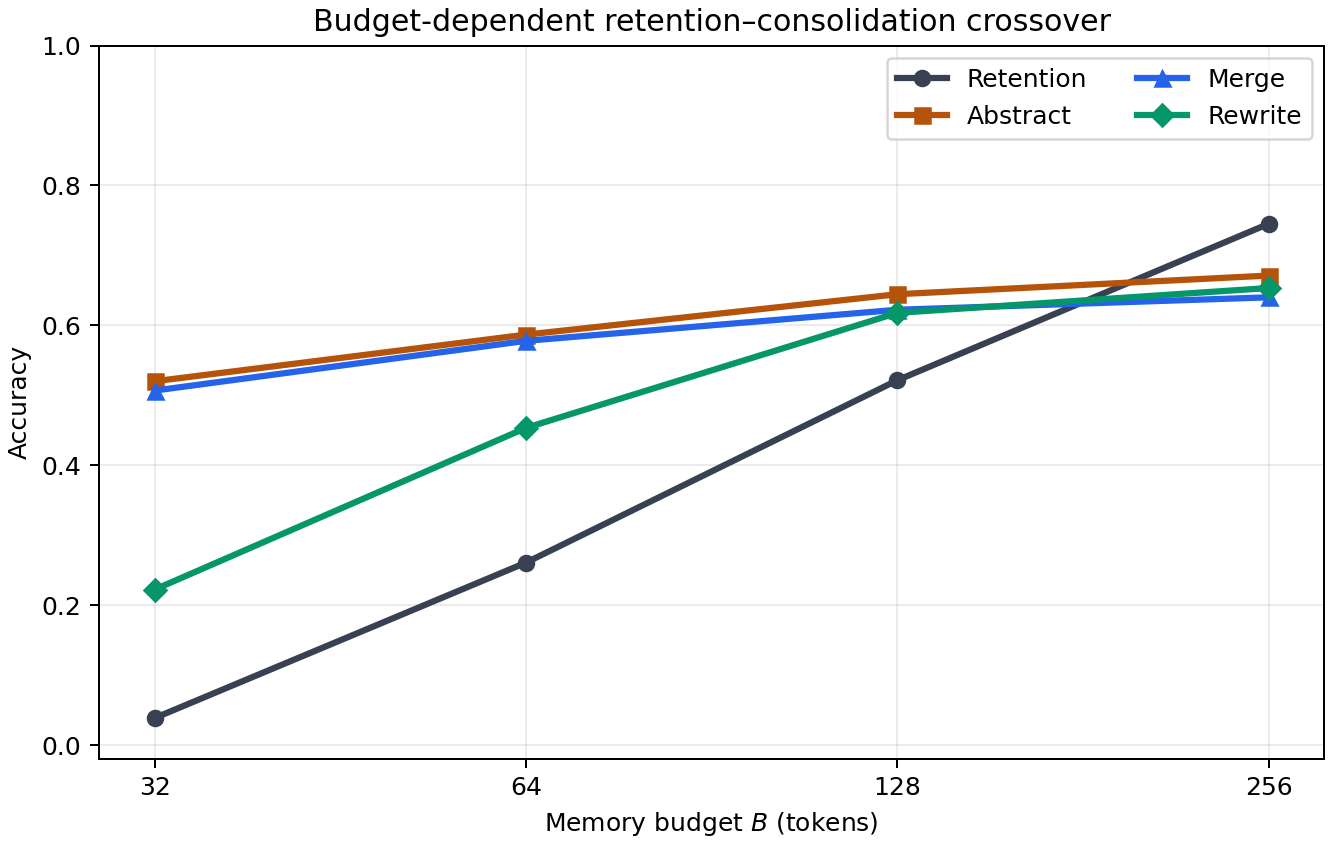
Figure 2 reports the budget sweep. Retention accuracy decreases from \(74.5\%\) at the loose budget to \(3.9\%\) at the severely tight budget as fewer raw evidence turns fit. Every consolidation operator has a higher accuracy point estimate than retention in the tight and transition regimes, whereas retention has the highest accuracy at the loose budget. For the representative Abstract comparison, the tight-budget absolute accuracy gain is \(48.0\%\), with a bootstrap interval from \(37.3\%\) to \(58.2\%\); its loose-budget difference is \(-8.0\%\), with an interval from \(-16.9\%\) to \(0.5\%\). The corresponding loose-budget interval for Merge excludes zero in the negative direction (supplementary paired inference). The reversal therefore supports the directional prediction of Proposition 1: reducing the budget contracts the region grounded by raw retention and increases the potential coverage effect. The sweep does not identify the latent terms separately; that implication is tested by the fit-stratified diagnostic below.
4.1.0.1 Cross-model replication.
The complete retain-versus-abstract sweep with GLM-5.2 reproduces the same answer to when: abstraction improves accuracy in the severely tight regime and is worse than retention in the loose regime. Full results are reported in the supplementary material.
4.1.0.2 Full-history retrieval evaluation.
With identical lexically retrieved candidates, abstraction again improves over retention in the tight regimes, while its advantage disappears as the budget loosens. This auxiliary result shows that the budget interaction survives retrieval noise; it does not establish superiority over optimized end-to-end memory systems. Full results and paired uncertainty are in the supplementary material.
| Operator | \(B\) | Retention fit | Gain (help/harm; \(n\)) |
|---|---|---|---|
| Abstract | 128 | Incomplete | \(+.343\) (.38/.04; 36) |
| 128 | Complete | \(-.043\) (.06/.10; 39) | |
| 256 | Incomplete | \(-.061\) (.21/.27; 11) | |
| 256 | Complete | \(-.083\) (.07/.16; 64) | |
| Merge | 128 | Incomplete | \(+.324\) (.41/.08; 36) |
| 128 | Complete | \(-.145\) (.06/.21; 39) | |
| 256 | Incomplete | \(+.152\) (.27/.12; 11) | |
| 256 | Complete | \(-.151\) (.04/.19; 64) | |
| Rewrite | 128 | Incomplete | \(+.306\) (.39/.08; 36) |
| 128 | Complete | \(-.094\) (.08/.17; 39) | |
| 256 | Incomplete | \(-.061\) (.18/.24; 11) | |
| 256 | Complete | \(-.089\) (.07/.16; 64) |
4.2 Which Operator? Budget-Dependent Tradeoffs (Q2)↩︎
The operator leader changes with budget. In both tight regimes, Abstract ranks first, followed by Merge, Rewrite, and retention; under the loose budget, retention ranks first and every generated operator has a negative paired gain. The two cross-note operators outperform local Rewrite under compression, but their direct difference is not significant. Thus which is not a universal named operator: cross-note fusion is preferred for fragmented evidence, while the choice between abstraction and merging remains instance dependent. Full pairwise tests and per-type results are in the supplementary material.
4.3 Mechanism Diagnostic: Coverage and Replacement↩︎
We test the surrogate’s observable implication by stratifying outcomes on the retention fit fraction \(f_B\). Table 1 shows that every operator gains when some evidence does not fit but loses when all evidence fits in the transition regime; the full-fit loss persists under the loose budget. This coverage–replacement interaction supports Proposition 1 without claiming to identify its latent fidelity terms.
4.4 A Unified Gate for When and Which (Q3)↩︎
OAS is evaluated by grouped five-fold cross-fitting: utility fitting, threshold calibration, and testing use disjoint questions, and all budgets of a question remain in one fold. Table ¿tbl:tab:unified? shows significant gains over retention in the three stressed regimes and no difference under the loose budget. Selected actions shift from cross-note operators toward retention as evidence fit grows, thereby realizing both when and which. Calibration reduces harmful replacements at some utility cost; its empirical constraint is not a population safety certificate.
@ccccc@ & \(B\) & Accuracy & Gain [95% CI] & Harm
& 32 & .545 & \(+.507\) [.404,.607] & 3
& 64 & .618 & \(+.357\) [.227,.483] & 12
& 128 & .640 & \(+.119\) [.015,.224] & 14
& 256 & .745 & \(.000\) [\(-.061\),.064] & 10
& 32 & .487 & \(+.449\) [.345,.551] & 1
& 64 & .403 & \(+.142\) [.056,.234] & 3
& 128 & .613 & \(+.092\) [.034,.160] & 2
& 256 & .742 & \(-.003\) [\(-.009\),.000] & 1
4.5 Cross-Dataset Replication on LoCoMo↩︎
LoCoMo replicates both conclusions. In its severely tight regime, Abstract and Merge attain \(48.0\%\) accuracy, compared with \(12.9\%\) for retention and \(26.7\%\) for Rewrite; their paired gains remain significant in both tight regimes. The advantage disappears once 64 tokens accommodate the evidence for approximately three quarters of the sample. Because LoCoMo evidence is shorter, this earlier crossover supports relative fit pressure, as predicted by Proposition 1, rather than an absolute token threshold. It also replicates the which result: cross-note synthesis is preferred under compression, without establishing universal dominance between Abstract and Merge. Complete operator results, paired inference, router controls, and the MLP comparison are in the supplementary material.
5 Conclusion↩︎
We formulate memory management as a joint, budget-dependent when–which decision. Its coverage and replacement effects explain the consistent pattern across LongMemEval and LoCoMo: consolidation is preferred while relevant raw evidence does not fit, retention becomes preferable after it fits, and cross-note synthesis is more effective than local rewriting under compression. OAS operationalizes this mechanism through lightweight multi-action utility learning. The results establish relative budget pressure, rather than a universal operator or token threshold, as the central determinant of consolidation.
5.0.0.1 Limitations and future work.
The controlled study isolates representation from retrieval; future work can jointly learn retrieval, consolidation, and packing in persistent memory.
6 Scope of the When–Which Formalization↩︎
The decomposition in Proposition 1 is exact only for the surrogate \(\mathcal{U}_B\) under Assumption 1. It is intentionally not stated as an identity for binary LLM-judge accuracy. This distinction makes the mechanism falsifiable: the budget sweep can agree or disagree with its directional prediction without being used to define the latent fidelity functions. Proposition 2 then formalizes the joint action implied by those operator-specific values. It does not impose a universal semantic ranking among Merge, Abstract, and Rewrite; the comparison across operators and budgets therefore determines the ranking empirically.
Proof of Proposition 1. Fix an operator \(o\) and write \(d_o(q)=s_B(q,T_{C,o,B}(M))-s_B(q,M)\). By Assumption 1, \(d_o(q)\) is zero outside \(H_{B,o}\) and on the unchanged part of \(H_{B,o}\cap G_B\). On \(X_{B,o}\), retention contributes zero and consolidation contributes \(\varphi_{\tilde{m}_{o,B}}(q)\). On \(J_{B,o}\), the contribution changes from \(\varphi_{m_{\rm raw}(q)}(q)\) to \(\varphi_{\tilde{m}_{o,B}}(q)\). Therefore, \[\begin{align} d_o(q) &=\mathbf{1}\{q\in X_{B,o}\}\varphi_{\tilde{m}_{o,B}}(q) \\ &\quad+\mathbf{1}\{q\in J_{B,o}\} \bigl(\varphi_{\tilde{m}_{o,B}}(q)-\varphi_{m_{\rm raw}(q)}(q)\bigr). \end{align}\] Taking expectation under \(F\) gives \(C_{B,o}+R_{B,o}\) by conditional expectation. The stated sign conditions follow directly from the two terms. ◻
Proof of Proposition 2. Retention has surrogate gain zero. Let \(\delta^\star=\max_{o\in\mathcal{O}_{\rm gen}}\Delta\mathcal{U}_{B,o}\). If \(\delta^\star\leq 0\), no generative action improves on retention, so the stated tie rule selects retention. If \(\delta^\star>0\), any operator attaining \(\delta^\star\) has greater surrogate utility than retention and no smaller utility than any other generative action. Selecting such an operator is therefore optimal. ◻
6.1 Plug-in Utility Bound↩︎
The following standard bound explains why action-utility regression is aligned with the finite when–which decision. It is conditional on estimation accuracy and does not assert that OAS attains a particular error; that question is evaluated by held-out experiments.
Proposition 3 (Utility estimation controls decision regret). For an instance \(z\), suppose every predicted action utility satisfies \(|\widehat\mu_a(z)-\mu_a(z)|\leq\epsilon(z)\). Let \(a^\star(z)\) maximize the true conditional utility and let \(\widehat\pi(z)\) maximize the predicted utility. Then the conditional utility lost by the learned when–which decision is at most \(2\epsilon(z)\): \[\mu_{a^\star(z)}(z)-\mu_{\widehat\pi(z)}(z)\leq 2\epsilon(z).\]
Proof. The true utility of \(a^\star(z)\) is at most its predicted utility plus \(\epsilon(z)\). Predicted maximization makes this no greater than the predicted utility of \(\widehat\pi(z)\) plus \(\epsilon(z)\), which is at most the true utility of \(\widehat\pi(z)\) plus \(2\epsilon(z)\). ◻
7 Reproducibility and Experimental Detail↩︎
This section first reports the paired inference underlying the main operator comparisons, then collects auxiliary robustness analyses, and finally documents the shared evaluation protocol and router-capacity checks. All tables use the same action definitions and budget caps as Sections 3.1 and 4.
7.1 Primary Paired Inference↩︎
Tables 2 and 3 report the question-level paired inference underlying the main when–which conclusions on LongMemEval and LoCoMo. The first tests each operator against retention across budgets; the second verifies the corresponding budget-dependent pattern on the shorter-evidence benchmark.
| Operator | Budget | Paired gain [95% CI] | one-sided \(p\) |
|---|---|---|---|
| Abstract | 32 | \(+0.480\) \([+0.373,+0.582]\) | below \(.001\) |
| Abstract | 64 | \(+0.333\) \([+0.204,+0.458]\) | below \(.001\) |
| Abstract | 128 | \(+0.142\) \([+0.044,+0.244]\) | \(0.005\) |
| Abstract | 256 | \(-0.080\) \([-0.169,+0.005]\) | \(0.969\) |
| Merge | 32 | \(+0.458\) \([+0.347,+0.569]\) | below \(.001\) |
| Merge | 64 | \(+0.316\) \([+0.191,+0.436]\) | below \(.001\) |
| Merge | 128 | \(+0.080\) \([-0.036,+0.196]\) | \(0.108\) |
| Merge | 256 | \(-0.107\) \([-0.204,-0.013]\) | \(0.989\) |
| Rewrite | 32 | \(+0.196\) \([+0.116,+0.280]\) | below \(.001\) |
| Rewrite | 64 | \(+0.187\) \([+0.067,+0.307]\) | \(0.002\) |
| Rewrite | 128 | \(+0.098\) \([-0.018,+0.218]\) | \(0.061\) |
| Rewrite | 256 | \(-0.084\) \([-0.178,+0.009]\) | \(0.967\) |
| Budget | Operator | Paired gain | 95% bootstrap interval | Helped/Harmed |
|---|---|---|---|---|
| 16 | Abstract | \(+0.360\) | \([+0.227,+0.480]\) | 30/3 |
| 16 | Merge | \(+0.347\) | \([+0.227,+0.467]\) | 29/3 |
| 16 | Rewrite | \(+0.133\) | \([+0.013,+0.253]\) | 16/6 |
| 32 | Abstract | \(+0.173\) | \([+0.040,+0.307]\) | 20/7 |
| 32 | Merge | \(+0.253\) | \([+0.120,+0.387]\) | 24/5 |
| 32 | Rewrite | \(+0.133\) | \([+0.000,+0.267]\) | 19/9 |
| 64 | Abstract | \(+0.000\) | \([-0.107,+0.107]\) | 8/8 |
| 64 | Merge | \(-0.013\) | \([-0.107,+0.080]\) | 6/7 |
| 64 | Rewrite | \(-0.027\) | \([-0.120,+0.067]\) | 6/8 |
| 128 | Abstract | \(-0.027\) | \([-0.093,+0.053]\) | 3/5 |
| 128 | Merge | \(-0.040\) | \([-0.120,+0.040]\) | 3/6 |
| 128 | Rewrite | \(+0.000\) | \([-0.093,+0.093]\) | 6/6 |
7.2 Auxiliary Robustness Tables↩︎
The following analyses test whether the main when–which conclusions depend on the answer model, controlled evidence supply, question type, or router class. They are reported separately because they support robustness rather than define the primary mechanism evidence.
| Model | Budget | Retention | Abstract | Paired gain [95% CI] | Helped/Harmed |
|---|---|---|---|---|---|
| DeepSeek-V3.2 | 32 | 0.040 | 0.520 | +0.480 [+0.373,+0.582] | 49/2 |
| 64 | 0.253 | 0.587 | +0.333 [+0.204,+0.458] | 37/10 | |
| 128 | 0.502 | 0.644 | +0.142 [+0.044,+0.244] | 22/11 | |
| 256 | 0.751 | 0.671 | -0.080 [-0.169,+0.005] | 8/18 | |
| GLM-5.2 | 32 | 0.027 | 0.507 | +0.480 [+0.360,+0.600] | 37/1 |
| 64 | 0.267 | 0.627 | +0.360 [+0.227,+0.493] | 32/5 | |
| 128 | 0.453 | 0.707 | +0.253 [+0.120,+0.387] | 24/5 | |
| 256 | 0.707 | 0.560 | -0.147 [-0.267,-0.027] | 7/18 |
| Budget | Retention | Abstract | Paired gain [95% CI] | Helped/Harmed | Binary oracle |
|---|---|---|---|---|---|
| 32 tokens | 0.040 | 0.400 | \(+0.360\) \([+0.240,+0.480]\) | 28/1 | 0.413 |
| 64 tokens | 0.240 | 0.413 | \(+0.173\) \([+0.040,+0.307]\) | 20/7 | 0.507 |
| 128 tokens | 0.427 | 0.453 | \(+0.027\) \([-0.107,+0.160]\) | 13/11 | 0.600 |
| 256 tokens | 0.480 | 0.453 | \(-0.027\) \([-0.147,+0.093]\) | 9/11 | 0.600 |
| Paired gain over retention (helped/harmed, mean per run) | ||||
|---|---|---|---|---|
| 3-5 Question type | \(n\) | Abstract | Merge | Rewrite |
| Single-session | 9 | \(+0.037\) (0.7/0.3) | \(-0.037\) (0.0/0.3) | \(-0.037\) (1.0/1.3) |
| Multi-session | 13 | \(+0.051\) (2.7/2.0) | \(+0.179\) (2.3/0.0) | \(-0.077\) (0.7/1.7) |
| Temporal | 13 | \(-0.154\) (1.7/3.7) | \(-0.051\) (2.0/2.7) | \(+0.051\) (2.3/1.7) |
| Knowledge-update | 40 | \(-0.125\) (2.0/7.0) | \(-0.233\) (1.0/10.3) | \(-0.142\) (2.3/8.0) |
| All | 75 | \(-0.080\) (7.0/13.0) | \(-0.107\) (5.3/13.3) | \(-0.084\) (6.3/12.7) |
| Policy | 32 tokens | 64 tokens | 128 tokens | 256 tokens |
|---|---|---|---|---|
| Retention | 0.039 (0) | 0.261 (0) | 0.521 (0) | 0.745 (0) |
| Training-selected fixed operator | 0.493 (5) | 0.569 (13) | 0.631 (14) | 0.631 (26) |
| Evidence-fit rule | 0.493 (5) | 0.563 (12) | 0.681 (3) | 0.729 (4) |
| \(k\)-NN utility router | 0.487 (4) | 0.556 (14) | 0.618 (13) | 0.747 (6) |
| Direct utility (ours) | 0.545 (3) | 0.618 (12) | 0.640 (14) | 0.745 (10) |
| Calibrated-safe (ours) | 0.487 (1) | 0.403 (3) | 0.613 (2) | 0.742 (1) |
7.3 Shared Protocol and Statistical Units↩︎
7.3.0.1 Fixed configuration.
Primary operator and router runs use DeepSeek-V3.2 (temperature \(0\)) behind an OpenAI-compatible endpoint and text-embedding-3-small for the geometry features. Retriever packing, answer prompt, and grader prompt are held fixed across every policy, budget, and operator; only the memory state varies. The cross-model table reruns the complete retain-versus-abstract comparison with GLM-5.2, the same prompts, one paired realization per question, and the fixed primary DeepSeek-V3.2 judge. We partition the \(500\)-item LongMemEval_S into disjoint train (\(350\)), dev (\(75\)), and test (\(75\)) splits before the reported operator comparisons. The budget and operator sweeps cover the entire test partition; no question is filtered by outcome, evidence length, or operator success. Question-level paired bootstrap and sign-flip inference are computed from the cached outcomes. The utility-router table is a grouped five-fold cross-fitted estimate on the controlled evaluation matrix: for each rotation, three folds train, one disjoint fold calibrates thresholds, and the last fold tests; all budgets of a question remain in one fold.
7.3.0.2 Independent units and claim precision.
The four budgets and three label realizations are repeated measurements, not additional independent samples. We first average realizations within question and then perform inference across the held-out question IDs. Consequently, the paper uses the evaluation to support effects whose question-bootstrap intervals exclude zero, such as the tight-budget gain and the advantage of cross-note fusion over local Rewrite. It reports the point-estimate ordering of Abstract and Merge but does not claim dominance because their paired intervals include zero. The multilayer perceptron (MLP) capacity check follows the same rule. This explicit hierarchy avoids pseudoreplication while retaining every available test question.
7.3.0.3 Budgets, operators, and label realizations.
For LongMemEval, we evaluate budgets of 32, 64, 128, and 256 tokens. Abstract emits a higher-level summary, Merge emits a compact factual union, and Rewrite reformulates notes separately before packing them cheapest-first. Every resulting representation is capped at the target budget. Because the answerer and grader are stochastic across reruns, the budget crossover and the comparison of operators across budgets relabel the test split three times, and the breakdown by question type and operator uses the same three realizations, all reported with across-run means. Operator gains use each file’s within-run retention pair. For the unified action comparison, each action’s utility is its three-run mean and retention is the mean over all nine paired reruns, avoiding the invalid combination of one operator file with another file’s stochastic retention label.
| \(B\) | Mean fit | Full (%) | Zero (%) | Partial (%) | Regime |
|---|---|---|---|---|---|
| 32 | .065 | 1.3 | 78.7 | 20.0 | Severely tight |
| 64 | .424 | 9.3 | 10.7 | 80.0 | Tight |
| 128 | .718 | 52.0 | 1.3 | 46.7 | Transition |
| 256 | .911 | 85.3 | 0.0 | 14.7 | Loose |
| \(B\) | Merge \(-\) Abstract | Abstract \(-\) Rewrite | Merge \(-\) Rewrite |
|---|---|---|---|
| 32 | \(-.013\) [\(-.093,+.067\)] | \(+.298\) [\(+.196,+.396\)] | \(+.284\) [\(+.173,+.396\)] |
| 64 | \(-.009\) [\(-.080,+.058\)] | \(+.133\) [\(+.027,+.240\)] | \(+.124\) [\(+.018,+.227\)] |
| 128 | \(-.022\) [\(-.093,+.049\)] | \(+.027\) [\(-.062,+.120\)] | \(+.004\) [\(-.089,+.098\)] |
| 256 | \(-.031\) [\(-.111,+.049\)] | \(+.018\) [\(-.062,+.098\)] | \(-.013\) [\(-.107,+.080\)] |
7.3.0.4 Unified router.
The low-capacity router fits one ridge utility response per action and selects the action with the highest predicted utility. Ridge regularization is selected by three-fold grouped CV entirely inside each outer training partition. The resulting generated-action selector and its predicted advantage over retention are then frozen; only a per-budget threshold is selected on the disjoint calibration fold. No test question informs the utility model, hyperparameter, or threshold. This estimates within-benchmark generalization; it is not a population safety certificate.
7.4 Nonlinear Router Capacity Check↩︎
We test whether the linear utility heads merely underfit a nonlinear action boundary. The comparison uses a one-hidden-layer ReLU MLP with four sigmoid utility outputs as a minimal nonlinear control. Hidden widths of 4, 8, and 16, weight-decay values of 0.001, 0.01, and 0.1, and the early-stopping epoch are selected by three-fold question-grouped CV wholly inside each outer-training partition. It is then refit on those training questions and evaluated on the untouched outer test fold; the outer calibration fold is unused. Thus the 300 budget rows are never treated as 300 independently split samples.
| Budget | Ridge accuracy | MLP accuracy | Difference from ridge [95% CI] |
|---|---|---|---|
| 32 | 0.545 | 0.529 | \(-0.016\) \([-0.049,+0.007]\) |
| 64 | 0.618 | 0.604 | \(-0.013\) \([-0.040,+0.004]\) |
| 128 | 0.640 | 0.644 | \(+0.004\) \([-0.027,+0.036]\) |
| 256 | 0.745 | 0.708 | \(-0.037\) \([-0.102,+0.024]\) |
The MLP has absolute accuracy \(1.6\%\) and \(1.3\%\) lower than ridge at 32 and 64 tokens, \(0.4\%\) higher at 128 tokens, and \(3.7\%\) lower at 256 tokens; no difference is statistically distinguishable. We therefore retain ridge as the primary lightweight learner. This choice is empirical and variance-aware, not an attempt to avoid neural methods. The purpose is to test whether basic nonlinearity changes the result, rather than to conduct a separate architecture search. Under the common grouped protocol, added nonlinear capacity does not provide reliable additional utility and is less attractive for harm calibration.
7.5 Full-History Retrieval Stress Test↩︎
7.5.0.1 Controlled setting.
Throughout, “retention,” each operator, and the oracle gate receive the same gold evidence per question; the study measures the consolidation decision in isolation. The separate retrieval diagnostic starts from every test question’s full chronological memory pool. It uses a local, deterministic implementation of the lexical retriever defined in the main setup, with a term-frequency saturation parameter of 1.2 and a length-normalization parameter of 0.75, retrieves the 20 highest-ranked dialogue turns, and greedily applies a common 2,048-token candidate cap. From this same capped ranked list, retention packs complete turns into \(B\), while abstraction generates one record capped to \(B\); answer and judge prompts are shared. The complete split contains 9 single-session, 13 multi-session, 13 temporal, and 40 knowledge-update questions. We report one realization at the four budgets of 32, 64, 128, and 256 tokens and bootstrap paired question differences 10,000 times. This is a retrieval stress test, not a tuned retriever or full-system leaderboard comparison.
7.6 Independently Split Full-History Four-Action Evaluation↩︎
This stricter transfer test uses a type-stratified split of previously unused LongMemEval training questions into disjoint fit, calibration, and gate partitions. The lexical retriever supplies the same top 20 turns to retention, Abstract, Merge, and Rewrite under a common 2,048-token candidate cap. Generation, answering, and fixed judging use DeepSeek-V3.2 at temperature zero. Router features exclude gold-evidence indicators, and all model choices and calibration thresholds are frozen before the gate outcomes are aggregated. This transfer test uses its own prespecified harm cap, so its safe threshold is distinct from the zero-observed-harm calibration used in the controlled cross-fitting experiment.
Table 11 reports one complete realization. Fixed Merge, tied with the per-budget policy selected on fit data, obtains the highest macro accuracy of \(45.7\%\). Direct ridge reaches \(44.7\%\), while the frozen safe router reaches \(39.3\%\) and reduces harmful generated choices from nine to six relative to fixed Merge. The hindsight action oracle reaches \(50.3\%\), so heterogeneous action value exists, but the safe pre-generation router does not rank it reliably on the independent full-history split. This result is the basis for the paper’s restricted routing claim: the controlled evaluation supports learnable when–which structure, whereas transferable end-to-end routing is not established.
| Policy | 32 tokens | 64 tokens | 128 tokens | 256 tokens | Macro |
|---|---|---|---|---|---|
| Retention | .173 (0) | .267 (0) | .387 (0) | .480 (0) | .327 |
| Fixed abstract | .373 (2) | .400 (4) | .480 (1) | .453 (6) | .427 |
| Fixed merge | .387 (2) | .453 (2) | .467 (2) | .520 (3) | .457 |
| Fixed rewrite | .320 (2) | .440 (1) | .440 (2) | .480 (3) | .420 |
| Per-budget policy selected on fit data | .387 (2) | .453 (2) | .467 (2) | .520 (3) | .457 |
| Direct ridge | .347 (2) | .440 (2) | .480 (1) | .520 (2) | .447 |
| Frozen safe router | .347 (2) | .307 (2) | .440 (0) | .480 (2) | .393 |
| Action oracle | .440 (0) | .520 (0) | .493 (0) | .560 (0) | .503 |