AI_LectureNote: A Retrospective Pilot Study of a Post-ASR Workflow for English-Script Rendering and Semantic Drift in Korean–English Medical Lectures
July 19, 2026
Abstract
AI_LectureNote is a historical, readability-oriented post-ASR workflow for Korean–English medical lectures. It rewrites speech-to-text output into study transcripts while restoring Latin-script medical terms rather than Korean phonetic transliterations. We retrospectively evaluate the workflow on four author-recorded lectures across five conditions. In this pilot, post-processing raised the macro English-script rendering rate from 0.39 to 0.71 on the whisper-1 path and from 0.26 to 0.65 when applied to 3-minute chunked gpt-4o-transcribe output. However, English-script rendering did not imply semantic faithfulness: the two post-processed conditions showed semantic drift in 34 and 36 of 282 reference sentences and polarity failures in 11 and 13 of 101 polarity-cue rows. A descriptive cross-input comparison suggested different candidate failure patterns: polarity-failure sets overlapped more strongly across front-ends (Jaccard 0.60; 9 shared of 15 unioned failures) than general semantic-drift sets (Jaccard 0.23; 13 shared of 57 unioned drifts). This single-annotator pilot documents concrete failure modes rather than population rates and supports evaluating surface accuracy, term-script rendering, chunk-level script consistency, and medical-meaning preservation separately.
1 1. Introduction↩︎
Students using recorded Korean–English medical lectures often need something different from a verbatim acoustic transcript. A useful study transcript should keep the lecturer’s medical claims readable, render English medical terminology in English script, and retain clinically or biologically important directionality. Generic ASR metrics do not directly measure this target. In Korean–English medical lectures, the gap is especially visible when ASR renders embedded English terms as Korean phonetic strings (for example, “carbonic anhydrase inhibitor” may be rendered as “카르보닉 아나이드레이즈 이니비터”), producing fluent-looking but hard-to-study transcripts.
AI_LectureNote was built for that practical problem. It was a student-built prototype that used the OpenAI whisper-1 API as its raw ASR front-end and added domain-aware post-processing to restore medical terms and regularize wording into a
study transcript. The system originated as an internal study aid. Here, we re-run that historical post-processing code unchanged and evaluate it retrospectively.
The central distinction is between readability and faithfulness. English-script rendering makes a transcript easier to scan, search, and align with textbooks, but it can hide different errors. A rewritten transcript may replace a Korean phonetic string with an English medical word that looks plausible while being the wrong word. It may compress an explanation and drop the causal relation, or it may flip a polarity cue such as hypo- versus hyper-. These are not only formatting errors; they alter what a student would study.
The motivating question is therefore not whether AI_LectureNote is a better ASR system than a modern commercial transcriber. The question is narrower: when readability-oriented post-ASR rewriting improves English-script rendering, what happens to medical-meaning faithfulness? This question remains relevant even with newer raw STT front-ends such as gpt-4o-transcribe, because fluent raw output and readable post-processed output can fail in different ways.
We compare five conditions over the same four author-recorded lectures. Two conditions are the historical path and its raw front-end: raw whisper-1 and AI_LectureNote. Two are gpt-4o-transcribe conditions: raw chunked output and the same chunking with a
single minimal Korean prompt asking for English medical terms in English. The fifth condition, gpt4o_ailn_post, applies the same AI_LectureNote post-processing to raw gpt-4o-transcribe output. This cross-input condition changes the upstream
raw transcript while holding the downstream post-processing stage fixed.
The pilot reveals a readability–faithfulness trade-off: post-processing improves English-script rendering, while observed semantic and polarity errors require separate evaluation of medical meaning.
Accordingly, this report treats AI_LectureNote as a diagnostic case study in the trade-off between readability-oriented post-ASR rewriting and medical-meaning faithfulness, rather than as a benchmark of ASR systems. Detailed non-claims are handled in Limitations; the main scope sentence is simple: this is a four-lecture, five-condition, single author-annotator pilot of one historical workflow.
Our contributions are:
A five-condition retrospective protocol for evaluating a Korean–English medical study-transcript workflow, including a cross-input control that applies the same post-processing to a different raw ASR front-end.
Two readability-oriented metrics — English-script rendering and chunk-level script consistency — reported separately from medical correctness.
An operational labeling scheme for post-processed errors as introduced when raw ASR preserved the relevant information but post-processing lost or changed it, and propagated when post-processing carried forward an upstream ASR error.
2 2. Related Work↩︎
Code-switched and medical ASR. Code-switching between a matrix language and embedded English is a known challenge for ASR, especially when the system must choose between native-script transliteration and English-script rendering (Sitaram et al., 2019; Wang et al., 2019; Paik et al., 2025). Medical lecture speech adds technical terms, abbreviations, and morphology that are sparse in general-purpose training data. Recent medical ASR work similarly reports that domain terminology remains difficult even when general transcription fluency is high (Adedeji et al., 2024, 2025). Korean–English medical lectures combine these problems: the sentence frame may be Korean, while many target concepts are conventionally learned and searched in English.
LLM post-ASR correction. A common response to raw ASR errors is to place a language model after the transcriber to clean, normalize, or correct the transcript. Recent work has explored LLM-based correction pipelines for full-text speech recognition and specialized speech settings (Ma et al., 2023; Tang et al., 2025; Zheng et al., 2026). Such systems can improve readability and reduce surface noise, but an unconstrained rewriting stage may also paraphrase, compress, substitute, or hallucinate content. This risk is easy to miss if evaluation stops at WER or at a term-recall score. AI_LectureNote is a retrospective example of this pattern: a readability-oriented LLM rewriting stage whose gains and costs can be measured separately.
Domain-term rendering and normalization. Technical transcription often benefits from contextual biasing, hotword lists, or dynamic vocabulary methods that encourage systems to retain or canonicalize domain terms (Sudo et al., 2024a, 2024b). These methods motivate a more constrained alternative to free-form rewriting. They also clarify why this paper uses “English-script rendering” rather than “preservation” for the headline readability metric. A curated reference term is counted when it appears in English/Latin script in the output. This is intentionally narrower than term correctness: a wrong English term can still be rendered in English script, and a hallucinated English term may not be penalized directly by recall.
Safety-critical polarity and negation errors. Medical text is sensitive to directionality and assertion status. Negation, uncertainty, and polarity cues have long been treated as first-class targets in clinical NLP because presence versus absence, increase versus decrease, and hypo- versus hyper- can change the meaning of a medical statement (Chapman et al., 2001; Uzuner et al., 2011; Peng et al., 2017). Lecture transcripts are not clinical records, but the same linguistic issue applies to study materials. A transcript that flips hypokalemia to hyperkalemia or omits a directional cue is not merely less polished; it teaches a different claim. For this reason, polarity is annotated separately from general semantic drift.
3 3. System Retrospective: AI_LectureNote↩︎
AI_LectureNote is a post-ASR, study-transcript generation workflow with the pipeline:
audio→raw ASR (whisper-1)→domain-aware LLM post-processing→study transcriptAfter raw STT, AI_LectureNote operates on text: it chunks the raw transcript, applies a correction pass for abnormal or disfluent wording, and then applies an “Englishing” pass that converts Korean-phonetic renderings of medical English terms into English/Latin script while keeping Korean sentences in Korean. The target output is therefore a readability-oriented study transcript rather than a verbatim conversational transcript. The workflow could optionally build a knowledge graph from the resulting study transcript, but this stage was not enabled for the present evaluation.
This design motivates the faithfulness analysis. Because the post-processing stage is generative rewriting rather than constrained glossary replacement, it can improve English-script rendering while introducing substitutions, omissions, compression, or polarity changes. We therefore evaluate AI_LectureNote as a readability-versus-faithfulness trade-off rather than as raw transcription accuracy.
Two historical caveats matter for interpretation. This study does not evaluate the original production corpus; instead, it re-runs the historical code with unchanged prompts and configuration on four author-recorded lectures. The whisper-1 path was re-executed in 2026, so it should not be read as a 2023 snapshot. Because whisper-1 may have changed internally, we report model names and execution dates but do not claim byte-for-byte historical reproduction.
4 4. Pilot Materials and Evaluation Setup↩︎
4.1 4.1 Lectures and conditions↩︎
The pilot uses four Korean–English medical lectures recorded specifically for this study by the authors, all delivered extemporaneously from loose AI-generated topic outlines without pre-written scripts or source texts. The recordings contain no patient data and are illustrative teaching content whose medical accuracy is not guaranteed; all speaker voices are from the author-speakers, who consented to research release. Table 1. Lecture recordings used in the pilot.
| lecture | topic | duration | speaker |
|---|---|---|---|
diuretics_01 |
Diuretics | 13m 13s | lke |
acuteinflammation_02 |
Acute inflammation | 13m 7s | lke |
anthrax_01 |
Anthrax (Bacillus anthracis) | 12m 16s | cdh |
anticancerdrugs_02 |
Anticancer drugs | 4m 30s | cdh |
Three lectures formed the initial pilot set; anticancerdrugs_02 was added later as a shorter same-speaker extension.
From the same audio we produced five output conditions:
raw whisper-1 — the historical pipeline’s raw ASR stage (whisper-1; Radford et al., 2023), re-executed in 2026 with per-lecture API dates recorded in the manifest.
AI_LectureNote — whisper-1 output passed through the historical AI_LectureNote post-processing (code unchanged).
raw gpt-4o-transcribe — the OpenAI gpt-4o-transcribe STT front-end (gpt-4o-transcribe; OpenAI, 2025) as accessed for this study, transcribed in 3-minute non-overlapping chunks.
prompted gpt-4o-transcribe — the same chunking with a single Korean prompt (“의학 강의 녹음입니다. 영어 의학 용어는 영어로 표기합니다.” — “This is a medical lecture recording. Write English medical terms in English.”), included only as a preliminary prompt-sensitivity check.
gpt4o_ailn_post — raw gpt-4o-transcribe output from condition 3 passed through the same AI_LectureNote post-processing stage as condition 2. This condition serves as a cross-input diagnostic control rather than an optimized modern pipeline.
For space, some figures abbreviate these condition names: raw gpt-4o-transcribe appears as “gpt-4o raw”, and the two post-processed conditions (AI_LectureNote and gpt4o_ailn_post) appear as “whisper→AILN” and “gpt4o→AILN post”.
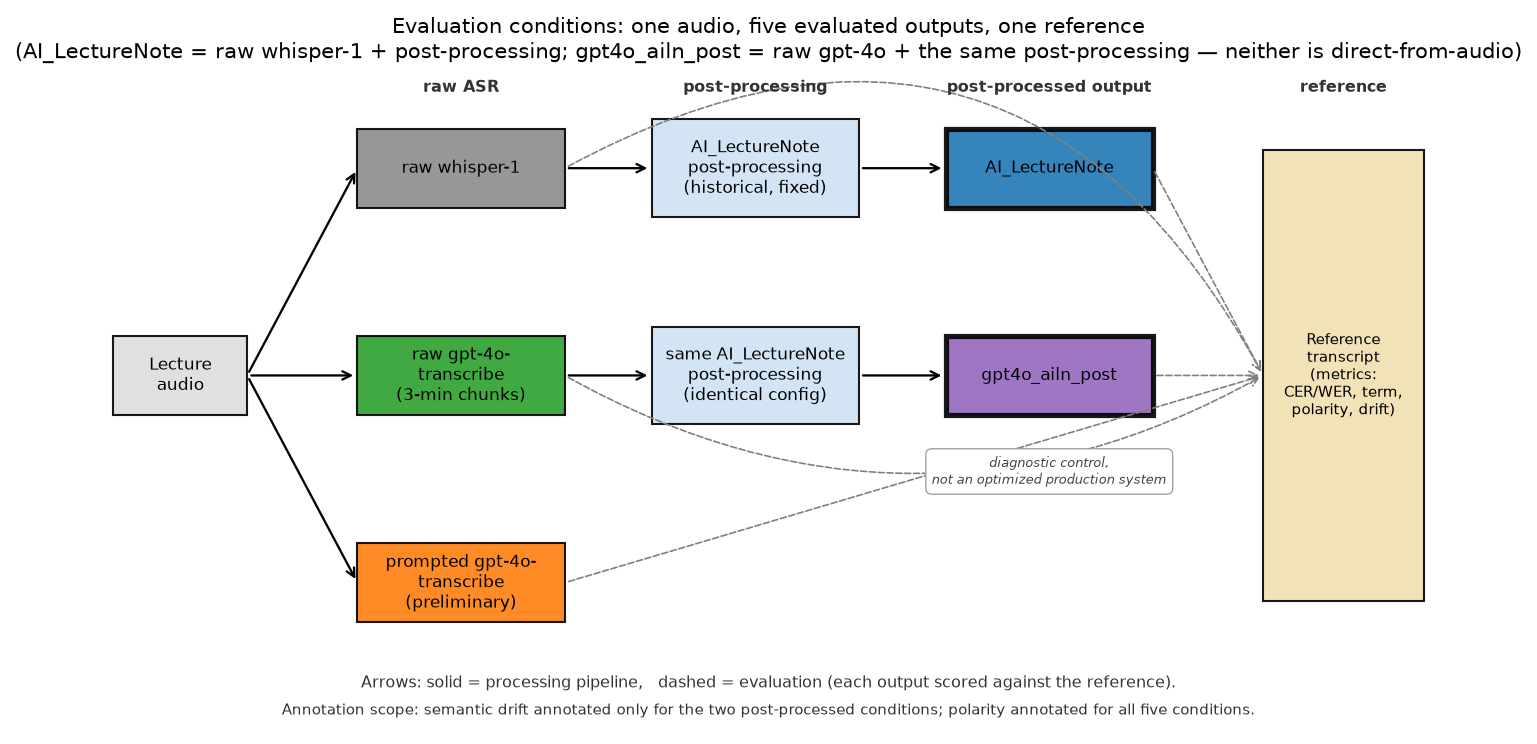
Figure 1: Evaluation design. Four author-recorded lectures were processed into five outputs and scored against author-created study-transcript references. The two post-processed conditions use the same historical AI_LectureNote rewriting stage..
4.2 4.2 Reference policy↩︎
The references are author-created, lightly cleaned, content-preserving study transcripts, not strict verbatim conversational transcripts or independent gold-standard ASR references. They preserve medical content, English medical terms, polarity/direction cues, and medically imperfect speaker statements, while lightly regularizing non-content artifacts such as fillers, coughs, abandoned fragments, and immediate stutter repetitions when this did not change the medical claim. Therefore, CER/WER should be interpreted relative to a study-transcript target rather than pure conversational-ASR accuracy. Rendering and semantic/polarity analyses are less sensitive to fillers and spacing but still depend on this reference policy. Term canonicalization is handled in annotation, not by editing the reference. The recordings and references are research materials for evaluating transcription and post-ASR processing; they are not medical or educational guidance, and the medical accuracy of the spoken lecture content was not independently verified.
5 5. Metrics and Annotation↩︎
5.1 5.1 Metric definitions↩︎
Normalization and metric definitions were frozen before analysis: English text is lowercased, punctuation is mapped to spaces, and whitespace is collapsed; polarity morphemes (hypo/hyper, acidosis/alkalosis) are never merged. The primary surface metric is CER (character error rate) computed on whitespace-stripped characters (removing the effect of Korean spacing). WER (word error rate) is reported as a secondary metric on normalized tokens, but is less interpretable for paraphrased study transcripts.
The headline readability metric is the English-script rendering rate: capped recall of curated reference domain-term occurrences rendered in English/Latin script. It measures script occurrence, not whether the rendered term is medically
correct in the correct sentence, and it does not directly penalize hallucinated English-script terms except through missing reference terms. The Korean phonetic count is the pooled count of curated reference domain terms rendered in Korean
phonetic/transliterated script, summed over lectures. Per-lecture domain-term lists were initialized by automatically extracting Latin-script term candidates from the reference transcripts. The author curated the kept term set, canonical English forms,
accepted English variants, and polarity tags. Korean phonetic variants were machine-assisted from observed ASR/STT outputs and used only for the descriptive phonetic-vs-omitted breakdown; they were not exhaustively verified and may undercount
Korean-phonetic renderings. The headline English-script rendering rate depends on canonical English forms and accepted English variants, not on the completeness of the korean_phonetic field. The chunk-level script-consistency
measure reports, for the chunked gpt-4o conditions, the per-3-minute-chunk proportion of rendered curated domain-term tokens that appear in English/Latin rather than Korean phonetic script — that is, English / (English + phonetic) computed within the
output, not a reference-normalized recall like the headline rate; chunks in which the output renders no curated domain term in either script carry no rate.
5.2 5.2 Human annotation (single annotator, single pass)↩︎
Human annotation was performed by a single author-annotator in one pass, without independent replication or adjudication.
Semantic faithfulness: for the two post-processed conditions, every reference sentence was labeled with the taxonomy {Faithful, Minor rewrite, Omission, Addition, Substitution, Polarity error, Relation error, Unclear}. A drifted sentence received a primary drift label and, where applicable, one or more additional (compound) labels, so labels are not mutually exclusive. We distinguish unique drifted rows (distinct drifted reference sentences; the
drift_rowscount) from taxonomy label incidences (per-category counts, which can exceed the number of drifted rows).Critical polarity: every reference sentence carrying a polarity or direction cue is labeled per condition as correct / wrong / omitted.
All quantitative results come from author-labeled worksheets; machine-generated draft labels were used only as non-authoritative hints. Accordingly, rates are descriptive summaries rather than population estimates.
6 6. Results↩︎
Interpretation is descriptive throughout; with four lectures we make no broad claims. Table 2 gives the cross-condition summary.

|

|

|

|

|

|

|
|---|---|---|---|---|---|---|
| raw whisper-1 | — | |||||
| AI_LectureNote | ||||||
| raw gpt-4o-transcribe | — | |||||
| prompted gpt-4o-transcribe | — | |||||
| gpt4o_ailn_post | ||||||

3pt
6.1 6.1 Surface metrics do not capture the trade-off↩︎
Macro CER did not cleanly separate the five conditions, and the lowest CER was raw whisper-1 rather than a post-processed condition. Post-processing improved surface distance mainly in lectures with heavy transliteration, but worsened it when raw ASR was already close to the study-transcript reference. This lecture-dependent pattern motivates reporting script rendering and semantic faithfulness separately rather than relying on CER/WER alone. Because the post-processing stage rewrites the ASR output rather than retranscribing the audio, the sharp increase in WER after post-processing—0.30 to 0.58 for whisper-1 and 0.31 to 0.61 for gpt-4o—offers a descriptive indication of substantial lexical rewriting introduced by post-processing, consistent with the observed surface-level drift.
6.2 6.2 Post-processing raised English-script rendering in the pilot↩︎
Table 2 shows that post-processing improved macro English-script rendering on both whisper-1 (0.39→0.71) and gpt-4o (0.26→0.65) paths, while reducing Korean phonetic occurrences from 398→15 and 473→17, respectively. The gain was largest where raw ASR
transliterated most heavily (diuretics_01 rendering rate 0.05 → 0.77; acuteinflammation_02 rendering rate 0.16 → 0.78), but was not guaranteed when raw output already had a high English-script rendering rate
(anthrax_01 0.56 → 0.54; anticancerdrugs_02 0.81 → 0.75). Because the rendering rate measures script rather than medical correctness, these gains must be interpreted alongside the drift and polarity analyses in Section 6.3; a
transcript can render many terms in English while still substituting medically wrong terms.
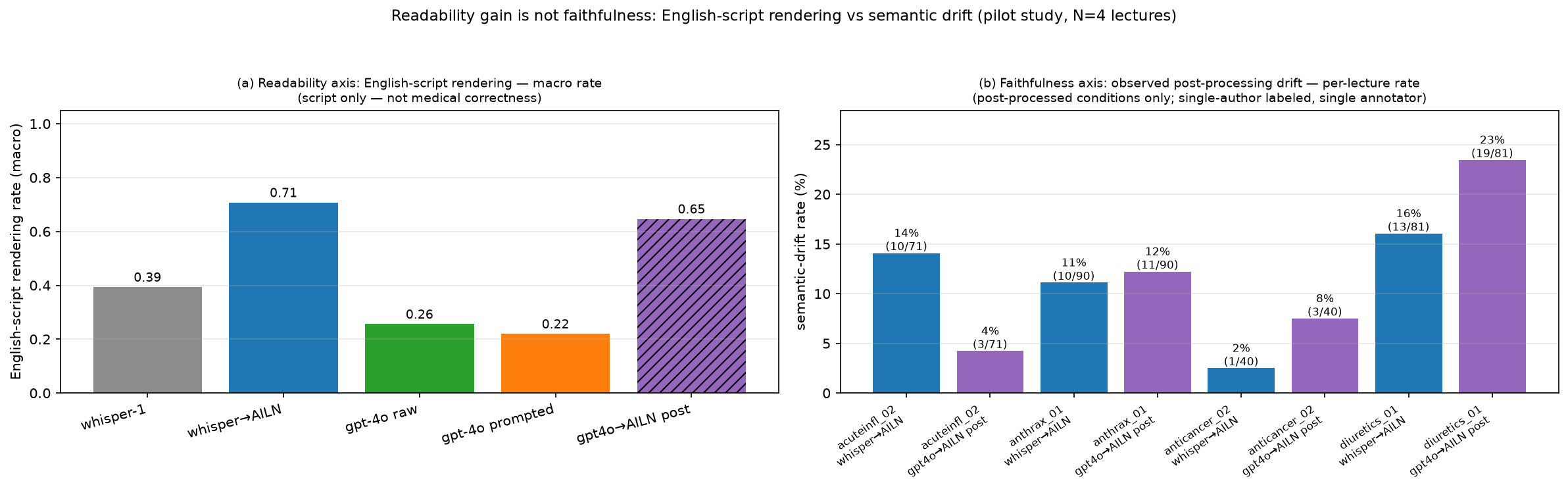
Figure 2: Readability gain versus observed faithfulness risk, N=4. Left: macro English-script rendering by condition. Right: per-lecture semantic-drift rate for the two post-processed conditions..
Chunking and prompt sensitivity. Under the 3-minute gpt-4o chunking policy, per-chunk rendering varied sharply within lectures (acuteinflammation_02 0.94 then 0.07; diuretics_01 0.00–0.29;
anticancerdrugs_02 0.38 then 0.96), consistent with script-selection instability. A single minimal Korean prompt changed rendering inconsistently across lectures (diuretics_01 +0.12, anthrax_01 +0.13,
acuteinflammation_02 −0.17, anticancerdrugs_02 −0.22), so we treat it only as preliminary prompt-sensitivity evidence.
6.3 6.3 Observed faithfulness errors: semantic drift and polarity↩︎
Semantic drift. Semantic drift was annotated only for the two post-processed conditions, so Table 3 should not be read as an aggregate raw-vs-post comparison. Table 3 reports unique drifted reference sentences, whereas Figure 3 reports drift-label incidences, which can exceed unique-row counts because compound labels are allowed.
Table 3. Semantic-drift summary for the two post-processed conditions. Faithful/minor/drift counts are row-level annotations; drift counts denote unique drifted reference sentences.
Figure 3: |
Figure 4: |
Figure 5: |
Figure 6: |
Figure 7: |
Figure 8: |
|---|---|---|---|---|---|
diuretics_01 |
/ 2 / 13 | % | / 6 / 19 | % | |
acuteinflammation_02 |
/ 4 / 10 | % | / 4 / 3 | % | |
anthrax_01 |
/ 2 / 10 | % | / 3 / 11 | % | |
anticancerdrugs_02 |
/ 1 / 1 | % | / 0 / 3 | % | |
| pooled total | 34 | 36 | |||
 .
.  .
.  .
.  .
.  .
.  .
. Semantic drift was observed in both post-processed conditions, with similar pooled counts but different lecture-level distributions. Table 3 therefore supports treating drift as workflow- and input-sensitive rather than as a single aggregate rate. The redistribution of affected rows motivates the cross-input analysis in Section 6.4.
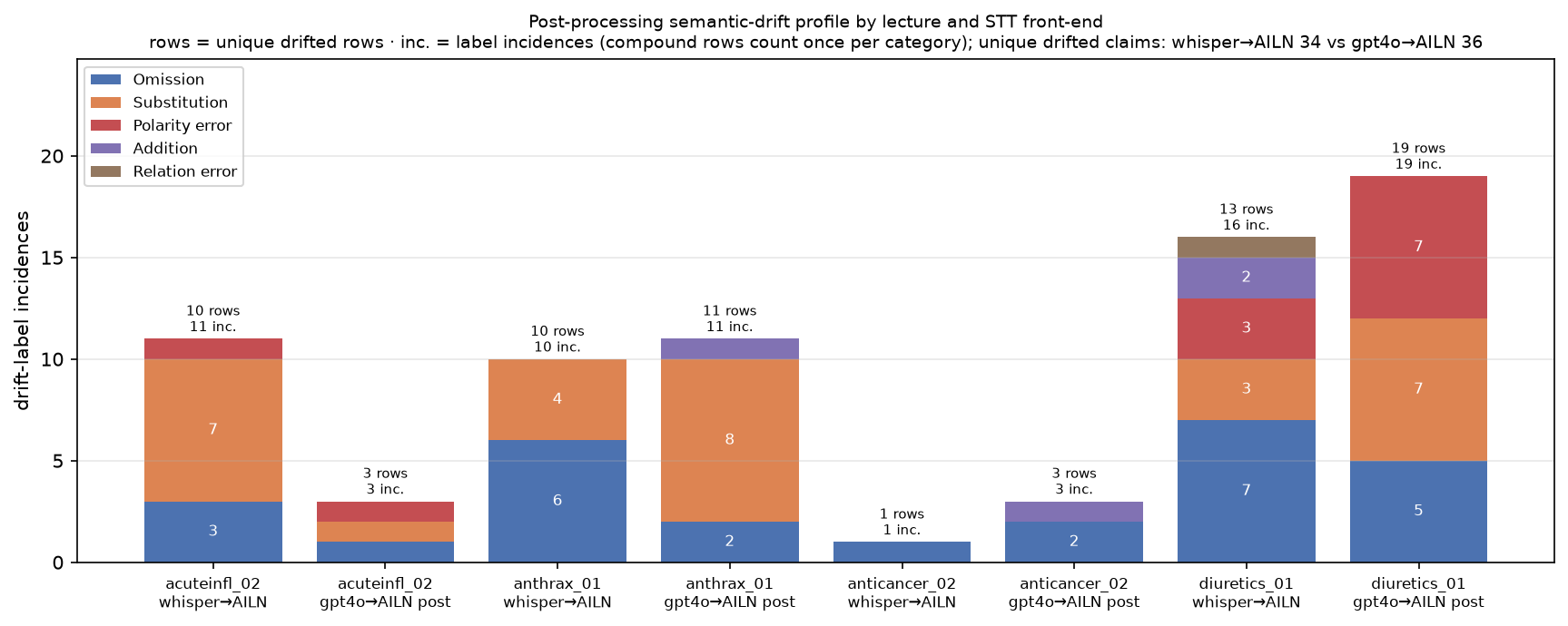
Figure 9: Semantic-drift taxonomy for the two post-processed conditions. Bars show drift-label incidences by lecture and error type; labels are not mutually exclusive, so category counts can exceed unique drifted-row totals..
Critical polarity. We report wrong and omitted separately but interpret a polarity failure as the wrong+omitted set, pooled over 101 polarity-cue rows.
Table 4. Critical-polarity failures by condition. Counts are pooled over 101 polarity-cue rows; failure is defined as wrong plus omitted.
| condition | wrong | omitted | failure (= w + o) |
|---|---|---|---|
| raw whisper-1 | 7 | 0 | 7 |
| AI_LectureNote | 8 | 3 | 11 |
| raw gpt-4o-transcribe | 11 | 0 | 11 |
| prompted gpt-4o | 9 | 0 | 9 |
| gpt4o_ailn_post | 9 | 4 | 13 |
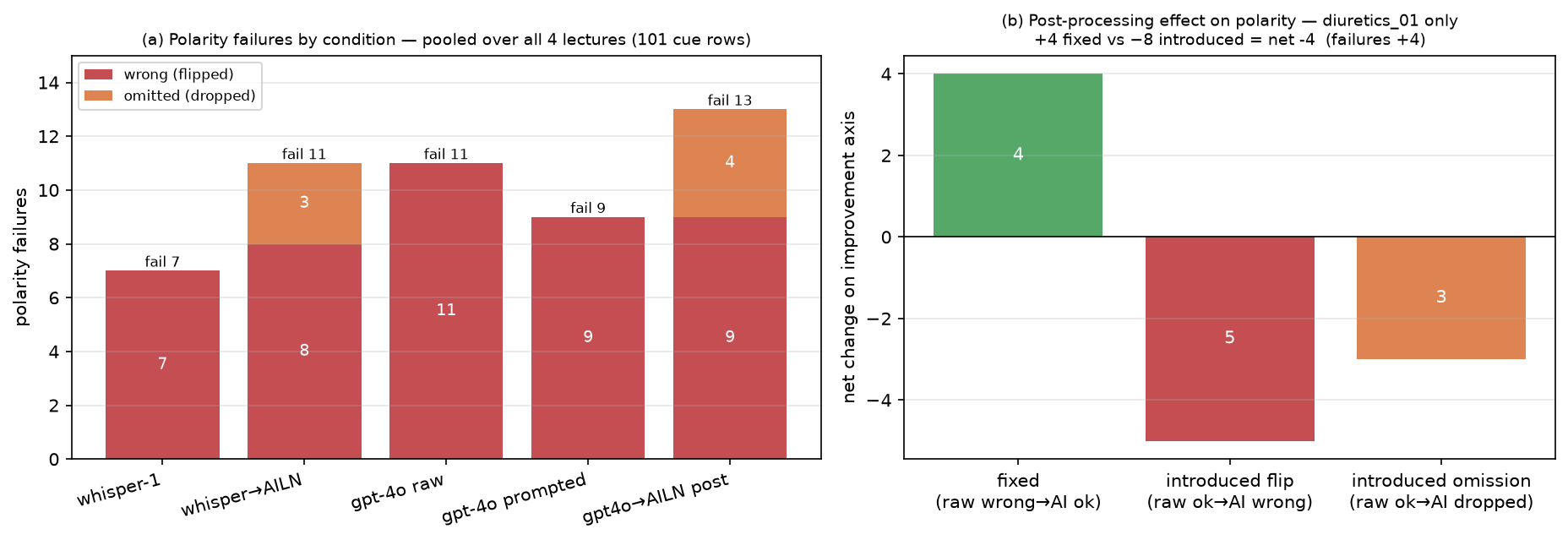
Figure 10: Critical medical polarity, N=4. Panel (a) shows wrong and omitted polarity-cue rows by condition; panel (b) shows the whisper-1 → AI_LectureNote polarity transition for diuretics_01..
Polarity failures were rarer than general semantic drift but more clinically salient, and they concentrated in diuretics_01. Counting omissions together with wrong polarity changed the interpretation of post-processing performance:
AI_LectureNote introduced omissions that would be missed by a wrong-only count.
6.4 6.4 Cross-input control: introduced versus propagated errors↩︎
To examine why similar pooled drift counts produced different affected sentences, the cross-input control probes two candidate sources of post-processed errors. We label selected errors as introduced when raw ASR preserved the relevant information but post-processing lost or changed it, and propagated when post-processing carried forward an upstream ASR error. Representative introduced errors included polarity or term substitutions such as “hypercalcemia” → “hypercalciuria,” whereas propagated errors included upstream substitutions such as “lymphocyte” → “lipocyte.” Additional examples are listed in Appendix B.
The two post-processed conditions showed different cross-input patterns in this pilot. For directional polarity, the two conditions agreed on 95 of 101 rows, with a failure-set Jaccard of 0.60 (9 shared of 15 unioned failures). Several rows that all raw front-ends transcribed correctly flipped to the same wrong value after post-processing, consistent with a recurring post-processing-associated polarity pattern. For general semantic drift, the overlap was much lower: the drift-set Jaccard was 0.23, with 13 shared drifted claims out of a union of 57. Aggregate drift was similar across the two post-processed conditions (34 vs. 36), but the affected sentences shifted with the input ASR.
This input sensitivity was clearest in acuteinflammation_02: applying the same post-processing to gpt-4o output reduced drift from 10 to 3 and substitutions from 7 to 1, consistent with fewer propagated whisper-path substitutions. At the
same time, shared drift remained across front-ends, especially in the diuretics_01 mechanism/electrolyte cluster and anthrax_01 compression omissions. Thus, the control argues against treating the observed gains and errors as
merely whisper-1 artifacts: applying the same post-processing to raw gpt-4o also raised English-script rendering (0.26 → 0.65), but did not eliminate observed faithfulness errors. These patterns should be interpreted as workflow-specific.
7 7. Discussion↩︎
Four points follow from the pilot.
First, student-facing transcript utility is not the same as generic STT accuracy. The five conditions trade off differently across surface accuracy, term-script rendering, chunk consistency, and medical-meaning preservation; CER/WER alone miss this
trade-off. The original transliteration problem persisted in some lectures, including under the chunked gpt-4o condition, but not uniformly. The clearest counterexample is anticancerdrugs_02, where raw whisper-1 already rendered 0.81 of
curated terms in English script; this is also the shortest lecture (4m30s), so its high raw rendering may reflect length as well as content.
Second, English-script rendering is a useful readability proxy for Korean–English medical lectures, but it is not semantic faithfulness. A high rendering rate can coexist with wrong English terms (Section 6.3), so script rendering and medical meaning must be measured separately.
Third, post-ASR rewriting can improve readability while adding paraphrase, compression, and faithfulness risks, especially when raw ASR is already close to the reference. The cross-input comparison suggests that some polarity failures were post-processing-associated, whereas broader semantic drift was more input-sensitive.
Fourth, these findings should not be read as evidence that all domain-aware post-processing introduces semantic drift. AI_LectureNote is a readability-oriented LLM rewriting pipeline rather than a constrained term-normalization system; the diagnostic point is that script-rendering gains and semantic faithfulness should be evaluated separately.
8 8. Limitations↩︎
This retrospective pilot bounds every claim above; we make no benchmark, population-rate, educational, or clinical claim.
Scale and confounding. Four lectures only. Speaker, topic, lecture length, and reference style remain confounded, even after adding a second cdh lecture.
Annotation provenance and evaluator overlap. References and labels were created via single-pass annotation by the system developers (single author-annotator) with no second pass, independent replication, adjudication, or inter-annotator agreement. Furthermore, references are lightly cleaned study transcripts rather than gold-standard verbatim transcripts.
Polarity concentration. Polarity failures concentrate in
diuretics_01, so polarity comparisons are illustrative rather than robust rate estimates.Implementation choices. Condition 5 is a diagnostic control, not an optimized modern-STT post-processor; the gpt-4o conditions use 3-minute non-overlapping chunks and one minimal prompt, and the whisper-1 condition is a 2026 rerun rather than a 2023 snapshot.
Metric scope. English-script rendering is recall-like and script-only; it does not measure term correctness or hallucinated terms except through missed reference terms.
Korean-phonetic diagnostic counts. The Korean-phonetic counts are diagnostic lower-bound counts based on a machine-assisted list of observed phonetic variants; the phonetic variant lists were not exhaustively verified.
9 9. Conclusion↩︎
Across four author-recorded lectures, AI_LectureNote-style post-processing improved English-script rendering on both input paths, but these readability gains coexisted with semantic drift and polarity failures. The cross-input control suggested that polarity failures were more stable across raw front-ends than general semantic drift, whose affected sentences shifted with the input ASR. The central methodological takeaway is that surface distance, term-script rendering, chunk-level consistency, and medical-meaning preservation should be evaluated separately. Future work should test more constrained alternatives, such as span-level glossary replacement, verifier-backed correction, or constrained rewriting.
10 10. Reproducibility / Data and Code Availability↩︎
From the evaluation_paper/ directory, all tables and figures regenerate with pythonanalysis/run_all.py. Source files are organized as (paths relative to evaluation_paper/):
References
data/<lecture>/reference.txtSemantic labels
annotations/<lecture>/semantic_review.csvCondition-5 semantic labels
annotations/<lecture>/semantic_review_gpt4o_ailn_post.csvPolarity labels
annotations/<lecture>/polarity_review.csvDomain terms
annotations/<lecture>/domain_terms.csvCondition manifest
manifest/condition_manifest.csv
The condition manifest records model names, API dates, prompt text, and the condition-5 pipeline description.
Code, speaker-coded evaluation transcripts, references, annotation files, and generated tables/figures are released in the public repository: https://github.com/boyskier/ailecturenote-retrospective-pilot. Where audio is included, it is released with explicit author-speaker consent for research reproducibility; because the audio contains identifiable voices, it should not be treated as anonymized.
11 Acknowledgements↩︎
We thank Professor Hogun Park for supervising the 2024 CO-Deep Learning student project that laid the foundation for this work.
12 Appendix A. Supplementary figures↩︎
The four main figures appear inline (Figure 1, Section 4.1; Figure 2, Section 6.2; Figure 3 and Figure 4, Section 6.3). The following supplementary figures provide per-lecture detail and are reproduced by pythonanalysis/run_all.py:
Figure S1 () — per-lecture CER (primary) and WER (secondary) for all five conditions, showing the
anthrax_01andanticancerdrugs_02divergence where raw whisper-1 is clean but post-processing raises CER (Section 6.1).Figure S2 () — English-script rendering rate by condition and lecture, the per-lecture detail behind the headline trade-off in Figure 2 (Section 6.2).
Figures S3a–d (
figures/fig3_chunk_<lecture>.png) — per-3-minute-chunk English vs. Korean-phonetic counts for raw and prompted gpt-4o, one panel per lecture (acuteinflammation_02,anthrax_01,anticancerdrugs_02,diuretics_01), illustrating the chunk-level script instability (Section 6.2).
13 Appendix B. Illustrative errors↩︎
Appendix B lists illustrative author-reviewed errors. The examples are drawn from table7_semantic_drift_examples.csv. Examples include propagated substitutions such as lymphocyte \(\rightarrow\) “lipocyte”
and tissue edema \(\rightarrow\) “tissue adenoma”; introduced or post-processing-associated polarity/substitution errors such as hypercalcemia \(\rightarrow\) “hypercalciuria” and
hypokalemia-prevention \(\rightarrow\) “hyperkalemia-prevention”; and additions such as an unmentioned “ibuprofen” in the ototoxicity discussion. Condition 5 also produced a concept error in anticancerdrugs_02,
conflating antimetabolites with alkylating agents.
For balance, post-processing also corrected some upstream errors in anthrax_01, including restoring whisper-1’s “Annihilation” to “Inhalation”, preserving the 90–95% / 20% mortality figures, and restoring the PA/EF/LF abbreviations in
English. Thus, the examples illustrate mixed effects of readability-oriented rewriting rather than a one-directional degradation.
14 References↩︎
Adedeji, A., Joshi, S., & Doohan, B. (2024). The Sound of Healthcare: Improving Medical Transcription ASR Accuracy with Large Language Models. arXiv:2402.07658.
Adedeji, A., Sanni, M., Ayodele, E., Joshi, S., & Olatunji, T. (2025). The Multicultural Medical Assistant: Can LLMs Improve Medical ASR Errors Across Borders? arXiv:2501.15310.
Chapman, W. W., Bridewell, W., Hanbury, P., Cooper, G. F., & Buchanan, B. G. (2001). A simple algorithm for identifying negated findings and diseases in discharge summaries. Journal of Biomedical Informatics, 34(5), 301–310. doi:10.1006/jbin.2001.1029.
Ma, R., Qian, M., Manakul, P., Gales, M., & Knill, K. (2023). Can Generative Large Language Models Perform ASR Error Correction? arXiv:2307.04172.
OpenAI. (2025). Speech to text. OpenAI API documentation. Accessed 2026-06-27. https://developers.openai.com/api/docs/guides/speech-to-text
Paik, G., Kim, Y., Lee, S., Ahn, S., & Kim, C. (2025). HiKE: Hierarchical Evaluation Framework for Korean–English Code-Switching Speech Recognition. arXiv:2509.24613.
Peng, Y., Wang, X., Lu, L., Bagheri, M., Summers, R. M., & Lu, Z. (2017). NegBio: a high-performance tool for negation and uncertainty detection in radiology reports. arXiv:1712.05898.
Radford, A., Kim, J. W., Xu, T., Brockman, G., McLeavey, C., & Sutskever, I. (2023). Robust speech recognition via large-scale weak supervision (Whisper). Proceedings of the 40th International Conference on Machine Learning, PMLR 202:28492–28518. arXiv:2212.04356.
Sitaram, S., Chandu, K. R., Rallabandi, S. K., & Black, A. W. (2019). A survey of code-switched speech and language processing. arXiv:1904.00784.
Sudo, Y., Shakeel, M., Fukumoto, Y., Peng, Y., & Watanabe, S. (2024a). Contextualized Automatic Speech Recognition with Attention-Based Bias Phrase Boosted Beam Search. arXiv:2401.10449.
Sudo, Y., Fukumoto, Y., Shakeel, M., Peng, Y., & Watanabe, S. (2024b). Contextualized Automatic Speech Recognition with Dynamic Vocabulary. arXiv:2405.13344.
Tang, Z., Wang, D., Zhou, Z., Liu, Y., Huang, S., & Shang, S. (2025). Chain of Correction for Full-text Speech Recognition with Large Language Models. arXiv:2504.01519.
Uzuner, Ö., South, B. R., Shen, S., & DuVall, S. L. (2011). 2010 i2b2/VA challenge on concepts, assertions, and relations in clinical text. Journal of the American Medical Informatics Association, 18(5), 552–556. doi:10.1136/amiajnl-2011-000203.
Wang, J., Kim, J., Kim, S., & Lee, Y. (2019). Exploring Lexicon-Free Modeling Units for End-to-End Korean and Korean–English Code-Switching Speech Recognition. arXiv:1910.11590.
Zheng, X., Dong, S., Phukon, B., Hasegawa-Johnson, M., & Yoo, C. D. (2026). Towards Robust Dysarthric Speech Recognition: LLM-Agent Post-ASR Correction Beyond WER. arXiv:2601.21347.