Move First, Commit Later: Selective LiDAR-to-BIM Global Initialization via Sequential Consensus with Symmetry-Aware Abstention
July 19, 2026
Abstract
Global LiDAR-to-BIM initialization must place a robot within an as-designed building model without a prior pose. In repetitive interiors, the principal failure mode is not low-confidence registration but confident aliasing: a submap can match several BIM regions with comparable scores, producing a high-scoring pose displaced by symmetry. We present Move First, Commit Later, a selective layer that treats a registration front-end as an evidence source and decides whether to commit. Candidates from multiple submaps are mapped to a common \(\mathrm{SE}(2)\) anchor; a top-1 consensus \(B_m\), invariant to non-champion multiplicity, aggregates cross-submap evidence; and topology serves only as a binary feasibility gate. The decision is typed—Commit, Defer, or Ambiguous\((\tau)\), reporting the detected symmetry period—and reversible: symmetry-breaking motion upgrades Ambiguous to Commit. On a real multi-room building and a controlled symmetric simulation, the layer commits correctly in every tested trajectory-scale configuration and otherwise abstains with a typed state, whereas forced-choice policies on the same front-end select wrong rooms in most cases. Committed anchors are within \(0.02\)–\(0.36\) m of an independent laser-tracker position reference and within \(1.9^\circ\) of a BIM-registration orientation proxy. The evaluation covers one building and one front-end; the layer is designed to be front-end modular.
Localization, global initialization, LiDAR-to-BIM registration, selective decision-making, symmetry-aware perception
1 Introduction↩︎
Global localization against a prior building model is fundamental for indoor robots. When a robot enters a building represented by a BIM, the required output is an anchor that maps the robot’s LiDAR frame to the BIM frame and specifies both position and yaw, without requiring a prior pose. This anchor provides absolute localization rather than local refinement [1], avoids a separate pre-mapping campaign, and supports inspection, construction monitoring, and service robots. Unlike image-based priors, as-designed BIMs provide reliable geometry but little appearance information, making LiDAR a natural sensing modality.
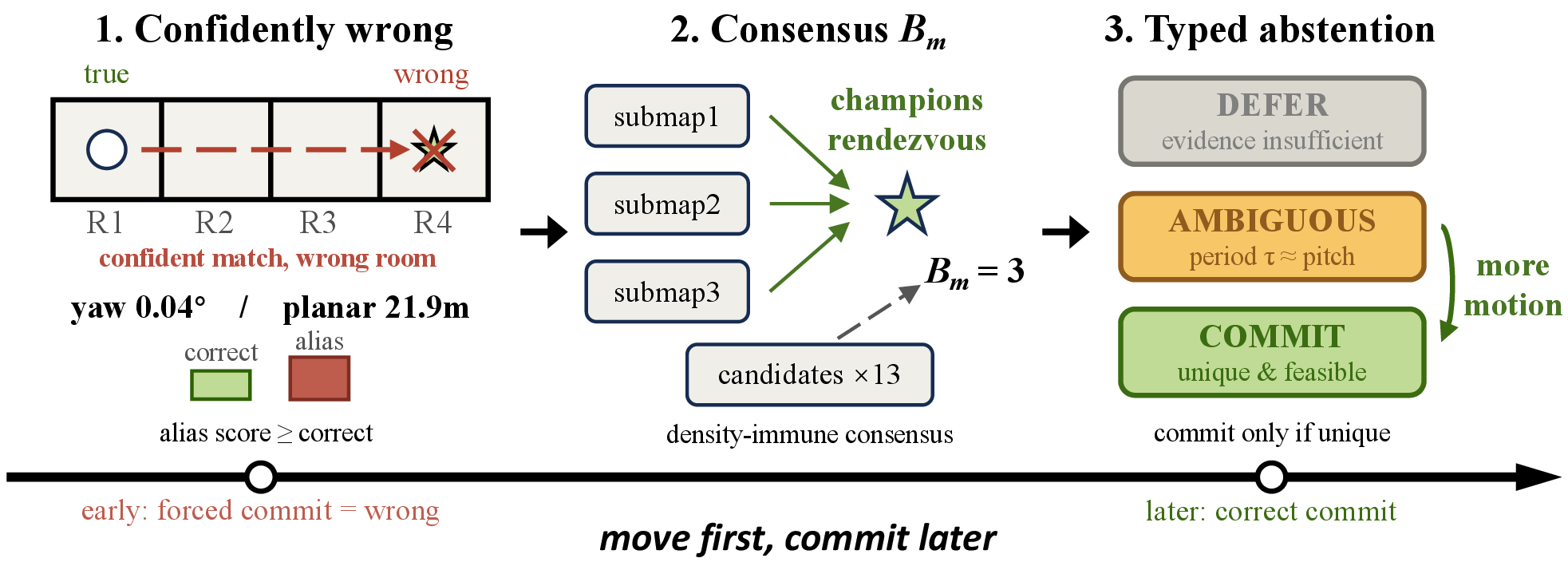
However, the main difficulty is not registration failure but confident failure. In repetitive interiors, a reflected room, shifted corridor, or repeated doorway can produce an alias whose verification score matches or exceeds that of the true anchor. Such an alias is a high-scoring \(\mathrm{SE}(2)\) pose with plausible yaw and occupancy fit, not a low-confidence outlier. Dedicated LiDAR-to-BIM front-ends likewise identify these layouts as difficult [2]. The question is therefore not only how to generate candidates, but whether to commit at all (Fig. 1).
Existing pipelines generally expose a forced-choice interface: they return the highest-scoring pose or converge a multi-hypothesis belief. Additional evidence can break accidental aliases, but these interfaces do not distinguish insufficient evidence (keep moving) from structural non-identifiability (several anchors remain geometrically equivalent). Under a single-anchor interface, the missing capability is to abstain when commitment is unsafe and report the geometric form of the ambiguity rather than only a scalar confidence.
To fill this gap, we propose Move First, Commit Later, a selective initialization layer that treats a registration front-end as an evidence source. It maps each submap’s candidates to a common anchor \({}^{B}T_L\in\mathrm{SE}(2)\), aggregates a top-1 consensus \(B_m\) that is immune to non-champion multiplicity, uses topology only as a binary feasibility gate, and repeatedly emits a typed decision—Commit, Defer, or Ambiguous—as the robot moves. Ambiguous is not a weaker form of Defer: the former denotes evidence saturated on an unresolvable equivalence class, whereas the latter denotes evidence that is not yet informative enough to decide.
Together, these mechanisms turn global initialization from a one-shot registration decision into a sequential, evidence-driven decision process. The main contributions are as follows:
(C1) Typed abstention for LiDAR-to-BIM global initialization. Under a single-anchor output interface, we distinguish Defer (the evidence is not yet informative, and motion may provide what is missing) from Ambiguous (saturated evidence resolves to an equivalence class rather than a unique anchor). The latter is either a translational \(\tau\)-lattice under coherent symmetry, for which we report the period \(\tau\), or a non-coherent multimodal set. This decision reports the geometric form of non-identifiability rather than a scalar score, converting an unsafe forced pose into an auditable statement.
(C2) Consensus immune to non-champion multiplicity, with a regime characterization. We introduce a top-1 consensus statistic \(B_m\) over common \(\mathrm{SE}(2)\) anchors, with each submap contributing only its highest-scoring candidate. Because non-winning candidates never enter the statistic, \(B_m\) is invariant to non-champion multiplicity—the sense in which it is density-immune—and cannot be inflated by head-count as support-style counting can. Proposition 1 gives a dichotomy: in non-coherent layouts, the margin grows with the number of submaps; in exactly symmetric layouts, the true anchor is non-identifiable over a symmetry orbit, and the correct output is Ambiguous.
Topology supports both contributions only as a binary feasibility gate: it rejects physically impossible candidates without ranking feasible ones (Section 3.4), preventing a topologically plausible alias from overruling geometric consensus.
2 Related Work↩︎
2.1 Global LiDAR-to-BIM and scan-to-map registration↩︎
A LiDAR-to-BIM initializer must recover, without a prior pose, the rigid transformation between an observed submap and an as-designed model, despite perceptual aliasing from repeated structures [3]. The Pose Hough Transform method [2] (STSL) is the closest registration front-end to our setting: it extracts features shared by LiDAR and BIM, generates pose candidates by Hough voting, and verifies them with an occupancy-aware score. The SLABIM dataset [4] provides coupled SLAM and BIM data. In the related scan-to-map setting, 3D-BBS [5] uses branch-and-bound to localize against a pre-built point-cloud map. Another route uses learned LiDAR place-recognition descriptors [6], [7]. Both retrieve against measured point-cloud maps, whereas our prior is an as-designed BIM.
Rather than proposing another registration front-end, we address the decision that follows candidate generation. We retain the pose candidates produced by a front-end such as STSL and treat them as evidence. A conventional interface, however, returns a single transformation per observation and can force premature commitment when an aliased hypothesis scores as highly as the true alignment. We instead aggregate the corresponding anchors across multiple submaps and apply a selective decision layer to the accumulated evidence.
2.2 Sequential and multi-hypothesis localization↩︎
Beyond single-observation registration, a second line of work maintains multiple localization hypotheses over time. Monte Carlo Localization and robust variants represent belief with particles for global localization and kidnapped-robot recovery [8], [9]. Reliable-loc reweights particles with spatially verifiable cues and monitors sequential uncertainty to prevent erroneous convergence [10]. Active localization notes that motion can yield observations that reduce ambiguity in feature-scarce environments [11]. Localization-failure detection and integrity monitoring assess existing pose estimates [12], [13]; our layer instead applies typed abstention before anchor issuance and reports a \(\tau\)-lattice or multimodal set.
This line of work supports the first half of our premise: robot motion can reduce ambiguity that cannot be resolved from a single observation. However, it leaves open which type of decision should be issued as evidence accumulates. Further submaps may eventually break an accidental alias and enable a commit, but the current evidence may still be insufficient to determine whether this will occur; we denote this intermediate state as Defer. If the evidence instead saturates while the observed region remains intrinsically symmetric, we return Ambiguous. This distinction avoids forcing the belief onto a single estimate.
2.3 BIM, floorplan, and architectural-graph localization↩︎
Another line of work represents architectural priors using semantic and graph-based structures. Architectural priors can also be represented semantically. BIM-generated maps support 3D LiDAR localization using persistent walls, corners, and rooms [14]. iS-Graphs match an Architectural Graph to an online Situational Graph [15], and a tightly coupled extension estimates as-planned/as-built deviations [16].
These methods exploit the same architectural regularity but assume that sufficient semantic evidence yields a unique graph match, an assumption that is restrictive in symmetric buildings. We use topology more narrowly as a feasibility gate, not a ranking score; competition remains with \(B_m\), so a topologically plausible alias cannot overrule geometric consensus.
2.4 Selective decisions and quantified abstention↩︎
Our layer also relates to selective prediction, in which a model may abstain to reduce error on accepted cases. Selective classification formalizes the risk–coverage trade-off [17], and reject-option formulations analyze how acceptance affects selective risk [18]. We use this literature as decision-theoretic language, not as a localization baseline.
For LiDAR-to-BIM initialization under a single-anchor interface, a scalar threshold can reject a commit but cannot explain why. Limited evidence should yield Defer; a saturated yet unresolvable class should yield Ambiguous, with period \(\tau\) when the class forms a lattice. Our method provides this typed geometric abstention, replacing forced pose selection with selective anchoring.
3 Method↩︎
3.1 Problem Formulation and Overview↩︎
In this paper, we consider prior-free LiDAR-to-BIM global initialization. Without an initial guess, the robot must recover an anchor \({}^{B}T_{L}\in\mathrm{SE}(2)\) that maps its odometry world frame \(L\) into the BIM frame \(B\). The intuitive “LiDAR frame” used in the Introduction is this robot-side reference: the LiDAR–inertial odometry world frame \(L\), in which the accumulated submaps and trajectory are expressed. The anchor \({}^{B}T_{L}\) is a full pose \((x,y,\theta)\), and aliases may differ in translation, heading, or both—in repeated rooms the heading can be nearly correct while the translation is displaced by one room pitch (Fig. 1). Initialization must therefore resolve a full-pose equivalence class, not only a heading.
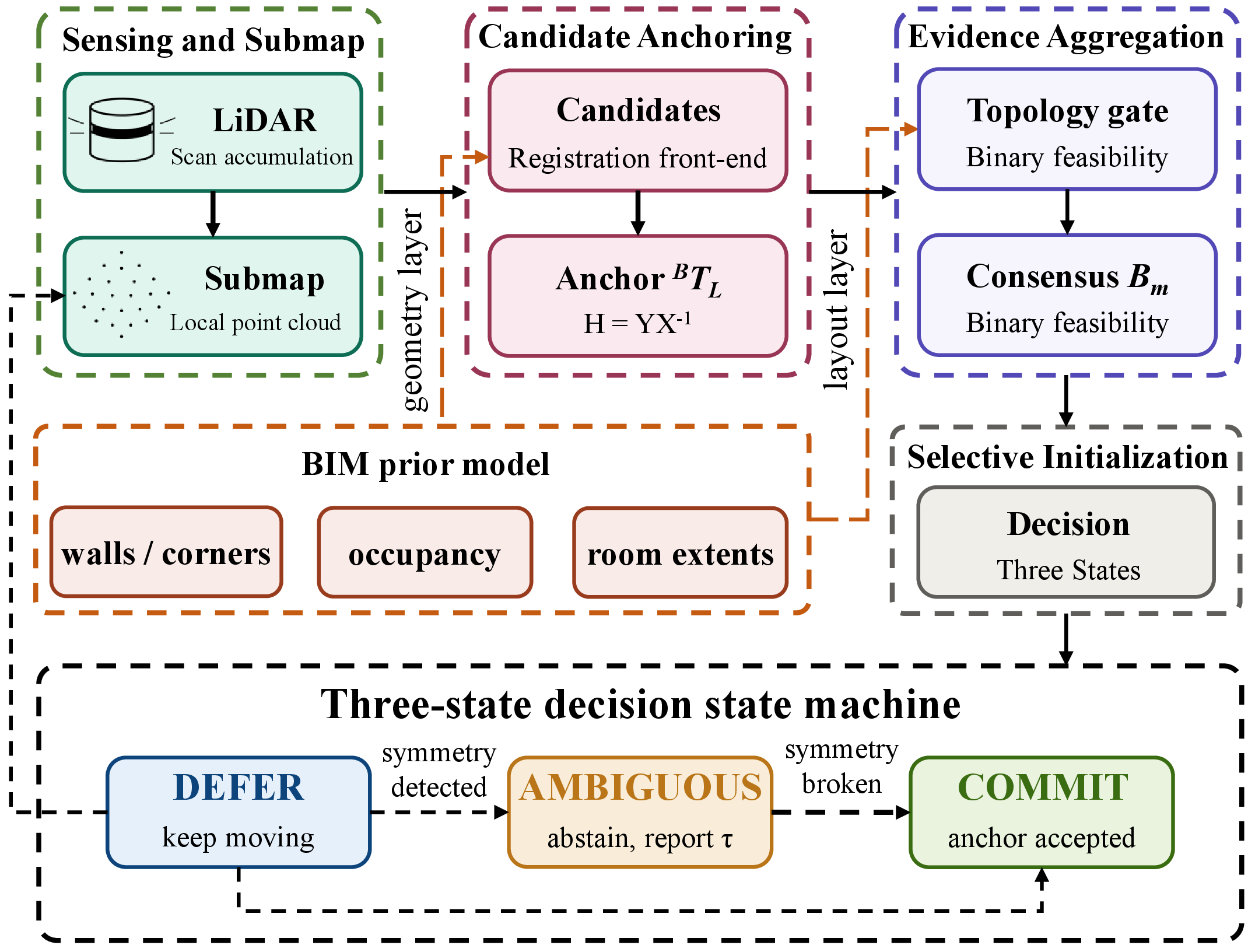
At the decision layer, architectural symmetry, undirected wall lines, and front-end parameterization all appear as a small set of confident \(\mathrm{SE}(2)\) candidates, and our method reasons about these candidates rather than their causes. The layer is designed to interface with different registration front-ends, although the experiments here use only STSL. Fig. 2 shows the pipeline and its information flow. During execution the feasibility gate precedes consensus aggregation; for ease of exposition we introduce the consensus first.
3.2 Candidate Anchoring via \(H=YX^{-1}\)↩︎
Because a single scan cannot localize the robot, the robot first moves while a LiDAR-inertial odometry (LIO) module [19] fuses scans into a denser submap—the “Move First” premise. A pose-voting front-end [2] then registers each submap to the BIM and returns a set of candidates, because symmetric geometry is inherently multi-solution.
A candidate specifies the submap pose in the BIM, whereas the required quantity is the odometry-world pose. Let \(S_i\) denote the submap frame. For a candidate, the front-end supplies \(Y_i={}^{B}T_{S_i}\) and the LIO supplies \(X_i={}^{L}T_{S_i}\); chaining through \(S_i\) gives \[{}^{B}T_{L}={}^{B}T_{S_i}\,{}^{S_i}T_{L} ={}^{B}T_{S_i}\,\bigl({}^{L}T_{S_i}\bigr)^{-1} =Y_i X_i^{-1}\;\triangleq\;H_i, \label{eq:anchor}\tag{1}\] Thus, every candidate induces an anchor \(H_i\). The order is fixed because the inner \(S_i\) cancels only in \(Y_iX_i^{-1}\).
Equation 1 makes all candidates commensurable: each estimates the same \({}^{B}T_{L}\) in one \(\mathrm{SE}(2)\) space. This requires unique frames. The single BIM fixes \(B\), whereas \(L\) remains unique only while LIO runs uninterrupted; a restart makes pre- and post-restart anchors incommensurable.
3.3 Density-Immune Consensus \(B_m\)↩︎
Contribution C2 is a consensus statistic immune to non-champion density. Up to noise, the correct candidate from each submap satisfies \(H_i^{\star}={}^{B}T_{L}^{\star}\): true anchors form one \(\mathrm{SE}(2)\) cluster, whereas aliases form separate clusters offset by symmetry elements. Cross-submap agreement distinguishes the truth from these aliases.
We count champions, not support. From each submap \(i\), we retain only its top-1 candidate \(h_i^{\star}=H_{ij^{\star}}\), \(j^{\star}=\arg\max_j s_{ij}\), so each submap contributes one entry. The \(N\) top-1 anchors are grouped by \(\mathrm{SE}(2)\) proximity. Membership is defined by distance to the group anchor rather than by single-linkage connectivity, thereby avoiding chaining. For the \(m\)-th group \(\mathcal{G}_m\), \[B_m \;\triangleq\; \lvert\mathcal{G}_m\rvert , \label{eq:bm}\tag{2}\] Here, \(B_m\) counts the submaps whose champions rendezvous in \(\mathcal{G}_m\). The winner is \(m^{\star}=\arg\max_m B_m\), with consensus \(B^{(1)}\) and margin \(\Delta=B^{(1)}-B^{(2)}\). The estimate \(T^{\star}\) is the circular mean of the winning group’s top-1 entries—arithmetic for position and \(\mathrm{atan2}\) for heading—rather than the centroid of all candidates, which would be polluted by non-champions.
Counting champions is essential. One submap may elect an alias, but the same alias is unlikely to win across many distinct viewpoints; a rendezvous of champions therefore indicates the truth. Support counting, by contrast, can be inflated by aliases that pad the candidate pool. Because \(B_m\) uses only each submap’s top-1, candidate count cannot change the winner, margin, or \(T^{\star}\)—the claimed immunity to non-champion multiplicity—whereas voting can flip when the pool is flooded (Section 4.1).
The \(\mathrm{SE}(2)\) distance is treated as a pair—Euclidean position and wrapped angular difference—with separate thresholds \(\delta_{xy}\) and \(\delta_\theta\); incommensurable units are never combined into one norm.
3.4 Topology as a Physical-Realizability Gate↩︎
Topology is used only as a feasibility gate, not as a ranking score. The BIM serves two roles: its geometry (walls and corners) drives registration, whereas its coarse layout—room extents and an occupancy grid—drives the gate. Under candidate anchor \(H\), the LIO trajectory maps into the BIM as \({}^{B}\hat{T}_t=H\,{}^{L}T_t\), and the gate tests whether the mapped trajectory is physically realizable: \[\mathrm{gate}(H)=\mathrm{feasible}\bigl(\{{}^{B}\hat{T}_t\}\bigr) \in\{\mathtt{true},\mathtt{false}\}. \label{eq:gate}\tag{3}\]
Feasibility is implemented as a structural-consistency score. The mapped trajectory is checked for free-space validity (each pose lies in a room), room membership (valid graph nodes), and inter-room adjacency (each transition follows a layout-graph edge rather than crossing a wall). The checks are aggregated, and only candidates above threshold \(\tau_c\) are admitted. The gate rejects aliases whose trajectories leave the building or jump between non-adjacent rooms while allowing legitimate revisits: \(209\!\to\!208\!\to\!207\!\to\!208\!\to\!209\) follows graph edges and passes, whereas an alias shifted beyond an exterior wall lies outside every room and fails.
Two design choices are deliberate. First, consistency gates feasibility but never ranks: a candidate either clears \(\tau_c\) or does not, and \(B_m\) alone selects among admitted candidates—a translation alias can attain the same consistency as the true anchor by construction, so ranking by consistency would fail precisely in the targeted cases. Consistency assesses possibility, \(B_m\) correctness. Second, the gate precedes \(B_m\), so consensus is computed only over survivors and cannot be contaminated by infeasible hypotheses.
3.5 Selective Decision State Machine↩︎
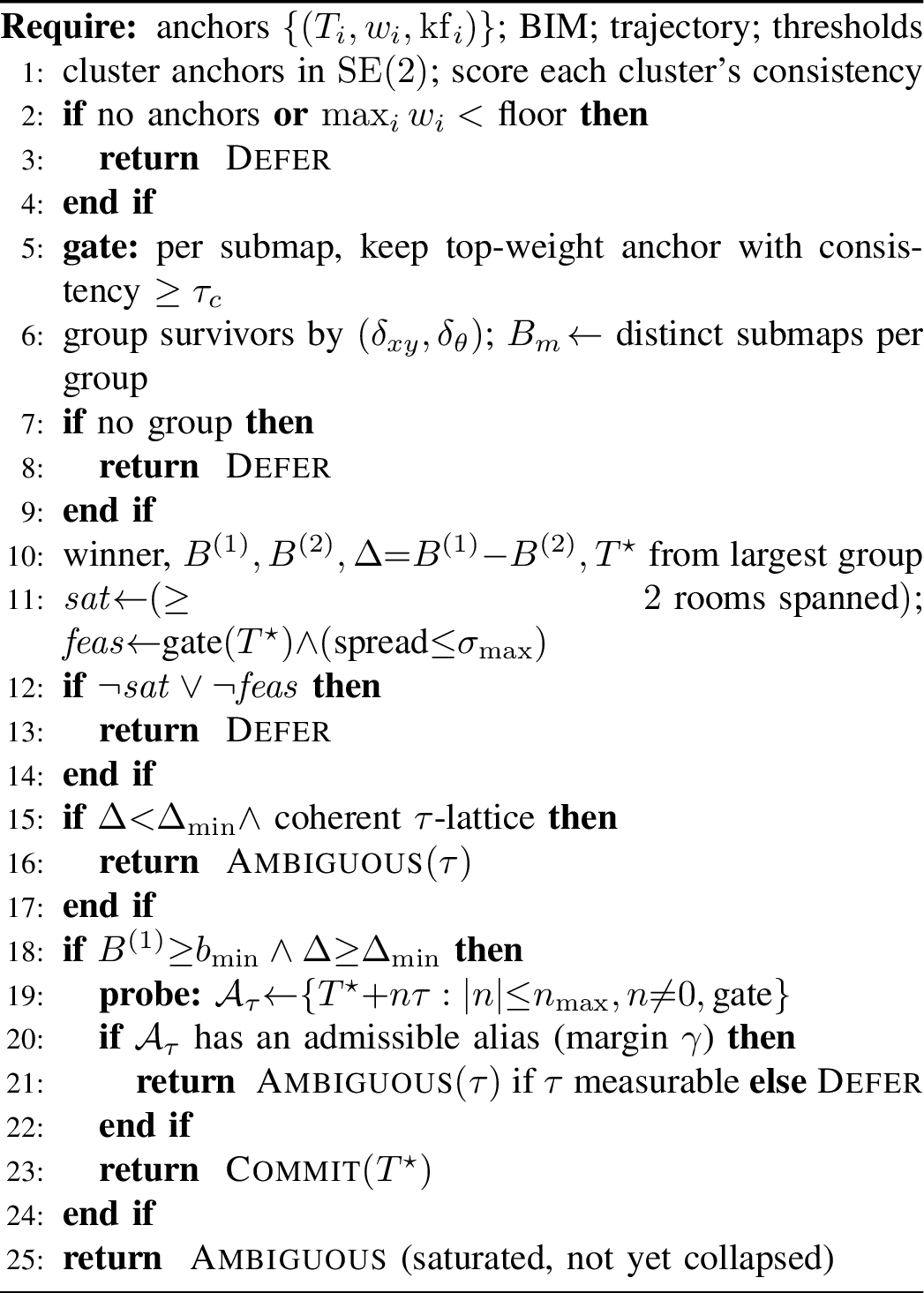
Contribution C1 is a selective decision layer that converts consensus into a state, re-evaluated after every submap from the surviving groups \(\{B_m\}\), the winner’s feasibility, and the lattice test in Section 3.6. A commit requires three conditions: saturated evidence (the mapped trajectory spans at least two distinct rooms, preventing a single-view commit), a feasible winner (its nearest cluster passes the gate and its intra-group spread is below \(\sigma_{\max}\)), and decisive consensus (\(B^{(1)}\ge b_{\min}\) and \(\Delta=B^{(1)}-B^{(2)}\ge\Delta_{\min}\)).
Even when these conditions hold, the layer does not trust the margin alone; it actively probes the detected symmetry. From winner \(T^{\star}\) and period \(\tau\), it synthesizes shifted anchors \[\begin{align} \mathcal{A}_\tau=\bigl\{\,T^{\star}+n\tau:\;&n\in\{\pm1,\dots,\pm n_{\max}\},\\[-1pt] &\mathrm{gate}(T^{\star}+n\tau)=\mathtt{true}\,\bigr\} \end{align} \label{eq:aliasset}\tag{4}\] with orientation preserved, and re-tests each through the gate. A period alias remains unresolved if any member of \(\mathcal{A}_\tau\) is admissible with consistency within \(\gamma\) of the winner. This synthesis can veto an alias absent from the candidate set: under exact symmetry, deterministic tie-breaking may exclude a period-shifted image from the top-1 groups, although that image must still block a premature commit. The decision is \[\mathrm{state}= \begin{cases} \mathrm{\small Commit}(T^{\star}) & \mathrm{decisive} \wedge \mathcal{A}_\tau\text{ clear},\\[2pt] \mathrm{\small Ambiguous}\,[(\tau)] & \mathit{sat} \wedge \mathit{feas},\;\text{not resolved},\\[2pt] \mathrm{\small Defer} & \text{otherwise}, \end{cases} \label{eq:decide}\tag{5}\] Here, decisive means \(B^{(1)}\!\ge\!b_{\min}\wedge\Delta\!\ge\!\Delta_{\min}\); “\(\mathcal{A}_\tau\) clear” means that no synthesized alias remains admissible within \(\gamma\); and \(\mathit{sat},\mathit{feas}\) denote the saturation and feasibility tests above. The floors \(b_{\min}{=}3\) and \(\Delta_{\min}{=}2\) are fixed across all experiments (Table 1). Defer and Ambiguous differ not by a fixed observation count but by whether motion has made the evidence informative: Ambiguous denotes saturated evidence resolving only to an equivalence class—a coherent \(\tau\)-lattice, a multimodal set, or a still-admissible synthesized alias—whereas Defer denotes unsaturated evidence or an infeasible winner. Without the probe the raw margin can clear its floor deep inside a symmetric region (Section 4.2); the probe holds Ambiguous\((\tau)\) until motion renders every shifted anchor infeasible.
These transitions implement “Commit Later.” Defer self-loops while evidence is insufficient, moves to Commit when consensus is decisive without unresolved symmetry, and moves to Ambiguous when the survivors form a \(\tau\)-lattice. Crucially, Ambiguous\((\tau)\) transitions to Commit after the robot leaves the symmetric region and shifted anchors become infeasible. Abstention is therefore evidence-conditioned: survivors are indistinguishable only along the trajectory observed so far, so withholding the decision until informative evidence arrives is the intended behavior, not a premature guess.
3.6 Symmetry Characterization via a Lattice↩︎
The period \(\tau\) appears only in the coherent Ambiguous state and is a detected output, not an input. For gate-passing groups tied in consensus, pairwise differences \(\Delta_{ab}=T_a^{-1}T_b\) are tested against a single translational lattice (\(\Delta_{ab}\approx\tau k_{ab}\), \(k_{ab}\in\mathbb{Z}\)). The period is estimated from these anchors and validated against BIM room spacing; inconsistent generators, particularly integer sub-harmonics, are rejected, so the period is layout-constrained rather than manually supplied. Success yields Ambiguous\((\tau)\); failure yields Ambiguous without a period if evidence is saturated, and Defer otherwise.
Let \(\mathcal{G}\) be the symmetry group on \(\mathrm{SE}(2)\); an alias is \(T^{\star}g\) for \(g\in\mathcal{G}\setminus\{e\}\). The detector covers only the translational subgroup—the prevalent corridor and repeated-room aliases—and leaves rotational and mirror elements to future work. Although the framework is stated for general \(\mathcal{G}\), the implementation and experiments are restricted to translational symmetry, keeping theory, implementation, and evaluation aligned.
3.7 Theoretical Analysis↩︎
We characterize when consensus separates the truth from an alias by distinguishing symmetric from non-symmetric traversed regions.
Proposition 1 (Consensus dichotomy). Consider the top-1 anchors from \(N\) submaps. (i) Incoherent regime. If the structure is not symmetric and a champion lands in the true cluster with probability \(p_{\star}\) but in a given alias with probability \(p_a<p_{\star}\), the consensus margin grows with \(N\). For independent submaps, the probability that consensus prefers the alias is bounded by a term that decays exponentially in \(N\): \[\Pr\bigl(B_{\mathrm{alias}}\ge B_{\star}\bigr)\le e^{-cN}, \qquad c=c(p_{\star},p_a)>0, \label{eq:hoeffding}\tag{6}\] and the system reaches Commit. (ii) Coherent regime. If the traversed region is exactly symmetric under some \(g\in\mathcal{G}\setminus\{e\}\) and the front-end is \(g\)-equivariant, evidence is invariant over the orbit \(\{T^{\star}g^k\}\), so the true anchor remains non-identifiable. Raw top-1 consensus cannot disambiguate the orbit: front-end tie-breaking may select arbitrary representatives, making the margin uninformative even when it exceeds a fixed floor. The correct output is therefore Ambiguous\((\tau)\), obtained by synthesizing feasible orbit aliases 4 and withholding commitment until motion or the gate invalidates them.
For (i), \(B_{\star}\) and \(B_{\mathrm{alias}}\) are sums of \(N\) independent indicators with means \(p_{\star}>p_a\), and Hoeffding’s inequality gives 6 [20]. Without independence, the expectation still separates: \(\mathbb{E}[B_{\star}-B_{\mathrm{alias}}]=N(p_{\star}-p_a)\), so the expected margin grows with \(N\), although concentration requires a weak-dependence assumption. For (ii), \(g\)-equivariance assigns identical scores to a pose and its \(g\)-image. The raw margin may tie or favor an arbitrary representative, but it cannot certify the true orbit member. The alias probe, rather than the raw margin, must therefore gate commitment.
Regime (ii) persists only within the symmetric region: once a symmetry-breaking observation arrives, regime (i) takes over and Ambiguous transitions to Commit; only unbounded or closed symmetry makes ambiguity permanent. Because exact \(g\)-equivariance is a modeling assumption no real building meets, we study it in simulation. Our submaps are also not strictly independent, so the rate in (i) describes the mechanism under an idealization rather than a tight bound; the qualitative dichotomy—margin growth off symmetry, non-identifiability under it—is unchanged.
4 Experiments↩︎
4.1 Real-World Multi-Room Localization↩︎
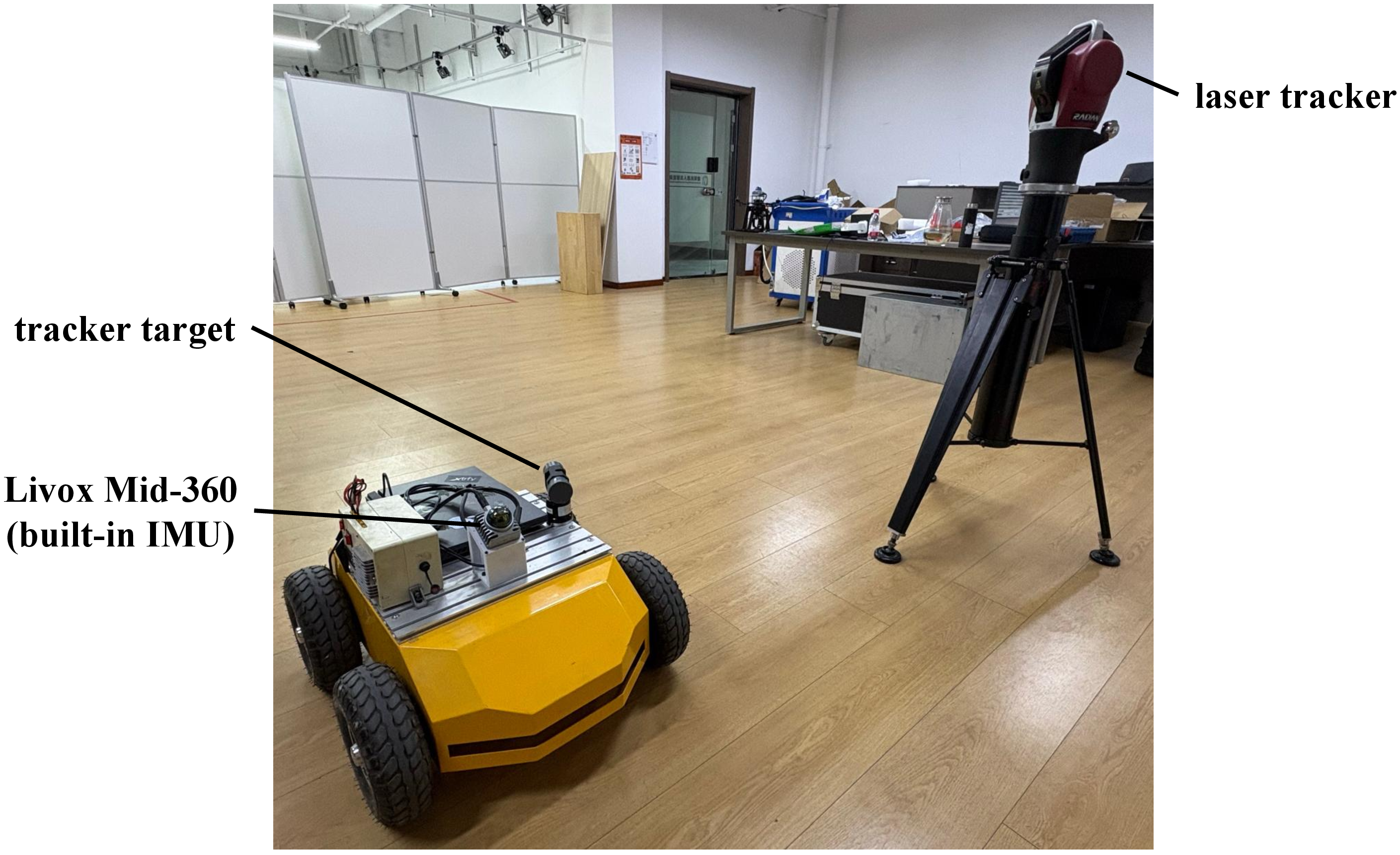
In the experiment, we first evaluate outside the exactly symmetric regime in one real building, using a position reference independent of odometry. The study covers three adjacent rooms (207–209) and two trajectories from different starts (Fig. 4); it is not a large-scale benchmark. Because the rooms are not congruent—their areas and corner counts differ—no exact translational symmetry exists, and no single period \(\tau\) describes the ambiguity.
Following the STSL front-end [2], a sliding window accumulates LiDAR-inertial scans until traveled distance reaches \(d_s\), then advances its start by a fixed step. We sweep \(d_s\in\{5,6,7\}\) m—about half the shorter room dimension—with a \(2\) m step and report both trajectories at all three scales. Every policy receives the same submaps, isolating the decision policy. Ground-truth position comes from the AT laser tracker, independent of odometry, so the committed position is scored without circularity; orientation uses a BIM-registered proxy, leaving room-level and positional conclusions on the independent reference. The as-designed BIM differs from the as-built environment (furniture, later partitions), but registration uses the persistent wall structure and the occupancy-aware score does not penalize regions occupied in the submap yet free in the BIM.
| Symbol | Meaning | Value |
|---|---|---|
| \(\delta_{xy},\delta_\theta\) | consensus grouping tolerance | \(1.5\) m, \(18^\circ\) |
| \(b_{\min},\Delta_{\min}\) | commit floors on \(B^{(1)}\), margin | \(3\), \(2\) |
| \(\sigma_{\max}\) | winner intra-group spread cap | \(3.0\) m |
| \(\tau_c\) | consistency-gate threshold | \(0.50\) |
| \(n_{\max}\) | period-shift range in the probe | \(3\) |
| \(\gamma\) | alias consistency margin | \(0.075\) |
| grid res. | room raster resolution | \(0.10\) m |
| \((\epsilon_t,\epsilon_\theta)\) | lattice fit tolerance | \(2.5\) m, \(12^\circ\) |
4pt
Trajectory 1: confident alias corrected by consensus. The trajectory follows \(209\to208\to207\to208\to209\). Its candidates immediately saturate on a multimodal set, so the state is Ambiguous from the first submap, and the first champion places the robot in the 208 alias—one room from the true 209—with a comparable score, so a single-shot policy commits to 208. On the same front-end and submaps, our layer aggregates instead: champions accumulate on 209 while the 208 alias does not recur, and the commit floor is reached at the \(8\)-th submap for \(d_s{=}6\) m. The resulting \(T^{\star}{=}(17.25,\,13.10,\,177.0^\circ)\) lies within \(0.20\) m of the AT position reference and \(0.41^\circ\) of the orientation proxy (Fig. 5). This multimodal ambiguity—distinct rooms without a period—is the non-coherent counterpart of the simulation’s lattice ambiguity.
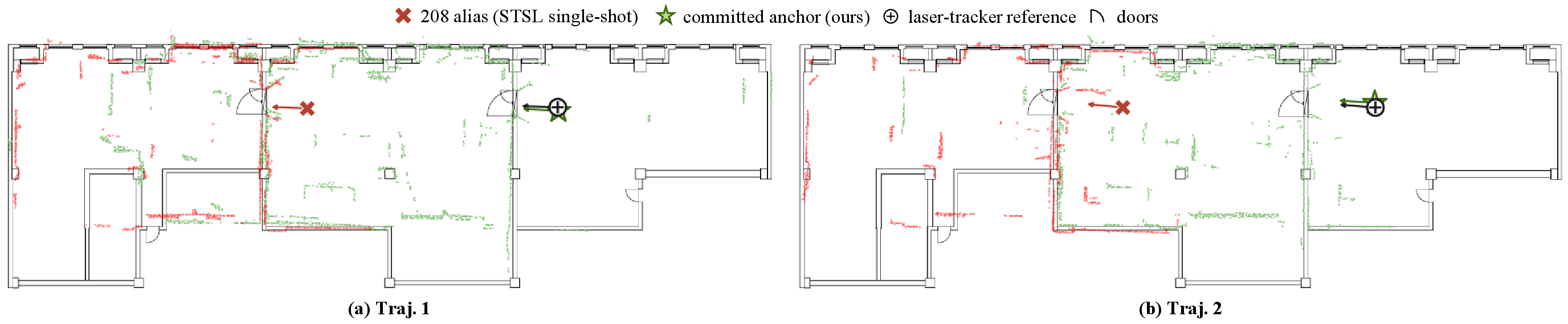
Trajectory 2: a second start location. With a different start and path through the same rooms, while keeping the front-end, submaps, and parameters fixed, the front-end again favors the 208 alias; a single-shot policy therefore commits to 208 (\(14.5\) m error). Our layer remains Ambiguous initially and commits to 209 at the \(8\)-th submap for \(d_s{=}6\) m. Its anchor, \(T^{\star}{=}(18.76,\,13.76,\,177.1^\circ)\), is within \(0.28\) m of the AT position reference and \(1.70^\circ\) of the orientation proxy. Correct commits from both starts, together with cadence-dependent windows across scales (\(k{=}4/8/6\) for Trajectory 1 at \(d_s{=}5/6/7\) m), show that the result is not specific to one path and that commit timing adapts to the rate at which evidence collapses.
Forced-choice comparison across cadences. Table ¿tbl:tab:roomda95policy? evaluates all four policies on both trajectories at \(d_s\in\{5,6,7\}\) m, giving six configurations with identical front-end outputs and submaps; only the decision policy changes. We compare ours with three forced-choice policies: single-shot (STSL top-1 on the first submap), support (the anchor with the most accumulated candidates), and confidence (commit when the top-1 lead exceeds a fixed ratio of \(1.2\), set once rather than tuned per configuration). Support and confidence are sequential and self-paced, so the comparison is not simply waiting versus acting immediately. The three policies place the anchor in a wrong room or more than a meter from the truth in \(4/6\), \(6/6\), and \(4/6\) cases, respectively; most errors span at least one room (\(8\)–\(26\) m). Their success varies with cadence and start, showing that forced selection is unstable. Our layer is correct in all six (\(6/6\)), with sub-meter errors of \(0.02\)–\(0.36\) m. Waiting longer is not sufficient: support commits latest (mean window \(18.2\) vs.our \(5.8\)) yet fails every time. Correctness therefore follows from champion rendezvous, not accumulated candidate count. The confidence policy further shows that a large top-1 margin cannot certify correctness because a symmetric alias can produce the same signal.
3pt
@llcccc@ Traj. & \(d_s\) & STSL & Support & Confidence & Ours (\(k\))
& 5 m & 209/0.24 & 209/1.25 & 209/0.18 & 209/0.36 (\(4\))
1 & 6 m & 208/14.7 & 208/14.7 & 208/8.0 & 209/0.20 (\(8\))
1 & 7 m & 208/14.9 & 209/1.28 & 209/0.13 & 209/0.27 (\(6\))
2 & 5 m & 207/22.6 & 209/7.36 & 208/21.6 & 209/0.02 (\(6\))
2 & 6 m & 208/14.5 & 208/5.60 & 208/14.5 & 209/0.28 (\(8\))
2 & 7 m & 209/0.15 & 207/25.6 & 207/25.6 & 209/0.13 (\(3\))
& 2/6 & 0/6 & 2/6 & 6/6
Selective-decision metrics. Table 2 summarizes selective behavior over the six identifiable configurations. A false commit lands in the wrong room or more than a meter from the truth. Our layer has no false commits (\(0/6\)), whereas forced-choice policies fail in \(4/6\) to \(6/6\) cases. It also achieves full correct coverage with mean commit window \(5.8\), earlier than support (\(18.2\)) and confidence (\(10.7\)), confirming that the decision criterion, rather than longer waiting, drives correctness. The symmetric simulation shows the same pattern: our layer makes no false commit in either run, whereas disabling the periodic-alias probe causes one in both. The detected period remains within \(0.09\) m of the true \(7.30\) m pitch, with mean absolute error \(0.04\) m over clean coherent detections.
| STSL | Support | Confidence | Ours | |
|---|---|---|---|---|
| Correct commit | 2/6 | 0/6 | 2/6 | 6/6 |
| False commit | 4/6 | 6/6 | 4/6 | 0/6 |
| Mean commit \(k\) | 1.0 | 18.2 | 10.7 | 5.8 |
5pt
Immunity to non-champion multiplicity. We verify C2 on real data. For Trajectory 2 at \(d_s{=}6\) m, we enlarge the candidate pool \(13\times\) at the commit window, from \(1367\) to \(17767\), by appending low-weight candidates without changing any top-1. The committed room, anchor, \(B_m\), margin, and window remain unchanged: champion rendezvous, not head-count, determines \(B_m\). This result is conditional on fixed per-submap champions and does not protect against a front-end whose top-1 is systematically biased toward one alias, as discussed in the limitations.
Component ablation on real data. On the same six configurations, the feasibility gate alone—with consensus removed and the highest-scoring feasible candidate committed—succeeds in \(2/6\) and otherwise latches at the first window onto a wrong-room alias (\(14\)–\(23\) m error): feasibility alone cannot select the truth, as several aliases may be equally feasible. Consensus alone recovers the correct room in all six (\(6/6\)), and adding the gate changes no committed anchor. As the real rooms are non-congruent and lack a sealed periodic boundary, these commits follow from champion rendezvous rather than a boundary cue. The components address distinct failures: consensus resolves uniqueness, the gate removes infeasible candidates, and the periodic-alias probe—inactive here—protects the symmetric regime examined in Section 4.2.
Threshold sensitivity. Re-running all six configurations with a permissive \((2,1)\) and a conservative \((4,2)\) floor yields correct commits in all six under all three settings, with no wrong commits and no abstentions; only the commit window shifts (for Trajectory 2 at \(d_s{=}7\) m, \(k\) moves from \(2\) to \(13\)). The default therefore lies in a stable neighborhood, not at an isolated tuned point.
4.2 Controlled Extreme Symmetry in Simulation↩︎
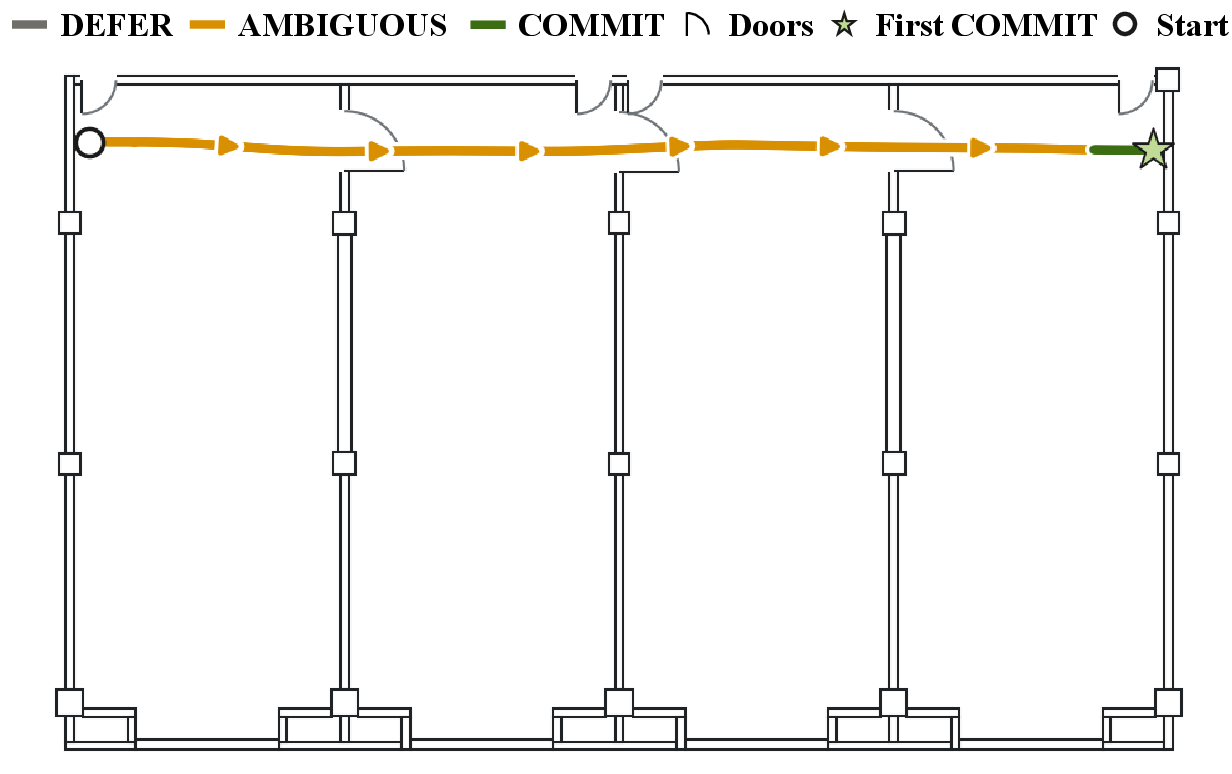
We next use Isaac Sim to isolate initialization ambiguity from other error sources. Four congruent rooms \(R_1\)–\(R_4\), with pitch \(7.30\) m, are sealed at both ends and realize the coherent regime of Proposition 1; the sealed ends provide the only symmetry-breaking structure. Furniture provides clutter absent from the BIM, so registration relies on walls alone. Because odometry closely follows ground truth, failures are geometric rather than drift-induced. Submaps match the real experiment (\(d_s{=}6\) m, \(2\) m step). The robot moves from \(R_1\) to the wall at \(R_4\) (Fig. 6); we report two runs from starts offset by \(0.3\) m.
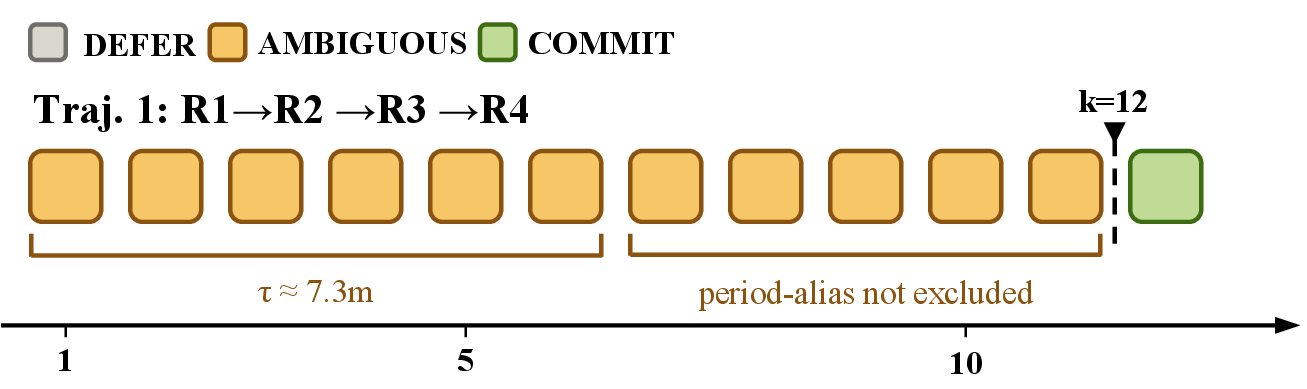
State evolution. Fig. 7 shows the state versus window \(k\) in the main run. In the symmetric interior, champions collapse onto a \(\tau\)-lattice tracking the \(7.30\) m pitch, and commitment is withheld for the first eleven windows because a one-bay alias remains possible, as Proposition 1 predicts. At the sealed wall of \(R_4\) that alias becomes infeasible, consensus rendezvouses on one anchor with a decisive margin, and the system enters Commit at \(k{=}12\) (\(B{=}7\), margin \(4\)), within \(0.21\) m and \(0.04^{\circ}\). This Ambiguous\(\to\)Commit transition realizes “Commit Later”: motion supplies the symmetry-breaking evidence needed to issue the decision.
Component check: periodic-alias probe. Disabling the probe on the same windows causes an early commit inside the symmetric interior, where a one-bay alias remains feasible: the main run commits at \(k{=}7\) rather than \(12\), selecting a neighboring bay offset by \(0.996\,\tau\)—one room and \(6.67\) m from the truth. Detecting this \(\tau\)-alias and withholding commitment, rather than relying on the gate alone, keeps the layer Ambiguous until symmetry is broken.
A second start pose. Starting \(0.3\) m away produces the same pattern: Ambiguous throughout the interior and a correct commit at the far wall (\(k{=}12\), within \(0.83\) m). Without the probe, the layer commits early two bays away (\(1.98\,\tau\), \(14.0\) m). Both runs succeed with the probe and fail at different period multiples without it, so the effect is not specific to one start; every forced error is a bay multiple, the signature of symmetry.
The simulation isolates the periodic-alias safeguard that the non-congruent real rooms cannot exercise. The layer withholds commitment in the symmetric interior, where the truth is non-identifiable and Ambiguous is the safe output, and commits only at the symmetry-breaking boundary. The forced-choice and density-immunity tests use the real building (Section 4.1), where aliases are genuine room offsets rather than an imposed period.
5 Limitations↩︎
The method and evaluation have several boundaries. The lattice detector handles only translational symmetry; rotational and mirror symmetries, such as a square room’s four aliases, remain future work. Consensus is immune to non-champion multiplicity but not to systematic top-1 bias: if a front-end repeatedly selects the same alias, champions rendezvous there, and \(B_m\) inherits rather than certifies front-end reliability. Under exact symmetry, no single-anchor method can identify the true anchor from symmetric observations alone. Our objective is therefore not to resolve symmetry within that region, but to avoid unsafe commitment until motion introduces symmetry-breaking evidence; reliance on reaching such structure is a design choice. Empirically, position uses an independent laser-tracker reference, whereas orientation uses a BIM-registration proxy that is not fully independent of the registration assessed. The evaluation covers one building, three rooms, two trajectories, and one front-end; broader validation across buildings, front-ends, and symmetry classes remains future work.
6 Conclusion↩︎
In this paper, we presented a selective LiDAR-to-BIM initialization layer that decides whether to commit an anchor rather than forcing a best guess. It aggregates a top-1 consensus over multi-submap \(\mathrm{SE}(2)\) anchors—immune to non-champion multiplicity—uses topology only as a feasibility gate, and reports a typed abstention naming the period \(\tau\) for translational lattices. Under the evaluated conditions, it commits in identifiable cases and abstains auditably when the geometry is non-identifiable, avoiding the forced-choice failures seen in the real building and exhibiting the Ambiguous\(\to\)Commit transition when motion breaks symmetry in simulation. Extending the detector to rotational and mirror symmetry, adding matched-budget baselines, and integrating the layer into a full online stack are natural next steps.
References↩︎
This work has been submitted to the IEEE for possible publication. Copyright may be transferred without notice, after which this version may no longer be accessible.↩︎
Y. Zhang, Y. Guo, J. Zheng, Z. Fan, X. Jia, and J. Liu are with the School of Mechanical Engineering, Hebei University of Technology, Tianjin 300401, China. (202421202009@stu.hebut.edu.cn; 202421202013@stu.hebut.edu.cn; 202511201004@stu.hebut.edu.cn; 202621202043@stu.hebut.edu.cn; 2010081@hebut.edu.cn; ljy@hebut.edu.cn)
Corresponding authors: X. Jia and J. Liu.↩︎