Cold-Start Model Delivery in Kubernetes Inference Serving: An Empirical Study of OCI-Based Distribution and Its Integrity
July 18, 2026
Abstract
The startup latency of a model-serving pod on Kubernetes is dominated by one step: delivering the model weights. As models grow from megabytes to the hundred-gigabyte weights of large language models, cold-start delivery time governs the economics of
autoscaling and scale-to-zero—every replica added under load pays it before serving its first request. Yet the dominant delivery mechanisms remain ad-hoc downloads from object storage, with none of the pull caching, digest addressing, or verification that
Kubernetes provides for container images. We analyze the model delivery paths available to a Kubernetes serving platform along two axes: which component pulls the artifact, and whether any admission-time verifier can bind the deployed reference to the
bytes that arrive. We validate the analysis upstream in KServe, a widely deployed Cloud Native Computing Foundation (CNCF) model-serving platform, by implementing the two missing delivery paths: an oci+native:// scheme that mounts model images
through Kubernetes image volumes (KEP-4639), merged upstream, and an oci+fetch:// scheme that pulls OCI artifacts inside the platform’s storage initializer for clusters without image-volume support, under review. We then report, to our
knowledge, the first systematic controlled comparison of model delivery paths within a Kubernetes serving platform—modelcar sidecars, native image volumes, and object-storage download; oci+fetch://, still under upstream review, shares the
initializer data path and is left to future measurement—on artifacts sized to the fp16 weights of 1B-, 7B-, and 70B-parameter models (2–140 GB), measuring cold- and warm-start time-to-first-prediction, per-phase latency, and node storage overhead.
Node-cached OCI delivery makes warm replica addition size-independent—11.7 s for a 70B-class artifact versus 40.7 minutes of object-storage re-download, a \(208\times\) difference—while the first cold pull costs up to \(2\times\) a plain download, a trade-off we localize to containerd’s blob-write-then-unpack double pass. Efficient delivery still leaves a trust gap: for models that remain loose objects on s3://,
gs://, or hf:// URIs, no admission-time verifier ever observes the bytes. We therefore complement the distribution work with a serving-time integrity design proposed to the KServe community—digest pinning and Open Source Security
Foundation (OpenSSF) model-signing enforcement in the storage initializer, the last platform-owned component on the data path—and show that hashing the artifact while it downloads adds under 0.1% to delivery time, whereas a post-download verification pass
adds up to 53%.
Cloud computing, Kubernetes, machine learning systems, model serving, OCI artifacts, software supply-chain security, model signing.
1 Introduction↩︎
Serving a machine-learning model on Kubernetes begins with moving its weights. Before an inference pod can answer its first request, the model artifact—megabytes for classic predictive models, up to hundreds of gigabytes of fp16 weights for large language models—must travel from wherever it is stored to the node that will serve it. That delivery step dominates cold-start latency, and cold-start latency governs the economics of GPU serving: how aggressively a fleet can scale to zero, how fast it can scale out under load, and how much expensive accelerator time is spent waiting for bytes rather than serving requests. Every replica added by an autoscaler pays the delivery cost in full before it contributes a single prediction.
Yet in the dominant deployment pattern the model travels the least-engineered path in the stack. The model is not in the container image: a serving platform such as KServe [1] materializes an inference pod whose init container—the storage initializer—downloads the model at startup from an object store or model hub (s3://, gs://, hf://,
https://) and hands the bytes to the model server. The split is operationally sensible: models are re-trained on a different cadence than serving code, they are large, and they are produced by different teams. But the consequences compound at
LLM scale. The artifact is re-downloaded on every pod start because nothing on the node caches it; it is copied at least once more on its way to the server; and every added replica multiplies both costs. Container images solved these exact problems years
ago—kubelet-managed pulls, node-level caching, content-addressed storage—and that machinery has recently become applicable to models: Kubernetes image volumes (KEP-4639 [2]), stable since v1.36, let a pod mount an arbitrary OCI image as a read-only volume, and packaging efforts such as CNCF ModelPack [3] and KitOps [4] standardize how models are laid out inside OCI images. What has been missing is the serving-platform half:
making the standard model-serving control plane treat OCI-packaged models as a first-class storage source.
Delivery efficiency, however, is only half of the story: the container ecosystem also gives images a trust apparatus that models entirely lack. A container image is addressed by a cryptographic digest, its provenance can be attested with in-toto
metadata [5] and signed with Sigstore [6], and cluster
operators enforce those signatures before the pod is scheduled with admission controllers such as Kyverno [7] or the sigstore
policy-controller [8]; frameworks like SLSA [9] grade the rigor of the whole pipeline. The model’s download path has none of this: it is addressed by a mutable reference, verified against nothing, and performed after every admission decision has already been made. A
compromised bucket, a re-pointed model-hub revision, or a man-in-the-middle on an https:// pull all end the same way: the pod starts and serves unverified weights. Any redesign of model delivery should therefore answer for both properties at
once—how fast the bytes arrive, and how they can be trusted.
This paper describes work on both halves of that problem, carried out upstream in KServe within a community roadmap to harmonize OCI model support (issue #4083). We make four contributions:
An analysis of the model delivery design space. We characterize the delivery paths available to a Kubernetes serving platform along two axes—which component pulls the artifact (which determines caching and copy behavior, hence cold-start cost), and whether an admission-time verifier can bind the deployed reference to the arriving bytes—and derive a placement rule for integrity enforcement (Section 3, Table 1). The axes are platform-generic; KServe is our implementation and measurement vehicle.
Upstream validation: two new delivery paths. We designed and implemented the two previously missing points in that design space: the
oci+native://scheme, which materializes a model image as a Kubernetes image volume mounted directly into the inference container—no sidecar, no init-container copy, kubelet-managed pull and cache—merged upstream (PR #5558), with compatibility handling across the image-volume API maturity window; and theoci+fetch://scheme (PR #5739, under community review), which pulls OCI artifacts inside the storage initializer itself, runtime-agnostically (Section 3).Measurement. To our knowledge we report the first systematic, controlled comparison of model delivery paths within a Kubernetes serving platform; no such data has, to our knowledge, been published for any of these paths. The comparison covers modelcar,
oci+native://, ands3://download (three of the four design-space paths;oci+fetch://is not yet merged and is left to future measurement), on artifacts sized to the fp16 weights of 1B-, 7B-, and 70B-parameter models (2, 14, and 140 GB), cold and warm, with per-phase startup latency, kubelet pull time, and node storage overhead (Section 5).Serving-time integrity for non-OCI URIs. Applying the placement rule to the models that remain loose objects on blob storage—where no admission-time component ever observes the bytes—we present a verification design proposed to the KServe community (RFC #5789): digest pinning and OpenSSF model-signing [10] enforcement in the storage initializer, the integrity counterpart of the platform’s merged confidential-serving support, with its key feasibility question answered by a streaming-hash microbenchmark (Section 4, Section 5).
We conclude with lessons for evolving the supply-chain posture of a large CNCF project incrementally (Section 6). The benchmark harness and all measurement data are open source at https://github.com/kliukovkin/oci-model-delivery-bench.
2 Background and Related Work↩︎
2.1 KServe and the model delivery problem↩︎
KServe is a widely deployed CNCF (incubating) model-inference platform for Kubernetes: an InferenceService custom resource describes a model to serve, and controllers materialize the serving stack around it. The part of that stack relevant
here is model delivery. Each InferenceService names its model with a storageUri; a webhook injects a storage initializer init container that resolves the URI scheme (s3://, gs://,
hf://, https://, …), downloads the artifact to a shared emptyDir volume, and exits before the model server starts. The storage initializer is thus the single platform-owned component that observes every downloaded
model byte—a property that both the confidential-serving work discussed below and our integrity proposal build on.
KServe’s first OCI-based alternative is the modelcar pattern: the model is packaged into a container image under /models/, and the platform runs that image as a sidecar container in the inference pod, sharing its filesystem with
the model server. Modelcar demonstrated the appeal of OCI distribution for models—registry infrastructure, layer dedup, image pull caching—but pays for it with a permanently resident sidecar per pod and container-runtime plumbing that predates
purpose-built kernel and runtime support for artifact mounting. A community roadmap (issue #4083) set out to harmonize modelcar with the newer alternatives that this paper implements.
2.2 OCI artifacts and Kubernetes image volumes↩︎
The OCI image and distribution specifications have evolved from “container image format” into a general content-addressed artifact ecosystem, and Kubernetes has followed: KEP-4639 [2] introduces the image volume source, letting a pod mount an arbitrary OCI image as a read-only volume. The feature graduated deliberately: alpha in v1.31, beta (still feature-gated) in v1.33, enabled by
default in v1.35, and stable in v1.36; containerd supports it from v2.1 (v2.2 for subPath mounts) and CRI-O from v1.31. Image volumes carry exactly the properties the model-delivery path lacks: kubelet-managed pull with node-level caching,
digest-addressable references, and—critically for supply-chain enforcement—presence in the pod specification, where admission controllers can in principle verify the reference before scheduling (Section 2.3 discusses how far today’s tooling actually goes). Section 3 describes how oci+native:// maps model delivery onto this primitive and what compatibility
handling that multi-release API maturity window required. A rich systems literature optimizes container image distribution itself—lazy pulling, deduplication, and registry design, from Slacker [11] onward; it measures rootfs provisioning for containers, not the delivery of model artifacts whose paths differ in admission visibility, which is the axis this paper is about.
2.3 Model packaging and supply-chain security↩︎
2.3.0.1 Packaging.
CNCF ModelPack [3] specifies how models, tokenizers, and metadata are laid out as OCI artifacts; KitOps [4] provides tooling that packages models as signed “ModelKits,” and has recently been positioned as a route to verified inference on KServe itself [12]. These efforts answer how a model becomes a (signed) OCI artifact, and their route to verification requires repackaging. They are complementary to this paper, which answers how the serving platform delivers such artifacts (Section 3) and how it can verify the majority of models that are not repackaged at all (Section 4).
2.3.0.2 Signing and verification.
in-toto [5] and Sigstore [6] established general
software-artifact provenance and signing; SLSA [9] frames them into pipeline maturity levels. For ML specifically, the OpenSSF Model Signing (OMS)
specification [10] defines a sigstore-bundle-based signature format over file-level hashes of a model directory, with keyless and key-based flows;
producer-side adoption is real—NVIDIA signs its NGC catalog models with OMS [13]—but serving-side enforcement on the download path remains manual.
The closest system to our proposal is the sigstore model-validation-operator [14], an admission webhook that injects an OMS-verification init container into
labeled pods, shipped downstream in Red Hat Trusted Artifact Signer [15]. It is deliberately platform-agnostic, and that is precisely its limit: it verifies
already-materialized volumes on pods it is pointed at, with no knowledge of the serving platform’s storageUri schemes, download code path, status conditions, or per-namespace policy surface, and it offers no digest-pinning mode. Section 4 argues for first-party enforcement inside the platform’s own storage initializer—the component that performs the download the operator never sees—and Section 2.3 returns to
what admission-based tools can and cannot bind. At the research end, Atlas [16] attests the full ML lifecycle with transparency logs and trusted hardware; our
design is narrower and deployable today: one enforcement point, standard formats, no new infrastructure. On the Kubernetes side, admission-based verifiers—Kyverno image-verification policies [7] and the sigstore policy-controller [8]—verify image references present in the pod
spec, and today require custom configuration to extract even image-volume references. For artifacts fetched by the storage initializer (s3://, gs://, hf://, and oci+fetch://), the reference
appears in the pod spec only as opaque init-container arguments: it is not content-addressed, no image verifier extracts it, and—decisively—no admission-time component can observe the bytes the initializer will later download. Binding those bytes to a
digest can only happen on the data path. This is the precise gap Section 4 addresses.
2.3.0.3 Confidentiality precedent.
KServe recently merged confidential model serving (PR #5382): the storage initializer detects JWE-encrypted artifacts on the same non-OCI URI schemes and decrypts them inside a trusted execution environment. This established the storage initializer as the accepted enforcement point for security properties of downloaded models. Confidentiality answers who can read the artifact; the integrity design in Section 4 is its missing counterpart—is this artifact the one the operator signed off on—on the same code path.
2.3.0.4 Attacks.
The supply-chain relevance of serve-time artifacts is not hypothetical: compromise classes demonstrated for software dependencies [17] transfer directly to models, and recent surveys of ML supply-chain security [18] catalogue model-replacement and hub-compromise incidents. We defer a full threat model to Section 4.
3 OCI-Native Model Distribution↩︎
3.1 Design space↩︎
Once a model is packaged as an OCI image, a Kubernetes serving platform has three structurally different ways to get its bytes in front of the model server, summarized in Table 1 alongside the object-storage baseline. They differ along two axes that matter for the rest of this paper: who performs the pull (the kubelet/container runtime vs.platform code) and whether the artifact reference appears in the pod specification, which determines whether admission-time supply-chain tooling can see it.
| Path | Scheme | Pulled by | Node cache | Admission-verifiable | Cluster requirements |
|---|---|---|---|---|---|
| Modelcar sidecar | container runtime | yes | yes | any Kubernetes | |
| Image volume | kubelet (KEP-4639) | yes | yes | K8s \(\geq\)v1.33*, ctrd \(\geq\)v2.1 / CRI-O \(\geq\)v1.31 | |
| Initializer OCI pull | storage initializer | no | no | any Kubernetes, registry egress | |
| Object storage | s3://, gs://, hf:// | storage initializer | no | no | any Kubernetes |
| *With the ImageVolume feature gate on 1.31–1.34 (default-on from 1.35, stable 1.36); subPath mounts require \(\geq\)1.33. K8s = Kubernetes, ctrd = containerd. See Section [sec:sec:ocinative]. | |||||
4pt
The modelcar pattern (Section 2.1) predates both new schemes and established the image layout convention—model files under /models/ inside the image—that the new paths deliberately preserve, so a single
model image works unmodified across all three OCI modes. Scheme selection follows the same philosophy: a cluster-wide ociModelMode default in the platform configuration maps plain oci:// URIs to one of the modes, while the
explicit oci+native:// and oci+fetch:// schemes override the default per service. Operators migrate incrementally; individual teams opt in early.
3.2 oci+native://: models as image volumes↩︎
The oci+native:// implementation (merged upstream; PR #5558) maps model delivery onto the KEP-4639 image volume source. At admission time, the platform webhook rewrites the pod: the storageUri becomes a
spec.volumes[].image.reference, and the inference container receives a read-only mount of that volume at the model path with subPath: "models", preserving the modelcar layout convention. No init container is injected—the storage
initializer is bypassed entirely—and no sidecar runs. The kubelet pulls the image through the container runtime exactly as it pulls the serving image itself, which yields three properties the download paths lack: node-level caching across pod restarts and
replicas, digest-addressable references with the runtime’s existing content-addressed store, and a reference in the pod spec that admission controllers can verify before the pod is scheduled.
Two design decisions are worth recording. First, graceful degradation across the API maturity window: the image-volume API spans four distinct capability regimes across Kubernetes releases—alpha and gate-required on 1.31–1.32 (where
subPath mounts are additionally rejected), beta but still gate-required on 1.33–1.34, default-on from 1.35, stable in 1.36. Rather than failing pod creation with an opaque API error, the controller detects the cluster’s regime and surfaces an
advisory OciImageVolumeCompatible condition on the InferenceService, telling the operator exactly which capability is missing. Compatibility handling of this kind is unglamorous but was a precondition for merging: the platform
supports clusters spanning several Kubernetes minor versions.
Second, bypassing the storage initializer is a feature and a liability. It removes an entire copy of the artifact from the startup path (Section 5 quantifies this), but it also means any future verification logic
living in the initializer will never see oci+native:// artifacts. We return to this boundary in Section 4: for image volumes, integrity enforcement belongs at admission, where the reference is visible and
mature tooling exists.
3.3 oci+fetch://: portable OCI pull↩︎
Image volumes require a recent runtime; many production clusters will lack them for years. oci+fetch://(PR #5739, under review at the time of writing) covers that gap: the storage initializer itself resolves the image reference, pulls the
layers from the registry, and extracts the /models/ tree—no container runtime involvement, no cluster version requirement, and compatibility with air-gapped registries. The trade-offs invert: the artifact is re-fetched per pod start (no node
cache), and the reference reaches the pod spec only as an opaque argument to the initializer, not as an image field any admission verifier extracts.
That last property deserves emphasis because it is easy to miss: oci+fetch:// is the only OCI delivery path for which no admission-time verifier can bind the bytes. Kyverno or policy-controller can verify modelcar and
oci+native:// references because both appear as image references in the pod spec and the same runtime that admission vouched for delivers the content; for oci+fetch://, platform code fetches the bytes after every admission
decision is made. Any integrity guarantee for it must be enforced where the bytes flow—inside the storage initializer—which makes it a natural early adopter of the verification design in Section 4, alongside the
object-storage schemes it shares that code path with.
4 Serving-Time Integrity for Non-OCI Storage↩︎
The OCI paths of Section 3 inherit the container ecosystem’s verification story. Everything else does not—and “everything else” is the prevailing deployment pattern, as the platform’s documentation and defaults
reflect: models referenced as loose objects on s3:// and gs:// buckets or hf:// hub revisions. For these, the storage initializer downloads whatever bytes the remote endpoint returns. This section summarizes the
verification design we have proposed to the KServe community (RFC #5789); it is a design under review, not merged work, and we present it as such.
4.1 Threat model↩︎
We assume the InferenceService specification and cluster policy are trusted—an attacker who can rewrite the spec defeats any artifact-level mechanism and is admission/RBAC territory—while the remote storage endpoint and the network path are
not. We additionally trust the Kubernetes control plane, the node, the container runtime, and every container that shares the inference pod: verification happens once, at initialization, and the verified bytes then sit on a volume shared within the pod, so
a malicious co-located sidecar or an operator with pods/exec could modify them after the check (a time-of-check/time-of-use window). The design mitigates but does not close this window—the model volume is mounted read-only into the server
container, and co-located containers are the cluster policy’s problem by assumption; continuous re-validation, as prototyped by the model-validation-operator’s sidecar mode [14], is future work. Note also that init containers do not re-run when only the main container restarts, so cached contents are re-consumed unverified within the pod’s lifetime—another reason verification state must be
keyed on content digest, never on URI (Section 4.2).
Under that model, the two mechanisms serve different purposes. Digest pinning (an expected digest declared in the spec, checked against the downloaded bytes, failing closed) defends against artifact mutation, stale or re-pointed references, corruption, and compromised storage. Because a model is typically a directory, the pin is defined over the artifact’s file-level hash manifest—in the limit, the digest of its OMS statement—not over an ill-defined concatenation of bytes. Signature verification is the stronger provenance mechanism: it defends against artifact replacement even when the storage location and any metadata beside the artifact are attacker-controlled, by requiring the bytes to verify against a signature from an allowed identity or key. Alone, however, it verifies provenance, not intent: any artifact ever signed by the allowed identity passes, so an attacker controlling storage can substitute an older signed revision (a rollback/freeze attack, in The Update Framework (TUF) terms [19]) or a different model signed by the same release identity. The policy therefore binds the expected statement subject—model name and, where available, version—in addition to the signer identity, and we track freshness requirements as an open question.
4.2 Design↩︎
The proposal deliberately invents no cryptography and no format. Signatures are OpenSSF Model Signing bundles [10]—Dead Simple Signing Envelope (DSSE) payloads over in-toto statements with file-level hashes, supporting keyless (OpenID Connect (OIDC) identity via Fulcio/Rekor) and key- or certificate-based flows; air-gapped clusters use the key/certificate flows against a private trust configuration, since keyless verification requires reaching the public transparency infrastructure. The platform consumes the emerging standard; it does not compete with it.
Verification runs inside the storage initializer, after download and before handoff to the model server—the same stage where the merged confidential-serving support performs TEE-based decryption. The symmetry is deliberate: confidentiality and integrity
are the two halves of one model-security story on one code path. An optional verification block on the model spec carries the expected digest and/or signature policy (bundle location, pinned identity and issuer, or key reference). Failure
behavior is policy, with deliberately asymmetric semantics. In enforce mode the init container exits non-zero and the pod never starts serving—and it fails closed on every verifier error, not only on mismatch: a missing bundle, an
unreachable trust root, or a crashed verifier must block startup, because an attacker who controls storage can trivially delete the signature beside the artifact. warn mode starts the pod and surfaces the result as an
InferenceService status condition, an event, and a metric; it is a time-boxed migration state for existing fleets and provides no integrity guarantee—under this threat model it must not be mistaken for a security control. Policy resolves per
namespace over a cluster-wide default so a platform team can ratchet enforcement one tenant at a time, with the namespace override settable only through cluster-scoped RBAC (otherwise a careless tenant silently downgrades itself). The same discipline
applies to the platform’s own delivery pipeline: while upstreaming this work we fixed two races in the project’s CI install path that could validate against a half-started control plane (PR #5770, PR #5784)—a policy feature that silently fails open in CI
is worse than no policy feature at all. Enforce mode also hands a storage-level attacker a startup denial-of-service; we consider that the correct trade-off and say so explicitly.
4.3 Non-goals and boundaries↩︎
Three exclusions keep the design small and are themselves findings about where enforcement belongs. Modelcar and oci+native:// are out of scope: their references are admission-verifiable (Table 1), the
runtime that admission vouched for delivers their content, and image-signature tooling covers them in principle today, and in practice once verifiers extract volumes[].image references—a configuration gap, not an architectural one; duplicating
that check inside the platform would create two half-trusted enforcement points. oci+fetch:// is architecturally in scope—it transits the initializer and nothing else can see it—but is deferred to a follow-up to keep the initial surface small.
Packaging-side workflows (ModelPack, KitOps ModelKits) are complementary: they can produce signed artifacts, which this design then enforces at serve time—an enforcement path that also covers the majority of models that are never
repackaged at all.
Open questions tracked in the RFC include the interaction of signature subjects with encrypted artifacts (verify ciphertext vs.verify plaintext: different guarantees, different signing pipelines), digest pinning against mutable hf://
revisions, freshness requirements against rollback (Section 4), verification caching across pod restarts (keyed on content digest, never URI), and whether hashing should stream during download rather than run as a
second pass. The last question is empirical, and Section 5 answers it.
5 Evaluation↩︎
We evaluate two questions: (1) how do the delivery paths of Table 1 compare on startup latency and storage cost as artifact size grows, and (2) is streaming hash verification cheap enough to make the Section 4 design’s enforce mode practical on the download path? To our knowledge this is the first systematic, controlled comparison of model delivery paths within a Kubernetes serving platform; the container-image
distribution literature (Section 2) measures a different object.
5.1 Methodology↩︎
All experiments run on a dedicated cloud VM (AWS m6i.2xlarge: 8 vCPU Intel Xeon Platinum 8375C, 32 GB RAM, us-east-1) with a 1 TB gp3 EBS volume at its baseline provisioning (3,000 IOPS, 125 MiB/s), Ubuntu 24.04 (kernel 6.17), Docker
29.1.3, and a single-node kind v0.32.0 cluster (Kubernetes v1.36.1, containerd 2.3.1, image volumes enabled), with a colocated OCI registry and in-cluster MinIO as the S3 endpoint—eliminating WAN variance so that differences reflect the
delivery architecture rather than network variability. The provisioned disk throughput is a ceiling shared identically by every path; absolute times scale with it, and the object of study is the relative behavior of the paths on equal hardware. KServe is
built from source at upstream commit dbf6cfe. Artifacts of 2, 14, and 140 GB—sized to the fp16 weights of representative 1B-, 7B-, and 70B-parameter models—combine a real (tiny) scikit-learn model—so that readiness reflects a genuine server
load—with random ballast, packaged identically as an OCI image (single layer, /models/ layout) and as loose objects in a bucket. (The measured quantity is the delivery path, which depends on artifact bytes, not parameter count; the tiers name
the model classes those byte sizes correspond to.) Random ballast is representative, not a shortcut: production fp16/bf16 weights are already near-incompressible, so compression-based transfer optimizations help neither. Each cell reports the median over
10 runs (5 for the I/O-bound 140 GB tier). Interquartile ranges are within 7% of the median everywhere except the S3 140 GB cells (14% cold, 35% warm), a spread consistent with the storage-initializer restarts we observed under memory pressure (Section 6), which inflate upper quartiles but not medians; individual outlier runs of up to \(+84\%\) of the cell median occur across the matrix (full per-run data in the released artifact); on
the warm oci+native:// cells the absolute IQR is below 0.8 s. Phase timings are wall clock with 0.2 s polling resolution (the integrity microbenchmark of Section 5.4 uses its own in-process timers).
Cold removes the model image from the node’s containerd store before the run; warm starts with it cached. For the S3 path the “warm” condition re-downloads the artifact—there is no node-level cache on this path, and that asymmetry is
precisely the architectural property the OCI paths exist to change, so we report it as data rather than omitting it. KServe’s optional LocalModelCache subsystem can pre-warm object-storage models onto dedicated node groups; it requires
pre-warming controllers and node-group configuration orthogonal to the delivery-path taxonomy measured here, and we scope it out. The harness and raw data are available at the repository cited in Section 1.
5.2 Time to first prediction↩︎
| Artifact size | ||||
|---|---|---|---|---|
| 3-5 Path | Mode | 2 GB | 14 GB | 140 GB |
| cold | 38.6 | 443.4 | 4,585.5 | |
| warm | 11.5 | 11.4 | 11.7 | |
| modelcar | cold | 59.6 | 363.3 | 4,603.0 |
| warm | 15.4 | 15.2 | 15.8 | |
| s3:// | cold | 39.6 | 137.8 | 2,318.8 |
| warm | 30.0 | 128.4 | 2,441.6 | |
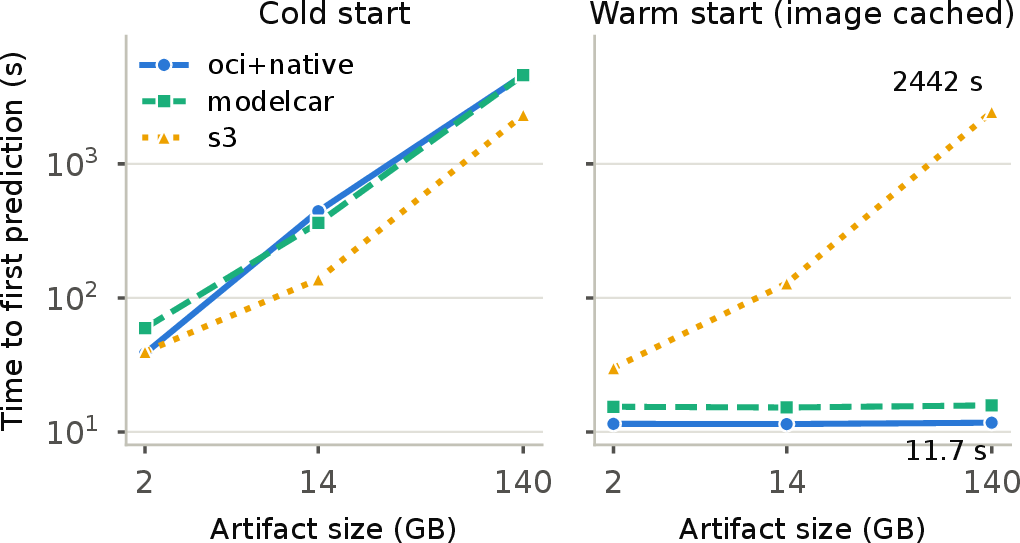
Table 2 and Fig. 1 give the headline result. Warm starts on the OCI paths are size-independent. With the model image in the node’s containerd store, oci+native://
reaches first prediction in 11.4–11.7 s whether the artifact is 2 GB or 140 GB; modelcar tracks it at 15.2–15.8 s, the constant \(\sim\)4 s gap being sidecar lifecycle overhead. The S3 path has no node cache to warm: every
pod start re-downloads, so its “warm” number grows linearly from 30.0 s to 2,441.6 s. At the 70B-class tier, adding a replica on a node that has served the model before costs 11.7 s with oci+native:// versus 40.7 minutes over object
storage—a \(208\times\) difference (\(155\times\) for modelcar). This is the number that governs autoscaling: replicas added under load are overwhelmingly scheduled onto nodes that
have already pulled the image.
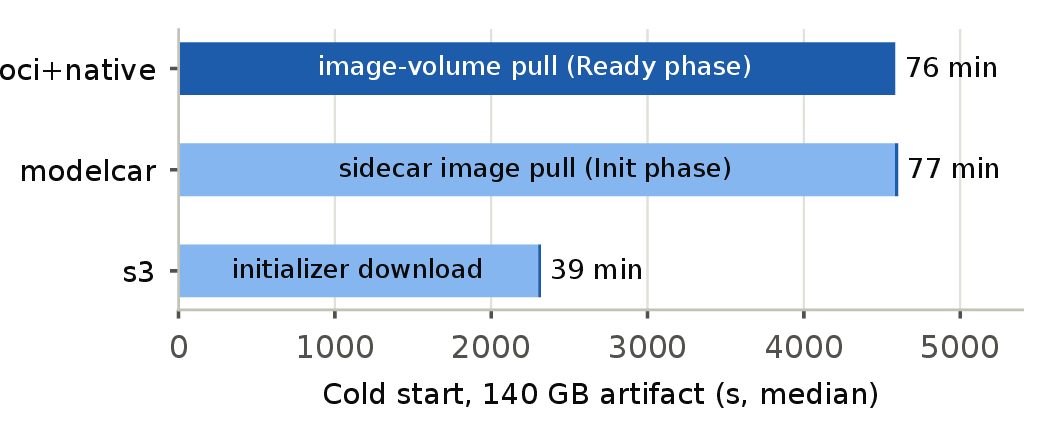
The cold column tells the honest other half. First-pull cost on the OCI paths is roughly \(2\times\) a plain download at the 140 GB tier (4,585.5 and 4,603.0 s versus 2,318.8 s), and 2.6–3.2\(\times\) at 14 GB, where the S3 path additionally benefits from the page-cache effect discussed below. The mechanism is visible in the phase breakdown (Fig. 2) and in the kubelet-reported pull
durations, which account for essentially the entire gap: a containerd image pull writes the layer blob to the content store and then unpacks it into a snapshot —two passes over the same disk—whereas the storage initializer streams the object into the pod
volume once. (At the 14 GB tier the initializer path additionally benefits from the colocated MinIO’s page cache; at 140 GB, four times RAM, that advantage disappears and the \(2\times\) ratio is the durable one.) At 2 GB
the ordering inverts —oci+native://(38.6 s) edges out S3 (39.6 s) and modelcar pays its sidecar overhead (59.6 s)—because fixed per-pod costs dominate transfer time. The practical rule for operators follows directly: the OCI paths win
wherever a node serves more than one replica of a model over its lifetime, and lose only the very first pull—and the first pull is exactly what lazy-pulling and compression research on container images [11] knows how to attack (Section 6).
5.3 Storage overhead↩︎
Across the OCI paths, a cold start grows the node’s containerd store by approximately the artifact size (within 5% at the 14 and 140 GB tiers; the 2 GB tier additionally carries \(\sim\)0.7 GB of fixed image overhead),
retained across pod restarts—that retention is the warm-start cache. The S3 path leaves no persistent node state, but materializes a full transient copy of the artifact in the pod’s emptyDir on every start: at the 140 GB tier
each concurrent replica requires 140 GB of free node disk in addition to any cached images, and the copy is re-paid on every restart. Neither path is free; they differ in whether the space buys anything (a reusable cache) or is pure per-replica
overhead.
5.4 Cost of integrity verification↩︎
| 2 GB | 14 GB | 140 GB | |
|---|---|---|---|
| Plain download (s) | 1.4 | 190.3 | 2,220.4 |
| Streaming hash (s) | 2.3 | 190.4 | 2,219.8 |
| overhead | — | +0.05% | \(<\)0.1% |
| Post-download hash (s) | 3.3 | 203.6 | 3,406.8 |
| overhead | — | +7.0% | +53.4% |
Table 3 answers the feasibility question Section 4 left open. Hashing the artifact while it downloads is free at any scale that matters: within \(\pm\)0.1% of the plain download at both 14 and 140 GB—SHA-256 throughput on one core far exceeds the disk- and network-bound download rate, so the hash hides entirely inside the transfer. Verifying after download, as a
separate pass, costs +7.0% at 14 GB and +53.4% at 140 GB: the re-read no longer fits the page cache and becomes a second full pass over the disk. (The 2 GB tier is sub-4-second and page-cache-dominated—its download-time variance across variants exceeds the
hashing cost being measured; we report it for completeness but draw conclusions from the larger tiers.) The design consequence for RFC #5789 is unambiguous for the digest-pinning half of the design: verification in enforce mode should stream
during download, where its cost is measurement noise, and must not be implemented as a post-download pass, where it adds half again to LLM-scale delivery time. The signature-verification half adds cryptographic and, in keyless mode, network costs
(Fulcio/Rekor round trips) that are independent of artifact size and remain to be measured.
6 Discussion and Lessons↩︎
6.0.0.1 Incrementalism as a security strategy.
None of this work landed as a big-bang redesign. The distribution schemes arrived as steps of a community umbrella plan (issue #4083) whose earlier step (modelcar) had already normalized OCI models; the integrity proposal explicitly mirrors a merged confidentiality feature on the same code path. In a large CNCF project, we found that the fastest route to a stronger supply-chain posture is to identify the enforcement point the project has already accepted (here, the storage initializer) and extend its guarantees, rather than to introduce a new privileged component. The same logic dictated what not to build: admission-visible paths stay with admission tooling.
6.0.0.2 The boundary is the finding.
The most consequential fact in Table 1 is a negative one: for two of the four delivery paths, no admission-time component can bind the deployed reference to the bytes that arrive—not because the reference is hidden (it sits in the pod spec as initializer arguments), but because nothing at admission time observes the download. Admission policy can go surprisingly far with external lookups—resolve a mutable URI, consult a signature service, even mutate the spec to pin a digest—but resolution at admission and download at pod start are separated in time, and a mutable reference can change between them; only a data-path component closes that window. As OCI packaging pushes models toward image volumes it is tempting to declare the problem solved at admission; the prevalence of initializer-path deployments says otherwise. Platform designers should treat “which component can bind the bytes” as the primary question when placing verification, not “which component has the best tooling today.”
6.0.0.3 Initializer paths carry hidden operational cost.
Beyond latency, running the download inside a pod-level init container means the download’s resource envelope is the operator’s problem: at the 140 GB tier the storage initializer exceeded the memory limits our deployment had provisioned (sized, like the platform defaults, for classic model sizes) and was OOM-killed until its limit was raised \(4\times\). The kubelet pull path has no such knob—the runtime manages its own resources. This is a second, quieter argument for kubelet-managed delivery at LLM scale, and an operational checklist item for anyone staying on the initializer path.
6.0.0.4 Limitations and future work.
Our evaluation is single-node and LAN-local by design; multi-node image distribution, registry-side rate limits, and layer-parallel pulls (our artifacts are single-layer) remain unmeasured, and absolute times are bounded by the provisioned disk
throughput shared by all paths. Our time-to-first-prediction measures artifact delivery: the serving payload is a small classical model, so GPU inference-engine initialization (weight loading, tensor-parallel setup), which is additive and
delivery-independent for LLM servers, is out of scope. The colocated object store’s page cache flatters the S3 path at the 14 GB tier (Section 5.2); the 140 GB tier is cache-free and carries the durable ratios. The
\(2\times\) cold-pull penalty is not fundamental: zstd layers, lazy-pulling (eStargz/SOCI-style [11]), and multi-layer
parallelism all attack the blob-write-then-unpack double pass and are natural follow-ups on the oci+native:// path. The integrity design is under community review and may change; its signature-verification stage depends on the OpenSSF
model-signing format’s evolution. Digest pinning does not yet handle mutable hf:// revisions well. oci+fetch:// verification—the path that needs it most—is specified but deferred to a follow-up.
7 Conclusion↩︎
Model artifacts lag container images in supply-chain treatment: mutable references, unverified downloads, weak policy hooks. This paper reports an effort to close that gap in a widely deployed CNCF serving platform from both ends. On the distribution
end, the merged oci+native:// scheme gives models kubelet-managed delivery with digest semantics and admission-verifiable references via Kubernetes image volumes, and oci+fetch:// (under review) extends OCI delivery to clusters
that cannot use them; our measurements provide, to our knowledge, the first systematic basis for choosing among a serving platform’s delivery paths. On the verification end, a serving-time integrity design proposed to the community—digest pinning and
OpenSSF model-signing enforcement at the storage initializer—covers the object-storage models that no admission-time verifier can bind, at a streaming-verification cost Section 5 quantifies. The through-line is a simple
design rule: put enforcement where the reference is verifiable when you can, and where the bytes flow when you must.
Acknowledgment↩︎
The author thanks the KServe maintainers and reviewers whose feedback shaped the upstream implementations discussed here. This work received no external funding. Disclosure: the author is the implementer of the oci+native:// and
oci+fetch:// schemes and the author of RFC #5789; the benchmark harness, raw data, and analysis scripts are released precisely so that these results can be independently reproduced. In accordance with IEEE policy on artificial-intelligence
tools, the author discloses that AI-based assistants were used in developing the benchmark tooling and analysis scripts and in editing the manuscript; the study design, upstream contributions, validation of all results, and responsibility for the content
rest with the author.
Georgii Kliukovkin is a software engineer specializing in the efficiency of large-scale retrieval, ranking, and model-serving systems, and an open-source contributor to CNCF projects, including KServe, where he authored the platform’s OCI-native model delivery paths. His interests include machine-learning serving infrastructure, model delivery, and software supply-chain integrity.
References↩︎
G. Kliukovkin is an independent researcher and KServe contributor (e-mail: kliukovkin@gmail.com). Corresponding author: G. Kliukovkin.↩︎