Xiaomi-Robotics-1: Scaling Vision-Language-Action Models
with over 100K Hours of Real-World Trajectories
July 16, 2026
1 Introduction↩︎
The remarkable capabilities of modern large models are fundamentally driven by scale, where massive and diverse training corpora have underpinned unprecedented leaps in performance for both large language models [1]–[4] and vision-language models [5]–[8]. Recent work on vision-language-action (VLA) models [9]–[15] and world-action models (WAM) [16]–[18] has produced increasingly promising results in robot manipulation, with early evidence that policies become more capable and generalizable as the training data grows in scale and diversity. Following the same scaling trajectory of large models is therefore a natural and appealing direction for robotics. However, robotics is hindered by a unique bottleneck of data. The dominant data collection paradigm, real-robot teleoperation, is slow, costly, and hardware-bound, making it difficult to scale. Furthermore, teleoperated data tends to be highly redundant, concentrated on a narrow slice of tasks and environments, limiting the diversity of the data.
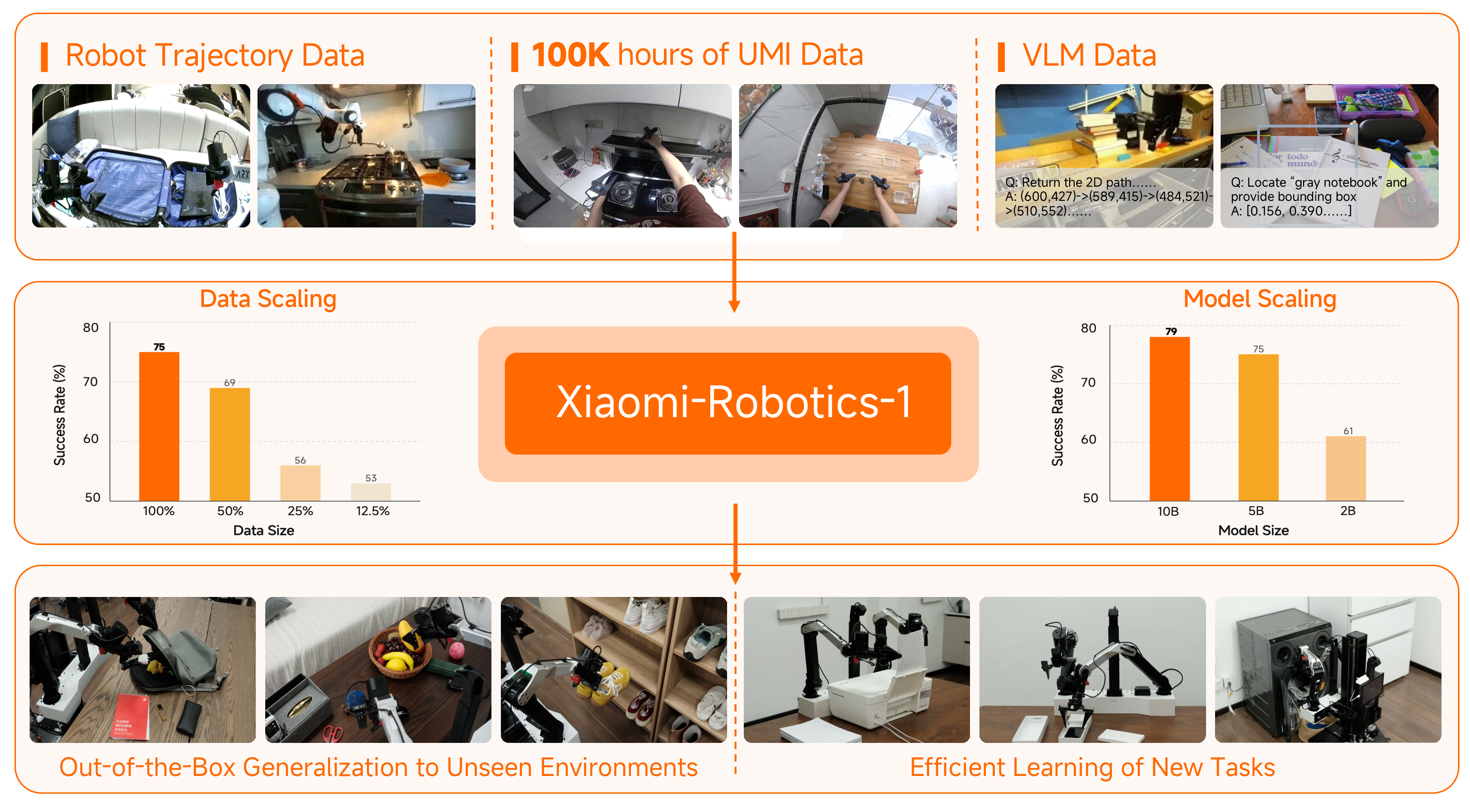
We present Xiaomi-Robotics-1 (Fig. 1), a foundational vision-language-action (VLA) model trained on a massive scale of real-world manipulation trajectories. Drawing inspiration from the training paradigms of
large language models, we propose a two-stage training recipe comprising pre-training and post-training. During pre-training, we endow the model with robust and generalizable action-generation capabilities by leveraging data sources that scale readily in
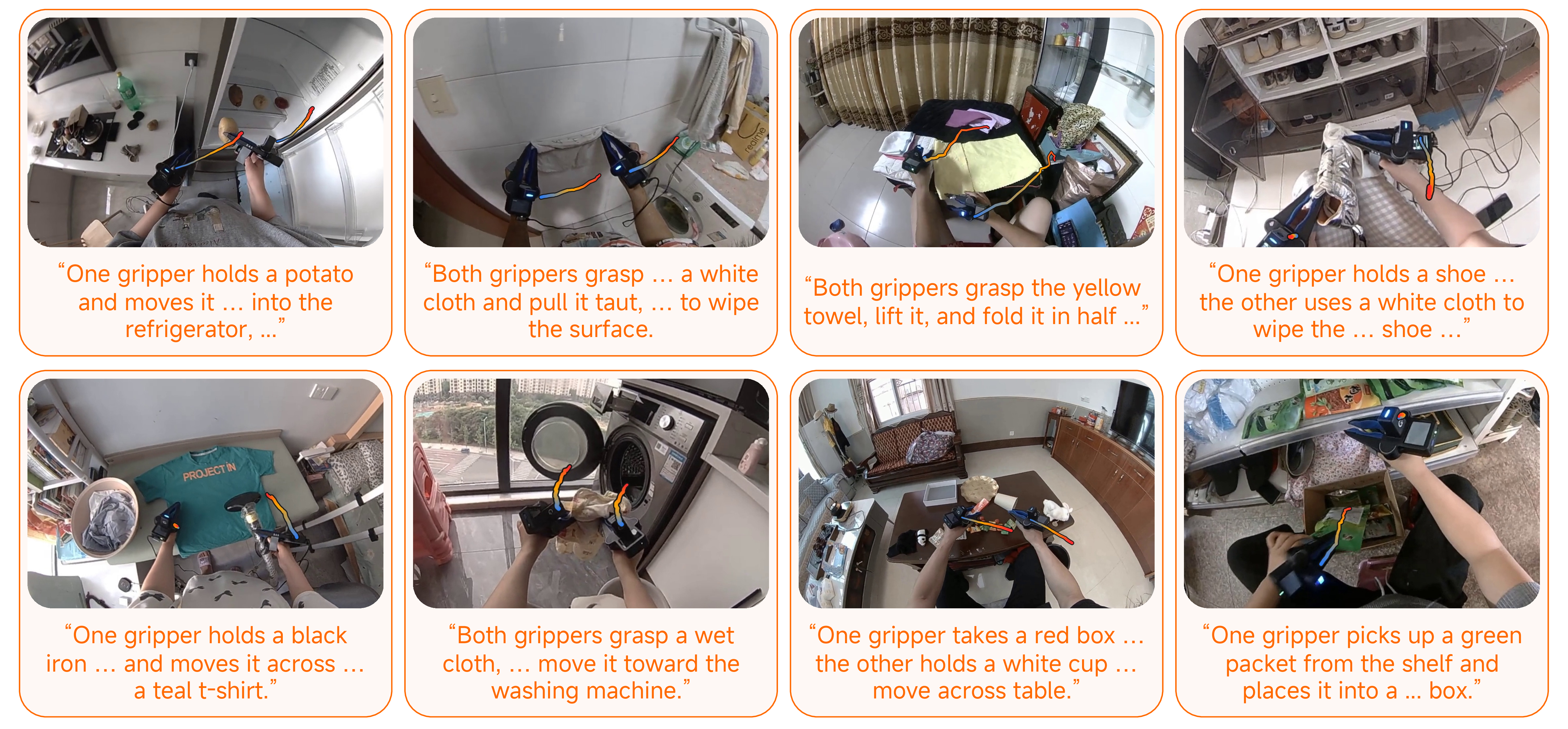
both volume and diversity. Specifically, we curate a dataset of over 100k hours of real-world manipulation trajectories with UMI devices [19], spanning a wide range of environments and tasks. Traditional trajectory labeling typically requires manual segmentation by task semantics and language annotations—a labor-intensive process that becomes prohibitive at
this scale. To address this challenge, we develop a scalable auto-labeling pipeline that leverages a pre-trained vision-language model (VLM) [20] to
annotate fixed-length trajectory segments with language descriptions detailing scene state transitions. These annotations provide precise and sufficient semantic supervision. Trained on these data, the model learns to generate actions that transform the
scene from its current state to the language-specified target state (Fig. 6). In the post-training phase, we utilize over 10k hours of cross-embodiment data to align the strong action-generation capabilities
acquired during pre-training. This stage bridges two gaps: adapting the model from generating actions for UMI grippers to actions for robot embodiments, and transitioning from state-transition prompts to imperative instructions typically used by humans to
prompt robots. After post-training, Xiaomi-Robotics-1 is able to follow instructions and perform a wide range of tasks in unseen environments. Furthermore, it serves as a strong robot foundation policy that can be efficiently fine-tuned to
learn new tasks.
We perform extensive experiments to study the scaling properties of Xiaomi-Robotics-1. Results show that Xiaomi-Robotics-1 scales effectively during the pre-training phase, achieving lower validation action errors as data and
model scale up. Moreover, the scaling behavior observed in pre-training directly transfers to post-training, where stronger pre-training models yield better post-training success rates in out-of-the-box real-robot evaluation in unseen environments. These
results are encouraging, as they indicate that we are able to continue improving performance as we further scale data and model size. In addition, we fine-tune the model on multiple complex dexterous tasks with minimal data. Xiaomi-Robotics-1
achieves an average success rate of 75% across four challenging tasks given less than 10 hours of data per task on average, outperforming \(\pi_{0.5}\) [10] which obtains 40%. In addition, we evaluate Xiaomi-Robotics-1 on four challenging simulation benchmarks, i.e., RoboCasa [21], RoboCasa365 [22], VLABench [23], and RoboDojo [24]. Xiaomi-Robotics-1 achieves state-of-the-art results across all four benchmarks. Notably, it
sets a new state-of-the-art with a 57.6% success rate on RoboCasa365, a substantial leap from the previous best of 46.6%. On RoboDojo, it delivers an average score of 20.07, significantly outperforming the prior state-of-the-art of 13.07. Finally,
Xiaomi-Robotics-1 enables the robot to autonomously accomplish a long-horizon, room-level mobile manipulation task of suitcase packing that spans over 10 minutes (see the project page for the video). Code and model checkpoints will be
released. Project page: https://robotics.xiaomi.com/xiaomi-robotics-1.html
2 Xiaomi-Robotics-1↩︎
Xiaomi-Robotics-1 is an end-to-end vision-language-action (VLA) model trained at scale on heterogeneous data sources, including UMI trajectories, cross-embodiment robot trajectories, and vision-language data. Given an observation \(\mathbf{o}_{t}\) and a language instruction \(l\), the model \(\pi_{\theta}\) is trained to predict an action chunk \(\mathbf{a}_{t:t+H}\) by maximizing the log-likelihood over the training dataset \(\mathcal{D}\): \[\max_{\theta} \mathbb{E}_{(\mathbf{o}_{t}, l,
\mathbf{a}_{t:t+H})\sim \mathcal{D}} \log \pi_{\theta}(\mathbf{a}_{t:t+H}\mid\mathbf{o}_{t}, l)\] We adopt a two-stage training recipe consisting of pre-training and post-training. Pre-training leverages a scalable non-robot dataset with rich
open-world diversity to endow the model with broad and generalizable representations for action generation. Post-training then aligns these representations to robot embodiments and instruction-conditioned action generation, using a high-quality set of
cross-embodiment data. In the following sections, we describe the details of model architecture, data curation, and training recipe.
![Figure 2: Model Architecture. Xiaomi-Robotics-1 adopts a Mixture-of-Transformers [25] architecture that couples a pre-trained VLM with a DiT. The VLM encodes the observation and language instruction, and additionally predicts action chunks via Choice Policies [26] to accelerate training convergence. Conditioned on the robot state and the VLM’s KV cache of the observation and language tokens, the DiT generates the action chunk via flow matching. Note that the action-related tokens from the VLM are excluded from the DiT’s attention computation.](/article/2607.15330/figures/model.png "fig:")
2.1 Model↩︎
As illustrated in Fig. 2, Xiaomi-Robotics-1 adopts a Mixture-of-Transformers (MoT) [25]
architecture consisting of a pre-trained vision-language model (VLM) (i.e., Qwen3-VL [27]) and a diffusion transformer (DiT) [28]. The DiT matches the VLM in the number of layers but employs a smaller hidden size for faster inference speed. The model parameters
for different scaling variants of Xiaomi-Robotics-1 are detailed in Tab. 1. The VLM takes the current observation \(\mathbf{o}_{t}\) and language instruction \(l\) as inputs. Conditioned on the robot proprioceptive state \(\mathbf{s}_{t}\) and the KV cache produced by the VLM, the DiT generates the action chunk via flow-matching [29]: \[L_{\textrm{Flow}}(\theta) = ||\mathbf{v}_{\theta}(\mathbf{o}_{t}, l, \mathbf{s}_{t}, \tilde{\mathbf{a}}_{t:t+H}^{\tau}, \tau) -
\mathbf{u}(\tilde{\mathbf{a}}_{t:t+H}^{\tau}, \mathbf{a}_{t:t+H}, \tau)||^{2}_{2}\] \(\tau\) is the flow-matching timestep. \(\tilde{\mathbf{a}}_{t:t+H}^{\tau} = \tau \mathbf{a}_{t:t+H} + (1
- \tau) \boldsymbol{\epsilon}\) is the noisy action where \(\boldsymbol{\epsilon} \sim \mathcal{N}(\mathbf{0}, \mathbf{I})\). Following [9], we sample timestep \(\tau\) from a Beta distribution, placing more weight on noisier timesteps during training: \[u \sim \textrm{Beta}(1.5, 1), \quad \tau =
(1-u) * 0.999 \in [0, 0.999]\] Similar to [30], we leverage adaptive normalization layers (adaLN) [28] to inject the flow-matching timestep condition into the DiT for action generation. During inference, we initialize the predicted action chunk from a
random noise \(\mathbf{a}^{\tau=0}_{t:t+H} \sim \mathcal{N}(\mathbf{0}, I)\). The clean action chunk is recovered via a 5-step Euler integration, \(\mathbf{a}^{\tau+\Delta \tau}_{t:t+H} =
\mathbf{a}^{\tau}_{t:t+H} + \Delta\tau \cdot \mathbf{v}_{\theta}(\mathbf{o}_{t}, l, \mathbf{s}_{t}, \mathbf{a}_{t:t+H}^{\tau}, \tau)\), where the step size is set to \(\Delta \tau=0.2\).
| Model | # Layers | VLM | DiT | Total Params | |||
|---|---|---|---|---|---|---|---|
| 3-4 (lr)5-6 | Hidden Size | Params | Hidden Size | Params | |||
| -2B | 28 | 2048 | 2.1B | 1024 | 470M | 2.6B | |
| -5B | 36 | 2560 | 4.4B | 1024 | 604M | 5.1B | |
| -10B | 36 | 4096 | 8.8B | 2048 | 1.5B | 10.5B | |
To accelerate convergence [31], we introduce an auxiliary action-generation supervision on the VLM. Specifically, we leverage Choice Policies [26] to enable action generation directly within the VLM framework [30]. We encode the robot state into a token using a multi-layer perceptron (MLP) and append it, along with the action and score query tokens, to the end of the vision-language token sequence. The outputs corresponding to the action and score query tokens predict \(K\) candidate action chunks and their associated \(K\) scores, respectively. We adopt a winner-takes-all paradigm as in [26], where only the candidate with the smallest \(L_{1}\) loss is included in action loss computation: \[L_{\textrm{Regression}}(\theta) = ||\hat{\mathbf{a}}^{*}_{t:t+H} - \mathbf{a}_{t:t+H}||_{1} + \sum_{k}^{K}||\hat{s}_{k} - s_{k}||_{2}^2\] Let \(\hat{\mathbf{a}}^{k}_{t:t+H}\) denotes the \(k\)-th predicted candidate action chunk, then \(\hat{\mathbf{a}}^{*}_{t:t+H}\) is the one with the smallest \(L_1\) distance to the ground truth \(\mathbf{a}_{t:t+H}\). \(\hat{s}_{k}\) is the predicted score for the \(k\)-th candidate, and its regression target \(s_{k}\) is defined as \(s_{k} = ||\hat{\mathbf{a}}^{k}_{t:t+H} - \mathbf{a}_{t:t+H}||_{1}\). That is, the \(L_1\) distances between the \(K\) predicted action chunks and the ground-truth action chunk serve as the target labels for score prediction.
Applying action-generation supervision directly on the VLM steers its representations toward features that better support action generation, thereby making the DiT learning more effective. However, we empirically observe that letting the DiT tokens attend to the KV cache of these action-related tokens degrades performance. We hypothesize that this arises from a shortcut in which the DiT simply copies the actions generated by the VLM rather than effectively grounding its own generation in the visual and textual context. To mitigate this issue, we exclude these action-related tokens from the DiT’s attention computation, constraining the DiT tokens to attend solely to the representations of the language instruction and visual observations.
2.2 Training & Data↩︎
2.2.1 Pre-training↩︎
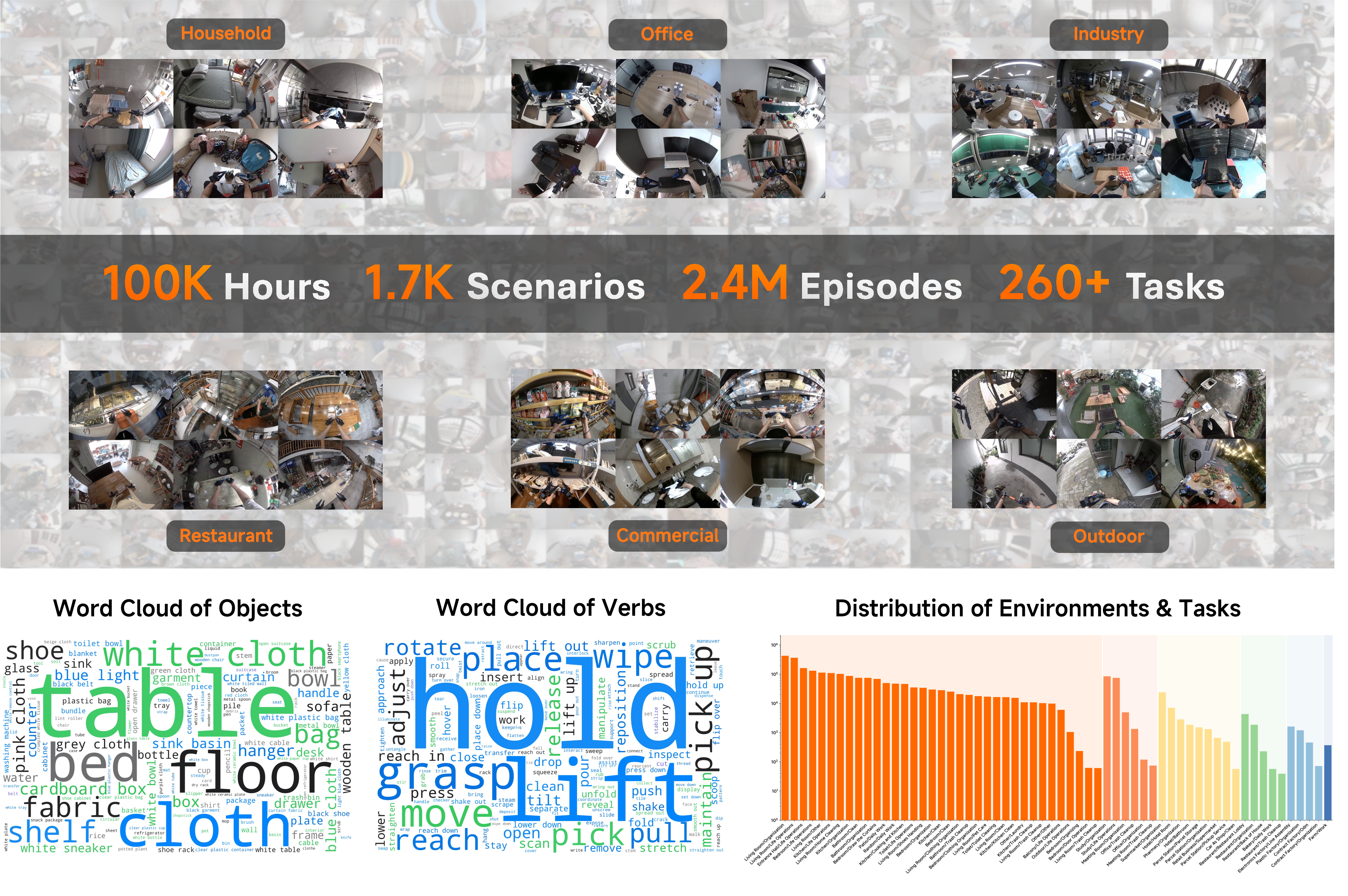
During pre-training, our primary objective is to endow the model with broad and generalizable representations that transfer across diverse manipulation scenarios. To this end, we curate a dataset of over 100,000 hours of real-world manipulation trajectories, captured with Universal Manipulation Interface (UMI) handheld grippers [19] and egocentric cameras (Fig. 3). The dataset spans a diverse array of tasks collected across a massive scale of environments, including households, commercial premises, industrial sites, offices, and outdoor spaces. Traditional robot trajectory annotation requires manually segmenting trajectories according to task semantics and labeling each segment with a language instruction—a labor-intensive process that becomes prohibitive at this scale.
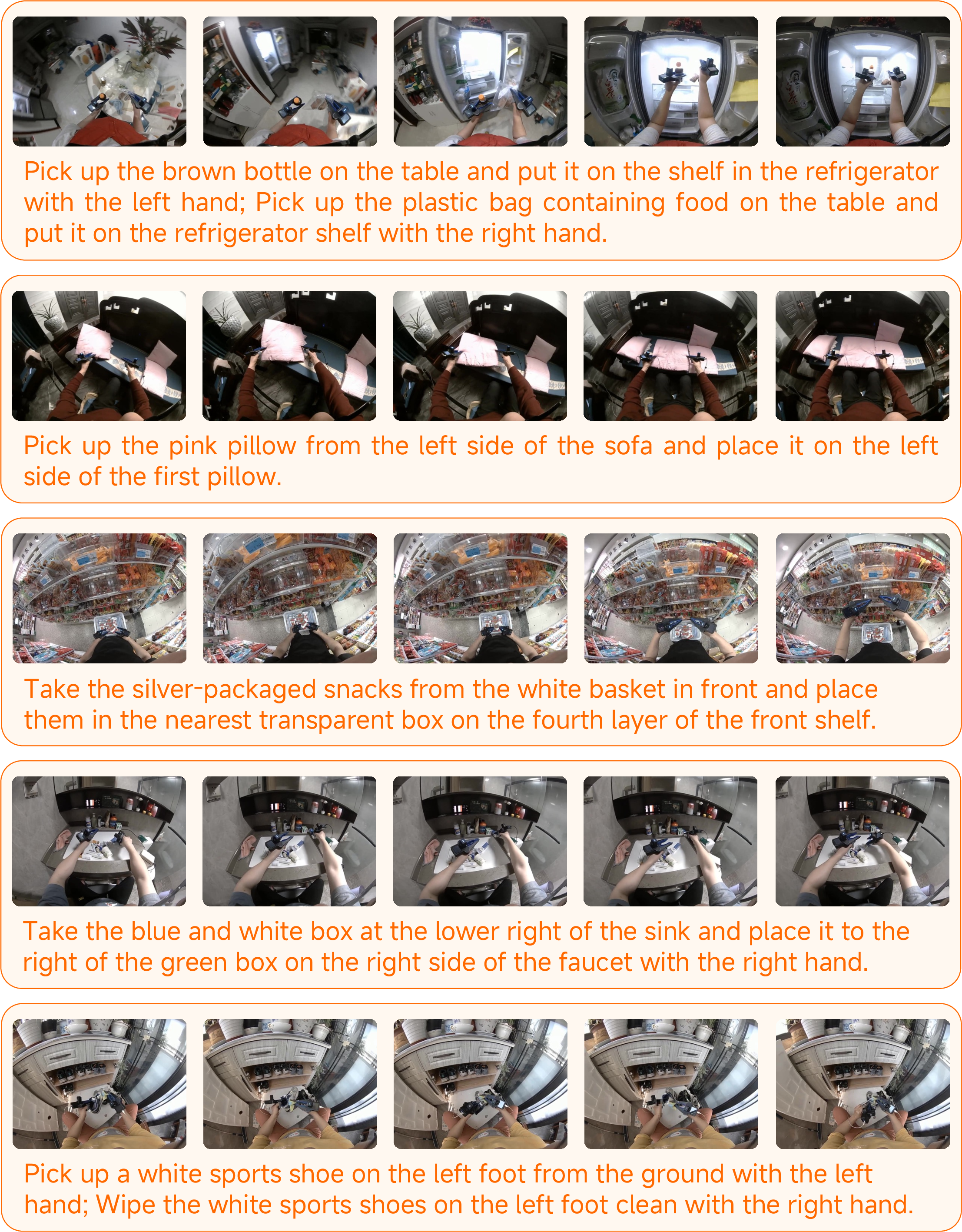
To scale language annotation, we develop an auto-labeling pipeline that first divides each trajectory into equal-length segments and leverage Qwen3.5-27B [20] to caption the state transitions of both the grippers and the interacting objects in the scene within each segment (see Fig. 11 for examples). To accelerate the annotation process, we develop a producer–consumer pipeline that decouples clip segmentations from caption labeling: while CPU worker threads cut per-segment clips into an in-memory filesystem, client threads keep hundreds of captioning requests in flight. This highly effcient pipeline allows us to label the entire corpus of over 100k hours in roughly two weeks. Trained on this dataset, the model learns to generate actions that drive the scene from the state in the current observation to the target state described by the language annotation.
The model is optimized to predict actions by jointly minimizing the flow-matching loss \(L_{\textrm{Flow}}\) of the DiT and the regression loss \(L_{\textrm{Regression}}\) of the VLM choice policy. To preserve the vision-language capabilities of the pre-trained VLM, we further co-train the model on a high-quality vision-language dataset curated in our previous work [30] under the next-token prediction objective \(L_{\textrm{NTP}}\). The overall training objective is formulated as: \[L = L_{\textrm{Flow}} + L_{\textrm{Regression}} + \lambda L_{\textrm{NTP}} \label{eq:loss}\tag{1}\] where \(\lambda\) is set to \(0.1\) in our experiments. Vision-language data and UMI trajectories are sampled at a ratio of \(1{:}9\). To maximize training throughput, we pack all vision-language tokens within a batch into a single sequence for a VLM forward pass. Since the VLM is computationally more expensive than the DiT, we amortize its cost by sampling four flow-matching timesteps per sample. The resulting four DiT inputs are similarly packed and processed in one DiT pass, conditioned on the corresponding unpacked VLM KV cache.
2.2.2 Post-training↩︎
The goal of post-training is twofold. First, we transfer the action-generation capabilities of UMI grippers acquired during pre-training to robot embodiments. Second, we shift the language conditioning from the state-transition descriptions used in pre-training to the imperative instructions humans typically issue when prompting robots to perform tasks.
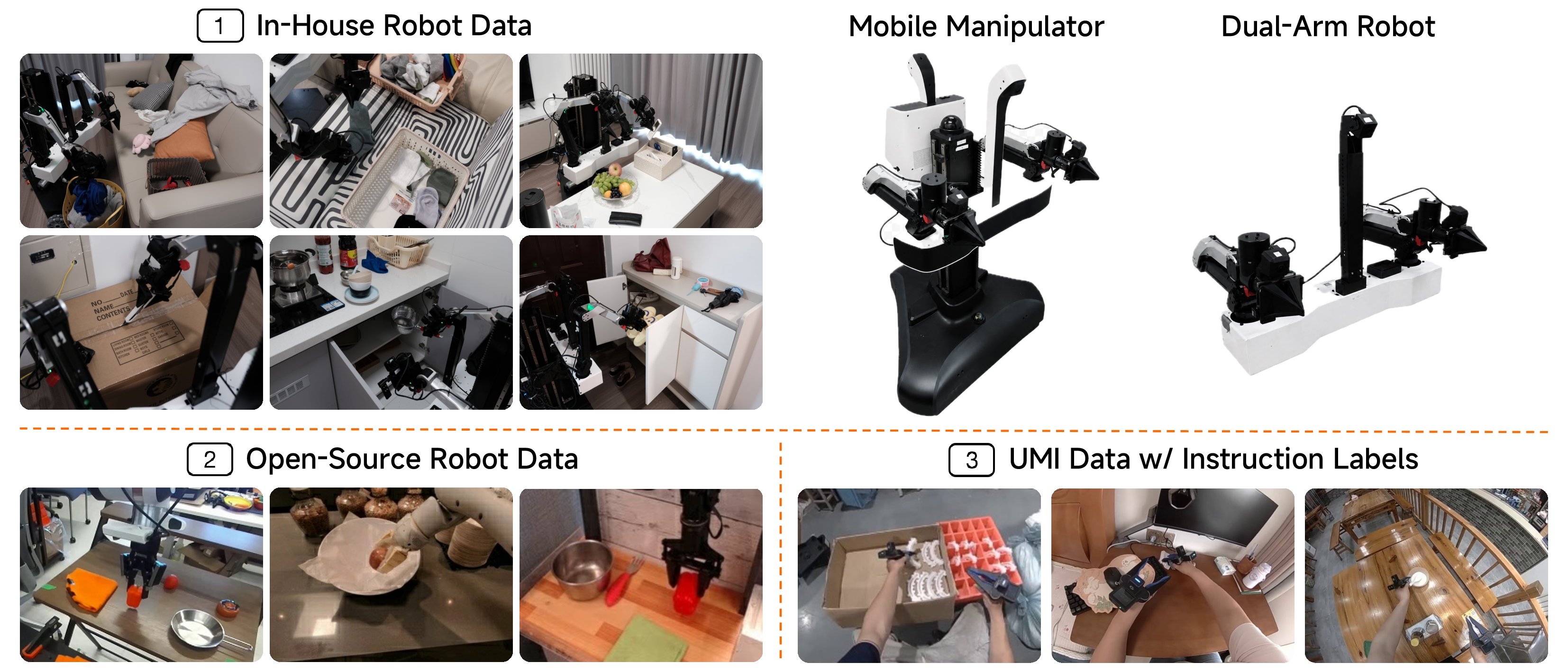
We curate the post-training dataset with cross-embodiment manipulation trajectories collected using UMI devices, static robot arms, and mobile manipulators. Specifically, we collect over 7,200 hours of robot data using mobile manipulators and dual-arm robots across a diverse range of household environments and tasks (Fig. 4). We leverage Qwen3.5 [20] to annotate human-segmented video clips with language instructions. In addition, we incorporate over 1,000 hours of human-annotated UMI data labeled with both temporal segments and language instructions. Unlike the state-transition descriptions used in pre-training, these language instructions closely mirror how humans prompt robots to perform tasks, directly matching our alignment objective in the post-training phase (see Fig. 11 and 12 for comparison). Finally, we include open-source robot datasets, including Bridge V2 [32], RT-1 [33], and DROID [34]. We filter out idle segments within trajectories to prevent the model from learning uninformative or noisy signals. In total, our post-training dataset comprises about 10,000 hours of trajectory data.
For arm actions, we adopt relative delta end-effector (EE) poses with respect to the current state: \[\mathbf{a}_{t+i} = (\prescript{\textrm{EE}}{\textrm{Base}}{T}_{t})^{-1}\prescript{\textrm{EE}}{\textrm{Base}}{\hat{T}}_{t+i}\] where \(\prescript{\textrm{EE}}{\textrm{Base}}{T}_{t}\) denotes the pose of the end-effector with respect to the base at the current timestep \(t\), and \(\prescript{\textrm{EE}}{\textrm{Base}}{\hat{T}}_{t+i}\) represents the target end-effector pose at timestep \(t+i\). To align the arm action spaces across different embodiments, we unify the orientation of the end-effector frames across all robot data and UMI data in both the pre-training and post-training datasets. Consequently, similar arm motions (e.g., moving forward or backward with respect to the end-effector frame) yield consistent action values regardless of the underlying hardware platform. For mobile robot data, we represent the base and waist actions using the base velocity and the relative delta of the waist position, respectively. To accommodate heterogeneous embodiments, we adopt a unified action vector for all trajectory data. Although the arm actions are aligned across embodiments, the action spaces of different robots still differ in dimensionality. We mask out the dimensions corresponding to missing action components during loss computation.
We train the model with the same objective as in pre-training (Eq. 1 ). Vision-language data, open-source robot data, instruction-labeled UMI data, and our in-house robot data are sampled at a ratio of \(0.5{:}0.5{:}0.5{:}8.5\). After post-training, the model can be prompted with language instructions to perform a wide range of tasks in unseen environments out-of-the-box. In addition, it can efficiently adapt to novel downstream tasks with minimal amount of data.
3 Experiments↩︎
We design Xiaomi-Robotics-1 with scaling in mind. In this section, we investigate its scaling properties through extensive experiments. Specifically, we design experiments to answer the following questions:
Does
Xiaomi-Robotics-1scale effectively with increasing data scale and model size during pre-training?Does a stronger pre-trained model translate to better post-training performance when evaluated out-of-the-box in novel environments?
Can
Xiaomi-Robotics-1adapt to challenging new tasks with a minimal amount of data?How does
Xiaomi-Robotics-1compare to other robot foundation models in real-robot experiments and simulation benchmarks?
3.1 Pre-training: Data and Model Scaling↩︎
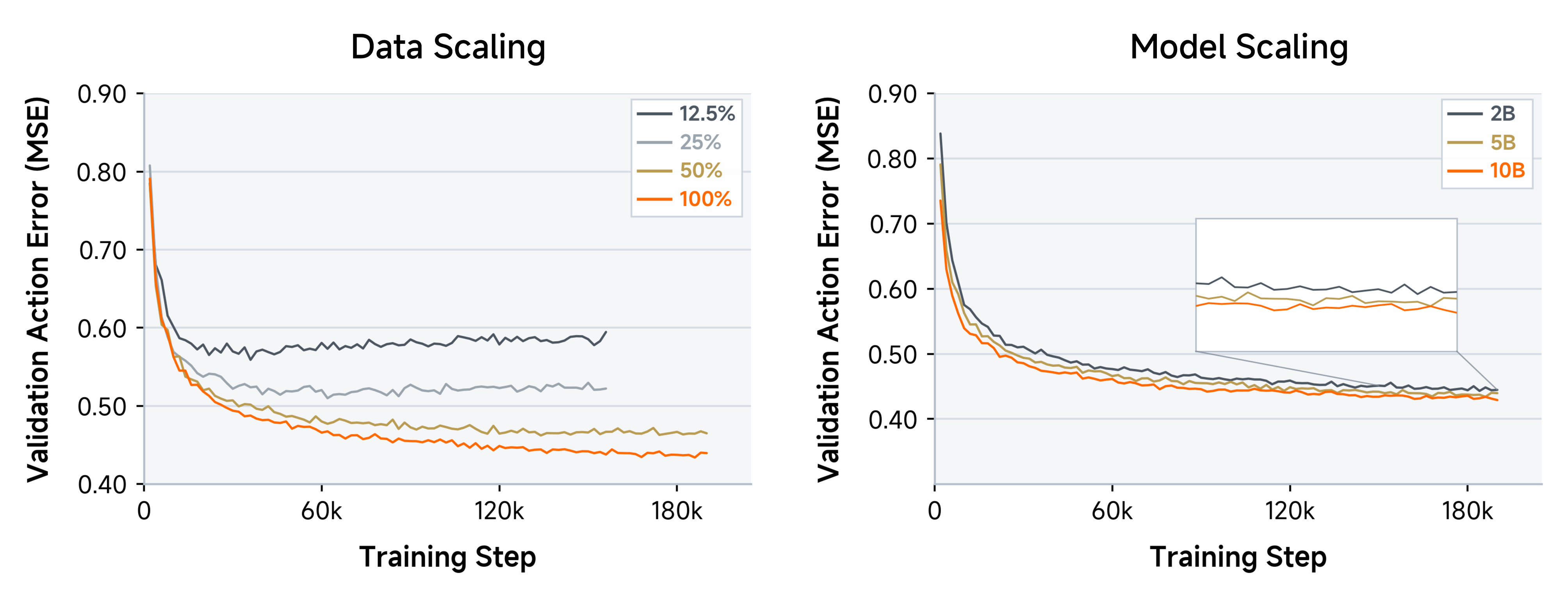
Data Scaling. We perform data-scaling experiments with Xiaomi-Robotics-1-5B. Due to compute budget limit, we pre-train the model on 12.5%, 25%, 50%, and 100% of about 20k hours of UMI data, respectively. Each model is
evaluated on a held-out validation set. We use the mean-squared error (MSE) between the action predicted by flow-matching and the ground truth as the evaluation metric. As shown in Fig. 5,
Xiaomi-Robotics-1 attains lower validation action errors with the increase of data scale. With 12.5% and 25% of data, the validation action errors first decrease and then increase during training, indicating overfitting. In contrast, the 50%
and 100% data settings yield a monotonic decrease in loss, with the 20k setting exhibiting a steeper descent. We show qualitative results of action prediction on validation data in Fig. 6.
Model Scaling. We perform model-scaling experiments on three size variants of Xiaomi-Robotics-1 (2B, 5B, and 10B) as specified in Tab. 1. All three models are trained on the same 20k hours
of data as in the data-scaling experiments and then evaluated on the same held-out validation set. As illustrated in Fig. 5, Xiaomi-Robotics-1 exhibits consistent improvements in action prediction
precision as the model size scales up. However, the performance gap among different model sizes are less pronounced than those observed across different data scales. This result suggests that model capacity at the billions-parameter scale may already be
sufficient to capture the current dataset’s distribution, thereby making data volume the primary bottleneck for further generalization. These findings do not diminish the value of model scaling, but rather highlight the critical importance of prioritizing
the collection of large-scale, diverse datasets to unlock further performance gains.
3.2 Post-training: Out-of-the-Box Evaluation in Novel Environments↩︎
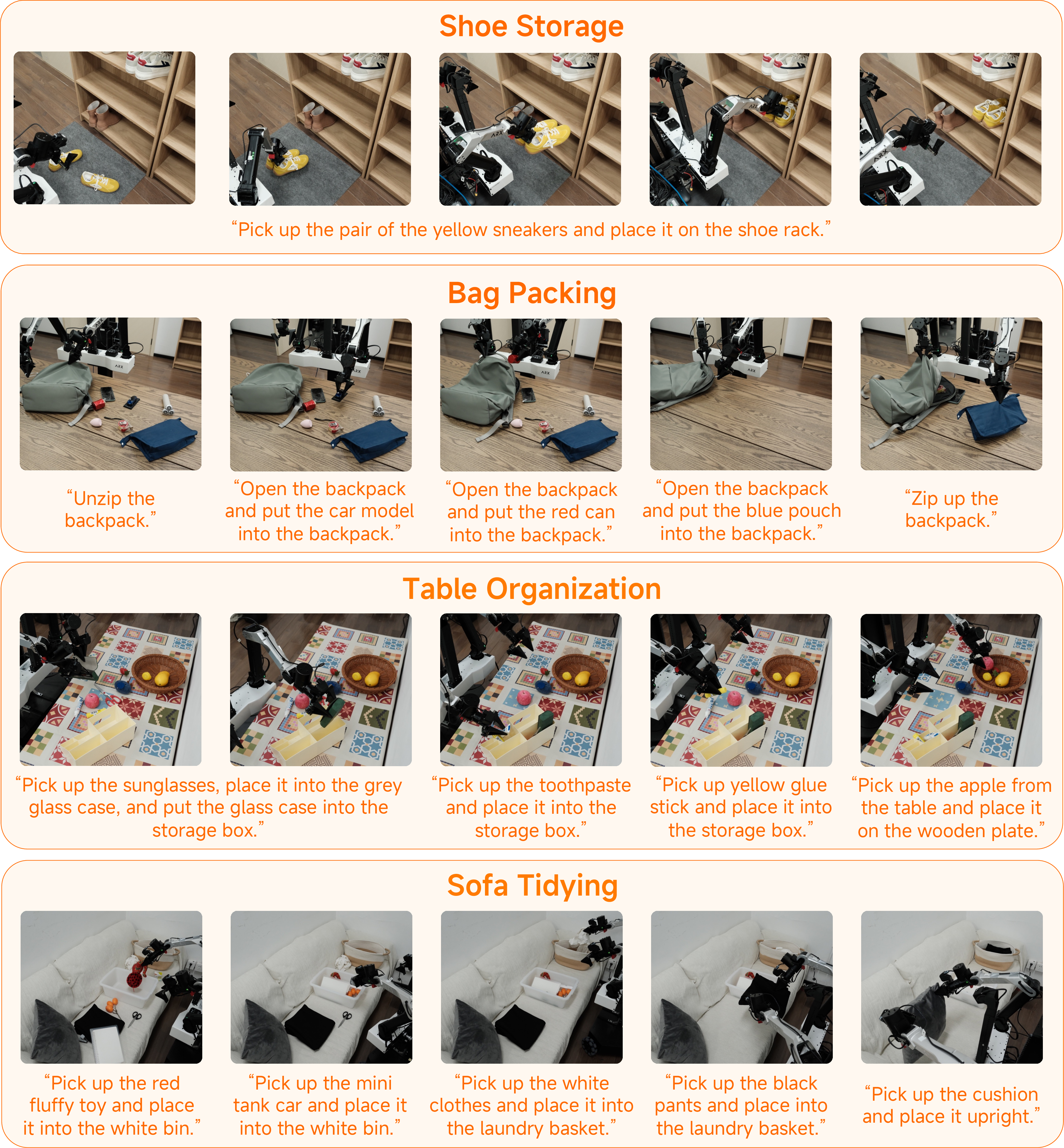
In this section, we perform post-training experiments on the cross-embodiment post-training dataset and study its out-of-the-box performance in novel environments that are unseen during training. In particular, we are interested in understanding whether the data scaling and model scaling properties from pre-training can transfer to post-training. To mitigate overfitting, for the in-house robot data, we sample a diverse subset from the whole dataset for post-training. Models are evaluated out-of-the-box in unseen environments after post-training without any per-task or per-environment fine-tuning. Specifically, we evaluate on 4 tasks (Fig. 7), i.e., shoe storage, bag packing, table organization, sofa tidying. These tasks are seen in the post-training dataset but the environments and object instances during evaluation are unseen.
3.2.1 Effectiveness of Scaling Pre-training Data↩︎
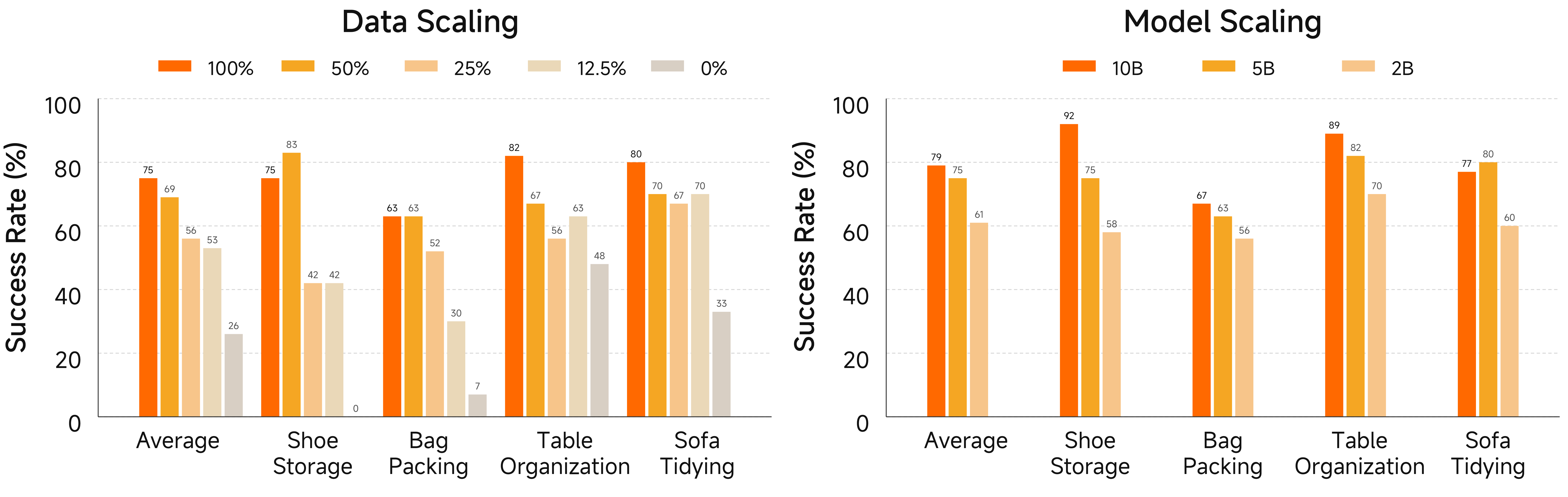
We first examine whether the benefits of scaling pre-training data transfer to post-training with the 5B variant of Xiaomi-Robotics-1. Using an identical training recipe, we post-train models initialized from checkpoints pre-trained on
12.5%, 25%, 50%, and 100% of 20k pre-training data (Sec. 3.1), alongside a baseline initialized from the Qwen3-VL [27] pre-trained weight without any action pre-training. Out-of-the-box evaluation results are shown in Fig. 8. The overall success rate increases monotonically with the scale of
pre-training data, rising from 26% without action pre-training to 75% with 100% of pre-training data. The gains from scaling pre-training data are particular pronounced on tasks that demand contact-rich manipulation. For instance, the baseline without
pre-training fails completely on shoe tidying, whereas the model pre-trained on 100% of the data reaches a 75% success rate. Notably, utilizing only 12.5% of the pre-training data more than doubles the baseline’s overall success rate (26% vs. 53%). While
the marginal gains gradually moderate as the pre-training corpus grows, the performance shows no sign of saturation: doubling the data from 50% to 100% yields an additional 6 percentage point improvement. These findings suggest that further scaling robot
pre-training data remains a highly promising avenue for achieving stronger out-of-the-box performance in unseen environments.
3.2.2 Effectiveness of Scaling Model Size↩︎
We further investigate the impact of model scale during post-training. Specifically, We post-train the three size variants of Xiaomi-Robotics-1 (2B, 5B, and 10B) specified in Tab. 1. These variants are
initialized from checkpoints pre-trained on 20k hours of UMI pre-training data. As shown in Fig. 8, the overall success rate increases monotonically with model size, rising from 61% for the 2B variant to 75% and 79%
for the 5B and 10B variants, respectively. Similar to data scaling, the gains from model scaling are most pronounced on shoe tidying, where the success rate climbs from 58% (2B) to 75% (5B) and further to 92% (10B). Performance improves consistently with
model size across three out of four tasks, with the 5B and 10B variants performing comparably (80% and 77%) on sofa tidying. Combined with the results in Sec. 3.2.1, these findings suggest
that pre-training data scale and model size constitute two complementary axes for improving out-of-the-box performance in out-of-distribution settings. And a stronger pre-trained model is able to translate to better out-of-the-box real-robot performance
after post-training.
3.3 Downstream Fine-tuning: Efficient Adaptation to New Tasks↩︎
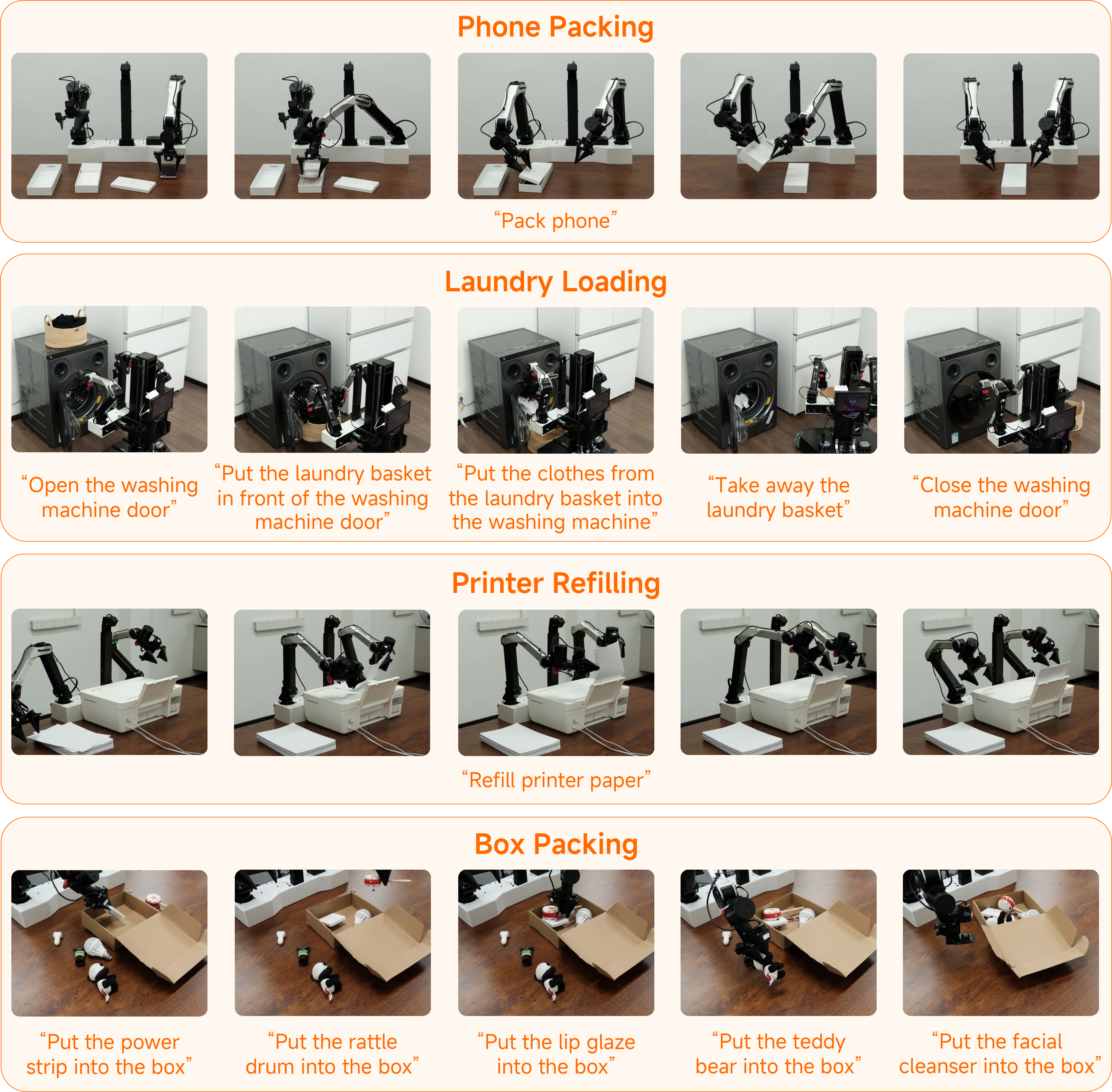
A key desideratum of robot foundation models is their ability to efficiently adapt to novel tasks with minimal data. To investigate how Xiaomi-Robotics-1 performs in this setting, we fine-tune our post-trained model on a suite of four novel
challenging tasks: phone packing, laundry loading, printer refilling, and box packing (Fig. 9). Crucially, these tasks are entirely held out from the in-house robot dataset. Each task introduces different
complexities: phone packing requires bimanual coordination; laundry loading is a long-horizon mobile manipulation task involving multi-step instruction following; printer refilling demands handling of highly deformable sheets of paper; and box packing
evaluates language grounding across multiple objects.
To evaluate data efficiency, we fine-tune the model under two settings. For the high-data setting, we leverage a total of 144 hours of data across all tasks. For the low-data setting, we sample 25% of the data for each task from the high-data setting,
resulting in a subset of 36 hours in total. The average data per task for the low-data setting is less than 10 hours, with the maximum-data task, printer refilling, containing only 10.3 hours. This poses a significant challenge for policy learning. We
fine-tune Xiaomi-Robotics-1 on the data of all four tasks using the asynchronous training recipe proposed in [30]. We compare our
method against two baselines: \(\pi_{0.5}\) [10] and Xiaomi-Robotics-0 [30]. For \(\pi_{0.5}\), we follow the official OpenPi1 fine-tuning protocol and fine-tune the base model on these tasks. For Xiaomi-Robotics-0 [30], we fine-tune
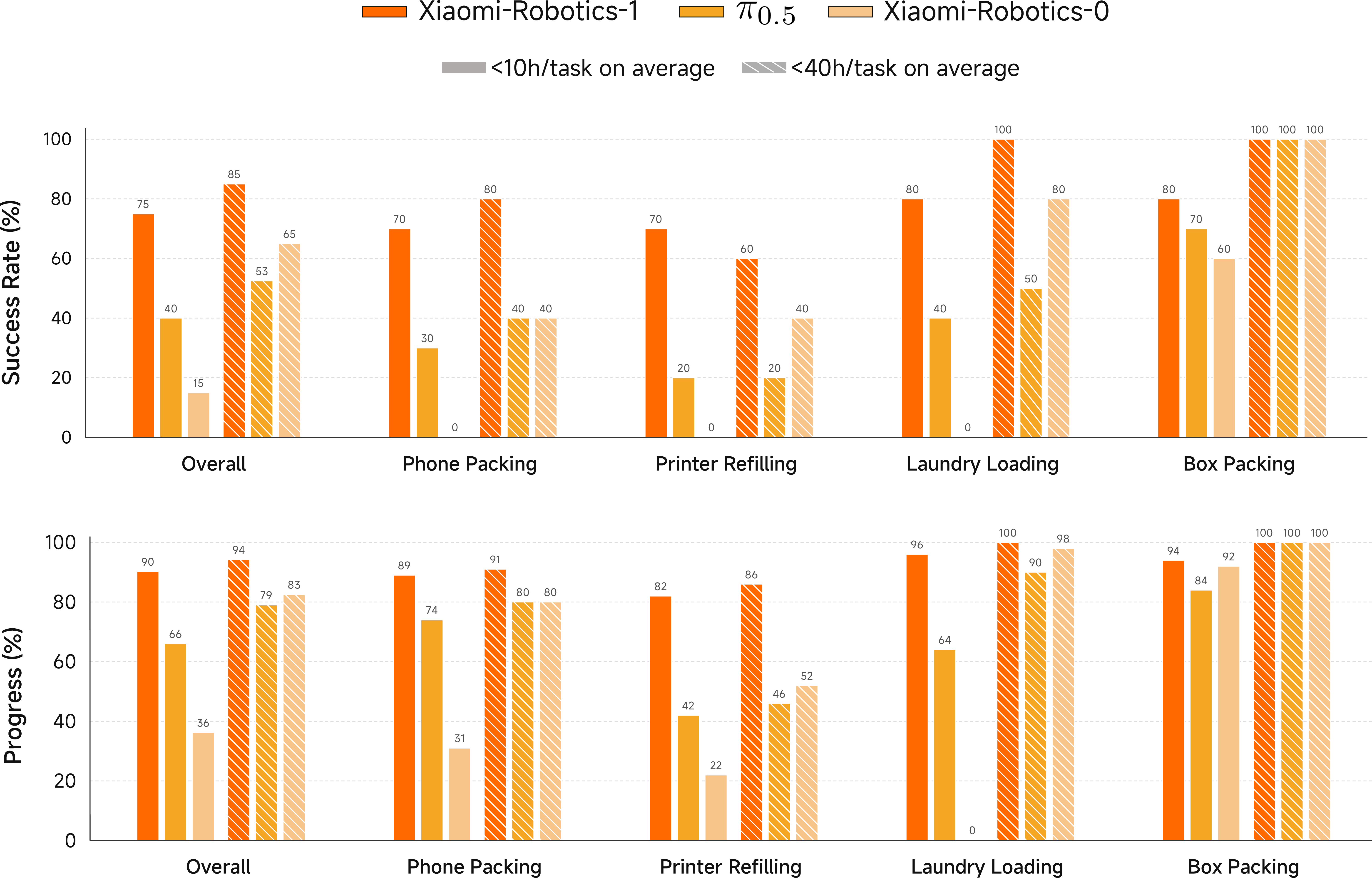
its pre-trained model using the asynchronous setting. Each model is evaluated for 10 trials per task. We report both the average success rate and progress, where the progress measures partial task completion based on the task-specific milestones (Tab. 4). Results are shown in Fig. 10.
Xiaomi-Robotics-1 outperforms the two baseline methods in terms of average success rates and progress in both low-data and high-data settings. In the low-data setting with less than 10 hours per task on average, it achieves an average
success rate of 75% and an average progress of 90% across all four tasks, significantly outperforming \(\pi_{0.5}\) with a 40% success rate and a progress of 66%. The advantage of our method is most substantial on tasks
requiring dexterous manipulation and mobile manipulation. In phone packing, Xiaomi-Robotics-1 outperforms both baseline methods substantially in the two data settings. In printer refilling, Xiaomi-Robotics-1 improves the success
rate of the best baseline from 20% to 70% in the low-data setting, showcasing powerful capabilities in manipulating deformable objects. In laundry loading, our method shows strong robustness over the full task horizon where failure may occur at any stage,
achieving an 80% success rate and a progress of 96% in the low-data setting. In this task, \(\pi_{0.5}\) struggles with opening the washing machine while Xiaomi-Robotics-0 fails to complete the task in the low-data setting.
In box packing, all methods perform relatively well compared to other tasks, reaching 100% success rates when more task-specific data are available. Overall, all methods benefit from increasing the amount of fine-tuning data, but
Xiaomi-Robotics-1 is substantially more data-efficient. We attribute this advantage to large-scale pre-training which exposes the model to diverse environments and tasks, and careful post-training alignment that aligns the strong manipulation
capabilities acquired during pre-training to robot embodiments and instruction prompts. These results demonstrate that Xiaomi-Robotics-1 can serve as a strong foundation robot policy for efficient adaptation to novel tasks.
3.4 Simulation Benchmarks↩︎
In this section, we evaluate Xiaomi-Robotics-1 on four simulation benchmarks.
RoboCasa [21]: RoboCasa features single-arm manipulation in realistic kitchen environments. The benchmark contains 24 everyday kitchen manipulation tasks spanning pick-and-place, articulated-object interaction, appliance operation, and coffee-making. In order to test generalization capabilities, it evaluates policies on unseen object instances and includes two scenes of which the styles were unseen in the training data among the five evaluation scenes. For training, we use the official set of 300 synthetic demonstrations provided by the benchmark. Following the standard evaluation protocol, we report the average success rate over 100 evaluation episodes per task across the five evaluation scenes. Results are shown in Tab. 2.
RoboCasa365 [22]: RoboCasa365 extends RoboCasa into a large-scale simulation benchmark for evaluating general-purpose robot manipulation, with a particular emphasis on generalization beyond the training task distribution. It expands the original 24-task benchmark to 365 tasks across over 2,500 procedurally generated kitchen scenes and 3,200 object instances, covering both short-horizon manipulation and long-horizon mobile manipulation. This diversity introduces substantial variations in kitchen layouts, object appearances, and spatial relationships, testing whether policies remain robust across unseen scene and object configurations rather than overfitting. More importantly, RoboCasa365 explicitly evaluates generalization on task composition via a split featuring task templates that are unseen during training. We train our policy using the officially released dataset, which provides 100 demonstrations for each task. We follow the standard evaluation protocol and evaluate across 50 benchmark tasks, comprising 18 seen atomic tasks, 16 seen composite tasks, and 16 unseen composite tasks. The unseen composite tasks provide a zero-shot evaluation of whether the policy can recombine previously learned atomic skills and semantic knowledge to solve novel long-horizon tasks. Results are shown in Tab. 3.
VLABench [23]: VLABench is a large-scale benchmark designed for comprehensive evaluation of language-conditioned manipulation. It comprises 100 task categories with over 2,000 object instances, emphasizing challenging scenarios involving semantic and distribution shifts. Specifically, VLABench introduces instructions with implicit human intentions, long-horizon tasks requiring multi-step reasoning, and evaluation settings that demand commonsense reasoning, category-level generalization, and robustness to unseen object appearances. These challenges are distributed across five evaluation tracks—In-distribution, Cross-Category, Commonsense, Instruction, and Texture—to thoroughly assess policy generalization. Beyond success rate (SR), VLABench introduces progress score (PS) and intention score (IS) to measure task completion quality and instruction understanding. Following the standard evaluation protocol, we train our policy using only the official training set from the In-distribution track, which contains 10 tasks with 500 demonstrations per task. We leverage chain-of-thought (CoT) labeling as in ERVLA [35] and train our model with a 50% probability on the next-token-prediction loss of CoT alongside the action loss. During evaluation, each task is tested across all five tracks with 50 evaluation episodes per track, resulting in 250 rollouts for each task and 2,500 rollouts in total. Results are shown in Tab. ¿tbl:tab:vlabench?.
RoboDojo [24]: RoboDojo is a unified simulation and real-world benchmark for comprehensively evaluating generalist robot manipulation policies. Unlike existing benchmarks that focus primarily on individual skills, RoboDojo provides a diverse and challenging suite comprising over 42 simulation tasks with varied object configurations, scene layouts, and language objectives. These tasks are organized into five core capability dimensions: Generalization (robustness to object/layout changes), Precision (fine-grained control), Long-Horizon (multi-step execution), Memory (state-dependent manipulation), and Open (open-ended instruction following). Following the official protocol, we evaluate
Xiaomi-Robotics-1on the RoboDojo simulation benchmark and report the average score and success rate of each capability dimensions. Results are shown in Tab. ¿tbl:tab:robodojo?.
| Method | Avg. Success (%) |
|---|---|
| UVA [36] | 50.0 |
| UWM [37] | 60.8 |
| \(\pi_{0.5}\) [10] | 62.1 |
| \(\pi_{0}\)-FAST [31] | 63.6 |
| GR00T N1.6 [13] | 66.2 |
| Cosmos Policy [38] | 67.1 |
| RLDX-1 [39] | 70.6 |
| World2Act [40] | 72.6 |
| Xiaomi-Robotics-1 (Ours) | 74.5 |
| Method | Average | Atomic | Comp.-Seen | Comp.-Unseen | |||||||||||||||||||||||||||||||||||||||||||||||||||||||||||||||||||||||||||||
|---|---|---|---|---|---|---|---|---|---|---|---|---|---|---|---|---|---|---|---|---|---|---|---|---|---|---|---|---|---|---|---|---|---|---|---|---|---|---|---|---|---|---|---|---|---|---|---|---|---|---|---|---|---|---|---|---|---|---|---|---|---|---|---|---|---|---|---|---|---|---|---|---|---|---|---|---|---|---|---|---|---|
| Diffusion Policy [41] | 6.1 | 15.7 | 0.2 | 1.3 | |||||||||||||||||||||||||||||||||||||||||||||||||||||||||||||||||||||||||||||
| \(\pi_{0.5}\) [10] | 16.9 | 39.6 | 7.1 | 1.2 | |||||||||||||||||||||||||||||||||||||||||||||||||||||||||||||||||||||||||||||
| GigaWorld-Policy 0.1 [42] | 20.7 | 44.4 | 11.8 | 2.9 | |||||||||||||||||||||||||||||||||||||||||||||||||||||||||||||||||||||||||||||
| GR00T-N1.6 [13] | 21.9 | 51.1 | 9.4 | 1.7 | |||||||||||||||||||||||||||||||||||||||||||||||||||||||||||||||||||||||||||||
| WorldDreamer [43] | 35.3 | 66.3 | 26.7 | 9.0 | |||||||||||||||||||||||||||||||||||||||||||||||||||||||||||||||||||||||||||||
| Qwen-RobotManip [14] | 35.9 | 68.6 | 20.1 | 14.9 | |||||||||||||||||||||||||||||||||||||||||||||||||||||||||||||||||||||||||||||
| RLDX-1 [39] | 36.0 | 67.6 | 27.9 | 8.5 | |||||||||||||||||||||||||||||||||||||||||||||||||||||||||||||||||||||||||||||
| ABot-M0.5 [44] | 40.4 | 75.9 | 38.3 | 2.7 | |||||||||||||||||||||||||||||||||||||||||||||||||||||||||||||||||||||||||||||
| ABot-M0.6 [44] | 46.6 | 79.4 | 48.3 | 7.9 | |||||||||||||||||||||||||||||||||||||||||||||||||||||||||||||||||||||||||||||
| Xiaomi-Robotics-1 (Ours) | 57.4 | 80.2 | 57.1 | 32.1 |
6pt
Xiaomi-Robotics-1 achieves state-of-the-art results across all the four challenging benchmarks. It achieves an average success rate of 74.5% in RoboCasa. In RoboCasa365, it significantly outperforms the previous best methods by 10.8
percentage points, obtaining an average success rate of 57.4%. Specifically, it delivers the largest improvement on the most challenging split of Composite-Unseen, showcasing powerful generalization capabilities to task compositions that were
unseen during training. In VLABench, Xiaomi-Robotics-1 achieves the highest average success rate and progress score, while maintaining a competitive intention score. This highlights its strong robustness to semantic and distribution shifts as
well as superior long-horizon reasoning and language-conditioned manipulation capabilities. Notably, under cross-category and texture shifts, Xiaomi-Robotics-1 surpasses the strongest baseline by 6.0 and 15.2 percentage points in terms of
success rate, respectively, demonstrating effective generalization to unseen objects and high resilience to visual appearance and background perturbations. In RoboDojo, Xiaomi-Robotics-1 significantly outperforms existing baseline methods,
achieving absolute improvements of 7% and 5.13% in terms of average score and average success rate, respectively, over the second-best method. It ranks first across four out of five dimensions, indicating the model’s outstanding overall performance across
diverse task types. Notably, we do not incorporate history observation in the evaluation of the RoboDojo benchmark. Consequently, it scores lower on the memory dimension than Hy-Embodied-0.5-VLA [45] which explicitly models memory, yet it still significantly outperforms all other models.
| Method | In-dist. | Cross Category | Commonsense | ||||||
|---|---|---|---|---|---|---|---|---|---|
| 2-4 (lr)5-7 (lr)8-10 | SR \(\uparrow\) | PS \(\uparrow\) | IS \(\uparrow\) | SR \(\uparrow\) | PS \(\uparrow\) | IS \(\uparrow\) | SR \(\uparrow\) | PS \(\uparrow\) | IS \(\uparrow\) |
| \(\pi_0\)-FAST [31] | 56.2 | 66.8 | 72.4 | 31.0 | 38.2 | 47.8 | 38.0 | 48.6 | 56.8 |
| X-VLA [46] | – | 67.8 | – | – | 25.1 | – | – | 48.2 | – |
| ACoT-VLA [47] | – | 66.1 | 79.8 | – | 38.9 | 54.1 | – | 37.8 | 52.3 |
| \(\pi_{0.5}\) [10] | 65.4 | 77.8 | 80.4 | 38.2 | 49.7 | 52.0 | 43.9 | 57.3 | 60.0 |
| ERVLA [35] | 69.7 | 81.1 | 84.2 | 47.0 | 61.0 | 66.4 | 44.0 | 55.0 | 57.2 |
| Xiaomi-Robotics-1 (Ours) | 75.6 | 85.0 | 79.8 | 53.0 | 66.6 | 66.4 | 48.4 | 58.3 | 58.2 |
| Method | Instruction | Texture | Avg. | ||||||
|---|---|---|---|---|---|---|---|---|---|
| 2-4 (lr)5-7 (lr)8-10 | SR \(\uparrow\) | PS \(\uparrow\) | IS \(\uparrow\) | SR \(\uparrow\) | PS \(\uparrow\) | IS \(\uparrow\) | SR \(\uparrow\) | PS \(\uparrow\) | IS \(\uparrow\) |
| \(\pi_0\)-FAST [31] | 35.0 | 45.0 | 59.4 | 39.0 | 49.0 | 56.8 | 39.8 | 49.5 | 58.6 |
| X-VLA [46] | – | 63.1 | – | – | – | – | – | 51.1 | – |
| ACoT-VLA [47] | – | 39.6 | 56.8 | – | 54.6 | 74.6 | – | 47.4 | 63.5 |
| \(\pi_{0.5}\) [10] | 48.2 | 64.2 | 67.0 | 44.9 | 62.3 | 65.0 | 48.1 | 62.3 | 64.9 |
| ERVLA [35] | 58.0 | 70.2 | 73.8 | 47.4 | 62.3 | 70.6 | 53.2 | 65.9 | 70.4 |
| Xiaomi-Robotics-1 (Ours) | 55.8 | 66.8 | 70.2 | 62.6 | 74.9 | 74.8 | 59.1 | 70.3 | 69.9 |
2.8pt
| Method | Generalization | Precision | Long-Horizon |
|---|---|---|---|
| GalaxeaVLA (G0) [48] | |||
| GigaWorld-Policy [42] | |||
| StarVLA-\(\alpha\) [49] | |||
| Xiaomi-Robotics-0 [30] | |||
| X-WAM [50] | |||
| X-VLA [46] | |||
| \(\pi_{0.5}\) [10] | |||
| Spatial Forcing [51] | |||
| Hy-Embodied-0.5-VLA [45] | |||
| Xiaomi-Robotics-1 (Ours) |
| Method | Memory | Open | Average |
|---|---|---|---|
| GalaxeaVLA (G0) [48] | |||
| GigaWorld-Policy [42] | |||
| StarVLA-\(\alpha\) [49] | |||
| Xiaomi-Robotics-0 [30] | |||
| X-WAM [50] | |||
| X-VLA [46] | |||
| \(\pi_{0.5}\) [10] | |||
| Spatial Forcing [51] | |||
| Hy-Embodied-0.5-VLA [45] | |||
| Xiaomi-Robotics-1 (Ours) |
3.0pt
4 Related Work↩︎
Scaling for Robot Learning. Research on the scaling laws of large language models (LLMs) demonstrates that performance improves predictably when data, compute, and model capacity are scaled in tandem [1], [2]. Recent advances in large language models [3], [52] and multi-modal foundation models [7], [8], [27], [53] further demonstrate substantial capability gains driven by scaling of data and model size. Motivated by these advancements, robot learning has increasingly embraced this scaling paradigm, enlarging both data and model sizes in pursuit of foundational generalist policies [9], [10], [13], [30], [31], [33], [54]–[59]. Scaling robot learning, however, differs fundamentally from scaling models trained on web-scale data. Collecting real-robot trajectories requires costly and labor-intensive teleoperation, and the resulting data are often confined to a narrow slice of environments and tasks, severely constraining the data diversity. To alleviate this data bottleneck, recent work leverages portable UMI devices [19], enabling the collection of real-world manipulation trajectories without requiring physical robot embodiments [19], [57], [58], [60]–[62]. This lowers the barrier to data collection by facilitating in-the-wild collection across a highly diverse spectrum of unconstrained, real-world environments. Complementarily, another line of research leverages egocentric human manipulation trajectories to capture diverse behaviors across various tasks, objects, and environments, and subsequently converts them to robot data via representation alignment or motion retargeting [63]–[65]. In this work, we leverage over 100k hours of real-world manipulation trajectories collected from UMI devices. By varying data scale and model size, we investigate the scaling behavior of our model during pre-training and whether scaling translates to real-robot performance after post-training.
Robot Foundation Models. Recently, robot foundation models have emerged as a new paradigm for generalizable robot learning. By leveraging large-scale datasets, these models enable robust generalization across diverse environments and facilitate efficient adaptation to novel downstream tasks. World-action models (WAMs) [16]–[18], [38], [50], [66]–[71] and vision-language-action (VLA) models [9], [10], [30], [46], [55], [72]–[77] represent two popular paradigms of robot foundation models. WAMs are generally built upon pre-trained video models. They explicitly model future observations or environment dynamics and use these predictions to facilitate action generation. Early approaches typically generate visual plans from language-specified goals and subsequently translate them into executable robot actions [78]–[82]. More recent work extends this paradigm to several directions, including jointly modeling future prediction and action generation [17], [36]–[38], [83], incorporating explicit 3D geometric structure [50], [67], [84], [85], and training on large-scale heterogeneous video-action data to improve zero-shot generalization and cross-embodiment transfer [16], [68]. In contrast, VLA models leverage pre-trained vision-language models as backbone, aiming to harness their rich, general semantic knowledge to facilitate robust action prediction [9]–[13], [30], [54], [72], [73], [75], [86]. Recent advances improve VLA models along three main axes. First, reasoning-oriented methods introduce intermediate representations (e.g., embodied reasoning tokens [87]–[91] and visual chains of thought [92], [93]) to support semantic, spatial, and temporal reasoning. Second, advances in action representation address the limitations of naive action discretization through learned tokenizers and flow matching [9], [31], [74], [94], [95]. Third, large-scale pre-training across heterogeneous datasets with different robot embodiments enables strong cross-embodiment transfer and robust downstream performance [13], [30], [74], [75], [96], [97]. Our work follows the VLA paradigm but focuses on a complementary question: the scaling behavior of robot foundation models. To support this investigation, we develop a scalable infrastructure to curate massive trajectory datasets with precise language annotations. Leveraging this data for large-scale training, we conduct extensive experiments to systematically explore the scaling properties of foundational VLA models.
5 Conclusions↩︎
In this work, we present Xiaomi-Robotics-1, a foundational vision-language-action (VLA) model that is able to follow instructions to perform a wide range of mobile manipulation tasks out-of-the-box in unseen environments, and efficiently
adapt to novel challenging tasks with a minimal amount of data. During pre-training, we leverage over 100,000 hours of real-world manipulation trajectories, endowing the model with broad and generalizable manipulation capabilities. To scale training
effectively, we propose an auto-labeling pipeline that annotates the large-scale dataset with detailed descriptions of scene state transitions as language prompts. In the post-training phase, we align these strong capabilities acquired during pre-training
with robot embodiments and imperative instruction prompts using a cross-embodiment dataset. Extensive experiments demonstrate that the performance of Xiaomi-Robotics-1 consistently improves with increasing data scale and model size during
pre-training. More importantly, the scaling property directly translates to out-of-the-box performance in unseen environments after post-training. Xiaomi-Robotics-1 can also serve as a powerful robot foundation model that is able to adapt to
novel challenging real-robot tasks with minimal data. In addition, it achieves strong state-of-the-art results on four challenging simulation benchmarks. We hope this work can serve as a foundation for future exploration of scalable robot policies that can
be deployed out-of-the-box in the real world.
Contributions↩︎
Authors are listed in alphabetical order.
-2 Core Contributors
Jun Guo
Piaopiao Jin
Jason Li
Peiyan Li
Yingyan Li
Futeng Liu
Wanli Peng
Optimus Qin
Yifei Su
Nan Sun
Qiao Sun
Runze Suo
Heyun Wang
Yunhong Wang
Rujie Wu
Caoyu Xia
Lina Zhang
Jack Zhao
Contributors
Guoliang Chen
Wenlong Chen
Xinze He
Bin Li
Qing Li
Zhuorong Li
Heng Qu
Wenxuan Song
Diyun Xiang
Yifan Xie
Peiran Xu
Hangjun Ye
Wen Ye
Han Zhao
Quanyun Zhou
Acknowledgment↩︎
We express our sincere appreciation to the broader team for their tremendous support, including those not listed above: Li Jiang, Xiaohan Yu, Meichen Mu, Xiaoke Xilinjueluo, Qingyi Li, Qi Liu, Yayun Liu, Jun Xia, Feng Qiu, Donghao Wang, Yan Hou, Dong Wang, Liangliang He, Jiaxin Liu, Kang Zhou, Rui Cai, Shuoxue Bi, Yingchao Zhou, Kun Ma, Yiwei Zhou and Dongsheng Li.

| Task | Progress milestones | Progress (%) |
|---|---|---|
| Phone Packing | Grasp the phone; place the phone into the box; grasp the instruction manual; place the manual into the box; grasp the lid; successfully close the lid. | 10, 10, 30, 10, 10, 30 |
| Printer Refilling | Grasp the paper; complete the handover; successfully insert one end of the paper into the printer tray; fully insert the paper stack into the printer tray; return both robot arms to the resting pose. | 20, 20, 20, 30, 10 |
| Laundry Loading | Open the washing machine door; move the laundry basket to the door; transfer the clothes into the washing machine; remove the laundry basket; close the washing machine door. | 20 each |
| Box Packing | Grasp and place each specified target object into the box according to the language instruction. Five target objects are evaluated in each rollout. | 20 each |
4pt
References↩︎
https://github.com/Physical-Intelligence/openpi↩︎