Human-Robot Interaction in GenAI Architectures via the Agent-Client Protocol
July 16, 2026
Abstract
Recent advances in Generative Artificial Intelligence (GenAI), particularly Large Language Models (LLMs), are driving robotic architectures toward agent-based high-level orchestration, in which natural-language instructions can be translated into context-aware action sequences. While the integration of these agents and robotic capabilities is increasingly converging toward standardization through the Model Context Protocol (MCP), the upper Human-Robot Interaction (HRI) layer remains fragmented by proprietary, ad hoc interfaces that hinder real-time human-in-the-loop collaboration.
To address this fragmentation, this paper proposes the adoption of the Agent-Client Protocol (ACP)—a communication standard originally introduced for coding agents in software engineering—as a unified communication contract for the HRI layer in agent-based robotic systems. By combining ACP at the interface-agent link and MCP at the agent-execution link, we formulate a fully decoupled three-layer architecture that separates human interaction, deliberative orchestration, and physical execution. This topology removes rigid architectural dependencies, enabling heterogeneous user interfaces to connect to the same robotic system and allowing the underlying robotic platform to be replaced without requiring client-specific integration changes. Moreover, it provides native support for collaborative HRI capabilities such as real-time observability, explicit human authorization, and immediate task interruption. We experimentally evaluate the proposed architecture on a physical mobile robot, demonstrating interoperability across three heterogeneous user interfaces and validating real-time human-in-the-loop workflows with negligible latency overhead.
Moncada-Ramirez et al.: Human-Robot Interaction in GenAI Architectures via the Agent-Client Protocol
Software Architecture for Robotic and Automation, Cognitive Control Architectures, Human Factors and Human-in-the-Loop, AI-Enabled Robotics, Autonomous Agents
1 Introduction↩︎
While robotics has traditionally relied on tightly coupled software architectures and deterministic logic systems for high-level decision-making and planning [1], recent advances in Generative Artificial Intelligence (GenAI) are reshaping this paradigm [2]. In particular, the adoption of Large Language Models (LLMs) [3] and Vision-Language-Action (VLA) models [4] is driving robotic systems toward architectures based on autonomous AI agents, where high-level natural-language instructions can be translated into context-aware action sequences. This evolution alleviates some of the rigidity of traditional programming abstractions—such as finite state machines and behavior trees—by enabling robots to interpret intuitive user instructions (e.g., “Carry the medical box to room 3”) and reason about task execution at a semantic level. As a result, these models extend robotic systems with capabilities such as common-sense reasoning, contextual generalization, and real-time dynamic replanning.
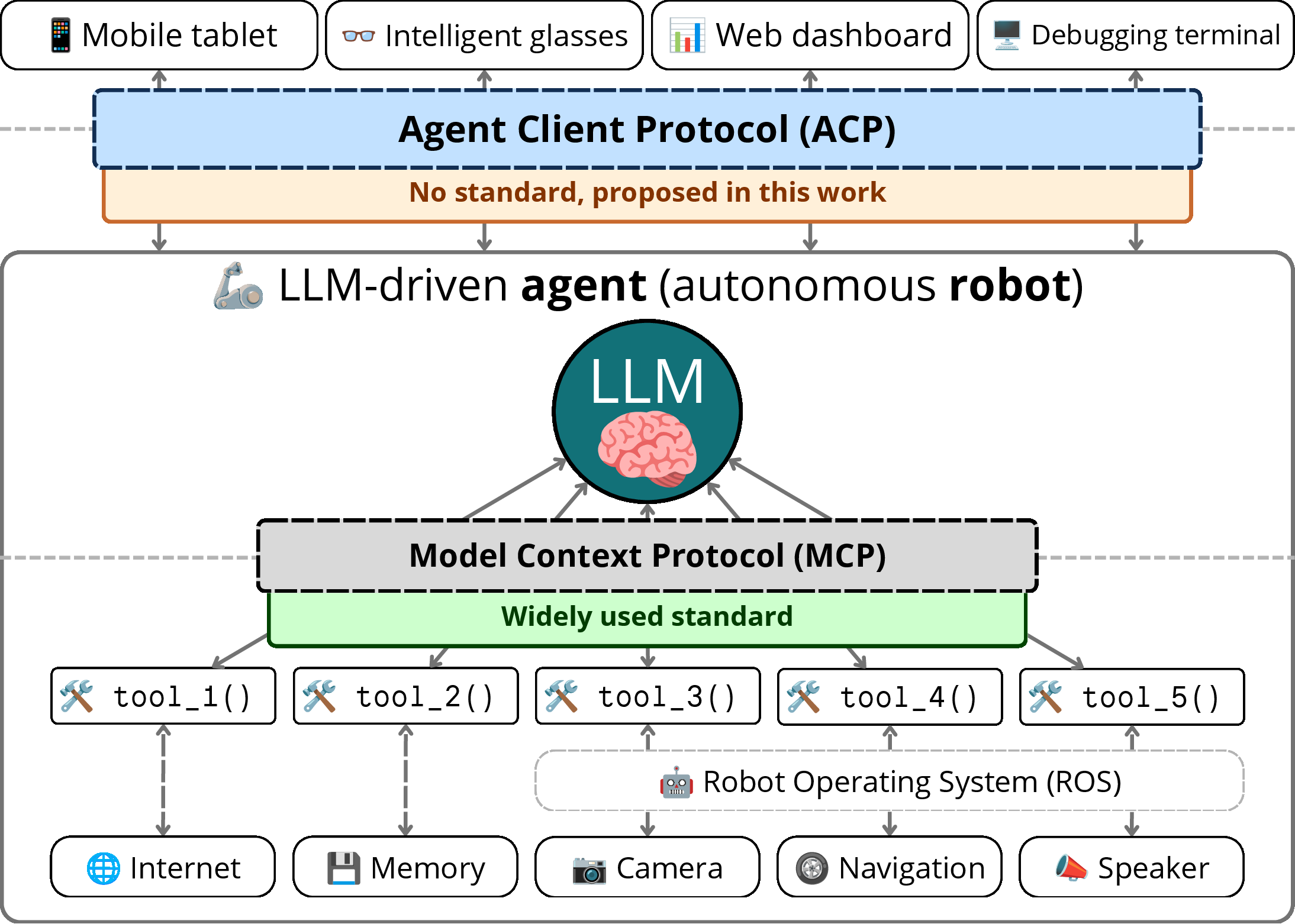
To implement this form of high-level deliberation, a common architectural pattern is to employ an LLM as a central orchestrator, equipped with a set of tools that provide access to the robot’s primitive capabilities (e.g., perception,
navigation, or manipulation) [5], [6]. This integration of LLMs with external
functionalities defines the operational framework of an autonomous agent, typically structured under the Reason+Act (ReAct) paradigm [7].
Under this model, the agent interleaves internal reasoning with the execution of function calls, forming an iterative cycle of thought, action, and observation that enables closed-loop deliberative control. For example, given the instruction
“Pick up the battery”, the agent may first generate an intermediate reasoning step (“I must locate the battery visually”), invoke a perception tool (detect_objects()), and use the resulting observation (“The battery is at
coordinates X, Y”) to guide its next action (navigate_to(X, Y)).
To formalize the integration between LLM-driven agents and their available tools, the Model Context Protocol (MCP) [8] has emerged as an open standard for tool discovery and invocation. Architecturally, MCP follows a client-server model in which the server encapsulates the functionalities of an underlying system and exposes them to the LLM through a standardized communication contract. In the robotics domain, an MCP server can encapsulate the robot’s execution middleware—such as Robotic Operating System (ROS) topics, services, or actions—and expose it to the agent as a structured catalog of tools.
Although the interaction between LLM-driven agents and robotic execution systems is progressively converging toward standardization through MCP, the same does not hold for the upper interaction layer. The bidirectional communication between human operators and robotic agents remains fragmented across proprietary and tightly coupled implementations [9]. This lack of a common communication contract imposes substantial integration overhead, requiring user interfaces to be redesigned or refactored whenever the robotic system changes, or conversely, forcing modifications in the robot’s high-level communication logic when deploying new interfaces. Beyond engineering costs, this fragmentation also limits Human-Robot Interaction (HRI). On one hand, it obscures the agent’s intermediate reasoning and decision-making process, making it difficult for users to inspect the system’s internal state. On the other hand, it complicates critical collaborative operations such as requesting explicit user authorization for sensitive actions or interrupting an ongoing task to provide corrective instructions in real time. Ultimately, this lack of standardization hinders the realization of effective human-in-the-loop robotic workflows.
A similar fragmentation problem has already been addressed in the software engineering domain. Early AI-driven programming assistants—now commonly referred to as coding agents (e.g., Claude Code, Codex)—relied on proprietary integrations tied to specific Integrated Development Environments (IDEs) (e.g., VS Code, IntelliJ), resulting in duplicated integration effort across platforms. To address this limitation, the community recognized the need to decouple the user interface (the client) from the AI logic (the agent), establishing a common communication layer for transmitting user intent, managing permissions, and visualizing the agent’s progress in real time. This led to the creation of the Agent-Client Protocol (ACP) [10], a bidirectional standard that allows any application (client) to interact with AI agents (servers) through a unified and platform-agnostic communication contract.
Motivated by this standardization strategy, this work proposes and experimentally evaluates the adoption of ACP as the communication protocol for the upper interaction layer in GenAI-orchestrated robotic systems. By combining ACP at the interface–agent link and MCP at the agent–execution link, we formulate a fully decoupled three-layer architecture. This topology removes rigid architectural dependencies and incorporates human interaction as a native component of the system, enabling real-time observability, ambiguity resolution, and explicit permission management.
To illustrate the architectural implications of this proposal, consider a mobile manipulator powered by an LLM-based agent tasked with inspecting and classifying components on a factory floor (see Fig. 1). Under a non-unified architecture, enabling human supervision requires implementing custom communication pathways for each user interface. For example, if operators need to monitor the robot through a web dashboard, a mobile tablet, and a developer terminal, each frontend must be individually integrated with the robot’s backend communication logic, often requiring additional ad hoc mechanisms for state transmission, intervention, or assistance requests. By contrast, encapsulating the robotic agent behind the ACP exposes a single standardized communication contract. This allows heterogeneous ACP-compatible clients to connect to the same robotic system without requiring modifications to the robot-side orchestration logic. As a result, ACP not only reduces integration effort but also provides a common substrate for advanced HRI capabilities across multiple interfaces.
To evaluate the architectural feasibility of the proposal, we deployed the architecture on a physical mobile robot called Sancho. We validated the connection of three heterogeneous user interfaces (a developer CLI, a tablet application, and a generic web client) without requiring modifications to the robot’s orchestration layer. From the experiments conducted, we report a representative assistance session and analyze its execution trace, illustrating how the architecture natively supports real-time human-in-the-loop interaction. Furthermore, latency analysis of representative HRI workflows shows that the communication overhead introduced by ACP (\(1.0\) ms) and MCP (\(170.6\) ms) is negligible, amounting to only \(171.6\) ms (less than \(0.5\)% of the average \(36.9\)-second interaction loop, which is dominated by LLM inference and physical tool execution such as navigation). To promote reproducibility, the source code implementing the proposed architecture on Sancho3 and the developed client interfaces4 have been released as open-source.
2 Related Work↩︎
The transition toward agent-based robotic architectures has gained significant attention in recent years, largely driven by the emergence of LLMs and multimodal foundation models. This section reviews the current landscape of AI-driven robotics, focusing on orchestration paradigms, hardware abstraction, and the remaining challenges in HRI standardization.
2.1 LLM-Driven Robotic Orchestration↩︎
Early integrations of LLMs into robotics exploited their zero-shot reasoning capabilities to translate abstract natural-language instructions into structured task decompositions [11]. To improve the physical feasibility of these plans, frameworks such as SayCan [3] introduced grounding mechanisms to align the model’s output with the robot’s available affordances. Building upon these foundations, architectures such as LLM-Planner [6] extended the paradigm through hierarchical planning, using the LLM to generate high-level sub-goals that were subsequently executed by specialized low-level controllers. Beyond purely text-driven architectures, the field has progressively evolved toward Vision-Language-Action (VLA) models, such as RT-1 [12] and RT-2 [4], which provide a more direct mapping from multimodal observations and user intent to low-level control policies.
While static planning and purely reactive strategies remain effective for short-horizon tasks, more complex and open-ended scenarios require foundation models to operate as high-level orchestrators within closed-loop control systems. Recent architectures exemplify this transition by placing the foundation model at the center of iterative perception-action loops [13]. For instance, AutoRT [5] adopts this paradigm to coordinate fleets of robots in unstructured environments, while SayPlan [14] grounds the model in 3D scene graphs to support long-horizon task execution. Inspired by iterative reasoning frameworks such as ReAct [7] and Inner Monologue [15], these systems allow the LLM to continuously observe the environment, perform actions, and replan in response to execution failures.
Despite these advances in autonomy, their implementations typically remain tightly coupled to specific hardware stacks or software ecosystems, lacking a unified abstraction layer for interoperability across heterogeneous robotic platforms. To address this limitation, the architecture proposed in this work isolates the agent orchestrator into a fully decoupled central layer. By relying exclusively on standardized communication contracts, the proposed approach ensures that the agent’s reasoning remains independent of both the underlying execution platform and the external user interfaces.
2.2 Hardware Abstractions↩︎
To perform tasks beyond text generation, LLM-driven agents require structured interfaces to discover and interact with external tools and APIs. In the robotics domain, early integration approaches, such as Code as Policies [16], leveraged the code-generation capabilities of LLMs to synthesize executable Python programs that directly invoked hardware APIs. Other works, such as ProgPrompt [17], structured this interaction by exposing the model to a predefined set of high-level callable functions. Despite these advances, the discovery, invocation, and documentation of these capabilities have traditionally relied on ad hoc parsers and custom integrations.
To address this fragmentation, recent efforts have moved toward protocol-level standardization through the MCP [8]. By adopting a client-server architecture, MCP defines a unified JSON-RPC communication contract for tool discovery and execution, abstracting the complexities of the underlying robotic middleware [18], [19]. While our work adopts MCP for the lower execution layer, we note that standardizing the hardware link only solves half of the architectural problem, leaving the human-interaction layer unaddressed.
2.3 Human-Robot Interaction in GenAI Architectures↩︎
Despite recent progress in agent-based robotic systems, the bidirectional communication between human operators and LLM-driven robots remains largely implemented through task-specific and tightly coupled interfaces [20], [21]. Current HRI solutions in GenAI-enabled robotics typically rely on proprietary communication channels and application-specific frontends [9]. While traditional robotic visualization tools (e.g., RViz, Foxglove) provide effective support for monitoring deterministic system telemetry (e.g., point clouds, coordinate transforms, or navigation states), they lack the semantic abstractions required to support natural-language interaction and expose the internal reasoning processes of LLM-based agents. As a result, functionalities that are increasingly important for collaborative embodied AI—such as real-time intent visualization, explicit human authorization for sensitive actions, and context-preserving session management—must often be implemented independently for each robotic system [21]. This fragmentation limits interoperability and increases integration complexity across heterogeneous interfaces.
As discussed earlier, the software engineering domain addressed a similar fragmentation problem between coding agents and IDEs through the ACP [10]. However, to the best of our knowledge, no prior work has adapted and evaluated this decoupling strategy in the robotics domain. The architecture proposed in this work addresses this gap by introducing ACP as a common communication protocol for the upper interaction layer, enabling heterogeneous user interfaces to interact with robotic agents in a decoupled, unified manner.
3 Description of the Proposed Architecture↩︎
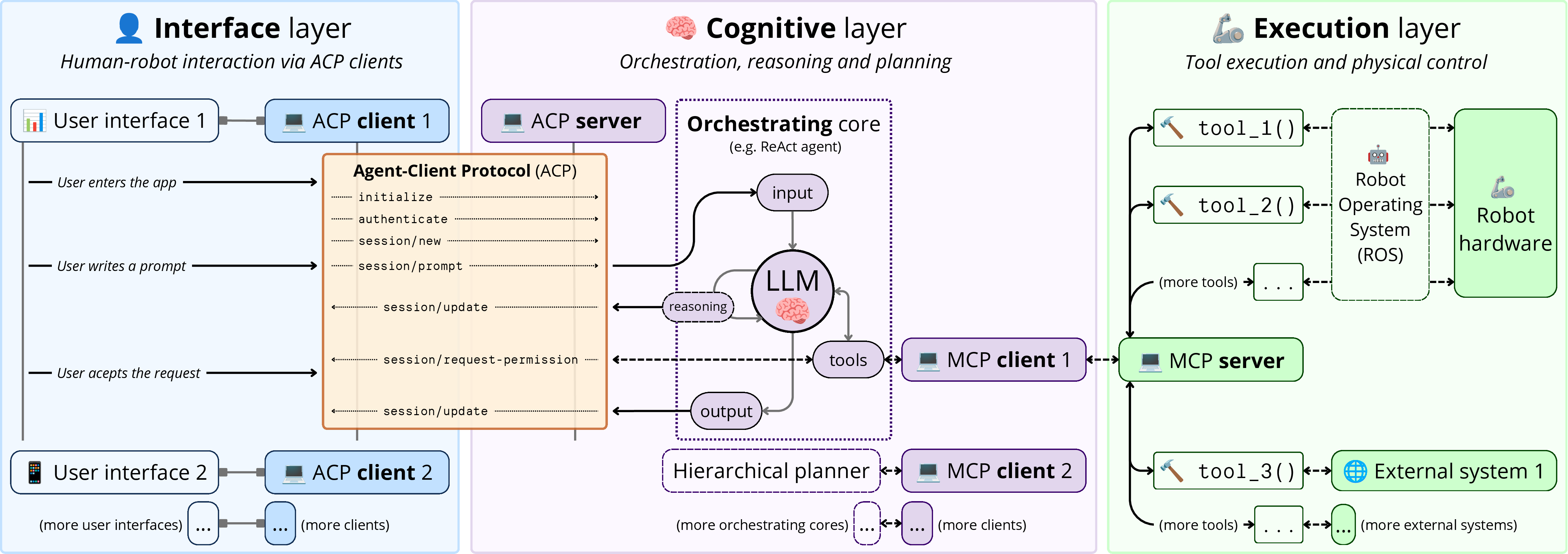
The proposed robotic architecture, illustrated in Fig. 2, is a fully decoupled three-layer system connected through asynchronous JSON-RPC communication contracts: ACP at the upper interface–agent link and MCP at the lower agent–execution link. Functionally, the interface layer governs HRI (see Section 3.1), the cognitive layer concentrates high-level orchestration and planning (see Section 3.2), and the execution layer encapsulates physical control, deterministic safety constraints, and hardware-level operations (see Section 3.3).
3.1 Interface Layer↩︎
The interface layer represents the user-facing entry point (frontend) of the architecture and can be instantiated through heterogeneous ACP clients, i.e., user interfaces such as a console, a web dashboard, or a mobile application, without requiring modifications to the robotic agent hosted in the cognitive layer, which operates as the ACP server. Under the ACP, and adapted here to the robotics domain, the client is an interaction layer not responsible for planning or physical control of the robot. All deliberation resides in the agent (server), while the client is limited to managing the dialogue session, capturing user intents, and visualizing the agent’s feedback.
In this context, a session is defined as a continuous, stateful communication lifecycle between the client interface and the robotic agent. Rather than a single prompt-response exchange, a session spans multiple dialogue turns and iterative ReAct loops, encompassing user instructions, tool executions, environment observations, and dynamic replanning. It acts as an interaction context, preserving the agent’s short-term memory and operational state until the connection is explicitly terminated by the client.
The following list summarizes the client-side operations defined by the ACP and describes their practical role within the proposed robotic architecture.
3.1.0.1 Connection Initialization
At the start of the interaction, the client and the agent establish a communication channel to ensure protocol compatibility and validate the client’s identity (through the initialize operation in the ACP specification). During this step,
both parties negotiate their supported capabilities, including client-side resources (e.g., file system access, terminal execution) and agent-side functionalities (e.g., multimodal prompts or MCP connectivity), which define the operational scope of
subsequent sessions. This initialization model also enables concurrent interaction, allowing multiple client interfaces to connect simultaneously to the same robotic system.
3.1.0.2 Authentication
To guarantee access control, the agent may require credential validation (authenticate), ensuring that only clients with the appropriate authorization can establish sessions that affect the robot’s operation.
3.1.0.3 Session Management
The interaction is structured through a complete lifecycle that allows creating (session_new), loading (session_load), listing (session_list), forking (session_fork), resuming
(session_resume), and closing sessions (session_close). This management is vital at an operational level, as it ensures that the robot agent does not lose context when switching sessions, allows for immediate control recovery
after a network failure, and ensures a traceable log of all decisions made, among others.
3.1.0.4 Configuration Selection
The behavior of the robotic agent during a session can be dynamically modified by selecting the appropriate operating mode (session/set_mode), which allows adjusting the agent’s available tools, system prompts, and permission requirements
on the fly. Translated to a robotic context, this feature allows seamless transitions between passive (e.g., stationary sensor monitoring, reasoning, trajectory generation without physical actuation) and active profiles (e.g., movement-only, fully
autonomous operation, human-in-the-loop supervised execution). Additionally, the client can adjust the LLM governing the agent (session/set_model), choosing the most suitable one depending on cost, response speed, and other requirements of the
intended task. Beyond these, the agent can publish additional settings to be configured by the client (session/set_config_option).
3.1.0.5 Instruction Delivery
The core of the interaction materializes when the operator transmits directives in natural language, optionally supported by multimodal context (session/prompt). This input triggers the agent’s cognitive cycle, which processes the user
intent, plans the necessary physical actions, and asynchronously reports its progress within the session flow.
3.1.0.6 Cancellation
To guarantee dynamic and safe human intervention, the protocol incorporates an immediate interruption mechanism (session/cancel). This operation allows the operator to halt the cognitive loop and physical execution in real-time in the face
of operational risks, context degradation, or the need to replan the mission.
Reverse operations, initiated by the server toward the client, are detailed in Section 3.2, as they originate in the agent’s orchestration logic.
3.2 Cognitive Layer↩︎
The cognitive layer forms the deliberative core of the architecture, where an LLM transforms user intent into high-level action plans under the coordination of an orchestrator core (see Section 3.2.1). Operationally, this layer maintains two simultaneous communication links: it operates as an ACP server toward the interface layer (see Section 3.2.2) and as an MCP client toward the execution layer for tool discovery and invocation (see Section 3.2.3).
3.2.1 Orchestrator Core↩︎
The orchestrator core concentrates the deliberative logic of the system by transforming user intent into executable action sequences. Although it typically follows the ReAct [7] paradigm, its design is compatible with other orchestration paradigms, including hierarchical planning and multi-agent coordination. At each iteration, the orchestrator evaluates the current context, invokes tools through the MCP client, and integrates the resulting observations to refine its action plan. In parallel, it uses the ACP to stream its intermediate reasoning and execution progress to the user interface, enabling clarification requests or human validation when ambiguities or execution failures arise.
Overall, the orchestrator maintains an iterative loop of reasoning, execution, and evaluation. This enables the system to adapt safely to unforeseen events while preserving a strict separation between high-level deliberation and low-level physical control.
3.2.2 ACP Server↩︎
Within the proposed architecture, the orchestrator core leverages the ACP server to issue requests and notifications to the ACP client (recall Section 3.1). The following list summarizes the server-initiated communication primitives defined by the ACP, highlighting their role in enabling real-time observability, human-in-the-loop validation, and feedback during robotic execution.
3.2.2.1 Status Updates to the Client
Real-time supervision is guaranteed through a continuous stream of events reporting on agent messages, thoughts, and tool usage (session/update). In this way, the operator maintains visibility into the agent’s internal state and can
interpret how the task evolves at each stage.
3.2.2.2 Human Authorization Requests
Human intervention is explicitly integrated when execution requires prior validation for a sensitive action (session/request_permission). This control point formalizes the human-in-the-loop scheme and reduces operational risk in decisions
impacting safety, the environment, or the mission.
3.2.2.3 Local File Read and Write
Although not a strictly central capability in many robotic deployments, reading and writing files (fs/read_text_file, fs/write_text_file) can be useful for the agent to transfer files to the client, such as execution traces or
diagnostic logs
3.2.2.4 Terminal Process Management
The terminal process management on the client provided by the ACP (terminal/create, terminal/output, terminal/wait_for_exit, terminal/release, terminal/kill) generally makes little sense
in a robotic deployment; therefore, these operations should be restricted.
3.2.3 MCP Client↩︎
The MCP client bridges the cognitive layer with the robot’s physical capabilities by consuming the formal catalog of structured tools (e.g., navigate to a waypoint, open the gripper, check the battery level) exposed by the execution layer (see Section 3.3). The LLM itself does not interact with the hardware; rather, it outputs tool-call intents which the MCP client forwards to the MCP server for execution, returning the results as contextual feedback to the model, always under the control of the orchestrator core (recall Section 3.2.1). This separation decouples cognitive logic from physical implementation, ensuring portability across different robotic platforms.
3.3 Execution Layer↩︎
The execution layer establishes the connection between high-level orchestration and the physical operation of the robot through an MCP server. This component encapsulates the operational capabilities of the system—including native middleware functionalities (such as ROS topics, services, and actions) as well as external resources (such as web services or cloud queries)—and exposes them to the cognitive layer as a unified catalog of standardized tools.
From an engineering perspective, this layer retains full responsibility for low-level control and operational safety. The MCP server validates invocation parameters, enforces physical constraints, and rejects unsafe actions before they reach the hardware. Consequently, non-deterministic generative inference is isolated from fast control loops, leaving stability, temporal guarantees, and emergency-stop mechanisms to specialized deterministic components.
4 Experimental Evaluation↩︎
This section presents the experimental evaluation of the proposed architecture through its deployment on a physical mobile robot operating in a standard office environment (see Section 4.1). The evaluation focuses on three architectural properties. First, we assess the decoupling between the robotic agent and its user interfaces enabled by the ACP, demonstrating that three heterogeneous clients can connect to the robot without requiring modifications to its orchestration logic (see Section 4.2). Second, we present a representative collaborative assistance scenario and analyze its execution trace within the architecture, illustrating how the proposed design supports real-time human-in-the-loop interaction (see Section 4.3). Finally, we analyze the computational overhead introduced by the architectural decoupling through ACP and MCP, showing that the proposed three-layer design preserves the robot’s real-time responsiveness (see Section 4.4).
4.1 Evaluation Setup↩︎
The proposed three-layer architecture has been implemented and deployed on the mobile robot Sancho, which is based on the ROS 2 Humble framework. Built upon an AgileX Ranger Mini V3 base, Sancho is equipped with two Hokuyo laser scanners to support robust navigation and reactive capabilities. For environmental perception and HRI, it incorporates an Orbbec Astra RGB-D camera, as well as a head-mounted RGB camera and an integrated speaker for verbal communication and social interaction.
To materialize the execution layer, an MCP server was developed to interface with the robot’s hardware and middleware. Given that all physical capabilities of the robot are natively managed by ROS, this server acts as a semantic bridge to the underlying ROS topics, services, and actions. The defined MCP tools enable the agent to get a pre-built topological map of the environment, navigate to specific coordinates or locations, capture images via the RGB camera, and synthesize speech through the robot’s integrated speakers.
In the cognitive layer, the orchestrator core is implemented as a pure ReAct agent driven by the LLM gemini-3.1-flash-lite. Given the user’s prompt, this agent iteratively reasons and invokes the available MCP tools until the task is
completed. As a specific implementation detail, an initial LLM call is executed to generate the robot’s preliminary thought. Similar to how many conversational interfaces display their thought process while generating a longer response, this initial
intention is shared with the ACP clients as the very first message, providing users with immediate feedback on what the robot is about to do. Regarding the ACP server in this layer, since the ACP currently relies on standard input/output
(stdio) for local process communication, the protocol was deployed over a raw TCP transport layer to enable remote network connection, requiring clients to establish a socket connection before exchanging JSON-RPC messages.
In the interface layer, three heterogeneous user interfaces were deployed to act as independent ACP clients. A description of them, along with the demonstration of how the architecture seamlessly accommodates their connection without requiring any custom integration adapters or modifications to the robot’s logic, is discussed below.
4.2 Decoupling of the Robotic Agent and User Interfaces↩︎
To validate that the proposed architecture successfully decouples the robot (agent, whose logic lives in the cognitive layer) from the user interfaces (clients, which live in the interface layer), we connected three different ACP clients to Sancho
without modifying its orchestrator (see Fig. 3). Specifically, the evaluated interfaces include two custom-developed clients and one pre-existing third-party application: (i) a Developer CLI (see Fig. 3.a), our custom minimalist terminal-based client for low-level command injection; (ii) a Mobile app (see Fig. 3.b), our custom touchscreen-based interface deployed on
a tablet for on-site operators; and (iii) acp-ui (see Fig. 3.c)5, a pre-existing, general-purpose open-source
client.
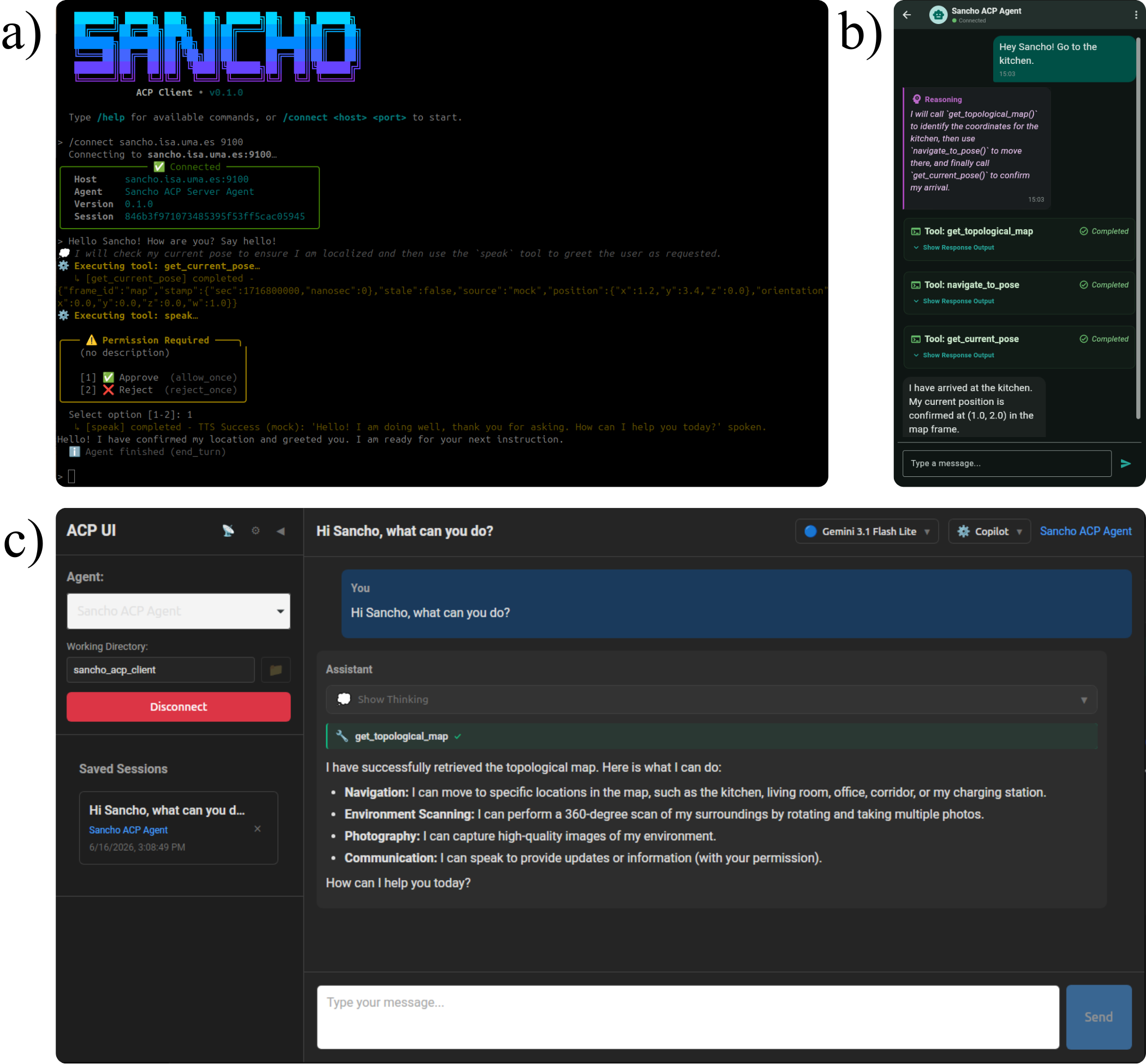
Integrating these diverse clients required no custom code on the robot, thanks to the implementation of the ACP in the robot (ACP server in the cognitive layer) and user interfaces (ACP clients in the interface layer), demonstrating how this protocol enables true decoupling in the architecture. Actually, not only does it allow multiple interfaces to connect to a single robot, but conversely, it ensures that the developed user interfaces can instantly connect to any other robotic system implementing the ACP, showcasing the complete portability and independence of the interface layer.
4.3 HRI Workflow Validation↩︎
To evaluate the architecture’s suitability for HRI, several experimental trials were conducted; among these, we highlight a representative usage session of Sancho interacting with a user via the acp-ui client in an assistance robotic
context.
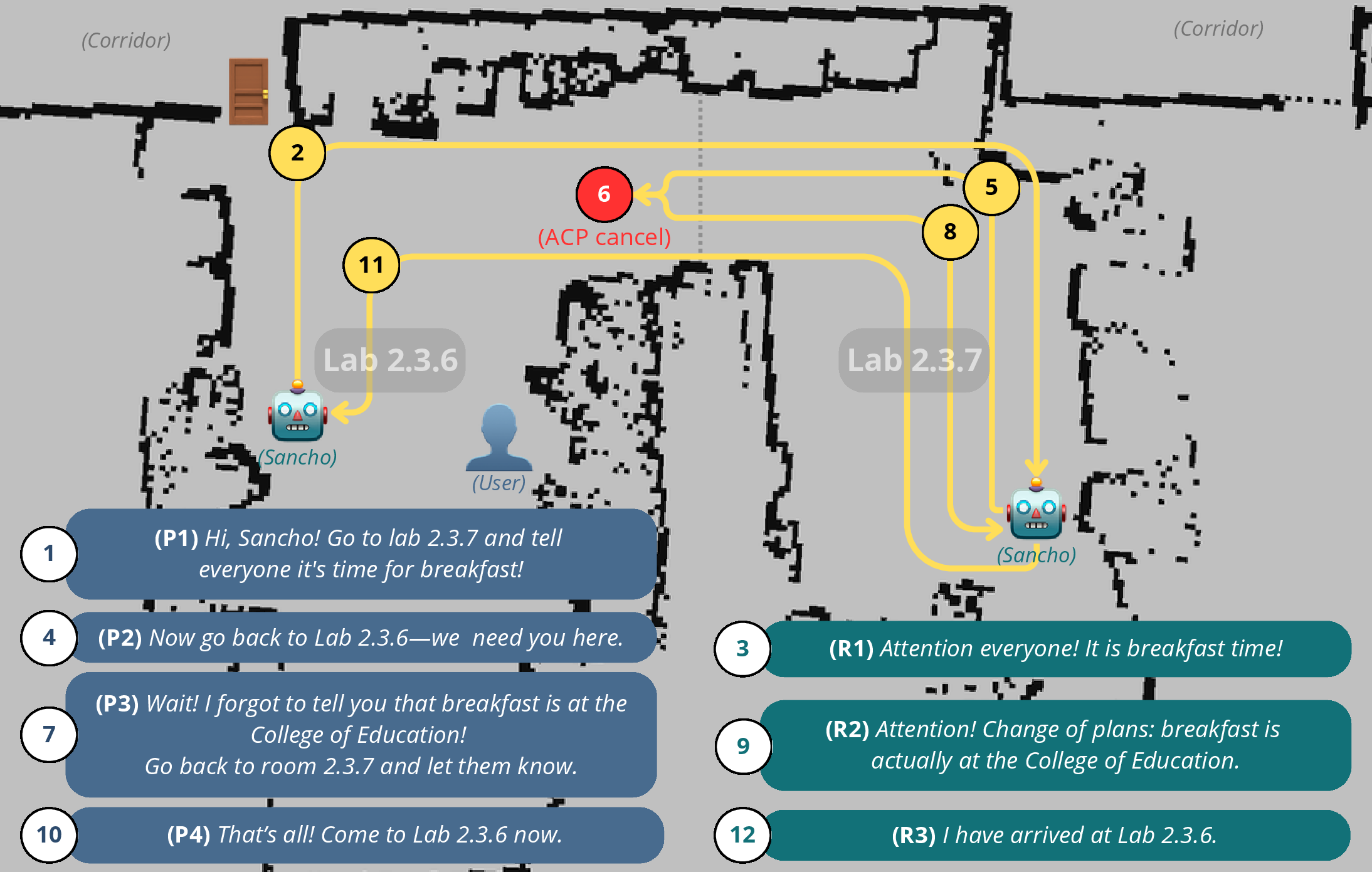
The trace of this representative session, depicted in Fig. 4, unfolded as follows. First, the user instructed Sancho to navigate to a specific laboratory location and deliver a spoken message (P1;
session/prompt event in ACP). The agent processed the intent and started executing the navigation, streaming its internal reasoning and progress back to the user’s interface in real time (session/update). Upon reaching the
destination and before synthesizing the speech, the agent proactively paused its execution loop to request explicit human authorization (session/request_permission). Note that requiring authorization for speech synthesis was a specific
implementation decision to maintain a quiet office environment, preventing the robot from emitting loud verbal messages without confirmation. Once the user granted permission via the interface, Sancho delivered the message. Subsequently, the user commanded
the robot to return to the starting position (P2; session/prompt). However, shortly after the robot started its return navigation, the user remembered an additional detail that needed to be communicated and instantly aborted the task
(session/cancel). This command immediately halted the robot’s physical movement. Then, the user issued a new instruction encompassing the forgotten message (P3; session/prompt), prompting the agent to replan and execute the
updated task. Once completed, the user commanded the robot back to the starting location (P4; session/prompt).
As shown, the native ACP capabilities—real-time observability, explicit authorization, and instant task interruption—allow operators to supervise and intervene at any point during the robot’s operation, enforcing safety boundaries before triggering sensitive physical actions.
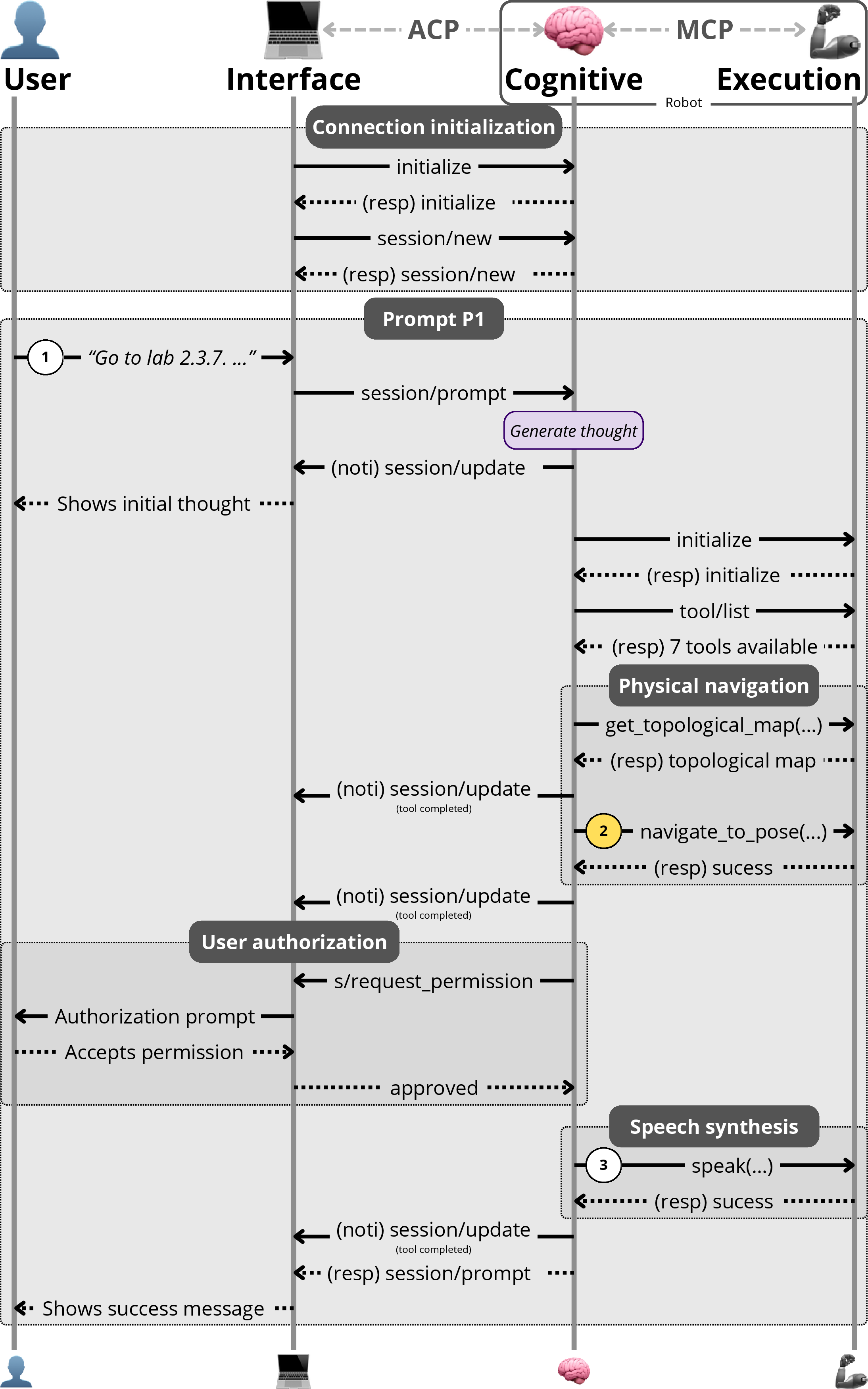
To better understand the operation of the ACP and the proposed architecture, Fig. 5 illustrates the exchange across the three architectural layers during the connection initialization and the first prompt (P1). First,
the client initializes the connection by executing the initialize command and creating a session via a session/new request. When the user inputs the prompt P1 (“Go to lab 2.3.7...”), the client transmits this via a
session/prompt request. The cognitive orchestrator performs an initial LLM call to generate a preliminary thought and publishes it as a progress update to the client using a session/update notification. Next, the cognitive layer
establishes its connection with the execution layer using the initialize and tool/list commands, discovering \(7\) available MCP tools. To perform the physical navigation, the cognitive layer first
retrieves the topological map via get_topological_map and then triggers navigation via navigate_to_pose, sending progress updates to the client after each tool completes. Upon arrival, and before executing the speech synthesis,
the cognitive agent pauses its execution loop and issues an s/request_permission request. As mentioned, requiring authorization for this specific tool is an implementation decision. Once the user accepts the permission, the client returns an
approved response, allowing the agent to proceed by calling the speak tool on the execution layer. Finally, the execution layer reports success, and the cognitive layer completes the loop by sending a final
session/update notification and the session/prompt response.
4.4 Overhead Analysis↩︎
To quantify the computational impact of the proposed architectural decoupling, we analyzed the latency breakdown of the representative usage session described in Section 4.3 as an example. Table ¿tbl:tab:latency95breakdown? presents the detailed timing breakdown for each interaction within the session. These timings are categorized into five distinct phases: (i) Initial LLM Thought, measuring the time taken by the LLM to generate its first thought; (ii) ReAct LLM Inference, corresponding to the subsequent reasoning cycles within the ReAct loop; (iii) Physical Tools (MCP), representing the execution of hardware actions via the MCP server (navigation and speech synthesis); (iv) User Authorization (ACP), which accounts for the user response latency when granting permission; and (v) Protocols & APIs, capturing the JSON-RPC serialization, TCP round-trips, and minor software-only MCP tool calls (e.g., retrieving the topological map, which do not involve physical actuation).
2.5pt
| Phase | P1 | P2* | P3 | P4 | Avg. |
|---|---|---|---|---|---|
| Initial LLM Thought | \(2.49\) s | \(2.76\) s | \(2.18\) s | \(2.86\) s | \(2.51\) s |
| ReAct LLM Inference | \(5.38\) s | \(1.56\) s | \(3.62\) s | \(4.55\) s | \(4.52\) s |
| Physical Nav. (MCP) | \(25.12\) s | \(12.07\) s | \(20.57\) s | \(20.47\) s | \(22.05\) s |
| Speech Synth. (MCP) | \(3.94\) s | – | \(6.39\) s | \(3.95\) s | \(4.76\) s |
| User Auth. (ACP) | \(3.02\) s | – | \(2.36\) s | \(3.42\) s | \(2.93\) s |
| Protocols & APIs | \(380.9\) ms | \(1.1\) ms | \(66.0\) ms | \(68.0\) ms | \(171.6\) ms |
| Total | \(40.33\) s | \(16.39\) s | \(35.19\) s | \(35.31\) s | \(36.94\) s |
| *P2 was cancelled by the user and did not complete. | |||||
| Avg. represents the average of completed prompts (P1, P3, P4). | |||||
As shown, the completed interactions of the session required an average of \(36.94\) s. As expected, the vast majority of this time was consumed by deterministic physical navigation via ROS 2 (\(22.05\) s, \(59.7\)%) and LLM inference (totaling \(7.03\) s, \(19.0\)% across both the initial thought and the subsequent reasoning loops). In contrast, the communication overhead introduced by the proposed protocols is negligible. The ACP layer (handling session management and state streaming) introduces just \(1.0\) ms (\(<0.01\)%), while the MCP layer (handling connection and tool routing) adds only \(170.6\) ms (\(0.5\)%). These results confirm that the latency footprint of dividing the system into three distinct layers, bridged by the ACP and MCP contracts, represents less than \(0.5\)% of the total execution time. Therefore, the architecture provides layer decoupling, successfully enables advanced HRI capabilities, and does not compromise the robot’s real-time responsiveness.
5 Conclusions and Limitations↩︎
This paper has addressed a key HRI challenge in GenAI-driven robotics: the fragmentation and tight coupling between LLM-based agents and their user interfaces. To address this limitation, we proposed the adoption of the ACP as a unifying communication protocol for the upper interface–agent link. Combined with MCP at the lower agent–execution link, this yields a fully decoupled three-layer architecture. The experimental evaluation demonstrated that this topology enables multiple heterogeneous user interfaces to interact with the same robotic system without requiring custom integration, while naturally supporting human-in-the-loop capabilities such as real-time intent observability, explicit authorization, and task interruption, all with negligible computational overhead.
Despite these advantages, the proposed approach presents certain limitations. Since ACP was originally designed for coding agents in software engineering, some of its operations are not directly applicable to robotic systems. For example, terminal process management offers limited practical utility in this context and should typically be restricted. Furthermore, the protocol does not natively support capabilities that could be useful for robotics, such as continuous multimodal data streaming (e.g., live camera feeds) or asynchronous background telemetry (e.g., battery-level monitoring without explicit user prompts), requiring complementary mechanisms outside the ACP specification.
Future work may explore extensions to the ACP specification to incorporate multimodal streaming and continuous telemetry primitives, further strengthening its applicability as a unified layer for GenAI-enabled robotic systems.
Acknowledgment↩︎
This work has been supported by the projects: MINDMAPS (PID2023-148191NB-I00), funded by the Ministry of Science, Innovation, and Universities of Spain; Voxeland (PPRO-B1-2023-017, JA.B1-09), funded by the University of Málaga; the Andalusian Plan for Research, Development, and Innovation (PPRO-TEP960-G-2023); and the Spanish FPU fellowship program under grant FPU24/02974.
References↩︎
This work has been submitted to the IEEE for possible publication. Copyright may be transferred without notice, after which this version may no longer be accessible.↩︎
1The authors are with the Machine Perception and Intelligent Robotics Group (MAPIR-UMA), Malaga Institute for Mechatronics Engineering and Cyber-Physical Systems (IMECH.UMA), University of Malaga, 29071 Málaga, Spain (e-mail:
jemonra@uma.es;jotaraul@uma.es;javiergonzalez@uma.es).↩︎Sancho source code: https://github.com/MAPIRlab/sancho_robot/↩︎
ACP clients developed: https://github.com/MAPIRlab/sancho-acp-clients↩︎