Kernelization for \(H\)-Packing Revisited
July 16, 2026
Abstract
\(H\)-Packing asks whether a graph \(G\) contains \(k\) vertex-disjoint copies of a fixed pattern graph \(H\). Via the standard reduction to \(d\)-Set Packing, one obtains generic kernels with \(O(k^{|V(H)|-1})\) vertices and \(O(k^{|V(H)|})\) edges. We revisit the question of beating these bounds for specific patterns \(H\).
Our main results concern subdivided stars. Let \(S_{d_1,d_2}\) denote the subdivided star with \(d_1\) branches of length \(1\) and \(d_2\) branches of length \(2\). We obtain kernels with \(O(k^2)\) vertices and \(O(k^3)\) edges for \(P_5=S_{0,2}\), for \(S_{1,2}\), and for every \(S_{d_1,1}\), kernels with \(O(k^4)\) vertices and \(O(k^6)\) edges for every fixed \(S_{d_1,d_2}\) with \(d_1\ge 1\), and a kernel with \(O(k^2)\) vertices and \(O(k^4)\) edges for the paw. Our proofs proceed in two steps. First, we reduce to instances in which all but a small part of the graph is independent, or in which the graph has a small vertex cover. Second, we reduce the independent side by keeping only a bounded number of witness vertices for each subset of the small part.
On the negative side, we prove a lower bound for the line \(S_{0,d}\). For every \(d\ge 3\) and every \(\varepsilon>0\), \(S_{0,d}\)-Packing does not admit a compression of size \(O(k^{d-\varepsilon})\) unless \(\textrm{NP}\subseteq \textrm{coNP}/\textrm{poly}\). Thus, deleting a single vertex from the pattern may, surprisingly, make kernelization provably harder, showing that compressibility of \(H\)-Packing is not monotone under taking induced subgraphs.
1 Introduction↩︎
For a fixed graph \(H\), the following \(H\)-Packing problem [1], [2] is a fundamental problem in theoretical computer science, extensively studied in the literature on parameterized algorithms [3]–[7].
\(H\)-Packing:
Input: An undirected graph \(G\) and an integer \(k\in \mathbb{Z}_{\geq 0}\).
Question: Does \(G\) contain \(k\) vertex-disjoint (not necessarily induced) subgraphs isomorphic to \(H\)?
One of the lines of research for this problem is kernelization, which refers to a polynomial-time algorithm that transforms an instance into a possibly smaller equivalent instance. For general \(H\), the standard upper bounds come from reducing \(H\)-Packing to \(d\)-Set Packing:
\(d\)-Set Packing:
Input: Universe \(U\), set family \(\mathcal{F}\subseteq \binom{U}{d}\), and integer \(k\in \mathbb{Z}_{\geq 0}\).
Question: Does \(\mathcal{F}\) contain \(k\) pairwise disjoint sets?
Fellows et al. [4] provided a kernel of \(O(k^d)\) sets for this problem, while Abu-Khzam [8] gave a kernel with \(O(k^{d-1})\) elements and \(O(k^d)\) sets. By reducing \(H\)-Packing to \(d\)-Set Packing in the standard way and then kernelizing the resulting Set Packing instance, one obtains an upper bound of \(O(k^{|V(H)|-1})\) vertices and \(O(k^{|V(H)|})\) edges for \(H\)-Packing. Indeed, one may lift the Set Packing kernel back to an \(H\)-Packing instance by keeping the vertices and edges that appear in the surviving copies of \(H\). For connected \(H\), the vertex bound \(O(k^{|V(H)|-1})\) was obtained earlier by Moser [7]. This leads to the following question:
Can one beat the \(d\)-Set Packing kernel bound for \(H\)-Packing?
Known positive answers were confined to a few patterns. Star packing, that is, \(K_{1,d}\)-Packing, has been studied in the kernelization literature. Prieto-Rodriguez and Sloper [9] obtained an \(O(k^2)\)-vertex kernel for general \(K_{1,d}\)-Packing, and this was improved to a \(O(k)\)-vertex kernel [10], [11]. The special case \(P_3\) has attracted attention: Prieto-Rodriguez and Sloper [9] obtained a \(15k\)-vertex kernel, and later work improved this to the best bound of \(5k\) vertices [12]–[14]. Dell and Marx [3] showed that when \(H\) is a path on \(\ell\) vertices, one can beat the general bound with kernels of \(O(k^{2.5})\) edges for \(\ell=4\) and \(O(k^3)\) edges for \(\ell\geq 5\). Cervený, Choudhary, and Suchý [15] studied the hitting counterpart, obtaining kernels of \(O(k^2)\) edges for \(\ell=4,5\) and \(O(k^4)\) edges for general \(\ell\).1 However, beyond these examples, the list of graphs \(H\) known to beat the \(d\)-Set Packing bound remained very short.
This paper gives several new affirmative answers. At the same time, it shows that the picture is subtler than expected. Concretely, we show that deleting a single vertex from the pattern may lead to provably worse kernelization behavior. This is surprising, and suggests that a more systematic understanding of kernelization for \(H\)-Packing is still needed.
Our main focus is the subdivided star \(S_{d_1,d_2}\), which has \(d_1\) branches of length \(1\) and \(d_2\) branches of length \(2\) (1). In particular, \(S_{1,1}=P_4\) (\(4\)-vertex path), \(S_{0,2}=P_5\) (\(5\)-vertex path), and \(S_{d,0}=K_{1,d}\) (\(d\)-leaf star). For the case \(d_2=0\) (that is, stars), linear-vertex kernels are already known [10], [11].
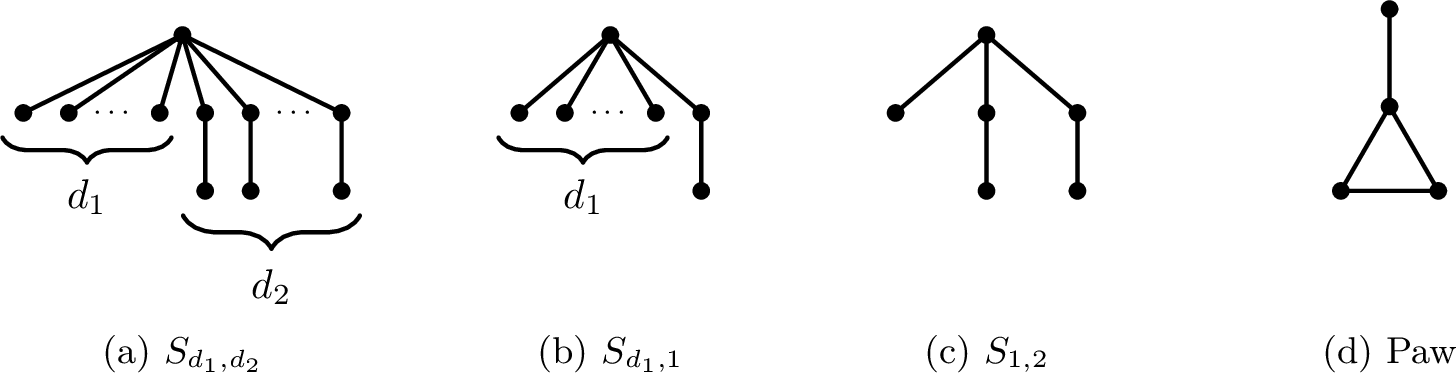
Our first theorem extends this line beyond stars, giving quadratic-vertex and cubic-edge kernels when \(d_2=1\) and in the two additional cases \((d_1,d_2)\in\{(0,2),(1,2)\}\).
theoremShortSubdividedStarKernel For every fixed subdivided star \(H=S_{d_1,d_2}\) with \(d_2 = 1\) or \((d_1,d_2)\in\{(0,2),(1,2)\}\), \(H\)-Packing admits a kernel with \(O(k^2)\) vertices and \(O(k^3)\) edges.
For the family \(H=S_{d_1,1}\), the hidden constants depend polynomially on \(d_1\).
At a high level, the argument has two steps, both using reductions based on the expansion lemma: first, one finds a small set that captures the non-trivial part of the graph, and then one reduces the remaining independent side.
The cleanest case is \(P_5=S_{0,2}\). The key step is to obtain a vertex cover of size \(O(k)\). Let \(C\) be the union of vertex sets of a maximal family of vertex-disjoint copies of \(P_5\); then \(|C|=O(k)\), and \(C\) meets every copy of \(P_5\) by maximality. A reduction based on the expansion lemma reduces the number of non-trivial components of \(G-C\) to \(O(k)\). We then obtain a linear-size vertex cover, because every connected \(P_5\)-free graph has a constant-size vertex cover. Thus each non-trivial component of \(G-C\) contributes only constantly many cover vertices, while all remaining vertices are isolated in \(G-C\). Consequently the resulting graph has a vertex cover of size \(O(k)\).
The second step is to reduce the remaining independent side by keeping only a bounded number of vertices for each relevant subset of the vertex cover. For \(P_5\), applying this to the linear-size vertex cover obtained in the first step yields a quadratic-vertex kernel.
For \(S_{1,2}\) and \(S_{d_1,1}\), the same first idea starts the proof, but the vertex-cover argument used for \(P_5\) is too rigid. To handle this, we introduce the notion of an isolating set. Concretely, we seek an isolating set \(C\) for which \(V(G)\) admits a partition \(V(G)=C\uplus Z\uplus I\), where \(I\) is independent and there is no edge between \(I\) and \(Z\). When \(Z=\emptyset\), this set \(C\) is exactly a vertex cover. Here one again applies reduction based on the expansion lemma to obtain \(|C|=O(k)\), but now keeps an additional set \(Z\) of size \(O(k^2)\) that contains the non-trivial surviving part, leaving the rest in the independent set \(I\). The second step then reduces this \(I\)-side exactly as in the \(P_5\) case. This yields [thm:short-subdivided-stars].
We next turn to arbitrary subdivided stars with \(d_1 \ge 1\).
theoremSubdividedStarKernel For \(d_1 \ge 1\), \(S_{d_1,d_2}\)-Packing admits a kernel with \(O(k^4)\) vertices and \(O(k^6)\) edges.
The kernelization landscape for subdivided stars is summarized in 2.
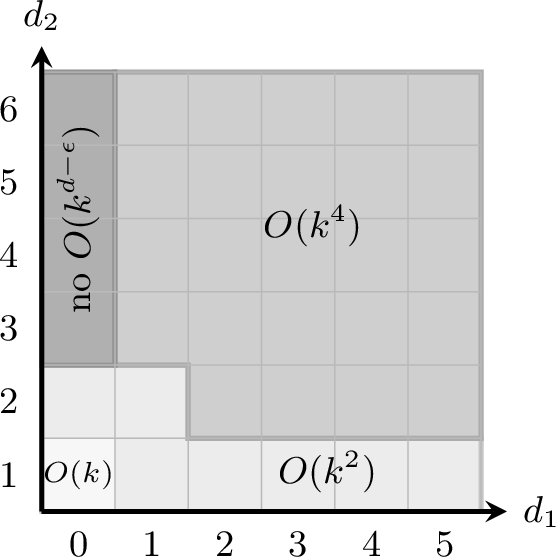
The overall strategy again has two steps. First, we reduce the instance to one with a vertex cover of size \(O(k^2)\). Unlike the cases covered by [thm:short-subdivided-stars], this vertex cover is no longer linear in \(k\). Starting from a maximal packing, we take a maximal matching in the remaining graph. Because the vertices outside this matching form an independent set, the packing vertices together with the matched vertices already form a vertex cover. The key point is then to show, by a degree analysis around the matching, that after deleting vertices that belong to no copy of \(H\), only \(O(k^2)\) matched vertices need to be kept. Second, we reduce the remaining part outside this vertex cover using the same general approach as in the proof of [thm:short-subdivided-stars].
The assumption \(d_1\ge 1\) in [thm:general-result] is essential for the second step. We introduce the notion of the pattern’s \(r\)-replaceability, defined formally in 3. Roughly speaking, this notion controls how efficiently the part outside the vertex cover or isolating set can be represented once a partition \(V(G)=C\uplus Z\uplus I\) is given. Our general reduction theorem shows that, from such a partition, one obtains a kernel with \(O(|C|^r+|Z|)\) vertices (1).
For subdivided stars, the distinction between the cases \(d_1=0\) and \(d_1\ge 1\) turns out to be fundamental. If \(d_1\ge 1\), then the presence of a branch of length \(1\) makes it possible to replace the part of a copy outside the cover while preserving the pattern, and \(S_{d_1,d_2}\) is already \(2\)-replaceable, which is what ultimately yields the polynomial kernel of [thm:general-result]. In contrast, when \(d_1=0\), our framework gives only \(d_2\)-replaceability for \(S_{0,d_2}\). One might suspect that this is merely a limitation of our method. The next theorem, however, shows that it reflects a genuine structural barrier:
theoremSubdividedStarHardness For any \(d\geq 3\) and \(\epsilon>0\), \(S_{0,d}\)-Packing does not admit a compression with size \(O(k^{d-\epsilon})\) unless \(\textrm{NP}\subseteq \textrm{coNP}/\textrm{poly}\).
This shows that deleting a single vertex from the pattern can make kernelization strictly harder: \(S_{1,7}\)-Packing admits a kernel with \(O(k^6)\) edges by [thm:general-result], whereas \(S_{0,7}\)-Packing does not admit a compression of size \(O(k^{7-\epsilon})\) unless \(\textrm{NP}\subseteq \textrm{coNP}/\textrm{poly}\). It also highlights the role of replaceability: \(S_{1,7}\) is already \(2\)-replaceable, while \(S_{0,7}\) is only \(7\)-replaceable, and this gap is reflected in their kernelization complexity.
Finally, we consider the paw ([fig:paw]), i.e., a triangle with a pendant edge.
theoremPawKernel Paw-Packing admits a kernel with \(O(k^2)\) vertices and hence \(O(k^4)\) edges.
This is the first example, to the best of our knowledge, of beating the general \(d\)-Set Packing bound for a pattern that contains a cycle. The proof again follows a two-step kernelization scheme, but now in a form adapted to triangles. Starting from a maximal paw packing, one reduces the number of triangle components outside the initial set and controls large matchings around its vertices. This yields an equivalent instance with a vertex cover \(C\) of size \(O(k^2)\). The remaining outside vertices matter only through \(O(k^2)\) edges of \(C\) that can participate in triangles, and a second matching-based kernelization using these edges gives the kernel in [thm:paw-result].
The algorithmic study of \(H\)-Packing goes back to Hell and Kirkpatrick’s work on generalized matching problems [1], [16]: for fixed \(H\), the problem is polynomial-time solvable when each connected component of \(H\) has at most two vertices and NP-hard when \(H\) has at least three vertices. For broader background on the algorithmic and computational aspects of graph packing, we refer to Yuster’s survey [2].
From the parameterized perspective, the generic benchmark is \(d\)-Set Packing. For that problem, the fastest known generic randomized algorithms are due to Björklund, Husfeldt, Kaski, and Koivisto [17]; in particular, they solve \(3\)-Set Packing in time \(O^*(3.328^{k})\) and \(4\)-Set Packing in time \(O^*(7.312^k)\).2 Deterministically, Nederlof [18] very recently obtained an \(O^*(2^{dk+o(dk)})\)-time algorithm for \(d\)-Set Packing. Via the standard reduction from \(H\)-Packing to \(d\)-Set Packing, this yields fixed-parameter algorithms for \(H\)-Packing. For the special case \(P_3\), Zehavi [19] gave a deterministic algorithm with running time \(O^*(6.75^k)\) based on Feng et al. [20].
Concerning kernelization, generic kernels for \(H\)-Packing with \(O\!\left(k^{|V(H)|-1}\right)\) vertices and \(O(k^{|V(H)|})\) edges follow from \(d\)-Set Packing [4], [8]. For connected \(H\), Moser [7] had earlier obtained the vertex bound \(O\!\left(k^{|V(H)|-1}\right)\) directly for \(H\)-Packing. On the lower-bound side, Dell and Marx [3] showed that \(H\)-Packing does not admit a kernel of \(O(k^{2-\epsilon})\) edges for any \(\epsilon>0\) and any connected graph \(H\) with at least three vertices unless \(\textrm{NP}\subseteq \textrm{coNP}/\textrm{poly}\). For cliques, they further proved that \(K_d\)-Packing does not admit a kernel of \(O(k^{d-1-\epsilon})\) edges for any \(\epsilon>0\) and any \(d\ge 3\) unless \(\textrm{coNP}\subseteq \textrm{NP}/\textrm{poly}\).
Before the present paper, the only graphs known to beat these generic upper bounds were essentially stars and paths. For stars, the kernel size was improved from quadratic to linear [9]–[11]; for the special case \(P_3\), the kernel size was later reduced further to \(5k\) vertices [9], [12]–[14]. For paths, Dell and Marx [3] obtained kernels with \(O(k^{2.5})\) edges for \(P_4\) and \(O(k^3)\) edges for \(P_\ell\) with \(\ell\geq 5\).
A variant that considers packing induced subgraphs instead of subgraphs, Induced \(H\)-Packing, has also been studied. Via the standard reduction to Set Packing, one obtains a compression with \(O(k^{|V(H)|-1})\) elements and \(O(k^{|V(H)|})\) sets. Fomin et al. [21] obtained an \(O(k^{5/3})\)-vertex kernel for induced \(P_3\)-Packing via expansion lemma, and Bessy et al. [22] improved this to \(O(k)\) vertices via rainbow matching. These papers also obtained improved kernels for packing oriented triangles in tournaments.
2 Preliminaries↩︎
We assume that the reader is familiar with the basic notions of parameterized complexity; for background, we refer to Cygan et al. [23].
Graphs.
In this paper, all graphs are finite, simple, and undirected. For a graph \(G\) and a vertex set \(X\subseteq V(G)\), we write \(G[X]\) for the induced subgraph on \(X\) and \(N_G(X)\) for the neighborhood of \(X\) in \(G\); if \(X=\{x\}\), we abbreviate \(N_G(\{x\})\) to \(N_G(x)\). For two disjoint vertex sets \(X,Y\subseteq V(G)\), we write \(G[X,Y]\) for the bipartite graph obtained from \(G[X\cup Y]\) by removing all edges in \(G[X]\) and \(G[Y]\). We denote a path by the sequence of its vertices, so \((v_1,\dots,v_r)\) is the path with edges \(v_iv_{i+1}\) for \(i\in\{1,\dots,r-1\}\). For \(D\subseteq V(G)\) and \(X\subseteq V(G)\), let \(N_D(X):=N_G(X)\cap D\), and for an integer \(r\ge 1\), let \(N_D^{\le r}(X)\) denote the set of vertices \(v\in D\) such that, for some \(x\in X\), there is a path \((x,\dots,v)\) of length at most \(r\), or equivalently, at most \(r\) edges, whose internal vertices all lie in \(D\).
We write \(\deg_G(v)\) for the degree of a vertex \(v\) in \(G\), \(\Delta(G)\) for the maximum degree of \(G\), \(\operatorname{dist}_G(u,v)\) for the distance between \(u\) and \(v\) in \(G\), and \(\operatorname{diam}(G)\) for the diameter of a connected graph \(G\). In particular, every subdivided star \(S_{d_1,d_2}\) has diameter at most \(4\).
Kernelization.
Two instances \((G,k)\) and \((G',k')\) of \(H\)-Packing are equivalent if either both are yes-instances or both are no-instances. A kernelization of size \(f(k)\) for a parameterized problem is a polynomial-time algorithm that maps each instance \((x,k)\) to an equivalent instance \((x',k')\) of the same problem whose size is bounded by a computable function \(f(k)\). More generally, a compression of size \(f(k)\) outputs an equivalent instance of some parameterized problem that can be encoded using \(O(f(k))\) bits. In this paper, for graph problems we measure the size of a reduced instance in terms of the number of vertices and edges of the reduced graph. A reduction rule that replaces an instance \((G,k)\) by an instance \((G',k')\) is safe if \((G,k)\) and \((G',k')\) are equivalent.
For a fixed graph \(H\), we will repeatedly use the following elementary reduction rule.
Rule 1. If a vertex or an edge of \(G\) is contained in no copy of \(H\), delete it.
Lemma 1. 1 is safe.
After exhausting the rule, we may assume that every vertex and every edge of \(G\) belongs to a copy of \(H\). Since \(H\) is fixed, applicability of the rule can be checked in polynomial time.
2.0.0.0.1 Expansion lemma.
The expansion lemma, originally introduced by Thomassé [24] in his quadratic-kernel algorithm for Feedback Vertex Set, is a standard tool in kernelization. For background and applications, we refer to the textbook on kernelization by Fomin et al. [25]. In this paper, we repeatedly use the following formulation due to Fomin et al. [21].
Lemma 2 (Expansion lemma [21]). Let \(B=(L\uplus R,E)\) be a bipartite graph and \(q\ge 1\) be an integer. There is a polynomial-time algorithm that computes sets \(\widehat L\subseteq L\), \(\widehat R\subseteq R\), and an edge set \(M\subseteq E\) such that
\(|\widehat R|\le q|\widehat L|\),
every vertex of \(L\setminus \widehat L\) is incident with exactly \(q\) edges of \(M\),
every vertex of \(R\setminus \widehat R\) is incident with at most one edge of \(M\), and
there is no edge of \(B\) between \(\widehat L\) and \(R\setminus \widehat R\).
Definition 1 (Isolating set). Let \(G\) be a graph. A set \(C\subseteq V(G)\) is an isolating set of \(G\) if there is a partition \(V(G)=C\uplus Z\uplus I\) such that \(I\) is an independent set and \(E(Z,I)=\emptyset\). We say that such a partition witnesses that \(C\) is an isolating set. In particular, if \(Z=\emptyset\), then \(C\) is a vertex cover of \(G\).
Fix \(H=S_{d_1,d_2}\) among these three graphs and write \(d:=d_1+d_2\). We begin by computing a maximal family \(\mathcal{P}\) of pairwise vertex-disjoint copies of \(H\) and setting \(C:=\bigcup_{P\in\mathcal{P}}V(P).\) This can be done in polynomial time. If \(|\mathcal{P}|\ge k\), then \((G,k)\) is a yes-instance. Hence we may assume that \(|\mathcal{P}|<k\). It follows that \(|C|=|V(H)|\cdot |\mathcal{P}|<|V(H)|k\le (2d+1)k\), and maximality implies that \(G-C\) is \(H\)-free.
2.1 Non-trivial component reduction↩︎
Let \(\mathcal{R}\) be the set of connected components of \(G-C\) with at least two vertices, and let \(J\) be the set of isolated vertices of \(G-C\). Then \(V(G)\setminus C = J \uplus \bigl(\biguplus_{R\in\mathcal{R}}V(R)\bigr).\)
Define a graph \(\Gamma:=(C\uplus \mathcal{R},F)\) by joining \(c\in C\) and \(R\in\mathcal{R}\) whenever \(c\) has a neighbor in \(R\) in the graph \(G\). Applying 2 to \(\Gamma\) with \(q=d\), we obtain subsets \(\widehat C\subseteq C\) and \(\widehat{\mathcal{R}}\subseteq \mathcal{R}\), define \(A:=C\setminus \widehat C\) and \(\mathcal{D}:=\mathcal{R}\setminus \widehat{\mathcal{R}}\), and obtain an edge set \(M\subseteq F\) such that
\(|\widehat{\mathcal{R}}|\le d|\widehat C|\),
every vertex of \(A\) is incident in \(M\) with exactly \(d\) edges,
every vertex of \(\mathcal{D}\) is incident in \(M\) with at most one edge,
there is no edge of \(\Gamma\) between \(\widehat C\) and \(\mathcal{D}\).
We say that a component \(R\in\mathcal{D}\) is assigned to a vertex \(c\in A\) if \(cR\in M\). Then the second property implies that exactly \(d\) components of \(\mathcal{D}\) are assigned to each vertex of \(A\), while the third property implies that each component of \(\mathcal{D}\) is assigned to at most one vertex of \(A\).
We apply the following reduction rule.
Rule 2. Delete \(A\uplus \bigcup_{R\in\mathcal{D}}V(R)\) and decrease \(k\) by \(|A|\).
Lemma 3. 2 is safe.
Proof. Define \(G':=G\Bigl[\widehat C\cup J\cup \bigcup_{R\in\widehat{\mathcal{R}}}V(R)\Bigr]\) and \(k':=k-|A|\). Let \(D:=A\cup \bigcup_{R\in \mathcal{D}}V(R)\) be the set of deleted vertices. Note that \(V(G')=V(G)\setminus D\).
Suppose first that \((G,k)\) is a yes-instance and let \(\mathcal{Q}\) be a packing of \(k\) copies of \(H\) in \(G\). We claim that every copy in \(\mathcal{Q}\) intersecting \(D\) also intersects \(A\). Indeed, this is immediate if the copy uses a vertex of \(A\). Otherwise it uses a vertex of some component \(R\in\mathcal{D}\). Since \(G-C\) is \(H\)-free, the copy cannot be contained entirely in \(G-C\), and therefore it contains a vertex of \(C\) adjacent to \(R\). By the fourth property, no vertex of \(\widehat C\) is adjacent to a component of \(\mathcal{D}\), so this vertex of \(C\) must lie in \(A\). Hence every copy of \(\mathcal{Q}\) intersecting \(D\) contains a distinct vertex of \(A\). As the packing is vertex-disjoint, at most \(|A|\) copies of \(\mathcal{Q}\) intersect \(D\). Removing these copies leaves at least \(k-|A|=k'\) copies disjoint from \(D\), and therefore contained in \(G'\). Thus \((G',k')\) is a yes-instance.
Conversely, suppose that \((G',k')\) is a yes-instance, and let \(\mathcal{Q}'\) be a packing of \(k'\) copies of \(H\) in \(G'\). For each vertex \(c\in A\), consider the \(d=d_1+d_2\) components of \(\mathcal{D}\) assigned to \(c\). Choose \(d_1\) of them for the branches of length \(1\), and in each such component choose a vertex adjacent to \(c\). In each of the remaining \(d_2\) components, choose a vertex \(x\) adjacent to \(c\) and a neighbor \(y\) of \(x\) in the same component. These choices yield a copy of \(H=S_{d_1,d_2}\) centered at \(c\). Since no component of \(\mathcal{D}\) is assigned to two different vertices of \(A\), the resulting copies are pairwise vertex-disjoint and lie in \(G[D]\). These copies are disjoint from \(\mathcal{Q}'\) because \(V(G')\cap D=\emptyset\). Together with \(\mathcal{Q}'\), they yield \(k'+|A|=k\) pairwise vertex-disjoint copies of \(H\) in \(G\). Thus \((G,k)\) is a yes-instance. ◻
Let \((G',k')\) be the instance obtained by applying 2. Replace the current instance by \((G',k')\), and rename \(\widehat C\) and \(\widehat{\mathcal{R}}\) as \(C\) and \(\mathcal{R}\). Then \(|\mathcal{R}|\le d|C|<d|V(H)|k\). Moreover, if a component \(R\in\mathcal{R}\) has no neighbor in \(C\), then no copy of \(H\) can use a vertex of \(R\): indeed, \(R\subseteq G-C\) is \(H\)-free and has no edge to the rest of the graph outside \(R\). Hence all such components may be deleted.
2.2 Reduction for \(P_5\)↩︎
For \(H=P_5\), 2 already leaves only \(O(k)\) non-trivial components outside \(C\). The key point is that each such component has a vertex cover of constant size.
Lemma 4. Every connected \(P_5\)-free graph has a vertex cover of size at most \(3\).
Lemma 5. Given an instance \((G,k)\) of \(P_5\)-Packing, one can compute in polynomial time an equivalent instance \(G'\) with \(\mathop{\mathrm{\mathsf{vc}}}(G')=O(k)\).
Proof. Apply 2 with \(H=P_5=S_{0,2}\), and let \((G,k)\) denote the resulting equivalent instance. Then \(|\mathcal{R}|=O(k)\), and every component of \(\mathcal{R}\) has a neighbor in \(C\).
For each component \(R\in \mathcal{R}\), choose by 4 a vertex cover \(X_R\) of \(R\) with \(|X_R|\le 3\), and set \(C^+:=C\cup \bigcup_{R\in\mathcal{R}}X_R\). Since \(|\mathcal{R}|=O(k)\), we have \(|C^+|=O(k)\).
We claim \(C^+\) is a vertex cover of \(G\). Let \(uv\in E(G)\). If \(u\in C\) or \(v\in C\), then \(uv\) is covered by \(C\subseteq C^+\). Otherwise, both endpoints lie in \(V(G)\setminus C\) and belong to the same connected component of \(G-C\). This component cannot be trivial, since vertices of \(J\) are isolated in \(G-C\). Therefore both endpoints lie in some component \(R\in\mathcal{R}\), so \(uv\) is covered by \(X_R\subseteq C^+\). Thus every edge of \(G\) has an endpoint in \(C^+\), so \(\mathop{\mathrm{\mathsf{vc}}}(G)\le |C^+|=O(k)\). ◻
2.3 Reduction for \(S_{1,2}\)↩︎
For \(H=S_{1,2}\), we again seek an equivalent instance together with an isolating set \(C\) and a partition \(V(G)=C\uplus Z\uplus I\) witnessing this, where \(|C|=O(k)\) and \(|Z|=O(k^2)\).
Lemma 6. Let \(R\) be a connected \(S_{1,2}\)-free graph. Then \(R\) contains at most six vertices of degree at least \(3\).
We now return to the instance produced by 2 with \(H=S_{1,2}\). If that reduction certifies a yes-instance, we return the disjoint union of \(k\) copies of \(S_{1,2}\). Otherwise, we have \(|C|<6k\) and \(|\mathcal{R}|<18k\).
For each component \(R\in \mathcal{R}\), move every vertex of degree at least \(3\) in \(R\) to \(C\). By 6, this adds at most \(6|\mathcal{R}|=O(k)\) vertices, so still \(|C|=O(k)\). Let \(D\) be the union of all non-trivial components of \(G-C\). Then \(\Delta(D)\le 2\). Moreover, by 1, every vertex of \(D\) belongs to some copy of \(S_{1,2}\). Since each such copy intersects \(C\) and \(\operatorname{diam}(S_{1,2})=4\), it follows that \(V(D)\subseteq N_D^{\le 4}(C).\)
A vertex subset \(X\subseteq D\) is scattered if for any \(x,y\in X\), \(\operatorname{dist}(x,y)\geq 3\) within \(D\). We apply the following reduction rule:
Rule 3. If there exists a vertex \(v\in C\) and a scattered set \(X\subseteq N_D(v)\) of size at least \(5k\), then delete \(v\) and decrease \(k\) by \(1\).
Lemma 7. 3 is safe.
Proof. Clearly, if \((G,k)\) is a yes-instance, \((G-v, k-1)\) is a yes-instance. We focus on the opposite direction. Suppose that \(G-v\) contains \(k-1\) vertex-disjoint copies of \(S_{1,2}\); let \(\mathcal{Q}\) be such a packing. Every copy in \(\mathcal{Q}\) intersects \(C\). Since \(S_{1,2}\) has six vertices, each copy uses at most five vertices of \(D\). Since \(X\) is scattered, the closed neighborhoods \(N_D[x]\), \(x\in X\), are pairwise disjoint. Hence each copy in \(\mathcal{Q}\) intersects at most five of these closed neighborhoods, and the whole packing intersects at most \(5(k-1)\) of them. Since \(|X|\ge 5k\), there exist distinct vertices \(x_1,x_2,x_3\in X\) such that \(N_D[x_i]\cap V(\mathcal{Q})=\emptyset\) for each \(i\in\{1,2,3\}\).
Each \(x_i\) lies in a non-trivial component of \(D\), so it has a neighbor in \(D\); choose neighbors \(y_1\) of \(x_1\) and \(y_2\) of \(x_2\). Then \(\{v,x_1,y_1,x_2,y_2,x_3\}\) contains a copy of \(S_{1,2}\): use \(v\) as the center, use \(x_1-y_1\) and \(x_2-y_2\) as the two branches of length \(2\), and use \(x_3\) as the branch of length \(1\). This copy is disjoint from every member of \(\mathcal{Q}\), because \(\mathcal{Q}\) avoids \(N_D[x_1]\cup N_D[x_2]\cup N_D[x_3]\) and \(v\notin V(G-v)\). ◻
While computing a maximum scattered set in \(N_D(c)\) is hard in general, for each \(c\in C\) we greedily construct a maximal scattered set \(X_c\subseteq N_D(c)\), and apply 3 only when \(|X_c|\ge 5k\). Once this process stops, every \(c\in C\) satisfies \(|X_c|<5k\).
Lemma 8. Given an instance \((G,k)\) of \(S_{1,2}\)-Packing, one can compute in polynomial time an equivalent instance together with an isolating set \(C\) and a partition \(V(G)=C\uplus Z\uplus I\) witnessing that \(C\) is an isolating set, such that \(I\) is independent, \(E(Z,I)=\emptyset\), \(|C|=O(k)\), \(|Z|=O(k^2)\), and \(|E(C\uplus Z)|=O(k^2)\).
Proof. Fix \(c\in C\). The maximality of \(X_c\) implies that every vertex of \(N_D(c)\) has \(D\)-distance at most \(2\) from some vertex of \(X_c\). Since \(\Delta(D)\le 2\), every radius-\(2\) ball in \(D\) contains at most five vertices. Hence \(|N_D(c)|\le 5|X_c|<25k\). As \(|C|=O(k)\), it follows that \(|N_D(C)|=O(k^2)\).
Set \(Z:=V(D)\). Every vertex of \(Z\) lies in \(N_D^{\le 4}(C)=N_D^{\le 3}(N_D(C))\). Since \(\Delta(D)\le 2\), every radius-\(3\) ball in \(D\) contains at most seven vertices, and therefore \(|Z|=O(k^2)\). Also, \(|E(Z)|=O(k^2)\) because \(\Delta(D)\le 2\), and \(|E(Z,C)|=\sum_{c\in C}|N_D(c)|=O(k^2).\) Since \(|C|=O(k)\), we have \(|E(C)|=O(k^2)\) as well, and thus \(|E(C\uplus Z)|=O(k^2)\).
Let \(I:=V(G)\setminus (C\cup Z)\). Every vertex of \(I\) lies in a trivial component of \(G-C\), hence \(I\) is independent. Moreover, no vertex of \(I\) is adjacent to a vertex of \(Z\), because distinct components of \(G-C\) are anticomplete. Thus \(V(G)=C\uplus Z\uplus I\) is the desired partition witnessing that \(C\) is an isolating set. ◻
Lemma 9. For every fixed subdivided star \(H=S_{d_1,d_2}\), where \(d:=d_1+d_2\), there exists a polynomial-time reduction that transforms every instance \((G,k)\) of \(H\)-Packing into an equivalent instance \((G',k')\) such that \(k'\le k\) and \(\mathop{\mathrm{\mathsf{vc}}}(G') = O(d^5k^2)\).
3 Kernelization from an Isolating Set↩︎
The goal of this section is to reduce instances of \(H\)-Packing given together with an isolating set to instances of a bounded number of vertices, thereby completing the kernelization.
3.1 General reduction↩︎
Here, we give an algorithm that kernelizes the given instance \((G,k)\) with an isolating set \(C\). We work with the general \(H\); we begin by defining the following \(r\)-replaceability, which is a condition that depends solely on the graph \(H\).
Definition 2. Let \(H\) be a graph, let \(r\ge 1\) be an integer, and let \(x=(x_1,\dots,x_r)\) be a tuple of positive integers. For a vertex cover \(C_H\) of \(H\), put \(I_H:=V(H)\setminus C_H\). The \(x\)-extension of \(H\) with respect to \(C_H\) is a graph obtained from \(H[C_H]\) as follows: For every \(i\in \{1,\dots,r\}\), let \(\mathcal{T}_i\subseteq \tbinom{C_H}{i}\) be the family of size-\(i\) subsets \(T\) of \(C_H\) such that there exists a vertex \(u\in I_H\) with \(T\subseteq N_H(u)\). For each \(T\in \mathcal{T}_i\), add \(x_i\) fresh vertices adjacent exactly to the vertices of \(T\). We say that \(H\) is \(r\)-replaceable, witnessed by \(x\), if for every vertex cover \(C_H\) of \(H\), the \(x\)-extension contains a copy of \(H\).
The goal here is to prove the following.
Theorem 1. Assume \(H\) is \(r\)-replaceable witnessed by \(x=(x_1,\dots, x_r)\). There is a polynomial-time algorithm that, given an instance \((G,k)\) with a partition \(V(G)=C\uplus I\uplus Z\), which witnesses that \(C\) is an isolating set, outputs an equivalent instance \((G',k)\) such that \[|V(G')|\leq |Z|+|C|+\sum_{i=1}^{r}x_i\binom{|C|}{i} = |Z|+O(|C|^r), \qquad |E(G')|\leq |E(G[Z\cup C])|+O(|C|^{r+1}).\]
Let \((G,k)\) be an instance of \(H\)-Packing with a partition \(V(G)=C\uplus I\uplus Z\), which witnesses that \(C\) is an isolating set. Let \[L:=\biguplus_{i=1}^r \bigl(\tbinom{C}{i}\times [x_i]\bigr),\] where \([x]=\{1,\dots,x\}\). For a vertex \(\lambda=(D,j)\in \tbinom{C}{i}\times [x_i]\), write \(D(\lambda):=D\). Define the bipartite graph \(\mathcal{B}=(L\uplus I,F)\) by letting \(\lambda v\in F\) if and only if \(D(\lambda)\subseteq N_G(v)\).
Apply 2 to \(\mathcal{B}\) with \(q=1\). We obtain subsets \(\widehat L\subseteq L\), \(\widehat I\subseteq I\), and an edge set \(M\subseteq F\) such that:
\(|\widehat I|\le |\widehat L|\),
every vertex of \(L\setminus \widehat L\) is incident with exactly one edge of \(M\),
every vertex of \(I\setminus \widehat I\) is incident with at most one edge of \(M\),
there is no edge of \(\mathcal{B}\) between \(\widehat L\) and \(I\setminus \widehat I\).
For every \(\lambda\in L\setminus \widehat L\), let \(m_\lambda\in I\setminus \widehat I\) be the unique vertex satisfying \(\lambda m_\lambda\in M\). For every \(D\in \bigcup_{i=1}^r \tbinom{C}{i}\), define \[R_D:=\{m_\lambda : \lambda\in L\setminus \widehat L\text{ and }D(\lambda)=D\}.\] Thus \(R_D\) is the set of such vertices \(m_\lambda\) whose left endpoint \(\lambda\) satisfies \(D(\lambda)=D\). Let \(R:=\bigcup_{D\in \bigcup_{i=1}^r \tbinom{C}{i}} R_D\). We apply the following rule.
Rule 4. Replace \((G,k)\) by \((G',k)\), where \(G':=G[C\cup Z\cup \widehat I\cup R]\).
Lemma 10. The graph \(G'\) from 4 satisfies \[|V(G')|\le |Z|+|C|+\sum_{i=1}^r x_i\binom{|C|}{i}, \qquad |E(G')|\leq |E(G[Z\cup C])|+|C|\sum_{i=1}^r x_i\binom{|C|}{i}.\]
Proof. By the first property, \(|\widehat I|\le |\widehat L|\). Also, \(|R|=|L\setminus \widehat L|\). Therefore \(|\widehat I|+|R|\le |\widehat L|+|L\setminus \widehat L|=|L|\). Since \(|L|=\sum_{i=1}^r x_i\binom{|C|}{i}\), we obtain \[|V(G')|=|Z|+|C|+|\widehat I|+|R|\le |Z|+|C|+\sum_{i=1}^r x_i\binom{|C|}{i}.\] The bound of \(|E(G')|\) is straightforward. ◻
Now we prove that the reduction is safe. Since \(G'\subseteq G\), it is clear that if \((G',k)\) is a yes-instance, then \((G,k)\) is also a yes-instance. Thus, it remains to prove the converse. The idea is to show that each copy \(P\) in a packing of \(G\) can be replaced by a copy contained in a set \(\mathsf{Ext}(P)\subseteq V(G')\) (12), defined later, and that these sets are pairwise disjoint for different copies (11). Fix a packing \(\mathcal{P}\) of \(k\) copies of \(H\) in \(G\). For each \(P\in \mathcal{P}\), define \[\mathsf{Ext}(P):=(V(P)\cap (C\cup Z\cup \widehat{I}))\cup \bigcup_{D\in \bigcup_{i=1}^{r}\binom{V(P)\cap C}{i}}R_D.\]
Lemma 11. The sets \(\mathsf{Ext}(P)\), for \(P\in \mathcal{P}\), are pairwise disjoint.
Proof. Let \(P,Q\in \mathcal{P}\) be distinct. Since the copies in \(\mathcal{P}\) are vertex-disjoint, we immediately have that \(V(P)\cap (C\cup Z\cup \widehat I)\) and \(V(Q)\cap (C\cup Z\cup \widehat I)\) are disjoint. Thus, it remains to show that no vertex of \(R\) belongs to both \(\mathsf{Ext}(P)\) and \(\mathsf{Ext}(Q)\).
First, observe that the sets \(R_D\) are pairwise disjoint. Indeed, if some vertex \(r\in R_D\cap R_{D'}\), then \(r=m_\lambda=m_{\lambda'}\) for two vertices \(\lambda,\lambda'\in L\setminus \widehat L\) with \(D(\lambda)=D\) and \(D(\lambda')=D'\). But then the vertex \(r\in I\setminus \widehat I\) is incident with two edges of \(M\), namely \(\lambda r\) and \(\lambda' r\), contradicting (E3). Hence \(D=D'\) and \(R_D\cap R_{D'}=\emptyset\) for \(D\neq D'\).
Now suppose for contradiction that some vertex \(r\) belongs to both \(\mathsf{Ext}(P)\) and \(\mathsf{Ext}(Q)\). Then \(r\in R_D\) for some nonempty set \(D\subseteq V(P)\cap C\), and also \(r\in R_{D'}\) for some nonempty set \(D'\subseteq V(Q)\cap C\). By pairwise disjointness of the mate sets, we have \(D=D'\). Therefore, \(D\subseteq V(P)\cap C\cap V(Q)\cap C\), which is impossible because \(P\) and \(Q\) are vertex-disjoint and \(D\neq \emptyset\). Thus \(\mathsf{Ext}(P)\) and \(\mathsf{Ext}(Q)\) are disjoint. ◻
Lemma 12. For every \(P\in \mathcal{P}\), the set \(\mathsf{Ext}(P)\) contains a copy of \(H\).
Proof. Fix \(P\in \mathcal{P}\). Put \(C_P:=V(P)\cap (C\cup Z\cup \widehat I)\) and \(I_P:=V(P)\setminus C_P=V(P)\cap (I\setminus \widehat I)\). Then \(C_P\) is a vertex cover of \(P\) because every vertex of \(I_P\) lies in \(I\) and \(I\) is independent.
Consider the \(x\)-extension of the copy \(P\) with respect to the vertex cover \(C_P\). For every \(i\in\{1,\dots,r\}\), let \(\mathcal{T}_i\subseteq \binom{C_P}{i}\) be the family of size-\(i\) subsets \(T\) of \(C_P\) such that there exists a vertex \(u\in I_P\) with \(T\subseteq N_P(u)\). We claim that this \(x\)-extension is a subgraph of \(G[\mathsf{Ext}(P)]\).
First, the base graph \(P[C_P]\) is a subgraph of \(G[\mathsf{Ext}(P)]\), because \(C_P\subseteq \mathsf{Ext}(P)\). It remains to realize the fresh vertices of the extension. Fix \(i\in\{1,\dots,r\}\) and a set \(T\in \mathcal{T}_i\). By definition, there exists a vertex \(u\in I_P\subseteq I\setminus \widehat I\) with \(T\subseteq N_P(u)\). Since \(u\in I\), every neighbor of \(u\) in \(P\) lies in \(C\). Consequently, \(T\subseteq V(P)\cap C\). For each \(j\in [x_i]\), the left vertex \(\lambda=(T,j)\) belongs to \(L\) and is adjacent to \(u\) in \(\mathcal{B}\), because \(T\subseteq N_G(u)\). Since \(u\in I\setminus \widehat I\), Property (E4) implies that none of these vertices \((T,j)\) lies in \(\widehat L\). Therefore, all \(x_i\) vertices \((T,j)\) have mates, and the corresponding mates are pairwise distinct by Property (E3). Hence \(|R_T|=x_i\). Moreover, each vertex \(r\in R_T\) is adjacent in \(G\) to all vertices of \(T\), because \(r=m_\lambda\) for some \(\lambda=(T,j)\) and \(\lambda r\in F\) implies \(T\subseteq N_G(r)\). Since \(T\subseteq V(P)\cap C\), we have \(R_T\subseteq \mathsf{Ext}(P)\). Thus, the \(x_i\) fresh vertices required for \(T\) in the \(x\)-extension are present inside \(\mathsf{Ext}(P)\).
We have proved that the \(x\)-extension of \(P\) with respect to \(C_P\) is a subgraph of \(G[\mathsf{Ext}(P)]\). Because \(P\) is a copy of \(H\) and \(H\) is \(r\)-replaceable, witnessed by \(x\), this \(x\)-extension contains a copy of \(H\). Therefore, \(\mathsf{Ext}(P)\) contains a copy of \(H\). ◻
Proof of 1. By Lemma 12, for every \(P\in \mathcal{P}\) we may choose a copy \(P^{\star}\) of \(H\) inside \(G[\mathsf{Ext}(P)]\). By Lemma 11, the sets \(\mathsf{Ext}(P)\) are pairwise disjoint, so the chosen copies \(P^{\star}\) are pairwise vertex-disjoint. Since every \(\mathsf{Ext}(P)\) is contained in \(V(G')\), this yields a packing of \(k\) copies of \(H\) in \(G'\). Thus \((G,k)\) is a yes-instance only if \((G',k)\) is a yes-instance. Together with the trivial reverse implication, this proves that \((G,k)\) and \((G',k)\) are equivalent. The construction is polynomial-time, and the size bound follows from Lemma 10. ◻
3.2 Replaceability Analysis↩︎
In this subsection, we state that \(P_5\) and \(S_{d_1,d_2}\) with \(d_1\ge 1\) are \(2\)-replaceable, whereas \(S_{0,d}\) is not \(\ell\)-replaceable for any \(\ell<d\). We begin with \(P_5\).
Lemma 13. The graph \(P_5\) is \(2\)-replaceable, witnessed by \((1,1)\).
We extend this to all subdivided stars with at least one branch of length \(1\). The presence of such a branch is what makes this case \(2\)-replaceable.
Lemma 14. Let \(d_1\ge 1\) and \(d_2\ge 0\). Then the subdivided star \(S_{d_1,d_2}\) is \(2\)-replaceable, witnessed by \((d_1,1)\).
Proof. Let \(H=S_{d_1,d_2}\), let \(c\) be the center of \(H\), let \(C_H\) be an arbitrary vertex cover of \(H\), and let \(I_H:=V(H)\setminus C_H\). Consider the \((d_1,1)\)-extension \(H^{\mathrm{ext}}\) of \(H\) with respect to \(C_H\). We prove that \(H^{\mathrm{ext}}\) contains a copy of \(H\).
In this case, every vertex of \(I_H\) is a non-center. For each \(u\in I_H\), put \(D_u:=N_H(u)\). Since \(I_H\) is independent, every vertex of \(I_H\) has all neighbors in \(C_H\). As \(u\) is a non-center of a subdivided star, the set \(D_u\) is either a one-element subset of \(C_H\) or a two-element subset of \(C_H\).
We now examine which traces \(D_u\) can repeat. A singleton trace can repeat only if it is \(\{c\}\), because the only vertices of \(H\) with neighborhood \(\{c\}\) are the leaves on branches of length \(1\). This happens at most \(d_1\) times. Every other singleton trace is of the form \(\{b\}\), where \(b\) is the internal vertex of a branch of length \(2\), and such a trace occurs exactly once. Similarly, every two-element trace is of the form \(\{c,\ell\}\), where \(\ell\) is the leaf of a branch of length \(2\), and this trace also occurs exactly once. Thus, the only repeated trace is \(\{c\}\), and it occurs at most \(d_1\) times.
By the definition of the \((d_1,1)\)-extension, for every singleton trace \(D\) there are \(d_1\) fresh vertices adjacent exactly to \(D\), and for every two-element trace \(D\) there is one fresh vertex adjacent exactly to \(D\). Therefore, we can choose, for every vertex \(u\in I_H\), a distinct fresh vertex \(u'\) adjacent exactly to \(D_u=N_H(u)\). Keep all vertices of \(C_H\), and replace every \(u\in I_H\) by \(u'\). Since \(u'\) is adjacent exactly to \(N_H(u)\), every edge of \(H\) incident with \(u\) is reproduced. Hence, the resulting graph is isomorphic to \(H\).
Then all neighbors of \(c\) lie in \(C_H\) because \(C_H\) is a vertex cover. Let \(A:=N_H(c)\). Since \(H=S_{d_1,d_2}\), we have \(|A|=d_1+d_2\). Fix any vertex \(a\in A\). Because \(\{a\}\subseteq N_H(c)\), the set \(\{a\}\) belongs to \(\mathcal{T}_1\). Hence the \((d_1,1)\)-extension contains \(d_1\) fresh vertices adjacent exactly to \(a\). Denote them by \(x_1,\dots,x_{d_1}\). Now let \(a'\in A\setminus\{a\}\). Since \(\{a,a'\}\subseteq N_H(c)\), the pair \(\{a,a'\}\) belongs to \(\mathcal{T}_2\). Therefore, the extension contains a fresh vertex \(y_{a'}\) adjacent exactly to \(a\) and \(a'\). Choose any \(d_2\) vertices \(a'_1,\dots,a'_{d_2}\in A\setminus\{a\}\) (which is possible because \(|A\setminus\{a\}|=d_1+d_2-1\ge d_2\), as \(d_1\ge 1\)). Then the subgraph of \(H^{\mathrm{ext}}\) on the vertex set \(\{a\}\cup \{x_1,\dots,x_{d_1}\}\cup \{y_{a'_1},\dots,y_{a'_{d_2}}\}\cup \{a'_1,\dots,a'_{d_2}\}\) is isomorphic to \(S_{d_1,d_2}\): the center is \(a\), the vertices \(x_1,\dots,x_{d_1}\) form the \(d_1\) branches of length \(1\), and for each \(j\in\{1,\dots,d_2\}\) the path \(a-y_{a'_j}-a'_j\) is a branch of length \(2\).
In both cases, the extension contains a copy of \(H\). Therefore \(S_{d_1,d_2}\) is \(2\)-replaceable, witnessed by \((d_1,1)\). ◻
We now turn to the line \(d_1=0\) and show that this phenomenon disappears. In that case the replaceability parameter cannot be pushed below \(d\).
For \(d\ge 3\), \(S_{0,d}\) is not \(\ell\)-replaceable for any integer \(\ell<d\).
Proof. Fix an integer \(\ell<d\), and let \(x=(x_1,\dots,x_\ell)\) be any tuple of positive integers. We prove that \(x\) does not witness \(\ell\)-replaceability of \(H\).
Let \(c\) be the center of \(H\), let \(b_1,\dots,b_d\) be the \(d\) neighbors of \(c\), and let \(a_1,\dots,a_d\) be the leaves, where each \(a_i\) is adjacent only to \(b_i\). Consider the vertex cover \(C_H:=\{b_1,\dots,b_d\}\). Then \(H[C_H]\) is an independent set on \(d\) vertices. Let \(X\) be the \(x\)-extension of \(H\) with respect to \(C_H\). By definition of \(x\)-extension, 1) every added vertex of \(X\) has degree at most \(\ell\), and 2) the graph \(X\) is bipartite with bipartition \((C_H, V(X)\setminus C_H)\).
Suppose for contradiction that \(X\) contains a copy \(F\) of \(S_{0,d}\), and let \(z\) be the center of \(F\). From 1) and \(\ell < d\), we have \(z\in C_H\). By 2), every neighbor of \(z\) in \(F\) lies outside \(C_H\). Since \(F\) has no branches of length \(1\), each such neighbor must in turn have another neighbor in \(F\), distinct from \(z\). Again by 2), this second vertex must belong to \(C_H\setminus\{z\}\). Thus each of the \(d\) branches of length \(2\) in \(F\) ends in a distinct vertex of \(C_H\setminus\{z\}\). But \(|C_H\setminus\{z\}|=d-1\), so there are not enough vertices in \(C_H\setminus\{z\}\) to realize all \(d\) branches, which is a contradiction. ◻
This argument does not extend to the case \(d_1=0\). The first step, namely 9, still applies and reduces \(S_{0,d_2}\)-Packing to an equivalent instance with a vertex cover of size \(O(k^2)\). However, the second step no longer improves the generic bound: by [prop:S0d-not-replaceable], the graph \(S_{0,d_2}\) is not \(\ell\)-replaceable for any \(\ell<d_2\), so 1 yields at best an \(O(k^{2d_2})\)-vertex kernel, which is no better than the generic \(d\)-Set Packing bound.
4 Conclusion↩︎
In this paper, we obtained kernels for \(H\)-Packing beating the generic \(d\)-Set Packing bound for several new pattern graphs \(H\). In particular, we proved:
for \(H=P_5\) and \(H=S_{1,2}\), a kernel with \(O(k^2)\) vertices and \(O(k^3)\) edges,
for \(H=S_{d_1,1}\), a kernel with \(O(k^2)\) vertices and \(O(k^3)\) edges,
for \(H=S_{d_1,d_2}\) with \(d_1\ge 1\), a kernel with \(O(k^4)\) vertices and \(O(k^6)\) edges, and
for the paw, a kernel with \(O(k^2)\) vertices and \(O(k^4)\) edges.
By contrast, we did not obtain a smaller kernel for the line \(H=S_{0,d}\). Instead, we proved that for every \(d\ge 3\) and every \(\varepsilon>0\), \(S_{0,d}\)-Packing does not admit a compression of size \(O(k^{d-\varepsilon})\) unless \(\textrm{NP}\subseteq \textrm{coNP}/\textrm{poly}\). In particular, this shows that kernelization for \(H\)-Packing is not monotone under taking induced subgraphs. This suggests that the kernel complexity of \(H\)-Packing is rather subtle, and that further investigation is needed.
References↩︎
These kernel bounds for the hitting counterpart do not seem to imply analogous bounds for the packing problem; this was also confirmed to us by Ondřej Suchý (private communication). Intuitively, preserving a small hitting set appears substantially easier than preserving many pairwise disjoint copies.↩︎
The \(O^*\) notation suppresses polynomial factors.↩︎