Exact Online Rank Recycling in Floyd’s
Uniform Subset Sampler
July 15, 2026
Abstract
A uniformly random \(m\)-subset of \([n]=\{0,\ldots,n-1\}\) has entropy \(\log_2\binom{n}{m}\). Standard without-replacement procedures often expose an additional ordering coordinate that is absent from the returned set. We show that Floyd’s subset sampler admits an exact round-local factorization of this coordinate. In round \(r\), let \(S\) be an \((r-1)\)-subset of \([j]\), let \(T\sim\operatorname{Unif}([j+1])\), and let \(S'\) be the result of Floyd’s transition. If \(D\) is the zero-based rank of the original draw \(T\) in \(S'\), then \((S,T)\leftrightarrow(S',D)\) is a bijection between \(\binom{[j]}{r-1}\times[j+1]\) and \(\binom{[j+1]}{r}\times[r]\). Consequently, \(S'\) and \(D\) are independent and uniform on their respective spaces. The digit \(D\) can therefore be merged immediately into a residual uniform random state; an induction shows that the partial subset remains independent of that state after every round. For \(k=\min(m,n-m)\), the sampling phase uses \(O(k\log k)\) time and \(O(k)\) auxiliary space with an order-statistic tree; explicitly materializing a complement incurs the unavoidable output cost. The combinatorial layer avoids binomial-coefficient arithmetic and recovers the complete \(k!\) state-space factor exactly. We also give a finite counterexample showing that analogous immediate rank recycling in a partial Fisher–Yates array is invalid because the unselected suffix retains a correlated ordering. A 64-bit Rust implementation is checked by exhaustive state-space enumeration for all \(n\leq 8\) and by an entropy-accounting trace for choosing \(20{,}000\) of \(30{,}000\) items. We make no claim of runtime superiority over existing subset samplers.
1 Introduction↩︎
Exact uniform sampling without replacement is a basic primitive in randomized algorithms, simulation, experimental design, and lottery-style selection. Throughout, \([n]=\{0,\ldots,n-1\}\) and \(\binom{[n]}{k}\) denotes the family of all \(k\)-subsets of \([n]\). The statistical requirement is that every \(m\)-subset be returned with probability \(1/\binom{n}{m}\). In the random-bit model, however, exactness is only one part of the specification: source randomness is itself a resource. A uniform \(m\)-subset has Shannon entropy \[H_{n,m}=\log_2\binom{n}{m}, \label{eq:subset-entropy}\tag{1}\] and any exact sampler driven by independent fair bits has expected source cost at least \(H_{n,m}\) [1]. For \(n=30{,}000\) and \(m=20{,}000\), \[H_{30{,}000,20{,}000} =H_{30{,}000,10{,}000} \approx 27{,}541.1978846043\,\text{bits}.\] This corresponds to \(3{,}442.6497\) bytes of entropy. The integer \(3{,}443\) is only the smallest whole number of bytes whose raw state space is large enough to cover all possible subsets.
A partial Fisher–Yates shuffle generates an ordered \(k\)-sample through \[P(n,k)=\frac{n!}{(n-k)!} =\binom{n}{k}k! \label{eq:falling-factorization}\tag{2}\] equiprobable choice sequences. Returning only the underlying set discards the \(k!\) ordering factor. Once the procedure has terminated, the factorization is elementary: an ordered sample is equivalent to an unordered set together with a permutation of its elements. Recycling this coordinate during the procedure is more delicate. A digit is safe to reuse only when it is independent of every retained state variable that can affect future output.
This paper makes four scoped contributions.
We express every round of Floyd’s subset sampler [2] as an explicit product bijection \((S,T)\leftrightarrow(S',D)\), where \(D\) is the rank of the original draw in the updated set.
We use this bijection to prove exact subset uniformity and an invariant of independence between the partial subset and the residual uniform state after every immediate recycling step.
We show why global counting alone is insufficient: immediate insertion-rank recycling in a partial Fisher–Yates array is biased, even though the completed ordered sample has a set–permutation factorization.
We separate the lossless combinatorial transformation from the bounded-range state implementation, bound the latter’s branch loss, and validate the claimed product structure by exact finite-state enumeration.
The broader objective of entropy-efficient subset generation is not new. Uniform-state recycling has been studied for changing ranges and general online stochastic processes [3]–[5], and fixed-weight binary words—equivalently, uniform subsets—have been addressed directly by [6]. Their method makes Fisher–Yates insertions distinguishable and later deconstructs the induced permutation, either after completion or at block boundaries. The contribution here is more local: Floyd’s future-relevant combinatorial state is only a set, and each round exposes a Cartesian rank factor that is already independent of that complete retained state. We do not claim novelty for randomness recycling, Floyd sampling, or entropy-efficient subset generation as such; the claim concerns this round-local factorization and its immediate use.
Section 2 states the uniform-state interface and its range-sampling loss. Section 3 gives the Fisher–Yates counterexample. Section 4 proves the Floyd rank bijection and the sampler invariant. Sections 5–7 separate combinatorial accounting, finite-word implementation, and exact validation, followed by related work and conclusions.
2 Uniform random states and bounded draws↩︎
This section specifies a supporting interface rather than a contribution of this paper. The uniform-state model and the split, rejection, and recycling operations are standard or adapted from prior randomness-recycling constructions [3]–[5]. We include Algorithm 1 to state the independence contract used later and to separate it from the paper’s combinatorial contribution.
Definition 1 (Uniform state). For a positive integer \(M\), a pair \((Z,M)\) is a uniform state if \(Z\sim\operatorname{Unif}([M])\). When \(M\) is random, this means \(Z\mid M\sim\operatorname{Unif}([M])\). A uniform state is independent of an external variable \(Y\) when the pair \((Z,M)\) is independent of \(Y\).
The state retains \(\log_2 M\) bits of randomness. Two elementary bijections are sufficient for the construction.
2.0.0.1 Appending a source digit.
If \(U\sim\operatorname{Unif}([A])\) is independent of \((Z,M)\), then \[(Z,U)\longmapsto AZ+U \label{eq:append}\tag{3}\] is a bijection from \([M]\times[A]\) to \([AM]\). For byte input, \(A=256\).
2.0.0.2 Merging a recycled digit.
If \(D\sim\operatorname{Unif}([r])\) is independent of \((Z,M)\), then \[(Z,D)\longmapsto rZ+D \label{eq:merge-digit}\tag{4}\] is a bijection from \([M]\times[r]\) to \([Mr]\). We denote this operation by \(\operatorname{Recycle}(D,r)\).
2.1 A recycled bounded-uniform sampler↩︎
Algorithm 1 returns an exact draw from \([N]\) and retains the offset within a rejected region rather than discarding the entire state. A parameter \(R\geq 2\) bounds the rejection probability at each attempted split. The idealized algorithm uses unbounded integers; finite-word behavior is discussed in Section 6.
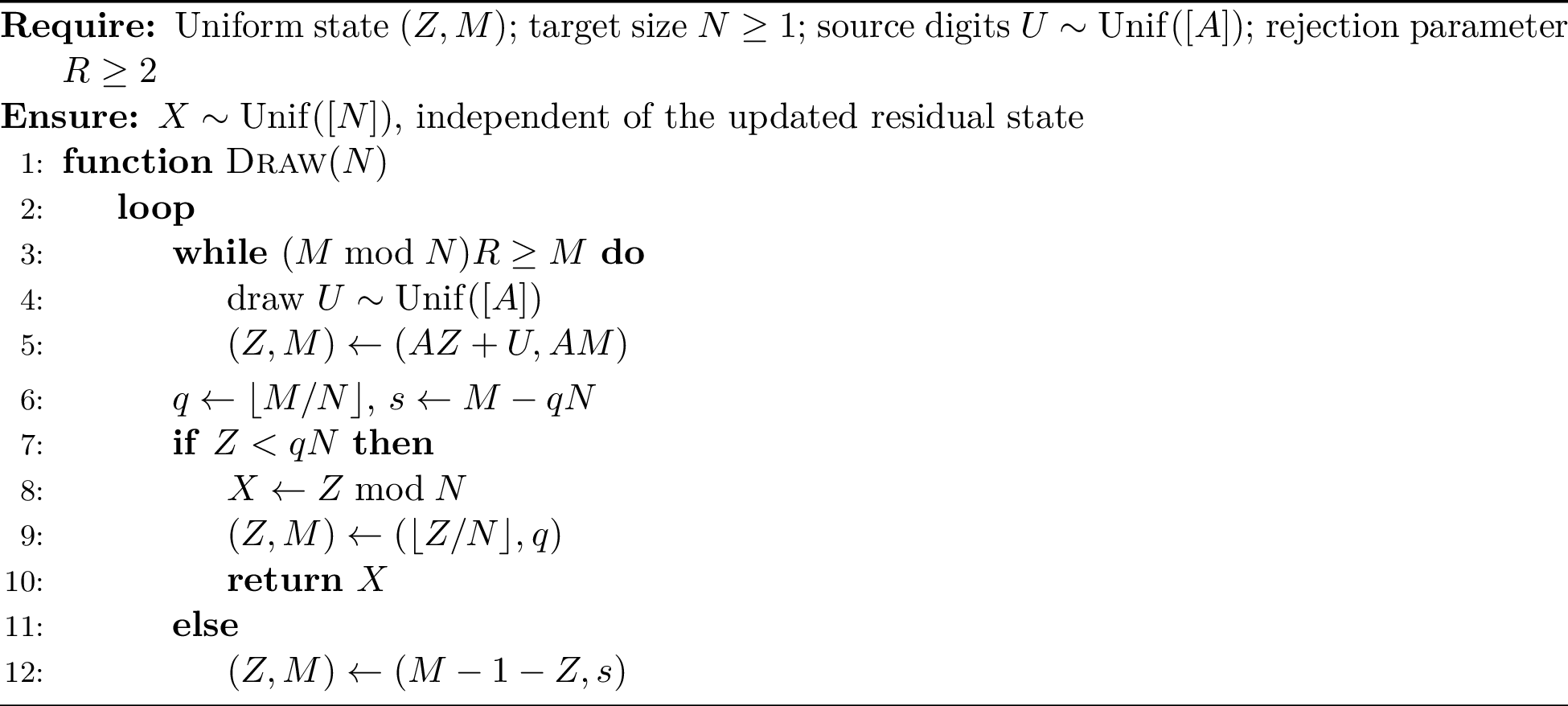
For a fixed pre-split modulus, write \(M=qN+s\) with \(0\leq s<N\). On acceptance, the map \[Z\longmapsto (Z\bmod N,\lfloor Z/N\rfloor) \label{eq:accepted-split}\tag{5}\] is a bijection from \([qN]\) to \([N]\times[q]\). On rejection, \(Z\mapsto M-1-Z\) is a bijection from \(\{qN,\ldots,M-1\}\) to \([s]\). Thus a rejected offset is again a valid uniform state.
Proposition 1 (Bounded-draw contract). Let the input uniform state \((Z,M)\) be independent of an external variable \(Y\). Assume that all source digits used by the call are mutually independent, uniform on \([A]\), and jointly independent of \((Z,M,Y)\). Algorithm 1 terminates almost surely, returns \(X\sim\operatorname{Unif}([N])\) independently of \(Y\), and leaves a residual uniform state independent of \((X,Y)\).
Proof. At the beginning of each loop iteration, maintain the invariant that the current state is uniform and independent of \(Y\). Appending a source digit preserves this invariant by the bijection in 3 . At an attempted split, conditional on the current modulus \(M\), the accepting region has size \(qN\). Conditional on acceptance, 5 maps the state bijectively to \([N]\times[q]\); hence the returned value is uniform and independent of both the residual state and \(Y\). Conditional on rejection, the reindexing \(Z\mapsto M-1-Z\) produces a uniform state on \([s]\) and restores the loop invariant. Because the conditional law of the returned value is the same uniform law for every terminal modulus and branch history, mixing over those histories preserves independence from the final state and from \(Y\).
The expansion loop is finite: repeated appends multiply \(M\) by \(A\), whereas \(M\bmod N<N\). Whenever a split is attempted, its rejection probability is \(s/M<1/R\). Therefore the probability of at least \(h\) consecutive rejections is at most \(R^{-h}\), which proves almost-sure termination. ◻
2.2 Branch-state loss↩︎
The within-branch transformations above are bijective, but the control-flow branch itself is not encoded back into the pool. For a split with \[\varepsilon=\frac{s}{M},\] the unaccounted state-space loss on the accepted and rejected branches is, respectively, \[\begin{align} \ell_{\mathrm{acc}} &=\log_2 M-\log_2(qN) =-\log_2(1-\varepsilon), \\ \ell_{\mathrm{rej}} &=\log_2 M-\log_2 s =-\log_2\varepsilon. \end{align}\] The expected loss of one attempted split is exactly \[(1-\varepsilon)\ell_{\mathrm{acc}} +\varepsilon\ell_{\mathrm{rej}} =H_2(\varepsilon), \label{eq:binary-entropy-loss}\tag{6}\] where \(H_2\) denotes binary entropy. Algorithm 1 attempts a split only when \(\varepsilon<1/R\). Since \(R\geq2\) and \(H_2\) is increasing on \([0,1/2]\), a geometric domination argument gives the per-call bound \[\mathbb{E}[\text{total branch loss}] \leq \frac{H_2(1/R)}{1-1/R}. \label{eq:range-loss-bound}\tag{7}\] The bound is intentionally simple rather than tight. Its purpose is to separate a tunable loss in bounded-range sampling from the lossless subset transformation developed below.
3 Why a global factorization does not justify online recycling↩︎
Equation 2 shows that a completed ordered sample decomposes into a subset and one of \(k!\) internal orders. It does not follow that an order digit may be returned to the random-state pool before the ordered sampler has finished.
Consider the following tempting modification of a partial Fisher–Yates shuffle. At round \(i=0,\ldots,k-1\), draw \(x\in[n-i]\), swap array positions \(i\) and \(i+x\), let \(d_i\) be the rank of the newly selected value among the first \(i+1\) selected values, and immediately recycle \((d_i,i+1)\). The array suffix is retained for subsequent swaps. Although the completed sequence \((d_0,\ldots,d_{k-1})\) encodes a permutation, an intermediate digit \(d_i\) is correlated with the current ordering of the suffix. Feeding that digit back into the pool changes the law of later draws.
A finite counterexample requires neither asymptotics nor a statistical test. Take \(n=6\), \(k=3\), and an initial state \(Z\sim\operatorname{Unif}([120])\). The three range splits are exact because the successive moduli are divisible by \(6\), \(5\), and \(4\). Exhaustive enumeration gives the multiplicities in Table 1; Appendix 10 lists the corresponding subsets. Uniformity would require each of the \(\binom{6}{3}=20\) subsets to occur six times.
| Multiplicity per subset | Number of subsets | Uniform multiplicity |
|---|---|---|
| 4 | 4 | 6 |
| 6 | 12 | 6 |
| 8 | 4 | 6 |
The counterexample isolates the relevant proof obligation. A recycled digit must be independent not only of the user-visible partial output but also of every hidden state variable that can influence future output. Floyd’s set transition eliminates the candidate-array ordering and admits exactly such a local independence proof.
4 Floyd sampling with online rank recycling↩︎
Let \(k=\min(m,n-m)\). We sample a uniform \(k\)-subset and, when \(k=n-m\), return its deterministic complement. The working set is stored in an order-statistic dictionary supporting membership, insertion, and rank. For a finite ordered set \(A\) and \(x\in A\), write \[\operatorname{rank}_A(x)=\left|\{y\in A:y<x\}\right|\] for the zero-based rank of \(x\). Algorithm 2 uses the abstract draw contract of Proposition 1.
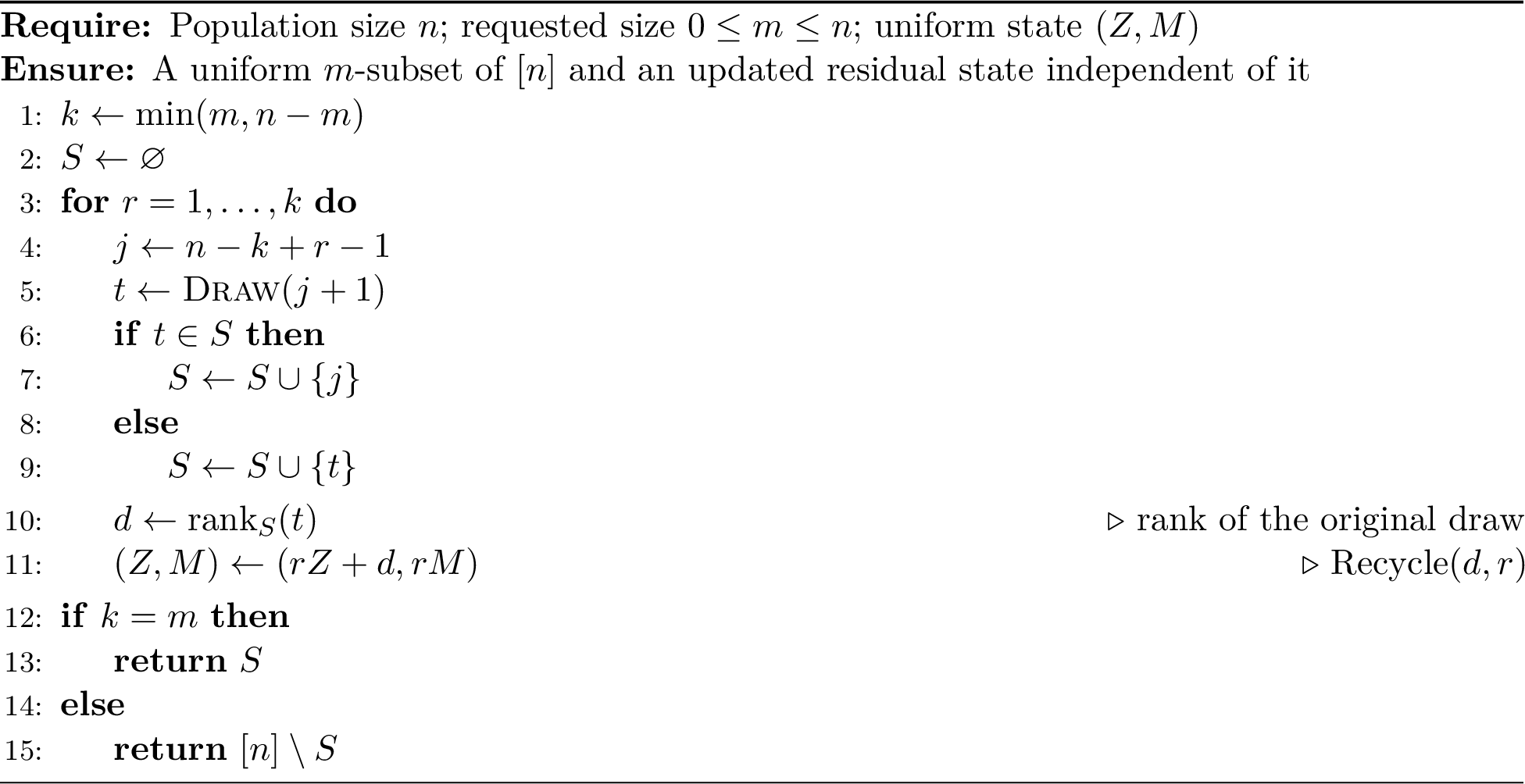
The collision branch deliberately recycles the rank of the original draw \(t\), not the rank of the replacement value \(j\). If \(t\in S\) before the update, it remains in the set after \(j\) is inserted. Moreover, \(j\) is larger than every element of the previous set, so this insertion does not change the rank of \(t\).
4.1 The round-local bijection↩︎
Fix a round \(r\in\{1,\ldots,k\}\) and set \(j=n-k+r-1\). At the beginning of the round, \(S\) is an \((r-1)\)-subset of \([j]\). For \(t\in[j+1]\), define the Floyd transition \[F(S,t)= \begin{cases} S\cup\{t\}, & t\notin S,\\ S\cup\{j\}, & t\in S, \end{cases} \label{eq:floyd-transition}\tag{8}\] and let \[d=\operatorname{rank}_{F(S,t)}(t) =\left|\{x\in F(S,t):x<t\}\right|\in[r].\]
Theorem 2 (Floyd rank bijection). The map \[\Phi_{j,r}: \binom{[j]}{r-1}\times[j+1] \longrightarrow \binom{[j+1]}{r}\times[r], \qquad (S,t)\longmapsto\bigl(F(S,t),\operatorname{rank}_{F(S,t)}(t)\bigr) \label{eq:local-bijection}\tag{9}\] is a bijection.
Proof. We construct the inverse. Let \((S',d)\) be in the codomain, and let \(t\) be the element of zero-based rank \(d\) in the sorted set \(S'\). Define \[S= \begin{cases} S'\setminus\{j\}, & j\in S',\\ S'\setminus\{t\}, & j\notin S'. \end{cases} \label{eq:local-inverse}\tag{10}\] In either case, \(S\) is an \((r-1)\)-subset of \([j]\). If \(j\notin S'\), then \(t\notin S\) and the forward transition inserts \(t\). If \(j\in S'\) and \(t\neq j\), then \(t\in S\), so the forward transition detects a collision and inserts \(j\). Finally, if \(t=j\), then \(j\notin S\) and the forward transition inserts \(t=j\) directly. Each case reconstructs \((S',d)\), and the reconstruction is unique. ◻
The associated cardinality identity is \[\binom{j}{r-1}(j+1)=\binom{j+1}{r}r. \label{eq:counting-identity}\tag{11}\] The explicit inverse is stronger than this count: it identifies the precise rank digit that can be recycled while preserving all combinatorial state needed by later rounds.
Corollary 1 (Exactness and output–pool independence). Under the assumptions of Proposition 1, Algorithm 2 returns each \(m\)-subset of \([n]\) with probability \(1/\binom{n}{m}\). The returned subset is independent of the final residual uniform state.
Proof. We prove by induction on \(r\) that, before round \(r\), the current set is uniform over \(\binom{[j]}{r-1}\) and independent of the pool. The base case is \(S=\varnothing\). For the inductive step, apply Proposition 1 with the current set as the external variable. The call returns \(t\sim\operatorname{Unif}([j+1])\) and a residual pool independent of \((S,t)\). By Theorem 2, the pair \((S',d)=\Phi_{j,r}(S,t)\) is uniform over \(\binom{[j+1]}{r}\times[r]\). Thus \(S'\) is uniform, \(d\) is uniform on \([r]\), and the two are independent. The residual pool is independent of \((S',d)\) because these are deterministic functions of \((S,t)\). Merging \(d\) by 4 therefore yields a uniform state independent of \(S'\), completing the induction.
After \(k\) rounds, \(S\) is a uniform \(k\)-subset of \([n]\). If \(k=n-m\), the complement map is a deterministic bijection from \(k\)-subsets to \(m\)-subsets, so it preserves both uniformity and independence from the pool. ◻
5 Entropy accounting↩︎
The \(k\) Floyd rounds draw from ranges \[n-k+1,n-k+2,\ldots,n,\] whose product is \(P(n,k)\). Their recycled rank radices are \(1,2,\ldots,k\), whose product is \(k!\). Hence the net state-space factor consumed by the combinatorial layer is \[\frac{P(n,k)}{k!}=\binom{n}{k}=\binom{n}{m}. \label{eq:net-combination-factor}\tag{12}\] Equivalently, \[\sum_{r=1}^{k}\log_2\frac{n-k+r}{r} =\log_2\binom{n}{k}.\] Thus the Floyd/rank transformation itself is lossless. Any gap between source entropy, output entropy, and retained-pool entropy arises in the bounded-range implementation—or in an explicit finite-word reset—rather than in the conversion from ordered choices to an unordered subset.
An exact divisible case makes the product structure concrete. Let the initial modulus be \(M_0\), assume \(P(n,k)\) divides \(M_0\), and suppose no refill or rejection occurs. Repeated range splits and the local bijections then give \[[M_0] \longleftrightarrow \binom{[n]}{k}\times \left[\frac{k!M_0}{P(n,k)}\right]. \label{eq:exact-global-product}\tag{13}\] Equivalently, the second factor decomposes as \([k!]\times[M_0/P(n,k)]\); the implementation folds these two coordinates into one mixed-radix residual state. Corollary 1 extends exactness and output–pool independence to arbitrary refill and branch histories.
6 Complexity and implementation boundaries↩︎
Let \(k=\min(m,n-m)\). With a balanced order-statistic tree, each round performs a constant number of \(O(\log k)\) membership, insertion, and rank operations. The sampling phase therefore uses \[O(k\log k)\text{ time} \qquad\text{and}\qquad O(k)\text{ auxiliary space}.\] Traversing the sampled side in sorted order adds \(O(k)\) time. When the sampled side is the complement of the requested output, a merge-style scan of \([n]\) and the sorted excluded set materializes the requested subset in \(O(n)\) time; this includes the unavoidable cost of emitting a dense output. If a library inserts every returned value into a separate balanced tree, the output container adds \(O(m\log m)\) time. These representation costs are not part of the Floyd transition itself.
The reference implementation uses a 64-bit pool state, 32-bit range sizes, byte refills, \(R=2^{32}\), and an order-statistic tree. Pool arithmetic is constant-time in the usual word-RAM model. Three finite-width boundaries are worth making explicit.
If appending another byte would overflow the modulus, the implementation draws a fresh full-width state and discards the old pool. The replacement is still exactly uniform, but retained entropy is lost; this reset has no analogue in the unbounded-integer model.
Rank recycling within Algorithm 2 cannot overflow a \(W\)-bit modulus. If a successful split uses working modulus \(M_{\mathrm{work}}\) and range \(j+1\), the residual modulus is \(q=\lfloor M_{\mathrm{work}}/(j+1)\rfloor\). Since \(r\leq j+1\), \[rq =r\left\lfloor\frac{M_{\mathrm{work}}}{j+1}\right\rfloor \leq M_{\mathrm{work}}<2^W.\] Moreover, for \(Z\in[q]\) and \(d\in[r]\), \(0\leq rZ+d<rq\). Thus neither the recycled modulus nor its state value requires an overflow fallback in the Floyd loop.
The construction is not a randomness extractor. It preserves and reallocates supplied entropy; it does not repair a biased, correlated, or predictable source. Cryptographic deployment would additionally require an appropriate source, side-channel and constant-time analysis, and a separate security argument.
7 Exact validation and a large-instance accounting trace↩︎
We validate the combinatorial product structure by finite state-space enumeration rather than by frequency tests alone. For every \(n\leq 8\) and \(0\leq m\leq n\), the initial pool ranges over all \(n!\) states. Because \(P(n,k)\) divides \(n!\), these tests require no refill, rejection, or reset and therefore isolate the Floyd/rank transformation. They verify that
each of the \(\binom{n}{m}\) subsets occurs exactly \(m!(n-m)!\) times;
every output–residual-value pair is unique; and
the final residual modulus is \(m!(n-m)!\).
The second property checks the full Cartesian product, not merely the output marginal. For \(n=6\) and \(m=3\), for example, each of the 20 subsets is paired once with every residual value in \([6]\).
For the motivating instance, let \(n=30{,}000\) and \(m=20{,}000\), so the algorithm samples a \(k=10{,}000\) element complement. Table 2 reports deterministic modulus accounting along the no-rejection trace of the 64-bit implementation. This trace has probability approximately \(0.9999996005\) under a uniform source. It reads 3,449 bytes, retains a state with \(1{,}963{,}181{,}278{,}250{,}000\) possibilities, and leaves only \(5.76344\times10^{-7}\) bits unaccounted for by the output and the retained pool. “Output-only efficiency” is output entropy divided by source entropy; “output-plus-pool efficiency” also credits the final residual entropy.
| Quantity | Value |
|---|---|
| Subset entropy \(\log_2\binom{30{,}000}{10{,}000}\) | \(27{,}541.1978846043\) bits |
| Source entropy read | \(27{,}592\) bits (3,449 bytes) |
| Retained states | \(1{,}963{,}181{,}278{,}250{,}000\) |
| Retained entropy | \(50.8021148193\) bits |
| Unaccounted branch loss | \(5.76344\times10^{-7}\) bits |
| Output-only efficiency | \(99.815880997\%\) |
| Output-plus-pool efficiency | \(99.9999999979\%\) |
This is an entropy trace, not a runtime benchmark. In particular, it does not establish that an order-statistic tree is faster than competing subset samplers. A comparative engineering study would need to control allocation, cache behavior, output representation, and random-source cost separately.
8 Related work↩︎
8.0.0.1 Exact discrete sampling and retained random state.
[1] established the random-bit complexity framework for exact discrete sampling and the classical single-sample upper bound of \(H+2\) bits. [7] introduced the Fast Dice Roller for exact uniform integer generation, and [8] developed the Fast Loaded Dice Roller for general finite distributions. Reuse of a bounded uniform register appears in scaling and fair-die algorithms [3], [4]. The interval algorithm of [9] gives a general arithmetic-coding-like construction for exact simulation of stochastic processes. Most directly, [5] develop an online theory of randomness recycling based on uniform-state merge and split operations, with applications that include changing-range draws and Fisher–Yates permutations. These works supply the state-pool layer used here. The additional question in this paper is which coordinate of a without-replacement process is independent of its complete retained combinatorial state and can therefore be recycled immediately.
8.0.0.2 Enumerative generation of subsets.
A uniform \(k\)-subset can be generated globally by drawing an integer in \([\binom{n}{k}]\) and unranking it. This is the random-generation counterpart of enumerative source coding and combinatorial ranking [10]–[12]. Such methods expose the global bijection between \(\binom{[n]}{k}\) and \([\binom{n}{k}]\) directly and can attain the information-theoretic state-space size. They generally use global rank/unrank logic and arithmetic on binomial coefficients or comparably wide integers. The present construction is not a new ranking order: it factorizes a standard local transition, uses only the successive ranges \(n-k+1,\ldots,n\) and radices \(1,\ldots,k\), and never materializes \(\binom{n}{k}\).
8.0.0.3 Sampling without replacement.
Fisher–Yates permutation generation is classical [13], [14]. The set transition commonly called Floyd’s algorithm is presented by [2], who attributes it to Robert Floyd; modern treatments discuss it alongside other simple subset samplers and output-order variants [15]. We claim neither transition as new. The counterexample in Section 3 does not contradict the offline Fisher–Yates factorization: it shows only that an insertion-rank digit is unsafe to reuse while a correlated candidate suffix remains future-relevant.
8.0.0.4 Related fixed-weight generation.
[6] study the same output family as fixed-Hamming-weight binary words concurrently. Their sparse construction performs distinguishable Fisher–Yates insertions, interprets the resulting labels as a uniform permutation, and deconstructs that permutation into independent bits. Recycling after completion gives expected net cost \(\log_2\binom{n}{k}+O(k)\) in their polynomially sparse regime; a multi-stage variant reinjects permutation entropy at block boundaries and obtains a \((1+\varepsilon)\)-type guarantee while retaining linear time for an explicitly materialized binary word. The two approaches are complementary. Floyd’s transition retains no candidate permutation, Theorem 2 supplies an exact product factor in every round, and the rank digit can be merged immediately while remaining independent of the updated set. At the combinatorial layer this recovers the full \(k!\) factor exactly; finite-word range splitting is accounted for separately.
9 Conclusion↩︎
Uniform subset sampling illustrates a general constraint on online randomness recycling: a coordinate that is redundant in the completed output need not be safe to reuse during the computation. The retained suffix order in partial Fisher–Yates gives a finite counterexample. Floyd’s transition avoids that hidden state and admits a round-local bijection between the previous set and a bounded draw, on one side, and the updated set and a rank digit, on the other.
The bijection yields an exact sampler whose partial subset remains independent of the residual random state after every round. It recovers the complete \(k!\) ordering factor without binomial-coefficient arithmetic and separates this lossless combinatorial transformation from the independently quantifiable loss of bounded-range state management. More broadly, a sound online-recycling argument must track all future-relevant internal state, not only the final user-visible output.
Software artifact↩︎
The implementation analyzed in this paper is entropy-pool version 1.0.0 [16], identified by Git tag
v1.0.0 and commit 50b4b7ce508c28e06b70d42270201ce6cd186468. The tagged source and the exact finite-state tests are available in the GitHub v1.0.0 tree; the same
release is distributed through crates.io.
10 Exact three-of-six counterexample↩︎
For reproducibility, this appendix fixes the convention used in Section 3. Initialize \(a=[0,1,2,3,4,5]\) and \((Z,M)=(z,120)\). For \(i=0,1,2\):
split \((Z,M)\) exactly into \(x=Z\bmod(6-i)\) and \((Z,M)=(\lfloor Z/(6-i)\rfloor,M/(6-i))\);
swap \(a_i\) and \(a_{i+x}\);
let \(d\) be the zero-based rank of \(a_i\) in \(\{a_0,\ldots,a_i\}\); and
set \((Z,M)=((i+1)Z+d,(i+1)M)\).
Enumerating \(z=0,\ldots,119\) gives the exact nonuniform counts
| Count | Subsets |
|---|---|
| 8 | \(\{0,3,4\}\), \(\{1,2,3\}\), \(\{1,2,5\}\), \(\{1,4,5\}\) |
| 4 | \(\{0,2,3\}\), \(\{0,2,5\}\), \(\{0,4,5\}\), \(\{1,3,4\}\) |
| 6 | all remaining 12 subsets |
The discrepancy occurs without range rejection, so it is purely a failure of the attempted combinatorial recycling.
11 Numerical details for the large trace↩︎
Starting from one source byte gives modulus \(M_0=256\). In round \(i\), let \(N_i\) be the requested range. Bytes are appended until \((M\bmod N_i)/M<2^{-32}\); on the successful branch, the split replaces \(M\) by \(\lfloor M/N_i\rfloor\), after which rank recycling multiplies it by the round number. Along the no-rejection trace, this recurrence reads a total of 3,449 bytes and ends at \[M_{\mathrm{final}}=1{,}963{,}181{,}278{,}250{,}000.\] The accumulated accepted-branch loss is \[-\sum_{i=1}^{10{,}000}\log_2(1-\varepsilon_i) =5.763441543123\times10^{-7}\,\text{bits},\] which agrees with \[8\cdot3449 -\log_2\binom{30{,}000}{10{,}000} -\log_2 M_{\mathrm{final}}\] up to the displayed rounding. The trace probability is \(\prod_i(1-\varepsilon_i)\approx0.9999996005087542\).