Measuring How Students Rely on Generative AI in Academic Writing: Development and Multi-Source Validation of the Generative AI Reliance Types Scale (GenAI-RTS)
July 15, 2026
Abstract
As generative AI (GenAI) becomes increasingly embedded in undergraduate academic writing, how students rely on these tools, rather than simply whether they use them, has become a central question for learning, academic integrity, and educational equity. Existing measures of reliance were developed inductively, focused on discrete problem-solving tasks, and validated mainly with homogeneous samples. The field lacks a theory-driven instrument for extended writing contexts. This study developed and validated the GenAI Reliance Types Scale (GenAI-RTS), a 20-item instrument measuring four theoretically derived types of GenAI reliance: Strategic, Instrumental, Dependent, and Dialogic. Validation followed the multisource framework of Standards for Educational and Psychological Testing, drawing on a survey of 382 undergraduates at a U.S. Minority-Serving Institution and interviews with 14 purposively sampled students. Confirmatory factor analyses of six competing models indicated support for a five-factor structure. Within this structure, Strategic Reliance consists of two facets, Deliberate Use and Critical Evaluation, in addition to Instrumental, Dependent, and Dialogic factors (CFI = .92, RMSEA = .08; DWLS CFI = .98, RMSEA = .07). Subscale reliability was acceptable to good (\(\omega\) = .75–.88), and scalar measurement invariance held across gender, first-generation status, and STEM/non-STEM majors; to our knowledge, the first such evidence for an instrument measuring GenAI reliance. Rasch analysis indicated that a five-point response format would improve category functioning. Strategic reliance was positively associated with AI literacy; Critical Evaluation and Dependent reliance emerged as empirically distinct constructs; and the reliance types differentiated students across multiple writing process and outcome variables. The GenAI-RTS offers researchers and educators a theoretically grounded, psychometrically validated instrument for identifying undergraduate reliance profiles and supporting research, assessment, and AI literacy intervention.
Keywords: Generative artificial intelligence; ChatGPT; AI Literacy; Measurement invariance; Scale Development; Higher Education
1. Introduction
When ChatGPT reached an estimated 100 million users within two months of its November 2022 release, making it, at the time, the "fastest-growing consumer application in history" (Hu, 2023, para. 1), it entered higher education at unprecedented speed. Adoption was primarily student-driven, outpacing institutional policy development, faculty preparation, and empirical research: reviewing the field only weeks after release, Rudolph et al. (2023) found a "dearth of empirical research" (p. 352) on the tool's educational implications even as institutions scrambled to formulate policy responses (Cotton et al., 2024). Use has since approached universality: among UK undergraduates surveyed annually, the proportion using AI in at least one way rose from 66% in 2024 to 92% in 2025 (Freeman, 2025) and 95% in 2026, with 94% now using generative AI (GenAI) to support assessed work (Stephenson & Armstrong, 2026). Academic writing is a key domain of this use: in the largest early study of adopters, content creation and editing, composing, summarizing, and proofreading text accounted for 78.11% of reported ChatGPT applications in higher education (Mogavi et al., 2024). Students entering college since Fall 2022 are thus the first cohort whose undergraduate writing development has unfolded entirely within a GenAI-rich environment. Throughout this article, GenAI denotes the large language model (LLM)-based text-generation tools that students overwhelmingly use in academic writing; because LLMs are the technology underlying these tools, the theoretical analysis draws on both the GenAI and human–AI reliance literatures.
Under these conditions, the question that has guided most institutional policy and research, whether students use GenAI, has lost its diagnostic value. When use is nearly universal, the distinction between use and non-use no longer differentiates students meaningfully: it cannot distinguish a student who critically evaluates and selectively integrates AI-generated content from one who accepts and submits it with little or no evaluation. Yet the difference between these two students is precisely what matters for learning, integrity, and equity. For learning, writing develops thinking through cognitive struggle (Bereiter & Scardamalia, 1987; Kellogg, 2008), and emerging evidence points in a consistent direction at two levels of specificity: in a four-month EEG study of essay writing, participants composing with LLM assistance showed the weakest brain connectivity of three tool conditions and underperformed at neural, linguistic, and behavioral levels (Kosmyna et al., 2025), while survey evidence links frequent AI-tool use to lower critical-thinking scores, a relationship mediated by cognitive offloading (Gerlich, 2025); both the writing literature and this newer evidence indicate that the effects depend on how the tool is engaged, not merely whether it is used. For integrity, current frameworks rely on the same binary, treating qualitatively different forms of GenAI engagement as a single category of misconduct, even as nearly all students, 94%, now use GenAI to support assessed work (Stephenson & Armstrong, 2026). For equity, access to AI technologies is unevenly distributed and risks widening existing educational inequalities (Bulathwela et al., 2024), and a socioeconomic divide in student AI use is already documented (Freeman, 2025); whether students from under-resourced backgrounds also develop less productive patterns of reliance is a question only an instrument measuring qualitatively distinct reliance patterns can answer. The pressing empirical question is therefore not whether students rely on GenAI but how.
Answering that question requires a new instrument, for three reasons. First, existing measures were developed for discrete decision-making tasks rather than extended academic writing. Second, the most closely related scales measure adjacent constructs or were developed inductively rather than from theory. Third, none provides evidence of scalar measurement invariance across demographic groups, the evidence needed to support meaningful equity-related comparisons.
First, the reliance construct was developed largely within decision-support paradigms, where trust is conceptualized as an attitude and reliance as the behavior it guides (Lee & See, 2004), and where reliance is operationalized through discrete, outcome-linked behaviors: adjusting a judgment toward advice received (Logg et al., 2019) or accepting versus overriding an algorithm's recommendation, with appropriateness defined by the advice's correctness (Schemmer et al., 2023). These operationalizations presuppose tasks with identifiable decision points and verifiable outcomes. Hou et al. (2025) advanced the field on precisely these grounds, arguing that outcome-linked measures are unsuited to complex problem-solving tasks whose outcomes are neither binary nor immediately clear, and developing a self-report scale that measures reliance behaviors without linking them to outcomes. Academic writing extends this logic further still: it is extended, iterative, and evaluatively open-ended, with no correctness signal against which reliance could be scored as appropriate or excessive, and it is among the most common and educationally consequential applications of GenAI in higher education, as the evidence on adoption above indicates. The present study extends reliance measurement to this domain.
Second, the task-domain gap is compounded by a construct and method gap: the rapidly growing family of related instruments measures adjacent constructs through predominantly inductive methods. Recent scales capture AI dependence as a maladaptive disposition encompassing emotional dependence and loss of control (Wu et al., 2026), student learning agency in GenAI-supported contexts (Xia et al., 2025), and students' general use of GenAI tools (Barcelona & Dela Cruz, 2025). Reliance itself, the behavioral repertoire through which students engage GenAI during authentic academic tasks, remains measured by a single validated instrument (Hou et al., 2025), whose four factors (reflective, cautious, thoughtless, and collaborative use) emerged from exploratory factor analysis and were named post hoc. Inductive approaches are valuable for mapping new phenomena, but the resulting factors remain tied to the items, tasks, and samples from which they were derived, and even where dimensions have been hypothesized in advance (Wu et al., 2026), the retained structures were established through exploratory extraction rather than tested against rival theoretical specifications. A fully deductive approach, specifying a typology from theory, operationalizing it a priori, and testing it against competing structures has not, to our knowledge, been undertaken for GenAI reliance. The present study derives four reliance types (Strategic, Instrumental, Dependent, and Dialogic) from established frameworks in metacognition (Schraw & Dennison, 1994), critical AI literacy (Long & Magerko, 2020), and writing research; Section 2.3 develops each in full.
Third, existing validation studies are limited in both the diversity of their samples and the breadth of validity evidence they report. Most have been conducted within a single institution or national context: Hou et al. (2025) acknowledge that their scale was validated with "a relatively homogeneous sample of undergraduate students from a single Asian university" (p. 10), and the same constraint characterizes newer AI dependence and GenAI use scales (Barcelona & Dela Cruz, 2025; Wu et al., 2026). Where measurement invariance has been examined at all, testing has been limited to configural and metric checks across split validation samples (Wu et al., 2026) rather than to scalar invariance across demographic groups, as required for meaningful latent mean comparisons. It therefore remains unclear whether these instruments function equivalently across diverse student populations. Validation evidence has also typically been reported as a collection of statistical indices rather than as a coherent validity argument: the Standards for Educational and Psychological Testing (American Educational Research Association [AERA], American Psychological Association [APA], & National Council on Measurement in Education [NCME], 2014) call for multiple complementary sources of validity evidence, integrated on the argument-based view of validation into a structured case for score interpretation (Kane, 2013). No GenAI reliance instrument has, to our knowledge, been validated within this framework or examined for scalar invariance across demographic groups, limiting confidence in group comparisons and equity-related interpretations.
This study addresses these three gaps by developing and validating the GenAI Reliance Types Scale (GenAI-RTS), a 20-item self-report instrument administered to undergraduates at a U.S. public R1 Minority-Serving Institution. The study makes four contributions. First, to our knowledge, it provides the first theory-derived, confirmatory-tested typology of GenAI reliance in academic writing, evaluating the hypothesized structure against rival one-, two-, three-, four-, and five-factor and higher-order specifications rather than assuming it. Second, it presents a multisource validity argument structured by the Standards (AERA et al., 2014), delivering evidence on four of the five sources, test content, response processes, internal structure, and relationships to other variables, including response-process evidence gathered across the full range of scale scores, evidence that prior studies have confined to item development or to high-scoring respondents. Third, to our knowledge, it reports the first evidence of scalar measurement invariance for an instrument measuring GenAI reliance, testing configural, metric, and scalar invariance across gender, first-generation status, and STEM versus non-STEM majors in a demographically diverse sample in which no racial group constitutes a majority. Fourth, it cross-validates the internal structure across two analytic traditions, confirmatory factor analysis within the classical test theory framework and structural equation modeling, and Rasch measurement analysis, providing convergent psychometric evidence that neither tradition alone provides.
Accordingly, this study asks whether the accumulated evidence supports interpreting GenAI-RTS scores as measures of undergraduate students' reliance on GenAI in academic writing. Specifically, it evaluates evidence from four of the five sources specified in the Standards: test content, response processes, internal structure, and relationships to other variables. By developing and validating the GenAI-RTS, the study provides researchers and educators with a theory-derived instrument to identify distinct profiles of GenAI reliance and to support future research on AI literacy, academic writing, and responsible GenAI use.
1 Literature Review↩︎
1.1 Reliance on GenAI: From decision support to generative tasks↩︎
Reliance on GenAI refers to the behavioral act of depending on a GenAI tool's output, which is distinct from trust in GenAI: trust is the attitude that predicts but does not necessarily constitute reliance (Lee & See, 2004). In the decision-support tradition where the construct was developed, the central concern is calibration: over-reliance, or accepting automation despite errors (misuse), and under-reliance, or underutilizing or rejecting automation (disuse) (Parasuraman & Riley, 1997), with the corresponding design goal of appropriate reliance (Lee & See, 2004), in which acceptance of the system's advice corresponds to the correctness of that advice on a case-by-case basis (Schemmer et al., 2023). Reliance is accordingly operationalized as advice-taking or judgment revision in tasks with objectively verifiable answers (Logg et al., 2019), thereby enabling acceptance behavior to be scored for appropriateness relative to decision accuracy (Schemmer et al., 2023).
GenAI tools dissolve the conditions this machinery presupposes. When students engage these tools during academic writing, there is no discrete recommendation to accept or reject and no binary correctness signal against which acceptance could be calibrated. Engagement is extended, iterative, and distributed across the composing process, and its object is co-produced text whose quality is evaluatively open-ended. The consequences of concern have also shifted from immediate decision accuracy to cumulative cognitive development. In a randomized experiment, AI-assisted writers achieved greater essay-score improvement than comparison groups while showing no advantage in knowledge gain or transfer and reduced engagement in metacognitive processes such as orientation and evaluation, a pattern Fan et al. (2025) term metacognitive laziness. Preliminary neurocognitive evidence points in the same direction (Kosmyna et al., 2025). Yet the effects are not inherent to the tool: when LLM use is deliberately scaffolded within strategy instruction, even young learners' self-regulated learning and writing performance improve (Liu et al., 2024). These studies converge on a moderating insight: the cognitive costs attach not to use but to the manner of use. Reliance on GenAI is therefore best conceptualized not as a quantity to be calibrated against system accuracy but as a repertoire of qualitatively distinct behavioral patterns whose consequences for learning differ. Hou et al. (2025) operationalized this reconceptualization for collaborative problem-solving, developing a self-report scale that measures reliance behaviors without linking them to task outcomes. Academic writing, extended, individual, identity-laden, and among the most common student applications of GenAI (Stephenson & Armstrong, 2026), is the natural next domain, and the one in which, to our knowledge, no validated reliance instrument yet exists.
1.2 Existing measures of student engagement with GenAI↩︎
Table 1 summarizes the published instruments most relevant to measuring how students engage with GenAI, compared across construct, development approach, task context, sample, and the validity evidence provided. Two boundary clarifications govern inclusion. First, the rapidly expanding family of AI literacy and attitude scales (e.g., Chung et al., 2025; Gümüş & Kara, 2025; Marengo et al., 2025; Zhang et al., 2025) measures competencies and evaluations rather than reliance behavior and is treated here as adjacent rather than competing. Second, instruments measuring AI dependence as a maladaptive psychological disposition, exemplified by the AIDep-22, whose dimensions include emotional dependence and loss of control (Wu et al., 2026), capture a clinical-adjacent trait conceptually downstream of the behavioral patterns measured here: a student may enact dependent reliance behaviors without the affective entanglement that defines dependence as a disposition, and the two constructs warrant separate measurement.
Three patterns emerge from Table 1, and together they define the gap this study addresses. First, only one published instrument measures reliance as a behavioral repertoire during authentic academic tasks (Hou et al., 2025); the remainder measure general use practices, dependence dispositions, or adjacent constructs. Second, development has been predominantly inductive: factors are extracted from item pools and named post hoc, an approach that maps unfamiliar terrain effectively but binds the resulting structure to the items, tasks, and samples that produced it and provides no mechanism for testing whether a theoretically specified structure survives confrontation with rival models. Third, the validity evidence delivered is structurally incomplete in consistent ways: no instrument in the table reports scalar measurement invariance across demographic groups, the precondition for the latent mean comparisons that motivate much of this literature (invariance testing, where reported at all, has been limited to configural and metric checks across split validation samples; Wu et al., 2026); none organizes its evidence as a structured validity argument; and response-process evidence is absent, confined to item development (Wu et al., 2026), or restricted to high-scoring respondents (Hou et al., 2025). Every validation sample is drawn from a single institution or a single national context. These are not incidental omissions; they jointly constrain what scores from these instruments can legitimately be interpreted to mean and for whom.
The practical consequence is concrete. With existing instruments, educators cannot distinguish productive from unproductive reliance patterns, identify students whose reliance profile warrants intervention, evaluate whether AI-literacy programs change how students rely rather than merely how much, or compare reliance across groups and institutions, comparisons that only scalar invariance evidence can license. These are the uses a validated reliance typology must support, and they define the evidentiary bar the present study sets for itself.
1.3 A theory-derived typology of GenAI reliance in academic writing↩︎
The four-type typology operationalized by the GenAI-RTS derives from the intersection of three literatures: metacognition and self-regulated writing, AI literacy, and approaches-to-learning theory. Its organizing premise, supported by the process-level evidence reviewed above, is that reliance patterns differ along two theoretically consequential dimensions: the degree of cognitive governance the writer retains (planning, monitoring, and evaluating the AI's contribution) and the scope of delegation (which writing functions, and how much of each, are transferred to the system); Figure 1 maps the four types on these dimensions.
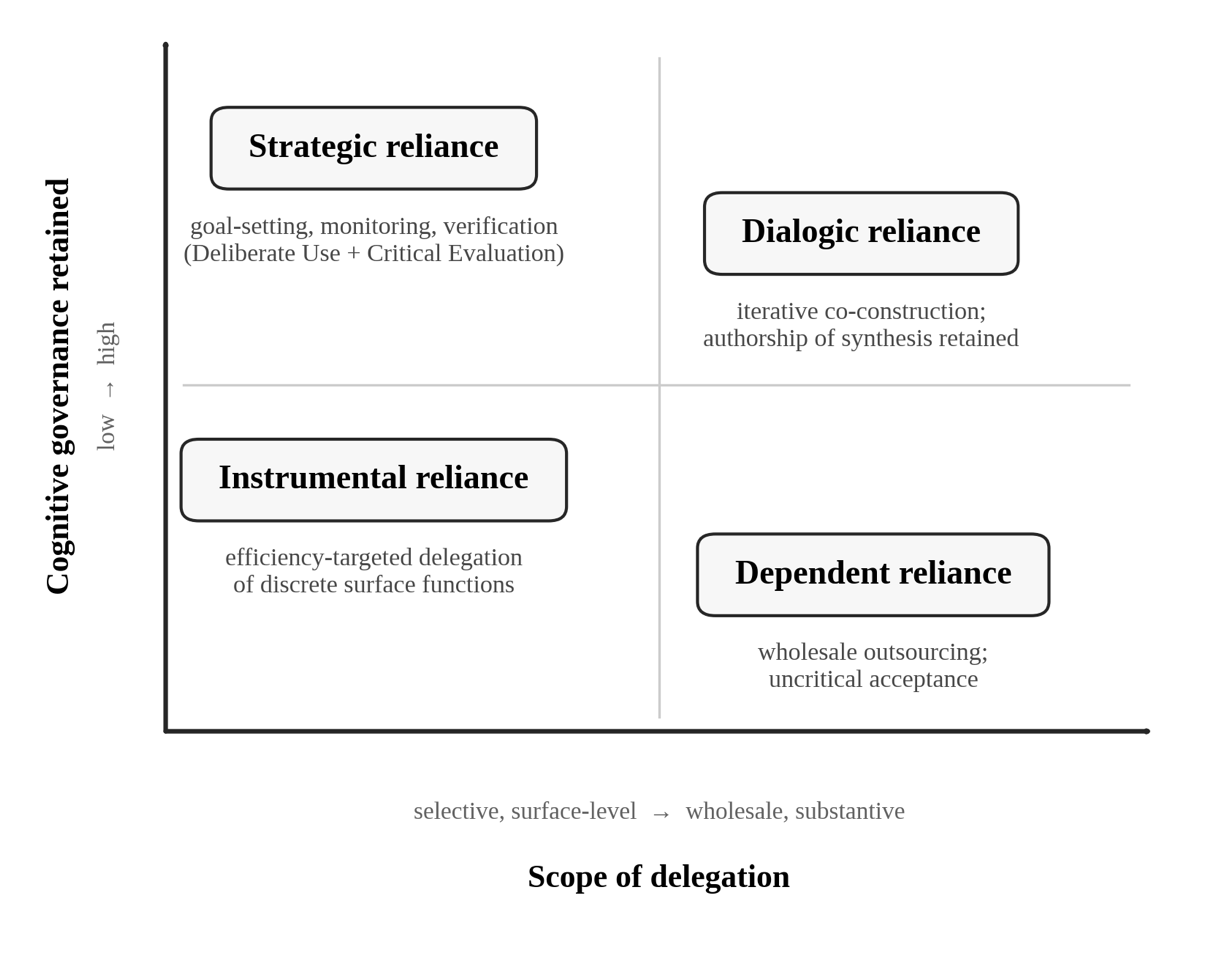
Strategic reliance denotes goal-directed engagement governed by metacognitive orchestration and critical evaluation of output, grounded in the regulation-of-cognition component of metacognitive theory (Schraw & Dennison, 1994), self-regulated writing development (Graham & Harris, 2000), and the evaluative competencies of AI literacy frameworks (Long & Magerko, 2020); these foundations imply both an orchestration facet and an evaluative facet, and the instrument operationalizes both. Instrumental reliance denotes efficiency-targeted delegation of discrete, surface-level functions while the writer retains the substantive cognitive work, anchored in the surface–deep distinction of Biggs' (1987, 1999) approaches-to-learning framework: the functions delegated are those a surface approach targets, while deep engagement with content and argument is retained. Dependent reliance denotes wholesale outsourcing across writing functions, including the idea-generation and argument-construction work through which writing develops thinking (Bereiter & Scardamalia, 1987; Kellogg, 2008), grounded in cognitive-offloading research (Lodge & Loble, 2026; Risko & Gilbert, 2016) and the experimentally documented metacognitive-laziness pattern (Fan et al., 2025). Dialogic reliance denotes iterative, conversational co-construction in which the writer engages the GenAI tool as an interlocutor while retaining authorship of the resulting synthesis, extending sociocultural accounts of learning through interaction (Vygotsky, 1978) and social-cognitive models of writing that position responsive others within the task environment (Hayes, 1996).
The typology corresponds in informative ways to the four factors that Hou et al. (2025) derived empirically in the problem-solving domain. Their reflective use purposeful engagement combining prompt revision, critical reading, and iterative refinement of AI output spans territory the present typology differentiates: its orchestration component parallels the Deliberate Use facet of Strategic reliance, and its iterative-refinement component anticipates Dialogic reliance. Their cautious use (recognizing and reacting to AI errors) parallels the Critical Evaluation facet, and their thoughtless use (copying task prompts, adopting output without major changes) parallels Dependent reliance. Two features of this correspondence merit emphasis. First, that an inductive analysis conducted in a different task domain, country, and sample recovered factors aligning with a theory-derived typology constitutes mutual corroboration of a kind that purely inductive replication cannot supply convergence across derivation logics, not merely across samples. Second, the correspondence is structurally diagnostic: the two facets that Hou et al.'s data separated into distinct factors (reflective and cautious use) are precisely the two facets the present typology subsumes under Strategic reliance, raising a question the confirmatory analyses reported in Section 4 are designed to answer: whether strategic reliance is better modeled as one factor or two. The remaining non-overlap is symmetric and task-diagnostic: Hou et al.'s collaborative use captures reliance mediated by peers, a dimension their collaborative problem-solving context foregrounds and individual academic writing does not, while Instrumental reliance has no counterpart in their structure, plausibly because surface-level delegation manifests in extended writing where editing, rephrasing, and condensing are distinct, recurrent functions in ways bounded group problem-solving does not afford. Each instrument's coverage thus reflects its task ecology; the inclusion of Instrumental reliance extends the construct's coverage rather than relabeling it.
These four theoretically derived types, and the two dimensions organizing them, informed the development of the GenAI-RTS items.
1.4 Validity as argument: The Standards framework↩︎
The Standards for Educational and Psychological Testing (AERA et al., 2014) define validity as the degree to which evidence and theory support the interpretations and uses of test scores, organized across five sources of evidence: test content, response processes, internal structure, relationships to other variables, and consequences of testing. On the argument-based view this framework instantiates (Kane, 2013), validation is a structured case built across these sources rather than a property certified by any single coefficient, with reliability a necessary but not sufficient condition. Section 3.1 details how this framework structures the present validation.
| Instrument / study | Construct and task context | Development | Sample | Validity evidence and qualitative validation | Reliability | Invariance |
|---|---|---|---|---|---|---|
| Reliance on GenAI scale (Hou et al., 2025) | Reliance behaviors in problem-solving; two structured collaborative problem-solving tasks | Inductive (EFA; factors named post hoc) | Singapore; 1 university; EFA n = 800; CFAs n = 730 / 1,173 | Internal structure (EFA, 2 CFAs); limited behavioral alignment; qualitative check partial (chat histories; high scorers only) | \(\alpha\) = .84; subscales \(\geq\) .65 | No |
| AIDep-22 (Wu et al., 2026) | AI dependence as maladaptive disposition (emotional, functional, cognitive, loss of control); general AI use (non-task-specific) | Hypothesized dimensions; expert review + cognitive interviews; structure via EFA/CFA | China; 1 university; two samples, N = 400 each | Content; internal structure (EFA, CFA); convergent / discriminant / criterion; qualitative work at item development only | \(\alpha\) = .87 (total); subscales .86–.89 | Configural / metric across split samples only |
| GAI tool-use scale (Barcelona & Dela Cruz, 2025) | GenAI use practices and perspectives (research, communication, reliance, ethics); general academic use | Mixed (interviews of 20 students + scoping review; inductive extraction) | Philippines; N = 793 (two pilots) | Internal structure (EFA, CFA); internal consistency; convergent; qualitative work at item generation only | Loadings .72–.93; \(\alpha\) reported | No |
| SLA-GAI (Xia et al., 2025) | Student learning agency in GenAI-supported contexts (adjacent construct); GenAI-supported learning generally | Mixed (literature + expert interviews; EFA/CFA) | China; two stages; EFA n = 268; second sample split EFA / CFA n = 268 / 245 | Internal structure (EFA, CFA); qualitative work at item development only | Per subscale | No |
| GenAI-RTS (this study) | Reliance as behavioral repertoire in academic writing (4 types; 5 facets); academic writing across process stages | Deductive (a priori theory; tested against rival 1–5-factor and higher-order models) | U.S. Minority-Serving Institution; preliminary survey n = 143; validation N = 382 (no racial majority) | Content; response processes; internal structure (competing CFAs, invariance, Rasch); relationships to other variables (Standards framework); qualitative validation (14 interviews; maximum variation; all score levels) | \(\alpha\) = .74–.88; \(\omega\) = .75–.88; AVE/CR | Yes — scalar (gender, first-gen, STEM) |
2 Methodology↩︎
2.1 Validity framework and design↩︎
Data were drawn from a larger sequential explanatory mixed-methods study of undergraduate reliance on GenAI in academic writing. The present article reports the components relevant to instrument validation. The validation design was guided by the Standards framework introduced in Section 2.4. Each source of validity evidence was linked a priori to specific data sources and analyses. Quantitative survey data supported factor analytic, reliability, invariance, and Rasch analyses, while interview data provided complementary evidence about students’ response processes. Table 2 presents the evidence-source-by-data-source matrix governing the study. Two features of the design are particularly important. First, the logic is theory-then-confirmation: the items were specified deductively from named theoretical frameworks and screened through faculty expert review, and the full confirmatory burden, competing-model tests, invariance, and Rasch diagnostics were carried by the validation sample. Second, the qualitative strand was designed to contribute directly to validation rather than simply illustrate the quantitative findings. Interview participants were selected through maximum variation sampling across the full range of reliance scores. This allowed the response-process analysis to examine how students at different score levels interpreted and responded to the items.
Consistent with the argument-based view of validity, validation evidence accumulates across a research program rather than within a single study (Kane, 2013; Krupa et al., 2020; Sondergeld, 2020). The present study examines four sources of validity evidence: test content, response processes, internal structure, and relationships to other variables. Evidence regarding the consequences of testing is deferred to future research examining the instrument’s use in advising and instructional contexts, consistent with recent validation practice in education (Mata-McMahon et al., 2023). None of the instruments reviewed in Section 2.2 has been validated using this framework. Applying it here provides a coherent structure for evaluating the GenAI-RTS and makes clear both the evidence examined in the present study and the evidence that remains to be established.
| Validity evidence source (AERA et al., 2014) | Data sources and analyses in the present study |
|---|---|
| Test content | Theoretical derivation of the four-type typology from named frameworks (Section 2.3); literature-to-item mapping (Table 5); faculty expert review; preliminary survey evidence informing construct identification (n = 143) |
| Response processes | Directed content analysis of 14 maximum-variation interviews; coded alignment between scale-implied behavior and participants’ self-described behavior across high, mid, and low scorers per subscale |
| Internal structure | Competing-model confirmatory factor analyses (one- through five-factor and higher-order specifications); reliability (\(\alpha\), \(\omega\), mean inter-item correlations); convergent/discriminant indices (AVE, CR, HTMT); configural–metric–scalar measurement invariance (gender, first-generation status, STEM/non-STEM); Rasch rating-scale and item-fit analyses per subscale |
| Relationships to other variables | A priori convergent expectations (Strategic reliance \(\times\) AI literacy), discriminant expectations (theoretically patterned subscale intercorrelations), and criterion expectations (reliance-type differences across ten writing-process and outcome variables) |
| Consequences of testing | Deferred to future research on the instrument’s use in advising and instructional contexts (rationale and precedent in Section 3.1) |
2.2 Participants and setting↩︎
The study was conducted at a public R1 doctoral university in the mid-Atlantic United States with a federal Minority-Serving Institution designation. The institutional context is integral to the validation argument rather than incidental to it: published validations of related instruments rest on demographically homogeneous, single-nation samples (Section 2.2), and the present sample extends validation to a racially diverse Minority-Serving Institution and examines measurement invariance across gender, first-generation status, and academic discipline (STEM vs. non-STEM majors). To our knowledge, these are the first reported tests of scalar measurement invariance across demographic groups for an instrument measuring student reliance on GenAI.
Sample size justification. The achieved validation sample exceeded common recommendations for confirmatory factor analysis of an instrument of this length: the validation sample of N = 382 provides approximately 19 participants per item, within the widely cited 10–20-per-item guideline, and retains group sizes adequate for two-group measurement-invariance testing (all groups \(\geq\) 125 after listwise deletion).
Preliminary survey. Instrument development was also informed by a preliminary online survey of 143 undergraduates that examined GenAI familiarity, use, perceived benefits and concerns, and open-ended accounts of challenges in academic work. The survey findings were used to identify context-specific expressions of theoretically defined reliance patterns and to inform item wording rather than to derive the factor structure.
Main sample. Participants were recruited over six weeks through departmental listservs coordinated with faculty liaisons across more than 30 academic departments, in-class announcements by cooperating instructors, and institutional research participation channels. Recruitment reached approximately 1,500 students, yielding an estimated response rate of 26%. Of 385 survey submissions, two platform-preview test records and one case exceeding the a priori 20% missing-data threshold were excluded, yielding an analytic sample of N = 382 with negligible item-level missingness. Table 3 presents sample characteristics. Mean age was 20.8 years (SD = 3.9; range 17–56) among the 291 participants who reported age. Participants reported a mean self-reported GPA of 3.44 (SD = 0.53) and spent an average of 7.9 hours per week (SD = 8.9) on academic writing. The sample was racially and ethnically diverse: 34.3% identified as White, 27.2% as Black or African American, 24.9% as Asian, and 7.6% as Hispanic or Latino. In addition, 33.5% were first-generation college students and 54.2% were STEM majors.
Interview subsample. Fourteen survey respondents who expressed willingness to participate in an interview were selected using maximum variation purposive sampling (Patton, 2015) across four dimensions: dominant reliance type, AI literacy level (tercile splits on the composite score), first-generation status, and academic discipline. Sampling across the full range of reliance scores, rather than selecting only high scorers, allowed the response-process analysis to examine item interpretation across different score levels (Table 2). Interviews averaged 46 minutes (range 31–60 minutes). Thematic saturation monitoring indicated that new codes ceased emerging by approximately the tenth interview, with the final interviews confirming existing categories.
Ethics. The study was approved by the university's Institutional Review Board (Protocol #03-07-24-1408). Survey participants provided digital informed consent, and interview participants provided written consent with verbal reconfirmation at the start of each session. Fifty randomly selected survey participants received a $10 incentive, and interview participants received $25. Survey responses were anonymous, and interview participants were assigned pseudonyms.
| Characteristic | n | % |
|---|---|---|
| Gender | ||
| Woman | ||
| Man | ||
| Non-binary, genderqueer, or transgender | ||
| Prefer not to answer | ||
| Race/ethnicity | ||
| White | ||
| Black or African American | ||
| Asian | ||
| Hispanic or Latino | ||
| Another identity (incl. Native Hawaiian/Pacific Islander) | ||
| Prefer not to answer | ||
| Academic year | ||
| Freshman (0–29 credits) | ||
| Sophomore (30–59 credits) | ||
| Junior (60–89 credits) | ||
| Senior (\(\geq\)90 credits) | ||
| Not reported | ||
| First-generation college student | ||
| Yes | ||
| No | ||
| Major/discipline | ||
| STEM | ||
| Social sciences | ||
| Arts & humanities | ||
| Performing arts | ||
| Other | ||
| Family socioeconomic background | ||
| Working class | ||
| Lower-middle | ||
| Middle | ||
| Upper-middle | ||
| Affluent | ||
| Prefer not to answer |
2.3 Instrument↩︎
Instrument development proceeded in sequential phases: theoretical construct specification, deductive item generation, faculty expert review, refinement to the final 20-item form, and multi-source validation in the present study. Table 4 summarizes the sequence.
| Stage | Purpose | Outcome |
|---|---|---|
| Construct identification | Derive reliance types from theory (Section 2.3) and preliminary survey evidence (Section 3.2) | constructs; 5 measurement facets |
| Item generation | Deductive item writing from named source frameworks | Initial pool of 25 items |
| Faculty expert review | Content relevance, clarity, and redundancy screening | items retained |
| Validation (present study) | Multi-source psychometric evaluation | Five-facet structure retained; one wording revision and a 5-point response format recommended |
Construct identification. The four reliance types were specified before any item was written, derived from the theoretical frameworks documented in Section 2.3 and informed by preliminary survey evidence on undergraduates’ GenAI use (Section 3.2). Strategic reliance was specified with two facets, Deliberate Use and Critical Evaluation, yielding five measurement facets in total.
Item generation. An initial pool of 25 items was generated deductively from the five measurement facets. Each item was designed to represent a single facet-level behavior grounded in its source framework. Negative wording and double-barreled items were avoided. A post hoc readability check of the final 20 items yielded a mean Flesch Kincaid grade level of 11.2 and a Flesch Reading Ease score of 41. Because readability was not formally assessed during item development, these results are reported descriptively.
Expert review. The initial item pool was reviewed by three faculty experts with expertise in quantitative methodology and statistics, educational technology, and literacy education. Each expert independently evaluated every item for clarity, alignment with its intended reliance construct, representativeness of the construct domain, and relevance to academic writing. Feedback was consolidated by the research team, and items were revised or removed when concerns involved redundancy, unclear wording, or weak alignment with the intended facet. Of the 25 initial items, expert review led to rewording for clarity and the removal of five items (three for content redundancy with retained items and two for weak alignment with their intended construct), yielding the final 20-item instrument. No formal content-validity indices were computed, and no external panel beyond this faculty review was convened, a constraint acknowledged in the limitations.
Final instrument. The GenAI-RTS contains 20 items representing four theoretically derived reliance types and five measurement facets. Strategic reliance comprises two facets, Deliberate Use and Critical Evaluation, while Instrumental, Dependent, and Dialogic reliance are each represented by one facet.
GenAI Reliance Types Scale. The GenAI-RTS comprises 20 items distributed across the four theoretically derived reliance types, with all items rated on 7-point Likert scales (1 = Strongly Disagree, 7 = Strongly Agree). Strategic reliance is measured by eight items operationalizing its two theoretical facets (Section 2.3):four Deliberate Use items informed by metacognitive awareness theory and measurement (Schraw & Dennison, 1994) and four Critical Evaluation items adapted from critical AI literacy competencies (Long & Magerko, 2020). Instrumental reliance (four items) operationalizes efficiency-targeted, surface-level delegation; Dependent reliance (four items) operationalizes wholesale outsourcing and uncritical acceptance, with items adapted from self-efficacy and learned-helplessness measurement traditions (Bandura, 1997); and Dialogic reliance (four items) operationalizes iterative co-construction, drawing on sociocultural accounts of learning through interaction (Vygotsky, 1978). Table 5 presents the literature-to-item mapping with a sample item per facet; the full instrument appears in Appendix A. Subscale scores are item means (range 1–7); the Strategic composite is the mean of its two facet means, weighting the facets equally. All validation analyses reported here use continuous subscale scores. For known-groups analyses, students were classified by their highest subscale mean (yielding Strategic n = 131, Instrumental n = 118, Dialogic n = 116, Dependent n = 17); no minimum-score threshold was applied. Interpretively, subscale scores describe reliance profiles rather than assign students to types, no diagnostic cut scores are proposed, and the highest-subscale classification serves research description only (see Section 5).
| Construct facet | Definition and theoretical source | Sample item | Items |
| Strategic, Deliberate Use | Planned, goal-directed engagement with AI. Metacognitive regulation: planning and monitoring (Schraw & Dennison, 1994) | “I set clear objectives for using generative AI tools before each writing session.” | |
| Strategic, Critical Evaluation | Verification and appraisal of AI output before incorporation. Critical AI literacy: output evaluation competencies (Long & Magerko, 2020) | “I verify facts in text produced by generative AI tools against authoritative sources.” | |
| Instrumental | Efficiency-targeted delegation of discrete writing tasks. Surface approach to learning (Biggs, 1987) | “I use generative AI tools to rephrase or clarify complex sentences in my drafts.” | |
| Dependent | Wholesale outsourcing with uncritical acceptance of AI output. Over-reliance patterns adapted from self-efficacy and learned-helplessness measurement (Bandura, 1997); cognitive offloading (Risko & Gilbert, 2016) | “I accept outputs from generative AI tools by default, even when I could compose those sections myself.” | |
| Dialogic | Iterative co-construction of ideas through interaction. Sociocultural co-construction (Vygotsky, 1978) | “I use generative AI tools as brainstorming partners to explore new ideas or perspectives.” |
Measures used as validity criteria. Four sets of external measures provided evidence based on relationships to other variables. AI literacy was measured using six items informed by Allen and Kendeou's (2024) framework (\(\alpha\) = .78); this six-item measure served as the core AI literacy score. A separate seven-item prior exposure index showed lower reliability (\(\alpha\) = .66) and was therefore interpreted with caution. An overall AI literacy composite was computed as Expectancy-value beliefs were measured by five items adapted from expectancy-value theory (Wigfield & Eccles, 2000). The five items formed a unidimensional composite (\(\alpha\) = .92; one-factor CFA CFI = .98, standardized loadings .78–.85), and were combined as a single task-value index rather than modeled as separate expectancy-value subconstructs. The items covered expectancy for success, perceived efficiency (an AI-context extension of utility value capturing time and effort savings; cf. Venkatesh et al., 2003), intrinsic enjoyment, attainment value, and utility value. Writing process engagement was measured using 12 items, with three items assessing AI use at each stage of writing: planning (\(\alpha\) = .89), drafting (\(\alpha\) = .87), revising (\(\alpha\) = .94), and editing (\(\alpha\) = .90). Perceived writing outcomes were measured by six single-item indicators covering overall quality, self-efficacy, clarity, grammar and style, originality, and critical thinking.
Criterion definition. A measurement clarification governs all evidence based on relationships to other variables in Section 4.5 and must be stated before any result is interpreted. The writing process and outcome items were phrased as "I use generative AI tools to [achieve X]." They therefore measure students' self-reported use of AI for specific writing functions and the benefits they perceive from that use. They do not measure independently assessed writing quality or cognitive ability. Under this criterion, theoretically coherent predictions differ from those an independent-quality criterion would generate: students whose reliance pattern is defined by restraint and verification (Strategic) should report lower AI-assisted attainment precisely because their engagement involves withholding, whereas students who outsource broadly (Dependent) should report high AI-assisted attainment, including high AI-assisted self-efficacy. The a priori expectations in Section 3.5 are stated against this criterion.
2.4 Procedures↩︎
Survey administration. The survey was administered through the university's Qualtrics platform. Item order was randomized within construct blocks to reduce order effects. Key items used forced response settings, while sensitive demographic questions included a "prefer not to answer" option. The survey was optimized for mobile devices and included a progress indicator. Median completion time was 15 minutes (range 10–22 minutes among retained respondents). Before analysis, exclusion criteria were specified for platform preview records, failed attention checks, and more than 20% missing data; Qualtrics additionally flagged completion times below eight minutes (approximately half the median) for manual review.
Careless-response documentation. Beyond the a priori screening, careless responding was documented following the longstring procedure of Hou et al. (2025); flagged cases were treated as candidates for sensitivity analysis rather than definitively classified as careless responders, given the randomized item order. For each retained respondent, the longstring index, the maximum number of consecutive identical responses, was computed across the full survey battery of items in presentation order (M = 10.47, SD = 10.12, Mdn = 6, range 2–56); because item order was randomized within blocks, the index is conservative with respect to block boundaries. This mirrors Hou et al.'s (2025) computation of the index across all survey questions rather than only the target scale. Twenty-eight cases (7.3%) exceeded 1.5 times the interquartile range above the third quartile (index > 26.5), including four respondents who selected an identical response across the entire survey; Qualtrics' native straightlining metric corroborated this pattern. Rather than excluding these cases post hoc, which would depart from the prespecified exclusion criteria, all substantive analyses were accompanied by sensitivity analyses omitting the flagged cases. All structural conclusions were robust: subscale reliabilities shifted by at most \(-\).033 and remained acceptable, the retained measurement model's fit was essentially unchanged (CFI = .911, RMSEA = .076 vs. .916 and .079 in the full sample), and discriminant-validity indices were stable or strengthened (the Critical Evaluation–Dependent HTMT ratio remained well below the .85 threshold, indicating clear discriminant separation). Sensitivity results are noted alongside the corresponding analyses in Section 4.
Interview procedures. Semi-structured interviews followed a protocol developed and refined through three preliminary interviews. Interviews were conducted through institutionally licensed video conferencing. For participants who preferred written interaction, a structured asynchronous format with sequential follow-up probes was used. Preliminary interviews suggested that both formats produced comparable depth. Interviews were recorded with consent, transcribed, and anonymized using pseudonyms. The protocol excerpt relevant to reliance behaviors appears in Appendix B.
2.5 Data analysis↩︎
Analyses are reported in the order the Results section follows, organized by validity evidence source. Statistical significance was evaluated at \(\alpha\) = .05 throughout, with effect sizes reported for all group comparisons.
Screening and distributional treatment
Item-level missingness in the analytic sample was negligible (10 of 7,640 responses on the 20 GenAI-RTS items, 0.13%; 56 of 21,392 across the full 56-item battery, 0.26%) and consistent with missing completely at random by Little’s (1988) test for both sets, \(\chi^2\)(130) = 98.77, p = .98, and \(\chi^2\)(1238) = 1226.58, p = .59, respectively. Analyses requiring complete cases used listwise deletion (e.g., confirmatory models, n = 375); descriptive and correlational analyses used pairwise deletion. Because the 7-point response format is ordinal, the confirmatory analyses estimated under normal-theory maximum likelihood (ML) were accompanied by diagonally weighted least squares (DWLS) sensitivity estimations; treating responses with seven categories as approximately continuous under ML is defensible (Rhemtulla et al., 2012), and reporting both estimators establishes that structural conclusions are not estimator-dependent.
Structural evaluation strategy
Because the items were developed deductively, structural evaluation proceeded through competing confirmatory models rather than exploratory factor analysis. This approach allowed the proposed structure to be tested against theoretically plausible alternatives.
Confirmatory factor analysis (competing models)
Rather than fitting only the hypothesized structure, six competing measurement models were specified a priori and compared in the main sample: (M1) a single general factor; (M2) two factors separating Strategic reliance from all engagement-oriented items; (M3) three factors merging the Instrumental and Dialogic items, the alternative implied by their expected intercorrelation; (M4) the hypothesized four-factor model with Strategic as a single eight-item factor; (M5) a five-factor model separating Strategic reliance into its Deliberate Use and Critical Evaluation facets; and (M6) a higher-order model with Strategic specified as a second-order factor over the two facets alongside the three remaining first-order factors. Fit was evaluated with \(\chi^2\)/df, CFI, TLI, RMSEA, and SRMR, interpreting CFI/TLI \(\geq\) .90 and RMSEA \(\leq\) .08 as conventional acceptability thresholds while noting Hu and Bentler’s (1999) stricter guidelines and Marsh et al.’s (2004) cautions against rigid universal cutoffs, with AIC and BIC for non-nested comparison and DWLS sensitivity estimation as described above.
Reliability and within-instrument convergent/discriminant evidence
Internal consistency was assessed with Cronbach’s \(\alpha\) and McDonald’s \(\omega\) per subscale, with mean inter-item correlations evaluated against the .20–.40 optimal range (Piedmont, 2014). Convergent and discriminant adequacy within the instrument was assessed with average variance extracted (AVE \(\geq\) .50; Fornell & Larcker, 1981), composite reliability (CR \(\geq\) .70), and heterotrait–monotrait ratios (HTMT; Henseler et al., 2015), interpreting HTMT against both the strict .85 and liberal .90 criteria. One interpretive rule was fixed in advance: for the Instrumental–Dialogic pair, whose intercorrelation was expected to be the instrument’s highest given the shared engagement-volume component (Section 3.3), the structural test, whether the five-factor model outperforms the three-factor model merging the pair (M5 vs. M3), was designated the primary discriminant criterion, with HTMT reported descriptively.
Measurement invariance
Multigroup confirmatory models tested configural, metric (equal loadings), and scalar (equal loadings and intercepts) invariance of the retained measurement model across three groupings: gender (women vs. men; the non-binary, genderqueer, and transgender group, n = 25, was too small to model and is addressed in the limitations), first-generation status, and STEM versus non-STEM major. Invariance at each step was evaluated by \(\Delta\)CFI \(\leq\) .01 and \(\Delta\)RMSEA \(\leq\) .015 (Chen, 2007), criteria less sample-size-sensitive than \(\Delta\) \(\chi^2\). Group sizes (all \(\geq\) 125 per group after listwise deletion) are reported with each comparison; two-group invariance testing at these ns is adequately powered for the loading- and intercept-level constraints evaluated.
Rasch analysis
Because Rasch models assume unidimensionality, Rasch analyses were conducted within each of the five subscales identified by the confirmatory analyses rather than across the full instrument. Andrich’s rating scale model evaluated whether the 7-point response format functioned as intended, applying Linacre’s (2002) criteria: at least 10 observations per category, monotonic advance of average person measures across categories, ordered step calibrations advancing by at least 1.0 and less than 5.0 logits, and distinct probability-curve peaks for each category. Threshold ordering was cross-validated with partial credit model estimates obtained by marginal maximum likelihood, guarding against estimation-method artifacts. Item and person fit were evaluated with infit and outfit mean-squares (0.6–1.4; Wright & Linacre, 1994), and person and item reliability and separation were computed, with Wright maps used to examine item targeting. A possibility was anticipated explicitly at the design stage: if intermediate categories of the 7-point format failed Linacre’s criteria, category collapse would be reported as a substantive finding with a concrete instrument-revision recommendation, following the precedent of Mata-McMahon et al. (2023).
Relationships to other variables
Convergent, discriminant, and criterion expectations were specified a priori against the AI-assisted-attainment criterion defined in Section 3.3 and summarized in Table 2: Strategic reliance was expected to correlate positively with AI literacy; the Strategic–Dependent intercorrelation was expected to be the instrument’s lowest, reflecting their conceptual opposition; Dependent reliance was expected to correlate positively with AI-assisted writing self-efficacy; and reliance types were expected to differentiate the ten writing-process and outcome variables. Expectations were tested with Pearson correlations and one-way analyses of variance with \(\eta^2\) effect sizes, using Tukey’s HSD for homogeneous variances and Games–Howell otherwise.
Response-process analysis
Interview transcripts were analyzed by directed content analysis (Hsieh & Shannon, 2005) with the five measurement facets as the a priori coding frame. For each facet, excerpts describing participants’ actual engagement behaviors were coded for alignment, partial alignment, or divergence with the behavior the corresponding items imply, and the analysis sampled participants across high, mid, and low score levels per subscale, the maximum-variation design feature that distinguishes this evidence from qualitative validation restricted to high scorers. Coding was conducted in NVivo 15 with reflexive memoing and an audit trail; divergences are reported alongside alignments, as divergence bounds interpretation rather than invalidating it.
Software
Quantitative analyses were conducted in Python 3 (pandas, NumPy, and SciPy), with confirmatory factor models estimated in semopy 2.3.11, multigroup invariance models estimated by custom maximum-likelihood routines validated to exact agreement with semopy single-group estimates, and Rasch rating-scale models estimated by joint maximum likelihood with threshold structure cross-validated against partial credit estimates from girth (marginal maximum likelihood); Little’s MCAR test was computed in pyampute. Qualitative coding used NVivo 15. Analysis code reproducing all reported statistics is available from the authors.
Results↩︎
Results are organized by the sources of validity evidence specified in Table 2. Unless otherwise noted, analyses used the main sample (N = 382), with n = 375 for confirmatory models after listwise deletion. Sensitivity analyses excluding the 28 cases flagged by the longstring index are reported when they affect the interpretation of a finding.
2.6 Preliminary analyses↩︎
Screening outcomes were as specified in Sections 3.2 and 3.4: of 385 submissions, three were excluded according to prespecified criteria: two platform preview records and one case with 60.7% missing data. This yielded an analytic sample of N = 382. Item-level missingness was negligible (0.13% on the 20 GenAI-RTS items; 0.26% across the full 56-item battery) and was consistent with data missing completely at random for both sets (Little's test, p = .98 and p = .59, respectively). Table 6 presents descriptive statistics, internal consistency estimates, and the correlation structure for the five measurement facets. Table 7 presents item-level statistics. Corrected item–total correlations, calculated within each facet, ranged from .54 to .78 for 19 of the 20 items. The exception was DEL3 (r = .28), consistent with the weaker factor loading reported in Section 4.3.1. Two descriptive patterns merit note. First, the two Strategic facets occupied different regions of the scale. Critical Evaluation was the most strongly endorsed facet (M = 5.11, SD = 1.38), whereas Deliberate Use fell below the scale midpoint (M = 3.54, SD = 1.29). Students, therefore, endorsed Critical Evaluation more strongly than Deliberate Use, a difference that would be obscured by the eight-item Strategic composite. Second, the facet correlations showed substantial variation. Critical Evaluation was nearly uncorrelated with Dependent reliance (r = \(-\).09), whereas Instrumental and Dialogic reliance showed the strongest association among the five facets (r = .77).
| Facet | M | SD | Skew | Kurt | |||||
|---|---|---|---|---|---|---|---|---|---|
| 1. Deliberate Use | \(-\)0.26 | (.74) | |||||||
| . Critical Evaluation | \(-\)0.86 | (.84) | |||||||
| . Instrumental | \(-\)0.27 | \(-\)1.08 | (.88) | ||||||
| . Dependent | \(-\)0.58 | \(-\).09 | (.88) | ||||||
| . Dialogic | \(-\)0.51 | \(-\)0.67 | (.86) |
| Item | M | SD | Skewness | Kurtosis | Corrected item–total r |
|---|---|---|---|---|---|
| Deliberate Use | |||||
| DEL1 | \(-\)0.08 | \(-\)1.28 | |||
| DEL2 | \(-\)0.70 | ||||
| DEL3 | \(-\)0.57 | \(-\)0.17 | |||
| DEL4 | \(-\)0.09 | ||||
| Critical Evaluation | |||||
| CE1 | \(-\)0.77 | \(-\)0.25 | |||
| CE2 | \(-\)0.95 | ||||
| CE3 | \(-\)0.74 | \(-\)0.24 | |||
| CE4 | \(-\)0.75 | \(-\)0.21 | |||
| Instrumental | |||||
| INST1 | \(-\)0.08 | \(-\)1.47 | |||
| INST2 | \(-\)0.17 | \(-\)1.41 | |||
| INST3 | \(-\)0.19 | \(-\)1.44 | |||
| INST4 | \(-\)0.12 | \(-\)1.33 | |||
| Dialogic | |||||
| DIAL1 | \(-\)0.07 | \(-\)1.30 | |||
| DIAL2 | \(-\)0.83 | \(-\)0.46 | |||
| DIAL3 | \(-\)0.05 | \(-\)1.41 | |||
| DIAL4 | \(-\)0.74 | \(-\)0.82 | |||
| Dependent | |||||
| DEP1 | \(-\)0.62 | ||||
| DEP2 | \(-\)0.56 | ||||
| DEP3 | \(-\)0.82 | ||||
| DEP4 | \(-\)0.31 |
2.7 Test content evidence↩︎
Evidence based on test content comes from the deductive construct development and faculty review described in Sections 2.3 and 3.3. The item mapping showed that each theoretical facet was represented by four items linked to a named source framework (Table 5): metacognitive regulation for Deliberate Use, critical AI literacy competencies for Critical Evaluation, surface approaches to learning for Instrumental reliance, over-reliance and cognitive offloading for Dependent reliance, and sociocultural co-construction for Dialogic reliance. All items were written to reflect generative AI–supported academic writing behaviors, with item wording informed by preliminary survey evidence on undergraduates' GenAI use (n = 143; Section 3.2). Item content was reviewed by three faculty experts in quantitative methodology and statistics, educational technology, and literacy education (Section 3.3); no external panel was convened, and no formal content-validity indices were computed, so content evidence rests on theoretical traceability, preliminary survey grounding, and faculty expert review, a constraint acknowledged in the limitations.
2.8 Internal structure evidence↩︎
2.8.1 Confirmatory factor analysis: Competing models↩︎
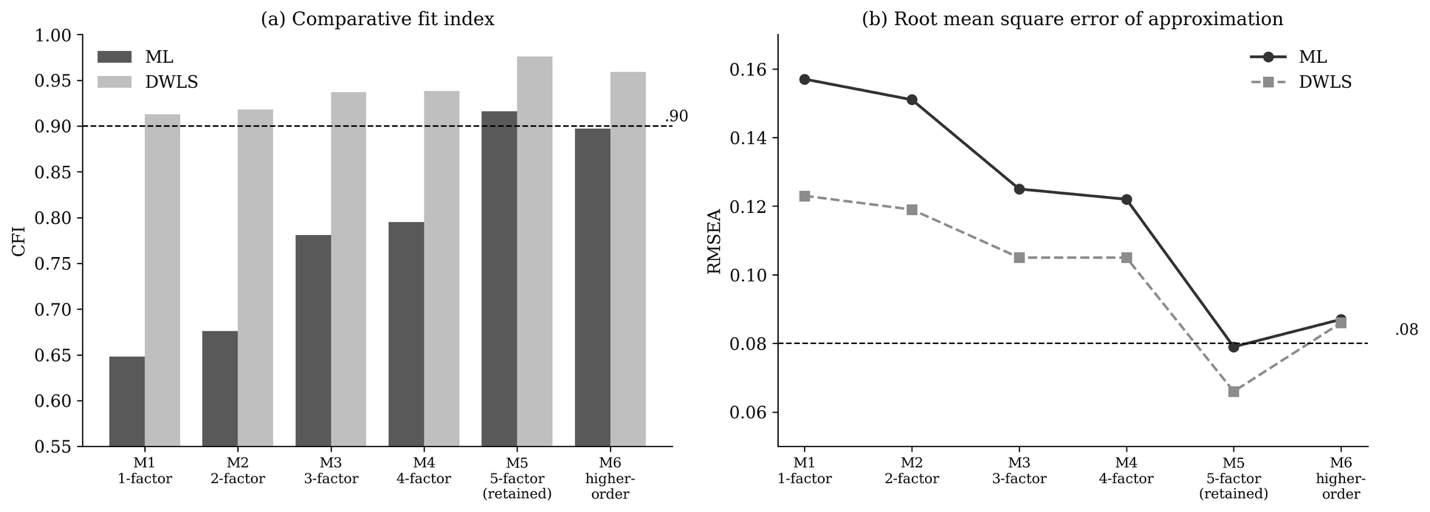
Table 8 presents fit statistics for the six competing measurement models. The model comparisons showed a consistent pattern across ML and DWLS estimation. The four-type model (M4), which represented Strategic reliance as a single eight-item factor, did not reach acceptable fit under ML (CFI = .795, RMSEA = .122) and remained inadequate under DWLS (RMSEA = .105). In contrast, the prespecified five-facet model (M5), which modeled Deliberate Use and Critical Evaluation separately, showed acceptable fit under ML, \(\chi^2\)(160) = 535.3, \(\chi^2\)/df = 3.35, CFI = .916, TLI = .900, RMSEA = .079, SRMR = .088, and stronger fit under DWLS, CFI = .976, TLI = .972, RMSEA = .066. M5 showed the strongest overall fit among the competing models and the lowest AIC and BIC of the six specifications.
The higher-order model (M6) tested whether Deliberate Use and Critical Evaluation could be represented by a broader Strategic factor. This model fell slightly below the acceptable ML criteria (CFI = .897, RMSEA = .087) but showed acceptable fit under DWLS (CFI = .959). Two model comparisons were particularly informative. First, combining Instrumental and Dialogic reliance into one factor substantially worsened fit relative to M5 (\(\Delta\)CFI = \(-\).135 under ML), supporting their treatment as distinct factors despite their strong correlation. Second, modeling Deliberate Use and Critical Evaluation as separate facets substantially improved fit over representing Strategic reliance as a single factor (\(\Delta\)CFI = +.121), supporting the five-facet measurement structure. Figure 2 displays the model comparisons.
Table 9 presents standardized loadings for the retained five-facet model. Nineteen of the 20 items had standardized loadings of .66 or higher (range = .66–.89). The exception was DEL3, “I avoid using generative AI tools unless their use aligns with my predetermined writing objectives” (\(\lambda\) = .25). DEL3 was also the only item in the facet framed in terms of restraint rather than engagement. Latent factor correlations ranged from \(-\).07 between Critical Evaluation and Dependent reliance to .89 between Instrumental and Dialogic reliance. Excluding the 28 cases flagged by the longstring index did not change the model ordering or the overall interpretation of M5 fit (CFI = .911, RMSEA = .076).
| Model | \(\chi^2\) (df) | \(\chi^2\)/df | CFI | TLI | RMSEA | SRMR | AIC | BIC | CFI | RMSEA |
| M1: One factor | (170) | ,689.2 | ,924.8 | |||||||
| M2: Two factors (Strategic vs. engagement) | (169) | ,563.9 | ,803.5 | |||||||
| M3: Three factors (Instrumental + Dialogic merged) | (167) | ,101.0 | ,348.4 | |||||||
| M4: Four factors (hypothesized) | (164) | ,041.1 | ,300.3 | |||||||
| M5: Five factors (Strategic facets separated) | 535.3 (160) | 3.35 | .916 | .900 | .079 | .088 | 26,507.0 | 26,781.9 | .976 | .066 |
| M6: Higher-order (Strategic over two facets) | (162) | ,588.1 | ,855.1 |
| Factor / item | \(\lambda\) | Factor / item | \(\lambda\) |
|---|---|---|---|
| Deliberate Use | Dependent | ||
| DEL1 (set clear objectives) | DEP1 (accept outputs by default) | ||
| DEL2 (plan sections in advance) | DEP2 (uneasy starting without AI) | ||
| DEL3 (avoid unless aligned with objectives) | DEP3 (incorporate with minimal revision) | ||
| DEL4 (allocate dedicated time blocks) | DEP4 (rarely question accuracy) | ||
| Critical Evaluation | Dialogic | ||
| CE1 (verify facts against sources) | DIAL1 (multiple rounds of refinement) | ||
| CE2 (evaluate logical consistency) | DIAL2 (pose follow-up questions) | ||
| CE3 (identify biases/ethical issues) | DIAL3 (blend AI passages with own voice) | ||
| CE4 (revise extensively for rigor) | DIAL4 (brainstorming partner) | ||
| Instrumental | |||
| INST1 (create outline/framework) | |||
| INST2 (rephrase/clarify sentences) | |||
| INST3 (condense source material) | |||
| INST4 (craft and refine prompts) |
2.8.2 Reliability and convergent and discriminant evidence↩︎
Table 10 presents reliability estimates and evidence of convergent and discriminant validity. Omega and alpha were good for four facets (\(\omega\) = .85–.88) and acceptable for Deliberate Use (\(\omega\) = .75), where the weak third item depresses internal consistency. Average variance extracted exceeded .50 for all facets except Deliberate Use (.46), and composite reliabilities all exceeded .70. Mean inter-item correlations exceeded the .20–.40 optimal range for four of five facets (.58–.65), an expected property of short, homogeneous four-item subscales that is reported for transparency; it indicates item redundancy within facets rather than unreliability and bounds the breadth of each facet's content coverage. The HTMT matrix (Table 6, above diagonal) localized discriminant pressure exactly where the design anticipated it: nine of ten ratios fell below the strict .85 criterion, with the Instrumental–Dialogic pair at .89, below the liberal .90 criterion but above the strict one. Under the interpretive rule fixed in advance (Section 3.5), the structural test governs this pair, and the M5-versus-M3 comparison in Table 8 resolves the issue: collapsing the two factors is untenable. At the opposite pole, Critical Evaluation and Dependent reliance were empirically near-orthogonal (HTMT = .17; latent r = \(-\).07), the instrument's clearest discriminant evidence and a direct empirical signature of the theoretical opposition between vigilant evaluation and wholesale outsourcing. This separation strengthened in the careless-response sensitivity analysis.
| Facet | \(\alpha\) | \(\omega\) | MIC | AVE | CR | Loading range |
| Deliberate Use | –.82 | |||||
| Critical Evaluation | –.89 | |||||
| Instrumental | –.85 | |||||
| Dependent | –.85 | |||||
| Dialogic | –.82 |
2.8.3 Measurement invariance↩︎
Table 11 presents configural, metric, and scalar invariance of the five-factor model across gender, first-generation status, and STEM versus non-STEM major. Configural fit sat at the adequate–borderline boundary under ML in each grouping (CFI = .896–.905), consistent with the full-sample ML solution; invariance itself is evaluated by the change statistics, which were uniformly and decisively within criteria: across all three groupings and both constraint steps, \(\Delta\)CFI never exceeded .002 (criterion \(\leq\) .01) and \(\Delta\)RMSEA never exceeded zero in the adverse direction (criterion \(\leq\) .015), with RMSEA improving at every step. Scalar invariance, therefore, held for all three groupings, licensing latent and observed mean comparisons across gender, first-generation status, and disciplinary groups. To our knowledge, this is the first reported evidence of scalar measurement invariance across demographic groups for an instrument measuring student reliance on generative AI, the precondition for the group-difference research questions that motivate reliance measurement.
| Grouping / model | \(\chi^2\) (df) | CFI | RMSEA | \(\Delta\)CFI | \(\Delta\)RMSEA | Decision |
|---|---|---|---|---|---|---|
| Gender (women n = 181, men n = 161) | ||||||
| Configural | (320) | — | — | — | ||
| Metric | (335) | \(-\).002 | Hold | |||
| Scalar | (350) | \(-\).001 | Hold | |||
| First-generation (no n = 250, yes n = 125) | ||||||
| Configural | (320) | — | — | — | ||
| Metric | (335) | \(-\).001 | Hold | |||
| Scalar | (350) | \(-\).001 | Hold | |||
| STEM (yes n = 203, no n = 172) | ||||||
| Configural | (320) | — | — | — | ||
| Metric | (335) | \(-\).001 | \(-\).002 | Hold | ||
| Scalar | (350) | \(-\).001 | Hold |
2.8.4 Rasch analysis: Rating-scale functioning↩︎
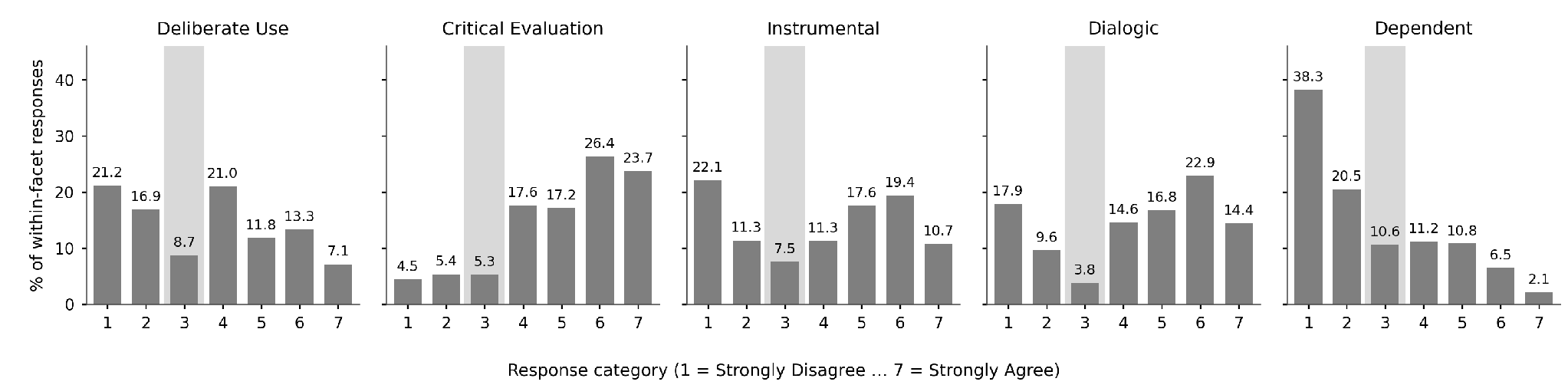
Rasch rating-scale analyses within each facet evaluated whether the 7-point response format functioned as intended. All seven response categories met Linacre's (2002) minimum frequency criterion, with every category attracting at least 32 observations in every facet. The format nevertheless failed the threshold-ordering criteria in a consistent, interpretable pattern replicated across two estimation methods (rating-scale JML and partial-credit MML): the step calibrations adjacent to category 3 ("Slightly Disagree") were disordered in 18 of the 20 items, indicating a category that is never the most probable response at any level of the latent trait, and category 3 was used less frequently than both adjacent categories in every facet (e.g., 58 of 1,527 Dialogic responses). A secondary disordering in the mild-agreement region, the step between categories 4 and 5 exceeding the subsequent step, appeared in 6 of the 20 items. Together, these results indicate that respondents are not distinguishing "Slightly Disagree" from its neighbors and that the disagreement side of the scale carries more categories than respondents use.
Item-difficulty orderings were stable across both estimators and substantively interpretable: within Deliberate Use, aligning use with predetermined objectives was the easiest behavior to endorse, and allocating dedicated time blocks was the hardest, while the four Critical Evaluation items clustered tightly in difficulty; evaluation behaviors travel together; planning behaviors stratify. The category-functioning verdict yields the instrument-revision recommendation developed in Section 5: a 5-point format that merges the two intermediate disagreement categories and the adjacent mild-agreement region should function more cleanly, paralleling the category-collapse finding of Mata-McMahon et al. (2023) for a 5-point frequency scale. Figure 3 displays the category-usage profile underlying this diagnosis.
2.9 Response processes evidence↩︎
Directed content analysis of the 14 maximum-variation interviews examined whether participants’ descriptions of their AI use matched the behaviors represented by the scale items. This provides evidence about the link between item responses and score interpretation that factor analysis alone cannot establish. Because participants were sampled across a broad range of scores, the analysis examined response processes among low, middle, and high scorers. This extends qualitative validation beyond the high-scoring respondents emphasized in previous research (Hou et al., 2025). Table 12 summarizes alignment evidence for each facet and provides illustrative excerpts using participant pseudonyms.
Evidence of alignment was found for all five facets. Five participants described selective restraint and boundary setting consistent with Deliberate Use. Critical Evaluation appeared in accounts of actively questioning and verifying AI output. Tyler, for example, explained, “I expect it to be wrong, and I’m kind of trying to disprove it.” Nine participants described bounded, task-specific delegation consistent with Instrumental reliance. Seven described experiences of wholesale outsourcing consistent with Dependent reliance, although these accounts were retrospective, as discussed below. Eight described sustained, iterative exchanges with AI consistent with Dialogic reliance. Sandra, for example, described AI as “a thinking partner” used through repeated and refining questions. Alignment was also evident across score levels. Participants with low Dependent scores described careful evaluation and verification practices consistent with limited dependent reliance, while participants with mid-range Instrumental scores described bounded, task-specific delegation consistent with their scores.
Three findings also identified important limits to score interpretation. First, no participant fit a single reliance category. All 14 described multiple reliance patterns that varied across tasks and situations. Scores should therefore be interpreted as profiles of co-occurring reliance behaviors rather than as fixed or mutually exclusive student types. This finding supports continuous subscale scoring and cautions against categorical labeling.
Second, participants described Dependent reliance only as a past behavior; none reported current uncritical use. This pattern may reflect social desirability, changes in reliance over time, or both. The finding raises the possibility that current self-reports may underestimate dependent reliance, particularly among students reluctant to acknowledge behaviors viewed negatively.
Third, one participant reported limiting AI use because of concern following a disputed academic integrity accusation rather than because of a deliberate learning strategy. The scale may record these forms of restraint similarly even though they arise from different reasons. This finding suggests that similar Deliberate Use scores may arise from different motivations. The scale captures the reported behavior but may not distinguish intentional learning strategies from restraint driven by fear of institutional consequences. This limitation should be considered when scores are used in policy-sensitive settings.
| Facet | Aligned behavioral evidence (prevalence) | Illustrative excerpt | Divergence / interpretive bound |
| Deliberate Use | Deliberate withholding and self-regulated boundary-setting (5/14) | “I try to avoid using AI. I only use AI as a last resort…” (Tyler) | Externally induced restraint can mimic deliberate restraint (1 case); low scores admit two mechanisms |
| Critical Evaluation | Adversarial verification; trust calibration against authoritative sources | “At this point I expect it to be wrong and I’m kind of trying to disprove it… So, I’ll go back to the textbook.” (Tyler) | None observed; closest item–behavior correspondence in the corpus |
| Instrumental | Task-directed, bounded problem-solving with retained authorship (9/14) | “I use the AI for the simple reason… to get things done, to solve problems that I face.” (Elias) | Feedback-seeking variants (AI as evaluator) sit at the facet’s boundary with Dialogic use |
| Dependent | High-volume, low-oversight outsourcing (7/14) | “I used to… use AI to do almost all of my assignments and then eventually I started to truly realize that I wasn’t learning anything, so I stopped.” (Destiny) | Narrated only in past tense; concurrent self-report may underestimate active dependency |
| Dialogic | Iterative prompting and co-construction with retained synthesis (8/14) | “I use AI as a thinking partner… If I’m stumped with how I should approach something… I ask AI a question.” (Sandra) | Overlaps situationally with Instrumental use; repertoires co-occur within persons |
2.10 Relationships to other variables' evidence↩︎
Table 13 compares the observed findings with the a priori expectations specified in Section 3.5 against the AI-assisted-attainment criterion defined in Section 3.3. These expectations were based on external measures of students’ reported use of AI for writing functions and perceived benefits rather than independently assessed writing quality. All a priori expectations were supported. Strategic reliance was positively associated with the AI literacy composite (r = .61), core AI literacy (r = .51), and prior AI exposure (r = .55). Among the four broad reliance type scores, the Strategic composite showed its weakest association with Dependent reliance (r = .19), while the remaining reliance types showed stronger positive associations with one another (r = .53–.77). The four dominant profile groups differed significantly across all ten writing process and perceived benefit variables, with all omnibus tests reaching p < .001. Effect sizes ranged from \(\eta^2\) = .166 for grammar and style to \(\eta^2\) = .329 for overall quality. Dependent reliance was strongly associated with self-reported AI-assisted writing self-efficacy (r = .64). This direction was consistent with the prespecified expectation because the criterion reflects perceived capability when using AI rather than independent writing self-efficacy. Additional evidence for distinguishing Instrumental and Dialogic reliance came from the dominant profile comparisons. Despite their strong correlation, the Instrumental and Dialogic groups differed in perceived originality (d = 0.45) and critical thinking (d = 0.41), providing further support for retaining the two constructs separately.
| Expectation (stated in advance) | Observed | Verdict |
| Convergent: Strategic reliance correlates positively with AI literacy (composite, core, exposure) | r = .61 / .51 / .55, all p < .001 | Supported |
| Discriminant: Strategic–Dependent is the lowest subscale intercorrelation (conceptual opposition) | r = .19; lowest of all pairs | Supported |
| Discriminant pattern: high-engagement types (Instrumental, Dialogic, Dependent) intercorrelate more strongly with one another than with Strategic restraint | r = .53–.77 within triad | Supported |
| Criterion: dominant reliance type differentiates all ten writing-process and outcome variables | All F p < .001; \(\eta^2\) = .166–.329 (uniformly large) | Supported |
| Criterion (attainment frame): Dependent reliance correlates positively with AI-assisted writing self-efficacy | r = .64, p < .001 | Supported |
| Differentiation of the most-correlated pair: dominant-Instrumental vs. dominant-Dialogic students differ on originality and critical thinking | d = 0.45 (originality); d = 0.41 (critical thinking) | Supported |
3 Discussion↩︎
This discussion addresses the central question of an instrument validation study: What does the accumulated evidence show about the quality of the GenAI-RTS as a measure? The discussion evaluates the overall validity argument, explains the structural refinements supported by the data, and positions the instrument within the emerging measurement literature. Claims about AI reliance are considered only when they inform the interpretation and use of GenAI-RTS scores.
3.1 Summary of the validity argument↩︎
This study examined whether the GenAI-RTS demonstrates acceptable evidence across four of the five validity sources specified in the Standards. Table 14 summarizes the evidence for each claim. Evidence based on test content came from the theory-driven development of the five facets (Table 5), the literature-to-item mapping, and review by three faculty experts. However, the absence of an independent external panel and formal content validity indices remains the main limitation of this evidence source.
Response process evidence showed alignment between participants’ accounts and the behaviors represented by all five facets across a broad range of scores. The interviews also identified three limits to score interpretation: scores represent overlapping profiles rather than fixed types; current Dependent reliance may be underreported; and similar Deliberate Use scores may arise from different motivations.
Internal structure evidence provided the strongest support for a five-facet measurement structure, which outperformed five competing models across both estimators. The five facets showed acceptable to good reliability and scalar invariance across the three tested groupings.
Evidence based on relationships with other variables supported all prespecified expectations.
The resulting argument is not that the instrument is flawless. The evidence identifies clear limitations, including the weak third Deliberate Use item, possible overlap within some facets, and problems with the seven-point response format. At the same time, the evidence supports specific score interpretations while clearly identifying where those interpretations should be limited. This is the purpose of a validity argument rather than a simple validity verdict (Kane, 2013).
| Claim about GenAI-RTS scores | Principal evidence | Verdict |
|---|---|---|
| Items represent the theorized reliance construct (content) | Framework-derived facets; literature-to-item mapping; faculty expert review; no external panel | Supported, with the expert-review gap acknowledged |
| Responses reflect the behaviors the items imply (response processes) | Item–behavior alignment across all facets and score levels in 14 maximum-variation interviews; three bounded divergences | Supported, with three explicit interpretive bounds |
| Scores reflect five distinct facets organized by a four-type taxonomy (internal structure) | M5 superior to five rivals under ML and DWLS; \(\omega\) = .75–.88; scalar invariance across gender, first-generation status, STEM | Supported; four-type taxonomy retained at the theoretical level, five facets at the measurement level |
| The 7-point format functions as intended (internal structure) | Replicated threshold disordering at category 3; category-3 underuse across facets | Not supported; 5-point revision recommended |
| Scores relate to external variables as theory predicts (relationships to other variables) | Pre-stated expectations supported (convergent r = .51–.61; \(\eta^2\) = .166–.329; d = 0.41–0.45 for the most-correlated pair) | Supported |
| Scores support consequential use decisions (consequences) | Deferred to future research (Krupa et al., 2020; Sondergeld, 2020) | Not yet evaluated |
3.2 The four-type taxonomy and the five-facet structure: What held and what the data refined↩︎
The findings largely supported the proposed theoretical structure while refining how Strategic reliance is represented at the measurement level. At the theoretical level, the four broad reliance patterns remained meaningful. Among the four broad type scores, Strategic and Dependent reliance showed the weakest association (r = .19), while Critical Evaluation and Dependent reliance were nearly unrelated at the facet level.
What the data refined: Strategic reliance is one construct at the theoretical level but two at the measurement level. Deliberate orchestration and critical evaluation are dissociable behaviors; students in this sample evaluated far more than they planned (M = 5.11 vs. 3.54), and forcing them into a single factor is the difference between an inadequate and an acceptable model.
Three independent signals converge on this refinement: the competing-model result, the facet asymmetry in the descriptives, and the external replication discussed below. The instrument’s most correlated pair, Instrumental and Dialogic reliance (r = .77; HTMT = .89), was interrogated from three directions and survived all three: structurally, merging them degrades fit severely (\(\Delta\)CFI = \(-\).135); theoretically, the correlation reflects shared engagement volume, not shared construct — both patterns involve frequent AI contact while differing in its character; and criterially, students dominant in each pattern differ on exactly the outcomes the distinction predicts, originality (d = 0.45) and critical thinking (d = 0.41).
Two instrument revisions follow directly from the evidence. The third Deliberate Use item, the facet’s only restraint-phrased item (\(\lambda\) = .25), should be reworded in the engagement-phrased direction of its facet or replaced. And the response format should move from seven categories to five: respondents demonstrably do not distinguish “Slightly Disagree” from its neighbors, a diagnosis invisible to factor-analytic methods and recoverable only at the rating-scale level, paralleling Mata-McMahon et al.’s (2023) category-collapse finding and illustrating why the dual-tradition design carries its analytic cost. The recommended 5-point format also converges with the response format Hou et al. (2025) themselves adopted, independent designs arriving at the same calibration.
3.3 Position in the cumulative literature↩︎
The distinction between Deliberate Use and Critical Evaluation also has a parallel in previous research. Hou et al. (2025) distinguished reflective use from cautious use, a distinction that parallels the separation of Deliberate Use and Critical Evaluation in the present study.
When deductive and inductive derivations, applied to different populations and tasks, fracture a construct at the same joint. This convergence suggests that regulating AI engagement and evaluating AI output may represent related but distinct competencies across more than one task context. Further replication is needed to determine how broadly this distinction generalizes.
The present study extends this work by testing a theory-derived structure against competing models and adding forms of evidence not previously reported in this literature, including measurement invariance and an argument-based validation framework. The study also extends validation to a racially diverse Minority Serving Institution, although racial invariance could not be tested with the present sample sizes.
The presence of an Instrumental facet in this study, but not in Hou et al.’s problem-solving structure, may reflect differences between task contexts. Extended writing provides repeated opportunities for surface-level delegation, such as polishing, rephrasing, and condensing, that may be less central in bounded problem-solving tasks. This suggests that some features of reliance may be shaped by the task context. The reverse difference is also informative. Hou et al.’s collaborative use factor, which involves reliance through peers, has no direct counterpart in the GenAI-RTS. Together, these differences suggest that reliance structures may partly depend on the tasks and social contexts in which AI use occurs.
3.4 Implications↩︎
For researchers, the practical importance of scalar invariance is straightforward. Comparisons across gender, first-generation status, or academic discipline are meaningful only if respondents interpret the items in the same way. To our knowledge, scalar invariance across demographic groups had not previously been established for an instrument measuring student reliance on GenAI. Researchers using the GenAI-RTS can interpret observed differences across the tested groups as reflecting differences in reliance rather than differences in how participants understood the items.
For educators and practitioners, three implications follow. First, scores should be interpreted as reliance profiles rather than fixed student types. The response-process evidence showed that students used different patterns of AI reliance depending on the writing task and context. Therefore, interventions should focus on strengthening productive reliance patterns rather than labeling students.
Second, high scores on the Dependent dimension provide the clearest indicator of students who may benefit from AI literacy instruction. Because Dependent reliance represents a pattern distinct from Critical Evaluation, interventions should focus on strengthening students’ ability to critically evaluate AI-generated content rather than simply reducing AI use.
Third, the response-process evidence carries a caution for policy-sensitive uses: low engagement scores can reflect principled strategy or fear of institutional consequences, and the instrument cannot distinguish them; the GenAI-RTS is a formative diagnostic, not a conduct-screening device.
3.5 Limitations and future directions↩︎
Limitations should be considered, each with a corresponding direction for future research. First, the structural evidence is based on a single validation sample. Although competing CFA models were compared, the five-factor structure should be replicated in an independent sample to establish cross-validation. Second, the study was conducted at a single institution using a cross-sectional design. Although interview data suggested movement from dependent toward strategic reliance, these retrospective accounts cannot establish developmental change. Longitudinal studies across multiple institutions are needed. Third, all measures are self-report: the study lacks the behavioral data such as AI interaction logs with which Hou et al. (2025) anchored their qualitative check, and triangulating GenAI-RTS scores against interaction-log indicators would provide the strongest available test of the response-process claims.
Fourth, evidence based on test content would be strengthened through review by an independent panel of experts. Future administrations should include formal content validation, such as expert ratings of item relevance and clarity. Fifth, the criterion variables focused on AI-assisted writing behaviors rather than independently assessed writing quality. Future studies should examine whether reliance profiles predict external outcomes such as writing quality, course performance, and transfer of learning. These outcomes would also provide evidence regarding the consequences of testing (Krupa et al., 2020; Sondergeld, 2020). Sixth, measurement invariance could only be examined across two-group comparisons because the non-binary, genderqueer, and transgender subgroup was too small for stable estimation. Multi-site studies with more diverse samples would permit more comprehensive and intersectional invariance testing.
In addition, the observed mean inter-item correlations suggest that future versions of the scale could broaden the content represented within each facet. Finally, the temporal stability of the GenAI-RTS has not yet been established. Future studies should examine test–retest reliability across appropriate time intervals.
4 Conclusion↩︎
The Generative AI Reliance Types Scale measures how undergraduates rely on generative AI in academic writing, addressing a question that has become increasingly important as generative AI use has become nearly universal. Using quantitative and qualitative evidence from a Minority-Serving Institution, the study provided validity evidence across four of the five sources identified in the Standards for Educational and Psychological Testing. Evidence supported the instrument’s theoretical foundation, response processes, internal structure, measurement invariance across key student groups, and relationships with external variables.
The instrument is intended for formative use, helping educators identify reliance profiles and students who may benefit from AI literacy support, rather than for academic misconduct screening. The findings also identify two priorities for the next version of the instrument: revising one item and adopting a five-point response scale.
Future research should evaluate the revised instrument across different institutions, educational contexts, and writing tasks, ultimately, against behavioral evidence of students’ writing processes. By moving beyond a simple distinction between AI use and non-use, the GenAI-RTS enables researchers and educators to better understand how students engage with AI during academic writing and to design more targeted AI literacy interventions.
Data availability↩︎
The de-identified item-level dataset and the analysis code reproducing all reported statistics are available on request from the corresponding author.
CRediT authorship contribution statement↩︎
Shahin Hossain: Conceptualization, Methodology, Investigation, Formal analysis, Data curation, Writing – original draft, Writing – review & editing. Tukhbita Afroz Nawmi: Validation, Writing – review & editing.
Funding↩︎
This research did not receive any specific grant from funding agencies in the public, commercial, or not-for-profit sectors.
Declaration of competing interest↩︎
The authors declare no competing interests.
Declaration of generative AI and AI-assisted technologies in the writing process↩︎
During the preparation of this work, the authors used Claude (Anthropic; Fable 5, Opus 4.8, and Sonnet 4.6) and ChatGPT (OpenAI; GPT-5.5) to improve language clarity, edit style, and format tables. After using these tools, the authors reviewed and edited the content as needed and take full responsibility for the content of the published article.
Appendix A. The Generative AI Reliance Types Scale (GenAI-RTS)↩︎
Instructions: Please indicate your agreement with each statement using the following 7-point scale: 1 = Strongly Disagree; 2 = Disagree; 3 = Slightly Disagree; 4 = Neither Agree nor Disagree; 5 = Slightly Agree; 6 = Agree; 7 = Strongly Agree.
Strategic Reliance, Deliberate Use (DEL)
1. I set clear objectives for using generative AI tools before each writing session.
2. I plan in advance which sections of my assignment I will draft with generative AI tools.
3. I avoid using generative AI tools unless their use aligns with my predetermined writing objectives.
4. I allocate dedicated time blocks to interact with generative AI tools during my writing process.
Strategic Reliance, Critical Evaluation (CE)
5. I verify facts in text produced by generative AI tools against authoritative sources.
6. I evaluate the logical consistency and coherence of text produced by generative AI tools.
7. I identify potential biases or ethical issues in text produced by generative AI tools.
8. I revise text produced by generative AI tools extensively to ensure academic rigor.
Instrumental Reliance (INST)
9. I use generative AI tools to create an outline or structural framework for my writing before I begin drafting.
10. I use generative AI tools to rephrase or clarify complex sentences in my drafts.
11. I use generative AI tools to condense lengthy source material into concise summaries.
12. I craft and refine prompts to guide generative AI tools toward specific writing objectives.
Dependent Reliance (DEP)
13. I accept outputs from generative AI tools by default, even when I could compose those sections myself.
14. I feel uneasy starting a writing task without first consulting generative AI tools for guidance.
15. I incorporate suggestions from generative AI tools into my drafts with minimal revision.
16. I rarely question the accuracy or reliability of suggestions provided by generative AI tools.
Dialogic Reliance (DIAL)
17. I engage in multiple rounds of prompts and refinements with generative AI tools to co-author text.
18. I pose follow-up questions to generative AI tools to deepen or nuance their responses.
19. I blend passages from generative AI tools with my own writing voice within the same draft.
20. I use generative AI tools as brainstorming partners to explore new ideas or perspectives.
Scoring: subscale scores are item means (1–7); the Strategic composite is the mean of the Deliberate Use and Critical Evaluation facet means. Recommended revisions for the next version (Section 5.2): reword item 3 in the engagement-phrased direction of its facet; administer with a 5-point response format.
Appendix B. Interview Protocol Excerpt (Reliance-Relevant Sections)
Note. The protocol is reproduced as administered; interview questions used the term “LLM,” whereas survey items used “generative AI tools.”
The semi-structured protocol comprised 13 core questions in four sections; the two sections most relevant to the response-process analysis are excerpted below. The full protocol is available from the author.
Section 1: LLM usage contexts and experiences
• Can you walk me through a recent writing assignment where you used an LLM? What was the assignment, how did you use the LLM, and what was the outcome?
• Thinking across your different courses and writing assignments, how does your LLM use vary depending on the context?
• Can you describe a time when using an LLM went particularly well? What made it successful? Can you describe a time when it did not go well? What went wrong?
Section 2: Reliance type understanding and self-perception
• Based on your survey responses, you were classified as exhibiting primarily [strategic/instrumental/dependent/dialogic] reliance. Does this characterization resonate with how you think about your LLM use? Why or why not?
• How do you distinguish between using an LLM as a helpful tool versus relying on it too much? Where do you draw that line for yourself?
• Some students describe GenAI as “thinking partners,” others as “productivity tools,” and others as “crutches.” Which metaphor best captures your experience, and why?
References↩︎
1.2em1 Allen, L. K., & Kendeou, P. (2024). ED-AI Lit: An interdisciplinary framework for AI literacy in education. Policy Insights from the Behavioral and Brain Sciences, 11(1), 3–10. https://doi.org/10.1177/23727322231220339
American Educational Research Association, American Psychological Association, & National Council on Measurement in Education. (2014). Standards for educational and psychological testing. American Educational Research Association.
Bandura, A. (1997). Self-efficacy: The exercise of control. W. H. Freeman.
Barcelona, A., & Dela Cruz, S. R. (2025). Development and validation of a scale measuring students’ use of generative artificial intelligence tools. International Journal of Evaluation and Research in Education, 14(5), 3612–3621. https://doi.org/10.11591/ijere.v14i5.34809
Bereiter, C., & Scardamalia, M. (1987). The psychology of written composition. Lawrence Erlbaum Associates.
Biggs, J. B. (1987). Student approaches to learning and studying. Australian Council for Educational Research.
Biggs, J. B. (1999). Teaching for quality learning at university. Society for Research into Higher Education & Open University Press.
Bulathwela, S., Pérez-Ortiz, M., Holloway, C., Cukurova, M., & Shawe-Taylor, J. (2024). Artificial intelligence alone will not democratise education: On educational inequality, techno-solutionism and inclusive tools. Sustainability, 16(2), 781. https://doi.org/10.3390/su16020781
Chen, F. F. (2007). Sensitivity of goodness of fit indexes to lack of measurement invariance. Structural Equation Modeling, 14(3), 464–504. https://doi.org/10.1080/10705510701301834
Chung, K., Kim, S., Jang, Y., Choi, S., & Kim, H. (2025). Developing an AI literacy diagnostic tool for elementary school students. Education and Information Technologies, 30, 1013–1044. https://doi.org/10.1007/s10639-024-13097-w
Cotton, D. R. E., Cotton, P. A., & Shipway, J. R. (2024). Chatting and cheating: Ensuring academic integrity in the era of ChatGPT. Innovations in Education and Teaching International, 61(2), 228–239. https://doi.org/10.1080/14703297.2023.2190148
Fan, Y., Tang, L., Le, H., Shen, K., Tan, S., Zhao, Y., Shen, Y., Li, X., & Gašević, D. (2025). Beware of metacognitive laziness: Effects of generative artificial intelligence on learning motivation, processes, and performance. British Journal of Educational Technology, 56(2), 489–530. https://doi.org/10.1111/bjet.13544
Fornell, C., & Larcker, D. F. (1981). Evaluating structural equation models with unobservable variables and measurement error. Journal of Marketing Research, 18(1), 39–50. https://doi.org/10.1177/002224378101800104
Freeman, J. (2025). Student generative AI survey 2025 (HEPI Policy Note 61). Higher Education Policy Institute.
Gerlich, M. (2025). AI tools in society: Impacts on cognitive offloading and the future of critical thinking. Societies, 15(1), 6. https://doi.org/10.3390/soc15010006
Graham, S., & Harris, K. R. (2000). The role of self-regulation and transcription skills in writing and writing development. Educational Psychologist, 35(1), 3–12. https://doi.org/10.1207/S15326985EP3501_2
Gümüş, M. M., & Kara, M. (2025). Development and validation of the Generative AI Literacy for Learning Scale (GenAI-LLs). Australasian Journal of Educational Technology, 41(4), 1–16.
Hayes, J. R. (1996). A new framework for understanding cognition and affect in writing. In C. M. Levy & S. Ransdell (Eds.), The science of writing: Theories, methods, individual differences, and applications (pp. 1–27). Lawrence Erlbaum Associates.
Henseler, J., Ringle, C. M., & Sarstedt, M. (2015). A new criterion for assessing discriminant validity in variance-based structural equation modeling. Journal of the Academy of Marketing Science, 43(1), 115–135. https://doi.org/10.1007/s11747-014-0403-8
Hou, C., Zhu, G., Sudarshan, V., Lim, F. S., & Ong, Y. S. (2025). Measuring undergraduate students’ reliance on Generative AI during problem-solving: Scale development and validation. Computers & Education, 234, Article 105329. https://doi.org/10.1016/j.compedu.2025.105329
Hsieh, H.-F., & Shannon, S. E. (2005). Three approaches to qualitative content analysis. Qualitative Health Research, 15(9), 1277–1288. https://doi.org/10.1177/1049732305276687
Hu, K. (2023, February 2). ChatGPT sets record for fastest-growing user base. Reuters. https://www.reuters.com/technology/chatgpt-sets-record-fastest-growing-user-base-analyst-note-2023-02-01/
Hu, L., & Bentler, P. M. (1999). Cutoff criteria for fit indexes in covariance structure analysis: Conventional criteria versus new alternatives. Structural Equation Modeling, 6(1), 1–55. https://doi.org/10.1080/10705519909540118
Kane, M. T. (2013). Validating the interpretations and uses of test scores. Journal of Educational Measurement, 50(1), 1–73. https://doi.org/10.1111/jedm.12000
Kellogg, R. T. (2008). Training writing skills: A cognitive developmental perspective. Journal of Writing Research, 1(1), 1–26.
Kosmyna, N., Hauptmann, E., Yuan, Y. T., Situ, J., Liao, X. H., Beresnitzky, A. V., Braunstein, I., & Maes, P. (2025). Your brain on ChatGPT: Accumulation of cognitive debt when using an AI assistant for essay writing task [Preprint]. arXiv. https://arxiv.org/abs/2506.08872
Krupa, E., Bostic, J., & Shih, J. (2020). Validation in mathematics education: An introduction. In J. Bostic, E. Krupa, & J. Shih (Eds.), Quantitative measures of mathematical knowledge: Researching instruments and perspectives (pp. 1–13). Routledge.
Lee, J. D., & See, K. A. (2004). Trust in automation: Designing for appropriate reliance. Human Factors, 46(1), 50–80. https://doi.org/10.1518/hfes.46.1.50_30392
Linacre, J. M. (2002). Optimizing rating scale category effectiveness. Journal of Applied Measurement, 3(1), 85–106.
Little, R. J. A. (1988). A test of missing completely at random for multivariate data with missing values. Journal of the American Statistical Association, 83(404), 1198–1202. https://doi.org/10.1080/01621459.1988.10478722
Liu, Z. M., Hwang, G. J., Chen, C. Q., Chen, X. D., & Ye, X. D. (2024). Integrating large language models into EFL writing instruction: Effects on performance, self-regulated learning strategies, and motivation. Computer Assisted Language Learning, 39(3), 466–490. https://doi.org/10.1080/09588221.2024.2389923
Lodge, J. M., & Loble, L. (2026). Artificial intelligence, cognitive offloading and implications for education. University of Technology Sydney. https://doi.org/10.71741/4pyxmbnjaq.31302475
Logg, J. M., Minson, J. A., & Moore, D. A. (2019). Algorithm appreciation: People prefer algorithmic to human judgment. Organizational Behavior and Human Decision Processes, 151, 90–103. https://doi.org/10.1016/j.obhdp.2018.12.005
Long, D., & Magerko, B. (2020). What is AI literacy? Competencies and design considerations. In Proceedings of the 2020 CHI Conference on Human Factors in Computing Systems (pp. 1–16). ACM. https://doi.org/10.1145/3313831.3376727
Marengo, A., Karaoglan-Yilmaz, F. G., Yılmaz, R., & Ceylan, M. (2025). Development and validation of generative artificial intelligence attitude scale for students. Frontiers in Computer Science, 7, Article 1528455. https://doi.org/10.3389/fcomp.2025.1528455
Marsh, H. W., Hau, K.-T., & Wen, Z. (2004). In search of golden rules: Comment on hypothesis-testing approaches to setting cutoff values for fit indexes and dangers in overgeneralizing Hu and Bentler’s (1999) findings. Structural Equation Modeling, 11(3), 320–341. https://doi.org/10.1207/s15328007sem1103_2
Mata-McMahon, J., Haslip, M. J., & Kruse, L. (2023). Validation study of the Early Childhood Educators' Spiritual Practices in the Classroom (ECE-SPC) instrument using Rasch. International Journal of Children's Spirituality, 28(3–4), 99–132. https://doi.org/10.1080/1364436X.2023.2218590
Mogavi, R. H., Deng, C., Kim, J. J., Zhou, P., Kwon, Y. D., Metwally, A. H. S., Tlili, A., Bassanelli, S., Bucchiarone, A., Gujar, S., Nacke, L. E., & Hui, P. (2024). ChatGPT in education: A blessing or a curse? A qualitative study exploring early adopters’ utilization and perceptions. Computers in Human Behavior: Artificial Humans, 2(1), Article 100027. https://doi.org/10.1016/j.chbah.2023.100027
Parasuraman, R., & Riley, V. (1997). Humans and automation: Use, misuse, disuse, abuse. Human Factors, 39(2), 230–253. https://doi.org/10.1518/001872097778543886
Patton, M. Q. (2015). Qualitative research and evaluation methods (4th ed.). SAGE.
Piedmont, R. L. (2014). Inter-item correlations. In A. C. Michalos (Ed.), Encyclopedia of quality of life and well-being research (pp. 3303–3304). Springer. https://doi.org/10.1007/978-94-007-0753-5_1493
information technology: Toward a unified view. MIS Quarterly, 27(3), 425–478. https://doi.org/10.2307/30036540
Rhemtulla, M., Brosseau-Liard, P. É., & Savalei, V. (2012). When can categorical variables be treated as continuous? A comparison of robust continuous and categorical SEM estimation methods under suboptimal conditions. Psychological Methods, 17(3), 354–373. https://doi.org/10.1037/a0029315
Risko, E. F., & Gilbert, S. J. (2016). Cognitive offloading. Trends in Cognitive Sciences, 20(9), 676–688. https://doi.org/10.1016/j.tics.2016.07.002
Rudolph, J., Tan, S., & Tan, S. (2023). ChatGPT: Bullshit spewer or the end of traditional assessments in higher education? Journal of Applied Learning and Teaching, 6(1), 342–363. https://doi.org/10.37074/jalt.2023.6.1.9
Schemmer, M., Kühl, N., Benz, C., Bartos, A., & Satzger, G. (2023). Appropriate reliance on AI advice: Conceptualization and the effect of explanations. In Proceedings of the 28th International Conference on Intelligent User Interfaces (pp. 410–422). ACM. https://doi.org/10.1145/3581641.3584066
Schraw, G., & Dennison, R. S. (1994). Assessing metacognitive awareness. Contemporary Educational Psychology, 19(4), 460–475. https://doi.org/10.1006/ceps.1994.1033
Sondergeld, T. A. (2020). Shifting sights on STEM education quantitative instrumentation development: The importance of moving validity evidence to the forefront rather than a footnote. School Science and Mathematics, 120(5), 259–261. https://doi.org/10.1111/ssm.12410
Stephenson, R., & Armstrong, C. (2026). Student generative AI survey 2026 (HEPI Report 199). Higher Education Policy Institute.
Venkatesh, V., Morris, M. G., Davis, G. B., & Davis, F. D. (2003). User acceptance of
Vygotsky, L. S. (1978). Mind in society: The development of higher psychological processes. Harvard University Press.
Wigfield, A., & Eccles, J. S. (2000). Expectancy–value theory of achievement motivation. Contemporary Educational Psychology, 25(1), 68–81. https://doi.org/10.1006/ceps.1999.1015
Wright, B. D., & Linacre, J. M. (1994). Reasonable mean-square fit values. Rasch Measurement Transactions, 8(3), 370.
Wu, H., Ni, H., Luo, W., & Wu, T. (2026). Development and validation of the AI dependence scale for Chinese undergraduates and a preliminary exploration. Frontiers in Psychology, 16, Article 1725393. https://doi.org/10.3389/fpsyg.2025.1725393
Xia, L., Shen, K., Sun, H., An, X., & Dong, Y. (2025). Developing and validating the student learning agency scale in generative artificial intelligence (AI)-supported contexts. Education and Information Technologies, 30(10), 13999–14021. https://doi.org/10.1007/s10639-024-13137-5
Zhang, H., Perry, A., & Lee, I. (2025). Developing and validating the artificial intelligence literacy concept inventory: An instrument to assess artificial intelligence literacy among middle school students. International Journal of Artificial Intelligence in Education, 35(1), 398–438. https://doi.org/10.1007/s40593-024-00398-x