Never Too Late for Force: Accelerating VLA Post-Training with Reactive Force Injection
July 15, 2026
Abstract
Pretrained vision-language-action (VLA) policies provide strong language-conditioned manipulation knowledge, but they remain largely vision-driven and can struggle once manipulation enters contact states where the scene is occluded, depth is ambiguous, or small force errors push execution off the offline demonstration distribution. We present LIFT, Late Reactive Injection of Force for VLA Post-Training, a force-aware post-training framework that adds contact reactivity to a pretrained VLA policy while preserving its general manipulation knowledge. LIFT grafts a reactive action expert beside the original action expert, initializes it from pretrained action weights, and injects recent 6D end-effector force through causal force memory and zero-initialized cross attention, enabling actions to be refreshed during execution. To address the policy-dependent distribution shift of contact feedback, LIFT further couples reactive force injection with an online DAgger loop that trains on a mixture of offline task-alignment data and human-corrected online rollouts. Across towel folding, book insertion, and Hanoi ring placement, LIFT learns faster and reaches higher performance than vision-only post-training, while ablations show that reactive force memory and online corrective data are both important for robust contact-rich manipulation. Our code and data will be publicly available.
1 Introduction↩︎
Pretrained vision-language-action (VLA) policies [1]–[6] have made it possible to transfer large-scale vision-language priors to robot manipulation. These models are strong at language-conditioned scene understanding and general action generation, but they still rely mainly on vision. Without force sensing, a policy can struggle when contact states are visually ambiguous due to occlusion, partial observation, or inaccurate depth perception. This limitation matters even when a task is not explicitly contact-rich, because execution still passes through contact states where physical feedback can reveal whether the robot has touched, pushed, inserted, or released an object. In those moments, force provides extra physical feedback and can also serve as a cheap memory of contact history. Recent force-aware manipulation systems [7]–[13] further support this view by showing that explicit contact feedback helps in both reactive control and policy learning. However, force and torque are harder to include during pretraining at scale because they are costly to collect, depend on robot platform and end-effector hardware, and vary across setups.
This makes force-aware post-training a natural next step. Instead of rebuilding the foundation model, we want to adapt an existing VLA to a specific robot platform and sensor stack. Doing so, however, raises three questions. First, because force is high-frequency, low-dimensional, and tightly coupled to contact dynamics, how should it be injected so the policy can react quickly to new contact events and retain a useful force memory? Second, adding a new force path can disturb the pretrained VLA prior, so how can we preserve it at initialization and during adaptation? Third, force distributions are highly policy-dependent and can shift sharply after small deviations from offline states, so how can post-training stay effective when offline force data do not cover most states of force?
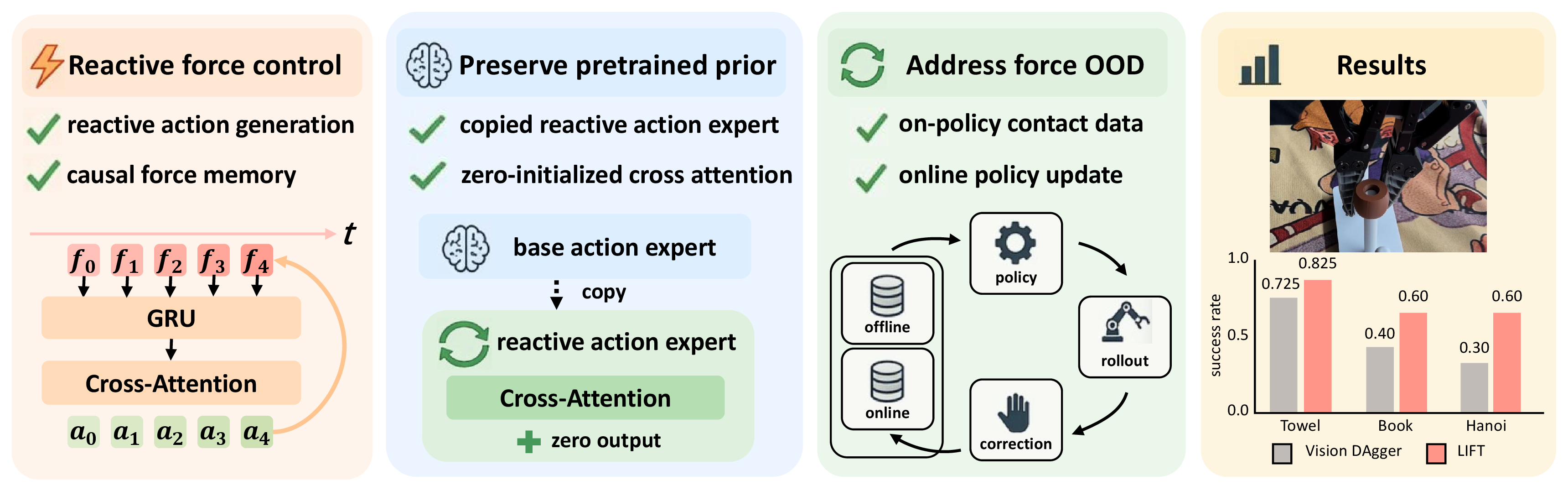
We address these questions with LIFT, Late Reactive Injection of Force for VLA Post-Training, a force-aware post-training framework for pretrained VLA models. As summarized in 1, LIFT adds a reactive action expert beside the original action expert and injects causal force memory through a causal force encoder and cached vision-language prefix. This gives the policy a fast reactive path that can update actions in real time while treating force as a low-cost temporal context over recent contact history. To avoid damaging the pretrained model, LIFT copies the original action parameters into the reactive action expert, uses shifted causal attention, and adds zero-initialized cross attention so the network starts output-equivalent to the original VLA. To handle noisy and shifting force distributions, LIFT couples this architecture with online DAgger, so the model can keep collecting corrections from the states induced by its own policy and adapt to the resulting contact distribution.
We evaluate LIFT on three real-world manipulation tasks with different contact characteristics: towel folding, book insertion, and Hanoi ring placement. Across these tasks, LIFT improves faster than vision-only post-training and reaches higher final performance. It also preserves the pretrained VLA’s generalization behavior in out-of-domain settings, and online post-training consistently outperforms offline-only adaptation on all 3 tasks.
Our contributions are listed below.
We design reactive force injection with causal force memory and cached vision-language prefix so VLA can react to contact changes while using force as a low-cost temporal context.
We preserve the pretrained VLA prior with initialization-equivalent parameter copying, shifted causal attention, and zero-initialized cross attention.
We propose a force-aware online post-training framework that adapts pretrained VLA models to platform-specific force feedback and mitigates force distribution shift.
2 Problem Formulation↩︎
Starting from a vision-only VLA policy, our ultimate goal is to introduce force late in post-training without discarding its general manipulation knowledge. To achieve this, we use a two-stage training pipeline. In Stage 1, a handheld data-collection device provides an abundant vision-only task-alignment dataset \(D_v=\{(\ell,I,\mathbf{a})\}\), from which a vision-only policy \(\pi^{\mathrm{V}}(\mathbf{a}\mid \ell,I)\) learns coarse manipulation knowledge. In Stage 2, we switch to a real robot equipped with a 6D end-effector force sensor and collect online corrective data \(D_f^{(k)}=\{(\ell,I,\mathbf{F},\mathbf{a}^{*})\}\) (where \(\mathbf{a}\) and \(\mathbf{F}\) are chunks from \(t\) to \(t+H-1\)). The post-training policy \(\pi^{\mathrm{V+F}}(\mathbf{a}\mid \ell,I,\mathbf{F})\) is trained on the online sequence \(\{D_f^{(k)}\}_k\) together with the static visual set \(D_v\). Because the second-stage data are collected by online DAgger from the on-policy distribution \(d_{\pi^{(k)}}\), the corrective set is effectively reduced to the states actually visited by the current policy, which helps mitigate covariate shift. Our hypothesis is that this force participation should speed up post-training rather than merely add another modality.
To realize this overall goal, we must solve three technical objectives:
Reactive force injection (O1). Inject recent force memory into the policy so it can react to contact events instead of committing to an open-loop action chunk.
Preservation of general capabilities (O2). Preserve the model’s generalization ability while still improving its ability to adjust actions promptly during contact.
Simultaneous use of heterogeneous data (O3). Jointly exploit abundant visual task-alignment data and scarce force-enabled online corrections so the policy benefits from both supervision sources throughout post-training.
3 Methods↩︎
Our methods are designed around the three objectives in 2. To satisfy O1, we add a late reactive force injection path that can causally decode actions within a chunk from recent force measurements while reusing the cached vision-language prefix. To satisfy O2, we initialize this new path so that the augmented model is output-equivalent to the original \(\pi_{0.5}\) before post-training. To satisfy O3, we train the same model on both vision-only offline data and force-enabled online corrections through explicit force masking and balanced sampling.
3.1 Closing the loop with reactive force injection (O1)↩︎
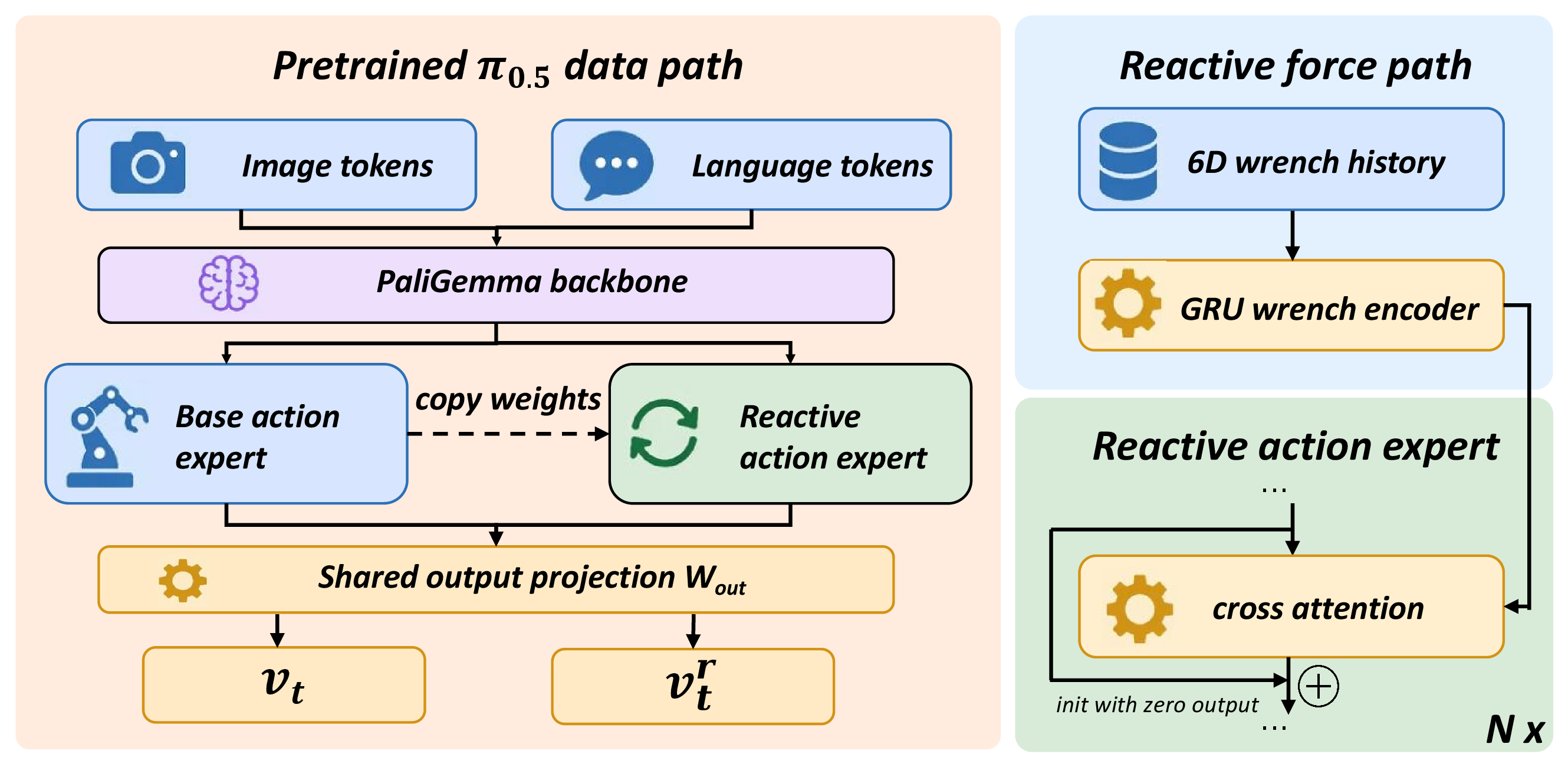
2 summarizes the O1 mechanism. A pretrained \(\pi_{0.5}\) action expert normally denoises a whole action chunk with full within-chunk attention, which is not suitable for updating individual actions from newly observed contact. LIFT first turns the action side into a causal reactive stream that decodes the chunk action by action, then injects latency-aligned force memory into that stream, and caches the slow vision-language context so the reactive path can be refreshed within each chunk.
3.1.0.1 O1.1 Reactive action expert.
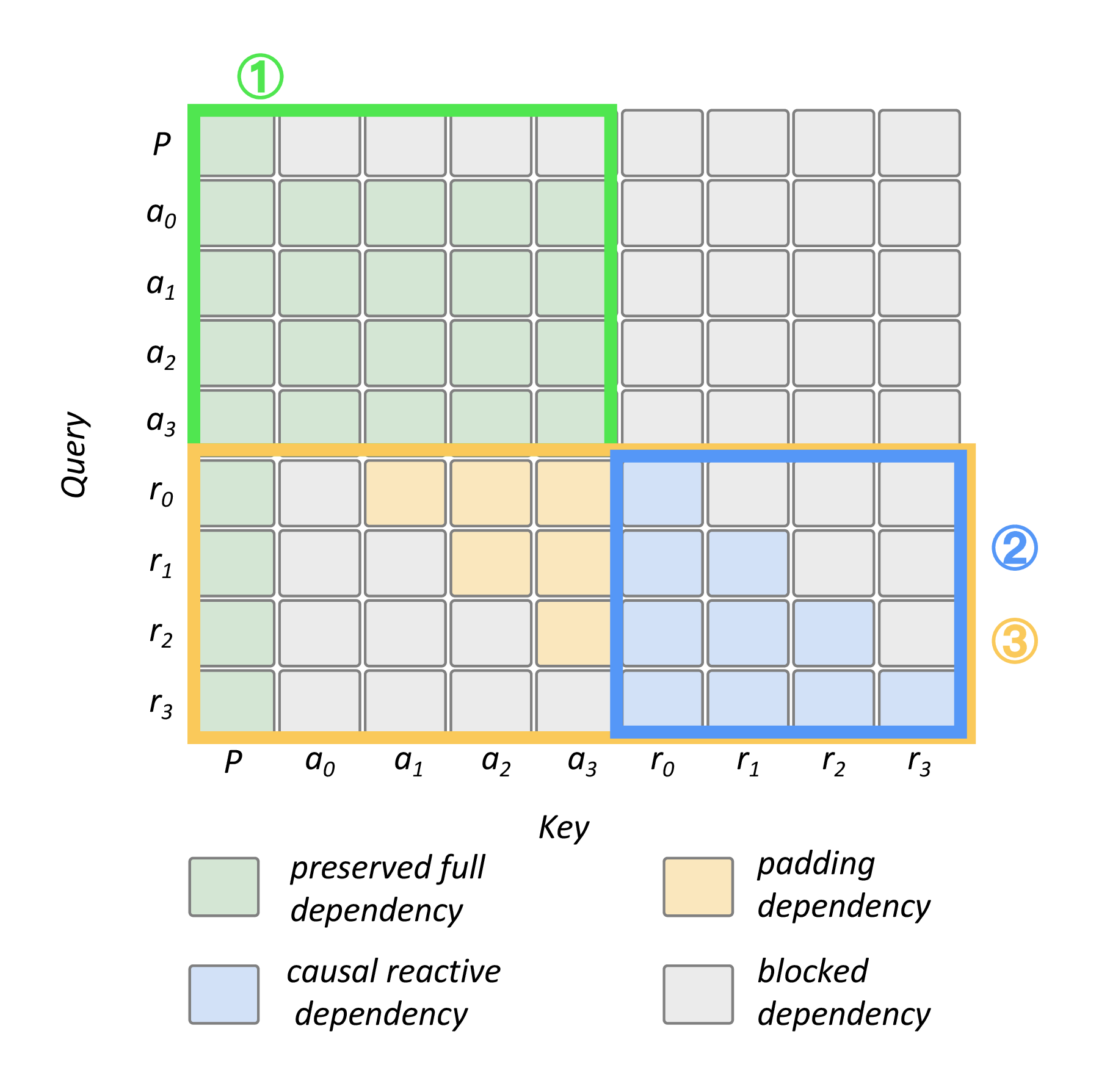
We instantiate a reactive action expert beside the original \(\pi_{0.5}\) action expert and use it as the stream that will be updated during contact. For O1, the key requirement is that action decoding in this new expert is causal within each chunk. This makes the reactive stream suitable for refreshing the chunk action by action as new contact arrives. The exact shifted causal attention pattern and token-level formulation are deferred to O2.1 and highlighted in 3.
3.1.0.2 O1.2 Causal force-injected cross attention.
LIFT encodes recent 6D end-effector force into a causal force memory and injects it only into the reactive action expert through force-injected cross attention with a latency-aligned causal mask. This lets each reactive action use the newest force measurements available when inference finishes, so the controller can react to contact in real time without using outdated or unavailable force, with the full formulation deferred to 8.
3.1.0.3 O1.3 Cached Vision-Language Slow Context.
The final obstacle to closed-loop contact response is latency from the vision-language context. LIFT separates this slow context from the fast force-injected action update. At deployment, the runtime first computes the vision-language prefix once and stores its KV cache. Within the action chunk, it then repeatedly encodes the latest latency-aligned force history and reevaluates the action experts against the cached prefix. Because the expensive vision-language prefix is reused, each refresh can update the reactive action chunk with newly observed contact transients without waiting for a full vision-language forward pass.
3.2 Preserving the pretrained VLA prior at initialization (O2)↩︎
Reactive force injection gives LIFT the closed-loop path required by O1, but it also alters the pretrained VLA’s action-side structure. Such structural change can make the model forget the original manipulation capabilities that make the pretrained prior useful. We therefore preserve the prior at initialization through an output-equivalent reactive action expert and zero-initialized cross attention.
3.2.0.1 O2.1 Make reactive action expert output-equivalent.
Starting from pretrained \(\pi_{0.5}\), we instantiate a second action-denoising expert with the same action-token interface as the original expert and copy the original action-expert weights into it. The original action expert is fully attentive within a chunk: each base action token \(a_i\) can attend to all action tokens \(a_{0:H-1}\). LIFT keeps this base action stream unchanged, as shown by ① in 3, then appends reactive tokens \(r_{0:H-1}\) with the shifted causal attention introduced in O1.1 and illustrated in ③ of 3. For each position \(i\), the reactive token \(r_i\) sees the vision-language prefix, later base-action tokens \(a_{i+1:H-1}\), and the causal reactive prefix \(r_{0:i}\), while blocking base-action tokens \(a_{0:i}\) and subsequent reactive tokens \(r_{i+1:H-1}\). At initialization, copied weights and aligned positions make \(r_{0:i}\) equivalent to base-action representations \(a_{0:i}\), while the shifted context supplies \(a_{i+1:H-1}\) from the base stream. Thus \(r_i\) receives the same context as \(a_i\) in the original fully-attentive action expert, making ① and ③ in 3 initialization-equivalent and the reactive action expert output-equivalent to the original before force training.
3.2.0.2 O2.2 Zero-initialize cross attention output.
The zero-initialized cross attention block is added as a residual update to the reactive action representation. LIFT zero-initializes the output projection of this residual path, so the force-injected update is exactly zero at step 0 even though the force encoder and attention logits are present. With no effective force residual, the copied reactive action expert receives the same action interface and output projection as the original action expert. Thus force cannot change the pretrained action output until post-training learns a nonzero residual.
Together, O2.1 and O2.2 let LIFT add the causal action branch and force path needed for O1 while starting post-training from the same action output as the base model.
3.3 Training with heterogeneous visual and force data (O3)↩︎
O3 turns the architecture above into a post-training recipe that uses both available supervision sources. The offline set \(D_v\) provides broad vision-only task alignment from the handheld data-collection device, while the online set \(D_f\) provides force-enabled corrections on states visited by the deployed policy. LIFT trains both streams with one shared objective, but uses explicit force masking so samples without force data do not update the force encoder.
3.3.0.1 O3.1 Additive flow-matching objective.
For both data sources, LIFT jointly trains the original and reactive action streams. We sample independent noises \(\varepsilon,\varepsilon^{\text{r}}\sim\mathcal{N}(0,I)\) and same-time interpolants \(x_\tau,x_\tau^{\text{r}}\), then minimize \[\mathcal{L}(\theta) \;=\; \big\lVert v_\theta(x_\tau,\tau,o) - u \big\rVert_2^2 \;+\; \big\lVert v_\theta^{\text{r}}(x_\tau^{\text{r}},\tau,o,m_{t:t+H}) - u^{\text{r}} \big\rVert_2^2 . \label{eq:loss}\tag{1}\] The two losses are computed in the same forward pass, their gradients are accumulated together, and the shared parameters are updated jointly. This keeps the base stream anchored to the pretrained action prior while the reactive stream learns force-injected corrections. At inference time, LIFT still computes both action streams because the reactive stream uses the base stream through shifted causal attention, but only the reactive action is sent to the robot controller.
3.3.0.2 O3.2 Selective force masking.
Each sample enables the force path only when real force data exists. Vision-only batches use zero force placeholders for shape, then mask encoded force memory before cross attention, blocking gradients to the force encoder and force-injected attention. Online correction batches keep measured force memory active, updating the force pathway and reactive branch. Thus one model trains on both data sources without synthetic force labels.
3.3.0.3 O3.3 Equal sampling of heterogeneous data.
We follow the RLPD symmetric sampling strategy [14] and train on a \(1{:}1\) mixture of offline task-alignment batches and online corrective batches. Each update therefore sees equal amounts of prior-preserving vision-only data and force-enabled on-policy corrections, allowing the model to benefit from the complementary strengths of both sources.
3.4 Pipeline overview and system implementation↩︎
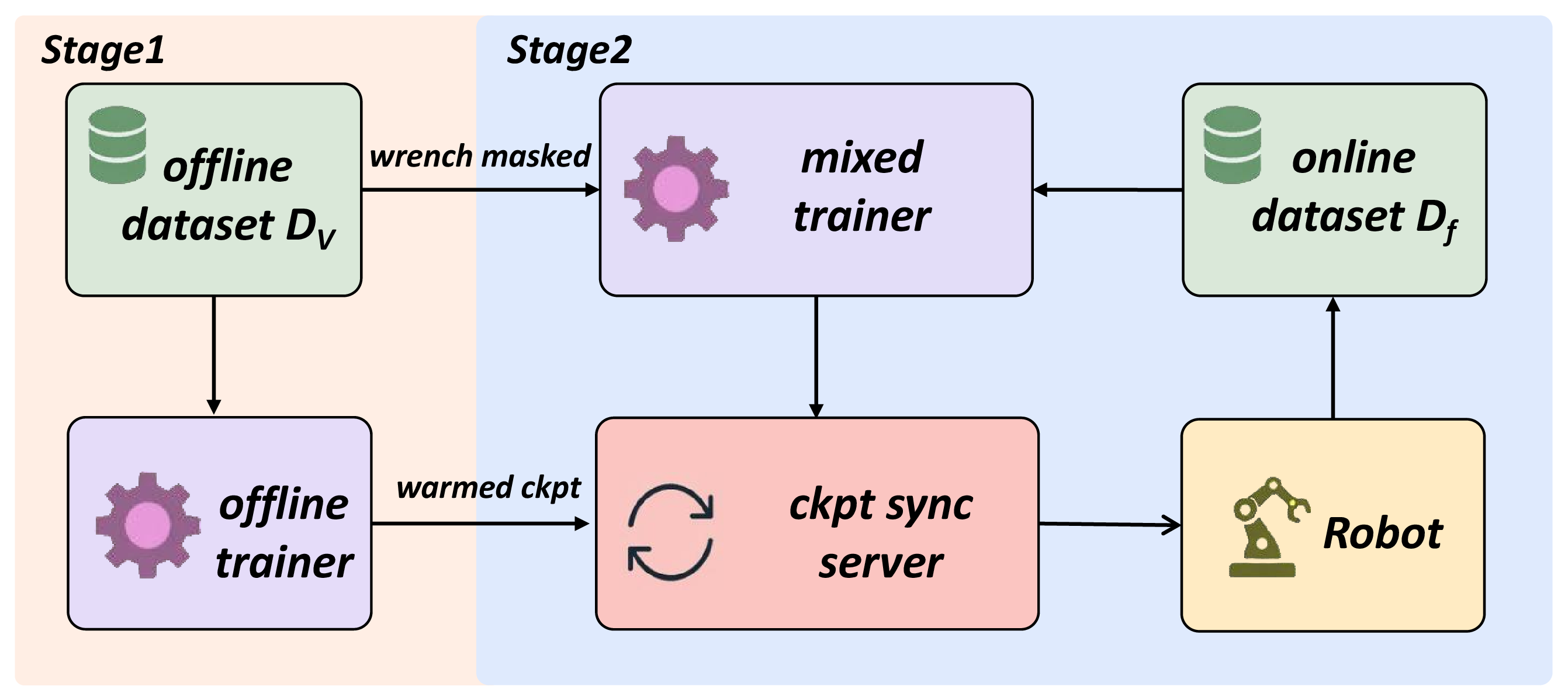
As shown in 4, the pipeline instantiates the three objectives in two stages. Stage 1 builds LIFT on pretrained \(\pi_{0.5}\) and trains on the vision-only dataset \(D_v\) with force masked out, so the model aligns to the target tasks while preserving the pretrained prior. Stage 2 moves to the real robot, collects force-enabled corrective episodes into \(D_f\), and continues post-training on a fixed \(1{:}1\) mixture of \(D_v\) and the asynchronously ingested online buffer \(D_f\). Similar to recent work [15], [16] on online post-training infrastructure, the latest checkpoint is periodically synced back to the rollout client for redeployment, closing the loop between correction collection, post-training, and redeployment.
4 Experimental Results↩︎
4.1 Experimental setup↩︎
We evaluate on three real-robot manipulation tasks: towel folding, book insertion, and Hanoi ring placement. The stage-one vision-only data are collected with a handheld data-collection device, while stage-two force-enabled post-training data are collected through Flexiv TDK [17]. Rollouts are executed on a Flexiv Rizon 4S robot with a 6D end-effector force sensor. Each checkpoint is evaluated with ten autonomous rollouts, and # denotes collected online samples.
We compare five policy variants:
\(\pi_{0.5}\) w/ Online DAgger: the same online DAgger loop without force input.
LIFT w/o Reactive Force Injection: stage-two force post-training with a single-frame force input rather than the reactive force memory.
LIFT w/o Online DAgger: the reactive model trained without repeated online updates.
\(\pi_{0.5}\) w/ Offline Handheld Data: a policy trained only on the larger offline handheld set.
LIFT: the full reactive force-injected VLA trained with online DAgger.
4.2 Does force accelerate or improve Post-Training? (Q1)↩︎

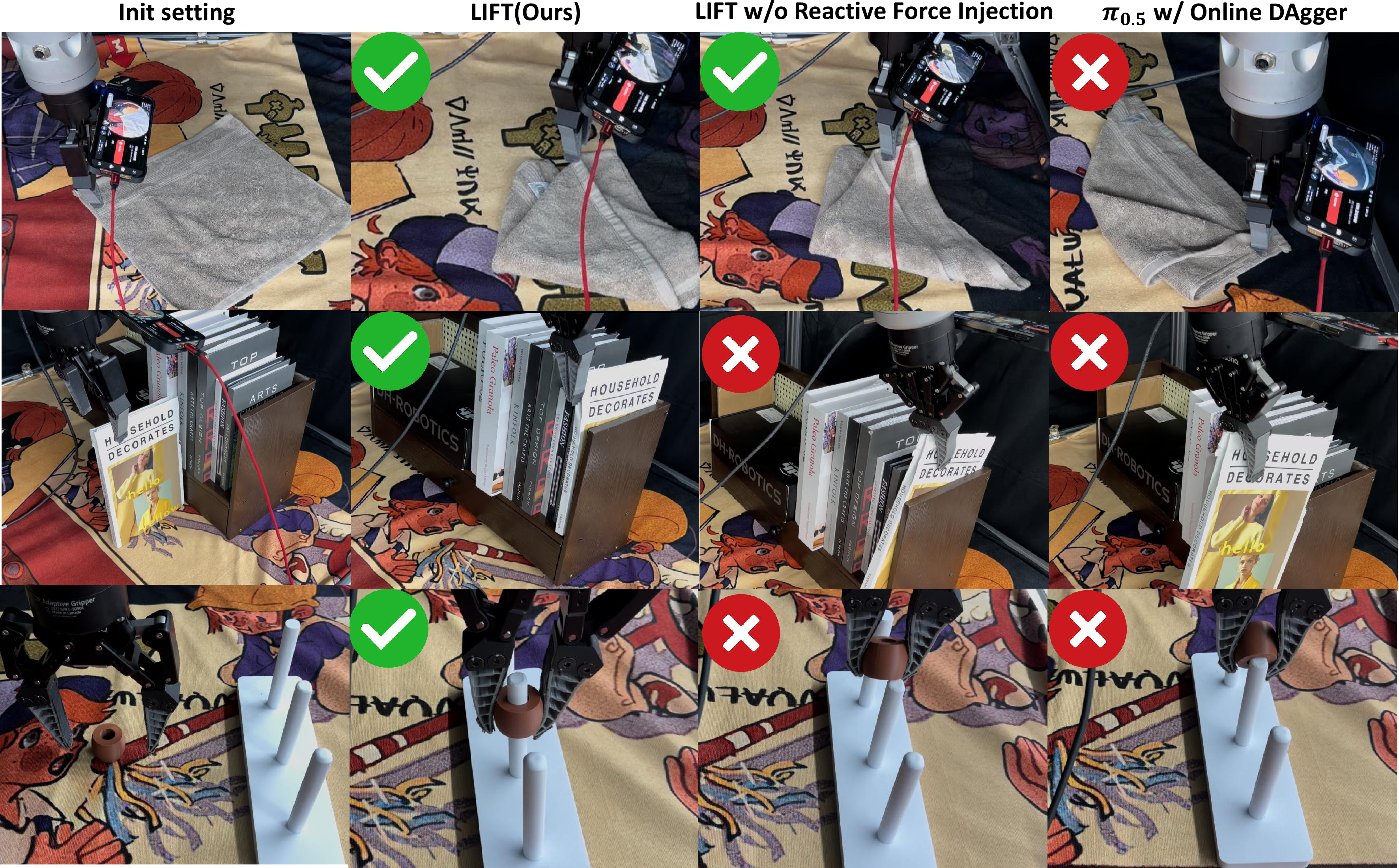
5 shows that force accelerates post-training and raises peak performance across contact-rich manipulation tasks. On towel folding, both force-aware variants improve faster and reach higher scores than vision-only online DAgger. \(\pi_{0.5}\) w/ Online DAgger improves from \(0\) (# 1.3K) to \(0.725\) (# 3.1K), while LIFT reaches \(0.65\) with fewer samples (# 2.3K) and peaks at \(0.825\) (# 2.8K). LIFT w/o Reactive Force Injection improves even faster on this task, reaching \(0.925\) (# 2.4K) and peaking at \(0.95\) (# 2.8K). The main failure case is contact ambiguity: because the towel is thin, a monocular wrist camera can misestimate depth and fail to tell whether the gripper has actually contacted or grasped the cloth. Force feedback directly exposes this contact state, helping the policy recover from failed grasps during the first and subsequent folds.
Book insertion highlights the value of the full LIFT policy for constrained insertion. LIFT reaches the highest peak score, \(0.6\) (# 4.6K), compared with \(0.4\) (# 5.6K) for \(\pi_{0.5}\) w/ Online DAgger. The task requires inserting a book into an empty slot bounded by neighboring books and the shelf, so side contact and insertion depth determine when the robot should keep pushing, stop, or release. The key vision-only failure is that the policy cannot reliably judge whether the book has bottomed out: it may continue pushing after full insertion or release before the book is seated, causing the book to flip or fail to settle. LIFT uses contact feedback from the book-shelf interaction to learn the insertion and release timing needed for higher final performance.
Hanoi ring placement shows the same pattern in a precision placement setting. LIFT reaches \(0.6\) (# 1.7K) and maintains \(0.6\) at the final checkpoint (# 2.0K), whereas \(\pi_{0.5}\) w/ Online DAgger peaks at \(0.3\) (# 1.4K) and ends at \(0.2\) (# 1.6K). Here the clearance between the ring and pole is small, so slight misalignment can turn a placement attempt into a jam. The core vision-only failure is continuing to push downward when the ring is not fully aligned, which tilts the ring and prevents insertion. By sensing the direction and magnitude of contact forces, LIFT can identify offset or stuck states and adjust the motion, making force feedback useful for both faster learning and higher scores.
4.3 Does reactivity matter beyond single-frame force? (Q2)↩︎
We compare LIFT with LIFT w/o Reactive Force Injection to study whether force should enter as reactive force memory rather than as a single-frame cue.
On book insertion, LIFT reaches a peak score of \(0.6\) (# 4.6K), while the single-frame force baseline peaks at \(0.4\) (# 5.0K) and (# 5.3K). A typical failure of LIFT w/o Reactive Force Injection occurs after the book has already bottomed out in the slot: the policy keeps pushing downward against the shelf, even under large contact force, instead of releasing the gripper or backing out. This non-Markovian decision requires knowing whether the current load comes from ongoing insertion or from a completed insertion that should trigger release. LIFT uses recent force memory to infer the contact phase from how the force evolved, so it can stop pushing and complete the final insertion-and-release stage more reliably.
On Hanoi ring placement, LIFT reaches a peak score of \(0.6\) (# 1.7K), while LIFT w/o Reactive Force Injection peaks at \(0.5\) (# 0.7K) and later drops to \(0.1\) (# 1.0K), \(0\) (# 1.5K), and \(0.1\) (# 1.7K). The typical single-frame failure appears when the ring collides with the pole or surrounding support: an abnormal force spike can drive the policy into unstable motions, including oscillating forward and backward, losing localization, or moving far away from the placement region. Besides, fast and precise correction is required because contact can occur around the whole ring. Single-frame force is easily misled by instantaneous noise or out-of-distribution impact forces. LIFT makes the policy reactive by averaging this decision over a short force memory window and injecting the contact signal into the reactive branch, which stabilizes the force input and lets the policy update its action chunk quickly after contact changes.
4.4 Does LIFT preserve original VLA generalization? (Q3)↩︎

Under object, tablecloth, and lighting changes, 6 shows no clear drop for LIFT on most tested settings across the three tasks. The exact shift introduced in each condition (e.g., Another desktop, Blue towel, Purple light) is documented in 15. This suggests that LIFT largely preserves original VLA generalization, consistent with the copied action expert, shifted causal attention, and zero-initialized cross attention in 3.2.
4.5 Does online data matter for reactive force injection? (Q4)↩︎
Offline-only comparisons are plotted as separate markers in 5. LIFT w/o Online DAgger underperforms on all three tasks and falls to zero on book insertion. This indicates that offline data miss abrupt force-pattern changes during real execution, while online DAgger adds corrections on the learner’s failure states.
5 Related Work↩︎
A complete related work discussion is provided in 7. Prior force-aware systems [7]–[13], [18]–[21], recent VLA models [1]–[6], [22], [23], and DAgger-style post-training [24]–[28] motivate LIFT. LIFT adds force late to preserve the pretrained VLA prior, injects it reactively to handle within-chunk contact changes, and collects corrections from force states induced by the current policy.
6 Conclusion and Limitations↩︎
LIFT adds force-aware post-training to pretrained VLA policies through late reactive force injection, prior-preserving initialization, and online corrective training. Across three tasks, it learns faster and reaches stronger performance than vision-only post-training while preserving original VLA generalization. This suggests that post-training can add a physically grounded modality to a pretrained VLA without discarding its existing capabilities.
Limitations and future directions. LIFT still depends on human corrections during online DAgger, which limits data throughput. Our evaluation is also limited to single-arm manipulation. Future work should reduce correction load and test more diverse robot arms, force sensors, and end-effectors.
7 Full Related Work↩︎
7.0.0.1 Force-augmented policies.
Contact-rich manipulation work increasingly models force and torque explicitly rather than relying on visual trajectories alone. FoAR [7] fuses force measurements into a diffusion policy with a force-aware gating signal, ForceMimic [8] pairs force-motion capture with hybrid force-position imitation learning, and ACP [9] learns approximate compliance to balance position tracking and contact forces. Other recent efforts include force-attending curricula [18], force-informed actions from kinesthetic demonstrations [19], and torque-aware VLA policies [20]. Force Policy [21] structures contact-phase control around an interaction frame. Our architecture is most directly inspired by reactive force control: RDP [10] separates slow visual planning from fast contact feedback, while ImplicitRDP [11] integrates visual and force streams through end-to-end causal attention. Compared with these force-aware systems, LIFT starts from a general VLA trained on large-scale visual data and adds a lightweight reactive force path, preserving the backbone’s visual generalization while improving contact response.
7.0.0.2 Vision-language-action models for manipulation.
Recent vision-language-action (VLA) policies [1]–[3], [6] and the \(\pi_0\) / \(\pi_{0.5}\) family [4], [5] scale Transformer backbones pretrained on web-scale visual and robot-trajectory data to multi-task manipulation. Because collecting synchronized force or torque supervision at comparable scale remains costly, these models are typically trained mainly from visual observations and robot trajectories, without large force-feedback corpora. ForceVLA [22], ForceVLA2 [23], and TA-VLA [20] are the closest efforts to make VLA policies force- or torque-aware. Compared with these baselines, which use force or torque throughout post-training while still executing each action chunk open-loop, LIFT implements a late reactive injection mechanism for a pretrained VLA through a reactive branch trained during online post-training, so contact feedback can shape the chunk while preserving the original VLA capabilities.
7.0.0.3 Post-training for robotic policy.
Behaviour cloning on a fixed teleoperation dataset suffers from compounding covariate shift [24], especially in contact-rich regimes where small force-tracking errors quickly take the robot off-distribution. DAgger and interactive variants such as HG-DAgger [25], SIRIUS [26] and Sirius-Fleet [27] reduce this gap by collecting expert corrections on states visited by the learner. CR-DAgger [28] is particularly relevant: it uses compliant human corrections to train a force-aware residual policy with force control for contact-rich manipulation. At the system level, recent work [15], [16] has also built online post-training infrastructure for robot policies and VLAs. LIFT differs in the policy class: we post-train a general VLA backbone, inject force through zero-initialized cross attention rather than a residual action head, and keep the deployed controller position-based.
8 Latency-aligned causal mask details↩︎
After the reactive action stream is made causal, LIFT injects force so each action can condition on the newest admissible force observations. The recent 6D end-effector force chunk \(F_{t:t+H}\in\mathbb{R}^{H\times 6}\) is first encoded by a single-layer causal GRU followed by a linear projection, \[\begin{align} m_{t:t+H} \;=\; \mathrm{Linear}_{d_m}\!\big(\mathrm{GRU}_{d_h}(F_{t:t+H})\big) \;\in\; \mathbb{R}^{H\times d_m}, \label{eq:force} \end{align}\tag{2}\] where \(d_h=d_m/2\) and \(d_m\) matches the action-expert width, and we denote the resulting sequence as the force memory \(m_{t:t+H}\).
Only the reactive action tokens attend to this force memory. Concretely, each reactive query \(q_i\) attends over the full force-memory sequence through force-injected cross attention, while a latency-aligned causal mask removes force tokens that should not yet be available: \[\begin{align} \mathrm{Cross}(q_i, m_{0:H-1}) &= \sum_{j=0}^{H-1} \alpha_{ij}\, m_j W_V,\\ \alpha_{ij} &= \frac{\exp(s_{ij}+b^{(L)}_{ij})}{\sum_{k=0}^{H-1}\exp(s_{ik}+b^{(L)}_{ik})},\qquad s_{ij}=\frac{(q_iW_Q)(m_jW_K)^\top}{\sqrt{d_m}},\\ b^{(L)}_{ij} &= \begin{cases} 0, & j \le i-L,\\ -\infty, & j > i-L . \end{cases} \end{align} \label{eq:cross}\tag{3}\] Here \(L\) is a latency-alignment offset chosen to match the network inference delay. The mask is causal in the force stream: it prevents the reactive action expert from using force measurements that should not yet be available and shifts the available force window to the action time after inference completes. The shift ensures that after a nonzero delay, the model still outputs the action to execute at completion time rather than an outdated action.
9 Pseudocode: cached reactive inference↩︎
For completeness, 8 restates the cached reactive rollout loop referenced in 3.

10 Hardware and sensor setup↩︎
10.0.0.1 Robot.
A single Flexiv Rizon 4S 7-DoF cobot equipped with a Robotiq 2F-85 parallel-jaw gripper executes all rollouts. The arm operates in position-control mode at 10 Hz, and trajectory targets from the policy are tracked by the robot’s internal impedance controller.
10.0.0.2 Sensing.
A built-in 6D end-effector force/torque (F/T) sensor provides raw wrench measurements \(f_x, f_y, f_z, \tau_x, \tau_y, \tau_z\) at more than 1000 Hz. We downsample this stream to 10 Hz and time-synchronize it with the action stream before using it as policy input. A wrist-mounted iPhone provides RGB images at 10 Hz. We use a single-camera setup for all tasks reported here.
10.0.0.3 Teleoperation.
Stage-two force-feedback demonstrations are collected through Flexiv TDK [17]. TDK uses a bilateral master-follower setup with two Flexiv Rizon 4S arms: the operator moves the master arm, while the follower arm executes the task. Contact forces measured on the follower arm are fed back to the master arm, allowing the operator to feel force signals and adjust the motion.
11 Dataset details↩︎
11.0.0.1 Stage-one offline data (stage-one handheld).
The stage-one offline dataset \(D_v\) is collected with a handheld gripper with iPhone (no force sensor) at 10 Hz. We use the iPhone main camera for RGB recording and call the ARKit SLAM interface to estimate the camera pose. Each demonstration is recorded and represented in the iPhone camera frame. We remove short static segments from the beginning and end of each episode to avoid stuck frames.
11.0.0.2 Stage-two online data (stage-two online correction data).
Collected with the Flexiv TDK setup. During collection, we set the robot TCP to the iPhone camera frame. Each timestep stores the synchronized 6D wrench alongside RGB observations. We record robot commands rather than robot states to provide more accurate control supervision. Only human-intervention correction data are added to the stage-two dataset \(D_f\).
11.0.0.3 Action representation.
All actions are relative actions. The action vector is padded to the shared output dimension required by the policy head.
12 Training hyperparameters↩︎
| Parameter | Value |
|---|---|
| Backbone | \(\pi_{0.5}\) with PaliGemma vision-language tower and action expert |
| Action chunk horizon | \(10\) |
| Padded action dimension | \(32\) |
| Force input dimension | \(6\)D wrench |
| Force encoder | Single-layer causal GRU followed by a linear projection |
| Force encoder hidden width | \(512\) |
| Force encoder output width | \(d_m=1024\) |
| Latency-alignment offset | \(3\) |
| Reactive expert initialization | Copied from the base action expert |
| Cross-attention initialization | Zero-initialized output projection |
| Parameter | Value |
|---|---|
| Batch size | \(32\) |
| Total training steps | \(30{,}000\) |
| Learning-rate schedule | Constant |
| Learning rate | \(5\!\times\!10^{-5}\) |
| Optimizer | AdamW |
| AdamW \(\beta_1\) | \(0.9\) |
| AdamW \(\beta_2\) | \(0.95\) |
| AdamW \(\varepsilon\) | \(10^{-8}\) |
| Weight decay | \(10^{-10}\) |
| Gradient clipping norm | \(1.0\) |
4pt
13 Per-task protocols↩︎
Every checkpoint is evaluated with ten autonomous rollouts. We report the mean task score for graded protocols and the success rate for binary protocols.
13.0.0.1 Towel folding.
Goal: fold a square towel through a two-corner sequence. The robot starts \(5\,\text{cm}\) directly above the lowest towel corner, and the towel is reset by the operator before each rollout. The graded score is assigned by task progress: grasping the first corner gives \(0.25\), folding the first corner gives \(0.5\), grasping the second corner gives \(0.75\), and folding the second corner gives \(1.0\). Max episode length: \(2\) min.
13.0.0.2 Book insertion.
Goal: place a hardcover book into a shelf slot and push on the spine until the book is fully inserted. The robot starts holding the book in a fixed pre-grasp pose. The graded score is assigned by task progress: placing the book into the shelf without colliding with the left or right side of the slot gives \(0.5\), and successfully pushing the spine so that the book is fully inserted gives \(1.0\). Max episode length: \(2\) min.
13.0.0.3 Hanoi ring placement.
Goal: place a held ring onto a vertical pole with a diameter of \(10\,\text{mm}\). The robot starts holding the ring above the pole base. This task uses binary scoring: a rollout receives \(1\) only if the ring is fully seated on the pole base and \(0\) otherwise. Max episode length: \(2\) min.
14 Online DAgger protocol↩︎
14.0.0.1 Data sources.
Two datasets are mixed at training time: an offline visual dataset \(\mathcal{D}_v\) (stage-one handheld), and a growing online dataset \(\mathcal{D}_f\) (stage-two online correction data) that the collection pipeline appends as each new rollout terminates. The online data are force-enabled.
14.0.0.2 Adaptive mixing.
We use the adaptive sampler from SOP [15]. At learner step \(j\), it maintains sliding-window loss estimates \[\bar{\ell}_{\mathrm{on}}=\frac{1}{W}\sum_{i=j-W}^{j-1}\ell_{\mathrm{on}}^i, \qquad \bar{\ell}_{\mathrm{off}}=\frac{1}{W}\sum_{i=j-W}^{j-1}\ell_{\mathrm{off}}^i,\] and sets the online sampling ratio to \[\omega_{\mathrm{on}}= \frac{\exp(\alpha\bar{\ell}_{\mathrm{on}})}{\exp(\alpha\bar{\ell}_{\mathrm{on}})+\exp(\bar{\ell}_{\mathrm{off}})}.\] We use \(W=200\) and \(\alpha=1.5\), clip \(\omega_{\mathrm{on}}\) to \([0.2,0.8]\), and sample offline data with probability \(1-\omega_{\mathrm{on}}\).
14.0.0.3 Synchronization.
The trainer checks the data-cloud endpoint for newly completed episodes at every training step. Updated checkpoints are pushed to the inference server every \(100\) training steps, which refreshes the policy deployed on the robot.
14.0.0.4 Human intervention.
During each rollout, an operator monitors the robot and triggers a reset whenever (i) the policy stalls in a non-progressing configuration, (ii) the force trace exceeds a hardware safety threshold, or (iii) the episode exceeds the task’s max length.
15 Generalization condition details↩︎
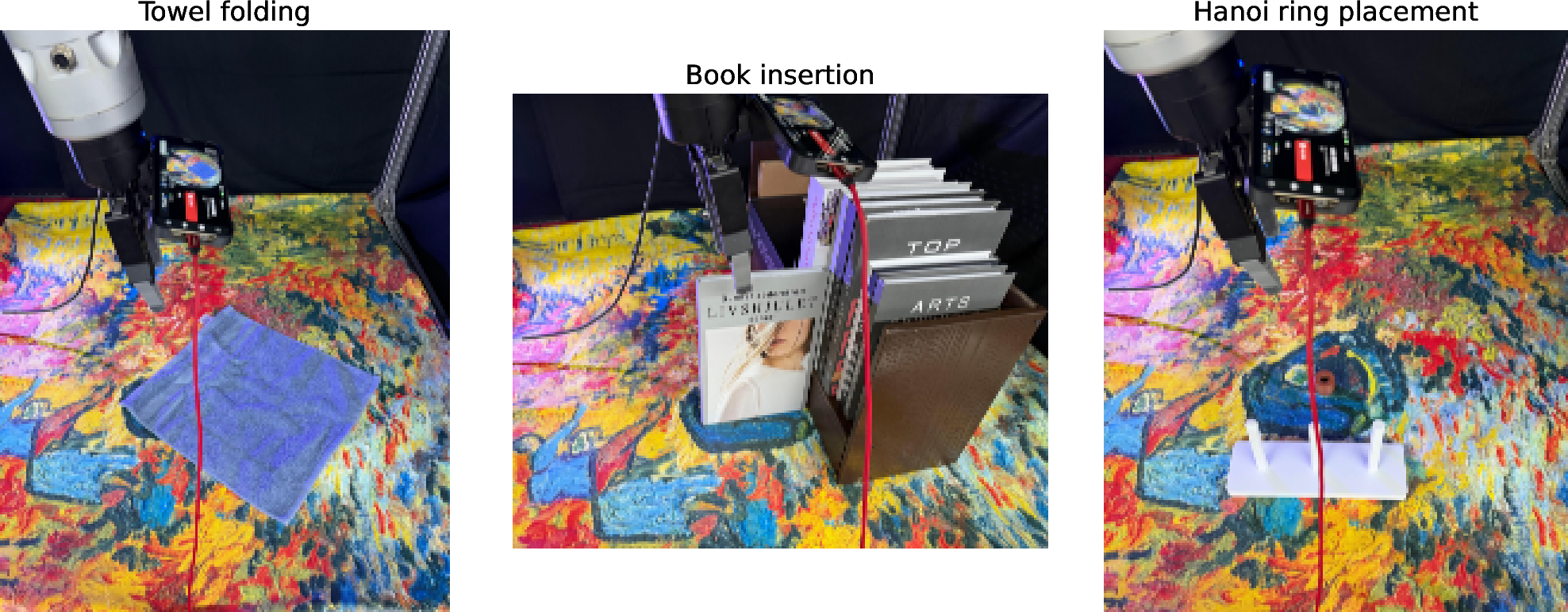
15.0.0.1 Towel folding.
Blue towel: replace the original towel with a blue towel of the same style.
Another tablecloth: replace the rough cartoon-style brown tablecloth with a slightly smoother yellow tablecloth with an oil-painting texture.
Purple light: add a purple side light while keeping the task geometry unchanged.
15.0.0.2 Book insertion.
Gray book: replace the original book with a new gray book.
Another tablecloth: replace the rough cartoon-style brown tablecloth with the same smoother yellow oil-painting-texture tablecloth used in the towel-folding shift.
Purple light: add the same purple side light.
15.0.0.3 Hanoi ring placement.
Another tablecloth: replace the rough cartoon-style brown tablecloth with the smoother yellow oil-painting-texture tablecloth.
Purple light: add the same purple side light.
For every shift the robot start pose and target object location are kept identical to the in-distribution evaluation; only the listed factor changes.
16 Extended failure-mode analysis↩︎
16.0.0.1 Towel folding.
Early in online DAgger, the dominant failure is closing the gripper before the towel is actually grasped, producing an empty grasp. After several rounds of DAgger, LIFT resolves this first-grasp failure faster than the vision-only policy, so it reaches the second-fold stage more often and collects more corrective data for second-fold states. This leads to better second-fold behavior. By the final checkpoints, the remaining vision-only failures mostly occur during the second fold: the gripper chooses the wrong grasp location, fails to catch the towel, executes an empty grasp, or moves and rotates in the wrong direction after grasping.
16.0.0.2 Book insertion.
The main failures occur at four stages. First, while entering the empty slot, the book can collide with the neighboring books or shelf side walls. Second, the policy can release the book in midair, causing it to flip out of the shelf. Third, after the book reaches the back of the slot, the policy may keep pushing instead of releasing, creating large damaging contact forces. Finally, in the spine-pushing stage, the policy can localize the spine inaccurately and miss the final push.
16.0.0.3 Hanoi ring placement.
The main vision-only failure is angled insertion: the ring approaches the pole with lateral or angular error and jams instead of sliding down. The single-frame force-injection baseline can also become unstable after an external contact impulse. For example, an initial tap against the pole can drive the policy to move far away from the current placement pose, showing that instantaneous force alone is easily misled by transient contact.
17 Compute and reproducibility↩︎
17.0.0.1 Compute.
Each training run uses a single 8-GPU node equipped with NVIDIA A800 GPUs.
17.0.0.2 Code release.
Our codebase is built on openpi. After paper acceptance, the code will be publicly available.