Abstract
This paper presents an educational system architecture that enables learners to practice the Uzbek language through game-playing. The architecture integrates UzWordnetand the largest currently available orthographic dictionary for Uzbek as core lexical resources, together with generative AI as a fundamental component for learning support. We design four educational games to facilitate Uzbek language learning and propose a game-based methodology for improving UzWordnetas a direct by-product of game dynamics. Our approach combines game design and lexical resources to address objectives that are at the same time educational (language learning) and lexical (improvement and enrichment of a lexical resource).
1 Introduction↩︎
Game-based paradigms of learning help to penetrate cultural limits and eventually transform them into learning advantages for the student, since games are natural learning environments in most cultures [1]. Games involve competition, death and victory, deception and frustration, emotions —exactly as in real life.
Learning natural languages is not an exception. This partially explains why millions of people use “gamified” language learning systems to study their preferred language [2]–[4]. It seems natural: language learning is a cognitive process, a “mental action” well-expressed by playing a game.
The question is: How game-based paradigms of language learning and Artificial Intelligence (AI), especially the AI called “generative” [5], help the avid learner to progress? Applications like Duolingo [6] and others [4], [7]–[10] provide each an answer. Unfortunately, as far as we know, none of the existing language-learning platforms include the Uzbek language as an option.
In this paper, we focus on the learning of Northern Uzbek, a Turkic language officially recognized as the national language of the Republic of Uzbekistan. In particular, we build on an existing educational system architecture for Uzbek language learning, called Kitaabi2 [11], and integrate its linguistic resources with UzWordnet—a lexical resource open-source3 for Northern Uzbek; see for instance [12] —and a word base built on the largest and most complete orthographic dictionary for Uzbek currently available [13]. Moreover, our development leverages UzWordnet, in addition to generative AI, specifically the Generative Pre-trained Transformer 3.5 (GPT for short; see [14]), to implement three new features, each in the form of a game: for spelling correction, creative writing, and use of definitions.
The results of this paper are the following:
()
We design a novel software architecture for learning Uzbek through a game-based approach integrating UzWordnetand LLM generative AI.
We design four educational games to facilitate Uzbek language learning.
We provide a methodology to improve UzWordnet —and any lexical database, or “word-net”, as we generally mean the term today after the work started in mid 1980s that produced Princeton WordNet [15], [16] —as a direct by-product of game dynamics.
This paper is organized as follows. In the next section, we present a few elements of the Uzbek language. We will see that, in spite of its official status, the language has been experimenting with a number of issues for the disclosure of its full potential, especially in the digital world. This fact has arguably made its study, learning, and teaching difficult. In Section 3, we advance and discuss the proposed system architecture. In Section 4, we describe the most characterizing component of the architecture, which contains four games for Uzbek learning. Three games also serve to enrich and improve the main lexical resource, namely UzWordnet, by game-playing (Section 5). In Section 6, we discuss the related work. In Section 7, we end the paper with conclusion, limitations, and future work.
2 The Uzbek Language↩︎
The Uzbek language (native: O’zbek tili) or, more precisely, Northern Uzbek, is the statutory language of the Republic of Uzbekistan. It is a Turkic language and, together with Southern Uzbek, is spoken by approximately 34.1 million people around the world [17], remarkably by a large group of ethnic Uzbeks residing in Uzbekistan and abroad in Afghanistan, Kyrgyzstan, Kazakhstan, Turkmenistan, Tajikistan, Russia, Turkey, and Xinjiang (China). Uzbek is the second-most widely spoken Turkic language after Turkish [18].4
Unless otherwise stated, in this paper we limit our discussion to Northern Uzbek, and refer to it simply as Uzbek.
![Figure 1: Spread of Uzbek languages and Uzbek dialects (cf. [12]).](/article/2607.14104/_pdflatex/xylkdgim.png "fig:")
2.1 Digital Language Support↩︎
Following [17], Uzbek is institutional (“the language has been developed to the point that it is used and sustained by institutions beyond the home and community”) and vital (“the language is supported by multiple [digital] tools [...] it has digital contents, encoding tools, some spell checking, some machine translation, some speech processing”; see also [19]. However, despite its vitality, the computational development and lexical resources available for Uzbek in the digital world are limited. As a result, Uzbek can be classified as a low-resource language.
We believe that two main reasons have delayed the development of digital support for Uzbek. First, computational linguistics appeared as a field of research in Uzbekistan since the late 2000s, so relatively recently; see [20], [21] and Abdurakhmonova20book?. Second, Uzbek faced a number of challenges with syntax throughout history, with the alphabet going through changes four times in the 20th century [22], [23]. As a consequence of the aforementioned issues, the avid, enthusiastic, and serious learner of Uzbek faces numerous difficulties, such as distinguishing the “right alphabet” at first, or using the correct spelling, finding reliable lexical resources, textbooks, and any material suitable for learning Uzbek.
3 System Architecture↩︎
The technical focus of this paper is on system design from a software engineering perspective. In this section, we describe the overall and specific components of the architecture we propose, and emphasize the connection between different functional modules. The components are depicted in Figure 2.

The main components are seven: AI Helper, Rules, Classes, Hosts, WordBase, UzWordnet, Games.5 In the following, we describe the most important components relevant to understanding our specific contribution.
AI Helper. This module is designed to support the system in building the structured information (“prompt”) that instructs the language model in use to generate what is necessary for the specific educational or lexical objective.
Since the objectives pursued in this paper are achieved through game-playing, the AI Helperis defined differently depending on the specific game design. Accordingly, we postpone its detailed description to Section 4.
Rules. To provide grammar content at the elementary and intermediate levels, we adopt the CEFR Rules [24], which are stored in this component. Grammar rules are used by the AI Helperto operate in one game (Game 0, Section 4).
WordBase. The first lexical module we present stores linguistic data used in the game’s modules Spelling Corrector and Sentence Formation (see Section 4). We built the component by using an orthographic dictionary of Uzbek words, specifically [13], as well as two sets of English words, exactly The Oxford 3000 by CEFR level [25]6, and the A2 Key and B1 preliminary vocabulary lists by Cambridge University Press and Assessment [26].7
Remark: 1. Since the proposed architecture —specifically, the design of Game 0 (first game in Section 4) —is intended to support the learning of Uzbek at beginner, elementary, or intermediate levels (i.e., CEFR levels A1, A2, and B1, respectively; [24]), the WordBase is expected to store Uzbek words classified according to these levels. However, to the best of our findings, there are no resources available mapping the Uzbek language into A1, A2, B1 levels. Therefore, we decided to store English words and CEFR levels as a reference to the most “useful” or “common” Uzbek words, after translation from English* of those words. The working assumption we have done here presumes that “the most common words” of a language are the same across all languages and cultures.*
UzWordnet. We employ a lexical database for Uzbek to provide the necessary lexicon in support of game design. We opted for UzWordnet[12] because it is open-source8 and currently the largest wordnet for Uzbek, and the second wordnet developed overall.9 UzWordnetis compatible with semantic networks, or “word-nets”, of the kind first developed with Princeton WordNet (PWNfor short) [15], [16]. Its use allows us to possibly extend our game-based methodologies to other languages linked through the Open Multilingual Wordnet [27], [28].
UzWordnetwas developed by expanding the semantic structure of PWNaccording to the extend method [28], which assumes that the lemmas of the target language are created from English synsets of PWN.
4 Games↩︎
The last and most characterizing component of the architecture is Games; it contains four game-based modules. We now describe each of them in turn.
Game 0 – Free Writing. By playing this game, a learner can verify the quality of her writing and receive feedback. We call this game the Free Writing Game (FW-gamefor short). We now describe its mechanics.
The learner (Player 1) starts the game by writing some text in Uzbek; let Textdenote it. The system (Player 2) sends a request to the AI Helperto build a “prompt” (hereafter, Prompt; see the box below for details) upon Text. Successively, the system sends Promptto a suitable large language model (LLM component in Figure 2). In this paper, we refer to GPT via its standard API. The GPTseries has provably shown outstanding performance in unifying all natural language understanding tasks into generative tasks [14], so we assume it is well-suitable as a starting point for language learning.
Finally, the system processes the response R(in JSON format) from the language model and displays it to the learner as feedback.
[language=json,numbers=none,escapeinside={*}{*}]]
You are provided with a text in language *\LANG *:
1. Set language *\LANG * to "language" Key.
2. Set text to "originalText" Key.
3. Find the mistakes in text and correct them.
   Set corrected text to "correctedText" Key.
4. Identify CEFR level of text by using rules *\CEFR *.
   Set CEFR level to "cefrLevel" Key.
5. Provide suggestions in an array to improve writing proficiency in text.
   Set your suggestions to "suggestions" Key.
6. Provide points on a scale of 100 for text in following criteria:
   1. Correctness: set "correctness" Key
   2. Clarity: set "clarity" Key
   3. Delivery: set "delivery" Key
7. Your response must be in JSON format!
Input: *\TEXT\;*
Here are some examples.
Example 1. Suppose that Textis: “Yurtimizga xush kelibsiz. Sizni ko’rganimizdan mamnunmiz” (“Welcome to our country. We are pleased to see you.”). Then:
1. Promptis built by AI Helperand sent to LLM component of the system.
2. The language model generates the response R(in JSON format), namely:
{
  "language": "Uzbek",
  "originalText": "Yurtimizga xush kelibsiz. Sizni ko`rganimizdan mamnunmiz.",
  "correctedText": "Yurtimizga xush kelibsiz. Sizni ko`rganimizdan mamnunmiz.",
  "cefrLevel": "A2",
  "suggestions": [
    "Ravonlik va ta'sirchanlikni oshirish uchun murakkabroq gap tuzilmalaridan foydalaning.",
    "Sinonimlardan foydalanib, so`z boyligingizni oshirishga harakat qiling.",
    "Rasmiy yoki norasmiy kontekstga mos ravishda muvofiq so`z tanlashni o`rganing.",
    "Tinish belgilari va ifodaviy vositalardan to`g`ri foydalanish bilan matnning ta'sirchanligini oshiring."
  ],
  "correctness": 100,
  "clarity": 100,
  "delivery": 95
}
3. The system decodes Rand displays via user interface the feedback:
\(<Correctness = 100\%, Clarity = 100\%, Delivery = 95\%>\)
together with CEFR’s level (A2) and suggestions to improve Text.
Remark: 1. By CEFR’s rules, if Textis too simple or short, then the only levels available are A1 (“Beginner”), and A2 (“Elementary”); see [24] for the definition of A1 and A2 language proficiency levels.
Example 2. Suppose Textis: “Sizzi ko’rganimdan hursanman. Axvollariz qaley?” (“I am happy to see you. How are you?”) Then:
1. Prompt is built by AI Helperand sent to LLM component of the system.
2. The language model generates the response R(in JSON format), namely:
{
  "language": "Uzbek",
  "originalText": "Sizzi ko`rganimdan hursanman. Axvollariz qaley?",
  "correctedText": "Sizni ko`rganimdan xursandman. Ahvolingiz qanday?",
  "cefrLevel": "A2",
  "suggestions": [
    "Imlo va grammatik jihatdan to`g`ri yozishga e'tibor bering.",
    "Rasmiy va norasmiy uslub o`rtasidagi farqni yaxshiroq tushunish uchun misollar ustida ishlang.",
    "Talaffuz va yozuvdagi aniqlikka erishish uchun so`zlarning to`g`ri shakllaridan foydalaning.",
    "Muloqotda yanada tabiiyroq va ravon ifodalanish uchun gap tuzilmalarini kengaytiring."
  ],
  "correctness": 85,
  "clarity": 90,
  "delivery": 88
}
3. The system decodes Rand displays via user interface the feedback:
\(<Correctness = 85\%, Clarity = 90\%, Delivery = 88\%>\)
together with CEFR’s level (A2) and suggestions to improve Text. The correct(ed) sentence: “Sizni ko’rganimdan xursandman. Ahvolingiz qanday?” is also displayed.
Example 3. Suppose Textis: “O’zbekiston Markaziy Osiyodagi davlatdir. U yerda juda ko’p e’tiborga sazovor maskanlar mavjud. Bu yurtda ilm-fan rivojiga hissa qo’shuvchi ko’plab olimlar istiqomat qilishadi.” (“Uzbekistan is a country in Central Asia. There are many well-known places there. Many scientists who contribute to scientific advancements dwell in this country.”) Then:
1. Prompt is built by AI Helperand sent to LLM component of the system.
2. The language model generates the response R(in JSON format), namely:
{
  "language": "Uzbek",
  "originalText": "O`zbekiston Markaziy Osiyodagi davlatdir. U yerda juda ko`p e'tiborga sazovor maskanlar mavjud. Bu yurtda ilm-fan rivojiga hissa qo`shuvchi ko`plab olimlar istiqomat qilishadi.",
  "correctedText": "O`zbekiston Markaziy Osiyoda joylashgan davlatdir. U yerda e'tiborga sazovor joylar juda ko`p. Bu yurtda ilm-fan rivojiga hissa qo`shayotgan ko`plab olimlar yashaydi.",
  "cefrLevel": "B1",
  "suggestions": [
    "Ravonroq ifoda uchun 'Markaziy Osiyodagi' o`rniga 'Markaziy Osiyoda joylashgan' iborasidan foydalanish yaxshiroq bo`lishi mumkin.",
    "'Maskanlar' o`rniga 'joylar' so`zi ishlatilsa, gap yanada tabiiy eshitiladi.",
    "'Istiqomat qilishadi' o`rniga 'yashaydi' so`zi rasmiy va aniqroq ifoda beradi.",
    "Matnni yanada boyitish uchun murakkab gap tuzilmalaridan foydalanishni sinab ko`ring."
  ],
  "correctness": 95,
  "clarity": 92,
  "delivery": 90
}
3. The system decodes Rand displays via user interface the feedback:
\(<Correctness = 95\%, Clarity = 92\%, Delivery = 90\%>\)
together with CEFR’s level (B1) and suggestions to improve Text.
Remark: 1. By CEFR’s rules, if Textis sufficiently long and complex, the possible proficiency levels are B1 (“Intermediate”) or higher (B2, C1, C2); see [24].
Remark: 1. It is interesting to report the suggestions provided by response Rin Example 3. Below we list such suggestions (our translation to English from Uzbek).
[language=json,numbers=none,escapeinside={*}{*}]
- For smoother expression, it might be better to use *\textit{Markaziy Osiyoda joylashgan}* instead of *\textit{Markaziy Osiyodagi}*.

- If the word *\textit{maskanlar}* is replaced with *\textit{joylar}*, the sentence sounds more natural.

- By using *\textit{yashaydi}* instead of *\textit{istiqomat qilishadi}* provides a more formal and precise expression.

- To enrich the text, try to use more complex sentence structures.
Game 1 – Spelling Corrector. This gamified functional module designs a user session as a 2-player game with a fixed time limit. We call this game the Spelling Corrector Game (SC-gamefor short). Here are the mechanics.
The system (Player 1) starts the game by randomly selecting a synset \(S\) from UzWordnetand a lemma \(l\) in \(S\). It then possibly modifies \(l\) by one, two, or more letters and asks the learner to (a) guess whether \(l\) is correct and, if \(l\) is not correct, (b) provide the correct lemma. The learner (Player 2) does answer a lemma, say \(l'\). The system spell-check \(l'\) by using the orthographic dictionary stored in the WordBase, and assign a score \(\sigma\)to the learner for the quality of the answer. To perform these two steps, the system sends a request to the AI Helperin order to build the prompt that instructs the language model to spell-check \(l'\) and generate the score. Below is the prompt produced.
[language=json,numbers=none,escapeinside={*}{*}]]
Generate a JSON response on following criteria:
1. Lemmas: Provide an array with lemma *$l'$*.
2. Find the mistakes in *$l'$* and correct them using the *\WB*.
3. Score: Provide a numerical score *\SCORE * (on a scale of 1 to 10)
indicating how much *$l'$* differs from correct lemma in *\WB*.
3.1 A score of 10 means that *$l'$* is correct. Lower scores are computed
proportionally to the number of letters wrong in *$l'$*.
4. Set corrected lemma to "correctLemma" Key.
5. Set score to "correctness" Key.
Input: *$l'$ *
Finally, the system displays the correct lemma and the assigned score \(\sigma\)to the learner as a summary of the play session. The learner can repeatedly play a new session starting from another randomly selected synset and lemma, and so on.
Remark: 1. The correct lemma is added to \(S\) in place of \(l\), thereby improving UzWordnetby correcting orthographic errors in its lemmas (if any occur).
Example 4. Let yaxshi* (“good”) be a lemma randomly retrieved from UzWordnet. Suppose the system plays yahshi by modifying yaxshi in one letter: x \(\rightarrow\) h. The new lemma, yahshi, is incorrect. The learner is asked to determine if yahshi is correct and to provide the correct lemma: yaxshi. If the learner succeeds, a score in the upper range of [1,10] is assigned to the learner for the play session; otherwise, a score in the lower range of [1,10] is assigned (see Promptin box above, point 3). If the game is repeated, the final score is computed from the scores assigned in all \(n\) plays (\(n\) sessions, a game parameter).*
Game 2 – Matching Definitions. The structure of this gamified functional module is similar to that of the previous game; it models a user session as a 2-player game with a fixed time limit. However, two distinct ‘modes of play’ are designed. Each mode represents a different level of difficulty for the task proposed to the learner: ‘easy’ and ‘hard’. We briefly explain each mode.
Let \(D\) denote a definition (“gloss”) in a synset \(S\) of UzWordnet.10
Easy Mode: The system (Player 1) starts the game by displaying \(D\) and a set of related lemmas \(l_1,... l_k\) in synset \(S\) randomly selected from UzWordnet(\(k\) is a game parameter), plus a fixed number of randomly selected lemmas in UzWordnetbut not in \(S\). To keep things simple, in this paper we assume \(k=1\) and define \(l = l_1\). The system then asks the learner to select \(k\) lemmas (one lemma, by assumption on \(k\)) that best fit the definition \(D\). We know that such a lemma is \(l\). The learner (Player 2) selects a lemma, say \(w\). The system compares \(w\) against each lemma in \(S\). Two cases arise:
Case 1. A string match of \(w\) with an existing lemma in \(S\) is computed, i.e., \(w = l\) upon the assumption on \(k\). Then, a positive score is assigned to the learner. Moreover, one or more “example sentences” for \(w\) are possibly provided to the learner as feedback for learning. These sentences are retrieved from the synset \(S\), if such sentences are available.11 If it is not available, the system sends a request to the AI Helperin order to build the structured information (“prompt”) that instructs the language model (GPT in this paper) to generate one or more sentences using \(w\), and displays the sentences to the learner as feedback.
Remark: 1. Contextually, each generated sentence is added to \(S\), thereby enriching UzWordnetwith example sentences for \(l\).
Case 2. A string match of \(w\) with a lemma in \(S\) does not exist. This means that \(w\) is not semantically equivalent to \(l\) (or to any \(l_1,... l_k\) in \(S\) in the general case). A negative score is assigned to the learner. Moreover, the system sends a request to the AI Helperto build the structured information (“prompt”) that instructs the language model to input \(<D, w>\) and generate feedback on the semantic relationship, if any, between \(D\) and \(w\); the system then displays the feedback to the learner.
Hard Mode: The system starts the game and displays \(D\). No additional information or guidelines are provided to the learner. The learner writes a word (lemma) \(w\) that satisfies \(D\). The system compares \(w\) against each lemma in \(S\). Two cases arise, exactly as in the Easy Mode.
Example 5. Assume that the game is played in Easy Mode. Suppose the system selects the following synset \(S\) from UzWordnet, represented in JSON format.
{
  "@id": "uzwordnet-7768694-n",
  "partOfSpeech": "noun",
  "relations": [
    {
      "relType": "hyponym",
      "target": "uzwordnet-7705931-n"
    }
  ],
  "members": [ "w8801" ],
  "definition": [
    {
      "gloss": "qattiq jigarrang-qizil qobig`ida suvli qizil pulpa
      bo`lgan ko`plab urug`larga ega bo`lgan yirik sharsimon meva"
    } ]
}
Note that the definition (“gloss”) in the box above means: “A large spherical fruit with a hard reddish-brown rind, juicy red pulp, and many seeds.” Let \(D\) denote such a definition.
Now suppose the system selects a lemma related to the definition, namely, the only lemma existing in the synset \(S\), identified by ID w8801. The lemma is anor* (pomegranate).12 Moreover, the system selects two more lemmas in UzWordnetbut not in \(S\). In this example, we consider these lemmas:*
w4536 tuproq* (soil)*
w3575 poyga* (race)*
(w4536 and w3575 are IDs from UzWordnet, cf. [12]). At this point, the system displays to the learner the tuple: \[<D, \textit{anor}, \textit{tuproq}, \textit{poyga}>\] (modulo random re-ordering) and asks the learner to choose the lemma that best fits \(D\). We know the lemma is anor. Let \(w\) denote the learner’s answer.
If \(w\) is equal to anor, then a positive score is assigned to the learner. However, an “example sentence” using anor* cannot be provided to the learner by retrieving the sentence directly from \(S\) (cf. JSON code above, where there are no example sentences). Therefore, the system requires the AI Helperto form the structured information, or “prompt”, that the language model inputs to generate one or more sentences using \(w\) (anor). These sentences are finally displayed by the system to the learner as feedback. In addition, each generated sentence is added to \(S\), so enriching UzWordnetwith example sentences for anor.*
If \(w\) is not equal to anor, then a negative score is assigned to the learner. Moreover, the system performs a kind of “double-check” on the pair \(<D, w>\) to eventually provide further feedback to the learner.
Example 6. Assume that the game is played in Hard Mode. Suppose the system selects the following synset \(S\) from UzWordnet, represented in JSON format.
{
  "@id": "uzwordnet-9906538-n",
  "partOfSpeech": "noun",
  "relations": [
    {
      "relType": "hyponym",
      "target": "uzwordnet-9614684-n"
    }
  ],
  "members": [ "w3394", "w4613", "w4614", "w9771" ],
  "definition": [
    {
      "gloss": "biron bir sabab uchun kurashadigan kishi"
    }
  ]
}
Note that the definition (“gloss”) in the box means:“A person who fights for a cause.” Let \(D\) denote such a definition. Observe that the lemmas in \(S\) are identified by w3394, w4613, w4614, and w9771; in UzWordnet, these IDs refer to these Uzbek terms (the corresponding lemma in English is given in parentheses):
w3394 askar* (soldier)*
w4613 jangchi* (warrior)*
w4614 kurashuvchi* (fighter)*
w9711 paladin* (paladin, i.e. a very brave knight).*
The system asks the learner to write a word that best fits \(D\). Let \(w\) denote the learner’s answer. If \(w\) is equal to any of the lemmas in \(S\), say \(l\), then a positive score is assigned to the learner. A negative score is assigned otherwise. The mechanism aimed to provide the learner with “example sentences” for \(l\), as well as the way UzWordnetis enriched with example sentences AI-generated to explain the use of \(l\), are identical to those in Easy Mode.
Game 3 – Sentence Formation. This functional module designs a 2-player game with a fixed time limit between the system (Player 1; \(\Psi\)) and a learner (Player 2; \(\Phi\)) who aims to learn how to correctly write sentences in Uzbek. We call this game the Sentence Formation Game (SF-gamefor short) and it is the most complex of the games proposed in this paper.
The first design objective is educational: it provides an environment in which the learner can practice and improve writing skills. This educational feature of the game supports the “creative writing” module of the architecture (Figure 2). The second design objective, shared with Game 1 (cf. Remark 1) and Game 2 (cf. Remark 1), is lexical: it enables the improvement and enrichment of UzWordnetwith corrected lemmas and new example sentences. In the following, we explain the game in detail (cf. also Algorithm 3).

. [System Move] \(\Psi\)randomly selects a set \(\{S_1,... S_{k}\}\) (\(k\) game parameter) of synsets from UzWordnetand one lemma \(l_i\) from each \(S_i\). Then \(\Psi\) displays the set of lemmas \(L= \{l_1,... l_{k}\}\) to \(\Phi\)(the learner), and asks \(\Phi\)to: (a) guess whether each \(l_i\) in \(L\)is correct and, if not, provide the correct lemma; and (b) write a meaningful Uzbek sentence using one or more lemmas in \(L\), corrected if necessary. Moreover, \(\Psi\)informs \(\Phi\)that the more lemmas in \(L\)are correctly corrected, the higher the score assigned, provided that the sentence is meaningful and grammatically correct.
. [Learner Move] \(\Phi\)writes a sentence \(\theta\)using \(L' = \{l'_1,... l'_{j}\}\) lemmas (\(j \le k\)).
. [System Move] \(\Psi\)spell-checks \(\theta\)by using the orthographic dictionary stored in the WordBase, and assigns a score \(\sigma\)to \(\Phi\)for the quality of \(\theta\).
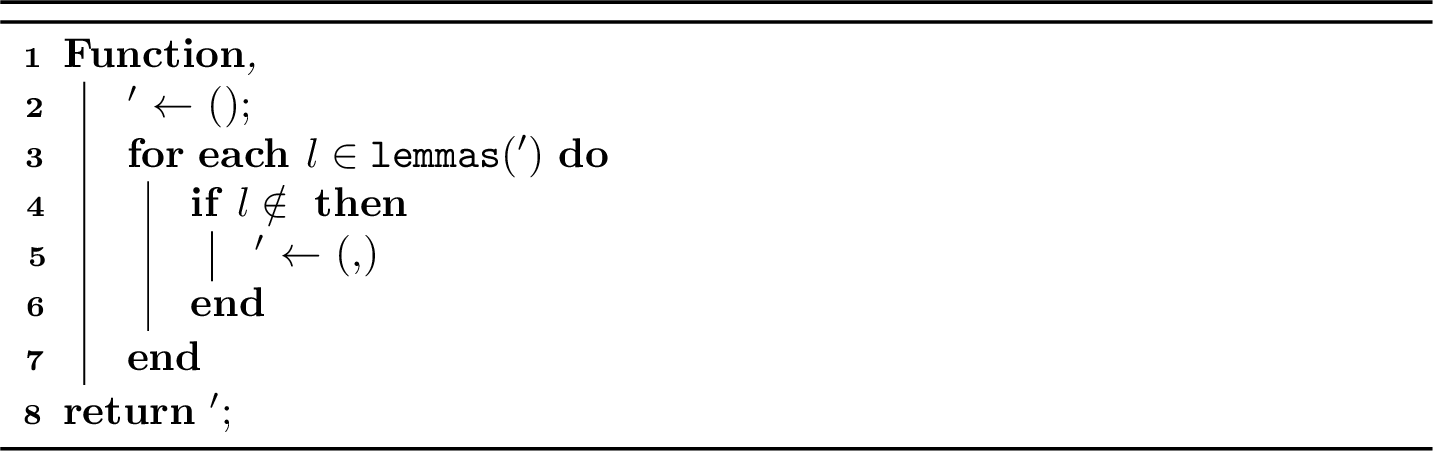
To perform these steps, \(\Psi\)sends a request to the AI Helperin order to build the structured information (“prompt”) that instructs the language model to spell-check each lemma in \(\theta\)used by \(\Phi\) and generate the score. The prompt is described below.
[language=json,numbers=none,escapeinside={*}{*}]]
Generate a JSON response on following criteria:
1. Lemmas: Provide an array of lemmas *$\LEM'$ *.
2. Relation: Describe how lemmas in *$\LEM'$ * are conceptually related
in *\ASEN * and how they interact to form *\ASEN *'s meaning.
3. Find and correct errors in each lemma in *$\LEM$* using the *\WB*.
   Denote by *$\LEM^c = \{l^c_1,... l^c_{\KLEM}\}$* the set of lemmas in *$\LEM$* corrected in 3.
4. Find and correct errors in each lemma in *$\LEM'$* using the *\WB*.
5. Sentence Score: Provide a score *$\SCORE \in [1,10]$* measuring the
orthographic correctness of lemmas in *$\LEM'$* and their usage in *\ASEN *.
5.1 A score of 10 means that *$\LEM' = \LEM^c$*, all lemmas in
*$\LEM'$ * appear in *\ASEN *, and the lemmas are highly related and easily combined.
5.2 Lower scores indicate weaker usage or orthographic errors in the lemmas used in *\ASEN*.
6. Correct lemmas: Provide an array of corrected lemmas *$\LEM^c$*.
7. Set score to "correctness" Key.
Input: *\LEM, $\LEM'$, \ASEN *
Finally, the system displays the correct(ed) lemmas, the assigned score \(\sigma\), and an explanation of how the lemmas used in \(\theta\)are related to each other and how they interact to form \(\theta\)’s meaning (see Promptin box above, points 6,5,2).
Remark: 1. Each lemma \(l^c_i \in L^c\) is added to \(S_i\) in place of \(l_i\), thereby improving UzWordnetby correcting orthographic errors in its lemmas (if any occur).
5 Enhancing UzWordnet↩︎
At this point, it is important to emphasize that the purpose of three of the four educational games we defined and discussed is twofold: educational and lexical. In particular, Game 1 improves UzWordnetby correcting orthographic errors in its lemmas (if any occur), while Game 2 (Case 1) and Game 3 enable the enrichment of the lexical resource employed with example sentences as a direct consequence of the learner playing the game.
In Game 1, the simplest of our games, lexical enrichment is performed without constraints. Each time a game session is played, one lemma in UzWordnet(randomly selected by the system) is either verified as orthographically correct or replaced with a corrected version.
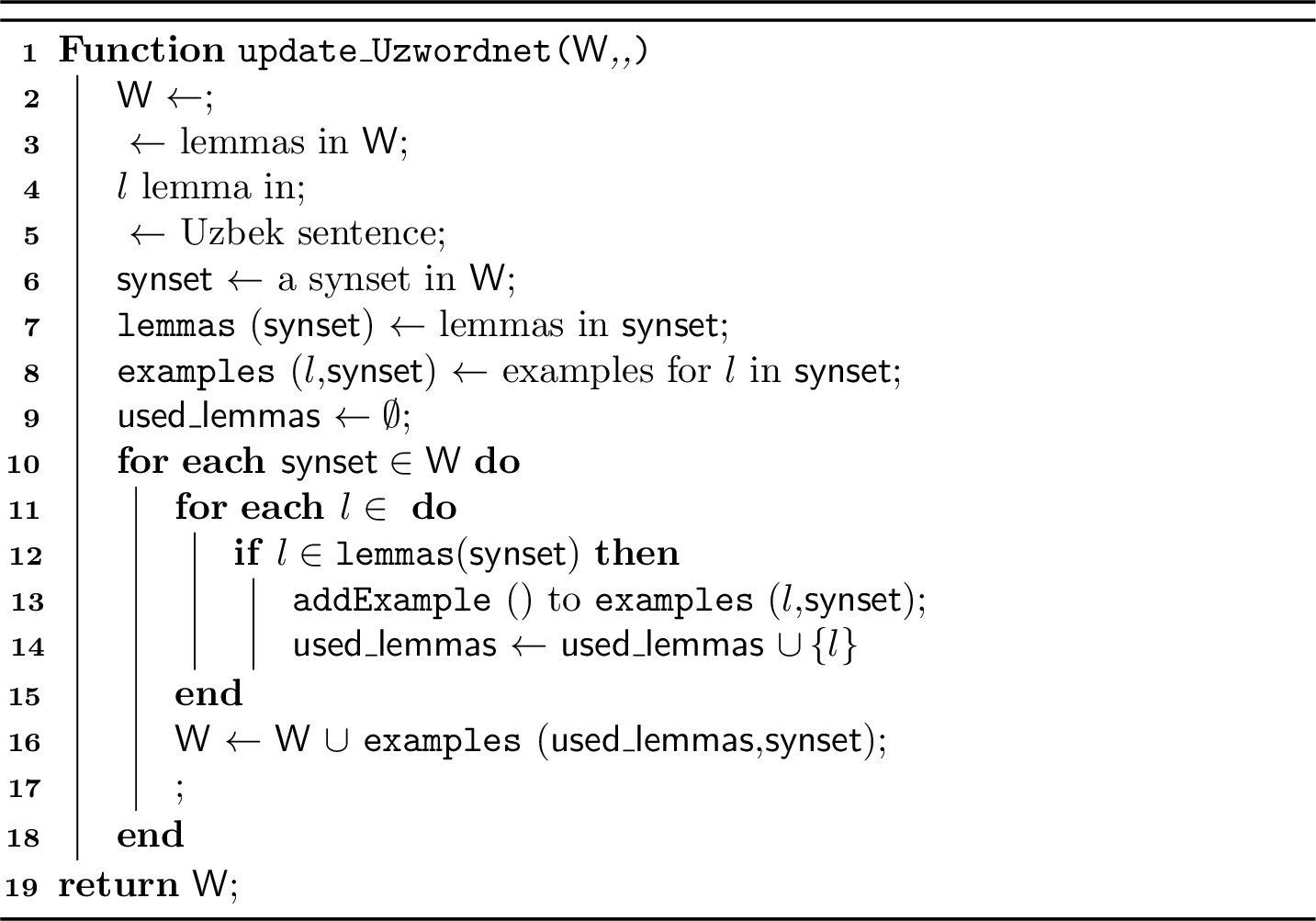
In Game 2, lexical enrichment is performed if and only if (a) the learner selects lemmas in a synset \(S\) of UzWordnetfrom among the lemmas displayed by the system, and (b) \(S\) does not contain any example sentences for any of the lemmas the learner selected. In this case, we have seen, the system sends a request to the AI Helperin order to build the prompt that instructs the language model to generate one or more example sentences for lemmas \(l_1,l_2,...\) in \(S\) selected by the learner. Here is the prompt:
[language=json,numbers=none,escapeinside={*}{*}]]
Generate a JSON response on following criteria:
1. Lemmas: Provide an array of the given lemmas *\LEM *.
2. Sentences: Construct *$n$* sentences in Uzbek, each incorporating as many of the given lemmas as possible.
3. Relation: Describe how the lemmas are conceptually related and how they interact in meaning.
Input: *\LEM *
The prompt is used to display the \(n\) example sentences (Prompt, point 2) to the learner as educational feedback. More importantly, for the focus of this section, the sentences are added to the synset \(S\) to enrich its set of example sentences (cf. Algorithm 5). This fulfills the lexical goal of game-playing.
In Game 3, lexical enrichment is performed if and only if the score \(\sigma\)assigned to a learner for a Uzbek sentence \(\theta\)formed using lemmas \(L= \{l_1,... l_{k}\}\) (\(k\) game parameter) is ‘good enough’ according to a game threshold. In this case, the system (a) spell-checks the lemmas in \(L\)using the orthographic dictionary stored in the WordBase, and (b) adds \(\theta\), corrected with the spell-checked lemmas, to the set of example sentences of each synset in UzWordnetthat contains at least one lemma from \(L\). Moreover, for each lemma in \(L\)retrieved from a synset of UzWordnetand found to be orthographically incorrect according to the WordBase, the system replaces it with the corrected lemma.
6 Related Work↩︎
To the best of our knowledge, none of the existing educational platforms for natural language learning, whether or not they use generative AI or game elements, include Uzbek as an option; see [4], [6], [8] (multilingual); [9] (English, Korean); [10] (Arabic); [29] (Turkish). Moreover, we are not aware of much related scholarly work available in English. Language learning, however, like education in general, benefits from the application of generative AI; see surveys [30], [31].
Some of our work, specifically the design of Game 0, roots into the AI Help Writing feature of Kitaabi[11], and builds on research that correlates AI-generated teaching material and CEFR rules of language comprehension [32]. In [32] the authors discuss the advantages of ChatGPTin teaching English to learners who are classified in CEFR levels from “A1” to “B1”. The contents generated by ChatGPTare, according to [32], more suitable for these levels than higher levels of proficiency. This motivated our choice of design for Game 0.
Although there is substantial work on the use of “gamification” and game mechanics to collect linguistic data or to improve lexical resources in general, see for instance [33]–[35] and the references cited therein, we are aware of only one study —namely [36], and none more recent —that applies a game-based approach to the improvement of a wordnet of the kind and structure considered in this paper. In [36], “players are asked to answer targeted questions about their language, for which they receive various rewards when their answers adhere to the consensus”. (p. 30) The lexical data improved by tools developed within the Kamusi Project described in [36] concern English definitions in PWN, and definitions in other wordnets linked to PWN[27]. In contrast, our methods aim to improve the lemmas and example sentences of UzWordnet.
7 Conclusion, Limitations, and Future Work↩︎
This paper presented an educational system architecture that enables learners to practice the Uzbek language through game-playing. The proposed architecture integrates UzWordnetwith generative AI to support both natural language learning and the enhancement of the lexical resource in use. To achieve this, we followed a game-based perspective and designed four new educational games for language learning. Two of them (Game 1 and Game 3) employed a word base built on the largest and most authoritative orthographic dictionary for Uzbek currently available; one game (Game 0) used a set of grammar rules to guide language learning at the elementary and intermediate levels.
The design of three games (Game 1, Game 2, and Game 3) provided a methodology for improving UzWordnetand of any other lexical database structurally compatible with PWN, making the resulting enhancements a direct by-product of learning through game-playing. These games are both educational and lexical. One game (Game 0) is purely educational.
Our approach is replicable at the technical level. By using the proposed architecture and games with different components —for example, another LLM, a wordnet for another language, a different orthographic dictionary, or alternative grammar rules —learners can practice their target language by game-playing, while improving at the same time the wordnet used.
7.1 Study limitations↩︎
First, as mentioned in Remark 1, we could not find resources for mapping Uzbek words to the A1, A2, and B1 language proficiency levels defined by CEFR [24]. Consequently, we assumed that the CEFR levels assigned to English words apply to their Uzbek translation. This assumption remains to be verified.
Second, and most importantly, although we designed four games, they have not yet been extensively evaluated, neither in terms of their educational effects nor with respect to the proposed lexical objectives. The reasons are twofold: (1) the technical focus of this paper is on system design from a software engineering perspective, and (2) a critical mass of data, here also to interpret as the social impact of engaging a sufficient number of learners to play the games and provide feedback, has not yet been reached.
Third, the metric used to assess how natural or correct a set of lemmas from UzWordnetis when a learner composes an Uzbek sentence using the lemmas (e.g., the computation of the Sentence Score in the SF-game) is LLM-generated, so only partially accessible, transparent, and explainable. For example, how the language model determines whether “the lemmas are highly related and easily combined” (cf. Promptin the SF-game)? How the model assigns a numerical score \(\sigma\)on a scale of 1 to 10 to measure the distance between a lemma written by the learner and a lemma in the WordBase? Unfortunately, we cannot provide definitive answers to these and similar questions related to how the language model in use computes. Our structured prompting methodology, however, allows us to extract an interpretable and consistent metric that serves as a basis for improving UzWordnetand for reliably scoring the learner’s performance.
7.2 Future work↩︎
This paper lays the groundwork for future research, building on the limitations described to evaluate the impact and effectiveness of the proposed architecture in achieving the educational and lexical objectives defined by the game design.
In particular, it would be interesting to evaluate the quality of the responses generated by the AI Helperacross the games, or to experiment with LLMs other than GPT-3.5, especially open-source ones. This would be valuable for replicating our game-based approach on other low-resource languages and in contexts with limited economic resources.
The extension of the linguistic resources for (Northern) Uzbek language, which we stored in three components of the architecture presented in this paper, namely, UzWordnet, WordBaseand Rules, is crucial to the quality of the responses the AI Helperprovides to the learner, whichever LLM module is employed in the system’s architecture. On the grammatical side, one research direction to explore is the extension of Rules to include grammar rules defined in the Mother Tongue school textbook series [37]–[39]. These textbooks provide detailed explanations of essential lexical and grammatical rules of the language, and their integration into the architecture would improve the prompt used in Game 0. On the lexical side, a direction of research is to replicate our approach using the Open Multilingual Wordnet [27], [28] or lexicographic datasets such as Wikionary. Another direction is the design of multilingual games, in partnership within the DataScientia initiative13, leveraging the Universal Knowledge Core [40], a multilingual, high-quality, large-scale, and diversity-aware machine-readable lexical resource.
References↩︎
Electronic correspondence to: a.agostini@inha.uz / agostini@disi.unitn.it.↩︎
“My book” from Arabic (), symbolizing writing, knowledge, and learning.↩︎
Available at https://github.com/LDKR-Group/UzWordnet.↩︎
Turkish (91.3M), Azerbaijani (24.2M), Kazakh (21.4M), Uyghur (13.6M).↩︎
Classes addresses the learner to standard lessons; Hosts lets teachers to organize their classes. These components of the system are outside the scope of this paper.↩︎
The list contains the most common 3000 English words categorized by the CEFR levels.↩︎
The lists contain the words and topics that mostly occur in Cambridge Assessment tests.↩︎
https://globalwordnet.github.io/resources/wordnets-in-the-world. Accessed: 2026-02-21.↩︎
The first is part of the Extended Open Multilingual WordNet project [27].↩︎
A synset is a set of lemmas with the same meaning in a specific sense, cf. [15], [16].↩︎
Typically, a synset in a wordnet might contain sentences aimed to illustrate the usage of a lemma in the synset; these sentences are called example sentences in the wordnet-related literature. However, due to incompleteness, not all synsets in a wordnet provide example sentences. Moreover, not all lemmas in a synset are generally associated with an example sentence. This may be the case for \(w\).↩︎
The connection between the synset \(S\) and the location of anor is structural in UzWordnet. For the sake of brevity, in this paper we omit the technical details of this connection; see [12], [15], [16].↩︎
See http://datascientia.disi.unitn.it/. Accessed: 2026-02-21.↩︎