Anatomy of Uncertainty: Expressive Descriptors of Robotic Manipulator Motion for Non-verbal Communication in Human-Robot Collaboration
July 15, 2026
Abstract
Robots operating in human-robot collaboration must communicate not only their intended actions but also uncertainty arising from incomplete or ambiguous perception. This work introduces a mathematical framework for expressing perceptual uncertainty through robotic manipulator motion. Drawing on Laban Movement Analysis, robot behavior is organized in a Commitment-Vigilance state space that maps uncertainty-related states - confidence, curiosity, hesitance, fear, and inactivity - to distinct Laban Effort signatures. Five motion primitives - approach, pause, retreat, exploration, and oscillation - are then parameterized using eleven kinematic and geometric descriptors, including acceleration, pause and retreat characteristics, gaze angles, tilt, and shiver amplitude. A video-based human-subject study evaluated recognition of four expressive trajectories and the influence of individual descriptors on perceived intensity. Participants reliably identified the intended behavioral states, while several descriptors significantly modulated expressiveness. The results establish a perceptually grounded basis for encoding robot uncertainty in motion and support future autonomous trajectory generation using parametric movement representations for collaborative tasks in shared environments. Code, videos, questionnaire and appendices are available at "https://bit.ly/github-aou".
1 INTRODUCTION↩︎
Robots operating in human environments rarely possess complete or error-free knowledge of the world. Sensor noise, occlusion, ambiguous object observations, imperfect models, and changes in the task environment produce uncertainty about the current state and the consequences of future actions. Classical decision-making formulations represent this condition through a belief over possible world states, while active-perception methods allow a robot to select movements that improve its observations and reduce uncertainty [1], [2]. In human-robot collaboration, however, uncertainty is not solely an internal estimation problem. A human collaborator must also be able to infer whether the robot has confidently resolved the situation, is gathering additional information, or is unable to determine an appropriate action. A robot that executes every action with an identical motion profile may consequently appear more certain and capable than its perceptual state warrants.
Robot motion provides an immediately available channel through which such internal states can be communicated. Nonverbal robot behaviors have been shown to improve the understandability, efficiency, and robustness of collaborative interaction [3]. Animation principles such as anticipation and reaction can make robot actions easier to interpret [4], while legible-motion formulations explicitly optimize trajectories to reveal an intended goal [5]. More broadly, motion-design research has argued that timing, rhythm, posture, and transitions should be treated as communicative properties rather than as incidental consequences of control [6]. These findings are particularly relevant to robotic manipulators, which frequently lack anthropomorphic faces, speech interfaces, or dedicated displays but continuously produce observable motion during task execution. Their functional trajectories can therefore act simultaneously as task actions and as nonverbal signals about attention, intention, and internal state.
A central challenge is determining how motion should change when the robot is perceptually uncertain. Laban Movement Analysis (LMA) offers a systematic vocabulary for describing movement through Body, Effort, Shape, and Space, with the Effort factors of Weight, Time, Space, and Flow characterizing the dynamic quality of an action [7]. LMA-derived features have enabled aerial robots to communicate affect through flight paths [8], mobile robots to express attitudes toward their goals [9], and robotic manipulators to convey recognizable emotional qualities [10]. Independent work on expressive motion timing has further demonstrated that changes in speed and pauses can alter perceived robot confidence even when the geometric path remains fixed [11]. Nevertheless, most existing methods map selected motion qualities to discrete emotions, personality traits, or intended goals. They do not provide a general mathematical account of how perceptual uncertainty should be decomposed into behavioral processes or identify a sufficient set of measurable motion parameters through which different uncertainty-related states and their intensities can be expressed.
A useful representation of uncertainty must connect the robot’s perceptual assessment to its observable action tendency. Appraisal theories characterize behavior in terms of evaluations such as certainty, urgency, and coping potential [12], while approach-avoidance models distinguish commitment toward a goal from withdrawal in response to an undesirable or unresolved situation [13]. At the same time, active perception requires the robot to allocate actions toward observation and information gathering rather than immediate task completion [2]. These perspectives suggest two complementary dimensions for expressing perceptual uncertainty through motion one describing the degree to which the robot invests its motion toward or away from a task goal, and the other describing the degree to which motion is allocated to monitoring, checking, and gathering information.
This work develops an anatomy of perceptual uncertainty in robotic-manipulator motion. Its principal contributions are:
An anatomical behavioral model of perceptual uncertainty, in which the four Laban Effort factors are mathematically projected onto the orthogonal dimensions of Commitment and Vigilance. The resulting state space organizes confidence, curiosity, hesitance, fear, and inactivity according to the robot’s task-directed engagement and uncertainty-management behavior.
A set of motion primitives and computable expressive descriptors that translate the behavioral model into manipulator trajectories. Motion primitives such as approach, pause, retreat, exploration, and oscillation are parameterized using eleven kinematic and geometric descriptors - approach acceleration; pause count and duration; retreat count, distance, and acceleration; horizontal and vertical gaze angles; tilt angle and velocity; and shiver amplitude.
A human-perception validation of the proposed representation examining whether descriptor-parameterized trajectories communicate distinct uncertainty-related behavioral states and whether systematic changes in individual descriptors modulate their perceived expressive intensity.
2 RELATED WORK↩︎
2.1 Expressive Robot Motion↩︎
Expressive robot motion encompasses behaviors designed not only to achieve a physical objective but also to make the robot’s intentions, affect, capabilities, or interaction state understandable to an observer. Early work showed that implicit nonverbal cues can improve coordination and recovery from miscommunication in human-robot teamwork [3]. Takayama et al. applied the animation principles of anticipation and reaction to make robot actions more readable [4], while Dragan et al. distinguished predictable motion, which conforms to an observer’s expectation, from legible motion, which enables rapid inference of the robot’s goal [5]. Hoffman and Ju subsequently framed movement as a fundamental robot-design material, emphasizing that temporal phrasing and transitions influence how people interpret even mechanically simple platforms [6]. Complementary studies have investigated external and embodied methods for communicating intent in shared workspaces, including trajectory modifications, gaze, lights, projections, and augmented-reality cues [14].
Within this broader area, LMA has provided a structured representation for transferring principles of human expressive movement to nonhuman embodiments. Burton et al. proposed LMA as a compact abstraction for affective-motion recognition and generation [15]. Sharma et al. encoded Laban Effort qualities into quadrotor flight paths and showed that observers could perceive different affective characteristics from locomotion alone [8]. Knight and Simmons converted Effort factors into path and velocity features for differential-drive robots, demonstrating that low-degree-of-freedom platforms can express attitudes such as confidence, urgency, and reluctance [9]. Expressive timing has also been studied independently of path geometry where Zhou et al. found that pauses and temporal profiles influenced perceived confidence, naturalness, and even assumptions about the object being manipulated [11]. More recently, La Viola et al. applied Laban-inspired timing, path, flow, and joint configurations to a robotic arm and obtained recognizable emotional interpretations from observers [10].
These studies establish that humans infer meaning from robot velocity, acceleration, path shape, posture, pauses, and movement rhythm. Nevertheless, the represented meanings are commonly fixed emotional labels, personality styles, task goals, or general competence impressions. LMA factors are frequently implemented as qualitative presets, and the selected features are often specific to a particular robot morphology or experimental scenario. Consequently, the literature does not yet provide a unified decomposition that explains why perceptual uncertainty should produce particular motion changes or how several changes can be composed to represent qualitatively different uncertainty-related states.
2.2 Robot Uncertainty and Its Communication↩︎
Existing approaches to robot-uncertainty communication span verbal, visual, and behavioral modalities. Bartneck and Moltchanova investigated linguistic probability expressions such as “likely” and “almost certainly,” finding systematic but imperfect correspondence between verbal phrases and numerical probabilities [16]. Visual interfaces can present confidence scores, distributions, or uncertainty indicators explicitly; Schömbs et al. studied uncertainty visualization in robot-assisted decision-making and demonstrated that both the representation and embodiment of uncertainty influence user judgments [17]. Such explicit methods can communicate quantitative information, but they require users to attend to an additional display or interpret statistical terminology, and they may be less suitable when attention is divided across a physical collaborative task.
Behavioral signals provide an alternative in which uncertainty is conveyed through the robot’s actions. Van den Brule et al. showed that nonverbal warning signals preceding poor performance can improve interaction and support more appropriate expectations of the robot [18]. Kwon et al. formulated the expression of robot incapability as a trajectory-optimization problem, generating task-specific motions that communicate both the intended action and the physical reason that it cannot be completed [19]. These approaches demonstrate the value of exposing limitations before or during failure, but incapability and expected performance are not identical to perceptual uncertainty: a robot may remain physically capable while being unsure about an object, observation, or appropriate course of action.
Hesitation has been the uncertainty-related motion behavior studied most directly. Moon et al. derived an acceleration-based hesitation profile from human reaching motions and implemented it on a robot arm during shared-resource conflicts [20]. Later, they proposed Negotiative Hesitation Generator which reproduced characteristic human-inspired stopping and yielding trajectories and showed that such behavior can facilitate nonverbal conflict negotiation [21]. Expressive timing research similarly found that pauses can make a manipulator appear uncertain or as though it is reconsidering its action [11]. Recent Laban-based manipulator work has introduced hesitant trajectories using sustained timing, retreating Shape qualities, and direct or curved movement paths, with observers associating these motions with reduced competence and task-success likelihood [22].
The uncertainty literature therefore confirms that hesitation, delays, warning cues, retreats, and displays can affect human interpretation. However, most methods encode uncertainty as a binary condition, a single probability, an impending failure, or one context-specific hesitation gesture. They seldom distinguish confidence, information-seeking curiosity, approach-withdrawal conflict, defensive fear, and complete disengagement within a common model. Furthermore, relatively little work identifies which independent kinematic and geometric variables control the perceived intensity of these states. The methodology developed in this manuscript addresses these limitations by representing perceptual uncertainty as a structured continuum and by specifying a reusable set of trajectory-level descriptors through which uncertainty-related behaviors can be generated, measured, and systematically varied.
3 METHODOLOGY↩︎
We begin from the premise that uncertainty in a robot’s world perception is not expressed solely through task delay or trajectory error, but through systematic changes in motion quality. To capture such changes, we adopt LMA as the qualitative interpretive framework. The Laban Effort system [7] describes movement according to four motion factors, each of which encodes a distinct psychological function relevant to uncertainty processing. The Weight (\(W\)) factor (Strong \(\leftrightarrow\) Light) encodes intentional engagement - the resolution of force toward action. The Time (\(T\)) factor (Sudden \(\leftrightarrow\) Sustained) captures decision urgency - the temporal pressure under which the agent acts. The Space (\(S\)) factor (Direct \(\leftrightarrow\) Indirect) governs attentional focus - the agent’s mode of environmental scanning. The Flow (\(F\)) factor (Bound \(\leftrightarrow\) Free) reflects emotional regulation - the degree to which motion is controlled versus released. We formalize the dynamics of expressing uncertainty through motion using the normalized 4D Effort vector, \(E = (W, T, S, F) \in [-1, +1]^4\), where each factor spans from its Condensing pole (\(-1\)) to its Indulging pole (\(+1\)) [23].
3.1 Behavioral Modeling of Robot Motion for Perceptual Uncertainty↩︎
To transform these qualitative LMA Effort factors into a learnable and composable representation for robot behaviors expressing uncertainty, we introduce a 2D latent behavioral model where perceptual uncertainty is characterized by both the robot’s motor commitment to a goal position or object and its allocation of motion to gather information. The model’s theoretical basis is the observation that a robot confronting perceptual uncertainty must simultaneously manage two functionally distinct processes - resolving its action tendency toward or away from the goal, and regulating its attentional allocation toward monitoring the environment. We formalize these as the orthogonal dimensions of Commitment, \(C \in [-1, 1]\), and Vigilance, \(V \in [-1, 1]\), each derived from a principled pairing of Laban Effort factors, where \(C\) is anchored in Laban Near state, and Vigilance in Laban Remote state [7].
\[\begin{align} C &= -c_1W - c_2T; & W, T \in [-1, +1] \tag{1} \\ V &= v_1S - v_2F; & S, F \in [-1, +1] \tag{2} \end{align}\]
Here, \(c_1, c_2, v_1, v_2 \in \mathbb{R}^+\) are weighting coefficients. The sign conventions ensure that Strong Weight (\(W = -1\)) and Sudden Time (\(T = -1\)) yield maximal Commitment at equal weighting, while Light Weight (\(W = +1\)) and Sustained Time (\(T = +1\)) yield minimal Commitment. Similarly, Indirect Space (\(S = +1\)) and Bound Flow (\(F = -1\)) yield maximal Vigilance at equal weighting, while Direct Space (\(S = -1\)) and Free Flow (\(F = +1\)) yield minimal Vigilance.
Fig. 1 illustrates the proposed behavioral model of perceptual uncertainty through robot motion. Commitment measures whether the robot invests motion toward task completion or withdraws from it. Positive commitment appears as advancing, direct, target-oriented motion, while no commitment appears as stopping, and negative commitment as retracting, or yielding. This is grounded in approach-avoidance theory [13], fear-related backward movement from LMA studies [24], and manipulator studies where confidence was made legible through higher movement speed and reduced waiting [25]. Vigilance measures how much of the motion budget is spent on uncertainty management rather than direct execution. Low vigilance corresponds to narrow, stable target fixation and uninterrupted exploitation, while high vigilance corresponds to active information seeking or defensive monitoring, expressed as gaze sweeps, orientation adjustments, or pauses for checking. This is directly motivated by active perception [2] and motion-intent research showing that robot communication is not only about future motion but also about attention and internal state [26].
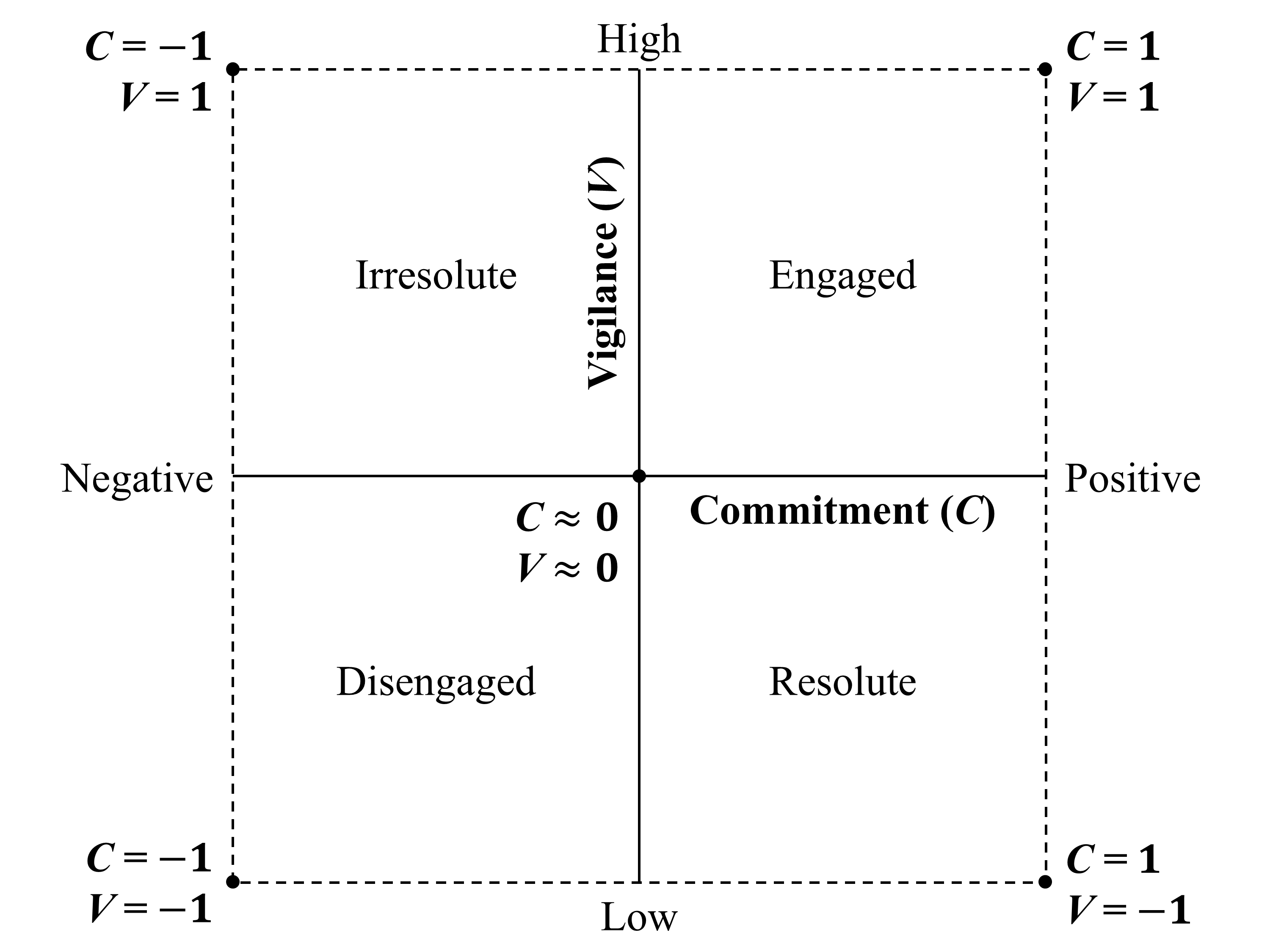
The \(C\)-\(V\) state-space naturally partitions into regions corresponding to qualitatively distinct behavioral profiles of robots with respect to a goal position or object - functional robot behavior classes grounded in movement quality and surveillance management. Positive commitment with high vigilance (\(C > 0\), \(V > 0\)) describes an engaged agent that approaches while scanning. No or negative commitment with high vigilance (\(C < 0\), \(V > 0\)) describes an irresolute agent actively withdrawing under uncertainty. No or negative commitment with low or no vigilance (\(C < 0\), \(V > 0\)) describes a disengaged agent indecisive between acting and monitoring. Positive commitment with low or no vigilance (\(C > 0\), \(V < 0\)) describes a resolute agent that acts decisively without defensive monitoring. The boundaries of these regions and their inverse mapping back to Effort factors form the basis for deriving five canonical behavioral states associated with increasing perceptual uncertainty. The derivation of the behavioral states proceeds through appraisal-theoretic criteria [12], where each state is characterized jointly by its certainty appraisal (how resolved the agent’s environmental assessment is) and its coping potential appraisal (how capable the agent judges itself of engaging).
Confidence corresponds to maximal certainty with high coping potential, where the robot has fully resolved its environmental assessment and commits without reservation. Curiosity corresponds to moderate uncertainty with maintained coping potential, where the robot has not resolved its environmental assessment but judges the situation as potentially rewarding, warranting exploratory engagement. Hesitance corresponds to high uncertainty with low coping potential, where the robot detects potential threat but cannot resolve whether approach or withdrawal is optimal and oscillates between the two. Fear corresponds to high uncertainty with no coping potential, where the robot assesses the environment as threatening and its engagement capacity as insufficient. Inactivity corresponds to maximal uncertainty with no coping potential, where the robot disengages itself from the task completely under indecision regarding approach and withdrawal. Table 1 lists the canonical robot states derived from the \(C\)-\(V\) space and their corresponding Effort signatures.
| Robot Behavioral State | Weight (W) | Time (T) | Space (S) | Flow (F) |
|---|---|---|---|---|
| Confident (\(C = 1\), \(V = -1\)) | Strong (\(-1\)) | Sudden (\(-1\)) | Direct (\(-1\)) | Free (\(+1\)) |
| Curious (\(C = 1\), \(V = 1\)) | Strong (\(-1\)) | Sudden (\(-1\)) | Indirect (\(+1\)) | Bound (\(-1\)) |
| Hesitant (\(C \approx 0\), \(V \approx 0\)) | Light (\(+1\)) | Sudden (\(-1\)) | Indirect (\(+1\)) | Free (\(+1\)) |
| Fearful (\(C = -1\), \(V = 1\)) | Light (\(+1\)) | Sustained (\(+1\)) | Indirect (\(+1\)) | Bound (\(-1\)) |
| Inactive (\(C = -1\), \(V = -1\)) | Light (\(+1\)) | Sustained (\(+1\)) | Direct (\(-1\)) | Free (\(+1\)) |
3.2 Robot Motion Primitives and Expressive Descriptors for Perceptual Uncertainty↩︎
With the behavioral archetypes established in \(C\)-\(V\) space and their Effort signatures specified, we now identify five elemental motion primitives as temporally bounded segments of end-effector trajectory of a robotic manipulator in a goal-directed task, as depicted in Fig. 2. We exploit the dimensional spans (\(C,V \in [-1, +1]\)) of the behavioral model to define the primitives. Each of these primitives has a characteristic kinematic profile governed by specific Effort factors influencing target-progress rate of the robot in a given task - minimal but sufficient for uncertainty expression in goal-directed robot tasks. These primitives constitute the observable building blocks from which aforementioned behaviors expressing levels of perceptual uncertainty are composed.
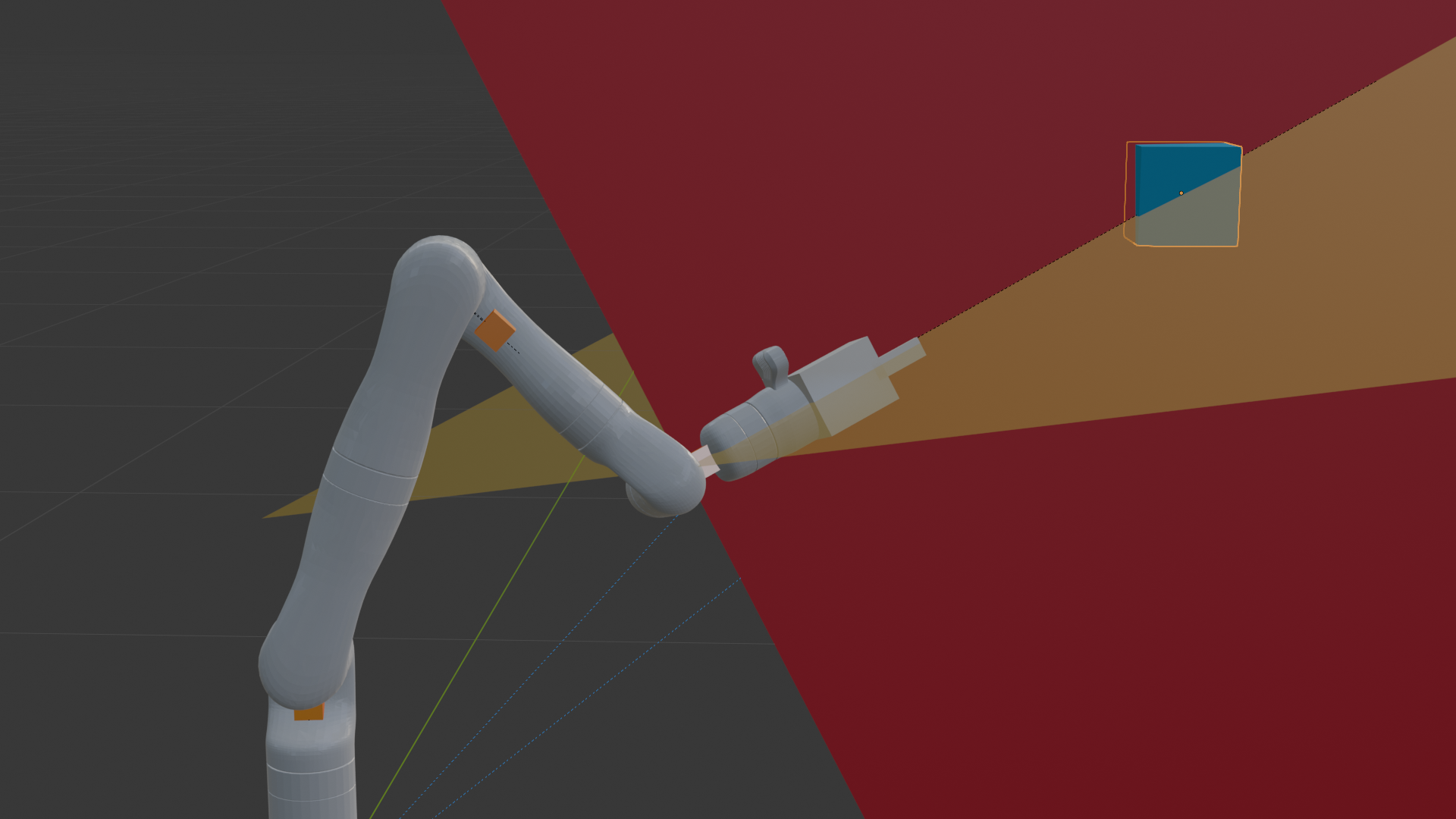
Figure 2: A robotic manipulator in a goal-directed task. The blue cube represents the target object. The horizontal (yellow) and longitudinal (red) planes represent the mid-transverse and the mid-sagittal planes of the end effector, respectively..
Approach is the forward translational movement of the end-effector toward the target, along the intersection of the mid-transverse and mid-sagittal planes. It is governed primarily by Commitment - Time controls the temporal acceleration profile and Weight controls force magnitude. In LMA terms, Approach realizes the action-drive component of Commitment - the robot’s resolved motor intention directed toward the target. Pause is the cessation of translational motion during which the end-effector maintains position while the agent conducts environmental assessment. Pause is primarily a Vigilance manifestation - it emerges when Bound Flow (high readiness to halt) combines with Indirect Space (multi-focal scanning that triggers assessment interruptions). In LMA framework, Pause reflects a shift from the action-drive - the robot temporarily suspends goal-directed action. Retreat is the backward translational movement of the end-effector away from the target, along the intersection of the mid-transverse and mid-sagittal planes. It is the spatial inverse of Approach and is governed by the same Commitment factors but with reversed spatial direction, activated when \(C\) becomes negative or when approach-avoidance oscillation occurs at \(C \approx 0\). Exploration is the lateral, arc-like, or rotational movement of the end-effector around or adjacent to the target without direct translational approach or retreat, taking place on either the mid-transverse or the mid-sagittal plane. Exploration is primarily governed by the Vigilance factor of Indirect Space - the multi-focused, scanning attentional mode that drives the agent to sample the environment from multiple vantage points. Oscillation is the rapid, low-amplitude alternating motion of the end-effector around an axis aligned with its forward direction, showcasing involuntary micro-movements operationalizing "nervousness". Oscillation is the kinematic expression of extreme Bound Flow - representing a component of Vigilance.
Each expressive behavior consists of these five primitives in proportions that follow directly from its \(C\)-\(V\) position and Effort signature. Confidence (\(C > 0\), \(V < 0\)) is primarily Approach - the maximal Commitment and minimal Vigilance leave no reason to pause, scan, retreat, or oscillate. The resultant spatial realization is a single, uninterrupted forward trajectory. Curiosity (\(C > 0\), \(V > 0\)) is dominated by Exploration, with secondary Approach and tertiary Pause - the simultaneous activation of moderate Commitment and moderate Vigilance produces the dual-process behavior where the robot approaches while monitoring, an indirect scanning trajectory that gradually converges on the target from multiple angles. Hesitance (\(C < 0\), \(V < 0\)) is dominated by Pause, with secondary Retreat, tertiary Approach, and incipient Oscillation - the classic approach-avoidance conflict where the agent tentatively advances, freezes, withdraws partially, freezes again, and may repeat. Fear (\(C < 0\), \(V > 0\)) is dominated by Retreat with substantial Oscillation and brief Pauses - rapid withdrawal punctuated by freeze episodes and accompanied by high-frequency tremor.
From the five motion primitives and their governing Effort factors, we derive a set of computable descriptors that parametrically encode the observable kinematics and geometry of uncertainty-modulated manipulator behavior. Each descriptor is a scalar-valued function of the end-effector trajectory, computable in real-time from joint encoder data via forward kinematics.
As denoted in Fig. 3, the local coordinate system of the goal is given by \(( {\boldsymbol{R}}, {\boldsymbol{p}}) \in SE(3)\) where \({\boldsymbol{R}} = [ {\boldsymbol{x}}, {\boldsymbol{y}}, {\boldsymbol{z}}]\) and \({\boldsymbol{p}} = [p_x, p_y, p_z]^T\). The end-effector frame is denoted by \(\{e\} \equiv ( {\boldsymbol{R}}_e, {\boldsymbol{p}}_e)\) where \({\boldsymbol{p}}_e\) is position of the end-effector w.r.t. the goal. We define the goal vector \({\boldsymbol{g}}\) joining robot end-effector to goal at time \(t_i\):
\[{\boldsymbol{g}}_i \coloneq - {\boldsymbol{p}}_e(t = t_i) \label{eq:objectvector}\tag{3}\]
A plane \(\Pi\) is given by point \({\boldsymbol{p}}\) and normal \({\boldsymbol{n}}\) as \(\Pi \equiv ( {\boldsymbol{p}}, {\boldsymbol{n}})\). The horizontal and vertical/longitudinal planes respectively, \(\Pi_{H}\) and \(\Pi_{V}\) are defined as:
\[\begin{align} \Pi_H &\coloneq ( {\boldsymbol{0}}, {\boldsymbol{y}}_e(t=0)), \\ \Pi_V &\coloneq ( {\boldsymbol{0}}, {\boldsymbol{x}}_e(t=0)). \label{eq:Planes} \end{align}\tag{4}\]
Projection of a vector \({\boldsymbol{x}}\) onto a plane \(\Pi\) is denoted by \(\Upsilon_\Pi( {\boldsymbol{x}})\). Robot gaze w.r.t. the goal is operationalized by Line of Sight (\(\gamma \in R\)), which is the angle between end effector’s local Z axis (\(z_{e,i}\)) and goal vector (\({\boldsymbol{g_i}}\)) at each robot configuration \(i\). In this work, the robot’s gaze is fixed onto the goal by making \(\gamma_{i} = 0; \,\, \forall{i}\). The expressive descriptors are defined as follows.
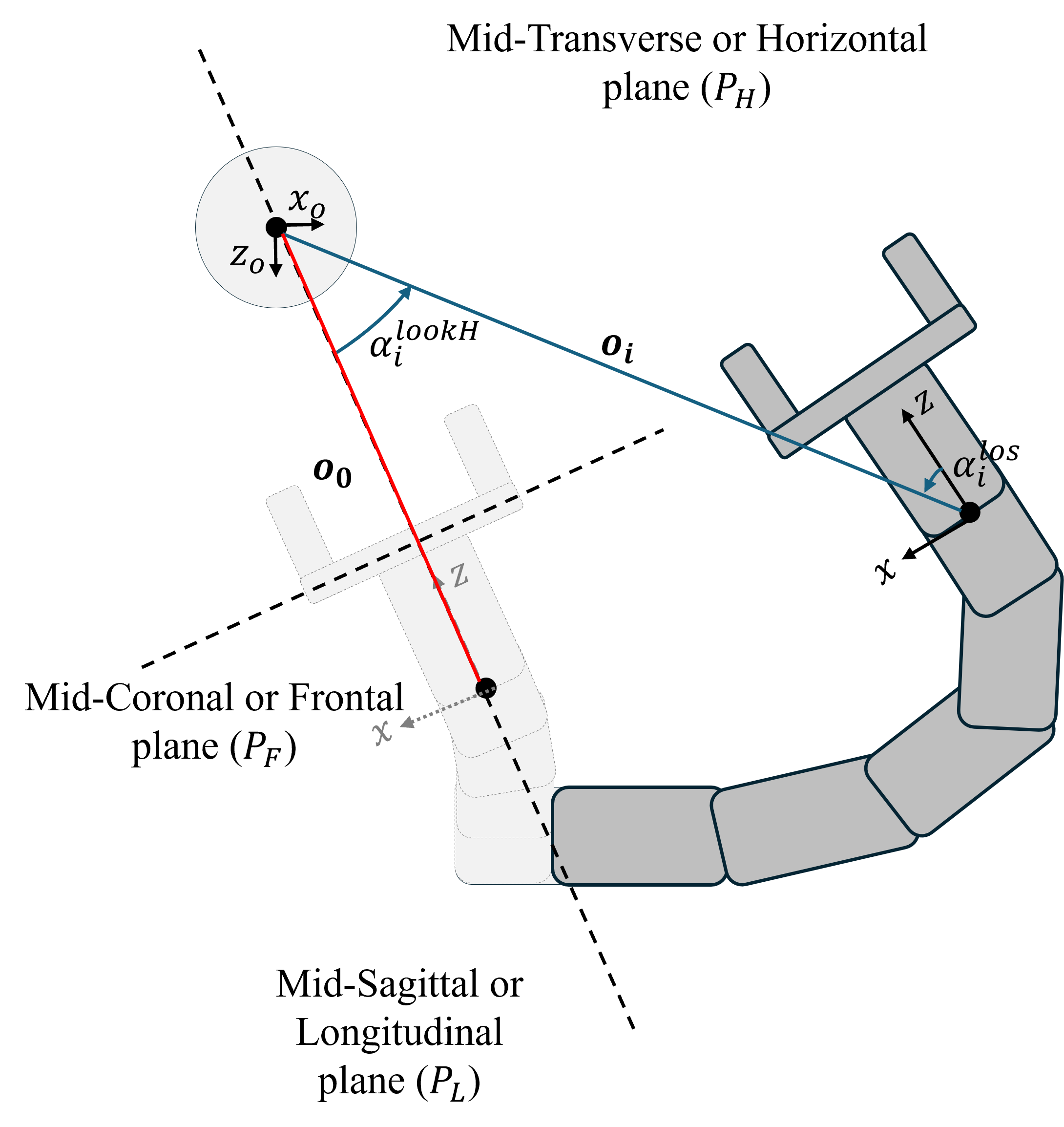
Approach Acceleration (\(\alpha_{approach}\in R\)) [\(m/s^2\)] is the peak magnitude of the end-effector’s translational acceleration across all approach episodes, \(approach_i\), starting at configuration \({i}\) and ending at configuration \({i+1}\) where \(|| {\boldsymbol{g_{i+1}}}||_2 < || {\boldsymbol{g_{i}}}||_2\).
\[\alpha_{approach} = max \left( max \left( \left|\frac{\mathrm{d}^2 \;( {\boldsymbol{g_{i+1}}} - {\boldsymbol{g_{i}}}) }{\mathrm{d}t^2} \right| \right), \forall i \right) \label{eq:ApproachAcceleration}\tag{5}\]
Pause Count (\(n_{pause}\in R\)) [-] is the number of pauses i.e. number of configurations from total configurations \(n\) where all joints’ velocities are simultaneously zero.
\[n_{pause} = \sum_{i=1}^{n} 1_{\dot{\chi}_{j,i} = 0 \,\, \forall(j)} \label{eq:PauseCount}\tag{6}\]
Pause Duration (\(\tau_{pause}\in R\)) [\(s\)] is the temporal duration of a pause. In a given trajectory, all pauses are of equal duration.
Retreat Count (\(n_{retreat}\in R\)) [-] is the number of distinct episodes during which the end-effector translates away from the goal from configuration \({i}\) to \({i+1}\) such that both configurations \(i\) and \(i+1\) are pauses.
\[n_{retreat} = \sum_{i=1}^{n} 1_{|| {\boldsymbol{g_{i+1}}}||_2 > || {\boldsymbol{g_{i}}}||_2; \,\, \dot{\chi}_{j,i} = 0, \,\, \dot{\chi}_{j,i+1} = 0\,\, \forall(j) } \label{eq:RetreatCount}\tag{7}\]
Retreat Distance (\(d_{retreat}\in R\)) [\(m\)] is the Euclidean distance traversed by the end-effector during each retreat episode, \(retreat_i\), starting at configuration \({i}\) and ending at configuration \({i+1}\) where \(|| {\boldsymbol{g_{i+1}}}||_2 > || {\boldsymbol{g_{i}}}||_2\). In a given trajectory, all retreat episodes cover equal distance.
\[{d}_{retreat} = {d}_{retreat_i} = || {\boldsymbol{g_{i+1}}} - {\boldsymbol{g_{i}}}||_2 \label{eq:RetreatDistance}\tag{8}\]
Retreat Acceleration (\(\alpha_{retreat}\in R\)) [\(m/s^2\)] is the peak magnitude of the end-effector’s translational acceleration across all retreat episodes, \(retreat_i\), starting at configuration \({i}\) and ending at configuration \({i+1}\) where \(|| {\boldsymbol{g_{i+1}}}||_2 > || {\boldsymbol{g_{i}}}||_2\).
\[\alpha_{retreat} = max \left( max \left( \left|\frac{\mathrm{d}^2 \;( {\boldsymbol{g_{i+1}}} - {\boldsymbol{g_{i}}}) }{\mathrm{d}t^2}\right| \right), \forall i \right) \label{eq:RetreatAcceleration}\tag{9}\]
Horizontal Gaze (\(\theta_H\in R\)) [\(deg\)] is the amplitude of the angle in the horizontal plane traversed by the end-effector during each gaze episode \(gaze_i\). It is computed as the angle between the goal vectors at configurations 0 (\({\boldsymbol{g_0}}\)) and i (\({\boldsymbol{g_i}}\)) projected on the Horizontal plane \(\Pi_H\) where configuration \(i\) is a pause at the end of the gaze episode. In a given trajectory, all horizontal gaze episodes cover equal angle.
\[\theta_{H} = \theta_{H_i} = \left| cos^{-1} \left( \frac{ \Upsilon_{\Pi_H}( {\boldsymbol{g_0}}).\Upsilon_{\Pi_H}( {\boldsymbol{g_i}}) }{ |\Upsilon_{\Pi_H}( {\boldsymbol{g_0}})|.|\Upsilon_{\Pi_H}( {\boldsymbol{g_i}})| } \right) \right| \label{eq:HorizontalGaze}\tag{10}\]
Vertical Gaze (\(\theta_V\in R\)) [\(deg\)] is the amplitude of the angle in the longitudinal/vertical plane traversed by the end-effector during each gaze episode \(gaze_i\). It is computed as the angle between the goal vectors at configurations 0 (\({\boldsymbol{g_0}}\)) and i (\({\boldsymbol{g_i}}\)) projected on the Vertical plane \(\Pi_V\) where configuration \(i\) is a pause at the end of the gaze episode. In a given trajectory, all vertical gaze episodes cover equal angle.
\[\theta_{V} = \theta_{V_i} = \left| cos^{-1} \left( \frac{ \Upsilon_{\Pi_V}( {\boldsymbol{g_0}}).\Upsilon_{\Pi_V}( {\boldsymbol{g_i}}) }{ |\Upsilon_{\Pi_V}( {\boldsymbol{g_0}})|.|\Upsilon_{\Pi_V}( {\boldsymbol{g_i}})| } \right) \right| \label{eq:VerticalGaze}\tag{11}\]
Tilt Angle (\(\chi_{tilt}\in R\)) [\(deg\)] is the amplitude of the roll angle of the end-effector around its forward-motion axis (local Z axis (\(z_e\))) during each end-effector tilt, \(tilt_i\), between configurations \(i\) and \(i+1\), imagined as an inquisitive head tilt.
\[\chi_{tilt} = \chi_{tilt_i} = |\chi_{e,i+1} - \chi_{e,i}| \label{eq:TiltAngle}\tag{12}\]
Tilt Velocity (\(\dot{\chi}_{tilt}\in R\)) [\(deg/s\)] is the average angular velocity during each end-effector’s tilt, \(tilt_i\).
\[\dot{\chi}_{tilt} = \dot{\chi}_{tilt_i} = \left| \frac{ \chi_{tilt_i}}{t_{i+1} - t_i} \right| \label{eq:TiltVelocity}\tag{13}\]
Shiver Amplitude (\(\chi_{shiver_{j}}\in R\)) [\(deg\)] is the peak-to-peak amplitude of high-frequency oscillatory motion of joint \(j\) around the forward-motion axis (local Z axis (\(z_j\))) where joint \(j\) is a redundant joint not active in the current end-effector movement and \(i\), \(i+1\) correspond to the two peak amplitude configurations.
\[\chi_{shiver_{j}} = |\chi_{j,i+1} - \chi_{j,i}| \label{eq:ShiverAmplitude}\tag{14}\]
All expressive descriptors except Tilt Angle, Tilt Velocity and Shiver Amplitude are defined in the Cartesian space with respect to the local coordinate system of the goal position/object. The aforementioned three descriptors are defined in the joint space where the angle moved by joint \(j\) between robot configurations \(i\) and \({i+1}\) is denoted by \(\chi_{j,i}\).
4 EXPERIMENTAL DESIGN↩︎
An IRB-approved human subjects study was conducted to validate the developed methodology. A video-based survey was used to evaluate the accuracy with which the expressive behaviors could communicate the robot’s uncertainty in a given task and environment. The chosen task was a goal-directed approach i.e. the initial phase of a manipulation sequence where the robot’s end-effector (like a gripper or tool) navigates to a precise pre-grasp or pre-operation pose near a target object without making physical contact, setting up a stable and accurate final action. The survey also assessed the capability of the identified expressive descriptors in modulating the intensity of the robot’s expressive behaviors. Videos showcasing the expressive behaviors as well as the study questionnaire is available at "https://bit.ly/github-aou".
Four base trajectories corresponding to the four expressive behaviors were designed by animators who mapped robot’s uncertainty to relevant expressive motion descriptors. Fig. 4 illustrates the velocity profiles of the four base trajectories incorporating suitable expressive descriptors. The specific values for the expressive descriptors for each trajectory are summarised in Table 2.
Confident: The confident trajectory reflects a state of complete and consistent perception. The robot’s motion is smooth and direct with minimal pauses and faster approach movements, thus conveying certainty.
Curious: The curious trajectory represents a situation in which the robot has incomplete information about its task and environment. The motion reflects information-seeking behaviour through exploratory attention shifts and varied gaze directions, suggesting that the robot is attempting to seek the missing information.
Hesitant: The hesitant trajectory corresponds to inconsistent or conflicting information. The robot’s motion is characterised by repeated pauses, retreats and reduced approach speed. This conveys uncertainty about how to proceed with the task at hand.
Fearful: The fearful trajectory represents a perceived possibility of an unsafe future. This is expressed through pronounced avoidance behaviours such as increased retreat distance, longer pauses and more cautious movements.
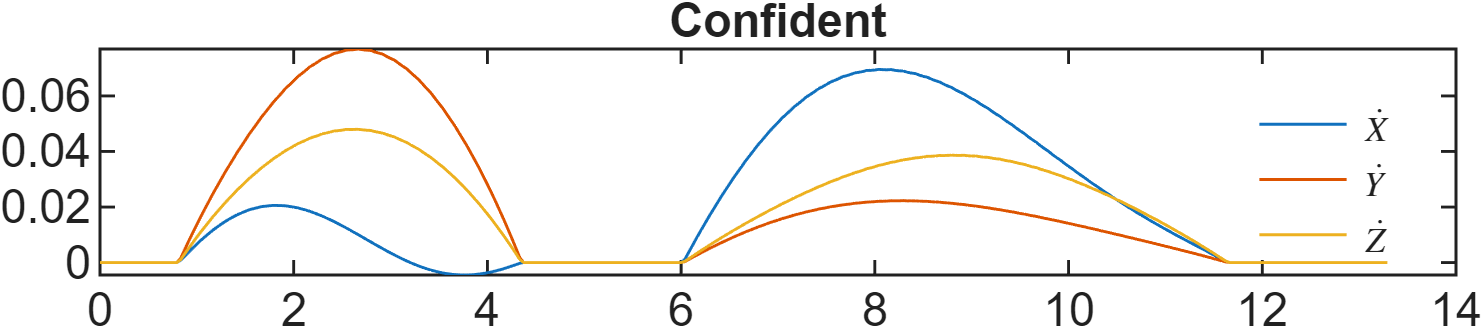
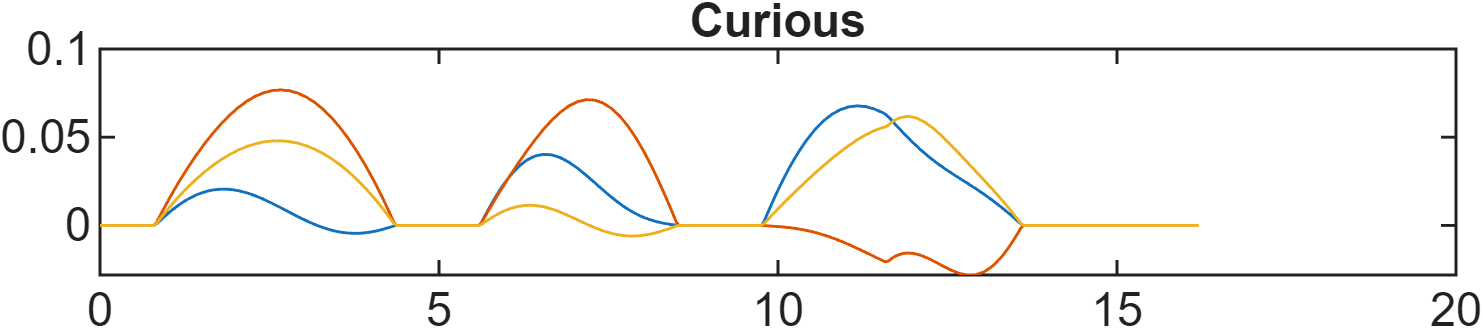
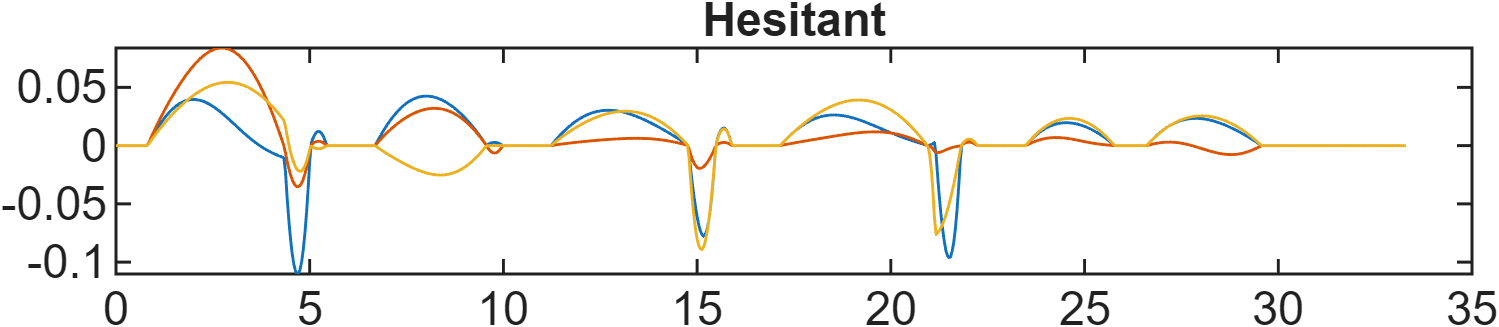
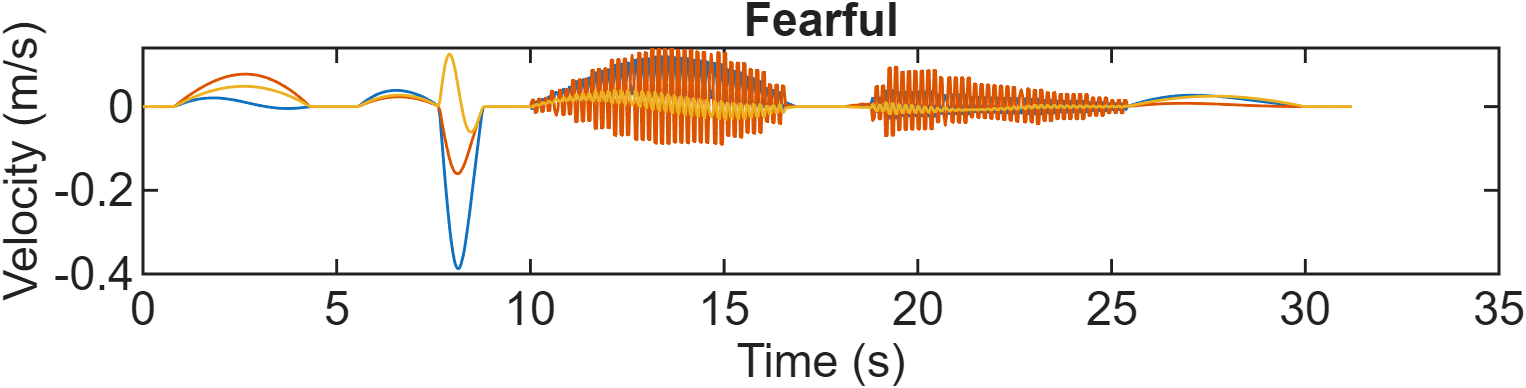
Figure 4: Velocity profiles of the base trajectories of the robotic manipulator during the goal-directed task in the user studies..
| Expressive Descriptor | Confident | Curious | Hesitant | Fearful |
|---|---|---|---|---|
| Approach Acc. (\(\alpha_{approach}\)) [\(m/{s}^2\)] | 0.1 | 0.09 | 0.05 | 0.1 |
| Pause Count (\(n_{pause}\)) [\(-\)] | 1 | 3 | 5 | 4 |
| Pause Duration (\(\tau_{pause}\)) [\(s\)] | 1.67 | 1.25 | 1.67 | 1.25 |
| Retreat Count (\(n_{retreat}\)) [\(-\)] | 0 | 0 | 3 | 1 |
| Retreat Distance (\(d_{retreat}\)) [\(m\)] | N/A | N/A | 0.06 | 0.06 |
| Retreat Acc. (\(\alpha_{retreat}\)) [\(m/{s}^2\)] | N/A | N/A | 0.12 | 2 |
| Horizontal Gaze (\(\theta_H\)) [\(^{\circ}\)] | N/A | 20 | N/A | N/A |
| Vertical Gaze (\(\theta_V\)) [\(^{\circ}\)] | N/A | N/A | N/A | N/A |
| Tilt Angle (\(\chi_{tilt_i}\)) [\(^{\circ}\)] | N/A | N/A | N/A | N/A |
| Tilt Velocity (\(\dot{\chi}_{tilt_i}\)) [\(^{\circ}/s\)] | N/A | N/A | N/A | N/A |
| Shiver Amplitude (\(\chi_{shiver_{j}}\)) [\(^{\circ}\)] | N/A | N/A | N/A | 6 |
0pt
For each expressive behavior, variations with respect to relevant expressive descriptors were designed to test whether changes in the descriptor values affect the intensity of the expressive behaviors.
4.1 Protocol↩︎
The IRB-approved, video-based human perception study was conducted using an online survey platform. Participants completed the study remotely; participation was voluntary, and all responses were collected anonymously without recording personally identifiable information or IP addresses. At the start of the study, participants were presented with an information and consent page outlining the purpose of the research and the nature of the experimental tasks. Upon providing informed consent, participants completed a demographic questionnaire collecting information on age, gender, ethnicity, education level and familiarity with and comfort around robots. Following this, in Part A of the survey, participants were given written instructions explaining that they would observe short video clips of a robot arm executing expressive behaviors and would be asked to evaluate the robot’s behavioral state. The video depicted four base trajectories depicting A-confident, B-curious, C-hesitant, and D-fearful expressions.
Each trial in Part A followed the same structure. The four base trajectory videos were presented simultaneously and played in a continuous loop. Participants were first asked to qualitatively describe the robot’s behavioral state for each expression using their own words for an unbiased evaluation of the robot’s expressivity. They then selected the behavioral state that best described the robot’s behavior from a fixed set of options. Subsequently, participants rated the perceived intensity or degree of the expressed state on a five-point Likert scale. Participants could also select “Others” to input a different perceived behavioral state or choose “None” if they believed the robot did not express any behavioral state through its motion.
In Part B of the survey, the relevant expressive descriptors of each base trajectory were systematically modified one at a time such that the new trajectories differed from the base trajectory along a single descriptor. Participants viewed \(<base, variant>\) trajectory pairs side-by-side. For each pair, participants were asked to select the trajectory, if any, that appeared to express the base behavioral state with greater intensity. This procedure was repeated for all variations of each base trajectory. No time limits were imposed on participant responses. The order of video presentation was randomized across participants to mitigate order and learning effects, while all participants viewed the same set of stimuli. Responses from participants who did not complete the full survey were excluded from subsequent analysis.
4.2 Hypotheses↩︎
This study investigates whether expressive robot motion trajectories can enable a robot to communicate uncertainty and whether expressive descriptors can modulate the intensity of the expressed uncertainty. The following hypotheses were formulated:
H1 (Recognition of Behavioral States from Expressive Robot Motion): The four base robot motion trajectories will be perceived as expressing distinct behavioral states, namely confidence, curiosity, hesitance, and fear, at rates significantly above chance level.
H2 (Effect of Expressive Descriptors on Intensity of Expressive Behaviors): Specific modifications to motion descriptors will result in statistically significant changes in the intensity of the corresponding expressive behaviors.
5 RESULTS↩︎
A total of 74 survey responses were collected. The responses with incomplete progress (\(<100\%\)) were removed (18 responses), and one response was excluded due to an inconsistency. This resulted in 55 valid responses that were used for all subsequent analysis.
5.1 Part A - Recognition of Behavioral States from Expressive Robot Motion↩︎
To examine whether perceived behavioral states differed from chance for each expression, chi-squared goodness-of-fit tests were conducted assuming a uniform distribution across behavioral state categories. The results indicated significant deviations from uniformity for all four expressions (Expression A: \(\chi^2(5)=191.44\), \(p<.001\); Expression B: \(\chi^2(5)=60.75\), \(p<.001\); Expression C: \(\chi^2(5)=94.78\), \(p<.001\)); Expression D: \(\chi^2(5)=118.35\), \(p<.001\);. The corresponding effect sizes were extremely large (Cohen’s \(w=1.05\)-\(1.87\)), indicating substantial departures from chance-level response.
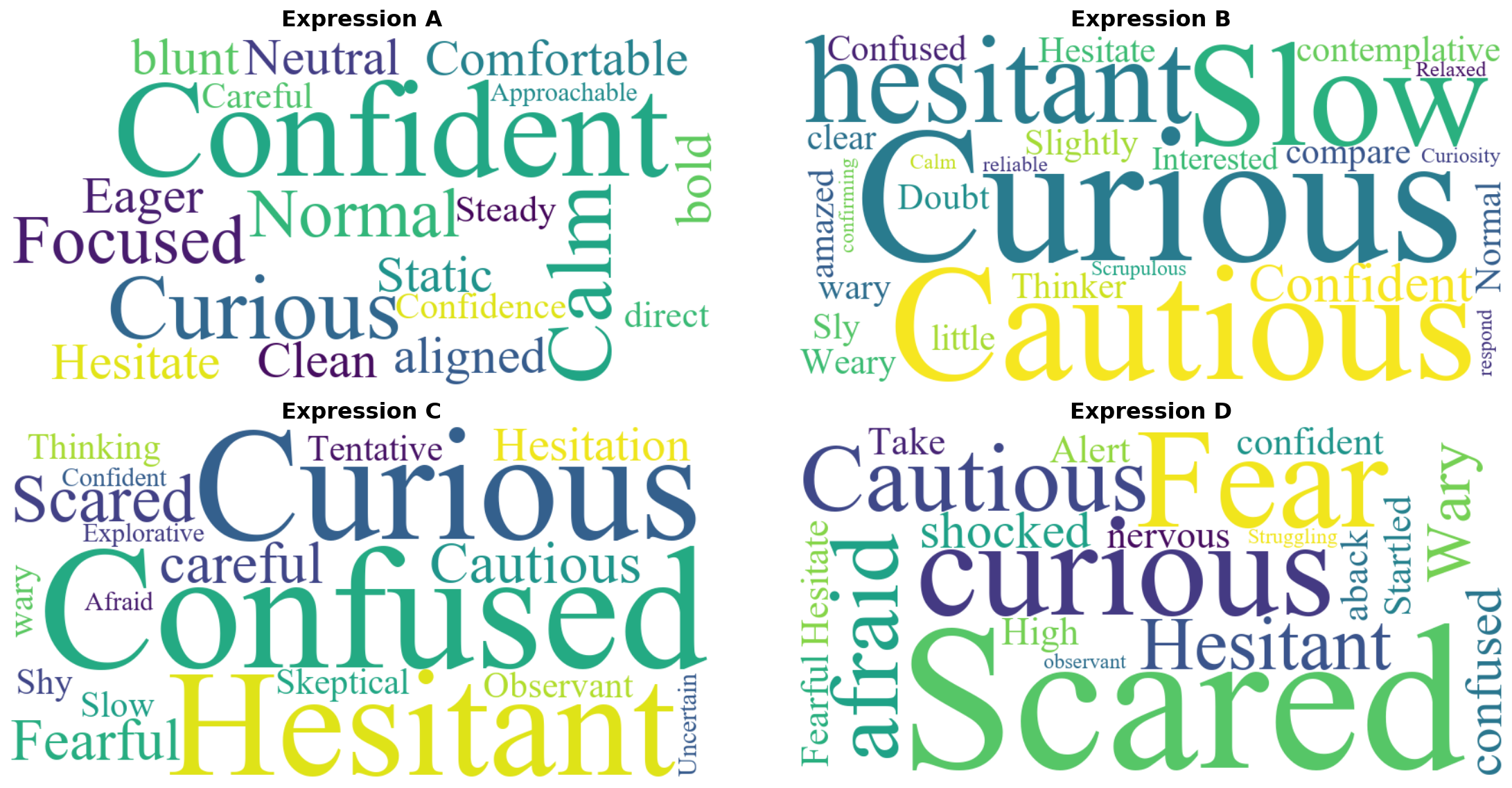
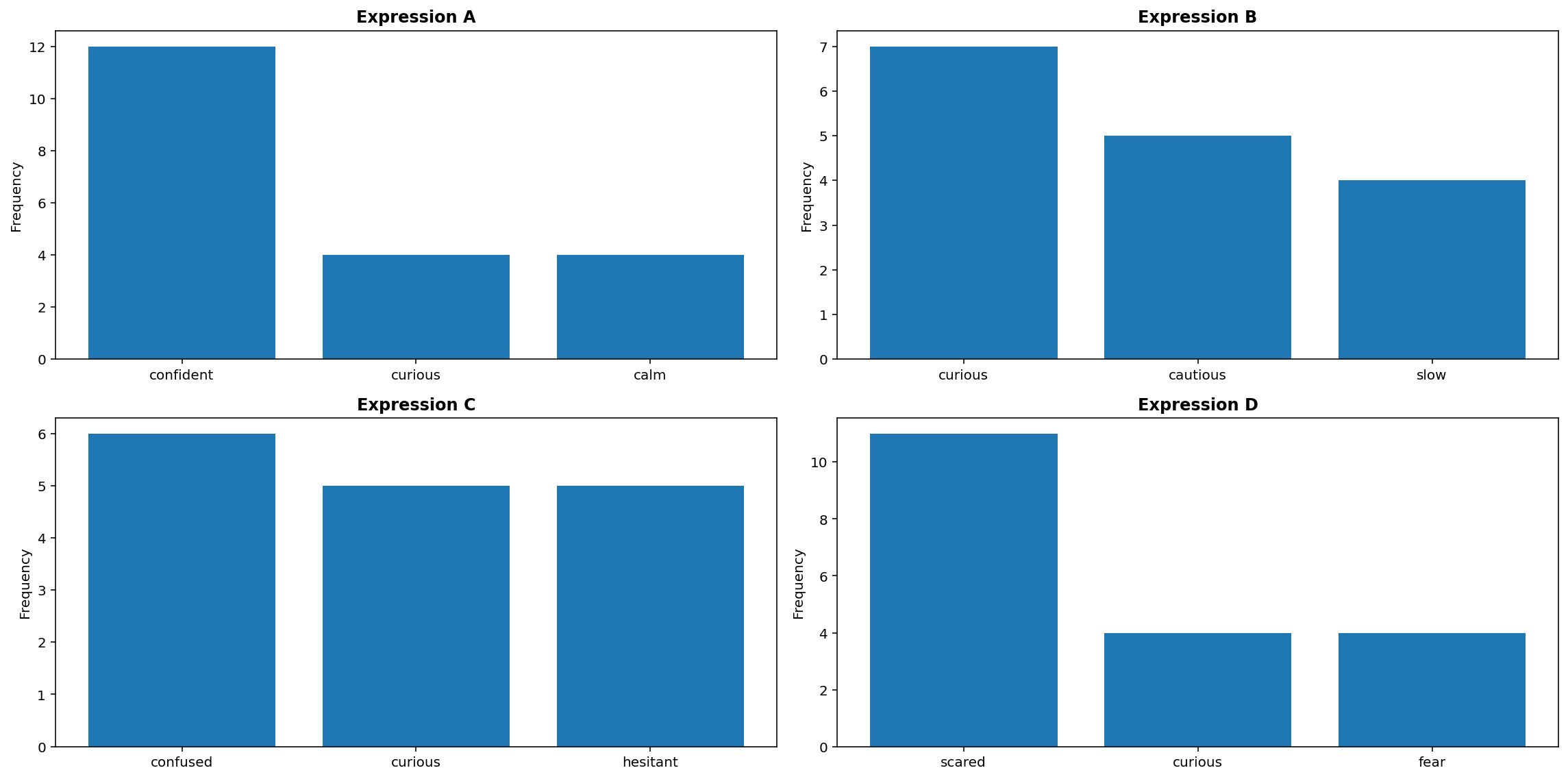
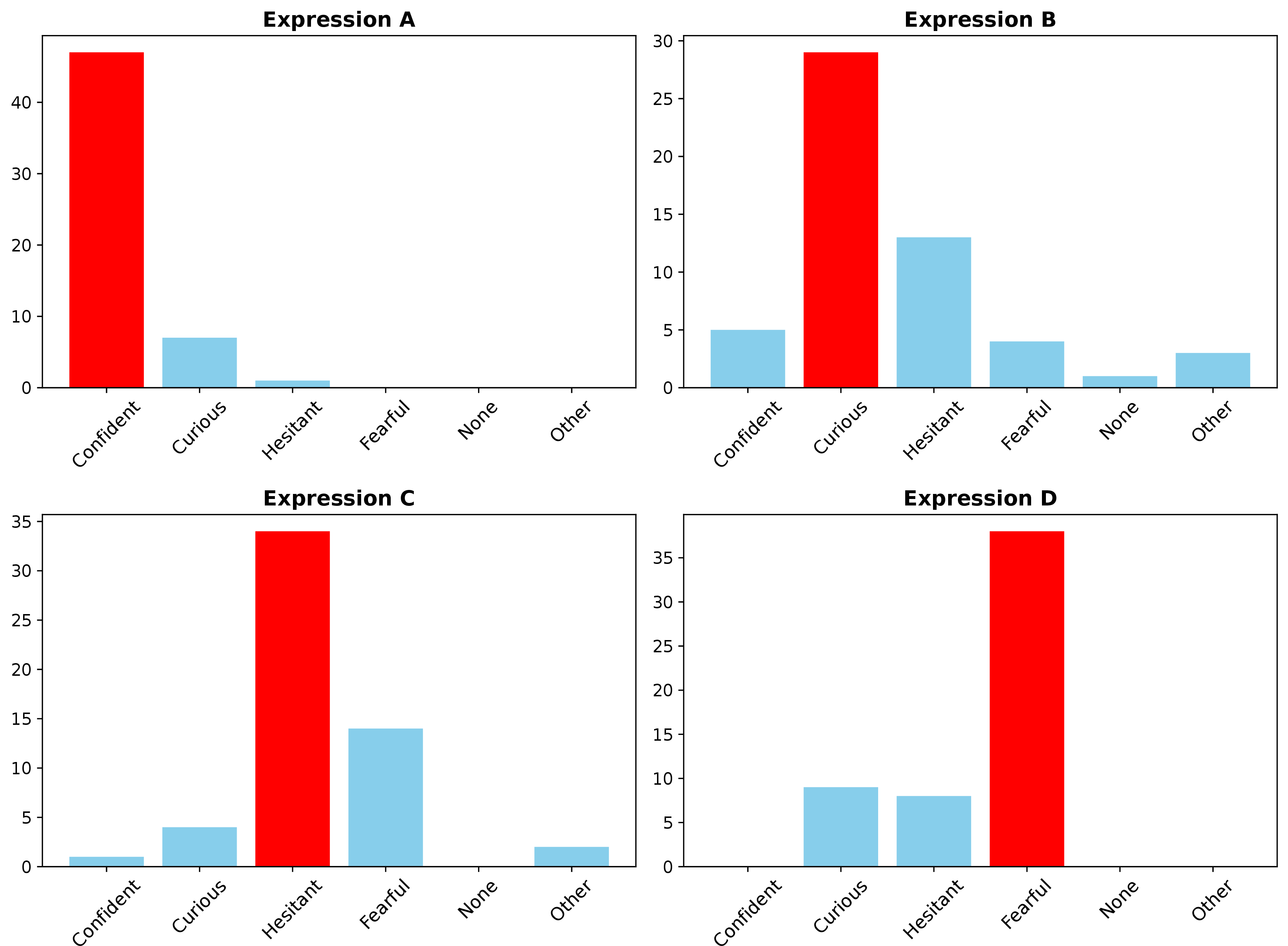
To identify which behavioral state categories contributed to these deviations, post-hoc standardized residuals were examined. Residuals exceeding \(\pm1.96\) were treated as statistically significant and only positive residuals were interpreted. This analysis revealed a single dominant behavioral state for each expression: Confident for Expression A (\(r=12.50\)), Curious for Expression B (\(r=6.55\)) and Hesitant for Expression C (\(r=8.20\)), Fearful for Expression D (\(r=9.52\)). No other category within any expression exceeded the significance threshold.
Finally, a chi-squared test of independence was conducted to assess whether the distribution of perceived behavioral states depended on the expression. The results indicated a significant association between the expression and the perceived behavioral state \(\chi^2(15)=261.22\), \(p<.001\), confirming each expressive trajectory elicited a distinct profile of perceived behavioral state.
5.2 Part B - Effect of Expressive Descriptors on Intensity of Expressive Behaviors↩︎
In Part B, participants compared the base and variant trajectories for each expressive descriptor and selected the more expressive of the two. In each case, chi-squared goodness-of-fit tests were conducted to assess whether responses were uniformly distributed between the four options (Low Descriptor Variant, High Descriptor Variant, Both appear equally confident/curious/hesitant/fearful, Neither appears confident/curious/hesitant/fearful).
Confident: Responses were significantly non-uniform for both motion conditions (PDur: \(\chi^2=101.29\), \(p<.001\); AAcc: \(\chi^2=120.64\), \(p<.001\)). Post-hoc standardized residuals showed that participants perceived motions with shorter pauses (\(r=8.70\)) and greater approach acceleration (\(r=9.51\)) as more confident, while all other response options were under-selected.
Curious: Responses were significantly non-uniform across all motion conditions (PDur: \(\chi^2=26.82\), \(p<.001\); TA: \(\chi^2=50.38\), \(p<.001\); GAH: \(\chi^2=53.29\), \(p<.001\); GAV: \(\chi^2=51.26\), \(p<.001\); AAcc: \(\chi^2=26.38\), \(p<.001\); TS: \(\chi^2=16.78\), \(p<.001\)). Further post-hoc tests showed that participants perceived motions with greater tilt amplitude (\(r=6.00\)), greater horizontal gaze angle (\(r=6.00\)), greater vertical gaze angle (\(r=6.00\)) and faster approach acceleration (\(r=3.03\)) as more curious. The effect of pause duration is inconclusive as both the robots have positive residual greater than \(1.96\). Finally, for tilt speed, no response option exceeded the significance threshold (all \(r < 1.96\)), indicating the absence of a dominant curiosity attribution for this descriptor.
Hesitant: Chi-squared tests indicated significant non-uniformity across all motion conditions (PDur: \(\chi^2=53.44\), \(p<.001\); RD: \(\chi^2=79.18\), \(p<.001\); TA: \(\chi^2=34.09\), \(p<.001\); RC: \(\chi^2=157.15\), \(p<.001\); AAcc: \(\chi^2=58.67\), \(p<.001\); RAcc: \(\chi^2=17.66\), \(p<.001\)). Further post-hoc tests showed that participants perceived motions with longer pauses (\(r=6.00\)), greater retreat distance (\(r=7.62\)), greater retreats count (\(r=10.85\)) and slower approach acceleration (\(6.27\)) as more hesitant. W.r.t tilt amplitude, most people selected “Both appear equally hesitant” (\(r = 4.65\)), suggesting no clear differentiation between the two motion variants. Finally, w.r.t retreat acceleration, no response option exceeded the significance threshold (all \(r \leq 1.96\)), indicating the absence of a dominant hesitation attribution for this descriptor.
Fearful: Significant non-uniformity was observed across all motion conditions (PDur: \(\chi^2=56.06\), \(p<.001\); SA: \(\chi^2=29.44\), \(p<.001\); PC: \(\chi^2=37.29\), \(p<.001\); RC: \(\chi^2=95.04\), \(p<.001\); AAcc: \(\chi^2=55.47\), \(p<.001\); RAcc: \(\chi^2=16.35\), \(p=.001\)). Further post-hoc tests showed that participants perceived motions with longer pauses (\(r=6.27\)), greater number of pauses (\(r=4.92\)) and retreats (\(r=8.43\)) and slower approach acceleration (\(r=6.27\)) as more fearful. W.r.t shiver amplitude, maximum people selected ” Both appear equally fearful” (\(r=4.38\)), suggesting no clear differentiation between the two motion variants. Finally, w.r.t retreat acceleration, no response option exceeded the significant threshold (all \(r < 1.96\)), indicating the absence of a dominant fear attribution in this comparison.
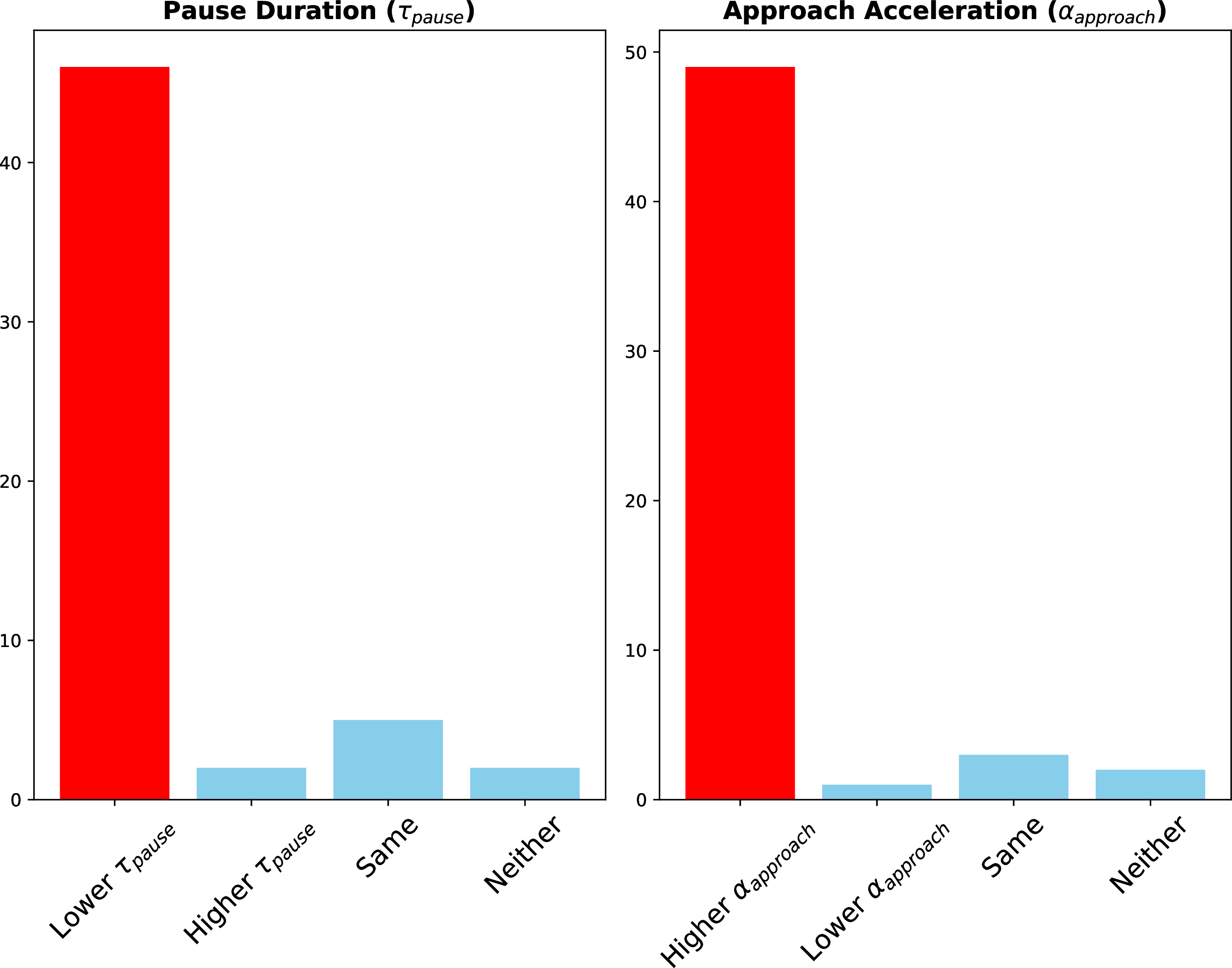
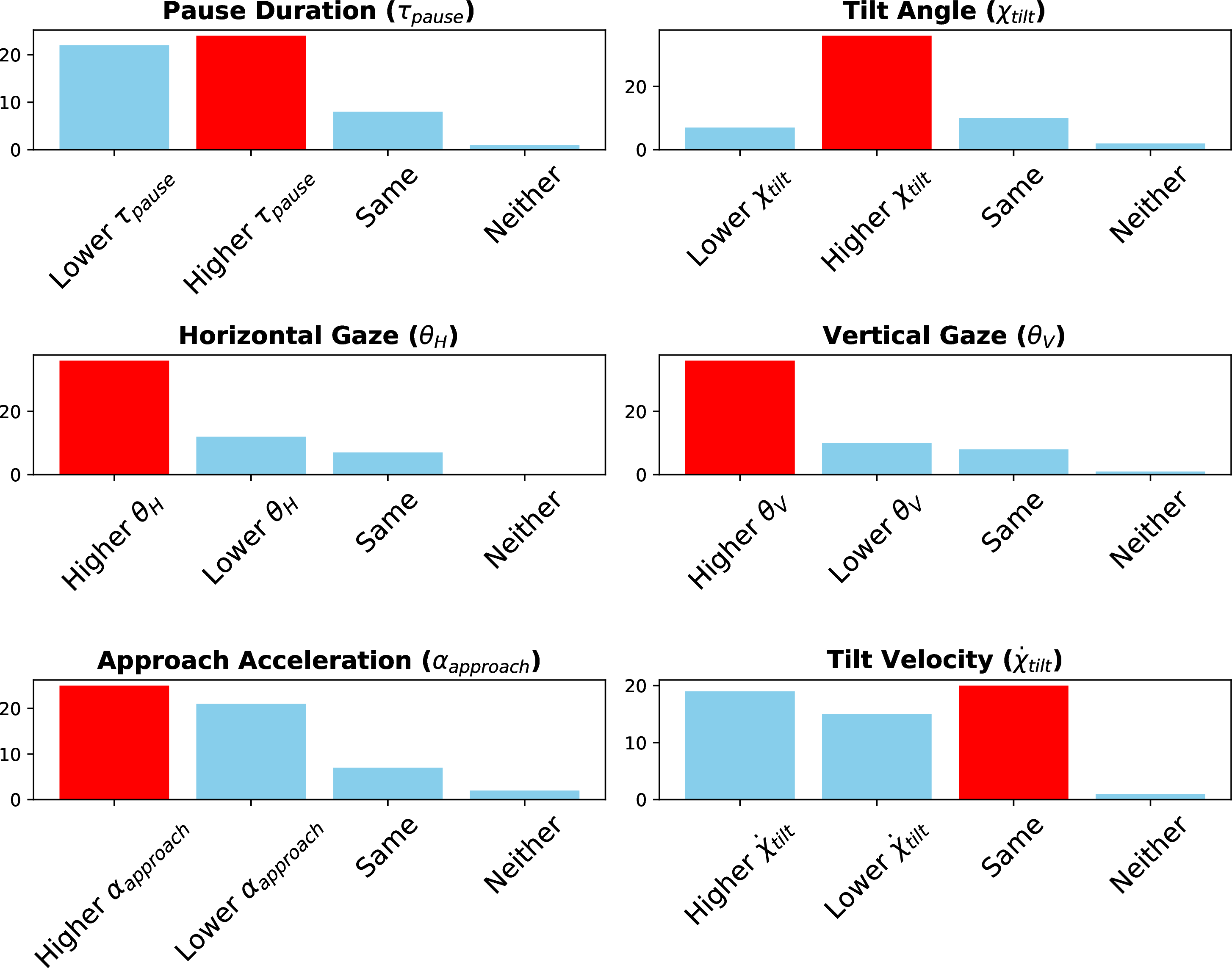
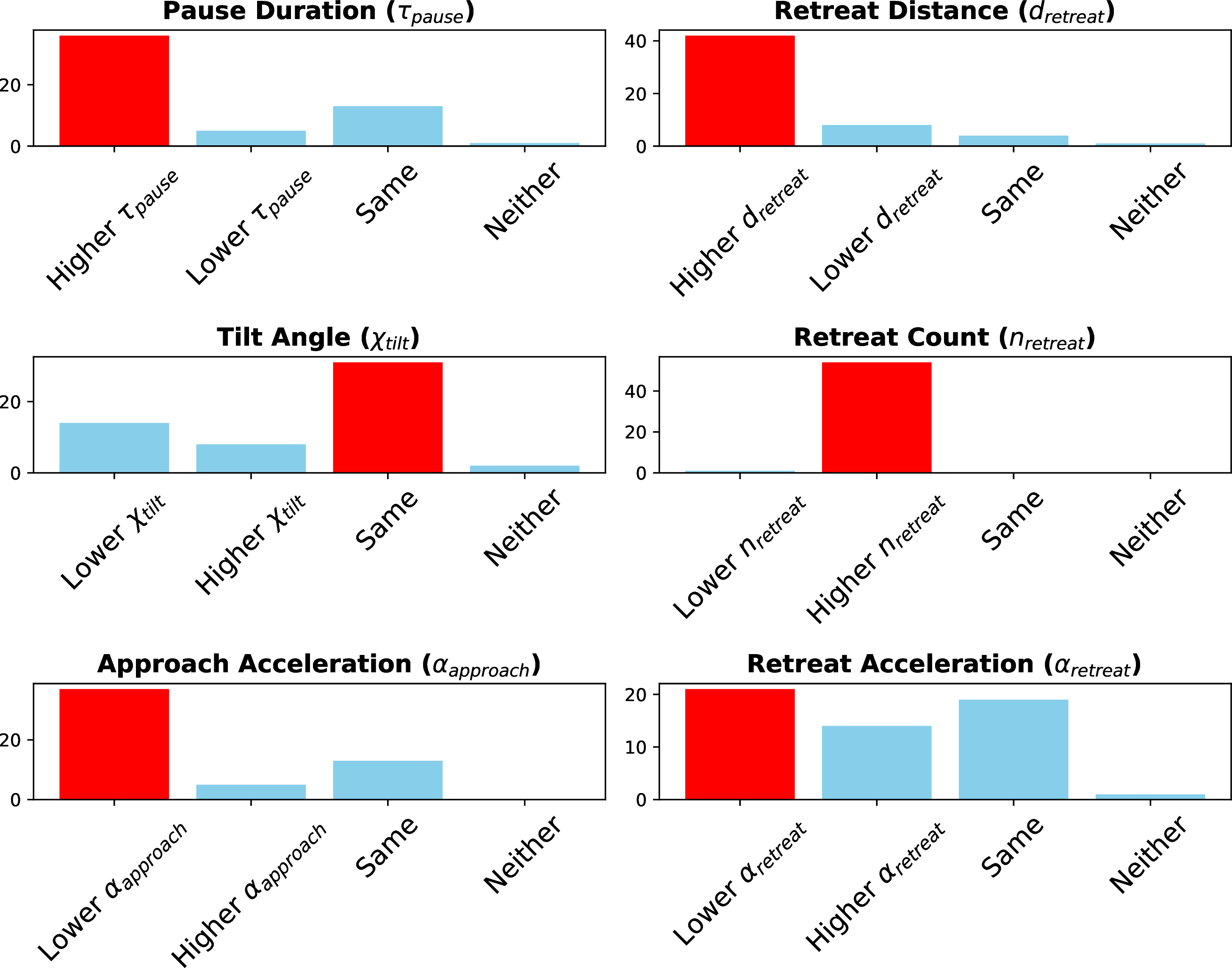

Figure 8: Kinematic variables explored across the four mental states: (a) Confident, (b) Curious, (c) Hesitant, and (d) Fearful.. a — Confident, b — Curious, c — Hesitant, d — Fearful
6 DISCUSSION↩︎
The results demonstrate that expressive robot motion parametrised using expressive descriptors can reliably communicate both the type and intensity of robot behavioral states associated with robot’s perceptual uncertainty of a given task and environment. Across both parts of the study, participants consistently identified the intended behavioral states and were able to perceive changes in the intensity of these expressed behavioral states.
6.1 Interpretation of Part A: Recognition of Behavioral States from Expressive Robot Motion↩︎
The findings from Part A provide strong evidence that the four base trajectories elicited distinct and unambiguous behavioral state attributions. All expressions deviated significantly from a uniform distribution with extremely large effect sizes. Post-hoc analyses revealed a single dominant behavioral state for each expression, with no competing categories reaching significance, suggesting that the expressive motions conveyed clear and interpretable cues. These results directly support H1, confirming that the four base robot motion trajectories were perceived as expressing distinct behavioral states, namely confidence, curiosity, hesitance, and fear, at statistically significant levels.
Moreover, the dominant behaviors identified for each expressive trajectory aligned with the intended forms of perceptual uncertainty:
Confident: The trajectory that is smooth and direct with minimal pauses and faster approach movements was predominantly identified as confident.
Curious: The trajectory designed to depict information-seeking behaviour through exploratory movements was identified predominantly as curious.
Hesitant: The trajectory characterized by repeated pauses, retreats and reduced approach acceleration was predominantly identified as hesitant.
Fearful: The trajectory expressing pronounced avoidance behaviour using increased retreat distance, longer pauses, and more cautious movements was predominantly identified as fearful.
The alignment between motion design intent and participant interpretation supports H1, demonstrating a reliable mapping between expressive robot motion and the behavioral states perceived by the human collaborators.
This multi-component approach appears particularly important for distinguishing between closely related behavioral states associated with uncertainty, such as curiosity, hesitation and fear. Although these states may share overlapping Effort characteristics, such as reduced approach acceleration or increased pause duration, their differentiation relies on differences in spatial orientation, body involvement and shaping behaviour. The strong agreement observed across participants suggests that integrating Body and Space alongside Effort and Shape elevates non-verbal robot motion by enabling fine-grained differentiation between subtly different internal states.
6.2 Interpretation of Part B: Effect of Expressive Descriptors on Intensity of Expressive Behaviors↩︎
Results from Part B demonstrate that the intensity of an expressive motion can be modulated through variations of certain expressive descriptors, thus partially supporting H2.
For confidence, shorter pauses and faster approach acceleration were consistently perceived as more confident, indicating that variations in Effort-Time played a particularly influential role. Such movement patterns mirror human body language linked to decisiveness and commitment, suggesting that less hesitation and more direct forward motion make the robot appear more certain.
In contrast, fear and hesitation were characterised by longer pauses, increased retreats and slower approaches, reflecting pronounced changes in Effort-Time, Effort-Direction, and Shape-Directional components. These motion features correspond to cautious and avoidant behaviour, thereby reflecting uncertainty about the environment. Retreat-related parameters, such as increased retreat distance and frequency, further reflected changes in Shape-Directional that corresponds to increased perception of uncertainty.
Curiosity exhibited a distinct expressive structure that combined exploratory and cautious movement elements. Increased tilt amplitude and variations in horizontal and longitudinal gaze angles strengthened Shape-Directional and Space-Indirect qualities, resulting in greater perceived curiosity. This combination reflects curiosity as a state involving information seeking rather than decisiveness or avoidance behaviors.
6.3 Ambiguous and Non-Dominant Expressive Descriptors↩︎
Not all expressive descriptors produced clear perceptual differentiation across behaviors. In several cases, such as shiver amplitude for fear, retreat acceleration for fear and hesitation, and tilt speed for curiosity, participants either perceived both motion variants to be equally expressive or failed to converge on a dominant response. These findings suggest that certain motion parameters may be perceptually weaker when manipulated in isolation or may require interaction with other descriptors to convey meaningful expressive differences.
Alternatively, the magnitude of variation between motion variants may have been insufficient for these parameters to exceed perceptual thresholds. This observation further underscores the importance of using all LMA components holistically to design expressive robot motion that effectively conveys both the robot’s attention and its internal state intent.
7 CONCLUSIONS↩︎
The findings indicate that perceptual uncertainty is not represented by a single kinematic cue, but emerges from coordinated variations in task commitment and information-seeking behavior. The reliable identification of confident, curious, hesitant, and fearful trajectories suggests that observers interpret uncertainty through structured combinations of approach, interruption, exploration, and withdrawal. Moreover, the descriptor-level results reveal that not all motion parameters contribute equally to perception. Approach acceleration, pause duration, pause and retreat frequency, retreat distance, and gaze amplitude produced comparatively clear changes in perceived expression, whereas isolated variations in retreat acceleration, tilt velocity, and shiver amplitude were less distinguishable. This asymmetry suggests that expressive uncertainty is governed by perceptually prominent combinations of temporal and spatial cues rather than by uniform sensitivity to every measurable trajectory feature. It also indicates that some descriptors may require joint modulation, larger parameter variations, or task-dependent contextualization before producing reliable perceptual effects.
A principal limitation of the present work is that the descriptor values and expressive trajectories were designed manually. Although the proposed anatomical model establishes a mathematical connection between perceptual uncertainty, Commitment-Vigilance states, motion primitives, and observable descriptors, it does not yet autonomously compute the descriptor values required for a robot’s current perceptual condition. Consequently, the generated motions depend on designer interpretation and may not generalize directly across robots, tasks, workspaces, or dynamically changing uncertainty levels. The video-based evaluation additionally measures human interpretation of predefined trajectories rather than closed-loop interaction in which robot perception, motion generation, and human response continuously influence one another.
Future work will therefore focus on representing the expressive trajectories using Dynamic Movement Primitives (DMPs). DMPs can provide a compact parametric formulation that preserves the characteristic structure of an expressive behavior while supporting temporal scaling, spatial adaptation, trajectory blending, and convergence toward task goals. By associating DMP parameters and modulation terms with the proposed expressive descriptors, trajectory generation can be reformulated as an optimization problem conditioned on the robot’s estimated perceptual uncertainty, task constraints, and safety requirements. This would enable the robot to autonomously determine an appropriate expressive trajectory and continuously regulate its intensity as uncertainty changes. The resulting framework could transform the present descriptor model from a motion-design methodology into an adaptive computational mechanism for generating task-effective and perceptually interpretable robot behavior during human-robot collaboration.
References↩︎
*Equal contribution↩︎
\(^{1}\)Authors are with the School Of Art, Design and Media, Nanyang Technological University, 81 Nanyang Drive, Singapore 637458
{ridhima001, souravik001, reeyan.yeoh, jtan511}@e.ntu.edu.sg, bjschmitt@ntu.edu.sg↩︎\(^{2}\)Authors are with the School of Mechanical and Aerospace Engineering, Nanyang Technological University, 50 Nanyang Ave, Block N3, Nanyang Avenue, 639798
{poornima002@e.ntu.edu.sg, d.campolo@ntu.edu.sg}↩︎