Networked Intelligence: Active Shared Context Graphs for Human-AI Team Science
July 14, 2026
Abstract
Most AI-for-science systems focus on scaling a single reasoning process by using better models, larger context windows, long-horizon agentic execution, or digital co-scientists working with one principal user. However, challenging scientific problems are rarely solved by one reasoner alone. They are solved by teams whose members carry different priors, experimental background, tacit knowledge, and domain-trained intuitions. The open problem is therefore not only how to scale models, but how to cultivate networked intelligence, scaling the connections between humans and AI systems so that a result or hypothesis produced in one context reaches another person, agent, instrument or robot that can act on it. We introduce Mycelium, an active shared workspace that automatically connects researchers and AI agents akin to a multi-user co-scientist. As human users and agents work, the system captures important observations and hypotheses, tracks how they relate to the team’s evolving model, and routes them to the person or agent whose next decision they can inform. We evaluate Mycelium in its first empirical test, a biological multi-omics campaign where routed shared context turned a local analytical finding into a cross-expert mechanistic constraint and ultimately into experimental design. We also give networked intelligence a computational account as sparse conditional computation over distributed scientific contexts, which separates when a scaled standalone agent can match the network from when independent expertise and non-merge-able contexts make it irreducible.
1 Introduction↩︎
The next era of scientific discovery requires bridging two defining dimensions: the distributed expertise of team science and the autonomous execution of AI agents operating at machine speed. Most consequential discoveries now require expertise that exceeds what any individual can command, a mode the National Research Council formalized as team science [1]. AI systems have already begun to automate core scientific functions, from protein-structure prediction [2] to experimental chemistry planning and execution [3]–[6]. Consequently, AI-accelerated team science is becoming a national-scale infrastructure priority, with initiatives like the DOE’s Genesis Mission envisioning discovery platforms that connect these isolated tools, instruments, and high-performance computing resources into shared networks [7]–[9]. Scientific agents, tools, and instruments are arriving faster than the network architecture required to coordinate them.
The limiting problem is no longer only whether an individual AI system can reason, but whether scientific context can move faithfully across humans, agents, and instruments while a team is still discovering. Existing AI co-scientists and autonomous laboratory workflows largely remain bounded by a single scientist’s AI session or an orchestrated agent team [10], [11], even as the overarching scientific mission is distributed across specialists and still advances through slow, human-mediated exchange [12], [13]. As agents take on longer and more autonomous investigations [14], coordination becomes an architectural bottleneck that model scaling alone does not remove: a model in one scientist’s session can summarize local work, but it has no runtime mechanism for deciding when a finding should change another scientist’s analysis, maintaining the team’s evolving hypotheses as persistent shared state, or guaranteeing that a propagated claim carries the provenance required for reuse. Agent-communication protocols such as the Model Context Protocol and Agent-to-Agent Protocol standardize how tools and agents discover or route tasks [15]–[17], while emerging memory layers persist an agent’s own state across sessions [18]–[20]. What remains missing is a runtime architecture for networked intelligence: scientific context that can move across humans, agents, and instruments while remaining attributable, contestable, and actionable.
We introduce Mycelium, a runtime architecture for networked human–AI scientific discovery built around an active context graph (ACG). The graph represents shared scientific context as provenance-aware project state: typed entries record observations, interpretations, hypotheses, findings, open questions, recommendations, and experiment proposals together with their derivation history.
Mycelium makes three operations explicit: cross-user state routing, in which context generated in one participant’s work can be surfaced to another when it is relevant; persistent hypothesis state, in which the team’s evolving mechanistic model survives across sessions and actors; and provenance-bounded propagation, in which every routed claim remains tied to the evidence and reasoning that produced it. Researchers and AI agents can read from and write to this shared graph through ordinary chat interfaces. As human and agentic users modify the graph through their work, Mycelium periodically discovers connections among entries, updates the network state, and surfaces goal-relevant context to the users or agents whose next decisions it can inform.
We show that scaling the network, rather than just the model, alters the trajectory of an active scientific investigation. To isolate the value of this networked architecture, we compare Mycelium against an adversarial baseline: a standalone agent given identical data and prompted to reason across all domains with maximum resource and autonomy. We evaluate Mycelium in a multi-omics microbial campaign [21] in which three researchers with complementary expertise in proteomics, regulatory biology, and genetics worked asynchronously through their own chat interfaces alongside autonomous Mycelium investigations. Although the system is domain-neutral by construction, this campaign provides its first empirical test.
In this paper, we first define the requirements for active shared-context networks and present the Mycelium architecture (Section 2). In Section 3, we detail this empirical test, demonstrating how routed context changed scientific interpretation and experimental action compared to the standalone-agent baseline. Finally, we formalize networked intelligence as sparse conditional computation, clarifying the strict boundaries where independent expertise makes a network irreducible to a single scaled model (Section 4).
2 Methods↩︎
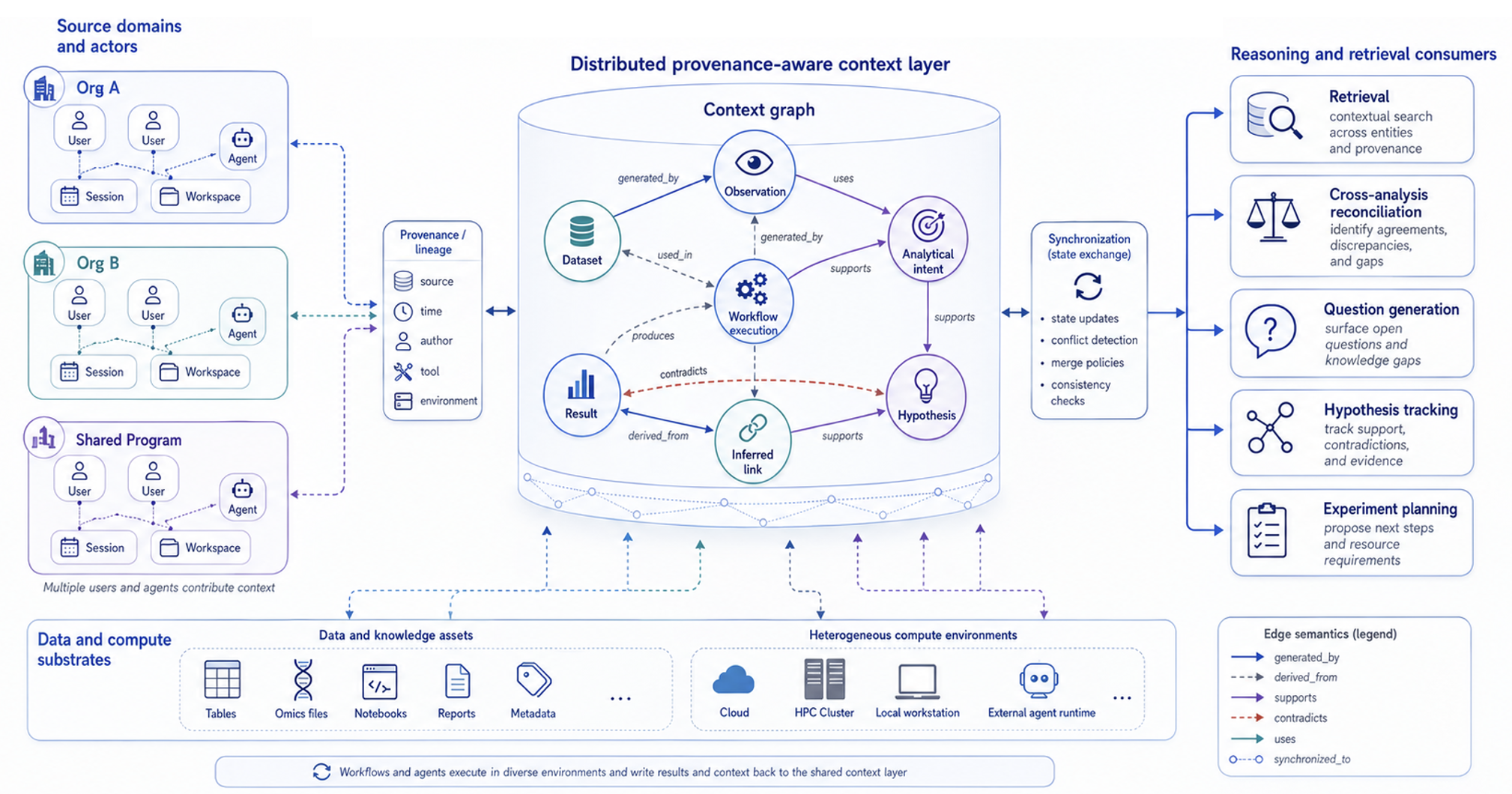
Mycelium implements a runtime architecture for networked human-AI scientific discovery (Fig. 1). The architecture is built on three distinct pillars: (1) an active context graph that holds the shared scientific state and enforces provenance (Section 2.1); (2) a participant-facing runtime that connects researchers’ standard AI chatbot clients to the server-side execution environment (Section 2.2); and (3) a set of shared-context protocols, the agentic primitives that autonomously inject, maintain, and route state across the distributed team (Section 2.3).
2.1 Active context graph↩︎
The key enabler of networked intelligence is an active context graph, representing the shared project state as a directed graph, \(G=(V, E)\). The nodes \(V\) represent typed
scientific entries, each carrying an epistemic role (e.g., evidence, reasoning, action) as defined by a closed ontology (Table 1). The edges \(E\) map the provenance and
cross-session derivations using strict semantics (e.g., generated_by, derived_from, supports, as shown in Fig. 1), explicitly linking every new claim to the exact data, user, agent,
or tool execution that produced it.
| Entry Type | Role | Description |
|---|---|---|
| dataset | Evidence | A registered data file or measurement table. |
| observation | Evidence | A raw or auto-captured analytical result. |
| interpretation | Reasoning | A participant’s reading of an observation. |
| hypothesis | Reasoning | A testable claim. |
| finding | Knowledge | An established result. |
| open_question | Coordination | A blocking question or knowledge gap. |
| recommendation | Action | A proposed next action. |
| experiment_proposal | Action | A structured experiment with required resources. |
We term this graph active because the Mycelium runtime continuously evolves and evaluates the state, unlike a passive graph database. Specifically, the runtime executes three operations over this graph that are unavailable to standalone-agent sessions: Cross-user state routing dynamically moves relevant context from an originating participant or process to the participant whose analysis it impacts, without requiring explicit requests. Evolving hypothesis state maintains the team’s claims alongside supporting and contradicting evidence across independent sessions. Provenance-bounded propagation ensures that as claims are routed, they retain the lineage, tool chain, and attribution required for evaluation and reuse. Consequently, every downstream interpretation or proposed experiment is formally grounded in prior graph context, ensuring the entire collaborative lineage remains physically auditable.
2.2 Runtime infrastructure for autonomous analytical execution↩︎
Users interface with Mycelium through a standard AI chat client connected via the Model Context Protocol (MCP) (Fig. 2 (a)).

Figure 2: No caption. a — Participant-facing runtime. Researchers interact with the Mycelium network using a standard, familiar AI chat interface. Rather than functioning as an isolated chatbot, the Model Context Protocol (MCP) connects this chat window directly to the team’s shared active context graph. This allows a user to query the entire project’s history, dispatch complex autonomous workflows, and review results, all without leaving a simple conversational interface.
However, unlike standard chat models that lose context when a window closes, this runtime binds the client to the active context graph through a suite of stateful agentic tools. This allows the user’s interface to seamlessly query the shared project state, dispatch autonomous workflows, and formally commit new findings.
To execute complex analytical workflows, the server-side runtime relies predominantly on dynamic, on-the-fly code generation within a sandboxed Python environment (Fig. 3 (a)). The runtime integrates project-specific tools for standard tasks (e.g., data ingestion, PCA, differential abundance, and metabolic-pathway queries), preferentially leveraging validated library functions to enforce scientific reproducibility. It generates novel execution graphs only when a workflow demands analytical motifs that are unavailable. Crucially, this autonomous execution includes automated error recovery: if a programmatic step fails due to data inconsistencies or runtime exceptions, the system autonomously reads the error trace, generates a corrective script, and resumes execution. Because the system is strictly schema-aware, it programmatically verifies all data structures prior to interaction and emits a fully executable Jupyter notebook of its trace upon completion. This ensures that every autonomous discovery remains fully reproducible and auditable by a human expert.
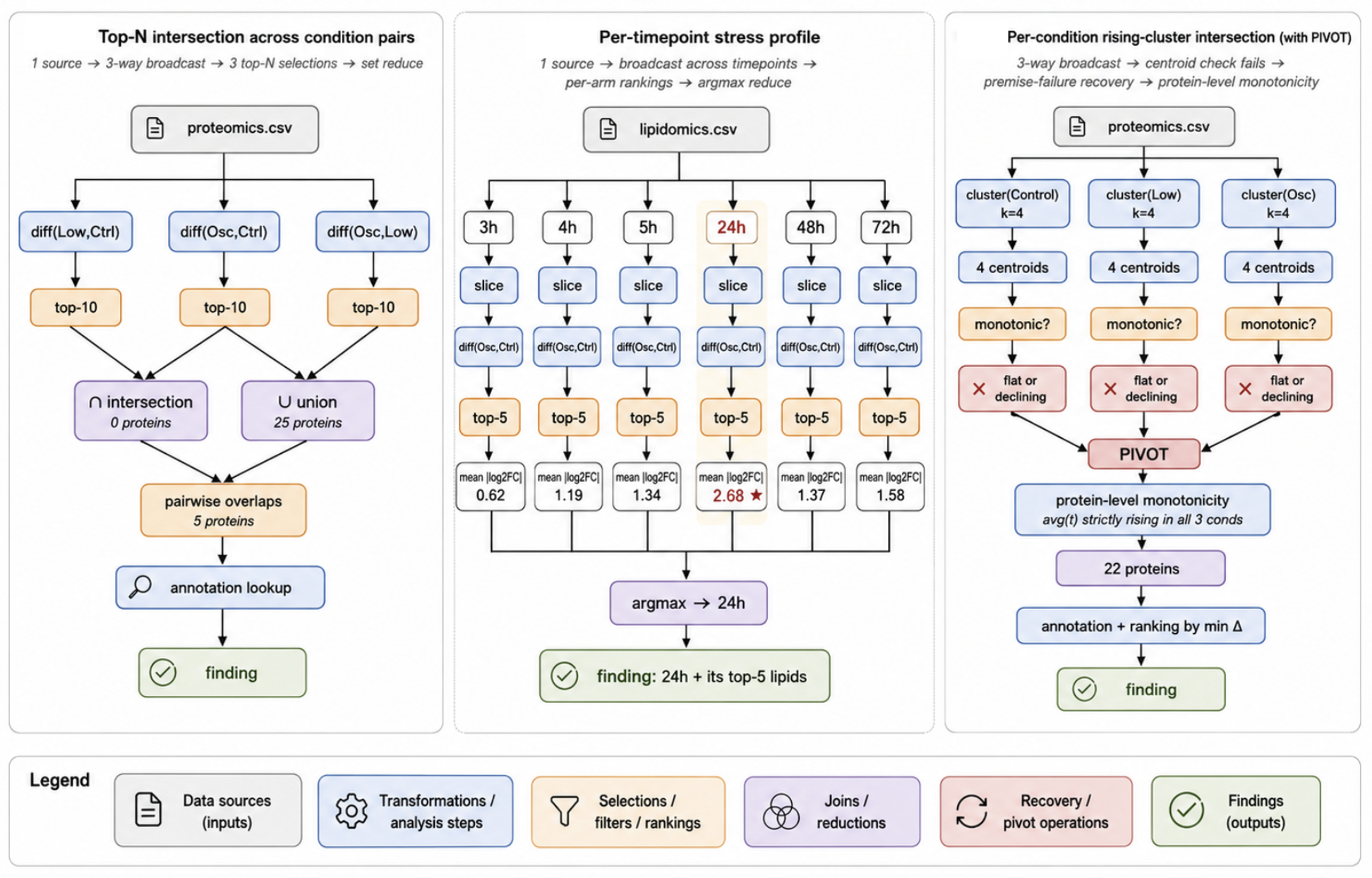
Figure 3: No caption. a — Autonomous workflow execution. The Mycelium runtime leverages dynamic code generation to construct multi-step analytical pipelines on the fly for both interactive and autonomous analysis. The figure above shows illustrative computational dataflow graphs. The execution engine supports automated fault tolerance, allowing the system to recover from runtime errors and successfully output formalized findings to the shared project state.
2.3 Shared-context protocols↩︎
Four operational primitives define how scientific state enters, moves through, and is reused across the Mycelium network. Together, these primitives make the active context graph more than a shared memory store: they specify how claims become auditable state, how autonomous work remains bounded, how relevant context reaches the right recipient, and how synthesized claims remain tied to evidence.
Provenance (Logging). The runtime enforces strict provenance by converting analytical executions into persistent, queryable state nodes. When a human or agent executes a task, the system automatically captures the result as an immutable observation bound exactly to its parameter space, tool chain, and dataset references.
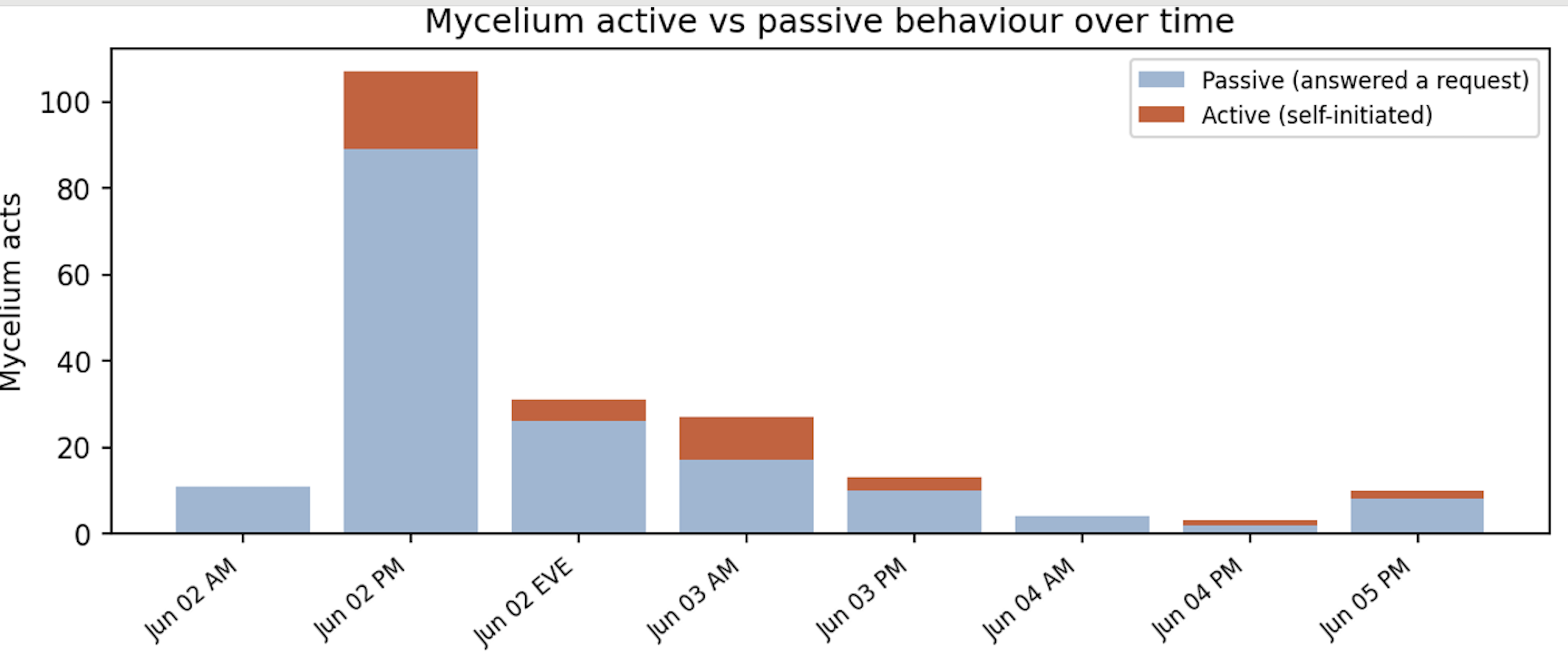
Bounded autonomy (Proactive Execution). The runtime continuously monitors for emerging knowledge gaps and launches autonomous exploratory analyses between active user sessions (Fig. 7 in Supplementary Methods). When a structural defect or missing link is detected in the data, the agent autonomously plans and executes a corrective task. The rectified result is then persisted to the active context graph, cleanly surfacing for the participant as an actionable finding upon their next session.
State-routing (Pollination). The defining capability of the network is the asynchronous routing of emerging context to relevant participants (see Fig. 6 in Supplementary Methods). To achieve this without overwhelming users, the system evaluates new candidate linkages against localized belief states to score their epistemic utility—determining if a new observation supports, refines, or introduces tension to a specific researcher’s ongoing analysis. Algorithmically, this scoring-and-updating operation across neighboring threads acts as a message-passing step [22], [23]. However, unlike standard graph algorithms that average signals into a single joint distribution, this architecture deliberately preserves disagreement. Belief states remain isolated to their respective threads, ensuring that scientific contradictions across distinct analytical lenses remain distinct objects of attention rather than being silently merged.
Grounding (Persistence). To maintain the network’s analytical precision, the runtime enforces strict validation at the graph-write layer for all scientific entries (e.g., hypothesis, observation,
finding, experiment_proposal). Every entry committed to the active context graph must be explicitly grounded in existing graph nodes, such as registered datasets, verified tool outputs, or provenance-bearing parent entries. By
mandating this referential grounding, the architecture ensures that all synthesized claims retain their empirical lineage, directly increasing the specificity of generated scientific artifacts and preventing the accumulation of ungrounded, unstructured
prose within the project state.
3 Results↩︎
We frame the test of networked intelligence as a domain-neutral coordination problem: whether shared context routed via an active context graph can change scientific interpretation and experimental action across distributed users. We evaluated this against specific, testable outcomes: a local result must not merely be stored; it must reach the specific human or agent context where it becomes an actionable constraint, shifts an interpretation, or alters an experimental decision.
As a case study, we deployed Mycelium in a microbial multi-omics campaign investigating secreted gluconate accumulation [24] in Pseudomonas putida, an industrial bioproduction chassis [25]. The objective was to extract actionable insights across four data modalities to inform the next round of strain and medium designs for PNNL’s Anaerobic Microbial Phenotyping Platform (AMP2) [6], [7]. In the following subsections, we first detail the distributed scientific setup (Section 3.1). Next, we analyze the empirical impact of active context routing on the team’s scientific findings (Section 3.2). Finally, we benchmark this networked execution against standalone-agent baselines to quantitatively and qualitatively isolate the value of network scaling over model scaling (Section 3.3).
3.1 Scientific campaign setup↩︎
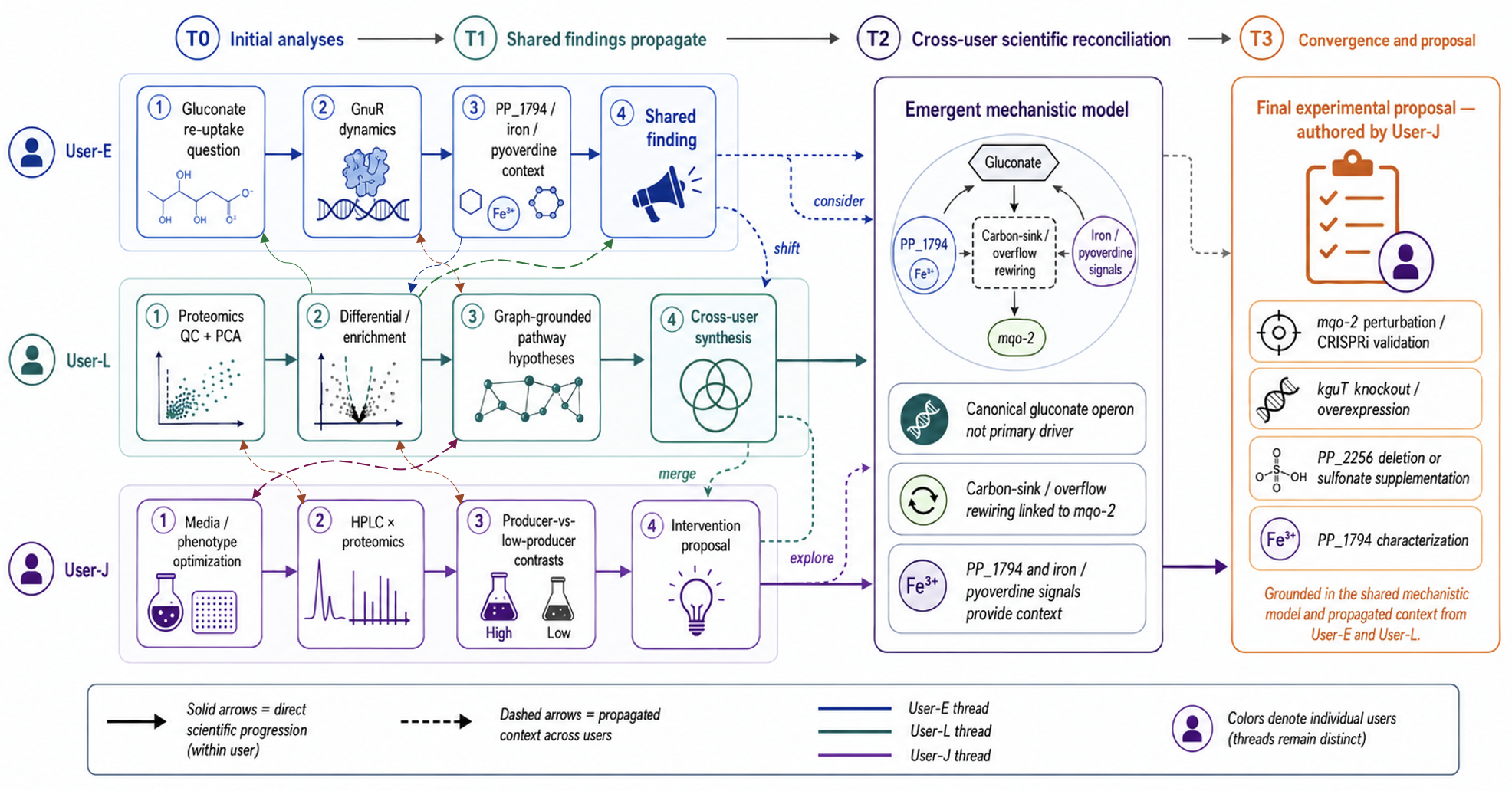
In this deployment, three domain experts analyzed the campaign asynchronously over one week via independent chat interfaces (Fig. 4). Broadly, User-L performed proteomics and systems analysis over a differential-abundance dataset of 4,495 proteins across 62 samples; User-E provided regulatory and iron-biology reasoning; and User-J contributed phenotype interpretation and experimental design, including high-performance liquid chromatography (HPLC) assays, among other analyses detailed below. The campaign spans four data modalities across four engineered strains (Supplementary Table 4). All researchers worked through Claude Chat-based Mycelium client (as shown in Fig. 2 (a)). All client and server-side Mycelium operations used Claude Opus 4.8.
3.2 Solving team coordination challenges via shared context propagation↩︎
Team science ultimately hinges on two familiar coordination challenges: reconciling distributed findings across isolated domains, and producing synergistic outcomes that a single researcher cannot achieve alone. The following results show how Mycelium addressed both.
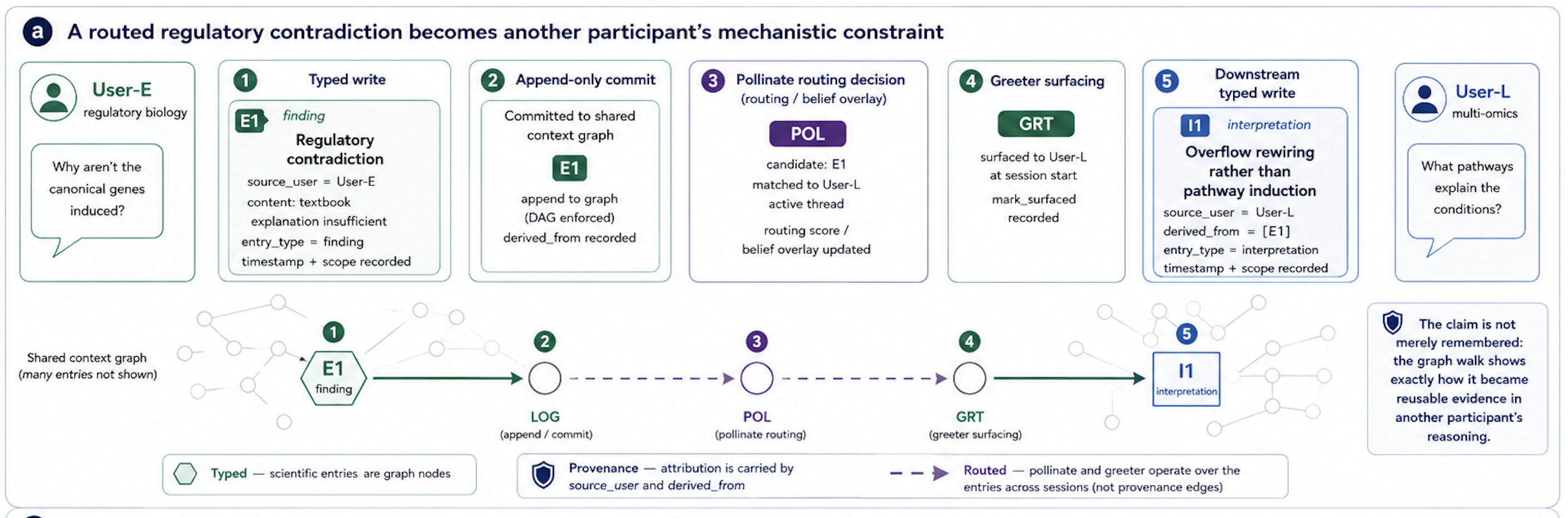
Reconciling multiple sources of evidence: The first routing event demonstrated how the network converts an isolated negative result into highly confident corroborating evidence. User-E (focusing on biological regulation) noted that the
expected genetic pathways for processing the target chemical (canonical gluconate-uptake and Entner-Doudoroff pathway) were not turning on as anticipated [24]. When routed into User-L’s thread, this regulatory anomaly recontextualized an independent, confusing finding: the corresponding proteins were also absent from the top proteomic signals. Combined via a
derived_from edge, these isolated observations successfully reconciled a 12-h regulatory differential with 24-h proteomics. Fig. 4 shows this interaction from User-E’s regulatory thread (top row) through
User-L’s proteomic analysis to the emergent model (T2).
Proving synergistic effects and team constraints: The second routing event demonstrated how cross-domain synergy shifts an entire analytical approach. User-J (focusing on physical outcomes) uploaded chemical measurements (HPLC) that clearly distinguished successful, high-producing bacterial strains from low-producing ones. When this constraint was routed into User-L’s workspace, it reframed the proteomic analysis. It shifted User-L’s synthesis from a standard protein-ranking problem to an intervention problem, forcing the identification of testable molecular mechanisms that explained the measurable extracellular accumulation. This is shown in Fig. 4, where evidence from User-J’s phenotype thread (bottom row) is routed into User-L’s analysis.
Steering the team to convergence: In the campaign, continuous routing assembled a mechanistic model held by no single participant. User-E supplied the regulatory contradiction; User-L provided proteomic evidence for carbon-sink rewiring; and User-J imposed the phenotype constraint. The converged model established gluconate retention and re-assimilation rather than synthesis, as the core focus. Shared context also revealed a new finding: sulfonate-scavenging and sulfur-metabolism proteins [26] were consistently elevated in producing strains. The network also pruned false leads; for example, cross-checking gene identifiers against growth-state signatures led to redirection of a control variable to a characterization marker (Emergent mechanistic model panel, Fig. 4).
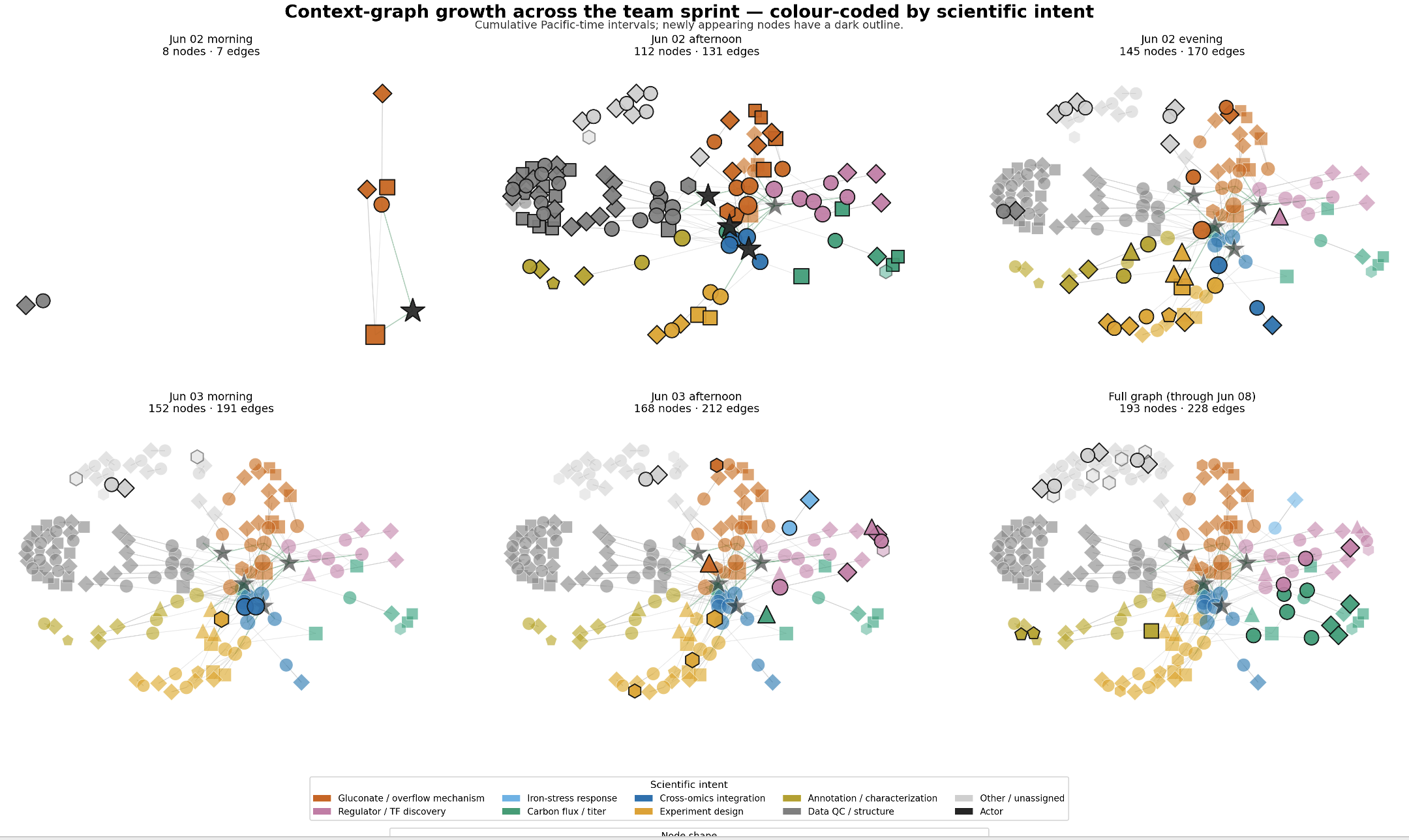
Actionable recommendations grounded in distributed evidence: The shared model materialized as an experiment plan authored by User-J, with Fig. 4 tracing the three expert threads through the converged model (T2) into the final proposal (T3). The proposal mapped each model element to an intervention: mqo-2 perturbation/CRISPRi (overflow node), kguT knockout/overexpression (import/re-assimilation), PP_2256 deletion or sulfonate supplementation (stress context), and PP_1794 characterization. Fig. 5 visualizes the team effort as the active context graph evolves from isolated analyses toward integrated experimental design.
3.3 Impact of network scaling↩︎
Benchmarking network scaling against model scaling: To isolate the architectural advantage of networked intelligence, we benchmarked the Mycelium-supported team sprint against two single agent autonomous baselines. The objective was to
determine whether a standalone model, given identical data, maximum reasoning effort, and unconstrained autonomy could subsume the function of a distributed human-AI network. All executions used Claude Opus 4.8. Baseline B was explicitly prompted with the
multidisciplinary team specification, and baseline C was instructed to reason solely based on goal and data specification, without team specification (see Box S1 in Supplementary Method for full prompt). The single agent baselines were configured for
autonomous operation with maximum reasoning effort (xhigh) and adaptive thinking [27]; Mycelium was run
with the default high setting for inference cost and consistency. Both baselines ran to natural termination without hitting computational limits and successfully produced mechanistically grounded findings.
| Metric | Mycelium | Standalone Agent B | Standalone Agent C |
|---|---|---|---|
| Artifacts surfaced (\(>0\)) | 25 | 17 | 18 |
| Evidence-grounded or better (\(\geq 2\)) | 22 | 14 | 15 |
| Experiment-ready or better (\(\geq 3\)) | 17 | 9 | 11 |
| Actionable decision rule (\(=4\)) | 4 | 2 | 3 |
| Coverage-weighted artifact score (absences = 0) | 2.62 | 1.62 | 1.81 |
| Average specificity of surfaced artifacts | 2.72 | 2.47 | 2.61 |
Auditing the evidence-to-action pipeline: We evaluated these executions by extracting a global set of 26 unique “scientific artifacts”, defined as any traceable analytical claim, mechanistic hypothesis, or actionable decision rule capable of directing laboratory action. Each execution trace was scored from 0 (absent) to 4 (actionable, data-backed rationale) (Table 2; full matrix in Table 3). This rubric captures the evidence-to-action pipeline rather than final-answer similarity alone [28]–[31], and deliberately isolates two metrics: breadth (the fraction of the 26 artifacts explicitly surfaced) and specificity (the depth to which a surfaced artifact was developed). Because expert teams and autonomous models both possess tacit knowledge they may not explicitly articulate, this matrix functions strictly as an audit of explicit evidence-to-action coverage rather than a measure of latent capability.
Networked execution expands discovery breadth: Networked execution increased artifact breadth while preserving comparable specificity among the artifacts it surfaced. Mycelium generated 25 artifacts, including 22 evidence-grounded or better and 17 experiment-ready, compared with 17 present and 9 experiment-ready for baseline B and 18 present and 11 experiment-ready for baseline C. As a coverage-weighted summary, the mean score over the full 26-artifact set, with absences scored as zero, was higher for Mycelium (2.62) than for baseline B (1.62) or baseline C (1.81). This distinction is critical: unlike convergent tasks with definitive completion states (such as software engineering benchmarks [32]), open-ended scientific discovery relies on systemic exploration and continuous feedback to expose and correct analytical blind spots.
A complementary scaling axis: Crucially, when the standalone baselines successfully surfaced an artifact, they developed it with a specificity entirely comparable to the networked team (average specificity: 2.72 for Mycelium vs. 2.47 and 2.61 for the baselines). This proves the single-context baselines were not superficial reasoners; their limitation was purely exploration breadth during open-ended discovery. Notably, baseline C (which received no team-composition framing) outperformed baseline B (which was explicitly instructed to integrate findings as a multidisciplinary team would) in both artifact breadth and specificity.
| ID | Scientific Artifact | Technical Category | A | B | C |
|---|---|---|---|---|---|
| A01 | Nitrogen dominance over organic-acid and gluconate output | Bioprocess Engineering | |||
| A02 | Quantitative iron impact on organic-acid yield and saturation | Bioprocess Engineering | |||
| A03 | Iron gating mechanism of gluconate-to-organic-acid flux | Metabolic Mechanisms | |||
| A04 | Primary gluconate carbon routing via 2-ketogluconate branch | Metabolic Mechanisms | |||
| A05 | Ranked validation design for N \(\times\) Fe with directional controls | Exp. Design & QC | |||
| A06 | Constitutive dCas12a strain for slow-uptake/succinate platform | Strain Engineering | |||
| A07 | Landing-pad lineage optimization for glucose-to-gluconate conversion | Strain Engineering | |||
| A08 | mqo-2 malate-node CRISPRi target and promoter verification | Strain Engineering | |||
| A09 | PtxS CRISPRi targeting for the 2-ketogluconate carbon sink | Strain Engineering | |||
| A10 | CRISPRi chassis and perturbation selection for validation | Strain Engineering | |||
| A11 | Discovery of unannotated producer-associated protein PP_1794 | Strain Engineering | |||
| A12 | HPLC–proteomics discordance in gluconate accumulation | Metabolic Mechanisms | |||
| A13 | Lack of canonical gluconate/ED operon induction at 12 hours | Metabolic Mechanisms | |||
| A14 | Identification of formate as a low-nitrogen metabolic byproduct | Analytical Chemistry | |||
| A15 | Integration of 2-ketogluconate as a targeted HPLC analyte | Analytical Chemistry | |||
| A16 | Anaerobic-AMP2 vs. obligate-aerobe platform compatibility risk | Bioprocess Engineering | |||
| A17 | Proteomics quality control, PCA packages, and imputation rules | Exp. Design & QC | |||
| A18 | Genome-wide differential abundance and GO-enrichment packages | Exp. Design & QC | |||
| A19 | GnuR regulatory identity correction and specificity checks | Exp. Design & QC | |||
| A20 | Sulfonate supplementation assays to modulate gluconate yields | Strain Engineering | |||
| A21 | Targeted kguT knockout or overexpression strategies | Strain Engineering | |||
| A22 | Characterization of PP_2256/dctA-III regulatory island | Strain Engineering | |||
| A23 | Inoculum nitrogen carry-over mitigation and experimental control | Exp. Design & QC | |||
| A24 | Baseline evaluation of headroom for future yield optimization | Bioprocess Engineering | |||
| A25 | Regulatory hypothesis for FnrB redox malate-node governor | Metabolic Mechanisms | |||
| A26 | Unit reconciliation for FeCl\(_3\) across datasets and text | Exp. Design & QC |
4pt
4 Discussion↩︎
Networked intelligence accelerates discovery not by expanding model context, but by actively routing scientific state to alter experimental action. In this deployment, a shared active context graph enabled three domain experts to converge on a mechanistic model of carbon-overflow rewiring in P.putida by generating a significantly broader set of actionable scientific artifacts than autonomous agents operating over identical data (section 3.3). While this rapid acceleration compresses what is typically a four-to-six-month human-mediated iteration cycle into a single sprint, the primary breakthrough is architectural. Convergence emerged from a routed cross-modality link where a regulatory anomaly in one domain became a constraint on another (proteomic interpretation), which in turn formed the premise for physical experimental design.
4.1 Calibrating agentic proactivity and claim attribution in human-AI networks↩︎
Operating a distributed scientific context network introduces design parameters absent in standalone reasoning agents. The first is systemic proactivity, that requires calibrating the autonomous background investigation effort against user review burden [33]. In this campaign, Mycelium operated primarily responsively, but a critical, sustained active fraction of self-initiated investigation drove discovery (Fig. 7 in Supplementary Methods). This active fraction was necessary for cross-user context propagation. Proactivity is therefore a central calibration problem for scientific networks: deficient proactivity drops critical links, while excessive proactivity overwhelms human oversight.
The second parameter is claim attribution and epistemic weighting. Cross-actor provenance flowed asymmetrically among all three researchers and the system actor (Fig. 7). The current architecture attributes
every propagated claim to its source but applies equal epistemic weight. While equal attribution supports strict accountability, future architectures must model differential expertise, preferring reliable contributors or surfacing unresolved contradictions
rather than a silent merge.
4.2 Network scaling overcomes the exploration bottlenecks of standalone agents↩︎
The defining event in this deployment was a shift in the functional utility of a scientific claim: a local observation found the attention of the right user in the network,and altered the team’s trajectory. Standalone agents miss cross-domain linking opportunities due to the lack of continuous, asynchronous interaction of independent perspectives. We define networked intelligence as this specific capability: humans, agents, and instruments operating in isolated contexts, unified by a runtime that routes relevant state precisely when it alters downstream action. This paradigm complements rather than competes with model scaling. While stronger models and larger context windows improve localized synthesis, scale alone cannot eliminate the strict boundaries of real scientific workflows, namely data rights, institutional firewalls, and unique operational knowledge. Because these partitioned contexts frequently cannot be merged into a single window at any scale, networked intelligence acts as an independent scaling axis.
In computational terms, this architecture executes sparse conditional computation [34], [35] over distributed contexts. Most claims lack cross-domain utility; the systemic challenge is identifying the rare edges that alter a receiving context’s maximum expected utility. We formalize this routing value in the Supplementary Note, clarifying the mathematical boundary between operations a scaled standalone agent can efficiently subsume and those that remain strictly irreducible due to non-mergeable contexts.
4.3 A standardized protocol standardizes distributed reasoning state↩︎
Networked intelligence requires a standardized contract for agents, instruments, and researchers to exchange structured scientific state. Independent actors adhere to a shared schema, writing typed, provenanced entries directly into the active context graph [36], [37]. Consumers such as experimental planners [38], safety monitors [39], literature agents [40], or human researchers can then query hypotheses and lineage as structured data rather than re-deriving them from free text. Any component honoring this data model contributes results with persistent attribution and receives routed context and cross-session propagation in return. This primitive enables applications inaccessible to standalone tools, such as routing physical experiments directly from a project’s global state, or cross-project fusion [41] that permission-links hypotheses across laboratories while preserving privacy boundaries.
4.4 Limitations and outlook↩︎
The present deployment demonstrates that active context propagation alters scientific interpretation and experimental action. Next priority is scaling this runtime to validate reliability across multi-laboratory consortiums and extended, multi-month investigations. Beyond systemic scale, resolving conflicting signals across routed contexts (Section 4.1) requires sophisticated handling. Finally, sharing context across distinct scientific disciplines introduces translation risks. While Mycelium tracks the exact origin of a claim, future systems must also measure the uncertainty and loss of specific meaning that occurs when a finding is adapted from one domain to another.
5 Acknowledgements↩︎
This work was supported by the OPAL project, supported by the U.S. Department of Energy (DOE), Office of Science, Office of Biological and Environmental Research (BER) and Office of Advanced Scientific Computing Research (ASCR). A portion of this research was performed on a project award at the Environmental Molecular Sciences Laboratory (EMSL), a DOE Office of Science User Facility sponsored by the BER program, using the Anaerobic Microbial Phenotyping Platform (AMP2), under Contract No. DE-AC05-76RL01830. A portion of this research was supported by the “Accelerating biological discovery by enabling genomic resources in Deep Phenotyping on automated platforms" project, funded by DOE BER and ASCR, under FWP 86450. Pacific Northwest National Laboratory is operated by Battelle for the U.S. DOE under Contract No. DE-AC05-76RL01830.
6 Author Contributions↩︎
S.C. conceived networked intelligence, designed and implemented the Mycelium system, and wrote the manuscript. J.C., L.M., and E.B. conducted the multi-omics campaign through Mycelium and provided scientific interpretation of the routed findings. A.Be. provided the engineered strains developed under his BER biodesign program and contributed to strain design. J.E. constructed the engineered strains. P.P. designed the proteomics experiments. K.T. prepared samples. S.B. provided access to and oversight of the AMP2 platform at EMSL. Y.G. and A.Bi. performed proteomics data analysis. K.S. performed statistical analysis. K.B.J., R.R., C.O., J.B., and K.W. contributed to study conceptualization and scientific framing, advised on experimental design and feasibility, and provided supervision and resources. All authors reviewed and approved the manuscript.
Supplementary Note: Networked vs Monolithic Intelligence↩︎
This subsection formulates human–AI team science as a problem of sparse conditional computation. Our goal is to answer three fundamental questions:
When will a super-intelligent, monolithic AI model with massive context windows and full access to data subsume the need for a collaborative network?
When is a networked intelligence approach mathematically irreducible, meaning it guarantees success where a standalone model must fail?
When does a Human Expert outperform an Agent as a node in the network?
We answer these questions using the running example from our empirical campaign (Section 3), where Mycelium steered three independent researchers toward a unified biological discovery by routing findings between them.
The Architectural Premise: Networked intelligence performs sparse conditional computation over distributed human–AI contexts. The architecture splits the scientific workload across separate reasoners, people, agents, and instruments. Because only a tiny fraction of their local findings ever needs to travel between them, the system must spend computational and cognitive effort solely on that critical fraction. The active context graph \(G=(V,E)\) provides the shared state from which the system identifies exactly which cross-context connections are worth acting on.
To understand the network’s value, we first make "a finding worth moving" mathematically precise. The system measures the value of propagating a claim to a neighboring context by its epistemic utility: how much it improves the receiver’s downstream experimental decisions.
Definition [Context and Routing Value]: We define a context \(C_i=(X_i,H_i,A_i)\) as a localized workspace containing local evidence \(X_i\), an active hypothesis state \(H_i\), and a set of actionable experimental interventions \(A_i\).
Example (The Context): To ground this, consider the domain expert User-J from the multi-omics campaign. User-J’s context \(C_J\) contains local high-performance liquid chromatography (HPLC) measurements (\(X_J\)), an active hypothesis regarding carbon-sink rewiring (\(H_J\)), and a set of physical interventions they can authorize on the laboratory platform, such as a kguT knockout or mqo-2 perturbation (\(A_J\)).
The context derives its decision value under hypothesis state \(H\) from the maximum expected utility of an action: \[V_i(H)=\max_{a\in A_i}\mathbb{E}_{\omega\mid
H}\,[\,U_i(a,\omega)\,]\] When a different context produces a new graph node \(v\) (such as an observation or finding), the system calculates \(v\)’s routing value to context \(j\) as:\[\Delta(v\to j)=V_j(H_j\oplus v)-V_j(H_j)\] where \(H_j\oplus v\) represents the receiver’s localized belief state updated via a provenance edge (e.g.,
derived_from). The system designates a candidate edge as a critical edge when \(\Delta(v\to j)>\tau\) for a system-defined threshold \(\tau\). Under this definition,
the vast majority of new findings will not change a neighboring scientist’s mind. The routing value (\(\Delta\)) remains below the threshold \(\tau\), so the system leaves the receiver
alone.
Example (The Routing Value): However, consider the “critical edge” generated by User-E. Operating in an isolated context, User-E notes a regulatory anomaly \(v\): canonical gluconate-uptake genes fail to induce as expected. Mycelium scores and routes this finding to User-L and User-J. Integrating this new claim fundamentally alters their working theories (\(H_J \oplus v\)), shifting their synthesis from a standard pathway-induction problem to an overflow-rewiring problem. Because this shift successfully redirects User-J to select a more effective physical intervention from \(A_J\), the routing value \(\Delta\) is exceptionally high.
The Dilemma: With routing utility formalized, we must address the obvious architectural critique: Why build a distributed network to find these rare connections, rather than simply passing all the data into a single, massively scaled AI model?
The answer splits into two regimes. The first regime directly answers Q1, outlining where a monolithic model subsumes the network through mere efficiency.
Claim 1 [The Efficiency Regime]: Suppose a project generates \(N\) claims across \(K\) expert contexts. A naive, dense integration forces every context to evaluate every claim, requiring \(O(NK)\) computational interactions. If a claim is only relevant to a few (\(d\)) contexts, a routing network avoids this burden, exposing exactly \(O(Nd)\) interactions and the overhead of recipient discovery.
While highly efficient, this does not establish a rigorous separation between networked and monolithic intelligence. A standalone AI agent with a massive context window could theoretically ingest the entire proteomics table, the HPLC readings, and the transcription factor library. It could perform the sparse arithmetic internally, ignore the irrelevant data, and discover the exact same pathway overlap. Therefore, computational efficiency alone cannot justify the network.
To answer Q2 and prove the network is strictly necessary, we must enter the second regime. This regime defines the exact boundaries that a single AI model cannot cross, regardless of its size or context length. Here, the factored network performs a fundamentally irreducible computation.
Claim 2 [The Irreducibility Regime]: A factored network suceeds whenever either of two conditions holds: (i) Independent corroboration: Reducing error via agreement requires estimators with conditionally independent error profiles. A single model evaluating every domain under one set of weights produces correlated errors; it cannot mathematically corroborate itself at any scale. (ii) Non-mergeable contexts: Real-world team science frequently involves evidence that cannot physically or organizationally be placed into a single context window.
Condition (i) provides a formal account for why a network must preserve distinct expert models. A single AI model uses a single set of weights. If it encounters an edge case and makes a confident error early in the analysis, it will mathematically propagate that exact same error across every subsequent step of the workflow. An independent expert acts as an epistemic circuit breaker: their value is that their failure modes are entirely different from the primary AI’s failure modes.
Condition (ii) explicitly defines why the monolithic AI system will never have full knowledge of the problem. A super-human AI can only be super-human if it has access to all the variables. In scientific research, the full state of the project is never fully digitized or perfectly observable. A standalone AI cannot factor in the human’s tacit knowledge about a scientific instrument, the proprietary regulatory policies of a partner institution, or the physical constraints of the laboratory floor. Because this local evidence is held in the human expert or behind a physical firewall, dense model integration is impossible.
Answering Q3: When does a Human Expert outperform an Agent? Let an expert thread \(i\) map local evidence to an isolated distribution \(q_i(h\mid X_i)\) over hypotheses, and let \(q_0\) represent a generic standalone reasoner. The expert provides strict systemic value when, for a productive mechanistic hypothesis \(h^\star\), \(q_i(h^\star)>q_0(h^\star)\).
In plain terms, \(h^\star\) is the correct or most productive hypothesis (e.g., “The bug is in incorrect PCA computation," or”The gluconate is accumulating due to overflow rewiring"). \(q_i(h^\star)\) is the probability that the expert assigns to that correct hypothesis, given the data they can see (\(X_i\)). \(q_0(h^\star)\) is the probability that a generic, standalone AI model assigns to that correct hypothesis. Therefore, \(q_i(h^\star)>q_0(h^\star)\) simply means the expert is sharper than the generic model. The expert places more probability mass on the correct answer.
This corollary explicitly defines the mathematical threshold where an expert becomes obsolete versus where they remain essential. If a task is straightforward and fully observable such as generating standard workflow software implementations and the AI model demonstrably identifies the optimal solution (\(h^\star\)) with super-human empirical performance, adding a human expert adds no accuracy to the baseline prediction.
Conclusion: As AI models conquer these fully observable tasks, the value of the Human-AI network shifts to incorporate higher quality contexts into AI reasoning through customization preferences, operational policies, and tacit knowledge. The network remains necessary not because the human brain possesses more expressive power than the AI models, but because the human holds exclusive access to critical context and provides the independent judgment required to halt correlated errors.
Supplementary Methods↩︎
S1. Standalone agent baseline: harness, sweep, and prompts↩︎
The team-framed prompt is reproduced in Box S1, lightly abridged to omit field-level output schemas. Both variants receive the same frozen problem statement, datasets, and annotation and pathway resources, and the same artifact contract; the unframed variant differs only in the highlighted clause.
Role and objective. You are a senior microbial systems biologist analyzing a multi-omics dataset from Pseudomonas putida KT2440, working alone. Cover every relevant angle yourself and integrate across them as a multidisciplinary team would. Using proteomics and HPLC data, predict molecular insights into how modification of gluconate and organic-acid production, including environmental and genetic factors in the culture medium, affects phenotype and the production of compounds of interest. Design up to ten validation experiments to be run on the Anaerobic Microbial Phenotyping Platform (AMP2).
{workspace_description}
Environment. Run any analysis you need in the provided code-execution environment, including your own scripts: statistics, dimensionality reduction, differential analysis, enrichment, correlation, clustering, and arbitrary Python over the provided files and annotation tables.
Tagging. Tag meaningful intermediate findings: #idea (a claim or hypothesis; fields: statement, tests), #question (an unmet need; fields: need, success criterion), #result (a synthesized finding;
fields: statement, driver, computation), #note (an observation worth keeping; fields: statement, context).
Deliverable. Before the run ends, produce and save (1) a ranked list of up to ten validation experiments over nitrogen (NH4_2SO4_g_per_L) \(\times\) iron (FeCl3_ug_per_L)
combinations with predicted outcomes, (2) a summary of the key reasoning chain naming which data patterns drove the predictions, and (3) a log of all tagged entries.
Execution. Work at maximum reasoning effort in a single continuous context, autonomously to completion. For minor choices, make a reasonable assumption and note it rather than stopping to ask.
Final artifact contract. End the final answer with two machine-readable fenced blocks, experiment_design.csv (one ranked experiment per row) and reasoning_chain.jsonl (one tagged entry per line). {column and
field semantics omitted; see released harness}
The highlighted clause is the swept framing. The unframed variant removes it, so the model is still told it is working alone but is not told to integrate as a multidisciplinary team would; every other instruction, the data, and the artifact contract are identical across the two.
Supplementary Dataset↩︎
The experimental campaign comprises a four-modality dataset structured to address a cross-modal reconciliation problem. Five individual data tracks span proteomics, a curated metabolic network, extracellular metabolite chemistry, and media-design phenotypes (Table 4). Each dataset resolves a distinct facet of the system’s phenotype: identifying protein variance, mapping pathway context, verifying secreted chemistry, or isolating key media drivers.
Table 4 details these datasets, their dimensions, design factors, and corresponding scientific roles. The underlying biological evaluation spans four distinct strains of P. putida: wild-type KT2440, a landing-pad (LP) lineage, and two LP-background dCas12a variants (constitutive and induced). This dCas12a contrast establishes the mechanistic baseline for the gluconate-retention findings detailed in the main text.
| Dataset | Modality | Size | Design factors (levels) | Scientific role |
|---|---|---|---|---|
| Proteomics (differential abundance) | Proteomics | 495 proteins, 62 samples | 4 strains \(\times\) 2 carbon \(\times\) 2 timepoints (16 conditions, up to four replicates) | Which proteins change (User-L) |
| UniProt annotation | [42] | 564 entries \(\times\) 13 fields | KEGG, EC, GO (BP/CC/MF), pathway | Functional grounding for enrichment |
| Metabolic pathway graph | Curated network from [43] | 170 nodes / 1,007 edges | KEGG-reaction-labeled edges | Pathway context for proteomic signals |
| HPLC phenotype | Metabolite quantitation | measurements, 4 analytes | 4 strains \(\times\) 2 carbon \(\times\) 3 timepoints (24 conditions) | What the secreted chemistry confirms (User-J) |
| Media-optimization DoE | Design / phenotype | measured + 28 proposed runs | continuous (NH\(_4\))\(_2\)SO\(_4\) \(\times\) FeCl\(_3\) | The actionable intervention axis on AMP2 [6] |
| TF library | Reference | regulators \(\times\) 10 fields | gene-identifier keyed | Regulatory grounding (User-E) |
5pt
References↩︎
Corresponding author:
Sutanay.Choudhury@pnnl.gov↩︎