Form, Not Content? A Preregistered, Placebo-Controlled Evaluation of Learned Error-Conditioned Self-Repair Through Prompts and Weights in Frozen Small Code Models
July 14, 2026
Abstract
Today, frozen small code large language models (LLMs) are increasingly deployed locally, yet the information by which a retry is guided after a failed attempt is still measured without placebo controls in the self-repair literature. In this work, a failed program is treated as a conjecture and an execution counterexample as an oracle-relative refutation, and PoPE (Popperian Placebo-controlled Evaluation) is introduced as a methodology for measuring whether evidence that falsifies code generated by an LLM can be used operationally by that same model. Within PoPE, error content is paired with channel-specific placebos that preserve the predeclared scaffold components while either ablating task-relevant content or deranging the task–error assignment, and frozen small code models (0.5–1.5B) are evaluated under preregistered rules through two channels: a prompt channel and a weight channel based on small-data adapter training. In both channels, the generation budget is matched at four generations per arm–unit pair. In the prompt channel, public-tier screening unlocks were recorded for 12 units under the content-ablated form placebo and for 10 units under the live error-pattern arm on the 40-unit resistant band, and the result was recorded as mechanism-null. In the weight channel, an 8–8 tie was observed between the error-content adapter and the intervention-free baseline (\(p = 1.0\)), while the SHA-deranged placebo adapter remained numerically ahead with 10 public-tier screening unlocks, and content-attributable superiority was not confirmed. These results do not constitute evidence of equivalence or non-inferiority. Equivalence was not tested separately. Within the self-audit chain, the \(+6.0\) percentage-point (pp) delta from a superseded record was retained together with the \(+0.001\) adaptive–random control from the same record, whereas the effect was recorded as null in the valid draw-budget-matched record. The only confirmed interaction in the program was the unit-by-portfolio interaction observed in public-tier dense progress with \(p = 0.0001\), and it was not interpreted as evidence of controller superiority. In a two-point comparison read from the program cycle logs, an increase in the any-portfolio public-tier unlock rate from \(27.5\%^{\dagger}\) to \(60\%^{\dagger}\) was observed when moving from 0.5B to 1.5B, and this observation was retained as a descriptive directional result within the program. The findings are restricted to the public-tier screening endpoint, and hidden-tier confirmation was deferred by design. This pattern is interpreted not as indicating that compiled criticism disappears as information, but as indicating that its external epistemic role in independently testing a new conjecture is lost. When a representation learned from the oracle is written back into the generation state, testing is replaced by conditioning, and criticism remains criticism only when each new conjecture is reconnected to an external test. No working JEPA-RL controller is claimed. Instead, PoPE is presented as a placebo-controlled and retestable measurement standard through which this interpretation is operationalized.
Keywords: large language models; code generation; self-repair; frozen small code models; preregistration; placebo control; falsification; QLoRA/PEFT; best-of-N allocation; joint-embedding predictive architecture; negative results.
0.0.1 Introduction↩︎
Code-generating large language models (LLMs) are increasingly being run at smaller scales, on local hardware, and in frozen form, with their weights left unchanged, because of latency, cost, and data-privacy considerations [1], [2]. In this deployment regime, retraining is not a practical option. When a generated program fails a public test, the standard mechanism invoked is a retry loop. At that point, the actual decision faced by the practitioner is whether the failed code should be shown to the model again together with execution evidence or whether the same output-generation budget should be allocated to blind resampling. The central question is therefore not so much whether a retry should be performed, but by what information and through which channel the limited draws should be directed.
Within the positive line of work on this retry decision, preference has been given to a learned and error-conditioned controller. In the self-repair literature, improved correction performance has been reported when a failed program is presented to the model again together with execution evidence [3]–[7]. On the training side of this line of work, learning from execution feedback through reinforcement learning (RL) has been pursued [8]–[11]. At its origin, an early formulation was introduced in which a separate corrector module was trained using feedback on defective outputs produced by the base model [12]. The same idea has also been instantiated through self-training loops constructed from filtered model-generated outputs [13]–[15]. Progressive refinement has been presented as a recent positive example of this family [16]. In the weight channel, small-data adapter training has been made accessible by parameter-efficient fine-tuning (PEFT), particularly low-rank adaptation (LoRA) and its quantized derivative, QLoRA [17], [18]. It has also been reported that the behavior of small models can be changed through training [19]. Across all of these lines of work, error content learned from refutations is therefore assumed to constitute a transferable signal in its own right.
This shared assumption has not been validated at every model scale or in every task regime. In controlled re-evaluations, a substantial proportion of reported self-repair gains has been attributed to model capacity and additional sampling budget [20]–[22]. A critical survey has further concluded that self-correction obtained through prompted-LLM feedback has not exhibited a general record of success outside exceptionally well-suited tasks [23]. On the training side of the same line of evaluation, offline supervised fine-tuning over self-generated correction traces has been reported to be insufficient on its own to instill self-correction because of distribution mismatch and mode collapse [24]. In small models, the generation distribution can be shifted adversely by the failing code itself [25], and a capability gap can remain between generation and self-verification [26]. Blind best-of-N sampling, in which no error information is used, is also regarded as a strong baseline in the test-time compute literature [27], [28]. For small frozen generators, the critical question is therefore whether the purported gain from a learned controller is attributable to learned error content or instead to the form of the retry and the scale of the generator.
A Popperian framework is adopted for the epistemological decomposition of the retry loop [29]–[31]. Under this reading, a generated program can be treated as a conjecture, while a public-test violation can be read as an oracle-relative refutation defined with respect to a computational procedure external to the model. The concept of severity can likewise be approximately operationalized through the execution oracle [32]. Through this lens, the measurement problem is decomposed into three components: the error content learned from refutations, the form of the retry prompt or adapter, and the scale of the generator.
In the existing learned-controller literature, this decomposition has not been established at four points, and each problem conditions the next. The first problem is form confounding. Under learned selection or learned conditioning, the mechanism claimed to have been learned is presented in the same package as the prompt form through which that mechanism is rendered. It is known that prompt form, including the number of bullet points, ordering, and surface structure, can alter model behavior even when semantic content is weak [33]–[35]. This sensitivity is quantitative rather than merely existential. Performance can be reduced to the level of random guessing through template selection alone, and the effect has been found to be most pronounced in smaller models [36]. In code tasks, marked performance shifts have likewise been produced through reformatting alone while content is held fixed [37]. Among the studies reviewed here, very few positive reports have been evaluated against a form-matched placebo. The second problem is matched-budget and order-statistic confounding. Within-unit adaptation is reported without being separated from the number of additional draws. Because best-of-B is an order statistic, the contribution of an adaptive allocator cannot be distinguished from additional sampling unless a comparison with uniform mixing is performed under the same output-generation budget. Independent arms are assumed in classical allocation theory. Correlated samples drawn from a single frozen generator fall outside that regime [38]–[40]. Findings that gains from iterative debugging decay rapidly across rounds can also be read as a symptom of the same confound [41]. The third problem following this budget issue is channel confounding. Error conditioning is tested either in the prompt channel or in the weight channel, while the two channels are never measured jointly on the same units against the same family of placebo controls. A null in the prompt channel therefore remains open to the objection that “the content would have transferred if it had been written into the weights.” A positive result in the weight channel remains open to objections based on form and memorization. It has been reported that LoRA trained on small datasets learns less and forgets less [42], and that narrowly targeted fine-tuning can impair general correctness [43]. However, a weight-space form control such as a SHA-deranged placebo LoRA has not been included among the studies reviewed here. The fourth problem is scale confounding. A result obtained at a single small scale is interpreted as a result “about the method,” even though scale dependence is known to exist [44], [45]. Unless generator scale is measured as a separate arm, method effects and scale effects remain conflated. When these four problems are considered together, learned error-conditioned self-repair claims cannot be attributed in their current form.
A structural reason prevents this attribution gap from being closed using the existing literature. The cited positive anchors have not been evaluated under the complete combination of conditions studied here. The joint-embedding predictive architecture (JEPA) line has been reported on large-scale image data [46]–[49], execution-feedback RL has been reported for models with at least 8B parameters [10], self-training has been reported for large model families [15], and instruction-diversity results have been reported under full fine-tuning [50]. The regime comprising frozen 0.5–1.5B code models, a zero-pass-in-pool stratum, and a data budget of a few hundred examples lies in a region that has not been characterized among the studies reviewed here. The selected literature provides few directly comparable records in which the same regime is evaluated through an explicit failure boundary or a preregistered null. The negative characterization provided here therefore does not contradict the existing positive findings. Instead, a regime left outside their scope is measured.
The discipline required to measure this scope gap has not been constructed from scratch. This paper constitutes the fourth stage of a program through which the same measurement discipline has been established in three preceding stages. In the first stage, the measured gain of a Popperian prompt skill was shown to be attributable not to Popperian vocabulary but to scaffold structure [51]. In the second stage, it was reported that none of 26 post-hoc falsification operators applied by frozen small code models to their own samples outperformed best-of-N under a matched output-generation budget. This negative result was characterized mechanistically as a coverage wall, capability scissors, and a near-empty consensus trap, while LoRA or soft-prompt adaptation and a stronger generator were identified explicitly as future work [52]. In the third stage, the self-repair feedback packet was decomposed under placebo control, the form-not-content wall was defined, and JEPA-RL controllers that had not been preregistered were presented as the starting point for the subsequent evaluation [53].
For all of these reasons, PoPE is presented in this work as an original evaluation methodology through which learned error-conditioned self-repair can be tested. Through this formulation, the controller line left by the preceding stages as a starting point is subjected to a standalone and preregistered treatment, while the training-based weight channel, the stronger generator, and the third architectural family identified by [52] are addressed as the remaining open programmatic branches. Previous controllers are not reported again as new results. Instead, they are carried in the program ledger as inherited stages by reference to [53]. Within PoPE, preregistration and placebo control are combined across two deployment channels on frozen small code models. A two-gate decision rule is adopted. A content arm is first required to outperform the intervention-free baseline or blind baseline at the signal gate and is then required to outperform its form-matched placebo at the content gate. An arm that passes the signal gate but fails at the content gate is attributed to form rather than to error content. The measurement instruments are instantiated as the error detector (HEF), diagnostic pipeline (FASTR), diversity schedulers (DS), learnability-gated design (LG), budgeted best-of-B allocator (AEG-BANDIT), JEPA-based error-set architecture (ERA), and the two decisive instruments, namely the learned error-lattice prompt controller (ELF) and the error-lattice QLoRA weight adapter (ELW). Each content arm is mirrored by a form-matched placebo within its own deployment channel. In the prompt channel, a content-ablated placebo (Sh) and a mismatched decoy (De) are used. In the weight channel, a SHA-deranged placebo adapter (Sf) and an intervention-free baseline (Fr) are used. All comparisons are performed under a matched output-generation budget (\(R = 4\), with four outputs per unit for each arm). By design, negative results are positioned not as unregistered by-products, but as controlled and reusable boundary evidence of the kind that the field has been urged to publish [54]. The AEG result was withdrawn through a matched-budget self-audit and was preserved with a supersession record. Under the naive analysis, an apparently promising allocation gain was withdrawn after the matched draw-budget self-audit, and the correction was documented through a persistent supersession record [55]. No working JEPA-RL controller is claimed in this work. The contribution is instead the measurement apparatus through which each negative result is rendered falsifiable.
The contributions of this measurement apparatus are summarized under five headings:
C1 — Measurement of the content-attribution failure boundary across two deployment channels. In public-tier (\(U_p\)) screening, superiority attributable to error content was not confirmed in either the prompt channel or the small-data weight channel. This result is reported as a failure boundary restricted to the 1.5B band. No claim of form superiority, equivalence, or general non-transferability is advanced.
C2 — A channel-agnostic placebo hierarchy as a methodological contribution. The Sh placebo is extended with De and a SHA-deranged placebo LoRA. The placebo principle is instantiated in weight space as it is in prompt space, and both channels are adjudicated on a common endpoint, under a matched output-generation budget, and according to the same discovery-versus-confirmation and statistical-verdict-versus-audit-verdict rules. The reflexive measurement instrument is thereby extended to PEFT.
C3 — Mechanistic attribution through preregistered kill gates. stratum-null (sample depletion), p2-null-offline (a low-cost offline kill), g1-kill\(^{\dagger}\) (the gate-blocked build itself being treated as a result), and the realizability gates (doa, unrealizable, and underpowered) are used to distinguish the component to which each null is attributable. A learnability or realizability gate must be passed by a controller before live spend is opened.
C4 — Matched-budget allocator self-audit and provenance-tracked supersession. The naive allocation positive produced by AEG-BANDIT was withdrawn after the pool-cap confound had been identified, and the correction was recorded through a persistent supersession pointer. Adaptive-allocation superiority was not confirmed in the matched-budget replay. Placement before the first draw is retained as a design hypothesis compatible with this replay-null and is not presented as a theorem or a confirmed regularity.
C5 — A provenance-tracked audit record and endpoint-separated instrument diagnostics. Measurements of taxonomy saturation, the exact Hedge bound, outcome-calibrated severity, the C-matrix, and public–hidden calibration are presented in a form that is cleanly separated from the transfer nulls. Explicit defects are preserved within the same record, allowing the frozen results and the audit lineage to be re-examined.
To make these contributions traceable, the remainder of the paper is organized section by section. In Section 2, the population and endpoint definitions of the PoPE methodology, the placebo-mirroring scheme, the two-gate decision rule, and the audit invariants are described. In Section 3, the experimental design is presented, and the findings from the two channels, together with the self-audit and standing-diagnostics results, are reported at the level of observation. In Section 4, the findings are discussed in terms of the identified regularities, the operational boundary of learned criticism, comparisons with prior work, and the conditions governing validity. In the final section, the defensible conclusion, the methodological contribution, and future work concerning task diversity and a larger generator are summarized.
0.0.2 Methods↩︎
A single question is addressed by the proposed evaluation method, Popperian Placebo-controlled Evaluation (PoPE): whether the limited draws are directed by learned error content or by the form of the retry and the scale of the generator. PoPE is used to measure whether evidence that falsifies an LLM’s own output can be used operationally by that same LLM. Each learned component, including the error lattice, adapter, and allocator, is treated as a test item for this question. The logical backbone of the method is formed by three distinctions: the distinction between content and form, under which each content arm is paired with a placebo that carries the same structure but has its task-relevant content removed; the distinction between the statistical verdict and the audit verdict, under which the statistical result of a contrast and the assessment of pipeline integrity are reported in separate fields and neither is allowed to substitute for the other; and the distinction between discovery and confirmation, under which no effect observed during discovery is assigned claim status unless it is remeasured using fresh seeds and fresh generations [53].
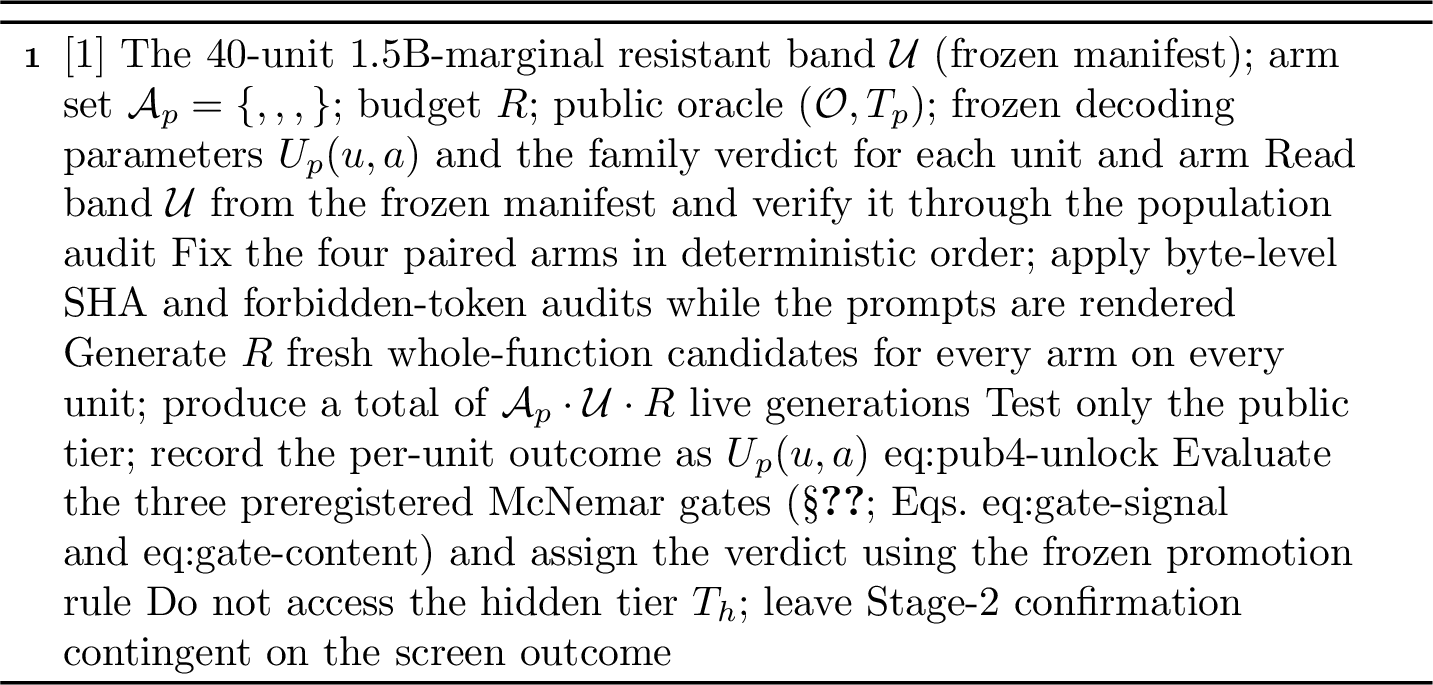
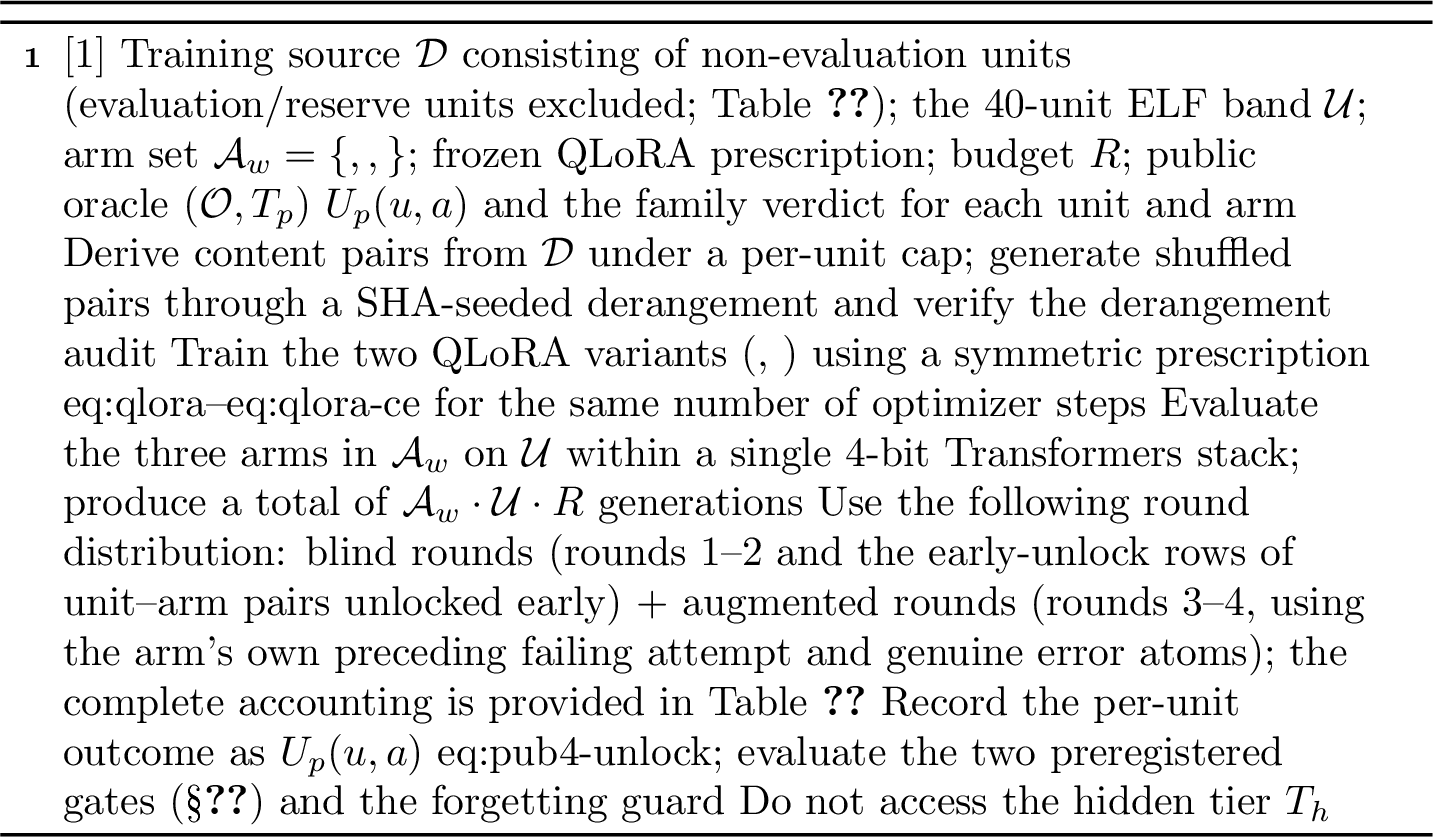
The instrument is summarized in Figure 1. The population and endpoint hierarchy, arm definitions and mirror chains, matched output-generation budget, two preregistered statistical families, generation protocol and audit invariants, discovery-to-confirmation rule, and mechanism ladder of the preceding instruments are described in this section. Only the prespecified methodological contract is presented. The design choices were not justified on the basis of the results, and all numerical fields were matched to provenance-tracked frozen records. Procedures 2–4 are not repair algorithms. They are executable evaluation procedures for the measurement instrument.
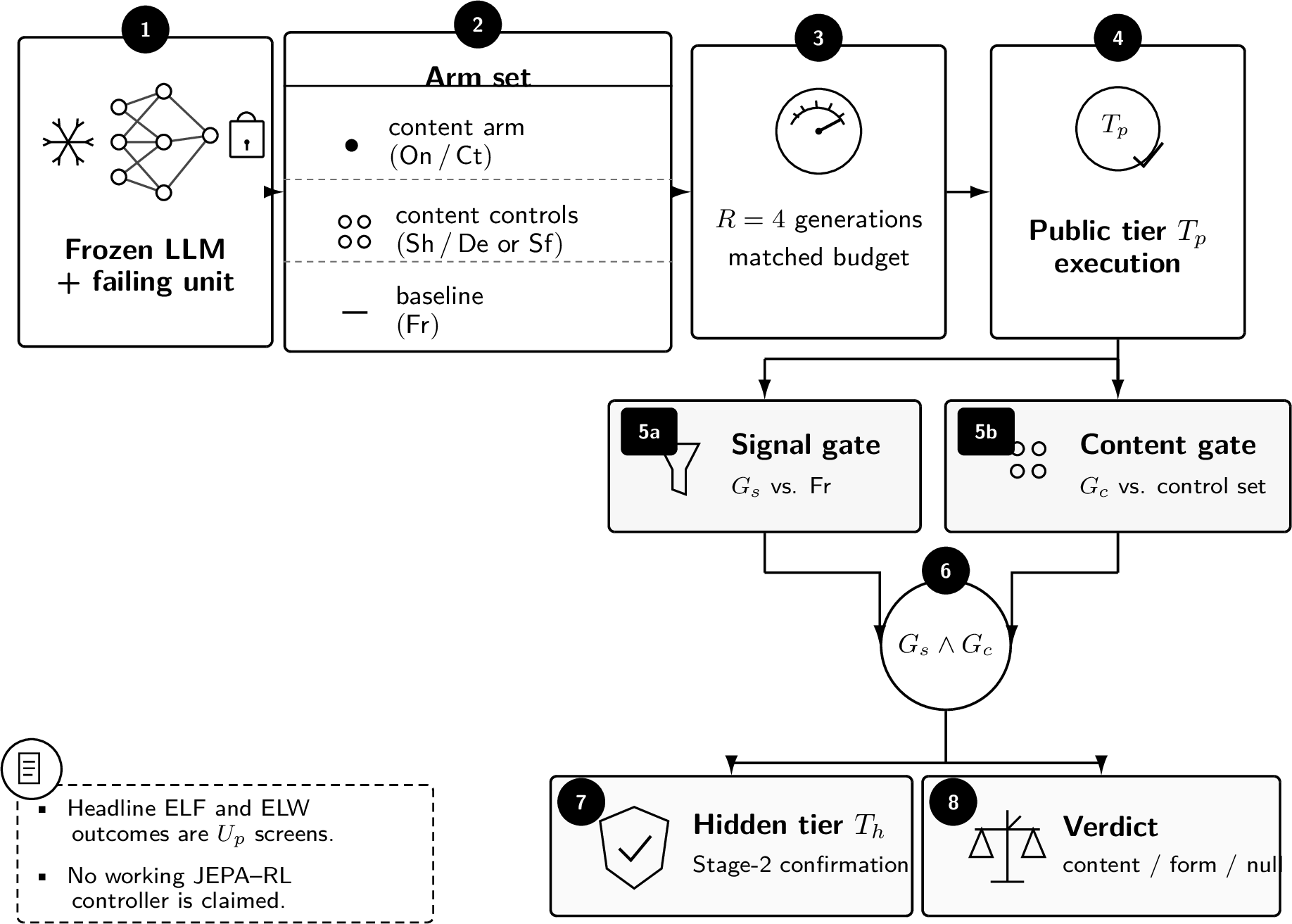
Figure 1 shows that content attribution is made contingent not on a single difference from a baseline, but on the joint passage of the signal and content gates.
0.0.2.1 Measurement instrument
0.0.2.1.1 Population, endpoints, and unit of analysis
The unit of analysis is the unit. The unit set is denoted by \(\mathcal{U}\), and an individual unit is represented as a task cell immutably keyed by the tuple \(u = \langle b, m, t\rangle\) [53]. Here, \(b\) denotes the benchmark, \(m\) denotes the model, and \(t\) denotes the task identifier within the benchmark. The notation below is defined once at this point and is held fixed throughout the section.
Each candidate is evaluated by an execution oracle \(\mathcal{O}\) on two test tiers, the public tier \(T_p\) and the prompt-hidden tier \(T_h\): \[\label{eq:oracle} \mathcal{O}(c,\tau)\in\{0,1\},\qquad \tau\in\{T_p,\,T_h\},\tag{1}\] where \(\mathcal{O}(c,\tau)=1\) if and only if candidate \(c\) passes the executable test suite of tier \(\tau\). Under this notation, each candidate is read as a conjecture, and each public-test violation is read as an oracle-relative refutation [30]. Falsification is thereby formalized not as a logical absolute, but as an executable predicate defined relative to \(\mathcal{O}\). Conditions under comparison are termed arms. The arm set \(\mathcal{A}\) is instantiated as \(\mathcal{A}_{p} = \{\textsf{On},\textsf{Sh},\textsf{De},\textsf{Fr}\}\) in the prompt channel and as \(\mathcal{A}_{w} = \{\textsf{Ct},\textsf{Sf},\textsf{Fr}\}\) in the weight channel. A matched output-generation budget of candidates is generated by each arm for each unit. This budget is denoted by \(R\) (\(R = 4\), §[sec:budget]). For a unit \(u\) and arm \(a\), the public-tier mechanism-screen unlock predicate is defined as \[\label{eq:pub4-unlock} U_{p}(u,a)=\mathbf{1}\big[\exists\, r \le R:\;\mathcal{O}(c_{u,a,r},T_p)=1\big],\tag{2}\] whereas the true-unlock predicate, which constitutes the program endpoint, is defined as \[\label{eq:true-unlock} U(u,a)=\mathbf{1}\big[\exists\, r \le R:\;\mathcal{O}(c_{u,a,r},T_p)=1 \wedge \mathcal{O}(c_{u,a,r},T_h)=1\big].\tag{3}\] Here, \(c_{u,a,r}\) is the \(r\)th candidate generated by arm \(a\) on unit \(u\). The objects \(U_p\) and \(U\) are distinct. Only the public tier is examined by \(U_p\), and the hidden tier is never accessed. By contrast, the same candidate is required by \(U\) to pass both tiers. For two paired arms \(a,a'\), the discordant counts \(b_{01}\), observed only in favor of \(a\), and \(b_{10}\), observed only in favor of \(a'\), the net effect \(\mathrm{net}(a,a')=b_{01}-b_{10}\), and the exact one-sided p-value \(p_{+}(a,a')\) are defined by Eq. 11 under the m3 convention. The two-gate promotion rule is defined using a channel-specific content-control set, \[\mathcal{P}(\textsf{On})=\{\textsf{Sh},\textsf{De}\}, \qquad \mathcal{P}(\textsf{Ct})=\{\textsf{Sf}\}.\] The signal gate compares the content arm with Fr, whereas the content gate requires the content arm to meet every preregistered threshold in its channel-specific placebo hierarchy. The signal and content thresholds \(\tau_s(a)\) and \(\tau_c(a,p)\) are family-specific: \[\label{eq:gate-signal} G_s(a)=\mathbf{1}\big[\mathrm{net}(a,\textsf{Fr})\ge \tau_s(a)\big],\tag{4}\] \[\label{eq:gate-content} G_c(a)= \mathbf{1}\!\left[ \bigwedge_{p\in\mathcal{P}(a)} \mathrm{net}(a,p)\ge\tau_c(a,p) \right].\tag{5}\] The exact one-sided McNemar tests and within-family Holm results are reported as inferential diagnostics alongside the frozen promotion thresholds. The threshold gates are not redefined by these tests. A genuine effect is attributed to a content arm only when \(G_s(a)\wedge G_c(a)\) is satisfied. The state \(G_s(a)\wedge\neg G_c(a)\) is read as form rather than content. This rule is the operational counterpart of severe-testing logic. Because a claim is considered severely tested only when it has passed a procedure by which it would probably have been detected had it been false, credit for content is made contingent on the gate at which the most plausible alternative explanation, the form of the retry, is controlled [32]. The family-specific threshold values are given in the corresponding family definitions (§0.0.2.2.1, §[sec:elw-family]).
Definition 1 (dead unit). A unit \(u\in\mathcal{U}\) is considered dead when none of the candidates in the cached best-of-\(N\) candidate pool (\(K_{\mathrm{POOL}} = 8\)) passes the public tier: \[\label{eq:dead-unit} D(u)=\mathbf{1}\Big[\max_{1\le k\le K_{\mathrm{POOL}}}\mathcal{O}(c^{\mathrm{pool}}_{u,k},T_p)=0\Big].\tag{6}\] This definition denotes a zero-pass state in the finite pool. It does not indicate that no correct program exists in the model distribution.
Definition 2 (public-tier best-of-4 unlock — mechanism-screen endpoint). A unit \(u\) is considered public-tier best-of-4 unlocked for an arm \(a\) when \(U_p(u,a)=1\), that is, when at least one of the \(R\) candidates generated by \(a\) passes the public oracle 2 . This endpoint is a mechanism screen. The hidden tier is not accessed.
The preregistered mechanism screen based on this definition is referred to throughout the text as the \(U_p\) screen.
Definition 3 (true unlock — program endpoint). A unit \(u\) is considered to have achieved a true unlock for an arm \(a\) when \(U(u,a)=1\), that is, when at least one regenerated candidate passes both the public tier and the prompt-hidden tier 3 .
Equation 3 defines the program endpoint, whereas Eq. 2 defines the mechanism screen under which the hidden tier is not accessed.
The population was not treated as a single homogeneous sample across all generations. The search-bound, hard-dead, 1.5B-marginal resistant, fresh-unit, non-evaluation training, and candidate-corpus layers were tracked in separate manifests. Inclusion and exclusion rules were applied at the manifest level before generation was initiated. The headline band was selected from the eligible inventory by deterministic SHA ordering, and parse-only, entrypoint-only, or timeout-only evidence was not considered sufficient on its own for semantic-marginal eligibility. Unit, training-pair, and candidate denominators were thereby retained within their respective layers without being converted into one another. The shared test population of ELF and ELW is the 40-unit 1.5B-marginal resistant band. The union of 37 P0-marginal units and 9 S2-marginal units was defined to contain 46 units, and the realized band contained 40 units. The complete flow of the layers and the supporting populations, including the corresponding population-audit diagnostic, are provided in the population and corpus accounting table in the Results section (Table ¿tbl:tab:consort?).
A single endpoint hierarchy is maintained across these layers. The program endpoint is true unlock (Definition 3). True unlock was realized in the inherited m3 primary. In LG P0, the unit-by-portfolio interaction in public-tier dense progress was measured, whereas hidden-partial calibration was retained as a separate descriptive record. By contrast, the two headline instruments, the learned error-lattice prompt controller (ELF) and the error-lattice QLoRA weight adapter (ELW), use a two-stage design. Stage-1 is the \(U_p\) screen 2 . Stage-2 hidden-tier (\(T_h\)) true-unlock confirmation was preregistered to be spent only if the screen was positive, so that under a negative screen it is not spent by design. No unlock count from ELF or ELW is therefore labeled “true unlock” in this paper. The correct label is the “\(U_p\) screen” 2 . The termination of hidden spend by a negative screen is the prespecified stopping rule of the program and is reported as a gate-as-result outcome.
No single pooled omnibus test is run above the endpoint hierarchy. Because benchmarks, models, strata, and endpoints differ across generations, such a test would constitute a category error. Instead, a single estimand template is defined and instantiated separately for each instrument.
E-UNLOCK (the default: net discordant unlock advantage over paired units, exact one-sided McNemar; LEGACY, live-ollama, FASTR, ELF, and ELW).
E-INTERACTION (LG P0 only: a permutation test for the unit- and portfolio-centered interaction variance \(T_{\mathrm{int}}\) in public-tier dense fraction. This estimand is neither an unlock-advantage estimand nor a public–hidden coupling estimand).
E-ALLOCATION (AEG only: the adaptive-versus-random net contrast under an equal draw budget, evaluated through zero-cost offline replay).
E-OFFLINE-GATE (DS P2 and FDP G1, for which the firing of the gate is itself the finding).
E-MECHANISM-DESCRIPTIVE (ERA standing diagnostics, the ELF C-matrix and decoy separation, and LG calibration \(r\) at the discovery tier, always labeled “descriptive / not confirmatory”).
All E-UNLOCK comparisons were conducted under a matched output-generation budget (\(R = 4\)). Four output samples were allocated to each arm for each unit. The global budget caveat is stated once at this point and is referenced by all E-UNLOCK families. Only the number of output generations is matched. Input length, tokenization cost, training cost, wall-clock time, and the number of floating-point operations are not matched, because code-bearing and error-augmented prompts are structurally longer. Accordingly, the term “matched output-generation budget” is used throughout the text, and expressions implying a stronger form of equality are avoided. The arm sets matched by this budget in the two channels are defined in Table ¿tbl:tab:arms?.
0.0.2.1.2 Arms and mirror chains
In both headline channels, the intervention arm is paired with placebos under which the predeclared scaffold components are held fixed and only the correctness of content is changed. The placebo twin is not treated as a decorative control. It constitutes the explicitly named alternative hypothesis. Because the sensitivity of LLMs to surface form has been documented independently [56], [57], any credit assigned to content without controlling for form would be assigned against the strongest untested rival explanation. The four paired arms in the prompt channel (ELF) and the three arms in the weight channel (ELW) are defined in Table ¿tbl:tab:arms?. The adapter mechanism in the weight channel is low-rank adaptation [17], implemented using the quantized LoRA [18] prescription over a 4-bit quantized frozen base.
4pt
The error-lattice controller that produces the On arm is composed of five components:
an outcome-calibrated severity value \(v\), learned through corrected-sign projected stochastic gradient descent. The gradient has the form \((y-p)e\), where \(y\) denotes the observed outcome, \(p\) denotes the model prediction, and \(e\) denotes the error feature;
a Hedge reservoir over a growing error vocabulary, with the same form as the C1 machinery in §[sec:era];
a LinUCB policy by which error-conditioned routing among six repair actions is performed within a unit [60]; and
an interaction matrix \(C\) carrying the family co-occurrence structure.
The \(C\) matrix is admitted only if it passes a predeclared offline gate whose threshold is at least a 1% relative improvement in log loss over the diagonal, and it was held frozen from its offline fit throughout Stage-1. Online updates to \(C\) were deferred. The sign of the severity update is a SymPy-verified correction to the reversed sign in the design document and is recorded in the amendment trail.
Of these five components, component (iv) and the parameterization of the weight-channel adapter are formally specified below. Repair routing by the On controller is performed through disjoint-linear LinUCB over the six repair actions \(\mathcal{K}=\{1,\dots,6\}\) [60]. Initially, \(A_a=I_d\) and \(b_a=0\) are maintained for each action. Given the error-conditioned context \(x_{t,a}\in\mathbb{R}^{d}\) in round \(t\), the ridge estimate is calculated as \(\hat{\theta}_a=A_a^{-1}b_a\), and the upper confidence bound is calculated as \[\label{eq:linucb-select} a_t=\arg\max_{a\in\mathcal{K}}\Big(\hat{\theta}_a^{\top}x_{t,a} +\beta\sqrt{x_{t,a}^{\top}A_a^{-1}x_{t,a}}\Big).\tag{7}\] Given the selected action \(a_t\) and observed reward \(\rho_t\), the statistics are updated as a between-unit batch after completion of the unit: \[\label{eq:linucb-update} A_{a_t}\leftarrow A_{a_t}+x_{t,a_t}x_{t,a_t}^{\top},\qquad b_{a_t}\leftarrow b_{a_t}+\rho_t\,x_{t,a_t}.\tag{8}\] Tie-breaks are deterministic. The exploration coefficient \(\beta\) and context dimension \(d\) are retained in the frozen policy configuration.
The intervention in the weight channel is quantized low-rank adaptation, under which a low-rank update is added to the 4-bit quantized frozen base weight \(W\) [18]. For rank \(r\) and scale \(\alpha\), the effective weight is \[\label{eq:qlora} W' = W + \frac{\alpha}{r}\,BA,\qquad B\in\mathbb{R}^{d\times r},\;A\in\mathbb{R}^{r\times k},\;r\ll\min(d,k).\tag{9}\] The weight \(W\) is kept frozen and NF4-quantized, and only \(A\) and \(B\) are trained. The adapter is learned over the error corpus through token-level causal cross-entropy: \[\label{eq:qlora-ce} \mathcal{L}(A,B)=-\frac{1}{\lvert\mathcal{D}\rvert}\sum_{x\in\mathcal{D}} \sum_{i=1}^{\lvert x\rvert}\log p_{W'}\!\big(x_i \mid x_{<i}\big),\tag{10}\] where \(\mathcal{D}\) denotes the error corpus, consisting of genuine content pairs for Ct and their SHA-deranged placebos for Sf, and \(x_i\) denotes the \(i\)th token. The causal language-modeling loss was calculated only over target tokens, while prompt and input tokens were masked using the ignore index (\(-100\)). The Ct and Sf variants differ only in the task\(\to\)content mapping of the examples. The number of examples, surface form, family marginals, and hyperparameters are identical. The concrete prescription, including NF4, rank \(r\), scale \(\alpha\), and the remaining optimization settings, is provided from a single source in Table ¿tbl:tab:experiment-implementation?. Successful training does not provide evidence of content transfer, since the Ct and Sf variants differ only in the task\(\to\)content mapping while the objective, data budget, and optimization settings are held identical. The realized training-loss convergence is reported as a diagnostic in the Results (§0.0.3.3).
The definition of Sh includes a registered amendment. In the original pilot, the task itself was also removed from Sh, through the use of a generic prompt and a fictitious entrypoint. Every subsequent On–Sh comparison would thereby have been turned into a strawman. The defect was detected during the Cycle-5 liveness pilot and was corrected through an amendment. The amended rule is the definition given in Table ¿tbl:tab:arms?. The original rule, the defect, and the correction are recorded in sequence in the audit trail in Appendix 0.0.6.
A unit-level split was applied in the weight mirror. Evaluation and reserve units were excluded from the training corpus through unit identifier, prompt, and solution-provenance fields. The complete provenance of the training corpus and the content/shuffled pair counts is provided in Table ¿tbl:tab:provenance?.
Contrast integrity is maintained through a minimal-pair discipline. The On–Sh contrast is the prompt-channel content contrast under which the task prompt, entrypoint, scaffold, and block layout are held fixed and only error truth is changed. Exact token length and lexical distribution are not matched byte-for-byte in either channel, and this internal-validity limitation is considered separately in the Discussion. Under the On–De contrast, representational form is preserved and donor matching is changed. The Ct–Sf contrast is the weight-channel content contrast under which the training-surface form and family marginals are preserved and the task\(\to\)error assignment is changed through derangement. Because adapter presence and learned content are changed jointly under the Ct–Fr contrast, that contrast is not described as a single-component minimal pair. Content attribution is therefore made contingent on the passage of both gates by Ct (§[sec:elw-family]).
Placebo integrity is maintained through executable audits. Byte-level SHA verification and the forbidden-token audit inherited from m3 were applied to all prompts rendered in the prompt channel. Function names, assertion literals, task identifiers, hidden content, and code-smuggling patterns were screened. Shape-leak and audit-failure invariants were predeclared for Stage-1. Fixed-point, donor-mismatch, and family-distribution invariants were predeclared in the weight channel. Under the leakage invariant, solutions from excluded and evaluation units are not loaded within the policy scope.
4pt
4pt
The content-attribution decision is made using the two-gate promotion rule 4 –5 . Content attribution is made only when both the signal gate (\(a>\textsf{Fr}{}\)/blind) and the content gate (\(a\) outperforms every control \(p\in\mathcal{P}(a)\)) are passed. An arm that passes only the signal gate is read as form. The Sh/De/Fr triad is the channel-agnostic generalization of the single GR-Sh placebo from m3. The SHA-deranged placebo LoRA extends the same reflexive instrument to parameter-efficient fine-tuning (PEFT). The statistical machinery for the two gates is defined in §0.0.2.2.1, the general execution loop is given in Procedure 2, and the channel-specific instantiations are given in Procedures 3 and 4.

0.0.2.2 Statistical analysis, generation protocol, and disclosure
0.0.2.2.1 Preregistered statistical families for the prompt and weight channels
The planned ELF family consists of three one-sided contrasts: {On\(-\)Sh, On\(-\)De, On\(-\)Fr}. Each contrast was evaluated using an exact one-sided McNemar test over the pooled discordant pairs of the paired units [61]. The exact conditional McNemar procedure was preregistered, and [62] is cited to contextualize its conservatism relative to mid-\(p\) and asymptotic alternatives. The quantity \(b_{01}\) denotes the number of treatment-favored discordant units, for which only On unlocks. The quantity \(b_{10}\) denotes the number of control-favored discordant units. The total number of discordances is denoted by \(d=b_{01}+b_{10}\), and the net effect is denoted by \(\mathrm{net}=b_{01}-b_{10}\). The m3 convention is used. The corresponding fields in the frozen records are labeled in the opposite direction and were remapped before reporting. The gate-aligned exact p-value has the following piecewise form: \[\label{eq:mcnemar} p_{+} = 1 \;\;\text{if } b_{01} \le b_{10}; \qquad \text{otherwise}\quad p_{+} = \sum_{k=b_{01}}^{d} \binom{d}{k} \left(\tfrac{1}{2}\right)^{d}.\tag{11}\]
Here, \(k\) is the number of treatment-favored discordances under the null. Concordant units do not contribute to the statistic. This choice is consistent with an error-statistical perspective. Under small discordant counts, use of the exact binomial reference distribution allows the error probabilities of the test to be audited without reliance on an asymptotic approximation and keeps explicit which effect sizes are actually constrained by a low-power non-rejection [32]. When the direction is reversed or a tie is observed, \(p_{+}=1\) is assigned so that movement outside the prespecified superiority direction cannot produce promotion. In the special case \(b_{10}=0\), the expression reduces to \(p_{+}=2^{-b_{01}}\). Within-family multiplicity was controlled using the Holm step-down rule [63], with \(m=3\) and family-level \(\alpha=0.05\): \[\label{eq:holm} p_{(j)} \le \dfrac{\alpha}{m-j+1}.\tag{12}\]
Here, \(p_{(1)}\le\dots\le p_{(m)}\) are the ordered raw p-values, and \(j\) is the ordered hypothesis index. A hypothesis passes only when its own threshold and all preceding rejection conditions are jointly satisfied. The gate thresholds were preregistered. Thresholds of net \(\geq+5\) units were defined for On\(-\)Sh and On\(-\)De, and a threshold of net \(\geq+3\) units was defined for On\(-\)Fr. Three states are defined by the frozen promotion rule. A mechanism-pass verdict is assigned if all primary gates pass. A mechanism-null verdict is assigned if On is equal to or lower than any control. Otherwise, a mechanism-partial verdict is assigned. The Haldane–Anscombe-smoothed matched-pair odds ratio was predeclared only as a descriptive summary of discordant composition: \[\label{eq:or-ha} \mathrm{OR}_{\mathrm{HA}} = \dfrac{b_{01}+1/2}{b_{10}+1/2}.\tag{13}\]
This quantity is a pooled descriptive summary. It is neither a causal odds ratio nor a measure of equivalence.
The power calculation and interpretation commitment were preregistered with the family. At \(n=40\), the design was powered for the preregistered \(+5\)-unit effects. In practice, the minimum detectable effect coincides with the gate thresholds. An interpretation was committed in advance for smaller true effects. A non-significant but direction-preserving result is read as “failed to confirm” and is never read as “refuted.” An observed tie is not interpreted as evidence of equivalence or non-inferiority, and no TOST margin is claimed. The condition under which the mechanism would be falsified was also named in the preregistration. The falsifier is a non-positive Sh delta. The audit invariant of the family requires zero shape leakage in the rendered prompts. The realized shape-leak count is reported in a field separate from the statistical decision in the Results.
The weight channel is presented as a separate preregistered family from the prompt channel. The two families were never merged into a single joint preregistration or a program-wide omnibus family. Although the narrative relates the two channels as “two channels of the same wall,” two distinct families are retained statistically. The planned inferential family comprises the two contrasts Ct\(-\)Fr and Ct\(-\)Sf (\(m=2\)). The forgetting guard is retained separately as a do-no-harm condition and is not part of the inferential family. The test machinery is the same as that defined above: the gate-aligned exact one-sided McNemar test in Eq. 11 , with the m3 \(b_{01}/b_{10}\) convention. Under the promotion rule, net thresholds of at least \(+4\) units are required to be met by Ct in both the Ct\(-\)Fr and Ct\(-\)Sf contrasts. The exact one-sided McNemar results are reported as inferential diagnostics alongside these thresholds. Failure of a single gate directs the family verdict to train-null, and hidden confirmation is opened only under a joint pass. At \(n=40\), the design was powered for the preregistered \(+4\)-unit effects. No point-null acceptance rule was defined for an observed tie or a smaller difference, and the “failed to confirm” interpretation commitment stated above applies without modification.
The guard component of the family is a do-no-harm condition. Over 12 held-in control units, it was preregistered that the number of blind unlocks under Ct could be at most two units below that under Fr (allowance 2). The guard was designed to distinguish a transfer null from a regression caused by catastrophic forgetting. It is not a statistical superiority claim and does not rescue failure of a primary gate.
The load-bearing falsification check is the adapter-effect probe. Three executable probes were predeclared to verify that the null verdict was not an artifact of the adapter never having been loaded. Under the first probe, the base output and content-adapter output must differ under the same seed, and disabling the adapter must restore the base output byte-for-byte. Restoration was verified by SHA. Under the second probe, sampled augmented rows must reproduce the stored prompt hash exactly when reconstructed using the procedure’s own builder. The realized reconstruction count is reported in the Results. Under the third probe, the round/kind distribution must match the protocol exactly: 280 blind rows, comprising 240 round-1/2 rows and 40 early-unlock rows corresponding to 20 unit–arm pairs, together with 200 augmented rows (Table ¿tbl:tab:provenance?). These probes are records of failed refutation, not proofs.
A symmetric sanity record was retained for training. The two variants were trained under the same prescription and for the same number of optimizer steps, and the realized training-loss convergence and NaN-step count are reported as diagnostics in the Results (§0.0.3.3). That the SHA-deranged placebo is trained under the same objective, data budget, and optimization prescription is an informative property of the design. Dense best-of-4 \(q\) contrasts were predeclared as a secondary analysis using a unit-wise sign-flip permutation and were not included as hypotheses in the binary unlock family. The secondary analysis cannot rescue the primary binary gates. The permutation reference was selected under the same error-statistical discipline. By constructing the null distribution from the data through unit-wise sign flips, the false-positive probability is controlled at the design level without an additional distributional assumption [32]. All generations read by both families are outputs of the single frozen generation protocol described below.
0.0.2.2.2 Generation protocol and audit invariants
Sampling parameters were frozen before each run. Ollama service parameters in the prompt channel were fixed in the pre-run manifest. The temperature used for blind sampling was the value that had yielded the highest unlock rate among the scanned temperatures in this regime during the diversity-scheduling scan (cycle log\(^{\dagger}\)). In ELF, decoding parameters were frozen at the action-specification level. Generations in the weight channel were produced under a fixed decoding configuration within a single 4-bit Transformers stack. Because all three arms were run using the same stack and the same decoding configuration, the Ollama/Transformers confound present in earlier stages was removed in this channel. All decoding values are provided in Table ¿tbl:tab:experiment-implementation?. Arm-specific generation settings were not permitted. Apart from adapter state, prompt payload, and seed, a common evaluation path was used. Seeds were derived deterministically: \[\label{eq:seed} s(u,a,r) = \mathrm{sha256}\big(ns \,\|\, b \,\|\, m \,\|\, t \,\|\, a \,\|\, r\big) \bmod 2^{32}.\tag{14}\]
Here, \(ns\) is the run-specific frozen namespace string, \(\|\) denotes byte concatenation, and \((b,m,t,a,r)\) is the unit–arm–round key. The scheme was inherited from Eq. 2.6 of [53], and the complete namespace values are retained in the frozen configurations. The base seed value for the weight channel is provided in Table ¿tbl:tab:experiment-implementation?. The manifest-resume mechanism prevented the same unit–arm–round key from being generated twice. The stored seed, prompt hash, output hash, and execution verdict were recorded jointly.
The audit layer is implemented not as an implementation detail, but as the falsification layer of the method. Two verdicts are reported separately for each generation. The statistical verdict is the result of the preregistered tests. The audit verdict is the executable result of the prompt-integrity, leakage, seed-uniqueness, stack-parity, derangement, shape-leak, hidden-access, and adapter-effect probes. An audit failure is not removed even when the statistical thresholds are passed, and no valid promotion can be produced under such a failure. As-frozen statuses are never overwritten, and the per-layer dispositions are provided in the audit-status table in the Results (Table ¿tbl:tab:audit?). The statistical and audit verdict cells in the figures were generated from separate frozen fields. These two forms of evidence were not merged.
The recording discipline also covers missing and incomplete states. Listwise deletion is not applied. When the expected generation count does not match the number of manifest rows, the family is not opened to unblinded analysis, and the resumable runner generates only the missing unit–arm–round keys. Executor timeout, parse failure, and public-test failure are retained as outcomes and are not converted into missing values. Hidden-tier values not generated after a negative public screen are marked “not spent” and are not added to the failure count.
Falsification is applied at two levels under the same discipline. At the object level, model outputs are tested through execution. Each candidate is run against the executable tests of the public tier, and a test violation is recorded as an oracle-relative counterexample. At the meta level, the researcher’s own claims are tested. The verdict for every generation is subjected to a falsification battery consisting of executable counterexample probes applied before and after the run: 5 categories and 18 probes for ELF, adapter-effect, prompt-SHA, and protocol-distribution probes for ELW, and 7 pre-use probes for AEG-BANDIT. A probe result of holds constitutes a record of failed refutation, not proof. A confirmed falsification is closed through correction and rerunning, and is entered into the amendment trail in Appendix 0.0.6.
For transparent disclosure, one known open defect remains in the record. The HEF decoy-synthetic test has failed deterministically since the migration to Torch 2.12. It is tracked rather than suppressed and is disclosed in Table ¿tbl:tab:audit? with the status as-frozen failing (tracked). The defect is retained as a record that weakens the reproducibility of the HEF learning signal. The Stage-1 ELF and ELW stacks are not affected.
The final component of the disclosure is the environment and provenance record. All numbers are retained in frozen result records together with run-level provenance and execution-environment records. The hardware and software fields reported in the submission are summarized in Table ¿tbl:tab:experiment-implementation?. The underlying environment and provenance records are available as stated under Reproducibility and Data Availability. Frozen records are not overwritten. Corrections are linked from the original artifact to a successor artifact through a supersession pointer. Numbers derived from cycle logs, marked by \(^{\dagger}\), are not contained in the frozen results archive and are reported by reference to the corresponding program-cycle record.
0.0.2.2.3 Discovery, single promotion, and gate as result
An effect observed during discovery is promoted at most once into a preregistered family, using a frozen hypothesis, fresh seeds, fresh generations, and a separate output manifest. This rule is the operational form of the use-novelty principle under which a hypothesis cannot be severely tested on the same data by which it was generated [32], [64]. Discovery outputs, offline fits, smoke statistics, and pilot amendments are excluded from the confirmation family. Within-family multiplicity is controlled through Holm (§0.0.2.2.1). The two channel families are never pooled. Because multiple families are present across the program, a descriptive program-wide sensitivity calculation was also reported so that the single confirmed positive would not be read as a fishing artifact. This calculation is reported with the P0 result in §[sec:standing].
The complementary rule is the gate-as-result principle. The firing of a preregistered gate is not treated as an abort. It is treated and reported as a separate prespecified result category. Examples include the offline conditioning gate (DS p2-null-offline), the first-draw learnability gate (FDP g1-kill\(^{\dagger}\) for both feature sets), the stratum-sufficiency rule under which falling below the preregistered minimum stratum size in LG produces stratum-null and terminates downstream spend, the realizability gates (DCH unrealizable, RIFT doa, and ECK underpowered; [53]), and the two public-tier screens themselves. Each null can thereby be attributed mechanistically. A learnability or realizability gate must first be passed by a controller. A preregistered stop and an unfinished run are not grouped under the same status. The mechanisms of the stages to which these gates belong are defined in §0.0.2.3, and their verdicts are reported in the program ledger in the Results (Table ¿tbl:tab:ledger?).
0.0.2.3 Preceding instruments and the mechanism ladder
The mechanism ladder was constructed not as a chronological experimental log, but as a sequence of instruments under which the narrowest question left open by the preceding preregistered verdict is tested at each stage. This structure is the measurement-level counterpart of the view that a research programme is evaluated through successive problem shifts rather than isolated experiments [31]. At each step, the content of the preceding refutation is converted into a boundary condition for the next question. Convergence is toward the objective of placing a learned error prior somewhere in the system, and the two decisive stages are the prompt and weight channels. Between these stages, the error-set architecture (ERA), budgeted best-of-B allocator (AEG-BANDIT), and joint-embedding predictive architecture (JEPA) components are included as candidate-controller machinery. Table ¿tbl:tab:ladder-short? provides the design view of the ladder and corresponds to the mechanism/channel rows of Table ¿tbl:tab:ledger?, the program ledger in §0.0.3.2. No results are reported in this view.
The two headline channels, ELF and ELW, constitute the instrument reached by the ladder and are defined in §0.0.2.1.1–§0.0.2.2.1. The deployed mechanisms of the preceding stages are summarized here for methodological completeness. Each stage has its own preregistered gate, and none is included in either headline confirmation family. The LEGACY stage, consisting of the FJR/RIFT/DCH/ECK/EOT/SR prompt-only JEPA-RL controllers, was inherited from the preceding stage [53]. Because their mechanisms and verdicts were reported there, they are not reported again here as new results. The first seven stages of the ladder progressively restrict the measurement conditions. ERA establishes the error taxonomy, error-weighted reward, and JEPA abstraction as formal machinery. ELF and ELW write the same error content into prompts and weights, respectively, so that both channels are subjected to the same placebo discipline.
0.0.2.3.0.1 HEF.
The hypothesis-error-family detector (HEF) was used to isolate whether an error-family signal could be learned in principle. The detector was run in a fully offline synthetic environment against an arm-blind fake oracle. The existence of learnability could thereby be tested without any live spend. The known open defect that weakens the reproducibility of this stage is disclosed in §0.0.2.2.2. The verdict is reported in Table ¿tbl:tab:ledger?.
0.0.2.3.0.2 live-ollama.
The same detector was run on a genuine frozen coder to test whether the offline signal transferred to live generation. The live-generation path of the Ollama-served frozen models (§0.0.2.1.1) was established at this stage in the form inherited by the remainder of the program. All subsequent prompt-channel stages were run on this path.
0.0.2.3.0.3 FASTR.
The end-to-end diagnostic pipeline was constructed by the FASTR instrument on genuine hard-dead units, and whether the pipeline produced a signal in the realized stratum was evaluated. The corresponding thin stratum is defined in the layer inventory in §0.0.2.1.1. The verdict and stratum accounting of the stage are reported in the Results.
0.0.2.3.0.4 DS.
Under the diversity-scheduling (DS) instrument, z-conditioning was tied to a preregistered offline gate. The question was whether conditioning could be screened out offline before live spend. This stage is the first instantiation of the E-OFFLINE-GATE estimand template (§0.0.2.1.1), and the firing of the gate is reported under the gate-as-result status defined in §0.0.2.2.3.
0.0.2.3.0.5 LG.
Under the learnability-gated (LG) instrument, the design was transferred to fresh units, and the unit-by-portfolio interaction in public-tier dense progress was tested. Its estimand is E-INTERACTION. Neither unlock advantage nor public–hidden coupling is estimated. A permutation test is instead performed on the unit- and portfolio-centered interaction variance \(T_{\mathrm{int}}\) (§0.0.2.1.1). The stratum-sufficiency rule for this stage, under which falling below the preregistered minimum stratum size produces stratum-null and terminates downstream spend, is an instance of the gate-as-result principle in §0.0.2.2.3.
0.0.2.3.0.6 AEG-BANDIT.
The budgeted best-of-B allocator (AEG-BANDIT) is the measurement instrument by which the question of within-unit exploitation is isolated. The objective is to maximize the genuine best-of-B objective over three fixed decoding portfolios, {\(P_{\mathrm{conc}}\), \(P_{\mathrm{mid}}\), \(P_{\mathrm{spread}}\)}, under a budget of \(B\) sequential calls per unit: \(\max\, \mathbb{E}[\max_{i \le B} q_i]\). Here, \(q\in[0,1]\) is the dense score, defined as the public-test pass fraction of a candidate. This is a pure-exploration allocation problem rather than a cumulative-regret bandit. The fixed-budget best-arm-identification setting is based on [39] and [40], and the acquisition-function view is based on [65]. Independent arms are assumed in classical bandit theory [38]. Because the candidates in this setting are drawn from a single frozen generator, a separate correction for correlation is introduced.
Dense outcomes lie in \(\{0\}\cup(0,1]\). Under the zero-inflated Beta (ZIB) posterior, a Bernoulli(\(\pi\)) liveness gate and a Beta(\(\alpha,\beta\)) dense score over \((0,1]\) are maintained for each (unit, arm) pair. Per-test passes within a single candidate are strongly correlated. An observation comprising \(m\) public tests is therefore reduced to \(\kappa_{\mathrm{eff}}\) effective Bernoulli observations: \[\label{eq:kappa-eff} \kappa_{\mathrm{eff}} = \dfrac{m}{1 + (m-1)\,\hat{\rho}}.\tag{15}\]
Here, \(m\) is the number of public tests per candidate, and \(\hat{\rho}\) is the intraclass correlation. The intraclass correlation was estimated from the S1 pass vectors and substituted into Eq. 15 . The realized values are reported in the Results. Without this correction, the posterior is approximately \(2.5\times\) overconfident.
The arm is selected through the greedy argmax of closed-form incomplete-beta Expected Improvement (EI). For the best dense score observed up to that point, \(q_\star\), the closed-form ZIB-EI acquisition is (the derivation is provided in Appendix 0.0.10): \[\label{eq:zib-ei} \mathrm{EI}_a(q_\star) = \hat{\pi}_a \big[\, \mu_a \big(1 - I_{q_\star}(\alpha_a{+}1, \beta_a)\big) - q_\star \big(1 - I_{q_\star}(\alpha_a, \beta_a)\big) \big].\tag{16}\]
Here, \(a\) denotes the allocation arm, \(\hat{\pi}_a\) denotes the posterior mean of liveness, \(\mu_a=\alpha_a/(\alpha_a+\beta_a)\) denotes the Beta posterior mean of the arm over \((0,1]\), and \(I_x(\cdot,\cdot)\) denotes the regularized incomplete beta function. Tie-breaks are SHA-256-salted and deterministic. Before the run, the closed form was verified against numerical integration, with a maximum absolute error of approximately \(1.0\times10^{-10}\). The implemented posterior-learning EI-greedy policy does not inherit the \((1-1/e)\) guarantee from the known-distribution idealization and was evaluated empirically only as a guarantee-free heuristic.
The decision layer of the instrument is formed by an exact zero-cost offline replay gate and a matched draw-budget (\(B=8\)) self-audit. The S1 cache contains 8 i.i.d.generations for each (unit, arm) pair. Because i.i.d.sampling implies exchangeability, any adaptive policy for which the number of per-arm draws does not exceed 8 can be evaluated as an exact policy replay through draws without replacement from a preshuffled order. It is not off-policy estimation. The condition of per-arm draws \(\leq8\) is the predeclared validity precondition of the gate. Pool-cap or unequal-draw states are recorded as budget-audit events that invalidate the primary claim, and the superseding replay is linked immutably to a new artifact through a supersession pointer. The decision rule was defined as follows. The paired contrast in \(\mathbb{E}[\text{best-of-}B\;q]\) per unit, averaged over 40 pool orders, between AEG and the best-FIXED arm was evaluated using a one-sided sign-flip permutation test with 4,000 permutations and \(\alpha=0.05\). The RANDOM-ADAPT form control, under which the same machinery is used with random arm selection, was predeclared to separate gains from mixing from gains from learning. An identical-arms null-world type-I calibration was also predeclared. Under the single-promotion rule, no live AEG generation was run before the offline gate had passed. This instrument constitutes the machinery of the matched draw-budget (\(B=8\)) self-audit chain reported in the Results, §[sec:selfaudit].
0.0.2.3.0.7 FDP.
The First-Draw-Prior (FDP) instrument was used to test, on the public-facing portion of BigCodeBench (Python), whether a learned prior could be learned before the first draw [66]. The stage was protected by a preregistered G1 pregate. The learnability of a first-draw prior is tested offline before live spend is opened, and firing of the gate is reported as a separate prespecified result category under the gate-as-result status defined in §0.0.2.2.3.
0.0.2.3.0.8 ERA.
The error-set architecture (ERA) is formalized through three coupled components. The definitions below are stated in the present tense. ERA is included in this paper only as constructed and smoke-tested machinery together with descriptive standing diagnostics. It is nowhere presented as a “validated JEPA-RL reward.” The validity test was preregistered but was left deferred. The deferral rule is given below.
The first component, C1, is the growing error taxonomy. A raw execution record is converted into a canonical event through a deterministic canonicalizer: \(e=\kappa(\mathrm{raw})= (\mathrm{phase},\mathrm{exc\_class},\mathrm{tmpl\_hash64})\). New signatures are admitted to the vocabulary according to their order of arrival. A countable prior mass is assigned to the category born in position \(m\): \[\label{eq:arrival-prior} \pi_m = \dfrac{1}{m(m+1)}, \qquad \sum_{m=1}^{\infty}\pi_m = 1, \qquad r_K = \dfrac{1}{K+1}.\tag{17}\]
Here, \(m\in\{1,2,\dots\}\) is the birth order of a category, \(K\) is the number of admitted categories, and \(r_K\) is the closed-form total reservoir mass of categories not yet born. Category weights are maintained through a Hedge update that remains valid under vocabulary growth: \[\label{eq:hedge-update} w_t(e) = \dfrac{\pi_e\, e^{\eta_t G_{t-1,e}}}{Z_t}, \qquad Z_t = \sum_{e' \in \mathcal{E}_t} \pi_{e'}\, e^{\eta_t G_{t-1,e'}} + r_{K_t}.\tag{18}\]
Here, \(\mathcal{E}_t\) is the error vocabulary at round \(t\), \(G_{t-1,e}\) is the cumulative gain of category \(e\), \(\eta_t\) is the learning rate, \(K_t=|\mathcal{E}_t|\) is the vocabulary size, and \(Z_t\) is the normalizer including the reservoir. For fixed \(\eta\), finite-horizon regret is bounded in closed form relative to every category \(e\) that is born: \[\label{eq:hedge-regret} \mathcal{R}_T(e) \le \dfrac{\ln(1/\pi_e)}{\eta} + \dfrac{\eta T L^2}{8}.\tag{19}\]
Here, \(T\) is the update horizon, \(\mathcal{R}_T(e)\) is the empirical regret relative to comparator \(e\), and \(L\) is the bounded-gain cap (\(L=1\)). The tuned rate and complete THM-6 derivation are provided in Appendix 0.0.11. It was predeclared as a smoke gate that the empirical regret for every category born must remain below this closed-form bound. Taxonomy saturation is monitored using the incidence-form Good–Turing missing-mass estimator, which belongs to the nonparametric coverage/lower-bound estimator family for species richness [67]–[69]; convergence guarantees are discussed by [70]: \[\label{eq:good-turing} \hat{M}_n = \dfrac{N_1}{n}.\tag{20}\]
Here, \(n\) is the number of candidates, \(N_1\) is the number of categories observed in exactly one candidate, and \(\hat{M}_n\) estimates the unseen incidence mass expected from the next candidate. The candidate was selected as the sampling unit, and dependent events within the same trace are not counted as separate i.i.d.tokens. A stability gate of \(\hat{M}\leq0.05\) was predeclared. Under the THM-1c growth-slope cross-check, the slope of the growth curve and \(\hat{M}\) are compared as two estimators of the same identity. The smoke corpus consists of 1,920 cached candidates re-executed from the hard-dead stratum. The taxonomy counts belong to this 1,920-candidate denominator.
The second component, C2, is the error-weighted RL reward. The reward is constructed from error-set values through online-adaptive scalarization. The predeclared smoke invariants require the bounds, cap saturation, and error/\(q\) monotonicity to hold at a rate of 1.0. Detailed derivations are summarized in Appendix 0.0.11, for which two independently produced derivation records are retained.
The third component, C3, is the VICReg JEPA head. The JEPA head through which error sets are abstracted [46] is trained using variance–invariance–covariance regularization [47]. The input is encoded through signed hashing with \(d=4096\), the embedding dimension is \(d_z=128\), the target encoder is updated through an exponential moving average (\(\theta^- \leftarrow 0.996\,\theta^- + 0.004\,\theta\)), and the masking probability is 0.5. The composite objective is \[\label{eq:vicreg-loss} \mathcal{L}_{\mathrm{JEPA}} = 25\,\mathcal{L}_{\mathrm{inv}} + 25\,\mathcal{L}_{\mathrm{var}} + \mathcal{L}_{\mathrm{cov}} + \mathcal{L}_{\mathrm{dec}} + \mathcal{L}_{q}.\tag{21}\]
Here, \(\mathcal{L}_{\mathrm{inv}}\) is the invariance loss between the online prediction and the target latent, \(\mathcal{L}_{\mathrm{var}}\) is the anti-collapse variance hinge, \(\mathcal{L}_{\mathrm{cov}}\) is the off-diagonal covariance penalty, \(\mathcal{L}_{\mathrm{dec}}\) is the error-profile decoder loss, and \(\mathcal{L}_{q}\) is the dense public-score head loss. The VICReg guarantee concerns collapse avoidance rather than downstream predictive utility. A non-collapsed embedding is not evidence by itself. Compression of error sets into a \(d_z=128\)-dimensional latent does not establish a tested claim about new outputs. It provides only a representation on which such a claim could be constructed.
The deferral rule was preregistered. The three-label out-of-fold first-draw ARM-REGRET validity statistic (EQ-10/EQ-16) was preregistered. The derivation states, however, that once the input-independence signature is triggered, S-4 and S-5 JEPA liveness cease to constitute evidence in favor of a JEPA claim. Because this condition was triggered, the validity gate was not spent in this generation and was redirected to a population carrying cross-unit signal. A JEPA downstream no-signal flag was observed in ERA’s own smoke evaluation, and the corresponding machinery measurements are reported in the Results and Appendix 0.0.11. All ERA numbers in this paper are descriptive machinery measurements, and their status is frozen as deferred(validity).
Each of these stages was tied to its own form-matched placebo discipline and preregistered gate. The narrowest question left open by the ladder was taken up by the two headline channels. Stage-level verdicts and key numbers are reported in the program ledger in the Results (Table ¿tbl:tab:ledger?, §0.0.3.2).
0.0.3 Results↩︎
The PoPE experiments were conducted on a class of frozen small code large language models (LLMs). The headline evaluation design is reported in Table ¿tbl:tab:experiment-config?, and the model, decoding, stack, training, and accounting details are reported in Table ¿tbl:tab:experiment-implementation?. The unit of analysis is the unit (\(u=\langle b,m,t\rangle\in\mathcal{U}\), task cell \(\langle\)benchmark\(|\)model\(|\)task\(\rangle\)). The two headline instruments, the learned error-lattice prompt controller (ELF) and the error-lattice QLoRA weight adapter (ELW), were evaluated on the same 40-unit 1.5B-marginal resistant band under a matched output-generation budget (\(R=4\)) and the preregistered \(U_p\) screen (Definition 2). The realized prompt-channel accounting was recorded as 640 generations (\(4\) arms \(\times\) \(40\) units \(\times\) \(R=4\)). The realized ELW accounting was recorded as 480 generations \(=\) 280 blind generations (240 round-1/2 rows \(+\) 40 early-unlock rows \(=\) 20 unit–arm pairs) \(+\) 200 augmented generations (rounds 3–4). Generation accounting, decoding settings, and run-cost values are reported in Table ¿tbl:tab:experiment-implementation?. In the Stage-1 audit, the shape-leak and audit-failure counts were recorded as zero. In the derangement audit across the three weight-channel arms, no fixed point or donor mismatch was observed, and the family distributions were recorded as byte-identical. In the standing-diagnostics record, ema_cos 0.9929 and erank 24.97 were recorded for the JEPA embedding, while \(\hat{\rho}=0.7771\) and \(\kappa_{\mathrm{eff}}=1.175\) were recorded for the allocator. The expected and realized row counts matched, and all weight-channel arms were run on the same evaluation stack. This single-stack arrangement removed the Ollama/Transformers distinction present in earlier stages from the weight-channel evaluation.
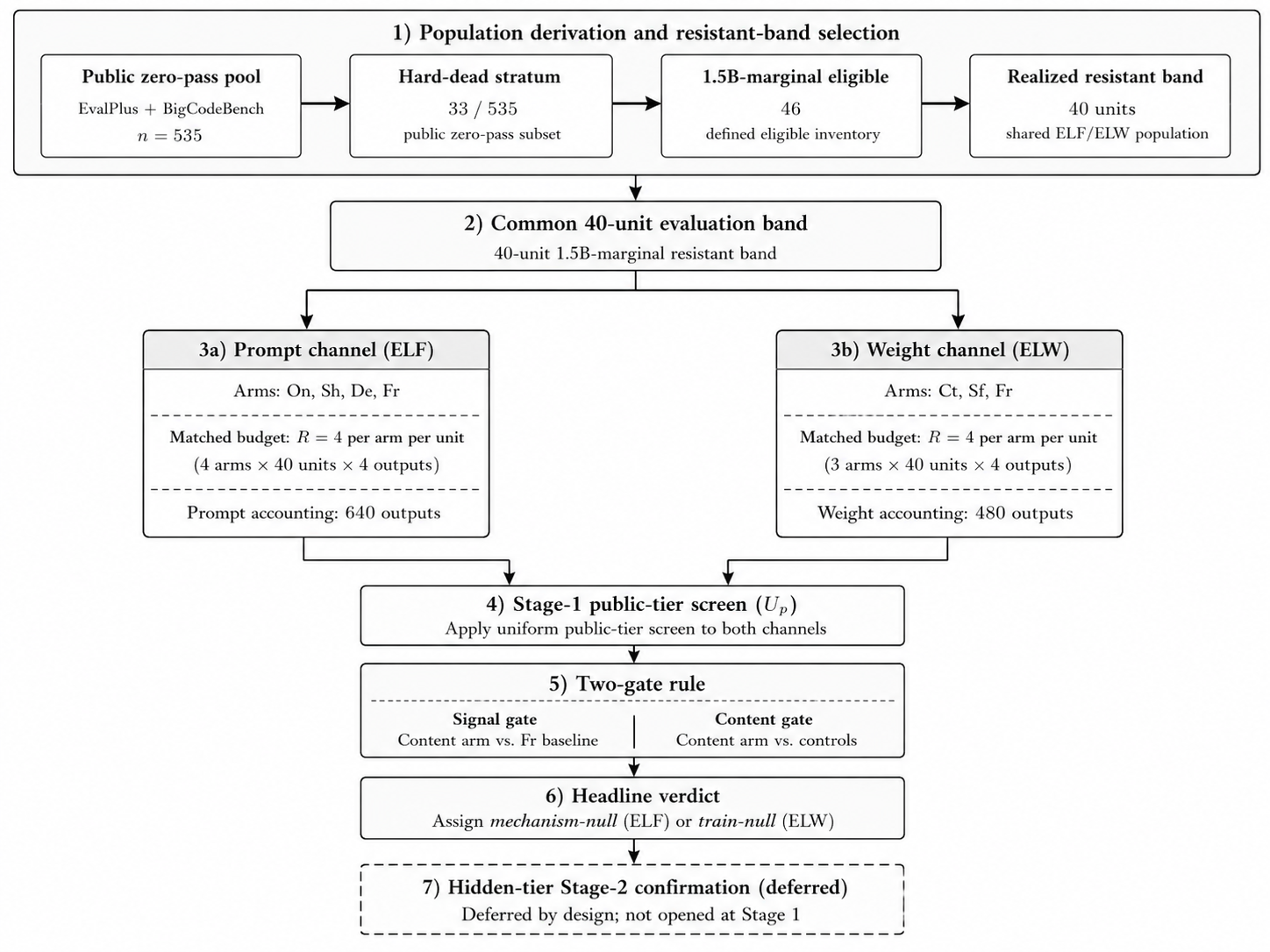
Population narrowing, matched channel budgets, the two-gate decision, and hidden-tier deferral are shown in a single reporting flow in Figure 5.
4pt
4pt
@c>
p0.21c>
p0.35c>
p0.35@
Implementation / accounting axis & Prompt channel (ELF, ) & Weight channel (ELW, )
Hardware &
Frozen model class &
Headline base model &
Benchmark family &
Serving stack & Ollama & single 4-bit Transformers stack
Decoding temperature & \(0.8^{\dagger}\) & \(0.7\)
Other decoding settings & generation length 1024 tokens, context 4096 tokens & top_p 0.9, generation length 512 tokens, sampling enabled
Round protocol & single-pass best-of-4 (blind) & rounds 1–2 blind, rounds 3–4 error-augmented
Base seed / derivation & SHA-256 derivation, frozen namespace & base 20260705, SHA-256 derivation
QLoRA adapter &
QLoRA optimization &
Training corpus &
Row accounting &
ERA smoke corpus &
LG fresh-unit stratum &
torch (stack) & \(2.7.1{+}\mathrm{cu}118^{\dagger}\) & \(2.12.1{+}\mathrm{cu}130\)
transformers & — (Ollama serving) & 4.57.6
Observed run cost & no separate run-cost record for the prompt channel & peak VRAM 3.516 GiB and wall time 5,561.5 s for the weight channel
The endpoint labeling is binding throughout this section. The headline verdicts for ELF and ELW were obtained using the \(U_p\) screen 2 . Hidden-tier (\(T_h\)) true-unlock confirmation was deferred by design, and no hidden-tier spend was incurred because the public screen was not passed. No ELF or ELW count should therefore be read as a “true unlock.” The program-level true-unlock endpoint \(U(u,a)\), defined as public \(\wedge\) prompt-hidden, was realized in the inherited m3 primary [53]. LG P0 measures the unit-by-portfolio interaction in public-tier dense progress, while hidden-partial calibration is retained as a separate descriptive record. Each result below is explicitly labeled as primary, secondary, or descriptive. Statistical and audit verdicts are reported separately.
0.0.3.1 Primary mechanism screens and arm profile
The two preregistered families were tested separately on the same 40-unit resistant band. These were the prompt channel (ELF, Table ¿tbl:tab:elf-family?) and the weight channel (ELW, Table ¿tbl:tab:elw-family?). The headline verdict of each family is based on the \(U_p\) screen 2 and has primary status. Hidden-tier confirmation was deferred by design. Both families carry the E-UNLOCK estimand. Net discordant unlock advantage over paired units was evaluated using the exact one-sided McNemar test on pooled discordant pairs. Holm correction was retained within each family (ELF \(m=3\), ELW \(m=2\)). The forgetting guard is a separate do-no-harm rule and is not included in the McNemar hypothesis family. The frozen net threshold was met for On–Fr, while the other primary net thresholds were not met. None of the exact tests met the prespecified threshold at the raw level, and the adjusted p-values therefore did not alter the inferential reading. Discordant counts are reported under the m3 convention (\(b_{01}\) = treatment-favored, namely On/Ct-favored, \(b_{10}\) = control-favored, and net \(= b_{01} - b_{10}\)). Because the frozen record fields were labeled under the reverse convention, only the remapped frozen values are reported here.
The promotion rule takes the two-gate form in both families 4 –5 . A content arm is credited only when both the signal gate (content arm \(>\) Fr/blind) and the content gate (content arm \(>\) Sh/deranged placebo) are passed. An arm that passes the signal gate but remains below the content gate is classified as form under the preregistered reading. This was the pattern recorded in the two family tables. In the prompt channel, On remained directionally positive relative to Fr but fell below Sh (Table ¿tbl:tab:elf-family?). In the weight channel, Ct exceeded neither Fr nor its own placebo (Table ¿tbl:tab:elw-family?).
4pt
A net effect of \(-2\) was observed in the On–Sh contrast, and the content gate was not met. More units were unlocked under the content-ablated Sh placebo than under the learned controller. A net effect of \(+2\) was observed in the On–De contrast, but no statistically detectable difference was obtained (\(p = 0.34375\)), and the \(+5\)-unit gate threshold was not met. In the On–Fr contrast, the frozen unit-count threshold was met with a net effect of \(+3\), while no statistically detectable difference was observed in the exact McNemar test (\(p = 0.2266\)). The frozen promotion rule was triggered under the condition On \(\leq\) Sh (\(10 \leq 12\)), and the family verdict was recorded as mechanism-null.
4pt
A net effect of exactly 0 was observed in the Ct–Fr contrast (\(b_{01} = 4\), \(b_{10} = 4\), \(p = 1.0\)). The predeclared \(+4\)-unit gate was not met. In the Ct–Sf contrast, the SHA-deranged placebo LoRA was numerically ahead (net \(-2\), \(p = 1.0\)). The content gate was not met. The preregistered forgetting guard was recorded as pass and was not violated. Broader forms of retention loss or downstream harm were not tested by this guard. The Sf–Fr contrast yielded a descriptive net effect of \(+2\) (\(p = 0.376953125\)). No statistically detectable difference was observed in this contrast, and no claim that the placebo was beneficial is licensed. The family verdict was recorded as train-null.
The ties and negative net effects in the two channels were based on only 6–8 discordant pairs. They are therefore directional or consistency findings under low power. The ELF design had been powered for preregistered effects of +5/+5/+3 units, and the ELW design had been powered for effects of +4 units. The observed effects were \(-2\)/+2/+3 and 0/\(-2\), respectively. These results do not constitute evidence of equivalence or non-inferiority. Equivalence was not tested separately. No TOST margin is claimed. Each null should be read as “no statistically detectable difference was observed.” It should not be interpreted as evidence of an absence of effect.
Under the same low-power qualification, the pooled per-arm counts showed the placebo to be numerically equal to or ahead of content in both channels. In the prompt channel, Sh finished ahead of On (12 to 10, mechanism-null), followed by De (8) and Fr (7). In the weight channel, Sf was numerically ahead (10, with Ct \(=\) Fr \(= 8\)), but the difference was not discriminative. These rankings are descriptive. The primary conclusion is derived only from the paired contrasts in Table ¿tbl:tab:elf-family? and Table ¿tbl:tab:elw-family?. The total spread across the four arms in the prompt channel was 5 units, from 7 to 12. The three arms in the weight channel were contained within a 2-unit band, from 8 to 10.
The same 40-unit band was evaluated in both channels. At the per-cell level, the unlock memberships of arms with the same pooled total were recorded as non-identical. The units unlocked by one arm did not coincide exactly with those unlocked by another arm. Agreement therefore occurred at the net-effect level rather than at the unit level, and the pooled tie should not be read as cell-by-cell equality. In the blind rounds of the weight-channel evaluation, the per-arm unlock counts were recorded as 6/6/8. This count is also descriptive. The per-cell and per-arm unlock rates and the membership heat strip in frozen-manifest order are provided in Figure 9 in Appendix 0.0.8.
The per-arm mean best-of-4 \(q\) values were recorded as On .4507 / Sh .4268 / Fr .3859 / De .3774 in the prompt channel. They were recorded as Sf .43850 / Ct .40329 / Fr .40329 in the weight channel. Ct and Fr are identical at floating-point precision.
The pooled profile of the two channels is summarized in Figure 6. The positions of the two family verdicts in the instrument ledger are reported in Table ¿tbl:tab:ledger?, while the per-unit membership records are reported in Figure 9 in Appendix 0.0.8.
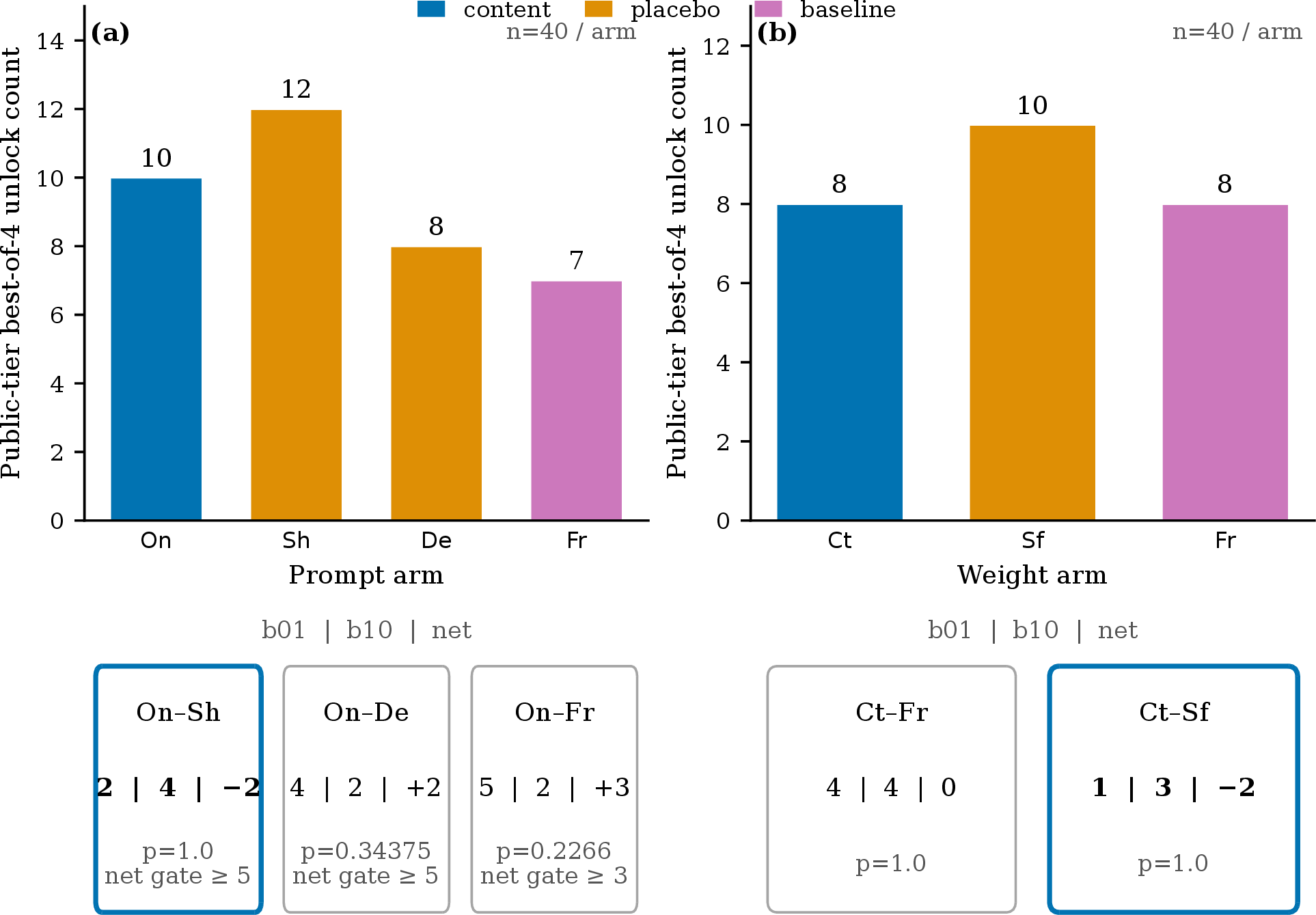
In Figure 6, the placebo arms were numerically equal to or ahead of the learned content arm in both channels. The primary decisions were obtained from the paired contrasts and the two-gate rule rather than from the pooled bar heights.
0.0.3.2 Program ledger, standing diagnostics, and self-audit
The controlled headline-verdict set \(\mathcal{V}\) is defined in 22 . Supporting diagnostic, machinery, inherited, and audit dispositions are reported in separate ledger fields and are not members of the headline-verdict set.
\[\label{eq:verdictset} \begin{align} \mathcal{V} &= \mathcal{V}_{+} \,\cup\, \mathcal{V}_{\mathrm{diag}} \,\cup\, \mathcal{V}_{0} \,\cup\, \mathcal{V}_{\mathrm{kill}}, \\[3pt] \mathcal{V}_{+} &= \bigl\{\text{\emph{confirmed}{}}\bigr\}, \qquad \mathcal{V}_{\mathrm{diag}} = \bigl\{ \text{\emph{standing}}^{+}, \text{\emph{deferred}{}(validity)} \bigr\},\\[3pt] \mathcal{V}_{0} &= \bigl\{ \text{\emph{mechanism-null}{}}, \text{\emph{train-null}{}}, \text{\emph{replay-null}{}} \bigr\},\\[3pt] \mathcal{V}_{\mathrm{kill}} &= \bigl\{ \text{\emph{g1-kill}{} (gate-blocked)}, \text{\emph{p2-null-offline}{}}, \text{\emph{stratum-null}{}},\\ &\qquad\; \text{\emph{doa}{}}, \text{\emph{unrealizable}{}}, \text{\emph{underpowered}{}} \bigr\}. \end{align}\tag{22}\]
Each headline evaluation stage is assigned a verdict in \(\mathcal{V}\). Supporting stages retain their frozen diagnostic, machinery, inherited, or audit dispositions in separate fields. Here, \(\mathcal{V}_{+}\) contains the program’s single confirmatory positive, \(\mathcal{V}_{\mathrm{diag}}\) contains descriptive standing and deferred dispositions, \(\mathcal{V}_{0}\) contains the placebo-controlled evaluation nulls, and \(\mathcal{V}_{\mathrm{kill}}\) contains the preregistered gates and realizability kills that stopped live spend. The row for the legacy stage is inherited and is quoted from m3 §4.1, Table 15 [53]. It is not reported again as a new result. The offline, live, allocation, architecture, and public-screen tiers are explicitly separated within the same column.
3pt
@c>
p0.040c>
p0.150c>
p0.150c>
p0.140c>
p0.285c>
p0.115@
\(\mathcal{G}_k\) & Instrument / channel & Statistical verdict & Audit or validity & Key record & Scope
0 & legacy FJR/RIFT/DCH/ECK/ EOT/SR (m3 §4.1)
prompt & null & inherited & FJR \(-1\) vs \(p = 0.773\) (\(n = 46\)). SR +6 vs B \(p = 0.073\), +1 vs
\(p = 0.50\) (\(n = 69\))\(^{\dagger}\) & live. None exceeded
1 & HEF
offline & standing\(^{+}\) & saturation-null & content axis \(p \approx 7\times10^{-14}\), leave-one-cluster-out leakage control 0 & offline synthetic
1.5 & live-ollama
prompt & live-null & — & form-not-content reproduced live & live
2 & FASTR
offline & diagnostic-null & F4-caught & \(>\) reversal. 33/535 at 0.5B & live (thin)
3 & DS
offline & & offline gate & scale 27.5% \(\to\) 60%\(^{\dagger}\). Temp 0.8 scan-max\(^{\dagger}\) & supporting
3pt
@c>
p0.040c>
p0.150c>
p0.150c>
p0.140c>
p0.285c>
p0.115@
\(\mathcal{G}_k\) & Instrument / channel & Statistical verdict & Audit or validity & Key record & Scope
4 & LG
offline & (P0) & & \(T_{\mathrm{int}}\) 0.016667, \(p_{\mathrm{perm}}\) 0.0001. Hidden-partial calibration (\(n=115\), \(r \approx 0.65\)–\(0.70\)) & fresh units. Public dense unit-by-portfolio interaction and separate descriptive record
4b & AEG-BANDIT
allocation & & superseded \(B=12\) \(\to\) governing \(B=8\) & Superseded +6.0 pp and +0.001 control retained together. Governing +0.02209 (\(p=0.2022\)), \(-0.00227\) (\(p=0.6176\)), . \(\hat{\rho}\) 0.7771, \(\kappa_{\mathrm{eff}}\)
1.175 & offline replay
5 & FDP
offline & & both feature sets & gate-blocked by design\(^{\dagger}\) & BigCodeBench
6 & ERA
architecture & built+smoke & validity & \(K = 93\), \(\hat{M} \approx 0.03\) over 1,920 candidates. Hedge \(0.88 < 10.25\) &
descriptive
7 & ELF
prompt & & primary & 12 \(\geq\) 10 & public screen
8 & ELW
weight & & primary & 8 = 8, \(p=1.0\) & public screen

4pt
The profile of the legacy ledger row, in its inherited form, was as follows [53]\(^{\dagger}\)2. The FJR controller yielded a net effect of +3 relative to the blind-resampling baseline (\(p = 0.274\)), but this value fell to \(-1\) relative to the Sh placebo (\(p = 0.773\), \(n = 46\)). The self-repair pilot yielded a net effect of +6 relative to the baseline (\(p = 0.073\)) and remained at only +1 relative to Sh (\(p = 0.50\), \(n = 69\), leak 0/69). EOT yielded +3 (\(p = 0.27\)) and +1 relative to Sh (\(p = 0.50\), \(n = 69\)). The code-free ECK variant was recorded as underpowered with +3 (\(p = 0.29\), \(n = 109\)). RIFT was not triggered in any of the 24 trials (0/24, doa). DCH remained unrealizable in the absence of an offline corpus. No statistically detectable difference was observed in any legacy contrast.
Within the instrument sequence in the ledger, the content axis of the HEF detector was decisive only in the offline synthetic regime (\(p \approx 7\times10^{-14}\), leave-one-cluster-out leakage control 0). In the same offline record, the learned-signal permutation gate exceeded its predeclared threshold (AUC \(= 0.628 \geq 0.60\), permutation \(p = 0.012\)). When the same detector was transferred to live evaluation, the form-not-content null was observed again. In FASTR, De finished ahead of On, and the diagnostic record remained in the null direction. In the diversity-scheduling instrument, z-conditioning was stopped by the preregistered offline gate before live spend (p2-null-offline). No out-of-unit transfer was detected for the learned portfolio phenotype from the same stage (ICC 0.372, out-of-unit Spearman 0.152 \(<\) permutation p95 0.255, AUC 0.546). This record is descriptive. While LG yielded the single confirmed positive, stratum depletion was recorded in the same evaluation (stratum-null, \(46 < 60\)). FDP was blocked by the preregistered first-draw gate for both feature sets (g1-kill), while ERA was retained with built-and-smoke status and deferred validity. None of these rows is confirmatory in isolation. Each is reported as the output of its own preregistered rule.
The generator-scale observation is among the supporting values in the ledger and is reported descriptively. In the same 40-unit pool, the any-portfolio unlock rate was recorded as 27.5% for the 0.5B generator and 60% for the 1.5B generator. The same direction was retained in the per-portfolio rates. In the 0.5B pool, \(P_{\mathrm{conc}} = .107\), \(P_{\mathrm{mid}} = .157\), and \(P_{\mathrm{spread}} = .132\) were measured. In the 1.5B pool, \(.350\), \(.475\), and \(.450\) were measured, respectively, and the portfolio ordering remained the same at both scales. These rates are descriptive. The temperature scan showed that 0.8 yielded the highest value among the scanned temperatures. This temperature observation belongs to the Ollama stack of the diversity-scheduling stage. The separate Transformers stack used for the weight channel (ELW) employed its own preregistered decoding configuration (Table ¿tbl:tab:experiment-implementation?). These two values are derived from cycle logs and define only a direction across two points. No scaling-curve extrapolation is performed in this section. The nulls for the conditioning and diversity arms were observed again at both scales.
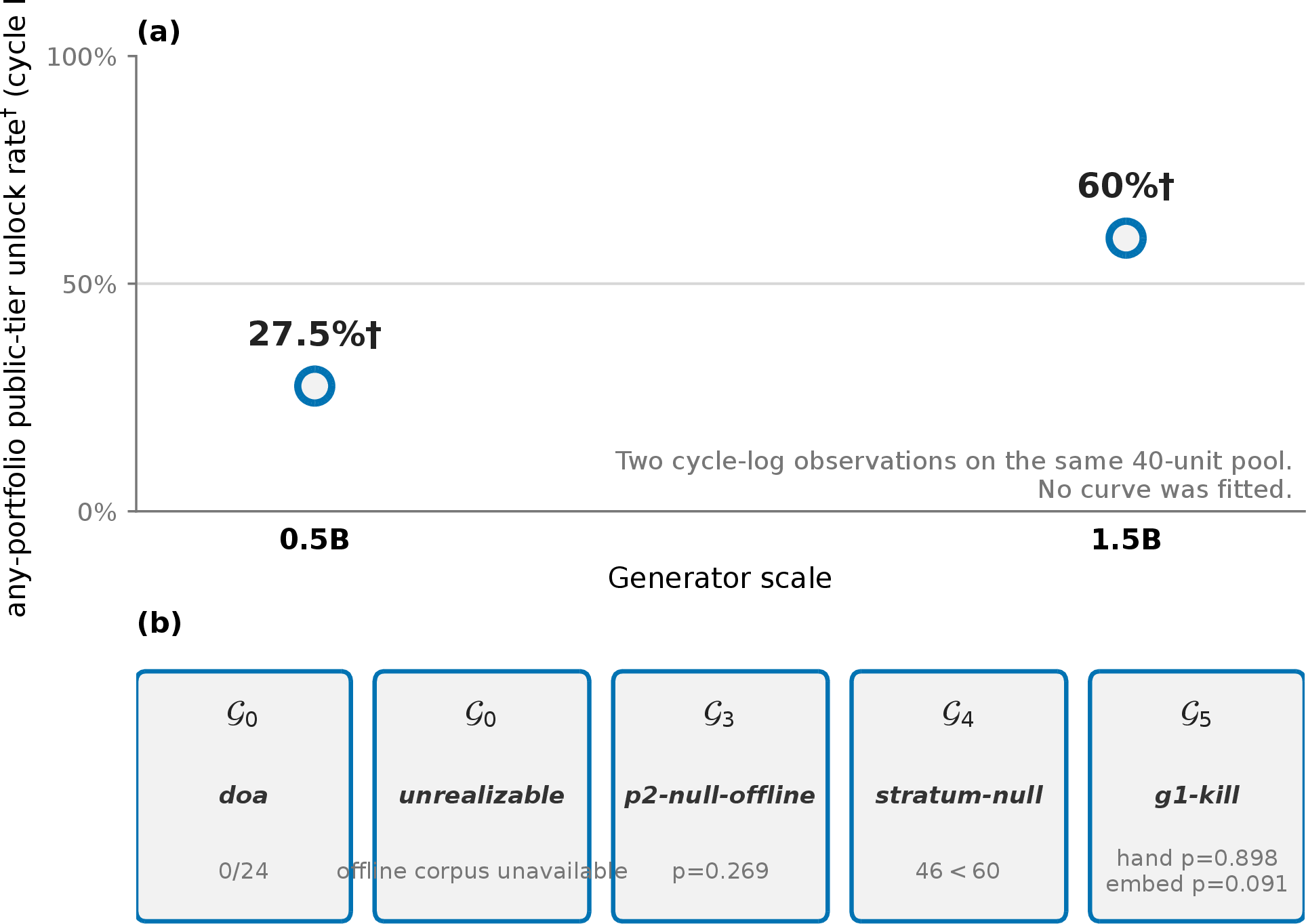
The two generator-scale points are reported in the upper panel of Figure 7, while the preregistered gate by which each null was produced is reported in the lower strip. A catalogue of gate outcomes, rather than a mechanism attribution, is provided by the figure.
Alongside the null-dominated profile of the ledger, the program’s mechanism- and measurement-level diagnostic records are reported in a separate table so that the alternative explanation of instrument failure can be evaluated (Table ¿tbl:tab:standing?). These rows carry the E-MECHANISM-DESCRIPTIVE label and all have descriptive status. No row is presented as evidence of a deployment gain or a “validated joint-embedding predictive architecture (JEPA)-RL reward.” The single confirmed positive carrying the E-INTERACTION estimand, LG P0, is reported in a separate paragraph after this profile.
4pt
@c>
p0.20c>
p0.27c>
p0.27c>
p0.12@
Diagnostic & Key statistic & Reference or scope & Status
Exact Hedge regret under vocabulary growth\(^{a}\) & worst 0.8836 \(<\) bound 10.254 & margin 9.37 & descriptive bound check
Outcome-calibrated severity\(^{b}\) & v(failure-atom) 0.5\(\to\)1.0, v(pass-atom) 0.5\(\to\)0.0 & corrected-sign projected SGD &
descriptive
Decoy-separable transitions\(^{c}\) & real-state dist 0.3480 \(<\) decoy-state dist 0.5176 & gate & descriptive gate
Exact correlated-evidence allocator\(^{d}\) & \(\hat{\rho}=0.7771\), \(\kappa_{\mathrm{eff}}=1.175\) & — & descriptive
JEPA embedding non-collapse\(^{e}\) & ema_cos 0.9929, erank 24.97 & \(d_z=128\) & descriptive liveness
ELF Stage-1 controller liveness\(^{f}\) & LinUCB \(6/6\) actions & 160 transitions, 40 unit updates & descriptive liveness
& blind 47, edge-first 43, counterex-min 25, type-contract 22, high-diversity 12, complexity 11 & 22 atoms, 0 cap violations. Hedge 1.1224 \(<\) 45.52 &
Reward-permutation liveness\(^{g}\) & \(P_{\mathrm{conc}}-P_{\mathrm{spread}} = +0.1293\), permutation \(p\approx1.0\times10^{-4}\) & 93-atom
vocabulary. 1,280 scored rows & mechanism liveness, not an endpoint result
ERA reward-mechanics conformance\(^{e}\) & bounds hit rate 1.0, cap saturation 1.0, monotonicity 1.0/1.0 & Kendall \(\tau\) with reward–error 0.468 and reward–\(q\) 0.327 & descriptive mechanism check
Ontology coverage\(^{h}\) & coverage \(0.9989\geq0.98\), & 494 generic F-value \(\to\) 388 F-numeric \(+\) 106
F-container & descriptive coverage gate
Error-taxonomy saturation\(^{i}\) & \(K = 93\), \(\hat{M} \approx 0.03\) & over 1,920 candidates & descriptive. ERA validity
C-matrix co-occurrence structure\(^{j}\) & log loss 0.254\(\to\)0.185 & 27.3% relative improvement & descriptive offline gate
Public–hidden dense calibration\(^{k}\) & Pearson \(r \approx 0.65\) / Spearman \(\approx 0.70\) & \(n=115\),
monotone buckets & descriptive, separate from P0

The error taxonomy was observed to have reached saturation on the online harvest of the JEPA-based ERA. Across 1,920 candidates, \(K = 93\) categories were recorded, and the Good–Turing missing mass was measured as \(\hat{M} \approx 0.03\). The Hedge regret bound held for every category born under vocabulary growth, with worst 0.8836 \(<\) bound 10.254 and a margin of 9.37. The planted-signal probe was passed under the corrected-sign projected SGD update of learned severity. Failure-atom severity moved from 0.5 to 1.0, while pass-atom severity moved from 0.5 to 0.0. The predeclared offline gate for the co-occurrence structure of the C-matrix, whose threshold was 1%, was passed by a clear margin. Diagonal log loss decreased from 0.254 to an interaction log loss of 0.185, a 27.3% relative improvement was recorded, and interaction matrix C was admitted for Stage-1. The decoy-separation gate was recorded as pass, constituting the first positive JEPA-mechanism signal in the program (real-state distance 0.3480 \(<\) decoy-state distance 0.5176).
By contrast, in ERA’s own smoke evaluation, the JEPA embedding remained non-collapsed but without downstream signal. JEPA loss decreased from 48.2 to 24.0, and the embedding did not collapse (ema_cos 0.9929, erank 24.97). However, out-of-fold ridge \(R^{2} \approx 0.0096\) and decoder \(R^{2} \approx -133\) were recorded. ERA values are reported only as descriptive machinery measurements, and ERA validity is retained with deferred status. In the weight-channel training record, Ct loss was measured as 0.5406\(\to\)0.00176 (99.674%), and Sf loss was measured as 0.4942\(\to\)0.00135 (99.727%). Both adapters completed 491 optimizer steps with 0 NaNs and were 73.9 MB each.
The calibration profile was recorded descriptively as follows. A Pearson correlation of \(r \approx 0.65\) and a Spearman correlation of \(\approx 0.70\) were observed between the public best-of-4 \(q\) statistic and the hidden pass rate (\(n = 115\)), and the bucket means followed a monotone staircase (0.114 / 0.343 / 0.462 / 0.792). The context for the single confirmed positive reported below is provided by this profile.
An independent conversion record was in the same direction. During the diversity-portfolio stage of the 0.5B generator, conversion from public unlock to hidden true unlock was measured as 8 of 13 (0.6154) in the \(P_{\mathrm{conc}}\) arm, 15 of 19 (0.7895) in the \(P_{\mathrm{mid}}\) arm, and 12 of 16 (0.75) in the \(P_{\mathrm{spread}}\) arm. In total, true unlock was obtained for 35 of 48 units. These rates are descriptive and carry no claim of portfolio superiority.
The program’s single confirmed positive was LG P0, which carries the E-INTERACTION estimand. It has primary status and is not an unlock-advantage result. At the LG P0 gate, the primary statistic was obtained as \(T_{\mathrm{int}} = 0.016667\). The permutation test yielded \(p = 0.0001\) (\(n_{\mathrm{perm}}\) 9999). The same verdict was retained in the dedup-robust recomputation with \(t_{\mathrm{int}} = 0.018255\). The per-arm profile of the P0 record was descriptively monotone. The mean dense-interaction fraction was measured as 0.4556 in the \(P_{\mathrm{conc}}\) arm, 0.3741 in the \(P_{\mathrm{mid}}\) arm, and 0.3268 in the \(P_{\mathrm{spread}}\) arm. The design was well powered (power \(\geq 0.97\), \(n = 80\) fresh units / \(g = 8\)), and this was the only result in the program with this level of power. In the program-wide sensitivity check, the family denominator was taken to be approximately 10, and a threshold of \(0.05/10 = 0.005\) was reported. Unless the exact family universe is listed in the frozen ledger, this calculation is to be read as a descriptive sensitivity check rather than as a confirmatory multiplicity correction. For P0, \(p = 0.0001 < 0.005\) was recorded. The LG P0 primary statistic was recorded as \(T_{\mathrm{int}}=0.016667\), with permutation \(p=0.0001\) and verdict confirmed. The statement that a unit-by-portfolio interaction was observed in public-tier dense progress on fresh units is licensed by this pass. In the separate hidden-partial calibration record, a descriptive association was observed between public and hidden partial progress. No claim of controller superiority or P0-confirmed public–hidden coupling is derived from this result.
Alongside this profile of positives, the built-in self-audit chain applied by the program to its own positive findings is reported. The family of the budgeted best-of-\(B\) allocator (AEG-BANDIT) carries the E-ALLOCATION estimand. Under an equal draw budget, adaptive–random net unlock was measured through the exact zero-cost offline replay gate. The superseded replay record showed +6.0 pp in favor of adaptive allocation and was retained together with the +0.001 control from the same record (\(\Delta=0.06025\), \(p=0.01375\), budget 12). This initial verdict was later explicitly invalidated in the frozen audit record by the self-audit conducted under a matched draw budget of \(B=8\). The fixed arms were limited to 8 draws by the pool cap, while the adaptive arm received 12 draws. The comparison was therefore made without matched draw budgets and was marked decision-invalid in the persistent supersession record. The initial value was retained only as a superseded audit step together with its retraction. The steps of the chain are provided in Table ¿tbl:tab:aeg?.
4pt
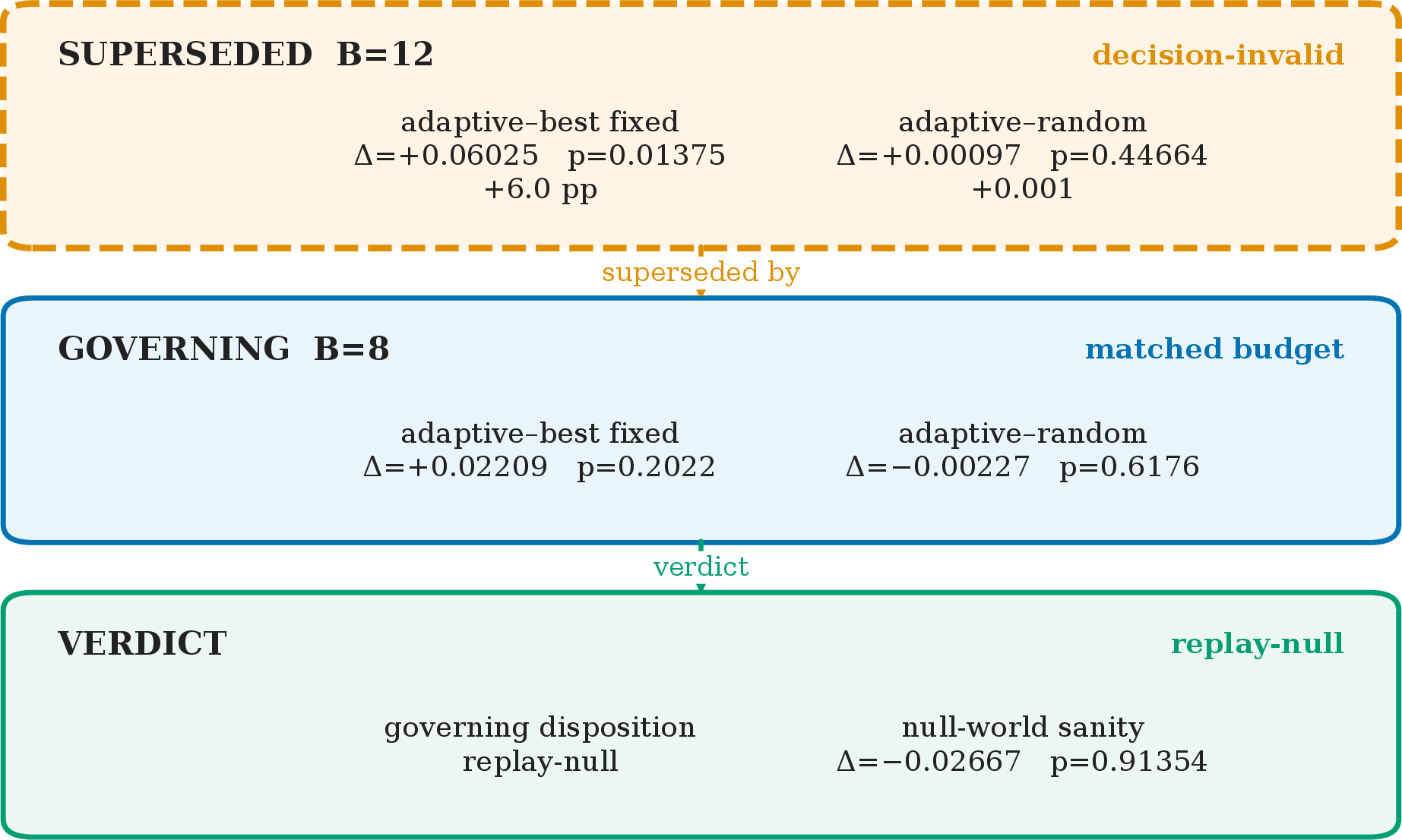
In Figure 8, the +6.0 pp value and +0.001 control from the superseded \(B=12\) record are shown within the same supersession step, while the +0.02209 and \(-0.00227\) contrasts from the governing \(B=8\) record are shown in a separate governing-record step (source: Table ¿tbl:tab:aeg?).
In the governing matched draw-budget (\(B = 8\)) recomputation, no statistically detectable difference was observed for the adaptive–best fixed contrast (\(\Delta = +0.02209\), \(p = 0.2022\)). In the adaptive–random control of the superseded (\(B = 12\)) record, +0.00097 and \(p = 0.44664\) were recorded. In the governing matched (\(B = 8\)) record, the adaptive–random contrast was recorded as \(-0.00227\) with \(p = 0.6176\). The family verdict was recorded as replay-null. The null-world sanity check yielded the expected directional result (\(\Delta = -0.02667\), \(p = 0.91354\)). The correlated-evidence internals of the allocator are reported descriptively, with \(\hat{\rho} = 0.7771\) and \(\kappa_{\mathrm{eff}} = 1.175\). The value \(\kappa_{\mathrm{eff}}=1.175\) was calculated using median \(m=3.0\) and \(\hat{\rho}=0.7771\).
The saturation pattern was separated descriptively by the budget scan from the same frozen replay record. Identification probability increased with the draw budget, from 0.5646 at \(B=4\) to 0.6088 at \(B=8\), with chance level 0.3333. By contrast, the expected maximum of the adaptive arm did not separate from that of random allocation, with 0.6169 versus 0.5967 at \(B=4\) and 0.7040 versus 0.6891 at \(B=8\). The model-based bootstrap extrapolation retained the same pattern at larger budgets. At \(B=48\), identification was 0.8858, while the expected maximum remained 0.7754 versus 0.7773. These extrapolated values are not exact replay values.
The +6.0 pp primary delta from the superseded (\(B=12\)) record and the +0.001 control from the same record are reported together with the supersession marker. The valid \(B=8\) analysis carries the +0.02209 and \(-0.00227\) contrasts and the replay-null verdict. A layer-by-layer account of the same retraction discipline is reported among the audit outcomes in Table ¿tbl:tab:audit?.
All AEG values are exact offline replay records on the frozen LG S1 cache (\(n=80\)). No live AEG candidate was generated.
0.0.3.3 Audit outcomes
None of the primary conclusions was changed by the sensitivity-level observations. All of these observations have secondary or descriptive status. The primary null in the weight channel (ELW) was also observed on the continuous secondary endpoint. The continuous best-of-4 \(q\) contrast for Ct–Fr was zero at floating-point precision and yielded permutation \(p = 1.0\). The accompanying continuous Ct–Sf contrast was recorded with mean \(-0.03521\) and permutation \(p=0.43826\) (\(n_{\mathrm{perm}}=10000\)). The continuous best-of-4 \(q\) contrasts for ELF were retained in the same analysis record. The mean difference was +0.0239 for On–Sh (permutation \(p = 0.6863\)), +0.0733 for On–De (\(p = 0.2140\)), and +0.0648 for On–Fr (\(p = 0.2354\)). In the prequential quartile record, the last-minus-first unlock rate was recorded as \(-0.10\) for On and \(-0.10\) for Fr, with a net quartile difference of 0.0. These secondary records were not added to the confirmatory binary family. The LG P0 verdict was retained in the dedup-robust recomputation (\(t_{\mathrm{int}} = 0.018255\)). The profile in which pooled ties were supported by different unit sets is provided in the per-cell and per-arm heat strip in the appendix (Figure 9).
An earlier record of the same self-audit discipline is present in the diagnostic layer. A learned-signal AUC value at the diagnostic stage was reduced from 0.597 to 0.467 after a defect that counted ties as wins was corrected (Mann–Whitney, tie \(=0.5\)). The corrected value is below chance, and this record is not an effect claim.
The family distribution in the ELW corpus is provided in the compact table in Appendix 0.0.8 (Table [tab:elw-family-distribution]).
Population accounting was recorded in the frozen audit as follows. The ELF population manifest defined 37 P0-marginal and 9 S2-marginal units. Their union yielded 46 units, and the realized Stage-1 count received pass status at 40. The strict all-24 recount diagnostic in the same audit recorded a value of 28. Both counts were retained together in the frozen population audit, and the denominator of the 40-unit screening tables was not changed. ELW used the same frozen Stage-1 manifest. The ELW protocol accounting matched the frozen record at 480 rows \(=\) 280 blind (240 round-1/2 \(+\) 40 early-unlock rows \(=\) 20 unit–arm pairs) \(+\) 200 error-augmented rows. The ELF audit manifest recorded hidden access 0, prompt violation 0, and shape leak 0.
This accounting is reported as program population, corpus, and candidate accounting for the nested strata (Table ¿tbl:tab:consort?). The flow is not a partition of a single pool. It is a sequence of strata derived by progressive narrowing from the same dead-unit pool across generations. The 40-unit band of the two headline families was formed through 1.5B-marginal selection after the FASTR thin-stratum finding of 33/535 at 0.5B. The LG fresh-unit stratum yielded 46 units against the target of 60 and was reported as stratum-null together with the record that EvalPlus had been exhausted at 1.5B. No exclusion was silently dropped. Each is shown as a recorded box.
In the ELF pilot, blind Fr unlocked 4/10 of the FASTR-33 “hard-dead” units. The Stage-1 population screen was constructed as 1.5B-marginal after this record.
4pt
@c>
p0.08c>
p0.23c>
p0.17c>
p0.43@
Step & Stratum & Gen & Layer accounting
1 & Dead-unit pool (zero-pass-in-pool, public tier) & — & initial pool
2 & Search-bound stratum & inherited & \(n = 46\) / 69 / 109\(^{\dagger}\)
3 & Hard-dead thin stratum (0.5B) & FASTR & 535 defined \(\to\) 33 realized. 33/535
4 & 40-unit 1.5B-marginal resistant band & ELF / ELW & 46 defined \(\to\) 40 realized. ELF 640 generations. ELW 480 generations
5 & Fresh-unit stratum & LG & 60 defined \(\to\) 46 realized. \(n=80\) / \(g=8\). 381 fresh screened \(\to\) 359
unlocks with blind \(k=4\) \(\to\) 9 marginal after \(k=8\) \(+\) 37 frozen P0-reuse \(=46<60\).
6 & ELW non-evaluation training split & & 236 units \(\to\) 1,964 content \(+\) 1,964 shuffled pairs (\(\leq\)30/unit, unit split, leakage 0, and
46 units excluded)
7 & ERA online taxonomy corpus & & 1,920 candidates
E1 & LG fresh-unit stratum & & (\(46 < 60\))
E2 & DCH offline corpus & & (offline corpus unavailable)
E3 & RIFT trigger & & (dead on arrival, 0/24)
E4 & FDP first-draw gate & &
Two amendments were recorded in the audit layer of this flow and are reported as frozen. In the ELF pilot, it was detected that the Sh control corrupted the task statement, producing the destroyed-task defect. The scaffold was corrected, and Stage-1 was run with the corrected Sh. Zero shape leak was recorded in the Stage-1 audit. In ERA, two \(\kappa\) defects were detected and corrected at the G6 falsification step. These amendments were not post-hoc interventions that changed the results. They were trace-preserving corrections closed before the primary runs. Both corrections are recorded with dates in the audit trail in Appendix 0.0.6.
The statistical verdict and audit verdict are reported separately for each layer (Table ¿tbl:tab:audit?). The known open defect is also included in this table without suppression and with the status as-frozen failing (tracked). The HEF decoy-synthetic test has failed deterministically since the Torch 2.12 migration. HEF is a supporting offline layer and is not used as the source of any endpoint-confirmatory claim.
2pt
@c>
p0.16c>
p0.15c>
p0.14c>
p0.27c>
p0.16@
Layer & Statistical verdict & Audit status & Evidence & Note
ELF Stage-1 & & clean & zero shape leak, no audit failure, recorded count 0 & destroyed-task defect detected and corrected in the pilot
ELW evaluation & & clean & adapter-effect , 12/12 prompt-hash rebuilds, derangement audited, leakage 0 & forgetting guard
LG P0 & & clean & dedup-robust, pool audit & single well-powered positive
AEG & & self-audited & superseded \(B{=}12\) +6.0 pp with +0.001 control retained together, governing \(B{=}8\) +0.02209 and \(-0.00227\), persistent supersession pointer & matched draw-budget correction
ERA & (validity) & amended & 2 \(\kappa\) defects falsified and fixed at G6 & JEPA shuffle gap \(=0.018<0.05\)
FDP & & gate-block & the gate block is a result & BigCodeBench
FASTR & diagnostic null & F4-catch & \(>\) reversal recorded & live thin stratum
HEF & standing\(^{+}\) / saturation null & as-frozen failing (tracked) & decoy-synthetic test, deterministic since Torch 2.12 & HEF is not used as a primary numerical claim
All results in this section are restricted to frozen 0.5–1.5B models, HumanEval+/MBPP+/BigCodeBench (Python) [71]–[73], the zero-pass-in-pool regime, a single scaffold, the matched output-generation budget (\(R = 4\)), and the \(U_p\) screening endpoint 2 . The mechanistic and epistemic readings of the pattern observed within these boundaries are provided only in the Discussion (§0.0.4).
0.0.4 Discussion↩︎
This study constitutes a PoPE evaluation of whether frozen small code LLMs can operationally use execution evidence that falsifies their own outputs. Learned error content was tested against form-matched placebos on the same units in both the prompt and weight channels. The only confirmed result in the program was the unit-by-portfolio interaction observed in public-tier dense progress. Public–hidden partial-progress calibration is retained as separate descriptive evidence. In addition, the allocation gain that appeared strongest was withdrawn through the built-in self-audit.
The results obtained within this framework address a narrower and more fundamental question than whether learned error conditioning is generally useful. Is the limited set of draws directed by learned error content, or by the form of the retry and the scale of the generator? Three principal patterns emerged together in relation to this question. First, on the 40-unit 1.5B-marginal resistant band, error content did not outperform the form-matched placebo in either the prompt or the weight channel. Both verdicts were obtained on the preregistered \(U_p\) screen (Definition 2), and hidden-tier true-unlock confirmation remains deferred by design (§0.0.3.1, Tables ¿tbl:tab:elf-family? and ¿tbl:tab:elw-family?). Second, a descriptive increase in the 1.5B direction was observed between the two within-program scale points (27.5% \(\to\) 60%\(^{\dagger}\) when moving from 0.5B to 1.5B3, §0.0.3.2, Table ¿tbl:tab:ledger?). This observation is not presented as a lever causally isolated from the other interventions or as a scaling curve. Third, the +6.0 pp primary delta from the superseded (\(B=12\)) record was retained together with the +0.001 control from the same record and its supersession marker. In the governing matched (\(B=8\)) record, the replay-null verdict was recorded with contrasts of +0.02209 and \(-0.00227\) (§[sec:selfaudit]). When read together, these three patterns yield the following four regularities.
The program findings are compressed into four regularities, presented below as Regularities 1–4. These regularities are presented not as positive laws, but as failure boundaries and design observations observed within the program, each restricted by its own scope guard. None is advanced as an impossibility proof or as a general law [29], [32]. This choice is motivated by the asymmetry of falsification. A failure boundary observed on a limited band is not a universal negative law, but a local refutation that records the region in which a claim fails, and any generalization must be established through new tests. The four regularities cover four axes of the same question: unconfirmed attribution is considered along the axis of content-attributable superiority (Regularity 1), the factor that moved is considered along the scale axis (Regularity 2), the time of transfer is considered along the pre-first-draw position axis (Regularity 3), and the channel in which transfer was not obtained is considered along the small-data weight-channel axis (Regularity 4). Immediately after each regularity, the scope guard that narrows the claim is stated explicitly. Content-attributable superiority was not confirmed. The subsequent readings concerning form, scale, and timing are not themselves this negative result, but an explicitly bounded layer of interpretation.
The first is Regularity 1 (the two-channel attribution failure boundary). Superiority attributable to error content was not confirmed in either deployment channel. This failure boundary is termed the “form wall” within the program. On the resistant band, the arm carrying error content did not outperform its channel-specific placebo twin in either channel. In the prompt channel, the pooled \(U_p\) screening counts were Sh 12 \(\geq\) On 10. No statistically detectable difference was observed in the On \(-\) Sh contrast (net \(-2\), \(b_{01} = 2\), \(b_{10} = 4\), McNemar \(p = 1.0\), mechanism-null). In the weight channel, Ct 8 = Fr 8 was observed (net 0, \(b_{01} = 4\), \(b_{10} = 4\), \(p = 1.0\), train-null), while the SHA-deranged placebo LoRA (LoRA, low-rank adaptation, Sf 10) was numerically highest. These two results are not interpreted as an absence of effect or as equivalence. Both primary paired findings rest on 6–8 discordant pairs, and equivalence was not tested separately. As a scope guard, this regularity is restricted to the 40-unit 1.5B-marginal resistant band, the \(U_p\) screening endpoint, the tested single scaffold, and the matched output-generation budget \(R=4\). It is not generalized to the broader population.
A descriptive increase in the 1.5B direction was observed between the two within-program scale points. The second is Regularity 2 (the two-point scale direction). The direction \(s_{1.5\mathrm{B}} > s_{0.5\mathrm{B}}\) was observed. This observation is not presented as a lever causally isolated from the other interventions or as a scaling curve. While the same conditioning and diversity nulls were reproduced at both scales, the solution rate increased from 27.5% to 60% when moving from 0.5B to 1.5B. Two points define a direction. They do not define a scaling curve. The existence of scale dependence is well established in the literature [44], [45]. However, those anchors were fitted to pretraining cross-entropy and carry no quantitative prediction for the cells considered here. As a guard, no scaling-law extrapolation is performed. Only a testable conjecture for 7B is formulated below.
Although support was added by scale, the manner in which the same budget was spent within a unit remained a separate question. The third is Regularity 3 (order-statistic saturation). Under a matched draw budget, \(\Delta_{\mathrm{adaptive-random}} \approx 0\) was observed, which is consistent with a saturation-compatible pattern in the order statistic under best-of-B sampling. Under the matched draw-budget (\(B = 8\)) self-audit, within-unit adaptation left approximately zero net gain over uniform mixing. The +6.0 pp allocation result in the program’s superseded (\(B=12\)) record (\(\Delta = 0.06025\), \(p = 0.01375\), budget 12) was retained together with the +0.00097 adaptive–random control from the same record (+0.001, \(p = 0.44664\)) and the supersession marker. In the governing matched (\(B=8\)) record, adaptive–best fixed was recorded as \(\Delta = +0.02209\) (\(p = 0.2022\)), adaptive–random was recorded as \(\Delta = -0.00227\) (\(p = 0.6176\)), and the verdict was replay-null (§[sec:selfaudit]). Best-of-\(n\) selection has been characterized in terms of its output distribution and reward–KL trade-off [74]. That analysis provides broader context and does not by itself establish the within-unit saturation mechanism inferred here. It also adds a limiting condition to the inference-scaling account under which a small model combined with sampling can be Pareto optimal [75]. Under the correlated-draw regime studied here, no statistically detectable adaptive-allocation advantage over the preregistered controls was observed. As a guard, this observation is restricted to a single replay-null. Positioning a learned prior before the first draw is retained as a design hypothesis alternative to adaptation between draws and is not presented as a theorem or a confirmed regularity.
The remaining candidate channel for content that was not transferred between draws was the weights. The fourth is Regularity 4 (the small-data weight boundary). No transfer superiority was observed while \(\mathrm{loss}_{\mathrm{train}} \downarrow\). The quantized LoRA (QLoRA) adapter trained on 1,964 content and 1,964 shuffled pairs derived from 236 non-evaluation units (NF4, rank 16/\(\alpha\) 32, 491 steps) reduced the training loss to 0.002. Nevertheless, content-attributable transfer superiority was not confirmed on the evaluation band (Ct 8 = Fr 8). It was recorded that the adapter met the offline training and machinery criteria but did not produce content-attributable operational superiority. When read together with analyses of knowledge capacity in large language models, this distinction indicates that acquisition, exposure, task diversity, adapter capacity, and training-target structure were not disentangled for the 236-unit corpus [76]. As a guard, this null is restricted to a single rank, a single set of target layers, a single 236-unit corpus, and a single scale. Limited task diversity was not separated from adapter capacity or training-target structure and is retained as one possible explanation. No general claim is made about the transfer capacity of the weight channel.
The four regularities state what was not transferred. Why it was not transferred can be read only at the level of an account. The reading from this point onward is an interpretation. It is not a mechanism directly identified by the design. An explanation consistent with the findings but not directly identified by the design can be stated as follows. At the 1.5B scale, the error distribution around a resistant unit is not reshaped merely by naming or recoding error content. The movement observed in the sampling distribution is consistent with sensitivity to the form of the retry and the scale of the generator. This reading is consistent with two observations. First, the band is not inert: at the descriptive level, Sh produced 12 unlocks, whereas Fr produced 7. Movement was observed at the descriptive level. Because form superiority was not established through a separate positive mechanism test, this pattern is treated as consistent with form sensitivity rather than as proof of a form effect. Second, although the same content could be measured and separated offline (C-matrix log loss 0.254 \(\to\) 0.185, 27.3% admitted, decoy-separation gate), no online refuting force was produced.
This pattern is consistent with the anchoring account of the preceding stage. When the failed solution or its abstractions are shown to the model again in the prompt, the sampling distribution is drawn toward the local neighborhood of the failure [25], [77], [78]. Findings of self-preference in large language model (LLM) evaluators point in the same direction [79]. The same distributional narrowing is also visible in the offline supervised fine-tuning (SFT) regime in which feedback is transferred into the weight channel. SFT over self-generated correction traces has been found insufficient because of distribution mismatch and mode collapse, and online RL has been required [24]. This pattern was not changed by the learned controller. Only the representation from which the pull was exerted was replaced by a learned lattice or adapter.
The same account can also be combined with the mechanistic negatives from the second stage. The coverage wall showed that deeper sampling did not rescue systematic failures. The capability scissors showed that a capable generator left no discriminable error margin among visibly passing outputs [52]. The wall observed here can be read as the learned-side view of the same wall. The tested object was not merely the addition of error text to a prompt. It was tested whether compiling criticism derived from execution outcomes into a lattice, adapter weights, or allocator state produced a discriminating force over new generations that exceeded the placebo. When no discriminable signal is available to a leakage-free selector, no conditionable signal may be available to a learned controller either. Conditioning can reweight support in the model distribution, but the resistant band was defined as a region in which the required support had not been observed in the pool. Scale adds support, form changes the search neighborhood, and, under this account, redescribing content does not add support. By retaining the learned object and its form-twin placebo within the same training and evaluation channel, it is made testable whether the observed movement is attributable merely to optimization or to the existence of a representation. The same form wall was also observed in the legacy stage of the program. There, too, the two strongest content channels failed to outperform a content-free shape placebo and only tied it [53].
The rivals to this account must be named explicitly. The first rival is an encoding bottleneck. The lattice or adapter encoding may compress the refuting detail of the counterexample in a lossy manner. The second is corpus narrowness. The confound stated for Regularity 4 (the small-data weight boundary) also applies here. The third is the screening endpoint. Because hidden-tier confirmation was deferred, a content effect that was not visible in the public-tier screen has not been ruled out. A negative public-tier screen licenses only the termination of the preregistered promotion. The fourth is band-selection heterogeneity. Because the resistant band was constructed only from a history of public zero-pass outcomes, unit types that might respond differently to content may have been collected within the same stratum. These explanations cannot be fully distinguished by the present design. No mechanism-level claim is therefore made.
Among the rival explanations, corpus narrowness becomes more concrete when it is read together with the weight channel’s own finding. Two observations were recorded together in the weight-channel adapter experiment. Both adapter variants symmetrically reduced the training loss to 0.002 within 491 steps. Actual adapter activation was confirmed by the adapter-effect probe: when the adapter was disabled, the base output was restored byte-for-byte, and 12 of 12 sampled rows were reproduced exactly in the prompt-hash rebuild probes. Nevertheless, no statistically detectable difference was observed in the Ct \(-\) Fr contrast (net 0, \(p = 1.0\)). The combination of near-zero training loss and unconfirmed evaluation-band superiority is consistent with a memorize-don’t-generalize interpretation. However, target memorization, scaffold adaptation, corpus diversity, adapter capacity, and semantic error-relation learning were not separated from one another by this design. This is the precise expression of the learned throughline in the weight channel. What was tested was not whether the corpus had been memorized, but whether what had been learned opened a solution on the resistant band. The combination of near-zero training loss and unconfirmed content-attributable transfer records that the latter was not observed. Pair multiplicity must also be noted. Although the 1,964 pairs increase the visible sample size, independent task support is not expanded in the same proportion. The 1,964-pair count should therefore not obscure the limit of 236 independent units, and the zero-leakage audit should not be read as a diversity audit.
This reading is consistent with recent findings on parameter-efficient fine-tuning (PEFT). The closest of these findings is the study documenting failure modes of small-data LoRA injection, including regression toward overrepresented answers and degradation on external benchmarks when new facts are packed into the adapter. This boundary is extended by ELW to an unconfirmed-transfer null at 1.5B through its SHA-deranged placebo LoRA and paired McNemar test [80]. Low-rank adaptation has been reported to learn less and forget less than full fine-tuning [42]. Here, too, the forgetting guard was passed (content-blind 4 \(\geq\) frozen-blind 3). The preregistered forgetting guard was therefore not violated, and broader harm was not tested. It has also been shown that narrowly targeted fine-tuning can instill the target behavior while eroding general correctness [43]. The weight-channel experiment therefore provides a symmetric negative result relative to this literature. Narrow error-content training in the small-data regime did not violate the forgetting guard, but it also did not produce content-attributable transfer superiority. Memorization is retained as an explanation consistent with this result and is not presented as a confirmed mechanism. This memorization boundary is consistent with the finding that LoRA instruction tuning primarily learns response-start and style tokens. The form interpretation thereby also receives an external comparator in the weight channel without requiring a positive Ct result [81]. Positive findings in the self-training literature [13]–[15], by contrast, arise in large-scale regimes with correct-answer filtering. No comparison in that literature tests error-structure conditioning with small data in a frozen small model. The result is therefore stated under the following boundaries: one rank (16), one QLoRA configuration (NF4, \(\alpha\) 32), one 236-unit corpus, one model scale (1.5B), and the \(U_p\) screening endpoint.
Given that training fit did not yield confirmed content-attributable transfer superiority in the weight channel, and that prompt-channel content did not outperform its placebo between draws, a timing question remains. When can a learned prior become useful? The self-audit chain of the budgeted best-of-B allocator (AEG-BANDIT) (§[sec:selfaudit], Table ¿tbl:tab:aeg?) records that the initial positive appearance depended on budget inequality. The +6.0 pp value from the superseded comparison is retained together with the +0.001 control from the same record and carries a budget confound caused by the adaptive arm receiving 12 draws while the fixed arms were pool-capped at 8. In the matched draw-budget (\(B = 8\)) replay, the adaptive–best fixed contrast was recorded as +0.02209. The governing adaptive–random contrast was \(-0.00227\). The +0.00097 (+0.001) control from the superseded (\(B=12\)) record is retained only as the preceding step in the audit lineage, together with the +6.0 pp primary delta and the supersession record. The null-world calibration (\(\Delta = -0.02667\), \(p = 0.91354\)) was consistent with the reading that the test bench did not generate a false positive. The interpretation of this chain is stated as follows and is explicitly labeled as an interpretation. What constrains within-unit adaptation is not a failure of identification, but saturation of the order statistic. Per-test passes within a candidate were strongly correlated (\(\hat{\rho} = 0.7771\)), and the effective evidential value of an observation containing median \(m = 3.0\) public tests was compressed to \(\kappa_{\mathrm{eff}} = 1.175\). Additional draws therefore purchase nearly the same evidence again. Under this reading, the design does not identify the unique binding constraint on within-unit adaptation, though an information limit is more consistent with the observations than a budget limit.
This reading points to a boundary of classical allocation theory. In the fixed-budget best-arm-identification framework [38]–[40], the bottleneck is modeled as identification. What was observed here, however, was a max-of-B statistic that saturated before identification became operative. Recent theoretical negatives within the same framework are also consistent with this reading. It has been shown that, when a relevant complexity exists in fixed-budget identification, it is attained by the best non-adaptive procedure [82], and that no stable-consistent algorithm uniformly outperforms uniform allocation in the two-arm fixed-budget setting [83]. These are the closest theoretical neighbors of the observation that the allocator left zero net gain over mixing. The distinction between existence and allocation also becomes clear at this point. Best-of-N existence results state that a correct candidate may be present in the pool [27]. The question here was how a fixed budget should be spent within a unit, and the observed answer was that spending order became practically irrelevant on a saturated order statistic. The independent finding that the effectiveness of iterative debugging declines with the number of rounds [41] is consistent with the same saturation interpretation. Pre-first-draw placement is retained as a design hypothesis consistent with replay-null. This hypothesis is not presented as a theorem or a confirmed regularity. Indeed, the attempt to place a prior before the first draw (FDP) received kill for both feature sets at its own preregistered G1 gate\(^{\dagger}\).
The aggregate of these three channel findings cannot be reduced to a single number. The program’s principal epistemic inference arises not from any single number, but from the placebo hierarchy as a whole. The third stage distinguished model-internal verbal self-critique from a counterexample derived from execution. The former is a textual artifact drawn from the same distribution, whereas the latter is an external comparison performed by a computational procedure outside the model [53]. That distinction is extended inward in this study. The criticism considered here is genuinely external in origin. An error taxonomy harvested from 1,920 real execution outcomes and saturated at \(K = 93\) categories, an outcome-calibrated severity measure, and a C-matrix that passed a predeclared gate were all available. Nevertheless, once this criticism was compiled into controller state, whether as a prompt lattice (the learned error-lattice prompt controller, ELF), a weight adapter (the error-lattice QLoRA weight adapter, ELW), or an architectural state (the error-set architecture, ERA), its behavioral signature could not be distinguished from that of the placebo. What was actually tested must therefore be stated explicitly. Once criticism is compiled into a learned object, such as a lattice, adapter, or architecture, the question being tested becomes whether the content of that criticism can open a solution through that object. The form-matched placebo twins make this test meaningful. Because the twin preserves predeclared scaffold components such as the task prompt, entrypoint, block layout, and injection position while removing the refuting content, exact token length and lexical distribution were not matched one-to-one, and residual surface aliasing was not ruled out. Under these constraints, a difference by which the learned object exceeded its twin was treated as the required measurement for content attribution, but no such difference was observed in either channel.
The observed pattern is consistent with prior evidence on form sensitivity. An older and established epistemic distinction between form and content is operationalized in both deployment channels of this program. In in-context learning, random replacement of ground-truth labels was found to reduce performance only slightly, indicating that the result was driven not by content but by label space, input distribution, and format [56]. The form sensitivity documented in that literature provides an attributional rationale for the Sh control. The result reported here is not presented as a direct replication of the content-irrelevance phenomenon reported for classification demonstrations. A prompt-semantics antecedent of this content irrelevance has also been documented. Models have been reported to learn from misleading or pathologically incorrect instructions at nearly the same rate as from well-formed instructions [57]. The Sf and SHA-deranged placebo-LoRA controls constitute the weight-channel counterpart of this observation. Under this reading, the observed movement is associated with the form of conditioning rather than with content. The Sh arm, which preserved the predeclared scaffold components while removing content, finished ahead of On (12 \(\geq\) 10). The placebo LoRA, in which the correspondence between error blocks was disrupted through a SHA-seeded derangement, was numerically highest in the weight channel (Sf 10). The De arm, in which transitions were deliberately mismatched, remained close to Fr (8 to 7). This observation is operationalized by the two-gate promotion rule: any arm that passes the signal gate but remains below the content gate is assigned the form label by definition. The prompt channel ended in this pattern, whereas the weight channel failed the signal gate as well. The ability of a placebo to produce movement without carrying content makes the external origin of compiled evidence insufficient on its own for operational credit.
The epistemological reading of this pattern is bounded as an interpretation. The externality of criticism is a property not of its provenance, but of its operational position. The execution oracle remains external at test time. By contrast, a prior learned from the oracle and compiled into the generation state is no longer the oracle. A feature used within the same generative process can be a representation of criticism, but it does not occupy the external epistemic position of criticism. The same execution trace becomes a counterexample relative to the oracle, a target in the training corpus, a token sequence in the prompt lattice, and a gradient contribution in the adapter. These transformations may provide useful compression, but they do not automatically preserve the counterexample’s function of testing a new output against an independent procedure. The philosophical importance of the placebo twins arises here. When no operational difference is found between a representation of criticism and a twin that carries the same learned and formal load without carrying the falsifying content, credit cannot be assigned to the content of criticism. Externality is thereby read not as an immutable property of the data source, but as a live relation between evidence and conjecture. Compiled criticism is preserved as error-derived information. However, unless the new conjecture is reconnected to the external oracle, it carries the role of conditioning rather than that of independent criticism.
In Popperian terms, criticism performs its work at the point of refutation, namely at execution. Compiling it at the point of generation turns criticism into a prior belief. This transformation removes the division of labor between conjecture and refutation. In the weight channel this conversion is made explicit, since the training objective 10 treats each error atom harvested from the oracle as a likelihood target, so that the content of criticism is compiled by the gradient into a prior encoded in the adapter weights. The epistemic force of criticism derives not from the truth of its content, but from its status as an independent comparison procedure standing outside the conjecture [30]. Compiled criticism is thereby caught one level higher by the exposure diagnosis that was applied to bare failing code in the third stage. Once a representation learned from the oracle is shown again through the prompt or the weights, it is no longer a test but a condition [53]. The gap between offline measurability and online refuting force is also consistent with this reading. The fact that content can be separated (decoy separation, C-matrix) did not imply that it would perform discriminating work at generation time. The epistemic validity of criticism and its generative efficacy must therefore be kept separate. An executable oracle can continue to show that a conjecture is false. A frozen generator, by contrast, may lack the representational freedom required to produce an alternative correct candidate from the same counterexample. This distinction between “measurable” and “operative” is consistent with the standing-diagnostics records of the program (§[sec:standing], Table ¿tbl:tab:standing?) coexisting with the transfer nulls without contradiction. In the tested regime, criticism did not perform its work as a vocabulary, as model-internal verbal critique, or as a compiled error representation. The function that was confirmed was the renewed testing of every new generation against the execution oracle. This reading is directly connected to the program’s contributions. The channel-agnostic placebo hierarchy that separates content from form establishes the measurement standard through which this distinction is made visible, while the self-audit that withdraws the program’s own positive within the experiment applies the same standard to the researcher’s own claims. The output of the study is not a repair algorithm, but a retestable measurement standard. The role of criticism is recovered when each new conjecture is reconnected to the external oracle.
For this result to become visible, falsification had to be applied at two levels. At the object level, model outputs were refuted through execution. At the meta level, the researcher’s own claims were made refutable through preregistration, form-matched placebos, a matched output-generation budget (\(R = 4\)), and executable audit invariants [53]. The finding that compiled criticism did not produce content-attributable superiority beyond the placebo could not have been produced without the meta level. Without the Sh, De, and SHA-deranged placebo-LoRA controls, the +3 direction of On relative to Fr or the reduction of the Ct adapter’s training loss to 0.002 could have been reported as a working content mechanism. The placebo hierarchy is therefore not decorative. It is the measurement apparatus that carries the claim itself. The contribution is consequently formulated not as a repair algorithm, but as a reflexive measurement instrument.
The same epistemic discipline must be applied to the borrowed architecture. A borrowed architecture is not a validated result. The joint-embedding predictive architecture (JEPA) head of ERA is a design borrowed from the vision literature [46]–[48], and it operated as intended at the smoke-test level. The embedding did not collapse, and training progressed. Nevertheless, no downstream signal was produced (ridge \(R^{2}_{\mathrm{oof}} \approx 0.0096\), decoder \(R^{2}_{\mathrm{oof}} \approx -133\)). The closest realization of JEPA on the language and code side adds a training-time embedding-prediction objective to next-token loss and reports gains on code-adjacent datasets [84]. The null reported here instead concerns error content injected at inference time through the prompt lattice or through small-data QLoRA in the weight adapter. The distinction is therefore between training-time and inference-time channels of the same architectural family. The two observations do not conflict. The guarantees of VICReg concern embedding non-collapse, not downstream utility. A non-collapsed but unhelpful embedding is consistent with the architecture operating as designed while failing to provide utility in this regime. The statement that “JEPA should be positioned before the first draw” is also an analogy within this framework. It refers to a world-model-before-acting vision and is not an empirical result established by that literature in this regime. Each of these distinctions explains why ERA validity was left deferred.
When this reading is combined with Regularity 3 (order-statistic saturation), a consistent design lesson emerges. If compiled criticism is ineffective between draws because of saturation, and if it did not produce content-attributable superiority beyond the form-matched placebo once compiled, one remaining testable position within the program at which a learned error prior can be tested is before the first draw. Even there, it must outperform a form-matched placebo. This account is consistent with the view that falsification is not a vocabulary or stored taxonomy, but a relation through which every new conjecture is reopened to executable comparison. The account itself is left falsifiable. A single demonstration in which a pre-first-draw prior outperforms its form control would weaken the reading developed in this section. The present evidence contains no such demonstration. The g1-kill result of FDP is the first attempt on this front to have been stopped at the gate.
Four distinctions systematically preserved by the program’s reporting discipline prevent these readings from being expanded beyond their support. First, the statistical verdict and audit verdict are separate axes (§0.0.3.3, Table ¿tbl:tab:audit?). The p-value of a contrast and the integrity of the pipeline that produced that contrast are reported separately. As-frozen audit statuses are not overwritten retrospectively. The HEF decoy-synthetic test, which has deterministically failed since Torch 2.12, was therefore not concealed and was retained as a tracked open defect in Table ¿tbl:tab:audit?. HEF is not used to support any endpoint-confirmatory claim.
Second, a gate block, stratum exhaustion, or public-screen null is a first-class result. The g1-kill result of FDP for both feature sets, the stratum-null result of LG (\(46 < 60\), with EvalPlus exhausted at 1.5B), and the ELF/ELW \(U_p\) screens are not failed attempts, but preregistered measurements that stopped expenditure at the correct point. A gate is not an incomplete experiment. It is a design object that prevents progression to the wrong epistemic stage. Because a preregistered gate gives a claim a genuine chance to die, a g1-kill result is, in this sense, a record imposed on the program itself by severe-testing discipline, not an incomplete experiment [32], [85]. The kill reasons for the legacy controllers at the beginning of the program carry the same status. RIFT was recorded as doa (0/24), DCH as unrealizable, and ECK as underpowered. Each is a reported box rather than a silent drop (§0.0.3.3, Table ¿tbl:tab:consort?).
The complement to this distinction is the manner in which the program’s single confirmed result is protected. In LG P0, permutation \(p = 0.0001\) was recorded for the unit-by-portfolio interaction in public-tier dense progress. In the program-wide sensitivity check, the family denominator was taken to be approximately 10, and a threshold of \(0.05/10 = 0.005\) was reported. Because the exact family universe is not listed in the frozen ledger, this calculation is retained as a descriptive sensitivity check rather than as a confirmatory multiplicity correction (§[sec:standing]). This reporting rests on the standard basis by which confirmatory and exploratory analyses are separated and hypotheses are frozen before the data are observed [64]. P0 is an E-INTERACTION result, not an unlock-advantage result. Public–hidden partial-progress calibration is retained as separate descriptive evidence (\(r \approx 0.65\)–\(0.70\)). No reading of a coupling substrate that could be exploited by a controller, or of a “working controller,” is licensed by this result.
Third, a tie is not sameness, and offline decisiveness is not live transfer. The results Sh 12 \(\geq\) On 10 and Ct 8 = Fr 8 (\(p = 1.0\)) rest on 6–8 discordant pairs. These observations do not constitute evidence of equivalence or non-inferiority. Equivalence was not tested separately, and no TOST margin was defined. A tie over 6–8 discordant pairs is not a demonstration of sameness, but an absence of discrimination. Because corroboration is asymmetric with respect to refutation, “failed to confirm” and “refuted” are distinct expressions [29], [32]. In this framework, corroboration is not a degree of verification, but a record indexed to the severity of the test survived. Because survival is cheap under a low-powered test, no high-severity survival status is assigned to either paired finding [85]. Similarly, the content-axis result of HEF in the offline synthetic environment (\(p \approx 7\times10^{-14}\), leave-one-cluster-out leakage control 0) was decisive offline. However, the Ollama probe of the same detector reproduced the form-not-content null in live evaluation. Offline certainty is nowhere used as evidence of live transfer.
Fourth, the principle from the first stage that “naming severity is not having it” [51] is deepened in this program. In m1, naming severity was insufficient. Here, severity was fitted from real outcomes and calibrated by ERA, yet it still did not exceed form once the order statistic had saturated. Having a measured severity is therefore not the same as having an operational severity. A three-step ladder thereby emerges, with each step carrying its own falsifier: named severity, which was refuted as a discriminating signal in m1; measured and calibrated severity, which was obtained in ERA; and operational severity, defined as exceeding form after the order statistic has saturated, which was not obtained in this program. This observation is consistent with the literature on the limits of self-correction [21]. The presence of an apparently external signal does not guarantee that it is usable. This limit on usability is narrowed further by the finding that small models can correct themselves only in the presence of a strong external verifier [86].
These distinctions also determine the position of the study relative to prior work. The study is distinguished from prior work not by method names, but by the experimental controls retained, continuing the positioning discipline of the third stage [53]. Positive results have been reported within their respective regimes by the self-repair and self-refinement line [3]–[5], [20], the execution-feedback RL line [8]–[10], the inference-aware best-of-N line [27], [28], [87], the PEFT and self-training line [13], [15], [17], [18], [42], and the progressive-refinement line [16]. The point of distinction is that none of these lines jointly includes a placebo separating content from form, a matched output-generation budget (\(R = 4\)), tests of both channels on the same units against their channel-specific placebo twins, and a self-audit that withdraws its own positive within the experiment. A controls-coverage map for selected prior work is provided as Table ¿tbl:tab:positioning? in Appendix 0.0.12. The marks are coded from the published method descriptions of the cited studies. The map is descriptive rather than an exhaustive certification and carries no claim of outcome superiority.
The simultaneous presence of placebo control, a matched output budget, two channels on shared units, and self-audit in the PoPE row of Table ¿tbl:tab:positioning? explains why the nulls reported here define a narrower failure boundary without directly contradicting prior positive findings. Controls-based positioning also keeps visible the regime mismatch between the positive literature and the nulls reported here. Execution-feedback RL and self-training systems operate on larger models, with online updates, or on broader corpora [10], [15]. The inference-aware best-of-N line links budget allocation to model weights, but does not pose the content-versus-form attribution question on the same endpoint [87], [88]. The same regime difference is visible in positive reports concerning error-content feedback itself. Returning error-type feedback to the model improved code quality at ChatGPT scale [89], whereas fine-tuning on outputs from stronger models copied style without closing the content gap across the 1.5B–13B range [90]. These two ends jointly bound the sub-2B error-corpus corner considered here, a corner that remains uncharacterized with respect to scale, endpoint, and placebo controls.
Three bounded practical implications follow from the findings, and all three are formulated only for the tested regime. The scope comprises frozen 0.5–1.5B code models, the zero-pass-in-pool regime, HumanEval+/MBPP+/BigCodeBench in Python, a single prompt scaffold, a matched output-generation budget (\(R = 4\)), and the \(U_p\) screening endpoint.
First, a learned error prior is not a reliable default against form, scale, or mixing in this regime. On the evidence observed for a frozen coder of \(\leq\)1.5B, larger-generator (Regularity 2, the two-point scale direction) and simple-mixing (Regularity 3, order-statistic saturation) baselines should be evaluated before a learned controller is credited. Because repeated draws from smaller models have independently been shown to exceed a single draw from a larger model under a matched budget only when unit-test selection is available [91], this ordering is specific to a deployment regime in which the execution oracle is available. At the level of the observed evidence, no measurable contribution beyond these two alternatives was added by the learned conditioning layer. For the practitioner, the default comparison should therefore not be a weak arm without a controller, but the strongest simple alternative using the same matched output-generation budget (\(R = 4\)). Second, before a content arm is advanced, it should be tested on a resistant band against a form-matched placebo within its own deployment channel. In the data from this program, gains measured only against Fr or blind sampling could not be distinguished from form effects under the two-gate rule. Third, small-data QLoRA training over error content did not produce content-attributable transfer superiority in this regime. Task diversity should be isolated before additional optimization steps are prioritized. Because of the confound stated for Regularity 4 (the small-data weight boundary), this recommendation retains the status of a hypothesis and is linked to the follow-up experiment specified below.
The natural extension of these bounded implications is a set of open research directions and preregistration-ready follow-up studies. The four regularities and their guards directly determine four follow-up lines left preregistration-ready by the program. First, task-diverse corpora can be used to test task diversity directly, the named prime suspect under Regularity 4 (the small-data weight boundary). The same QLoRA configuration should be retrained on a corpus with greater source diversity while the number of units is held fixed. Findings on instruction diversity [50], [92] show in larger regimes that diversity can be more consequential than volume. It has also been reported that weaker but cheaper generators can produce compute-optimal data through high coverage and diversity [93]. The side effects of narrow fine-tuning have been demonstrated independently [43]. These anchors motivate the hypothesis but do not validate it at this scale or under this data budget.
Second, a 7B generator should be evaluated. Regularity 2 (the two-point scale direction) records a descriptive cycle-log increase. Repetition of the same resistant-band protocol at 7B on a fresh band constructed separately from the original 40 units would test whether the attribution boundary shifts with scale or with the regime.
Third, the deferred ERA validity test should be conducted. ERA currently constitutes only built and smoke-proven machinery (\(K = 93\), \(\hat{M} \approx 0.03\), Hedge bound, and no signal in the JEPA head, §[sec:d-epistemic-core]). No ERA component should be regarded as validated before its preregistered reward-validity test has been run.
Fourth, the allocator should be repositioned as a pre-first-draw prior. The design rule obtained from Regularity 3 (order-statistic saturation) suggests moving the exact allocator machinery of AEG-BANDIT from between draws to before the first draw. The finding of declining debugging effectiveness independently motivates this move [41], and the g1-kill result of FDP has already established the gate discipline for this front. This “before the first draw” position is shared with a recent realization of the world-model-before-acting vision, in which a latent world model performs zero-shot planning before actions are selected [94], [95]. Its use here is analogical and is not an empirical result established by that literature in this regime. Positive findings from the progressive-refinement line [16] provide a natural external comparator in this setting. Unless the same claim is tested in this regime under a form-matched placebo and a matched output-generation budget (\(R = 4\)), it is not directly comparable with the nulls reported here. These four lines are designed to sharpen the boundary of the primary result. None changes the evidential status of the current verdicts unless and until it is run and reported.
To determine which claim could be upgraded by these follow-up lines, the validity boundaries of the findings are considered next. The boundaries are reported across four facets: construct, conclusion, internal, and external validity. With respect to construct validity, the program endpoint is true unlock, defined as public \(\wedge\) prompt-hidden. However, dead and resistant status is defined only through the public tier, and the two decisive verdicts, ELF and ELW, are based on the \(U_p\) screen. Hidden-tier confirmation was deferred by design because of the negative public-tier screen. ERA validity is deferred. “Severity” is a fitted rather than directly measured quantity and should be read under this construct boundary.
At the level of conclusion validity, all primary contrasts were reported against the preregistered gate thresholds using exact one-sided McNemar tests with within-family Holm correction. The ties on the 40-unit band rest on 6–8 discordant pairs. The low-powered families are labeled “failed to confirm,” and none is read as “refuted.” Equivalence and non-inferiority were not tested for any tie. By contrast, LG P0 is the program’s only well-powered result (power \(\geq 0.97\), \(n = 80\)/\(g = 8\), permutation \(p = 0.0001\)) and licenses only the claim of a unit-by-portfolio interaction in public-tier dense progress.
With respect to internal validity, the mirror and derangement controls preserve predeclared scaffold components such as the task prompt, entrypoint, block layout, and injection position, but do not hold exact token length or lexical distribution fixed. A residual degree of aliasing therefore remains between content and prompt statistics. The budget is defined as a matched output-generation budget (\(R = 4\)). Equality in FLOPs or input tokens was not achieved. The weight-channel experiment does not separate adapter capacity from the task diversity of the corpus. This boundary is retained in the guard for Regularity 4 (the small-data weight boundary). The +6.0 pp and +0.001 control from the superseded \(B=12\) AEG-BANDIT record were identified together with their supersession as arising under a pool-cap confound, and the record was corrected within the paper. The correction itself records that the internal-validity mechanism operated.
With respect to external validity, the findings are restricted along the following axes. Model scale is 0.5–1.5B (Qwen2.5-Coder 0.5B/1.5B, DeepSeek-Coder 1.3B, Ollama). The regime is zero-pass-in-pool. The benchmarks are HumanEval+/MBPP+ through EvalPlus and BigCodeBench, and only Python is covered. A single prompt scaffold and a single QLoRA configuration (NF4, r16/\(\alpha\)32) were used. The same direction or magnitude is not claimed for larger models, different languages, different scaffolds, or different adaptation configurations.
The four facets are not independent checklist items. A boundary in one facet directly changes the claim language in another. The public-only construct requires the results to be read at the conclusion level as superiority screens. The diversity confound requires capacity language to be withdrawn at the internal-validity level. Resistant-band selection and small model scale jointly limit external transport. A clean audit does not close this transport gap. This reading is consistent with an account under which boundary reporting is not a list of limitations, but a design map specifying which future contrast could upgrade which claim. The four concrete lines of this design map were stated above in preregistration-ready form.
Under these boundaries, the central result is restricted as follows. On the 40-unit 1.5B-marginal resistant band and at the \(U_p\) screening endpoint, error content did not outperform its form-matched placebo in either the prompt or the weight channel. In the two-point contrast derived from the cycle log, a descriptive scale increase in the 1.5B direction was observed, and the governing matched draw-budget (\(B = 8\)) self-audit was recorded as replay-null. None of these statements carries a claim of equivalence, non-inferiority, or general impossibility. Hidden-tier true-unlock confirmation is deferred by design.
The discipline of falsification was also applied to the program’s own positive results [52]. AEG-BANDIT provides the example. The superseded (\(B=12\)) +6.0 pp allocation result that could have been reported with \(p = 0.01375\) was retained together with the +0.001 control from the same record and the persistent supersession marker. In the governing matched (\(B=8\)) record, replay-null was recorded with contrasts of +0.02209 and \(-0.00227\). The initial decision was preserved as invalid in the persistent supersession record and was reported together with the valid \(B=8\) analysis. This recording discipline prevents negative evidence from being neutralized post hoc. The same discipline was applied throughout this paper. No working JEPA-RL controller is claimed. A program of negative-result and measurement-methodology character is presented. The nulls are not no-go theorems, but design rules that direct the expenditure of the next design toward the appropriate target. The standing diagnostics record that the instrument was operational and reduce the plausibility of a gross instrument-failure explanation; they do not exclude measurement error. This reading also renders testable the question of whether a sequence of nulls can count as progressive within a research programme [31]. The programme can be read as a progressive problem shift only for as long as each null narrows the question posed by the next test. Otherwise, continued development must be recorded as degeneration.
0.0.5 Conclusion↩︎
PoPE (Popperian Placebo-controlled Evaluation), the original evaluation methodology introduced here, was used to assess whether frozen small code large language models (LLMs, 0.5–1.5B) could operationally use evidence that falsified their own generated code. The operational value of learned, error-conditioned self-repair was tested across two separate deployment channels and was evaluated through a learned error-lattice controller in the prompt channel and a quantized low-rank adaptation (QLoRA) adapter in the weight channel. Every measurement was rendered falsifiable by two structural components of the methodology: a low-cost preregistered gate applied at each stage before live expenditure was opened, and a channel-agnostic control hierarchy in which each content arm was paired with a scaffold-matched placebo twin whose content was either ablated or deranged within the same deployment channel. All comparisons were conducted under a matched output-generation budget (\(R = 4\)) on the 40-unit 1.5B-marginal resistant band.
Under this evaluation, error content did not outperform its channel-specific placebo twin in either channel. In the prompt channel, Sh finished ahead of On (12 to 10, mechanism-null). In the weight channel, the content arm and the intervention-free baseline were numerically tied, while the SHA-deranged placebo remained ahead (Ct \(=\) Fr \(= 8\), Sf \(= 10\), train-null). These results do not constitute evidence of equivalence or non-inferiority. Equivalence was not tested separately. The transferable contribution retained from the study is therefore not a working controller, but a reflexive evaluation apparatus through which each negative result can be retested. The findings are interpreted not as showing that compiled criticism disappears as information, but as showing that its external epistemic role in independently testing a new conjecture is lost. Within the same evaluation sequence, only the unit-by-portfolio interaction in public-tier dense progress was recorded as confirmed. Public–hidden partial-progress calibration was retained as separate descriptive evidence. This result was not interpreted as evidence of controller superiority. In the two-point scale contrast obtained from the cycle log, a descriptive increase in the 1.5B direction was observed, with the any-portfolio unlock rate rising from 27.5% to 60%\(^{\dagger}\)4. This observation was not interpreted as evidence of a scaling law or of a single causal lever. The principal contribution to the reliability of the methodology was provided by its ability to withdraw its own apparently strongest positive result. The +6.0 pp primary delta in the superseded (\(B=12\)) record was retained together with the +0.001 control from the same record, and the replay-null verdict was made persistent in the governing matched (\(B=8\)) record through the +0.02209 and \(-0.00227\) contrasts.
The open research directions indicated by this evidential standard are task diversity and generator scale. Although training fit was achieved in the weight channel, the failure to confirm content-attributable transfer superiority leaves limited task diversity as one possible explanation. This explanation was not separated from adapter capacity or training-target structure. In the first follow-up study, task-diverse corpora should therefore be tested against the same deranged control. The descriptive two-point scale observation suggests that a larger generator (7B) could be tested as a separate preregistered intervention under the same attribution controls. Task diversity and scale should not be bundled again within the same run. The hidden-tier Stage-2 confirmation deferred by design and the validity test of the joint-embedding predictive architecture (JEPA)-based reward remain available to be conducted at low cost under the same preregistered discipline. The reported nulls are not no-go theorems, but design rules. A future learned error prior can be tested for whether, positioned before the first draw, it outperforms its placebo twin within its own deployment channel when task diversity and generator scale are varied as separate interventions. Within this framework, the idea of JEPA-based reinforcement learning (RL) is neither confirmed nor refuted. Only the boundaries within which that idea might become operationally effective are delineated.
Reproducibility and Data Availability↩︎
The research data, result manifests, generated outputs, prompt renders, seed payloads, audit records, pre-registration and amendment records, generation and evaluation code, falsification suites, and figure/table generation scripts produced and analyzed in this study have not been released through a public repository, DOI, or external deposit. These materials are available from the corresponding author upon reasonable request for academic verification and replication. Sharing of the requested materials may be limited by file size, technical transfer constraints, third-party benchmark/model license conditions, and institutional policy constraints. The open-weight models and EvalPlus benchmarks used in the study are already available from their respective public sources.
Ethics and Generative-AI Use Disclosure↩︎
The study evaluates publicly released open-weight code models on public benchmarks. No human subjects or personal data are involved. Large language models were used in two declared roles: as the objects of the study, namely the three tested frozen models, and as manuscript-preparation assistants for drafting and editing under the author’s direction and review. All experimental design decisions, pre-registrations, and verdicts belong to the author. All reported numbers were produced either by the executable pipeline or by the explicitly marked program-cycle records.
Funding↩︎
This work was supported by the Scientific and Technological Research Council of Türkiye (TÜBİTAK) under the 1001 programme, project no. 225M316, “A Tilt-Trirotor Vertical Take-Off and Landing Controller Enabling Task-Oriented Transfer and Rapid Adaptation. Hardware-in-the-Loop and Real Validation of a Meta-Learning–Based Reinforcement Learning Architecture.” The meta-learning code developed in that project was integrated into the test harness together with the frozen language models studied here and was used during the agent-design phase to optimize the algorithms designed by the author.
Conflict of Interest↩︎
The author declares that there is no conflict of interest.
APPENDIX↩︎
These appendices have been organized so that the records supporting the claims in the main text can be traced by the reader. In Appendix 0.0.6, the audit and amendment trail for all stages of the program is presented in chronological order. Appendix 0.0.7 summarizes the scaffold roles and placebo-construction rules for the prompt and weight channels. In Appendix 0.0.8, the per-cell and per-arm unlock rates on the resistant band are reported at full resolution. Appendix 0.0.9 records provenance notes associated with the main-text program ledger. Appendix 0.0.10 summarizes the calibration and supersession chain of AEG-BANDIT. Appendix 0.0.11 summarizes the derivational objects used by ERA together with the deferred-validity record. In Appendix 0.0.12, the study is positioned relative to prior work through the experimental controls retained.
0.0.6 Audit and amendment trail↩︎
In this appendix, the audit events associated with all stages of the program (\(\mathcal{G}_{0}\)–\(\mathcal{G}_{8}\)) are recorded in chronological order together with their dispositions and evidential statuses. The purpose is not merely to report the final amended verdict, but also to make the failure modes of the evaluation pipeline reproducible and open to criticism. Accordingly, the original audit failures were not removed, dated amendments were reported separately, and post-amendment verdicts were not substituted for the original as-frozen verdicts. Each correction is presented in the sequence original rule \(\rightarrow\) failure \(\rightarrow\) amendment \(\rightarrow\) amended rule.
Pre-run falsification suites and gate firings. Before each program generation was initiated, its implementation was tested using its own executable falsification suite. Preregistered gate firings, including the g1-kill result triggered for both feature sets at the FDP stage, were retained in the run record as dated dispositions rather than as silent exclusions.
FASTR sandbox amendment (\(\mathcal{G}_{2}\)). At the diagnostic stage, a sandbox defect caused by restricted built-ins had rendered 589 of 1,912 candidates all-exception casualties. After the defect was corrected and rescoring was performed, the dead-unit count decreased from 189 to 154, and the eligible search-bound stratum decreased from 38 to 33 (33/535). This amendment was closed before the primary runs and was retained as a trace-preserving data-quality correction.
FASTR learned-signal amendment (\(\mathcal{G}_{2}\)). At the same stage, the learned-signal AUC was reduced from 0.597 to 0.467 after the rule under which ties had been counted as wins was corrected. The corrected value remained below chance.
ERA \(\kappa\) defects (\(\mathcal{G}_{6}\)). Two \(\kappa\) (kappa) defects were detected and corrected at the G6 falsification step. The corrections were closed before the primary runs and were retained in the trail.
ELF severity-sign correction (\(\mathcal{G}_{7}\), design stage). The sign of the outcome-calibrated severity update used by the On controller was corrected from the reversed sign in the design document, and the correction was verified using SymPy. The correction was applied before the primary run and was recorded in this trail.
ELF destroyed-task Sh correction (\(\mathcal{G}_{7}\), pilot). During the Cycle-5 liveness pilot, it was detected that the original pilot version of Sh also corrupted the task statement, thereby producing the destroyed-task defect. The scaffold was corrected through the registered second shape-control amendment, and Stage-1 was run using the corrected Sh. In the Stage-1 audit, the shape-leak count was recorded as zero, and no audit failure was recorded.
AEG supersession (\(\mathcal{G}_{4b}\)). The initial pass decision from the naive replay reading (+6.0 pp) was linked to its matched draw-budget successor through the +0.001 control from the same record and a persistent supersession record. The initial pass decision was marked decision-invalid and was not interpreted as the valid result. A summary of the chain is provided in Appendix 0.0.10.
HEF known failure (tracked). The decoy-synthetic test in the HEF learning test suite has failed deterministically since the migration to Torch 2.12. The defect was not suppressed. It was retained with tracked status and is preserved as as-frozen failing (tracked) in the audit-status-by-layer table (Table ¿tbl:tab:audit?).
A layer-level summary of this trail is collected in the audit-status-by-layer table in the main text (Table ¿tbl:tab:audit?). The trail is retained to document, at the row level, that statistical verdicts and audit verdicts carry different epistemic statuses. As-frozen audit states are not overwritten by any correction, and the conjectures of the evaluation system itself remain open to executable counterexamples.
0.0.7 Prompt/LoRA scaffold and placebo summaries↩︎
In this appendix, the frozen scaffold records for all arms in the two channels are summarized. The roles of the On/Sh/De/Fr templates are summarized for the prompt channel, and the training and evaluation configurations for Ct/Sf/Fr are summarized for the weight channel. A single scaffold family is shared by the arms, and differentiation is introduced only through the conditioning packet or training data. The definitions were derived from the archived prompt-generation rules and the frozen training and evaluation configurations.
0.0.7.0.0.1 On.
The live learned error-lattice controller is instantiated as the On arm. An error-conditioned repair prompt is generated and updated within the run. The error content harvested from the unit itself is carried in the conditioning block.
0.0.7.0.0.2 Sh.
A structure-matched, content-free placebo is instantiated as Sh. The genuine task prompt, entrypoint, layout, and scaffold are held fixed, while only the public-facts block is replaced by a content-free block with the same layout. The destroyed-task defect in the original pilot version of Sh and the registered shape-control amendment are recorded in the trail in Appendix 0.0.6.
0.0.7.0.0.3 De.
The donor-error-facts construction is instantiated as De. Genuine-looking but mismatched error content taken from another evaluation unit is used. The task\(\to\)error mapping is disrupted while representational form is preserved.
0.0.7.0.0.4 Fr.
In the prompt channel, Fr is instantiated as the pretrained state of the same controller, and no online update is applied. In the weight channel, Fr is instantiated as the base model without an adapter (Qwen2.5-Coder-1.5B-Instruct). Byte-identical restoration is verified in the adapter-effect probe through the call by which the adapter is disabled.
0.0.7.0.0.5 Ct.
The Ct arm is instantiated as a QLoRA adapter trained on 1,964 genuine task–failing-code–error-atom pairs. The corpus was constructed from 236 non-evaluation units, with 46 evaluation/reserve units excluded and a cap of \(\leq\)30 examples per unit.
0.0.7.0.0.6 Sf.
The Sf arm is instantiated as a SHA-deranged placebo LoRA. Training is performed on a SHA-seeded complete derangement of the same error blocks. The number of examples, surface form, family marginals, and training hyperparameters are identical to those of Ct. The task\(\to\)content mapping is removed.
The definitions of the executable audits used to preserve placebo integrity are frozen together with these scaffolds. Byte-level SHA verification and the forbidden-token audit are defined for the prompt channel. The derangement audit with no fixed points and byte-identical family distributions, the unit-level split, and the adapter-disable probe are defined for the weight channel. The Stage-1 and evaluation outputs of these audits are reported in the main text (Table ¿tbl:tab:audit?).
0.0.8 Per-cell and per-arm unlock rates↩︎
The preregistered per-cell and per-arm \(U_p\) screening rates (Definition 2) on the 40-unit 1.5B-marginal resistant band are provided here at full resolution together with paired discordant membership. The purpose is to allow verification of whether pooled ties rest on different sets of units. A zero or negative pooled difference is not interpreted as evidence of equivalence or non-inferiority. All numbers belong to the \(U_p\) screening endpoint 2 . Hidden-tier true-unlock confirmation was deferred by design, and unspent cells are marked “not spent.” The unit-level membership records of arms with the same pooled total are shown in the heat strip in Figure 9.
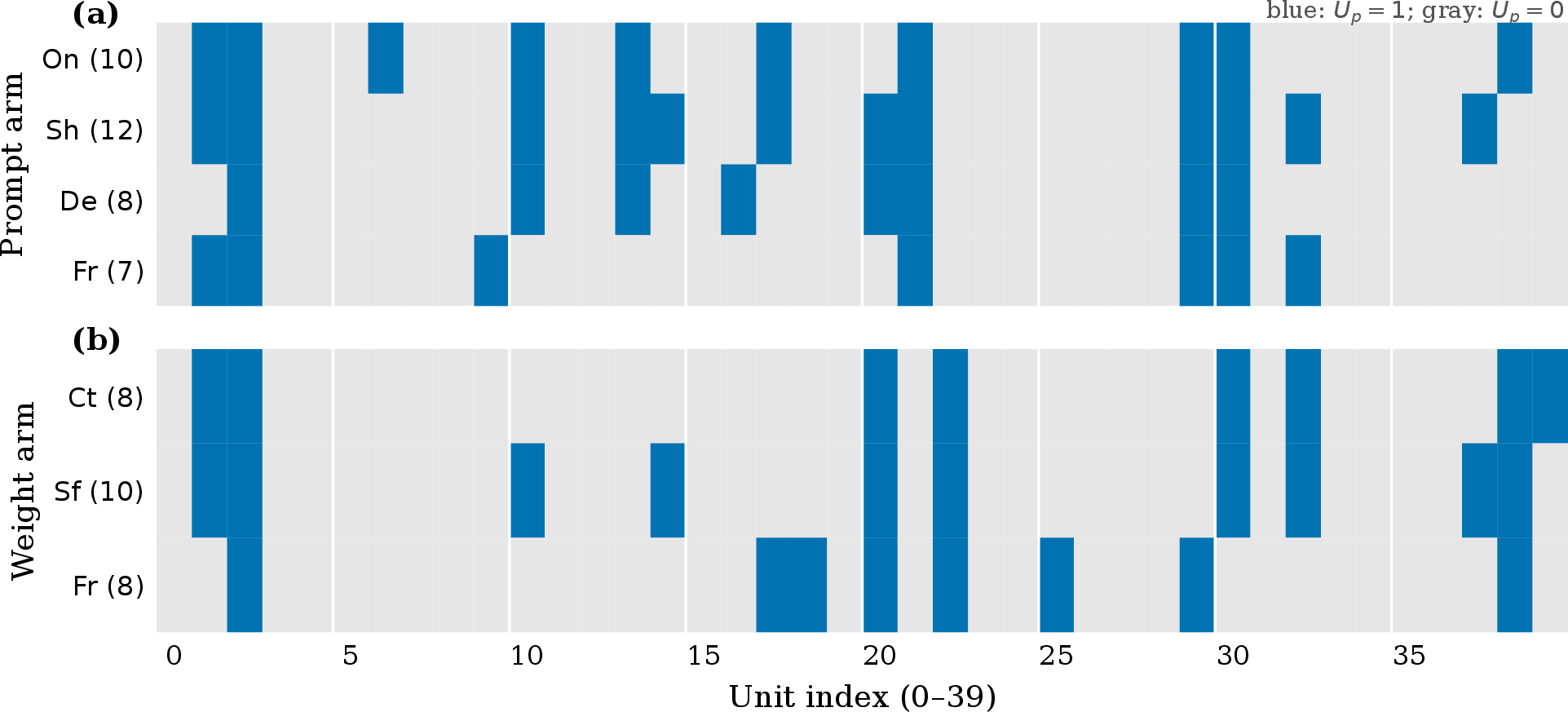
This table and heat strip are retained to show the per-cell structure of the mechanism screen defined by Definition 2 in the main text. They do not replace the pooled results.
0.0.9 Program-ledger provenance notes↩︎
The provenance fields associated with the program ledger are summarized here. The complete ledger remains in Table ¿tbl:tab:ledger?. The controlled verdict set is defined in 22 . The LEGACY rows are linked to [53] as inherited records. Numbers that exist only in the cycle log are marked with \(^{\dagger}\), and it is stated that these numbers are not contained in the frozen results archive. The doa, unrealizable, underpowered, and stratum-null dispositions are shown as separate rows rather than as silent exclusions. The supporting view of the ledger, comprising the generator-scale observation and offline-gate kills, is collected in the strip shown in Figure 7 in the Results.
0.0.10 AEG calibration and supersession summary↩︎
In this appendix, the instrument-calibration and supersession records of AEG-BANDIT are summarized together. The closed-form acquisition function itself is defined in Eq. 16 . The allocator’s own falsification suite was run at the level of instrument calibration before the supersession chain was opened. The planted-signal positive control was triggered (\(\Delta = 0.31611\), \(p = 0.00067\)), the difference remained null in the null world (\(\Delta = -0.01167\), \(p = 0.6942\)), and the closed-form validation recorded a maximum absolute error of \(1.02\times10^{-10}\) together with zero submodularity violations across 60 trials. The planted-signal value is not an allocation gain. It records that the instrument was capable of detecting the planted signal.
The closed-form zero-inflated Beta expected-improvement derivation and the correlated-evidence correction (\(\hat{\rho} = 0.7771\), \(\kappa_{\mathrm{eff}} = 1.175\)) of the budgeted best-of-B allocator are summarized here. The naive +6.0 pp pass in the superseded (\(B=12\)) record (\(\Delta = 0.06025\), \(p = 0.01375\), budget 12) is restated from the frozen record together with the +0.00097 (+0.001) adaptive–random control from the same record (\(p = 0.44664\)) and the supersession marker. In the governing matched draw-budget (\(B = 8\)) record, adaptive–best fixed is retained as \(\Delta = +0.02209\) (\(p = 0.2022\)), adaptive–random as \(\Delta = -0.00227\) (\(p = 0.6176\)), and the null-world sanity check as \(\Delta = -0.02667\) (\(p = 0.91354\)). The persistent supersession chain is presented as the traceable record of the self-audit. The initial pass decision is not interpreted as the valid result.
This derivation and persistent supersession chain constitute the machine-traceable record supporting the replay-null verdict reported in the main text.
0.0.11 ERA derivation summary and deferred validity↩︎
The derivational objects used by the error-set architecture (ERA) are summarized here. They comprise the arrival-order prior, the \(1/(K+1)\) reservoir mass, the exact Hedge regret bound under growing vocabulary (worst 0.8836 \(<\) bound 10.254), and the incidence-form Good–Turing missing mass. The taxonomy-saturation values (\(K = 93\), \(\hat{M} \approx 0.03\)) were calculated over 1,920 harvested candidates. Two independently produced derivation records are preserved for comparison. The ERA validity test, defined as the three-label out-of-fold first-draw ARM-REGRET statistic, was preregistered. It was not run in this generation because the deferral rule was triggered (deferred, §[sec:era]). All ERA outputs therefore have descriptive-machinery status and are nowhere presented as a validated JEPA-RL reward. For completeness, the JEPA no-signal finding in ERA’s own smoke record is repeated here (ridge \(R^{2}_{\mathrm{oof}} \approx 0.0096\), decoder \(R^{2}_{\mathrm{oof}} \approx -133\)). These derivations and the smoke record support the deferred-validity decision reported under §[sec:era] in the main text.
0.0.12 Positioning by controls↩︎
The positioning-by-controls table cited in the main text (Table ¿tbl:tab:positioning?) is provided here. The study is positioned relative to prior work not through terminology, but through the experimental controls retained. The columns indicate the presence of a content-versus-form placebo, a matched output-generation budget, a hidden-tier endpoint, paired prompt and weight channels, and a SHA-deranged placebo LoRA. Self-audit coverage of the study’s own positive result is recorded in the scope rows rather than as a separate axis. The table is a controls-coverage comparison. It does not carry a claim of outcome superiority. The marks were coded from the published method descriptions of the cited studies. The map is descriptive and does not constitute exhaustive certification.
| Research cluster | Content-versus-form placebo | Matched output budget | Hidden endpoint | Two channels | Weight-space placebo | |||||||||||
|---|---|---|---|---|---|---|---|---|---|---|---|---|---|---|---|---|
| Self-repair / self-refinement [3]–[5], [20] | — | \(\sim\) | \(\sim\) | — | — | |||||||||||
| Execution-feedback RL [8]–[10] | — | — | \(\sim\) | — | — | |||||||||||
| Inference-aware BoN / test-time compute [27], [28], [87] | — | \(\sim\) | \(\sim\) | — | — | |||||||||||
| PEFT / self-training [13], [15], [17], [18], [42] | — | — | \(\sim\) | — | — | |||||||||||
| Progressive refinement [16] | — | \(\sim\) | — | — | — | |||||||||||
| This study (gen 0–8) | ✔ | ✔ | \(\sim^{*}\) | ✔ | ✔ |
| Research cluster | Regime | Scope and limitation | |||
|---|---|---|---|---|---|
| Self-repair / self-refinement [3]–[5], [20] | Positive within its own regime | Prompt channel only. No content-versus-form placebo or self-audit is included | |||
| Execution-feedback RL [8]–[10] | Positive with larger models and online updates | Weight channel only. No matched budget or placebo is included | |||
| Inference-aware BoN / test-time compute [27], [28], [87] | Positive existence and budget-allocation results | The content-versus-form attribution question is not posed on the same endpoint | |||
| PEFT / self-training [13], [15], [17], [18], [42] | Large-scale positive regimes with correct-answer filtering | Weight channel only. No weight-space placebo is included | |||
| Progressive refinement [16] | Progressive-refinement regime | The positive results have not been tested in this regime under a form-matched placebo and a matched output-generation budget | |||
| This study (gen 0–8) | ELF and ELW were evaluated on the same 40-unit band against the same placebo hierarchy | // and a SHA-deranged placebo LoRA were used with \(R = 4\)/arm/unit. In the self-audit of the study’s own positive, the superseded +6.0 pp and +0.001 records were retained together under a persistent supersession pointer. The scope is limited to a small scale, one language, and one scaffold |
6pt
References↩︎
Corresponding author. PythaLab, Yıldız Technical University, Istanbul, Turkey. E-mail:
miscan@yildiz.edu.tr.↩︎This number is contained in the program cycle record and the record of İşcan (2026c), rather than in the frozen results archive.↩︎
This number is contained in the program cycle record and the record of İşcan (2026c), rather than in the frozen results archive.↩︎
This value is contained in the cycle log and the record of İşcan (2026c), rather than in the frozen result records.↩︎