Aïra: Rethinking AI Research Assistants for Interdisciplinary Science
July 14, 2026
Abstract
Scientific discovery increasingly depends on interdisciplinary teams whose members contribute distinct expertise, conceptual frameworks, vocabularies, assumptions, and standards of evidence. Today’s AI research assistants are largely designed to support individual researchers through literature review, writing assistance, coding, and data analysis. While these capabilities improve personal productivity, they provide little support for the collaborative reasoning required to integrate knowledge across disciplines. We argue that AI research assistants should evolve from tools that optimize individual workflows to systems designed for interdisciplinary teams. We introduce aïra, an AI research assistant built around this idea. Rather than focusing solely on summarization or question answering, aïra identifies disciplinary perspectives, translates terminology, highlights assumptions, and synthesizes collaborative research opportunities. We describe the design principles underlying aïra, present its system architecture, illustrate its outputs through interdisciplinary research meetings, and outline future research directions for AI systems that support collaborative scholarship.
1 Introduction↩︎
Scholarly inquiry increasingly relies on interdisciplinary collaboration [1]–[3]. Complex problems in health, climate, engineering, and public policy require researchers with different expertise to work together. However, interdisciplinary collaboration introduces challenges that extend beyond access to information: different fields often operate with different vocabularies, assumptions, methods, and conceptual frameworks, making it difficult for teams to communicate effectively, integrate ideas, and develop a shared understanding of research problems [4], [5].
At the same time, recent advances in large language models have transformed the way researchers interact with scientific information. AI research assistants now support activities such as literature retrieval, paper summarization, writing assistance, coding, and data analysis [6], [7]. These systems have become valuable tools for accelerating individual research workflows, but most share a common orientation: they are built to support an individual researcher. The typical interaction consists of a single user asking questions, providing documents, or requesting assistance with a specific task.
This individual-centered model is poorly matched to many of the challenges of interdisciplinary science. Productive collaboration depends not only on understanding the scientific problem itself, but also on understanding how collaborators approach that problem from different disciplinary perspectives. Researchers may use different terminology to describe similar concepts, rely on different methodological assumptions, apply different standards of evidence, and prioritize different research objectives. As a result, interdisciplinary teams need support for collaborative reasoning: defining problems together, reconciling competing perspectives, establishing shared terminology, identifying areas of agreement and disagreement, and translating discussion into actionable research plans.
In this paper, we argue that AI research assistants should evolve beyond optimizing individual productivity toward supporting interdisciplinary collaboration. Rather than focusing exclusively on answering questions or generating content for individual users, future systems should help research teams develop shared understanding by organizing perspectives, translating terminology, highlighting assumptions, preserving unresolved questions, and structuring discussions into future research directions. We present aïra (AI Interdisciplinary Research Assistant), which illustrates how AI systems can be designed around the needs of research teams rather than individual researchers and serves as a step toward a new generation of AI assistants that facilitate collaborative scientific research.
2 Design Principles for AI-Assisted Interdisciplinary Collaboration↩︎
Current AI research assistants are primarily designed to retrieve information, answer questions, or generate text for individual users [8]. Supporting interdisciplinary teams requires a different set of capabilities. Based on the challenges encountered in interdisciplinary collaboration [1]–[5], [9], we identified a set of design principles that guided the development of aïra and may serve as a foundation for future AI systems designed to support collaborative research.
First, AI systems should explicitly represent disciplinary perspectives rather than treating a discussion as a single, unified narrative. Researchers from different fields often approach the same problem with distinct objectives, conceptual models, and standards of evidence. Preserving these perspectives allows teams to understand how each discipline contributes to the broader research effort.
Second, AI systems should translate terminology across disciplines. Many misunderstandings arise because the same term carries different meanings in different fields, or because disciplines use separate vocabularies to describe similar concepts. Identifying these relationships can reduce communication barriers and establish a shared language for collaboration.
Third, AI systems should highlight implicit assumptions. Research discussions frequently rely on unstated assumptions about methodology, data quality, causal relationships, or domain knowledge. Making these assumptions explicit allows collaborators to identify potential sources of disagreement and evaluate whether conclusions are based on shared premises.
Fourth, AI systems should distinguish between areas of agreement and disagreement rather than producing a single synthesized summary. Productive interdisciplinary collaboration depends on understanding both where researchers converge and where legitimate differences remain. Explicitly representing these points of alignment and divergence can help guide future discussion and decision-making.
Fifth, AI systems should preserve unresolved questions instead of forcing premature consensus. Many interdisciplinary meetings conclude with open questions that require additional expertise, data collection, or experimentation. Rather than treating these as incomplete discussions, AI systems should recognize them as important outcomes of the scientific process.
Finally, AI systems should actively support future collaboration. Beyond documenting what occurred during a meeting, they should organize discussions into actionable research artifacts that help teams identify knowledge gaps, recognize complementary expertise, prioritize next steps, and develop new directions for collaborative investigation.
3 Aïra: AI Research Assistant for Interdisciplinary Teams↩︎
To explore the proposed design principles, we developed aïra, an AI research assistant designed to support interdisciplinary scientific collaboration. Aïra supports interdisciplinary meetings by transforming recorded discussions into structured collaboration frameworks. Rather than generating a conventional meeting summary, aïra analyzes the discussion through the lens of interdisciplinary collaboration, identifying each discipline’s perspectives, priorities, assumptions, and terminology before synthesizing these into a shared representation of the discussion.
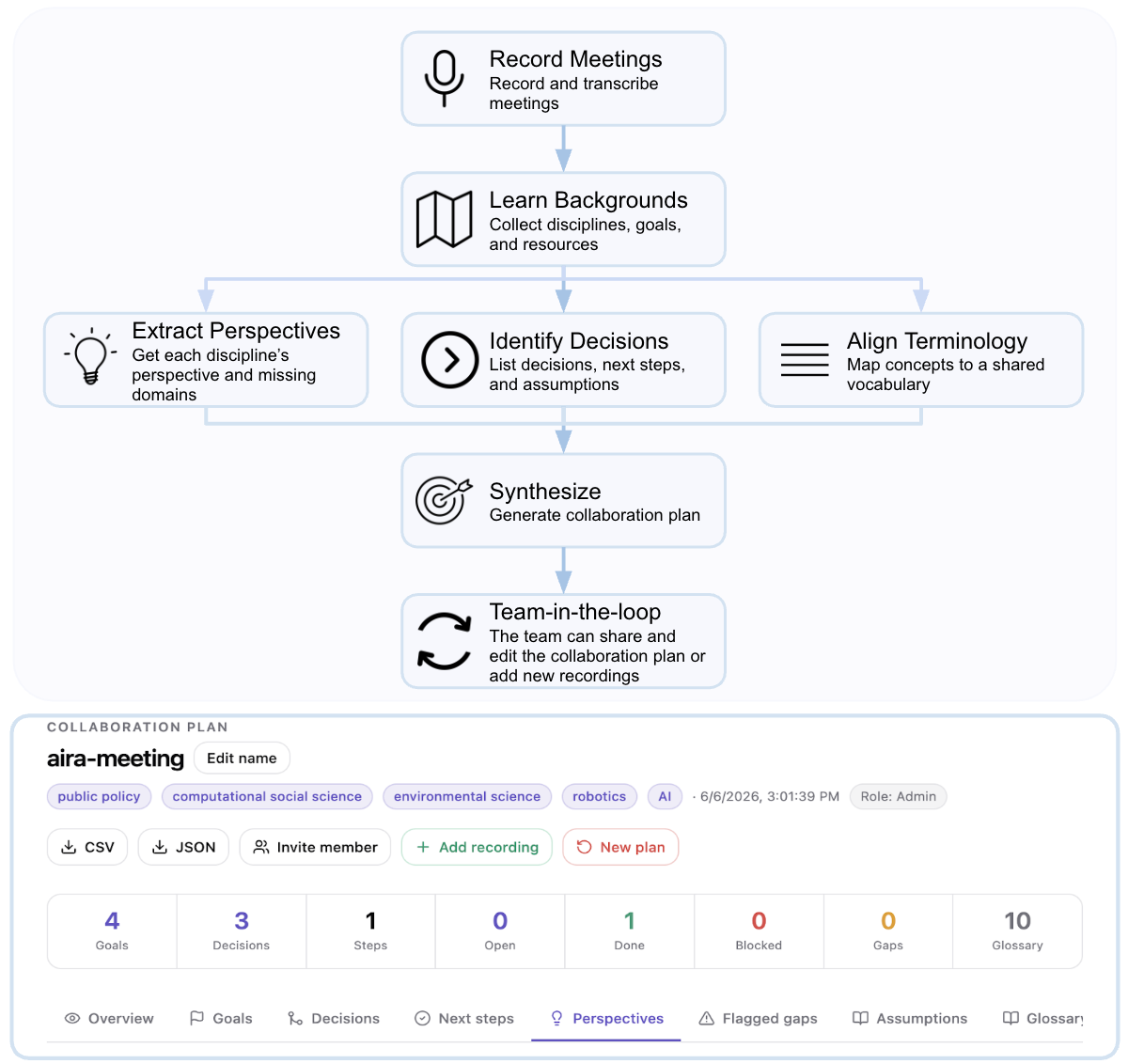
The overall workflow is illustrated in Figure 1. The process of creating a collaboration plan uses an agentic workflow of four agents. Following transcript ingestion, aïra’s first agent extracts the primary disciplines represented in the discussion and collects the mentioned goals and resources. Then, with the extracted disciplines as context, the rest of the agents can run in parallel to gather different aspects of the collaboration plan. One agent derives the perspectives from each of the disciplines and then uses a fine-tuned LLM to highlight any missing disciplines as flagged gaps that may add a new, needed viewpoint for future discussions. The LLM is fine-tuned on domain knowledge from the fields of philosophy, aerial systems, neuroscience, environmental science, and robotics to add enriched perspectives. Another agent obtains the decisions that were agreed on, including the rationale behind the decision, any objections against it, and tradeoffs that were discussed. It also lists the next steps with proposed actions and their due date as well as assumptions that the team made while making decisions. The last agent forms a glossary of terms and their definitions according to the discipline that used the term. Resulting insights are organized into a structured collaboration framework that can be shared and edited. Aïra can be found at researchwithaira.com.
We deployed aïra during the Summer Seminars in Neuroscience and Philosophy as a companion tool for research meetings involving philosophers and neuroscientists (IRB #2026-0428). This initial deployment was intended to explore the feasibility of the proposed workflow rather than evaluate effectiveness. Participants described the structured outputs as helpful for "clarifying unfamiliar terminology", "highlighting complementary expertise", and "organizing discussions into potential research directions". These qualitative observations motivate future studies evaluating AI systems designed to support interdisciplinary research.
4 Future Directions↩︎
Designing AI research assistants around interdisciplinary teams opens opportunities well beyond meeting support. As these systems mature, they could assist throughout the scientific lifecycle by helping research groups build shared understanding, coordinate expertise, and maintain continuity across projects that span months or years. Possible applications include collaborative grant development, cross-disciplinary literature synthesis, and support for distributed research teams. Across these settings, future AI assistants could help teams align objectives across disciplines, preserve prior decisions and assumptions, and recognize conceptual connections that might otherwise remain isolated within disciplinary boundaries.
Furthermore, AI systems designed around collaborative reasoning may contribute more directly to scientific discovery. By integrating perspectives from multiple disciplines, tracking unresolved questions over time, and identifying gaps between existing knowledge and emerging hypotheses, future assistants may help research teams formulate new interdisciplinary research questions and identify promising directions for investigation. These opportunities also raise important evaluation challenges. Current benchmarks for AI research assistants largely focus on individual tasks such as question answering, summarization, or code generation, while evaluation frameworks for collaboration-focused AI systems remain underdeveloped. Future work should investigate how to measure improvements in shared understanding, communication across disciplines, preservation of diverse perspectives, identification of conceptual gaps, and the quality of collaborative decision-making. We view aïra as an initial step toward this broader vision: a proof of concept for AI research assistants designed to support the collaborative processes of modern science.
5 Conclusion↩︎
As scientific problems become increasingly complex, effective collaboration across disciplines becomes increasingly important; and as research becomes increasingly interdisciplinary, AI research assistants should evolve beyond optimizing individual productivity. We argue for a shift toward AI systems designed to support collaborative reasoning and present aïra as an initial step in that direction. We hope this work encourages the development of AI research assistants that strengthen communication, integration, and discovery across disciplines.
Acknowledgements↩︎
This work was supported in part by OpenAI through the Duke DeepTech AI for Metascience Initiative.