Edge-Aware Thermal Infrared UAV Swarm Tracking
July 14, 2026
Abstract
Thermal infrared (TIR) imaging is essential for UAV swarm operations in visually degraded environments. However, tracking tiny UAVs remains challenging due to limited appearance cues, frequent occlusions, and rapid maneuvers. Despite significant progress driven by benchmarks such as the Anti-UAV challenge, existing methods primarily prioritize accuracy while overlooking the computational constraints of real-time edge deployment. The standard Kalman Filter (KF) offers the efficiency required for edge devices, yet its constant-velocity assumption often breaks down under highly dynamic UAV motion and thermal sensor jitter. More sophisticated nonlinear estimators can improve robustness but often introduce additional computational costs. To address this gap, we propose an edge-aware online tracking pipeline centered on the Adaptive Kinematic Kalman Filter (AKKF), which augments the linear KF with state-dependent kinematic modeling while preserving real-time efficiency. Combined with transient false-positive suppression and kinematics-driven predictive coasting, the presented pipeline improves trajectory continuity under challenging TIR conditions. Experiments on the Beyond Strong Baseline (BSB) benchmark provide a starting point for edge-aware UAV tracking by jointly evaluating tracking performance and computational efficiency, offering insights toward future real-time deployment.
1 Introduction↩︎
Cooperative UAV swarms have become increasingly important in applications such as surveillance, search and rescue, and environmental monitoring [1]–[3]. TIR imaging has emerged as a key sensing modality for these applications, providing reliable perception under nighttime and adverse weather conditions where RGB cameras become ineffective [4]–[6]. However, enabling real-time multi-object tracking (MOT) on resource-constrained edge devices remains challenging, requiring a balance between tracking accuracy and computational efficiency.
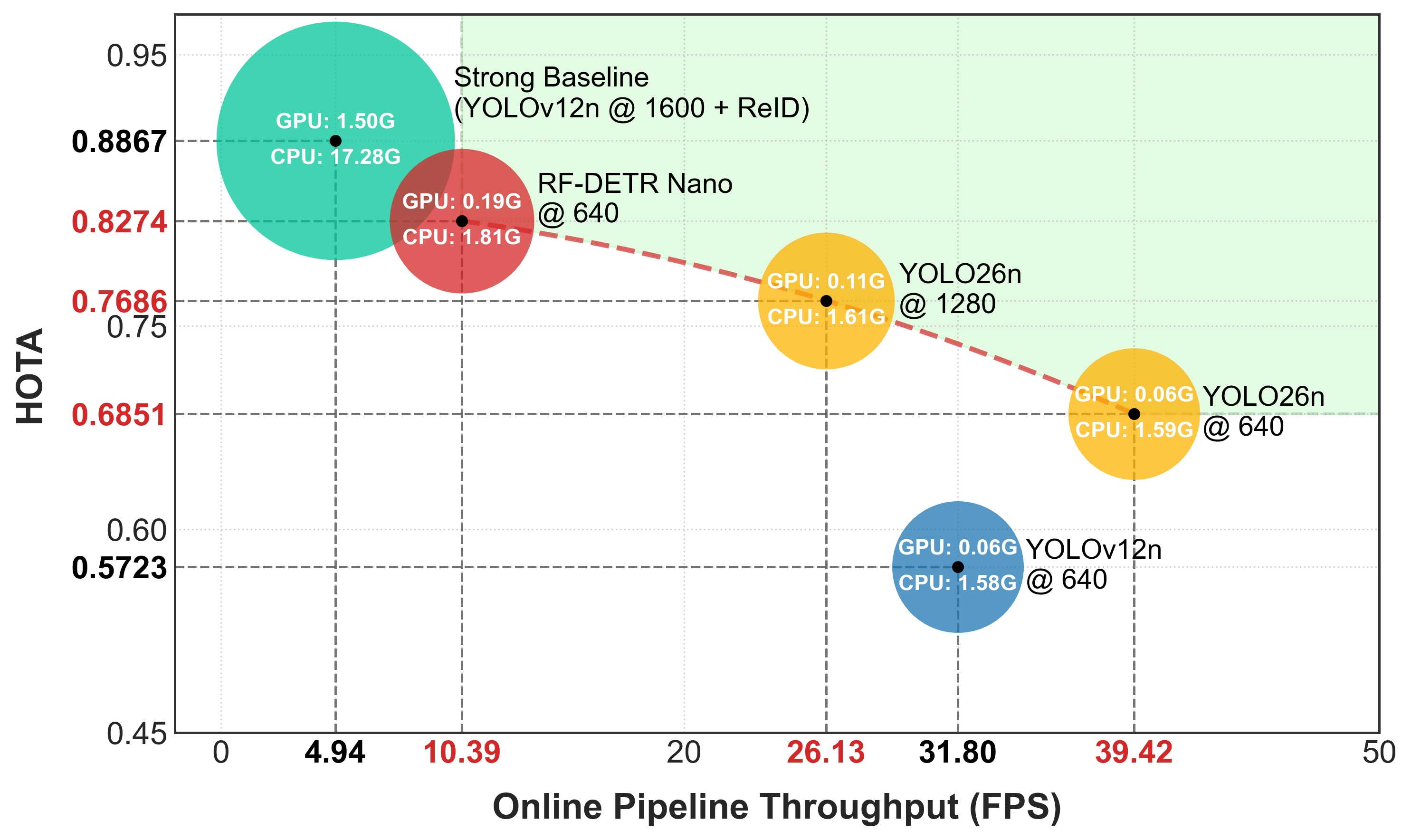
Figure 1: FPS-HOTA comparison of online tracking pipelines with the proposed AKKF on the BSB leaderboard using an Intel Core i7-12650H CPU, NVIDIA GeForce RTX 4050 Laptop GPU with 6GB memory, and 24GB RAM. The x-axis denotes online throughput (FPS), and the y-axis denotes HOTA. Bubble size represents computational resource usage. The red dashed line indicates the edge-aware threshold, and the light green region indicates the preferred operating regime for edge deployment..
Several MOT pipelines follow the tracking-by-detection (TBD) paradigm, combining object detectors with data association methods such as ByteTrack [7] and BoT-SORT [8]. Recent detector-tracker frameworks, such as YOLOv12 combined with BoT-SORT [9], have achieved competitive performance in the Anti-UAV challenge [10]. Although the KF remains the dominant motion model for online tracking due to its simplicity and efficiency, its fixed kinematic assumptions limit robustness under dynamic UAV motion. To address this limitation, we revisit the conventional KF and introduce adaptive kinematic modeling that preserves real-time efficiency while moving toward a more favorable balance between tracking performance and computational efficiency, as illustrated in Fig. 1. Our contributions are summarized as follows:
Adaptive Kinematic Kalman Filter: We augment the standard linear KF with state-dependent kinematic modeling for robust, real-time UAV swarm tracking.
Edge-aware online tracking pipeline: We integrate TFPS and kinematics-driven predictive coasting for reliable and continuous TIR UAV tracking.
Evaluation on the BSB benchmark: Extensive experiments characterize the accuracy-efficiency trade-off of tracking pipelines, providing a practical reference for edge-aware UAV tracking.
2 Related Work↩︎
2.1 UAV Datasets and Benchmarks↩︎
UAVs have been widely adopted in computer vision applications, ranging from air-to-ground target detection [11], [12] to cooperative multi-agent perception [13], [14]. Correspondingly, UAV perception datasets have been developed across diverse sensing modalities and viewpoints, including detection and segmentation from ground-to-air and air-to-air perspectives [15], [16], UAV swarm monitoring [17]–[19], and TIR UAV detection and tracking [20], [21].
Despite the growing availability of UAV datasets, standardized benchmarks for multi-UAV tracking remain limited. Existing studies, such as [22], often rely on custom datasets, leading to diverse data characteristics and evaluation protocols. The well-established Anti-UAV benchmarks [10], [20], [21] provide formal evaluation platforms for TIR UAV tracking; however, their evaluation availability is limited, and they do not explicitly consider computational efficiency for edge deployment. Building upon the publicly released Anti-UAV data [10], the BSB benchmark [9] provides a continuously maintained multi-UAV tracking evaluation platformwith carefully train/test splits, data characteristics summarized in Tab. ¿tbl:tab:dataset95stats?, and HOTA-based evaluation protocols [23], enabling reproducible comparison of tracking approaches under challenging TIR UAV scenarios.
max width=
2.2 Real-Time Multi-Object Tracking↩︎
Recent studies have explored data-driven state estimators to model complex motion dynamics [24]–[31]. Meanwhile, efficient motion-centric association strategies have demonstrated competitive performance for real-time tracking. Motion-based trackers, such as ByteTrack [7] and OCSORT [32], achieve effective association by leveraging bounding-box kinematics and observation history. Hybrid trackers, including StrongSORT [33] and BoT-SORT [8], further incorporate ReID modules and camera motion compensation (CMC) to enhance association performance while maintaining real-time efficiency.
At the core of most motion-based trackers lies the discrete-time KF [34], [35], which provides an efficient recursive framework for state estimation under linear dynamics. Given a target state \(\boldsymbol{x}_k \in \mathbb{R}^{n}\) and noisy observation \(\boldsymbol{z}_k \in \mathbb{R}^{m}\) at time step \(k \in \mathbb{N}^{+}\), the system is formulated as: \[\begin{align} \boldsymbol{x}_k &= \boldsymbol{F}_k\boldsymbol{x}_{k-1}+\boldsymbol{w}_{k},\\ \boldsymbol{z}_k &= \boldsymbol{H}_k\boldsymbol{x}_k+\boldsymbol{v}_k, \end{align}\] where \(\boldsymbol{F}_k\) and \(\boldsymbol{H}_k\) denote the state transition and observation matrices, respectively. Without external control inputs in bounding-box MOT, the dynamics are governed by kinematic evolution with Gaussian process and measurement noises, \(\boldsymbol{w}_k\sim\mathcal{N}(\boldsymbol{0},\boldsymbol{Q}_k)\) and \(\boldsymbol{v}_k\sim\mathcal{N}(\boldsymbol{0},\boldsymbol{R}_k)\). The prior estimate is propagated through the prediction step: \[\begin{align} \hat{\boldsymbol{x}}_{k|k-1} &= \boldsymbol{F}_k\hat{\boldsymbol{x}}_{k-1|k-1}, \\ \boldsymbol{P}_{k|k-1} &= \boldsymbol{F}_k\boldsymbol{P}_{k-1|k-1}\boldsymbol{F}_k^\top+\boldsymbol{Q}_k. \end{align}\] The Kalman gain \(\boldsymbol{K}_k\) is then computed in the update step to fuse the prior prediction with the incoming measurement: \[\begin{align} \boldsymbol{K}_k &= \boldsymbol{P}_{k|k-1}\boldsymbol{H}_k^\top (\boldsymbol{H}_k\boldsymbol{P}_{k|k-1}\boldsymbol{H}_k^\top+\boldsymbol{R}_k)^{-1}, \\ \hat{\boldsymbol{x}}_{k|k} &= \hat{\boldsymbol{x}}_{k|k-1} +\boldsymbol{K}_k(\boldsymbol{z}_k-\boldsymbol{H}_k\hat{\boldsymbol{x}}_{k|k-1}), \\ \boldsymbol{P}_{k|k} &= (\boldsymbol{I} - \boldsymbol{K}_k\boldsymbol{H}_k)\boldsymbol{P}_{k|k-1}, \end{align}\] where \(\boldsymbol{K}_k\) adaptively balances motion prediction and detector measurements according to their uncertainties.
Nonlinear KF variants, such as the Extended Kalman Filter (EKF) [36] and Unscented Kalman Filter (UKF) [37], provide greater modeling flexibility for complex dynamics but are rarely adopted in bounding-box MOT due to their increased computational cost for multiple targets. Consequently, SOTA trackers, including recent pipelines [38], [39], continue to rely on the standard KF with linear constant-velocity assumptions and predefined noise models [40], including TIR UAV tracking systems [9], [41], [42].
3 Methodology↩︎
3.1 Adaptive Kinematic Kalman Filter↩︎
We extend the linear KF with state-dependent kinematic modeling while preserving real-time efficiency. Following BoT-SORT [8], AKKF adaptively updates the transition and measurement uncertainty: \[\boldsymbol{F}_k = \boldsymbol{F}_k(\boldsymbol{x}_{k-1}), \quad \boldsymbol{R}_k = \boldsymbol{R}_k(\boldsymbol{z}_k).\] The state and measurement vectors are defined as: \[\begin{align} \boldsymbol{x}_k &= [x_c(k), y_c(k), w(k), h(k),\\ &v_x(k), v_y(k), v_w(k), v_h(k)]^\top, \\ \boldsymbol{z}_k &= [z_{x_c}(k), z_{y_c}(k), z_w(k), z_h(k)]^\top, \end{align}\] where \((x_c,y_c,w,h)\) denote the bounding-box center and scale, \((v_x,v_y,v_w,v_h)\) represent the corresponding velocities, and \(\boldsymbol{z}_k\) represents the detector measurement at frame \(k\). The frame interval is set to \(\Delta t=1\).
3.1.1 Area-Adaptive Motion Damping↩︎
The standard KF assumes constant positional velocity by setting \(\boldsymbol{F}_{5,5}\) and \(\boldsymbol{F}_{6,6}\) to one. During prolonged occlusions, this assumption leads to trajectory drift as the last estimated velocity is continuously propagated. To address this issue, we introduce Area-Adaptive Motion Damping (AAMD), which dynamically dampens positional velocity based on target scale. Inspired by aerodynamic damping models [35], the damping factor is defined as: \[D_{xy} = \alpha \left(\frac{A_{box}}{A_{box}+\beta}\right),\] where \(A_{box}=\max(1,w\times h)\) is the bounding-box area, \(\alpha\) controls the maximum damping strength, and \(\beta\) determines the saturation behavior. The velocity retention terms are replaced by \((1-D_{xy})\), allowing velocity decay during occlusions while maintaining trajectory continuity.
3.1.2 Perspective-Aware Velocity Braking↩︎
The standard KF assumes constant scale velocity by setting \(\boldsymbol{F}_{7,7}\) and \(\boldsymbol{F}_{8,8}\) to one. When a UAV recedes from the camera, negative scale velocities with \(v_w<0\) and \(v_h<0\) may lead to scale collapse if detections become unavailable. To mitigate this issue, we introduce Perspective-Aware Velocity Braking (PAVB), which dynamically suppresses scale velocity based on the target scale: \[D_w = \gamma\frac{1}{\max(w^{(k-1)},\epsilon)}, \quad D_h = \gamma\frac{1}{\max(h^{(k-1)},\epsilon)},\] where \(\epsilon\) prevents numerical instability and \(\gamma\) controls the braking strength. The coefficients modify the scale velocity retention terms to reduce excessive scale variation.
3.1.3 Dynamic Measurement Noise Estimation↩︎
The standard BoT-SORT measurement model assumes a scale-dependent measurement covariance \(\boldsymbol{R}_k\). However, TIR clutter can introduce geometrically inconsistent detections beyond scale-based uncertainty. To address this issue, we propose Dynamic Measurement Noise Estimation (DMNE), which adjusts measurement uncertainty according to detection consistency. Given the measured and predicted aspect ratios, \(a_{meas}=w_{meas}/h_{meas}\) and \(a_{pred}=w_{pred}/h_{pred}\), respectively, we define an anomaly factor: \[\rho = 1+\kappa \left(\frac{|a_{meas}-a_{pred}|}{a_{pred}}\right)^2,\] where \(\kappa\) controls the sensitivity to aspect-ratio deviations. The measurement covariance is then updated as: \[\boldsymbol{R}_k(\boldsymbol{z}_k)=\rho\boldsymbol{R}_k.\] Large geometric inconsistencies increase \(\rho\), which enlarges \(\boldsymbol{R}_k\) and reduces the Kalman gain contribution from unreliable detections, allowing the prediction to dominate.
3.2 Online Tracking Pipeline↩︎
Beyond the proposed AKKF, we further enhance the online tracking pipeline with two practical components tailored for TIR UAV tracking, namely Transient False Positive Suppression (TFPS) to improve track reliability and kinematics-guided predictive coasting to maintain trajectory continuity under temporary observation gaps.
3.2.1 Transient False Positive Suppression↩︎
The standard BoT-SORT implementation outputs newly initialized tracklets before temporal confirmation, allowing one-frame false positives to appear in the final tracking results. This setup is particularly problematic in TIR imagery, where thermal clutter frequently produces transient false detections. To address this issue, we restore temporal track confirmation, referred to as TFPS, by outputting only confirmed tracklets. As shown in Fig. 2, this refinement suppresses transient false positives and improves the baseline HOTA from \(0.82357\) to \(0.825405\). All subsequent experiments are conducted on this updated baseline, except for the results reported in Tab. ¿tbl:tab:det95vs95track?.
3.2.2 Kinematics-Guided Predictive Coasting↩︎
Temporary missed detections could be caused by thermal sensor jitter, motion blur, or mutual occlusions, which can interrupt trajectory association in TIR UAV tracking. To improve track continuity, we incorporate a predictive coasting strategy. When no valid detection is associated with frame \(k\), the measurement update is skipped, and the prediction is directly adopted as the posterior estimate: \[\begin{align} \hat{\boldsymbol{x}}_{k|k} &= \hat{\boldsymbol{x}}_{k|k-1} = \boldsymbol{F}_k\hat{\boldsymbol{x}}_{k-1|k-1},\\ \boldsymbol{P}_{k|k} &= \boldsymbol{P}_{k|k-1} = \boldsymbol{F}_k\boldsymbol{P}_{k-1|k-1}\boldsymbol{F}_k^\top + \boldsymbol{Q}_k. \end{align}\] We define \(\tau_{\mathrm{coast}}\) as the number of consecutive missed associations handled by predictive coasting. As shown in Fig. 2, both the standard KF and the proposed AKKF achieve the best performance with a single coasting frame using the RF-DETR Nano tracking pipeline with 640 input resolution.

Figure 2: Effect of TFPS and predictive coasting on the BSB leaderboard using the RF-DETR Nano tracking pipeline with 640 input resolution. HOTA is plotted against the number of predictive coasting frames. The vertical gray dashed line indicates the performance gain from TFPS, as discussed in Sec. 3.2.1. Both the standard BoT-SORT and the proposed AKKF achieve peak HOTA using a single predictive coasting frame..
4 Experiment Results↩︎
4.1 Implementation Details↩︎
We evaluate several advanced detectors, including YOLOv12 [43], YOLO26 [44], and RF-DETR [45], integrated with the BoT-SORT tracker [8] and the proposed AKKF. We primarily report HOTA metrics from the BSB leaderboard evaluation [9] introduced in Sec. 2.1. The model configurations, including model size and input resolution, are presented in Tab. ¿tbl:tab:det95vs95track?. Unless otherwise specified, the batch size is set to 32, while YOLOv12s and YOLOv12m use batch sizes of 16 and 8, respectively.
All experiments are conducted on an NVIDIA H100 80GB GPU, except for Fig. 1 and Tab. ¿tbl:tab:ablation?, which use an NVIDIA GeForce RTX 4050 Laptop GPU with 6GB memory to better approximate edge deployment conditions. The slight HOTA difference between the offline result of \(0.8271\) in Fig. 2 and the online result of \(0.8274\) in Fig. 1 is due to different processing pipelines: the offline pipeline truncates detection outputs to two decimal places before tracking, while the online pipeline directly uses original outputs.
4.2 Main Results↩︎
Tab. ¿tbl:tab:det95vs95track? summarizes the results, including training time, inference speed, peak GPU memory usage, detection accuracy, and tracking performance. RF-DETR Nano with 1280 resolution achieves the highest HOTA score of \(0.8437\). The underlined configurations, including RF-DETR Nano with 640 resolution and YOLO26n with 1280 and 640 resolutions, are selected as edge-aware candidates and further evaluated in Fig. 1 for resource-constrained deployment.
The visualization comparison in Fig. 3 illustrates the tracking behavior of different configurations. The leftmost column shows the strong baseline from [9] with the best localization and identity preservation, while the three middle panels present the edge-aware candidates with gradually decreasing tracking quality from left to right. YOLO26n at 640 resolution achieves a superior accuracy-throughput trade-off over YOLOv12n at the same resolution, consistent with Fig. 1. The temporal evolution from the upper to lower rows in Fig. 3, labeled [Coast], demonstrates effective predictive coasting during temporary observation gaps.
max width=, max height=0.5
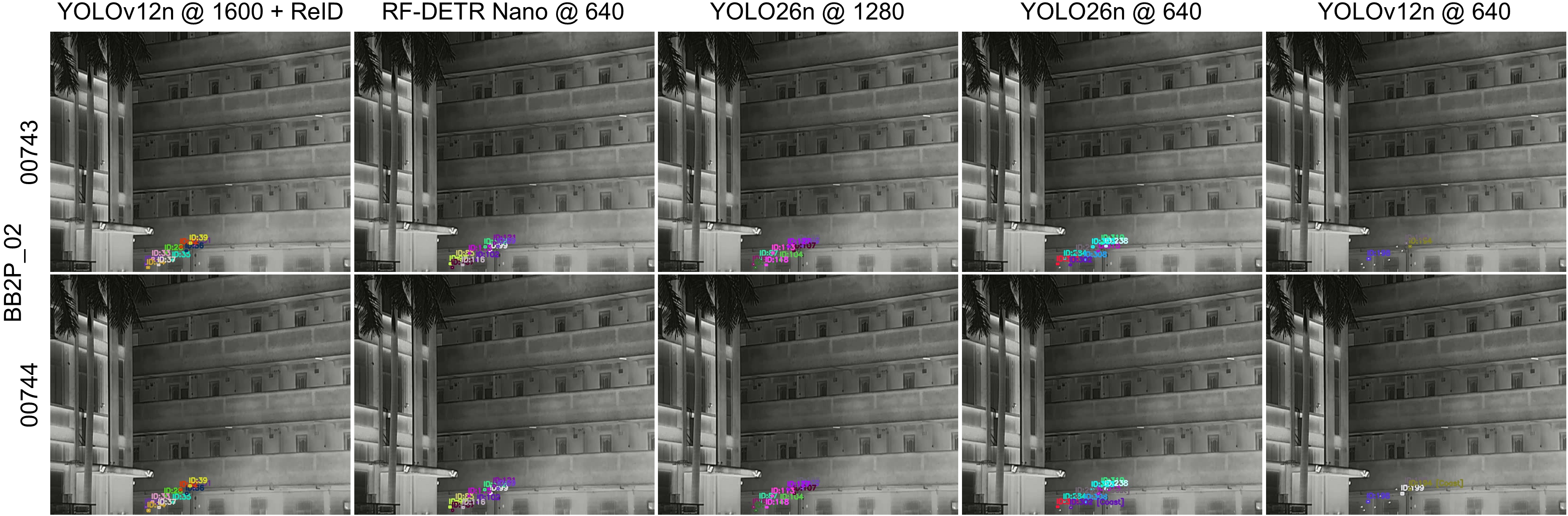
Figure 3: Visualization of tracked bounding boxes from different pipelines across two consecutive frames of the BB2P_02 sequence..
4.3 Ablation Study and Discussion↩︎
Tab. ¿tbl:tab:ablation? summarizes the contribution of each AKKF component. The full AKKF achieves the best overall tracking performance, improving all metrics over the baseline while reducing FPS from \(132.03\) to \(94.92\). Beyond the ablation results, Fig. 4 shows that higher detection accuracy does not necessarily translate into better tracking performance, revealing the detection-tracking paradox also observed in [9]. For tiny-object tracking, increasing input resolution consistently improves performance, aligning with previous findings [9], [46]. Since UAV targets are already extremely small, further reducing resolution may severely degrade tracking quality. Therefore, future improvements should focus on computational optimization, such as model pruning [47]–[49]. Additionally, under edge constraints with limited appearance cues in TIR imagery, leveraging temporal information through motion modeling offers a promising direction.
max width=, max height=0.5
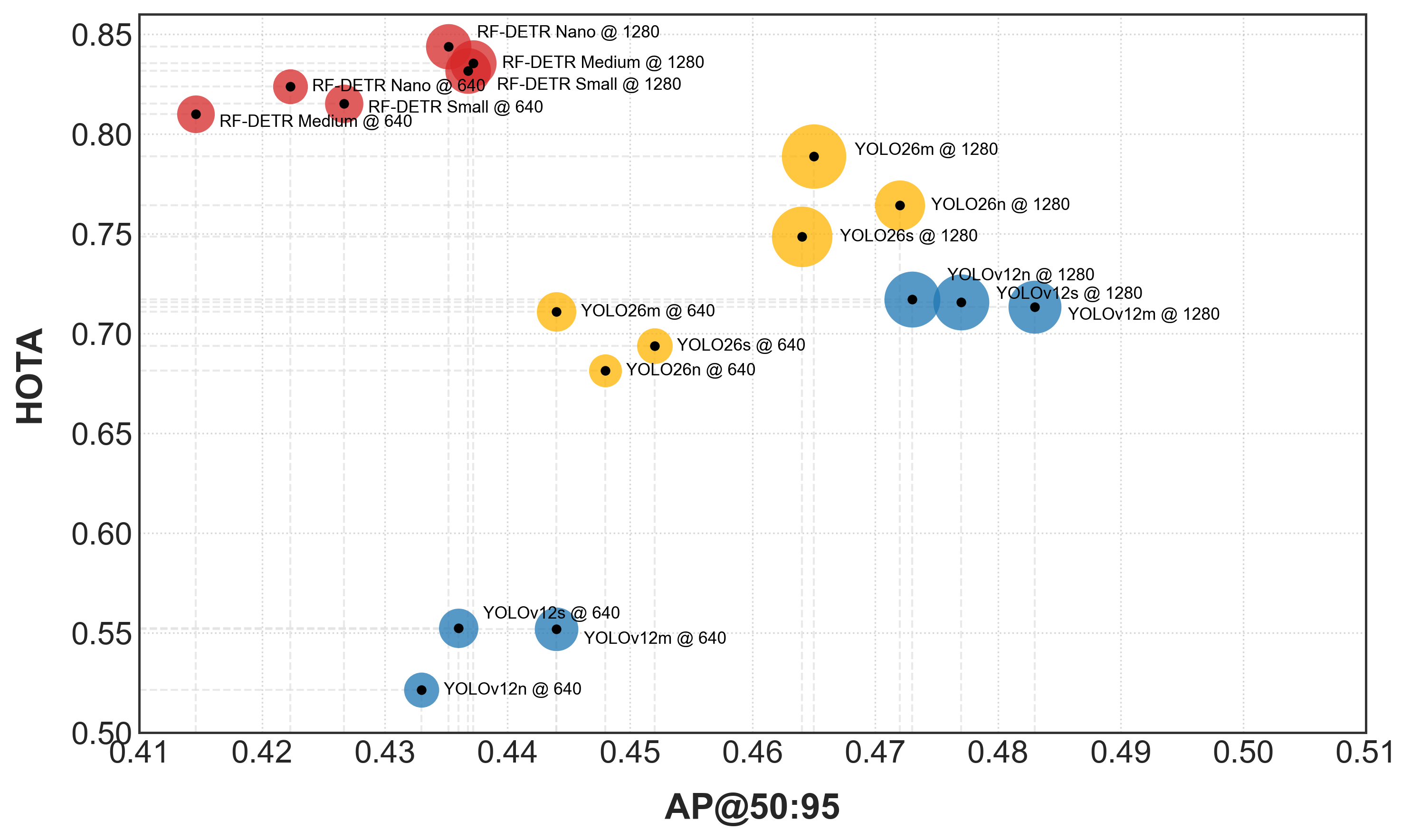
Figure 4: AP@50:95-HOTA comparison of tracking pipelines on the BSB leaderboard. The x-axis denotes detection performance measured by AP@50:95, and the y-axis denotes tracking performance measured by HOTA. The results reveal that higher detection accuracy does not necessarily lead to better tracking performance, exposing the detection-tracking paradox..
5 Conclusion↩︎
In this paper, we present an edge-aware tracking pipeline for TIR UAV swarms that jointly considers tracking robustness and computational efficiency. We propose the AKKF, which augments the standard KF framework with adaptive kinematic priors through state-dependent motion damping, velocity constraints, and measurement uncertainty estimation. Combined with TFPS and predictive coasting, the proposed pipeline enables robust TIR UAV tracking under temporary observation gaps. Extensive experiments on the BSB benchmark validate its effectiveness and highlight the detection-tracking paradox in TIR UAV tracking. Future work will explore model compression, temporal information utilization, and validation on dedicated edge devices.
6 Acknowledgments↩︎
We thank the Spartan HPC system [50] at The University of Melbourne for providing the computational resources that accelerated model training and supported this research.