On multiplicativity of directed graphs
July 14, 2026
Abstract
A graph category is a category with a set of graphs or similar structures (such as, directed graphs, signed graphs, etc.) playing the role of objects, and an appropriate notion of homomorphism playing the role of morphisms. The characterization of multiplicative objects are important open problems in categories of undirected and directed graphs. While the recent disproving of the Hedetniemi’s conjecture due to Shitov (Ann. Math. 2019), which claimed that all complete graphs are multiplicative, provided a breakthrough in the study of multiplicative undirected graphs, the characterization of multiplicative undirected graphs remains known only for cycles, circular cliques \(K_{{n/k}}\) where \({n/k} \in (2,4]\), complete graphs, and graphs whose each edge is part of at most one \(4\)-cycle. Similarly, whether a given directed graph is multiplicative or not is known only for some oriented paths, oriented cycles, and transitive tournaments.
We study multiplicative graphs in the category of directed graphs where pushable homomorphism plays the role of morphism. We provide full multiplicativity characterization for directed bipartite graphs, oriented cycles, and transitive tournaments. As a consequence we find new (infinite) classes of non-multiplicative directed graphs in the usual directed graphs category. We also resolve an open question posed by Das et al. (CALDAM 2026) related to the existence of exponential directed graphs with respect to pushable homomorphisms, and use our solution as a tool for our proofs.
1 Introduction↩︎
In the 1960s, Hedetniemi famously conjectured [1] that \(\chi(G \times H) = \min\{\chi(G),\chi(H)\}\), where \(G\) and \(H\) are simple graphs, \(\chi(\cdot)\) denotes the chromatic number, and \(G \times H\) is the categorical product of \(G\) and \(H\). The structure of \(G \times H\) is known as a graph on the vertex set \(V(G) \times V(H)\) where \((u, v)\) is adjacent to \((u',v')\) if \(u, u'\) and \(v,v'\) are adjacent in \(G\) and \(H\), respectively. The conjecture remained open for many years until it was famously disproved by Shitov [2] in 2019 using exponential graphs as a tool. While the above formulation of the Hedetniemi’s conjecture using the notion of chromatic number is its most popular version, its equivalent formulation using the language of graph homomorphisms and multiplicative graphs possibly carry more insight and naturally leads to the big picture of characterizing multiplicative graphs in the category of undirected graphs. Let us try to build our motivation from that perspective.
Let \(G\) and \(H\) be two graphs. A homomorphism of \(G\) to \(H\) is a vertex mapping \(f : V(G) \to V(H)\) such that \(f(u)f(v)\) is an edge of \(H\) whenever \(uv\) is an edge of \(G\). Additionally, if a homomorphsim \(f\) preserves non-adjacencies, that is, \(f(u),f(v)\) are non-adjacent in \(H\) whenever \(u, v\) are non-adjacent in \(G\), then \(f\) is an isomorphism. We write \(G \rightarrow H\) to indicate that \(G\) admits a homomorphism to \(H\). If \(G \rightarrow H\) and \(H \rightarrow G\), then \(G\) and \(H\) are homomorphically equivalent. A graph \(K\) is multiplicative if \(G \times H \rightarrow K\) implies \(G \rightarrow K\) or \(H \rightarrow K\). A graph \(K\) is non-multiplicative if it is not multiplicative. It is known (and is easy to observe) that \(\chi(G) \leq n\) if and only if \(G \rightarrow K_n\), where \(K_n\) denotes the complete graph on \(n\) vertices. Therefore, the Hedetniemi’s conjecture translates to the following statement.
Conjecture 1 (Hedetniemi’s conjecture 1966 [1]). For all \(n \geq 1\), the complete graph \(K_n\) is multiplicative.
In 1985, El-Zahar and Sauer [3] proved that \(K_1\), \(K_2\), and \(K_3\) are multiplicative, marking the first significant progress on the conjecture. More recently in 2019, Shitov [2] disproved Hedetniemi’s conjecture for large values of \(n\). Subsequent works [4]–[7] eventually established that \(K_n\) is non-multiplicative if \(n \geq 4\). That means, at present we have a complete characterization of complete graphs with respect to multiplicativity.
Theorem 2 (El-Zahar and Sauer 1985 [3], Tardif 2023 [5]). A complete graph \(K_n\) is multiplicative if and only if \(n \leq 3\).
Thus, the above theorem provides a true and complete resolution of the Hedetniemi’s conjecture by appropriately rephrasing its statement. A more general and a natural question that can be asked in this context is the following.
Question 3. Can you characterize all multiplicative graphs?
Most research related to the Hedetniemi’s conjecture in between the works of El-Zahar and Sauer [3], and Shitov [2] focused on the above question. Primarily, researchers tried to characterize multiplicative graphs in a particular graph family. As a positive result, and a natural extension to El-Zahar and Sauer [3]’s proof of \(K_3\) is multiplicative, the following was proved.
Theorem 4 (Hell, Zhou, and Zhu 1994 [8]). All cycles are multiplicative.
A circular clique \(K_{{n/k}}\) is a graph with vertex set \(\mathbb{Z}/n\mathbb{Z} = \{0, 1, \cdots, n-1\}\) where two vertices \(i\) and \(j\) are adjacent if \(|i-j| \geq k~(\bmod~n)\). Observe that, \(K_{2k+1/k}\) is nothing but the odd cycle on \(2k+1\) vertices. As a generalization of Theorem 4, Tardif [9] proved the following.
Theorem 5 (Tardif 2005 [9]). The circular clique \(K_{{n/k}}\) is multiplicative for all \({n/k} \in [2, 4)\).
Zhu [10] had proposed a strengthening of the Hedetniemi’s conjecture (now disproved) by replacing chromatic number with circular chromatic number in its popular formulation. The conjecture by Zhu [10] is equivalent to saying all circular cliques \(K_{{n/k}}\)s are multiplicative. The above theorem was a preliminary attempt to prove the conjecture. Since \(K_{n/1} = K_n\), the conjecture by Zhu [10], if true, would have implied the Hedetniemi’s conjecture as a special case. However, it is obviously false since the Hedetniemi’s conjecture has been disproved. Still it will be interesting to characterize the circular cliques according to their multiplicativity.
The last result which improves our understanding of multiplicativity focuses on sparse graphs.
Theorem 6 (Tardif and Wrochna 2019 [11]). If \(K\) is a graph where each of it’s edge is part of at most one \(4\)-cycle, then \(K\) is multiplicative.
Notice that, even though Theorems 2, 4, 5, and 6 helped us characterize many graphs with respect to multiplicativity, we are still very far from a complete answer to Question 3.
In this article, we address the analogue of Question 3 for directed graphs with respect to the ordinary homomorphism, and also a recent variant called the pushable homomorphism. However, to express our contributions and their proofs, we need a bit of preliminaries including some basics of category theory. Therefore, we would like to present the organization of the article here, and defer further motivation and context from the study of directed graphs to the later sections.
Organization
In Section 2, we present the preliminaries of category theory.
In Section 3, we present an overview of the multiplicativity research on directed graphs with respect to the ordinary homomorphism. We also discuss and present relevant known results as motivation.
In Section 4, we introduce pushable homomorphism and provide a brief historical overview on its research. We also recall and prove some basic results which, on the one hand builds the foundation for the rest of the article, and on the other hand establishes a deep connection with the study of directed graphs with respect to the ordinary homomorphism.
In Section 6, we prove the existence of exponential objects in the category of pushable directed graphs and also use it as a tool for our proofs. This also positively settles an open question posed in [12].
In Section 7, we completely characterize the multiplicativity of the following families of directed graphs with respect to pushable homomorphisms: bipartite directed graphs, oriented cycles, transitive tournaments.
In Section 8, using the connections between ordinary homomorphisms and pushable homomorphisms established in Section 4 and the pushable multiplicativity related results proved in Section 7, we present new infinite families of non-multiplicative directed graphs.
In Section 9, we summarize the state of the art in this domain, present some open questions, and suggest future directions to conclude the article.
2 Preliminaries: Category Theory↩︎
A category \(\mathbf{C}\) is a mathematical system consisting of
a class of objects denoted by \(ob(\mathbf{C})\),
for each pair of \(X , Y \in ob(\mathbf{C})\), a set of all morphisms of \(X\) to \(Y\) denoted by \({Hom}_{\mathbf{C}}(X,Y)\),
for each triple of \(X, Y, Z \in ob(\mathbf{C})\), an associative function \[\circ: Hom_{\mathbf{C}}(X,Y) \times Hom_{\mathbf{C}}(Y,Z) \rightarrow Hom_{\mathbf{C}}(X,Z)\] called composition,
for each \(X \in ob(\mathbf{C})\), an identity morphism \(id_X \in Hom_{\mathbf{C}}(X,X)\) which satisfies \(\circ(id_X , f) = f\) and \(\circ(g, id_X) = g\) for any \(f \in Hom_{\mathbf{C}}(Y,X)\), \(g \in Hom_{\mathbf{C}}(X,Z)\), and \(Y, Z \in ob(\mathbf{C})\).
Usually, we will use the notation \(f: X \to Y\) instead of \(f \in Hom_{\mathbf{C}}(X,Y)\) to denote a morphism. In fact, the notation \(X \to Y\) will represent the fact that there exists a morphism of \(X\) to \(Y\), that is, \(Hom_{\mathbf{C}}(X,Y) \neq \emptyset\). Moreover, we will use the notation \(f \circ g\) instead of \(\circ(f,g)\) for the composition function.
The categorical product of \(X, Y \in ob(\mathbf{C})\) is an object \(X \times Y \in ob(\mathbf{C})\) along with two morphisms \(p_X: X \times Y \to X\) and \(p_Y \in X \times Y \to Y\) called projections satisfying the following: for any \(Z \in ob(\mathbf{C})\) with \(f_X: Z \to X\) and \(f_Y: Z \to Y\) there exists a unique morphism \(g: Z \to X \times Y\) such that \(f_X = p_X \circ g\) and \(f_Y = p_Y \circ g\). The definition is captured by the following figure with a mandate of the diagram commuting.
Figure 1:  .
.
The exponential object of \(X \in ob(\mathbf{C})\) to the \(Y \in ob(\mathbf{C})\) is an object \(X^Y\) along with a morphism \(\epsilon: X^Y \times Y \to X\) called evaluation satisfying the following: for any \(Z \in ob(\mathbf{C})\) and any morphism \(g: Z \times Y \to X\) there exists a unique morphism \(\lambda_g : Z \to X^Y\) such that \(g = \epsilon \circ (\lambda_g \times 1_Y)\), where \(\lambda_g \times 1_Y: Z \times Y \to X^Y \times Y\) is given by \((\lambda_g \times 1_Y)(z,y) = (\lambda_g(z), y)\) for all \(y \in Y,z \in Z\). The definition is captured by the following figure with a mandate of the diagram commuting.
Figure 2: 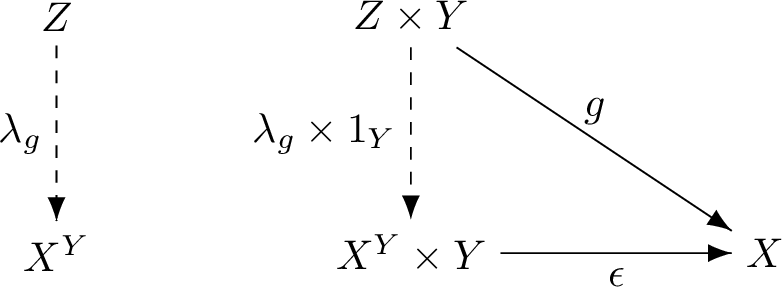 .
.
Remark 7. The set of all graphs together with the notion of homomorphism forms the category of undirected graphs, denoted by Und. The earlier defined \(G \times H\) actually satisfies the universal properties of categorical products given in the above definition (see [13] for a proof). Thus, \(G \times H\) is appropriately called the categorical product of \(G\) and \(H\).
3 Multiplicativity of directed graphs↩︎
A directed graph \(\overrightarrow{G}\) consists of a vertex set \(V(\overrightarrow{G})\) and an arc set \(A(\overrightarrow{G})\), where each arc is an ordered pair of vertices. An arc \(uv\) is directed from \(u\) to \(v\), and we write \(uv \in A(\overrightarrow{G})\). A bidirected arc refers two arcs \(uv\) and \(vu\) in opposite directions between two vertices \(u\) and \(v\). For a vertex \(v \in V(\overrightarrow{G})\), the out-neighborhood of \(v\) is \(N^+(v)=\{u \mid vu \in A(\overrightarrow{G})\}\), and the in-neighborhood of \(v\) is \(N^-(v)=\{u \mid uv \in A(\overrightarrow{G})\}\). The out-degree and in-degree of \(v\) are defined by \(d^+(v)=|N^+(v)|\) and \(d^-(v)=|N^-(v)|\), respectively. An oriented graph is a directed graph obtained from a simple undirected graph by assigning a direction to each edge; equivalently, it is a directed graph containing no loops or bidirected arcs.
Let \(\overrightarrow{G}\) and \(\overrightarrow{H}\) be directed graphs. A homomorphism of \(\overrightarrow{G}\) to \(\overrightarrow{H}\) is a vertex mapping \(f: V(\overrightarrow{G}) \rightarrow V(\overrightarrow{H})\) such that \(f(u)f(v)\) is an arc of \(\overrightarrow{H}\) whenever \(uv\) is an arc of \(\overrightarrow{G}\). Additionally, if a homomorphsim \(f\) preserves non-adjacencies, that is, \(f(u),f(v)\) are non-adjacent in \(\overrightarrow{H}\) whenever \(u, v\) are non-adjacent in \(\overrightarrow{G}\), then \(f\) is an isomorphism. We write \(\overrightarrow{G} \rightarrow \overrightarrow{H}\) to indicate that \(\overrightarrow{G}\) admits a homomorphism to \(\overrightarrow{H}\). If \(\overrightarrow{G} \rightarrow \overrightarrow{H}\) and \(\overrightarrow{H} \rightarrow \overrightarrow{G}\), then \(\overrightarrow{G}\) and \(\overrightarrow{H}\) are homomorphically equivalent. The set of all directed graphs endowed with the above defined homomorphism forms the category of directed graphs, denoted by Dir.
It is known [13] that the category of directed graphs contains the categorical product of any two directed graphs \(\overrightarrow{G}\) and \(\overrightarrow{H}\), denoted by \(\overrightarrow{G}\times \overrightarrow{H}\), whose structural description can be given as follows: \(\overrightarrow{G}\times \overrightarrow{H}\), is the directed graph with vertex set \(V(\overrightarrow{G}) \times V(\overrightarrow{H})\) in which there is an arc from the vertex \((u,v)\) to the vertex \((u',v')\) if \(uu'\) is an arc in \(\overrightarrow{G}\) and \(vv'\) is an arc in \(\overrightarrow{H}\). Naturally, a directed graph \(\overrightarrow{K}\) is multiplicative if \(\overrightarrow{G} \times \overrightarrow{H} \rightarrow \overrightarrow{K}\) implies \(\overrightarrow{G} \rightarrow \overrightarrow{K}\) or \(\overrightarrow{H} \rightarrow \overrightarrow{K}\). A directed graph \(\overrightarrow{K}\) is non-multiplicative if it is not multiplicative.
Since categorical product exists for directed graphs, the analogue of Question 3 becomes relevant.
Question 8. Can you characterize all multiplicative directed graphs?
There has been some progress in identifying multiplicative and non-multiplicative directed graphs which we are going to summarize in the following. Notice that, since all bipartite graphs (with at least one edge) are homomorphically equivalent to \(K_2\), they are multiplicative by Theorem 2. In contrast, the oriented paths have infinitely many homomorphically equivalent classes, and therefore, their multiplicativity characterization requires more attention. The following is what is known about them.
Theorem 9 (Nešetřil and Pultr 1978 [14]). Any oriented path that is homomorphically equivalent to a directed path is multiplicative.
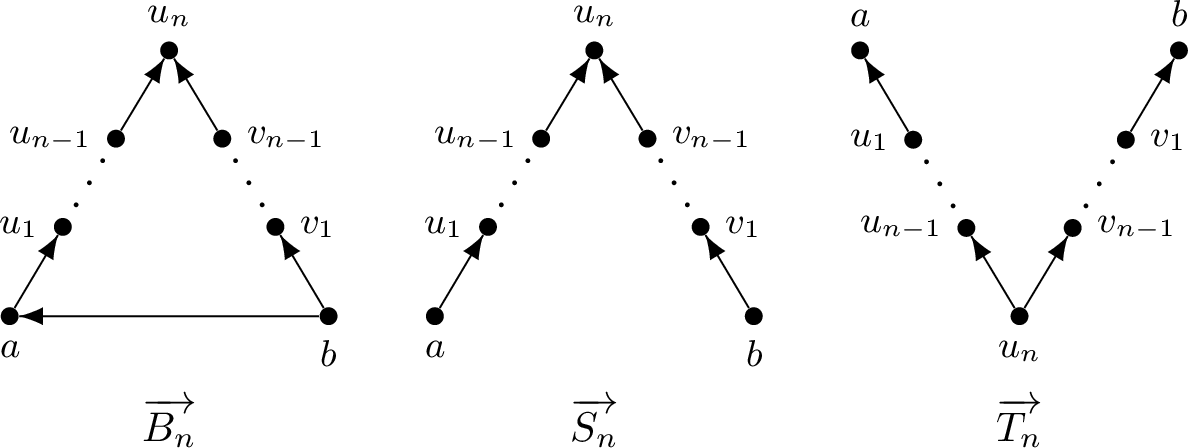
The next natural class to investigate are oriented cycles. A complete characterization with respect to multiplicativity is presented in Theorem 10. We need some prerequisites to state it. Zhou [15] introduced a special class of oriented cycles, called \(\mathcal{C}\)-cycle. Let \(\overrightarrow{B_n},\overrightarrow{S_n}\) and \(\overrightarrow{T_n}\) be digraphs as depicted in Figure 3. The class of \(\mathcal{C}\)-cycles is inductively defined as follows:
Each \(\overrightarrow{B_n}\) is a \(\mathcal{C}\)-cycle.
Let \(C\) be a \(\mathcal{C}\)-cycle and let \(v\) be a vertex of out-degree \(2\) (resp., in-degree \(2\)). Then there are two maximal directed paths \(P,P'\) starting (resp., ending) at \(v\), say of lengths \(l\leq l'\). Let \(m\leq l\) be an integer. Replace \(v\) by \(\overrightarrow{S_m}\) (resp., \(\overrightarrow{T_m}\)), identifying \(a\) with the beginning of \(P\) and \(b\) with the beginning of \(P'\). The new digraph \(C'\) is also a \(\mathcal{C}\)-cycle.
There are no other \(\mathcal{C}\)-cycles.
Theorem 10 (Hell, Zhou and Zhu 1994 [8], Häggkvist, Hell, Miller and Neumann Lara 1988 [16]). An oriented cycle \(\overrightarrow{C}\) is multiplicative if and only if it satisfies one of the three following conditions:
(i) \(\overrightarrow{C}\) is homomorphically equivalent to a directed path,
(ii) \(\overrightarrow{C}\) is homomorphically equivalent to a directed cycle of a prime power length,
(iii) \(\overrightarrow{C}\) is a \(\mathcal{C}\)-cycle.
While multiplicativity characterization of all tournaments (natural analogues of complete graphs) are not known, we do know that all transitive tournaments are multiplicative.
Theorem 11 (Nešetřil and Pultr 1978 [14]). All transitive tournaments are multiplicative.
An updated survey on multiplicativity in the categories of undirected and directed graphs is provided by Zhu [17]. That means, the state of the art is far from finding the complete answer to Question 8 as of now. Thus, finding any new class of multiplicative or non-multiplicative directed graphs will be a worthwhile contribution in this research domain.
4 Pushable homomorphisms: history and basic result↩︎
A particular modification via “push” operation on directed graphs has been popularly studied in the last few decades. Introduced in 1972 by Mosesyan [18], vertex pushing has been studied by Pretzel [19]–[21], Klostermeyer [22], Babai and Cameron [23] among others. The concept was combined with homomorphisms by Klostermeyer and MacGillivray [24], who introduced pushable homomorphisms and pushable chromatic number. Since then, pushable homomorphisms and the pushable chromatic number have been further investigated: complexity dichotomy problems for pushable chromatic number were studied in [24], [25], analogue of cliques were studied in [26]. Moreover, pushable chromatic number of various graph classes were studied, such as planar graphs and planar graphs with girth restrictions [24], [27]–[29], outerplanar graphs and outerplanar graphs with girth restrictions [24], [29], graphs with bounded acyclic chromatic number [29] and grids [30] among others.
To push a vertex \(v\) of a directed graph is to reverse the direction of the arcs incident to \(v\). Let \(\overrightarrow{G}\) and \(\overrightarrow{G}'\) be two orientations of a graph \(G\). If it is possible to obtain \(\overrightarrow{G}'\) from \(\overrightarrow{G}\) through pushing a subset of vertices, then \(\overrightarrow{G}\) is push equivalent to \(\overrightarrow{G}'\). A pushable homomorphism of \(\overrightarrow{G}\) to \(\overrightarrow{H}\) is a vertex mapping \(f: V(\overrightarrow{G}) \rightarrow V(\overrightarrow{H})\) such that \(f\) is a homomorphism of \(\overrightarrow{G}'\) to \(\overrightarrow{H}\), where \(\overrightarrow{G}'\) is some directed graph push equivalent to \(\overrightarrow{G}\). Additionally, if a pushable homomorphsim \(f\) preserves non-adjacencies, that is, \(f(u),f(v)\) are non-adjacent in \(\overrightarrow{H}\) whenever \(u, v\) are non-adjacent in \(\overrightarrow{G}\), then \(f\) is a pushable isomorphism. We write \(\overrightarrow{G} \xrightarrow{push} \overrightarrow{H}\) to indicate that \(\overrightarrow{G}\) admits a pushable homomorphism to \(\overrightarrow{H}\). If \(\overrightarrow{G} \xrightarrow{push} \overrightarrow{H}\) and \(\overrightarrow{H} \xrightarrow{push} \overrightarrow{G}\), then \(\overrightarrow{G}\) and \(\overrightarrow{H}\) are pushably homomorphically equivalent. The set of all directed graphs endowed with the pushable homomorphism forms the category of pushable directed graphs, denoted by Push.
Observe that, since pushable homomorphism allows modifications in a directed graph, it is not very clear whether a categorical product of two directed graphs always exists in the category of pushable directed graphs or not. Recently [31], the existence of categorical products of directed graphs with respect to pushable homomorphism was proved as part of a generalized framework. Let us elaborate on this a bit.
A vertex \(v\) of a directed graph \(\overrightarrow{G}\) is push invariant if it is not an isolated vertex, and yet, even after pushing \(v\), \(\overrightarrow{G}\) remains exactly the same (labeled) directed graph. Observe that a vertex \(v\) can be push invariant if and only if its only adjacencies are through loop, or bidirected arcs.
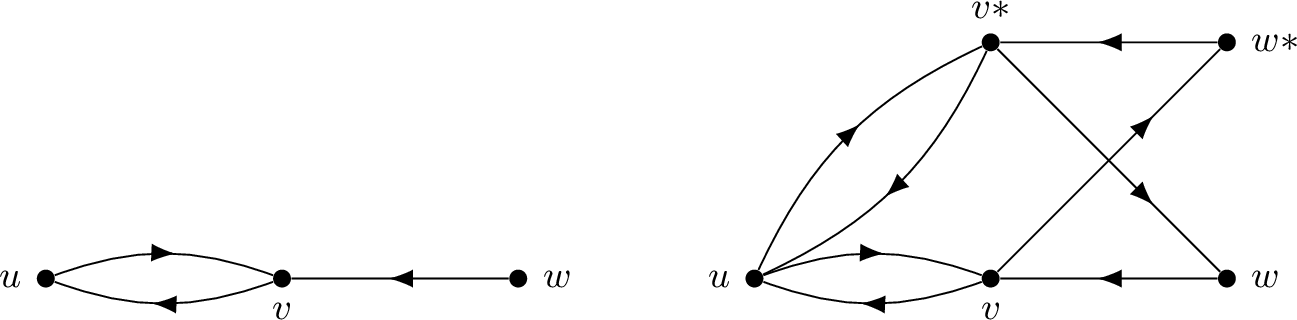
An anti-twin of a vertex \(v\) is another vertex \(v^*\) satisfying \(N^+(v^*) = N^-(v)\) and \(N^-(v^*) = N^+(v)\). The anti-twinned directed graph of \(\overrightarrow{G}\), denoted by \(AT(\overrightarrow{G})\), is obtained by adding an anti-twin \(v^*\) to each vertex \(v\), that is not a push invariant vertex, to the graph \(\overrightarrow{G}\). As a convention, we write \(V(AT(\overrightarrow{G})) = V(\overrightarrow{G}) \cup V^*(\overrightarrow{G})\), where \(V(\overrightarrow{G})\) is the set of original vertices from \(\overrightarrow{G}\) in \(AT(\overrightarrow{G})\), and \(V^*(\overrightarrow{G})\) is the set of newly added anti-twin vertices in \(AT(\overrightarrow{G})\). This definition is a slight generalization of the existing notion of an anti-twinned directed graph, as the earlier versions were defined primarily on oriented graphs, and the push invariant vertices were just the isolated vertices. In the earlier definition, the condition of not creating an anti-twin of the push invariant vertices was not mentioned. However, all the results and proofs can be trivially generalized, and holds for this extended definition of the anti-twinned directed graph. We are going to recall some of the useful properties of the anti-twinned directed graphs, and also describe the construction of the categorical product of directed graphs with respect to pushable homomorphisms.
Theorem 12 ([24]). Let \(\overrightarrow{G}\) and \(\overrightarrow{H}\) be directed graphs. Then the following are equivalent.
(i) \(\overrightarrow{G} \xrightarrow{push} \overrightarrow{H}\),
(ii) \(AT(\overrightarrow{G}) \rightarrow AT(\overrightarrow{H})\),
(iii) \(\overrightarrow{G} \rightarrow AT(\overrightarrow{H})\).
Theorem 13 ([29]). Let \(\overrightarrow{G}\) and \(\overrightarrow{H}\) be directed graphs. Then \(AT(\overrightarrow{G})\) is isomorphic to \(AT(\overrightarrow{H})\) if and only if \(\overrightarrow{G}\) is pushably isomorphic to \(\overrightarrow{H}\).
Let us fix some conventions now. Given the anti-twinned graph \(AT(\overrightarrow{G})\) of a directed graph \(\overrightarrow{G}\), notice that for every vertex \(v\) (not push invariant) of \(\overrightarrow{G}\) an anti-twin \(v^*\) is added to \(AT(\overrightarrow{G})\). This gives an one-to-one correspondence between the vertices of \(\overrightarrow{G}\) that are not push invariant, and the newly added anti-twins in \(AT(\overrightarrow{G})\). This one-to-one correspondence can be captured through setting up the convention \((v^*)^* = v^{**} = v\). Moreover, if \(v\) is a push invariant vertex, then set the convention \(v^{**} = v^* = v\).
Given two directed graphs \(\overrightarrow{G}\) and \(\overrightarrow{H}\), a vertex mapping \(f: V(AT(\overrightarrow{G})) \to V(AT(\overrightarrow{H}))\) is called an anti-twinned homomorphism if \(f\) is a homomorphism of \(AT(\overrightarrow{G})\) to \(AT(\overrightarrow{H})\) satisfying \(f(v^*) = f(v)^*\) for all \(v \in V(AT(\overrightarrow{G}))\). While not every homomorphism of \(AT(\overrightarrow{G})\) to \(AT(\overrightarrow{H})\) is an anti-twinned homomorphism, if \(AT(\overrightarrow{G}) \rightarrow AT(\overrightarrow{H})\), then there exists an anti-twinned homomorphism of \(AT(\overrightarrow{G})\) to \(AT(\overrightarrow{H})\).
Lemma 1. Suppose \(f\) is a homomorphism of \(AT(\overrightarrow{G})\) to \(AT(\overrightarrow{H})\). Then there exists an anti-twinned homomorphism \(f^*\) of \(AT(\overrightarrow{G})\) to \(AT(\overrightarrow{H})\).
Proof. Let \(f'\) be the function obtained by restricting the domain of \(f\) to \(V(\overrightarrow{G})\). Consider the following extension of \(f'\): \[f^*(v)=\begin{cases} f'(v), & \text{if v\in V(\overrightarrow{G}),}\\ (f'(v^*))^*, & \text{if v \in V^*(\overrightarrow{G})}. \end{cases}\] We want to show that \(f^*\) is an anti-twinned homomorphism of \(AT(\overrightarrow{G})\) to \(AT(\overrightarrow{H})\). That means, we need to verify the following two points:
for any vertex \(v\) of \(AT(\overrightarrow{G})\), we must have \(f^*(v^*) = f^*(v)^*\),
for any arc \(uv\) of \(AT(\overrightarrow{G})\), \(f^*(u)f^*(v)\) is an arc of \(AT(\overrightarrow{H})\).
The first point is satisfied as per the definition of \(f^*\). For verifying the second point, we need to consider the following three cases.
(i) Suppose \(uv\) is an arc of \(AT(\overrightarrow{G})\) and both \(u,v \in V(\overrightarrow{G})\). Then \(f^*(u)f^*(v)\) is an arc of \(AT(\overrightarrow{H})\) since \(f^*(u)=f'(u)=f(u)\), \(f^*(v)=f'(v)=f(v)\) and \(f\) is a homomorphism.
(ii) Suppose \(uv\) is an arc of \(AT(\overrightarrow{G})\) and exactly one of \(u,v\) belongs to \(V(\overrightarrow{G})\). Without loss of generality, let us assume that \(u \in V(\overrightarrow{G})\) and \(v \in V^*(\overrightarrow{G})\). Since \(uv\) is an arc, note that, \(v^*u\) is an arc of \(AT(\overrightarrow{G})\). Moreover, observe that, both \(u\) and \(v^*\) belongs to \(V(\overrightarrow{G})\). Thus, \(f^*(v^*)f^*(u)\) is an arc of \(AT(\overrightarrow{H})\) since \(f^*(u)=f'(u)=f(u)\), \(f^*(v^*)=f'(v^*)=f(v^*)\) and \(f\) is a homomorphism. That means, \(f^*(u)(f^*(v^*))^*\) is an arc of \(AT(\overrightarrow{H})\). However, \((f^*(v^*))^* = (f'(v^*))^* = f^*(v)\), and thus \(f^*(u)f^*(v)\) is an arc of \(AT(\overrightarrow{H})\).
(iii) Suppose \(uv\) is an arc of\(AT(\overrightarrow{G})\) and both \(u,v \in V^*(\overrightarrow{G})\). Then \(u^*v^*\) is an arc of \(AT(\overrightarrow{G})\) while \(u^*, v^* \in V(\overrightarrow{G})\). Thus, \(f^*(u^*)f^*(v^*)\) is an arc of \(AT(\overrightarrow{H})\) since \(f^*(u^*)=f'(u^*)=f(u^*)\), \(f^*(v^*)=f'(v^*)=f(v^*)\) and \(f\) is a homomorphism. Note that, \(f^*(u^*)f^*(v^*)\) is an arc implies \((f^*(u^*))^*(f^*(v^*))^*\) is an arc of \(AT(\overrightarrow{H})\). However, \((f^*(u^*))^* = (f'(u^*))^* = f^*(u)\) and \((f^*(v^*))^* = (f'(v^*))^* = f^*(v)\). Therefore, \(f^*(u)f^*(v)\) is an arc of \(AT(\overrightarrow{H})\).
This proves that \(f^*\) is an anti-twinned homomorphism of \(AT(\overrightarrow{G})\) to \(AT(\overrightarrow{H})\). ◻
Let \(f\) be an anti-twinned homomorphism of \(AT(\overrightarrow{G})\) to \(AT(\overrightarrow{H})\). The function \(f_{res}: V(\overrightarrow{G}) \rightarrow V(\overrightarrow{H})\) given by
\[f_{res}(v)=\begin{cases} f(v), & \text{if f(v) \in V(\overrightarrow{H}),}\\ f(v)^*, & \text{if f(v) \in V^*(\overrightarrow{H})} \end{cases}\] for all \(v \in V(\overrightarrow{G})\). This function is called an anti-twinned restriction of \(f\). Observe that, according to our definition, it is not clear whether \(f_{res}\) is a pushable homomorphism or not. The following result ensures it.
Lemma 2. For every anti-twinned homomorphism \(f\) of \(AT(\overrightarrow{G})\) to \(AT(\overrightarrow{H})\), its anti-twinned restriction \(f_{res}\) is a pushable homomorphism of \(\overrightarrow{G}\) to \(\overrightarrow{H}\).
Proof. Let \(S = \{v \in V(\overrightarrow{G}) | f(v) \in V^*(\overrightarrow{H})\}\). Let \(\overrightarrow{G}'\) be the directed graph obtained from \(\overrightarrow{G}\) by pushing the vertices of \(S\). It is enough to show that \(f_{res}\) is a homomorphism of \(\overrightarrow{G}'\) to \(\overrightarrow{H}\). We will verify this claim in three following cases.
(i) Suppose \(uv\) is an arc of \(\overrightarrow{G}\) and \(u, v \not\in S\). Then \(uv\) is an arc of \(\overrightarrow{G}'\) and \(f(u), f(v) \in V(\overrightarrow{G})\). Since \(f\) is a homomorphism, \(f(u)f(v)\) is an arc of \(AT(\overrightarrow{H})\). Since, \(f_{res}(u) = f(u)\) and \(f_{res}(v) = f(v)\), we have \(f_{res}(u)f_{res}(v)\) is an arc of \(\overrightarrow{H}\).
(ii) Suppose \(uv\) is an arc of \(\overrightarrow{G}\) and exactly one of \(u,v\) belongs to \(S\). Without loss of generality, we may assume that \(u \not\in S\) and \(v \in S\). Then \(vu\) is an arc of \(\overrightarrow{G}'\) (as only \(v\) got pushed); and \(f(u) \in V(\overrightarrow{H})\) and \(f(v) \in V^*(\overrightarrow{H})\). Since \(f\) is a homomorphism, \(f(u)f(v)\) is an arc of \(AT(\overrightarrow{H})\), which implies \(f(v)^*f(u)\) is also an arc of \(AT(\overrightarrow{H})\). Since by the definition of \(f_{res}\), we have \(f_{res}(u) = f(u)\) and \(f_{res}(v) = f(v)^*\), \(f_{res}(v)f_{res}(u)\) is an arc of \(\overrightarrow{H}\).
(iii) Suppose \(uv\) is an arc of \(\overrightarrow{G}\) and \(u, v \in S\). Then \(uv\) is an arc of \(\overrightarrow{G}'\) as well (as both vertices got pushed) and \(f(u), f(v)\) are vertices in \(V^*(\overrightarrow{H})\). Since \(f\) is a homomorphism, \(f(u)f(v)\) is an arc of \(AT(\overrightarrow{H})\), which implies \(f(u)^*f(v)^*\) is also an arc of \(AT(\overrightarrow{H})\). Since by the definition of \(f_{res}\), we have \(f_{res}(u) = f(u)^*\) and \(f_{res}(v) = f(v)^*\), \(f_{res}(u)f_{res}(v)\) is an arc of \(\overrightarrow{H}\).
Therefore \(f_{res}\) is a homomorphism of \(\overrightarrow{G}'\) to \(\overrightarrow{H}\). By definition, this means that \(f_{res}\) is a pushable homomorphism of \(\overrightarrow{G}\) to \(\overrightarrow{H}\). ◻
Given any pushable homomorphism \(f\) of \(\overrightarrow{G}\) to \(\overrightarrow{H}\), suppose \(f_{ext}\) is an anti-twinned homomorphism of \(AT(\overrightarrow{G})\) to \(AT(\overrightarrow{H})\) whose anti-twinned restriction is \(f\). Then \(f_{ext}\) is called an anti-twinned extension of \(f\). The following result ensures that such an extension always exists.
Lemma 3. For every pushable homomorphism \(f\) of \(\overrightarrow{G}\) to \(\overrightarrow{H}\), there exists at least one anti-twinned extension \(f_{ext}\), that is, an anti-twinned homomorphism \(f_{ext}\) of \(AT(\overrightarrow{G})\) to \(AT(\overrightarrow{H})\) whose anti-twinned restriction is \(f\).
Proof. Since \(f\) is a pushable homomorphism of \(\overrightarrow{G}\) to \(\overrightarrow{H}\), there must exist a set \(S \subseteq V(\overrightarrow{G})\) such that \(f\) is a homomorphism of \(\overrightarrow{G}'\) to \(\overrightarrow{H}\), where \(\overrightarrow{G}'\) is obtained from \(\overrightarrow{G}\) by pushing the vertices of \(S\). Define the function \(f': V(\overrightarrow{G}) \to V(AT(\overrightarrow{H}))\) as follows \[f'(v)=\begin{cases} f(v), & \text{if v \not\in S,}\\ f(v)^*, & \text{if v \in S}. \end{cases}\] Let us show that \(f'\) is a homomorphism. Suppose that \(uv\) is an arc of \(\overrightarrow{G}\) and consider the following two cases.
(i) If both \(u,v \not\in S\) (resp., \(u,v \in S\)), then \(uv\) is an arc of \(\overrightarrow{G}'\) (since either none of them got pushed, or both of them got pushed) as well. Therefore, \(f(u)f(v)\) is also an arc of \(\overrightarrow{H}\), and \(AT(\overrightarrow{H})\). This also means that \(f(u)^*f(v)^*\) is an arc of \(AT(\overrightarrow{H})\). Since \(f'(u) = f(u)\) and \(f'(v) = f(v)\) (resp., \(f'(u) = f(u)^*\) and \(f'(v) = f(v)^*\)), \(f'(u)f'(v)\) is an arc of \(AT(\overrightarrow{H})\).
(ii) If exactly one among \(u,v\) belongs to \(S\), then without loss of generality we may assume that \(u \not\in S\) and \(v \in S\). In this scenario, \(vu\) is an arc in \(\overrightarrow{G}'\), which implies that \(f(v)f(u)\) is an arc of \(\overrightarrow{H}\). That means, \(f(u)f(v)^*\) is an arc of \(AT(\overrightarrow{H})\). Since \(f'(u) = f(u)\) and \(f'(v) = f(v)^*\), \(f'(u)f'(v)\) is an arc of \(AT(\overrightarrow{H})\).
Therefore, \(f'\) is a homomorphism.
Next, define the function \(f_{ext}: AT(\overrightarrow{G}) \to AT(\overrightarrow{H})\) as follows: \[f_{ext}(v)=\begin{cases} f'(v), & \text{if v \in V(\overrightarrow{G}),}\\ f'(v^*)^*, & \text{if v \in V^*(\overrightarrow{G})}. \end{cases}\] Therefore, it is enough to prove that \(f_{ext}\) is an anti-twinned extension of \(f\).
First let us show that \(f_{ext}\) is a homomorphism of \(AT(\overrightarrow{G})\) to \(AT(\overrightarrow{H})\) via a verification of the following three cases.
(i) Suppose \(uv\) is an arc of \(AT(\overrightarrow{G})\) and both \(u,v \in V(\overrightarrow{G})\). Then \(f_{ext}(u)f_{ext}(v)\) is an arc of \(AT(\overrightarrow{H})\) since \(f_{ext}(u)=f'(u)\), \(f_{ext}(v)=f'(v)\) and \(f'\) is a homomorphism.
(ii) Suppose \(uv\) is an arc of \(AT(\overrightarrow{G})\) and exactly one of \(u,v\) belongs to \(V(\overrightarrow{G})\). Without loss of generality let us assume that \(u \in V(\overrightarrow{G})\) and \(v \in V^*(\overrightarrow{G})\). Since \(uv\) is an arc, note that, \(v^*u\) is an arc of \(AT(\overrightarrow{G})\). Moreover, observe that, both \(u\) and \(v^*\) belongs to \(V(\overrightarrow{G})\). Thus, \(f_{ext}(v^*)f_{ext}(u)\) is an arc of \(AT(\overrightarrow{H})\) since \(f_{ext}(u)=f'(u)\), \(f_{ext}(v^*)=f'(v^*)\) and \(f'\) is a homomorphism. That means, \(f_{ext}(u)f_{ext}(v^*)^*\) is an arc of \(AT(\overrightarrow{H})\). However, \(f_{ext}(v^*)^* = f'(v^*)^* = f_{ext}(v)\), and thus \(f_{ext}(u)f_{ext}(v)\) is an arc of \(AT(\overrightarrow{H})\).
(iii) Suppose \(uv\) is an arc of \(AT(\overrightarrow{G})\) and both \(u,v \in V^*(\overrightarrow{G})\). Then \(u^*v^*\) is an arc of \(AT(\overrightarrow{G})\) while \(u^*, v^* \in V(\overrightarrow{G})\). Thus, \(f'(u^*)f'(v^*)\) is an arc of \(AT(\overrightarrow{H})\) since \(f'\) is a homomorphism. Hence, \(f'(u^*)^*f'(v^*)^*\) is also an arc of \(AT(\overrightarrow{H})\). However, \(f_{ext}(u) = f'(u^*)^*\) and \(f_{ext}(v) = f'(v^*)^*\). Therefore, \(f_{ext}(u)f_{ext}(v)\) is an arc of \(AT(\overrightarrow{H})\).
This proves that \(f_{ext}\) is a homomorphism.
Notice that, \(f_{ext}(v^*) = (f_{ext}(v))^*\) by definition. Let us verify this. On the one hand, if \(v \in V(\overrightarrow{G})\), then \[f_{ext}(v^*) = (f'(v^{**})^* = (f'(v))^* = (f_{ext}(v))^*.\] On the other hand, if \(v \in V^*(\overrightarrow{G})\), then \[f_{ext}(v^*) = f'(v^*) = (f'(v^*))^{**} = ((f'(v^*))^*)^* = (f_{ext}(v))^*.\]
The last part of the proof that remains is to check \(f\) is an anti-twinned restriction of \(f_{ext}\). Thus we need to show that, given any \(v \in V(\overrightarrow{G})\), \[f(v) = \begin{cases} f_{ext}(v), & \text{if f_{ext}(v) \in V(\overrightarrow{H}),}\\ f_{ext}(v)^*, & \text{if f_{ext}(v) \in V^*(\overrightarrow{H})}. \end{cases}\] Suppose \(f_{ext}(v) \in V(\overrightarrow{H})\). Then \(f_{ext}(v) = f'(v) \in V(\overrightarrow{H})\). That means, \(v \not\in S\), which implies \(f_{ext}(v) = f'(v) = f(v)\). Next suppose \(f_{ext}(v) \in V^*(\overrightarrow{H})\). Then \(f_{ext}(v) = f'(v) \in V^*(\overrightarrow{H})\). That means, \(v \in S\), which implies \(f_{ext}(v) = f'(v) = f(v)^*\). This further implies, \(f_{ext}(v)^* = f(v)^{**} = f(v)\).
This completes the proof. ◻
Two anti-twinned homomorphisms \(f_1, f_2\) of \(AT(\overrightarrow{G})\) to \(AT(\overrightarrow{H})\) are equivalent if \(f_1(v) = f_2(v)\) or \(f_2(v^*)\) for all \(v \in V(AT(\overrightarrow{G}))\). In other words, \(f_1\) and \(f_2\) has the same anti-twinned restrictions. If two anti-twinned homomorphisms \(f_1, f_2\) are equivalent, then we denote it by \(f_1 \sim f_2\). Observe that the above defined relation \(\sim\) is an equivalence relation.
Lemma 4. Let \(f\) be a pushable homomorphism of \(\overrightarrow{G}\) to \(\overrightarrow{H}\). Any two anti-twinned extensions of \(f\) are equivalent. Moreover, any two equivalent anti-twinned homomorphisms have the same anti-twinned restrictions.
Proof. Let \(f_1\) and \(f_2\) be two anti-twinned extensions of \(f\) and let \(v \in V(AT(\overrightarrow{G}))\). Thus, according to the definitions of anti-twinned extensions, \(f_1(v), f_2(v) \in \{f(v), f(v)^*\}\) if \(v \in V(\overrightarrow{G})\) and \(f_1(v), f_2(v) \in \{f(v^*), f(v^*)^*\}\) if \(v \in V^*(\overrightarrow{G})\). This implies, \(f_1(v) = f_2(v)\) or \(f_2(v^*)\), and hence they are equivalent.
Suppose \(f_1\) and \(f_2\) be two equivalent anti-twinned homomorphisms of \(AT(\overrightarrow{G})\) to \(AT(\overrightarrow{H})\). By definition, they have the same anti-twinned restriction. ◻
5 Pushable categorical products and multiplicativity↩︎
Let \(\overrightarrow{G}\) and \(\overrightarrow{H}\) be two directed graphs. Let \(V_{1}(\overrightarrow{G})\) denote the set of vertices from \(V(\overrightarrow{G})\) in \(AT(\overrightarrow{G})\)) such that they are push invariant in \(\overrightarrow{G}\), and let \(V_{2}(\overrightarrow{G}) = V(\overrightarrow{G}) \setminus V_{1}(\overrightarrow{G})\). Similarly, let \(V_{1}(\overrightarrow{H})\) denote the set of vertices from \(V(\overrightarrow{H})\) in \(AT(\overrightarrow{H})\)) such that they are push invariant in \(\overrightarrow{H}\), and let \(V_{2}(\overrightarrow{H}) = V(\overrightarrow{H}) \setminus V_{1}(\overrightarrow{H})\). Let \(X = (V(\overrightarrow{G}) \times V(\overrightarrow{H})) \cup (V_2(\overrightarrow{G}) \times V^*(\overrightarrow{H}))\). The pushable categorical product of \(\overrightarrow{G}\) and \(\overrightarrow{H}\), denoted by \(\overrightarrow{G} \times_p \overrightarrow{H}\), is the following directed graph \[(AT(\overrightarrow{G}) \times AT(\overrightarrow{H}))[X].\] That is, \(\overrightarrow{G} \times_p \overrightarrow{H}\) is obtained by first taking the categorical product \(AT(\overrightarrow{G}) \times AT(\overrightarrow{H})\) of the anti-twin directed graphs of \(\overrightarrow{G}\) and \(\overrightarrow{H}\), and furthermore its subgraph induced by the vertex subset \(X\). To be the true categorical product in the category of pushable directed graphs, \(\overrightarrow{G} \times_p \overrightarrow{H}\) must satisfy the universal properties of categorical product as per its definition. That is what we will show next.
Theorem 14. Let \(\overrightarrow{G}\) and \(\overrightarrow{H}\) be two directed graphs. Then the directed graph \(\overrightarrow{G} \times_p \overrightarrow{H}\) is a categorical product in the category of pushable directed graphs.
Proof. As an important first step we are going to show that \(AT(\overrightarrow{G} \times_p \overrightarrow{H}) = AT(\overrightarrow{G}) \times AT(\overrightarrow{H})\). Since \(AT(\overrightarrow{G} \times_p \overrightarrow{H})\) is an induced subgraph of \(AT(\overrightarrow{G}) \times AT(\overrightarrow{H})\), to prove the above relation it is enough find appropriate anti-twins for every vertex of \(\overrightarrow{G} \times_p \overrightarrow{H}\) in \(AT(\overrightarrow{G}) \times AT(\overrightarrow{H})\). Recall that, according to the definition of anti-twinned directed graphs, push invariant vertices are anti-twins of themselves.
Let \(g\) and \(h\) be any vertex of \(\overrightarrow{G}\) and \(\overrightarrow{H}\), respectively. Then the vertices of \(\overrightarrow{G} \times_p \overrightarrow{H}\) are of the form \((g,h)\) where \(g\) and \(h\) varies over all vertices of their respective directed graphs, and of the form \((g,h^*)\) where \(g\) and \(h\) varies over all vertices of their respective directed graphs except the push invariant vertices. Let us find the anti-twinned vertices casewise.
(i) The vertex \((g,h)\) is push invariant if and only if \(g\) and \(h\) are push invariant. Therefore, if both \(g\) and \(h\) are push invariant, then \((g,h)^* = (g,h)\).
(ii) If \(g\) is push invariant, but \(h\) is not, then \((g,h)^* = (g,h^*)\). Similarly, if \(h\) is push invariant, but \(g\) is not, then \((g,h)^* = (g^*,h)\).
(iii) If none among \(g\) and \(h\) are push invariant, then \((g,h)^* = (g^*,h^*)\), and \((g,h^*)^* = (g^*,h)\).
Thus, every vertex of \(\overrightarrow{G} \times_p \overrightarrow{H}\) has appropriate anti-twins in \(AT(\overrightarrow{G}) \times AT(\overrightarrow{H})\) proving \(AT(\overrightarrow{G} \times_p \overrightarrow{H}) = AT(\overrightarrow{G}) \times AT(\overrightarrow{H})\).
We know that \(AT(\overrightarrow{G}) \times AT(\overrightarrow{H})\) is a categorical product of \(AT(\overrightarrow{G})\) and \(AT(\overrightarrow{H})\) where the projections are given by \(p^G(g,h) = g\) and \(p^H(g,h) = h\), respectively. Notice that, both the projections are natural anti-twinned homomorphisms. Let \(p^G_{res}\) and \(p^H_{res}\) be the anti-twin restrictions of \(p^G\) and \(p^H\). These are the projections of \(\overrightarrow{G} \times_p \overrightarrow{H}\) to \(\overrightarrow{G}\) and \(\overrightarrow{H}\), respectively.
Suppose, \(\overrightarrow{P}\) is a directed graph with pushable homomorphisms \(f^G\) and \(f^H\) of \(\overrightarrow{P}\) to \(\overrightarrow{G}\) and \(\overrightarrow{H}\), respectively. Thus, we need to find a unique pushable homomorphism \(\phi\) of \(\overrightarrow{P}\) to \(\overrightarrow{G} \times_p \overrightarrow{H}\) which satisfies \(p^G_{res} \circ \phi = f^G\) and \(p^H_{res} \circ \phi = f^H\). Let \(f^G_{ext}\) and \(f^H_{ext}\) be some anti-twinned extensions of \(f^G\) and \(f^H\), respectively. That means, \(AT(\overrightarrow{P})\) admits anti-twinned homomorphisms \(f^G_{ext}\) and \(f^H_{ext}\) to \(AT(\overrightarrow{G})\) and \(AT(\overrightarrow{H})\), respectively. That means, there exists a unique homomorphism \(\psi: AT(\overrightarrow{P}) \rightarrow AT(\overrightarrow{G}) \times AT(\overrightarrow{H})\) satisfying \(p^G \circ \psi = f^G_{ext}\) and \(p^H \circ \psi = f^H_{ext}\). Moreover, since \(\psi'(v) = (f^G_{ext}(v), f^H_{ext}(v))\) satisfies the above conditions, due to the uniqueness of \(\psi\), we have \(\psi = \psi'\). Notice that \(\psi = \psi'\) is an anti-twinned homomorphism. That means, its anti-twinned restriction \(\psi_{res}\) satisfies the conditions required to be satisfied by \(\phi\). That is, we can now fix \(\phi = \psi_{res}\). Clearly, \(p^G_{res} \circ \phi = f^G\) and \(p^H_{res} \circ \phi = f^H\).
That means, \(\overrightarrow{G} \times_p \overrightarrow{H}\) satisfies all but the uniqueness (up to pushable isomorphism) condition of a categorical product. However, since any other directed graph \(\overrightarrow{Q}\) satisfying all but the uniqueness property of categorical product in the category of pushable directed graphs will also imply that \(AT(\overrightarrow{Q})\) satisfies all properties (except uniqueness) the categorical product of \(AT(\overrightarrow{G})\) and \(AT(\overrightarrow{H})\). Due to the uniqueness of \(AT(\overrightarrow{G}) \times AT(\overrightarrow{H})\), we have \(AT(\overrightarrow{Q}) = AT(\overrightarrow{G}) \times AT(\overrightarrow{H}) = AT(\overrightarrow{G} \times_p \overrightarrow{H})\), which implies \(\overrightarrow{Q}\) is pushably isomorphic to \(\overrightarrow{G} \times_p \overrightarrow{H}\) using Theorem 13. ◻
Since categorical product exists in the category of pushable directed graphs, it is natural to define and study its multiplicative objects. A directed graph \(\overrightarrow{K}\) is pushably multiplicative if \(\overrightarrow{G} \times_p \overrightarrow{H} \xrightarrow{push} \overrightarrow{K}\) implies \(\overrightarrow{G} \xrightarrow{push} \overrightarrow{K}\) or \(\overrightarrow{H} \xrightarrow{push} \overrightarrow{K}\). A directed graph is pushably non-multiplicative if it is not pushably multiplicative. Thus, the natural question in this context is as follows.
Question 15. Can you characterize all pushably multiplicative directed graphs?
This question was unexplored, and we study it for the first time. However, our results in this context provides new infinite families of non-multiplicative directed graphs. We summarize our main contributions in Section 7.
6 Pushable exponential directed graphs↩︎
We study Question 15 for the families of bipartite directed graphs, oriented cycles and transitive tournaments; do a complete characterization based on if they are pushably multiplicative or not. For our proof, we prove the existence of exponential objects in the category of pushable directed graphs and use it as a tool for our proofs, and in the process solve the following open question posed in [12].
Question 16 (Das, P.D., Sen and Taruni 2026 [12]). Does there exist exponential objects in the category of pushable directed graphs?
Let us recall the exponential object in the category of directed graphs. Given two directed graphs \(\overrightarrow{K}\) and \(\overrightarrow{G}\), the exponential directed graph \(\overrightarrow{K}^{\overrightarrow{G}}\) is defined as follows: the vertices of \(\overrightarrow{K}^{\overrightarrow{G}}\) are functions \(\phi: V(\overrightarrow{G}) \to V(\overrightarrow{K})\) and there is an arc from such a vertex \(\phi\) to another vertex \(\psi\) if for any arc \(uv\) of \(\overrightarrow{G}\), \(\phi(u)\psi(v)\) is an arc of \(\overrightarrow{K}\). It is known [13] that exponential directed graph \(\overrightarrow{K}^{\overrightarrow{G}}\) is the exponential object in the category of directed graphs.
We show that the exponent of an anti-twinned directed graph to another anti-twinned directed graph is itself an anti-twinned directed graph. This forms a major step of our work.
Lemma 5. Given two directed graphs \(\overrightarrow{K}\) and \(\overrightarrow{G}\), the directed graph \(AT(\overrightarrow{K})^{AT(\overrightarrow{G})}\) is also an anti-twinned directed graph.
Proof. Notice that, it is enough to find appropriate anti-twins for every vertex of \(AT(\overrightarrow{K})^{AT(\overrightarrow{G})}\). Let \(\phi\) be a vertex of \(AT(\overrightarrow{K})^{AT(\overrightarrow{G})}\), that is, \(\phi: V(AT(\overrightarrow{G})) \to V(AT(\overrightarrow{K}))\) is a function. Let \(\phi^*\) be given by the following rule \[\phi^*(v) = \phi(v^*)^*.\] We claim that \(\phi\) and \(\phi^*\) are anti-twins of each other. For the sake of consistency, we must have \((\phi^*)^* = \phi\). Let us first check this. Observe that \[\phi^{**}(v) = (\phi^*(v^*))^* = ((\phi(v^{**}))^*)^* = \phi(v)^{**} = \phi(v).\] Thus, our claim is consistent.
Next suppose \(\phi \psi\) is an arc in \(AT(\overrightarrow{K})^{AT(\overrightarrow{G})}\). Note that it is enough to prove that \(\psi \phi^{*}\) is an arc in \(AT(\overrightarrow{K})^{AT(\overrightarrow{G})}\). That means, we need to show that for any arc \(uv\) in \(AT(\overrightarrow{G})\), \(\psi(u) \phi^*(v)\) is an arc of \(AT(\overrightarrow{K})\). In \(AT(\overrightarrow{G})\), \(uv\) is an arc, which implies \(v^*u\) is also an arc. That means, \(\phi(v^*)\psi(u)\) is an arc in \(AT(\overrightarrow{K})\). This implies, \(\psi(u)\phi(v^*)^*\) is an arc. Since \(\phi^*(v)=\phi(v^*)^*\), \(\psi(u) \phi^*(v)\) is an arc in \(AT(\overrightarrow{K})^{AT(\overrightarrow{G})}\). This completes the proof. ◻
Let \([\overrightarrow{K}^{\overrightarrow{G}}]\) be a directed graph satisfying \[\label{eq32exponential32antitwin} AT([\overrightarrow{K}^{\overrightarrow{G}}]) = AT(\overrightarrow{K})^{AT(\overrightarrow{G})}.\tag{1}\] We know that such a directed graph exists due to Lemma 5, and it is unique (up to pushable isomorphism) due to Theorem 13. Thus, \([\overrightarrow{K}^{\overrightarrow{G}}]\) we will refer to the above mentioned unique directed graph that satisfies Eq\(^n\) 1 . This directed graph turns out to be the exponential object in the category of pushable directed graph, which we will show in the following.
Theorem 17. Let \(\overrightarrow{K}\) and \(\overrightarrow{G}\) be directed graphs. Let \([\overrightarrow{K}^{\overrightarrow{G}}]\) be the directed graph that satisfies Eq\(^n\) 1 . Then \([\overrightarrow{K}^{\overrightarrow{G}}]\) is the exponential object of \(\overrightarrow{K}\) to the \(\overrightarrow{G}\) in the category of pushable directed graphs.
Proof. Suppose for an arbitrary directed graph \(\overrightarrow{H}\) a pushable homomoprhism \(g: \overrightarrow{H} \times \overrightarrow{G} \xrightarrow{push} \overrightarrow{K}\) is given. We need to prove the existence of a pushable homomorphism \(\lambda: \overrightarrow{H} \xrightarrow{push} [\overrightarrow{K}^{\overrightarrow{G}}]\), such that the following diagram commutes.
Figure 5: 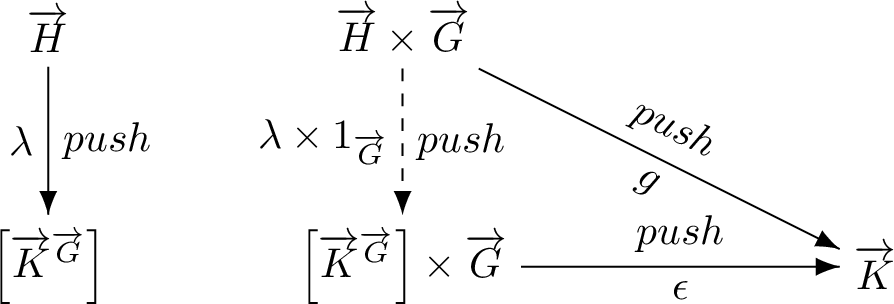 .
.
Here the evaluation function is defined as \(\epsilon((\phi,v)) = \pi(\phi(v))\) where \(\pi: AT(\overrightarrow{K}) \xrightarrow{push} \overrightarrow{K}\) is given by \[\pi(v) = \begin{cases} v, & \text{if v \in V(\overrightarrow{K}),}\\ v^*, & \text{if v \in V^*(\overrightarrow{K})}. \end{cases}\]
It is known that the exponential object of \(AT(\overrightarrow{K})\) to the \(AT(\overrightarrow{G})\) is \(AT(\overrightarrow{K})^{AT(\overrightarrow{G})}\) in the category of directed graphs. Let \(g_{ext}\) be an anti-twinned extension of \(g\). Then the universal properties of the exponential object will imply the existence of a homomorphism \(\lambda_{ext}\) (say) of \(AT(\overrightarrow{H})\) to \(AT(\overrightarrow{K})^{AT(\overrightarrow{G})} = AT([\overrightarrow{K}^{\overrightarrow{G}}])\) such that the following diagraph commutes.
Figure 6: 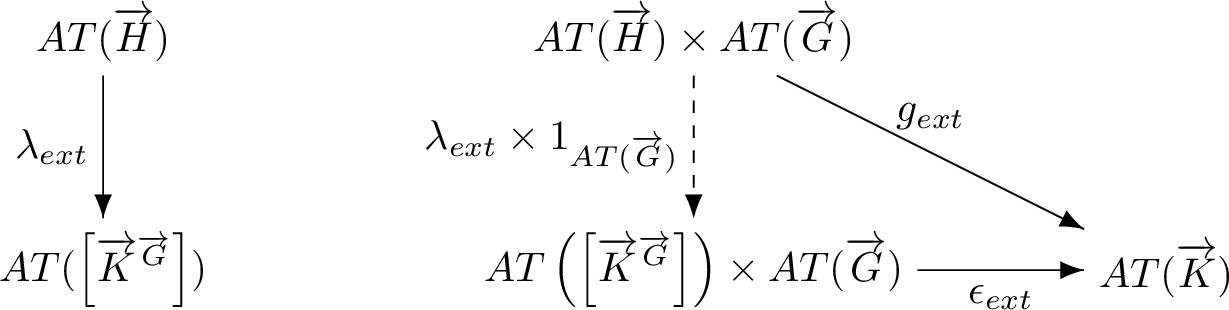 .
.
Here the evaluation function is defined in a natural way, that is, \(\epsilon_{ext}((\phi,v)) = \phi(v)\) for all \((\phi, v) \in AT([\overrightarrow{K}^{\overrightarrow{G}}]) \times AT(\overrightarrow{G})\).
Notice that \(\epsilon_{ext}\) is an anti-twinned homomorphism, and \(\epsilon\) is its anti-twinned restriction. Moreover, the identity homomorphism \(1_{AT(\overrightarrow{G})}: AT(\overrightarrow{G}) \rightarrow AT(\overrightarrow{G})\) is given by \(1_{AT(\overrightarrow{G})}(v) = v\) for all \(v \in V(AT(\overrightarrow{G}))\). Similarly, the identity pushable homomorphism \(1_{\overrightarrow{G}}: \overrightarrow{G} \xrightarrow{push} \overrightarrow{G})\) is given by \(1_{\overrightarrow{G}}(v) = v\) for all \(v \in V(\overrightarrow{G})\). Hence, notice that, \(1_{AT(\overrightarrow{G})}\) is an anti-twinned homomorphism, and \(1_{\overrightarrow{G}}\) is its anti-twinned restriction.
Next we want to show that \(\lambda_{ext}\) is an anti-twinned homomorphism. Let \(x\) be a vertex of \(AT(\overrightarrow{H})\). To verify that \(\lambda_{ext}\) is an anti-twinned homomorphism, we need to check that \(\lambda_{ext}(x^*) = \lambda_{ext}(x)^*\). For convenience, suppose that \(\lambda_{ext}(x) = \phi\) and \(\lambda_{ext}(x^*) = \psi\). Essentially, we need to show that \(\phi(v^*)^* = \psi(v)\) as per Lemma 5. Notice that \[\phi(v^*) = (\lambda_{ext}(x))(v^*) = \epsilon \circ (\lambda_{ext} \times 1_{AT(\overrightarrow{G})})(x,v^*) = g_{ext}(x,v^*).\] Furthermore, \[\psi(v) = (\lambda_{ext}(x^*))(v) = \epsilon \circ (\lambda_{ext} \times 1_{AT(\overrightarrow{G})})(x^*,v) = g_{ext}(x^*,v).\] Since \(g_{ext}\) is an anti-twinned homomorphism, and since \((x,v^*)\) and \((x^*, v)\) are anti-twins of each other, we have \[g_{ext}(x,v^*)^* = g_{ext}(x^*, v).\] This implies, \(\phi(v^*)^* = \psi(v)\), and thus, \(\lambda_{ext}\) is an anti-twinned homomorphism.
By taking \(\lambda\) as the anti-twinned restriction of \(\lambda_{ext}\), we can show that the first diagram commutes. Moreover, if any other directed graph, say, \(\overrightarrow{Q}\), satisfies the conditions of an exponential object of \(\overrightarrow{K}\) to the \(\overrightarrow{G}\) in the category of pushable directed graphs other than \([\overrightarrow{K}^{\overrightarrow{G}}]\), then \(AT(\overrightarrow{Q})\) will satisfy the conditions of an exponential object of \(AT(\overrightarrow{K})\) to the \(AT(\overrightarrow{G})\) in the category of directed graphs. However, since we know that \(AT(\overrightarrow{K})^{AT(\overrightarrow{G})}\) is unique, we must have \(AT(\overrightarrow{Q}) = AT(\overrightarrow{K})^{AT(\overrightarrow{G})} = AT([\overrightarrow{K}^{\overrightarrow{G}}])\). Thus, \(\overrightarrow{Q}\) is pushably isomorphic to \([\overrightarrow{K}^{\overrightarrow{G}}]\) due to Theorem 13. This completes the proof. ◻
Since we have proved the uniqueness of \([\overrightarrow{K}^{\overrightarrow{G}}]\), let us call it the pushable exponential directed graph from now on.
Let us establish one of the most important tools now.
Lemma 6. A directed graph \(\overrightarrow{K}\) is pushably multiplicative if and only if one of the following conditions is satisfied:
(i) \(\overrightarrow{G} \centernot{\xrightarrow{push}} \overrightarrow{K}\) implies \(\left[\overrightarrow{K}^{\overrightarrow{G}}\right] \xrightarrow{push} \overrightarrow{K}\),
(ii) \(\overrightarrow{G} \centernot{\xrightarrow{push}} \overrightarrow{K}\) implies \(AT(\overrightarrow{K})^{AT(\overrightarrow{G})} \xrightarrow{push} \overrightarrow{K}\).
Proof. \((i)\) Assume that \(\overrightarrow{K}\) is pushably multiplicative. Thus, if \(\overrightarrow{G} \centernot{\xrightarrow{push}} \overrightarrow{K}\) and \(\left[\overrightarrow{K}^{\overrightarrow{G}}\right] \centernot{\xrightarrow{push}} \overrightarrow{K}\), then \(\left[\overrightarrow{K}^{\overrightarrow{G}}\right] \times \overrightarrow{G}\centernot{\xrightarrow{push}} \overrightarrow{K}\). However, we have \(\epsilon: \left[\overrightarrow{K}^{\overrightarrow{G}}\right] \times \overrightarrow{G}\xrightarrow{push} \overrightarrow{K}\) by Theorem 17, which is a contradiction.
Conversely, suppose that condition \((i)\) is satisfied. Also suppose \(\overrightarrow{G} \times_p \overrightarrow{H} \xrightarrow{push} \overrightarrow{K}\). It is enough to show that either \(\overrightarrow{G} \xrightarrow{push} \overrightarrow{K}\) or \(\overrightarrow{H} \xrightarrow{push} \overrightarrow{K}\). Therefore, if \(\overrightarrow{G} \xrightarrow{push} \overrightarrow{K}\), then we are done. If \(\overrightarrow{G} \centernot{\xrightarrow{push}} \overrightarrow{K}\), then \(\left[\overrightarrow{K}^{\overrightarrow{G}}\right] \xrightarrow{push} \overrightarrow{K}\) due to condition \((i)\). Moreover, due to the universal properties of an exponential object, \(\overrightarrow{H} \xrightarrow{push} \left[\overrightarrow{K}^{\overrightarrow{G}}\right]\). Composing the two above pushable homomorphisms, we have \(\overrightarrow{H} \xrightarrow{push} \overrightarrow{K}\). Therefore, \(\overrightarrow{K}\) is pushably multiplicative.
\((ii)\) This follows from the fact \(AT(\left[\overrightarrow{K}^{\overrightarrow{G}}\right]) = AT(\overrightarrow{K})^{AT(\overrightarrow{G})}\) due to Lemma 5 and the definition of \(\left[\overrightarrow{K}^{\overrightarrow{G}}\right]\). ◻
In particular, we will use the following corollary of the above lemma as a tool in our proofs.
Corollary 1. If there exists a directed graph \(\overrightarrow{G}\) such that \(\overrightarrow{G} \centernot{\xrightarrow{push}} \overrightarrow{K}\) and \(AT(\overrightarrow{K})^{AT(\overrightarrow{G})} \centernot{\xrightarrow{push}} \overrightarrow{K}\), then \(\overrightarrow{K}\) is not pushably multiplicative.
7 Pushable multiplicativity of directed graphs↩︎
A directed graph is balanced if it is possible to push some of its vertices and convert every vertex into a source or a sink. If a directed graph is not balanced, then it is unbalanced.
Theorem 18. A bipartite oriented graph is pushably multiplicative if and only if it is balanced.
Proof. Let \(\overrightarrow{K}_2\) denote an orientation of \(K_2\). It is known [12] that an oriented graph is pushably homomorphically equivalent to \(\overrightarrow{K}_2\) if and only if it is balanced. That means, to prove that all balanced bipartite directed graph are pushably multiplicative, it is enough to prove that \(\overrightarrow{K}_2\) is multiplicative.
We know that any odd oriented cycle is pushably equivalent to the directed cycle [12]. We also know [12] that an even unbalanced cycle on \(4k\) vertices, for some \(k \geq 1\), is equivalent to the oriented cycle whose all but one arc is a forward arc and an even unbalanced cycle on \(4k+2\) vertices, for some \(k \geq 1\), is equivalent to the directed cycle.
Let \(\overrightarrow{UC}_{4k}\) be an unbalanced even cycle on \(4k\) vertices for some \(k \geq 1\). Suppose the vertices of \(\overrightarrow{UC}_{4k}\) are \(\{v_1, v_2, \ldots, v_{4k}\}\). Also, assume that its arcs are \(v_1v_2, v_2v_3, \ldots, v_{4k-1}v_{4k}\), and \(v_1v_{4k}\). Note that, in the anti-twinned graph \(AT(\overrightarrow{UC}_{4k})\) the following directed cycle of length \(4k+2\) is present: \[v_1v_2 \ldots v_{4k} v^*_{4k-1} v^*_{4k} v_1.\]
That means, anti-twin of any unbalanced directed graph contains a directed cycles of length \(2k+1\) or \(4k+2\), for some \(k \geq 1\). Furthermore, note that, the categorical product of two directed cycles of lengths \(k_1\) and \(k_2\) contains a directed cycle of length equal to the L.C.M. of \(k_1\) and \(k_2\). Observe that the L.C.M. of two numbers of the form \(2k+1\) or \(4k+2\) is also of the form \(2k+1\) or \(4k+2\). Suppose \(\overrightarrow{G}\) and \(\overrightarrow{H}\) are two unbalanced directed graphs. Thus, we can say that the categorical product \(AT(\overrightarrow{G}) \times AT(\overrightarrow{H})\) is an unbalanced directed graph. As any directed graph is pushably homomorphically equivalent its anti-twinned directed graph, we can conclude that the pushable categorical product of two unbalanced graph is unbalanced, and thus does not admit a pushable homomorphism to \(\overrightarrow{K}_2\). This implies that \(\overrightarrow{K}_2\) is pushably multiplicative.
Next we will show that all unbalanced bipartite directed graphs are pushably non-multiplicative. Let \(\overrightarrow{K}\) be an unbalanced bipartite directed graph, and let \(2k+2\) be the length of its shortest unbalanced even oriented cycle. Notice that, \(k \geq 1\) as we are working on oriented graphs.
Let \(\overrightarrow{D}_2\) denote the graph on \(2\) vertices \(x, y\) having two arcs \(xy\) and \(yx\). Let \(\overrightarrow{DC}_{2k+1}\) denote the directed cycle on \(2k+1\) vertices. Notice that \(\overrightarrow{D}_2 \centernot{\xrightarrow{push}} \overrightarrow{K}\) since \(\overrightarrow{K}\) is an oriented graph, and \(\overrightarrow{DC}_{2k+1} \centernot{\xrightarrow{push}} \overrightarrow{K}\) since \(\overrightarrow{K}\) is bipartite.
Note that \(\overrightarrow{D}_2 \times_p \overrightarrow{DC}_{2k+1} = \overrightarrow{D}_2 \times \overrightarrow{DC}_{2k+1}\), since all vertices of \(\overrightarrow{D}_2\) are push invariant. Furthermore, \(\overrightarrow{D}_2 \times \overrightarrow{DC}_{2k+1}\) is nothing but the directed cycle \(\overrightarrow{DC}_{4k+2}\) on \(4k+2\) vertices, that is the unbalanced even cycle on \(4k+2\) vertices. Observe that \(\overrightarrow{DC}_{4k+2}\) admits a homomorphism to any unbalanced even cycle of a lesser length. In particular, since \(\overrightarrow{K}\) contains an unbalanced cycle of lesser length, \(\overrightarrow{DC}_{4k+2} \xrightarrow{push} \overrightarrow{K}\). This implies that \(\overrightarrow{K}\) is pushably non-multiplicative. ◻
Theorem 19. An oriented cycle is pushably multiplicative if and only if it is a balanced and even.
Proof. We have already shown that even oriented cycles are pushably multiplicative if and only if they are balanced in Theorem 18. Thus, it is enough to prove that directed odd cycles are pushably non-multiplicative, since all oriented odd cycles are equivalent to the directed cycle. In other words, it is enough to prove that the directed cycle \(\overrightarrow{DC}_{2k+1}\) is pushably non-multiplicative for any \(k \geq 1\). For convenience assume that \(\overrightarrow{DC}_{2k+1}\) is the following directed cycle: \(0,1,\cdots, \cdots, 2k, 0\).
Let \(\overrightarrow{D}_2\) denote the directed graph on \(2\) vertices \(x\) and \(y\) having two arcs \(xy\) and \(yx\). Since both \(x\) and \(y\) are push invariant, \(AT(\overrightarrow{D}_2) = \overrightarrow{D}_2\). Clearly, \(\overrightarrow{D}_2\) does not admit a pushable homomorphism to \(\overrightarrow{DC}_{2k+1}\). Thus, if we can show that the graph \(AT(\overrightarrow{DC}_{2k+1})^{\overrightarrow{D}_2}\) does not admit a homomorphism to \(\overrightarrow{DC}_{2k+1}\), then using Lemma 6 we can conclude that \(\overrightarrow{DC}_{2k+1}\) is pushably non-multiplicative.
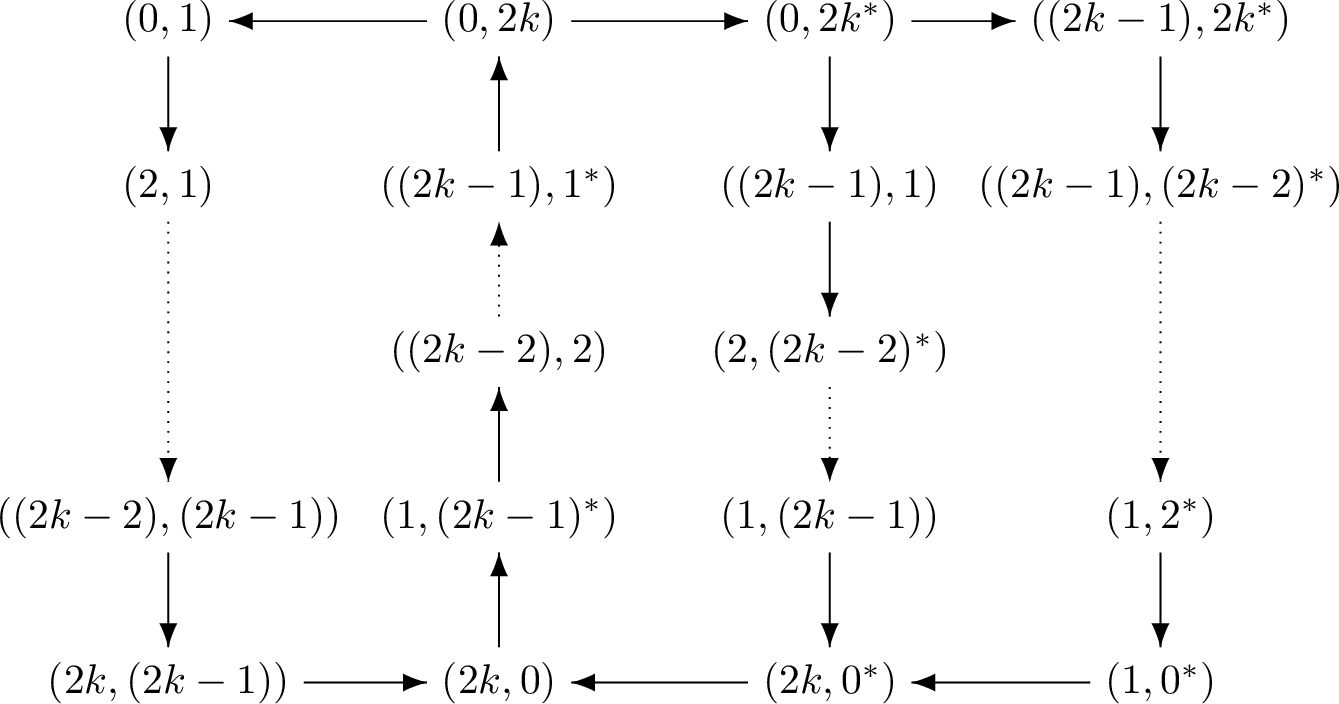
Indeed, we are going to show that a particular subgraph of \(AT(\overrightarrow{DC}_{2k+1})^{\overrightarrow{D}_2}\) does not admit a homomorphism to \(\overrightarrow{DC}_{2k+1}\). As a first step, let us discuss a convention to describe the above-mentioned subgraph. Notice that, the vertices of \(AT(\overrightarrow{DC}_{2k+1})^{\overrightarrow{D}_2}\) are functions from \(V(\overrightarrow{D}_2)\) to \(V(AT(\overrightarrow{DC}_{2k+1}))\). If \(f\) is such a function, then as a convention let us denote it by \((f(x),f(y))\). Notice that it is enough to know the values of \(f(x)\) and \(f(x)\) to know the whole function.
Using this convention, in Fig. 7 we have presented a subgraph of \(AT(\overrightarrow{DC}_{2k+1})^{\overrightarrow{D}_2}\). Let us call this graph \(\overrightarrow{Z}\). It is possible to verify that this graph is indeed a subgraph of \(AT(\overrightarrow{DC}_{2k+1})^{\overrightarrow{D}_2}\). While verifying, one may use the following observation for convenience: there is an arc from \((a,b)\) to \((c,d)\) in \(\overrightarrow{Z}\) if \(ad, bc\) are arcs in \(AT(\overrightarrow{DC}_{2k+1})\).
Now all that remains is to prove that \(\overrightarrow{Z}\) does not admit a pushable homomorphism to \(\overrightarrow{DC}_{2k+1}\). Let us first try to understand the structure of \(\overrightarrow{Z}\), beginning with a directed path decomposition. We will list down some directed paths of \(\overrightarrow{Z}\) which partitions its arcs.
\(\overrightarrow{P}_{L1} = (2k,0), (1,(2k-1)^*), ((2k-2),2), \dots ,((2k-1),1^*), (0,2k)\),
\(\overrightarrow{P}_{L2} = (0,2k), (0,1), (2,1) \dots (2k,(2k-1)), (2k,0)\),
\(\overrightarrow{P}_{R1} = (0,2k^*), ((2k-1),1), (2,(2k-2)^*), \dots ,(1,(2k-1)), (2k,0^*)\),
\(\overrightarrow{P}_{R2} = (0,2k^*), ((2k-1),2k^*), ((2k-1),(2k-1)^*), \dots ,(1,0^*), (2k,0^*)\),
\(\overrightarrow{P}_U = (0,2k),(0,2k^*)\),
\(\overrightarrow{P}_D = (2k,0^*),(2k,0)\).
Observe that the above-listed directed paths have the following size (number of arcs).
| Name of directed path | Size |
|---|---|
| \(\overrightarrow{P}_{L1}\) | \(2k\) |
| \(\overrightarrow{P}_{L2}\) | \(2k + 1\) |
| \(\overrightarrow{P}_{R1}\) | \(2k\) |
| \(\overrightarrow{P}_{R2}\) | \(2k + 1\) |
| \(\overrightarrow{P}_{U}\) | \(1\) |
| \(\overrightarrow{P}_{D}\) | \(1\) |
Next note that there are the following oriented cycles in \(\overrightarrow{Z}\), all induced by a collection of the above mentioned directed paths.
\(\overrightarrow{C}_{M} = \overrightarrow{P}_U, \overrightarrow{P}_{R1}, \overrightarrow{P}_{D}, \overrightarrow{P}_{L1}\),
\(\overrightarrow{C}_{L} = \overrightarrow{P}_{L1},\overrightarrow{P}_{L2}\),
\(\overrightarrow{C}_{R} = \overrightarrow{P}_{R1},\overrightarrow{P}_{R2}\).
Observe that the above-listed oriented cycles have the following orders, number of forward arcs, number of backward arcs. Here since all the three oriented cycles are already embedded in a planar way in Fig. 7, the arcs oriented clockwise will be counted as forward, and the arcs oriented counter-clockwise will be counted as backward.
| Name of oriented cycle | Order | Forward arcs | Backward arcs |
|---|---|---|---|
| \(\overrightarrow{C}_{M}\) | \(4k + 2\) | \(4k + 2\) | \(0\) |
| \(\overrightarrow{C}_{L}\) | \(4k + 1\) | \(0\) | \(4k + 1\) |
| \(\overrightarrow{C}_{R}\) | \(4k + 1\) | \(2k + 1\) | \(2k\) |
Suppose, \(\overrightarrow{C}\) be an oriented cycle having \(n_1\) forward arcs and \(n_2\) backward arcs. The oriented cycle admits a homomorphism to \(DC_{2k+1}\) if and only if \((2k+1)\) divides \((n_1-n_2)\). Notice that, if you allow to push the vertices of \(\overrightarrow{C}\), then the number of forward and backward arcs will change yet their parity will be the same. We will use these two observations in the following.
Let us assume that \(\overrightarrow{Z}'\) is a push equivalent directed graph of \(\overrightarrow{Z}\) that admits a homomorphism to \(\overrightarrow{DC}_{2k+1}\). Let us assume that the oriented cycles \(\overrightarrow{C}_{M}, \overrightarrow{C}_{L}, \overrightarrow{C}_{R}\) got converted into \(\overrightarrow{C}'_{M}, \overrightarrow{C}'_{L}, \overrightarrow{C}'_{R}\), respectively, in \(\overrightarrow{Z}'\).
Suppose that \(\overrightarrow{C}'_{M}\) has \(n_1\) forward and \(n_2\) backward arcs. Since \(\overrightarrow{C}_{M}\) had \(4k+2\) forward and \(0\) backward arcs, \(n_1, n_2\) must be even. Moreover, we must have \(n_1-n_2 \equiv 0~(mod~2k+1)\). That means the only two feasible solutions are \((n_1, n_2) = (4k+2, 0)\) and \((0, 4k+2)\). That means, \(\overrightarrow{C}'_{M}\) is a directed cycle. Let us assume that all its arcs are forward (the other case, when all its arcs are backward, can be handled in a similar way, hence is omitted from the proof).
Notice that \(\overrightarrow{C}_{L}\) has \(0\) forward and \(4k+1\) backward arcs. That means, \(\overrightarrow{C}'_{L}\) has even number of forward and odd number of backward arcs. Moreover, \(\overrightarrow{C}'_{L}\) has at least \(2k\) backward arcs (as they are part of \(\overrightarrow{C}'_{M}\)). Suppose \(\overrightarrow{C}'_{L}\) have \(n_1\) forward and \(n_2\) backward arcs, then we must have \(n_1-n_2 \equiv 0~(mod~2k+1)\). Observe that there is only one solutions that will satisfy all the constraints, namely, \((n_1, n_2) = (k, 3k+1)\) where \(k\) must be even.
Notice that \(\overrightarrow{C}_{R}\) has \(2k+1\) forward and \(2k\) backward arcs. That means, \(\overrightarrow{C}'_{R}\) has odd number of forward and even number of backward arcs. Moreover, \(\overrightarrow{C}'_{R}\) has at least \(2k\) backward arcs (as they are part of \(\overrightarrow{C}'_{M}\)). Suppose \(\overrightarrow{C}'_{L}\) have \(n_1\) forward and \(n_2\) backward arcs, then we must have \(n_1-n_2 \equiv 0~(mod~2k+1)\). Observe that there is only one solutions that will satisfy all the constraints, namely, \((n_1, n_2) = (k, 3k+1)\) where \(k\) must be odd.
This is a contradiction as \(k\) cannot be simultaneously even and odd. Thus, \(\overrightarrow{Z}\) does not admit a pushable homomorphism to \(\overrightarrow{DC}_{2k+1}\). ◻
Theorem 20. A transitive tournament \(\overrightarrow{TT}_n\) on \(n\) vertices is pushably multiplicative if and only if \(n \leq 2\).
Proof. The transitive tournaments on \(1\) and \(2\) vertices are pushably multiplicative using Theorem 18 since they are balanced bipartite graphs. The transitive tournament on \(3\) vertices is pushably non-multiplicative due to Theorem 19 as it is pushably equivalent to the directed cycle on \(3\) vertices.
Thus, we are left with showing that transitive tournaments \(\overrightarrow{TT}_n\) on \(n\) vertices are pushably non-multiplicative for all \(n \geq 4\).
Let \(\overrightarrow{D}_2\) denote the directed graph on \(2\) vertices \(x\) and \(y\) having two arcs \(xy\) and \(yx\). Since both \(x\) and \(y\) are push invariant, \(AT(\overrightarrow{D}_2) = \overrightarrow{D}_2\). Clearly, \(\overrightarrow{D}_2\) does not admit a pushable homomorphism to \(\overrightarrow{TT}_{n}\) for any \(n \geq 4\). Thus, if we can show that the graph \(AT(\overrightarrow{TT}_{n})^{\overrightarrow{D}_2}\) does not admit a homomorphism to \(\overrightarrow{DC}_{2k+1}\), then using Lemma 6 we can conclude that \(\overrightarrow{TT}_{n}\) is pushably non-multiplicative.
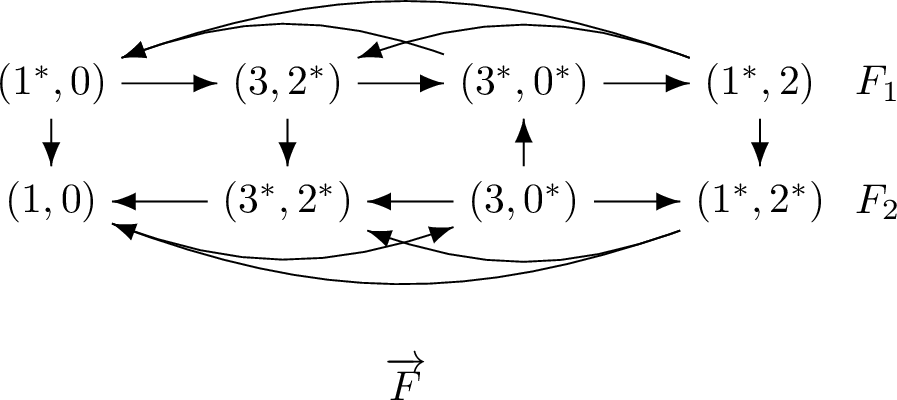
Indeed, we are going to show that a particular subgraph of \(AT(\overrightarrow{TT}_{n})^{\overrightarrow{D}_2}\) does not admit a homomorphism to \(\overrightarrow{TT}_{n}\), for any \(n \geq 4\). As a first step, let us discuss a convention to describe the above-mentioned subgraph. Notice that, the vertices of \(AT(\overrightarrow{TT}_{n})^{\overrightarrow{D}_2}\) are functions from \(V(\overrightarrow{D}_2)\) to \(V(AT(\overrightarrow{TT}_{n}))\). If \(f\) is such a function, then as a convention let us denote it by \((f(x),f(y))\). Notice that it is enough to know the values of \(f(x)\) and \(f(x)\) to know the whole function. Moreover, as a convention, we can suppose that the vertices of \(\overrightarrow{TT}_n\) are \(0, 1, \ldots, n-1\), while its arcs are oriented from \(i\) to \(j\) where \(i < j\). From this naming convention it is clear that if \(\overrightarrow{F}\) is a subgraph of \(AT(\overrightarrow{TT}_{4})^{\overrightarrow{D}_2}\), then it is also a subgraph of \(AT(\overrightarrow{TT}_{n})^{\overrightarrow{D}_2}\) for all \(n \geq 4\). We present such a subgraph \(\overrightarrow{F}\) on \(8\) vertices and show that it does not admit a pushable homomorphism to any \(\overrightarrow{TT}_n\) for \(n \geq 4\). That will conclude the proof.
First of all, let us present the special subgraph \(\overrightarrow{F}\) in Fig. [fig32F]. One can verify that \(\overrightarrow{F}\) is indeed a subgraph of \(AT(\overrightarrow{TT}_{4})^{\overrightarrow{D}_2}\), and thus a subgraph of \(AT(\overrightarrow{TT}_{n})^{\overrightarrow{D}_2}\) for all \(n \geq 4\). Thus, we are left to prove that \(\overrightarrow{F}\) does not admit a pushable homomorphism to \(\overrightarrow{TT}_n\) for any \(n \geq 4\). Notice that, \(\overrightarrow{F}\) admits a pushable homomorphism to \(\overrightarrow{TT}_8\) if and only if it is possible to push some vertices of \(\overrightarrow{F}\) and convert it into a directed acyclic graph. Let \(\overrightarrow{F}'\) be a directed acyclic graph push equivalent to \(\overrightarrow{F}\). Let \(F_1 = \{(1^*,0), (3,2^*), (3^*,0^*), (1^*,2)\}\) and \(F_2 = \{(1,0), (3^*,2^*), (3,0^*), (1^*,2^*)\}\). Observe that, the two induced tournaments \(\overrightarrow{F}'[F_1]\) and \(\overrightarrow{F}'[F_2]\) , respectively, must be transitive tournaments.
We do an exhaustive case analysis to prove the impossibility of converting \(\overrightarrow{F}\) into a directed acyclic graph \(\overrightarrow{F}'\) via pushing some vertices. Suppose, \(S\) is the set of vertices that we pushed to obtain \(\overrightarrow{F}'\) from \(\overrightarrow{F}\). Since pushing \(S\) or \(V(\overrightarrow{F}) \setminus S\) has the same effect, we can assume that \(S\) contains the vertex \((3^*,0^*)\) in particular. Moreover, let \(X = S \cap F_1\) and \(Y = S \cap F_2\). The case analysis is based on the following assumptions and observations.
First we observe that their are \(4\) choices for \(X\). In the table below, we list those four choices along with the topological order they induce on the tournament \(\overrightarrow{F}'[F_1]\).
| \(X\) | topological order |
|---|---|
| \((3^*,0^*)\) | \((1^*,2), (1^*,0), (3^*,0^*),( 3,2^*)\) |
| \((3^*,0^*), (1^*,2)\) | (\(1^*,0), (3^*,0^*), (3,2^*), (1^*,2)\) |
| \((3^*,0^*), (3,2^*)\) | \((3,2^*), (1^*,2), (1^*,0), (3^*,0^*)\) |
| \((3^*,0^*), (1^*,2), (1^*,0)\) | \((3^*,0^*), (3,2^*), (1^*,2), (1^*,0)\) |
Similarly, there are \(8\) choices for \(Y\) that are listed below:
\[\{ (3,0^*) \}, \{ (1,0) \}, \{ (3,0^*), (1^*,2^*)\}, \{ (1,0), (3,0^*) \}, \{(3^*,2^*), (1^*,2^*)\}, \{(1,0), (3^*,2^*)\},\] \[\{ (3,0^*), (3^*,2^*), (1^*,2^*)\}, \{(1,0), (3^*,2^*), (1^*,2^*)\} .\]
Therefore, let us do the case analysis based on the choices of \(X\). Let \(\overrightarrow{F}''\) denote the directed graph obtained from \(\overrightarrow{F}\) by pushing the vertices of \(X\). The explicit drawing of \(\overrightarrow{F}''\) is provided below for each of the \(4\) choices of \(X\). It is tedious, but easy to observe that, for each choice of \(X\), there does not exist any choice of \(Y\) (the options are the eight choices listed above) which will convert \(\overrightarrow{F}''\) into a directed acyclic graph (after pushing the vertices of \(Y\)).
(i) If \(X = \{ (3^*,0^*) \}\), then \(\overrightarrow{F}''\) is as follows:
::: center
:::
(ii) \(X = \{ (3^*,0^*), (1^*,2) \}\), then \(\overrightarrow{F}''\) is as follows:
 ::: center
 :::
(iii) \(X = \{ (3^*,0^*), (3,2^*) \}\), then \(\overrightarrow{F}''\) is as follows:
  ::: center
  :::
(iv) \(X = \{(3^*,0^*), (1^*,2), (1^*,0)\}\), then \(\overrightarrow{F}''\) is as follows:
 ::: center
 :::
That shows it is not possible to push some vertices of \(\overrightarrow{F}\) and convert it into a directed acyclic graph \(\overrightarrow{F}'\), and thus it concludes the proof. ◻
8 Non-multiplicative families of directed graphs↩︎
Furthermore, we explore a connection between pushably non-multiplicative directed graphs and non-multiplicative directed graphs.
Lemma 7. If \(\overrightarrow{K}\) is a pushably non-multiplicative directed graph, then \(AT(\overrightarrow{K})\) is a non-multiplicative directed graph.
Proof. Suppose \(\overrightarrow{K}\) is a pushably non-multiplicative directed graph. That means, there exists \(\overrightarrow{G}\) and \(\overrightarrow{H}\) such that \(\overrightarrow{G} \times_p \overrightarrow{H} \xrightarrow{push} \overrightarrow{K}\) but \(\overrightarrow{G} \centernot{\xrightarrow{push}} \overrightarrow{K}\) and \(\overrightarrow{H} \centernot{\xrightarrow{push}} \overrightarrow{K}\). Since \(AT(\overrightarrow{G}) \times AT(\overrightarrow{H}) = AT(\overrightarrow{G} \times_p \overrightarrow{H})\), by Theorem 14, we can conclude that \(AT(\overrightarrow{G}) \times AT(\overrightarrow{H}) \rightarrow AT(\overrightarrow{K})\), but \(AT(\overrightarrow{G}) \not\rightarrow AT(\overrightarrow{K})\) and \(AT(\overrightarrow{H}) \not\rightarrow AT(\overrightarrow{K})\). That means, \(AT(\overrightarrow{K})\) is non-multiplicative. ◻
Based on the above theorem, we are able to find new (infinite) families of non- multiplicative directed graphs contributing in the answer of Question [ques digraph multiplicative], and also building new tools to find non-multiplicative directed graphs.
Theorem 21. The directed graph \(AT(\overrightarrow{G})\) is non-multiplicative if \(\overrightarrow{G}\) is an unbalanced bipartite directed graph, or an unbalanced oriented cycle, or a transitive tournament on at least three vertices.
9 Conclusions↩︎
(1) We present the state of the art of multiplicativity research in Und, Dir, Push in a tabular form (see Table ¿tbl:tab32result?).
width=,center
(2) We have established the existence of exponential objects in the category of pushable digraphs in Theorem 17 resolving Question 16 from [12]. We managed to use the exponential objects and their properties as a tool to prove results related to pushable multiplicative directed graphs (in Theorems 19 and 20, to be specific). We wonder if it is possible to prove an analogue of the ‘Denstiy Theorem’ known for undirected and directed graphs (with respect to ordinary homomorphism), for directed graphs with respect to the pushable homomorphism.
(3) Our results partially address Question 15 which asks to characterize all pushably multiplicative directed graphs. However, the complete resolution of the question is far from complete. We propose the following ambitious conjecture, which proposes a complete solution to Question 15.
Conjecture 22. A directed graph \(\overrightarrow{G}\) is pushably multiplicative if and only if it is balanced.
(4) As a natural intermediate step towards the above conjecture would be to determine the multiplicativity of tournaments with respect to pushable homomorphisms. In particular, one may try to prove that every tournament on at least \(n\) vertices is pushably non-multiplicative, where \(n \geq 3\). Note that this claim is correct for \(n = 3\) since the directed cycle on \(3\) vertices is pushably non-multiplicative according to Theorem 19. In fact, we have proofs of this claim for \(n =4\) and \(n=5\) cases (not included in this article). Thus, it will not be surprising to find a proof of the claim for all \(n \geq 4\).
(5) The techniques developed here rely heavily on the exponential directed graphs. It would be worthwhile to examine whether similar ideas can be adapted to the classical categories Dir and Und, possibly yielding new insights into multiplicativity or related structural phenomena.
(6) Finally, an intriguing direction is the study of multiplicativity in other graph categories where categorical product exists, such as, the category of signed graphs. We did explore this direction a bit, and surprisingly found that most of the signed graphs are non-multiplicative. We are yet to resolve the analogue of Question 3 for signed graphs though. We will probably record our findings for signed graphs in a different article.