An Omnilingual-ASR-Based Speech-LLM System for the 2nd MLC-SLM Challenge
July 14, 2026
Abstract
We describe our submission to Task 1 of the 2nd MLC-SLM Challenge: a cascaded diarization-then-recognition system that combines DiariZen-Large-s80 (WavLM-Large) segmentation, CAM++ embedding-based two-speaker clustering, and a LoRA-adapted
omniASR_LLM_7B_v2 recognizer, with no oracle segmentation or speaker labels at test time. On the official Development set (150 conversations, 21 language/accent categories) the system attains a macro tcpMER of 29.27%, versus
\(79.15\%\) for the official baseline; on the Evaluation set it scores \(50.23\%\). We also analyze two engineering choices that substantially affect tcpMER. First, embedding-based speaker
clustering outperforms an end-to-end-style alternative that assigns speakers from ASR <sc> turn markers alone. Second, overlap-aware segmentation, although intended to raise diarization recall, increases tcpMER because
overlapped speech is transcribed twice.
Index Terms: speaker diarization, multilingual conversational speech, speaker assignment, time-constrained evaluation, cascaded systems
1 Introduction↩︎
Conversational speech in realistic, multilingual settings remains challenging for both automatic speech recognition (ASR) and speaker diarization (SD). The Multilingual Conversational Speech Language Model (MLC-SLM) Challenge [1] targets this gap by releasing a real-world, multi-language conversational corpus. In its second edition, Task 1 asks participants to jointly perform speaker diarization (“who spoke when”) and recognition (“what was said”) on raw recordings, without any oracle segmentation or speaker labels at evaluation time. Systems are ranked by the time-constrained minimum-permutation error rate (tcpMER), i.e.tcpWER for most languages and tcpCER for Japanese, Korean and Thai [2]; speaker permutations are resolved before concatenating transcripts for scoring. The official Task-1 baseline fine-tunes Microsoft’s open-source VibeVoice-ASR with LoRA on the challenge training set [3].
This paper describes our Task 1 submission and the Development-set ablations used to select it. The system is a cascaded pipeline—neural segmentation, CAM++-based speaker clustering, and LoRA-adapted ASR—so that each stage can be tuned and compared under the official tcpMER protocol. The remainder of the paper is organized as follows: Section 2 details the implementation, Section 3 the evaluation setup, and Section 4 reports Development results, component ablations (Table 1), and the Evaluation-set leaderboard score. In summary:
We describe the final cascaded system submitted to the challenge (Exp4 in Table 1).
We compare embedding-based clustering with end-to-end
<sc>-based speaker assignment on the Development set.We compare overlap-enabled and overlap-disabled segmentation fronts under the same scoring protocol.
We report the Evaluation-set leaderboard score and discuss the gap to Development tuning.
2 System Description↩︎
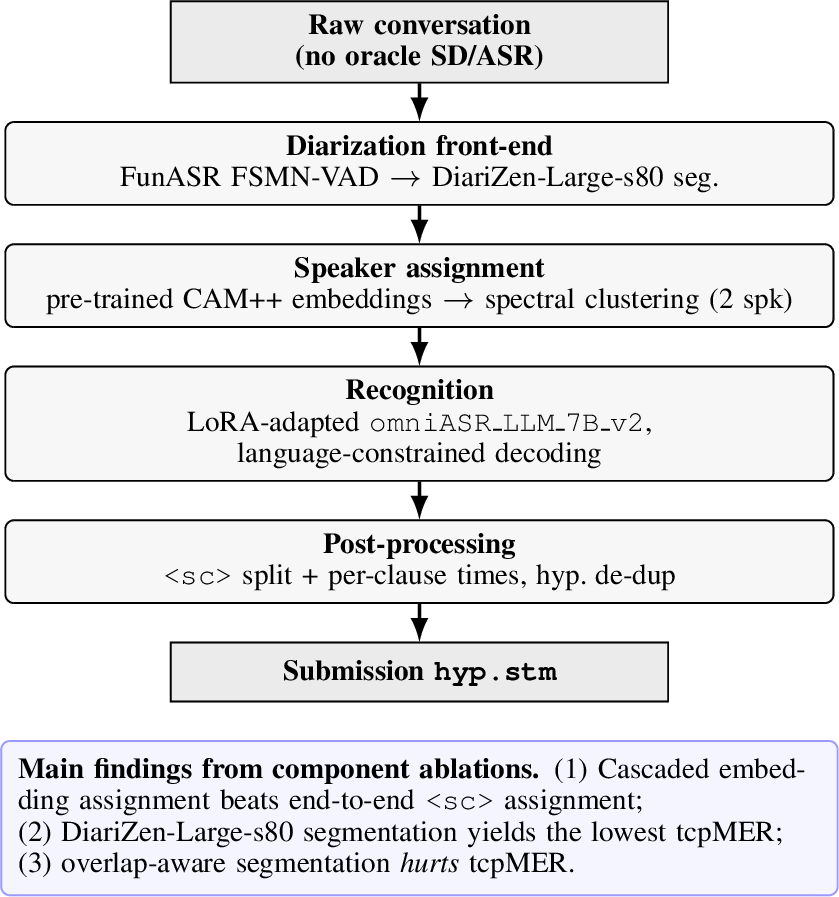
Figure 1 summarizes the pipeline. A raw conversation is (1) segmented into single-speaker regions, (2) assigned speaker identities by embedding extraction and clustering, (3) transcribed segment-by-segment by the ASR model, and (4) cleaned and packed into the submission format. The four stages are decoupled so that each can be replaced and ablated independently.
2.1 Speaker diarization front-end↩︎
We build on the 3D-Speaker toolkit [4] with a cascaded layout: segmentation is handled separately from speaker assignment. This separation matches our implementation and makes the Exp1–Exp4 comparisons in Section 4 straightforward—each stage can be swapped without retraining the recognizer.
Voice activity detection. All diarization configurations first apply the FunASR feedforward sequential memory network (FSMN) voice-activity detector [5], [6], using the ModelScope checkpoint speech_fsmn_vad_zh-cn-16k-common-pytorch. VAD is a shared module in every inference run
and is not part of the segmentation-model comparison below.
Segmentation. On top of VAD we compare two publicly released neural segmenters, both integrated via the 3D-Speaker pyannote.audio inference stack [4]: (a) the HuggingFace checkpoint pyannote/segmentation-3.0 [7], [8], a PyanNet powerset segmentation model (SincNet + BiLSTM head; \(10\,\)s windows, \(10\%\) hop) used as a
segmenter only—we do not use the pyannote speaker-embedding pipeline, and instead pair it with CAM++ clustering below; overlapped-speech decoding from the powerset head is enabled in Exp2 and disabled in Exp3; and (b) the
DiariZen-Large-s80 checkpoint (BUT-FIT/diarizen-wavlm-large-s80-md), a WavLM-Large + Conformer EEND segmentation model [9], run with \(12\,\)s windows and a \(10\%\) hop (Exp4, submitted). The raw segments are post-processed by (i) dropping segments shorter than \(0.7\,\)s, (ii) merging same-speaker segments separated by gaps \(\le 1.5\,\)s, and (iii) splitting any segment longer than \(25\,\)s, which keeps the per-segment
duration within the ASR model’s stable input range.
Speaker embedding. We use the publicly released, pre-trained CAM++ [10] checkpoint from the 3D-Speaker
toolkit [4] (campplus_cn_en_common): it is lightweight, supports multilingual telephone speech out of the box, and fits our two-speaker
clustering stage without additional speaker-model training. For each candidate segment we slice \(1.5\,\)s sub-windows with a \(0.75\,\)s hop and extract \(192\)-dimensional embeddings from an \(80\)-dimensional log-filter-bank front-end.
Clustering. All sub-window embeddings of a recording are grouped by spectral clustering [11] with the number of
speakers fixed to two, matching the two-party telephone conversations of the corpus. Each candidate segment then receives a single anonymous speaker ID (Speaker1/Speaker2), and adjacent same-speaker segments are merged. Because
the DiariZen front-end can hypothesize concurrent speakers, a further post-processing step resolves any residual cross-speaker time overlap (the shorter segment yields the overlapped region), so the segments passed to the recognizer are effectively
non-overlapping.
2.2 Multilingual ASR with LoRA adaptation↩︎
The recognizer is Meta’s publicly released omniASR_LLM_7B_v2 checkpoint from the Omnilingual ASR family [12] (a
wav2vec2-style encoder with a CTC head). We adapt it to the conversational, telephone-channel domain with Low-Rank Adaptation [13] rather than full
fine-tuning: with a single GPU and a 7B backbone, LoRA is the only practical option, and freezing the acoustic encoder also guards a strong multilingual model against over-fitting the comparatively small in-domain set. Only the low-rank adapters (rank
\(r{=}8\), \(\alpha{=}16\), dropout \(0.05\)) are updated, under a CTC objective. Adaptation runs in fairseq2 for \(50\)k
steps with FSDP and bfloat16; utterances are filtered to \(2\)–\(15\,\)s and length-bucketed (up to \(4{\times}10^{5}\) audio elements per batch, gradient
accumulation \(16\)). We use AdamW (lr \(2{\times}10^{-4}\), \(\beta{=}(0.9,0.98)\), no weight decay) with a tri-stage warm-up/hold/decay schedule (ratios
\(0.1/0.4/0.5\)). All reported systems use the same \(50\)k-step checkpoint. Training utterances are packed from consecutive reference-segmented turns in the challenge training set (oracle
boundaries available only during adaptation, not at test time) subject to the length filter; transcripts concatenate segment text and insert a speaker-change token (<sc>) between adjacent segments from different speakers (but not between
consecutive segments of the same speaker), so the model learns to predict turn boundaries alongside lexical content.
At inference, each diarized segment is decoded with the target language supplied explicitly as a decoding constraint (lang=<lang>), which confines the decoder to the target language’s token space and effectively eliminates spurious
language switching.
2.3 Post-processing↩︎
Two inference-time steps reduce time-constrained errors without changing the acoustic model. (1) Speaker-change splitting: the recognizer outputs the <sc> markers it was trained on; within a segment we split on these markers
and allocate per-sub-clause timestamps proportional to character length, instead of sharing a single timestamp across the whole segment. (2) Repeated-hypothesis de-duplication: within a segment, near-duplicate sub-clauses (identical, substring, or
\(\ge\!0.9\) sequence similarity after NFKC + case folding) are removed to suppress decoder echo. All Development-set numbers in this paper, including Exp1–Exp4, are scored with the same official symmetric
normalization applied to references and hypotheses (NFKC, then strict tokenization aligned with the challenge WER/CER scripts, with punctuation removal for word cohorts); see Section 3.
3 Experimental Setup↩︎
Data. All results are reported on the official MLC-SLM Development set: 150 long conversational recordings (\(\sim\!30\) min telephone-channel sessions) spanning 21 language/accent categories (English is split into five accents, following the official breakdown). The final system is submitted on the Evaluation set. LoRA adaptation uses the official challenge training manifest with reference turn boundaries (available for training only).
Metrics. Following the challenge, we report tcpWER for 18 categories and tcpCER for Japanese, Korean and Thai, with a collar of \(5\,\)s computed by MeetEval [2]. For each cohort we report the micro rate (total errors over total reference tokens); the overall macro score is the mean of
per-category micro rates over all 21 categories. All results reported in this paper—main results, Exp1–Exp4, and baseline comparisons—apply this identical scoring-time normalization (Unicode NFKC compatibility normalization, which
maps full-width and other compatibility-variant characters to their canonical forms, followed by strict tokenization aligned with the challenge WER/CER scripts, with punctuation removal for word cohorts) symmetrically to references and hypotheses, so
neither side gains from one-sided text cleaning. The official baseline Development scores (Table ¿tbl:tab:baseline?) are quoted from the released repository [3], where the authors likewise apply their text_normalization_2nd.py (NFC, lowercasing, punctuation removal) symmetrically to both sides under the same collar and tcpMER
protocol; we do not re-score their system. The \(\sim\!50\) point gap to our \(29.27\%\) therefore reflects architecture, not asymmetric normalization.
Hardware. ASR LoRA adaptation was performed on a single NVIDIA RTX 6000 Ada GPU.
4 Results and Analysis↩︎
4.1 Main results↩︎
Table ¿tbl:tab:perlang? reports per-language results of the final system (DiariZen-Large-s80 segmentation + pre-trained CAM++ + two-speaker clustering + LoRA-adapted omniASR_LLM_7B_v2). Following the official scoring
protocol we report over all \(21\) language/accent categories (English is broken down by accent). The system attains a macro tcpMER of 29.27%, with a word-cohort micro tcpWER of 29.41% and
a character-cohort micro tcpCER of 27.38%. For reference, the official Task-1 baseline—a LoRA-fine-tuned VibeVoice-ASR recognizer [3]—reports a macro tcpMER of \(79.15\%\) on the same Development set under the identical 21-category protocol; our cascaded system lowers this to \(29.27\%\), a relative reduction of roughly \(63\%\).
@ll@ll@ Language & tcpMER & Language & tcpMER
Spanish (MX) & 11.1 & Eng. (British) & 27.8
Eng. (Australian) & 17.8 & Vietnamese & 33.0
Eng. (Indian) & 18.2 & French & 34.6
Thai\(^\dagger\) & 18.7 & Korean\(^\dagger\) & 34.8
Italian & 19.9 & Tagalog & 34.9
Spanish & 20.0 & German & 37.8
Eng. (Filipino) & 20.1 & Portuguese & 39.4
Portuguese (BR) & 20.3 & Japanese\(^\dagger\) & 40.3
Russian & 22.9 & French (CA) & 46.7
Urdu & 24.0 & Turkish & 65.8
Eng. (American) & 26.6 & &
4.2 Comparison with the official baseline↩︎
For context, Table ¿tbl:tab:baseline? lists the per-language Development-set scores of the official Task-1 baseline as released in the repository of [3]; the baseline is a LoRA-fine-tuned VibeVoice-ASR recognizer evaluated under the same \(5\,\)s collar with tcpCER for Japanese/Korean/Thai and tcpWER elsewhere, with symmetric text normalization as above. Its scores are high across the board—no single category falls below \(60\%\) and the easiest cohorts still sit above \(63\%\)—yielding a \(79.15\%\) average over its \(21\) language/accent categories. Using the same 21-category protocol, our cascaded system reaches a macro tcpMER of \(29.27\%\); even our hardest cohort (Turkish, \(65.8\%\)) is comparable to the baseline’s single best category (\(63.4\%\)). This gap indicates that the combination of a strong segmentation front-end, embedding-based two-speaker clustering, and a LoRA-adapted multilingual recognizer is markedly more effective than a single fine-tuned speech-LLM recognizer on this conversational, telephone-channel data.
@ll@ll@ Language & tcpMER & Language & tcpMER
Eng. (American) & 77.39 & Portuguese & 75.64
Eng. (Australian) & 81.50 & Portuguese (BR) & 73.02
Eng. (British) & 67.60 & Russian & 83.84
Eng. (Filipino) & 63.36 & Spanish & 82.51
Eng. (Indian) & 72.12 & Spanish (MX) & 78.81
French & 83.39 & Tagalog & 81.09
French (CA) & 78.56 & Thai\(^\dagger\) & 83.67
German & 84.23 & Turkish & 92.97
Italian & 78.16 & Urdu & 89.63
Japanese\(^\dagger\) & 81.46 & Vietnamese & 71.81
Korean\(^\dagger\) & 81.33 & &
4.3 Cascaded-system ablations↩︎
Table 1 summarizes the main component ablations on the full Development set (\(150\) conversations, macro tcpMER over the official \(21\) language/accent categories). All four experiments are scored under the same official protocol (NFKC + strict symmetric normalization, collar \(5\,\)s). Following the incremental ablation style of [14], each experiment adds or changes one pipeline stage while keeping the same LoRA-adapted ASR checkpoint and scoring procedure.
Exp1 is an end-to-end-style baseline: FunASR FSMN-VAD cuts the audio, the recognizer emits <sc> turn markers, and speakers are assigned by alternating O1/O2 at each marker—without neural segmentation or
embedding-based clustering. Its macro tcpMER is \(141.2\%\) (values above \(100\%\) are possible when insertions dominate under the time-constrained metric). Exp2–Exp4 replace this with a
cascaded design: a neural segmentation model (pyannote/segmentation-3.0 or DiariZen-Large-s80) followed by CAM++ embedding clustering with two speakers forced. This change alone lowers tcpMER from \(141.2\%\)
to \(35.3\%\) (Exp2), showing that speaker identity cannot be inferred reliably from turn markers alone. Within the cascaded family, disabling overlap-aware segmentation (Exp3, \(30.6\%\))
improves over Exp2 (\(35.3\%\)) because overlapped regions are otherwise transcribed twice; switching the segmenter to DiariZen-Large-s80 (Exp4, 29.27%) yields a further \(1.3\) point gain. Exp4 is the configuration submitted to the challenge.
| Exp | System | tcpMER (%) |
|---|---|---|
| Exp1 | End-to-end: VAD + ASR | 141.2 |
| Exp2 | + pyannote/seg.-3.0, CAM++ | 35.3 |
| Exp3 | + overlap disabled | 30.6 |
| Exp4 | + DiariZen-Large-s80 (repl.pyannote) | 29.27 |
4.4 Leaderboard submission and error analysis↩︎
Under team name fangshuming, our Evaluation-set submission scored a tcpMER of 50.23%, markedly higher than the \(29.27\%\) macro tcpMER on the Development set. We ruled out several
formatting artifacts: speaker-ID style (1/2 vs O1/O2) is score-neutral under tcpMER, and overlap is negligible on Evaluation (only two overlapping segment pairs in \(20{,}914\) segments). Although
Evaluation references are not released and we cannot analyze per-utterance errors, the observed behavior suggests that the remaining gap is likely due to domain shift: the Development set was used to tune pipeline hyperparameters, while Evaluation differs
in speaker, channel, and language mix—especially on already difficult cohorts (e.g.Turkish, French (CA)). We also tried an automatic translation / “de-code-switching” post-step, which degraded tcpMER because references retain code-switched words;
it was not used in the final submission.
5 Discussion↩︎
Our Development-set ablations suggest three practical lessons for building systems under the challenge tcpMER metric:
Overlap-aware segmentation. Overlap detection is commonly used to improve diarization recall but hurt our tcpMER score: duplicated overlap regions are transcribed twice and count as errors under a time-constrained metric. We therefore disable overlap in the submitted system (Exp3/Exp4).
Speaker embedding. Segmentation alone does not identify who is speaking. On the Development set, <sc>-only assignment (Exp1, \(141.2\%\)) remains far above cascaded CAM++
clustering (Exp3, \(30.6\%\)); we keep a separate embedding stage in the submitted system.
Metric optimization. Choices that improve diarization recall (e.g.overlap) and choices that improve the challenge ranking metric are not the same problem; component choices should be validated on tcpMER directly.
6 Conclusion↩︎
We presented our Task 1 submission to the 2nd MLC-SLM Challenge: a cascaded system with DiariZen-Large-s80 segmentation, CAM++ two-speaker clustering, and LoRA-adapted omniASR_LLM_7B_v2. On the official Development set it reaches \(29.27\%\) macro tcpMER (\(50.23\%\) on Evaluation). Development ablations showed that (i) a separate embedding-clustering stage is essential compared with <sc>-only speaker
assignment, and (ii) overlap-aware segmentation should be turned off for this metric. Exp4 in Table 1 is the submitted configuration. These observations may help guide future engineering choices for multilingual
conversational speech systems evaluated under tcpMER.