CodeOwl: Automatic Generation of Tiered Parsons Problems for Introductory Programming
July 14, 2026
Abstract
Addressing learner heterogeneity in programming education is challenging due to variations in student speed, prior knowledge, and motivation. While differentiated instruction, such as tiered sequences, allows students to engage at appropriate difficulty levels, manually creating these resources is labour-intensive. This paper introduces CodeOwl, an AI-driven tool that automates the generation of tiered Parsons problems. Starting from a sample task or specific programming concepts, CodeOwl produces tiered sequences of Parsons problems automatically. We evaluated CodeOwl with a mixed-method framework comprising complexity analysis, expert ratings, and user studies. Analysis of 297 tiered sequences (three tiers each) revealed that \(98.7\%\) achieved a positive complexity increase, successfully rising in difficulty from Tier 1 to Tier 3. Experts rated the generated problem statements as highly clear. While teachers praised the tool’s utility, they identified a need for greater control over curriculum alignment. Similarly, students reported positively but requested enhanced feedback mechanisms and alternative interaction modes.
1 Introduction↩︎
Learning to program can be challenging and highly depends on the quality of the teaching materials. While teachers may be well versed in the programming concepts they want to teach they also face pedagogical challenges, as they must balance content difficulty, student motivation, and instructional methods to accommodate diverse learners with varying learning speeds, background knowledge, and motivation levels [1]. Computer-science education is particularly heterogeneous [2], [3], a group of students may already be finished and left without active learning time while another may be struggling to solve the exercise. A highly effective way to tackle this diversity is internal differentiation [4], [5], as it can avoid drawbacks of segregating students into homogeneous groups such as peer stigmatisation [6]. An example of internal differentiation is a tiered sequence, which offers students tasks of increasing complexity, allowing them to start at their current skill level and progress to more challenging exercises.
However, computer science teachers still struggle with heterogeneous classrooms reporting a persistent lack of differentiation, a core issue in computing education [7]. Differentiation is time-consuming, clashing with the time constraints computer science teachers frequently cite in lesson preparation [8], [9]. Recent advances in AI, especially Large Language Models (LLMs), have shown potential in automating aspects such as task creation. Prior work has demonstrated that LLMs can generate high-quality multiple-choice questions [10] and are effective at producing structured tasks such as Parsons problems [11].
While these approaches focus on generating single exercises, we present CodeOwl, targeting the automated generation of differentiated task sequences. CodeOwl generates differentiated tasks as tiered sequences. Each sequence consists of three Parsons problems of increasing difficulty; producing this monotonic difficulty progression across tiers is an explicit design goal of CodeOwl. These are automatically generated from a teacher-provided sample exercise within seconds instead of the minutes or even hours it would take to do so manually. We use Parsons problems to reduce cognitive load by eliminating typing and syntax errors, while being as effective as writing code [12], [13]. Furthermore, to provide instant feedback to students CodeOwl checks correctness of the solution and returns the results. To evaluate its effectiveness, we combine quantitative measures with qualitative feedback from teachers and students. In detail, the contributions of this paper are:
We propose a framework to automatically create differentiated task sequences from sample tasks or targeted programming concepts using LLMs.
We provide a reference implementation of this framework as CodeOwl.
We report the results of an experiment with 297 generated task sequences regarding the complexity progression within sequences.
We show the results of expert ratings of 60 generated problem statements targetting clarity and redundancy.
We describe a study with 28 CS educators, collecting ratings of CodeOwl about the acceptance and usefulness.
We report on a study with 11 first-semester CS students, collecting ratings of CodeOwl about task clarity, engagement, workload and support.
Our results confirm that \(98.7\%\) of all generated tiered sequences show an increase in complexity going from the first to the third tier. Also, the results of expert ratings suggest that the generated problem statements are easy to understand and appropriate for beginner level. Teachers pointed out the usefulness of the tool, emphasising the time-saving potential while still generating pedagogical valuable tasks. From the student point of view CodeOwl was also seen as supportive and positive for self-efficacy with manageable workload. These are very encouraging findings, however, further work is necessary to make the tool more user friendly as students wished for stronger feedback while teachers want to have more control over the created tasks.
2 Background↩︎
Learning to program may be hard, but teachers can support their students by selecting task formats helping beginners. Parsons problems have been shown to be particularly helpful for common problems such as syntax errors and error handling [14]. They remove syntax production while still requiring reasoning about program structure: a task consists of a student-facing problem statement and a set of scrambled code blocks that learners must arrange into a correct order [15]. This shifts attention to program structure and the targeted concept, reducing extraneous cognitive load while still requiring knowledge of control flow and common coding patterns [16]. Parsons-style tasks have been shown to be completed substantially faster without negative effects on learning outcomes, enabling more practice within fixed instructional time [12], [13], [17].
Nevertheless, a challenge teachers face when preparing tasks supporting their students are highly heterogeneous classrooms: students vary in prior knowledge, learning speed, and motivation [2], [3]. Internal differentiation is a pedagogical approach aimed at meeting the varying needs, abilities, and interests of all students, promoting inclusive and equitable education, without separating students into different classrooms [18], [19]. Tiered sequences are one way to implement internal differentiation [20], [21]. A tiered sequence is the organisation of a series of tasks in a progression of complexity, each building on the previous. Students are free to choose at which tier (i.e., difficulty) they start the sequence, allowing for self-regulated learning [22], [23]. Using Parsons problems can further enhance this effect as they provide immediate feedback, maintain student engagement, and effectively scaffold the learning process, particularly when tailored to individual learning needs [24]. While differentiated tasks are a suitable solution to classroom heterogeneity, lacking availability of such tasks is seen as a central challenge by teachers [7], [25]. Time constraints often hinder their practical use because designing well-fitting tasks is time-intensive [8], [9].
Recent advances in large language models (LLMs) offer a promising avenue to alleviate this burden by automating parts of the task design process. Consequently, the exploration of ways of introducing LLMs into education has gained attention [11]. Research has been done on LLM’s capabilities to solve code problems [26]–[28] showing promising results. Furthermore, LLMs can generate high-quality multiple-choice questions for programming education that align well with learning objectives [10]. These models are additionally effective at generating structured learning tasks such as Parsons problems and code explanations [11]. However, exercises created by LLMs often fail to reach an appropriate level of difficulty [29], most of the time resulting in exercises far too simple. By creating tiered sequences, we aim to overcome the challenge of generating exercises of appropriate difficulty by providing a range of tasks that increase in complexity. While a tool for generating differentiated tasks with the help of LLMs has been proposed before [30], that tool is tightly connected to the curriculum of Baden-Württemberg, Germany, and only creates one task that is differentiated from the input task. Our approach in CodeOwl creates a full sequence of tiered tasks in the form of Parsons problems while not being bound to any specific curriculum.
3 CodeOwl↩︎


Figure 1: CodeOwl WebUI: (a) teachers provide optional inputs, (b) review tiered tasks and reference solutions in teacher mode, and (c–d) students solve Parsons tasks via drag-and-drop blocks (before and after completion)..
CodeOwl is a web application supporting common classroom use cases such as differentiated in-class practice (assign tiers by readiness or allow student choice) and formative assessment (inspect where learners struggle based on tier completion and errors).
3.1 Overall Workflow↩︎
Instructors can preview and edit generated content before sharing it with students, reducing manual authoring overhead while keeping teacher control. To generate a tiered sequence they can provide a code snippet (a short, self-contained excerpt of source code), a problem statement, and optional metadata (target concepts, target language). 1 (a) shows an example Python code snippet that calculates the area of a triangle, along with a fitting problem statement, Python as the specified language, and two relevant concepts (cf. 1). Each field is optional on its own, but either a code snippet or a problem statement together with a target language must be supplied. Omitted inputs are automatically generated.
Based on the inputs, CodeOwl outputs a three-tier Parsons sequence with increasing difficulty, and teachers can preview solutions and curate content (cf.1 (b)). Difficulty increases across tiers by requiring more complex control flow, additional parameters, or richer data handling, rather than by superficial code variation. We fix the number of tiers to three (low, intermediate, high) as a pragmatic granularity that supports meaningful in-class differentiation.
Each task consists of a student-facing problem statement and scrambled code blocks that learners must arrange into the correct order (cf. 1 (c)). CodeOwl tasks provide immediate, block-level feedback (1 (d)) during interaction (correct blocks vs.the first incorrect block). Feedback is language-aware: for indentation-sensitive languages (e.g., Python) indentation mismatches are treated as errors, while for indentation-insensitive languages indentation is not graded [24].
3.2 Tiered Sequence Generation Pipeline↩︎
To reliably transform instructor input into a student-ready tiered sequence, CodeOwl executes a staged generation pipeline with three steps: First, the system completes any missing inputs (e.g., inferring a problem statement or language when needed).
Second, it generates one contract per tier—a compact, structured specification that serves as a uniform interface between task intent and code generation. Building on empirical evidence that prompt hygiene and contract-style constraints improve the reliability of LLM code generation [31], we operationalise this insight via a solver-facing contract (consumed by the code-generating LLM) that fixes the target language, a one-sentence task statement (describing the problem), an optional function signature, a brief behaviour specification (optionally via pre/postconditions), and, when applicable, one to two deterministic input–output examples. This contract-style separation reduces ambiguity and increases control over the generated tasks. In practice, tier-to-tier differences in the generated contract are the main driver of difficulty progression: implementation variations for the same contract typically have limited impact on task difficulty, whereas distinct contracts produce different code structures. Accordingly, we concentrated our prompt optimisation efforts on generating high-quality tiered contract. CodeOwl therefore uses prompts with explicit constraints to produce compact, tiered Parsons tasks. Key design choices include:
Explicit monotonicity constraints: The tier-generation prompt provides complexity levers (e.g., “+1 decision branch,” “add a parameter,” “extend from scalar to small collection”) and enforces strict progression.
Single-function output: Solutions are constrained to standalone functions without boilerplate, reducing structural noise and keeping tasks compact. Additionally, the use of code comments is explicitly prohibited.
Behaviour-focused problem statements: A few-shot prompt (an LLM prompt containing a handful of worked examples) produces concise, Parsons-compatible instructions that describe observable behaviour without prescribing variable names or implementation details.
Third, the system solves each contract, producing one runnable reference solution per tier. It then converts each solution into a Parsons task by splitting the code into scrambled blocks and generating the tier’s student-facing instructions last, conditioned on the finalised solution to keep the task statement tightly aligned with the code and optimised for clarity and low redundancy. To reduce extraneous cognitive load [16], statements are written to admit a single deterministic solution and omit unnecessary implementation details.
Before the sequence is exposed to instructors, CodeOwl enforces hard formatting constraints through a retry mechanism: if a tier’s solution exceeds a fixed line budget (e.g., 20 lines) or violates output rules (e.g., contains code comments), the system reruns generation up to five times and otherwise fails with an explicit error. Once satisfied, the sequence is exposed via a dedicated preview. The preview allows instructors to inspect each tier, including reference solutions, and to adapt content if desired.
3.3 System Design and Implementation↩︎
CodeOwl is implemented as a web application with a Java backend (Spring Boot), PostgreSQL database, and React TypeScript frontend. The backend isolates generation logic behind a provider-agnostic AI interface, so we can
swap models and prompt variants without changing pedagogical logic, enabling controlled experimentation. All sequences analysed in this paper were generated with OpenAI’s gpt-4.1.
3.3.1 Language and Concept Detection↩︎
Before generating the tiered sequence, CodeOwl detects the target language and programming concepts. When instructors provide a code snippet, concepts are extracted directly from it; when only a problem statement is provided, CodeOwl first generates a minimal reference solution and treats the resulting concept tags (labels from the eight-concept taxonomy introduced below) as heuristic metadata.
Language Detection: When the programming language is not explicitly provided, the system detects it from the source snippet using a zero-shot prompt (no worked examples). The language detection is conservative: it assigns a language only when there is sufficient evidence, and otherwise falls back to a sensible default rather than guessing. As a result, ambiguous code snippets may not be mapped to a specific language. Instructors should therefore specify the language whenever their snippet could plausibly match multiple languages (e.g., indicate TypeScript if it could also be JavaScript, or Kotlin if it could also be Java). This limitation is not unique to our system—humans also cannot distinguish Kotlin from Java if the snippet could syntactically be Java.
Concept Detection: To align tasks with curricular goals, the system extracts programming concepts from the code using a few-shot prompt. We adopt an intermediate taxonomy that balances the simplicity of Tsai’s basic control-flow constructs [32] with the expressiveness of the broader framework described by Luxton-Reilly et al. [33]. Concretely, our taxonomy consists of eight core concepts—Sequence, Condition, Loop, Variables, Functions, Parameters, Collections, and Recursion—that are educationally meaningful yet feasible for short Parsons problems. This detection step allows the system to tag sequences with metadata, facilitating future retrieval and curriculum alignment.
3.3.2 Task Metadata and Complexity Tracking↩︎
During generation, CodeOwl computes static code metrics for each tier’s reference solution—lines of code (LOC), cyclomatic complexity (CC), maximum nesting depth (MND), method-call count (MCC), and distinct identifier count (DIC)—and aggregates them into a composite complexity score. We selected these five metrics because they capture complementary, language-agnostic facets of structural complexity in short programs while remaining cheaply computable from a single function. For each metric \(k\), we z-standardise \(x_k\) using language-specific mean \(\mu_k\) and standard deviation \(\sigma_k\): \[z_k \;=\; \frac{x_k - \mu_k}{\sigma_k}.\] Z-scores are measured in standard deviations from the mean: \(z_k=0\) denotes average complexity on metric \(k\) within that language, \(z_k<0\) indicates below-average complexity, and \(z_k>0\) indicates above-average complexity; e.g., \(z_k=1\) is exactly one standard deviation above the mean. We standardise per language because languages differ in baseline verbosity and metric distributions, so mixing languages on a single scale would be misleading; z-standardisation also puts metrics on a comparable scale before aggregation. We define composite complexity as the mean of the available standardised metrics \[cz \;=\; \frac{1}{K}\sum_{k=1}^{K} z_k,\] where \(K\) is the number of metrics (in our case \(K{=}5\)). Higher \(cz\) indicates higher code-level complexity relative to other same-language solutions. All metrics are weighted equally, which is a defensible default and often performs on par with expert weightings [34]. In addition to these metrics, metadata such as target concepts, language, provider, model version, and prompt variant are persisted alongside each sequence to enable comparisons across generation configurations (combinations of provider, model version, and prompt variant).
4 Experimental Setup↩︎
We evaluate CodeOwl with a mixed-method design targeting (i) the reliability of tier-wise difficulty progression, (ii) the classroom readiness of generated problem statements, and (iii) perceived usefulness and learning experience in realistic use. We triangulate evidence from logged generation outputs (the produced tiered sequences and their stored metadata, cf.3.3.2), expert ratings, and teacher and student feedback, and we complement self-reports with click-level interaction traces recorded during student practice:
RQ1: Do CodeOwl’s AI-generated tiered Parsons problem sequences show a clear and meaningful increase in task complexity from T1 to T3?
RQ2: To what extent are the generated problem statements clear and free of redundant information?
RQ3: How do teachers perceive the usefulness of CodeOwl for classroom practice, particularly regarding preparation effort and support for differentiated instruction?
RQ4: How do students perceive and experience CodeOwl’s tiered sequences in terms of clarity, engagement, and perceived learning support?
4.1 Datasets and Participants↩︎
A tiered sequence consists of exactly three tiers, \(T1 \rightarrow T2 \rightarrow T3\), and contains one task per tier (three tasks per sequence). The generation dataset consists of tiered sequences (T1–T3) generated from \(N_{\mathrm{in}}=99\) base inputs drawn from introductory programming lecture material: each base input was anchored by a code snippet taken from the course, with the remaining input fields (problem statement, target language, and target concepts) filled in accordingly. These fields were then selectively included or excluded to define three input modes: full, code, and meta. In code mode, the prompt includes a code snippet; in meta mode, it includes textual metadata (problem statement, target language, and target concepts); full combines both. Each base input is generated in all three modes, yielding a paired (within-input) design for mode comparisons. This results in \(n=99\) sequences per mode (\(3\times 99=297\) sequences total) and \(3\times 297=891\) tasks overall.
Two of the authors, both with a background in computer-science education, assessed the same \(n=60\) tasks, sampled from the \(n=891\) generated tasks in RQ1 (cf. [subsubsec:setup-rq1-data]) using a stratified design: \(20\) tasks per tier (T1–T3) and \(20\) per input mode (full, code, meta). To prevent clustering, sampling without replacement ensured that no two tasks shared a tiered sequence or source input.
Raters evaluated each selected task’s problem statement along two dimensions. Clarity was rated on a 5-point Likert scale with anchored categories from incomprehensible (1) to unambiguously clear (5), with intermediate levels capturing increasing degrees of interpretability: clearly ambiguous (2), ambiguous but directional (3), and clear with some reflection required (4). Redundancy was coded as a binary indicator capturing whether the statement over-specifies details already fixed by the Parsons blocks (e.g., unnecessary low-level instructions).
We surveyed \(N=28\) participants (CS educators and teachers in training) after independently creating sequences with CodeOwl. Participants were asked to create sequences in any programming language and on any topic, and they received only the built-in Help Page as guidance. Based on the Technology Acceptance Model (TAM) [35] and extended with our domain-specific additions, the instrument measures six constructs on 5-point Likert scales: the three core TAM constructs Perceived Ease of Use (PEOU), Adoption Intention (AIN), and Perceived Usefulness (PU) [35], plus Preparation Effort Reduction (PER), Usefulness for Tiered Differentiation (UTD), and Generalisation (GEN). The questionnaire comprises 24 Likert-type items, includes an optional free-text field, and captures overall usefulness on a 10-point scale.
We conducted a guided student practice session with \(N=11\) first-semester CS majors followed by a questionnaire capturing perceptions of clarity, engagement, scaffolding support, self-efficacy, and workload. During solving, CodeOwl logs for every block placement (click) whether it was correct. Because these logs are not linked to individual students and the number of clicks varies from task to task, we aggregate them per task rather than per student and use them only as supporting behavioural evidence (triangulation), not as a primary outcome. The practice sessions were offered across two consecutive weeks; students could attend either or both sessions at their own discretion. In each week, students worked through a worksheet in CodeOwl containing sequences generated from that week’s introductory programming course material. Each session lasted 2 hours and used a worksheet with 10 sequences in week 1 and 13 sequences in week 2.
4.2 Measures and Operationalisations↩︎
For each generated task, we compute a single composite complexity score \(cz\) (cf. 3.3.2). To capture tier-wise progression within a sequence, we compute pairwise differences in composite complexity between tiers: \(\Delta cz_{12} = cz(T2) - cz(T1)\), \(\Delta cz_{23} = cz(T3) - cz(T2)\), and \(\Delta cz_{13} = cz(T3) - cz(T1)\). Based on these differences, we derive three progression indicators:
pass_basic: the sequence exhibits an overall increase, \(\Delta cz_{13} > 0\).
pass_step: the sequence shows a substantial increase in at least one step, \(\Delta cz_{12} \ge 0.2 \lor \Delta cz_{23} \ge 0.2\).
pass_advanced: the sequence is strictly increasing across tiers, \(\Delta cz_{12} > 0 \land \Delta cz_{23} > 0\), equivalently \(cz(T1) < cz(T2) < cz(T3)\).
These indicators are not nested and capture complementary notions of progression strength. To assess the overall tier effect, we report (i) a pooled association between tier index (1–3) and \(cz\) across all tasks (Pearson’s \(r\)) and (ii) a within-sequence view obtained by centring \(cz\) per sequence (subtracting the sequence mean) and recomputing the tier association on the centred values.
Because each of the \(N_{\mathrm{in}}=99\) base inputs is instantiated under all three modes (full, code, meta), mode contrasts are analysed as paired (within-input) comparisons. For each input \(i\) and progression metric, we compute paired differences between two modes \(A\) and \(B\) (e.g., \(\Delta cz^{(A)}_{12}(i) - \Delta cz^{(B)}_{12}(i)\)).
To quantify the magnitude of paired mode differences, we also report a paired probability-of-superiority effect size \(A_{\mathrm{paired}}\) (stochastic superiority effect size for correlated samples) [36]. We report \(A_{\mathrm{paired}}\) because mode contrasts are computed within the same base input, so treating observations as independent would be inappropriate; \(A_{\mathrm{paired}}\) respects the matched design and yields an intuitive probability interpretation. For a comparison labelled “\(A>B\)”, \(A_{\mathrm{paired}}\) is the probability that a randomly chosen input yields a larger \(\Delta cz\) under mode \(A\) than under mode \(B\), counting ties as \(0.5\): \[A_{\mathrm{paired}}=\frac{W + 0.5\,T}{N_{\mathrm{in}}},\] where \(W\) is the number of inputs with \(\Delta cz^{(A)}>\Delta cz^{(B)}\), \(T\) the number of ties, and \(N_{\mathrm{in}}=99\). Values near \(0.5\) indicate little to no systematic tendency; values \(>0.5\) favour mode \(A\), and values \(<0.5\) favour mode \(B\). This effect size is computed on within-input (paired) comparisons; the commonly cited Vargha–Delaney \(A_{12}\) refers to the independent-samples case [36]. For interpretability, we additionally report win/tie/loss counts and the median paired difference per contrast.
This probability-based summary is closely related to the matched-pairs rank-biserial correlation for the Wilcoxon signed-rank test, which likewise contrasts favourable and unfavourable within-pair evidence [37].
To assess whether paired differences are systematically shifted away from zero, we test whether the median paired difference differs from zero using two-sided Wilcoxon signed-rank tests; we report statistic \(V\) and raw \(p\)-values; zero paired differences are treated as ties and omitted from the signed-rank calculation, but retained for the win/tie/loss counts and \(A_{\mathrm{paired}}\). Because we conduct nine tests (\(3\) metrics \(\times\) \(3\) mode pairs), we control the family-wise error rate using the Holm–Bonferroni adjustment(\(\alpha=0.05\)) [38] .
For Clarity, we report both median (IQR) and mean (SD). To quantify uncertainty in the mean clarity score for the small sample (\(n=60\)) without distributional assumptions, we additionally compute a nonparametric bootstrap 95% confidence interval based on \(B=10{,}000\) resamples (with replacement). Exploratory subgroup summaries by tier and input mode are reported descriptively. For Redundancy, we report the share of tasks labelled redundant. We computed interrater reliability on the independent ratings using quadratic-weighted Cohen’s \(\kappa_w\) for Clarity and unweighted Cohen’s \(\kappa\) for Redundancy. After reliability estimation, disagreements were solved through discussion to obtain one consensus label per task.
For each multi-item construct, we compute a respondent-level construct score as the mean of its corresponding 5-point Likert items. The overall usefulness rating is analysed as a separate single-item measure on a 10-point scale (1–10), independent of the 5-point construct scores (1–5). Analyses are conducted at construct level; respondents with missing values for a construct are excluded from analyses involving that construct. For exploratory relationships between constructs, we compute pairwise Kendall’s \(\tau_b\) correlations on complete cases for the respective construct pair, to identify which perceptions co-vary (in particular with Adoption Intention) and to contextualise the construct-level results; correlations are interpreted descriptively rather than causally.
For each questionnaire construct, we compute a student-level construct score as the mean of its corresponding 5-point Likert items. Workload items are reverse-coded so that higher scores indicate lower perceived effort. We report descriptive statistics per construct and compute pairwise Kendall’s \(\tau_b\) correlations on complete cases.
From click-level interaction logs, we compute task-level correctness proxies by aggregating all interactions per task. We calculate share_correct as the proportion of interactions marked correct and define wrong-rate as \(1-\textit{share\_correct}\). We use wrong-rate for exploratory behavioural triangulation by (i) relating it to task complexity \(cz\) via rank correlations (Spearman’s \(\rho\), Kendall’s \(\tau\)) and (ii) comparing mean task wrong-rates across tiers using bootstrap resampling.
4.3 Threats to Validity↩︎
Threats to internal validity may arise because our evaluation is not a randomised controlled study and evidence partly relies on self-reports, which may be influenced by novelty effects or social desirability. Moreover, the guided nature of the student session and the specific interface may have affected behaviour and perceptions independently of the tiering mechanism; thus, we treat log-based analyses as descriptive triangulation rather than causal evidence.
Threats to construct validity may result because we operationalise task difficulty primarily through the composite complexity score \(cz\), which is derived from static properties of generated code and may not capture perceived difficulty or cognitive load during solving. We mitigate single-measure and single-source bias by triangulating across data sources, including complexity progression, expert ratings of statement quality, survey responses, and interaction traces.
Threats to external validity may arise because the generation inputs and participants stem from a specific introductory programming context, and results may not generalise across curricula, languages, or populations. In addition, the teacher survey includes heterogeneous stakeholder backgrounds and the student sample is limited in size and setting, constraining generalisability.
Finally, threats to conclusion validity may arise from small samples (especially the student study) and multiple exploratory analyses; we therefore emphasise descriptive statistics and effect sizes. Because generation relies on a stochastic LLM
(OpenAI gpt-4.1) without a fixed decoding seed, individual outputs are not deterministically reproducible; structured per-tier contracts and a format-checking retry step (cf.[subsubsec:outputPhase]) constrain outputs and reject malformed or over-long solutions, so we base conclusions on aggregate patterns across 297 sequences rather than on single generations. Our evaluation also
targets perceptions and behavioural proxies rather than learning gains; establishing effects on understanding or skill acquisition would require a controlled pre/post design, which we leave to future work. All respondents consented to data use.
5 Results↩︎
5.1 RQ1: Sequence Complexity Progression↩︎
Across tiered sequences, composite complexity increases from \(T1\) to \(T3\), indicating that CodeOwl can induce a tier-wise difficulty progression at scale. This upward trend is visible both in pooled analyses and when controlling for per-sequence baselines. 2 shows a clear upward shift in \(cz\) from \(T1\) to \(T3\). In a pooled view across all tasks, \(cz\) correlates positively with tier index (Pearson’s \(r \approx 0.42\), \(p<.001\)). When centring \(cz\) within each sequence—thus isolating within-sequence changes and removing between-sequence baseline differences—the association becomes substantially stronger (Pearson’s \(r \approx 0.77\), \(p<.001\)).
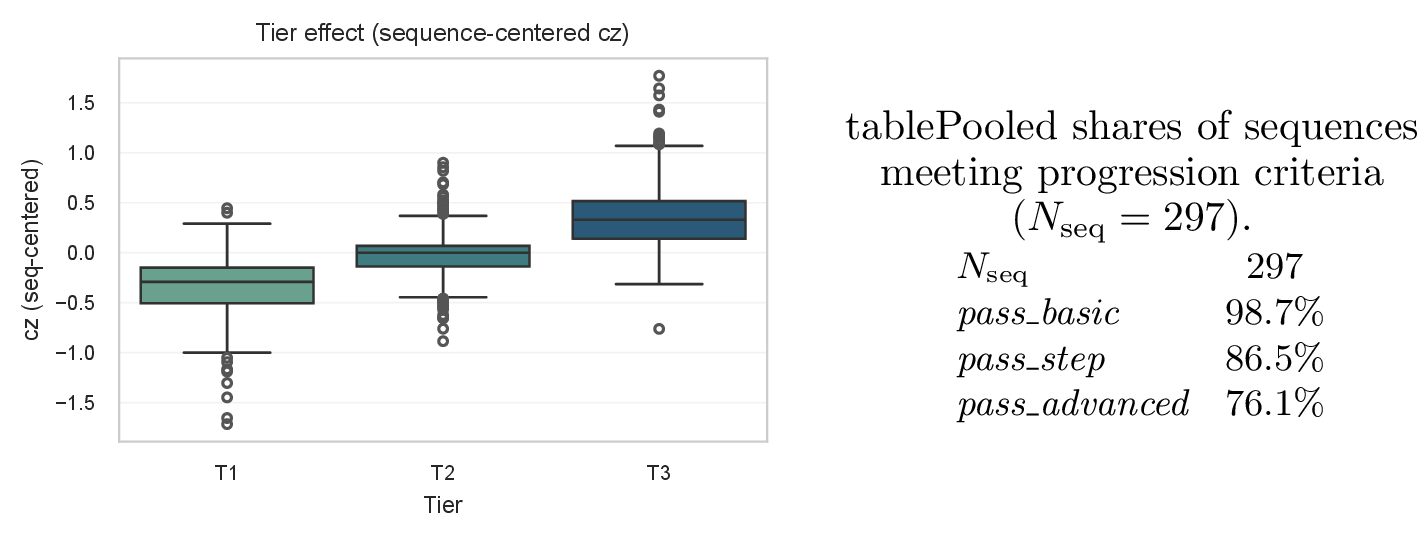
Using the pass indicators defined in [subsubsec:setup-rq1-measures], progression holds for a large majority of sequences. [tab:rq1-pass-global] summarises pooled shares across all analysed sequences (\(N_{\mathrm{seq}}=297\)). Nearly all sequences satisfy pass_basic (98.7%), indicating an overall increase from \(T1\) to \(T3\). A large share also meets pass_step (86.5%), meaning that at least one tier transition shows a substantial jump in complexity. Finally, 76.1% of sequences are strictly increasing across all tiers (pass_advanced). Among the remaining sequences that are not strictly increasing, most still increase overall but exhibit a local plateau or reversal in one step.
Across the nine paired mode contrasts (three \(\Delta cz\) metrics \(\times\) three mode pairs), we find no statistically detectable mode effect on progression deltas: all Wilcoxon signed-rank tests are non-significant after Holm correction (all \(p_{\mathrm{holm}}=1\); 1). Consistent with this, effect sizes are small: \(A_{\mathrm{paired}}\) values cluster near \(0.5\) and median paired differences are close to zero across contrasts. The largest deviation occurs for \(\Delta cz_{12}\) (meta vs.code; \(A_{\mathrm{paired}}=0.404\), median difference \(=-0.034\)), suggesting a slight tendency for code to yield larger first-step gains, but this pattern is not statistically significant. Overall, mode choice does not measurably affect the strength of tier-wise complexity progression.
| Metric | Comparison | \(A_{\mathrm{paired}}\) | \(\widetilde{\Delta}\) | \(V\) | \(p\) | \(p_{\mathrm{holm}}\) | |||||||||||||||||||||||||||||||||||||||||||||||||||||||||||||||||||||||||||||||||||||||||||
|---|---|---|---|---|---|---|---|---|---|---|---|---|---|---|---|---|---|---|---|---|---|---|---|---|---|---|---|---|---|---|---|---|---|---|---|---|---|---|---|---|---|---|---|---|---|---|---|---|---|---|---|---|---|---|---|---|---|---|---|---|---|---|---|---|---|---|---|---|---|---|---|---|---|---|---|---|---|---|---|---|---|---|---|---|---|---|---|---|---|---|---|---|---|---|---|---|---|
| \(\Delta cz_{13}\) | meta \(>\) full | 0.480 | 0.000 | 2139.0 | 0.724 | 1 | |||||||||||||||||||||||||||||||||||||||||||||||||||||||||||||||||||||||||||||||||||||||||||
| full \(>\) code | 0.485 | -0.011 | 2312.0 | 0.816 | 1 | ||||||||||||||||||||||||||||||||||||||||||||||||||||||||||||||||||||||||||||||||||||||||||||
| meta \(>\) code | 0.530 | 0.005 | 1966.5 | 0.316 | 1 | ||||||||||||||||||||||||||||||||||||||||||||||||||||||||||||||||||||||||||||||||||||||||||||
| \(\Delta cz_{12}\) | meta \(>\) full | 0.434 | -0.003 | 1702.5 | 0.371 | 1 | |||||||||||||||||||||||||||||||||||||||||||||||||||||||||||||||||||||||||||||||||||||||||||
| full \(>\) code | 0.455 | -0.007 | 2078.0 | 0.953 | 1 | ||||||||||||||||||||||||||||||||||||||||||||||||||||||||||||||||||||||||||||||||||||||||||||
| meta \(>\) code | 0.404 | -0.034 | 1832.0 | 0.302 | 1 | ||||||||||||||||||||||||||||||||||||||||||||||||||||||||||||||||||||||||||||||||||||||||||||
| \(\Delta cz_{23}\) | meta \(>\) full | 0.515 | 0.007 | 2132.0 | 0.379 | 1 | |||||||||||||||||||||||||||||||||||||||||||||||||||||||||||||||||||||||||||||||||||||||||||
| full \(>\) code | 0.500 | 0.000 | 2196.5 | 0.631 | 1 | ||||||||||||||||||||||||||||||||||||||||||||||||||||||||||||||||||||||||||||||||||||||||||||
| meta \(>\) code | 0.510 | 0.003 | 2137.5 | 0.307 | 1 |
4pt
Summary (RQ1) Composite complexity generally increases from \(T1\) to \(T3\), indicating that CodeOwl can induce tier-wise difficulty progression at scale. This progression holds for the vast majority of sequences, and input mode does not meaningfully change the strength of the progression.
5.2 RQ2: Problem Statement Quality↩︎


Overall, expert ratings indicate that the generated problem statements are clear and appropriate for the intended level, with redundancy present only in a subset of tasks. As shown by 3, clarity was rated very high across tasks (\(n=60\)), with a mean of \(\bar{x}=4.65\) (\(SD=0.66\)) and a median of \(5.0\) \([Q_1=4.75,\,Q_3=5.0]\). The bootstrap 95% confidence interval for the mean was \([4.48,\,4.82]\). Descriptively, clarity remained high across tiers and input modes.
Overall, 21.7% of tasks were flagged as redundant (cf.3). Redundancy typically reflected minor over-specification (e.g., explicitly naming variables or methods) and was rarely excessive. We observed no systematic relationship between redundancy and clarity. Inter-rater agreement was \(\kappa_w=0.66\) for clarity (quadratic-weighted) and \(\kappa=0.75\) for redundancy, corresponding to substantial agreement under common interpretation guidelines [39].
Summary (RQ2) Expert ratings indicate that generated problem statements are very clear and appropriate for the intended level. Redundancy appears only occasionally and is typically mild, and rater agreement suggests the quality assessment is robust.
5.3 RQ3: Teacher Perceptions↩︎
Overall, responses were consistently positive: all constructs were above the neutral midpoint (3 on the 5-point scale), and the separate overall usefulness item (10-point scale) was high, as shown in 4. PEOU and PU were highest (\(M=4.10\) and \(M=4.02\)), with PU showing the strongest consensus (\(SD=0.53\)). The domain-specific constructs were also clearly positive (UTD: \(M=3.89\), AIN: \(M=3.88\); both medians \(=4.00\)), while PER showed more dispersion (\(SD=0.84\), \(IQR=1.38\)), suggesting heterogeneous time-saving experiences. GEN had the highest mean among the 5-point items (\(M=4.15\)), indicating strong interest in transferring the differentiation approach beyond programming. Overall usefulness on the 10-point scale was high (\(M=7.77\), \(median=8.00\)). No systematic association emerged between prior AI/EdTech experience and overall usefulness.
Pairwise Kendall’s \(\tau_b\) correlations suggest that willingness to adopt is most closely linked to perceived pedagogical and practical value: Adoption Intention aligned most strongly with UTD (\(\tau_b \approx 0.60\)), PU (\(\tau_b \approx 0.55\)), and PER (\(\tau_b \approx 0.54\)). In contrast, PEOU was rated very highly but showed weaker associations with other constructs (e.g., \(\tau_b \approx 0.17\) with PER; \(\tau_b \approx 0.08\) with UTD), suggesting that ease of use was more of a baseline expectation than a key differentiator of overall judgments. Open-ended comments (\(n=21\)) corroborated the survey pattern: respondents frequently described CodeOwl as fitting typical lesson preparation workflows and enabling quick generation of tiered practice, while noting concrete improvement needs. The most common themes concerned UI/interaction details (especially drag-and-drop friction for longer tasks and clearer completion feedback), and teacher control and documentation (examples of good inputs, restricting constructs, limiting code length, and better curriculum alignment). Instructors perceived the core idea as valuable and transferable (GEN), while highlighting practical steps required for classroom-ready use.
Summary (RQ3) Teachers rated all constructs positively and considered CodeOwl useful. Willingness to adopt aligns most with perceived pedagogical/practical value and time-saving potential, while ease of use is a baseline expectation rather than a differentiator; comments emphasise smoother UI interaction and more teacher control and guidance.
5.4 RQ4: Student Perceptions and Behavioural Triangulation↩︎
Students (\(N=11\)) rated all constructs above the neutral midpoint. Statement Clarity was highest (\(M=4.55\), \(SD=0.63\)) and Self-efficacy was also high (\(M=4.41\), \(SD=0.62\)). Engagement and Perceived Scaffolding were positive but more heterogeneous (\(SD=0.96\) each). Workload (higher \(=\) lower effort) suggests manageable effort rather than overload (\(M=4.32\), \(SD=0.72\)) (cf. 5). Exploratory correlations (Kendall’s \(\tau_b\), computed on complete cases) suggest a coherent self-report pattern: clarity aligns with self-efficacy (\(\tau_b\approx 0.59\)) and self-efficacy aligns with lower workload (\(\tau_b\approx 0.57\)), consistent with the interpretation that clear statements support confidence and reduce perceived effort. Mean wrong-rates increase from Tier 1 to Tier 3 in the aggregate (cf. 6 (b)), consistent with a difficulty progression. However, within-sequence trajectories are heterogeneous: many sequences increase cleanly across tiers, while others are flatter or show local reversals (e.g., Tier 3 below Tier 2). 6 (a) relates task difficulty to observed performance: tasks with higher composite complexity \(cz\) tend to exhibit higher wrong-rates in the feedback logs. This association is substantial and consistent with \(cz\) capturing task difficulty (Spearman \(\rho=0.62,\, p=0.0013\); Kendall \(\tau=0.46,\, p=0.0020\); \(N=24\) tasks). At the same time, the task-level signal is noisy and varies across sequences; given (\(N=11\)) and non-student-indexed logs, we treat this triangulation as exploratory open-ended responses (\(n=11\)) corroborated the survey pattern. Students most often framed CodeOwl as useful for getting more practice and as a good fit for regular course routines (e.g., short warm-ups), while emphasising that reuse depends on trusting snippet correctness. The most common usability request concerned trackpad friction: students found drag-and-drop effortful and asked for click-based placement. A smaller but notable theme concerned strict evaluation: students reported rejection of valid alternative orderings, as the interface checks only one reference solution.


Figure 6: Task error patterns in the feedback logs..
Summary (RQ4) Students reported high clarity, supportive tiering, and strong self-efficacy with manageable workload. Click-level logs point to increasing difficulty across tiers and higher error rates for structurally more complex tasks, while open-ended feedback highlights drag-and-drop friction and overly strict checking of alternative correct solutions.
6 Conclusions↩︎
In this paper we presented CodeOwl, a tool to automatically create Parsons problems in three tiers of increasing difficulty. CodeOwl is built to deal with the challenging heterogeneity in computer science classrooms. While internal differentiation addresses it effectively, it is time-consuming, requiring additional lesson planning and material creation. CodeOwl can help to ease these efforts for educators by automatically creating multiple Parsons problems differentiated by complexity from a sample task or other parameters like programming concepts and targeted programming language, utilising the capabilities of LLMs. Furthermore, student solutions for the created Parsons problems can be automatically checked by CodeOwl, enabling immediate feedback.
Our study using 297 tiered sequences showed that \(98.7\%\) of sequences achieved a positive complexity increase. Expert ratings of 60 generated problem statements indicate high clarity and appropriateness for programming beginners. A survey of 28 teachers praised the tool’s time-saving potential and pedagogical value. Similarly, a study with 11 first-semester CS students reported a positive experience highlighting supportive tiering and positive effects on self-efficacy.
Notably, as such a generator becomes better, repeated use becomes less necessary. CodeOwl therefore stores each sequence with metadata, forming a reusable, queryable task library.
Future work includes: (i) adding keyboard and click-based input, (ii) generating full worksheets from richer input, (iii) integrating learning analytics, (iv) offering finer teacher controls (e.g., construct limits, code length, post-editing), and (v) enabling shared, curated task libraries.
To help the improvement of LLM-generated tiered Parsons problems and fully use its positive capabilities, a hosted version of CodeOwl can be found at https://scratch.fim.uni-passau.de/codeowl/ and the project itself is publicly available at https://github.com/se2p/codeowl.
6.0.1 ↩︎
This work was funded by INTERREG-Programm Bayern–Österreich 2021–2027 BA0100019-Grenzüberschreitender InnRaum³.
6.0.2 ↩︎
The authors have no competing interests to declare that are relevant to the content of this article.