Towards Knitted Textile Electromechanical Systems
July 14, 2026
Abstract
E-textiles and wearable sensing technologies enable flexible, customizable interfaces for human-computer interaction, with capacitive sensing offering precise touch and pressure detection. While machine knitting provides scalable, mechanically tunable structures ideal for such sensors, few studies develop or characterize insulated conductive yarns engineered for knitting’s complex structural geometry and high flexure strain. In this work, we present a yarn dip-coating process, driven by an adjusted dip-coating fluid dynamics model, that enables scalable, machine knittable fabrication of capacitive tactile pressure sensing arrays. We establish optimal dip-coating parameters and concentrations of thermoplastic polyurethane (TPU) dissolved in dimethylformamide (DMF) to create knitting-optimized coatings (~630\(\mu m\) thickness). These fabricated yarns are shown to maintain electromechanical characteristics with minimal deviation after knitting and washing, thus allowing the creation of knitted pressure sensors through multi-layered structures. This process demonstrates that machine knitting with insulated yarns is a viable and reliable manufacturing approach to integrate sensing functionality into wearable textiles.

1 Introduction↩︎
With rapid advances in e-textiles and wearable sensing, knitting has emerged as a fabrication method that enables mechanically dynamic fabrics and scalable, programmable garment production [1], [2]. Its stretchability and shape-conforming behavior make it ideal for wearable interfaces (Figure 1.A.) in human computer interactions, health monitoring, and robotic tactile sensing[3]–[6]. However, compared to simple techniques like weaving, knitting geometries are more complex and subject yarns to more strain and bending. Many works avoid this barrier by isolating textile designs to weaving braiding, or yarn-inlaying [7], [8], although this limits the mechanical behaviors of the fabrics. Existing knitted functionalized yarns exist [9]–[11], but their long-term mechanical stability and sensing performance remain largely unquantified [12]. In addition, there is a gap in functionalized yarns engineered specifically for machine knitting. This motivates the need to create insulated, functionalized yarns that can specifically support being machine-knitted while maintaining and characterizing electromechanical properties for sensing applications.
In this work, a simple and accessible yarn fabrication technique is introduced whereby 2-ply Shieldex 235/36 count silver-plated nylon conductive yarns are coated with thermopolyurethane(TPU) insulation through a dipcoating process. A base fluid dynamics framework guided the initial dipcoating parameters towards optimal coating conditions that minimize yarn stiffness while maintaining electrical integrity.
Electromechanical properties of dipcoated yarns are characterized against commercially available 2-ply Shieldex 235/36 TPU-coated that was experimentally determined to be unknittable. Our yarns show comparable electrical insulation that supports e-textile function and superior mechanical properties that render them machine knittable. We additionally show that machine knitting has negligible effects on the electromechanical properties.
Lastly, preliminary knitted applications are created with the Kniterate (Figure 1.E.) flatbed knitting machine and demonstrate capacitive pressure sensing capabilities. We discuss future application directions that include Triboelectric Nanogenerator (TENG) tactile sensing and more complex, plated knit geometries.
2 Fabrication Process: Dip-Coating↩︎
Conductive yarns were prepared by first aligning and tensioning the fibers to ensure uniform wetting and minimize geometric variability along the filament length (Figure 1.B.). Dip-coating was performed using a controlled-withdrawal apparatus designed to maintain constant speed of 2.5 mm/s and straight vertical withdrawal angle throughout the coating process (Figure 1.C.). The solution weight was systematically varied to identify conditions that produced continuous, defect-free TPU insulation layers with suitable thickness for machine knitting.
To rationalize the influence of solution formulation on coating behavior, we characterized the surface tension and viscosity of TPU/DMF mixtures across the concentration range 10% to 12.5%. Surface tension was measured using a pendant-drop method [13], and viscosity was obtained via rotational rheometry. These properties directly govern film entrainment during withdrawal and therefore serve as the physical basis for predicting coating thickness by the Landau Levich Thin-Fiber model [14]:
\[\delta = 1.34\, (\mathrm{\frac{\eta U}{\gamma}})^{2/3} R\label{eq:delta}\tag{1}\]
where \(\delta\) is the thickness of the fluid film deposited (\(m\)), \(\gamma\) is surface tension, \(R\) is the fiber radius (\(m)\), \(U\) is withdrawal speed (\(m/s\)), and \(\eta\) is the solution viscosity. It is recognized that additional models or modifications to the LLD equation are necessary future works to account for the deviations of complex wound fiber geometries, non-Newtonian solution behavior [15], and non-negligible thickness to yarn radius ratio.

Theoretical predictions are evaluated against experimental measurements to identify an optimal 12.5% TPU-weighted DMF formulation with a viscosity of 2.6x\(10^3 mPa\cdot s\) and surface tension of 34.76 \(\frac{mN}{m}\), achieving coated yarns with a diameter of \(\sim630 \mu\mathrm{m}\) (Figure 1.D.). The custom coated yarns were assessed through scanning electron microscopy to verify uniformity compared to commercially coated yarns (Figure 2). By addressing challenges in drying efficiency, morphological consistency, and thickness control, this work provides a reproducible processing pathway to produce high-quality insulated threads suitable for advanced textile integration.
3 Electromechanical Characteristics↩︎
We demonstrate that our TPU coating achieves commercial-level insulation properties while exhibiting more flexibility and knittability than commercially available options.
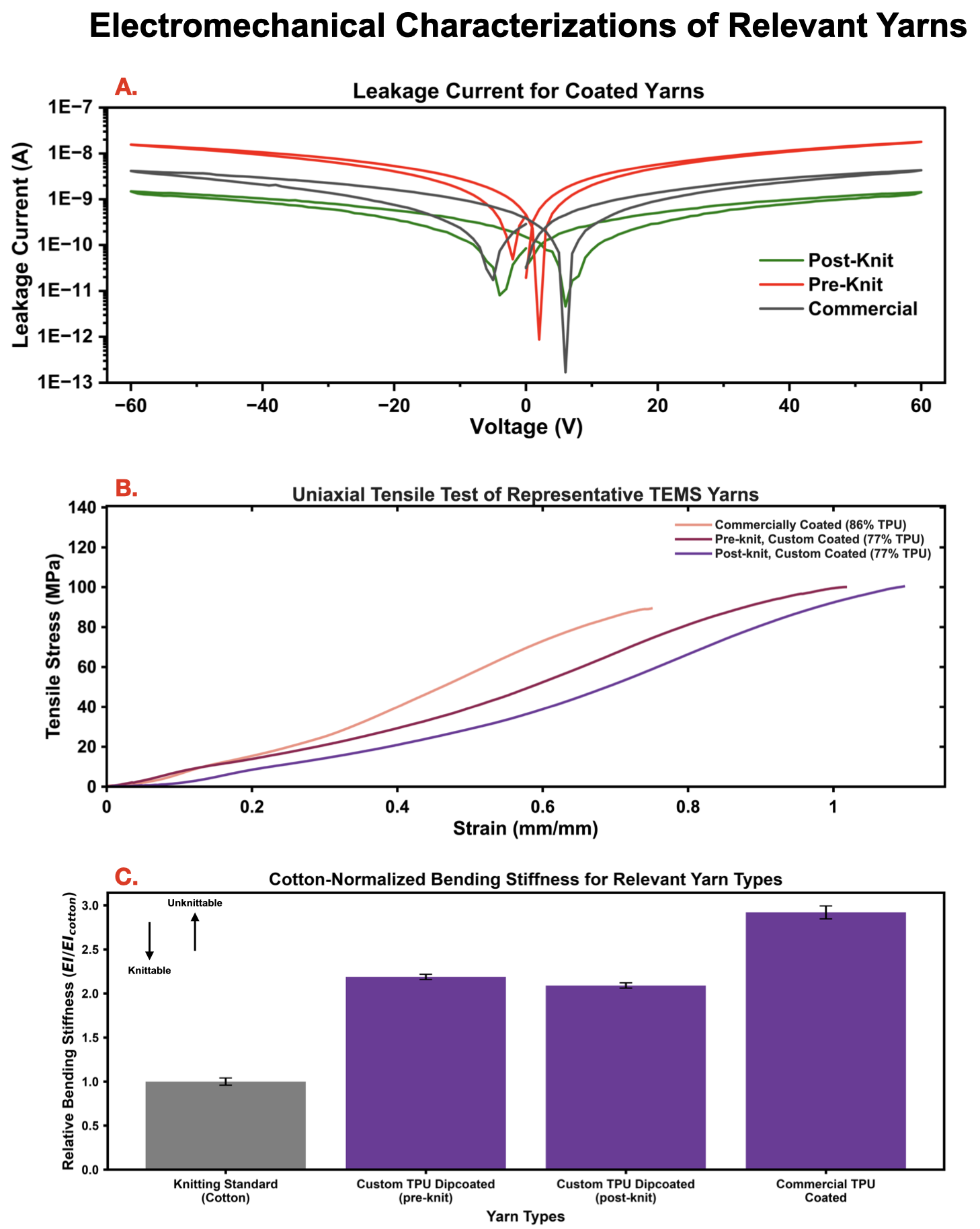
Electrical leakage current tests were performed to evaluate insulation properties of TPU coating by measuring any currents leaking through insulation voltage between the conductive core and insulation outer surface was swept between -60 to +60 volts. Results are show in Figure 3.A. and show maximum leakage currents of our dipcoated yarns to be within \(<10\) \(nA\) of commercial coated yarns and showed a downward jump between pre and post knitted samples. We believe the decrease in leakage current for post-knit dipcoated yarns to be due to slightly uneven coating thicknesses across the measured samples. Additional testing is underway to more fully validate these findings.
Tensile strength and bending stiffness of yarns were measured through uniaxial tensile testing and the hanging pear loop test [16], [17] respectively. Our yarns, handling more strain and a higher breaking force, were >20% more elastic than commercial coated yarns and found to become more elastic after knitting as shown in Figure 3.B. Post-knit yarns, while breaking at similar forces as pre-knit yarns, experienced more strain as the machine knitting process subjected them to bending and stretching that softened the TPU coating prior to tensile tests. Bending stiffness measurements were normalized against a standard, 10/2 count cotton yarn baseline. Results are displayed in Figure 3.C. and show a bending stiffness of 2.18 and 2.91 times that of cotton for our dipcoated yarn and commercial coated yarns respectively. Again, there was negligible, downward stiffness change for measured post-knit samples from warping experienced during machine-knitting. Knittability arrows in the top left corner indicate that the bending stiffness of custom dipcoated yarns are within the knittable range for stiffness, while commercial coated yarns are unknittable at their stiffness. Future work is aimed at better uncovering a more defined knittability range for bending stiffness.
4 Current Applications↩︎
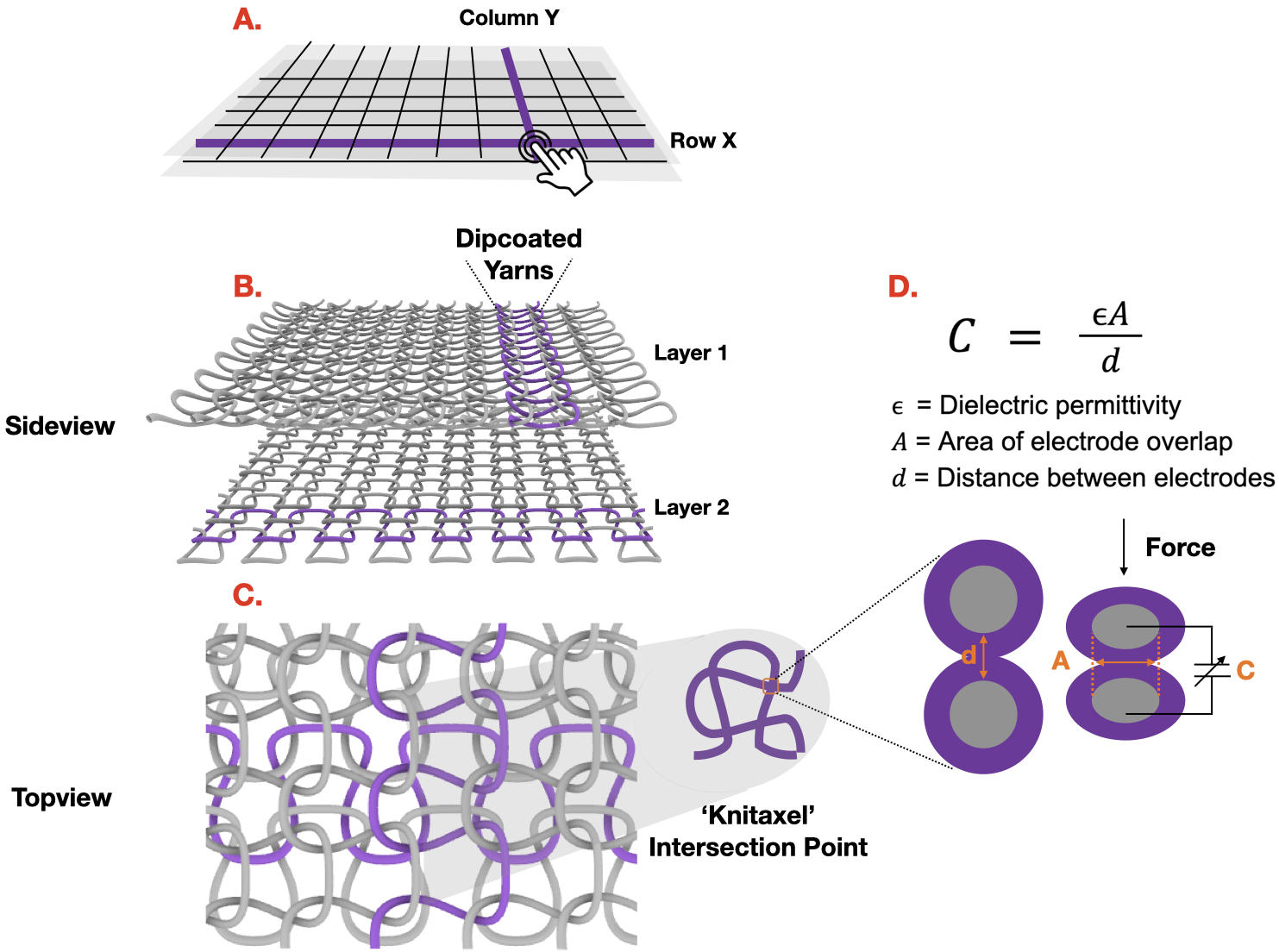
To evaluate the use of custom dip-coated yarns in knitted sensors and validate electromechanical performance, two patches were knitted that each contained 8 rows of dipcoated yarns and layered perpendicularly to create a grid of intersecting, capacitive sensing points. A breakdown of how these capacitive force sensors work is outlined in Figure 4. Fundamentally, capacitive-based force mapping sensors can be made using perpendicularly intersecting rows and columns of conductive electrodes separated by a dielectric material at each intersection point (shown in Figure 4.A.). A computing unit scans through each combination of row and column, measuring the capacitance between the chosen row and column. Pressure location is determined by identifying the row-column intersection from which a touch-induced capacitance change is recorded over time. By extending this 2-layer row-column structure to knitted structures (Figure 2.B.), we are able to knit our dipcoated yarns into 2 patches that overlay and create a grid of intersecting "knitaxel" points (Figure 2.C.). A relationship between force and capacitance can be determined since force at each knitaxel point causes deformation between yarn intersections. This produces measurable capacitance changes that follow the parallel plate capacitance equation outlined in Figure 2.D.
Currently, we are still fully characterizing the sensing capabilities of the 8 row x 8 column 2-layer knit force prototype (shown in figure 1.F.). This sensor, using 2 layers knit with the jersey stitch pattern, achieves a knitaxel density of 50 knitaxels/\(cm^2\).
As a preliminary characterization of sensor stability, we measure capacitive change between the central 4 row x 4 column knitaxels for cyclical forces between 1N-10N. This test shows a stable capacitive response for each repeated instance of each force amount. To further test washability of our sensor, we repeat capacitance measurements and cyclical force tests between 5 sets of machine washing the sensors. Overall, more tests are needed to clearly define a relationship between capacitance and force, however our preliminary results show promising stability between both repeated forces and washing cycles, indicating good structural integrity of yarns and minimal loss in pressure sensitivity between washes.
5 Discussion and Future Works↩︎
Future work will expand the interactive capabilities enabled by our functional knitted textiles. First, higher-density coated yarns can support expressive wearable interfaces, enabling gesture recognition, soft input surfaces, and more natural embodied interaction. Extending the dip-coating process to additional conductive and dielectric materials may unlock new sensing modalities for passive, non-invasive monitoring in health, athletics, and everyday activity. For example, by pairing conductive cores with coatings engineered for strong thermoelectric or triboelectric responses, thermoelectric generators (TEGs) and triboelectric nanogenerators (TENGs) can be incorporated into knitted structures that harvest ambient energy to power low‑energy sensing, communication, or hybrid TENG–capacitive systems [18]. These energy‑aware systems move e‑textiles toward self‑powered, battery‑free platforms for long‑term wearable computing.
Finally, improving manufacturing uniformity and scalability will enrich spatial resolution, supporting interfaces that enhance robotic tactile perception and reduce reliance on vision-only pipelines. The reliability of dip-coating uniformity and knitting’s scalability is essential for seamlessly integrating dense, durable sensing arrays within garments. Together, these directions position knitted sensing textiles as a promising platform for human-computer interaction and enable soft, continuous, and responsive interfaces to be integrated directly into the fabrics people wear and touch everyday.