A Behavioral State Vocabulary in Sony ERS-111 R-CODE
July 13, 2026
Abstract
This paper presents a corpus-level analysis of generated behavior diagrams derived from Sony’s R-CODE sample distribution for the ERS-111 AIBO. Rather than reading each script in isolation, the study compares named
states across the corpus to identify the recurring control vocabulary that structures the sample set. The resulting aggregate shows that many superficially different routines are built from a compact embodied grammar centered on initialization, sensing,
iterative action, synchronization, and recovery. In addition to historical analysis, the paper argues that this form of state-based abstraction is useful as an intermediate representation for constructing new encapsulated behavior routines, especially on
constrained native robotic systems where deterministic control, direct hardware access, and modular behavioral composition remain important.
Introduction↩︎
This paper examines the generated ERS-111 R-CODE behavior diagrams as a single behavioral corpus rather than as an assortment of independent scripts. Its objective is to identify the common control vocabulary that structures
the sample set, distinguishing recurring foundational states from those that appear only within more specialized variants.
This framing is useful in part because many contemporary robotics systems still exhibit a persistent imbalance between deliberation and embodiment. They may perform well in perception benchmarks, scripted manipulation pipelines, or high-level planning
tasks, yet remain comparatively weak in the continuous background competencies that allow an animal or human to remain viable in the world while doing something else. As a heuristic analogy, one may think here of a layered System 1 and
System 2 organization: fast, low-latency, embodied monitoring and response on one side, and slower, more reflective or task-selective decision processes on the other. In the psychological literature, these terms generally distinguish rapid,
automatic, and largely background cognition from slower, more deliberative reasoning (Kahneman, 2011). Many current robot architectures are still stronger on the deliberative side than on the deep integration of these everyday embodied loops. The
value of the R-CODE corpus, therefore, is not that it solves that modern problem in full, but that it gives a compact historical example of behavior being organized around persistent bodily monitoring, recovery, local branching, and
return-to-loop coordination rather than around isolated commands alone (Xu et al., 2024; Kawaharazuka et al., 2024).
The paper makes three main contributions. First, it provides a corpus aggregate over the currently generated ERS-111 diagrams and identifies the most common state titles and their frequencies. Second, it uses that aggregate to argue that
the corpus is organized around a compact, reactive, embodied state vocabulary rather than around unrelated one-off routines. Third, it treats that abstraction not only as an analytic device for legacy code, but also as a practical design representation for
constructing new behavior routines on native robotic systems (Brooks, 1991; Arkin, 1998).
Method and Corpus↩︎
These totals provide the first numerical outline of the corpus. Their value is not solely descriptive. They help determine whether the sample set is broad but structurally diffuse, or whether many distinct scripts are constructed from a comparatively compact set of recurring state forms. In this respect, the totals establish a baseline for assessing how much behavioral variation is produced from how little underlying control vocabulary.
The following corpus totals are included as a compact numerical reference point for the discussion that follows. They identify the size of the diagram set, the total number of state occurrences observed across it, and the number of distinct state titles from which that behavioral variation is constructed.
The method used here is deliberately simple and explicit. Behavior diagrams were generated from the ERS-111 sample corpus, state titles were normalized where placeholder labels still obscured their functional role, and the resulting state
names were then counted across the generated set. The aim is not to claim that the titles alone exhaust the semantics of the original code, but to show that the state layer is already rich enough to expose a stable behavioral grammar at corpus scale.
diagrams counted:
54total state instances:
292unique state titles:
47
The state-title aggregate makes it possible to treat the Sony ERS-111 R-CODE samples as a behavioral corpus rather than as an assortment of independent scripts. The most immediate result is the repeated reuse of a small control
vocabulary. The most common titles, especially Sense / Decide, Action Loop, Boot / Safe Pose, Synchronize, Boot, Sense Fall State, and Recover, indicate that the
dominant form in the corpus is not an extended linear routine. Instead, it is a recurrent embodied loop in which the robot establishes a viable posture, samples some portion of its body or local environment, selects an action, allows that action to settle,
and then returns to monitoring.
This finding is significant because it indicates that the surface diversity of the scripts exceeds their structural diversity. A football behavior, an obstacle routine, a contact-response behavior, and a locomotion loop may differ in immediate purpose,
yet the aggregate shows that they are often composed from the same recurring internal elements. The corpus is therefore not simply a set of demonstrations of what AIBO can do; it is also evidence of how Sony’s R-CODE sample distribution
organized behavior. The repetition of these core titles suggests a practical design grammar in which behavior is assembled through recombination of a small number of stable state-types.
The highest-frequency title, Sense / Decide, is particularly important. Its prominence suggests that much of the corpus is organized around conditional interpretation rather than predetermined motion playback alone. The scripts repeatedly
evaluate the present situation and determine which state should follow. This places the sample set closer to reactive robotics than to simple animation. When considered alongside the strong presence of Action Loop and Synchronize,
it points to a common sequence: evaluate, act, wait for bodily completion, and reevaluate. This is a compact yet robust pattern for embodied behavior (Brooks, 1991; Arkin, 1998).
The frequent appearance of Boot and Boot / Safe Pose is likewise meaningful. These states show that initialization is not treated as an incidental preface but as part of the logic of behavior itself. The robot is repeatedly
brought into a known physical and control condition before more specific behavior begins. Even these relatively early or simple scripts therefore assume that behavior depends on a stable bodily baseline. In robotics terms, the robot’s initial pose and
internal setup form part of the control architecture rather than a mere setup convenience.
The recurring appearance of Sense Fall State and Recover is among the most revealing findings. It indicates that bodily failure is not peripheral within the corpus. The robot’s viability as a moving body is part of the logic
that organizes behavior. The code does not merely issue movements and assume continued stability; it repeatedly checks whether posture has degraded and routes control through recovery when necessary. This reflects a strongly embodied orientation in the
sample set. The robot is managing itself as a physical agent in the world, not merely executing isolated commands.
The lower-frequency state titles are equally informative because they show where specialization enters the corpus. Titles such as Left Kick, Right Kick, Start Ball Tracking, and
It approaches a ball by the angle of the head belong to narrower families such as Football and related variants. Their lower counts indicate that these states do not belong to the corpus-wide backbone. Instead, they function as
family-specific elaborations layered onto the more common loop of sensing, action, synchronization, and recovery. This distinction helps separate general architecture from task-specific extension.
The same holds for titles such as Happy Hug Response, Idle Thought, Baby Sway Forward, Select First Average, and Reset Sample Count. These are analytically useful because they show how the
shared control vocabulary is directed toward different ends: social contact, expressive motion, temporary local computation, and directional averaging, among others. Their rarity, however, indicates that they are local elaborations rather than dominant
organizational principles. In aggregate, the sample set is therefore less a collection of unrelated unique behaviors than a set of behaviors constructed from a relatively compact repertoire of reusable state-forms.
The elimination of placeholder titles was analytically important. Names such as State 200, State 1011, State 1110, and State 1200 obscured the functional meaning the aggregate was meant to recover.
These were temporary labels introduced during extraction when numeric state identifiers from the source scripts had not yet been resolved into functional names. Renaming them as Quit Behavior, Reset Sample Count,
Select First Average, and Reset Scan Counter made those states legible as behavioral units rather than residual labels from the original scripts. Once the placeholders were removed, the count no longer mixed structural meaning
with accidental naming residue. The aggregate therefore became not merely a quantitative list, but a more reliable semantic map of the corpus.
Taken together, the aggregate supports a clear interpretation: the ERS-111 R-CODE samples are organized around a compact embodied state vocabulary that is repeatedly recombined across different behavior families. The counts
show that the common foundation is reactive and bodily grounded, while the rarer states indicate where the families diverge into specialized task or expressive behavior. This provides a clearer basis for discussing the material in both historical and
technical terms. Historically, it suggests that Sony’s samples already embodied a recognizable control grammar. Technically, it indicates that many apparently distinct behaviors can be understood as variations on a shared loop of setup, sensing, decision,
action, stabilization, and recovery.
The aggregate also carries broader significance for robotics. State titles and transitions are not useful only for analyzing legacy AIBO scripts; they express a more general principle of robot control. Advanced systems likewise distinguish among modes
such as searching, tracking, avoiding, recovering, and interacting. What changes over time is the richness of those states, the sophistication of their triggers, and the layering of control above and below them. In this respect, the ERS-111
sample corpus offers a small but concrete example of how complex robotic behavior can emerge through repeated reuse of a compact state-transition architecture (Brooks, 1991; Arkin, 1998).
The tables below make that distinction easier to see directly. The first table captures the high-frequency state titles that form the recurring structural backbone of the corpus. The second table gathers the lower-frequency titles that appear more locally, often within narrower behavior families or single specialized variants.
Most Common State Titles↩︎
| Count | State Title |
|---|---|
| Sense / Decide | |
| Action Loop | |
| Boot / Safe Pose | |
| Synchronize | |
| Boot | |
| Sense Fall State | |
| Recover | |
| Head Scan Position | |
| Repeat Forward Walk | |
| Left Kick | |
| Right Kick | |
| It approaches a ball by the angle of the head |
These more common titles provide the clearest expression of the shared behavioral grammar that runs through the sample set. They show where Sony’s examples repeatedly return to the same embodied control concerns: establishing posture, assessing conditions, selecting actions, waiting for movement to settle, and recovering when the body is no longer in a viable state.
Secondary State Titles↩︎
| Count | State Title |
|---|---|
| Quit Behavior | |
| Start Ball Tracking | |
| Mode | |
| Slow Forward Walk | |
| Main | |
| Increment Lost Counter | |
| Reset Lost Counter | |
| Set Search Mode | |
| Turn Left | |
| Shift Left | |
| Advance Left | |
| Search Turn | |
| Shift Right | |
| Advance Right | |
| Forward Walk | |
| Happy Hug Response | |
| It sleeps until it is set up | |
| Idle Thought | |
| Baby Sway Forward | |
| Baby Sway Backward | |
| When there was an obstacle in front | |
| Reset Sample Count | |
| When Distance became less than 300 | |
| At the time of loop_cnt=1 | |
| At the time of loop_cnt=2 | |
| Wait loop end | |
| Select First Average | |
| Reset Scan Counter | |
| Start | |
| Load Stored Poses | |
| Save Current Poses | |
| Resume Listener | |
| MainLoop | |
| Clear Light Playback | |
| Power Down |
Taken together, the secondary titles show where the common architecture branches into more specific local roles. They capture narrower aspects of the corpus: expressive reactions, temporary counters, intermediate scan steps, branch-specific motor decisions, and other states that are important within individual families without dominating the corpus as a whole.
Representative Behavior Diagrams↩︎
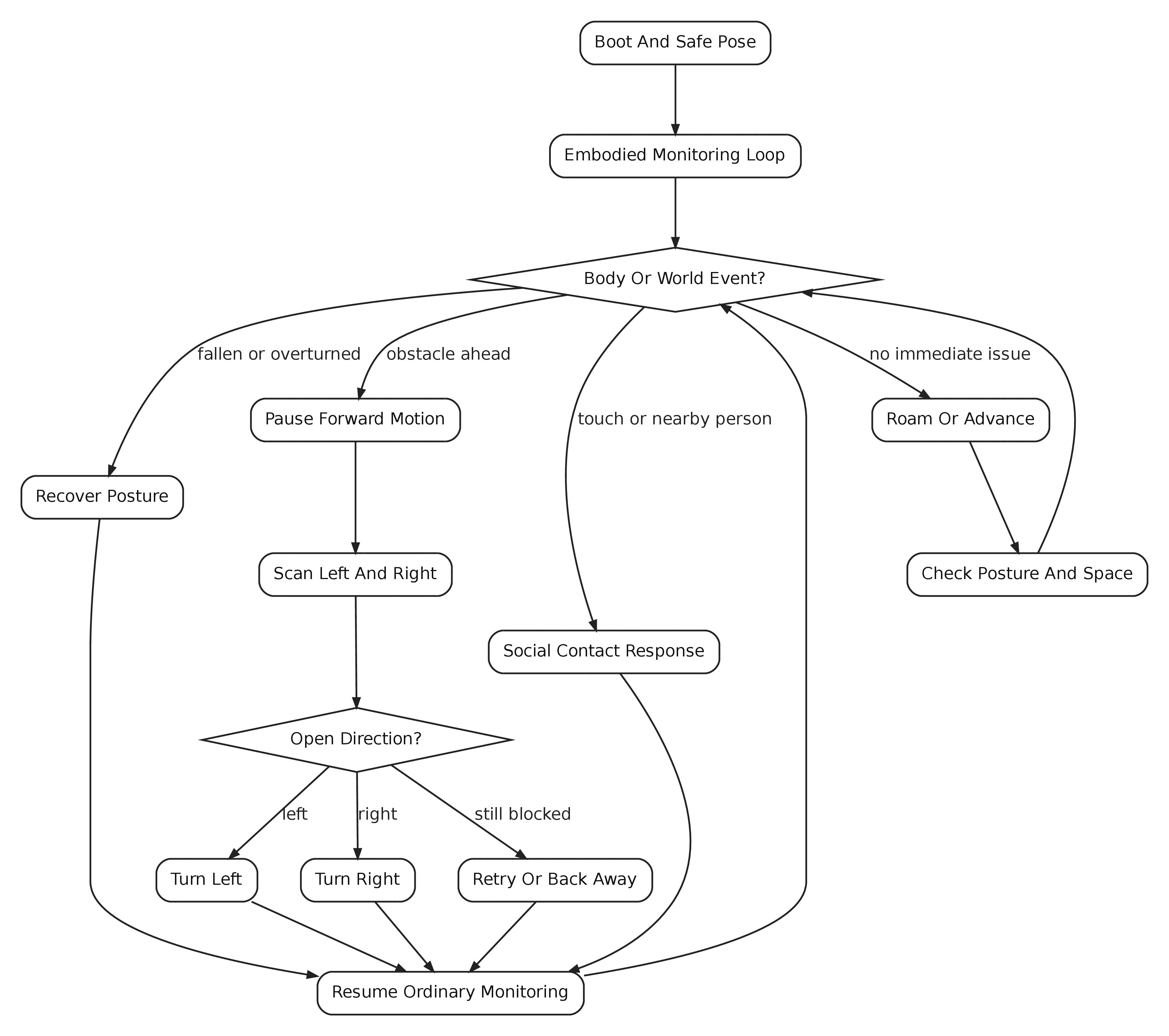
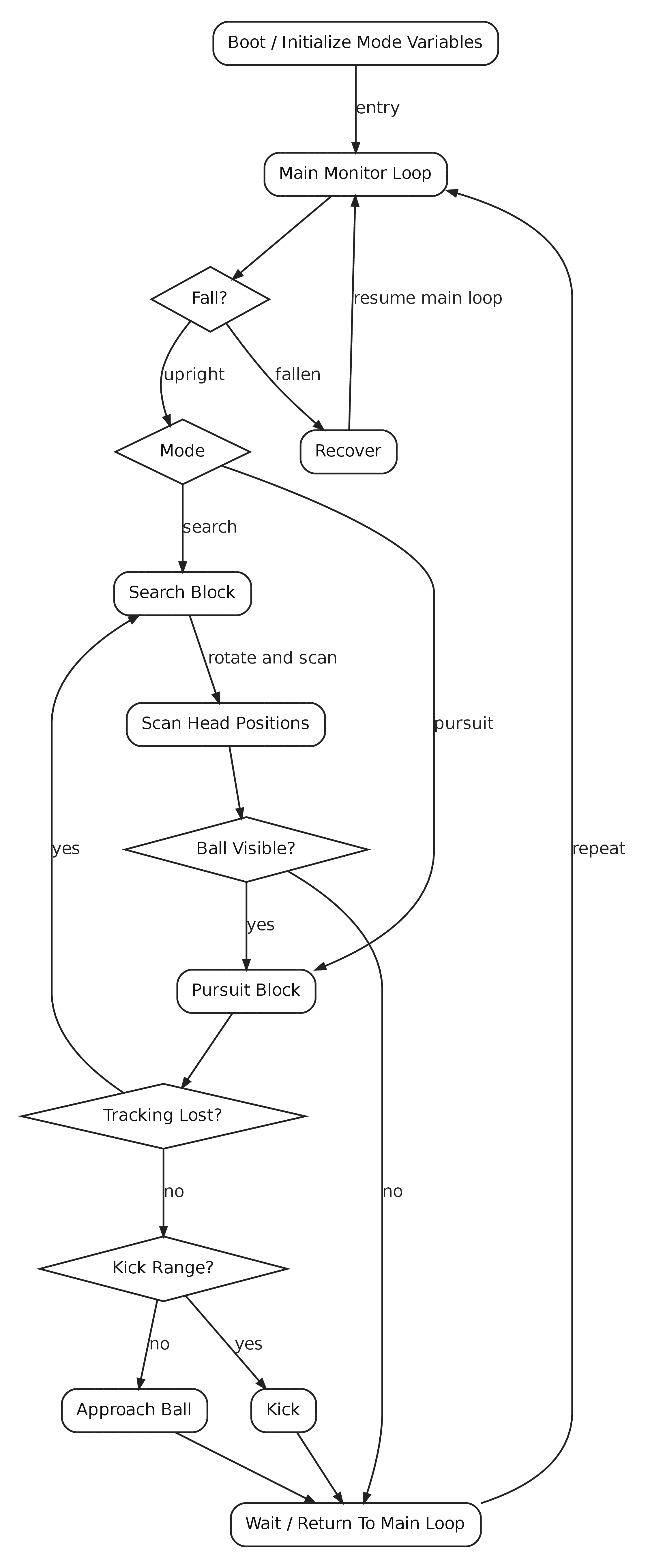
This section presents three representative behavior diagrams selected to support the central claims of the note. Considered together, they show the relationship between corpus-level structure, baseline locomotor control, and specialized task extension. The first figure corresponds to the aggregate argument by presenting a generalized view of the recurrent state vocabulary identified across the corpus. The second corresponds to the claim that many behaviors are organized as compact reactive loops grounded in bodily monitoring. The third corresponds to the claim that more specialized routines are constructed by extending that same control foundation rather than replacing it.

Aggregate Purpose↩︎
This aggregate is intended to show which control structures are broadly shared across the ERS-111 R-CODE set and which belong only to narrower behavior families. The counts are analytically useful not because they rank scripts
by popularity, but because they reveal the shared behavioral grammar of the corpus: the points at which the code repeatedly returns to sensing, looping, synchronization, and recovery before adding more specialized states for pursuit, contact response, or
expressive variation.
This analysis is relevant beyond AIBO, because the same pattern appears in many embodied robotic systems: a stable loop of sensing, deciding, acting, and rechecking the body and local environment before continuing. Viewed in this way, the
ERS-111 samples are not only historically interesting artifacts. They also provide an early small-scale example of how robotics often develops in practice, by building richer task-specific states on top of a compact base of posture control,
environmental monitoring, transition handling, and recovery (Xu et al., 2024; Kawaharazuka et al., 2024).
The principal result is not simply that one state title appears more often than another. The stronger result is that the diagram set repeatedly converges on the same architectural pattern:
initialize -> sense -> decide -> act -> synchronize -> repeat
This indicates that the preserved ERS-111 samples already express a recognizable embodied control style. Even when the surface behaviors appear different, the underlying workflow is usually a compact reactive cycle rather than a one-shot
animation or an extended scripted narrative.
A second important result is that bodily maintenance appears within the recurring structure itself. The regular presence of Sense Fall State and Recover shows that the robot’s posture and stability are treated as part of
behavior control rather than as external exceptions. In analytical terms, the corpus concerns not only the issuance of motion, but the maintenance of viable motion in the body.
A third result is that the more specialized behaviors remain legible because they are layered on top of that common base. Pursuit and kick states in the Football family, for example, do not replace the core reactive loop; they extend it.
Complexity in the sample set tends to accumulate by adding narrower decision and action states to an already stable embodied architecture.
Taken together, these findings clarify the central purpose of this paper. The R-CODE sample set can be read as an early behavioral design vocabulary in which a limited number of state-types are repeatedly recombined to produce locomotion,
orientation, contact response, recovery, and more specialized goal-directed action. The importance of the aggregate, therefore, lies not simply in documenting individual scripts, but in revealing the shared organizational logic that makes those scripts
analytically comparable. What may initially appear to be a heterogeneous collection of sample behaviors instead emerges as a coherent control corpus whose recurring state structures offer a foundation for historical interpretation, comparative analysis,
and broader discussion of embodied robot behavior.
This approach is also constructive rather than merely descriptive. Once the common structure of a behavior corpus has been made explicit, those states can be treated as reusable design units for new robotic systems. Instead of writing a new routine as a monolithic block of control code, one can begin from a small library of encapsulated behavioral forms: initialize posture, sense local conditions, branch by event, execute a bounded action, verify bodily state, and return to a monitoring loop. The diagrams therefore function not only as retrospective analysis, but as a practical intermediate representation for synthesis. They help make clear which elements should remain stable across platforms and which may be replaced to accommodate different sensors, actuators, timing models, or task domains (Arkin, 1998).
That design value becomes especially important in native-hardware robotics developed in a polyForth style. In such environments, behavior is often assembled from compact words, explicit stacks, direct device access, and tightly bounded control loops rather than from large framework abstractions. A state-based representation is well matched to that discipline because each state can be implemented as a small, testable routine with clear entry conditions, side effects, and exit transitions. The transition structure then serves as the behavioral scheduler. This makes it easier to preserve determinism, reason about timing, and isolate hardware-specific code inside a limited number of sensing and actuation words while leaving the higher-level behavioral organization intact.
For newer classes of robot systems, this means the method supports both portability and invention. A locomotion platform, a manipulator, or a socially interactive robot may differ greatly in embodiment, but each still benefits from an architecture that separates posture management, environmental interpretation, action execution, exception handling, and return-to-loop coordination. By treating those elements as explicit behavioral compartments, developers can introduce characteristic new routines without losing architectural clarity. In practical terms, one can retain the same behavioral skeleton while substituting new state contents for vision, force sensing, gait control, manipulation, dialogue, or safety recovery. The result is a disciplined path for building novel robot behavior on constrained native systems without collapsing all control logic into a single opaque procedure.
Conclusion↩︎
States and transitions are significant because they provide a robot with a means of organizing time, context, and response rather than reacting through a flat sequence of commands. A state indicates the mode in which the robot is currently operating, and a transition indicates the condition sufficient to move it into another mode. This structure becomes a foundation for more advanced robotics because sensing, motion, recovery, and task logic can remain coordinated rather than collapsing into an undifferentiated control stream.
This framework also helps explain how richer behavior and even personality constructs can emerge from the same underlying machinery. A robot that remains longer in interaction states, abandons pursuit more slowly, or returns more readily to contact-response states will appear different in temperament even if its hardware is unchanged. In this sense, personality is often expressed not as a separate layer, but as a structured pattern of preferred states, biased transitions, distinct thresholds, and differing persistence times imposed upon the same embodied control architecture.
References↩︎
Arkin, Ronald C. Behavior-Based Robotics. MIT Press, 1998.
Brooks, Rodney A. “Intelligence without Representation.” Artificial Intelligence 47, no. 1-3 (1991): 139-159.
Kahneman, Daniel. Thinking, Fast and Slow. Farrar, Straus and Giroux, 2011.
Kawaharazuka, Kento, Tatsuya Matsushima, Andrew Gambardella, Jiaxian Guo, Chris Paxton, and Andy Zeng. “Real-World Robot Applications of Foundation Models: A Review.” arXiv, 2024. https://arxiv.org/abs/2402.05741
Xu, Zhiyuan, Kun Wu, Junjie Wen, Jinming Li, Ning Liu, Zhengping Che, and Jian Tang. “A Survey on Robotics with Foundation Models: toward Embodied AI.” arXiv, 2024. https://arxiv.org/abs/2402.02385