Graph Feedback Controls Consensus and Clique Formation in Open-Weight Language-Model Populations
July 13, 2026
Abstract
Multi-agent language-model systems increasingly route local interactions, yet the runtime interaction graph is often treated as an implementation detail. We study convention formation in open-weight LM populations spanning 1.1B–32B parameters with a naming-game protocol. Restricted first-token scores over tokenizer-safe labels let us measure prompt-conditioned score-state distributions, construct state-similarity graphs, and separate sampled-label agreement from latent state-space consensus. Across controlled interventions, in the main open-weight repair grids, retained partner-label evidence is necessary but not sufficient: homophilous threshold-similarity routing deletes cross-basin exposure and amplifies fragmentation, while bridge-seeking routing often repairs fragmentation when memory is available. In a three-seed mixed four-model grid, threshold-similarity produces no final behavioral or state consensus in 189 setting-seed runs, whereas state-component and label-disagreement bridges recover final behavioral consensus in 14/18 retained-memory runs. Across homogeneous model populations, retained history generally shifts fragmented dynamics toward consensus; the clearest case is Qwen2.5-32B, which reaches stable behavioral and final state consensus in all 18 retained-history well-mixed settings, while threshold-similarity reaches neither form of consensus in 189 settings. Robustness over state thresholds, population size, and vocabulary size preserves the qualitative ordering, and early-window graph-energy features provide useful within-grid diagnostics.
1 Introduction↩︎
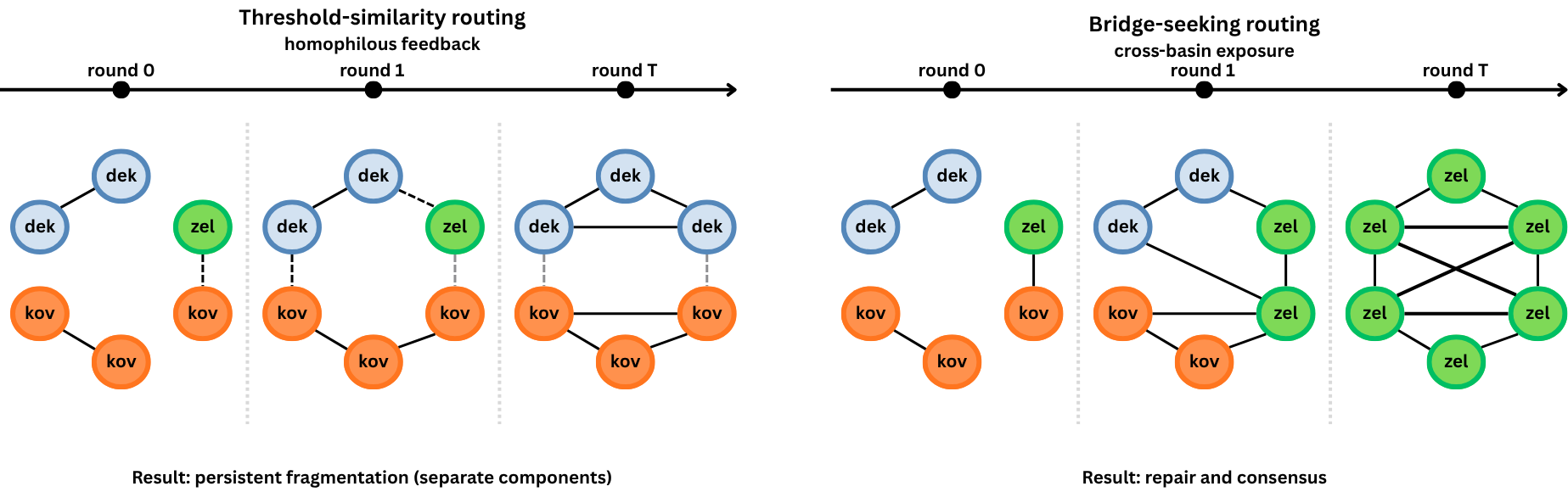
Multi-agent language-model (LM) systems increasingly rely on local communication; agents are paired, clustered, routed, or allowed to exchange partial histories before producing collective outputs. This paper tests a simple design claim: the runtime graph is causal. A routing rule can preserve cross-basin exposure and let disagreement dissipate, or it can remove bridges and stabilize clique-like fragmentation.
We use a controlled naming game. Each of \(N\) agents repeatedly chooses one label from a fixed set of tokenizer-safe nonce labels, observes limited partner feedback, and changes only through prompts, retained interaction history, and sampling rather than parameter updates. Open-weight models expose restricted first-token scores over the allowed labels, so each agent has both an emitted label and a measured score-state distribution over the convention set. This observability lets us distinguish behavioral consensus, where all agents sample the same label, from state-space consensus, where the state-similarity graph has one connected component. State disagreement energy separately measures the residual spread within that component.
The main evidence is interventional and spans homogeneous Qwen2.5 populations at 7B, 14B, and 32B together with a heterogeneous cohort spanning TinyLlama, Yi, Qwen2, and Qwen2.5. Without rendered partner-label history, homogeneous populations remain fragmented; retained history induces repair, most cleanly at 32B, where all 18 retained-history well-mixed settings reach stable behavioral and final state consensus. Homophilous feedback gives the complementary failure mode: threshold-similarity yields no final behavioral or state consensus in 189 settings for either Qwen2.5-14B or Qwen2.5-32B nor the 189-run mixed grid. Bridge-seeking controllers repair with memory but fail terminally without it; in the mixed grid, state-component and label-disagreement routing recover behavioral consensus in most runs, while state-distance routing is much weaker.
The contribution is a measurement and control framework for LM convention dynamics. We define label and score-state graphs, Jensen–Shannon components, disagreement energies, and connectivity diagnostics; show that retained partner-label memory separates fragmentation from convention formation; and demonstrate that sampled agreement can hide residual state structure. Runtime interventions establish that homophilous feedback fragments whereas bridge-seeking feedback repairs with memory, with the mechanism persisting through Qwen2.5-32B. Early graph-energy observables provide within-grid warnings of final outcomes, and task-grounded ARC-Challenge and MMLU ablations extend the propagation lens beyond nonce conventions. Figure 1 summarizes the central mechanism.
2 Related Work↩︎
Convention emergence and social norms have long been studied as decentralized coordination problems in which repeated local interaction selects among multiple equivalent equilibria [1]–[5]. Naming games provide a minimal protocol for shared vocabulary formation, metastability, and tipping phenomena [6]–[8]. We use nonce labels for the same reason: there is no externally correct convention, so agreement reflects social propagation rather than semantic recovery.
Consensus and opinion-dynamics models supply the graph language used in this paper. DeGroot-style averaging, nearest-neighbor consensus, and switching-topology consensus identify connectivity and repeated exposure as structural conditions for global agreement [9]–[13]. Adaptive-network and bounded-confidence models show the complementary failure mode: when interaction depends on current state, the system can polarize or settle into cluster consensus rather than global consensus [14]–[17]. We use this theory diagnostically, not literally. LM agents update through prompts, retained histories, priors, and sampling, so graph connectivity is an opportunity for repair rather than a guarantee of linear averaging.
Recent work on LM-agent populations studies social conventions, collective bias, opinion dynamics, norm-like behavior, and multi-agent collaboration mechanisms [18]–[24]. The closest connection is the observation that LM populations can form conventions or shared biases. Our question is more structural, which runtime exposure graphs make agreement, fragmentation, or latent residue more likely? The open-weight setting lets us answer at both the behavioral level, through sampled labels, and the score-state level, through restricted first-token distributions over the allowed labels.
3 Model and Diagnostics↩︎
3.0.0.1 Naming game.
At each round \(t\), each agent outputs one label from a finite convention set \(\mathcal{W}=\{w_1,\ldots,w_M\}\). The labels are artificial nonce strings, so agreement indicates convention formation rather than recovery of a semantically correct answer. At the beginning of a round, the runtime controller selects a matching over agents. Both agents in a matched pair are queried before either current-round output is added to any prompt, so current-round communication is not sequential.
Agent prompts contain the fixed task instruction, the allowed-label set, the matching objective, the round index, and at most \(H\) recent local interaction records. A local record stores the agent’s previous sampled label and the partner’s previous sampled label for that interaction. Thus \(H=0\) removes rendered partner-label history from the local history block, while \(H=3\) and \(H=10\) provide short retained memory. This does not make all prompts identical, the allowed-label order is randomized across interactions, and scored prompt variants include reward bookkeeping. We use “no-memory” to mean no rendered partner-label history, not absence of all prompt-level variation.
3.0.0.2 Measured state.
For open-weight models, let \(z_i(t)\in\mathbb{R}^M\) be the restricted first-token score vector over the allowed labels. We choose labels that are single tokens for every tokenizer in the cohort. The measured score-state distribution is the temperature-one restricted softmax \[s_i(t)_m=\frac{\exp(z_{im}(t))}{\sum_{\ell=1}^M \exp(z_{i\ell}(t))},\quad s_i(t)\in\Delta^{M-1}.\] The emitted label is sampled using the run’s decoding temperature \(\tau\), \[y_i(t)\sim\mathrm{Cat}\left(\frac{\exp(z_i(t)/\tau)}{\sum_{\ell=1}^M \exp(z_{i\ell}(t)/\tau)}\right).\] Unless stated otherwise, “state” refers to \(s_i(t)\), not the sampling distribution. State distance is metric Jensen-Shannon distance, \[\begin{align} D_{\mathrm{JS}}(p,q)&=\left[\tfrac12\mathrm{KL}(p\Vert m)+\tfrac12\mathrm{KL}(q\Vert m)\right]^{1/2},\notag\\ m&=\tfrac12(p+q). \end{align}\]
3.0.0.3 Graph views and energies.
We distinguish four graphs. The exposure graph records who interacted. The label graph connects agents with the same sampled label. The state-similarity graph connects agents when \(D_{\mathrm{JS}}(s_i(t),s_j(t))\leq\Delta\). The endogenous runtime graph is the graph used to choose future pairings. For a representation \(u_i(t)\), define \[V_u(t)=\frac{1}{2}\sum_{i=1}^N\lVert u_i(t)-\bar u(t)\rVert_2^2,\] where \(u_i\) is either \(s_i(t)\) or a one-hot sampled label. The algebraic connectivity \(\lambda_2(L(t))\) of a diagnostic or runtime graph indicates whether global bridges exist. These quantities are not assumed to be the LM update rule; rather, they are observables inspired by switched-consensus dynamics. In the reference model \(\dot{x}=-(L(t)\otimes I_M)x+r(t)\), positive repeated connectivity creates an opportunity for disagreement dissipation, whereas persistent disconnection permits cluster consensus.
3.0.0.4 Why homophilous thresholding can disconnect basins.
The threshold rule is useful diagnostically because it gives a sufficient condition for when cross-type bridges disappear. Let \(d(p,q)=D_{\mathrm{JS}}(p,q)\). Since \(D_{\mathrm{JS}}\) is a metric on probability distributions, suppose agents of model family or basin \(m\) remain within a \(d\)-ball of radius \(B_m\) around a prototype score-state \(\mu_m\): \[d(s_i(t),\mu_m)\leq B_m \qquad \text{for all agents i of type m.}\] For agents \(i\) and \(j\) of types \(m\) and \(n\), the triangle inequality gives \[d(s_i(t),s_j(t)) \geq d(\mu_m,\mu_n)-B_m-B_n.\] Thus, if \[d(\mu_m,\mu_n)>\Delta+B_m+B_n,\] then \(D_{\mathrm{JS}}(s_i(t),s_j(t))>\Delta\) for all such cross-type pairs, so the state-similarity graph contains no cross-type edge between those basins. In the common-radius case this reduces to \(D_{\mathrm{JS}}(\mu_m,\mu_n)>\Delta+2B\). This condition is not an assumption required by the experiments; it is a diagnostic explanation for why state-dependent homophily can remove exactly the cross-basin exposure needed for repair. If the resulting runtime graph has no edges between clusters, then the reference Laplacian is block diagonal after reordering agents, and the consensus reference dynamics split into independent cluster subsystems rather than forcing global consensus.
3.0.0.5 Runtime controllers.
The runtime controller constructs a candidate graph before querying the models in round \(t\). At \(t=0\), no previous observations exist, so the controller initializes from the complete graph without self-loops. For \(t\geq 1\), the candidate graph is computed only from observations saved at round \(t-1\); the controller has no access to current-round labels or current-round score states.
The threshold controller is homophilous, as it builds the next candidate graph from previous state similarity, \[a^{\mathrm{end}}_{ij}(t)=\mathbf{1}\{D_{\mathrm{JS}}(s_i(t-1),s_j(t-1))\leq\Delta\}.\] Candidate edges are converted to pairings by a greedy high-weight maximal matching, where edges are sorted by weight with a small random tie-breaker and accepted whenever neither endpoint is already matched. Bridge controllers instead prioritize cross-basin exposure before fallback well-mixed pairing. State-component bridge routing pairs agents across previous state-similarity components. Label-disagreement routing pairs agents whose previous sampled labels differ. State-distance bridge routing pairs agents in a moderate previous-distance band, \(0.05\leq D_{\mathrm{JS}}(s_i(t-1),s_j(t-1))\leq0.50\). Component-bridge runs should therefore be interpreted as bridge routing with fallback, not as a pure cross-component-only process.
4 Experiments↩︎
The open-weight study spans models from 1.1B to 32B parameters. The main controller grid uses \(N=10\) agents instantiated from TinyLlama-1.1B-Chat, Yi-1.5-6B-Chat, Qwen2-7B-Instruct, and Qwen2.5-7B-Instruct. Homogeneous scale-up runs additionally use Qwen2.5-14B-Instruct and Qwen2.5-32B-Instruct under the same \(N=10\), \(T=200\), history, temperature, and state-threshold design. Mixed populations cycle across the original four-model cohort; the larger models are evaluated homogeneously to isolate model scale from cross-family heterogeneity. Unless stated otherwise, \(\Delta=0.25\), \(\tau\in\{0.1,0.3,0.7\}\), and \(H\in\{0,3,10\}\).
Open-weight runs use tokenizer-safe nonce labels chosen to be single tokens for every tokenizer in the relevant cohort. After all agents have sampled labels in round \(t\), partner-label feedback and local histories are updated, and the saved observations from round \(t\) may be used to construct the candidate graph for round \(t+1\). This ordering is important for causal interpretation. That is, runtime graph feedback is based on previous-round observations, not on current-round outcomes.
A round has full behavioral consensus when all valid sampled labels are identical. A run has stable full behavioral consensus when this holds throughout the final 20 rounds. Final behavioral consensus means that the final label graph has one component, and final state consensus means that the final state-similarity graph has one connected component. Both are final-round criteria. Stable full consensus refers only to behavioral consensus throughout the final 20 rounds; state disagreement energy is reported separately.
5 Results↩︎
5.0.0.1 Memory separates fragmentation from convention formation.
Stationary prior probes show that model families have nonuniform prompt-induced initial attractors, but repeated interaction can move the population away from those priors. In homogeneous Qwen2.5-7B, the stationary no-history prompt strongly favors one
label, yet the repeated \(H=0\) game forms a persistent dek/kov split and the retained-history game converges to zel. The full history sweep shows a related transition across the
tested Qwen2.5 variants (Table 1). None of the \(27\) no-memory runs reaches final behavioral or state consensus. With retained history, Qwen2.5-7B and Qwen2.5-32B reach both forms of final
consensus in all \(18\) runs, whereas Qwen2.5-14B does so in \(6/18\) runs despite reaching full behavioral consensus transiently in every retained-history run. Retained social evidence
therefore consistently shifts the tested populations away from fragmentation, although the durability of the resulting consensus varies across model variants and settings.
| Model | History | \(n\) | ||
| label/state | ||||
| match | ||||
| 7B | \(H=0\) | 9 | \(0/9\) / \(0/9\) | 0.262 |
| 7B | \(H\in\{3,10\}\) | 18 | \(18/18\) / \(18/18\) | 1.000 |
| 14B | \(H=0\) | 9 | \(0/9\) / \(0/9\) | 0.210 |
| 14B | \(H\in\{3,10\}\) | 18 | \(6/18\) / \(6/18\) | 0.806 |
| 32B | \(H=0\) | 9 | \(0/9\) / \(0/9\) | 0.232 |
| 32B | \(H\in\{3,10\}\) | 18 | \(18/18\) / \(18/18\) | 1.000 |
4pt
Mixed populations show why sampled agreement is not enough. In one retained-memory mixed run, the final labels are vel:10, yet the state-similarity graph has two components: within-family score-state distances are much smaller than
cross-family distances, so thresholding the restricted score geometry preserves model-family structure even after sampled labels agree. The state graph therefore reveals latent residue that is invisible from labels alone.
5.0.0.2 Homophilous feedback fragments; bridge feedback repairs.
Threshold-similarity routing optimizes local similarity rather than global connectivity. Under random exposure, retained-memory homogeneous runs can reach consensus; under threshold-similarity feedback, similar agents keep interacting, dissimilar agents lose exposure, and cross-basin bridges disappear. In the mixed four-model grid, threshold-similarity reaches neither final behavioral consensus nor final state consensus in any of 189 setting-seed runs (Table 2).
Bridge-seeking feedback supplies the positive intervention. All bridge variants fail at \(H=0\), showing that cross-exposure alone is insufficient. With retained memory, state-component bridge and label-disagreement routing both recover final behavioral consensus in 14/18 runs. State-component bridge is cleaner in latent space, reaching final state consensus in 13/18 runs compared with 10/18 for label-disagreement. State-distance bridge is substantially weaker. Figure 2 separates \(H=3\) from \(H=10\) and shows that repair depends on retained memory rather than no-memory cross-exposure alone.
| Policy/subset | \(n\) | Label cons. | State cons. | Match |
|---|---|---|---|---|
| Threshold, all \(H\) | 189 | 0/189 | 0/189 | 0.163 |
| State-comp., \(H=0\) | 9 | 0/9 | 0/9 | 0.165 |
| State-comp., \(H\!\in\!\{3,10\}\) | 18 | 14/18 | 13/18 | 0.907 |
| Label-dis., \(H=0\) | 9 | 0/9 | 0/9 | 0.183 |
| Label-dis., \(H\!\in\!\{3,10\}\) | 18 | 14/18 | 10/18 | 0.911 |
| State-dist., \(H=0\) | 9 | 0/9 | 0/9 | 0.143 |
| State-dist., \(H\!\in\!\{3,10\}\) | 18 | 3/18 | 2/18 | 0.522 |
3pt

5.0.0.3 Robustness across model scale and configuration.
Across the full threshold-similarity grid, Qwen2.5-14B and Qwen2.5-32B each produce \(0/189\) final behavioral and \(0/189\) final state consensus. With retained memory, all three bridge policies reach final behavioral and state consensus and stable full behavioral consensus in \(18/18\) Qwen2.5-32B settings per policy. Qwen2.5-14B instead reaches transient full behavioral consensus in every retained-memory bridge run, but finishes in label/state consensus in \(7/18\) state-component, \(10/18\) label-disagreement, and \(8/18\) state-distance runs, with no stable final-window consensus. The larger homogeneous runs therefore establish bridge-plus-memory repair versus threshold-homophily fragmentation without ranking the bridge objectives as sharply as the heterogeneous grid. Table 3 summarizes the orthogonal state-threshold, population-size, and vocabulary-size tests.
| Stress test | Setting | Threshold | State-comp. | Label-dis. | State-dist. | Takeaway |
|---|---|---|---|---|---|---|
| \(\Delta\) sweep | Mixed, \(H=3,\tau=0.3\), \(\Delta\in\{0.15,0.20,0.25,0.30,0.35\}\) | \(0/15\) / \(0/15\) | \(12/15\) / \(8/15\) | \(15/15\) / \(7/15\) | \(0/15\) / \(0/15\) | Controller ordering does not reverse under state-threshold changes. |
| Population size | Mixed, \(H=3,\tau=0.3\), \(N\in\{20,50\}\) | \(0/6\) / \(0/6\) | \(2/6\) / \(3/6\) | \(1/6\) / \(1/6\) | \(1/6\) / \(1/6\) | Larger populations preserve the mechanism but expose fixed-budget limits. |
| Vocabulary size | Mixed, \(H=3,\tau=0.3\), \(M\in\{5,10,20\}\) | \(0/9\) / \(0/9\) | \(8/9\) / \(5/9\) | \(9/9\) / \(5/9\) | \(2/9\) / \(1/9\) | The effect is not an artifact of the main nonce vocabulary. |
4pt
Across these remaining stress tests, changing \(\Delta\) or \(M\) does not reverse the mixed-grid controller ordering. Increasing \(N\) preserves the memory and threshold-fragmentation effects but makes stable bridge repair finite-budget limited at \(T=200\). The homogeneous Qwen2.5-7B transition is likewise invariant across the tested \(\Delta\), \(N\), and \(M\) settings: \(H=0\) fragments, while retained history reaches behavioral and state-space consensus. Figure 3 visualizes the corresponding trajectory-level mechanism.

5.0.0.4 Exposure, adoption, and basin merging differ.
For each directed disagreement-exposure event, we ask whether target \(i\) adopts source \(j\)’s previous label in the next round: \[\begin{align} P_{\mathrm{adopt}}=\Pr(&y_i(t+1)=y_j(t)\mid i\text{ observed }j,\notag\\ & y_i(t)\neq y_j(t)). \end{align}\]
| Policy | Subset | Events | \(P_{\mathrm{adopt}}\) | Final cons. |
|---|---|---|---|---|
| State-comp. | \(H=0\) | 740 | 0.076 | 0/1 / 0/1 |
| Label-dis. | \(H=0\) | 768 | 0.082 | 0/1 / 0/1 |
| State-dist. | \(H=0\) | 720 | 0.083 | 0/1 / 0/1 |
| State-comp. | retained | 58–288 | 0.125–0.210 | 3/3 / 3/3 |
| Label-dis. | retained | 74–126 | 0.111–0.167 | 3/3 / 2/3 |
| State-dist. | retained | 102–212 | 0.197–0.363 | 1/3 / 0/3 |
3pt
Table 4 shows that exposure, one-step adoption, and global basin merging are distinct. No-memory bridge runs contain many disagreement-exposure events but do not repair. Retained-memory state-component and label-disagreement runs show positive adoption and merge basins. State-distance bridge can produce higher one-step adoption while still failing to merge basins, so local adoption is not sufficient for global repair.
5.0.0.5 Targeted controls rule out simple alternatives.
Table 5 summarizes controls that test whether the main effect can be reduced to stationary priors, generic local averaging, prompt length, or an unstructured bridge budget. Fixed-prior agents and a bounded-confidence naming-game baseline remain fragmented. A randomized bridge-budget baseline shows that random cross-basin exposure can produce behavioral consensus with retained memory, but no-memory bridge exposure is still insufficient. Most importantly, removing partner-label feedback destroys repair even when the prompt still has memory slots and bridge routing is available.
| Control | Setting | Final labels | \(C_{\ell}/C_s\) | Full frac. | Interpretation |
|---|---|---|---|---|---|
| Fixed-prior agents | \(N=10,M=10\) | w0:1, w2:2, w3:2, w5:1, w6:1, w7:2, w9:1 | 7/– | 0.000 | Stationary priors alone do not reproduce repair. |
| Bounded-confidence naming game | \(N=10,M=10\) | w0:1, w2:2, w3:2, w5:1, w6:1, w7:2, w9:1 | 7/– | 0.000 | Generic local averaging remains fragmented in this control. |
| Random bridge-budget | \(H=0,\tau=0.1\) | cal:3, fel:2, pel:3, tal:2 | 4/8 | 0.000 | Cross-basin exposure without memory is insufficient. |
| Random bridge-budget | \(H=3,\tau=0.3\) | vel:10 | 1/1 | 0.710 | Random cross-basin exposure can sometimes repair behavior. |
| Qwen2.5 well-mixed, no partner feedback | \(H=3,\tau=0.3\) | kov:4, zel:6 | 2/2 | 0.000 | Memory without partner labels does not repair fragmentation. |
| Mixed component bridge, no partner feedback | \(H=3,\tau=0.3\) | cal:1, gar:2, mur:2, sol:2, tal:1, vel:2 | 6/6 | 0.000 | Bridge exposure cannot help if prompts omit partner feedback. |
4pt
5.0.0.6 Early graph-energy diagnostics predict outcomes.
Using only rounds 0 through 10, we train within-grid classifiers under grouped train/test splits by run. Graph-energy features improve early-warning prediction over metadata-only baselines for final behavioral consensus and stable full consensus; graph-only features are strongest for final state consensus in this split (Table 6). These results are diagnostic rather than proof that LMs implement linear averaging.
The predictive result also gives the diagnostics an operational role. If early traces retain multiple label or state components, low state or runtime connectivity, or high disagreement energy, the system can switch away from homophilous or passive routing and allocate bridge-seeking exposure before fragmentation becomes stable. In this sense, the same observables that explain clique formation can serve as triggers for runtime intervention.
| Target | Metadata | Graph | Energy+graph |
|---|---|---|---|
| Final behavioral consensus | 0.953 | 0.983 | 0.997 |
| Final state consensus | 0.961 | 0.993 | 0.982 |
| Stable full consensus | 0.966 | 0.958 | 0.991 |
4pt
5.0.0.7 Task-grounded answer choices.
As a secondary validation, we replace nonce labels with answer choices on ARC-Challenge and MMLU items [25], [26]. The ARC-Challenge suite uses the full validation set after fixed-four-choice filtering, giving 295 items rather than all 299 validation items. The MMLU suite uses 100 questions. Each task-controller cell aggregates three seeds and two temperatures, with retained history \(H=3\) and \(\Delta=0.25\). These runs are not intended as benchmark claims: agents exchange only answer labels, not rationales or debate, and the point is to test whether topology changes answer propagation when terminal basins can be classified as correct, wrong, or fragmented.
2.8pt
@lcccccc@ Policy & & & & & &
State-comp. bridge & .881 & .834 & .071 & .901 & 30/1770 & 17/1770
Label-disagreement & .878 & .832 & .069 & .894 & 24/1770 & 20/1770
Threshold-sim. & .870 & .803 & .055 & .848 & 20/1770 & 11/1770
Well-mixed & .875 & .823 & .074 & .894 & 26/1770 & 29/1770
State-comp. bridge & .336 & .125 & .295 & .567 & 54/600 & 46/600
Label-disagreement & .341 & .145 & .272 & .563 & 55/600 & 44/600
Threshold-sim. & .333 & .080 & .180 & .330 & 36/600 & 38/600
Well-mixed & .339 & .138 & .278 & .573 & 54/600 & 49/600
Table ¿tbl:tab:task95choice95main? strengthens the propagation interpretation. On filtered ARC-Challenge validation, all controllers start from a high-correctness regime, so final accuracy differences are modest; nevertheless, threshold-similarity produces less correct consensus and less state consensus than bridge-seeking or well-mixed routing. State-component bridge has the highest final correctness, correct-consensus rate, and state-consensus rate, and it produces more wrong-majority-to-correct-majority flips than the reverse. On MMLU-100, final correctness remains similar across controllers, but topology still changes the collective state: threshold-similarity sharply suppresses both correct and wrong consensus and has much lower state consensus, while bridge and well-mixed policies produce more propagation. Thus the task-choice runs support the graph-control lens without implying that increased propagation is a general accuracy-improvement method.
6 Discussion↩︎
Runtime graphs do not merely record convention dynamics; they change them. Homophilous feedback removes cross-basin exposure and stabilizes cliques, whereas bridge-seeking feedback creates exposures that retained partner-label evidence can accumulate into basin merging. The effect is population-dependent: state-component routing gives the cleanest latent repair in the mixed population, state-distance routing is weak there, and all three bridge policies repair retained-memory Qwen2.5-32B populations. Qwen2.5-14B instead reaches transient repair without stable terminal alignment, showing that reaching consensus and maintaining it are distinct properties. Together with the randomized bridge-budget control, these results show that repair reliability, persistence, and state-space cleanliness depend on the bridge objective, retained evidence, population composition, and model family. The intervention therefore supports a conditional control claim rather than a universal ranking of routing policies.
State diagnostics matter because sampled agreement can coexist with separated score-state components. Such residual structure is invisible to a monitor that observes only final labels, yet it may affect how the population responds to later perturbations or routing changes. Early graph-energy signals can therefore support intervention before fragmentation stabilizes. The results suggest three design principles: do not treat similarity routing as a safe default; monitor sampled labels and latent state structure jointly; and pair bridge exposure with retained social evidence. In practice, these observables could serve as triggers for switching away from homophilous routing when connectivity collapses or disagreement remains concentrated in separate basins.
The task-grounded runs sharpen rather than broaden the claim. Topology changes whether answers propagate into correct consensus, wrong consensus, or fragmentation, but bridge routing is not a general accuracy-improvement method. The same mechanism that helps a correct basin spread can also reinforce a wrong one, so consensus rate and correctness must be evaluated separately. We therefore interpret the framework as a propagation-control and auditing tool, not as evidence that LMs implement linear consensus dynamics or that consensus itself is desirable.
7 Limitations and Ethics↩︎
The results are mechanism evidence rather than population-level statistical closure. The central heterogeneous controller grid uses models up to 7B; the 14B and 32B scale-up is homogeneous, so it only tests scale robustness. The ranking of bridge objectives is supported primarily by the mixed four-model grid. The main setting uses \(N=10\), \(M=10\), and \(T=200\), with the orthogonal robustness summary reported in Table 3; larger populations preserve the memory and threshold-fragmentation effects but require larger budgets or adaptive routing for reliable stable repair. The full-scale task-choice results use filtered ARC-Challenge validation and MMLU-100 with one model cohort, answer-label-only exchange, and a propagation protocol rather than standard benchmark evaluation. The supplement adds a one-seed selected-item rationale diagnostic, not a full-benchmark comparison. Directional adoption is observational and local, and state-space claims require restricted score access, so closed-interface checks support only behavioral conclusions. Most experiments use LMs to exchange nonce labels or answer choices; a supplementary selected-item diagnostic additionally exchanges model-generated rationales. No experiment uses user data, personal information, human debate transcripts, or human-subject intervention. The results instead show that topology can amplify wrong basins and correct ones, so multi-agent LM systems should monitor fragmentation, residual state structure, and bridge exposure rather than relying on sampled agreement alone.
8 Conclusion↩︎
We presented a graph-control view of convention formation in open-weight LM populations. Runtime topology is not merely an implementation detail. Homophilous state-similarity feedback removes cross-basin exposure and stabilizes cliques, while bridge-seeking feedback can repair fragmentation when agents retain partner-label evidence. Threshold-similarity remains terminally fragmented at both 14B and 32B; retained-memory bridge routing produces stable behavioral repair with final state consensus at 32B, while the transient repair observed at 14B distinguishes reaching consensus from maintaining it. The open-weight setting also reveals cases where sampled agreement hides separated score-state structure. Across the robustness, adoption, control, and task-grounded analyses, the supported claim is therefore not that agreement is always desirable, but that runtime topology controls which behavioral and latent basins propagate and stabilize. Multi-agent LM systems should treat the interaction graph as a control surface: monitor early graph-energy diagnostics, preserve or create bridges when fragmentation appears, and evaluate both behavioral and state-space agreement before trusting collective outputs. The implementation and paper-facing reproduction scripts are available at https://github.com/cedar-lau/llm-graph-control.