Production and Perception in LLMs: A Token Probability Approach
July 13, 2026
Abstract
The asymmetry between language production and perception has been well-documented in psycholinguistics. Whether large language models (LLMs) exhibit a functionally analogous distinction remains an open question, particularly given that LLMs rely on the same underlying mechanism—next-token prediction—for both input and output processing. In this exploratory study, we operationalize the production–perception distinction through direct token probability measurements rather than metalinguistic prompting. Using the base Llama-3.1-8B model, we generated poems under a production prompt and re-scored the same tokens under both rephrased production prompts and perception-oriented prompts. Across an extended experiment with four production and three perception prompts, production–perception distances consistently and substantially exceeded production–production distances, with non-overlapping ranges across conditions and an overall average ratio of approximately 1.8×. Near-ceiling correlations in the production–production control confirm that the effect is specific to communicative framing rather than prompt surface variation, and we show the effect replicates across five open-weight models (Llama-3.1-8B, EuroLLM-9B, gemma-2-9b-it, Mistral-7B-Instruct-v0.3, and Qwen2.5-7B-Instruct), spanning both base and instruction-tuned variants. Temporal analysis revealed that the perception prompt exerts its strongest influence at the beginning of the sequence, with divergence decaying as generated context accumulates, though the specific shape of this decay varies across prompt pairs. These findings suggest that prompt framing alone induces a production–perception distinction in LLM probability distributions, even within a decoder-only architecture.
1 Introduction↩︎
Human communication is not a mirror-image process in which the speaker and the hearer perform the same steps in reverse order. When we produce language, we select and encode a message with a particular communicative intention in mind. When we perceive language, we do not simply decode that message—we actively infer the most relevant interpretation given the context. Relevance Theory [1] models communication as ostensive-inferential: an utterance provides evidence of the speaker’s intention and carries a presumption of optimal relevance; the addressee, guided by the expectation of such relevance, infers the speaker’s intended meaning.
When we try to apply this framework to large language models (LLMs), an immediate difficulty arises. Unlike humans, LLMs do not have communicative intentions in the traditional sense, nor do they perform inference of the user’s intended meaning during interpretation. Instead, they process both input and output through the same underlying mechanism—next-token prediction. This symmetry is not merely a design choice but reflects a broader architectural shift in the field: whereas earlier encoder-decoder models [2] maintained structurally distinct pathways for input processing and output generation—which could in principle support separate representations of perception and production—contemporary LLMs are predominantly decoder-only [3]. This architectural symmetry would seem to preclude any meaningful production–perception distinction. However, the framing provided by a prompt—whether it positions the model as a producer or an interpreter of text—may still shift the model’s probability distributions in ways that mirror, at least functionally, the asymmetry outlined by Relevance Theory and other models and theories of human communication that describe the difference between speech production and perception1 (see, e.g., Cooperative Principle by [4], or the Common Ground framework by [5]).
Although LLMs are not cognitive agents in the human sense—that is, the intentions, goals, or agency attributed to them through anthropomorphisation are not inherent to their architecture—describing them as entirely devoid of agency can still be misleading. Their behavior is shaped by externally imposed objectives, constraints, and alignment procedures. In particular, instruction tuning and reinforcement learning from human feedback (RLHF) introduce normative pressures—such as helpfulness—that produce intention-like behavior. It creates an externally imposed goal structure that makes outputs appear as if communicative intentions were present. Goals should not be attributed to the model itself, but rather to personas that are simulated on that model, since if the simulated persona has intentions or goals, the intentions and goals are simulated as well [6].
Despite this apparent intentionality, the relationship between production and perception differs from human communication. [7] argue that in humans, production and perception are distinct developmental trajectories that interact but don’t always track each other, shaped by multi-modal, embodied experience. In LLMs, by contrast, input processing and output generation rely on the same underlying mechanisms, making production essentially a conditioned continuation of perceived text. Autoregressive LLMs use shared parameters for text processing and generation [3], [8], resulting in a much stronger symmetry between production and perception than assumed in classical psycholinguistic models (see, e.g., Levelt1989Speaking? for production, [9] for spoken language understanding, [10] for acquisition-based evidence of production–comprehension asymmetries, and [11] for conversational neuroimaging evidence).
Ways of measuring the difference between production and perception in LLMs are limited. Most studies on LLMs so far examined either production capabilities—e.g., on poetry [12], multi-genre texts [13]—or perception capabilities—e.g., about garden-path sentences [14], pragmatic resolution [15], or acceptability judgments [16]. Some researchers tested the distinction between production and perception in LLMs using behavioral tasks. [17] examined the phenomenon of implicit causality verbs, where humans are known to show an asymmetry: they are more subject-biased when interpreting an ambiguous pronoun than when freely producing a continuation. As discovered, LLMs can only partially and inconsistently replicate this human asymmetry. Larger models (LLaMA-70B, GPT-4o) do show some human-like distinction between the two tasks under specific prompting conditions, but the effect is weaker in magnitude than in humans, highly dependent on how the question is framed, and often disappears or even reverses with different prompts or smaller models. The authors conclude that LLMs generally struggle to recognize
the difference between production and perception the way humans do, and, similarly to [7], the authors conclude that it is because LLMs use the same underlying mechanism for both input and output, and the human-like asymmetry between the two processes is not naturally encoded in them.
In our exploratory study, we propose using token probability distributions to measure the distinction between production and perception. Our approach is motivated by [18], who demonstrate that eliciting metalinguistic judgments through prompting is not a reliable substitute for direct probability measurements in LLMs. They show that metalinguistic responses, i.e., model outputs elicited by asking the model to judge or evaluate linguistic content, systematically diverge from the model’s underlying token probability distributions, and that this divergence increases as the prompt moves further from a direct next-word prediction task. This finding supports our decision to measure the production–perception distinction through token probabilities directly, rather than through prompted evaluative responses.
2 Methodology↩︎
2.1 Experimental Setup and Hypotheses↩︎
The core logic of our design lies in the following premise: if switching from a production prompt to a perception prompt merely rephrases the same communicative role, the model’s token probability distributions should remain largely stable. If, however, the change in framing genuinely shifts the model into a functionally different mode—that of a perceiver rather than a producer—the probability distributions should diverge systematically. To test this, we used a simple production prompt (e.g., "Please write a poem about a rabbit") to elicit a poem, and recorded token probabilities during generation.
The same poem was then re-evaluated token by token under two alternative prompt framings: a rephrased production prompt (e.g., "I would like you to write a poem about a rabbit"), serving as a control condition (pro_pro), and a perception-oriented prompt (e.g., "Please rate this poem about a rabbit"), constituting the experimental condition (pro_perc). We chose this design to keep the two prompts as similar as possible, isolating communicative framing as the main variable. The whole procedure is visualized in Fig. 1.

Since LLMs rely on the same underlying representations for both input processing and output generation, we might expect the two conditions to yield similar probability distributions. However, if a systematic asymmetry is observed—specifically, if token probabilities diverge more strongly in the pro_perc condition than in the pro_pro control—this would suggest that prompt framing induces a functionally meaningful distinction at the level of token probabilities, analogous to the production–perception asymmetry documented in human language processing.
2.2 Model and stimuli↩︎
We used the self-hosted Llama-3.1-8B by Meta as the target model to generate both the poem and the probabilities. The choice of model was motivated by earlier studies suggesting that smaller LMs better mimic human cognitive behavior during
some tasks than larger ones [19]–[21]. We chose the base model to avoid an implicit "helpful assistant" effect, often present in fine-tuned models, and to ensure that the communicative role is invoked by the prompt itself.
We generated poems about 1,089 topics (individual animals and animal pairs, e.g.a hedgehog, a tiger and a penguin etc.) using a primary production prompt (“please write a poem about …”), sampling 100 tokens at temperature = 1. The probabilities \(p_0\) of the sampled tokens are recorded.
Secondary probabilities were obtained for these two scenarios:
Production–Production (prod-prod): For each generated poem, we make second forward pass, starting with secondary production prompt (“I would like you to write a poem about …”), and then feeding the same generated token IDs back into the model one at a time to obtain \(p_1\).
Production–Perception (prod-perc): The third forward pass starts with perception prompt (“Here is a poem about …, please rate the poem.”), and then again feeding the same generated token IDs back into the model one at a time to obtain \(p_2\). We did not let the model generate the rating since it is irrelevant for our study; the perception prompt serves solely as a framing context within which the probabilities of the poem tokens are computed.
In all three cases, the assistant–user environment was simulated, since the base model did not tend to generate a poem at all, unless triggered by user / assistant marking.
For technical reasons (to make the procedure easily parallelized on multiple machines), the poems and \(p_0\)’s were calculated twice for both scenario, but this should not influence results whatsoever. This procedure yields approximately 93,000 token-level \((p_1, p_2)\) pairs per condition (93,697 for prod-perc; 93,341 for prod-prod).
2.3 Measures↩︎
We quantified the divergence between the two probability streams at two levels of granularity:
Per-poem Pearson correlation between \(p_0\) and \(p_1\), and between \(p_0\) and \(p_2\), capturing the linear agreement of the two probability profiles.
Per-poem mean absolute distance \(\overline{|p_0 - p_1|}\), and \(\overline{|p_0 - p_2|}\), capturing the magnitude of token-level shifts independently of co-variation.
To examine how the prompt-framing effect evolves over the course of generation, we also computed position-wise mean distance for each of the first 100 token positions and modeled the position-wise means over positions 10–100 (excluding the high-variance boundary region immediately following the prompt). The model we have chosen is an exponential decay with asymptote, \(y = a\,e^{-bx} + c\), where \(a\) captures the initial excess divergence, \(b\) the decay rate, and \(c\) the irreducible residual divergence that persists regardless of sequence length. This functional form is motivated by the assumption that each additional token of context reduces the remaining prompt influence by a roughly constant fraction (multiplicative dilution), analogous to geometric mixing in ergodic processes.
All confidence intervals and fits were estimated via bootstrap resampling (10,000 iterations, resampling poems).
3 Results↩︎
3.1 Global token-level agreement↩︎
Figure 2 plots \(p_0\) against \(p_1\) and \(p_2\) for all tokens. In prod-prod, points cluster tightly along the diagonal, indicating that prompt rephrasing alone has negligible effect on token probabilities. In prod-perc, scatter around the diagonal is visibly larger, reflecting a systematic divergence introduced by the change in communicative framing.

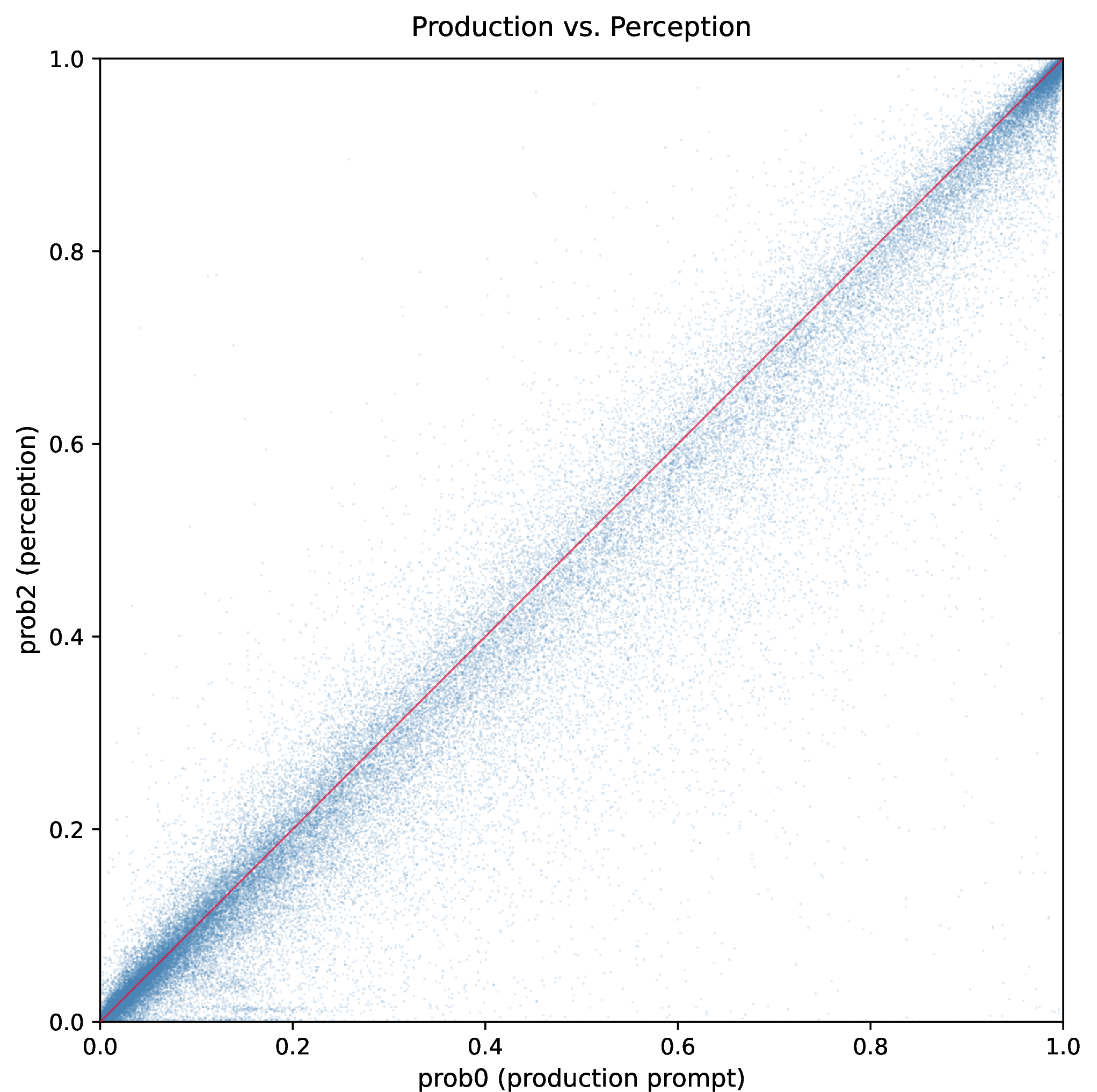
Figure 2: Token-level probability scatter plots. Each point is one token; the red line marks perfect agreement.. a — prod-prod, b — prod-perc
3.2 Per-poem distances↩︎
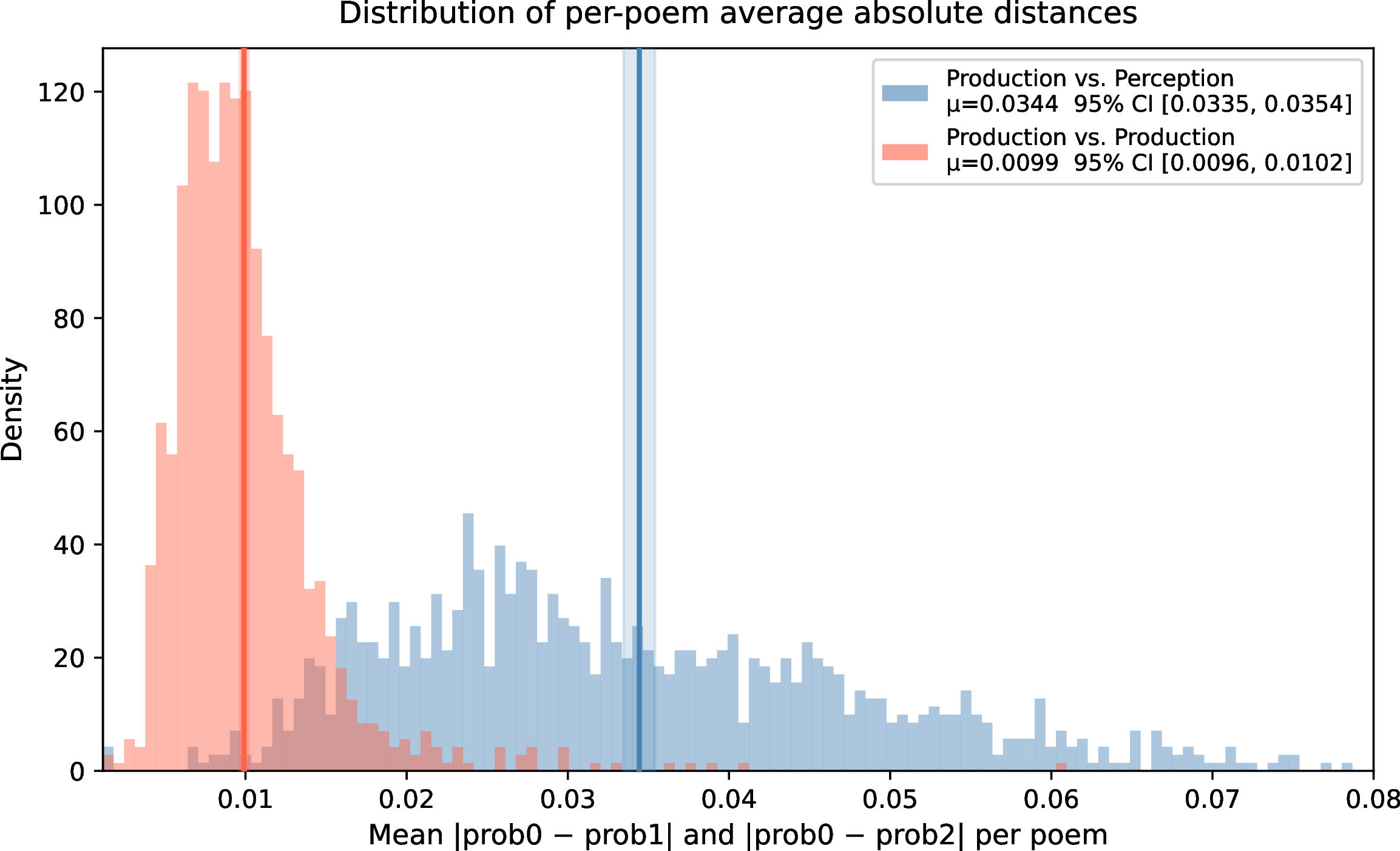
Figure 3 summarises the per-poem statistics. The mean absolute distance in the prod-perc condition (\(\mu = 0.034\), \(\mathit{SD} = 0.017\)) is approximately 3.5\(\times\) larger than in prod-prod (\(\mu = 0.010\), \(\mathit{SD} = 0.005\)), with non-overlapping 95% bootstrap CIs.
3.3 Temporal dynamics↩︎
Figure 4 shows how distances (\(|p_0 - p_1|\) and \(|p_0 - p_2|\)) evolve over token position. Both conditions exhibit a decreasing trend: as generated context accumulates, the local context increasingly dominates over the prompt signal, and the two probability seems to converge.
The separation between conditions persists throughout the sequence and remains outside the respective 95% CIs, but as the exponential decay model suggests, at some point in the future, it is perfectly possible that the lines will meet and that the production–perception distance can be even smaller than the production–production distances in the long run.
Bootstrap exponential decay fits over positions 10–100 yield: \[\begin{align} \mathrm{\small prod-perc}{:} \quad & y = 0.0427\, e^{-0.0083\,x} + 0.0016 \\ \mathrm{\small prod-prod}{:} \quad & y = 0.0052\, e^{-0.0096\,x} + 0.0058 \end{align}\] To be more precise, the goodness of fit, as measured by \(R^2\) for prod-perc is \(0.8869\) and the parameters of the model and their 95 % confidence intervals are \(a = 0.04265\) [CI: \(0.02985\), \(0.04625\)], \(b = 0.00829\) [CI: \(0.00705\), \(0.01811\)], \(c = 0.00164\) [CI: \(0.00000\), \(0.01651\)].
The \(R^2\) for prod-prod is \(0.5100\) and the parameters are \(a = 0.00523\) [CI: \(0.00345\), \(0.01136\)], \(b = 0.00960\) [CI: \(0.00286\), \(0.09189\)], \(c = 0.00576\) [CI: \(0.00000\), \(0.00851\)].
The total initial divergence (\(a+c\)) in prod-perc is roughly \(4\times\) that of prod-prod, confirming a stark contrast when the communicative framing changes. More notably, the context-sensitive portion of this divergence (parameter \(a\)) is \({\sim}8\times\) larger in prod-perc (\(a \approx 0.0427\) vs.\(0.0052\)).
While the relative rate of decay is comparable across both conditions (\(b \approx 0.0083\) vs.\(0.0096\)), the massive initial magnitude in prod-perc results in a much steeper absolute drop early in the text. This exponential trajectory demonstrates that the perception framing exerts a powerful initial influence that is rapidly and progressively overridden by accumulated context, eventually asymptoting to a near-zero baseline (\(c \approx 0.0016\)).
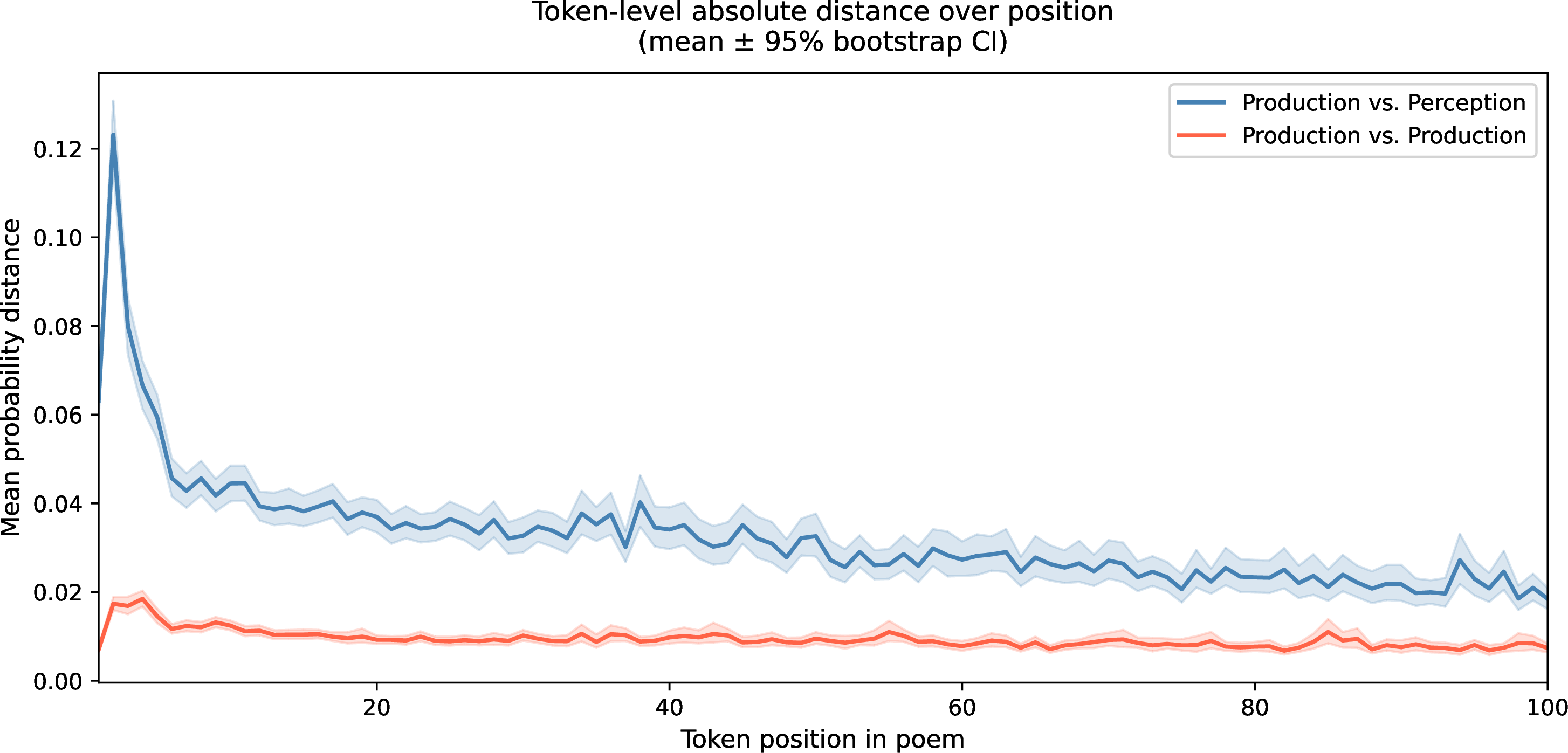
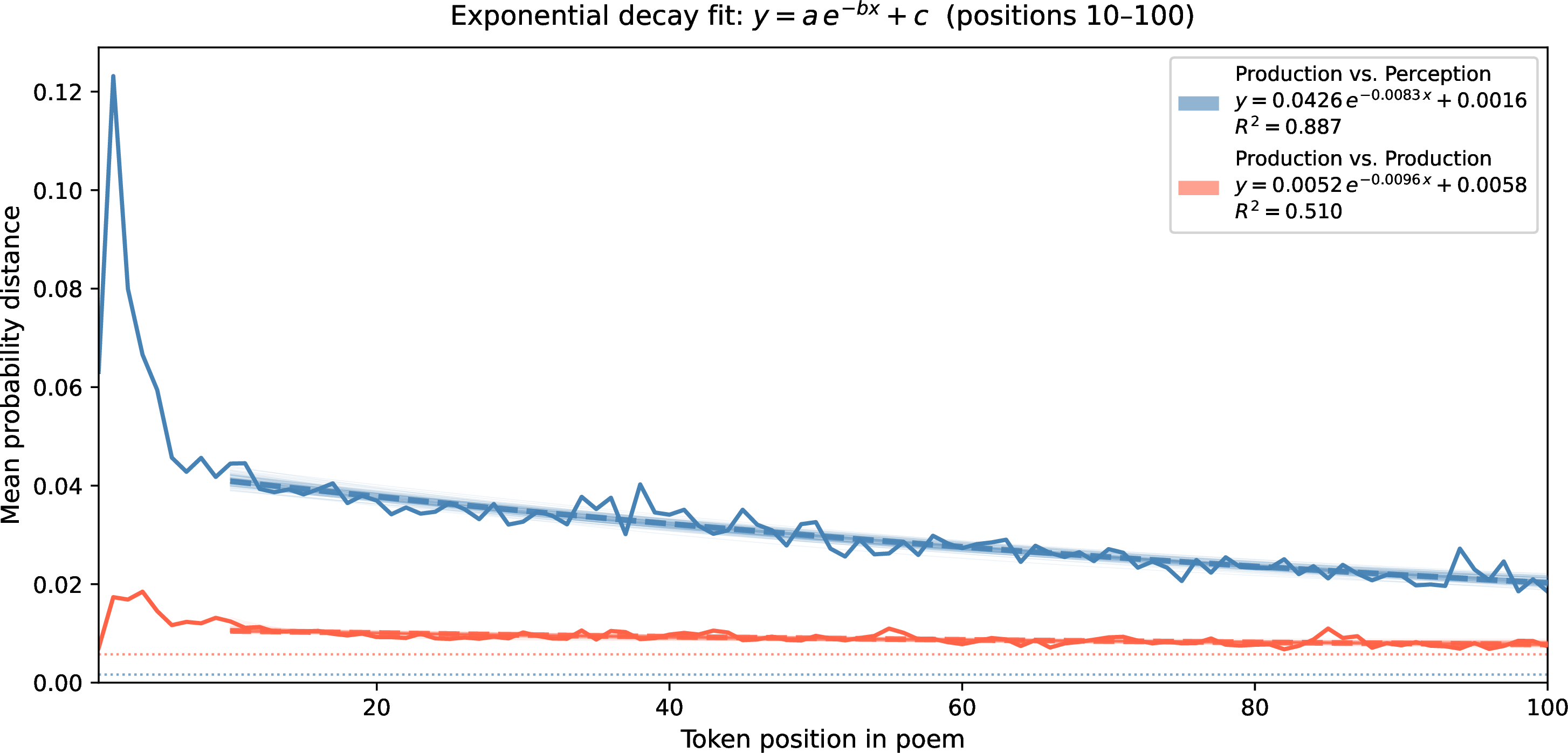
Figure 4: Temporal dynamics of the production–perception divergence.. a — Position-wise mean distances with 95% bootstrap CIs., b — Bootstrap exponential decay fits (positions 10–100).
4 Results for more prompts↩︎
The results reported in the previous section are based on a single production prompt and a single perception prompt, leaving open the possibility that the observed divergence is tied to the specific wording of those prompts rather than to the production–perception distinction per se. To assess robustness, we replicated the experiment with a set of four production prompts (prod\(_0\)–prod\(_3\)) and three perception prompts (perc\(_0\)–perc\(_2\)), yielding 12 production–perception combinations and 12 production–production combinations (one for each off-diagonal pair from the same set of four prompts). All other parameters were held constant: the same 1,089 topics, the same model and hyperparameters, and the same 100-token generation limit.
4.1 Prompt variants↩︎
Table 1 lists all prompt templates used in the extended experiment. The production prompts span a range of registers, from a minimal direct request (prod\(_0\)) to longer, more contextualised formulations (prod\(_2\), prod\(_3\)). The perception prompts likewise vary in how explicitly they position the model as an evaluator, from a brief rating instruction (perc\(_0\)) to a more discursive opinion framing (perc\(_2\)). In all conditions the assistant–user turn structure is preserved, as in the original experiment.
| ID | Prompt |
|---|---|
| prod\(_0\) | “Please write a poem about X.” |
| prod\(_1\) | “I would like you to write a poem about X.” |
| prod\(_2\) | “Hi, my kid wants to listen to a poem about X, would you be so kind and create one?” |
| prod\(_3\) | “I really love poetry but I have never seen a poem about X, compose one, please.” |
| perc\(_0\) | “Here is a poem about X, please rate the poem.” |
| perc\(_1\) | “I would like to hear your opinion on this poem about X:” |
| perc\(_2\) | “I have read a poem about X and I would like to know what you think about it. Here is the poem:” |
4.2 Overall statistics↩︎
The extended results closely replicate the original finding. In the prod-perc condition, mean absolute distances range from \(0.028\) to \(0.040\) across
all 12 production–perception prompt combinations (grand mean \(\approx 0.035\)), almost identical to the \(0.034\) reported in Section 3.2. Crucially,
this range does not overlap with the highest prod-prod distance (\(0.024\)). The mean difference between prod-prod and prod-perc
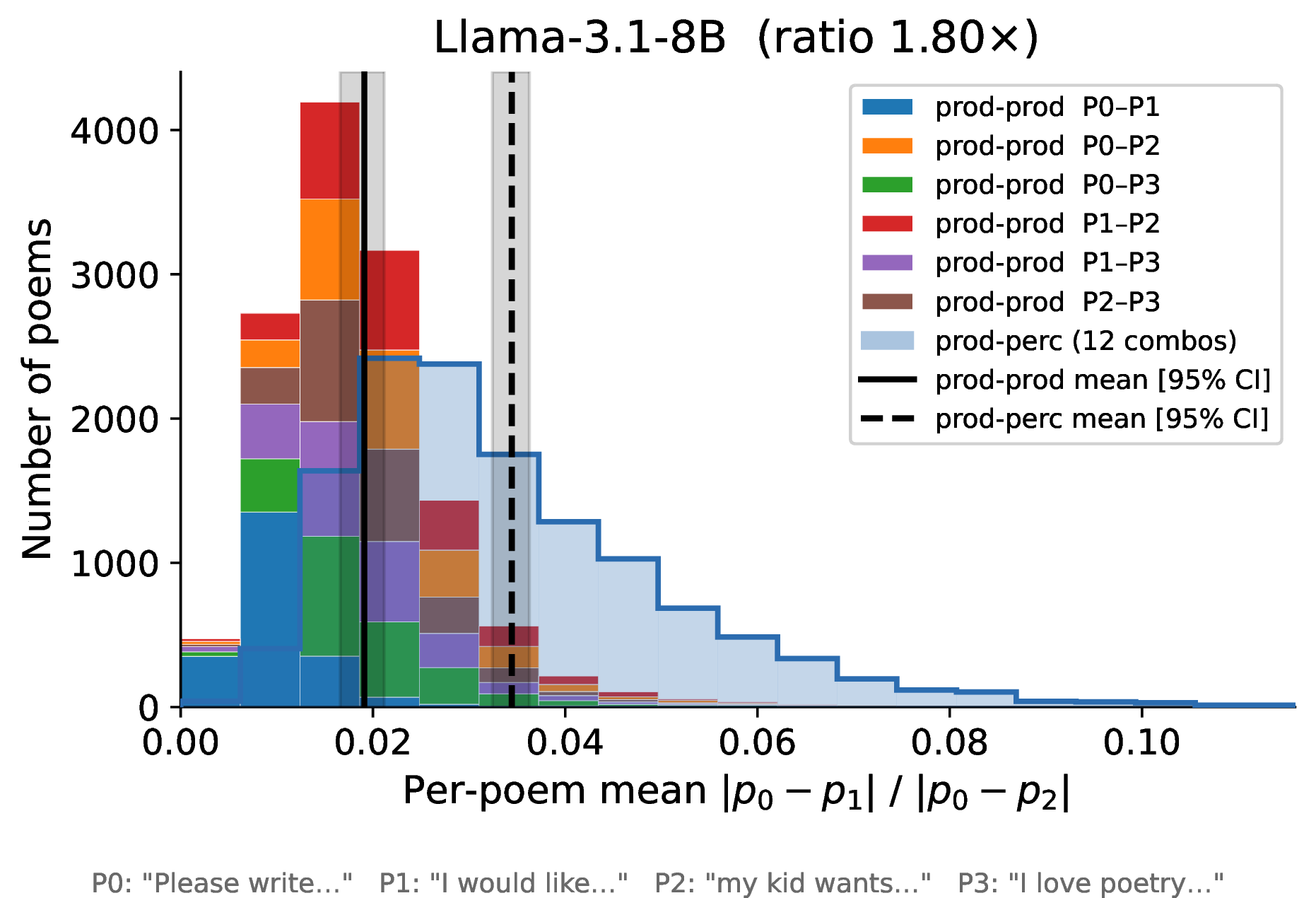
is \(0.016\) [95 % CI: \(0.013\), \(0.019\)] confirming that the production–perception asymmetry is not an artefact of a particular prompt pairing. Figure 5 shows the full per-poem distributions for Llama-3.1-8B, decomposed by prompt pair: the prod-perc mass (blue) sits clearly above the prod-prod
components (red), and the two overall means are separated with non-overlapping 95% bootstrap confidence intervals.
The distinction between prod-perc and prod-prod is also visible in correlation indices and in the exponential decay model parameters (see Table 2 in Appendix 8). Among these parameters, we are primarily interested in \(\hat{b}\), representing the rate of the curve’s decay, and \(\hat{c}\), representing the asymptote to which it would eventually drop. The results indicate that the behavior of these parameters is relatively chaotic; therefore, it cannot be simply concluded that any specific condition systematically exhibits a lower asymptote or a steeper decay curve.
4.3 Generalization across models↩︎
The results reported so far are based on a single model. To test whether the production–perception asymmetry is specific to Llama-3.1-8B or a more general property, we re-ran the identical extended pipeline (the same 1,089 topics, the four
production and three perception prompts, and the same 100-token generation limit) on four additional open-weight models: EuroLLM-9B, gemma-2-9b-it, Mistral-7B-Instruct-v0.3, and Qwen2.5-7B-Instruct. Of
these, EuroLLM-9B is a base model like Llama-3.1-8B, whereas the remaining three are instruction-tuned; this lets us probe whether the effect survives instruction tuning and the associated “helpful assistant” framing.
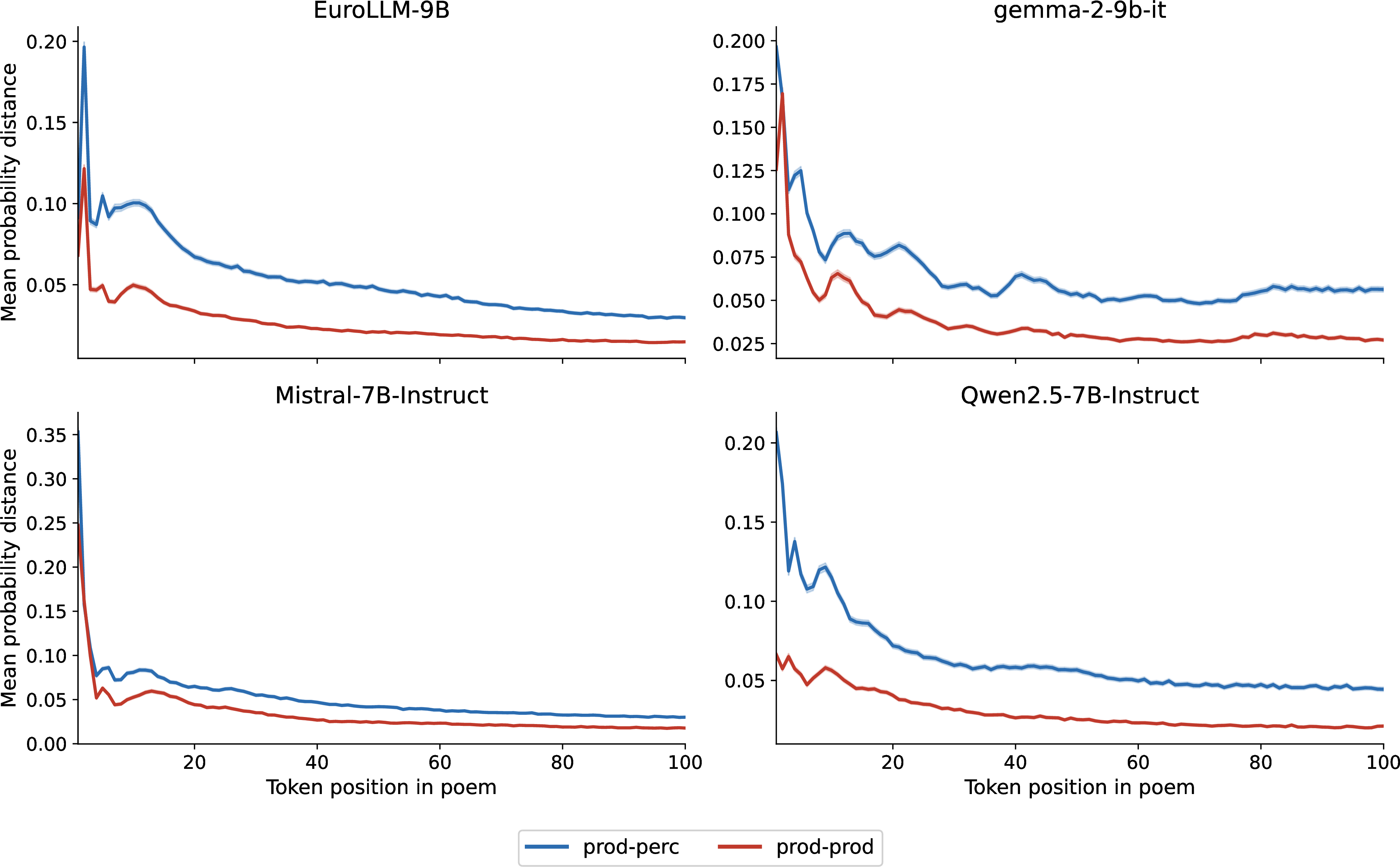
The asymmetry replicates in every model. As Figure 6 shows, the prod-perc curve lies above the prod-prod curve at every token position in all four
additional models: the distance between the probabilities assigned under production and perception framings is consistently larger than the distance between two production framings. The effect is present in the instruction-tuned models as well as the base
models, indicating that it is not an artefact of the absence of alignment. The temporal pattern is likewise preserved: in every model the prod-perc distance starts high at the beginning of the poem and decays towards the
prod-prod curve as generated context accumulates. Mistral-7B-Instruct and EuroLLM-9B behave similarly to Llama-3.1-8B, but the pattern does not fully generalize: in
gemma-2-9b-it and Qwen2.5-7B-Instruct the two curves do not converge, and the parameter \(c\) remains distinct.
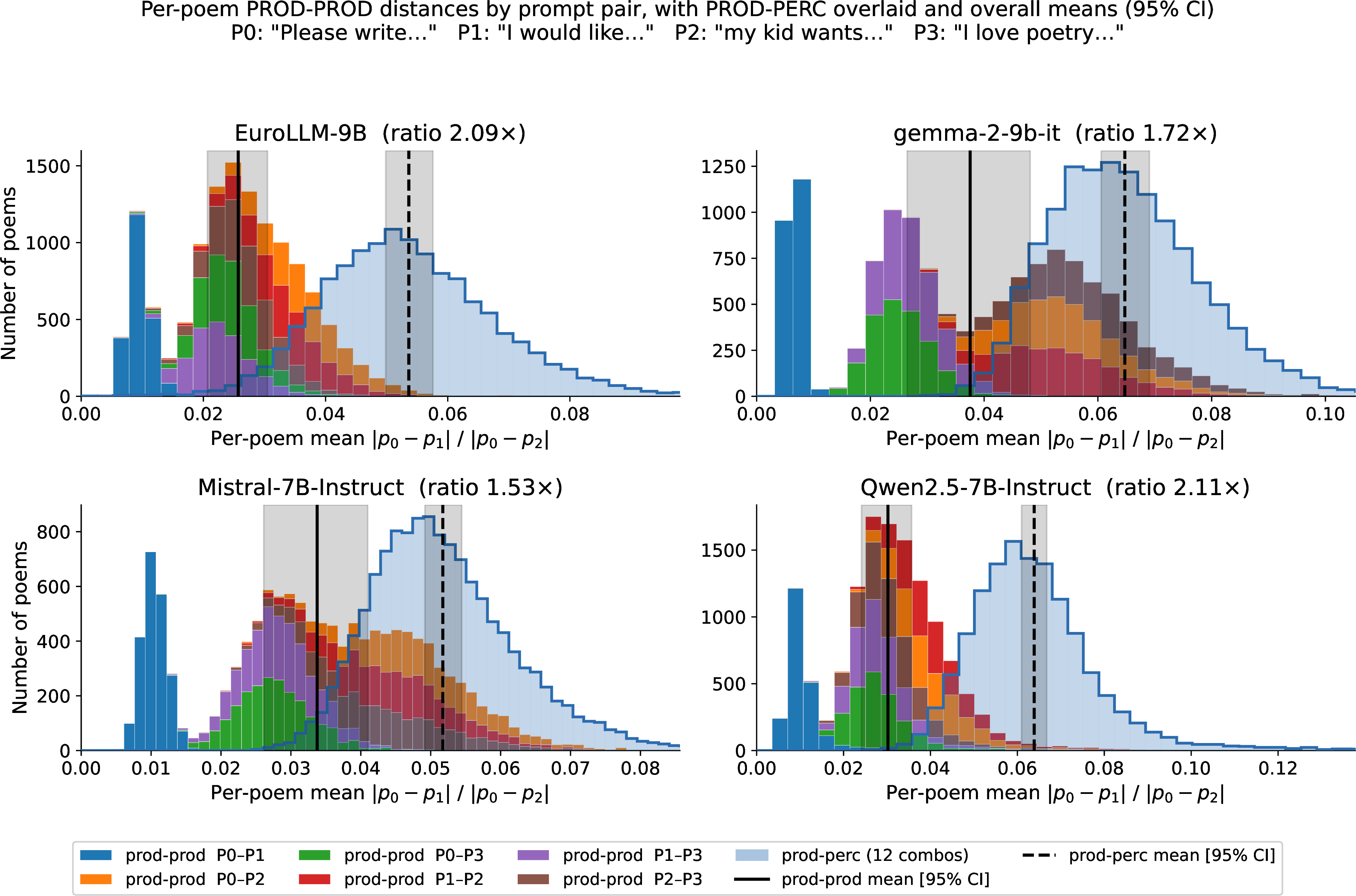
Quantitatively, the effect is substantial and consistent across all five models. The overall mean prod-perc distance exceeds the prod-prod distance by a factor of \(1.80\) [95% CI \(1.77\), \(1.83\)] for Llama-3.1-8B, \(2.09\) [\(2.07\), \(2.10\)] for EuroLLM-9B, \(1.72\) [\(1.71\), \(1.74\)] for gemma-2-9b-it, \(1.53\) [\(1.52\), \(1.55\)] for Mistral-7B-Instruct, and \(2.11\) [\(2.10\), \(2.13\)] for Qwen2.5-7B-Instruct; every interval lies well above \(1\) (each ratio pools \({\sim}13{,}000\) poems per condition), and in each model
the two per-condition means are separated with non-overlapping 95% bootstrap CIs.
One apparent irregularity is worth addressing. When the per-poem prod-prod distances are pooled across prompt pairs, their distribution can appear bimodal (e.g.EuroLLM-9B) or trimodal
(e.g.gemma-2-9b-it) rather than unimodal. This is a pooling artefact rather than a sign of an ill-behaved effect: some production prompt pairs are near-paraphrases of one another (for instance prod\(_0\), “Please write a poem about X,” and prod\(_1\), “I would like you to write a poem about X”), and for most models these near-identical pairs yield very small
distances while more dissimilar pairs yield larger ones, producing separate humps in the pooled histogram. Decomposing the prod-prod distances by individual prompt pair shows that each pair is cleanly unimodal (Figure 7), confirming that the multimodality reflects the mixture of qualitatively different prompt pairs rather than any instability in the underlying measurement.
5 Conclusion↩︎
This exploratory study examined the production–perception distinction in LLMs through direct token probability measurements, examining whether prompt framing alone—with no change in the generated text—induces a systematic divergence in the model’s
probability distributions. Our results show that it does. Probabilities assigned to poem tokens under a perception-oriented prompt diverge substantially and consistently from those assigned under a rephrased production prompt, with the
production–perception condition showing 1.82× larger mean absolute distances than the production–production control in Llama-3.1-8B. This divergence is not an artifact of prompt rephrasing per se, as the production–production condition yields
near-ceiling correlations across poems, confirming that the effect is specific to the change in communicative framing. The extended experiment across four production and three perception prompts further strengthens this conclusion, confirming that the
asymmetry is not an artifact of any particular prompt pairing but a robust consequence of shifting communicative framing (see Section 4).
We also found that the effect changes over the course of the poem. The perception prompt has the biggest impact at the beginning of the sequence, but as more tokens are generated, the two conditions become more similar. In other words, the prompt matters most at the start, but the generated text gradually takes over and reduces the difference between conditions. This pattern is consistent across prompt pairs at the level of overall magnitude, though as noted in Section 4, the specific shape of the temporal dynamics (decay rate and asymptote) varies considerably across prompt combinations and models.
These results are relevant for several reasons. First, they demonstrate that a base model without instruction tuning or fine-tuning encodes something functionally analogous to a production–perception distinction at the level of its probability distributions. This is noteworthy given that, as [7] and [17] argue, LLMs use the same underlying mechanism for input and output processing. One might therefore expect no difference at all. Our results suggest, however, that some form of the distinction is nonetheless present, even if it may be weaker and more context-dependent than in humans. Moreover, this distinction is not idiosyncratic to a single model: it replicates across five open-weight models and persists in instruction-tuned models as well as base models (Section 4.3). This finding is particularly noteworthy in light of the broader architectural trajectory of the field: the practical abandonment of encoder-decoder models in favor of decoder-only architectures implicitly treats separate perception and production mechanisms as unnecessary—yet our results suggest that even within a fully shared-parameter, decoder-only framework, prompt framing alone is sufficient to induce a functionally meaningful asymmetry between the two modes.
Second, our methodological approach—using direct token probabilities rather than metalinguistic prompting for examination of distinction between language production and perception—proved to be successful. [18] demonstrated that prompted responses systematically diverge from a model’s underlying probability distributions, and that this divergence increases as the prompt moves further from direct next-word prediction. This means that if we had asked the model to actually produce a rating, we would have been measuring not just how the model represents the text, but also how well it can talk about language, which is a separate ability. By using the perception prompt only as a framing context, and never actually collecting the rating, we avoid this problem. This way, we get a cleaner look at how the prompt framing itself affects the model’s internal probability distributions. We suggest our methodological approach for future examinations of production and perception in LLMs.
6 Limitations↩︎
Several limitations should be noted. While we replicated the effect across five models (Section 4.3), all are open-weight models in the 7–9B range, and we examined only a single creative domain (simple poems), which limits generalizability. Future work should test whether the observed divergence replicates across larger models, additional model families, and other text genres. Additionally, [22] argue that probabilities derived from internal layers of LLMs may better capture certain aspects of language processing than final-layer probabilities. Extending our paradigm to internal-layer probability extraction could reveal whether the production–perception divergence we observe is uniform across layers or concentrated at particular depths—a question with important implications for understanding where and how prompt framing is encoded in the model. Lastly, while we observed a difference between production and production–perception conditions, the correlation between production and perception token probabilities was high. This raises an important interpretive question: although we can establish that a statistically reliable difference exists, it remains unclear how meaningful this difference is in magnitude, and consequently, how directly these findings can be mapped onto human behavior. Future work should develop clearer criteria for what degree of divergence between conditions would constitute a theoretically meaningful difference when using LLMs as proxies for human cognitive processing.
Acknowledgments↩︎
Funding↩︎
Jiří Milička was supported by Czech Science Foundation Grant No. 24-11725S, gacr.cz (“Large language models through the prism of corpus linguistics”). Anna Marklová was supported by Primus Grant PRIMUS/25/SSH/010. Generating and analyzing of several datasets was supported by the project “Human‐centred AI for a Sustainable and Adaptive Society” (reg. no.: CZ.02.01.01/00/23_025/0008691), co‐funded by the European Union.
Declaration on using AI↩︎
We consulted Claude 4.6 Sonnet and Opus, Gemini 3 Pro, and GPT 5.2 for the stylization and editing of this article (however, all literature research was conducted by humans, and the core ideas originate entirely from the authors). The analysis scripts were also largely generated using these models (with all code thoroughly reviewed and verified by the authors).
7 Data Availability↩︎
The data and scripts used in this study are publicly available at https://osf.io/sc3ra/overview?view_only=7a0f407eccd94f289e3506727a4430c9 (anonymous link).
8 Per-scenario results for Llama-3.1-8B↩︎
| Scenario | Correlation [95% CI] | Distance [95% CI] | Param. \(\hat{b}\) [95% CI] | Param. \(\hat{c}\) [95% CI] |
|---|---|---|---|---|
| Production–Perception (prod-perc) | ||||
| prod\(_0\) / perc\(_0\) | 0.978 [0.976, 0.979] | 0.034 [0.033, 0.035] | 0.021 [0.008, 0.036] | 0.018 [0.005, 0.024] |
| prod\(_0\) / perc\(_1\) | 0.974 [0.972, 0.975] | 0.038 [0.037, 0.040] | 0.010 [0.008, 0.019] | 0.004 [0.000, 0.018] |
| prod\(_0\) / perc\(_2\) | 0.975 [0.973, 0.976] | 0.038 [0.037, 0.039] | 0.009 [0.006, 0.019] | 0.005 [0.000, 0.021] |
| prod\(_1\) / perc\(_0\) | 0.974 [0.972, 0.976] | 0.037 [0.036, 0.038] | 0.009 [0.005, 0.022] | 0.007 [0.000, 0.024] |
| prod\(_1\) / perc\(_1\) | 0.973 [0.971, 0.974] | 0.040 [0.039, 0.041] | 0.018 [0.007, 0.034] | 0.019 [0.000, 0.028] |
| prod\(_1\) / perc\(_2\) | 0.973 [0.970, 0.975] | 0.039 [0.038, 0.040] | 0.026 [0.009, 0.049] | 0.025 [0.011, 0.031] |
| prod\(_2\) / perc\(_0\) | 0.980 [0.978, 0.981] | 0.034 [0.033, 0.035] | 0.041 [0.031, 0.051] | 0.021 [0.019, 0.023] |
| prod\(_2\) / perc\(_1\) | 0.977 [0.975, 0.978] | 0.037 [0.036, 0.038] | 0.049 [0.039, 0.060] | 0.025 [0.023, 0.026] |
| prod\(_2\) / perc\(_2\) | 0.977 [0.976, 0.979] | 0.037 [0.036, 0.038] | 0.038 [0.026, 0.050] | 0.024 [0.021, 0.026] |
| prod\(_3\) / perc\(_0\) | 0.982 [0.980, 0.983] | 0.028 [0.027, 0.029] | 0.057 [0.032, 0.089] | 0.020 [0.018, 0.022] |
| prod\(_3\) / perc\(_1\) | 0.976 [0.974, 0.978] | 0.032 [0.031, 0.033] | 0.051 [0.027, 0.080] | 0.023 [0.020, 0.026] |
| prod\(_3\) / perc\(_2\) | 0.978 [0.974, 0.981] | 0.030 [0.029, 0.031] | 0.043 [0.005, 0.109] | 0.020 [0.000, 0.026] |
| Production–Production (prod-prod) | ||||
| prod\(_0\) / prod\(_1\) | 0.998 [0.997, 0.998] | 0.010 [0.010, 0.010] | 0.040 [0.005, 0.170] | 0.007 [0.001, 0.009] |
| prod\(_0\) / prod\(_2\) | 0.990 [0.990, 0.991] | 0.023 [0.022, 0.023] | 0.020 [0.006, 0.036] | 0.013 [0.001, 0.017] |
| prod\(_0\) / prod\(_3\) | 0.990 [0.987, 0.991] | 0.021 [0.020, 0.022] | 0.021 [0.007, 0.038] | 0.012 [0.000, 0.015] |
| prod\(_1\) / prod\(_0\) | 0.996 [0.995, 0.997] | 0.011 [0.011, 0.012] | 0.263 [0.001, 0.703] | 0.008 [0.000, 0.011] |
| prod\(_1\) / prod\(_2\) | 0.988 [0.987, 0.989] | 0.024 [0.023, 0.025] | 0.014 [0.004, 0.041] | 0.009 [0.000, 0.019] |
| prod\(_1\) / prod\(_3\) | 0.989 [0.988, 0.990] | 0.023 [0.022, 0.024] | 0.063 [0.028, 0.103] | 0.018 [0.016, 0.020] |
| prod\(_2\) / prod\(_0\) | 0.990 [0.989, 0.991] | 0.022 [0.021, 0.022] | 0.057 [0.041, 0.077] | 0.015 [0.014, 0.017] |
| prod\(_2\) / prod\(_1\) | 0.991 [0.990, 0.992] | 0.022 [0.021, 0.023] | 0.040 [0.031, 0.050] | 0.015 [0.013, 0.016] |
| prod\(_2\) / prod\(_3\) | 0.992 [0.990, 0.993] | 0.021 [0.020, 0.022] | 0.056 [0.040, 0.073] | 0.014 [0.013, 0.016] |
| prod\(_3\) / prod\(_0\) | 0.990 [0.988, 0.992] | 0.019 [0.018, 0.021] | 0.030 [0.005, 0.068] | 0.011 [0.000, 0.015] |
| prod\(_3\) / prod\(_1\) | 0.991 [0.989, 0.992] | 0.019 [0.018, 0.020] | 0.033 [0.005, 0.069] | 0.012 [0.000, 0.015] |
| prod\(_3\) / prod\(_2\) | 0.990 [0.989, 0.992] | 0.020 [0.019, 0.021] | 0.055 [0.033, 0.080] | 0.014 [0.013, 0.016] |
4pt
References↩︎
From here onward, we use the term perception for the process most commonly used in the psycholinguistic literature to describe the role of the receiver in communication. Other terms, such as interpretation or comprehension, have also been used for this process.↩︎