Abstract
Agentic systems increasingly improve themselves by editing skills: prompts, rubrics, plans, tool contracts, examples, validators, and traces. Skill edits are not independent coordinates in a vector space: they are local repairs to structured artifacts whose effects are observed only after rollout, validation, and critique. Distinct edits can have the same immediate visible effect while differing in routing context, template state, guardrail scope, or future composability. The order of edits can matter as well: repairing a schema before a normalization rule need not be equivalent to applying the same edits in the reverse order. This paper introduces a new framework for skill optimization called LASKO, for Lie Algebroid SKill Optimization. LASKOmodels typed, anchored Markdown skills as the base category and available edit policies as sections of a controlled Lie algebroid \(\mathcal{A}\to\mathsf{Md}\) with anchor \(\rho\). The anchor maps an edit policy to its visible Markdown effect; the kernel \(\ker(\rho)\) represents latent template, routing, or implementation structure; and the algebroid bracket measures noncommuting edit composition.
As shown in the paper, LASKOachieves order-of-magnitude speedups in skill optimization in our preliminary benchmark results, primarily because it substitutes inexpensive Lie-bracket screening tests that run in microseconds, before investing in expensive validations that require running large language models. On a causal extraction from natural language task, LASKOachieved a speedup of almost \(15 \times\) compared to a brute-force approach that validated all edits by running them through a DeepSeek V3.1 4-bit model with 671B parameters.
1 Introduction↩︎
Agentic skill optimization, exemplified by the SkillOptframework of [1], is currently one of the most important frontiers of agentic AI. SkillOptmakes a decisive step away from one-shot prompt writing and loosely controlled self-revision: it treats a skill as external textual state of a frozen agent, asks an optimizer model to propose bounded add/delete/replace edits, and accepts an edit only when it improves held-out validation performance. This discipline has a practical virtue that is easy to understate. It turns agent improvement into an experimental loop: propose a skill repair, roll out the agent, gate the edit on validation performance, and repeat.
The difficulty is that the search space is not flat. A skill is a structured artifact: a prompt, rubric, schema, plan, tool contract, validator, example set, or trace summary. A failed rollout may be caused by any one of these anchors, or by an interaction among several of them. Two edits can look locally reasonable and still fail as a pair; conversely, two weak edits may become productive only in the right order. Repairing a schema before a normalization rule, adding an abstention policy before a formatting contract, or installing a validator before a final-answer template are order-sensitive operations. A short-horizon SkillOptloop that validates only single edits can therefore miss the actual repair, while exhaustive enumeration of ordered edit programs quickly becomes the wrong place to spend expensive rollout calls.
This paper proposes that this is the central geometric problem of agentic skill optimization. We call the proposed generic framework LASKO: Lie Algebroid SKill Optimization. The aim is not merely to formalize an already successful method after the fact. The aim is to expose the geometry that can improve systems such as SkillOpt: where an edit acts, which part of its effect is visible, what hidden state it carries, how validation losses pull back to artifact anchors, and which pairs of repairs fail to commute. In this view, the key object is not a scalar score for an isolated prompt edit, but the local algebra of edits around a typed skill artifact.
Infinitesimal Causality (IC) [2] supplies the first piece of this algebra. It replaces finite counterfactual guesses with local interventions and studies their Lie brackets: if two infinitesimal interventions fail to commute, their bracket records a local composition defect. Earlier work proposed Lie-algebraic methods for latent-confounded causal discovery, specifically BRIDGE(Bracket Residuals for Interventional Discovery and Geometric Estimation) and SKFM(Spectral Kan-Do Flow Matching), which use bracket residuals to diagnose hidden causal structure [3]. Skill optimization needs the same idea, but with one crucial lift: the controlled edit chosen by an optimizer is not identical to the visible change observed in a document, rollout, model, or trace.
The remedy is to formulate ICover Lie algebroids. There is the controlled intervention chosen by an optimizer or agent, and there is the visible tangent effect observed on a structured skill artifact. A controlled intervention may have internal implementation coordinates, latent state, routing context, or template variables that are not visible at first order. It may nevertheless bracket nontrivially with future interventions. This suggests replacing the tangent bundle \(T\mathcal{M}\) by a Lie algebroid \[\mathcal{A}\longrightarrow \mathcal{M}, \qquad \rho : \mathcal{A}\longrightarrow T\mathcal{M}, \qquad [\,\cdot,\cdot\,]_\mathcal{A}: \Gamma(\mathcal{A})\times\Gamma(\mathcal{A})\to \Gamma(\mathcal{A}).\] The sections of \(\mathcal{A}\) are controlled intervention modes. The anchor \(\rho\) maps a controlled intervention to its visible infinitesimal effect. The kernel \(\ker(\rho)\) contains intervention structure with no immediate visible tangent effect: latent, isotropy, or unanchored degrees of freedom. The algebroid bracket models the infinitesimal algebra of intervention composition before this algebra is projected into observable dynamics. Operationally, the bracket becomes a screening statistic: high-bracket edit pairs are the pairs worth validating when rollout calls are expensive.
For LASKO, the base is not merely a Euclidean parameter space. We model skills in a tangent category of typed, anchored Markdown objects: documents, rubrics, prompts, tool contracts, plans, examples, validators, and traces. A practical instance—for example a SkillOpt, BASKET, ROCKET, or Democritus workflow—edits these artifacts, rolls them out, receives critiques or validation failures, and then edits again. The forward pass is the tangent functor: local edits push forward through rewrites, rollouts, and observation contexts. The backward pass requires reverse tangent or cotangent structure: losses and critiques pull back to anchors. A controlled Lie algebroid over this Markdown base then captures which edit policies are available, how they compose, and where hidden procedural structure lives. In a controlled ten-anchor benchmark we use this structure to prioritize ordered edit pairs before validation. The result is the empirical wedge of the paper: a LASKO-prioritized policy recovers the exhaustive ordered-pair solution with a small validation budget, while greedy single-edit search misses the interaction.
1 summarizes this specialization. The lower row is the typed Markdown base: anchors such as guardrails, schema fields, evidence edges, plan nodes, and validator traces are the locations at which local artifact changes and rollout observations are recorded. The upper row is the controlled algebroid of edit policies. A section \(s\) or \(t\) is not itself a visible Markdown change; its visible effect is obtained only after applying the anchor \(\rho\). The bracket \([s,t]_\mathcal{A}\) records the infinitesimal order-sensitivity of composing two skill edits, and its kernel component represents latent template, routing, or implementation structure that may leave the current document unchanged while changing how later edits behave. The feedback arrow from validator traces to evidence anchors depicts the reverse pass: losses and critiques are transported back to the artifact locations where the skill can be repaired.
ICwas originally formulated over ordinary tangent bundles. The hypothesis developed here is that, in structured applications such as agentic skill optimization, the better formulation is over controlled Lie algebroids of interventions. LASKOis the corresponding algebroid optimization problem over a tangent category of agent-facing artifacts; SkillOptis one concrete optimizer that can instantiate this geometry.

2 Background↩︎
Before developing the algebroid formalism, we fix the systems vocabulary and the related lines of work. SkillOptwas introduced by [1] as an executive strategy for self-evolving agent skills. We use the term in that spirit, and focus on the geometric structure of the underlying optimization problem: an agentic system improves operational skills by editing artifacts such as prompts, rubrics, plans, schemas, examples, tool contracts, validators, traces, and critique summaries. A SkillOpt update is therefore not only a parameter update. It is a structured intervention on a typed artifact or workflow, followed by rollout, validation, credit assignment, and another edit. This paper asks for the analogue of gradient geometry for that setting: what is the local direction of an edit, where is its visible effect, what hidden state does it carry, and how do we measure order-dependence among repairs?
The motivating agent-system examples are BASKETand ROCKET, introduced in the broader diagrammatic agent-systems program of Categories for AGI [4]. For the purposes of this paper, BASKET should be read as a workflow-construction mechanism: it turns source material such as filings, evidence fragments, or task descriptions into a typed diagram of claims, risks, plans, tool calls, and synthesized narratives. ROCKET should be read as a local workflow-repair mechanism: it searches near such a diagram by repairing plan nodes, replacing weak evidence edges, adding missing validators, or changing synthesis routes. These systems motivate why skills should be modeled as partially ordered diagrams of anchored artifacts rather than as flat prompt strings.
The causal lineage comes from structural causal models and do-calculus [5], potential-outcome causal inference [6], and constraint-based causal discovery [7]. IC [2] reframes interventions infinitesimally: interventions become local vector fields, and their Lie brackets measure local order-dependence. BRIDGEand SKFM [3] use bracket residuals as diagnostics for latent or missing causal directions. In this paper, those ideas are imported into LASKO: a skill edit is treated as an intervention, validator failures provide observable consequences, and noncommuting edits signal hidden structure or missing anchors in the workflow.
The geometric and categorical lineage supplies the technical language for this move. Lie algebroids and their integrability theory [8], [9] separate a controlled intervention from its visible anchored effect by means of an anchor map \(\rho:\mathcal{A}\to T\mathcal{M}\). Tangent categories provide the categorical foundation for forward derivative structure [10], while involution algebroids [11] provide a tangent-category analogue of involutive closure. In the present paper, the base object is usually not a smooth manifold but a typed Markdown workflow. The role of the algebroid is to model the controlled edit policies over that workflow, their visible anchored effects, and their hidden kernel structure.
Finally, neural-adapter composition is a useful parallel example, but not a target of this paper. Low-rank adaptation [12] motivates interventions on neural models, and ALLORA/LICKET [13] study bracket-control objectives for composing such adapters. Those ideas support the general intuition that controlled interventions can carry hidden structure above their visible effect. Here, however, the worked-out application is LASKOover typed artifacts.
3 A Minimal Geometric Vocabulary↩︎
This section gives the reader a brief overview of terminology that is standard in differential geometry, which we will generalize to arbitrary tangent categories.
A base space \(\mathcal{M}\) is the space of states that skill optimization searches through. In ordinary optimization this might be a parameter space. In agentic skill optimization it may be a space of typed Markdown workflows, where a point is a particular skill artifact with prompts, schemas, validators, examples, traces, and anchors. A tangent vector at a point \(x\in\mathcal{M}\) is a first-order direction in which that state can visibly change. The collection of all such directions over all points is the tangent bundle \(T\mathcal{M}\to\mathcal{M}\). Informally, the fiber \(T_x\mathcal{M}\) is the local menu of visible infinitesimal changes at \(x\).
A vector bundle is the same organizational idea with a more general fiber. Instead of attaching visible state changes to each \(x\), we attach some linear space of local data. For this paper the important bundle is \(\mathcal{A}\to\mathcal{M}\): the fiber \(\mathcal{A}_x\) contains controlled edit modes available at the skill state \(x\). These are not necessarily visible edits yet. They may include which optimizer policy is used, which validator route is active, which template slot is being filled, or which rollout context is selected. A section of a bundle is a rule that chooses one fiber element at every state. Thus a vector field is a section of \(T\mathcal{M}\), while a skill-edit policy is a section of \(\mathcal{A}\).
A bundle map is a structure-preserving map between bundles over the same base. The most important one here is the anchor \[\rho:\mathcal{A}\longrightarrow T\mathcal{M}.\] It sends a controlled edit mode to the visible first-order effect it produces on the skill artifact. The distinction is useful because two controlled edits can look identical in the present document while carrying different implementation context for later edits. The kernel \(\ker(\rho)\) is the part of the controlled edit state that has no immediate visible effect but can still matter downstream.
Finally, a Lie bracket measures order-dependence between two local directions. If \(X\) and \(Y\) are visible vector fields, then \([X,Y]\) captures the leading-order difference between “move a little along \(X\) and then \(Y\)” and “move a little along \(Y\) and then \(X\).” In skill optimization, this is the mathematical version of a common engineering fact: repairing the schema and then rewriting the examples may not be equivalent to rewriting the examples and then repairing the schema. A Lie algebroid has the same idea upstairs, on controlled edit policies: \[[s,t]_\mathcal{A} \quad\text{with}\quad \rho([s,t]_\mathcal{A})=[\rho(s),\rho(t)].\] The bracket says how controlled edits compose before we forget their internal context by applying the anchor.
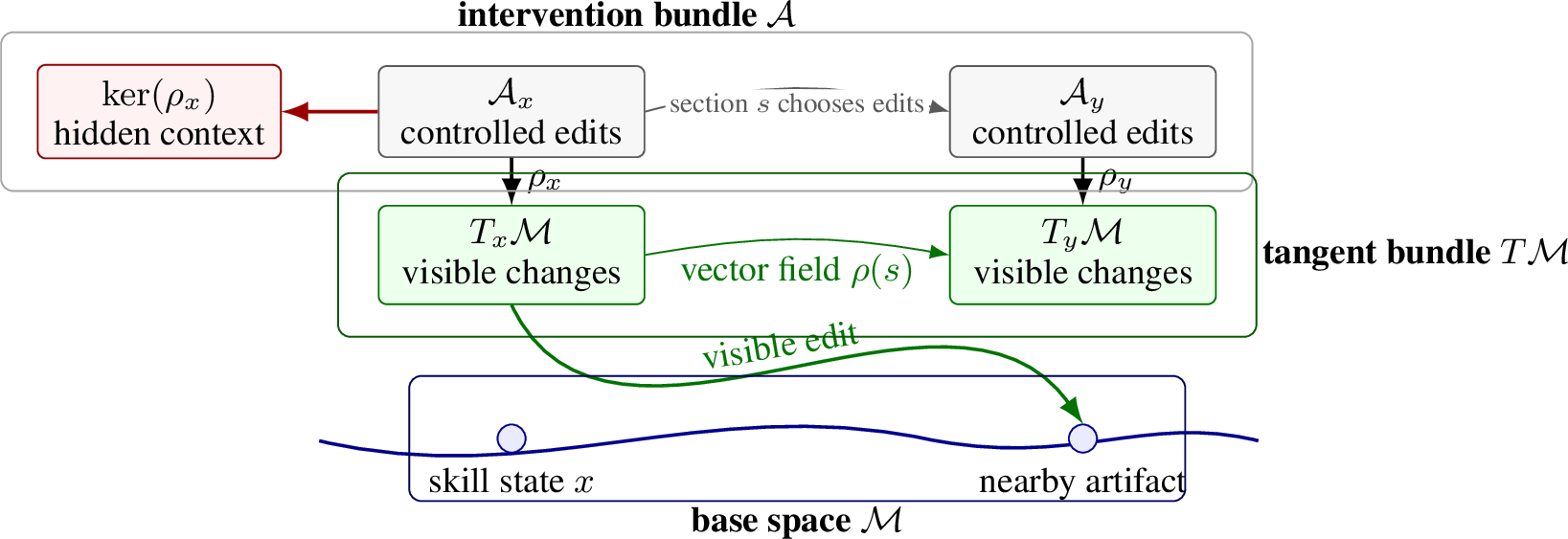
With this vocabulary, the main claim can be stated plainly. A flat optimizer acts as if every edit were already a visible tangent vector. A LASKOagent uses the richer picture in 2: controlled edit policies live in \(\mathcal{A}\), visible artifact changes live in \(T\mathcal{M}\), the anchor connects the two, and brackets measure whether local repairs compose predictably.
4 LASKO: Lie Algebroid SKill Optimization↩︎
The shift from tangent bundles to Lie algebroids is not a change of metaphor; it is the mathematical move required when an intervention has internal structure not visible in its first-order effect. In the flat approximation, an intervention is simply a vector field on a model, data, or artifact manifold. In the algebroid approximation, the intervention is a section \(s\in\Gamma(\mathcal{A})\) and only its anchor \(\rho(s)\) is visible as a vector field. The difference matters whenever two edits have the same immediate artifact effect but different future composition behavior.
4.1 LASKOand Markdown derivations↩︎
For LASKO, the base object is not a neural parameter vector but a typed Markdown workflow. The relevant algebroid is the bundle of controlled derivations on a Markdown presheaf or workflow diagram. A section is a possible skill edit policy: strengthen a guardrail, add an example, repair a schema, split a plan node, or change a validation route. The anchor evaluates that derivation on a concrete document or workflow and produces the visible Markdown edit. The kernel contains template variables, latent rubric assumptions, unfilled slots, hidden tool preconditions, and validator-routing choices that do not change the current artifact but alter future edit composition.
This is also the correct place to state the topological intuition carefully. For an ordinary tangent bundle, global nonvanishing vector fields are constrained by familiar Euler-class phenomena. For a Lie algebroid, analogous obstructions should be formulated through the characteristic classes or cohomology of the algebroid and through the anchor. Thus the agentic analogue is not a literal hairy-ball theorem for Markdown. It is the expectation that nontrivial algebroid topology or cohomology can force global skill policies to have anchor-zero states, singularities, or fixed points: \[\rho(s)=0.\] Operationally, these are halt states, unresolved templates, validator dead-ends, or workflow points at which a nominally global skill cannot make a visible admissible move without adding new local structure.
4.2 Scope of the present paper↩︎
The same algebroid lift has natural analogues in causal discovery and neural adapter composition, but those analogues are not developed here. BRIDGEand SKFMmotivate the use of bracket residuals as diagnostics for missing directions, while ALLORAand LICKETmotivate bracket control in adapter composition. In the present paper they serve only as lineage and vocabulary. The technical object studied below is LASKOover typed workflow artifacts: controlled sections are edit policies, the anchor is the realized artifact change, and feedback comes from rollout traces, validators, and critiques. SkillOptis the motivating optimizer instance, while BASKET, ROCKET, and Democritus supply workflow-specific instantiations.
This boundary is important. Algebroidic versions of BRIDGE/SKFMwould ask how to reconstruct hidden intervention directions from observed bracket residuals. Algebroidic versions of ALLORA/LICKETwould ask how adapter routing, rank, and constraint transport live above visible parameter updates. Both are interesting follow-on projects, but they would require their own observation models and experimental protocols. The rest of this paper stays with the LASKOquestion: how should an agent optimize structured skills when edits are anchored, typed, validated, and order-dependent?
5 From Tangent-Bundle IC to Lie Algebroid IC↩︎
5.1 The tangent-bundle baseline↩︎
Let \(\mathcal{M}\) be a statistical, behavioral, or model-state manifold. In the original ICviewpoint, an intervention \(\operatorname{do}(X)\) is represented locally by a vector field \(X\in \Gamma(T\mathcal{M})\). If two interventions are applied in infinitesimal orders, their leading order order-sensitivity is measured by the Lie bracket \[[X,Y] = XY - YX.\] For a visible family of interventions \(X_1,\ldots,X_k\), write \[\mathcal{V}= \operatorname{span}\{X_1,\ldots,X_k\}.\] The Frobenius diagnostic asks whether \([X_i,X_j]\in \mathcal{V}\) for all \(i,j\). If the bracket leaves the visible span, then the observed intervention family is not closed. In a LASKOsetting, this non-closure means that the visible edit library is missing some repair direction, hidden workflow condition, or singular regime that affects later rollouts.
5.2 Lie algebroids↩︎
Definition 1 (Lie algebroid). A Lie algebroid over a smooth base \(\mathcal{M}\) is a vector bundle \(\mathcal{A}\to\mathcal{M}\) equipped with an anchor bundle map \(\rho:\mathcal{A}\to T\mathcal{M}\) and a Lie bracket \([\,\cdot,\cdot\,]_\mathcal{A}\) on sections \(\Gamma(\mathcal{A})\) satisfying the Leibniz rule \[[s_1,f s_2]_\mathcal{A} = f[s_1,s_2]_\mathcal{A}+ (\rho(s_1)f)s_2\] for smooth functions \(f\in C^\infty(\mathcal{M})\) and sections \(s_1,s_2\in\Gamma(\mathcal{A})\). The anchor also preserves brackets: \[\rho([s_1,s_2]_\mathcal{A}) = [\rho(s_1),\rho(s_2)].\]
For IC, \(\mathcal{A}\) should be read as the bundle of available controlled interventions. A section \(s\in \Gamma(\mathcal{A})\) is not yet a visible vector field; it is a controlled action mode. Its visible effect is \(\rho(s)\in\Gamma(T\mathcal{M})\). This gives four objects with distinct empirical meanings:
| Object | Interpretation |
|---|---|
| \(s\in\Gamma(\mathcal{A})\) | controlled intervention mode |
| \(\rho(s)\in\Gamma(T\mathcal{M})\) | visible statistical or behavioral effect |
| \([s_i,s_j]_\mathcal{A}\) | abstract composition bracket of interventions |
| \([\rho(s_i),\rho(s_j)]\) | visible order-sensitivity in the base |
5.3 Kernel, image, and latent structure↩︎
The kernel of the anchor is the isotropy algebra \[\ker(\rho)_x = \{a\in \mathcal{A}_x : \rho(a)=0\}.\] When the rank is regular, this forms a bundle of Lie algebras. Elements of \(\ker(\rho)\) have no immediate visible first-order effect, but they can bracket with other sections and affect later composition. In LASKOterms, this is latent workflow state: not merely an unobserved variable, but an unanchored edit degree of freedom that changes the algebra of future repairs.
The image \(\rho(\mathcal{A})\subseteq T\mathcal{M}\) is the visible distribution generated by controlled interventions. For a genuine Lie algebroid, the full image of all sections is closed under the ordinary Lie bracket whenever it is a smooth distribution, because the anchor preserves brackets. Empirical non-closure therefore has to be interpreted carefully: it indicates non-closure of the chosen finite visible family, rank singularities, estimation error, projection error, or a missing extension of the intervention algebroid. It is not an invariant contradiction inside an exact Lie algebroid.
This is precisely where involution algebroids are useful. Burke and MacAdam [11] formulate involutivity in the setting of tangent categories, generalizing the closure condition that ordinary Lie algebroids impose over smooth manifolds. For LASKO, this supplies the right abstraction for the question: does the finite library of visible edit policies close under the ambient workflow tangent structure, or must the skill be completed by adding hidden, singular, or anchor-invisible repair modes? In other words, the empirical closure residual estimates the gap between a measured edit library and its involutive closure.
Definition 2 (Visible Frobenius residual). Let \(\widehat{V}\) be the finite visible span of measured anchored fields \(\rho(s_1),\ldots,\rho(s_k)\), and let \(P_{\widehat{V}}\) be a local projection. The visible Frobenius residual is \[R_{\mathrm{vis}}(i,j) = (I-P_{\widehat{V}})[\rho(s_i),\rho(s_j)].\]
Definition 3 (Anchor defect residual). For an estimated, projected, finite-rank, or routed intervention model \(\widehat{\mathcal{A}}\), define the anchor defect residual \[R_{\mathrm{anchor}}(i,j) = \widehat{\rho}([s_i,s_j]_{\widehat{\mathcal{A}}}) - [\widehat{\rho}(s_i),\widehat{\rho}(s_j)].\] For an exact Lie algebroid this quantity is zero by definition. In learned systems it is a modeling residual: it measures whether the estimated controlled intervention algebra explains the observed visible bracket.
5.4 Regular, equivalent, and singular cases↩︎
LASKOdecomposes the skill optimization task into three cases. First, in the regular case \(\operatorname{rank}(\rho)\) is locally constant. The image of the anchor behaves like a smooth distribution, and Frobenius-style closure can be studied locally. Second, in equivalence or Atiyah-style cases, multiple controlled interventions have the same anchored effect. The kernel then represents symmetries, redundant descriptions, conservation laws, or representation choices. A skill optimizer should quotient or monitor these directions before treating every bracket residual as a substantive missing repair mode.
Third, in the singular case, \(\operatorname{rank}(\rho)\) changes across regimes. This is the natural model for interventions that activate only under certain contexts: safety policies on risky prompts, tool contracts on tool-use tasks, citation constraints in document workflows, or evaluators active only in one task regime. Singular Lie algebroids therefore fit the variable-rank behavior that is awkward in ordinary vector-space models of skill editing.
6 The Tangent Category of Typed Markdown↩︎
LASKOoperates over artifacts rather than just vectors. We model the base category \(\mathsf{Md}\) as typed, anchored Markdown. An object is a tuple \[M=(A,P,\tau,\sigma)\] where \(A\) is a finite anchor tree or poset, \(P\) is a Markdown parse tree indexed by anchors, \(\tau\) assigns block types, and \(\sigma\) stores semantic metadata such as schemas, tool names, validators, provenance, or plan graph labels. Block types include instructions, guardrails, examples, schemas, citations, tool contracts, plan nodes, plan edges, and test cases.
A morphism \(f:M\to N\) is an anchor-respecting rewrite program. It transports anchors, rewrites parse fragments, updates metadata, and preserves or explicitly coerces block types. Composition is composition of rewrite programs.
For each Markdown object \(M\), let \(E(M)\) be the fiber of admissible anchored edits. Examples include rewriting an instruction clause, strengthening a guardrail, adding an example, changing a schema field, inserting a missing plan action, rewiring a plan edge, adding a citation constraint, or modifying a tool contract. “Infinitesimal” means local and admissible relative to the typed artifact, not character-level small.
Definition 4 (Markdown tangent object). The tangent object of \(M\) is \[T M = (M,E(M)).\] For a rewrite \(f:M\to N\), the tangent map is \[T f(M,\delta) = (N,Df_M(\delta)),\] where \(Df_M\) transports anchored edits through the rewrite program.
Proposition 1 (Typed Markdown tangent structure). Assume each edit fiber \(E(M)\) is an additive commutative monoid or module over compatible edit merge, and each rewrite \(f:M\to N\) has an edit pushforward \(Df_M:E(M)\to E(N)\) preserving zero, compatible addition, identity, and composition: \[D(\operatorname{id})_M=\operatorname{id}_{E(M)}, \qquad D(g\circ f)_M = Dg_{f(M)}\circ Df_M.\] Then typed anchored Markdown objects carry the forward structure of a tangent category with tangent endofunctor \(T\).
The proposition is intentionally conditional. Raw Markdown strings do not have enough structure. The tangent category appears only after adding anchors, types, admissible edits, and a merge or conflict policy.
Once this tangent category is fixed, the appropriate closure condition for edit policies is not merely closure under a hand-written bracket. It is involutive closure internal to the tangent category. This is the point at which involution algebroids [11] become the categorical counterpart of the workflow-closure condition needed by LASKO.
7 Markdown Objects and Partially Ordered Workflows↩︎
The preceding section treats a Markdown artifact as a typed object with local anchors. For LASKO, and for the earlier BASKET/ROCKETplan-repair experiments described in Categories for AGI [4], the more operational object is usually not a single document but a partially ordered workflow of document fragments, tool calls, evidence blocks, and plan states. This section makes that base category explicit.
Definition 5 (Anchored Markdown object). An anchored Markdown object is a tuple \[M=(A,P,\tau,\sigma,\chi)\] where \(A\) is a finite anchor poset, \(P\) assigns Markdown syntax trees to anchors, \(\tau:A\to\mathsf{Type}\) assigns block roles, \(\sigma\) stores semantic metadata, and \(\chi\) records local contracts. Typical contracts include schema validity, citation availability, tool preconditions, safety constraints, evaluator hooks, and provenance obligations.
The order on \(A\) is not merely formatting. It records dependency and scope. For example, a section heading scopes its children, a tool contract scopes the tool examples that instantiate it, a claim scopes the citations supporting it, and a plan node scopes the tests used to validate it. A local edit at anchor \(a\) may therefore propagate to every anchor above or below \(a\) depending on the chosen variance: changing a schema constrains children, while changing an example may update summary metadata upward.
Definition 6 (Workflow poset). A workflow shape is a finite poset \((W,\leq)\) whose elements are typed stages: document fragments, extraction steps, tool calls, validator checks, plan states, evidence bundles, or synthesis artifacts. The relation \(u\leq v\) means that the output or contract at stage \(u\) is available to, required by, or checked before stage \(v\).
Definition 7 (Markdown workflow). A Markdown workflow is a functor \[F:W\to \mathsf{Md}\] from a workflow poset to anchored Markdown objects and anchor-respecting rewrite maps. Thus each stage \(u\in W\) has a local artifact \(F(u)\), and each dependency \(u\leq v\) has a transport map \[F_{uv}:F(u)\to F(v)\] describing how anchors, claims, contracts, or evidence flow forward through the workflow.
This definition captures the structure that BASKETand ROCKETwere using informally. BASKETconstructs a workflow diagram from text: for example, from a 10-K filing to extracted risks, operating mechanisms, plan fragments, and synthesized financial narratives. ROCKETperforms local search in the neighborhood of such a diagram: repair a plan node, replace a weak evidence edge, add a missing validator, or choose a better synthesis path. In both cases, the artifact is a partially ordered diagram of Markdown-like typed objects, not a flat prompt string.
Definition 8 (Workflow morphism). Given workflows \(F:W\to\mathsf{Md}\) and \(G:W'\to\mathsf{Md}\), a morphism \((\alpha,\eta):F\to G\) consists of an order-preserving map \(\alpha:W\to W'\) and a natural transformation \[\eta_u:F(u)\to G(\alpha(u))\] compatible with dependency maps. This morphism can refine a workflow, compress several stages, rename anchors, insert validators, or translate one plan representation into another.
The category of Markdown workflows will be denoted \(\mathsf{WfMd}\). Ordinary Markdown artifacts embed as constant or one-node workflows. This lets the theory handle both simple skill files and larger agentic workflows with the same formal language.
Tangent vectors in \(\mathsf{WfMd}\) are workflow-local edits. Concretely, an edit is a finite family \[\delta = \{(u,\delta_u)\}_{u\in S\subseteq W}\] where each \(\delta_u\in E(F(u))\) is an anchored edit and the family satisfies dependency compatibility: if \(u\leq v\), then the pushed-forward edit \(DF_{uv}(\delta_u)\) must either agree with \(\delta_v\), be absorbed by the contract at \(v\), or be recorded as a boundary residual. This is the operational origin of curvature in plan repair. Two edits may commute on isolated Markdown blocks but fail to commute once their effects are transported through the workflow poset.
Partially ordered workflows also explain why colimits and limits keep reappearing in this program. Forward execution aggregates local artifacts into a user-facing synthesis, a colimit-like operation over the workflow diagram. Backward critique restricts a global failure to the stages and anchors that could have caused it, a limit-like or cotangent operation. DBis the backward transport of this critique signal through \(W\), while ROCKET-style repair chooses the next tangent direction in \(\mathsf{WfMd}\).
8 Reverse Skill Signals and Diagrammatic Backpropagation↩︎
Forward tangent structure explains how a proposed edit moves through a skill workflow. LASKOalso needs a backward pass. After rollout, the system observes validator failures, critic comments, safety rejections, bad tool calls, or weak held-out scores. These signals are not useful until they are localized: the optimizer must decide whether the repair belongs at a schema field, a guardrail, an example, a plan node, a tool contract, or a validator.
We model this localization by a reverse tangent or cotangent structure over the workflow category: \[T^*F \to F.\] An element of \(T^*F\) is an anchored reverse skill signal: a blame assignment, critique gradient, validation residual, score delta, or loss annotation attached to stages and anchors of the workflow. For a workflow morphism \(f:F\to G\), the reverse map pulls a downstream signal back to possible upstream causes, \[T^*f : T^*G \to T^*F,\] and satisfies the reverse chain rule \[T^*(g\circ f) = T^*f \circ T^*g.\] This is the LASKOanalogue of backpropagation. The objects are not tensors alone; they are skill cards, plans, tool contracts, examples, traces, and validators connected by workflow dependencies.
Definition 9 (Diagrammatic backpropagation curvature). Let \(X\) and \(Y\) be two anchored edit fields on a workflow \(F\). Let \(\eta_{XY}\) be the reverse skill signal obtained by applying \(X\) then \(Y\), running the resulting workflow, and pulling the validation signal back to anchors. Define \(\eta_{YX}\) analogously for the opposite edit order. A diagrammatic backpropagation curvature diagnostic is \[\operatorname{Curv}_{\mathcal{D}}(X,Y) = d(\eta_{XY},\eta_{YX}),\] where \(d\) is a chosen distance between anchored reverse signals.
This curvature measures path-dependence of credit assignment. Two edit paths can produce similar final Markdown while inducing different explanations of why a validator passed or failed. Such mismatches are exactly what make long-horizon skill repair unstable: the optimizer receives a local signal, but the signal depends on the order in which previous repairs exposed, masked, or rerouted the relevant anchors.
9 LASKOas Lie Algebroid Optimization↩︎
The tangent object \(T\mathsf{WfMd}\) contains visible anchored workflow edits. A real LASKOinstance has a smaller and more structured family of controlled edit policies: repair a schema, strengthen a guardrail, add a counterexample, localize a tool contract, split a plan node, rewrite a rubric, or insert a citation constraint. Thus the natural object is a Lie algebroid \[\mathcal{A}\to \mathsf{WfMd}, \qquad \rho:\mathcal{A}\to T\mathsf{WfMd}, \qquad [\,\cdot,\cdot\,]_\mathcal{A}.\] The fiber \(\mathcal{A}_M\) is the space of controlled intervention modes available at a workflow object \(M\). The anchor \(\rho(a)\) is the visible anchored workflow edit. The kernel \(\ker(\rho)\) contains hidden procedural structure: unstated rubrics, implicit tool assumptions, latent safety policies, template variables, or unfilled slots that do not affect the current execution but change composition.
Definition 10 (LASKOresiduals). Given controlled edit sections \(s_i,s_j\in\Gamma(\mathcal{A})\), define \[\begin{align} R_{\mathrm{Md}}(i,j) &= (I-P_{\widehat{V}})[\rho(s_i),\rho(s_j)],\\ R_{\mathrm{ker}}(i,j) &= \pi_{\ker(\rho)}([s_i,s_j]_\mathcal{A}),\\ R_{\mathrm{DB}}(i,j) &= \operatorname{Curv}_{\mathcal{D}}(\rho(s_i),\rho(s_j)). \end{align}\] These measure visible edit nonclosure, hidden procedural interaction, and path-dependent reverse blame transport.
The combined causal curvature loss is \[\begin{align} \mathcal{L}_{\text{\mathrm{\small LASKO}}} = \mathcal{L}_{\mathrm{task}} &+ \lambda_{\mathrm{IC}}\sum_{i<j}\|R_{\mathrm{Md}}(i,j)\|^2 \\ &+ \lambda_{\mathrm{ker}}\sum_{i<j}\|R_{\mathrm{ker}}(i,j)\|^2 \\ &+ \lambda_{\mathrm{DB}}\sum_{i<j}\|R_{\mathrm{DB}}(i,j)\|^2 \\ &+ \lambda_{\mathrm{A}}\sum_{i,j,k}\|R_\mathcal{A}(s_i,s_j)s_k\|^2, \end{align}\] where \(R_\mathcal{A}\) is the curvature of a chosen connection on the intervention algebroid. The connection specifies how controlled edit modes transport across changed documents: \[R_\mathcal{A}(s_i,s_j)s_k = \nabla_i\nabla_j s_k - \nabla_j\nabla_i s_k - \nabla_{[s_i,s_j]_\mathcal{A}}s_k.\]
Conjecture 1 (Low-curvature skill fixed points). Let \(\Phi\) be the combined forward rollout, reverse critique, and edit-selection operator of a LASKOsystem on a typed Markdown tangent category. Under compactness, continuity, and bounded-edit assumptions appropriate to a chosen edit theory, locally optimal stable skills occur at fixed points of \(\Phi\) where the task gradient, visible IC residual, kernel interaction residual, DB curvature, and algebroid connection curvature vanish relative to the observation functor.
This is a categorical analogue of a Bellman optimality condition. Value iteration becomes repeated forward-backward transport in a tangent category. Convergence is obstructed by causal curvature: noncommuting edits, hidden procedural interactions, and path-dependent reverse blame.
10 Experimental Program: LASKOover Workflow Algebroids↩︎
The most direct way to test the framework is not to begin with an abstract algebroid reconstruction algorithm, but with a small LASKOexperiment in which all objects are inspectable. The base object is a Markdown workflow \(F:W\to\mathsf{Md}\) built from a short task document, a tool contract, a few examples, and one or more validators. The intervention algebroid is generated by a finite set of named edit policies: \[s_{\mathrm{schema}},\quad s_{\mathrm{guardrail}},\quad s_{\mathrm{example}},\quad s_{\mathrm{tool}},\quad s_{\mathrm{plan}}.\] Each section is a controlled edit mode. The anchor sends it to the visible workflow edit that is actually applied: \[\rho(s_i)\in T_F\mathsf{WfMd}.\] The experiment then compares ordered edit pairs. Starting from the same workflow \(F\), apply \(s_i\) followed by \(s_j\), and compare this with \(s_j\) followed by \(s_i\). The final artifacts, validator results, and reverse blame signals give empirical estimates of three quantities: \[\begin{align} R_{\mathrm{vis}}(i,j) &= d_{\mathrm{art}}(F_{ij},F_{ji}),\\ R_{\mathrm{DB}}(i,j) &= d_{\mathrm{blame}}(\eta_{ij},\eta_{ji}),\\ R_{\mathrm{ker}}(i,j) &= d_{\mathrm{trace}}(\theta_{ij},\theta_{ji}) \quad\text{when } d_{\mathrm{art}}(F_{ij},F_{ji})\approx 0. \end{align}\] Here \(d_{\mathrm{art}}\) measures visible artifact difference, \(d_{\mathrm{blame}}\) measures the path-dependence of validator blame, and \(d_{\mathrm{trace}}\) measures hidden procedural differences such as changed tool assumptions, different anchor provenance, or different validator routes. The last term is a practical proxy for kernel energy: the visible artifact may look unchanged, but the workflow trace shows that the controlled edit algebra has changed.
10.1 A minimal LASKObenchmark↩︎
A first benchmark can use three small workflow families.
| Workflow family | Example repair task |
|---|---|
| Skill card | Repair a tool-using Markdown skill with schema, guardrails, examples, and tests. |
| Plan graph | Repair a partially ordered plan with missing preconditions and inconsistent evidence edges. |
| 10-K workflow | Repair a BASKET/ROCKET-style extraction workflow from filing fragments to risks, mechanisms, and narratives. |
Each workflow is initialized with seeded defects: a missing schema field, a misplaced guardrail, an example that contradicts the tool contract, a plan edge that bypasses evidence, or a validator that fires at the wrong stage. The system runs a small library of edit policies in all ordered pairs. For each pair it records final validator score, visible artifact distance, reverse blame locality, and trace-level disagreement. The central hypothesis is: \[\text{higher curvature residuals predict worse repair stability.}\] In operational terms, edit pairs with large \(R_{\mathrm{vis}}\) or \(R_{\mathrm{DB}}\) should be more likely to produce validator regressions, diffuse blame assignment, or unstable follow-up edits. Pairs with small \(R_{\mathrm{vis}}\) but large \(R_{\mathrm{ker}}\) are especially interesting: they are candidates for latent workflow structure, because their visible Markdown outputs agree while their traces or future compositions disagree.
10.2 What counts as algebroid structure?↩︎
The experiment does not need a perfect symbolic Lie algebroid. It needs an estimated algebroid with four observable parts:
a finite library of sections, the named edit policies;
an anchor, the realized workflow edit emitted by each policy;
a bracket estimator, computed by order-contrast of edit pairs;
a kernel proxy, obtained from trace disagreement when visible artifact distance is small.
This is enough to test whether the algebroid vocabulary earns its keep. If the kernel proxy predicts future order-sensitivity, then the anchor/kernel distinction is not merely decorative: it identifies hidden procedural state that ordinary Markdown diffing misses.
10.3 Ten-anchor controlled benchmark↩︎
The cleanest empirical setting is a controlled benchmark in which the interaction structure is known. We therefore construct a ten-anchor Markdown skill chain with anchors \[\begin{gather} \texttt{schema},\;\texttt{normalization},\;\texttt{evidence},\; \texttt{citation},\;\texttt{abstention},\;\texttt{format},\\ \texttt{tool\_contract},\;\texttt{routing},\;\texttt{validator},\; \texttt{final\_answer}. \end{gather}\] There are ten corresponding edit sections. Five ordered pairs are productive: \[\begin{array}{lll} \texttt{schema}\to\texttt{normalization}, && \texttt{evidence}\to\texttt{citation},\\ \texttt{abstention}\to\texttt{format}, && \texttt{tool\_contract}\to\texttt{routing},\\ \texttt{validator}\to\texttt{final\_answer}. && \end{array}\] Reversing a productive pair loses the benefit. In other words, the benchmark is deliberately designed so that useful repair directions live in ordered edit interactions rather than in independent single edits. This is the point at which ordinary SkillOptbegins to resemble a combinatorial search over edit sequences.
We compare four strategies. Greedy single-edit search evaluates local one-edit candidates, as in a short-horizon SkillOptloop with edit budget one. Exhaustive ordered pairs evaluates all \(10\cdot 9=90\) ordered edit pairs. Random ordered pairs samples ten ordered pairs. The LASKO-prioritized method first computes a cheap bracket proxy from the anchor/order structure and then validates only the ten highest-bracket ordered pairs. Bracket probes are algebraic diagnostics; validation probes are the expensive rollout/gate calls.
| Method | Bracket probes | Validation probes | Score |
|---|---|---|---|
| Greedy single-edit | 0 | 27 | 0.240 |
| Random ordered pairs | 0 | 10 | 0.266 mean / 0.800 max |
| Exhaustive ordered pairs | 0 | 90 | 1.000 |
| LASKO-prioritized | 90 | 10 | 1.000 |
We then wrapped the same controlled task in the local SkillOptserving contract. Each candidate edit sequence is rendered as a Markdown skill and sent to an Exo-served OpenAI-compatible chat endpoint running
mlx-community/Llama-3.2-3B-Instruct-4bit. The score is progress times faithfulness: progress counts closed productive chains, while faithfulness checks whether the served model reads the skill state correctly. The fully Exo-served run
gives:
| Method | Bracket probes | Exo validation probes | Score |
|---|---|---|---|
| Greedy single-edit | 0 | 10 | 0.000 |
| Random ordered pairs | 0 | 11 | 0.120 |
| Exhaustive ordered pairs | 0 | 91 | 1.000 |
| LASKO-prioritized | 90 | 11 | 1.000 |
We also scale the construction by increasing the number of independent productive chains. With \(k\) productive chains there are \(N=2k\) edits and \(N(N-1)\) ordered edit pairs. Exhaustive validation therefore grows quadratically in \(N\), while the bracket screen validates only the top \(2k\) ordered pairs plus a small number of focused final validation chunks. The same Exo-served target model remains faithful through the \(160\)-edit setting when validation is focused by chain subset:
| Edits | Exhaustive Exo probes | LASKO Exo probes | Score |
|---|---|---|---|
| 10 | 91 | 11 | 1.000 |
| 20 | 381 | 21 | 1.000 |
| 40 | 1561 | 42 | 1.000 |
| 80 | 6321 | 84 | 1.000 |
| 160 | 25441 | 168 | 1.000 |
This is the intended analogue of the ten-node latent-confounded chain used in the BRIDGE/SKFMsetting. The win is not that the controlled benchmark is realistic; it is that the failure mode is isolated. Short-horizon greedy SkillOptsees only small local gains and recovers only part of the interaction chain. Exhaustive ordered-pair search recovers the full chain but pays the enumeration cost. The LASKO-prioritized method recovers the exhaustive score while spending a linear number of focused validation probes after the bracket screen. The high-level message is therefore specific: when skill edits do not commute, the algebroid bracket is a screening device for edit interactions, reducing expensive validation from brute-force sequence enumeration to targeted pair probing.
10.4 Agent-workflow controlled benchmark↩︎
The ten-anchor chain establishes the validation-economics claim, but its anchors are intentionally schematic. We therefore added a second controlled benchmark whose anchors are recognizable agent workflow contracts: \[\begin{gather} \texttt{task\_contract},\;\texttt{plan\_graph},\; \texttt{tool\_manifest},\;\texttt{router\_policy},\; \texttt{observation\_schema},\\ \texttt{normalization\_rules},\;\texttt{evidence\_ledger},\; \texttt{citation\_policy},\;\texttt{answer\_template},\; \texttt{validator\_contract},\\ \texttt{failure\_triage},\;\texttt{handoff\_memory}. \end{gather}\] Six workflow scenarios reuse these contracts: retrieval QA, data extraction, code patching, research synthesis, long-horizon agency, and tool incident triage. A scenario succeeds only when its required repairs occur in the right order. For example, citation binding depends on the evidence ledger, tool-routing repair depends on tool-affordance repair, and failure triage depends on the validator contract. This makes the benchmark closer to a LASKOworkflow loop: edits are not merely local prompt clauses but repairs to staged agent infrastructure.
The bracket proxy is computed from cheap workflow metadata. Each edit section has read and write anchors; a pair receives high bracket score when the first edit writes an anchor read by the second, when the reverse order is also plausible, or when the pair appears as a scenario-local ordered dependency. Expensive validation then scores only the selected ordered pairs and the final linearized workflow.
| Method | Bracket probes | Validation probes | Mean workflow score |
|---|---|---|---|
| Greedy single-edit | 0 | 12 | 0.000 |
| Random ordered pairs | 0 | 17 | 0.322 mean / 0.860 max |
| Exhaustive ordered pairs | 0 | 133 | 1.000 |
| LASKO-prioritized | 132 | 17 | 1.000 |
The LASKO-prioritized method recovers the exhaustive workflow repair while using the same expensive validation budget as the random baseline. The difference is that the bracket screen uses anchor/read-write structure to buy the validations that correspond to real workflow dependencies. This is a better operational picture of agentic skill optimization than the anonymous anchor chain: the objects being repaired are the things an agent actually uses to act, observe, validate, recover, and hand off state.
10.5 10-K BASKET/ROCKET workflow benchmark↩︎
The next controlled instantiation uses a Democritus-style financial research workflow. The anchors are now BASKET/ROCKET artifacts rather than generic agent contracts: \[\begin{gather} \texttt{section\_router},\;\texttt{business\_model\_claims},\; \texttt{risk\_factor\_rebuttals},\;\texttt{mda\_operating\_claims},\\ \texttt{numeric\_table\_extractor},\;\texttt{numeric\_table\_gate},\; \texttt{evidence\_ledger},\;\texttt{citation\_binding},\\ \texttt{mechanism\_graph},\;\texttt{macro\_motif\_completion},\; \texttt{financial\_outcome\_alignment},\\ \texttt{temporal\_stability},\;\texttt{narrative\_synthesis},\; \texttt{report\_validator}. \end{gather}\] Seven scenarios model common 10-K research paths: business model to revenue, risk-adjusted thesis construction, numeric financial claims, MD&A mechanism repair, cross-year ROCKET stability, Democritus report gating, and the full BASKET/ROCKET loop. The ordered dependencies are domain-specific. A numeric table gate must follow table extraction before a verified claim enters the evidence ledger; risk rebuttals must be extracted before a risk-adjusted narrative; ROCKET mechanism graphs must precede macro motif completion and financial outcome alignment; temporal stability must be checked before final narrative synthesis.
| Method | Bracket probes | Validation probes | Mean 10-K score |
|---|---|---|---|
| Greedy single-edit | 0 | 14 | 0.000 |
| Random ordered pairs | 0 | 29 | 0.525 mean / 1.000 max |
| Exhaustive ordered pairs | 0 | 183 | 1.000 |
| LASKO-prioritized | 182 | 29 | 1.000 |
We also ran this 10-K workflow through an Exo-hosted mlx-community/gpt-oss-20b-MXFP4-Q8 model. Each candidate sequence was rendered as a compact workflow skill; the served model returned the scenario-scoped edge IDs it judged closed, and
the script converted those closed edges into scenario scores. In this live served-model run, exhaustive ordered-pair validation again reached score \(1.000\) with \(183\) Exo validation
probes, while LASKO-prioritized validation reached the same score with \(29\) Exo validation probes after \(182\) cheap bracket probes. A same-budget random ordered-pair run scored \(0.537\) under the served model and \(0.439\) under the oracle, with served-model faithfulness \(0.903\).
This benchmark is still controlled, but it is no longer anonymous. It says how the bracket screen would be used inside a real BASKET/ROCKET repair loop: validate high-bracket pairs such as table extraction before numeric gating, business claims before
mechanism graphs, evidence ledgers before citations, and macro motif completion before outcome alignment. It also gives a clean bridge to the existing ROCKET trace artifacts: future runs can replace the synthetic scenario graph with observed
base_plan\(\to\)selected_plan deltas and use the same algebroid validation accounting.
10.6 Trace-derived Democritus LASKO benchmark↩︎
The 10-K workflow benchmark still uses a hand-specified scenario graph. As a first step toward real LASKO validation, we next use completed Prometheus/Democritus runs as the source of the workflow graph itself. A Democritus run exposes an ordered agent trace and its materialized artifacts: query planning, corpus materialization, document intake, topic graph construction, causal question generation, causal statement extraction, relational triple extraction, CSQL materialization, PSR/manifold construction, Prometheus claim-world gluing, and report/dashboard validation. These stages become the repair anchors, and observed artifact dependencies become the required ordered edges.
We instantiated this benchmark on two Prometheus runs. The first is a focused physical-exercise run for the claim that regular physical exercise improves cardiovascular health and reduces heart-disease risk. It contains three document episodes, \(380\) CSQL claims, \(47\) CSQL domains, and three PSR episodes. The second is a larger GLP-1 run over recent weight-loss-drug studies. It contains eleven document episodes, \(3376\) CSQL claims, \(190\) CSQL domains, and eleven PSR episodes. In both cases the benchmark verifies the presence of the expected artifact surfaces: query plans, selected documents, document manifests, topic graphs, causal questions, causal statements, relational triples, CSQL stores, PSR Hankel bundles, Prometheus world models, persistent states, reports, and claim atlases.
| Case | Method | Bracket probes | Validation probes | Mean LASKO score |
|---|---|---|---|---|
| Physical exercise | Greedy single-edit | 0 | 11 | 0.000 |
| Physical exercise | Exhaustive ordered pairs | 0 | 111 | 1.000 |
| Physical exercise | LASKO-prioritized | 110 | 21 | 1.000 |
| GLP-1 studies | Greedy single-edit | 0 | 11 | 0.000 |
| GLP-1 studies | Exhaustive ordered pairs | 0 | 111 | 1.000 |
| GLP-1 studies | LASKO-prioritized | 110 | 21 | 1.000 |
We then repeated both cases with served validation through a local mlx-community/gpt-oss-20b-MXFP4-Q8 endpoint. The served validator receives the candidate repair sequence, the Democritus artifact summary, and the allowed LASKO edge
catalog, and must return strict JSON containing only the closed ordered edges. The physical-exercise and GLP-1 runs each produced \(54\) served evaluation records with zero JSON parse failures. In both served runs, greedy
single-edit validation remains at score \(0.000\), random ordered-pair validation reaches score \(0.700\), and the LASKO-prioritized policy reaches score \(1.000\) with \(21\) served validation probes and faithfulness \(1.000\) to the oracle edge computation. Exhaustive ordered-pair validation is retained as the
deterministic oracle reference at \(111\) probes. The validation topology is the same in the two cases, but the artifact substrates are different by nearly an order of magnitude in extracted claims. This matters for the
LASKO story: the algebroid screen is not tied to a toy document. It can be applied to real Prometheus/Democritus run folders, where the workflow stages are explicit, the artifacts are inspectable, and expensive validation can be focused on the high-bracket
repair pairs.
10.7 PSR-LASKO: repairing a causal manifold↩︎
The previous Democritus cases treat the run as an ordered agent workflow. A more intrinsic PSR-LASKO view treats the Democritus output itself as the base object. The object is a predictive-state causal manifold \[\mathcal{M}_{\mathrm{psr}}=(E,C,H,T,P,W,R,G),\] where \(E\) is the event stream, \(C\) the family of context charts, \(H\) and \(T\) the local histories and tests, \(P_c(h,t)\) the local predictive cells, \(W\) the claim–test witnesses, \(R\) the restriction maps, and \(G\) the glued causal manifold. Sections of the corresponding algebroid \[A_{\mathrm{psr}}\longrightarrow \mathcal{M}_{\mathrm{psr}}\] are local repairs such as scoping the query-relevant manifold, splitting or merging domain charts, canonicalizing causal entities, adding PSR tests, pruning histories, relinking witnesses, introducing mediators, repairing restriction gluing, and routing diagrammatic-backpropagation blame. The anchor sends each abstract repair to its visible effect on events, Hankel cells, witnesses, restriction diagnostics, and the final glued manifold.
We instantiated this PSR-LASKO benchmark on a Washington Post coffee-benefits Democritus run. The run contains one PSR episode, nine contexts, \(346\) events/relational triples, \(200\) causal statements, \(18\) PSR test witnesses, and \(8/8\) compatible restriction checks. It is a useful stress case because only \(33.5\%\) of the extracted events lie in coffee-relevant domains, while \(65.6\%\) lie in drifted but structurally similar neighborhoods such as advertising, Parkinson’s disease, alcohol, finance, and generic lower-risk reasoning. Thus the problem is not merely extracting local triples about coffee; it is constructing the right causal manifold and quarantining off-query charts.
| Method | Bracket probes | Validation probes | Score | Mean residual |
|---|---|---|---|---|
| Greedy repair | 0 | 45 | 0.339 | 0.702 |
| Brute-force ordered pairs | 0 | 73 | 1.000 | 0.000 |
| PSR-LASKO bracket screening | 72 | 19 | 1.000 | 0.000 |
| Random same-budget pairs | 0 | 19 | 0.645 | – |
The residual vector has six operational components: Hankel residual \(R_H\), restriction residual \(R_{\mathrm{res}}\), witness residual \(R_W\), causal-sign/mediator residual \(R_{\mathrm{causal}}\), query-scope residual \(R_{\mathrm{scope}}\), and DB blame residual \(R_{\mathrm{DB}}\). Brute force and PSR-LASKO find the same zero-residual repair program: \[\begin{array}{l} s_{\mathrm{scope}}\to s_{\mathrm{context}}\to s_{\mathrm{canon}}\to s_{\mathrm{test}}\to s_{\mathrm{history}}\to s_{\mathrm{witness}}\\ \qquad\to s_{\mathrm{mediator}}\to s_{\mathrm{glue}}\to s_{\mathrm{DB}}. \end{array}\] The difference is validation economics. Brute force validates every ordered pair of PSR sections, whereas PSR-LASKO uses \(72\) cheap bracket probes to focus validation on \(19\) candidate pairs and the final manifold. This is the causal-PSR analogue of the crossword example: local causal triples are clue answers, context charts are grid regions, shared PSR tests are crossing letters, and the target object is not a bag of plausible triples but a single globally glued causal manifold.
We then repeated the PSR-LASKO construction on a product brand-feedback foundry generated by Prometheus from the query “How comfortable is the Lovesac sectional sofa?” This is a different substrate from the Democritus coffee case: the input is a review-oriented product feedback run, so the sections are product-review repairs rather than scientific causal repairs: scope the comfort question, normalize review sources, extract aspect-sentiment evidence, build usage contexts, construct product tests, stabilize purchase histories, relink review witnesses, repair brand gluing, and route return-risk blame. The materialized PSR object contains \(5\) review episodes, \(53\) product-review events, \(7\) contexts, \(124\) PSR test witnesses, and \(5/6\) compatible restriction checks. The event stream is deliberately mixed: \(32.1\%\) of events are product-relevant and \(21.1\%\) carry return-risk or negative-signal pressure.
| Method | Bracket probes | Validation probes | Score | Mean residual |
|---|---|---|---|---|
| Greedy repair | 0 | 45 | 0.615 | – |
| Brute-force ordered pairs | 0 | 73 | 1.000 | 0.000 |
| PSR-LASKO bracket screening | 72 | 19 | 1.000 | 0.000 |
| Random same-budget pairs | 0 | 19 | 0.628 | – |
The local Exo-served run used the same OpenAI-compatible validation contract as the coffee experiment, with a larger token budget because the local model otherwise clipped verbose edge validation. Brute force again obtains score \(1.000\) after \(73\) served validation probes. PSR-LASKO obtains the same score using \(72\) cheap bracket probes and \(19\) served validation probes. The served validations took \(212.396\) seconds in total, or \(11.179\) seconds per call on average; the bracket screen took \(0.000127\) seconds in total. The product result is therefore not just another Democritus trace: it shows that the same algebroid routing primitive transfers to a PSR foundry whose anchors are reviews, aspect sentiment, usage contexts, witnesses, brand gluing, and purchase-risk diagnostics.
10.8 SearchQA gated sanity check↩︎
As a sanity check, we also ran the native SkillOptSearchQA environment rather than a bespoke workflow. Both optimizer and target are a locally hosted mlx-community/Llama-3.2-3B-Instruct-4bit model served
through an OpenAI-compatible Exo endpoint. The run uses the standard rollout–reflect–merge–rank–validate loop with one epoch, eight training items, eight held-out selection items, batch size four, edit budget one, and the SkillOptvalidation gate enabled. This is intentionally a small diagnostic, not the main benchmark claim: its purpose is to check whether native SkillOpttraces already expose algebroid-relevant
structure.
| Mode | Seed | Baseline | Best | Accept | Reject | Tokens |
|---|---|---|---|---|---|---|
| Force accept | 424344 | 0.375 | 0.500 | 2 | 0 | 56,273 |
| Gated | 424344 | 0.375 | 0.500 | 1 | 1 | 56,247 |
The gated run completed in 19 seconds and accepted the first candidate while rejecting the second. The accepted edit was a success-derived Markdown section, Royal Succession Rules, with support count four; it improved selection hard
accuracy from \(0.375\) to \(0.500\). The rejected second edit was also success-derived and topical, describing a miniseries theme, and fell back to the baseline hard score \(0.375\). Thus vanilla SkillOptsupplies a necessary native baseline: the gate prevents one local degradation, while the trace records a rejected visible move. By itself, however, this does not yet
establish the algebroid case. It only shows that the native trace has enough structure to define the next test.
More importantly for the present paper, the accepted improvement is not fully explained by the semantic content of the accepted section. The best-step item flip was a Christmas-carol question whose answer changed from Debbie to
FUM; the learned section about royal succession does not directly encode this repair. This is precisely the kind of phenomenon the algebroid view is meant to isolate. The visible anchor records a successful held-out move, but the controlled
section is a brittle topical edit whose future composability is uncertain. The next empirical step is therefore to mine these traces for section labels, anchor validity, rejected local moves, and order-sensitive edit pairs.
The algebroid-facing probe is a counterfactual edit fiber over a fixed pre-skill state. At each SkillOptstep, keep the same current skill and materialize every merged edit as a separate candidate section before ranking. For the gated SearchQA trace above, step 2 contains two such neighboring sections: a failure-derived date/answer-formatting repair with support count three, and a success-derived miniseries-theme edit with support count one. The ranker selected the success-derived edit, and the validation gate rejected the result. Evaluating these sibling sections independently on the same held-out selection set is the first direct algebroid diagnostic: it compares nearby controlled sections with the same base point, the same anchor evaluation protocol, and different semantic provenance.
| Step/edit | Selected | Source | Support | Hard | Soft |
|---|---|---|---|---|---|
| 1.1 | yes | success | 4 | 0.500 | 0.522 |
| 2.1 | no | failure | 3 | 0.375 | 0.443 |
| 2.2 | yes | success | 1 | 0.375 | 0.395 |
The result is not yet decisive: the unselected failure-derived edit does not beat the selected topical edit on hard accuracy. But it does dominate it on the soft score under the same anchor evaluation. This is a small but concrete fiber-level signal. The ranker selected a success-derived topical section, while a neighboring failure-derived section at the same base point carried higher support and better soft transfer. The algebroid claim becomes stronger if this pattern persists across seeds or if ordered pairs of such sections show path-dependent validation behavior.
10.9 ALFWorld micro-benchmark: closing one live repair edge↩︎
We also ran a tiny native SkillOpt/ALFWorld probe to connect the controlled edge-ID experiments to a live embodied environment. The purpose is deliberately narrow. It is not a broad ALFWorld result; it is a LASKO-style micro-benchmark showing that a failed rollout can be localized to an ordered repair edge, that a local skill repair can target that edge, and that the next live rollout can close it.
The task is a single look_at_obj_in_light training episode: \[\texttt{look at alarmclock under the desklamp.}\] The local Exo endpoint served mlx-community/gpt-oss-20b-MXFP4-Q8. An oracle check
in the same simulator solves the instance with four actions: \[\begin{array}{l}
\texttt{go to desk 1}\\
\texttt{take alarmclock 3 from desk 1}\\
\texttt{go to dresser 1}\\
\texttt{use desklamp 1}.
\end{array}\] The last action gives reward \(10.0\), terminates the episode, and sets won=true. Thus the key repair is not generic exploration or final examination. After picking up the target object,
the policy must navigate to the light source before using it.
We encode the local edge catalog as \[\begin{align} \texttt{look\_at\_obj\_in\_light.e1}:& \quad \texttt{repair\_goal\_parse} \to \texttt{repair\_visible\_object\_pickup},\\ \texttt{look\_at\_obj\_in\_light.e2}:& \quad \texttt{repair\_visible\_object\_pickup} \to \texttt{repair\_toggle\_target\_navigation},\\ \texttt{look\_at\_obj\_in\_light.e3}:& \quad \texttt{repair\_toggle\_target\_navigation} \to \texttt{repair\_toggle\_target\_use},\\ \texttt{look\_at\_obj\_in\_light.e4}:& \quad \texttt{repair\_toggle\_target\_use} \to \texttt{repair\_completion\_check}. \end{align}\] Three live rollouts then test increasingly specific repairs.
| Repair tested | Hard | Turns | Fallbacks | First post-pickup navigation |
|---|---|---|---|---|
repair_light_examination |
0 | 12 | 5 | – |
repair_toggle_target_navigation |
0 | 20 | 10 | go to shelf 1 |
repair_lamp_location_search_order |
1 | 5 | 1 | go to dresser 1 |
The first repair finds and manipulates the visible alarm clock but does not reach the lamp. The second repair correctly says to search for a toggle target, but the live policy chooses go to shelf 1 and falls into a desk/shelf loop. The
third repair adds a single ordering rule: after taking the target object, prefer go to dresser ... before go to shelf ... when searching for a desklamp. The resulting live trajectory is \[\begin{array}{l}
\texttt{go to desk 1}\\
\texttt{take alarmclock 2 from desk 1}\\
\texttt{look}\\
\texttt{go to dresser 1}\\
\texttt{use desklamp 1},
\end{array}\] which succeeds with hard and soft score \(1.0\).
This is the smallest useful embodied version of the paper’s claim. The controlled algebroid story says that useful directions are often not isolated edits but ordered repair edges. The ALFWorld probe observes exactly such an edge in a native environment: \[\texttt{repair\_visible\_object\_pickup} \to \texttt{repair\_toggle\_target\_navigation}.\] A generic lamp rule does not close it; a targeted navigation-order repair does. The result therefore serves as a live sanity check for the LASKO search primitive before scaling to broader ALFWorld suites.
10.10 Preliminary diagnostic: Odyssey causal-claim SkillOpt↩︎
An initial offline diagnostic was run on an odyssey_causal_claim SkillOpttrace. The task is to repair a Markdown skill for admitting, rejecting, or qualifying causal claims extracted from Democritus/Odyssey
case studies, using the local truth-preserving foundry framework of [14]. Candidate edits are grouped into section components such
as claim_extraction, evidence_grounding, confounder_guardrail, mechanism, ticket_decision, and json_contract. The anchor is the visible validation response on held-out cases; the
kernel proxy is residual energy weighted toward candidates with weak visible anchor; and the involutive-closure gap records section pairs absent from the accepted edit basis.
In a seed-42 trace with seven candidate steps, five accepted and two rejected, the flat bracket residual already separated rejected candidates: \[\overline{R}_{\mathrm{flat}}(\mathrm{accepted})=0.9299, \qquad \overline{R}_{\mathrm{flat}}(\mathrm{rejected})=1.4848.\] The algebroid decomposition sharpened the interpretation: \[\begin{array}{lcc} \toprule & \mathrm{accepted} & \mathrm{rejected}\\ \midrule \text{visible anchor norm} & 0.5336 & 0.3641\\ \text{kernel proxy norm} & 0.5194 & 1.0377\\ \text{involutive-closure gap} & 0.0000 & 0.3333\\ \bottomrule \end{array}\] The kernel proxy predicted rejection with AUC \(0.8\), while the involutive-closure gap separated the two rejected candidates in this small trace. The rejected latent section labels were \[\texttt{confounder\_guardrail+evidence\_grounding} \quad\text{and}\quad \texttt{confounder\_guardrail+ticket\_decision}.\] These labels are semantically meaningful: they suggest that the problematic edits were not arbitrary bad patches, but missing closure conditions linking evidence scope, confounder handling, and admission/review decisions. The next test is to materialize these latent sections as explicit subskills and check whether doing so reduces kernel energy and held-out transfer regressions.
A live follow-up SkillOptrun on the same Odyssey/Democritus causal-claim skill provides an additional sanity check on the validation-gate interpretation. At epoch 2, step 5 of a 16-step run, the train minibatch contained one failure and three successes, yielding hard accuracy \(0.7500\) and soft score \(0.7107\). Reflection and aggregation produced three candidate edits, the selector kept two, and the proposed patch expanded the skill from 2270 to 2850 characters. On the seven-item held-out selection set, however, the candidate reached hard accuracy \(1.0000\) and soft score \(0.9468\), but its mixed score \(0.9734\) remained below the incumbent \(0.9836\), so the edit was rejected. The run therefore illustrates the desired discipline: even a patch that looks perfect by hard held-out accuracy can be rejected when the softer validation signal detects a regression.
| Step | Train hard | Train soft | Selection hard/soft | Action |
|---|---|---|---|---|
| 5/16 | 0.7500 | 0.7107 | 1.0000 / 0.9468 | reject: \(0.9734 \leq 0.9836\) |
| 6/16 | 1.0000 | 0.9807 | in progress | pending |
Step 6 is still incomplete in the available transcript. Its train minibatch had four successes, produced two success-derived edits, and proposed a shorter patch from 2270 to 2522 characters. The first three held-out evaluations were mixed: one perfect
item, followed by a hard failure on democritus_wapo_elnino and a partial score on democritus_wapo_emperorpenguin. We therefore treat this as a provisional trace rather than a final result. If the completed run rejects this patch
as well, it would strengthen the algebroid diagnostic: high minibatch performance and success-only reflection can still move hidden workflow state in a way that the held-out anchor detects as path-dependent regression.
11 Conclusion↩︎
Agentic skill optimization is not ordinary prompt tuning. A skill edit acts at an anchor in a typed artifact, propagates through a workflow, receives feedback from rollout and validation, and may fail to commute with other seemingly local repairs. Lie algebroids give a compact language for this structure: controlled edit policies live upstairs, visible artifact changes appear through the anchor, and kernel directions record hidden procedural state that may matter only in later composition.
This paper introduced a new approach to skill optimization based on Lie algebroids. LASKOmodels agentic skill optimization as optimization over a Lie algebroid of controlled edit policies above a tangent category of typed Markdown workflows. Forward tangent structure pushes edits through the workflow; reverse tangent structure pulls critiques and validator residuals back to anchors; bracket and curvature diagnostics measure order-dependence in both artifact changes and blame assignment. Stable skills are the low-curvature fixed points of this forward-backward repair process. Preliminary results reported in this paper show order-of-magnitude improvements in performance, as cheap inexpensive Lie-bracket screening tests filter out a large percentage of edits before requiring expensive server-hosted LLM validations.
12 Implementation Notes: Bracket Probes, Served Validation, and Audit↩︎
The experiments in this paper distinguish two very different costs. A cheap bracket probe is a static, application-specific proxy for whether two controlled sections are likely to fail to commute. It does not execute the agent, call a served model, or validate a complete repair program. It inspects local structure such as read/write overlap, shared anchors, residual overlap, context-chart overlap, witness overlap, or query-scope pressure. A served validation is an expensive semantic check of an actual candidate repair sequence, typically through an OpenAI-compatible endpoint hosted by Exo. The served validator receives the candidate sequence and an edge catalog, then returns the ordered residual edges it judges closed.
This distinction is important for interpreting the probe counts. For example, in the WaPo coffee PSR-LASKO run, brute-force ordered-pair validation reaches score \(1.000\) using \(73\) validation probes and no bracket probes. The PSR-LASKO policy reaches the same score using \(72\) cheap bracket probes and only \(19\) served validation probes. The bracket probes are not additional model validations; they are the inexpensive geometric prefilter that decides which candidate repair orders deserve served validation.
The wall-clock measurements make the distinction concrete. On the served WaPo coffee run, the \(72\) PSR-LASKO bracket probes took \(0.000508\) seconds in total, or about \(7.1\) microseconds per probe. The \(19\) Exo-hosted validations took \(122.086\) seconds in total, with a mean served latency of \(6.426\) seconds per validation. At that measured latency, validating all \(73\) ordered-pair candidates through the same served endpoint would cost approximately \(469\) seconds before accounting for retries or endpoint variability. Thus the bracket layer is not competing with the served validator; it is a near-zero-cost routing layer that decides where the served validator is worth spending.
The Lovesac product-feedback PSR foundry repeats this separation on a non-scientific review artifact. The \(72\) bracket probes took \(0.000127\) seconds, while the \(19\) served validations took \(212.396\) seconds. The brute-force reference needed \(73\) served validation probes for the same score \(1.000\). This keeps the empirical claim narrow: LASKO does not remove semantic validation, but it changes the validation queue before the expensive served calls are made.
We also ran a partial overnight model sweep on the same WaPo coffee task using downloaded local Exo models. The sweep used the per-model psr_lasko_results.json files as the source of truth. Across eight evaluated served models, every model
exhibits the same validation count reduction: \(73\) exhaustive served validations versus \(19\) LASKO served validations, with \(72\) cheap bracket
probes.
| Served model | Vanilla time | LASKO time | Score | Speedup |
|---|---|---|---|---|
| DeepSeek V3.1 4-bit | 538.1 s | 36.2 s | 0.578 | \(14.85\times\) |
| Nemotron 70B 8-bit | 712.4 s | 86.0 s | 0.474 | \(8.28\times\) |
| Nemotron Nano 4-bit | 4075.7 s | 515.3 s | 0.161 | \(7.91\times\) |
| Llama 3.2 3B 4-bit | 1365.2 s | 242.7 s | 0.000 | \(5.63\times\) |
| Qwen3 0.6B 4-bit | 1927.4 s | 359.8 s | 0.670 | \(5.36\times\) |
| Qwen3 Next 80B 6-bit | 215.6 s | 38.4 s | 0.869 | \(5.61\times\) |
| Qwen3.5 2B 8-bit | 3283.8 s | 776.4 s | 0.000 | \(4.23\times\) |
| gpt-oss 20B MXFP4-Q8 | 1210.7 s | 328.0 s | 1.000 | \(3.69\times\) |
The observed speedups range from \(3.69\times\) to \(14.85\times\), with mean speedup \(6.94\times\). Across the evaluated lanes, the total served validation time saved is \(10946.0\) seconds, while the largest measured bracket-screening time is \(0.000909\) seconds. The ICML tutorial claim is therefore deliberately narrow but concrete: when the same repair task is served across multiple local models, LASKO consistently replaces most expensive served validations by sub-millisecond static bracket screening. The score column should be read separately from this routing claim. It is a served-LLM semantic repair score, so it varies with model capacity, instruction following, JSON/edge-ID format compliance, and stochastic endpoint behavior. LASKO does not guarantee that every local model is an equally good semantic repair validator; it guarantees that the same structural bracket screen can route the expensive validation calls before those model-specific effects are paid for.
12.1 Application-specific bracket proxies↩︎
The formal role of the bracket is generic: \[[s_i,s_j] \approx s_i s_j - s_j s_i .\] Operationally, however, the proxy used to rank section pairs depends on the artifact being optimized. In PSR-LASKO, the proxy combines read/write dependencies between PSR sections, overlap in residual components \((R_H,R_{\mathrm{res}},R_W,R_{\mathrm{causal}},R_{\mathrm{scope}}, R_{\mathrm{DB}})\), context-chart interactions, witness dependencies, Hankel row/column effects, and drift pressure induced by off-query clusters. In Markdown SkillOpt, the analogous proxy may use shared anchors, schema fields, examples touched by both edits, validator dependencies, and hidden tool or prompt-routing state. In BASKET/ROCKET, it may use dependencies from table extraction to claims, claims to mechanism graphs, evidence ledgers to citations, and year-over-year stability constraints.
Thus the invariant idea is not a single universal formula for the cheap probe. It is the architecture: \[\text{application-specific static noncommutation proxy} \quad\Longrightarrow\quad \text{focused expensive validation}.\]
12.2 Served validation protocol↩︎
For the served experiments, candidate repair sequences are rendered as compact JSON objects containing section names, anchors, read/write fields, residual families, and an explicit catalog of allowed ordered edges. The served model is instructed to return a strict JSON object of the form \[\{\texttt{"closed\_edges"}:[\cdots]\}.\] An edge is counted as closed only when both named sections appear in the candidate sequence and the left section occurs earlier than the right section. The model is not asked to invent edges, score the science, or infer additional causal structure. Its task is a deliberately narrow validation step over a given catalog.
This design separates three layers:
the deterministic oracle edge computation used for calibration;
the cheap bracket screen used to choose candidate pairs;
the served validator used to check selected sequences under model latency, parsing, and endpoint constraints.
The served path therefore tests not only the mathematical prioritization, but also whether a real hosted model can execute the validation contract reliably.
12.3 WaPo coffee PSR-LASKO audit↩︎
The WaPo coffee run exposed two practical issues that are useful for future experiments. First, a short token budget caused the served model to reason in prose and truncate before emitting the requested JSON object. The benchmark was updated to use a
larger maximum token budget and a stricter prompt stating that the first character must be {.
Second, the parser initially recovered edge identifiers too aggressively from prose. If a response listed both closed and not-closed edges, a naive fallback could recover identifiers mentioned in negative statements. The parser was tightened so fallback recovery ignores lines containing “not closed” and accepts only lines that explicitly mark an edge as closed or added. The final served WaPo coffee run produced \(48\) evaluation records: \(47\) strict-JSON responses and one audited text fallback. The resulting scores were: \[\begin{array}{lcccc} \toprule \text{Method} & \text{Bracket probes} & \text{Served validations} & \text{Score} & \text{Faithfulness}\\ \midrule \text{Greedy repair} & 0 & 10 & 0.000 & 1.000\\ \text{Random ordered pairs} & 0 & 19 & 0.371 & 1.000\\ \text{Brute-force reference} & 0 & 73 & 1.000 & \text{oracle}\\ \text{PSR-LASKO bracket screening} & 72 & 19 & 1.000 & 1.000\\ \bottomrule \end{array}\] For the PSR-LASKO served row, those \(72\) bracket probes took \(0.000508\) seconds, while the \(19\) served validations took \(122.086\) seconds. The random same-budget served row took \(125.156\) seconds for the same number of served validations but reached score \(0.371\). This is the operational version of the geometric claim: cheap infinitesimal compatibility tests do not replace validation, but they dramatically change which validations are performed. This audit is part of the result. It shows that LASKO’s claimed reduction is not merely an offline scoring artifact: the same candidate sequence can be checked through a real served model, with parse behavior and faithfulness recorded for inspection.
References↩︎
Draft under revision.↩︎