ABot-N1: Toward a General Visual Language Navigation Foundation Model
July 11, 2026

1 Introduction↩︎
Embodied navigation serves as a fundamental capability for general-purpose physical agents, bridging high-level cognition and low-level motor control [1]–[14]. A truly versatile navigator must operate in open-world environments—where lighting, geometry, dynamics, and social norms vary continuously—to reach precise metric targets, follow free-form natural-language instructions, search for open-vocabulary objects, locate points of interest (POIs), and track moving people. However, historically, these abilities have been pursued in isolation. Tasks such as point-goal, object-goal, POI-goal, instruction-following, and person-following are typically dominated by task-specific architectures characterized by bespoke goal interfaces, narrow training data, and limited cross-task transfer [1], [15]–[17]. This fragmentation hinders the extraction of physical and semantic priors from heterogeneous data, resulting in a “zoo” of specialized models that are difficult to integrate into a single robot.
Recent efforts address this fragmentation by developing general-purpose navigation foundation models [18]–[21] that unify diverse tasks within a single architecture and corpus. While this paradigm has demonstrated improved cross-task transfer, three critical challenges persist as these generalist models transition from benchmark leaderboards to real-world robotic deployment:
To-Point Navigation. Target coordinates are specified as ego-centric offsets relative to the robot’s pose. However, inaccuracies in Standard-Definition (SD) map routing or localization can shift these targets into physically infeasible regions—such as vehicle lanes or flower beds—instead of valid walkable paths. This misalignment necessitates explicit traversability reasoning to ensure safe arrival.
To-Target Navigation. End-to-end fine-tuning on object-search trajectories risks eroding pretrained semantic priors critical for open-vocabulary recognition. Moreover, conflating “search” and “approach” phases couples stochastic exploration with deterministic execution, leading to brittle training convergence and ambiguous failure attribution.
Interpretability & Safety. Monolithic policies that map observations directly to actions operate as black-box systems, lacking explicit, human-readable decision traces or intermediate reasoning steps. This opacity obscures the causal link between sensory inputs and motor outputs, severely hindering root-cause analysis of failures and complicating safety audits, as developers cannot easily discern whether errors stem from perception, reasoning, or control modules.
These pain points share a fundamental architectural root cause: the reliance on monolithic policies that bypass intermediate reasoning. This design suffers from two critical flaws. Firstly, it creates a spectral mismatch between the slow dynamics of semantic reasoning and the fast dynamics of motor control, forcing distinct computational processes into a single update cycle. Secondly, optimizing for heterogeneous tasks within a shared parameter space leads to optimization interference, where conflicting gradients from diverse objectives (e.g., precision navigation vs. semantic exploration) cause negative transfer [22], [23]. We argue that a modular, factorized approach offers a superior solution. By decoupling cognition from control, we enable a low-frequency reasoner to perform explicit planning and a high-frequency controller to handle reactive execution. These components interact through a transparent, structured bottleneck, replacing the black-box latent representations of traditional end-to-end models.
Motivated by these insights, we introduce ABot-N1 (see Figure 1), a Vision-Language-Navigation (VLN) foundation model featuring a hierarchical slow–fast architecture. The slow subsystem employs a 4B-parameter multimodal VLM to conduct high-level deliberative reasoning. By processing instructions, visual memory, and current observations, it produces a CoT rationale that interprets intent, grounds language to visual entities, and adheres to social norms [21], [24], [25]. Crucially, this reasoning process yields a pixel goal—a compact set of 2D anchors in the egocentric view that defines the next sub-goal. The fast subsystem, a specialized 2B-parameter VLM, acts as a low-latency action expert. It synthesizes the slow system’s CoT and pixel goal with real-time visual inputs to emit continuous waypoints, ensuring responsive control at the robot’s native frequency.
The core design principle of our architecture lies in its dual-modality guidance: the slow system emits a CoT for semantic reasoning and a Pixel Goal for spatial grounding. The linguistic traces provide robust, transferable high-level logic, while the pixel goal translates this logic into actionable, egocentric visual anchors. Regardless of the initial task formulation—whether a metric coordinate, a free-form instruction, an object category, a POI name, or a target person—it is decomposed into this shared language-plus-vision representation. By reducing all tasks to “tracking CoT-explained pixels”, the fast controller operates on a consistent interface regardless of input complexity. This approach generalizes earlier visual-prompting techniques [20], [26], [27] by evolving from passive, user-defined prompts to active, reasoning-aware model generations. As a result, the framework seamlessly handles geometric, semantic, and dynamic targets. Three distinct advantages emerge from this design:
To-Point Navigation. By performing image-space re-grounding at each step, we mitigate the sensitivity to coordinate inaccuracies inherent in ego-centric offset targets. When localization or map errors shift the goal into non-traversable areas, the CoT-guided affordance pixels automatically correct the trajectory toward the nearest safe pathway, preventing the agent from getting stranded in prohibited regions—a common failure mode for metric-only baselines.
To-Target Navigation. By offloading open-vocabulary recognition to the deliberative slow reasoner, we decouple semantic understanding from reactive control. The slow system utilizes its robust pre-trained priors to resolve ambiguities in long-tail distributions and compositional queries, which are typically prone to failure in end-to-end policies. This separation ensures that complex semantic interpretations do not compromise the stability of the fast controller, leading to more reliable identification of novel and intricate targets.
Interpretability & Safety. By integrating human-readable CoT reasoning with visually grounded pixel anchors, our architecture achieves fine-grained interpretability at every decision step. This transparency is crucial for safety-critical applications, as it allows for precise root-cause analysis of failures. Developers can distinguish whether an error stems from flawed semantic reasoning (visible in the CoT) or inaccurate spatial targeting (visible in the pixel goal), thereby accelerating debugging and ensuring that the robot’s behavior aligns with human expectations and safety constraints.
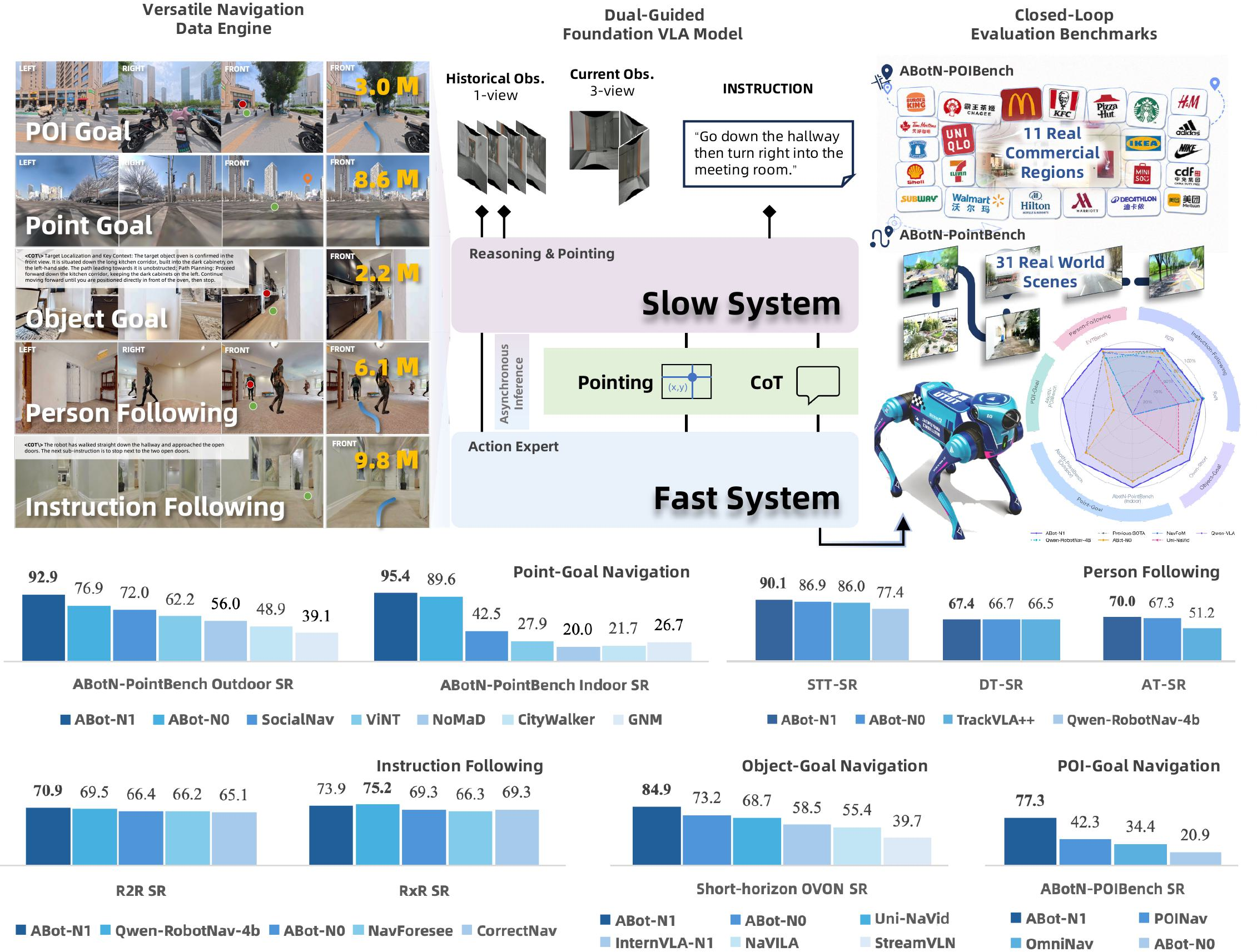
Realizing this design at scale requires overcoming the data and optimization bottlenecks prevalent in existing generalist models. We address this by extending our prior data infrastructure [19] with high-fidelity, pixel-grounded reasoning traces for all target tasks. Crucially, we depart from standard token-level supervision by introducing a GRPO-based reinforcement learning stage [25] for the slow system. This mechanism aligns the model’s output with actual task completion rather than just linguistic plausibility, thereby enhancing the robustness and physical feasibility of the generated pixel goals.
Despite the maturity of benchmarks for instruction-following and object-goal tasks [1], [16], [28], [29], open-source evaluation frameworks for cityscale navigation—specifically point-goal and POI-goal—remain notably scarce. We bridge this gap by releasing two novel benchmarks: ABotN-PointBench covering complex indoor and outdoor environments, and ABotN-POIBench situated in realistic commercial districts. Through a hierarchical difficulty structure, these benchmarks enable comprehensive assessment of state-of-the-art methods and demonstrate the superior capabilities of ABot-N1. We make both benchmarks publicly available to foster further advancements in the field.
In summary, this report makes the following contributions:
Architecture. We introduce ABot-N1, a dual-system VLA navigator featuring a slow–fast architecture and a unified pixel-goal interface. It provides joint semantic-spatial guidance via CoT and image anchors for five key tasks: point-goal, object-goal, POI-goal, instruction-following, and person-following.
Training Recipe. Building on the ABot-N0 data engine [19], we integrate pixel-grounded supervision and CoT trajectories for all five tasks. Furthermore, we employ GRPO-style post-training [25] to align the slow system’s reasoning directly with downstream navigation rewards.
Cityscale Benchmarks. We release ABotN-PointBench and ABotN-POIBench, which comprehensively evaluate point-goal navigation (short/long-range, indoor/outdoor) and POI-goal navigation in real-world commercial scenarios.
Cityscale Navigation. Using a unified checkpoint, ABot-N1 achieves state-of-the-art performance across five tasks, exceeding both specialized and multitask models. It further propels urban navigation forward by enabling robust long-horizon autonomy in complex cityscapes with only low-fidelity SD maps, thereby overcoming the traditional reliance on high-precision infrastructure.
More intuitively, this slow-fast separation allows us to treat semantic recognition and motor action as distinct data streams. By decoupling the slow reasoning system from the fast control system, we effectively disentangle these domains—a distinction crucial for open-world scaling as it enables the independent expansion of training corpora for perception and control without interference. Having already validated the effectiveness of this paradigm in ABot-N1, we plan to further verify the efficacy of this data-centric scaling strategy in our next iteration, ABot-N1.1.
2 Related Works↩︎
We organize prior work along three axes that are most relevant to ABot-N1: (i) general-purpose navigation foundation models that move from single-task specialists to unified policies, (ii) the emerging “brain–body” decoupling represented by dual-system VLN architectures that separate deliberation from reactive control, and (iii) the rise of reasoning—both linguistic and visual—inside navigation, which we view as a stepping stone toward general embodied reasoning models. Comprehensive treatments of the broader VLN landscape can be found in recent surveys [2], [3], [30].
2.1 Generalist Navigation Foundation Models↩︎
Classical VLN research is dominated by task-specific architectures that specialize either the goal interface or the policy backbone for a single benchmark, spanning instruction-following on R2R/RxR-style graphs [1], [28], [31]–[34], open-vocabulary object goal search [15], [29], and geometric point-goal or person-following controllers [17], [35]. These specialists rarely transfer across tasks and adopt disjoint goal interfaces that resist joint training.
A recent line of work instead consolidates multiple navigation tasks under a single video-conditioned VLM-based policy [36]–[38], while larger-scale foundation models such as NavFoM [18] and our prior ABot-N0 [19] push toward cross-embodiment, multi-task coverage, and training-free routes such as OpenFrontier [20] ground language to visual frontiers for open-world generalization. ABot-N1 inherits this commitment to a single, multi-task architecture but departs from prior generalists in two ways: it explicitly factorizes deliberation from control rather than emitting actions from a monolithic network, and it routes all tasks through a shared pixel-goal interface that the fast controller can chase regardless of the original goal modality.
2.2 Brain-Body Decoupling: Dual-System VLN Architectures↩︎
A central trend across robotics, autonomous driving, and humanoid control is the explicit separation of a high-capacity “big brain” that deliberates over multimodal context from a lightweight “small brain” that executes high-frequency motor commands. This brain–body division of labor is motivated by the very different time constants and uncertainty profiles of cognition and control, and it is most often framed in the language of Kahneman’s dual-process theory: a slow, deliberative System 2 paired with a fast, reactive System 1.
The pattern has crystallized across domains: VLM-based deliberators paired with fast low-level controllers in autonomous driving [39], hierarchical or asynchronously coupled VLAs in manipulation and humanoid control [40]–[42], and dedicated humanoid foundation models that make the System 1/System 2 split explicit, most notably NVIDIA’s GR00T N1 [43]. Follow-up work refines the interface between the two systems with value-guided thinking, shared-representation execution, or unified embodied brains [44]–[46], and the same brain–body split has been imported into navigation for socially-aware behavior [21].
ABot-N1 inherits this brain–body philosophy but specializes it for embodied navigation in two important respects. First, the interface between the two systems is not an opaque latent vector or a free-form natural-language sub-goal, but a structured pixel goal accompanied by a Chain-of-Thought explanation; this bottleneck is human-readable, imitation-friendly, and amenable to reinforcement learning at the reasoning level. Second, the slow system is post-trained with GRPO [25] so that its reasoning is supervised by downstream navigation outcomes rather than only by token-level targets.
2.3 Toward General Embodied Reasoning for Navigation↩︎
Orthogonal to the architectural question of how to split brain and body is the representational question of what the deliberative side should reason about and how that reasoning should be expressed. Recent work has converged on two complementary answers: explicit linguistic CoT, and structured visual representations such as visual prompts and grounded spatial reasoning. We see ABot-N1’s CoT-plus-pixel-goal output as an instance of this broader trend toward general embodied reasoning.
On the linguistic side, CoT prompting and its reinforcement-learning descendants have shown that step-by-step textual reasoning markedly improves compositional decision making [24], [25], and this idea has been instantiated inside navigation through navigational chain-of-thought training that disentangles reasoning from action prediction [47]–[49], with parallel embodied chain-of-thought recipes in manipulation [50], [51].
On the visual side, a parallel thread argues that purely textual reasoning under-uses the structure of the scene and grounds reasoning in image-space artifacts—numbered action proposals, user-drawn goals, frontier marks, or predicted subgoal images [20], [26], [27], [52]. A complementary line invests in the spatial competence of the underlying VLM through quantitative and region-grounded 3D reasoning and unified embodied perception [53]–[55].
ABot-N1 unifies these two threads inside a single navigator. The slow system produces an explicit Chain-of-Thought in the spirit of NavCoT, NavGPT-2, ECoT, and FantasyVLN, but, in line with PIVOT, VPN, CoT-VLA, and SpatialVLM, the reasoning grounds out in image-space pixel goals rather than text-only sub-goals or category embeddings. This generalizes visual prompting beyond user-drawn marks and beyond manipulation, and it makes the slow system’s behavior directly amenable to outcome-driven post-training. We view this combination as a concrete step toward general embodied reasoning models, in which a shared deliberative core can be specialized into many physical tasks by what it points at on the image, while the fast controller solves the universal problem of “follow the predicted pixels.”
3 Preliminaries↩︎
Versatile embodied navigation requires a single agent to fulfill heterogeneous user goals—ranging from precise metric coordinates to abstract semantic descriptions—using only on-board visual observations and producing executable motion commands at the control rate. Before describing ABot-N1, we cast this requirement as a unified conditional sequential decision problem, specialize the goal specification to the five tasks considered in this work, and introduce the VLM-conditioned action-policy abstraction that subsequent sections build on.
3.1 Embodied Navigation As Goal-Conditioned Visual Control↩︎
We model an embodied navigator as a discrete-time agent acting in an unknown environment \(\mathcal{E}\). At each step \(t\), the agent receives an ego-centric RGB observation \(I_t \in \mathbb{R}^{N\times H\times W\times 3}\) from \(N\) cameras and an optional proprioceptive/odometry signal \(q_t\), and is conditioned on a task specification \(g\) that encodes the user’s intent. Following recent navigation foundation models [18], [37], [42], we formulate the navigator as a goal-conditioned visual policy which predicts a chunk of \(H\) future low-level commands \(a_{t:t+H}=(a_t,a_{t+1},\ldots,a_{t+H-1})\) from the visual history \(I_{1:t}\) and the goal condition \(g\). Each command \[a_i=\bigl(x_i,\,y_i,\,\sin\theta_i,\,\cos\theta_i,\,c_i\bigr)\in\mathbb{R}^4\times\{0,1\} \label{eq:waypoint}\tag{2}\] is a continuous \(\mathrm{SE}(2)\) waypoint in the agent’s local frame augmented with a binary completion flag \(c_i\) that triggers the “arrive” signal once the goal is reached. The agent rolls out \(\pi_\theta\) in a closed loop, re-planning at every step from updated observations, until \(c_i=1\) or a step budget is exhausted; an episode succeeds when the final pose lies within a task-specific tolerance of the true target. Crucially, this formulation is map-free: \(\pi_\theta\) is given neither a global metric map nor depth or semantic segmentation, and must extract all necessary geometry and semantics from the on-the-fly RGB stream alone, matching the constraints of real deployment on commodity sensors [36], [37].
3.2 Unifying FIVE Navigation Tasks in ONE Framework↩︎
The goal condition \(g\) is realized as a natural-language instruction \(g=\ell\), where \(\ell\) is a free-form sentence that encodes the navigation intent. This single interface absorbs all five tasks studied in this report without per-task heads or bespoke encoders: in point-goal, \(\ell\) encodes a relative metric offset; in instruction-following (R2R/RxR/VLN-CE-style episodes), \(\ell\) is a step-by-step natural-language route description; in object-goal, \(\ell\) is an open-vocabulary category phrase such as “find the nearest chair”; in POI-goal, \(\ell\) names a point of interest characterized by a landmark or business identity; and in person-following, \(\ell\) describes the target person via attribute or identity clauses. Casting heterogeneous goal modalities into a unified language instruction \(\ell\) lets a single policy \(\pi_\theta\) share parameters and representations across tasks [18], [19], [37], which is a prerequisite for transferring semantic priors learned on one task to another.
3.3 VLM-Conditioned Policy and Continuous-Action Decoding↩︎
Realizing \(\pi_\theta\) at the scale required for open-world generalization motivates initializing the policy from a pre-trained vision-language model [42], [53], [56]. A natural design factorizes the navigator into a VLM reasoner \(f_\phi\) and a lightweight action policy \(\psi_\xi\): \[\begin{align} s_t &= f_\phi\!\bigl(I_{1:t},\,\ell\bigr), \tag{3}\\ a_{t:t+H} &= \psi_\xi\!\bigl(s_t,\,I_{1:t},\ell,\,q_t\bigr) \tag{4} \end{align}\] where \(s_t\) denotes an intermediate guidance signal produced by the reasoner–its concrete form (latent features, decoded language, visual anchors, or a combination thereof) is a design choice deferred to specific instantiations. This factorization brings two benefits. First, the broad linguistic and visual priors acquired during web-scale VLM pre-training transfer directly into navigation, providing open-vocabulary recognition, spatial-relation understanding, and instruction parsing without task-specific modules [53], [54], [56]. Second, decoupling the heavy reasoner from the reactive action policy allows them to operate at asymmetric computational budgets—a principle that ABot-N1 materializes as a slow-fast dual-system architecture detailed in §4.
4 Methods↩︎
4.1 Model Architecture↩︎
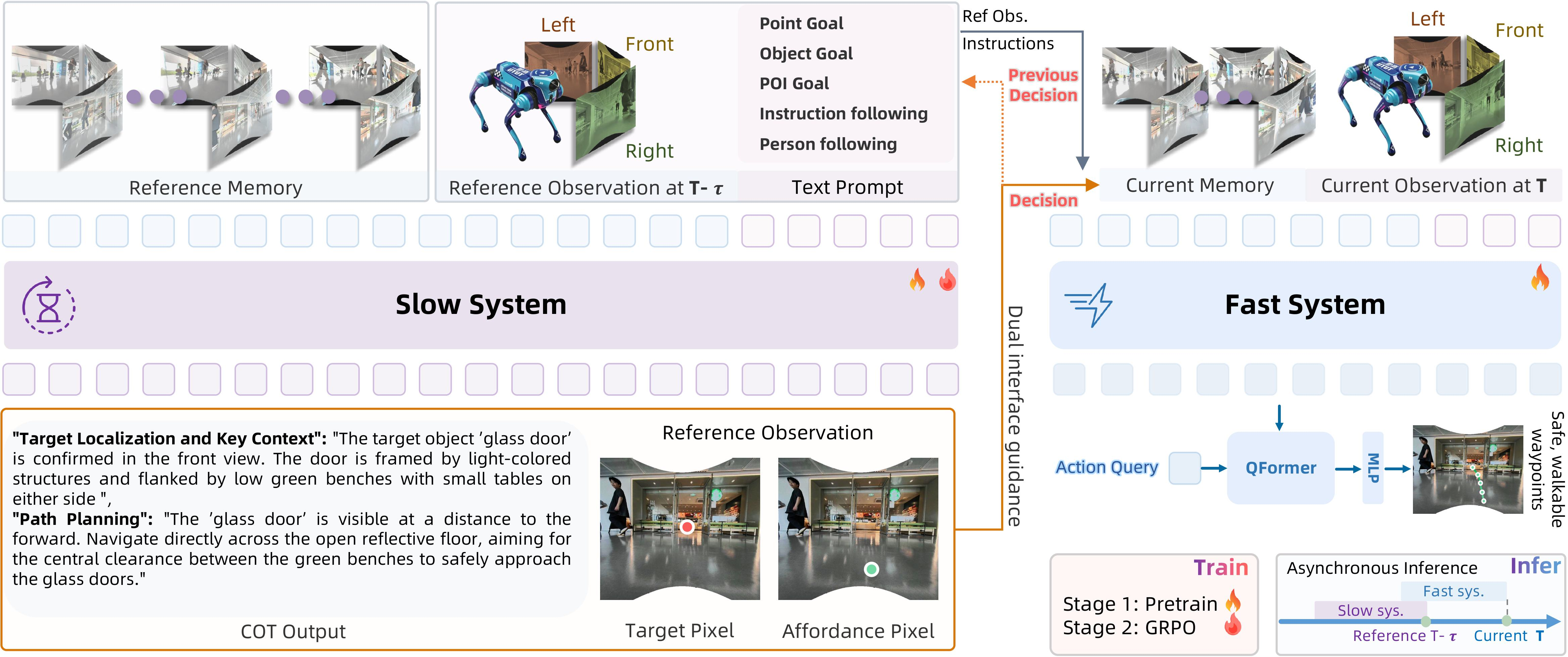
ABot-N1 decomposes the navigator of Eq. 1 into two asynchronously coupled sub-networks: a slow system that performs deliberative reasoning and a fast system that executes reactive control. The two systems share the same visual front-end but differ significantly in capacity, operating frequency, and responsibility.
Slow System - Deliberative Reasoner. The slow system is built on a 4B-parameter vision-language model (Qwen-3.5-4B). Let \(n\in\{1,2,\ldots\}\) index its successive invocations. At the \(n\)-th invocation it receives four categories of input: (i) a reference memory \(I^{\mathrm{ref,mem}}_{1:K}\)—a short buffer of historical front-view frames that summarizes the trajectory up to the moment of this invocation; (ii) the reference observation \(I^{\mathrm{ref}}_{\mathrm{tri}}\)—the tri-view capture (left, front, right cameras) taken at this invocation; (iii) the task specification \(g=\ell\) defined in §3.2; and (iv) the previous decision \((\mathcal{C}_{n-1},\,\mathbf{p}_{n-1})\) produced at invocation \(n{-}1\). Feedback of the prior decision enables temporal consistency: for tasks such as instruction-following and person-following, the model can condition on its earlier decision to avoid contradictory or oscillating behavior across successive inference cycles. Given these inputs the slow system produces two complementary outputs: \[f_\text{slow}\!\bigl(I^{\mathrm{ref,mem}}_{1:K},\, I^{\mathrm{ref}}_{\mathrm{tri}},\, g,\, \mathcal{C}_{n-1},\,\mathbf{p}_{n-1}\bigr) \;=\;\bigl(\mathcal{C}_n,\;\mathbf{p}_n\bigr) \label{eq:slow}\tag{5}\] where \(\mathcal{C}_n\) is an explicit natural-language Chain-of-Thought trace that decomposes intent, grounds linguistic and target references, and \(\mathbf{p}_n\) is a set of pixel goals projected onto the current tri-view images. The Chain-of-Thought is emitted only for the semantically demanding tasks—instruction-following and object-goal—whereas point-goal, POI-goal, and person-following rely on the pixel goals alone. The pixel goals come in two semantic flavors, whose presence depends on the task and the current state:
Affordance Pixel An image-space point denoting where forward locomotion is currently afforded, i.e., the next safe, traversable waypoint the agent should pursue (typically \(\sim\)3 m indoors or \(\sim\)5 m outdoors ahead on the reachable ground).
Target Pixel An image-space point marking the final goal itself (e.g., an object, a POI entrance, or the tracked person), emitted only when the target becomes visible or the agent is within the final approach distance.
Different tasks instantiate these two slots in slightly different ways. In point-goal, the affordance pixel marks the next safe waypoint on the occupancy-aware traversable area; no target pixel is emitted (the metric coordinate goal is consumed by the slow system internally and does not need an image-space anchor). In instruction-following, the affordance pixel corresponds to the near-future feasible waypoint along the ground-truth path, and the target pixel is activated near the route endpoint. In object-goal, the affordance pixel guides exploration while the target pixel marks the discovered object once recognized. In POI-goal, the affordance pixel follows the same convention as point-goal—marking the next safe traversable waypoint toward the entrance—while the target pixel marks the physical entrance of the queried POI once it is localized. In person-following, both pixels collapse to the bounding-box bottom center of the tracked person when visible, or the affordance pixel falls back to the first projectable future waypoint if the person temporarily exits the field of view.
Fast System - Action Expert. The fast system uses Qwen-3.5-2B as its backbone. It jointly encodes four input streams: (i) the current memory \(I^{\mathrm{cur,mem}}_{1:K}\) and current observation \(I^{\mathrm{cur}}_{\mathrm{tri}}\)—both captured in real time, (ii) the slow system’s CoT trace \(\mathcal{C}_n\) and pixel goals \(\mathbf{p}_n\), (iii) the slow system’s reference observation \(I^{\mathrm{ref}}_{\mathrm{tri}}\)—which anchors the pixel goals to their original visual context—and (iv) the task specification \(g\). The backbone produces a fused hidden state A set of learnable action queries \(q_{\mathrm{act}}\) then interact with \(h_t\) via a QFormer-style cross-attention module, distilling navigation-relevant features into a compact query representation. A lightweight MLP head decodes this representation into the navigation output: \[a_{t:t+H} = \mathrm{MLP}\!\bigl(\mathrm{QFormer}(q_{\mathrm{act}},\,h_t)\bigr) \label{eq:fast}\tag{7}\] where \(a_{t:t+H}\) is a sequence of \(H{=}5\) continuous SE(2) actions in the ego-centric frame (Eq. 2 ), each comprising a 2-D position \((x_i, y_i)\), a heading angle encoded as \((\sin\theta_i, \cos\theta_i)\), and a binary completion flag \(c_i\), with adaptive step sizes that are larger outdoors and smaller indoors to balance efficiency and obstacle clearance.
Asynchronous Inference. The slow and fast systems operate at different cadences. The slow system runs at a low frequency, limited by the 4B-parameter model’s inference cost but sufficient for high-level reasoning that changes on the timescale of navigation decisions. The fast system runs at a higher rate, consuming the most recent slow-system context to produce smooth, responsive trajectories. Between successive slow-system updates, the fast system continues to execute using the last available \((\mathcal{C}_t, \mathbf{p}_t, I^{\mathrm{ref}}_{\mathrm{tri}})\), densely tracking the cached pixel goal to bridge the temporal gap between sparse deliberative updates. This asynchronous coupling allows the slow system to reason deeply without stalling the control loop, and lets the fast system compensate for the reasoning latency through visual closed-loop tracking of the provided pixel goals.
4.2 Pretraining↩︎
Both the slow and fast systems are pre-trained via supervised imitation on a heterogeneous corpus that we curate to cover all five navigation tasks. Generalist behavior under Eq. 1 only emerges when the training distribution covers the diversity of real deployment; following recent navigation foundation models [18], [19], [42], our corpus spans photorealistic indoor simulation from Habitat-style scene banks [15]–[17], outdoor driving and street-view trajectories, and real-robot teleoperation. We reformat each episode into the \((g,\,I_{1:T},\,a_{1:T})\) tuple of Eq. 1 and enrich it with chain-of-thought rationales and pixel-goal annotations. The two systems are trained independently: the slow system learns to produce CoT traces and pixel goals, while the fast system learns the continuous-waypoint policy conditioned on slow-system outputs. We first describe the general training principles, then summarize task-specific characteristics.
4.2.1 Training Protocol↩︎
We initialize both systems from their respective pre-trained Qwen-3.5 checkpoints. The slow system is supervised with a cross-entropy language-modeling loss for CoT tokens and pixel coordinates, while the fast system is supervised with a smooth-\(L_1\) loss on position and heading angle together with a binary arriving loss. In generic VLN settings, a smooth-\(L_1\) regression objective is well known to induce mode collapse: when the target distribution is multi-modal (e.g., go left vs.go right with comparable likelihood), the loss is minimized by the conditional mean, which often corresponds to an averaged trajectory that is invalid in either mode and causes severe performance degradation on the downstream task. This is the standard motivation for GMM heads, discretized action tokens, and flow- or diffusion-based action heads. We can nevertheless rely on smooth-\(L_1\) in ABot-N1 because of the dual-system factorization: the slow system has already committed to a discrete decision through its CoT trace and pixel-goal output (target pixel + affordance pixel), which together sharply concentrate the future-waypoint distribution around a dominant mode. Conditioned on these slow-system outputs, the fast policy faces an approximately uni-modal regression problem, in which the conditional mean closely approximates the desired trajectory and smooth-\(L_1\) regression is both stable and sample-efficient. In other words, the slow system substantially reduces the modal-selection burden that would otherwise be handled by a heavier flow- or diffusion-based action head. A shared design principle across tasks is robustness augmentation: we feed both systems noise-injected inputs (perturbed target coordinates, noisy prior pixel predictions, or simulated asynchronous lag) so that they learn to tolerate imperfect upstream signals encountered during deployment.
4.2.2 Pretraining Data Recipe↩︎
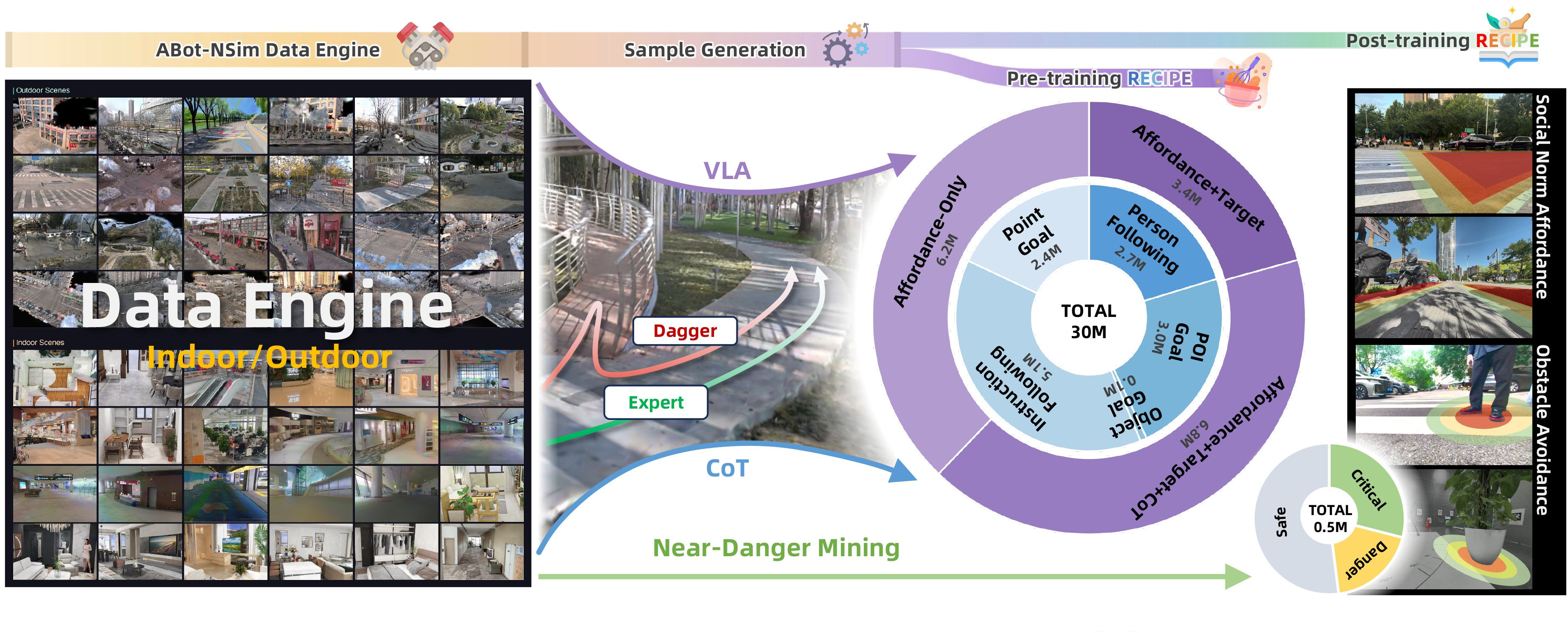
Figure 3 summarizes the overall data pipeline and composition across both training stages; here we focus on its pre-training portion, while the post-training composition is detailed in Section 4.3.3.
Our data engine maintains a bank of high-fidelity simulation scenes spanning 800+ indoor and 22 outdoor environments reconstructed as 3D Gaussian Splatting. From these scenes, trajectory generation produces two complementary types of rollouts: expert demonstrations that provide strictly correct supervision, and Dagger rollouts that introduce controlled errors and recoveries to build corrective capabilities. The resulting 30 M pre-training samples are distributed across five navigation tasks— point-goal, object-goal, POI-goal, instruction-following, and person-following—organized into high-level data (13.3 M) for the slow system and low-level data (16.4 M) for the fast system. The low-level inputs come in three configurations: (1) CoT + affordance pixel + target pixel for instruction-following and object-goal, (2) affordance pixel only for point-goal, and (3) affordance pixel + target pixel for POI-goal and person-following. Below we describe the data sources and construction pipeline for each task.
Point-Goal. Building upon the data engine of ABot-N0, we construct a unified scene bank of 800+ indoor and 22 outdoor scenes reconstructed as high-fidelity 3D Gaussian Splatting (3DGS) environments and manually annotate every scene with an occupancy map that delineates traversable from prohibited regions (sidewalks, crosswalks, building entrances vs.vehicle lanes, lawns, and static obstacles). Episodes are sampled along curated trajectories: for each starting pose we draw a target 5–50 m away outdoors (3–20 m indoors), and the ground-truth affordance pixel is obtained by selecting a safe traversable waypoint along the path (5 m outdoors, 3 m indoors), running a safety check, and projecting the resulting 3D point onto the current image plane. The safety check verifies that the line of sight from the viewpoint to the candidate point does not cross any non-traversable region; if it does, we backtrack along the trajectory until a valid point that is both unoccluded and traversable is found. From this shared episode pool, the slow and fast systems derive their respective training samples—often from the same trajectory sampling points but with different input and supervision content, as summarized below.
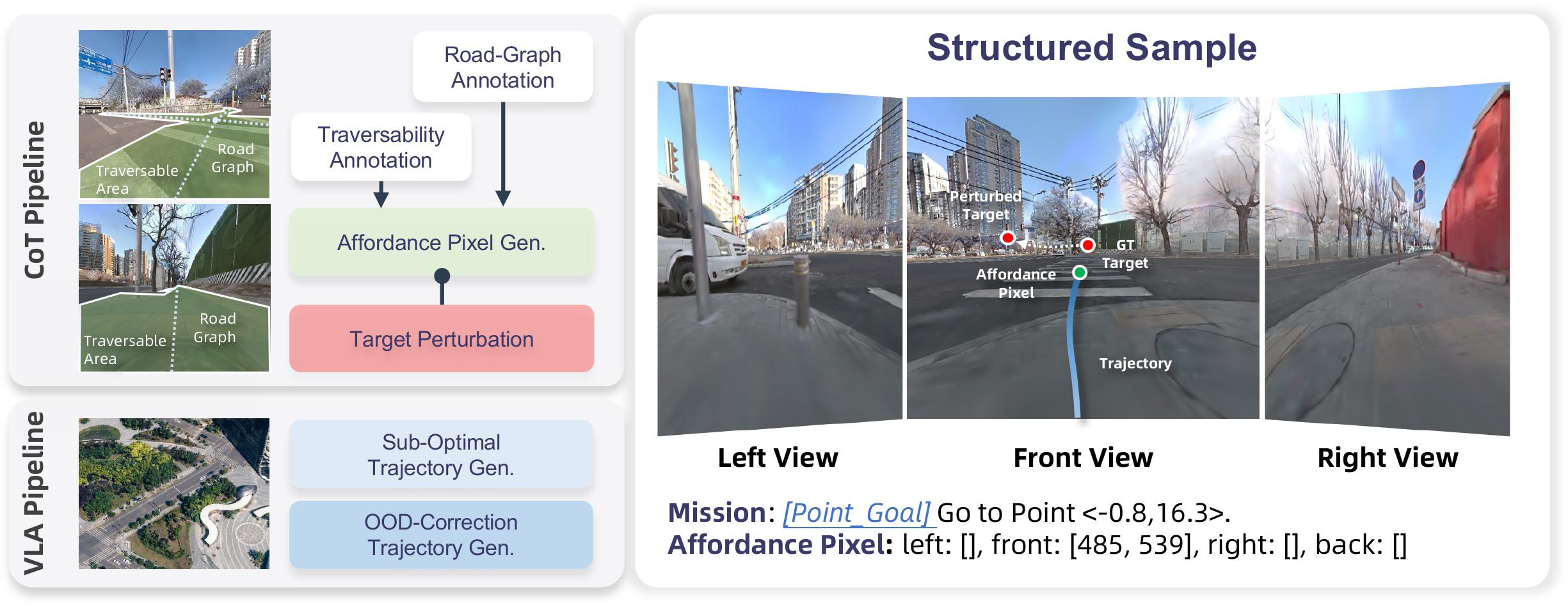
Slow System (\(\sim\)2.36 M). Its input consists of the tri-view observation, a noisy global target, and—in 50% of the samples—recent history frames paired with the slow system’s predictions on them as a temporal prior; the remaining 50% drops history to keep the model robust when memory is absent. Because point-goal targets are ego-centric offsets relative to the robot’s current pose, deviations arising from non-high-precision map routes and localization inaccuracies can shift the apparent target in the body frame—potentially placing it in a physically illegal region (vehicle lane, flower bed, or other non-walkable area) rather than on a valid pedestrian pathway. To robustify the policy against this real-world coordinate drift, we perturb the input target with a direction-aware non-uniform distribution (normal component up to 10 m, tangential up to 2 m) and reject perturbations whose angular deviation from the ground truth exceeds \(30^\circ\) to prevent semantic ambiguity. The model learns to fall back on visual evidence and walkable-region semantics to locate a legally reachable arrival point whenever the input coordinate has drifted outside the traversable area.
Fast System (\(\sim\)6.20 M). Its input comprises the current tri-view frame, the current history, the slow system’s most recent affordance result together with its reference views, and the global position target. The history channel compensates for the asynchronous inference gap: because the slow system runs at a lower rate than the fast system, recent reference frames fill the information vacuum between slow updates and damp control jitter. The supervision targets are the next 5 ego-centric relative waypoints, with adaptive step sizes that are larger outdoors and smaller indoors, trading off open-space throughput against fine-grained obstacle avoidance. These waypoint supervisions are drawn from both sub-optimal and OOD-correction trajectories, exposing the controller to off-optimal states and teaching it to steer back onto a valid path. Figure 4 illustrates the end-to-end data construction pipeline for the point-goal corpus.
Instruction-Following. We assemble the instruction-following corpus from four complementary streams curated in ABot-N0 [19], all rendered in Habitat [17] and our proprietary simulator. The dominant stream is VLN-CE R2R/RxR [16], [28] on Matterport3D; three auxiliary streams over the InteriorGS scene bank inject short-horizon and grounding skills. Pixel supervision is constructed by a unified geometric pipeline shared across all four streams: along each reference trajectory, the affordance pixel is the projection of the next traversable waypoint at a fixed look-ahead horizon, and the target pixel is the projection of the route endpoint, emitted only once the agent enters the final approach segment to signal task termination. A VLM then validates each projected pixel, filtering out those that are not visible in the current view.
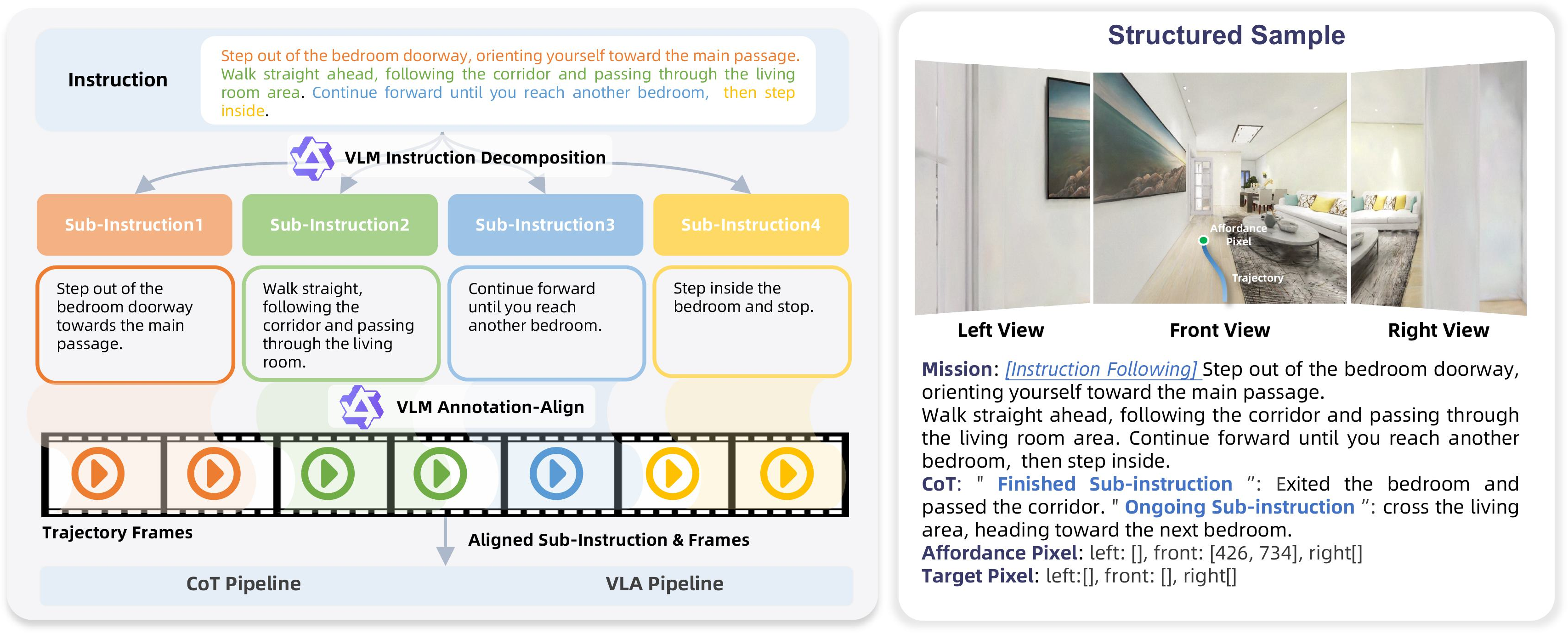
VLN-CE R2R/RxR (slow \(\sim\)2.25 M, fast \(\sim\)2.10 M). We build the corpus from \(\sim\)30 K reference trajectories. CoT labels are produced by a two-stage Qwen-3.5-27B annotator: Stage 1 decomposes each long natural-language instruction into an ordered list of executable sub-instructions; Stage 2 aligns every sub-instruction to its corresponding trajectory frame range, yielding per-frame “done / current” progress annotations. Pixel labels follow the unified geometric pipeline above and are therefore decoupled from the instruction annotator (Figure 5).
InteriorGS Auxiliaries (slow \(\sim\)2.86 M, fast \(\sim\)2.57 M). Three InteriorGS-rendered streams sharpen specific competencies, each annotated for both systems via the unified pixel pipeline: (i) door-traversal clips (slow \(\sim\)0.44 M, fast \(\sim\)0.38 M) for narrow-passage maneuvers; (ii) an office-building instruction-following set (slow \(\sim\)69 K, fast \(\sim\)68 K) purpose-built for commercial-tower interiors (corridors, lobbies, meeting rooms, and elevator halls), a domain that is severely underrepresented in residential-centric R2R/RxR but critical for real deployments such as last-mile indoor delivery; (iii) short-horizon primitives (slow \(\sim\)2.35 M, fast \(\sim\)2.12 M) covering atomic rotational, translational, and compound actions to regularize fine-grained execution. The slow count is consistently slightly larger than the fast count because the slow corpus applies stronger terminal-segment augmentation, where end-of-instruction frames are oversampled and perturbed more aggressively so that the slow system reliably recognizes the correct stopping point and emits the target pixel at the right moment.
CoT Supervision. The slow system’s CoT reasons about instruction progress—what sub-instruction has just been completed and what is currently being executed—following the schema established in ABot-N0. Combined with the unified affordance and target pixels, this cleanly separates long-horizon path tracking from terminal grounding.
Object-Goal. We construct the object-goal corpus on the OVON [29] 145-scene Habitat [17] subset, complemented by proprietary InteriorGS-rendered scenes curated in ABot-N0 [19] for long-tail category coverage. Reference trajectories are produced by A\(^{\!*}\) from each starting pose to the target object, and because the dual-system decomposition explicitly factors recognition and approach apart, we keep the slow- and fast-system corpora structurally distinct. Figure 6 illustrates the overall data generation pipeline.
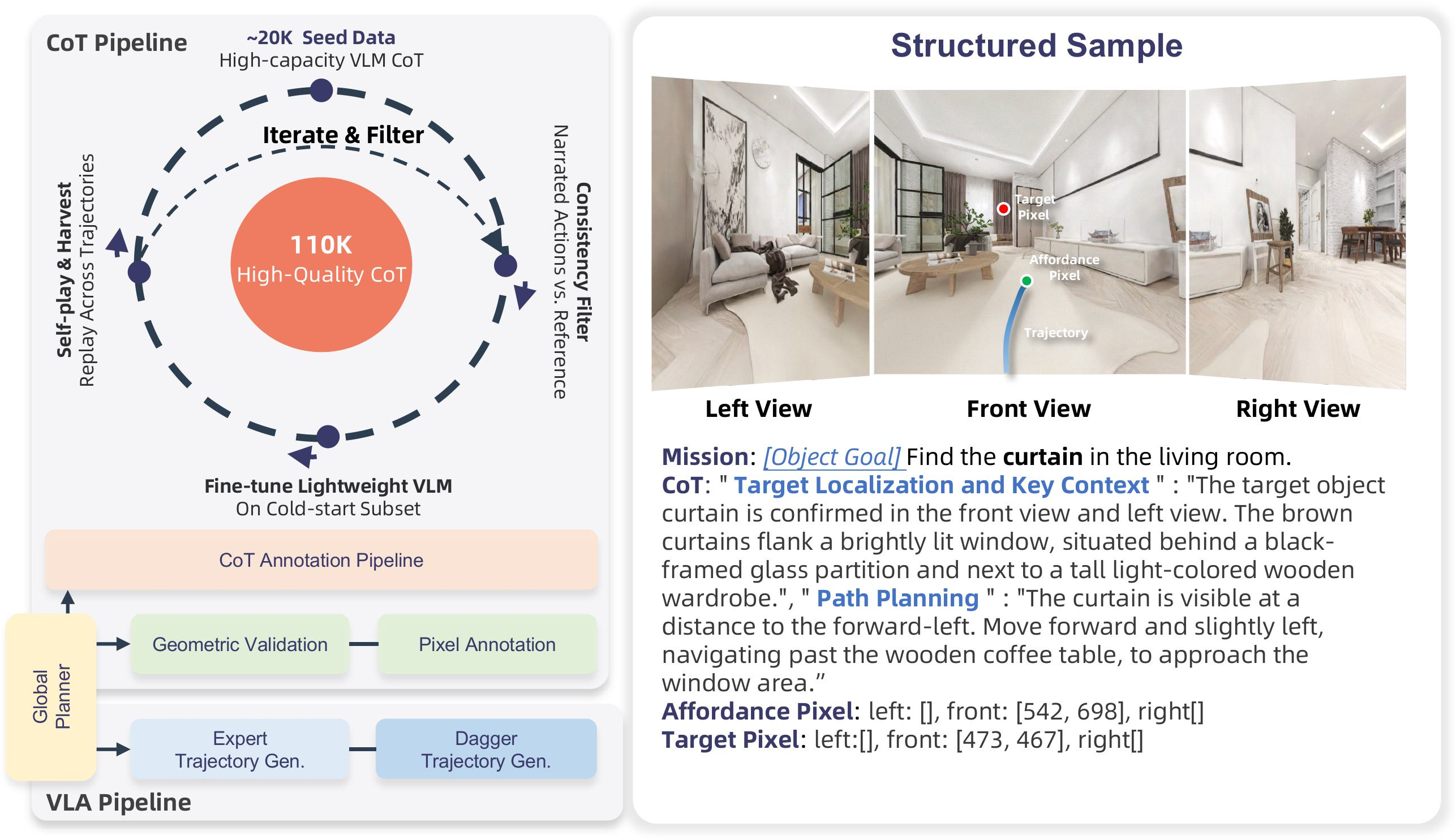
Slow System (\(\sim\)110 K). The slow system maps a tri-view observation plus an object name to three co-emitted outputs: a natural-language path plan, an affordance pixel, and an object pixel. The affordance pixel is the projection of the next A\(^{\!*}\) corner waypoint along the current segment onto the camera image plane; the object pixel is the projection of the target object’s 3D centroid, emitted only once the object is visible. CoT labels are produced through a data flywheel rather than a one-shot annotator dump: a high-capacity VLM first seeds \(\sim\)20 K raw CoT samples spanning target visibility, spatial location with explicit landmark references, path narration, and the implied atomic actions; every seed is then scored by the consistency between its narrated atomic-action sequence and the A\(^{\!*}\) reference, and only high-consistency samples enter the cold-start set. We then launch a data flywheel: the cold-start set is used to fine-tune a lightweight open-source VLM (Qwen-2.5-VL) rather than the slow system itself; this distilled annotator is replayed across the full trajectory pool to harvest fresh CoT at scale, the outputs are re-scored against A\(^{\!*}\) consistency, and the filtered results are fed back to refine the annotator in the next iteration. The loop converges at \(\sim\)110 K high-quality episodes, attenuating the seeding-VLM’s hallucinations while entirely removing the dependency on the expensive high-capacity VLM at production time.
Fast System (\(\sim\)2.10 M). Inputs pair the current frame with a slow-system reference frame (either the current frame or a recent history frame) carrying the slow system’s natural-language path plan, affordance pixel, and object pixel. To prevent the fast controller from over-relying on any single upstream signal, we randomly mask each of the three reference channels independently during training, so the controller learns to remain effective under partial slow-system guidance and degrades gracefully when individual signals are missing or stale. Outputs are 5 ego-centric relative waypoints at a fixed 0.3 m/frame step size, supervised by both sub-optimal and OOD-correction trajectories so that the controller learns to recover from off-optimal poses and out-of-distribution deviations.
CoT Structure. The CoT decomposes into two named blocks aligned with the dual-pixel output: Target Localization and Key Context describes whether the target is currently visible and, if so, its spatial location relative to surrounding objects and the agent’s pose; Path Planning reasons about the next actions required to reach the target. The affordance pixel is always emitted to supervise locomotion; once the target enters the field of view, the object pixel is emitted alongside it, providing explicit visual grounding for the approach phase.
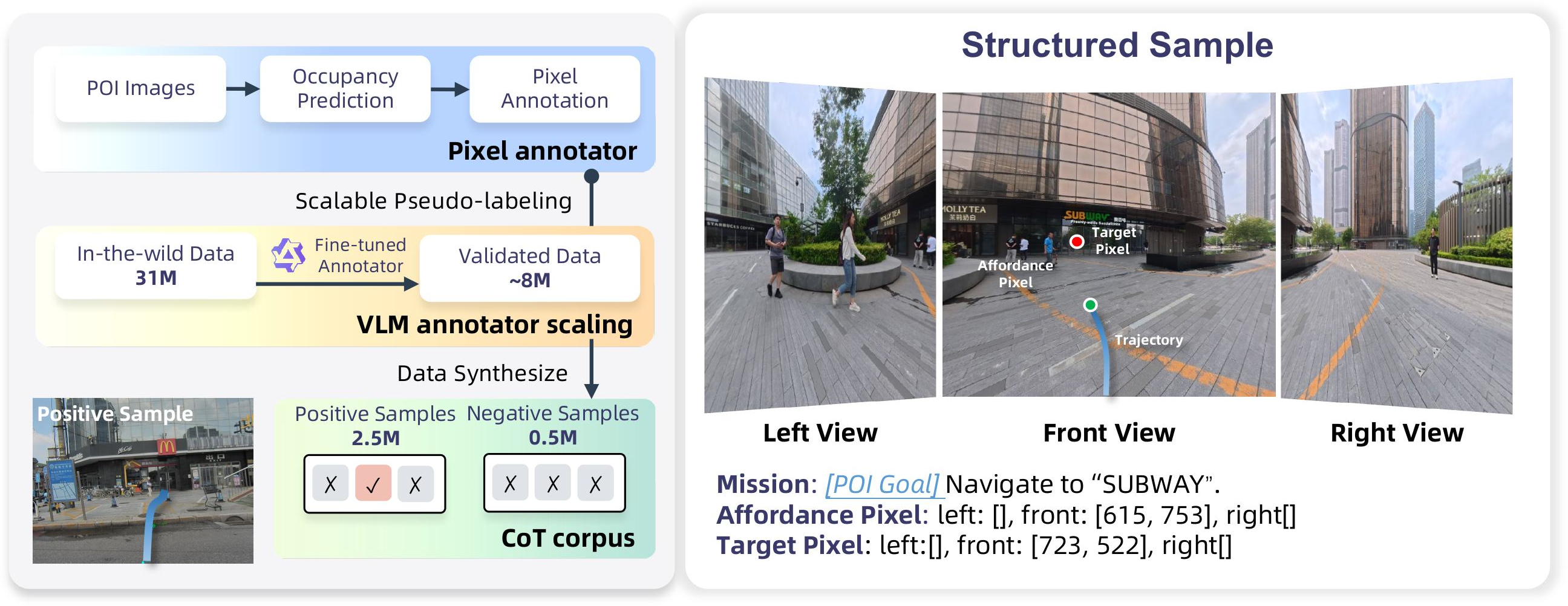
POI-Goal. No 3D simulator currently covers the commercial-street settings required for POI-goal navigation, so closed-loop rollout collection is infeasible. We therefore supervise only the slow system on static street-view annotations and let the fast system inherit its execution capability from point-goal at inference time. To reach data-engine scale, we build a three-stage annotation pipeline (Figure 7).
Seed Annotation (\(\sim\)275 K). We collect tuples of (POI name, signage bbox, entrance bbox) from two sources: 55 K human-annotated samples from BridgeNav with first-frame signage and entrance bounding boxes, and 220 K samples from POINav with rule-plus-model pseudo-labels covering roughly 70 K distinct images (each image may host multiple POIs). We run MoGe-V2 [57] monocular depth on every image, derive an image-aligned occupancy map from surface normals, set the target pixel to the nearest ground point under the entrance-bbox bottom center, and trace a straight ground-line from the camera footprint to the target, sampling waypoints every 0.5 m and truncating at the first obstacle.
VLM Annotator Scaling. The MoGe-V2 pipeline is too slow to scale to tens of millions of images, so we distill it into a Qwen-3.5-4B annotator (full-LLM fine-tuning with the ViT and projector frozen). The annotator takes a POI name and a target affordance distance bucket (\(\{2,3,4,5\}\) m) and emits a JSON record whose ordered fields (signage bbox \(\rightarrow\) entrance bbox \(\rightarrow\) target pixel \(\rightarrow\) affordance pixel) act as an implicit chain of thought. Training covers three patterns: positives where a feasible affordance pixel exists, positives where the path is blocked (no feasible affordance pixel), and negatives where the queried POI is absent from the image, instilling an explicit “cannot-be-grounded” rejection behavior. Applying this annotator to \(\sim\)31 M collected street-view (POI name, image) pairs at the 3 m bucket yields \(\sim\)8 M valid positive labels.
N1 Slow-System Corpus (\(\sim\)3.0 M). Because N1 consumes a tri-view input but the upstream pipeline is monocular, we synthesize tri-views by stitching one positive image with two negative images (the queried POI absent from the two side views). The final slow-system corpus contains 2.5 M positive tri-view episodes and 0.5 M fully negative tri-view episodes (POI absent in all three views) to harden rejection capability under missing-target conditions. POI-goal is a single-shot grounding task that does not benefit from temporal memory, so the slow system operates on the current observation only and history frames are omitted.
Person-Following. Following TrackVLA [35], we generate avatar-tracking sequences in Habitat [17] photorealistic indoor scenes by replaying TrackVLA’s open-sourced humanoid motion trajectories and planning agent waypoints with A\(^{\!*}\) at three following distances (1.2, 1.5, and 2.0 m). Specific data generation procedures are illustrated in Figure 8.
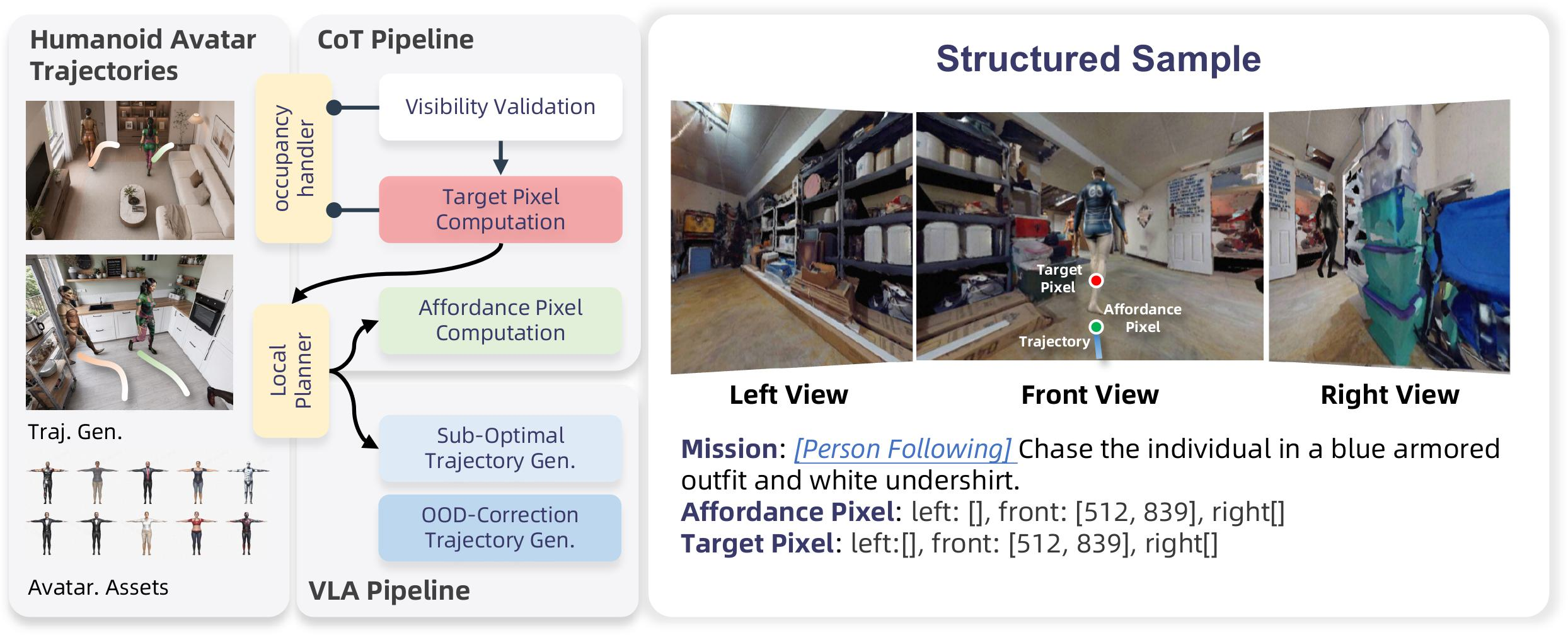
Scenario Composition. For each following distance we synthesize three scenario categories that mirror TrackVLA’s taxonomy: Single-Target Tracking (STT) with a unique target, Distracted Tracking (DT) with non-target distractor avatars, and Ambiguity Tracking (AT) where multiple avatars share attributes with the target so that disambiguation must be resolved from the language query.
Slow System (\(\sim\)2.7 M). We draw samples from the 1.2 m and 2.0 m sets. When the target is visible, both the affordance and target pixels are anchored to the bottom-center of the target bounding box; once the target leaves the field of view, the target pixel is set to null and the affordance pixel falls back to the first projectable future waypoint, forcing the model to reason about occluded targets through the memory buffer.
Fast System (\(\sim\)3.4 M). We span all three distances and randomly pair the current frame with a reference frame sampled \(0\)–\(4\) steps earlier so that the fast system learns to consume slightly stale slow-system predictions. In addition to the waypoint sequence the fast system also predicts per-step heading and a safety-clearance flag. The waypoint supervision is likewise built from sub-optimal and OOD-correction trajectories, training the controller to recover smoothly when the followed target drifts off the optimal path.
Asymmetric Noise Schedules. Both systems are trained with task-specific perturbations over the prior pixel inputs. The slow system tolerates an aggressive schedule because its temporal context smooths out corrupted single frames; the fast system, far more sensitive to single-frame pixel perturbations, uses a conservative schedule. This asymmetry keeps both policies stable under imperfect upstream signals and transient detection failures at deployment.
4.3 Post-Training↩︎
Supervised pre-training aligns the slow system’s outputs with expert demonstrations, yet these demonstrations are inherently limited: reference trajectories produced by shortest-path planners often lack safety margins and ignore implicit social constraints. More fundamentally, token-level supervision does not directly optimize the downstream navigation outcome, leaving a gap between imitating individual decisions and maximizing episode-level success. To bridge this gap, we apply Group Relative Policy Optimization (GRPO) [25] to the slow system, casting its pixel-goal generation as a language-model policy whose outputs are rewarded by environment-grounded signals.
4.3.1 Formulation↩︎
For each state \(s=(I^{\mathrm{mem}}, I^{\mathrm{cur}}_{\mathrm{tri}}, g)\) we sample \(G\) candidates \(o^{(i)}{=}(\mathcal{C}^{(i)},\mathbf{p}^{(i)})\sim\pi_\theta\), score each with the composite reward \(R^{(i)}\) defined below, and form group-relative advantages \(A^{(i)}{=}(R^{(i)}{-}\mu_R)/(\sigma_R{+}\varepsilon)\) over the group. We then optimize \[\mathcal{L}_{\mathrm{GRPO}}(\theta) \;=\; \mathbb{E}\!\left[\sum_{i,t} \min\!\bigl(\rho_t^{(i)} A^{(i)},\; \mathrm{clip}(\rho_t^{(i)},\,1{\pm}\epsilon)\,A^{(i)}\bigr) \right] \;-\;\beta\,\mathrm{KL}\!\bigl[\pi_\theta\,\Vert\,\pi_{\mathrm{ref}}\bigr], \label{eq:grpo}\tag{8}\] with \(\rho_t^{(i)}\) the per-token importance ratio against the previous policy iterate. The KL anchor against the reference model \(\pi_{\mathrm{ref}}\) is non-negotiable in our setting: aggressive exploration in the joint CoT\(+\)pixel output space quickly produces unparseable strings, on which every downstream reward becomes zero and the gradient collapses.
4.3.2 Reward Design↩︎
The composite reward \(R\!=\!w_f R_{\mathrm{format}}\!+\!w_t R_{\mathrm{target}}\!+\!w_o R_{\mathrm{safety}}\) (weights summing to one) targets three orthogonal failure modes of the pretrained policy and is calibrated to a comparable scale so that within-group normalization remains informative.
Format. A binary indicator that the output respects the per-view JSON schema. We gate \(R_{\mathrm{target}}\) and \(R_{\mathrm{safety}}\) on \(R_{\mathrm{format}}{=}1\), preventing the policy from drifting off the parseable manifold during early-stage exploration.
Target Alignment. The target reward is computed as the average of per-view matching scores. Missing predictions in any view are treated as escape behaviors and incur a large penalty. When valid points are present across all views, the reward adopts an exponential decay of their L2 distance. The overall formulation is given by: \[R_{\mathrm{target}}\!=\!\sum_{\mathrm{frame}}\alpha_t\;{\exp\bigl(-\|\hat{\mathbf{p}}-\mathbf{p}^{\star}\|^2/\mathrm{scale}\bigr)}_{\mathrm{frame}}, \quad \mathrm{frame}\in\{\mathrm{front}, \mathrm{left}, \mathrm{right}\},\] where \(\hat{\mathbf{p}},\mathbf{p}^{\star} \in \mathbb{R}^2\) denote the predicted and ground-truth target coordinates in each camera view, respectively; \(\mathrm{scale}\) controls the spatial tolerance of the exponential kernel, determining how rapidly the reward decays with increasing prediction error; and \(\alpha\) is a normalization weight that ensures balanced contributions across views when computing the final averaged reward. This design effectively constrains model outputs and mitigates knowledge forgetting during pretraining.
Safety Clearance. We back-project \(\hat{\mathbf{p}}\) to the world frame via the local depth map and camera intrinsics, take the worst-case clearance \(d\) across views, and apply \[R_{\mathrm{safety}}(d) = \begin{cases} -\alpha_0, & d \ge d_{\mathrm{safe}},\\ -\alpha_o\,\exp\!\bigl(\beta\,(d_{\mathrm{safe}}{-}d)\bigr), & d < d_{\mathrm{safe}}. \end{cases} \label{eq:obstacle}\tag{9}\] Here \(d\) measures the distance to the nearest non-traversable region, which encompasses not only physical obstacles but also traffic-rule violations and illegal zones (e.g.vehicle lanes, restricted construction areas). The exponential profile is deliberately asymmetric: flat in safe zones, so legitimate close-quarters maneuvers (e.g.doorway traversal) are not penalized, but sharp inside the danger margin where behavioral correction is most urgent. Catastrophic outcomes (parse failure, full intrusion into prohibited regions) are clamped to a large negative floor so that they always receive the worst within-group advantage.
4.3.3 Balance Sampling for GRPO Training Dataset↩︎
As shown in the post-training composition of Figure 3, we build the GRPO training set on top of the point-goal pretraining corpus: episodes are stratified by proximity to non-traversable regions into Safe, Critical, and Danger zones, unstable samples beyond the stability limit are discarded, and the remaining episodes are sampled according to a theoretically motivated ratio to ensure balanced gradient signals.
To formalize this balancing strategy, we analyze the geometric properties of the sample distribution by examining the local variance of the composite reward. For a given prompt, the policy generates \(K\) rollout trajectories within a group \(G\); let \(d\) denote the distance from the robot to the closest non-traversable region (including physical obstacles, illegal zones, and traffic-rule-violating areas) along each rollout. Due to policy stochasticity, these \(K\) rollouts yield different trajectories and thus different \(d\) values, with within-group mean \(\bar{d}\) and variance \(\sigma_d^2\). When the group mean penetrates the safety margin (\(\bar{d} < d_{\mathrm{safe}}\)), we apply a first-order Taylor expansion to the asymmetric exponential penalty \(R_{\mathrm{safety}}(d) = -\alpha_o \exp\bigl(\beta(d_{\mathrm{safe}}-d)\bigr)\) around \(\bar{d}\): \[R_{\mathrm{safety}}(d) \approx R_{\mathrm{safety}}(\bar{d}) + \alpha_o \beta \exp\bigl(\beta(d_{\mathrm{safe}}-\bar{d})\bigr) (d - \bar{d}).\]
Since the model output remains valid in non-degenerate cases, we assume \(\mathrm{Var}(R_{\mathrm{format}}) \approx 0\). Taking the non-zero covariance between the target alignment and safety clearance into account, the total within-group variance \(\sigma_G^2\) (omitting the early-converged format term) is formulated as: \[\sigma_G^2 \approx w_t^2 \mathrm{Var}(R_{\mathrm{target}}) + w_o^2 \mathrm{Var}(R_{\mathrm{safety}}) + 2w_t w_o \mathrm{Cov}(R_{\mathrm{target}}, R_{\mathrm{safety}}), \label{eq:total95var}\tag{10}\] where the local variance propagated by the safety term is approximated by: \[\mathrm{Var}(R_{\mathrm{safety}}) \approx \left[ \alpha_o \beta \exp\bigl(\beta(d_{\mathrm{safe}}-\bar{d})\bigr) \right]^2 \sigma_d^2. \label{eq:obstacle95var}\tag{11}\]
Due to the intrinsic task conflict in close-quarters maneuvers, these two objectives exhibit a strong negative correlation, i.e., \(\mathrm{Cov}(R_{\mathrm{target}}, R_{\mathrm{safety}}) = -\rho \sigma_{\mathrm{target}}\sigma_{\mathrm{safety}}\) with \(\rho > 0\). Although this negative covariance slightly dampens the aggregate variance locally, the squared derivative in Eq. 11 still dictates that the safety reward variance grows exponentially with the intrusion depth \((d_{\mathrm{safe}}-\bar{d})\) at rate \(2\beta\), even when \(\sigma_d^2\) itself is small for deeply intruding prompts.
To prevent this exploding variance from masking the target alignment gradients, the gradient isotropy condition dictates that the variance contribution of the target alignment reward must be bounded by a stability threshold \(\gamma \in (0, 1)\), such that: \[w_t^2 \mathrm{Var}(R_{\mathrm{target}}) \geq \gamma\;\sigma_G^2.\]
Substituting Eq. 10 into the current equation yields: \[w_o^2 \mathrm{Var}(R_{\mathrm{safety}}) - 2w_t w_o \rho \sigma_{\mathrm{target}}\sigma_{\mathrm{safety}} \le \frac{1-\gamma}{\gamma} w_t^2 \mathrm{Var}(R_{\mathrm{target}}).\]
By solving this quadratic inequality with respect to \(\sigma_{\mathrm{safety}}\), we can map out the minimum allowable average distance \(\bar{d}_{\min}\) that defines the critical hazard boundary for a valid prompt. Prompts with \(d \le \bar{d}_{\min}\) produce reward variance that exceeds the stability budget and are therefore discarded from the training set. Introducing a transition margin \(\Delta d > 0\), we partition the remaining prompts into three categories: Safe Zone (\(d \ge d_{\mathrm{safe}}\)): the exponential penalty is inactive, contributing negligible reward variance; Critical Zone (\(\bar{d}_{\min} + \Delta d < d < d_{\mathrm{safe}}\)): the penalty is active but the resulting variance remains well within the stability budget; Danger Zone (\(\bar{d}_{\min} < d \le \bar{d}_{\min} + \Delta d\)): the variance approaches the tolerable limit, yet the steep penalty slope produces the strongest directional gradient signal among all trainable prompts.
To curate a well-balanced training set, these scenarios must be mixed in a controlled ratio guided by the Gradient Signal-to-Noise Ratio (GSNR). In GRPO, training stability requires not only bounding the aggregate variance but also ensuring sufficient gradient magnitude across all critical regions. These three zones exhibit fundamentally distinct gradient characteristics. Safe Zone prompts serve as high-GSNR anchors that stabilize the baseline target alignment gradient. Critical Zone prompts suffer from degraded GSNR due to exponential variance growth and negative target-safety covariance, yet they provide essential boundary refinement signals. Crucially, Danger Zone prompts produce the largest gradient magnitude among all trainable samples via the steep exponential penalty slope; although their per-sample GSNR is the lowest (variance grows faster than signal at rate \(2\beta\) vs.\(\beta\)), batch averaging over \(P_{\mathrm{danger}} \times B\) samples allows the consistent repulsive direction to accumulate while noise partially cancels. This directional signal is irreplaceable: without it, the policy risks converging to suboptimal solutions near the safety boundary, as the milder gradients from the Critical Zone alone are insufficient to enforce hard safety constraints. Therefore, the sampling proportions must satisfy a composite gradient sufficiency condition rather than a simple variance equality: \[P_{\mathrm{safe}} \cdot \mathcal{S}_{\mathrm{safe}} + P_{\mathrm{critical}} \cdot \mathcal{S}_{\mathrm{critical}} + P_{\mathrm{danger}} \cdot \mathcal{S}_{\mathrm{danger}} \geq \tau, \label{eq:composite95gradient}\tag{12}\] where \(\mathcal{S}_z = |\mu_{\nabla,z}|^2 / \sigma_{\nabla,z}^2\) denotes the per-sample GSNR of zone \(z\) (expected gradient magnitude squared divided by gradient variance), and \(\tau\) is a minimum threshold for stable policy improvement.
We summarize the principles guiding our sampling proportions as follows:
Safe Zones take up the largest share. They stabilize training by providing high‐GSNR signals that prevent model degradation.
Critical Zones are kept in check to avoid inflating batch‐variance with their moderate‐GSNR samples, yet—together with Danger Zones—they supply essential safety-compliance rewards.
Danger Zones, although they exhibit the lowest per-sample GSNR, deliver a unique and irreplaceable gradient direction for hard-safety enforcement. To preserve overall training stability, they are assigned the smallest proportion.
Empirically, we adopt a structured sampling ratio of \(5:3:2\) (\(P_{\mathrm{safe}} : P_{\mathrm{critical}} : P_{\mathrm{danger}}\)). This ratio ensures that: (1) \(P_{\mathrm{safe}} = 0.5\) provides dominant gradient stability; (2) \(P_{\mathrm{critical}} = 0.3\) supplies adequate boundary learning without exceeding the variance budget; and (3) \(P_{\mathrm{danger}} = 0.2\) delivers sufficient high-magnitude repulsive gradients to prevent unsafe convergence. This theoretically grounded composition enables stable GRPO training by balancing gradient fidelity, variance control, and safety enforcement simultaneously.
4.3.4 Training Dynamics and Generality↩︎
To prevent degradation of the capabilities acquired during the pretraining phase, we avoid biased preference sampling in GRPO data collection. We employ action-balanced batch sampling to ensure dataset unbiasedness. By balancing trivial states with challenging scenarios (e.g., near non-traversable regions), this strategy not only preserves the pretrained policy’s generalization but also smooths within-group learning signals, thereby stabilizing training. We address two reward-hacking equilibria: target withholding (avoiding goals to minimize safety penalty) and permanent inaction (zero motion and progress). To mitigate these, we explicitly balance the magnitudes of \(R_{\mathrm{target}}\) and \(R_{\mathrm{safety}}\) to prevent disproportionate avoidance behavior, and impose a high-magnitude missing-prediction penalty within \(R_{\mathrm{target}}\). This combination effectively breaks both inertial and evasive stalemates.
The factorization is task-agnostic by construction: \(R_{\mathrm{format}}\) depends only on the output schema and \(R_{\mathrm{safety}}\) only on scene geometry and traversability rules, both shared across the five tasks. Extension to instruction-following, object-goal, or person-following reduces to redefining \(R_{\mathrm{target}}\) alone (route-endpoint distance, mask IoU, or bounding-box-center distance, respectively). We instantiate and validate the pipeline at scale on point-goal (0.5 M episodes after zone classification and filtering, as shown in Figure 3) and view extension to the remaining tasks as a matter of metric design rather than algorithmic modification.
5 Benchmark↩︎
Existing navigation benchmarks fall short of evaluating two capabilities that are central to deployable real-world agents: (i) closed-loop, social-rule-aware navigation in heterogeneous indoor and outdoor environments, and (ii) final-meters arrival at the physical entrance of a named point of interest in dense commercial streetscapes. We therefore introduce two complementary benchmarks built on the same high-fidelity 3DGS reconstruction stack: ABotN-PointBench for coordinate-conditioned navigation and ABotN-POIBench for name-conditioned POI navigation. Figure 9 gives an overview of both benchmarks and the unified scene construction pipeline shared by them. Then we describe the ABotN-PointBench and ABotN-POIBench in detail, respectively.
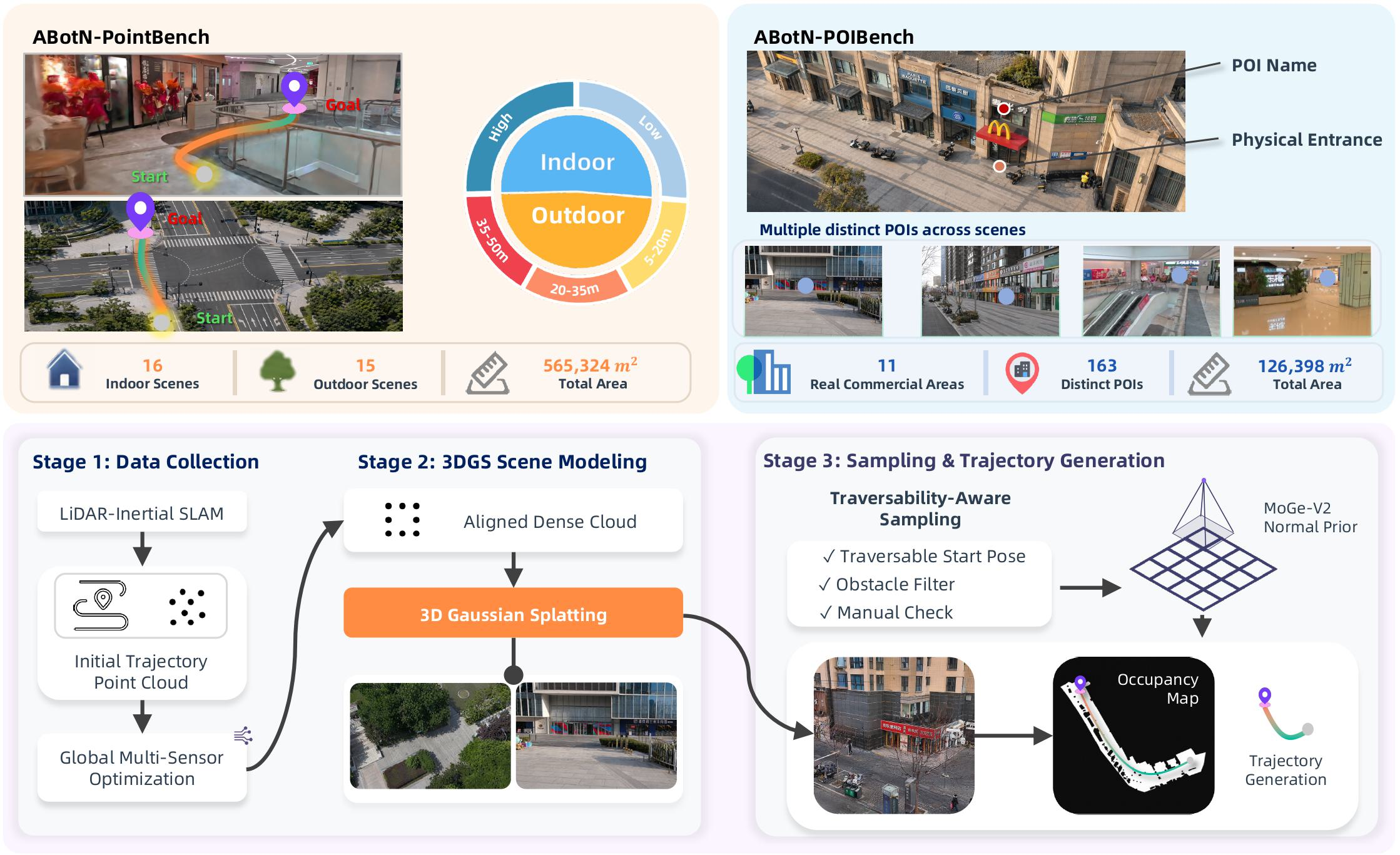
5.1 ABotN-PointBench↩︎
Motivation. Most prior point-goal benchmarks suffer from three structural gaps. Scene homogeneity: representative works such as CityWalker evaluate exclusively on street blocks, leaving malls, parks, and indoor commute settings unmeasured. Open-loop protocol: single-step waypoint regression decouples prediction from downstream control and ignores compounding errors that dominate real deployment. Social rules ignored: traditional benchmarks score only geometric arrival, so policies that cut across vehicle lanes or trample lawns are rewarded equally with socially compliant ones. ABotN-PointBench is the first closed-loop, high-fidelity benchmark that explicitly addresses all three gaps for indoor and outdoor point-goal navigation.
Scene Construction. We collect 31 real-world scenes (16 indoor, 15 outdoor) spanning shopping malls, parks, road intersections, and daily commute corridors, and reconstruct each as a high-fidelity 3DGS environment. Annotators then label every scene with a fine-grained walkability map that distinguishes legally traversable regions (sidewalks, crosswalks, building entrances, intersection paths) from violating regions (vehicle and non-motorized lanes, lawns, static obstacles such as bicycles, pillars, and flower beds). The resulting occupancy maps double as ground truth for both episode generation and compliance scoring.
Episode and Reference-Trajectory Generation. For every scene we run A\(^{\!*}\) on the annotated occupancy map to produce shortest feasible paths used as reference trajectories for efficiency metrics (e.g., SPL), yielding 465 distinct reference trajectories. Targets are stratified by distance to cover both short-horizon precision and long-horizon endurance: indoor targets are sampled in \(3\)–\(20\) m, while outdoor targets are partitioned into three buckets (\(5\)–\(20\), \(20\)–\(35\), \(35\)–\(50\) m). Each episode is rolled out closed-loop in our in-house 3DGS evaluator, with the agent receiving real-time RGB and a global coordinate.
Difficulty Stratification. To probe robustness under increasing navigational demands, episodes are stratified by path length. Outdoor (15 scenes, 5 episodes per scene per tier): Low (\(5\)–\(20\) m), Medium (\(20\)–\(35\) m), High (\(35\)–\(50\) m), yielding 75 episodes per tier. Because the large-scale outdoor occupancy annotations inevitably carry slight boundary deviations, the outdoor split adopts a relaxed collision budget—an episode is counted as successful only if the agent arrives with fewer than three collision events; we denote this metric SR\(_{<3\text{col}}\). This redundant tolerance prevents minor labeling inaccuracies near obstacle boundaries from being misinterpreted as genuine navigation failures. Indoor (16 scenes, 8 Low-difficulty + 8 High-difficulty): targets range over \(3\)–\(20\) m. Additionally, since indoor scenes are compact and precisely annotated, indoor episodes impose a strict collision budget—an episode is counted as successful only if the agent arrives with no collision event; we denote this metric SR\(_{<1\text{col}}\).
Metrics. We report the following metrics:
SR (Success Rate): fraction of episodes where the agent reaches within a threshold distance of the target under the split-specific collision budget (SR\(_{<3\text{col}}\) outdoors, SR\(_{<1\text{col}}\) indoors).
SPL (Success weighted by Path Length): SR discounted by path efficiency relative to the A\(^{\!*}\) reference trajectory.
5.2 ABotN-POIBench↩︎
Motivation. POI-goal navigation requires the agent to reach the physical entrance of a named POI, not merely an abstract coordinate or a coarse semantic region. Existing protocols sit at two unsatisfactory extremes: open-loop benchmarks like BridgeNav evaluate only single-step waypoint prediction and cannot reflect closed-loop interaction, while coarse-grained benchmarks like CitySeeker evaluate only at the block or graph-node level and miss the entrance-level final-meters arrival accuracy that real deployment demands. ABotN-POIBench is, to our knowledge, the first closed-loop, high-fidelity benchmark for real-world POI-goal navigation.
Scene Construction. We select 11 real commercial regions with high POI density and diverse storefront types. Sidewalk width is treated as a hard constraint during selection: robots have limited camera heights and vertical FOV, so excessively narrow streets would make high-mounted signage invisible from the agent’s perspective. Each region is reconstructed as a 3DGS scene through a four-stage pipeline: (i) LiDAR-Inertial SLAM yields an initial trajectory and point cloud; (ii) global multi-sensor optimization jointly refines camera poses and produces a dense LiDAR point cloud aligned with the captured RGB frames; (iii) the dense LiDAR points directly initialize the 3D Gaussians, which are then optimized against the RGB observations and refined camera poses for improved geometric consistency, sharply improving reconstruction quality on textureless street surfaces; (iv) a dense triangle mesh is extracted from the optimized Gaussians and registered with our in-house 3DGS evaluator as collision geometry, ensuring both photorealistic fidelity and physically faithful interaction.
POI and Entrance Annotation. The benchmark covers 11 commercial regions totaling \(\sim\)126,398 m\(^2\), 163 distinct POIs, \(>\)38 M Gaussian points, \(\sim\)2.81 M mesh vertices, and \(\sim\)4.40 M mesh faces. Each POI is annotated with both its name and its physical entrance: the entrance is represented as a ground-flush horizontal bounding frame defined by two ground-aligned points that span the doorway width. This entrance frame serves as the ground-truth arrival region against which final-meters success is judged, avoiding the ambiguity of a single arrival coordinate.
Start Sampling and Reference Trajectories. For every annotated POI, we sample multiple starting poses within a radius around the entrance under traversability-aware constraints: (i) start point must lie inside human-annotated walkable regions; (ii) grass, steps, and large obstacles unsuited to quadruped locomotion are excluded; (iii) every start point is manually checked to guarantee that, from the low viewpoint, at least partial signage of the target POI is visible. To enable efficiency metrics, we generate ground-truth reference trajectories by estimating surface normals with MoGe-V2, classifying upward-facing surfaces as traversable ground and walls/pillars as obstacles, projecting to a 2D top-down occupancy grid, and running A\(^{\!*}\) from the start to the entrance frame.
Metrics. We report success rate at a \(2\) m entrance threshold (SR\(_{<2\mathrm{m}}\)) and SPL against the A\(^{\!*}\) reference. The strict entrance-distance criterion enforces final-meters arrival accuracy and prevents trivial credit for stopping in the rough vicinity of the storefront.
6 Experiments↩︎
6.1 Simulation Evaluation↩︎
We evaluate ABot-N1 in simulation across all five core tasks. To keep the comparison directly interpretable, every task is reported under the most widely adopted protocol in its respective literature (VLN-CE R2R/RxR for instruction-following, TrackVLA’s EVT-Bench for person-following) or under the closed-loop benchmarks introduced in Sec. 5 (ABotN-PointBench, ABotN-POIBench, and an object-goal benchmark derived from OVON, defined below). Unless specified, “ABot-N1” refers to the joint multi-task checkpoint co-trained on all five tasks—our primary model demonstrating generalist capability and scaling—and “ABot-N1\(^\dagger\)” to the variant fine-tuned on each individual task, demonstrating the intrinsic framework advantage.
| Observation | R2R-CE Val-Unseen | RxR-CE Val-Unseen | |||||||||
|---|---|---|---|---|---|---|---|---|---|---|---|
| 2-5 (lr)6-9 (lr)10-12 Method | S.RGB | Pano. | Depth | Odo. | NE\(\downarrow\) | OSR\(\uparrow\) | SR\(\uparrow\) | SPL\(\uparrow\) | NE\(\downarrow\) | SR\(\uparrow\) | SPL\(\uparrow\) |
| HPN+DN\(^{\ast}\) [59] | ✔ | ✔ | ✔ | 6.31 | 40.0 | 36.0 | 34.0 | – | – | – | |
| CMA\(^{\ast}\) [58] | ✔ | ✔ | ✔ | 6.20 | 52.0 | 41.0 | 36.0 | 8.76 | 26.5 | 22.1 | |
| Sim2Sim\(^{\ast}\) [60] | ✔ | ✔ | ✔ | 6.07 | 52.0 | 43.0 | 36.0 | 8.76 | 26.5 | 22.1 | |
| GridMM\(^{\ast}\) [61] | ✔ | ✔ | ✔ | 5.11 | 61.0 | 49.0 | 41.0 | – | – | – | |
| DreamWalker\(^{\ast}\) [62] | ✔ | ✔ | ✔ | 5.53 | 59.0 | 49.0 | 44.0 | – | – | – | |
| Reborn\(^{\ast}\) [33] | ✔ | ✔ | ✔ | 5.40 | 57.0 | 50.0 | 46.0 | 5.98 | 48.6 | 42.0 | |
| ETPNav\(^{\ast}\) [32] | ✔ | ✔ | ✔ | 4.71 | 65.0 | 57.0 | 49.0 | 5.64 | 54.7 | 44.8 | |
| HNR\(^{\ast}\) [63] | ✔ | ✔ | ✔ | 4.42 | 67.0 | 61.0 | 51.0 | 5.50 | 56.3 | 46.7 | |
| InstructNav [64] | ✔ | ✔ | ✔ | 6.89 | – | 31.0 | 24.0 | – | – | – | |
| AO-Planner [65] | ✔ | ✔ | 5.55 | 59.0 | 47.0 | 33.0 | – | – | – | ||
| NaVid [36] | ✔ | 5.47 | 49.0 | 37.0 | 35.0 | – | – | – | |||
| Uni-NaVid [37] | ✔ | 5.58 | 53.5 | 47.0 | 42.7 | 6.24 | 48.7 | 40.9 | |||
| NaVILA [66] | ✔ | 5.22 | 62.5 | 54.0 | 49.0 | 6.77 | 49.3 | 44.0 | |||
| StreamVLN [67] | ✔ | 4.98 | 64.2 | 56.9 | 51.9 | 6.22 | 52.9 | 46.0 | |||
| CorrectNav [68] | ✔ | 4.24 | 67.5 | 65.1 | 62.3 | 4.09 | 69.3 | 63.3 | |||
| NavFoM [18] | ✔ | 4.61 | 72.1 | 61.7 | 55.3 | 4.74 | 64.4 | 56.2 | |||
| NavForesee [69] | ✔ | 3.94 | 78.4 | 66.2 | 59.7 | 4.20 | 66.3 | 53.2 | |||
| Qwen-VLA [70] | ✔ | 5.10 | 69.0 | 57.3 | 51.2 | 5.80 | 59.6 | 47.8 | |||
| ABot-N0 [19] | ✔ | 3.80 | 70.8 | 66.4 | 63.9 | 3.83 | 69.3 | 60.0 | |||
| Qwen-RobotNav-4B [71] | ✔ | 3.80 | 77.2 | 69.5 | 63.6 | – | 75.2 | 65.0 | |||
| ABot-N1\(^\dagger\) | ✔ | 3.91 | 71.7 | 68.3 | 66.6 | 3.43 | 70.9 | 61.4 | |||
| ABot-N1 | ✔ | 3.32 | 75.2 | 70.9 | 67.5 | 3.13 | 73.9 | 63.9 | |||
3pt
6.1.1 Instruction-Following: VLN-CE R2R/RxR↩︎
Protocol. We evaluate on the Habitat [17] VLN-CE Val-Unseen splits of R2R-CE [16] and RxR-CE [28], using standard metrics: navigation error (NE), oracle success rate (OSR), success rate (SR), and success weighted by path length (SPL). Table 1 categorizes methods to provide a clear comparison for ABot-N1: (i) sensor-heavy methods (top block) using panoramic RGB, depth, and odometry-based waypoints; (ii) recent foundation models and VLMs (middle block) that shift towards minimal sensor suites, including both single-view (S.RGB) and panoramic (Pano.) inputs without relying on specialized mapping; and (iii) our proposed ABot-N1 (bottom block). Note that ABot-N1 takes only a front-left-right tri-view—three fixed camera views—rather than a dense \(360^\circ\) panoramic sweep, which we categorize under the panoramic (Pano.) column for brevity.
Analysis. ABot-N1 sets a new state of the art on R2R-CE Val-Unseen in NE (3.32 m), SR (70.89%), and SPL (67.5%), surpassing all baselines—including depth-and-odometry methods in the top block—while using only a front-left-right tri-view of RGB. NavForesee retains the highest OSR (78.4%); ABot-N1 trades marginal OSR for substantially higher SR/SPL, indicating more decisive goal-reaching rather than merely passing near the target. On RxR-CE Val-Unseen, ABot-N1 achieves the best NE (3.13 m) across all reported methods. SR (73.85%) and SPL (63.85%) rank second only to Qwen-RobotNav-4B (75.2%/65.0%), which was trained on significantly larger in-domain RxR data; ABot-N1 nonetheless outperforms all other methods including CorrectNav (69.3%/63.3%) and NavFoM (64.4%/56.2%). Comparing ABot-N1 with ABot-N1\(^\dagger\): the joint multi-task model matches or exceeds the single-task specialist on both splits (R2R SR +2.63, RxR SR +2.95), demonstrating that multi-task co-training yields positive cross-task transfer rather than catastrophic interference. We attribute the gain over prior work to two mechanisms: the affordance pixel re-grounds the slow system’s instruction-progress reasoning into image-space anchors that the fast controller tracks, and the explicit “done / current” sub-instruction CoT eliminates the ambiguous mid-segment behavior that single-system VLN policies often exhibit on long instructions.
6.1.2 Object-Goal: Short-Horizon OVON↩︎
Protocol. As motivated in Sec. 5.1 and the Introduction, naive long-horizon object-goal evaluation conflates “find the object” with “reach the object”, confounding recognition errors with execution failures. We therefore evaluate on a re-curated short-horizon OVON benchmark [29]: starting from the original OVON Val-Unseen split, we manually annotate the first frame in which each target object becomes visible across 36 scenes, and re-anchor the start pose to that frame. The resulting episodes isolate the recognition-and-approach phase, providing a clean measurement of out-of-vocabulary generalization and final-meters arrival. We report SR, SPL, and the average Distance-to-Goal (DTG) at termination.
| Method | SR\(\uparrow\) | SPL\(\uparrow\) | DTG\(\downarrow\) |
|---|---|---|---|
| StreamVLN [67] | 39.7 | 15.8 | 2.368 |
| NaVILA [66] | 55.4 | 26.1 | 1.811 |
| InternVLA-N1 (S2 only) [72] | 58.5 | 30.0 | 1.441 |
| Uni-NaVid [37] | 68.7 | 34.5 | 1.495 |
| ABot-N0 [19] | 73.2 | 35.4 | 1.442 |
| ABot-N1\(^\dagger\) | 85.5 | 50.8 | 0.592 |
| ABot-N1 | 84.9 | 51.8 | 0.822 |
Analysis. ABot-N1 raises SR by +11.7 points and SPL by +16.4 points over ABot-N0, while compressing DTG from 1.44 m to 0.82 m—a 1.8\(\times\) reduction reflecting improved last-meter precision. The single-task ABot-N1\(^\dagger\) pushes SR slightly higher (85.5) and DTG lower (0.59 m), demonstrating the framework’s raw per-task capability. ABot-N1 only marginally trails ABot-N1\(^\dagger\) in SR (by 0.6 points) while in fact exceeding the specialist on SPL (51.8 vs.), evidencing strong cross-task transfer rather than catastrophic interference. The gap to single-system baselines (Uni-NaVid, NaVILA) widens most on DTG and SPL, consistent with our hypothesis that decoupling recognition (object pixel) from approach (affordance pixel) removes the exploration–arrival entanglement that bottlenecks monolithic policies on out-of-vocabulary targets.
6.1.3 Point-Goal: ABotN-PointBench↩︎
Protocol. We evaluate on ABotN-PointBench (Sec. 5.1) in closed-loop rollouts within our in-house 3DGS evaluator, separating outdoor and indoor splits and further stratifying each into difficulty tiers (outdoor: Low / Medium / High; indoor: Low / High) based on path length and environmental complexity. Outdoor metrics are SR and SPL. The outdoor split adopts a relaxed collision criterion suited to complex open environments: an episode is deemed successful only if the agent arrives with fewer than three collision events (SR\(_{<3\text{col}}\)). This redundant collision budget accounts for the slight annotation deviations inherent in the large-scale outdoor occupancy maps, preventing minor labeling inaccuracies near obstacle boundaries from being mistaken for genuine navigation failures. The indoor split adopts a strict collision criterion: an episode is deemed successful only if the agent arrives with no collision event.
Importantly, the success rate (SR) serves as a holistic indicator that naturally reflects the agent’s social compliance over both distance and time. Since a socially non-compliant policy (e.g., one that frequently cuts across vehicle lanes or enters restricted pedestrian zones) inevitably fails to navigate safely, achieving a successful, collision-free arrival inherently ensures that the agent has spent the vast majority of its travel distance and execution time within socially compliant pathways.
| SR\(_{<3\text{col}}\uparrow\) | SPL\(\uparrow\) | |||||||
|---|---|---|---|---|---|---|---|---|
| 2-5 (lr)6-9 Method | All | L | M | H | All | L | M | H |
| GNM [73] | 39.1 | 66.7 | 32.0 | 18.7 | 36.7 | 65.3 | 28.4 | 16.5 |
| ViNT [74] | 62.2 | 92.0 | 50.7 | 44.0 | 62.2 | 92.0 | 50.6 | 44.0 |
| NoMaD [75] | 56.0 | 90.7 | 45.3 | 32.0 | 55.7 | 90.0 | 45.3 | 31.6 |
| CityWalker [76] | 48.9 | 73.3 | 40.0 | 33.3 | 48.3 | 72.2 | 39.7 | 32.8 |
| SocialNav [21] | 72.0 | 93.3 | 64.0 | 58.7 | 71.9 | 93.2 | 63.9 | 58.7 |
| ABot-N0 [19] | 76.9 | 93.3 | 72.0 | 65.3 | 76.9 | 93.3 | 72.0 | 65.3 |
| ABot-N1\(^\dagger\) | 92.0 | 98.7 | 90.7 | 86.7 | 90.7 | 96.7 | 89.4 | 85.8 |
| ABot-N1 | 92.9 | 96.0 | 94.7 | 88.0 | 91.4 | 95.6 | 92.3 | 86.4 |
6.0pt
| SR\(_{<1\text{col}}\uparrow\) | SPL\(\uparrow\) | |||||
|---|---|---|---|---|---|---|
| 2-4 (lr)5-7 Method | All | L | H | All | L | H |
| GNM [73] | 26.7 | 30.8 | 22.5 | 26.6 | 30.6 | 22.5 |
| ViNT [74] | 27.9 | 32.5 | 23.3 | 27.9 | 32.4 | 23.3 |
| NoMaD [75] | 20.0 | 20.8 | 19.2 | 19.6 | 20.5 | 18.6 |
| CityWalker [76] | 21.7 | 23.3 | 20.0 | 21.6 | 23.3 | 19.9 |
| SocialNav [21] | 42.5 | 46.7 | 38.3 | 42.5 | 46.7 | 38.3 |
| ABot-N0 [19] | 89.6 | 91.7 | 87.5 | 85.6 | 87.5 | 83.7 |
| ABot-N1\(^\dagger\) | 90.4 | 92.5 | 88.3 | 89.4 | 91.5 | 87.4 |
| ABot-N1 | 95.4 | 95.0 | 95.8 | 93.7 | 93.3 | 94.2 |
6.0pt
Analysis. Outdoor results highlight the structural advantage of the slow-fast factorization: ABot-N1 reaches 92.9% overall SR with strong social compliance, improving over ABot-N0 by +16.0 SR while simultaneously raising compliance performance. The difficulty-stratified view reveals that the gain is particularly pronounced on the hardest tier (SR: 88.0 vs., a +22.7-point jump), where prior policies—lacking any notion of traversable regions—simply follow the geometrically shortest path to the goal coordinate, cutting across vehicle lanes and restricted regions and thus failing to maintain safety and compliance. By generating a CoT-guided affordance pixel that re-grounds navigation onto the nearest traversable pathway at every step, ABot-N1 recovers safe, compliant trajectories that a metric-only policy cannot maintain. ABot-N1\(^\dagger\) (92.0% SR / 90.7% SPL) already outperforms all baselines, confirming the framework advantage independent of multi-task data; the full ABot-N1 further improves all metrics, especially on Medium and High tiers, suggesting that social-rule semantics learned via object-goal and POI-goal supervision transfer back into point-goal compliant behavior. Indoor performance under the strict no-collision criterion shows ABot-N1 at 95.4% SR—a +5.8-point gain over ABot-N0 (89.6%)—with the improvement concentrated on the High-difficulty set (95.8 vs.), indicating robust generalization to complex interior layouts.
6.1.4 POI-Goal: ABotN-POIBench↩︎
Protocol. We evaluate on ABotN-POIBench (Sec. 5.2). The success criterion is final-meters arrival to the annotated entrance frame: an episode is successful if the agent terminates within a 2 m radius of the entrance (SR\(_{<2\mathrm{m}}\)). We additionally report SPL against the A\(^{\!*}\) reference trajectory.
| Method | SR\(_{<2\mathrm{m}}\uparrow\) | SPL\(\uparrow\) |
|---|---|---|
| ViNT [74] | 19.0 | 18.2 |
| OmniNav (vanilla) [77] | 23.9 | 22.4 |
| OmniNav (BridgeNav training)[77] | 34.4 | 31.5 |
| ABot-N0 [19] | 20.9 | 17.7 |
| POINav [78] | 42.3 | 40.3 |
| ABot-N1\(^\dagger\) | 69.9 | 59.8 |
| ABot-N1 | 77.3 | 72.6 |
Analysis. ABot-N1 sets a new state of the art on ABotN-POIBench, raising SR\(_{<2\mathrm{m}}\) from 42.3% (POINav) to 77.3% (+35.0 points) and SPL from 40.3% to 72.6% (+32.3 points). Even ABot-N1\(^\dagger\) variant already achieves 69.9% / 59.8%, confirming the framework advantage alone; the full ABot-N1 pushes further, benefiting from the largest cross-task synergy we observe: POI-goal supervises only the slow system, so its fast controller benefits from point-goal data, while its slow system benefits from object-goal-style visibility reasoning. The contrast with OmniNav variants is instructive—OmniNav (BridgeNav training) improves over the vanilla version by 10 points but plateaus, consistent with the documented BridgeNav rollout-bias on large-heading-offset starts; ABot-N1’s slow system, trained on \(\sim\)3.0 M tri-view annotations including 0.5 M hard negatives, avoids this trajectory bias by construction.
6.1.5 Person-Following: EVT-Bench↩︎
Protocol. We evaluate person-following on the closed-loop EVT-Bench [35] in Habitat, using the identical protocol as ABot-N0 [19] and TrackVLA [35]: each episode requires the agent to follow a target person under three difficulty levels – Single-Target Tracking (STT, nominal following), Distracted Tracking (DT, similar-looking pedestrians causing identity confusion), and Ambiguity Tracking (AT, frequent severe occlusions). For each scenario we report Success Rate (SR), Tracking Rate (TR, formerly “following rate”), and Collision Rate (CR), all in percent.
| Single-Target (STT) | Distracted (DT) | Ambiguity (AT) | |||||||
|---|---|---|---|---|---|---|---|---|---|
| 2-4 (lr)5-7 (lr)8-10 Method | SR\(\uparrow\) | TR\(\uparrow\) | CR\(\downarrow\) | SR\(\uparrow\) | TR\(\uparrow\) | CR\(\downarrow\) | SR\(\uparrow\) | TR\(\uparrow\) | CR\(\downarrow\) |
| IBVS\(^{\ddagger}\) [79] | 42.9 | 56.2 | 3.75 | 10.6 | 28.4 | 6.14 | 15.2 | 39.5 | 4.90 |
| PoliFormer\(^{\dagger}\) [80] | 4.67 | 15.5 | 40.1 | 2.62 | 13.2 | 44.5 | 3.04 | 15.4 | 41.5 |
| EVT\(^{\ddagger}\) [81] | 32.5 | 49.9 | 40.5 | 15.7 | 35.7 | 53.3 | 18.3 | 21.0 | 44.9 |
| Uni-NaVid [37] | 25.7 | 39.5 | 41.9 | 11.3 | 27.4 | 43.5 | 8.26 | 28.6 | 43.7 |
| NavFoM [18] | 85.0 | 80.5 | – | 61.4 | 68.2 | – | – | – | – |
| TrackVLA++ [82] | 86.0 | 81.0 | 2.10 | 66.5 | 68.8 | 4.71 | 51.2 | 63.4 | 15.9 |
| Qwen-RobotNav-4B [71] | 77.4 | 90.0 | 6.40 | – | – | – | – | – | – |
| Qwen-RobotNav-8B [71] | 78.6 | 89.7 | 5.70 | – | – | – | – | – | – |
| ABot-N0 [19] | 86.9 | 87.6 | 8.54 | 66.7 | 75.4 | 11.6 | 67.3 | 79.5 | 7.05 |
| ABot-N1\(^\dagger\) | 87.0 | 86.9 | 6.83 | 65.2 | 72.7 | 14.7 | 70.3 | 81.1 | 9.47 |
| ABot-N1 | 90.1 | 89.8 | 4.27 | 67.4 | 84.4 | 17.9 | 70.0 | 87.8 | 17.9 |
3pt
Analysis. ABot-N1 leads on all SR metrics and on TR for the DT and AT splits, while matching the top STT TR within 0.2 points. On the easy STT setting, it reaches 90.1 SR / 89.8 TR—surpassing ABot-N0 by +3.2 SR and +2.2 TR while maintaining comparable CR (4.27 vs.). On the hardest AT split, ABot-N1 achieves 70.0 SR / 87.8 TR, improving over ABot-N0 by +2.7 SR and +8.3 TR, confirming that the asymmetric pixel protocol (target-pixel set to null while the affordance pixel falls back to the first projectable future waypoint, cf.Sec. 4.2.2) effectively hardens re-identification across severe occlusions. The most striking gain appears on DT, where ABot-N1 raises TR from 75.4 to 84.4 (+9.0 points) and SR from 66.7 to 67.4, indicating that joint multi-task training strengthens the slow system’s identity reasoning even under distractor interference. The trade-off is a slightly higher CR on DT/AT (17.9% vs.% / 7.05%), reflecting a more aggressive approach policy learned from the combined training set; future work may mitigate this via an explicit collision-avoidance reward during post-training.
6.1.6 Cross-Task Summary↩︎
Across the five tasks evaluated in this report, ABot-N1 improves over ABot-N0 on the primary metric of every task: +3.9 SR on R2R-CE, +16.0 SR on ABotN-PointBench (outdoor split) with simultaneously improved compliance, +0.558 absolute jump in SR\(_{<2\mathrm{m}}\) on ABotN-POIBench, and +3.2 STT-SR / +2.7 AT-SR on EVT-Bench Person-Following. On short-horizon OVON, ABot-N1\(^\dagger\) variant lifts SR by +12.3, confirming the framework advantage even without multi-task data. ABot-N1 matches or exceeds ABot-N1\(^\dagger\) on point-goal, instruction-following, and POI-goal and only marginally trails on object-goal, indicating that the unified pixel-goal interface supports positive cross-task transfer and effective scaling rather than the destructive interference often reported when training generalist navigators on heterogeneous data.
6.2 Real-World Deployment↩︎
To validate the practical applicability of the proposed system, we deploy the complete ABot-N1 on our proprietary AMap TuTu quadrupedal robot platform and conduct extensive real-world experiments in diverse indoor and outdoor environments.
6.2.1 Hardware Setting↩︎
The experimental platform is AMap TuTu, a 12-DOF quadrupedal robot equipped with omnidirectional LiDAR, RTK-GNSS, and a Tri-Camera array spanning \(270^{\circ}\) horizontal FOV for egocentric perception. For ABot-N1, we introduce two key upgrades. First, we deeply integrate the previously modular perception stack (BEV occupancy mapping, legged odometry, and obstacle filtering) with the VLN inference pipeline into a single unified onboard framework, eliminating inter-process communication overhead and reducing end-to-end latency. Second, we upgrade the compute module from Jetson Orin NX to Jetson AGX Orin 64 GB. The \(4\times\) memory expansion and increased GPU throughput are critical for hosting the dual slow-fast VLN inference concurrently with real-time BEV perception and locomotion control, enabling the full navigation architecture to run entirely on-robot without offloading.
6.2.2 Edge Deployment Scheme↩︎
For real-time execution on the edge device, we deploy the full slow-fast pipeline at an overall control frequency of 10 Hz. To ensure robust performance under limited computational resources, a lightweight model structure together with an asynchronized sequential execution scheme are deliberately designed as follows.
To reduce parameter size, the slow system is built upon Qwen-3.5-2B, while the fast system is implemented by a DiT with 306 M parameters whose visual observations are encoded by a DINOv2-Base encoder. The two systems operate asynchronously: the slow system runs at a lower frequency than the fast system, whereas the fast system runs continuously with cached information from the slow system and current observations over multiple control cycles. Once the slow system produces an updated plan, the fast system generates waypoints conditioned on the latest reasoning result. This decoupled scheduling maximizes GPU utilization on the Jetson AGX Orin while maintaining consistent 10 Hz closed-loop responsiveness.
6.2.3 Deployment Results↩︎
We present qualitative deployment results across the five core tasks, demonstrating ABot-N1’s real-world reasoning and control capabilities through representative episodes with slow-system CoT and pixel-level prediction visualizations.
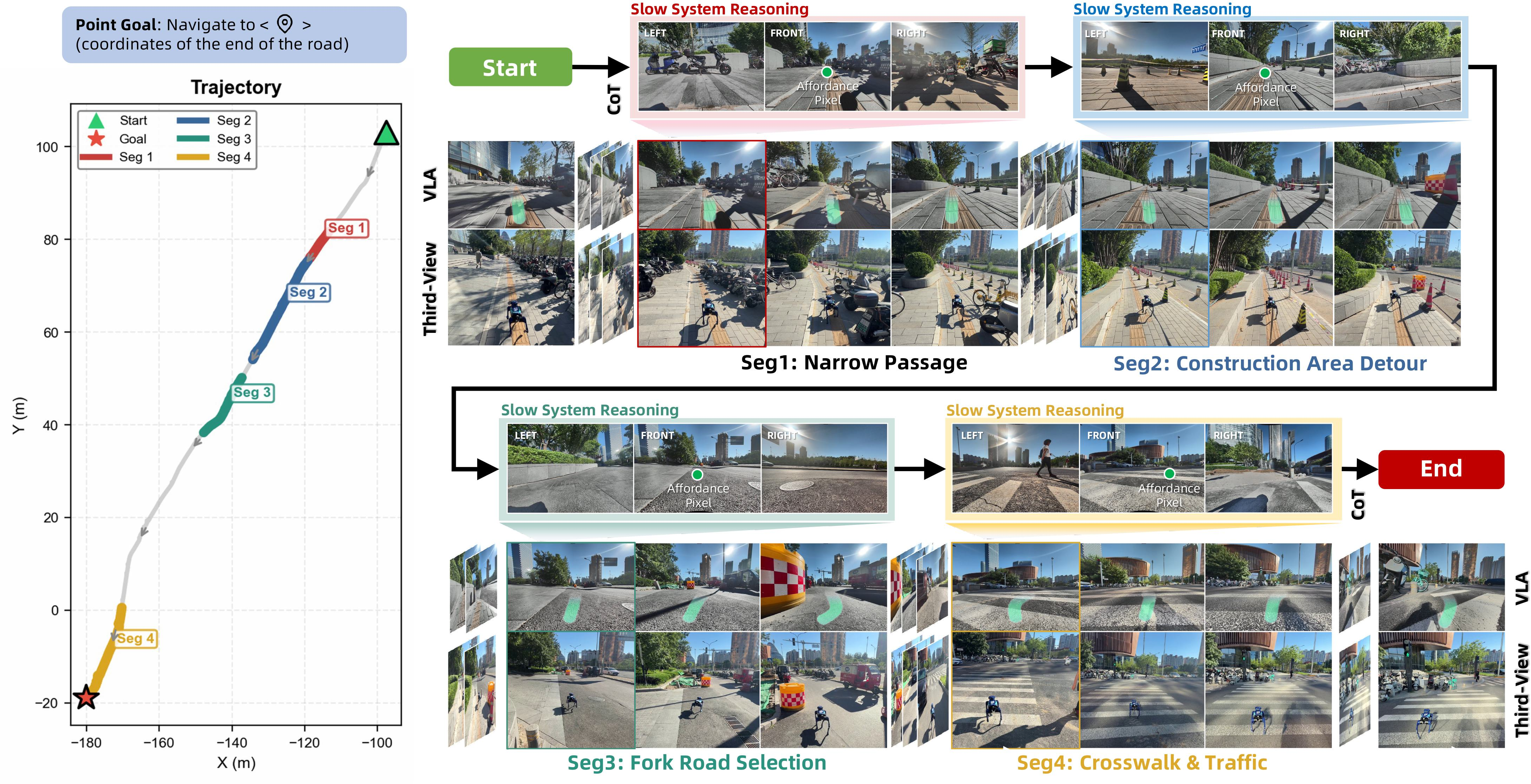
Point-Goal Navigation. Figure 10 illustrates a long-distance outdoor navigation episode decomposed into four representative segments. (1) Narrow-road obstacle avoidance: the agent successfully navigates around parked vehicles on a constricted roadway, with the affordance pixel consistently anchored to the traversable lane. (2) Construction-zone detour: upon detecting a construction area, the slow system places the affordance pixel on a detour around the restricted region, steering the fast controller clear of the illegal construction zone rather than entering it. (3) Fork selection: at a road bifurcation, the affordance pixel is anchored to the target-aligned branch, steering the agent onto the correct path and avoiding wrong-turn failures. (4) Traffic-light compliance: approaching a signalized crosswalk, the agent waits for the green signal before crossing, demonstrating awareness of traffic rules and the ability to temporally gate its own actions—a behavior absent from metric-only point-goal policies. These results confirm that the slow system’s traversability-aware pixel guidance translates into safe, rule-compliant outdoor navigation beyond simple goal-reaching.
Object-Goal Navigation. Figure 11 presents three representative object-goal episodes with CoT, affordance pixel, and target pixel outputs. (1) Outdoor bench finding: the agent locates a park bench under dappled tree shade at a considerable distance, demonstrating robust long-range recognition under complex natural lighting. (2) Indoor chair with water bottle: the slow system reasons about spatial relations between objects—distinguishing the target chair with a water bottle from other chairs—evidencing spatial reasoning and attribute-aware recognition. (3) Indoor fire extinguisher: the agent navigates around indoor obstacles and identifies a partially occluded fire extinguisher, showcasing perception under occlusion. Across all cases, the affordance pixel consistently falls on safe traversable surfaces while the target pixel locks onto the goal object once visible, validating the decoupled recognition-and-approach protocol.
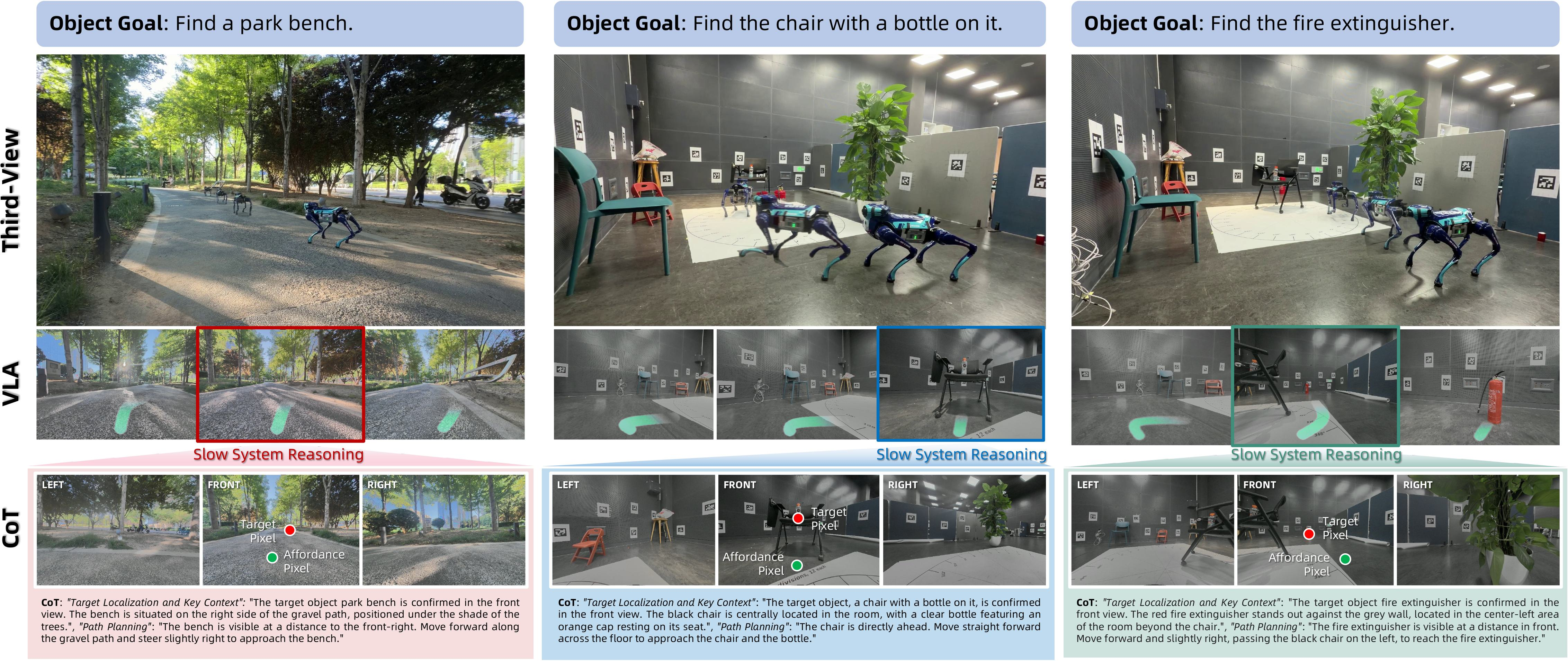
POI-Goal Navigation. Figure 12 shows three POI-goal episodes in which the agent locates commercial storefronts by recognizing signage. (1) Lanzhou beef noodle restaurant: the agent identifies the shop sign at a large oblique viewing angle, demonstrating robust text and logo recognition under perspective distortion. (2) McDonald’s: building upon recognition, the agent performs obstacle avoidance during approach, coordinating the affordance pixel around street-level obstructions. (3) Luckin Coffee: the agent navigates a gentle slope, identifies a passable entrance, and avoids an impassable staircase with high steps, demonstrating the slow system’s joint reasoning over accessibility and goal identity. These results highlight that POI-goal requires not only fine-grained visual recognition but also path-feasibility reasoning, both of which are naturally captured by the target pixel + affordance pixel protocol.

Instruction-Following. Figure 13 visualizes four key decision moments during an indoor instruction-following episode with the command: “Walk down the stairs …approach and stop directly in front of the bar counter.” At each moment the slow system produces a CoT trace and an affordance pixel (and, near the destination, a target pixel): (1) Descending stairs: the CoT identifies the current sub-instruction and the affordance pixel marks the stairwell path. (2) Entering the gym room: the reasoning correctly advances the instruction pointer and anchors the pixel to the gym doorway. (3) Exiting the gym: the CoT tracks cumulative progress and shifts the pixel toward the hall exit. (4) Approaching the bar counter: having recognized the final landmark, the system emits a target pixel directly on the bar and prepares to terminate. The explicit CoT decomposes the long instruction into manageable sub-goals at each step, eliminating the ambiguous mid-segment behavior typical of single-system VLN policies.
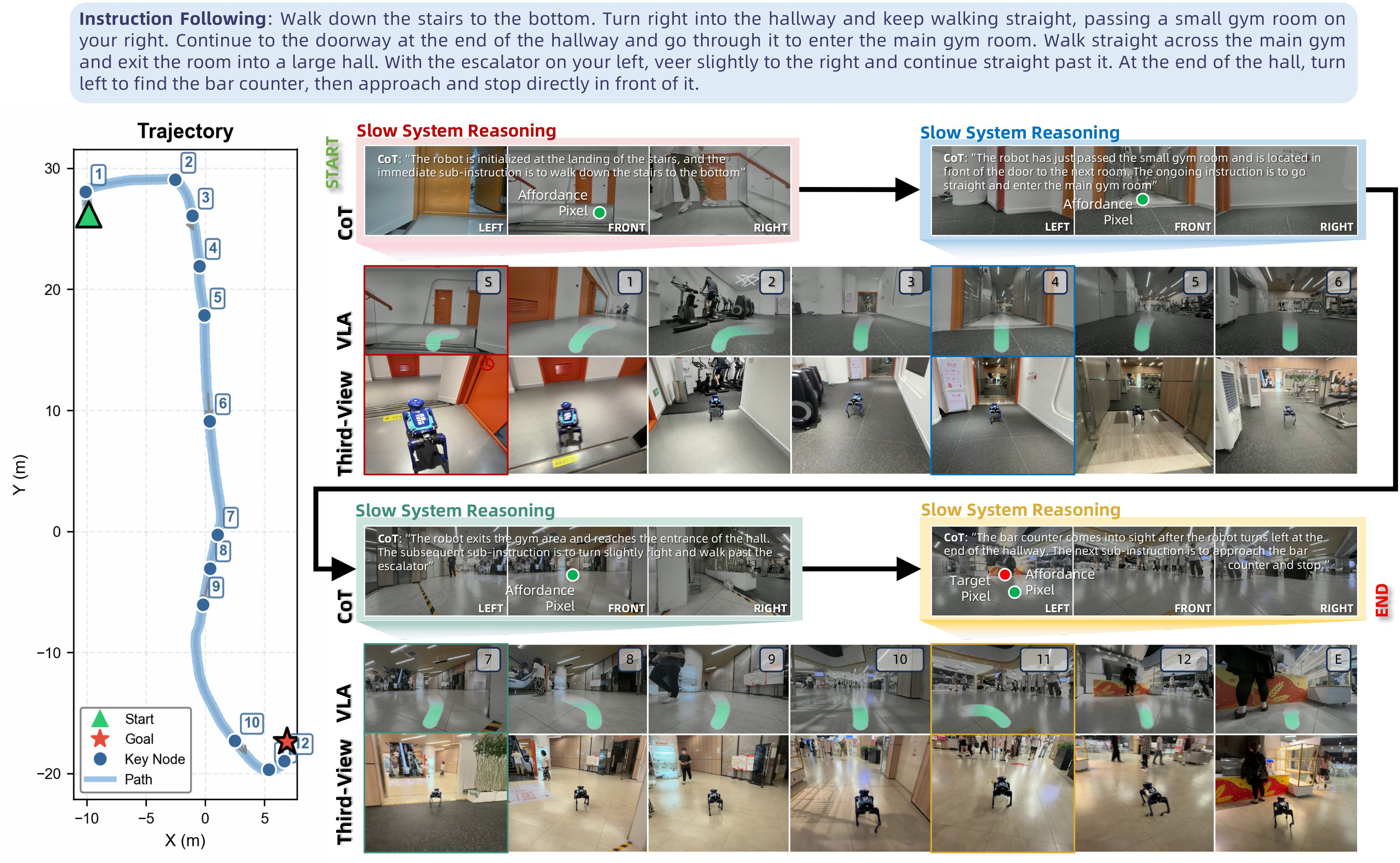
Person-Following. Figure 14 illustrates three Person-Following cases. (1) Outdoor following with distractors: the agent maintains stable tracking of the designated target despite the presence of other pedestrians, demonstrating the slow system’s robust identity reasoning and re-identification capability. (2) Outdoor stair-climbing: the target ascends a staircase and the agent follows seamlessly, confirming the fast system’s stable low-level control under elevation changes. (3) Indoor corner tracking: as the target rounds a sharp indoor corner, the agent adjusts its heading in time and follows smoothly while keeping the target continuously in view. The combination of slow-system identity persistence and fast-system reactive control ensures continuous, collision-aware following across challenging real-world conditions.
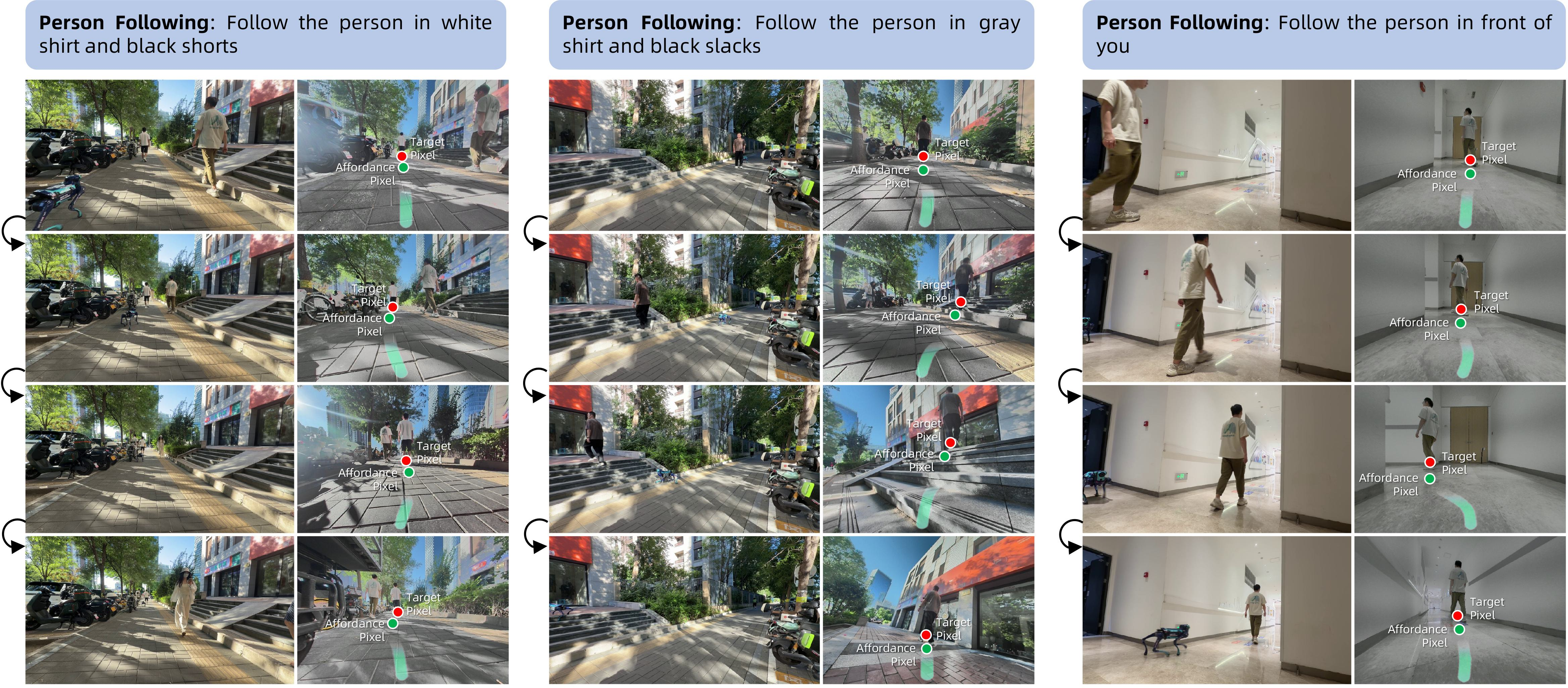
Summary. The five deployment tasks collectively validate the slow-fast architecture: the slow system provides high-level semantic reasoning—instruction decomposition, open-vocabulary recognition, spatial relation inference, rule-aware decision-making, and identity persistence—externalized as CoT traces and pixel-level grounding; the fast system translates these pixel anchors into smooth control with precise last-meter arrival, dynamic obstacle avoidance, and stable locomotion under terrain variation. Their asynchronous coupling eliminates odometric drift through continuous visual re-grounding while the fast system’s reactivity compensates for the slow system’s latency, yielding robust, compliant navigation across all five real-world scenarios.
7 Conclusion↩︎
We have presented ABot-N1, a general visual-language navigation foundation model whose fast–slow architecture factorizes high-level cognition from low-level control: a slow vision-language reasoner produces Chain-of-Thought traces and pixel-level grounding, while a fast action expert converts these into reactive waypoints. The dual visual-language guidance through affordance and target pixels serves as a universal action interface that accommodates five navigation tasks—point-goal, instruction-following, object-goal, POI-goal, and person-following—from a single multi-task checkpoint, enabling strong cross-task transfer without task-specific modifications. ABot-N1 achieves state-of-the-art results on all five benchmarks (70.89% SR on R2R-CE, 92.9% SR on outdoor point-goal, 77.3% on POI-goal, 84.9% on object-goal, and 90.1% on person-following), with the multi-task model consistently matching or exceeding single-task specialists. Real-world deployment on a quadrupedal robot further confirms generalization from simulation to diverse physical environments, demonstrating a viable path toward embodied navigation agents that are simultaneously robust, versatile, and interpretable.
8 Contributions↩︎
2
Research↩︎
Ruiyan Gong
Yingnan Guo
Junjun Hu
Jintao Kong
Xiaoxu Leng
Tianlun Li
Weize Li
Fei Liu
Zhicheng Liu
Jia Lu
Minghua Luo
Chenlin Ming
Yanfen Shen
Jiyue Tao
Zhengbo Wang
Mingyang Yin
Engineering↩︎
Minqi Gu
Zihao Guan
Wei Guo
Guoqing Liu
Huachong Pang
Menglin Yang
Zeqian Ye
Data↩︎
Xiaoxiao Geng
Zhining Gu
Honglin Han
Di Jing
Hongyu Pan
Mingchao Sun
Kuan Yang
Jianfang Zhang
Infra↩︎
Yanghong Chen
Ye He
Wei Mei
Jiahao Shi
Xiangpo Yang
Yanqing Zhu
Project Lead↩︎
Zedong Chu\(^{\dagger}\)
Xiaolong Wu\(^{\dagger}\)
Advisor↩︎
- Mu Xu
Acknowledgments↩︎
We extend our sincere gratitude to the broader team for their support, particularly Ziqiao Li, Zhining Gu, Shihui Su, Zixiao Tang, Yang Cai, Linbo Zheng, and Jingjing Ma.
Authors are listed in alphabetical order.
\(^{\dagger}\) Corresponding authors: chuzedong.czd@alibaba-inc.com, huanlu.wxl@alibaba-inc.com