Feeling UISTful: An Interactive Portrait of Scholarly Authorship, Readership, and the In-Between
January 01, 1970
Abstract
We introduce UISTful, a system that turns reading activity into a collective portrait of a scholarly community. Readers explore a semantic globe of UIST papers and authors while the system records private reading traces that can be reviewed, reflected upon, curated, and published for others to replay. Inspired by the information flâneur, UISTful treats a reading trace as a camera through which readers frame and interpret what they read, casting reading as a creative and authorial process. Shared traces display the plurality of interpretations composed across the same scholarly landscape, while collective trace views reveal paths and concentrations of attention across the community, inviting UIST to see itself as an interactive system of papers, authors, readers, and their exchanges.
<ccs2012> <concept> <concept_id>10003120.10003121.10003124.10010868</concept_id> <concept_desc>Human-centered computing Web-based interaction</concept_desc> <concept_significance>500</concept_significance> </concept> <concept> <concept_id>10003120.10003145.10011768</concept_id> <concept_desc>Human-centered computing Visualization theory, concepts and paradigms</concept_desc> <concept_significance>100</concept_significance> </concept> <concept> <concept_id>10003120.10003130.10003131.10003292</concept_id> <concept_desc>Human-centered computing Social networks</concept_desc> <concept_significance>500</concept_significance> </concept> </ccs2012>
1 Introduction↩︎
Reading augmentation systems increasingly use LLMs and agentic workflows to perform reading and synthesis on the reader’s behalf [1]. Many scholarly sensemaking systems instead scaffold readers in carrying out this work themselves across research texts at scale [2], [3]. Whether automating or assisting the process, these approaches provide powerful support for reading for transmission through information extraction and synthesis, but offer comparatively less support for interpretive and creative reading [1].
One mode of such creative reading is the curiosity-driven exploration of wiki rabbitholing [4] and information flânerie, which describe wandering through textual landscapes [5] without a fixed destination, encountering information by bumping into it [6]. Like the camera of the urban flâneur [7], a creative activity trace can preserve an otherwise ephemeral creative process for later revisitation [8]. Earlier work automatically captured browsing interaction histories to reduce effort in directed search [9]. More recent systems support the deliberate curation of research threads [10], “paper gardens” [11], and shareable research trails [12] through the reader’s explicit selection of sources and links. This suggests an opportunity to pair explicit curation with automatic, implicit capture so that the reader’s path is recorded as a trace they can revisit and layer interpretation onto. This approach is especially timely as LLMs and AI summaries compress reading into immediate answers and risk diminishing the curiosity, creativity, and critical eye of the flâneur [6].
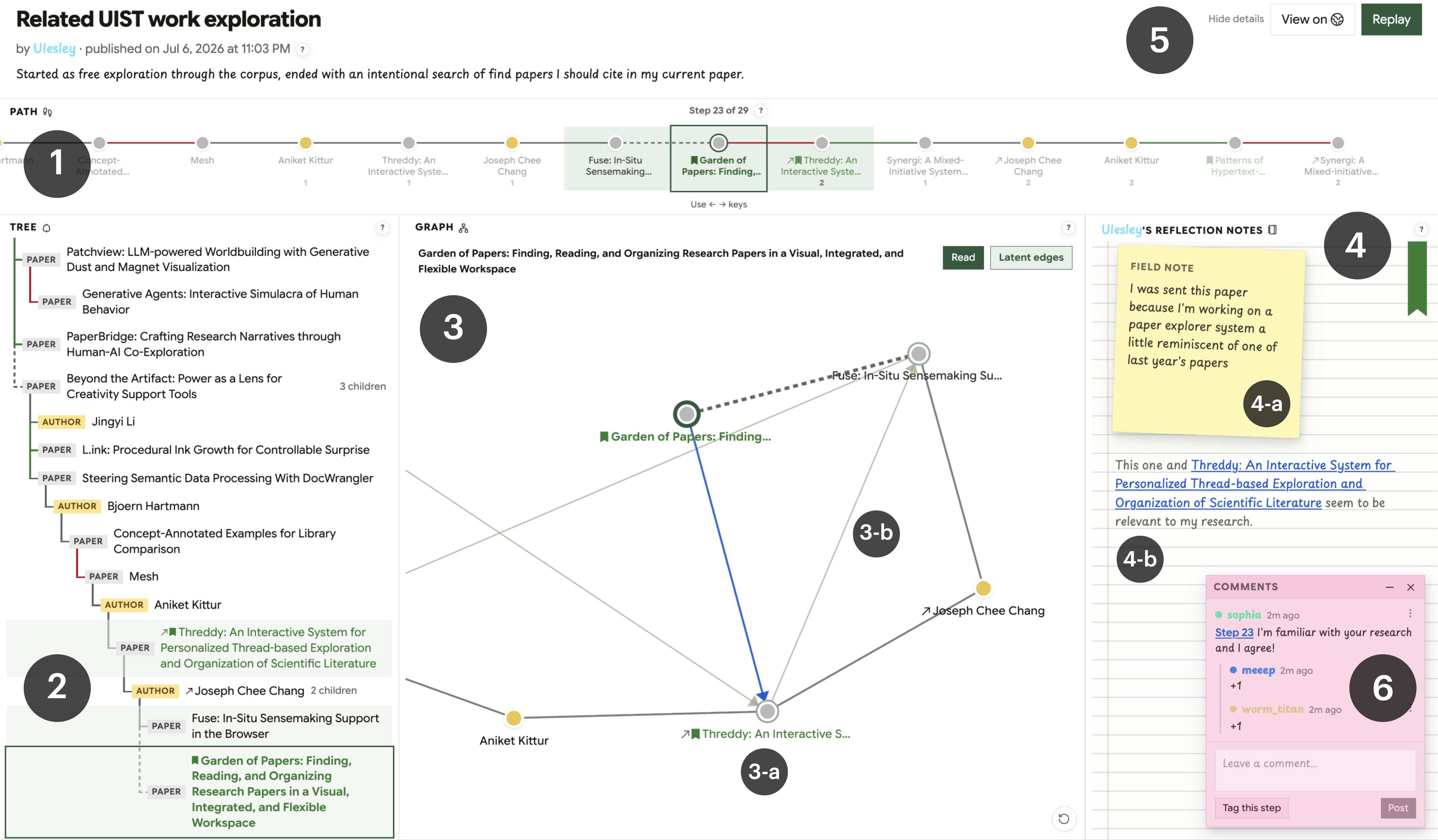
We introduce UISTful, a system for collectively capturing and composing an interactive portrait of a scholarly community of readers, authors, and those in between. Authors read to write, while readers exercise an authorial role by composing their own interpretations and syntheses across texts. At a conference, the readers are often also the authors of the papers circulating among them. This duality recalls the “participant-observer dialectic” of the urban flâneur, who is part of the very crowd they observe [13]. In UISTful, readers navigate a semantic globe of recent UIST papers and authors, zoom into individual pages, and follow citation or authorship links. The system records each path as a private reading trace that readers can inspect, annotate, and curate before publishing. Published traces (Fig. [fig:teaser]) appear in a public library, while anonymized full reader traces appear across the Globe, showcasing a plurality of readings and supporting reflection at both individual and collective levels. In effect, UISTful arms the information flâneur with a camera that encourages wandering and noticing while preserving each reading for later, even wistful, viewing [6], [7]. The result resembles a live wedding—or conference—portrait whose subjects are also its portraitists. Through this demonstration, we invite the UIST community, as researchers of interactive systems, to view itself as a living and observable whole [14].
2 UISTful: Interaction↩︎
UISTful provides three main interfaces: the Globe for exploring papers and authors, My Trace for reviewing and reflecting on one’s own reading trace, and the Trace Library for publishing and replaying community traces.
2.1 Globe View: Reading↩︎
The Globe serves as both an overview of the UIST community and an entry point for reading, situating individual papers and authors within the broader scholarly landscape.
2.1.1 The UISTful Globe↩︎
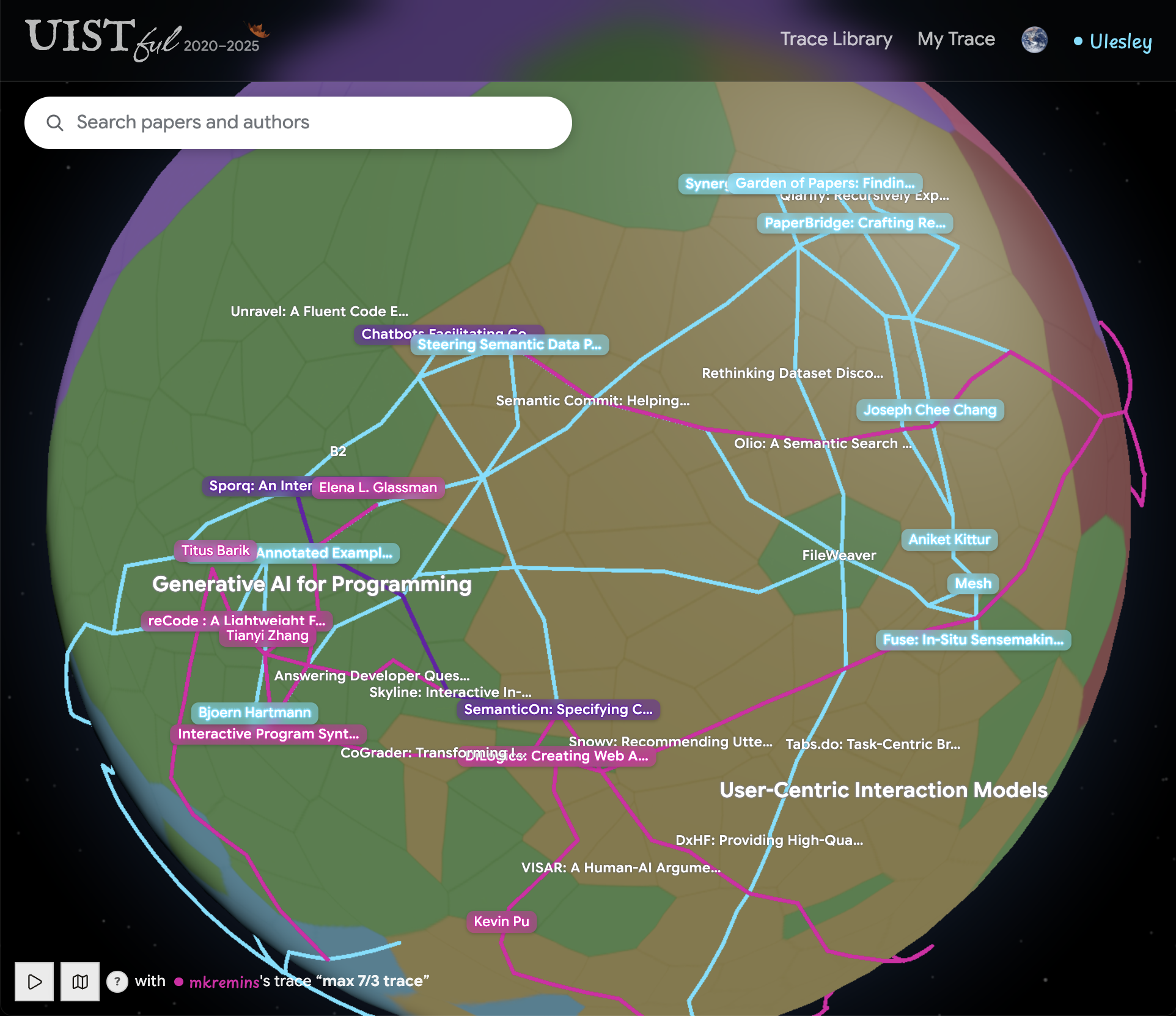
Inspired by spatial browsing interfaces like Artographer [15], the UISTful Globe (Fig. 4) maps UIST 2020–2025 full papers and recurring authors onto seven semantic continents. Paper titles and abstracts are embedded and projected onto a sphere with spherical UMAP, authors are positioned at the mean of their papers, and papers are grouped with \(k\)-means in embedding space into seven clusters named by an LLM. A Voronoi tessellation gives each paper a cell, while shortest paths over neighboring-paper Delaunay edges route citation and authorship links. The same layout is also available as a 2D equirectangular map. Readers rotate, pan, search, and zoom through the corpus much like Google Earth, with semantic zoom progressively revealing more labels [16], [17]. By eliminating the edges of a planar map, the Globe presents the proceedings as a bounded yet continuously navigable whole, supporting an overview effect while preserving meaningful local neighborhoods [14].
2.1.2 Reading Interaction↩︎
Readers can wander across the Globe, search directly, or use I’m Feeling Lucky to find a paper or author. Selecting a label opens a side panel with metadata and links to references, citing papers, and authors (Fig. 1). Selecting Read opens a full page with a yellow sticky Field Note for in-reading reflection (Fig. 2). Paper pages include the title, author links, abstract, and in-context citations, while author pages list papers and collaborators. Readers follow blue hypertext links between pages while the system records each visit and traversed link in their private trace.
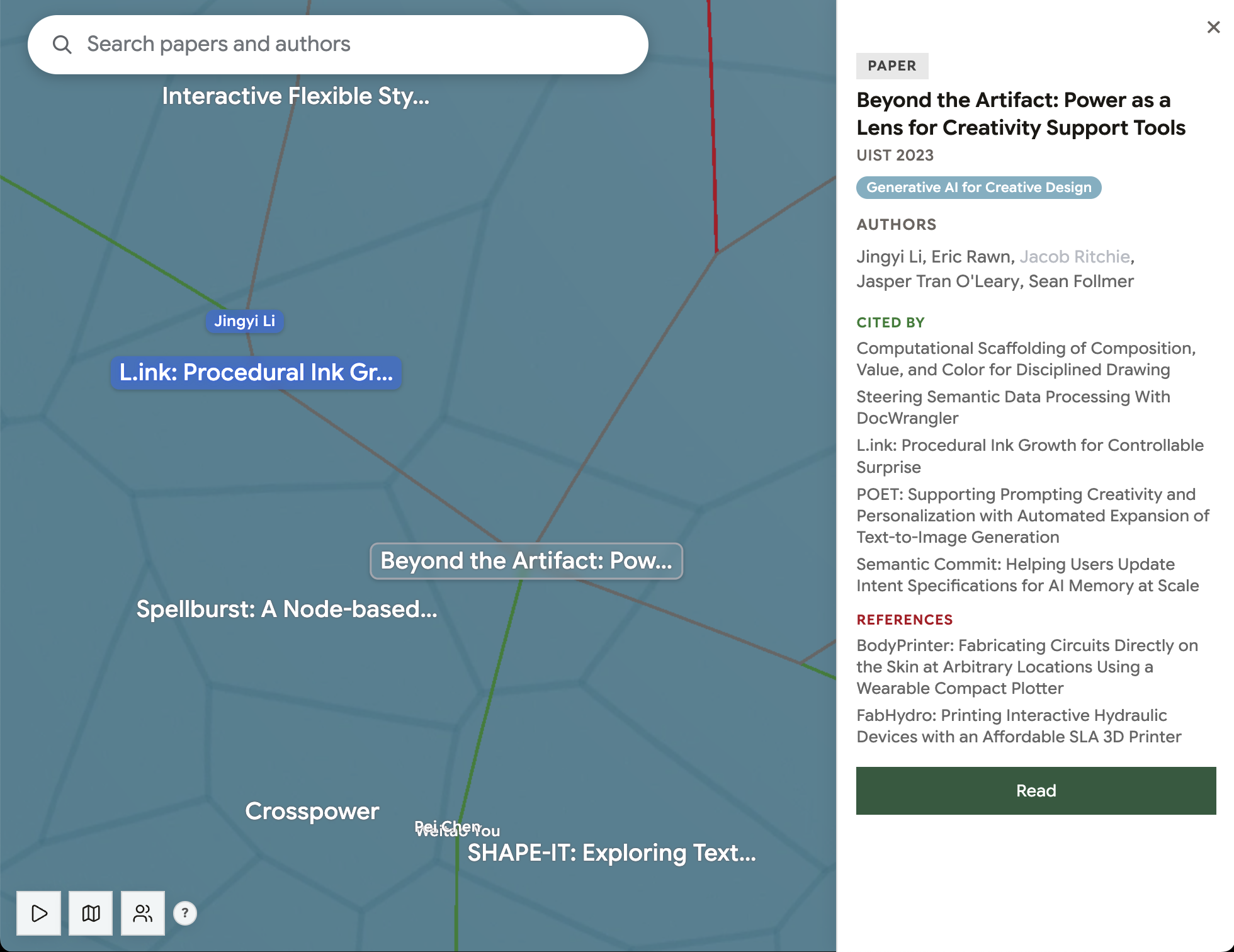

Figure 2: A full paper page with linked authors and in-context citations, plus a Field Note for reflection during reading..
2.2 Trace View: Sharing↩︎
A reading trace records the ordered paper and author pages a reader visits, including revisits and traversed links. Readers inspect and reflect on this private trace in My Trace, then curate and publish selected traces to the Trace Library.
2.2.1 My Trace↩︎
My Trace uses the same coordinated Path, Tree, Graph, and notes interface shown in Fig. [fig:teaser], but in an editable form. Readers can scrub between steps in their trace, revisit in-reading Field Notes, write retrospective, post-reading Reflection Notes, bookmark steps, reveal latent (untraversed) citation and authorship edges, and add interpretive links between pages. They can then crop and title the trace, add an overall reflection, and either save it privately or publish it. Their current trace also appears on the Globe as visited paper cells and authors connected by the shortest paths between them (Fig. 4 and 5-A).
2.2.2 Trace Library↩︎
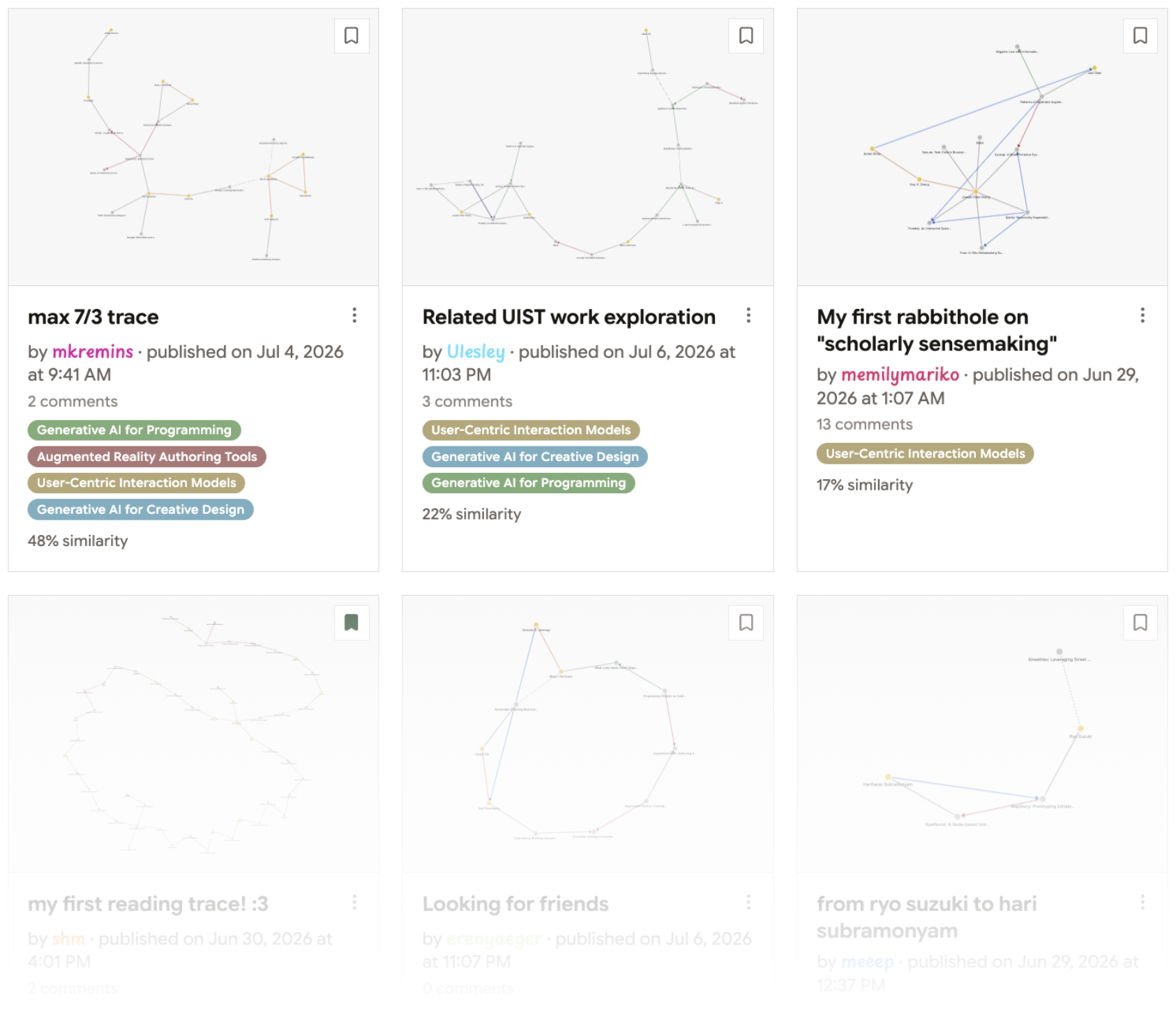
Published traces appear in the public Trace Library, where readers can search and filter by paper, author, user, or continent, and sort by recency or Jaccard similarity to their own trace (Fig. 3). Opening a trace presents the Path, Tree, Graph, and notes interface from Fig. [fig:teaser] in read-only form, with controls to replay it step by step through the corresponding full pages and comment on the trace or individual steps. Readers can also project a published trace onto the Globe alongside their own, making overlaps and divergences visible across the shared landscape (Fig. 4).
2.2.3 Collective Trace↩︎
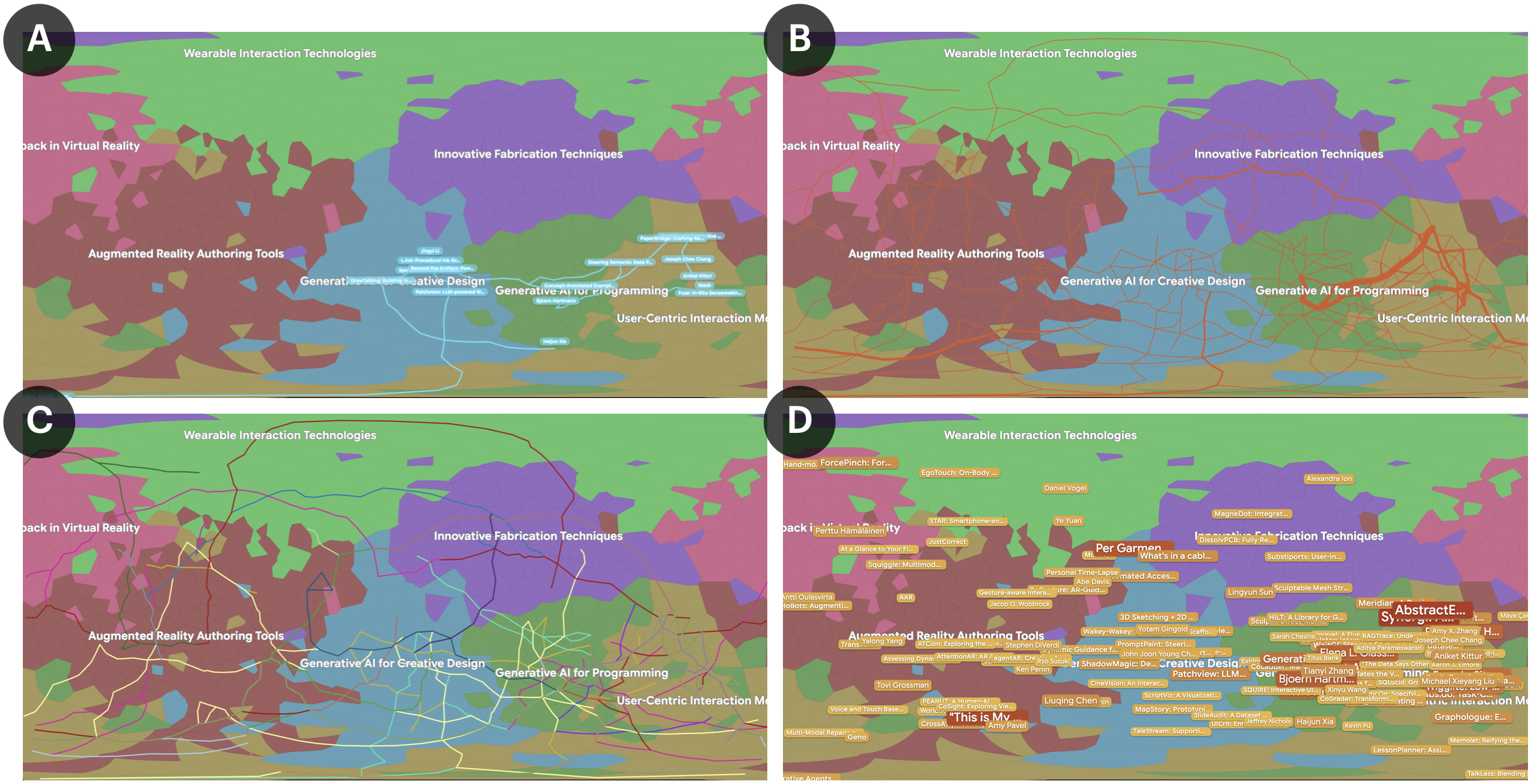
The Globe and Map offer three anonymized collective trace layers across all UISTful readers (Fig. 5). Paths overlays aggregate reading paths in orange, with thicker segments indicating more frequent traversal (Fig. 5-B). Readers shows each reader’s route in their personal trace color, making individual paths and overlaps visible (Fig. 5-C). Heat presents a heatmap of visit frequency across papers and authors (Fig. 5-D). By aggregating and zooming out from the individual traces in My Trace and the Trace Library, these layers capture a bird’s-eye view of the collective creative reading happening on UISTful, evoking an “Overview Effect” at the scale of the systems research community [14], [18].
2.3 Usage Scenarios↩︎
Curated traces can be saved privately or published to the community. We anticipate UISTful supporting both directed and exploratory reading for oneself, for others, or for both [19].
| For oneself | For others | |
|---|---|---|
| Directed | Find and contextualize sources for an ongoing project. | Curate a path through a topic or argument. |
| Exploratory | Wander for curiosity or inspiration. | Share an unexpected rabbithole for others to replay. |
3 Conclusion↩︎
The photographer is an armed version of the solitary walker reconnoitering, stalking, cruising the urban inferno, the voyeuristic stroller who discovers the city as a landscape of voluptuous extremes. Adept of the joys of watching, connoisseur of empathy, the flâneur finds the world “picturesque.”
—Susan Sontag, On Photography
We present UISTful, a system that turns the scholarly reader into a flâneur wandering through a shared landscape of papers and authors. Reading traces serve as a camera through which readers frame and interpret what they encounter, much as a flâneur interprets a city scene through photography, demonstrating reading as a deeply creative process [1], [7], [13]. Shared traces expose a plurality of readings, while collective views induce an overview effect through which UIST, a conference on interactive systems, can see itself as an interactive system of papers, authors, readers, and their exchanges. As participants read, reflect, and share, they compose a living portrait of the scholarly community they belong to, enacting the participant–observer and reader–author dialectics at the heart of UISTful.
We thank Kosa Goucher-Lambert, Hugh Dubberly, TJ McLeish, John Cain, Kevin Ma, and Caseysimone Ballestas of the knowledge graph discussion group, as well as Ronen Tamari and Wesley Finck of Semble and the Cosmik Network, for thoughtful discussions, feedback, and inspiration for the system.