Quantum Circuits in Diffusion Models:
A Fair-Comparison Study and a Mechanistic
Analysis of Angle-Embedding Failures
July 10, 2026
Abstract
We study the integration of variational quantum circuits (VQCs) into diffusion models through a squeeze-and-excitation (SE) channel-modulation scaffold that isolates the quantum contribution. Using a role-matched classical control (a classical MLP that plays the identical role in the same scaffold) and multi-seed significance testing across DDPM and latent diffusion on MNIST and CIFAR-10 (with a score-based NCSN study on MNIST), both quantum cores achieve comparable mean FID to the role-matched classical control across DDPM and latent diffusion, while paired sampling-seed tests for EfficientSU2 detect no statistically significant difference. While the quantum cores use \(4.5\)–\(9\times\) fewer parameters than this control, at matched budgets they attain slightly lower mean FID in all four MNIST/CIFAR-10 comparisons; the differences are small and not significance-tested, so the experiments do not establish a quantum parameter-efficiency advantage. We further mechanistically identify and resolve a structural failure in the score-based NCSN setting: the unbounded score target (\(\propto 1/\sigma\)) drives angle-embedding inputs far beyond the \(2\pi\) period of the rotation gates, a phase-aliasing effect that flattens the expectation-value landscape and collapses the quantum modulator. A bounding transformation \(\theta \leftarrow \pi\tanh(\cdot)\) projects the feature space onto the non-aliasing domain \((-\pi,\pi)\), removing the failure and substantially improving both quantum cores; normalized RealAmplitudes attains the lowest mean FID in this single-training-run comparison (not established as statistically significant). Because all circuits are classically simulated at a few-qubit scale, we characterize whether a variational quantum parameterization is a useful inductive bias under strictly matched controls, rather than claiming quantum advantage; under this controlled comparison the quantum core exhibits functional parity—not superiority—with a classical core of equal parameter budget. Our contributions are (i) a rigorous fair-comparison methodology for quantum-enhanced generative models and (ii) a mechanistic account of when and why angle embeddings fail.
1 Introduction↩︎
Quantum machine learning (QML) [1] for generative modeling has attracted strong interest, with a growing body of work inserting parameterized quantum circuits into autoencoders, GANs, and, more recently, diffusion models [2], [3]. A recurring difficulty in this literature is evaluation: a quantum-augmented model is often compared against a plain baseline without a classical module of matched capacity in the same location, so an observed gain may simply reflect the extra parameters and nonlinearity of the inserted block rather than anything quantum. When the quantum circuit is small enough to be classically simulable, as is the case at the few-qubit scale used in practice, the experiments are not designed to test computational quantum advantage; what remains to be measured is whether the quantum parameterization is a useful inductive bias relative to a classical core playing the same role.
We therefore adopt a deliberately conservative experimental design. We fix a single squeeze-and-excitation (SE) modulation scaffold and vary only its core, swapping a variational quantum circuit for a role-matched classical multilayer perceptron (MLP)—one that occupies the identical position in the same scaffold, though with more core parameters (144 vs./32), making it a higher-parameter, not smaller, control—or for nothing at all, with all wrappers, initializations, and training schedules held identical. Differences are then assessed with multi-seed significance testing rather than single-run point estimates. Diffusion models are an attractive testbed because the same scaffold can be evaluated across three structurally distinct families — denoising diffusion (DDPM), latent diffusion (LDM), and score-based generation (NCSN) — on standard image benchmarks.
Across this matrix we find no statistically detectable difference: quantum cores match the higher-parameter classical control while using \(4.5\)–\(9\times\) fewer parameters within the core, with no significant win or loss on DDPM or LDM. We stress that this efficiency is local to the modulation core, which is a tiny fraction of the full \(\sim\)23 M-parameter model (Sec. 4); it is a statement about a compact parameterization, not about whole-model size, runtime, or memory. The one exception, score-based NCSN, turns out to be informative: we trace the dominant observed failure to aliasing in the periodic angle embedding when fed the unbounded score target—rather than to an obvious shortage of core parameters—a failure we diagnose and fix. We make no claim of quantum advantage; the value of the work is a fair-comparison methodology and a transferable mechanistic insight.
1.0.0.1 Contributions.
A fair-comparison framework (Sec. 3): a fixed SE scaffold in which only the core is swapped between a quantum circuit, a role-matched classical MLP (with more core parameters), or nothing, with identity initialization so all variants share the same starting point.
A no-difference finding with no efficiency advantage (Sec. 4): across DDPM and latent diffusion on MNIST/CIFAR-10, quantum cores match the higher-parameter (\(144\)-parameter) classical control (\(|\mathrm{SNR}|<0.3\)); but a parameter-matched classical core (\(16\)/\(32\) parameters) is numerically comparable to the quantum core, so the apparent “fewer-parameter” edge is not a significant quantum efficiency advantage.
A mechanistic discovery (Sec. 5): score-based (NCSN) models fail with quantum cores due to angle-embedding aliasing; a \(\pi\tanh\) normalization substantially improves both quantum cores and, for RealAmplitudes, attains the lowest mean FID in a single-training-run comparison.
Methodological rigor over empirical confounding (Sec. 3): rather than reporting unvetted gains, we decouple architectural confounders from quantum expressivity, establishing a transparent, reproducible evaluation standard for hybrid generative models and isolating a transferable mechanistic failure mode.
2 Background↩︎
2.1 Diffusion models↩︎
A diffusion model defines a forward process that gradually adds Gaussian noise, \(x_t=\sqrt{\bar\alpha_t}\,x_0+\sqrt{1-\bar\alpha_t}\,\epsilon\) with \(\epsilon\sim\mathcal{N}(0,I)\), and learns a reverse (denoising) process that predicts \(\epsilon\) [4]. Score-based models instead learn the score \(\nabla_x\log p(x)\) over a range of noise scales [5], [6]. Latent diffusion runs the process in a compressed latent space [7].
2.2 Variational quantum circuits and angle embedding↩︎
A VQC encodes classical inputs as rotation angles (angle embedding), applies parameterized entangling layers, and reads out expectation values such as \(\langle Z_i\rangle\) [8], [9]. Crucially, rotation gates are \(2\pi\)-periodic, a fact central to Sec. 5.
3 Method: Quantum SE Modulation with Fair Controls↩︎
3.1 The SE scaffold↩︎
We insert a squeeze-and-excitation (SE) channel gate [10] at the U-Net bottleneck. Given features \(x\in\mathbb{R}^{B\times C\times H\times W}\), we pool over space to \(v\in\mathbb{R}^{B\times C}\), project to \(n_q\) values, apply a core \(f_\theta:\mathbb{R}^{n_q}\!\to\!\mathbb{R}^{n_q}\), map back to a per-channel gate, and modulate: \[g = 1 + \tanh\!\big(W_{\uparrow}\,\tanh(f_\theta(W_{\downarrow}\,v))\big), \qquad x' = x \odot g,\] where \(W_{\downarrow}\) and \(W_{\uparrow}\) are the down/up projections. The up-projection \(W_{\uparrow}\) is zero-initialized, so \(g\equiv 1\) and \(x'=x\) at initialization; every variant therefore starts from the identical, unmodulated network and the gate is wrapped residually. The only object that changes between conditions is the core \(f_\theta\).
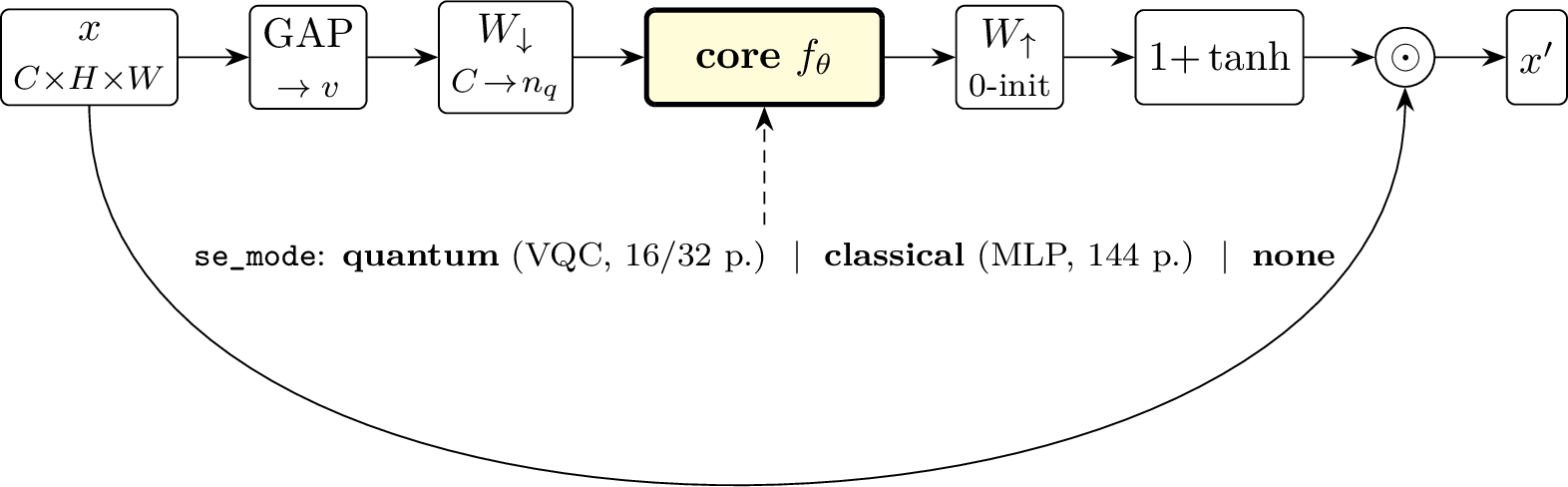
3.2 The se_mode axis and the role-matched control↩︎
The core is one of:
none: no SE module (plain diffusion baseline).classical: an MLP core in the same role (144 core parameters) — the control. It has more core parameters than either quantum core, so it is a higher-parameter, not smaller, comparison point.quantum: a VQC core, either RealAmplitudes (16 parameters) or EfficientSU2 (32 parameters).
The quantum cores thus use \(4.5\)–\(9\times\) fewer core parameters than the classical control; matching a higher-parameter control is the sense in which the quantum parameterization is compact. We emphasize that this comparison is role-matched, not parameter-matched: a parameter-matched comparison would shrink the classical core to \(16/32\) parameters, which we examine separately in Sec. 4 (tiny-MLP control).
3.3 Evaluation protocol↩︎
For each configuration we generate samples under \(5\) generation seeds and report FID [11] and SSIM [12] as mean\(\pm\)std. We summarize each paired comparison with an effect size \(\mathrm{SNR}=\overline{\Delta}/\mathrm{std}(\Delta)\) over seeds—a standardized mean difference (Cohen’s-\(d\) family), not a \(p\)-value. It is the per-seed analogue of a paired \(t\) statistic, \(t=\mathrm{SNR}\sqrt{n}\) with \(n{=}5\) (\(\mathrm{df}{=}4\)), so our flag \(|\mathrm{SNR}|>2\) corresponds to \(|t|>4.5\) (two-sided \(p\!\approx\!0.01\)) and is a conservative threshold. These seeds vary the generation (sampling) noise at a fixed checkpoint; they probe ranking stability under sampling noise. To also probe training-initialization variance, we retrain the two SE cores under four additional seeds, for a total of five independent training seeds, and re-evaluate each checkpoint under five generation seeds (Table 6). SSIM is computed between arbitrarily paired generated and real images (no correspondence exists for unconditional generation); we therefore treat it only as a coarse structural-similarity indicator and rely on FID for quality.
4 Experiments↩︎
4.0.0.1 Setup.
All cores use \(8\)-qubit circuits (PennyLane default.qubit, backprop) and are trained for \(300\) epochs with Adam (learning rate \(10^{-4}\), batch size \(64\)), a cosine-annealed schedule, gradient clipping at \(1.0\), and an exponential moving average of weights (decay \(0.9999\)) used for evaluation. Hyperparameters are identical across cores; only the se_mode differs. We evaluate on MNIST and CIFAR-10, computing FID with pytorch-fid and SSIM with
torchmetrics over \(1000\) generated and \(1000\) real images (\(500\) for NCSN), using \(100\) sampling steps
and \(5\) generation seeds. Full hyperparameters and SSIM tables are in the Appendix.
se_mode |
core params (per block) | SE-module params | total trainable |
|---|---|---|---|
| none | 0 | 0 | \(23{,}328{,}641\) |
| classical-SE | 144 | \(134{,}704\) | \(23{,}463{,}345\) |
| quantum-real | 16 | \(134{,}448\) | \(23{,}463{,}089\) |
| quantum-su2 | 32 | \(134{,}480\) | \(23{,}463{,}121\) |
| Model | Dataset | none | classical-SE | quantum-real | quantum-su2 |
| (0 p.) | (144 p.) | (16 p.) | (32 p.) | ||
| DDPM | MNIST | \(14.79\pm0.77\) | \(14.59\pm0.86\) | \(14.80\pm0.74\) | \(\mathbf{14.52\pm0.70}\) |
| DDPM | CIFAR-10 | \(55.14\pm0.57\) | \(54.85\pm0.45\) | \(54.96\pm0.92\) | \(\mathbf{54.74\pm0.60}\) |
| LDM | MNIST | \(15.37\pm0.51\) | \(14.88\pm0.32\) | \(15.33\pm0.54\) | \(\mathbf{14.85\pm0.33}\) |
| LDM | CIFAR-10 | \(99.91\pm0.82\) | \(99.45\pm0.88\) | \(\mathbf{98.94\pm0.65}\) | \(99.18\pm0.25\) |
| NCSN | MNIST | \(23.73\pm0.60\) | \(\mathbf{19.07\pm0.66}\) | \(24.52\pm0.45\) | \(24.54\pm0.56\) |
| Model | Dataset | wins | mean gap (FID) | SNR |
|---|---|---|---|---|
| DDPM | MNIST | 3/5 | \(+0.072\pm0.434\) | \(0.17\) |
| DDPM | CIFAR-10 | 3/5 | \(+0.116\pm0.629\) | \(0.18\) |
| LDM | MNIST | 3/5 | \(+0.027\pm0.498\) | \(0.05\) |
| LDM | CIFAR-10 | 3/5 | \(+0.271\pm0.961\) | \(0.28\) |
| NCSN | MNIST | 0/5 | \(-5.471\pm1.040\) | \(\mathbf{-5.26}\) |
4.0.0.2 Result: comparable to the higher-parameter control.
On DDPM and latent diffusion (both datasets) quantum cores are statistically indistinguishable from the classical-SE control (Table 3, \(|\mathrm{SNR}|<0.3\); the paired test targets quantum-su2, and quantum-real shows comparable mean FID in Table 2), while using \(4.5\)–\(9\times\) fewer core parameters. As we show next, however, this does not establish a quantum efficiency advantage: parameter-matched classical controls achieve similar mean FID at the same \(16\)/\(32\)-parameter budgets. NCSN is the lone significant case (\(\mathrm{SNR}=-5.26\), quantum worse); we diagnose it in Sec. 5.
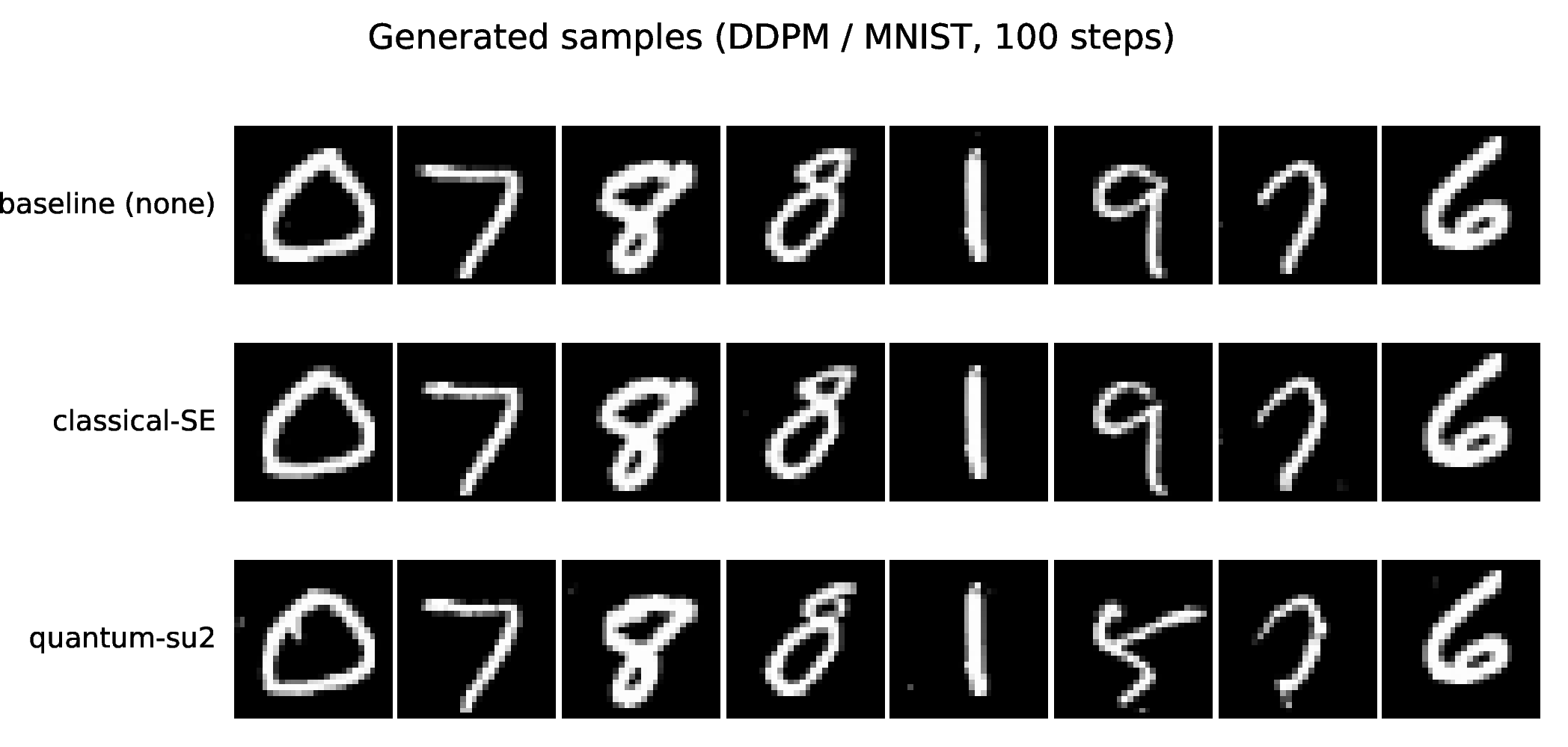
4.0.0.3 Is the efficiency real? A parameter-matched control.
The headline comparison above pits a \(16\)/\(32\)-parameter quantum core against a \(144\)-parameter classical-SE core, so “fewer parameters” conflates quantumness with smallness. To separate them we add classical cores shrunk to the same budget via a low-rank bottleneck (\(16\) and \(32\) parameters; Table 4). At matched budget the two cores are within sampling noise of each other: the quantum core is marginally lower at \(16\) parameters (\(14.80\) vs.\(15.18\)) and at \(32\) (\(14.52\) vs. \(14.67\)), gaps comparable to the per-seed standard deviation (\(\sim\) \(0.7\)–\(0.9\)). Moreover the \(144\)-parameter classical-SE (\(14.59\)) is no better than its \(32\)-parameter version (\(14.67\)), so the \(144\)-parameter control was simply over-provisioned for this task. We therefore find no significant parameter-efficiency advantage either way: at equal budget the quantum and classical cores obtain numerically comparable mean FID (the quantum core is not worse, and marginally lower here), and on DDPM/MNIST the SE core barely moves FID from the no-SE baseline (\(14.79\)) regardless of its form.
| Core | params | FID |
|---|---|---|
| none (baseline) | 0 | \(14.79\pm0.77\) |
| quantum-real | 16 | \(\mathbf{14.80\pm0.74}\) |
| classical (rank-1) | 16 | \(15.18\pm0.89\) |
| quantum-su2 | 32 | \(\mathbf{14.52\pm0.70}\) |
| classical (rank-2) | 32 | \(14.67\pm0.72\) |
| classical-SE | 144 | \(14.59\pm0.86\) |
4.0.0.4 Generalization to CIFAR-10.
The same parameter-matched comparison on DDPM/CIFAR-10 (Table 5) gives a similar numerical pattern: the quantum core is marginally lower at \(16\) parameters (\(54.96\) vs.\(55.30\)) and at \(32\) parameters (\(54.74\) vs.\(54.80\)). Across MNIST and CIFAR-10, the quantum cores obtain slightly lower mean FID in all four matched-budget comparisons, but the differences are small and are not established as statistically significant.
| Core | params | FID |
|---|---|---|
| none (baseline) | 0 | \(55.14\pm0.57\) |
| quantum-real | 16 | \(\mathbf{54.96\pm0.92}\) |
| classical (rank-1) | 16 | \(55.30\pm0.45\) |
| quantum-su2 | 32 | \(\mathbf{54.74\pm0.60}\) |
| classical (rank-2) | 32 | \(54.80\pm0.23\) |
| classical-SE | 144 | \(54.85\pm0.45\) |
4.0.0.5 Robustness to training initialization.
The significance tests above vary only the generation seed. To check that this comparability is not an artifact of one lucky initialization, we retrain classical-SE and quantum-su2 under four additional training seeds (five in total) and re-evaluate (each entry still averaged over \(5\) generation seeds; Table 6). The two cores track each other across all five training seeds (classical-SE spans \(14.59\)–\(15.04\), quantum-su2 \(14.41\)–\(15.35\)), with overlapping spread and no consistent winner. The comparability is thus stable to training initialization, not merely to sampling noise.
| Core | seed 0 | seed 1 | seed 2 | seed 3 | seed 4 |
|---|---|---|---|---|---|
| classical-SE | \(14.59\pm0.86\) | \(15.04\pm0.93\) | \(14.65\pm0.83\) | \(14.70\pm0.82\) | \(14.63\pm0.75\) |
| quantum-su2 | \(14.52\pm0.70\) | \(15.03\pm0.87\) | \(14.41\pm0.70\) | \(15.35\pm0.77\) | \(14.46\pm0.64\) |
5 The Angle-Aliasing Failure in Score-Based Models↩︎
5.0.0.1 Symptom.
On NCSN the quantum core is significantly worse than the classical control (Table 3), unlike every other configuration.
5.0.0.2 Diagnosis.
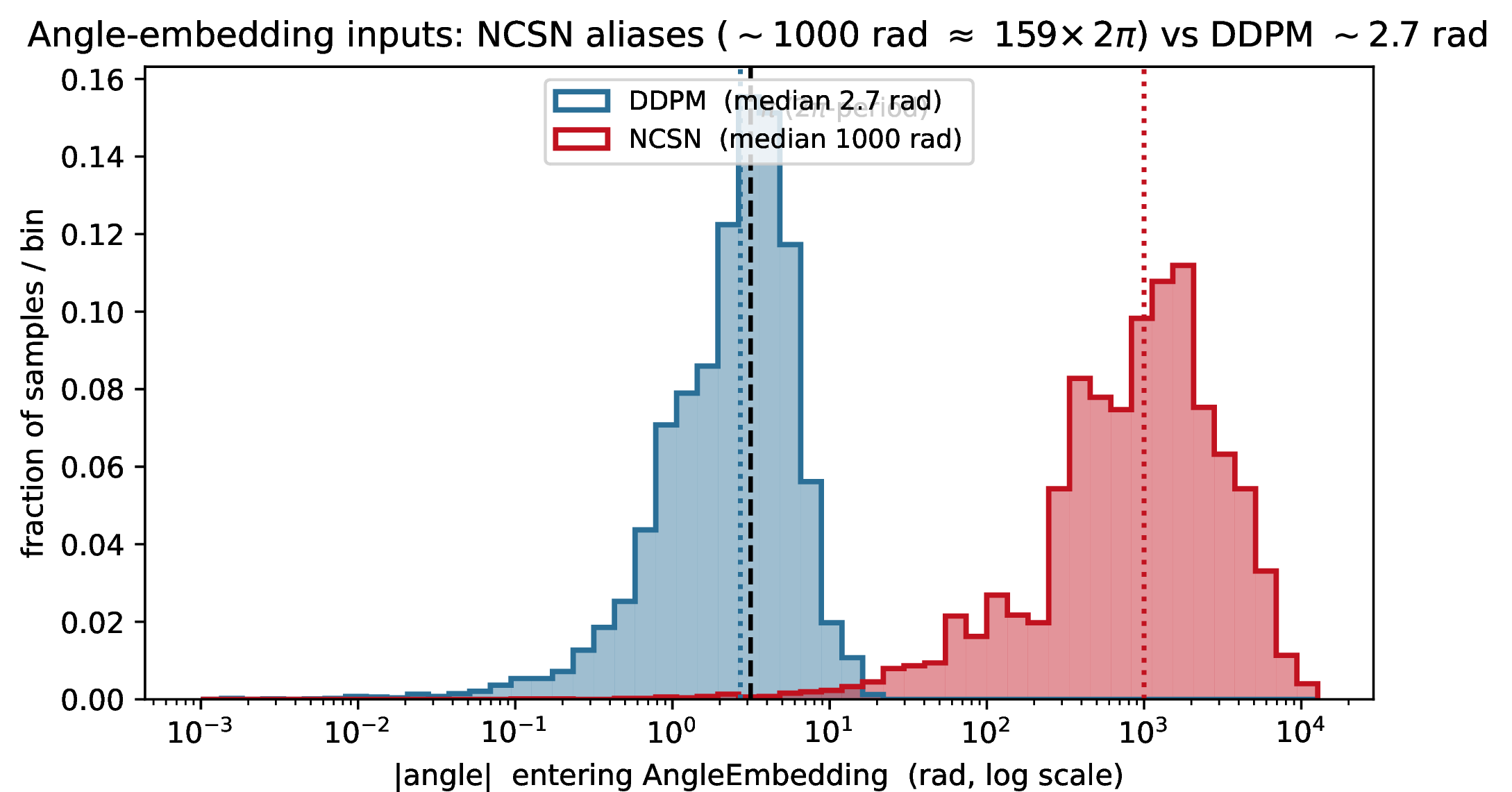
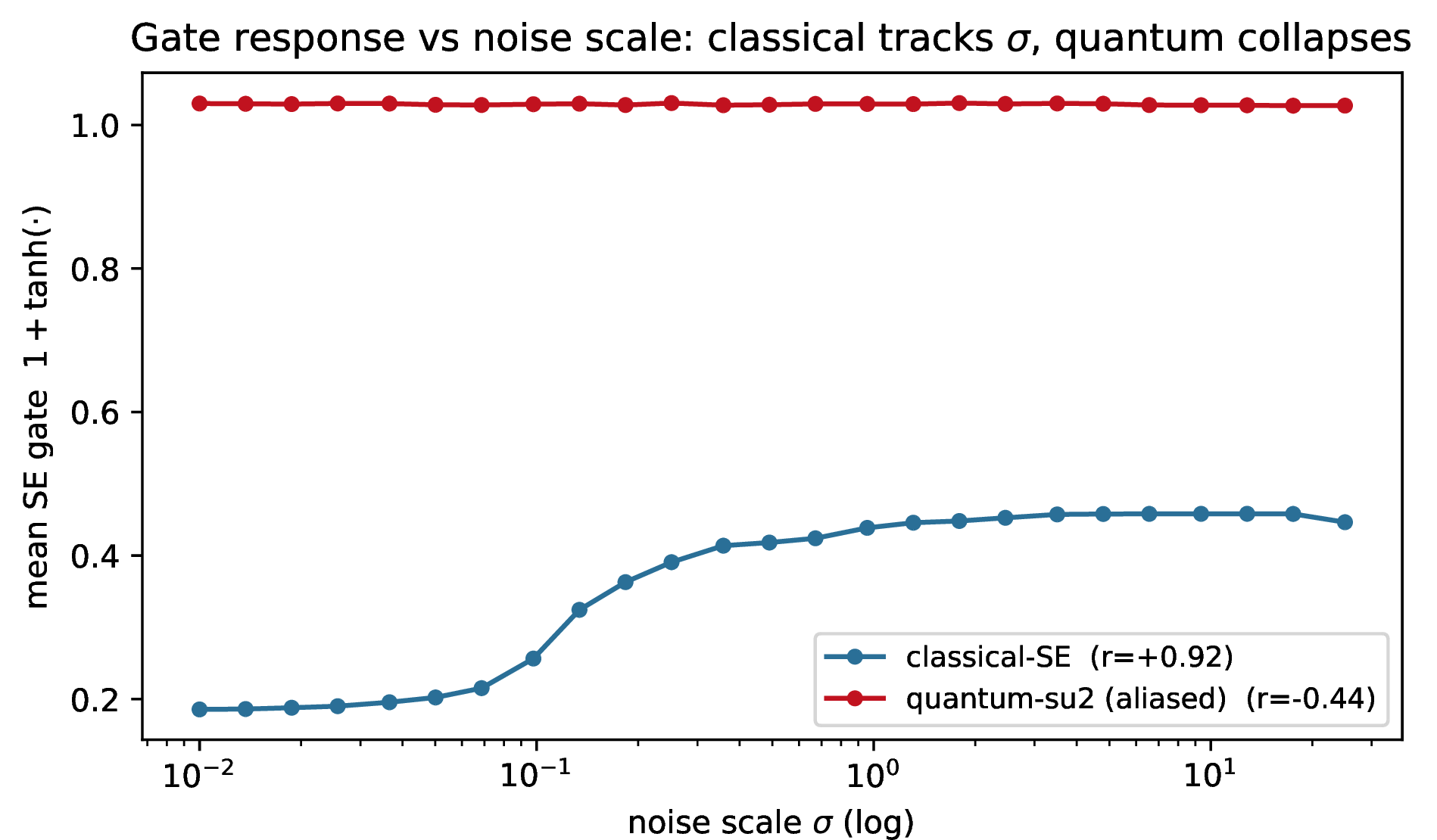
NCSN regresses an unbounded score target (\(\propto 1/\sigma\)). Measuring the actual arguments entering the angle embedding of a trained EfficientSU2 model (Fig. 3), the NCSN inputs have a median magnitude of \(\sim\!10^3\) radians (median \(1000\) rad \(\approx 159\times 2\pi\); \(99.6\%\) exceed \(\pi\), with a maximum of \(\sim\!1.3\times10^4\) rad), i.e.they wrap around the \(2\pi\) gate period hundreds of times. By contrast the bounded DDPM activations stay \(\mathcal{O}(1)\) (median \(2.7\) rad, at most a few wraps). The two distributions are separated by roughly \(2.5\) orders of magnitude with negligible overlap. At the NCSN scale the periodic encoder aliases, and the consequence is directly visible in the gate it drives (Fig. 4): the classical SE gate varies smoothly and monotonically with the noise scale \(\sigma\) (correlation \(r{=}{+}0.92\), range \(0.27\)), having learned a per-noise-scale schedule, whereas the quantum gate is essentially flat (range \(0.004\), \(\sim\) \(75\times\) smaller; \(r{=}{-}0.44\))—it has collapsed and no longer tracks \(\sigma\). The failure is thus a property of the encoder’s periodicity meeting an unbounded target, not of the quantum core’s capacity.
5.0.0.3 Fix.
We bound the embedding arguments with \(a \leftarrow \pi\tanh(a)\) (angle_norm), turning the periodic encoder into a saturating one within \((-\pi,\pi)\).
| Model | Core | no norm | \(+\,\pi\tanh\) |
|---|---|---|---|
| NCSN | classical-SE | \(19.07\pm0.66\) | \(16.62\pm0.28\) |
| NCSN | quantum-su2 | \(24.54\pm0.56\) | \(20.27\pm0.52\) |
| NCSN | quantum-real | \(24.52\pm0.45\) | \(\mathbf{16.25\pm0.52}\) |
| DDPM | quantum-su2 | \(14.52\pm0.70\) | \(14.53\pm0.79\) |
5.0.0.4 Outcome.
On NCSN, angle_norm improves su2 (\(24.54\!\to\!20.27\)) and RealAmplitudes (\(24.52\!\to\!16.25\)), with the normalized RealAmplitudes (\(16.25\)) the lowest of all NCSN cores, below the classical control (\(16.62\)). All six NCSN cells are re-evaluated under a single protocol so the no-norm/\(+\pi\tanh\) ordering is directly comparable. On bounded DDPM the fix is neutral (\(14.52\!\to\!14.53\), \(\mathrm{SNR}{=}0.19\)), confirming it is safe to apply
where it is not needed. Importantly, bounding the input also improves the classical NCSN core (\(19.07\!\to\!16.62\)), so \(\pi\tanh\) is partly a generic input-normalization
benefit, not a purely quantum-specific remedy. The larger gains for the quantum cores (\(+4.3\) for su2 and \(+8.3\) for RealAmplitudes vs.\(+2.5\)
for classical) are consistent with an additional aliasing-related failure beyond the generic input-scale problem, and with alleviating the gate collapse (Fig. 4): the periodic encoder suffers an aliasing failure on top of the
generic input-scale issue, and the same \(\pi\tanh\) addresses both. This behavior is consistent with the \(2\pi\) periodicity of the rotation gates and is reproduced by bounding the encoder
input without otherwise changing the training configuration.
6 Discussion↩︎
6.0.0.1 What the no-difference result does and does not say.
At the \(8\)-qubit scale studied here the quantum core is classically simulable; we therefore neither test nor claim quantum advantage, and the comparability we observe is the expected and honest outcome rather than a disappointment. The informative content is that, under a strictly role-matched protocol, the variational quantum circuit is neither better nor worse than a classical core of the same role — it is a viable but not superior inductive bias at this scale. This is precisely the statement that the prevailing comparison practice, lacking matched controls, cannot make.
6.0.0.2 No quantum parameter-efficiency advantage is statistically established.
It is tempting to read the \(4.5\)–\(9\times\) fewer core parameters as efficiency, but our parameter-matched control (Table 4) rules this out: a classical core shrunk to the same \(16\)/\(32\)-parameter budget is numerically comparable to the quantum core, and the \(144\)-parameter classical-SE is itself no better than its \(32\)-parameter version. The earlier “fewer parameters” framing therefore conflated quantumness with smallness against an over-provisioned control. Two further caveats apply even to the local comparability. First, the scope is small: the core is \(\sim\) \(10^2\) parameters out of a \(\sim\)23 M-parameter model (Table 1), and on DDPM/MNIST the SE core barely moves FID from the no-SE baseline regardless of its form. Second, fewer parameters do not imply cheaper computation: the circuit carries a higher per-forward-pass simulation cost than the MLP it replaces. In summary, at this scale the variational quantum circuit reaches strict functional parity with its parameter-matched classical counterpart while remaining neither superior nor more efficient; characterizing its behavior on real NISQ hardware is left to future work.
6.0.0.3 Generality of the aliasing insight.
The NCSN failure and its fix are not specific to score-based diffusion. Any pipeline that feeds an unbounded learned signal into a periodic encoder — angle embeddings being the canonical example — is exposed to the same wrap-around pathology. Bounding the encoder argument (here with \(\pi\tanh\)) converts the periodic map into a saturating one and removes the failure; this is a cheap, general safeguard worth adopting whenever angle embeddings meet unnormalized activations.
6.0.0.4 Limitations and outlook.
Our study is confined to \(8\)-qubit simulated circuits, two small image benchmarks, and a single insertion point (the bottleneck). Whether the picture changes with more qubits, deeper circuits, or other insertion points is open. A natural next step is to move the trained circuits onto real NISQ hardware and characterize the simulation-to-hardware gap—noise sensitivity, shot noise, measurement and latency overhead, and connectivity constraints—none of which the present classically-simulated study captures. (At \(8\) qubits the circuit remains classically simulable, so the value of hardware runs is this sim-to-real characterization, not classical irreproducibility.)
7 Related Work↩︎
7.0.0.1 Quantum generative models.
A line of work explores quantum or hybrid generative models, including quantum circuit Born machines [13], [14], quantum GANs [15], [16], and, more recently, proposals to embed parameterized circuits into the denoiser or sampler of diffusion models [2], [3], [17]. Several of these feasibility-oriented studies report favorable numbers on small benchmarks but do not include all of these controls simultaneously—a capacity- or role-matched classical control in the same location, an identity-initialized scaffold, and seed-level significance testing. Our contribution is therefore orthogonal to proposing a new architecture: we ask how such hybrids should be evaluated, and what a controlled evaluation actually reveals.
7.0.0.2 Variational circuits and feature maps.
Variational quantum circuits [1], angle/feature-map embeddings [18], circuit-centric classifiers [8], and data re-uploading [19] form the toolbox from which our quantum cores (RealAmplitudes, EfficientSU2) are drawn. The \(2\pi\) periodicity of the rotation gates underlying angle embedding is the property our Section 5 analysis hinges on, and it connects to a broader question of how the scale of encoded data interacts with circuit expressivity [19].
7.0.0.3 Trainability.
The trainability of VQCs is shaped by phenomena such as barren plateaus and the choice of ansatz/entanglement [1]. Our hardware-efficient cores [20] are shallow (\(\mathrm{depth}{=}2\), \(8\) qubits), so vanishing-gradient effects are mild; the failure we isolate in Sec. 5 is instead an input-encoding pathology (angle aliasing under unbounded targets), distinct from optimization-landscape issues.
7.0.0.4 Fair comparison in QML.
A recurring critique of empirical QML is the absence of strong, capacity-matched classical baselines [21], [22], which makes reported advantages hard to interpret. Our role-matched, identity-initialized, multi-seed protocol is a concrete response to this critique in the generative setting, and our SE scaffold borrows the channel-gating idea [10] purely as a controlled insertion point.
8 Conclusion↩︎
We presented a fair-comparison study of variational quantum circuits inside diffusion models. Holding a squeeze-and-excitation scaffold fixed and swapping only its core, we found no statistically detectable difference between quantum cores and a role-matched classical control across DDPM and latent diffusion on MNIST/CIFAR-10; the parameter-matched comparisons (same \(16\)/\(32\)-parameter budget) show small numerical differences favoring the quantum cores, but do not establish a statistically significant parameter-efficiency advantage at this scale. The lone exception, score-based NCSN, revealed a concrete failure mechanism — angle embeddings alias when fed NCSN’s unbounded score target, with input magnitudes reaching hundreds of multiples of the \(2\pi\) period — which a simple \(\pi\tanh\) normalization removes, substantially improving both quantum cores and, for RealAmplitudes, attaining the lowest mean FID in this single-training-run comparison (not significance-tested). We neither test nor claim quantum advantage: all circuits are classically simulated at a small-qubit scale, and the study is designed to assess parameterization and inductive bias rather than asymptotic speedup. The contributions are a methodology that prevents capacity from being mistaken for quantumness and a transferable mechanistic insight into when angle embeddings fail. Characterizing these circuits on real NISQ hardware is left to future work.
Acknowledgments↩︎
This research was supported by Seoul R&BD Program (QR250005, “Building a Quantum Computing–AI Integrated Development Platform and Developing Quantum–AI Algorithm”) through the Seoul Business Agency (SBA) funded by Seoul Metropolitan Government.
9 Circuit and Training Details↩︎
9.0.0.1 Cores.
The RealAmplitudes ansatz uses \(\mathrm{depth}=2\) layers of \(R_Y\) rotations with circular \(CZ\) entanglement (\(n_q\!\cdot\!\mathrm{depth}=16\) parameters). EfficientSU2 uses \(\mathrm{depth}=2\) layers of \(R_Y\)–\(R_Z\) pairs
with circular \(CNOT\) entanglement (\(2 n_q\!\cdot\!\mathrm{depth}=32\) parameters). Inputs are encoded by AngleEmbedding (\(R_Y\) rotations)
and read out as \(\langle Z_i\rangle\). The names RealAmplitudes and EfficientSU2 follow the Qiskit circuit library; we reimplement the equivalent ansätze in PennyLane (default.qubit). The
role-matched classical core is two blocks of \(\mathrm{Linear}(8,8)\!+\!\tanh\) (\(2(8{\cdot}8+8)=144\) parameters). The parameter-matched (tiny) classical controls use a bias-free
low-rank map \(f(x)=W_2\tanh(W_1 x)\) with \(W_1\in\mathbb{R}^{r\times 8}\), \(W_2\in\mathbb{R}^{8\times r}\), giving \(16r\) parameters (\(16\) for rank \(r{=}1\), \(32\) for \(r{=}2\)), matching the \(16\)/\(32\) parameter counts of RealAmplitudes/EfficientSU2.
9.0.0.2 Hyperparameters.
Optimizer Adam (\(10^{-4}\)); batch \(64\); \(300\) epochs; cosine schedule; gradient clip \(1.0\); EMA decay \(0.9999\). Quantum simulation: PennyLane default.qubit, \(\mathrm{diff\_method}=\texttt{backprop}\).
9.0.0.3 Architectures and schedules.
The backbone is a U-Net with GroupNorm, SiLU, and sinusoidal timestep embedding; the SE core is inserted at the two bottleneck (middle) blocks, where channel statistics are pooled to a length-\(8\) vector
before encoding. DDPM uses a cosine \(\beta\)-schedule with \(T{=}1000\) and ancestral sampling; NCSN uses a geometric noise scale schedule (\(\sigma_{\min}{=}0.01\), \(\sigma_{\max}{=}25\), \(200\) scales) trained by denoising score matching and sampled with annealed Langevin dynamics (\(10\) steps per scale, step size \(\epsilon{=}2\!\times\!10^{-5}\), a final denoising step); LDM runs DDPM in the latent space of a pretrained autoencoder (\(\mathrm{latent\_dim}{=}4\)). The LDM/CIFAR-10 setting is included as an architecture-family diversity check, not a state-of-the-art latent-diffusion baseline; its relatively high FID (\(\sim\)99) is limited by this compact low-dimensional autoencoder—not by the SE core under study, which is the controlled variable and where quantum/classical remain comparable. Images are normalized to the network’s input
range; FID/SSIM are computed on samples denormalized to \([0,1]\). The quantum core is evaluated as a single batched circuit per bottleneck block on CPU; its expectation values are computed analytically
(shots=None) from the statevector (PennyLane default.qubit), not sampled, so there is no shot noise. All other computation runs on GPU.
| Model | Dataset | none | classical-SE | quantum-real | quantum-su2 |
|---|---|---|---|---|---|
| DDPM | MNIST | \(0.3707\pm0.0023\) | \(0.3703\pm0.0024\) | \(0.3707\pm0.0019\) | \(0.3719\pm0.0019\) |
| DDPM | CIFAR-10 | \(0.2307\pm0.0015\) | \(0.2311\pm0.0013\) | \(0.2311\pm0.0016\) | \(0.2355\pm0.0015\) |
| LDM | MNIST | \(0.3749\pm0.0020\) | \(0.3772\pm0.0014\) | \(0.3761\pm0.0011\) | \(0.3761\pm0.0022\) |
| LDM | CIFAR-10 | \(0.2397\pm0.0025\) | \(0.2406\pm0.0020\) | \(0.2399\pm0.0013\) | \(0.2389\pm0.0007\) |
| NCSN | MNIST | \(0.3907\pm0.0017\) | \(0.3819\pm0.0024\) | \(0.3778\pm0.0023\) | \(0.3799\pm0.0025\) |