Subtoken Vision Transformer for Fine-grained Recognition
July 10, 2026
Abstract
We present Subtoken Vision Transformer (SubViT), a selective image tokenization method for fine-grained visual recognition. Standard Vision Transformers compress each fixed-size patch into a single token, although fine-grained distinctions often depend on localized variations within only a few patches. SubViT addresses this mismatch by representing discriminative patches with multiple subtokens while retaining the original token sequence for global context, thereby allocating additional capacity where it is most needed. Since attention heads encode complementary semantics and extracting attention maps at inference requires an extra backbone forward, we adopt a two-stage training strategy. Stage 1 fine-tunes the ViT using subdivision regions sampled from random attention heads, exposing the model to diverse subdivision patterns. Stage 2 identifies informative attention maps through feature-degradation distances and distills them into a lightweight single-map router, which directly predicts deterministic token-importance scores without a separate attention forward. We evaluate SubViT on Generalized Category Discovery (GCD), a challenging task requiring both fine-grained discrimination and generalization to unlabeled novel categories. Across CUB, FGVC-Aircraft, and Stanford Cars, SubViT improves the average novel-category accuracy of DINOv2 from \(81.3\%\) to \(84.7\%\), with only \(0.50\) ms additional latency and \(3.4\%\) more FLOPs, while reducing latency by \(73.8\%\) relative to Retina Patch. Results on CIFAR-10 and ImageNet-100 demonstrate its broader applicability.
1 Introduction↩︎
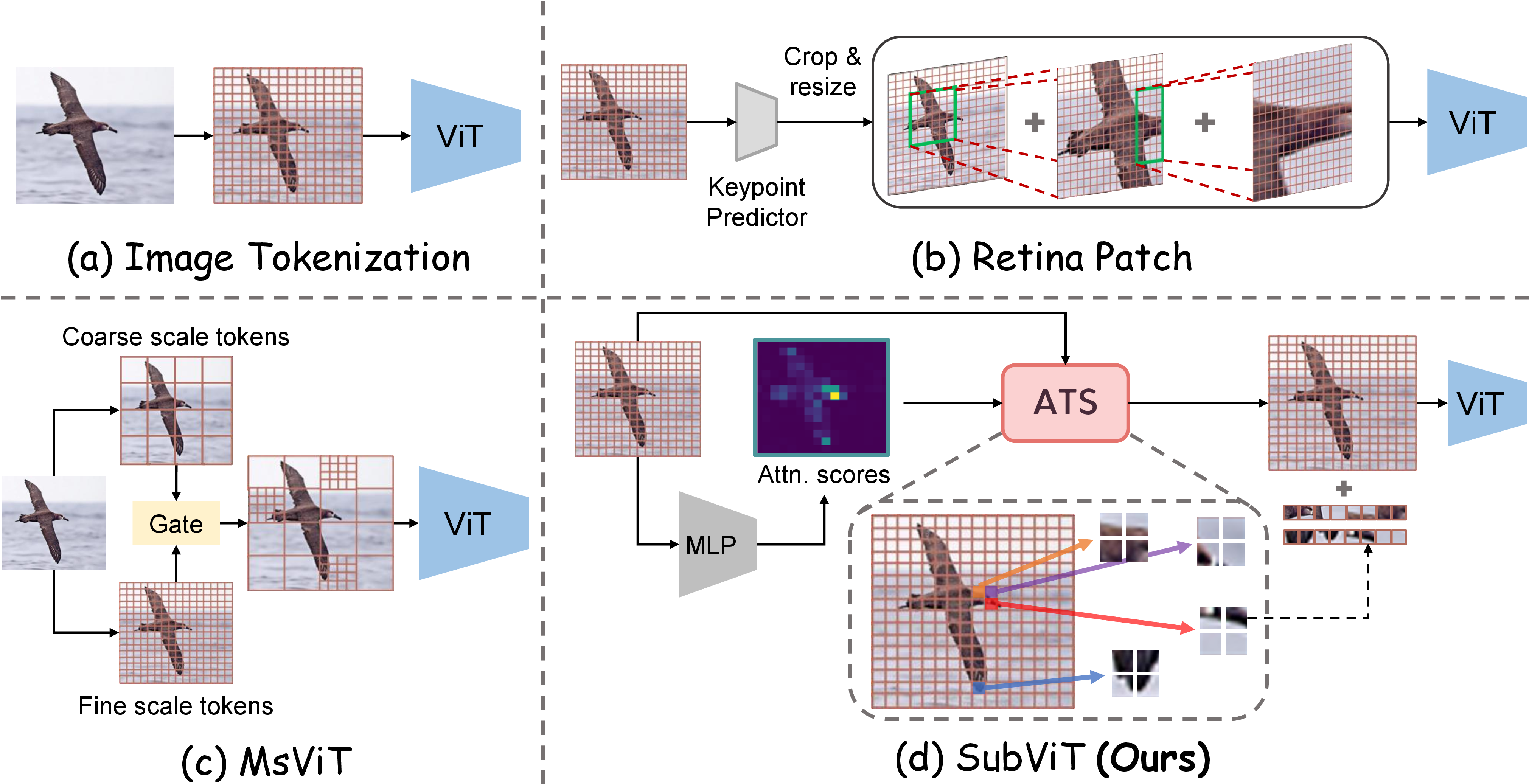
Vision Transformers (ViTs) [1] represent an image as a sequence of patch tokens and use self-attention to model their global relationships. Standard ViTs uniformly partition the image into fixed-size patches and project every patch into a single token. This design is effective for capturing global structure, but it imposes the same representational granularity on all regions: spatial variations within each patch are compressed into one embedding regardless of their semantic importance. Such uniform allocation is poorly matched to fine-grained recognition [2]–[6], where the distinction between visually similar subcategories may depend on a small texture, contour, or object part. Uniformly refining the entire image could preserve more local structure, but would substantially increase the token sequence and computation. The central challenge is therefore to increase token-level representational capacity only where fine-grained evidence is likely to occur, while retaining the global context provided by the original token sequence.
Recent work has explored spatially adaptive tokenization. Retina Patch in SapiensID [7] uses a keypoint predictor to construct region-level crops and concatenates tokens from multiple resized views, introducing external localization priors and a relatively dense token sequence. MSViT [8] learns to choose between coarse and fine tokenization scales across image regions. These approaches demonstrate the value of non-uniform visual processing, but leave an important trade-off unresolved: how can a pretrained ViT preserve its full-image representation while concentrating additional token capacity on task-relevant regions, without explicit part annotations or an expensive attention-based selection pass at inference? This problem is particularly important in Generalized Category Discovery (GCD) [9]–[12], where supervision covers only known categories and the learned representation must also separate unlabeled novel categories. A useful localization strategy must therefore discover transferable fine-grained cues rather than overfit to parts that distinguish only the labeled classes.
To address this trade-off, we propose Subtoken Vision Transformer (SubViT) and its Attention-based Token Subdivision (ATS) mechanism. ATS selects the top-\(K\) discriminative patches and represents each selected patch with \(f\!\times\!f\) subtokens, which are concatenated with all original tokens. Representing an important patch with multiple embeddings exposes its intra-patch spatial structure to the Transformer instead of compressing it into a single vector; retaining the base tokens simultaneously preserves the global image layout. Thus, SubViT does not densely increase image resolution or discard background context. It selectively increases representational granularity in informative regions and confines the additional computation to a small subset of patches. Fig. 1 contrasts this selective refinement with uniform tokenization and dense multi-scale inputs.
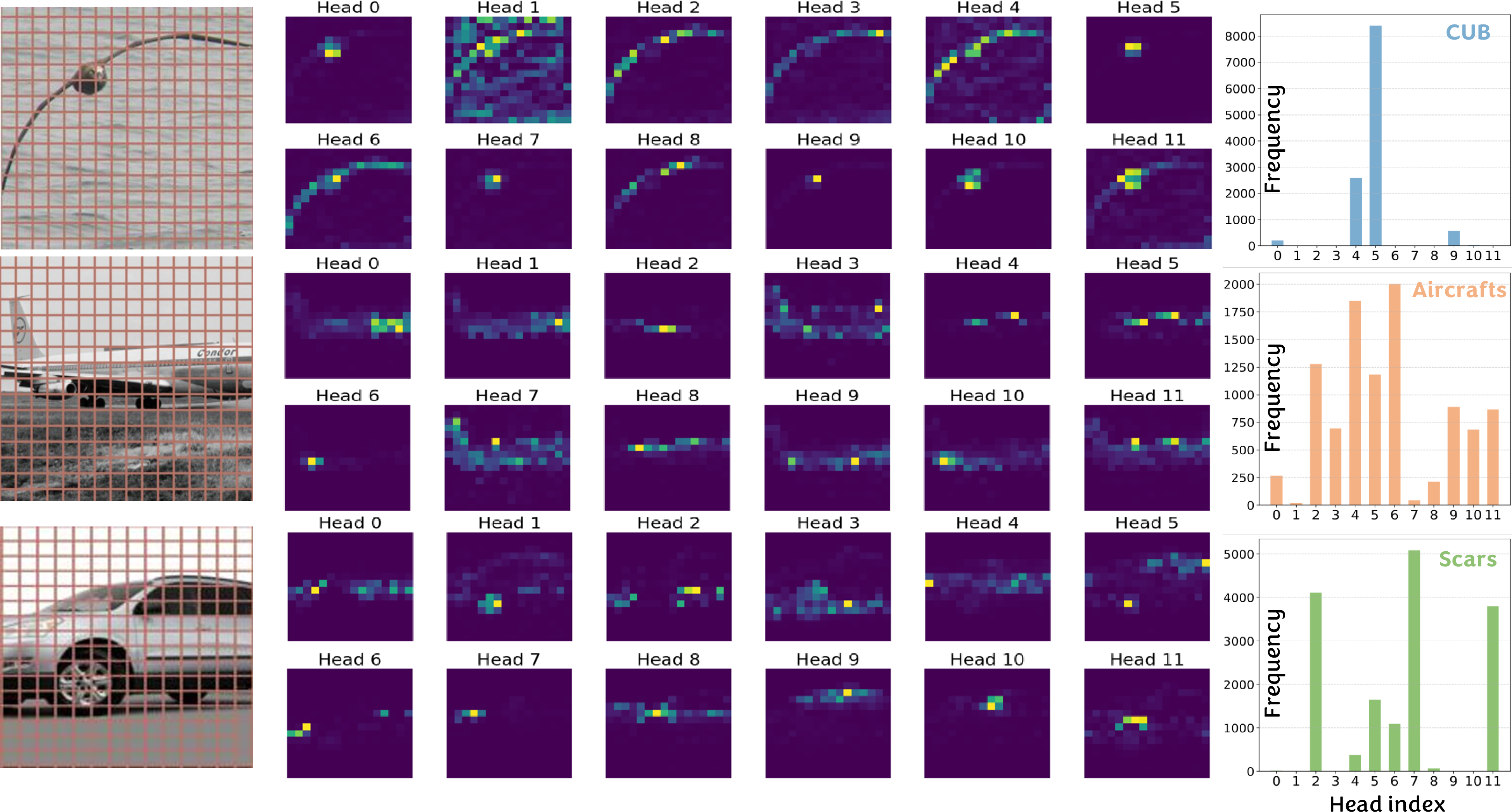
Learning where to subdivide remains difficult because different attention heads capture complementary semantics, while averaging them can dilute localized evidence. We address this difficulty with two training stages that separate exploration from efficient selection. In Stage 1, we randomly sample attention heads to generate diverse subdivision patterns while fine-tuning the ViT, encouraging the representation to remain effective across different potentially discriminative regions. In Stage 2, the Stage-1 backbone is frozen and used as a teacher. We remove the regions selected by each head and measure the resulting feature degradation; the attention map producing the largest degradation provides token-level supervision for a lightweight router. At inference, the teacher branch is removed, and the router directly predicts one deterministic importance map before a single Transformer pass. This converts diverse attention-based exploration into efficient top-\(K\) selection without a separate attention forward.
Experimentally, SubViT improves average novel-category accuracy from \(81.3\%\) to \(84.7\%\) over DINOv2 on three fine-grained GCD benchmarks. The efficiency gain is also practical: at \(K=1\%\), SubViT is only \(0.50\) ms above DINOv2, while reducing latency by \(73.8\%\) relative to Retina Patch. In summary, our contributions are threefold:
We introduce SubViT and ATS, a selective tokenization strategy that represents discriminative patches with multiple subtokens while retaining the original token sequence for global context.
We develop a two-stage learning strategy that combines randomized attention-head exploration with feature-degradation-guided distillation, producing a deterministic single-map router that eliminates the separate attention-based selection pass at inference.
Extensive experiments on fine- and coarse-grained GCD benchmarks demonstrate improved recognition of novel categories with controlled computation, together with interpretable, domain-specific subdivision patterns.
2 Related Works↩︎
2.0.0.1 Dynamic Token Scaling.
Vision Transformers (ViTs), exemplified by CLIP [13], SigLIP [14], and the DINO family [15], [16], partition images into non-overlapping tokens and leverage self-attention for feature extraction, contrasting with CNN-based convolutional feature hierarchies. Recent approaches address visual feature extraction through distinct architectural strategies. Swin Transformer [17] and Pyramid vision transformer [18] employ multi-scale feature aggregation through shifted windowing, though they introduce computational redundancy while overlooking intra-image heterogeneity. [7] introduces Retina Patch with multi-scale tokens concatenation for ViT. These methods demonstrate the importance of spatial adaptation but lack dynamic resource allocation mechanisms for region-specific processing demands. MSViT [8] proposes a mix-scale token using a learnable gating to choose between coarse or fine tokens in every region, but fails to provide flexible choices in adaptive selection [19]–[24]. In this work, we propose an Attention-based Token Subdivision (ATS), dynamically subdividing tokens to amplify discriminative features while maintaining pretrained ViT efficiency.
2.0.0.2 Fine-grained Localization.
Fine-grained localization pinpoints discriminative features critical for inter-class differentiation, primarily via keypoint detection [25]–[29] and class activation maps (CAMs). Beyond classification, such localized cues also underpin human recognition systems that fuse face, body, and gait evidence [30]–[33] and related human-centric analysis [34]. However, defining consistent keypoints for generic objects (e.g.., industrial products) [35], [36] remains challenging due to the lack of anatomical priors, risking overemphasis on unimportant features. CAM-based methods [37]–[39] generate class-specific saliency maps to identify crucial regions, but are limited in propagating them into feature refinement. To bridge this gap, we propose an attention-driven token selection method that identifies and amplifies discriminative tokens, optimizing fine-grained classification without relying on predefined keypoints.
2.0.0.3 Fine-grained recognition.
Fine-grained recognition aims to distinguish subordinate categories that share similar global appearances but differ in localized attributes, such as birds, aircraft, and vehicles [2]–[6]. Success therefore depends on preserving subtle, spatially localized evidence rather than relying only on holistic object representations; recent work leverages multimodal large language models for fine-grained recognition [40]–[47]. Generalized Category Discovery (GCD) is a particularly challenging fine-grained recognition setting because it tackles the task of jointly recognizing known classes and discovering novel categories in unlabeled data, as formalized by [9] and [10]. GCD extends novel category discovery (NCD) [11], [12], [48], [49] by requiring models to simultaneously leverage labeled data and partition unlabeled novel subcategories. We adapt the GCD task to evaluate the fine-grained capturing capability of SubViT and investigate two aspects: (1) Which object tokens are pivotal for fine-grained differentiation? and (2) Can targeted token subdivision enhance feature discernibility?
3 Methods↩︎
3.1 Preliminary↩︎
3.1.0.1 Image Tokenization.
Given an image tensor \(x \in \mathbb{R}^{C \times H \times W}\), ViTs partition \(x\) into \(N = \frac{H}{P} \times \frac{W}{P}\) non-overlapping patches, where \(P\) is the patch size. All patches are stacked into an image patch sequence \(I \in \mathbb{R}^{N \times C \times P \times P}\). Then \(I\) is flattened in its last three dimensions, and a learnable projection matrix \(\mathbf{W_p} \in \mathbb{R}^{C P^2 \times D}\) (i.e.., patch embedding layer) transforms \(I\) into patch embeddings, combined with positional embeddings \(E_{\text{pos}} \in \mathbb{R}^{N \times D}\) to generate the input token sequence \(z_0 \in \mathbb{R}^{N \times D}\).
3.1.0.2 Attention Map.
For input tokens \(\mathbf{z}_l \in \mathbb{R}^{N \times D}\) at transformer block \(l\), the self-attention mechanism computes queries \(\mathbf{Q} = \mathbf{z}_l \mathbf{W}_Q\), keys \(\mathbf{K} = \mathbf{z}_l \mathbf{W}_K\), and values \(\mathbf{V} = \mathbf{z}_l \mathbf{W}_V\), where \(\mathbf{W}_Q, \mathbf{W}_K, \mathbf{W}_V \in \mathbb{R}^{D \times d_k}\) are learnable weights to generate attention map \(\mathbf{A}_l \in \mathbb{R}^{N \times N}\). Conventionally, the attention map from the CLS token \(\mathbf{A}_{l, \text{CLS}} \in \mathbb{R}^{N}\) represents the global attention for the model. Each element \(\mathbf{A}_{l, \text{CLS}}{(j)}\) quantifies how much the CLS token attends to token \(j\), reflecting the model’s focus on discriminative regions (e.g.., object parts). Higher values indicate stronger semantic relevance between tokens. ViTs exhibit hierarchical attention patterns across layers, with deeper blocks increasingly focusing on semantically fine-grained details, while shallow layers prioritize low-level textures or global context [1], [50]. For Multi-Head Self-Attention (MHSA), attention maps are gathered from all heads \(\hat{\mathbf{A}}_{l, \text{CLS}} \in \mathbb{R}^{N_{\text{head}} \times N}\) where \(N_{\text{head}}\) is the number of heads.
3.2 Attention-based Token Subdivision (ATS)↩︎
Defining consistent keypoints for generic objects remains challenging due to the lack of anatomical priors, risking overemphasis on non-discriminative features. We introduce ATS to leverage knowledge from attention maps.
3.2.0.1 Image Subdivision.
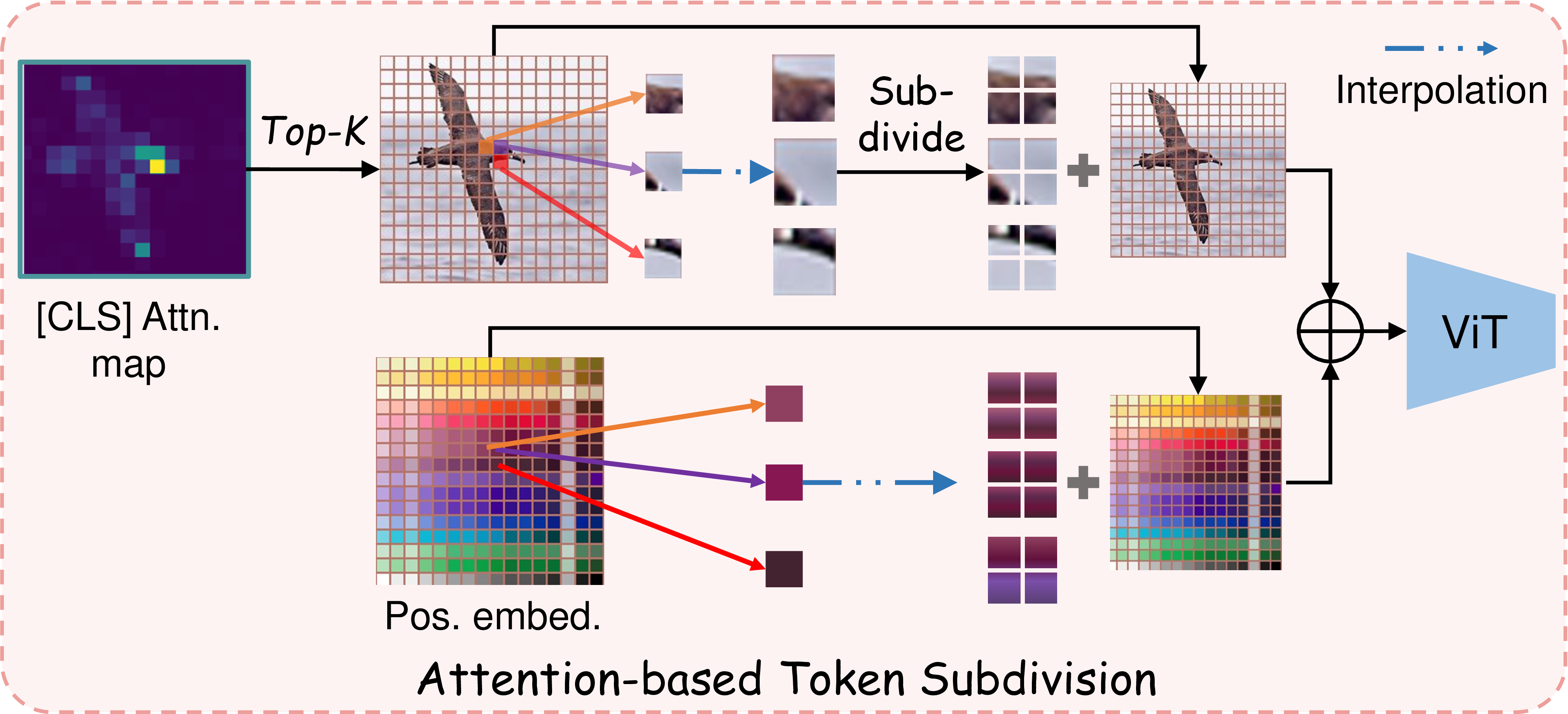
As shown in Fig. 2, given an image patch sequence \(I\) and its attention map \(\mathbf{A}^h_{l, \text{CLS}}\) from head \(h\), we locate the top \(K\) patch set \(T \in \mathbb{R}^{K \times (C \times P \times P)}\) sorted by the attention scores. For each patch, we generate \(f\!\times\!f\) subtokens. We first resize each patch by \[\begin{align} \hat{T}_i\!=\!\operatorname{Upscale}(T_i, \text{factor}\!=\!f), \quad \hat{T}_i \in \mathbb{R}^{C \times (fP) \times (fP)}. \end{align}\] Then we divide the interpolated patch into smaller patches for all \(m,n \in \{0, \dots, f-1\}\) in an \(f\times f\) grid. Specifically, one subtoken is defined as: \[\begin{align} \begin{aligned} \hat{T}_i^{(m,n)} &= \hat{T}_i[:, mP\!:\!(m\!+\!1)P, nP\!:\!(n\!+\!1)P], \end{aligned} \end{align}\] where all subtokens are denoted as: \[\begin{align} T' = \bigcup_{i=1}^{K} \bigcup_{m=0}^{f-1} \bigcup_{n=0}^{f-1} \hat{T}_i^{(m,n)} \in \mathbb{R}^{Kf^2 \times (C \times P \times P)}. \end{align}\] Simply put, subtokens are created by upscaling and dividing each patch. \(T'\) concatenates with \(I\) to form the input patch sequence \(I^{in}\) to the patch embedding layer. Note that we do not drop \(T\) after obtaining \(T'\). We believe that \(T\) and \(T'\) can provide multi-scale information for fine-grained classification.

3.2.0.2 Positional Embedding Interpolation.
Positional embeddings (PE) are also subdivided in a similar fashion to image patches. However, while image patches can be upscaled due to their spatial resolution, a positional embedding at a particular location is a vector and cannot be directly upscaled without remaining unchanged across the newly introduced positions.
To address this, we expand each positional embedding into a spatial structure by using its neighboring positional embeddings. Given an original positional embedding \(E_{\text{pos}, i}\), we generate an upscaled embedding patch using spatial interpolation: \[\begin{align} \hat{E}_{\text{pos}, i} = \operatorname{Upscale}(\{E_{\text{pos}, j} \mid j \in \mathcal{N}(i) \}, f), \end{align}\] where \(\mathcal{N}(i)\) represents the set of eight adjacent positional embeddings. After interpolation, we divide \(\hat{E}_{\text{pos}, i}\) into smaller positional embeddings in an \(f \times f\) grid, similar to image patch subdivision: \[\begin{align} \hat{E}_{\text{pos}, i}^{(m,n)} = \hat{E}_{\text{pos}, i}[:, mP\!:\!(m\!+\!1)P, nP\!:\!(n\!+\!1)P], \end{align}\] for all \(m,n \in \{0, \dots, f-1\}\). We then gather all subdivided positional embeddings into the final expanded set: \[\begin{align} E_{\text{pos}}^{T'} = \bigcup_{i=1}^{K} \bigcup_{m=0}^{f-1} \bigcup_{n=0}^{f-1} \hat{E}_{\text{pos}, i}^{(m,n)} \in \mathbb{R}^{K f^2 \times D}. \end{align}\] Finally, the expanded positional embeddings are concatenated with the original positional embeddings to maintain spatial consistency in the input sequence: \[\begin{align} z_0^{\text{new}} = \mathbf{W_p} I^{\text{in}} + \operatorname{Concat}(E_{\text{pos}}, E_{\text{pos}}^{T'}). \end{align}\] This method ensures that newly introduced PE retains meaningful spatial structure.
3.3 Two-stage Fine-Tuning↩︎
A key challenge in subtoken division is to obtain informative and diverse subdivision regions without requiring an additional Transformer forward pass at inference. Averaging all attention heads repeatedly emphasizes similar regions, whereas using a fixed head ignores the complementary semantics learned by multi-head attention. We therefore adopt two stages: randomized attention-guided SubViT fine-tuning followed by distance-selected attention-map distillation.
3.3.0.1 SubViT Fine-Tuning (Stage 1).
The first-stage fine-tuning of the SubViT aligns the model’s attention mechanisms with the target dataset distribution by simulating diverse attention behaviors. We stochastically sample attention maps \(A_{l,\text{CLS}}^h\) from layer \(l\) and head \(h\) to construct dynamic token sequences, addressing three key challenges: (1) interpolated positional information for subtokens, preserving spatial relationships across scales; (2) integrated subtokens for attention focus (i.e.., \(I + T'\)) to balance global and local attention; and (3) enriching token diversity through head-wise stochastic sampling. This stage ensures robust subtoken feature extraction while preserving pretrained knowledge for Stage-2 refinement.
3.3.0.2 Distance-guided Token Selection Training (Stage 2).
We freeze the Stage-1 ViT and use it as a teacher during Stage 2. For each image, the teacher first produces the original feature \(x_{\mathrm{ori}}\) and the CLS-to-patch attention map \(A^h\in\mathbb{R}^{N}\) for every head \(h\). We then remove the top-\(K\) patches indicated by each head and forward the remaining tokens through the frozen teacher to obtain the degraded feature \(x_{\mathrm{drop}}^h\). Following the selection-loss motivation, the importance label of head \(h\) is its feature-degradation distance \[\begin{align} d^h = \left\lVert x_{\mathrm{ori}}-x_{\mathrm{drop}}^h\right\rVert_2, \qquad h^*=\operatorname*{arg\,max}_{h} d^h. \end{align}\] The largest distance indicates that removing the corresponding regions causes the greatest representation degradation. We therefore use the selected map \(A^{h^*}\) as token-level supervision for a lightweight attention network \(R\). Given the base patch embeddings \(z\in\mathbb{R}^{N\times D}\), \(R\) predicts a single score map \(\hat{A}=R(z)\in\mathbb{R}^{N}\) rather than reproducing all attention heads.
We retain the attention map, ranking, and top-\(K\) objectives used for attention network distillation. With temperature \(\tau\), the map loss matches the score distributions, \[\begin{align} \mathcal{L}_{\mathrm{map}} = \tau^2\operatorname{KL}\!\left( \operatorname{Softmax}(\log A^{h^*}/\tau)\,\|\, \operatorname{Softmax}(\hat{A}/\tau)\right). \end{align}\] The ranking loss aligns the centered, normalized router scores with the ranks of \(A^{h^*}\), while \(\mathcal{L}_{\mathrm{topK}}\) applies cross-entropy to the teacher’s top-\(K\) mask. The Stage-2 objective is: \[\begin{align} \mathcal{L}_{\mathrm{router}} = \lambda_{\mathrm{map}}\mathcal{L}_{\mathrm{map}}+ \lambda_{\mathrm{rank}}\mathcal{L}_{\mathrm{rank}}+ \lambda_{\mathrm{topK}}\mathcal{L}_{\mathrm{topK}}. \end{align}\] The teacher’s attention and degraded-feature forwards are required only during Stage-2 training. At inference, the frozen teacher branch is removed: the router directly predicts one deterministic score map, whose top-\(K\) patches are subdivided before a single ViT forward.
4 Experiments↩︎
4.1 Experimental Setup↩︎
4.1.0.1 Datasets.
We evaluate our approach on fine-grained datasets: CUB-200 [2], FGVC-Aircraft [3], and Stanford-Cars [4]. In addition, we demonstrate the versatility of our method on coarse-grained datasets: CIFAR10 [51] and ImageNet-100 [52]. This comprehensive evaluation underscores the broader applicability of our approach beyond fine-grained classification tasks. Detailed statistics of the datasets are provided in the Appendix.
4.1.0.2 Baseline Setup.
We compare SubViT with classic ViT [16], [53], Retina Patch [7] and MSViT [8], which apply different strategies towards image tokenization. Note that the ViT baseline fine-tuned with the same loss corresponds to the full SelEx [54] method, a state-of-the-art GCD approach. For a fair comparison, we use the same loss function and hyperparameters proposed by SelEx [54]. We use CapeX [55] as the keypoint predictor for Retina Patch. Details of the Retina Patch implementation are provided in the Appendix.
4.1.0.3 Implementation Details.
We follow SelEx [54] to set up known, novel categories for all datasets and use DINOv2 [16] pretrained on LVD-142M and DINOv1 [15] pretrained on ImageNet-1K [52]. We use the batch size of \(128\) for training and set the same loss hyperparameters as SelEx. We fine-tune the last two blocks of the pretrained ViTs. We use the bilinear function as the interpolation function. We set \(K=10\%\) (i.e.., top 10% of image tokens) for CUB, \(K=2\%\) for Aircraft, and \(K=1\%\) for SCars. These dataset-specific values reflect the proportion of the image occupied by discriminative parts and are validated in Sec. 4.3. We use \(f=2\) and \(lr=0.1\) for Stage-1 ViT fine-tuning. In Stage 2, the ViT is frozen, and the single-map router is trained for 30 epochs using AdamW with \(lr=10^{-4}\). We use Euclidean feature-degradation distance, distillation temperature \(\tau=0.5\), and set \(\lambda_{\mathrm{map}}=\lambda_{\mathrm{rank}}=\lambda_{\mathrm{topK}}=1\).
4.2 Comparison with Tokenization Baselines↩︎
| Method | CUB-200 | FGVC-Aircraft | Stanford-Cars | Average | |||||||||
|---|---|---|---|---|---|---|---|---|---|---|---|---|---|
| 3-5 (lr)6-8 (lr)9-11 (lr)12-14 | All | Known | Novel | All | Known | Novel | All | Known | Novel | All | Known | Novel | |
| ViT* [53] | 73.6 | 75.3 | 72.8 | 57.1 | 64.7 | 53.3 | 58.5 | 75.6 | 50.3 | 63.0 | 71.9 | 58.8 | |
| MSViT [8] | 73.5 | 74.9 | 72.8 | 55.6 | 64.5 | 51.2 | 52.6 | 74.0 | 42.3 | 60.6 | 71.1 | 55.4 | |
| Retina Patch [7] | 71.6 | 73.5 | 70.7 | 52.9 | 57.7 | 50.5 | 52.0 | 72.9 | 41.9 | 58.8 | 68.0 | 54.4 | |
| (Ours) | 75.7 | 76.4 | 75.4 | 57.5 | 64.1 | 54.2 | 59.3 | 76.0 | 52.1 | 64.2 | 72.2 | 60.6 | |
| ViT* [53] | 87.4 | 85.1 | 88.5 | 79.8 | 82.3 | 78.6 | 82.2 | 93.7 | 76.7 | 83.1 | 87.0 | 81.3 | |
| MSViT [8] | 88.3 | 85.7 | 90.0 | 79.9 | 79.6 | 80.0 | 81.9 | 93.1 | 76.5 | 83.4 | 86.1 | 82.2 | |
| Retina Patch [7] | 87.8 | 86.1 | 88.8 | 73.2 | 74.0 | 72.8 | 80.4 | 93.8 | 73.9 | 80.5 | 84.6 | 78.5 | |
| (Ours) | 91.8 | 86.3 | 94.6 | 80.8 | 81.3 | 80.5 | 83.8 | 94.9 | 78.5 | 85.5 | 87.5 | 84.7 | |
| Method | CIFAR-10 | ImageNet-100 | Average | ||||||
|---|---|---|---|---|---|---|---|---|---|
| 2-4 (lr)5-7 (lr)8-10 | All | Known | Novel | All | Known | Novel | All | Known | Novel |
| DINOv1 | 95.9 | 98.1 | 94.8 | 83.1 | 93.6 | 77.8 | 89.5 | 95.9 | 86.3 |
| (Ours) | 97.0 | 97.9 | 96.3 | 83.9 | 94.0 | 78.9 | 90.8 | 96.0 | 87.6 |
4.2.0.1 Fine-grained Image Classification.
Our method is evaluated against baseline approaches on three fine-grained datasets, as summarized in Tab. 1. The results demonstrate the superior capability of our method in both the all and novel category classifications, highlighting its effectiveness for fine-grained recognition. Compared to Retina Patch, our method achieves better performance with fewer tokens by focusing on crucial regions, highlighting that excessive, non-essential tokens may introduce noise and are less compatible with pretrained ViTs. While MSViT improves computational efficiency, its fine-scale tokens offer limited benefits for fine-grained recognition tasks. Both MSViT and Retina Patch exhibit degraded performance on GCD, revealing that they either fail to generalize to pretrained ViT architectures or offer limited additional fine-grained information. The performance improvements can be attributed to SubViT’s ability to provide crucial fine-grained semantic tokens across multiple scales, enabling the model to prioritize discriminative details without modifying the loss function or the backbone architecture. Notably, the larger performance gain on novel categories (\(3.4\%\) versus \(0.5\%\) on known classes) underscores our method’s reduced susceptibility to overfitting and enhanced generalization to unseen objects.
4.2.0.2 Coarse-grained Image Classification.
We also validate our method on generic image classification tasks that focus on coarse-grained objects in Tab. ¿tbl:tab:coarse95performance? using the backbone DINOv1 [15] as the baseline to show the effectiveness of our methods with different backbones. Our method demonstrates superior performance on CIFAR10 and ImageNet-100 compared with DINOv1 fine-tuned with the same loss function. Note that SubViT is designed for fine-grained classification; our method still has performance gains in generic objects, which highlights the robustness of SubViT. The result also demonstrates that detailed regions are also important for generic image classification, even though the coarse-grained objects have a larger diversity than fine-grained objects.
| Model | # Tokens | Latency (ms) | Memory (MB) | FLOPs (G) |
|---|---|---|---|---|
| DINOv2 [16] | 256 | 3.07 | 8.42 | 22.30 |
| MSViT [8] | 256 | 3.30 | 9.18 | 22.34 |
| Retina Patch [7] | 711 | 13.63 | 35.35 | 82.68 |
| Two-pass (\(K=1\%\)) | 264 | 6.68 | 16.76 | 45.93 |
| Router (\(K=1\%\)) | 264 | 3.57 | 10.24 | 23.06 |
| Two-pass (\(K=2\%\)) | 276 | 6.85 | 16.75 | 46.96 |
| Router (\(K=2\%\)) | 276 | 3.74 | 10.71 | 24.08 |
| Two-pass (\(K=10\%\)) | 356 | 8.31 | 16.75 | 53.80 |
| Router (\(K=10\%\)) | 356 | 5.21 | 13.76 | 30.92 |
4.2.0.3 Inference Efficiency.
Tab. 2 separates the cost of fine-grained token processing from that of selecting subdivision regions. The earlier two-pass variant first extracts backbone attention to determine important regions and then processes the resulting token sequence, repeating a substantial portion of the backbone computation. In contrast, the single-map router predicts token scores directly from base patch embeddings and requires only one backbone pass. Under identical token budgets, the router reduces latency by \(37.3\)–\(46.6\%\), peak memory by \(17.9\)–\(38.9\%\), and FLOPs by \(42.5\)–\(49.8\%\) across the three \(K\) settings. At \(K=1\%\), SubViT takes \(3.57\) ms per image, only \(0.50\) ms (\(16.3\%\)) slower than the single-stream DINOv2 baseline, with just \(3.4\%\) additional FLOPs. In comparison, it reduces latency by \(73.8\%\) relative to Retina Patch while retaining targeted subtoken refinement. Increasing \(K\) provides a controllable trade-off between local detail and computation. Even at \(K=10\%\), the router reduces latency, memory, and FLOPs relative to Retina Patch by \(61.8\%\), \(61.1\%\), and \(62.6\%\), respectively, because it refines selected regions instead of concatenating several dense multi-scale views.
4.3 Ablation Studies↩︎
4.3.0.1 Effects of Token Selection Methods.
We compare our token selection strategy against two sampling strategies: (1) random sampling of \(K\) tokens and (2) top-\(K\) selection from the attention map averaged across heads. As shown in Tab. [tbl:tab:ablation95selection], random subdivision decreases All accuracy from \(87.4\%\) to \(82.4\%\), indicating that merely increasing the token count does not guarantee better representations. Averaged attention improves the baseline, particularly on novel categories, but still treats complementary head semantics uniformly. Our learned selection further improves All and Novel accuracy over averaged attention by \(2.8\%\) and \(3.4\%\), respectively. This gap supports the importance of selecting semantically informative subdivision targets rather than uniformly aggregating or randomly sampling them. Fig. 5 provides corresponding qualitative evidence through the consistent localization of discriminative regions.
0.38
| Method | # Tokens | All | Known | Novel |
|---|---|---|---|---|
| DINOv2 | 256 | 87.4 | 85.1 | 88.5 |
| Random | 356 | 82.4 | 85.2 | 81.0 |
| Average | 356 | 89.0 | 84.6 | 91.2 |
| Ours | 356 | 91.8 | 86.3 | 94.6 |
0.29
| \(f\) | \(K (\%)\) | All | Known | Novel |
|---|---|---|---|---|
| 2 | 1 | 90.3 | 84.0 | 93.5 |
| 2 | 10 | 91.8 | 86.3 | 94.6 |
| 3 | 1 | 90.4 | 84.2 | 93.6 |
| 3 | 10 | 90.7 | 85.9 | 93.3 |
0.29
| Method | All | Known | Novel |
|---|---|---|---|
| Ours | 91.8 | 86.3 | 94.6 |
| 1-4 w/o \(T\) | 90.9 | 84.5 | 94.1 |
| w/o \(T'\) | 89.7 | 84.6 | 92.4 |
| w/o \(T + T'\) | 68.6 | 65.1 | 70.3 |
0.48
| Method | All | Known | Novel |
|---|---|---|---|
| DINOv2 | 79.8 | 82.3 | 78.6 |
| 1-4 Stage 1 | 80.0 | 81.0 | 79.3 |
| Stage 2 | 80.8 (\(+0.8\%\)) | 81.3 (\(+0.3\%\)) | 80.5 (\(+0.8\%\)) |
0.48
| Method | All | Known | Novel |
|---|---|---|---|
| DINOv2 | 82.2 | 93.7 | 76.7 |
| 1-4 Stage 1 | 83.0 | 93.6 | 78.0 |
| Stage 2 | 83.8 (\(+0.8\%\)) | 94.9 (\(+1.1\%\)) | 78.5 (\(+0.5\%\)) |
4.3.0.2 Effects of Hyperparameters.
Tab. [tbl:tab:ablation95params] presents the effects of scale factor \(f\) and top-\(K\) selection of SubViT. At \(K=1\%\), \(f=2\) and \(f=3\) perform similarly, suggesting that either subdivision scale is sufficient when only a few highly ranked regions are refined. The difference becomes clearer at \(K=10\%\): increasing \(f\) from \(2\) to \(3\) reduces All accuracy from \(91.8\%\) to \(90.7\%\), suggesting that aggressively magnifying many regions can introduce overlapping or redundant local evidence. The best setting, \(f=2\) and \(K=10\%\), balances local resolution with token diversity on CUB. Results on Aircraft and SCars in Appendix Tab. [tab:supp_combined] favor smaller dataset-specific values of \(K\), reinforcing the need to avoid unnecessary refinement when discriminative regions occupy a different proportion of the image.
4.3.0.3 Effects of Token Masking.
We analyze token masking strategies through Tab. [tbl:tab:ablation95drop], revealing complementary roles of tokens \(T\) and subtokens \(T'\). Our method achieves optimal performance using all tokens. Masking \(T'\) alone causes 2.2% Novel accuracy drop versus 0.5% when masking \(T\), confirming \(T'\)’s greater contribution. Crucially, masking both triggers catastrophic collapse, demonstrating their synergy: \(T\) establishes base patterns while \(T'\) encodes fine details. The significant 2.2% novel class recognition gap highlights \(T'\)’s critical role in handling unseen categories.
4.3.0.4 Performance Comparison of Stage 1 and 2.
Tab. ¿tbl:tab:ablation95stage95performance? isolates the contribution of the two training stages. Stage 1 already improves novel-category accuracy over DINOv2 by \(0.7\%\) on Aircraft and \(1.3\%\) on SCars, showing that exposure to diverse subdivisions strengthens the underlying representation. Stage 2 then raises All accuracy by a further \(0.8\%\) on both datasets, with gains in both known and novel subsets. Thus, the router does more than replace the costly two-pass selection procedure: its distilled supervision preserves the useful attention preferences learned in Stage 1 while converting them into a deterministic and efficient selection rule. The consistent, moderate gains also indicate that the two stages are complementary rather than independent sources of model capacity.
4.3.0.5 Attention Map Comparison.
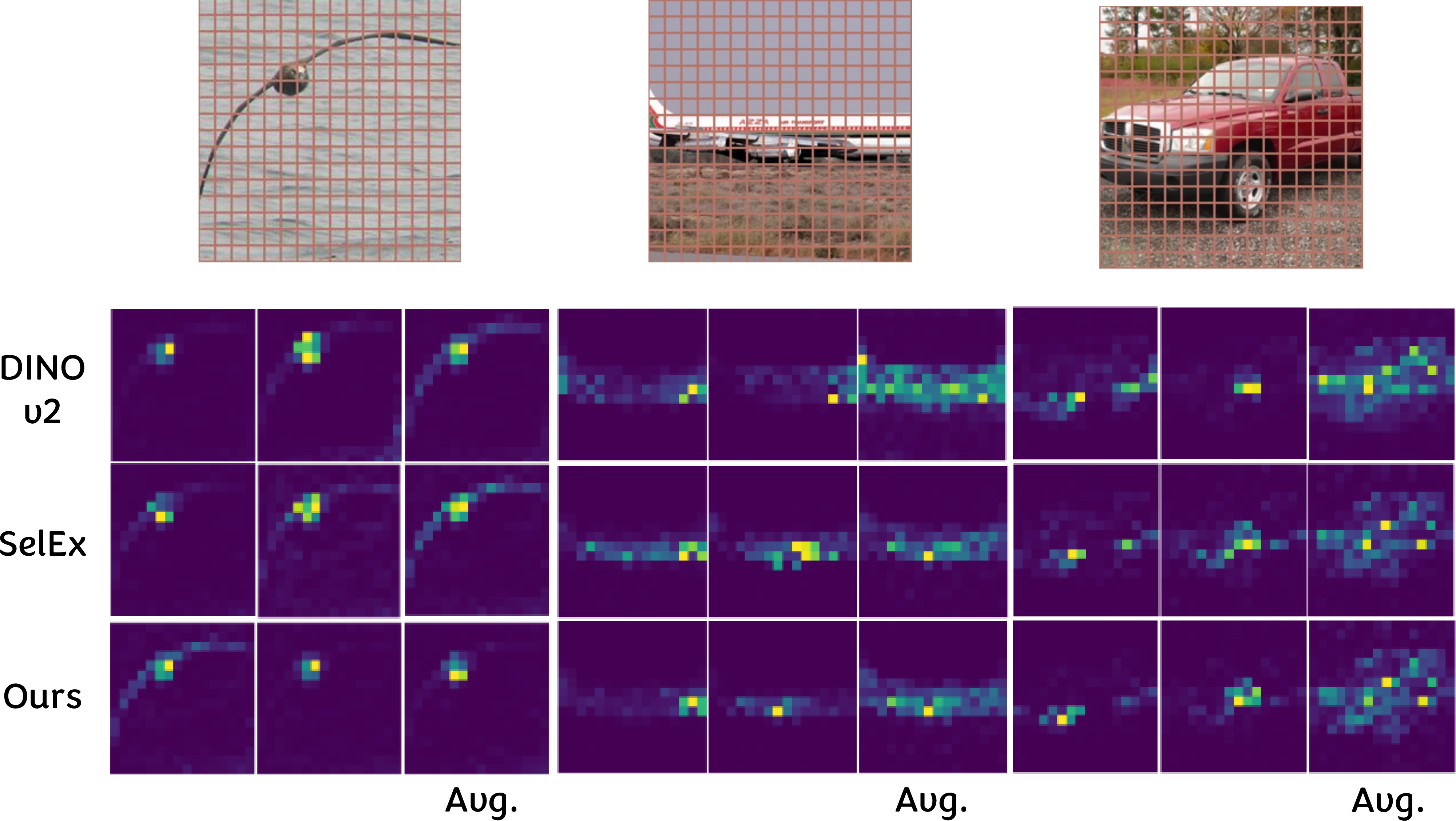
Fig. 4 compares the last-layer CLS attention of pretrained DINOv2, SelEx, and SubViT on the three fine-grained datasets. Both baselines allocate a non-negligible portion of attention to background context, e.g.., the wire supporting the bird, the ground clutter around the aircraft, and the vegetation behind the car, and their responses remain relatively diffuse across the token grid, as also reflected in the head-averaged maps. In contrast, SubViT attends more precisely to the fine-grained patches of the object itself, such as the bird’s body, the aircraft fuselage, and the front of the car. Moreover, the attention of SubViT is markedly more concentrated on these regions: high responses form compact clusters around discriminative parts rather than spreading over many weakly activated background tokens, indicating a stronger and more consistent focus on class-relevant evidence. We attribute this behavior to subtoken fine-tuning, which repeatedly exposes the model to subdivided discriminative regions and thereby encourages the attention to converge on the local cues that matter for fine-grained recognition.
4.3.0.6 Fine-grained Details Analysis.
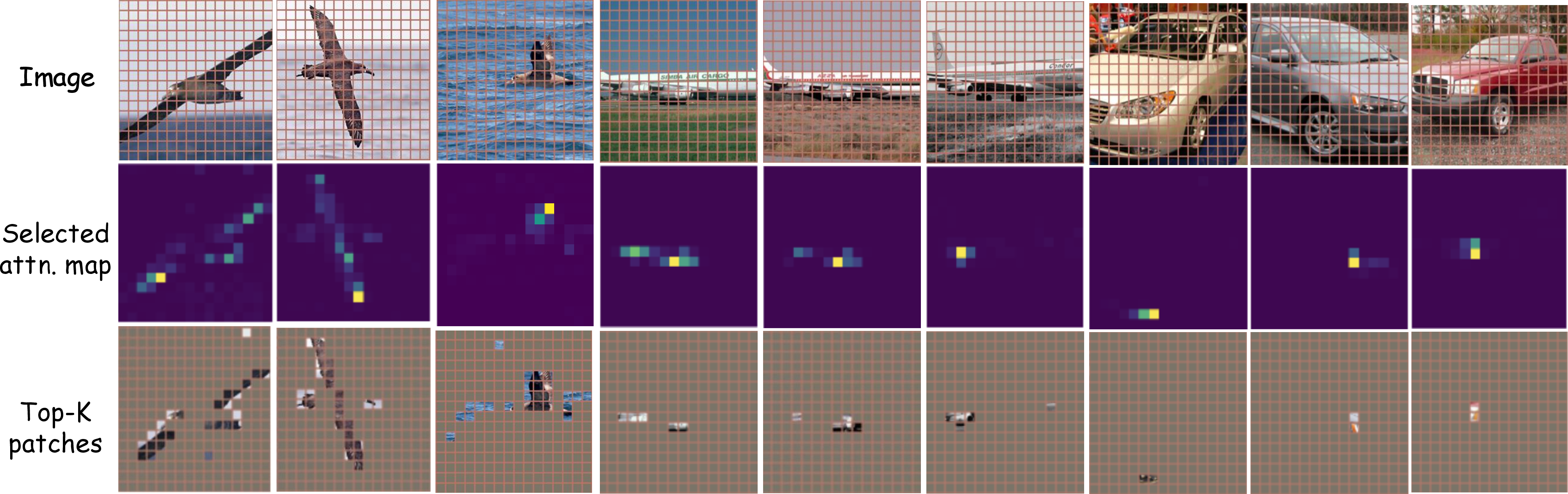
Fig. 5 shows that the selected regions remain semantically coherent across instances despite changes in pose, viewpoint, and background. The emphasized regions also vary with the visual cues required by each domain: bird examples concentrate on wing boundaries and small anatomical parts, aircraft examples emphasize engines and wing structures, and vehicle examples attend to headlights and front-body details. This behavior suggests that the router does not learn a dataset-independent center bias; instead, it adapts the subdivision budget to category-relevant evidence while retaining the base tokens for global context. Fig. 6 further shows that selection frequency is non-uniform across attention heads and differs among datasets, consistent with complementary head semantics. Some heads are rarely selected, which suggests possible redundancy, although establishing whether they can be safely pruned requires a dedicated study. Additional per-head attention visualizations are provided in the Appendix.
5 Conclusion↩︎
This work presents SubViT, a novel Subtoken Vision Transformer that enhances fine-grained recognition through selective image tokenization. By developing attention-based token subdivision and a two-stage training strategy, our method enables localized resolution enhancement in discriminative regions while maintaining global contextual understanding, bridging pretrained representations and downstream tasks without modifying the backbone architecture. The distilled single-map router further converts attention-guided exploration into a deterministic selection rule, retaining near-baseline inference cost. Extensive validation on fine-grained and coarse-grained benchmarks demonstrates SubViT’s superior performance over existing approaches, and the learned selection patterns reveal semantically meaningful regions aligned with domain expertise, providing interpretable evidence for model decisions. A current limitation is that the subdivision budget \(K\) remains a dataset-specific hyperparameter, and the router is distilled per dataset; learning to adapt \(K\) automatically and exploiting the observed head redundancy for pruning are promising directions for future work.