Evolutionary Intelligence for Scientific Discovery: From Evolutionary Computation to Cumulative Discovery Systems
July 10, 2026
1 Introduction↩︎
Artificial intelligence (AI) increasingly serves as a general-purpose tool for scientific discovery, transitioning from task-specific automation to systems that organize scientific exploration [1], [2]. By leveraging experimental feedback and human interaction, AI systems can explore scientific problems through discovery cycles. This shift is evident across disciplines, where AI actively investigates candidate spaces in molecular and materials design [3], [4], protein engineering [5], and automated laboratories [6], [7], moving beyond passive data analysis.
Feedback-driven discovery explores open-ended candidate spaces where boundaries are often undefined and emerge as evidence accumulates [1], [8]. Because experimental feedback is costly and physically constrained, every evaluated candidate, including failures, constitutes valuable scientific evidence [9], [10]. Consequently, the evaluation history can reveal hidden structures within the candidate space and support diverse exploratory behaviours [8], [11].
Evolutionary computation (EC) provides a foundational computational framework to support these discovery cycles [12], [13]. Rather than relying on a single-point search, EC maintains populations of scientific candidates that are iteratively updated by evolutionary operators according to feedback. This population-based approach is particularly well suited to open-ended candidate spaces characterized by weak or absent gradients, noisy feedback, and dynamically evolving boundaries [8], [14]–[16]. By steering exploration toward regions supported by accumulated evidence, EC sustains the creation of diverse scientific candidates across discovery cycles. This approach encompasses various common algorithms, such as classical genetic algorithm, evolution strategies [17]–[20], natural evolution strategies [21], [22], and quality-diversity search methods [23]–[26].
Conventionally, EC has advanced AI for scientific discovery primarily by refining candidates for well-defined scientific problems. Extensive research has focused on designing specialized evolutionary operators to steer this candidate refinement [17]–[19], [21]. However, cumulative discovery relies on more than just finding the best candidate. The entire search trajectory, including failed trials and complex feedback, provides experience that guides later searches [24], [26]–[28]. Therefore, evolutionary search serves not just to solve single problems, but to accumulate experience across iterative discovery cycles [29], [30].
To capture this transition, this review introduces evolutionary intelligence (EI) for scientific discovery. EI characterizes scientific AI systems that sustain exploration by linking candidate refinement with experience retention across evolutionary cycles. Within this framework, populations of scientific candidates are updated by evolutionary operators and evaluated via experimental or human feedback. Specifically, these evaluated candidates and their corresponding feedback are retained in structured forms to guide subsequent exploration. Unlike single-task search methods that primarily maximize sample efficiency for isolated problems [15], [31], [32], EI treats the entire search trajectory, including failed trials and candidate lineages, as scientific evidence to be structured and reused. By bridging candidate refinement with experience retention, EI provides a structured framework for cumulative discovery [27], [29], [30].
Recent AI systems increasingly embed evolutionary cycles into scientific discovery. Algorithm-discovery platforms, such as FunSearch and AlphaEvolve, refine candidate programs through automated evaluation mechanisms [33], [34]. Foundation-model-assisted evolutionary methods further expand this scope beyond final scientific targets to fundamental research components. These systems actively evolve prompts, code, and hypotheses, alongside reusable skills [8], [35]–[39]. Concurrently, autonomous laboratories and scientific agents integrate exploration with experimental and human feedback, enabling subsequent candidates to adapt dynamically to accumulated evidence [7], [9], [40]–[44]. The emergence of such autonomous research systems is increasingly recognized as agentic science [45]–[49]. As evolutionary search begins to reshape these research components, evaluation metrics need to expand beyond mere candidate quality to explicitly incorporate scientific reliability and human oversight [11], [39], [50]–[52].
This review examines the transition from EC to EI in scientific discovery. We first introduce a five-dimensional analytical framework designed to analyze diverse scientific AI systems, from foundation-model-assisted program search to closed-loop autonomous laboratories. This framework clarifies how the EI cycle transforms isolated search experiences into structured scientific insights. We further demonstrate how this paradigm operates across diverse discovery modes, from evolving concrete scientific entities to orchestrating automated research workflows. Finally, we outline key challenges regarding evaluation, process traceability, and shared infrastructure, providing a concrete roadmap to advance this transition. Ultimately, this perspective reframes EC from a task-level search tool into an organizing principle for cumulative scientific discovery.
2 From evolutionary computation to evolutionary intelligence↩︎
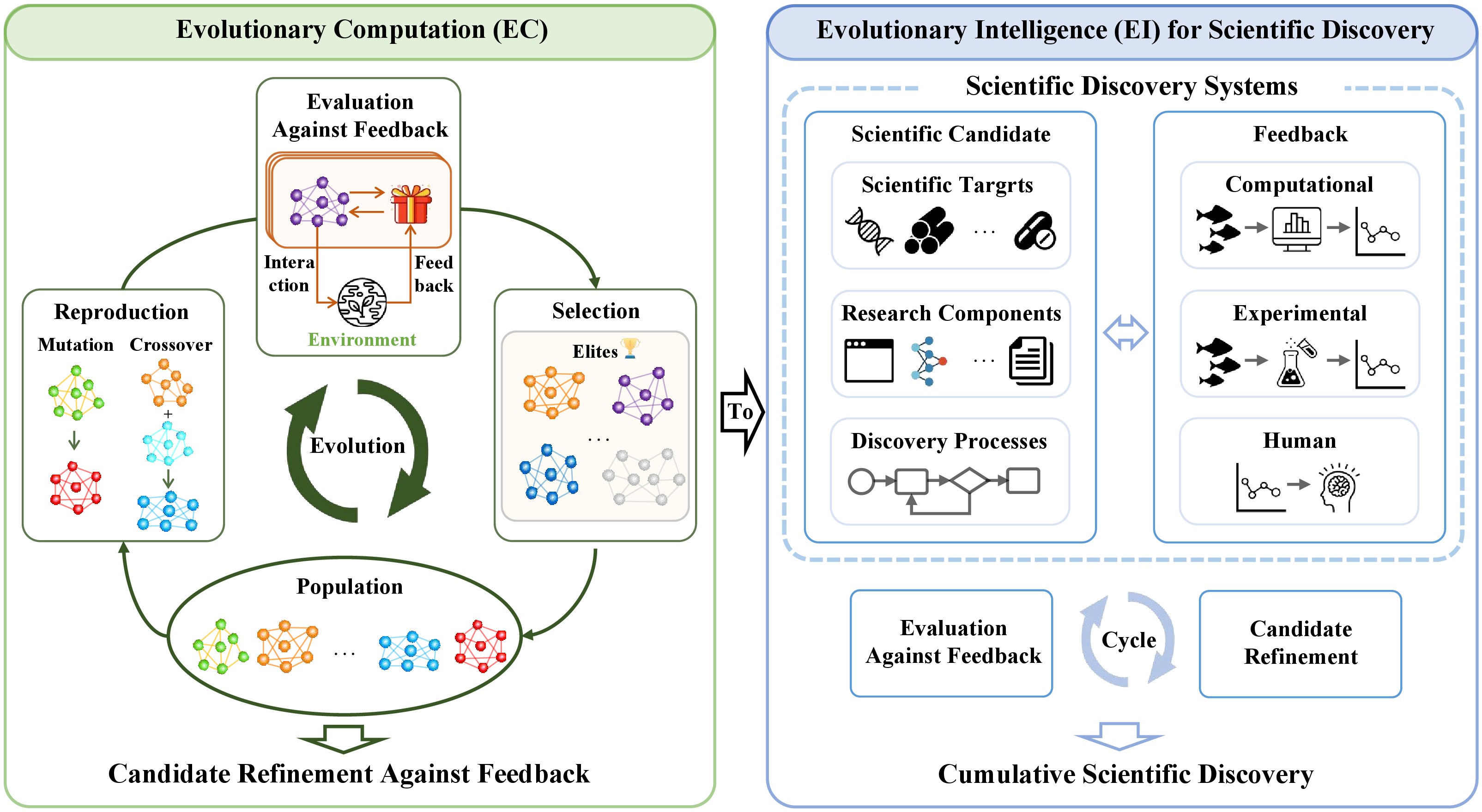
EC provides a foundational framework for population-based search in scientific discovery. Rather than relying on single-point updates, EC maintains populations of candidates through evolutionary operators that organize reproduction, evaluate outcomes against feedback, and drive selection. Adaptive strategies and archival mechanisms retain historical experience to influence subsequent search trajectories [13], [17], [18], [20], [21]. This organizational logic is well suited to open-ended scientific candidate spaces. In such environments, search often proceeds before boundaries, objectives, or feedback processes are fully defined, aligning with broader biological perspectives on adaptation and the evolution of physical artifacts [12], [53]. By preserving diverse candidate lineages and leveraging quality-diversity principles, EC sustains robust exploration even under weak gradients or noisy feedback [14], [15], [24]–[26], [54].
While EC provides the search mechanism, many traditional applications treat scientific discovery as black-box optimization over fixed representations. Unlike these approaches, EI broadens the scope of the evolving object. Candidate populations in EC need not be stored exclusively as explicit sets. While genetic algorithms [18] and genetic programming [19] traditionally maintain explicit candidate representations, natural evolution strategies [21], [22] and estimation-of-distribution algorithms [55]–[57] update probabilistic sampling distributions derived from evaluated candidates. In scientific discovery, evolution can act on scientific targets [4], [5], foundational research components [33], [35], [36], [58], [59], up to the discovery processes themselves [9], [40], [41], [60]. For instance, rather than merely refining a molecular structure, an EI system might concurrently evolve the machine learning model predicting its properties, alongside the experimental batching policy used to test it [43], [44], [61]. This shift from fixed representations to dynamic, multi-level targets allows scientific AI systems to organize exploration flexibly, whether through explicit candidate pools and learned generative models, alongside probabilistic proposal distributions. However, as the evolving objects become more complex and scientifically grounded, the evaluation mechanism needs to evolve beyond simple scalar fitness assignment.
Scientific feedback expands the role of evaluation beyond simple ranking to incorporate diverse physical and computational constraints. In EC practices, evaluation is typically reduced to a scalar objective value used to rank candidates [17], [18], [62]. In scientific discovery, however, feedback encompasses various types of signals. These range from data-driven computational proxies, such as predictive models and uncertainty estimates [3]–[5], [15], to physical constraints derived from laboratory experiments [7], [9], [10], [40], alongside human-driven reproducibility checks and expert judgement [1], [2], [11]. Consequently, these diverse signals shape not only which candidates are selected, but also how the underlying models, constraints, and experimental priorities are adjusted for the subsequent discovery cycle. These signals generate rich scientific evidence across every cycle, which raises the key question of how such evidence is preserved and utilized over time.
| Dimension | Evolutionary computation | Evolutionary intelligence for scientific discovery |
|---|---|---|
| Primary role | Population-based search | Cumulative scientific discovery |
| Population | Candidate sets or sampling distributions | Scientific targets, research components, or discovery processes |
| Reproduction | Mutation, crossover, distributional sampling, and program variation | Evolutionary variation, learned generation, foundation-model generation, and human-guided modification |
| Feedback-based evaluation | Fitness functions, objective values, or simulations | Computational, experimental, and human feedback |
| Selection and update | Candidate survival and distribution update | Updated candidates, proposal distributions, models, constraints, and experimental priorities |
| Archive and record | Elites, non-dominated solutions, diverse behaviours, and search states | Successful candidates, failures, lineages, model states, experimental records, and annotations |
| Experience retention and transfer | Adaptation within a search loop and transfer across related tasks | Experience reuse across evolutionary cycles and transfer across tasks, models, skills, or experiments |
Ultimately, the integration of expanded evolving objects and diverse scientific feedback requires a shift in the temporal scale of experience retention, marking a key transition from isolated search to cumulative scientific discovery. Traditional adaptive or transfer methods typically confine experience utilization within a single search loop [63] or between closely related tasks [64], [65]. By contrast, EI systematically archives the search trajectory, treating failed trials, candidate lineages, and experimental logs as valuable scientific evidence. This structured record reshapes candidate generation and selection pressures in subsequent cycles, enabling knowledge transfer across distinct tasks and scientific domains [28], [66]–[68], as well as simulation-to-experiment boundaries [65]. Recent foundation-model-assisted agents [8], [33]–[36] and autonomous laboratories [9], [40], [41] exemplify this paradigm. In these systems, validation, traceability, and human oversight operate as core elements of the EI framework rather than external checks [11], [52], [69]. Fig. 1 and Table 1 summarize this transition from EC to EI for scientific discovery. Fig. 1 illustrates how population-based search becomes embedded within feedback-driven discovery systems, while Table 1 compares their core operations.
3 A five-dimensional framework for evolutionary intelligence↩︎
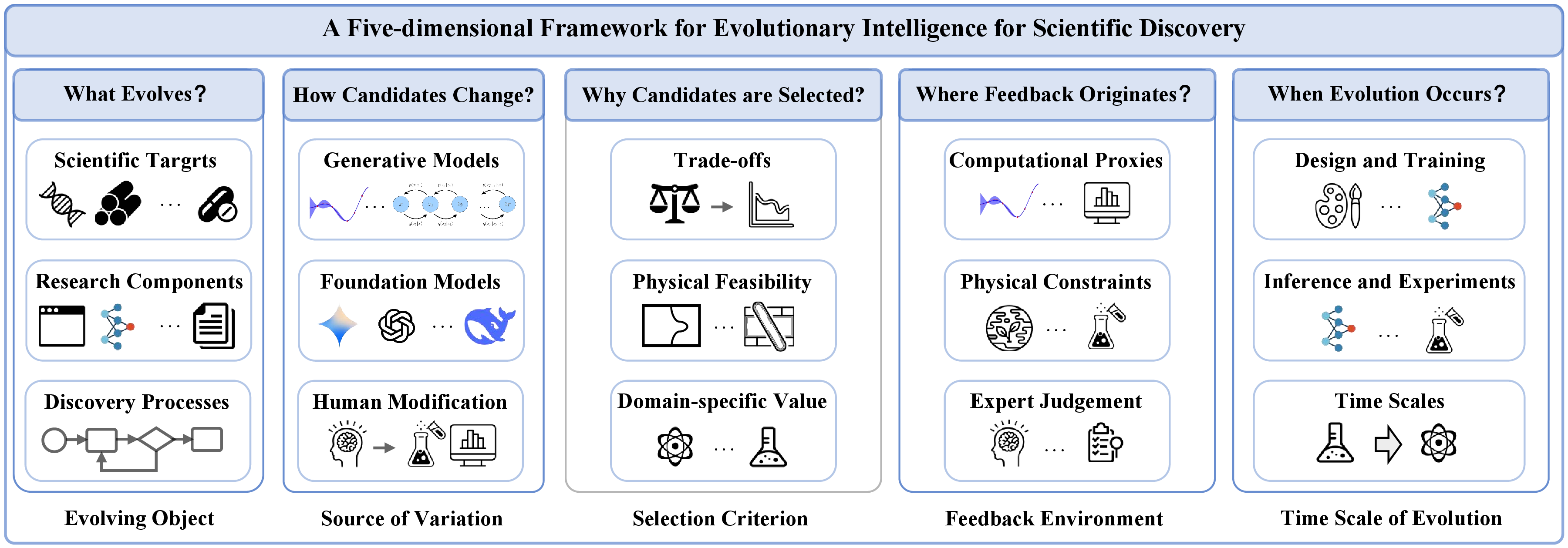
EI for scientific discovery can be analyzed through five interconnected questions: what evolves, how candidates change, why candidates are selected, where feedback originates, and when evolution occurs. These questions correspond to five components of a discovery system: the evolving object, the source of variation, the selection criterion, the feedback environment, and the time scale of evolution [17]. These components interact closely. The feedback environment influences the selection criteria, which in turn shape the mechanisms of variation, while the time scale determines how accumulated experience is retained and transferred across cycles [28]. This framework, illustrated in Fig. 2, provides a structured approach to analyze how isolated search trajectories are transformed into cumulative scientific insight.
What evolves. Many EC applications typically target fixed representations, ranging from numerical vectors to static programs and predefined policies [17]–[19], [70], [71]. For scientific discovery, EI broadens this scope across multiple levels. The evolving object may encompass concrete scientific targets, research components, or discovery processes. Specifically, targets range from molecular structures and protein sequences to complex experimental recipes [4], [5], [72], [73]. Research components include computational models and data representations [74]–[76], as well as prompt templates and testable hypotheses [35], [36], [77]. Furthermore, discovery processes themselves can evolve, including experimental planning protocols, tool-use routines, and human-AI collaborative workflows [7], [40], [41], [60]. This broader view is valuable because these objects frequently overlap in practice. A scientific AI system often adapts multiple components concurrently within a single cycle. For instance, an autonomous materials platform might simultaneously refine candidate compounds, update underlying surrogate models, and adjust experimental batching policies [15], [43], [44], [61]. Similarly, the evolution of reusable skills, such as automating data curation and literature retrieval, functions as a dynamic research component that supports the broader discovery workflow [39], [60].
How candidates change. EC algorithms primarily drive candidate variation through operators such as mutation and crossover, as well as distributional sampling and program transformation [18], [19], [21], [55]. In EI for scientific discovery, candidate variation is also driven by learned generative models, foundation models, and human-guided modification. For instance, large foundation models can propose or revise complex programs and testable hypotheses, and refine prompt templates and experimental plans [8], [33]–[36], [78], [79]. Domain-specific scientific constraints and prior knowledge can help guide this variation, restricting it to physically or logically plausible regions of the candidate space [50], [76].
Why candidates are selected. Many EC implementations rely on scalar fitness values or predefined objective functions to rank and propagate candidates [17], [18], [62]. In scientific discovery, however, selection criteria expand to encompass multi-dimensional trade-offs, physical feasibility, and domain-specific scientific value. Rather than prioritizing a single metric, selection pressures balance competing objectives, such as predictive accuracy, computational cost, and experimental safety [80], [81]. Furthermore, mechanisms that preserve novelty and diversity penalize premature convergence, keeping alternative hypotheses and unexplored regions of the candidate space viable [23]–[27]. These criteria adapt as feedback accumulates, while human judgement and expert oversight can steer selection toward scientifically promising regions that lack immediate computational validation [32], [82], [83]. Consequently, selection in EI functions not only to filter candidates, but also to steer the search trajectory toward evolving scientific priorities.
Where feedback originates. EC practices typically derive evaluation feedback from predefined, scalar fitness functions or controlled simulated environments [17], [18], [62]. In scientific discovery, however, the feedback environment includes various types of signals. These range from computational proxies, such as predictive models and uncertainty estimates [3]–[5], [84], to physical constraints derived from laboratory experiments [7], [9], [10], [40], [85], and human-driven reproducibility checks with expert judgement [1], [2], [11]. These signals do more than merely rank candidates; they influence how models, search constraints, and experimental priorities are adjusted for subsequent discovery cycles. Consequently, the feedback environment in EI serves as a direct link between the computational search and physical experiments.
When evolution occurs. The temporal scale at which evolutionary operations are applied influences whether a system remains confined to local search or supports systematic cumulative discovery. In scientific AI systems, evolution operates at multiple time scales, depending on the latency and cost of feedback. At the design and training stages, evolutionary mechanisms shape model architectures [58], [86] and search configurations [59], [87], and adjust proposal distributions during the learning process [21], [88]. At the inference and experimental stages, foundation-model systems can search over reasoning paths [77], [79], algorithmic programs [33], [34], and testable scientific hypotheses [7], [36], [37], while laboratory feedback refines candidate batches and experimental priorities [9], [40], [89]. Across time scales, archived priors and adaptive search strategies enable knowledge transfer across distinct tasks and scientific domains [28], [66]–[68]. Consequently, the timing of evolution is more than a scheduling detail; it determines how retained experience shapes future discovery cycles.
Collectively, these five dimensions provide a framework for comparing diverse scientific AI systems across different domains and technical implementations [1], [47]. By examining how a system combines its evolving objects, variation mechanisms, and feedback environments, we can determine whether it is limited to isolated search or capable of systematic cumulative discovery. This perspective shifts the focus from individual algorithms to how the system learns over time. Consequently, it provides a basis for analyzing the EI cycle, which integrates these dimensions to transform isolated search trajectories into scientific insight.
4 The evolutionary intelligence cycle: from experience retention to scientific insight↩︎
The role of search trajectories. EI expands the value of search trajectories. Many EC applications primarily focus on identifying a set of high-performing candidates or a Pareto front [24], [25], [27], [80]. For cumulative discovery, however, the entire search trajectory can serve as a valuable foundation for generating scientific insight. Rather than merely recording final outcomes, EI systems frequently capture detailed evidence. Failed trials often reveal physical and operational constraints, while candidate lineages document specific modifications that preserve or degrade function. Furthermore, experimental records can highlight systematic discrepancies between computational surrogates and physical reality [9], [15], [16], [40]. By archiving these complete search histories, EI translates isolated search trajectories into a structured experience that informs subsequent discovery cycles. This transformation is governed by the EI cycle (Fig. 3), which systematically retains, represents, utilizes, and transfers experience to generate scientific insight.
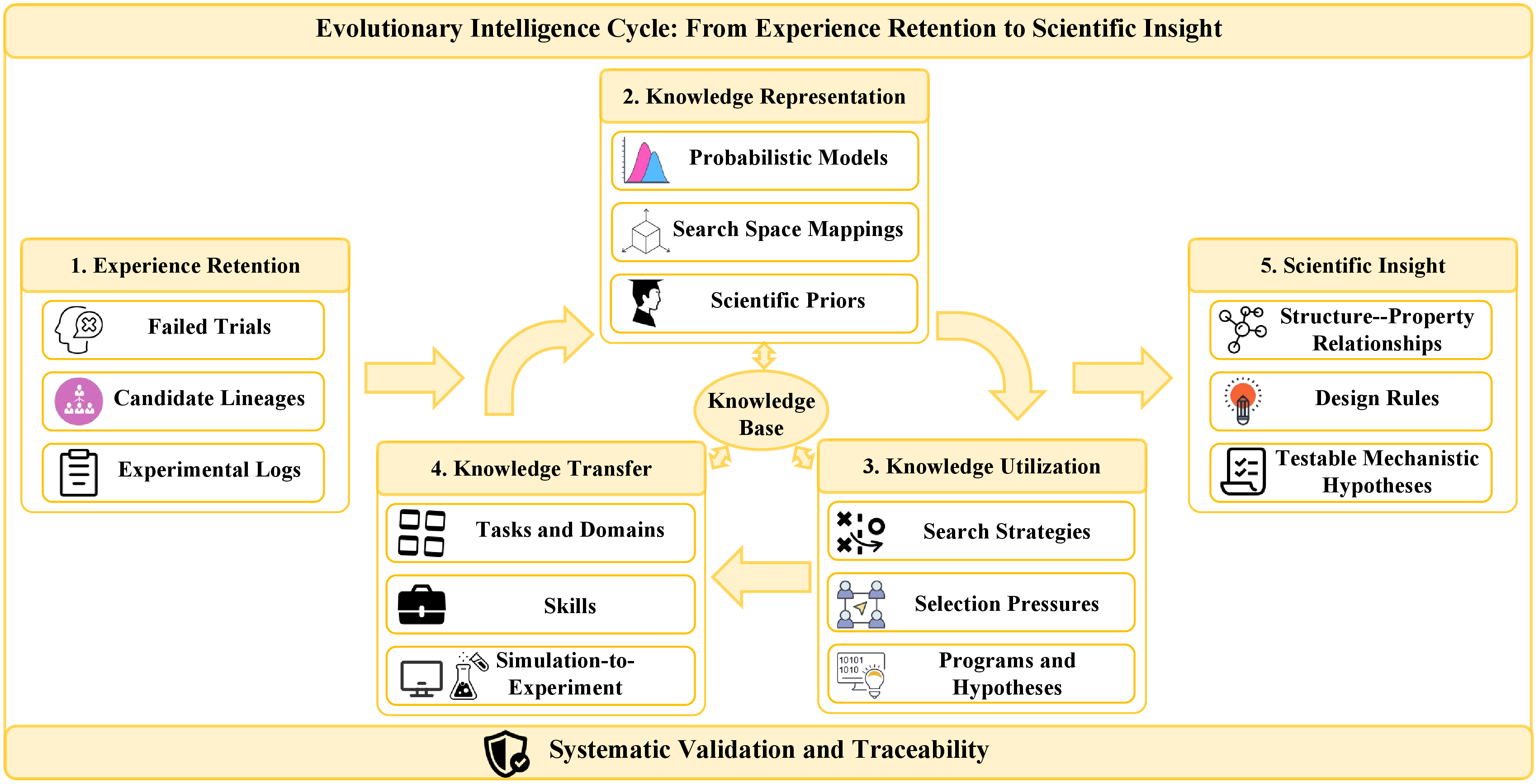
Experience retention. This mechanism differs from common EC practices of archiving primarily elite solutions or non-dominated fronts [17], [18], [23], [24]. In scientific discovery, EI systems often employ broader archival protocols that record more aspects of the search process. Rather than discarding suboptimal outcomes, these protocols frequently incorporate failed trials, intermediate evolutionary lineages, and raw experimental logs, and human annotations with contextual metadata [6], [9], [10], [40]. By structuring these diverse records into a unified historical record, EI helps preserve a broader range of scientific evidence. This extensive retention provides valuable raw material for subsequent knowledge representation, converting isolated data points into a coherent and traceable scientific record.
Knowledge representation. Raw archival records often require transformation into usable and interpretable forms to guide future exploration. In this phase, EI systems convert accumulated search history into structured representations. These representations range from data-driven probabilistic surrogate models that map candidate features to evaluation indicators [15], [90], [91], to topological mappings of the search space that reveal hidden basins of attraction [24], [27], and domain-specific scientific priors derived from physical laws or expert knowledge [1]–[3]. This step connects low-level data to higher-level reasoning. By recording both successes and failures, the system builds a structured history that guides future searches toward viable options and prevents repeated mistakes.
Knowledge utilization. This mechanism uses retained experience to steer the ongoing search process. Rather than relying on static rules, EI systems adjust their search strategies using the structured representations built in the previous phase. For instance, data-driven surrogates and uncertainty estimates can guide the generation of new candidates, directing evolutionary variation toward regions of the search space that are promising or uncertain [15], [91], [92]. Topological mappings and novelty metrics change selection pressures, penalizing premature convergence and encouraging the exploration of diverse behaviors [23]–[25]. Furthermore, foundation models use encoded scientific priors to propose programs and valid hypotheses, reducing reliance on random mutation [7], [33], [35], [36]. Through these mechanisms, knowledge utilization shifts the search from trial-and-error to evidence-driven inquiry, balancing open-ended exploration and targeted refinement as new feedback arrives.
Knowledge transfer. This mechanism enables cumulative discovery by reusing experience across tasks, rather than limiting search to single runs or closely related problems [28], [63], [64]. In EI systems, structured records and adaptive strategies are reused across new scientific contexts. Rather than starting from scratch, these systems use archived priors to accelerate exploration in distinct tasks and scientific domains [1], [7], [41], [47]. This transfer also bridges computational and physical boundaries. For instance, heuristics and data-driven models learned in simulations can be transferred to guide costly physical experiments, helping to connect simulations with physical experiments [15], [65], [68]. Similarly, experimental protocols and design principles can propagate across different length scales or material classes [3], [4], [76]. Systems also extract and reuse modular skills. When they find effective algorithms or prompt templates, they archive these structures for future tasks [35], [36], [39], [60]. Systems can then combine these saved skills to solve new problems. By reusing past results, each discovery cycle builds directly on previous knowledge rather than starting from scratch.
Scientific insight. This phase shifts the focus from finding high-performing candidates to generating interpretable scientific knowledge. While many search processes conclude with a single best candidate or a Pareto front, cumulative discovery systems extract generalized principles from the entire search trajectory. These insights include explicit structure–property relationships, design rules, or testable mechanistic hypotheses that explain why certain candidates succeed while others fail [1], [2], [11]. Because these insights are based on archived failures, diverse search paths, and physical validation, they are highly reliable and traceable [9], [16]. Over time, this new scientific insight feeds back into the broader research community, improving human understanding and providing initial priors for future autonomous discovery systems.
5 Modes of EI-enabled scientific discovery↩︎
To demonstrate the generality of the EI framework, we analyze scientific AI systems based on their evolving object rather than their specific application domains. This approach shows a progression in the scope of evolution: from concrete scientific entities and computational models, through symbolic reasoning processes, to automated research workflows. This classification shows that while specific candidate spaces and feedback mechanisms vary across disciplines, the EI architecture remains consistent [1], [47].
Evolving concrete scientific entities. EI operates on physical or chemical targets, including molecules [5], proteins [72], [73], and materials [4]. Because experimental feedback in these domains is often costly and sparse, systems frequently rely on data-driven surrogate models to guide exploration [15]. EI systems in this context often archive failed synthesis routes and negative characterization data. Rather than discarding these outcomes, the system uses them to identify physically feasible regions. This retained experience allows subsequent search cycles to avoid inaccessible areas and focus on viable spaces, as demonstrated in autonomous materials platforms [43], [44], [61].
Modifying computational models and representations. EI operates on the computational tools used to model scientific entities. Rather than searching directly over physical targets, these systems evolve neural architectures [58], [86] and molecular representations [75], [76], [93]–[95], and data-driven surrogate models [15]. Adapting these representations can reshape the search space, making previously inaccessible regions easier to explore. At this level, the system records how different representations capture physical or chemical constraints. Because this experience can transfer across related tasks, it enables the system to select representations that favor physically plausible solutions. For example, integrating foundation models into protein and materials design uses pretrained representations to guide the search toward viable biological or chemical structures [50], [96]–[99].
Evolving symbolic reasoning processes. At a higher level, EI systems target symbolic structures, including executable code, mathematical expressions [33], [34], and mechanistic hypotheses. Unlike physical experiments, the feedback for these symbolic entities can be automatically verified, often relying on massive parallel computing. This automated verification allows systems to evaluate a large volume of candidates. Instead of discarding code that fails a test suite, EI systems often archive these errors. By analyzing these failures, the system can identify recurring logical mistakes or extract partially correct subroutines to guide subsequent modifications [8], [79]. Over successive cycles, these archived code components and corrections enable the system to construct more complex algorithms or mathematical proofs, often resulting in human-readable solutions [36], [37].
Orchestrating automated research workflows. Beyond modifying single components, EI systems can target entire research workflows. These workflows integrate multiple scientific operations, from planning to experimental execution [7], [41]. At this level, the evolving objects are the execution plans for these tasks. Feedback typically evaluates whether the complete workflow successfully produces an outcome, such as a verified hypothesis. Because this requires completing all steps, the feedback is often sparser and more delayed than component-level signals [42], [44]. To manage these processes, EI systems archive successful multi-step protocols. By retaining these execution plans, the system can reuse them to automate complex scientific tasks [39], [51], [60], [100].
In practice, a single scientific workflow often combines multiple modes. For instance, an automated system might evolve the code used to analyze data while simultaneously synthesizing physical materials. Regardless of the objects being modified, the core mechanism remains the same: the system archives past results to guide subsequent steps. As EI systems integrate these modes into complex workflows, evaluation must look beyond the final output. Rather than measuring only the quality of a single result, assessments need to evaluate the reliability of the entire process and the system’s capacity to accumulate experience over time.
6 Evaluation, challenges and roadmap↩︎
Evaluating EI for scientific discovery requires criteria that go beyond the performance of isolated candidates. While candidate quality is a necessary baseline, EI is distinguished by its ability to retain experience, transfer knowledge, and produce interpretable insights across evolutionary cycles. Achieving this cumulative discovery presents several key challenges: defining evaluation metrics, improving process traceability, bridging simulation-to-experiment gaps, and developing shared databases for experience reuse.
Evaluating cumulative discovery beyond candidate refinement. Current evaluation frameworks primarily measure the quality of final candidates within isolated discovery cycles. Such single-cycle metrics are often insufficient to distinguish whether a system accumulates transferable knowledge or merely overfits to a specific task [1], [11]. Consequently, this limitation makes it difficult to separate short-term candidate refinement from systematic cumulative discovery. Addressing this gap requires a shift toward longitudinal metrics. Rather than relying on single-run performance, these metrics need to track how knowledge is utilized and transferred across successive cycles, as well as the emergence of interpretable scientific insights [7], [101].
Traceability of evolutionary processes. When foundation models generate variations, tracing how a specific candidate was derived is often difficult. Without a clear record of the evolutionary process, scientists cannot independently verify or reproduce the results [52], [69]. To address this, systems must record the complete history of candidate modifications, including both successful steps and failed attempts. Additionally, involving human experts to review these records helps ensure that the generated candidates align with known physical or logical rules, turning raw model outputs into trustworthy scientific evidence [11], [79].
Feedback reliability and simulation-to-experiment gaps. The EI cycle depends heavily on feedback, which is often costly, sparse, and noisy. Real-world experiments are slow and expensive, while computational simulations are fast but frequently simplify physical laws [40], [89]. Relying solely on either source can mislead the search. To address this, systems must combine simulations with experiments. They need to measure the gap between simulated predictions and real experimental outcomes, using this difference to continuously correct their models and avoid physically impossible regions [82], [83].
Shared infrastructure for experience reuse. Many current EI systems operate independently, generating large amounts of data that are difficult for other researchers to reuse. The lack of shared data platforms hinders the transfer of knowledge across different scientific domains, length scales, and simulation-to-experiment boundaries [3], [4]. To address this, the community needs standardized databases that systematically record failed experiments, modification histories, and trained models. Developing common data formats and sharing standards would allow new EI systems to begin their searches using previously accumulated experience, enabling cumulative scientific discovery across the broader research community [1], [47].
7 Outlook↩︎
The transition to EI for scientific discovery shifts the focus from automating single tasks to accumulating knowledge over time. Future scientific AI systems will likely integrate foundation models with automated experiments through evolutionary cycles [1], [47]. In these systems, every evaluated candidate and failed experiment contributes to a shared record. This accumulated history allows subsequent searches to build on existing scientific knowledge rather than starting from scratch.
As these systems become more autonomous, the role of human researchers will shift toward setting overall goals and validating results. Scientists remain essential for applying domain expertise and interpreting unexpected experimental outcomes [11], [52]. Therefore, the success of EI should not be judged solely by computational speed, the number of candidates generated, and accuracy. Instead, it depends on the system’s ability to produce experimentally validated insights that withstand scientific scrutiny and help researchers understand the underlying mechanisms.