HAT Super-Resolution and a PARSeq+CLIP4STR Voting Ensemble
for Extreme In-the-Wild License Plate Recognition
July 09, 2026
Abstract
We describe our entry to the ICIP 2026 Grand Challenge on Extreme In-the-Wild License Plate Super-Resolution (XLPSR), which scored 9.73 wECR on the public validation leaderboard. The system pairs a Hybrid Attention Transformer super-resolution (HAT) front-end with an ensemble of two scene-text recognisers (PARSeq-S and CLIP4STR-B) and a confidence-weighted character-voting scheme that abstains on uncertain positions. We treat XLPSR as a recognition task gated by image legibility: the SR step exists to lift characters out of sub-pixel territory, and the asymmetric scoring rule (\(+2\)/\(-1\)/\(0\)) is exploited explicitly through abstention. Our pipeline runs in 1.7 s per sequence on RTX 3090 (max 2.7 s, p99 2.4 s), well under the 60 s/sequence Docker budget.
License plate recognition, Super-resolution, Scene text recognition, Ensemble, Abstention.
1 Introduction↩︎
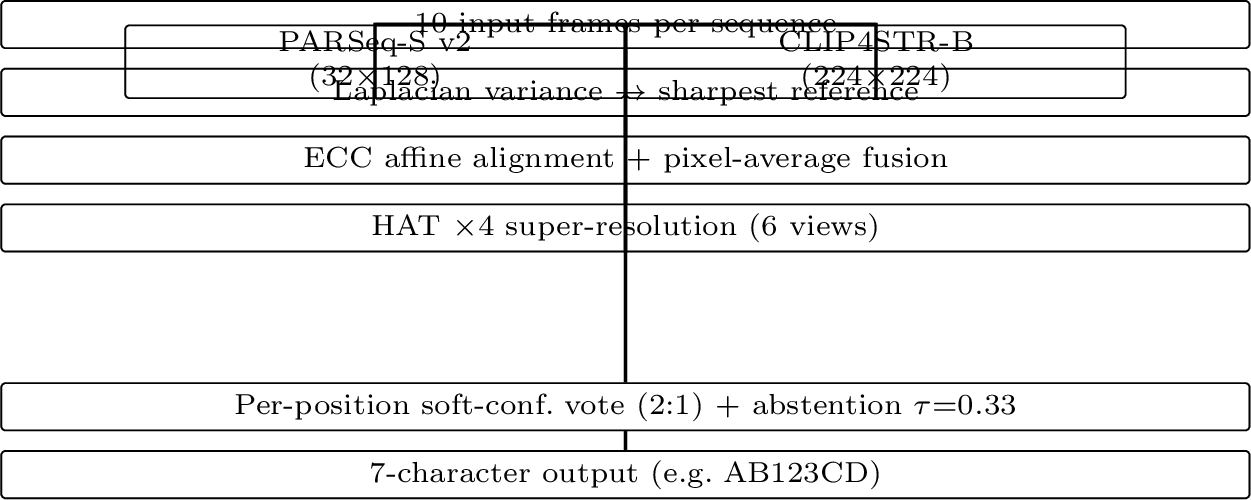
The XLPSR challenge provides 10 video frames per sequence of moving vehicles with French license plates under extreme in-the-wild degradation: plates as narrow as 12 px, motion blur, JPEG compression, adverse lighting, and occlusion. The task is to predict the plate text. The \(+2\)/\(-1\)/\(0\) per-character scoring makes guessing in low-confidence regions negative-EV below \(P(\textrm{correct}) = 1/3\), which we exploit explicitly. Figure 1 summarises the pipeline; the following sections describe each stage.
2 Method↩︎
2.1 Multi-frame fusion↩︎
Each sample in the blind-evaluation set is supplied as a temporal sequence of already-cropped license-plate images; the public-validation set provides full frames with per-frame bounding boxes which our pipeline crops first. After that branching step the rest of the pipeline is identical: we score every crop by Laplacian variance, pick the sharpest as a reference, align the remaining crops to it with the Enhanced Correlation Coefficient (ECC) algorithm under an affine motion model, and average them pixel-wise into a fused crop. ECC + affine was chosen over optical-flow alternatives because it is robust to the low-contrast conditions that dominate XLPSR crops, requires no ground-truth flow supervision, and is fast enough for CPU-side pre-processing. We carry forward six views per sequence into the recogniser stack: the sharpest reference, up to four additional aligned crops (in input frame order), and the fused crop.
2.2 Super-resolution↩︎
Each view is upscaled \(4{\times}\) by Real-HAT-GAN-SRx4 [1], a Hybrid Attention Transformer with six RHAG blocks at embed dim 180, window 16, overlap ratio 0.5, and a PixelShuffle upsampler. We use the public weights without further fine-tuning. Lighter real-time variants such as our earlier SwiftSRGAN [2] would suit tighter latency budgets, but XLPSR’s 60 s/sequence budget lets us prioritise legibility over throughput. SR is the single largest contributor to wECR in our ablation (Table 1, \(+2.00\) over the PARSeq+CLIP4STR no-SR baseline).
2.3 Two-model OCR ensemble↩︎
Both the super-resolved view and the original-resolution reference are passed through two recognisers:
PARSeq-S v2 [3]: 23.8 M-parameter ViT-Small with permuted autoregressive decoder, \(32{\times}128\) input. Fine-tuned from public weights for 10 epochs.
CLIP4STR-B [4]: 158 M-parameter CLIP-ViT-B/16 backbone with cross-modal decoder, \(224{\times}224\) input. Fine-tuned from the public checkpoint with focal cross-entropy (\(\gamma{=}2\)), label smoothing 0.1, differential LR (encoder \(1{\times}10^{-5}\), decoder \(1{\times}10^{-4}\)), EMA decay 0.999 and SWA over the last 30% of training.
The two architectures give diversity at the backbone, input-resolution and pretraining-corpus level (ImageNet-1K vs.CLIP’s 400 M image-text pairs) while sharing the same permuted-AR decoder family. Every view therefore yields two (predicted text, per-position soft-max confidence) tuples that enter the voter.
2.4 Character voting with abstention↩︎
Predictions of the modal string length (preferring 7, the French SIV format) are retained. For each character position we sum soft-max confidence per class across all retained tuples, weighting PARSeq twice and CLIP4STR once; the \(2{:}1\) weighting is chosen from ablation (Table 1, \(+0.04\) wECR over \(1{:}1\)). We then abstain (emit _) when
the winning class’s soft-max mass falls below \(\tau = 0.33\), which matches the \(P(\textrm{correct})=1/3\) breakeven of the \(+2/{-}1/0\) scoring rule
under a well-calibrated soft-max proxy. A small SIV-format correction maps I\(\to\)J, O\(\to\)D, U\(\to\)V at the four letter positions of 7-character
plates, since the French SIV format forbids I, O and U to disambiguate them from 1, 0 and V. Hard format constraints during voting hurt by \(-0.11\) wECR (Table 1) by filtering out correct
edge-case predictions and are therefore not used.
3 Training Data↩︎
We list every external resource exhaustively, as required by the challenge rules. Sources are: (i) the XLPSR development set (39 sequences with ground truth) used for OCR fine-tuning (\(100{\times}\) oversampled) and validation only; (ii) 200 K self-generated synthetic French plates rendered with OpenCV Hershey vector fonts (Apache-2.0 via OpenCV) and the community FE-Schrift TrueType file (free for non-commercial use), degraded with a BSRGAN [5]-style shuffled pipeline (3–6 random ops per sample, 40% second-order cascade; difficulty split \(50/30/15/5\%\) very-hard/hard/medium/easy by plate width); and (iii) public pretrained weights only: PARSeq-S [3], CLIP4STR-B [4], CLIP ViT-B/16 [6], and HAT [1]. No private data and no manual annotation of public-validation or blind sequences were used.
4 Results↩︎
Table 1 traces our path from a no-SR baseline at 7.27 wECR to the final 9.73 entry. Two headline findings drive the design:
Super-resolution dominates: \(+2.00\) wECR over the PARSeq+CLIP4STR no-SR baseline, regardless of OCR choice.
Ensemble diversity matters more than ensemble size: adding PARSeq+CLIP4STR over PARSeq alone cleanly adds \(+0.31\) wECR, whereas in preliminary trials a third recogniser (SVTRv2, CTC decoder) degraded the ensemble — an observation we return to below.
The dominance of super-resolution is a consequence of the extreme-scale regime: at 12–20 px plate widths, individual glyphs occupy only 2–3 pixels of stroke width, and OCR backbones trained on scene-text corpora have effectively no signal until pixels are recovered. HAT lifts strokes above this sub-pixel threshold, which is why the SR step contributes more than any single recogniser choice or ensembling trick. The observed failure of the SVTRv2 third member reflects a deeper principle: adding a model with a different decoder family (CTC vs.permuted-AR) increases disagreement without increasing correlated correctness, which is vote noise rather than vote signal. Abstention at \(\tau{=}0.33\) converts roughly 0.4 characters per sequence from likely \(-1\) errors into 0s, gaining \(+0.11\) wECR by calibrating exactly to the \(+2/{-}1/0\) breakeven.
| Configuration | wECR |
|---|---|
| PARSeq + CLIP4STR (no SR) | 7.27 |
| PARSeq + HAT SR | 9.27 |
| PARSeq + CLIP4STR + HAT SR (\(1{:}1\) vote) | 9.58 |
| PARSeq + CLIP4STR + HAT SR (\(2{:}1\) vote) | 9.62 |
| + hard format-constrained voting | 9.51 |
| + abstention \(\tau{=}0.33\) (final) | 9.73 |
5 Inference Cost and Conclusion↩︎
The full pipeline runs in \(\sim\)1.7 s per sequence on RTX 3090 (max 2.7 s, p99 2.4 s; peak VRAM \(\sim\)3.2 GB), leaving 22–35\(\times\) headroom under the 60 s/sequence limit. Careful super-resolution combined with modest ensemble diversity and asymmetric-scoring-aware abstention reaches 9.73 wECR on XLPSR without external data or proprietary models, demonstrating that legibility recovery, not decoder capacity, is the binding constraint on extreme-scale license-plate recognition.