DynaKRAG: A Unified Framework for Learnable Evidence Control in Multi-Hop Retrieval-Augmented Generation
July 07, 2026
Abstract
Multi-hop retrieval-augmented generation (RAG) acquires evidence sequentially, with each new document potentially revealing missing facts, bridge entities, query defects, or sufficient support for answering. Existing methods provide useful operations
such as iterative retrieval, query reformulation, evidence critique, and sufficiency judging, but typically organize them within method-specific pipelines or predefined control topologies. This leaves underexplored how to learn a shared state-conditioned
policy that chooses among currently valid evidence operations. We introduce DynaKRAG, which formulates multi-hop evidence acquisition as state-conditioned control over atomic evidence operations. At each step, a validity layer
constructs the executable action set, and a learned controller selects the next operation. The resulting transition updates the evidence state and may enable new operations at subsequent steps. With Qwen2.5-7B-Instruct,
DynaKRAG achieves F1 scores of 0.5998 on HotpotQA, 0.5340 on 2Wiki, and 0.3061 on MuSiQue, outperforming the strongest controlled baseline on all three benchmarks. Replacing the learned controller with a uniform-valid policy
reduces F1 by 3.96–5.78 points, while removing sufficiency feedback hurts all three datasets. Controlled retrieval-cap experiments further show that additional retrieval is not uniformly beneficial. Together, these results demonstrate the benefit of
coordinating retrieval, diagnosis, and gap-directed acquisition under an evolving evidence state.

1 Introduction↩︎
Retrieval-augmented generation (RAG) grounds language models in external sources of evidence [1], but multi-hop questions break the usual retrieve-then-generate abstraction. The first useful passage rarely completes the answer; instead, it changes the information need. It may expose a bridge entity, reveal a missing relation, show that the current query is misdirected, or provide enough support to stop. The next step is therefore not just a decision about retrieval depth. It is a control decision over an evolving evidence state: whether to continue along the retrieval frontier, reformulate the query, expand around a bridge entity, request a missing fact, check sufficiency, or stop and answer.
Adaptive RAG methods recognize parts of this problem by allowing intermediate results to guide later retrieval and reasoning [2], [3]. Recent systems further introduce useful behaviors such as query reformulation, evidence critique, sufficiency judging, and gap-directed retrieval [4]–[9]. Yet these behaviors are still largely packaged inside method-specific pipelines. Each pipeline fixes its own state representation, action schedule, and control topology, which makes heterogeneous evidence operations difficult to express, compare, and learn within one framework (Figure 1, top). This is more than an engineering inconvenience: a system that can decide when to retrieve more may not know when rewriting is better; a sufficiency module may identify a missing fact without jointly arbitrating against bridge expansion or stopping. The shared problem is to choose among currently executable evidence operations as the state evolves.
Efficiency makes this decision sharper. Adaptive RAG trajectories can repeatedly invoke retrievers and language models, and different operations impose different costs. More context can improve evidence coverage, but it can also introduce distractors, expand downstream prompts, and spend tokens on redundant evidence. A larger retrieval budget is therefore not a reliable substitute for better control. Effective adaptive RAG should be cost-effective: it should allocate computation to operations whose expected benefit justifies their cost, avoid invalid or low-value transitions, and stop once the evidence state is sufficient for answering.
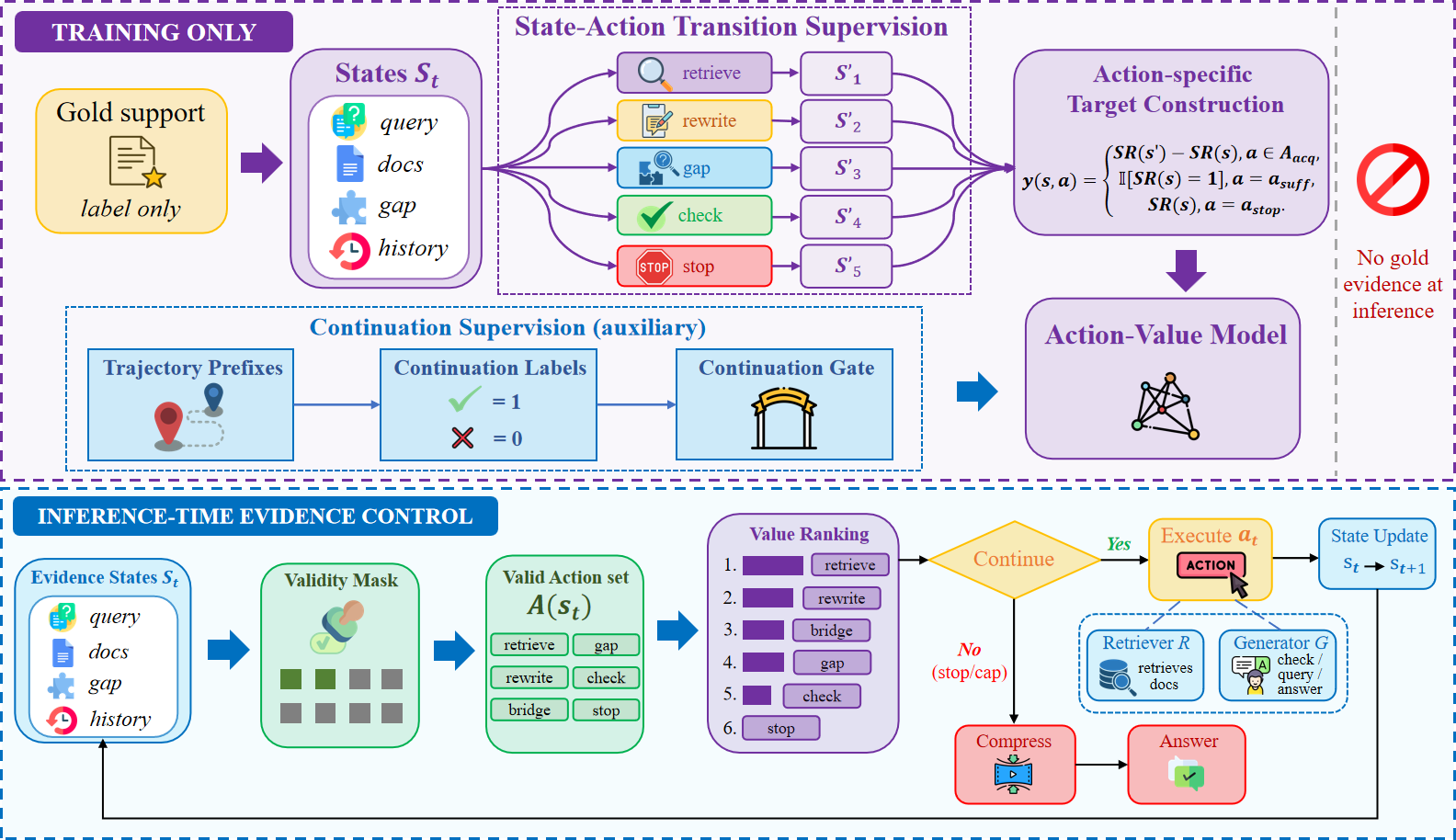
To this end, we introduce DynaKRAG, a unified learning framework for adaptive evidence acquisition (Figure 1, bottom). DynaKRAG represents heterogeneous RAG
behaviors as atomic evidence operations over a shared evidence state. The state records the question, retrieved documents, retrieval frontier, query and action history, bridge candidates, and diagnostic feedback. The action space includes frontier
retrieval, query rewriting, bridge-entity expansion, gap-directed retrieval, sufficiency checking, and stopping; terminal evidence compression prepares the accumulated context for answer generation. Executing an action updates the evidence state and may
change which actions become available next, turning fixed RAG pipelines into composable sequential decisions.
The key mechanism in DynaKRAG is the separation of action validity from action utility. A hard validity layer first constructs the executable action set for the current state, filtering operations that are undefined,
exhausted, or premature. A learned value model then ranks only the valid choices and selects the next operation. This design lets rules enforce transition consistency while learning decides which feasible operation is most useful. During training, support
annotations supervise the controller through changes in evidence coverage; during inference, the controller uses only the observable evidence state. By jointly deciding which operation to execute and when to stop, DynaKRAG
coordinates retrieval, diagnosis, reformulation, gap-directed acquisition, termination, and answer preparation under a cost-effective evidence-acquisition policy.
Our contributions are:
We formulate adaptive evidence acquisition as a unified evidence-action framework, in which heterogeneous RAG strategies are represented as atomic evidence operations and shared state transitions rather than isolated pipelines.
We develop a cost-effective learned controller that separates hard action validity from state-conditioned action utility, enabling dynamic coordination of retrieval, diagnosis, reformulation, gap-directed acquisition, and termination along an evolving trajectory.
We conduct controlled experiments on three multi-hop QA benchmarks, showing consistent gains in answer quality and token efficiency over strong baselines and isolating the effects of learned action ranking, sufficiency feedback, terminal evidence compression, and retrieval budgeting.
2 Related Work↩︎
Multi-hop evidence acquisition. Retrieval-augmented generation grounds language-model predictions in external non-parametric evidence [1]. Multi-hop benchmarks such as HotpotQA, 2WikiMultiHopQA, and MuSiQue extend this setting to questions whose answers depend on evidence distributed across documents and reasoning steps [10]–[12]. As intermediate facts reveal new entities and relations, the information needed at a later hop may be unavailable from the original query alone. Multi-hop dense retrieval addresses this dependency by conditioning later retrieval on previously acquired evidence [13], establishing evidence acquisition as a trajectory that evolves with the partial solution state.
Iterative and adaptive retrieval. Subsequent work develops several mechanisms for steering this trajectory. IRCoT interleaves retrieval with generated reasoning, while Self-Ask turns compositional questions into searchable follow-up questions [2], [14]. CoRAG learns multi-step retrieval chains through iterative query reformulation [15], and RQ-RAG trains models to rewrite, decompose, or disambiguate queries [16]. A complementary line adapts retrieval timing and strategy: FLARE and DRAGIN trigger retrieval from generation-time information needs [4], [5], while Adaptive-RAG routes questions among retrieval regimes according to estimated complexity [3]. Together, these methods make retrieval responsive to the evolving reasoning process, with each controller centered on a particular decision such as the next query, retrieval timing, or strategy.
Evidence diagnosis and action-level control. Recent systems increasingly use accumulated evidence to guide subsequent computation. CRAG evaluates retrieval quality and invokes corrective processing [7], while Self-RAG learns retrieval and critique decisions through reflection tokens [6]. S2G-RAG predicts evidence sufficiency and converts structured evidence gaps into subsequent retrieval queries [8]; PAR\(^2\)-RAG combines breadth-first evidence coverage with depth-first refinement and sufficiency control [9]. ReAct provides a broader foundation for interleaving reasoning with external actions [17]. These advances
expose a growing repertoire of complementary evidence behaviors, including frontier expansion, query reformulation, gap-directed retrieval, diagnosis, and stopping. Yet these behaviors are predominantly studied within separate control protocols, leaving
open how a system should choose among them as its evidence state evolves. DynaKRAG addresses this decision problem through a shared state-conditioned control process: the current evidence state determines the executable
operations, and a learned value model selects the next operation as the trajectory unfolds.
3 Method↩︎
3.1 Overview and Problem Formulation↩︎
We consider multi-hop question answering with a question \(q\), a corpus \(\mathcal{C}\), a retriever \(R\), and an answer generator \(G\). Unlike standard RAG, which commits to a fixed retrieval depth or a prescribed iterative routine, our setting allows the system to choose a different evidence operation after each state update. The objective is to acquire
sufficient support for answering \(q\) while avoiding invalid, redundant, or unproductive operations. Importantly, DynaKRAG controls this acquisition process without replacing \(R\) or \(G\), making the controller separable from the underlying retrieval and generation backbones.
Formally, DynaKRAG constructs an evidence trajectory \(\tau=(s_0,a_0,s_1,a_1,\ldots,s_T)\). The initial state \(s_0\) contains the question and an empty
evidence history. At step \(t\), the state \(s_t\) summarizes all information observable at inference time, including retrieved documents, query and action history, retrieval-frontier
statistics, detected bridge entities, and any missing-information feedback. A hard validity function maps this state to an executable action set \(\mathcal{A}(s_t)\). The learned controller then ranks only these valid
actions and selects \(a_t\in\mathcal{A}(s_t)\); executing \(a_t\) produces the next state \(s_{t+1}\). Because a transition can reveal a new gap, entity, or
sufficiency judgment, it can also change which actions are available at the next step.
Acquisition terminates when the controller selects stop_answer or reaches the action or retrieval cap. The accumulated evidence is optionally compressed into an answer-focused context and passed to \(G\).
This formulation makes query construction, evidence operations, and retrieval depth trajectory-level decisions rather than fixed hyperparameters. As illustrated in Figure 2, the remainder of this section presents the unified
evidence-action framework, learns a state-conditioned control policy, and describes terminal compression and the complete inference procedure.
3.2 Unified Evidence-Action Framework↩︎
The evidence state contains the information needed for action-level control: the question, retrieved documents, frontier cursor in the initial ranking, latest query, optional missing-information description, sufficiency result, action history, and accumulated cost. The action-value model receives question-length features, document and title counts, the retrieval frontier, retrieval-score statistics, question–evidence overlap, bridge-entity count, action identity, and expected action cost. A separate continuation model uses question-shape, evidence-burden, and action-history features. Gold answers, answer scores, supporting facts, and support recall are never runtime features.
The runtime exposes seven atomic operations. Five participate in the evidence-control loop: retrieve_more advances the existing retrieval frontier; gap_query generates a query for an identified missing fact;
rewrite_query reformulates the current query using accumulated evidence; bridge_entity_expand retrieves around entities detected in the evidence; and sufficiency_check asks \(G\)
whether the evidence supports an answer and, if not, records the missing information. stop_answer terminates acquisition. The seventh operation, compress_answer_evidence, is an answer-readiness action applied at termination in the
reported configurations and recorded in the action trace. It is analyzed separately from the support-recall-trained acquisition policy.
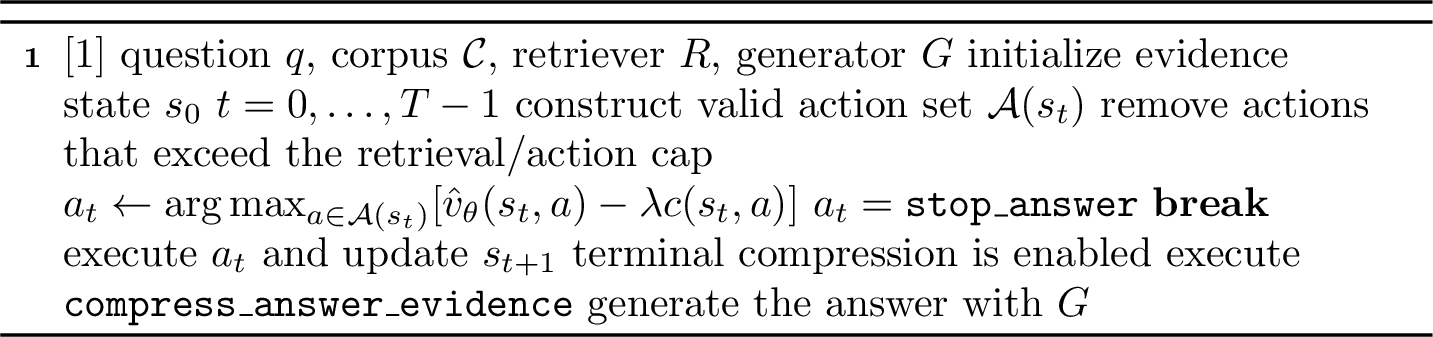
Not every action is meaningful in every state. We construct \(\mathcal{A}(s_t)\) before scoring: reformulation and sufficiency actions require retrieved evidence, gap querying requires a known gap, bridge expansion requires a bridge candidate, and retrieval actions are removed after the retrieval cap is exhausted. The hard validity layer prevents undefined or redundant transitions; learning is responsible only for ranking executable operations.
3.3 Learning a State-Conditioned Control Policy↩︎
The action-value model estimates how much each valid operation can improve the evidence state. For a training state–action pair \((s,a)\), we execute or simulate the transition offline. Let \(\mathcal{A}_{\mathrm{acq}}\) denote the evidence-acquisition actions, and let \(a_{\mathrm{suff}}\) and \(a_{\mathrm{stop}}\) denote sufficiency checking and stopping, respectively. We define \[\label{eq:action95target} v(s,a)= \begin{cases} \operatorname{SR}(s')-\operatorname{SR}(s), & a\in\mathcal{A}_{\mathrm{acq}},\\ \mathbb{I}[\operatorname{SR}(s)=1], & a=a_{\mathrm{suff}},\\ \operatorname{SR}(s), & a=a_{\mathrm{stop}}, \end{cases}\tag{1}\] where \(\operatorname{SR}(s)\) is the fraction of annotated supporting documents present in state \(s\), and \(s'\) is the post-action state. Supporting annotations are used only to construct train-time targets. The target rewards acquisition actions for adding missing support, supervises evidence-readiness assessment for sufficiency checking, and uses current support coverage to score stopping.
We fit a random-forest regressor \(\hat{v}_{\theta}(s,a)\) to these labels. At inference, every valid action is scored and the controller selects \[a_t^{*}=\arg\max_{a\in\mathcal{A}(s_t)}
\left[\hat{v}_{\theta}(s_t,a)-\lambda c(s_t,a)\right],\] where \(c(s_t,a)\) estimates retrieval or control-model cost. The reported main configurations use \(\lambda=0\); cost is
recorded for analysis but does not alter their ranking. A separate continuation model can suppress stop_answer when additional evidence is predicted to help. It is trained on trajectory prefixes to estimate the answer utility of continuing.
Together, value-based action ranking and continuation form the learned controller. The main runs use permissive continuation thresholds within a bounded trajectory. The “without learned controller” ablation replaces value ranking with a seeded
uniform-valid selector and uses the fixed trajectory horizon without learned continuation, while preserving the valid action set.
Executing the selected action produces the next evidence state. retrieve_more advances the initial ranking, while targeted actions issue a gap-focused, rewritten, or bridge-entity query to the dense index and merge the top unseen documents.
A sufficiency_check records an evidence-readiness judgment and, when support is incomplete, a missing-information description that enables subsequent gap-directed retrieval. These transitions update the observable state on which the next
policy decision is conditioned.
3.4 Terminal Evidence Compression↩︎
After acquisition terminates, the reported DynaKRAG configurations apply answer-focused evidence compression. The compressor asks \(G\) to extract a small set of mutually supporting snippets
from the accumulated documents, and the final answer is generated from the compressed state. This terminal operation is excluded from the support-recall target in Equation 1 and evaluated through a direct ablation.
Compression serves as an answer-readiness operation. It incurs an additional model call and often increases total tokens, while reducing the final generator’s burden of locating mutually supporting facts in noisy context.
3.5 Inference Procedure↩︎
Algorithm 3 summarizes inference. The validity layer first removes actions that cannot be executed; the value model then chooses among the remaining operations. Dynamic action composition therefore comes from learned ranking, while transition consistency comes from explicit validity constraints.
4 Experiments↩︎
Our evaluation asks whether the complete DynaKRAG system improves multi-hop QA, how learned action selection, sufficiency feedback, and terminal compression contribute within that system, whether the results can be
explained by simply retrieving more, and where dynamic control helps most.
7pt
max width=,center
| Variant | HotpotQA | 2Wiki | MuSiQue | ||||||
|---|---|---|---|---|---|---|---|---|---|
| w/o terminal compression | |||||||||
| w/o sufficiency check | |||||||||
| w/o learned controller | |||||||||
| Fixed-\(K\) static reference |
4pt
4.1 Experimental Setup↩︎
4.1.0.1 Datasets.
We evaluate on three multi-hop question-answering benchmarks: HotpotQA [10], 2Wiki [11], and MuSiQue [12]. Table 2 summarizes the evaluation splits, sizes, and reasoning structures. Together, the benchmarks cover open-domain, compositional, comparison, and variable-hop questions.
| Dataset | Split | Examples | Reasoning structure |
|---|---|---|---|
| HotpotQA | Fullwiki val. | 7,405 | 2-hop open-domain |
| 2Wiki | Dev. | 12,576 | Compositional/comparison |
| MuSiQue | Val. | 2,417 | 2–4-hop compositional |
3.2pt
4.1.0.2 Metrics.
We report normalized Exact Match (EM) and token-level answer F1, with F1 as the primary answer-quality metric. EM requires an exact normalized match, whereas F1 measures token overlap between a prediction and the reference answers. For iterative methods, we additionally record total token consumption, retrieval calls, and language-model calls to evaluate efficiency. Supporting-evidence recall is used to construct training targets and diagnose retrieval behavior.
4.1.0.3 Baselines.
We compare against fixed-\(K\) RAG [1] and controlled implementations of IRCoT [2], S2G-RAG [8], CoRAG [15], Adaptive-RAG [3], PAR\(^2\)-RAG [9], CRAG [7], and Self-Ask+Search [14]. This suite covers static, iterative, adaptive, corrective, and decomposition-based retrieval. We report CoRAG with three retrieval steps (s3), the stronger of the two- and three-step settings overall, and fixed-\(K\) reports the strongest non-gold setting from the completed grid.
4.1.0.4 Implementation details.
We evaluate Qwen2.5-7B-Instruct [18], GPT-4o-mini, and Llama-3.1-8B-Instruct as answer-model backbones. Within each backbone, all methods use the same corpus, retrieval resources, and evaluation pipeline. We train dataset-specific action-value and continuation models on 1,000 training examples disjoint from each reported evaluation split. Supporting-evidence annotations define the training targets, while inference uses the question and observable retrieval state. Crucially, the action-value and continuation models are trained once with Qwen2.5-7B-Instruct trajectories and transferred to GPT-4o-mini and Llama-3.1-8B-Instruct; no target-backbone policy training is performed. Each random forest contains 300 estimators, uses a minimum leaf size of 8, and is initialized with seed 13. Main runs use deterministic decoding, add up to three documents per retrieval operation, allow at most four acquisition or control steps, and retain at most 12 documents in the final context. Targeted actions query a BGE-large-en-v1.5 dense index [19] and retain unseen documents in score order. The complete system applies terminal evidence compression before answer generation.
4.2 Main Results↩︎
Table ¿tbl:tab:main95results? shows that DynaKRAG achieves the best F1 on all three benchmarks with Qwen2.5-7B and GPT-4o-mini. With Qwen2.5-7B, it reaches 0.5998 on HotpotQA, 0.5340 on 2Wiki, and 0.3061 on
MuSiQue, improving over the strongest controlled baseline by 2.88, 7.19, and 0.62 points, respectively. With GPT-4o-mini, the corresponding scores rise to 0.6218, 0.6391, and 0.3977, exceeding the strongest same-backbone baselines by 1.10, 1.33, and 1.01
points. These gains are therefore not tied to the Qwen answer model used to collect the controller’s training trajectories.
The fixed Qwen-trained policy also transfers effectively to Llama-3.1-8B-Instruct. Without target-backbone policy retraining, DynaKRAG achieves the best F1 on HotpotQA (0.4876) and MuSiQue (0.2391), improving over the
strongest same-backbone baselines by 1.06 and 2.65 points. On 2Wiki it reaches 0.3692 F1, within 0.38 points of the best baseline, while obtaining the second-best EM. Across the six non-Qwen dataset–backbone combinations,
DynaKRAG leads on five and remains competitive on the sixth. This result supports a useful separation between retrieval control and answer generation: the learned action-value policy captures evidence-acquisition preferences
that generalize across model families rather than overfitting to the model that produced its training trajectories.
The largest complete-system gain occurs on 2Wiki compositional questions, where DynaKRAG improves over the fixed-\(K\) reference by 24.31 F1 points. This pattern motivates the
question-structure analysis below; the ablations separately assess how learned control, sufficiency feedback, and terminal compression contribute to the overall result.
The main runs average 2.439, 2.599, and 2.912 retrieval calls on HotpotQA, 2Wiki, and MuSiQue, respectively. Terminal compression adds one language-model call and serves as answer preparation rather than token reduction. Compared with S2G-RAG, the
strongest F1 baseline, DynaKRAG reduces average total token use from 2807.26 to 2373.14 on HotpotQA, from 3543.52 to 3077.94 on 2Wiki, and from 3886.83 to 3082.29 on MuSiQue. These differences correspond to reductions of
15.5%, 13.1%, and 20.7%, respectively, while DynaKRAG also achieves higher F1. Both systems use the total-token accounting applied to iterative methods. We exclude fixed-\(K\) from this
comparison because its stored summaries report prompt tokens under a different accounting convention.
4.3 Ablation Studies↩︎
Table 1 separates learned control from merely exposing a larger action space. Replacing the learned controller with a seeded uniform-valid policy reduces F1 by 4.79 points on HotpotQA, 5.78 on 2Wiki, and 3.96 on MuSiQue. Exposing the action set without learning how to rank its members is insufficient. The controller must choose which valid operation to execute and whether the trajectory should continue.
Removing the sufficiency action also hurts all three datasets and drives the controller toward its step cap. By converting evidence-readiness assessment into an explicit state update, the probe supplies the missing-information description used by subsequent targeted retrieval. Terminal compression further improves all three datasets. The fixed-\(K\) row is included as a static-retrieval reference, not as a single-component ablation.
4.4 Retrieval Budget Sensitivity↩︎
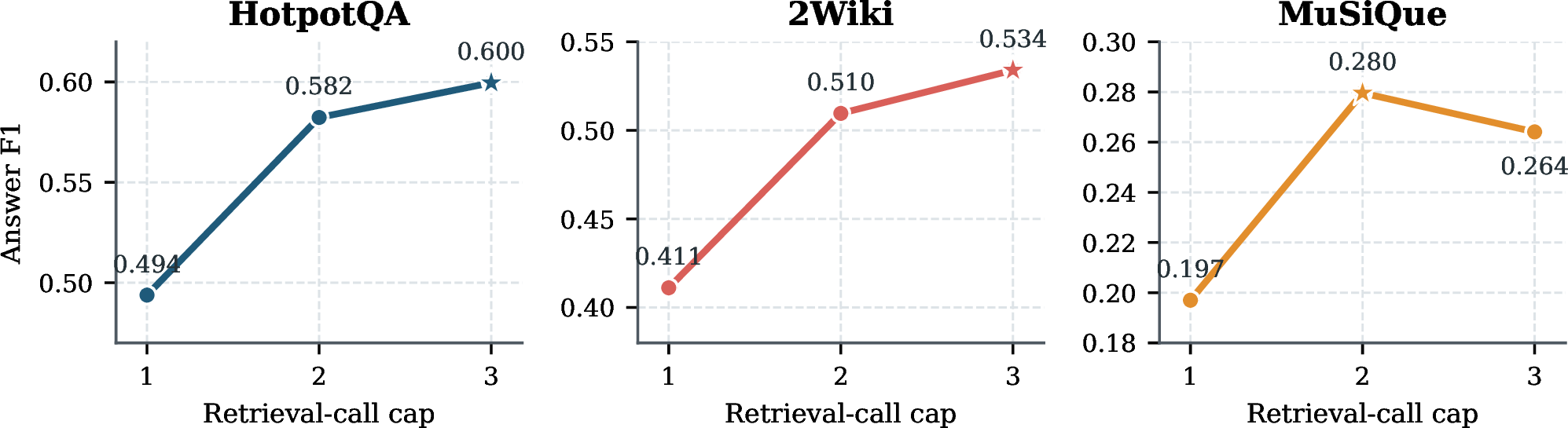
The controlled cap sweep rules out a monotonic “more retrieval is better” explanation. HotpotQA and 2Wiki improve from one to three calls, but MuSiQue peaks at two calls (0.2796 F1) and falls to 0.2641 at three despite consuming more tokens. The main
runs have no explicit retrieval-call cap and may issue a fourth retrieval on some examples. By contrast, cap 3 changes the final control decision once an example has already used three calls, which occurs frequently on MuSiQue. The useful budget is
therefore dataset dependent. Within a given budget, DynaKRAG can allocate calls among frontier expansion, gap queries, and bridge expansion as the evidence state changes, rather than repeating a single retrieval operation.
4.5 Learned Action Composition↩︎
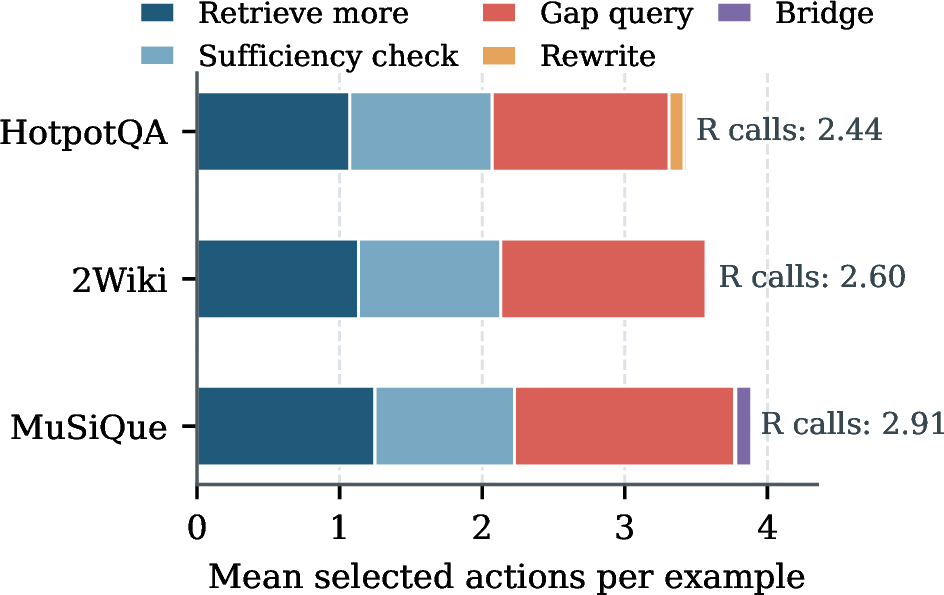
Figure 5 reveals a stable learned pattern across datasets: frontier retrieval is followed by gap-focused acquisition and approximately one sufficiency check. This confirms that the controller does not collapse to fixed retrieval. Bridge expansion and query rewriting are selected rarely; the learned controller instead favors explicit gap queries once diagnostic feedback identifies missing information.
4.6 Performance by Question Structure↩︎
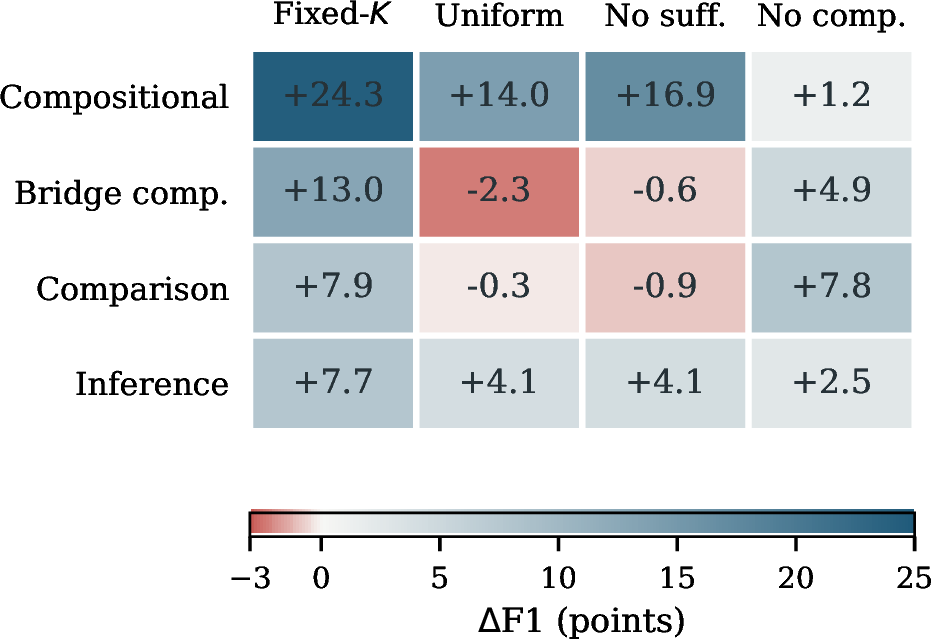
Figure 6 shows that the gains vary systematically with question structure. Relative to fixed-\(K\), DynaKRAG improves 2Wiki F1 by 24.31 points on
compositional questions, 12.97 on bridge-comparison questions, 7.95 on comparison questions, and 7.68 on inference questions. The advantage is largest when several facts must be assembled, matching the intended role of state-dependent evidence actions. On
comparison-oriented buckets, uniform selection or removal of the sufficiency probe can slightly outperform the full controller, indicating that learned control is most valuable when the evidence need evolves over a multi-step trajectory.
5 Conclusion↩︎
In this paper, we introduce DynaKRAG, a state-conditioned control framework for multi-hop retrieval-augmented generation. DynaKRAG organizes evidence operations within a shared state and
selects among currently executable operations as the state evolves. This formulation enables a closed-loop acquisition process that adapts both operation type and retrieval depth to the evidence already collected. Experiments on HotpotQA, 2Wiki, and
MuSiQue show that DynaKRAG is effective and efficient: it consistently improves F1 over strong shared-backbone baselines and reduces token consumption relative to the strongest iterative Qwen baseline. The retrieval-cap
analysis further shows that additional retrieval is not uniformly beneficial. These findings indicate that adaptive multi-hop RAG depends on selecting suitable evidence operations from the current information state.
6 Technical Appendix↩︎
This appendix supplies the implementation, evaluation, and diagnostic details needed to interpret and reproduce the experiments. Unless stated otherwise, all numbers are aggregate statistics from the same completed runs used in the main paper.
6.1 Reproducibility Summary↩︎
6.1.0.1 Data and splits.
We use the official HotpotQA fullwiki validation set (7,405 questions), 2Wiki development set (12,576 questions), and MuSiQue validation set (2,417 questions). Dataset-specific controllers are trained on 1,000 examples drawn from the corresponding training data and disjoint from the reported evaluation split. Supporting-document annotations are used only to construct training targets and diagnostic support recall. They are unavailable to the controller at evaluation time.
6.1.0.2 Retrieval and generation.
All default experiments use Qwen2.5-7B-Instruct with deterministic decoding (\(\text{temperature}=0\)). Initial frontier retrieval and targeted retrieval use the same corpus resources for all compared methods. Targeted actions search a FAISS flat index built with BGE-large-en-v1.5 embeddings. Each retrieval-producing action adds the top three unseen documents after identifier- and normalized-title-based deduplication. The final generator receives at most 12 documents.
6.1.0.3 Evaluation.
We lowercase predictions and references, remove punctuation and articles, and collapse whitespace before computing Exact Match and token-level F1. When a dataset supplies multiple acceptable answers, the maximum score over references is used. All main tables report the complete official evaluation split rather than a sampled subset. The random seed is 13. Since generation is deterministic, we report one full run per configuration rather than a multi-seed mean. Randomness remains in random-forest fitting and in the uniform-valid ablation, both controlled by the same seed.
| Component | Setting |
|---|---|
| Answer model | Qwen2.5-7B-Instruct |
| Dense retriever | BGE-large-en-v1.5, FAISS flat index |
| Decoding | greedy; temperature 0 |
| Training examples | 1,000 per dataset |
| Action-value model | random-forest regressor |
| Continuation model | random forest |
| Trees / minimum leaf | 300 / 8 |
| Seed | 13 |
| Maximum control steps | 4 |
| Documents per acquisition | 3 |
| Maximum final context | 12 documents |
| Runtime cost weight \(\lambda\) | 0 |
4pt
6.2 Controller Details↩︎
6.2.0.1 Runtime features.
The action-value model observes only quantities available at inference: question length and shape, number of retrieved documents and distinct titles, frontier position, retrieval-score statistics, lexical question–evidence overlap, detected bridge-entity count, current action identity, prior action counts, and estimated action cost. The continuation model additionally uses evidence-burden and trajectory-history features. Gold answers, supporting facts, support recall, and answer-quality scores are excluded.
6.2.0.2 Action targets.
For an evidence-acquisition action, the regression label is the change in annotated supporting-document recall after the transition. A sufficiency action receives a positive target when all annotated support is present, while the stop target is the current support recall. These labels teach evidence utility, not answer generation. Terminal compression is therefore excluded from this support-recall target and is evaluated through a direct intervention.
6.2.0.3 Validity constraints.
Table 4 gives the executable conditions. The validity layer is deterministic and applied before learned ranking. This separation is important: the model chooses among meaningful actions, while the rules prevent undefined transitions.
| Action | State transition | Principal validity condition |
|---|---|---|
| retrieve_more | Advance the initial ranked-list frontier and append unseen documents. | Frontier and retrieval budget remain. |
| gap_query | Search with the missing-information description produced by the probe. | A nonempty gap has been recorded. |
| rewrite_query | Reformulate the active query using accumulated evidence, then search. | Evidence has been retrieved. |
| bridge_entity_expand | Search around a detected bridge entity. | At least one bridge candidate exists. |
| sufficiency_check | Judge answerability and, if insufficient, write a missing-information description. | Evidence exists and the probe is not redundant in the current state. |
| stop_answer | Terminate evidence acquisition. | Enabled by the stopping and continuation logic or by a hard cap. |
| compress_answer_evidence | Extract mutually supporting snippets for the final answer call. | Acquisition has terminated in reported runs. |
6pt
6.2.0.4 Stopping and cost.
The learned continuation model may suppress stop_answer, while the reported configurations use permissive continuation thresholds and commonly approach the configured cap. It operates together with value-based action ranking as a learned
controller over a bounded trajectory. Although action costs are logged, the main runs set \(\lambda=0\) in the action score. We therefore do not attribute their gains to explicit cost-sensitive optimization.
6.2.0.5 Terminal compression.
HotpotQA and 2Wiki use an answer-focused extraction prompt with at most eight snippets, a 256-token compression limit, and a 48-token answer limit. MuSiQue uses a fact-table prompt with at most 12 snippets, a 384-token compression limit, and the same 48-token answer limit. We use dataset-specific compression parameters because MuSiQue contains a larger proportion of three- and four-hop questions and therefore requires organizing longer evidence chains and more supporting facts than HotpotQA and 2Wiki. Sharing the shorter compression configuration would discard more intermediate evidence on these examples. Compression is an extra language model call. It frequently increases total tokens while reducing the amount of unstructured evidence that the final answer prompt must inspect.
6.3 Baseline Control and Accounting↩︎
All baselines share the evaluation examples, corpora, retrieval artifacts, answer backbone, deterministic decoding, answer normalization, and metric implementation. Fixed-\(K\) selects the best completed non-gold setting. CoRAG is reported at one, two, and three retrieval steps; the other baselines use their completed controlled configurations. The “without learned controller” ablation retains the complete valid action set, uses a seeded uniform choice among valid actions, and follows the fixed trajectory horizon without learned continuation.
Token fields are not perfectly homogeneous across implementation families: fixed-\(K\) artifacts store prompt tokens, whereas iterative baselines and DynaKRAG store total generated-run
tokens. Retrieval and LLM calls use a common definition, while the DynaKRAG cap sweep and ablations use the same token accounting path throughout.
6.4 Supplementary Budget and Action Statistics↩︎
| Dataset / cap | EM | F1 | Tokens | Ret. calls | LLM calls | Exhausted |
|---|---|---|---|---|---|---|
| HotpotQA / 1 | 0.3801 | 0.4938 | 1211.24 | 1.000 | 3.000 | 1.0000 |
| HotpotQA / 2 | 0.4590 | 0.5823 | 1648.15 | 1.738 | 3.100 | 0.7376 |
| HotpotQA / 3 | 0.4731 | 0.5996 | 2373.78 | 2.437 | 3.663 | 0.6995 |
| 2Wiki / 1 | 0.3628 | 0.4111 | 1325.99 | 1.000 | 3.000 | 1.0000 |
| 2Wiki / 2 | 0.4412 | 0.5096 | 1948.57 | 1.804 | 3.006 | 0.8038 |
| 2Wiki / 3 | 0.4587 | 0.5340 | 3077.82 | 2.598 | 3.687 | 0.7945 |
| MuSiQue / 1 | 0.1080 | 0.1970 | 1502.30 | 1.000 | 3.000 | 1.0000 |
| MuSiQue / 2 | 0.1791 | 0.2796 | 2084.88 | 1.947 | 3.007 | 0.9470 |
| MuSiQue / 3 | 0.1643 | 0.2641 | 3137.42 | 2.889 | 3.690 | 0.9417 |
4pt
Table 5 also reports cap-exhaustion rates. The high rates reinforce that this experiment is a controlled-budget analysis, not evidence of frequent early stopping. The MuSiQue decline from cap two to cap three occurs while mean retrieval calls rise from 1.947 to 2.889 and mean tokens rise by more than 1,000, directly demonstrating that additional retrieval can introduce harmful context.
| Dataset | Retrieve | Suff. | Gap | Rewrite | Bridge | Compress | Ret. calls | LLM calls |
|---|---|---|---|---|---|---|---|---|
| HotpotQA | 1.072 | 0.998 | 1.241 | 0.106 | 0.021 | 1.000 | 2.439 | 3.661 |
| 2Wiki | 1.132 | 0.999 | 1.440 | 0.009 | 0.018 | 1.000 | 2.599 | 3.686 |
| MuSiQue | 1.249 | 0.977 | 1.543 | 0.009 | 0.112 | 1.000 | 2.912 | 3.664 |
4pt
6.5 Sufficiency-Probe Diagnostics↩︎
Removing the sufficiency action changes both the information available to the controller and its trajectory. In all three datasets, every no-probe example reaches max-step finalization; none selects stop_answer. Retrieval calls rise to
exactly 4.0 on average. Table 7 shows that the full method uses fewer acquisition steps and obtains higher F1. The result supports the probe’s role as a gap-producing control operation.
| Dataset | Full steps | No-probe steps | Full F1 | No-probe F1 |
|---|---|---|---|---|
| HotpotQA | 3.437 | 4.000 | 0.5998 | 0.5835 |
| 2Wiki | 3.598 | 4.000 | 0.5340 | 0.4623 |
| MuSiQue | 3.890 | 4.000 | 0.3061 | 0.2800 |
4pt
6.6 Question-Structure Analysis↩︎
The full 2Wiki development set has 2,751 bridge-comparison, 3,040 comparison, 5,236 compositional, and 1,549 inference questions. Relative to fixed-\(K\), DynaKRAG gains 12.97, 7.95, 24.31,
and 7.68 F1 points on these four groups, respectively. The compositional group therefore provides the strongest support for dynamic action composition.
On MuSiQue, the full method obtains F1 scores of 0.3694, 0.2691, and 0.1798 on the 1,252 two-hop, 760 three-hop, and 405 four-hop questions, respectively. The corresponding S2G-RAG scores are 0.3568, 0.2562, and 0.2060. Thus the controller improves the two- and three-hop groups but not the four-hop group. These results show how performance varies with the length of the evidence composition chain.