Spider 2.0-AIFunc: Extending Real-World Text-to-SQL to AI-Native SQL Workflows
July 07, 2026
Abstract
Major cloud data platforms now expose large language model capabilities as native SQL functions, enabling analysts to perform classification, filtering, sentiment analysis, extraction, similarity search, and aggregation within ordinary SQL queries. Yet existing text-to-SQL benchmarks evaluate only conventional SQL and provide no signal on whether models can generate such AI-native SQL. We introduce Spider 2.0-AIFunc, a benchmark of 465 verified instances across 125 real-world databases covering six types of AI functions on the Snowflake platform. Starting from an existing enterprise text-to-SQL benchmark, we construct Spider 2.0-AIFunc through an agent-based pipeline that rewrites source tasks into AI-native form, simultaneously transforming target queries and refining natural language instructions to make the intended AI-native solution explicit and reduce ambiguity. All instances pass a multi-round repeated execution protocol across temporally separated windows to confirm result stability before release. Evaluating ten state-of-the-art language models, we find that the strongest proprietary models reach 67–70% execution accuracy while the best open-source model achieves 58.1%, a gap driven primarily by errors in predicate specification, schema grounding, and AI function parameterization. Agent frameworks designed for traditional text-to-SQL challenges, such as schema retrieval and relevant table selection, do not transfer effectively to AI-native SQL: a minimal agent setup consistently matches or outperforms more elaborate alternatives, suggesting that the strategies these frameworks employ are less critical in this setting.
1 Introduction↩︎
Much of enterprise data analysis begins with questions that are easy to ask in natural language but awkward to express in traditional SQL: Which support tickets describe billing issues? Which survey responses mention churn risk? Which product reviews
are negative, and what are customers complaining about? Consider the last case. A data analyst has a table of product reviews stored in a cloud data warehouse and wants to analyze their sentiment and categorize the negative ones by complaint type. Until
recently, answering this kind of question meant extracting the text from the database, running sentiment analysis and classification models in a separate environment, and loading the results back. Today, on platforms like Snowflake, this can be done
directly in SQL using AI functions such as AI_SENTIMENT and AI_CLASSIFY:
\textcolor{sqlkw}{SELECT}
  review_id,
  \aifunc{AI\_SENTIMENT}(review_text) \textcolor{sqlkw}{AS} sentiment,
  \aifunc{AI\_CLASSIFY}(
    review_text,[\textcolor{sqlstr}{'shipping'}, \textcolor{sqlstr}{'quality'}, \textcolor{sqlstr}{'service'}, \textcolor{sqlstr}{'pricing'}]
  ):labels \textcolor{sqlkw}{AS} complaint_type
\textcolor{sqlkw}{FROM} product_reviews;
Such functions can be combined with standard SQL aggregations, filters, and joins, enabling analysts to express semantic operations over unstructured text within ordinary SQL queries [1]. Snowflake is not alone in this direction. BigQuery [2], Databricks [3], and other major cloud platforms have all introduced SQL-callable AI functions, enabling a broad spectrum of semantic operations, from text classification and sentiment analysis to similarity search and information extraction, to be expressed directly within SQL queries. In enterprise settings, analysts increasingly compose these AI functions with conventional SQL operators to build AI-native SQL workflows that would have previously required separate toolchains.
Text-to-SQL benchmarks have steadily evolved toward more realistic evaluation settings [4]. WikiSQL [5] introduced large-scale evaluation over simple single-table queries. Spider 1.0 [6] raised the complexity with cross-database generalization, joins, and nested subqueries. BIRD [7] brought in real-world database values and external knowledge. Most recently, Spider 2.0 [8] and BEAVER [9] moved to enterprise-level workflows with multi-dialect SQL over databases that often exceed 1,000 columns. These benchmarks have collectively driven significant progress in text-to-SQL research. At the same time, they all target SQL queries composed entirely of conventional SQL operators over structured data. Given the growing adoption of AI functions in enterprise SQL workflows, as described above, a natural next step is to extend text-to-SQL evaluation to cover AI-native SQL, where the expected output includes AI function calls alongside traditional SQL operations. Figure 1 shows a representative example of this transformation.
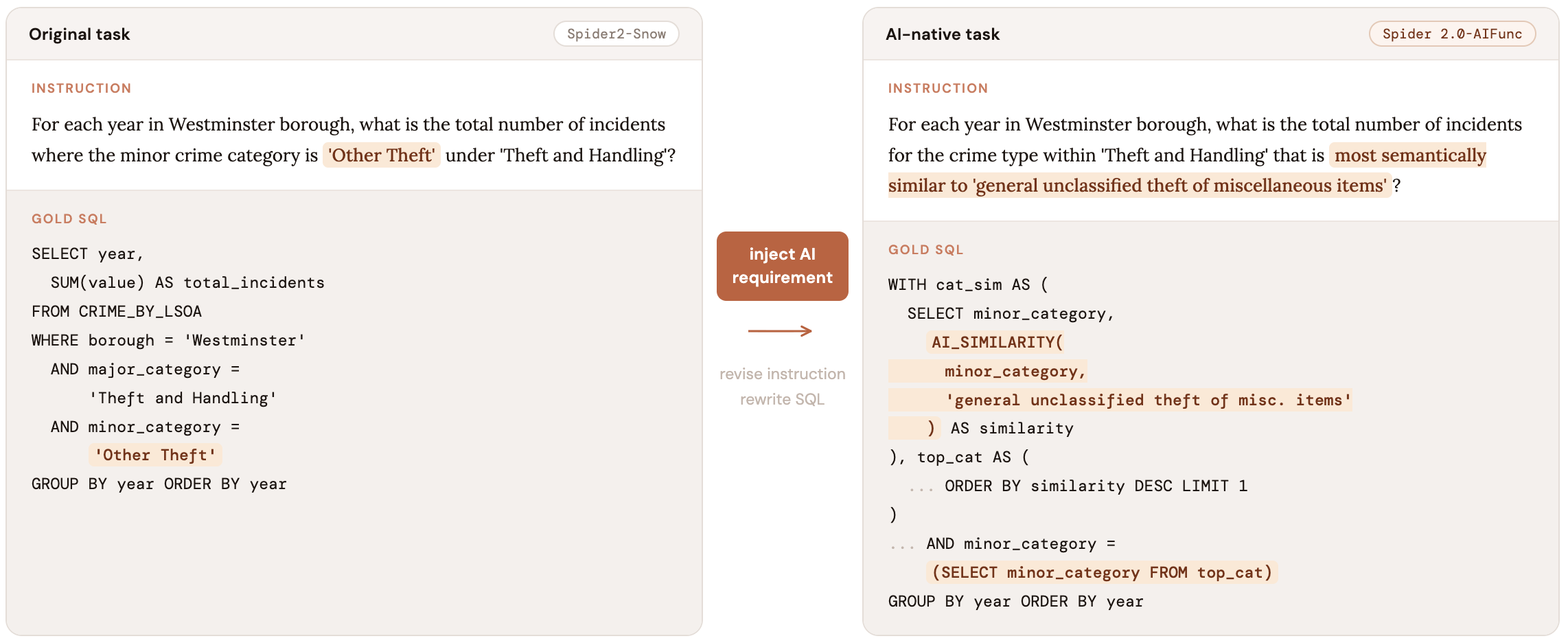
To this end, Spider 2.0-AIFunc extends Spider2-Snow [8] by rewriting its source tasks into AI-native
SQL versions. Starting from 513 Spider2-Snow instances, each with its original instruction, one or more gold SQL queries, their execution results, the database schema, and optional external knowledge, we simultaneously transform the target SQL to
incorporate Snowflake Cortex AI Functions and revise the corresponding instruction to match. When a source instance has multiple valid gold SQLs, we further refine the instruction to reduce ambiguity and make the expected AI-native SQL query more
explicitly specified. We design a reusable, agent-based pipeline to carry out this construction: agents interact directly with the Snowflake environment, proposing modifications to both the SQL and the instruction, executing the resulting query against the
database, and iteratively resolving execution errors, timeouts, and malformed outputs until the query returns reasonable results within an acceptable time frame. The agents also check that AI function parameters are explicitly specified (e.g., the complete
set of class labels for AI_CLASSIFY) and that the instruction clearly indicates the expected AI function usage. After construction, each instance goes through a verification stage where a separate agent executes the gold SQL multiple times
across several passes, repairing instances that produce inconsistent results. The benchmark is constructed in two rounds: a main round and a diversity round that broadens coverage across AI function types. The released benchmark comprises 465 verified
instances across 125 databases, covering six types of Snowflake Cortex AI Functions.
We evaluate a range of state-of-the-art language models on Spider 2.0-AIFunc using the Spider-Agent framework [8], where each model is provided with a minimal tool set consisting of bash for exploring database schemas and external knowledge, a SQL execution tool for running queries against Snowflake, and a task termination tool. Models are additionally given reference documentation for the relevant Snowflake Cortex AI Functions. Among the models we evaluate, Claude Opus 4.6 achieves the highest execution accuracy at 70.3%, followed by Claude Sonnet 4.6 at 69.0% and Gemini 3.1 Pro at 67.1%. A consistent gap emerges between proprietary and open-source models: the strongest proprietary models cluster in the 67–70% range, while the best open-source model reaches 58.1% and the remaining open-source models range from 44.9% to 57.0%. Agent frameworks specifically designed for traditional text-to-SQL challenges do not transfer effectively to AI-native SQL: three such frameworks, when given the same backbone model and AI function documentation, match but do not exceed the minimal Spider-Agent baseline.
2 Background and Preliminaries↩︎
2.1 Spider2-Snow↩︎
Spider 2.0 [8] is an enterprise-level text-to-SQL benchmark comprising 632 real-world workflow problems over databases sourced from industrial applications such as Google Analytics and Salesforce, hosted across multiple database systems including BigQuery, Snowflake, SQLite, DuckDB, and PostgreSQL. It offers several evaluation settings of varying complexity. Spider 2.0-AIFunc builds on Spider2-Snow, a self-contained text-to-SQL setting in which all 547 examples are hosted entirely on Snowflake. In Spider2-Snow, given a natural language question \(Q\), a database schema \(D\), and auxiliary documentation \(E\), a text-to-SQL parser \(f(\cdot)\) is required to produce the corresponding SQL query \(S = f(Q, D, E \mid \theta)\). Performance is measured by checking whether the predicted SQL produces the same result as the gold SQL when executed against the database. A notable aspect of Spider 2.0’s evolution is that each task was originally released with a single gold SQL query; however, as more teams submitted results and explored alternative solutions, the maintainers discovered that many tasks admit multiple valid SQL queries that produce different correct results, leading to ongoing updates to the evaluation suite.
2.2 Snowflake Cortex AI Functions↩︎
Snowflake Cortex AI Functions [1] are a family of built-in SQL functions provided by the Snowflake platform
that invoke large language models as part of query execution. Users call these functions in SQL statements just like conventional SQL functions, but instead of performing deterministic operations such as arithmetic or string manipulation, they perform
semantic operations such as classification, sentiment analysis, information extraction, and similarity computation. A typical AI function takes one or more table columns (usually containing text) along with user-specified parameters as input, and returns
its output as part of the query result. Because they conform to standard SQL syntax, AI functions can be freely composed with traditional SQL operators such as WHERE, JOIN, GROUP BY, and aggregation functions within a
single query.
Under the hood, each AI function call is served by a language model available in the Snowflake environment. At any given point in time, the underlying model for each function is fixed, and inference is run with a temperature of zero, meaning that the same input should in principle produce the same output. In practice, however, prior work has shown that LLM outputs can exhibit minor inconsistencies even at temperature zero [10]–[12]. This property is relevant to benchmarking because evaluation via execution accuracy requires that the gold SQL produces a stable result. We describe how we address this through multi-round execution verification in Section 3.
3 The Spider 2.0-AIFunc Benchmark↩︎
Spider 2.0-AIFunc is built on top of Spider2-Snow by rewriting its source tasks to incorporate Snowflake Cortex AI Functions into the target SQL. Constructing a benchmark around AI-native SQL introduces two challenges that do not arise in traditional text-to-SQL benchmarks. The first is specification determinism at the instruction level: AI functions introduce additional degrees of freedom beyond conventional SQL, including which function to use and how to specify its parameters (e.g., the set of class labels for a classification task). Instructions must be precise enough to determine these choices, or the notion of a correct answer becomes ill-defined. The second is execution determinism at the execution level: as discussed in §2.2, AI functions invoke language models whose outputs may vary slightly even under deterministic settings. The gold SQL must therefore produce a stable result for execution-based evaluation to be meaningful. Our construction process (§3.2) addresses specification determinism, and our verification protocol (§3.3) addresses execution determinism. We describe the task definition in §3.1, dataset statistics in §3.4, and evaluation setup in §3.5.
3.1 Task Definition↩︎
The input to each Spider 2.0-AIFunc task consists of a natural language instruction \(Q\), a database schema \(D\), auxiliary documentation \(E\), and AI function reference documentation \(R\). The first three components follow the same format as Spider2-Snow. The additional component \(R\) provides definitions, parameter specifications, and usage guidelines for the relevant Snowflake Cortex AI Functions, since these functions are relatively new and unlikely to be well represented in the training data of current language models. Given these inputs, a system \(f(\cdot)\) (which may be a text-to-SQL parser, an LLM, or an agent framework) is required to produce a SQL query \(S = f(Q, D, E, R \mid \theta)\) that includes one or more AI function calls alongside conventional SQL operations. During construction, we refine instructions to reduce ambiguity and make the intended AI function usage and parameters explicit, as discussed in §3.2.
3.2 Task Construction↩︎
Our construction starts from 513 Spider2-Snow source tasks. For each task, we take the original instruction, one or more gold SQL queries and their execution results, the database schema, and optional external knowledge as input. The goal is to produce
an AI-native SQL version of the task by incorporating one or more Snowflake Cortex AI Functions into the target SQL. The six AI function types covered in our benchmark are: AI_CLASSIFY for semantic classification, AI_FILTER for
filtering rows by semantic relevance, AI_SENTIMENT for sentiment analysis, AI_SIMILARITY for embedding-based similarity computation, AI_EXTRACT for extracting structured information from text, and AI_AGG
for aggregating content across rows using natural language instructions. These represent a broad range of semantic operations that cannot be expressed with conventional SQL operators. Note that each task may incorporate more than one AI function, and most
tasks in our benchmark combine two functions within a single query.
The construction is carried out by a reusable, agent-based pipeline using Claude Opus 4.5 [13] with a maximum of 15 interaction rounds
per task. Agents interact directly with the databases, simultaneously proposing modifications to both the SQL and the instruction. For the SQL, agents inject or rewrite portions of the query to incorporate AI function calls. For the instruction, agents
revise the wording to match the rewritten SQL; when a source task has multiple gold SQLs, the instruction is further refined to reduce ambiguity and make the intended query more explicit. Throughout this process, agents execute the candidate SQL against
the database and iteratively resolve issues, including execution errors, timeouts, and malformed outputs, until the query returns reasonable results within an acceptable time frame. The agents also verify that all AI function parameters are fully
specified: for instance, that a call to AI_CLASSIFY includes the complete set of target labels, or that a call to AI_EXTRACT specifies the exact extraction schema. This addresses specification determinism at construction time by
making the intended AI-function choices and parameters explicit.
The benchmark is constructed in two rounds. In the main round, agents select AI functions without constraints on function choice. This produces 513 candidate instances, but the resulting distribution is concentrated on three function types:
AI_CLASSIFY appears in 78.6% of tasks, AI_FILTER in 50.1%, and AI_SIMILARITY in 45.6%, while AI_SENTIMENT (0.2%), AI_EXTRACT (1.2%), and AI_AGG (10.7%) remain rare. The two most
frequent combinations, AI_CLASSIFY + AI_FILTER (35.3%) and AI_CLASSIFY + AI_SIMILARITY (33.7%), together account for 69% of all instances. This concentration reflects the broad applicability of
classification, filtering, and similarity operations across diverse analytical tasks, but it results in insufficient coverage of the remaining function types. To address this, we conduct a diversity round in which agents are explicitly instructed to
prioritize underrepresented functions: AI_SENTIMENT as the highest priority, AI_EXTRACT as the second, and AI_AGG as the third. Agents are required to include at least one of these target functions in each task, but
may reject a source instance if none of the target functions naturally fits the data and query intent. This yields 227 additional candidate instances with a complementary distribution: AI_AGG appears in 71.4% of diversity-round tasks,
AI_EXTRACT in 31.3%, and AI_SENTIMENT in 15.0%. Instances from both rounds then proceed to the verification stage (§3.3); only those that pass are retained in the final release. The pipeline is
designed to be general and can be adapted to construct future benchmarks for other AI functions or database platforms.
3.3 Determinism Verification↩︎
After construction, each candidate instance undergoes a multi-pass verification process to check execution determinism. The process consists of four consecutive passes: the first executes each gold SQL 5 times, and the subsequent three each execute it 10 times, totaling at least 35 executions per instance (additional executions may be triggered when repairs require re-verification). All passes are carried out by a verification agent (Claude Opus 4.5, maximum 15 interaction rounds). The agent is permitted to repair instances that produce inconsistent results: it may adjust the SQL, revise the instruction, or modify evaluation configuration such as whether row order should be compared. Beyond simple re-execution, the agent can run diagnostic SQL queries against the database to identify the source of inconsistencies before attempting a fix. Importantly, the agent also reviews instances that already pass consistency checks, examining whether the instruction sufficiently determines the intended AI function usage and whether the evaluation configuration is appropriate. This means the verification stage checks execution determinism while also reviewing residual specification-determinism concerns that may have survived construction. An instance is considered consistent only when 100% of executions within a pass produce identical results under the same comparison logic used for final evaluation. After all four passes, we apply filtering: instances that remain inconsistent are removed, as are instances whose AI function usage was reduced or eliminated during repair. We additionally discard instances built on a small number of Spider2-Snow source databases that are not static snapshots and whose underlying tables may be updated over time, since such changes can alter the inputs passed to AI functions and make results unstable across evaluation periods.
The surviving instances then enter a final stability check. Each instance is executed 10 times in each of three separate time windows, for a total of 30 additional executions. No repairs are made during this stage; any instance whose 10 executions within any single time window produce inconsistent results is dropped. This stage serves a different purpose from the repair-based passes: it checks that the released instances remain stable not only within a single session but also across temporally separated evaluations. After all verification and filtering stages, 465 instances (325 from the main round, 140 from the diversity round) across 125 databases constitute the final released benchmark.
3.4 Dataset Statistics↩︎
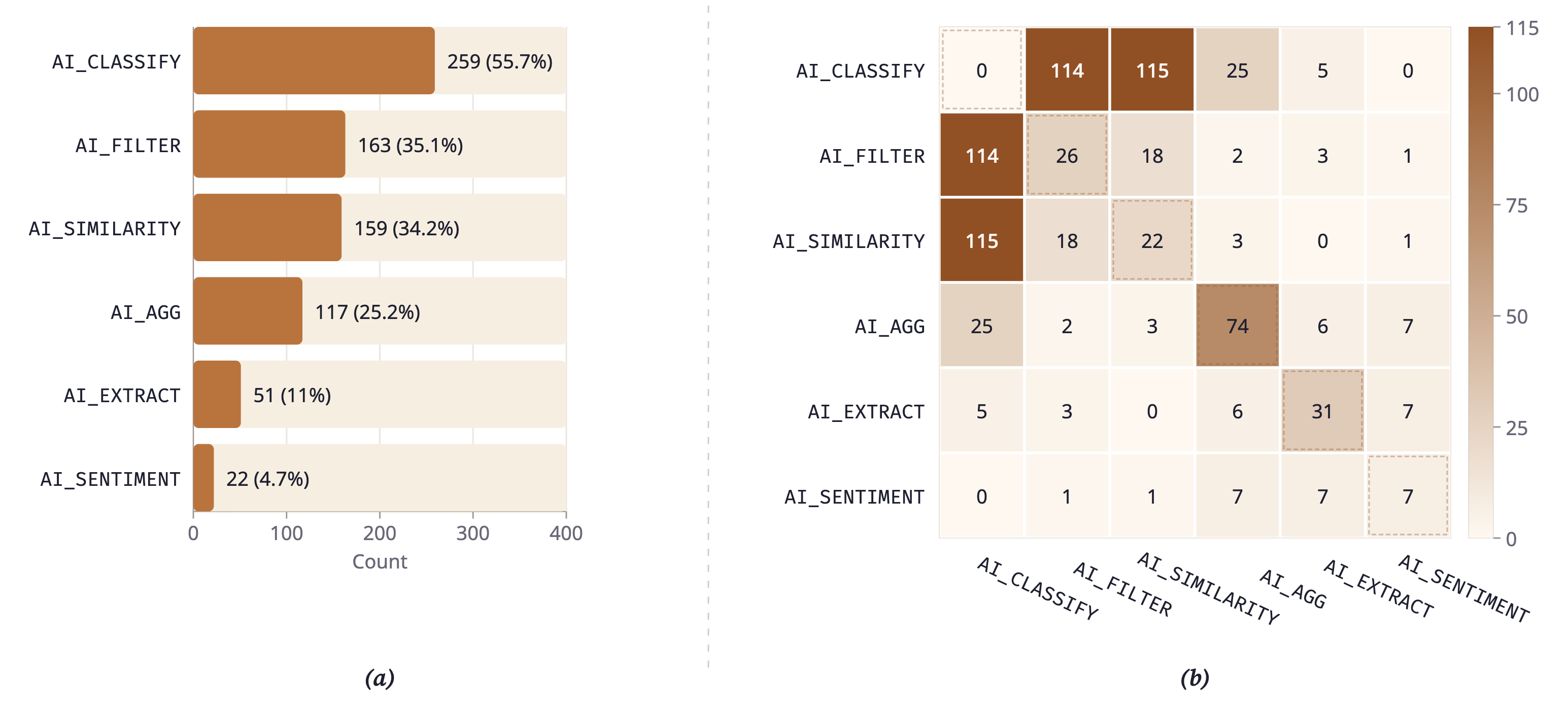
The final benchmark comprises 465 verified instances across 125 databases. Figure 2 (a) shows the distribution of AI function types across all released instances. AI_CLASSIFY is the most frequently used
function, appearing in over half of all tasks, followed by AI_FILTER and AI_SIMILARITY at comparable rates. The diversity round substantially increased the representation of AI_AGG, AI_EXTRACT, and
AI_SENTIMENT, which together now appear in over 40% of tasks. Two thirds of the tasks (66.0%) combine two AI functions within a single query, while 33.3% use a single function. Figure 2 (b) presents the
co-occurrence matrix across the six function types. Since Spider 2.0-AIFunc is built from Spider2-Snow source tasks, the gold SQL queries retain the characteristics of enterprise-level SQL: multi-table joins, common table expressions, and layered
aggregations. AI function calls are embedded within these multi-step queries rather than appearing in isolation, meaning that a system must not only select and parameterize the correct AI functions but also integrate them into the surrounding query logic
to produce the intended result. The gold queries average 65 lines and 2,617 characters in length, referencing an average of 3.9 tables per query. The gold query results average 23.1 rows (median 3) and 3.7 columns (median 3), with 91.8% of tasks returning
20 rows or fewer and 2.2% exceeding 100 rows. Execution times average 10.4 seconds (median 4.3 seconds), with 2.2% of instances requiring over a minute due to AI function invocations across large numbers of rows.
3.5 Evaluation↩︎
We evaluate using execution accuracy, following the framework of Spider2-Snow. In Spider2-Snow, the gold SQL result is pre-computed and stored; at evaluation time, only the predicted SQL is executed and compared against the stored result. In Spider 2.0-AIFunc, this approach is not viable: AI functions invoke language models that may be updated over time (§2.2), so a stored gold result may no longer reflect the current output of the same gold SQL. We therefore require that the gold SQL \(S_n\) and the predicted SQL \(\hat{S}_n\) are both executed within the same time window \(t\): \[EX = \frac{1}{N}\sum_{n=1}^{N} \mathbb{1}\!\Big( \mathrm{exec}(S_n,\, t),\; \mathrm{exec}(\hat{S}_n,\, t) \Big)\] where \(\mathrm{exec}(S, t)\) denotes the result of executing query \(S\) at time \(t\), and the shared \(t\) ensures that both queries are evaluated against the same underlying model state. Let \(v = \mathrm{exec}(S_n, t)\) and \(\hat{v} = \mathrm{exec}(\hat{S}_n, t)\). Following Spider2-Snow, the comparison function \(\mathbb{1}(v, \hat{v})\) uses column-subset matching: \[\mathbb{1}(v, \hat{v}) = \begin{cases} 1 & \text{if } v_i \in \hat{v},\; \forall\, v_i \in v \\ 0 & \text{if } v_i \notin \hat{v},\; \exists\, v_i \in v \end{cases}\] where \(v_i\) denotes the \(i\)-th column of result \(v\). That is, every column in the gold result must appear in the predicted result, but the predicted result may contain additional columns without penalty. Each instance additionally carries an evaluation configuration that specifies whether row order should be compared or ignored. Float values are compared with a tolerance of 0.01, and columns are matched by content rather than by position. This comparison logic is identical to the one used during the verification stage (§3.3).
4 Experiments↩︎
4.1 Experimental Setup↩︎
We evaluate all models using the Spider-Agent framework [8], with a minimal tool set consisting of
three general-purpose tools: a bash tool for exploring database schemas and external knowledge files, a SQL execution tool for running queries directly against the Snowflake environment, and a task termination tool for signaling completion. We deliberately
keep the tool set minimal to isolate model capability from framework complexity. Compared to the original Spider-Agent setup, the primary addition on the task side is the inclusion of AI function reference documentation \(R\) (defined in §3.1), which provides each model with definitions, parameter specifications, and usage guidelines for the relevant Snowflake Cortex AI Functions. The full prompt, including the
reference documentation and usage guidelines, is provided in Appendix 11. All agents are run with a maximum of 50 interaction rounds, a temperature of 1, and a per-query execution timeout of 120 seconds. For each model and
task, we report one complete agent trajectory. To account for transient warehouse instability that may cause spurious timeouts, each predicted SQL is executed up to three times; a query is marked as timed out only if all three attempts exceed the timeout
threshold. For models that expose a reasoning effort parameter, we set it to medium uniformly across all such models; models that do not support this parameter are run with their default configuration.
@ l r r r l @ Model & Params & Exec. (%) & EX (%) &
Claude Opus 4.6 & – & 99.4 & &
Claude Sonnet 4.6 & – & 98.9 & 69.0 &
Gemini 3.1 Pro & – & 97.8 & 67.1 &
GPT-5.4\(^\dagger\) & – & 97.6 & 63.0 &
Gemini 3 Flash & – & 90.6 & 60.9 &
Kimi K2.5 & 1000B / 32B & 97.8 & &
Qwen 3.5 Plus & 397B / 17B & 97.2 & 57.0 &
DeepSeek V3.2 & 671B / 37B & 97.2 & 54.6 &
GLM-5 & 744B / 40B & 94.6 & 52.9 &
MiniMax M2.5 & 230B / 10B & 96.1 & 44.9 &
We evaluate ten models spanning both closed-source and open-source families. On the closed-source side, we include Claude Opus 4.6 [14] and Claude Sonnet 4.6 [15], Gemini 3.1 Pro [16] and Gemini 3 Flash [17], and GPT-5.4 [18]. On the open-source side, we include Kimi K2.5 [19], Qwen 3.5 Plus [20], DeepSeek V3.2 [21], GLM-5 [22], and MiniMax M2.5 [23]. We additionally compare three open-sourced agent frameworks, AutoLink [24], ReFoRCE [25], and DSR-SQL [26], each using Claude Sonnet 4.6 as the backbone model under their default configurations, to assess whether framework complexity confers any advantage on this benchmark. To ensure a fair comparison, we augment each framework with the same AI function reference documentation \(R\) used in the Spider-Agent setting, inserting it into all available system prompts across each framework’s internal stages; all other configurations are left unchanged.
4.2 Main Results↩︎
Models generally produce executable AI-native SQL across sufficient interaction rounds. Table ¿tbl:tab:main? reports the results across all ten models. We measure two metrics: Exec., the proportion of instances on which the predicted SQL ran without error, and execution accuracy (EX), which additionally requires the query to return the correct result. Across all models, Exec. is consistently high, ranging from 90.6% to 99.4%, suggesting that with sufficient interaction rounds, models can generally produce syntactically valid AI-native SQL that executes without error or timeout.
Proprietary models consistently outperform open-source models. Among proprietary models, Claude Opus 4.6 achieves the highest accuracy at 70.3%, followed by Claude Sonnet 4.6 at 69.0% and Gemini 3.1 Pro at 67.1%. A notable gap emerges between proprietary and open-source models: the strongest proprietary models cluster in the 67–70% range, while the best open-source model, Kimi K2.5, reaches 58.1% and the remaining open-source models range from 44.9% to 57.0%.
Agent frameworks designed for traditional text-to-SQL do not transfer effectively to AI-native SQL workflows. Table 1 compares Spider-Agent against three alternative agent frameworks, all using Claude Sonnet 4.6 as the backbone model under their default configurations and ranked by EX. Spider-Agent achieves 69.0%, matching AutoLink (68.6%) and ReFoRCE (68.5%), while DSR-SQL trails at 62.2% despite achieving the highest Exec. of 100%. These frameworks were originally designed for traditional text-to-SQL challenges such as schema retrieval and relevant table selection; their relative ineffectiveness here may reflect that such strategies are less critical as model capabilities improve, or that they do not transfer naturally to AI-native SQL workflows.
Our qualitative inspection of disagreement cases suggests that these frameworks do transfer partially, but unevenly. They can help with conventional text-to-SQL components such as schema context, subtle filters, or multi-step SQL templates. However, AI-native SQL correctness often depends on small semantic decisions introduced by the AI-function call itself: which rows are passed into the function, whether filtering happens before or after the AI call, the aggregation grain, semi-structured field paths, and the exact function parameters. Decomposition, context selection, or intermediate rewriting can therefore introduce small deviations that offset the benefits of stronger traditional SQL scaffolding.
Detailed per-function-type breakdowns, single- versus multi-function accuracy, AI function selection accuracy, and execution time analysis are reported in Appendix 9.
| Framework | Exec. (%) | EX (%) |
|---|---|---|
| Spider-Agent | 98.9 | 69.0 |
| AutoLink [24] | 98.7 | 68.6 |
| ReFoRCE [25] | 99.8 | 68.5 |
| DSR-SQL [26] | 100.0 | 62.2 |
4.3 Agent Interaction Behavior↩︎
Table ¿tbl:tab:interaction? reports how each model distributes its 50-round budget across the two primary tools in our Spider-Agent setup: execute_sql for running queries against Snowflake, and bash for
exploring database schemas and external knowledge files. 1st SQL and 1st Succ.denote the average round at which the model first calls execute_sql and first produces an error-free execution, respectively.
Bash call counts are stable across models, ranging from 4.1 to 7.8, while SQL execution counts span a substantially wider range, from 4.4 for Gemini 3 Flash to 19.8 for DeepSeek V3.2. The gap in total rounds between proprietary and open-source models is therefore driven almost entirely by how many times each model executes SQL rather than how much it explores. Proprietary models average 4–6 SQL calls per instance and typically exhaust their budget at around 10 rounds; open-source models average 12–20 SQL calls over 19–30 rounds, with comparable bash usage. Open-source models also defer their first SQL attempt to around rounds 7–8, compared to rounds 5–6 for proprietary models, but this 2-round difference accounts for only a small fraction of the overall gap. The bulk of the difference accumulates after the first successful execution, suggesting that open-source models require substantially more iterative refinement to arrive at a correct result.
Open-source models are also more likely to exhaust the 50-round budget without terminating: MiniMax M2.5 reaches the limit on 10.8% of instances and GLM-5 on 6.2%, compared to at most 0.6% for any proprietary model. Beyond their tendency to consume more
rounds, we observe that a fraction of these cases stem from malformed terminate tool calls, where the model repeatedly issues incorrectly formatted termination tool calls without recognizing the error, preventing the agent from signaling
completion.
@ l @ r r r r r @ r r @ & &
(lr)2-6(l)7-8 Model & Rounds & SQL & Bash & B/S & Rnd-50 (%) & 1st SQL &
1st Succ.
Claude Opus 4.6 & 11.7 & 5.9 & 4.9 & 1.09 & 0.0 & 5.7 & 5.7
Claude Sonnet 4.6 & 10.0 & 4.9 & 4.1 & 1.42 & 0.0 & 4.9 & 5.3
Gemini 3.1 Pro & 17.1 & 10.2 & 5.8 & 0.79 & 0.6 & 5.6 & 6.6
GPT-5.4\(^\dagger\) & 10.1 & 4.4 & 4.4 & 1.45 & 0.0 & 5.1 & 5.6
Gemini 3 Flash & 9.9 & 4.4 & 4.3 & 1.47 & 0.0 & 4.7 & 5.1
Kimi K2.5 & 19.3 & 12.1 & 6.1 & 0.74 & 0.4 & 6.9 & 7.3
Qwen 3.5 Plus & 24.1 & 16.4 & 6.8 & 0.54 & 3.2 & 7.4 & 8.0
DeepSeek V3.2 & 28.6 & 19.8 & 7.8 & 0.45 & 0.4 & 7.8 & 8.2
GLM-5 & 24.5 & 14.4 & 7.0 & 0.94 & 6.2 & 8.0 & 8.4
MiniMax M2.5 & 30.0 & 19.1 & 6.7 & 0.47 & 10.8 & 7.7 & 8.7
4.4 Error Analysis↩︎
To better understand model failures on Spider 2.0-AIFunc, we conduct a stratified error analysis over a random sample of 85 instances drawn from three strata defined by which models succeed. S1 (\(n=30\)) contains instances where all three strong proprietary models (Claude Opus 4.6, Gemini 3.1 Pro, and GPT-5.4) fail. S2 (\(n=30\)) contains instances where at least one strong proprietary model succeeds. S3 (\(n=25\)) contains instances where all three strong proprietary models succeed but at least one open-source model fails. For each sampled instance, we manually identify the primary error type(s) from the predicted SQL of failing models, categorized into five types: C1 (schema grounding: wrong table, column, or prefix selection), C2 (predicate & filter: missing or incorrect filtering conditions), C3 (query logic: incorrect aggregation granularity, join scope, or algorithmic errors), C4 (AI function usage: wrong function, incorrect syntax, missing or misspecified parameters), and C5 (annotation issues: ambiguous or incorrect gold queries). Instances may carry multiple error labels; full category definitions and representative examples are provided in Appendix 10. Figure 3 summarizes the error distribution across the three strata.
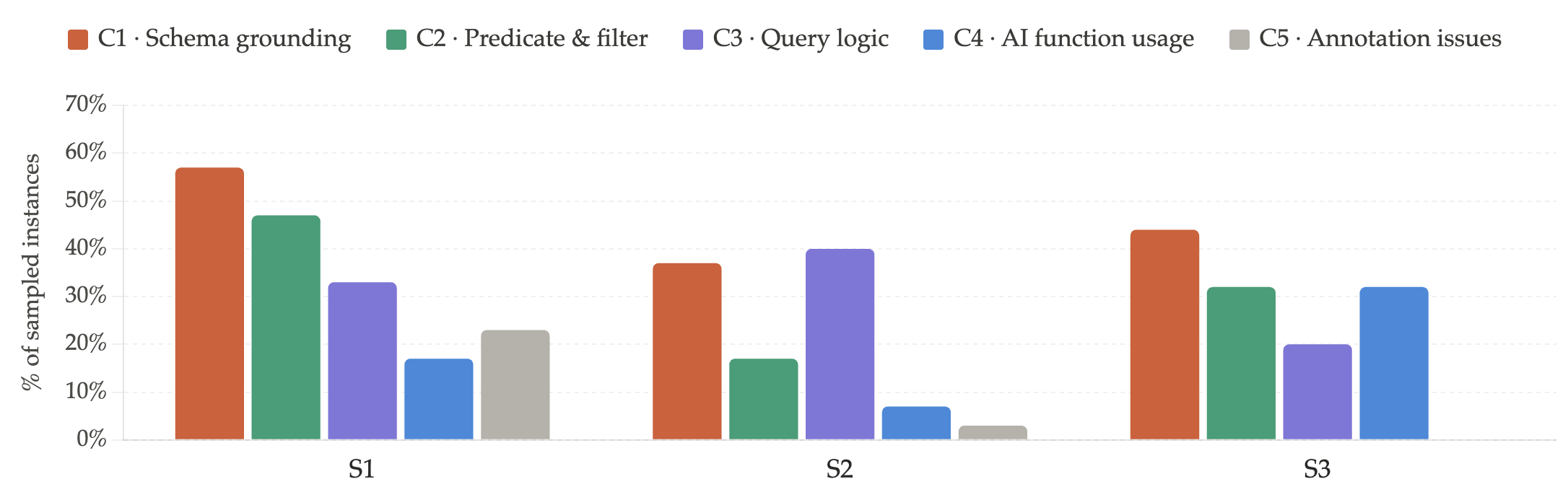
Universal failures are driven by predicate and schema errors. In S1, where all strong models fail, C2 (predicate & filter) and C1 (schema grounding) are the most prevalent error types, appearing in 47% and 57% of sampled instances respectively, often co-occurring. These errors reflect cases where the instruction does not fully specify filtering conditions or where the correct table and column names require precise knowledge of the database schema that all models lack. Notably, 7 of the 30 S1 instances (23%) show signs of annotation issues (C5), where the gold query encodes constraints absent from the instruction or admits multiple valid answers, suggesting that a non-trivial portion of universal failures may reflect benchmark limitations rather than model deficiencies.
Aggregation and query logic errors distinguish strong models from weaker ones. In S2, where at least one strong model succeeds, C3 (query logic) is the dominant error type, appearing in 40% of instances. Failures in this stratum tend to involve subtle decisions such as when to apply filtering before or after an AI function call, how to handle nested aggregations, or how to correctly process semi-structured data types. These are errors that stronger models more reliably avoid, suggesting that C3 captures a meaningful dimension of model capability on AI-native SQL tasks.
Open-source models show systematic weaknesses in schema grounding and AI function usage. In S3, where all strong proprietary models succeed but open-source models fail, C1 (schema grounding) and C4 (AI function usage) each appear in roughly 32% of instances, and C4 is nearly absent from S1 and S2. This indicates that non-standard AI function syntax and incorrect parameter specifications are disproportionately an open-source model failure mode, consistent with the function selection accuracy results in Appendix 9.1. Schema grounding errors in S3 tend to involve subtler mistakes than in S1, such as selecting a table from the wrong schema family or misidentifying column aliases, which stronger models resolve through more thorough exploration of the database environment.
5 Related Work↩︎
The landscape of text-to-SQL evaluation has evolved from early datasets targeting domain generalization and lexico-logical alignments, such as KaggleDBQA [27] and SQUALL [28], to highly complex, enterprise-grade environments. Recent benchmarks like BEAVER [9] and Spider 2.0 [8] introduce extreme schema complexity and multi-step real-world workflows, while datasets like MultiSpider 2.0 [29] and CORGI [30] extend these challenges to multilingual settings and predictive business logic. To navigate these increasingly massive schemas, researchers have developed sophisticated multi-agent reasoning frameworks, such as ReFoRCE [25], AutoLink [24], DSR-SQL [26], and APEX-SQL [31], that use iterative schema linking and agentic exploration. However, these evaluations and frameworks remain strictly confined to traditional relational algebra, overlooking a major shift in the database industry: the native integration of generative AI capabilities into query execution engines. Systems like LOTUS [32] and MOAR [33] have introduced semantic operators as declarative primitives, and commercial platforms such as BigQuery [2], Databricks [3], and Snowflake Cortex [1] now allow users to execute large language model operations directly within SQL statements. Spider 2.0-AIFunc addresses this gap by providing the first benchmark specifically tailored to evaluate how effectively modern models and agents can generate these emerging AI-native SQL workflows.
6 Conclusion↩︎
We introduced Spider 2.0-AIFunc, a benchmark for evaluating text-to-SQL systems on AI-native SQL, in which target queries incorporate Snowflake Cortex AI functions alongside conventional relational operators. The benchmark comprises 465 verified instances across 125 real-world databases, constructed through an agent-based pipeline that rewrites existing enterprise text-to-SQL tasks into AI-native form and subjects every instance to a multi-round execution verification protocol before release. Evaluation of ten state-of-the-art language models shows a consistent capability gap between proprietary and open-source systems, with errors concentrated in schema grounding, predicate specification, query logic, and AI function parameterization.
7 Limitations and Future Work↩︎
Spider 2.0-AIFunc has several limitations. First, it is scoped to Snowflake and the six Cortex AI function types available at the time of construction, so it does not cover analogous functions on BigQuery, Databricks, or other platforms. Second, although our construction pipeline explicitly refines instructions to reduce ambiguity and make the intended AI-function usage clear, it is difficult to fully verify before release that every instance rules out all reasonable alternative interpretations. As in Spider 2.0, future submissions may reveal additional valid solutions or residual underspecification not captured by the current reference SQL and evaluation configuration; we view these submissions and issue reports as an important stress test for further refining the benchmark. Third, our construction pipeline uses a single strong construction model. Although each instance is derived from an existing Spider2-Snow task with a real database, schema, and reference SQL, this design may still introduce biases in wording style, rewrite patterns, or AI-function choices.
Our evaluation is also limited by cost. We report a single agent trajectory per model and task, while repeated sampling with pass@k or variance estimates would provide a fuller picture of stochastic agent performance. Similarly, repeated gold-prediction execution with majority or stability-aware comparison could better capture AI-function output variability. Both directions would substantially increase model-inference cost and Snowflake AI-function execution cost, making them impractical for the current study. Looking ahead, future work should extend the construction pipeline to other platforms and function families, incorporate stronger human or multi-generator validation, and construct harder benchmarks that probe longer reasoning chains and more diverse AI-function compositions.
Appendix↩︎
8 Model-Specific Evaluation Adjustments for GPT-5.4↩︎
GPT-5.4 exhibited two model-specific output patterns during evaluation, which is why its result in Table ¿tbl:tab:main? is marked with \(^\dagger\) and accompanied by the ablation below.
HTML entity encoding. Because our agent framework uses XML tags for tool calls, GPT-5.4 frequently encoded SQL operators as HTML entities (e.g., >, <, &) rather than their
literal characters. This occurred in 184 of 465 instances, producing a total of 672 such entities, and caused direct SQL compilation failures. No other model exhibited this behavior. We applied automatic unescaping of HTML entities prior to SQL execution
uniformly across all runs reported in this paper.
Parameter optimization. Despite instructions explicitly stating to strictly follow AI function parameters as specified, GPT-5.4 consistently attempted to rephrase or optimize prompt text, category labels, and condition strings in AI function calls. Since evaluation requires exact semantic alignment with the gold query, such modifications cause evaluation failure. To address this, we applied an additional patch to the system prompt:
IMPORTANT: You MUST use the AI function parameters (category labels, prompt text, condition strings, etc.) EXACTLY as specified in the instruction. Any attempt to “improve”, rephrase, expand, or optimize these parameters will cause evaluation failure.
Table 2 reports execution accuracy across all combinations of patch status and reasoning effort setting. The patch consistently improves accuracy by approximately 10 percentage points regardless of reasoning effort level.
We additionally conducted an ablation study over reasoning effort settings (medium, high, xhigh). Contrary to expectations, increasing reasoning effort yields no consistent improvement in either the patched or
unpatched setting, suggesting that higher reasoning effort does not benefit AI-native SQL generation for GPT-5.4 on this benchmark. We report the patched medium result (63.0%) in Table ¿tbl:tab:main?, and include the full
ablation here to make the effect of the adjustment explicit.
| EX (%) | |||
|---|---|---|---|
| 2-3 Reasoning effort | w/o patch | w/ patch | \(\Delta\) (pp) |
| medium | 52.9 | 63.0 | |
| high | 51.2 | 62.2 | |
| xhigh | 51.4 | 61.9 | |
9 Detailed Analysis↩︎
9.1 AI Function Selection Accuracy↩︎
Beyond execution accuracy, we measure whether models select the correct set of AI functions for each task, defined as an exact match between the predicted and gold function sets: \[\mathrm{FSA} = \frac{|\{i : \mathrm{funcs}(\hat{S}_i) = \mathrm{funcs}(S_i)\}|}{N}\] where \(\mathrm{funcs}(S)\) denotes the set of AI function types invoked in query \(S\). Table ¿tbl:tab:func95select? reports function selection accuracy across all ten models.
r0.43
@ l r @ Model & FSA (%)
Claude Opus 4.6 & 99.6
Claude Sonnet 4.6 & 98.9
Gemini 3.1 Pro & 99.6
GPT-5.4 & 98.3
Gemini 3 Flash & 98.9
Kimi K2.5 & 96.6
DeepSeek V3.2 & 97.0
GLM-5 & 94.6
Qwen 3.5 Plus & 89.9
MiniMax M2.5 & 68.6
Function selection accuracy is high across most models, with all proprietary models exceeding 98% and most open-source models above 94%. This is consistent with the design of our benchmark: because task instructions explicitly specify AI function parameters in detail, the intended function usage is usually clear, making function selection a relatively tractable component of the task. Proprietary models are the most consistent in this regard. Among open-source models, most achieve similarly high selection accuracy, with one notable exception: MiniMax M2.5 achieves only 68.6%, with a substantial portion of its errors attributable to instances where the model failed to invoke the expected AI functions entirely. This largely explains its lower overall EX score relative to other open-source models.
9.2 Per-Function-Type Breakdown↩︎
Table ¿tbl:tab:func95breakdown? reports execution accuracy broken down by AI function type across all ten models. Each instance may involve more than one function type, so a single instance can contribute to multiple columns. Across all
models, tasks involving AI_CLASSIFY, AI_FILTER, and AI_SIMILARITY are solved at consistently higher rates than those involving AI_AGG and AI_EXTRACT, suggesting that aggregation and
structured extraction pose greater challenges regardless of overall model capability. AI_SENTIMENT shows the highest variance across models, which we attribute in part to the small number of instances (22) in this category.
@ l rrrrrr @ Model & AI_CLASS. & AI_FILTER & AI_SIMIL. & AI_AGG & AI_EXTR. & AI_SENT.
Claude Opus 4.6 & 77.6 & 76.1 & 74.2 & 60.7 & 60.8 & 54.5
Claude Sonnet 4.6 & 73.7 & 75.5 & 73.0 & 57.3 & 58.8 & 59.1
Gemini 3.1 Pro & 71.8 & 68.1 & 73.0 & 59.0 & 60.8 & 50.0
GPT-5.4 & 66.8 & 67.5 & 67.9 & 53.0 & 58.8 & 36.4
Gemini 3 Flash & 64.1 & 66.9 & 64.2 & 51.3 & 47.1 & 59.1
Kimi K2.5 & 59.1 & 62.0 & 56.0 & 57.3 & 52.9 & 40.9
Qwen 3.5 Plus & 57.9 & 63.2 & 56.6 & 47.9 & 52.9 & 68.2
DeepSeek V3.2 & 58.3 & 58.9 & 56.6 & 45.3 & 45.1 & 40.9
GLM-5 & 58.3 & 60.7 & 58.5 & 35.9 & 43.1 & 36.4
MiniMax M2.5 & 45.9 & 44.2 & 55.3 & 37.6 & 37.3 & 36.4
9.3 Single-Function vs.Multi-Function Tasks↩︎
Table ¿tbl:tab:single95multi? breaks down execution accuracy by the number of AI functions involved in each task. We group instances with two or more functions together (\(n=310\)). Across 9 of 10
models, accuracy on multi-function tasks is higher than on single-function tasks. This pattern is consistent with the function-type distribution: multi-function tasks are disproportionately composed of AI_CLASSIFY, AI_FILTER, and
AI_SIMILARITY combinations, which are the function types that models solve most reliably, as shown in Table ¿tbl:tab:func95breakdown?.
@ l rrr @ Model & Single & Multi & \(\Delta\) (pp)
Claude Opus 4.6 & 61.3 & 74.8 & \(+13.5\)
Claude Sonnet 4.6 & 63.9 & 71.6 & \(+7.7\)
Gemini 3.1 Pro & 63.2 & 69.0 & \(+5.8\)
GPT-5.4 & 60.0 & 64.5 & \(+4.5\)
Gemini 3 Flash & 57.4 & 62.6 & \(+5.2\)
Kimi K2.5 & 59.4 & 57.4 & \(-1.9\)
Qwen 3.5 Plus & 56.1 & 57.4 & \(+1.3\)
DeepSeek V3.2 & 54.2 & 54.8 & \(+0.6\)
GLM-5 & 47.1 & 55.8 & \(+8.7\)
MiniMax M2.5 & 42.6 & 46.1 & \(+3.5\)
9.4 Execution Time Analysis↩︎
We analyze the execution time of predicted SQL queries relative to their corresponding gold queries. For each correctly solved instance, we compute the time ratio \(r = t_{\mathrm{pred}} / t_{\mathrm{gold}}\), where \(t_{\mathrm{pred}}\) and \(t_{\mathrm{gold}}\) denote the execution times of the predicted and gold SQL queries respectively, both measured within the same evaluation window. A ratio below 1.0 indicates that the predicted query runs faster than the gold query; a ratio above 1.0 indicates it runs slower. We report the mean ratio, and the proportion of instances where the predicted query is faster than the gold (% Faster). We note that execution time on cloud data warehouses is subject to considerable variance due to factors such as cluster load and caching, and these results should therefore be interpreted as indicative rather than definitive.
Tables ¿tbl:tab:time? (a) and (b) report results on two subsets: all correctly solved instances per model, and the 73 instances solved correctly by all ten models, which provides a controlled comparison across models on identical tasks.
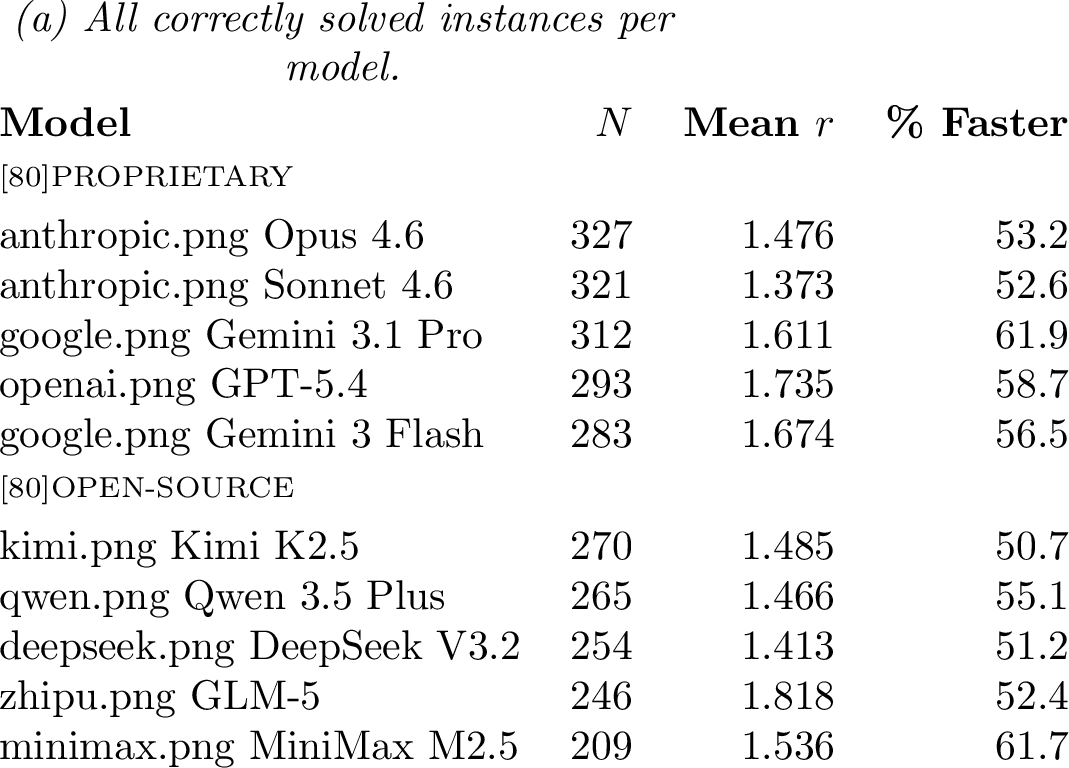
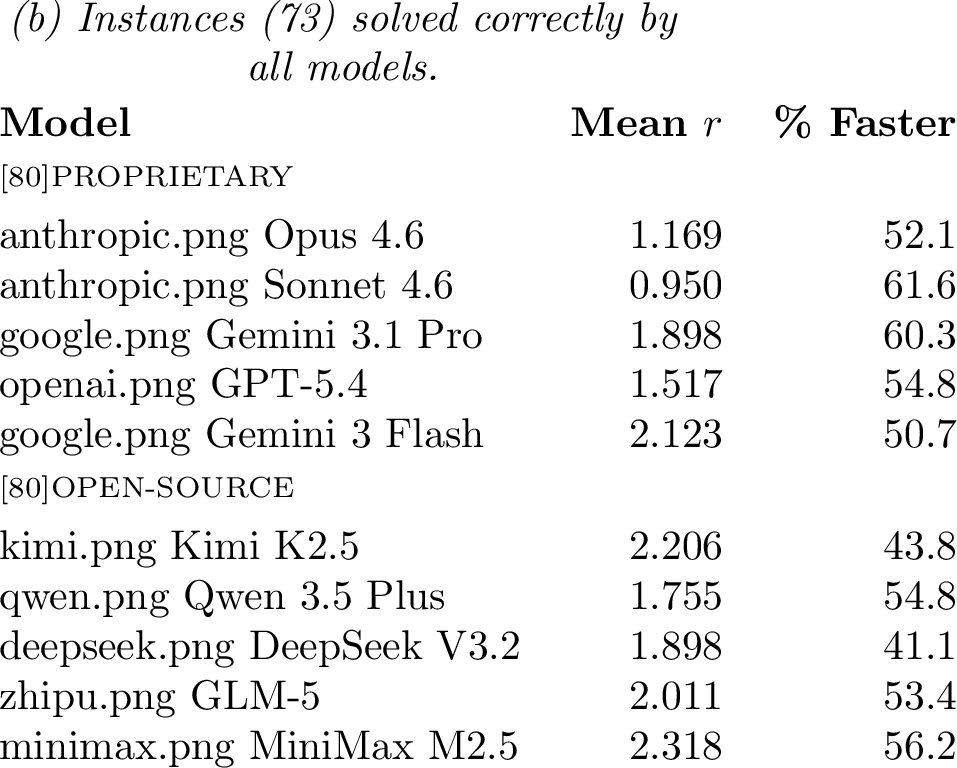
Across all models, mean ratios consistently exceed 1.0, indicating that predicted queries tend to run slower than gold queries on average. This is expected: gold queries are hand-crafted and often optimized, while model-generated queries may introduce redundant subqueries, unnecessary joins, or less efficient AI function usage. Despite this, the median ratio across most models remains close to 1.0, and roughly half of predicted queries run faster than the gold, suggesting that the overhead is not uniform and that models occasionally find more efficient solutions. On the controlled subset of 73 instances solved by all models, Claude Sonnet 4.6 achieves the only mean ratio below 1.0 (0.950), while open-source models tend toward higher mean ratios, though the small subset size limits the strength of this conclusion.
10 Error Taxonomy↩︎
We define five error categories for the stratified error analysis in §4.4. A single instance may be assigned multiple categories if the predicted SQL exhibits more than one type of error.
- C1
-
Schema grounding. The model selects the wrong table, column, or table prefix. This includes cases where a correct table family is identified but the specific table variant is wrong (e.g., selecting a table without a required schema prefix), as well as cases where column names do not match the schema exactly.
- C2
-
Predicate & filter. The model omits a required filtering condition or applies an incorrect one. This includes missing
WHEREclauses, incorrect comparison values, and conditions that are logically present but semantically wrong (e.g., filtering on the wrong column or using an incorrect constant). - C3
-
Query logic. The model produces incorrect aggregation granularity, join scope, or algorithmic logic. This includes grouping at the wrong level, joining too many or too few tables, incorrect handling of semi-structured data types, and algorithmic errors such as double-counting or incorrect unit conversion.
- C4
-
AI function usage. The model misuses an AI function, including invoking the wrong function type, using non-standard or unsupported syntax, omitting a required AI function call entirely, or specifying incorrect parameters such as wrong label formats or malformed extraction schemas. This category is specific to AI-native SQL and has no direct analogue in traditional text-to-SQL benchmarks.
- C5
-
Annotation issues. The gold query encodes constraints not mentioned in the instruction, or the task admits multiple valid SQL queries that produce different but arguably correct results. This category is only assigned in S1, where all strong models fail, and reflects potential benchmark limitations rather than model errors.
11 Sampled Prompt for Snowflake AI Function Reference↩︎
<ai_sql_function_reference>
You MUST use the exact function signatures and syntax below. These are the supported Snowflake Cortex AI SQL functions. Do NOT use deprecated syntax (like SNOWFLAKE.CORTEX.* prefix).

---

### AI_CLASSIFY

**Syntax**: `AI_CLASSIFY(<input>, <labels> [, <config_object>])`

Categorizes text into a set of labels you provide.

**Parameters**
- `input`: Text string to classify.
- `labels`: Array of category strings OR objects with optional descriptions:
  - Simple: `['sports', 'finance', 'technology']`
  - With descriptions (max 25 words each): `[{'label': 'urgent', 'description': 'requires immediate response'}, {'label': 'normal'}]`
- `config_object` (Optional):
  - `output_mode`: `'multi'` for multi-label (default: `'single'`)
  - `task_description`: Brief task explanation (50 words max)

**Returns**: JSON object `{"labels": ["best_match"]}`. Multi-label: `{"labels": ["match_1", "match_2"]}`.

**Example**
```sql
SELECT AI_CLASSIFY('My internet is not working', ['technical_issue', 'billing', 'general_inquiry']);
-- Returns: {"labels": ["technical_issue"]}

-- Multi-label with config
SELECT AI_CLASSIFY('I love traveling and cooking.', ['travel', 'cooking', 'gaming'], {'output_mode': 'multi'});
-- Returns: {"labels": ["travel", "cooking"]}
```

---

### AI_SENTIMENT

**Syntax**: `AI_SENTIMENT(<text> [, <categories>])`

Evaluates the emotional tone of text, optionally broken down by specific aspects.

**Parameters**
- `text`: Text string to analyze.
- `categories` (Optional): Array of aspect strings (max 10, each up to 30 chars). If omitted, only overall sentiment is returned.

**Returns**: JSON with `"categories"` array. Each entry has `name` and `sentiment` (one of: `positive`, `negative`, `neutral`, `mixed`, `unknown`). Always includes `"overall"`.

**Example**
```sql
SELECT AI_SENTIMENT('The pizza was great!');
-- Returns: {"categories": [{"name": "overall", "sentiment": "positive"}]}

SELECT AI_SENTIMENT('The pizza was great but the delivery was late.', ['Food', 'Delivery']);
-- Returns: {"categories": [{"name": "overall", "sentiment": "mixed"}, {"name": "Food", "sentiment": "positive"}, {"name": "Delivery", "sentiment": "negative"}]}
```

---

### AI_EXTRACT

**Syntax**: `AI_EXTRACT(<text>, <responseFormat>)`

Extracts structured facts from unstructured text. Use named parameters: `text => '...'`, `responseFormat => ...`.

**Parameters**
- `text`: Text to extract from (named parameter required).
- `responseFormat`: Defines extraction schema:
  - Object format: `{'name': 'What is the person name?', 'city': 'What is the city?'}`
  - Array format: `['What is the first name?', 'Where does the person live?']`
  - Supports questions or descriptions as values.
- Limits: max 100 questions, max 512 tokens per answer.

**Returns**: `{"error": null, "response": {"field1": "value1", "field2": "value2"}}` (object format) or `{"error": null, "response": ["val1", "val2"]}` (array format).

**Example**
```sql
SELECT AI_EXTRACT(
    text => 'John Doe lives in New York and works for Snowflake.',
    responseFormat => {'name': 'What is the person name?', 'city': 'What is the city?', 'company': 'What company does the person work for?'}
);
-- Returns: {"error": null, "response": {"name": "John Doe", "city": "New York", "company": "Snowflake"}}
```

---

### AI_FILTER

**Syntax**: `AI_FILTER(<input>)`

Returns TRUE or FALSE based on whether the input meets a natural language condition. Best used in WHERE clauses.

**Parameters**
- `input`: Natural language statement. Can be:
  - String constant: `AI_FILTER('Is Canada in North America?')`
  - With CONCAT: `CONCAT('The customer is satisfied: ', review_text)`
  - With PROMPT: `PROMPT('The reviewer enjoyed the restaurant: {0}', review_text)`
- Tip: Use detailed conditions, not vague words. Avoid NULL column values.

**Returns**: `BOOLEAN` (TRUE or FALSE).

**Example**
```sql
SELECT * FROM reviews
WHERE AI_FILTER(PROMPT('The reviewer enjoyed the restaurant: {0}', review_text));

SELECT country, region FROM countries CROSS JOIN regions
WHERE AI_FILTER(PROMPT('{0} is in {1}', country, region));
```

---

### AI_SIMILARITY

**Syntax**: `AI_SIMILARITY(<input1>, <input2>)`

Calculates semantic similarity between two texts using vector embeddings. Measures conceptual closeness, not keyword overlap.

**Parameters**
- `input1`: Text string to compare.
- `input2`: Text string to compare against.

**Returns**: `FLOAT` between -1.0 and 1.0 (1.0 = highly similar).

**Example**
```sql
SELECT review_text, AI_SIMILARITY(review_text, 'The battery drains too fast') AS score
FROM product_reviews
ORDER BY score DESC
LIMIT 3;
```

---

### AI_AGG

**Syntax**: `AI_AGG(<expr>, <instruction>)`

Aggregate function that processes grouped text rows into a single summary or analysis. Supports datasets larger than the model's context window.

**Parameters**
- `expr`: Text column or expression (can use `CONCAT()` or `||` to combine columns).
- `instruction`: Natural language string specifying how to aggregate.
- Tips: Use declarative statements, describe the data and use case.

**Returns**: Single string per group.

**Example**
```sql
SELECT product_id, AI_AGG(review_text, 'Summarize the product reviews for potential consumers') AS summary
FROM reviews
GROUP BY product_id;

-- Combining multiple columns
SELECT restaurant_id, AI_AGG(
    'Menu Item: ' || menu_item || ', Review: ' || review_text,
    'Summarize the restaurant reviews, highlighting menu items mentioned'
) AS summary
FROM restaurant_reviews
GROUP BY restaurant_id;
```
---

To ensure your final SQL query produces correct, testable results:

- Some AI functions return JSON objects. When these appear in your final output columns, always extract the scalar value using Snowflake JSON accessor syntax (e.g., `:labels[0]::STRING`). Raw JSON objects in output columns will not pass evaluation.
- Strictly follow the parameters specified in the instruction. Do not add, assume, or invent parameters that are not explicitly requested — any deviation from the instruction's specifications will cause test failures.

</ai_sql_function_reference>References↩︎
Work done during Tianyang Liu’s internship at Snowflake.↩︎