NAVER LABS System Re-implementation for the
IWSLT 2026 Instruction-Following Task
July 06, 2026
Abstract
We re-implement the NAVER LABS IWSLT 2025 instruction-following pipeline [1] for the IWSLT 2026 Shared Task (constrained condition, short audio track), adapting it to the mandated components: SeamlessM4T-v2-large [2] as the speech encoder and Qwen3-4B-Instruct [3] as the LLM backbone. The three-stage approach—projector alignment, text-only LoRA pre-training, and multimodal merging—is preserved from the original design. We additionally construct 100k synthetic instruction-following examples across ten speech-centric task types (10k per task) from the provided corpora, suitable for further Stage 3 fine-tuning. Our primary model achieves COMET 0.781 on EN–ZH speech translation and BERTScore-F1 0.346 on English SQA on the MCIF benchmark. Code, training scripts, and generated data are publicly available.1
1 Introduction↩︎
Multimodal speech LLMs such as SALMONN [4], Qwen-Audio [5], SpeechGPT [6], and WavLLM [7] couple a frozen speech encoder with an instruction-tuned LLM [8] via a lightweight connector, enabling flexible multi-task inference through natural language prompts. The IWSLT 2026 Instruction-Following Shared Task [9] formalizes this paradigm with the MCIF benchmark, evaluating unified models on ASR, multilingual ST (EN\(\rightarrow\)), and SQA. The NAVER LABS 2025 system [1] demonstrated a competitive three-stage pipeline in the IWSLT 2025 constrained setting [10], but was not publicly released.
We provide the first open-source re-implementation, adapted to the IWSLT 2026 constraints (SeamlessM4T-v2-large encoder, Qwen3-4B-Instruct LLM—replacing the LLaMA-3.1-8B [11] backbone used in 2025). We further construct 100k synthetic instruction-following examples across ten speech-centric task types (Section 2.1) and ablate LoRA rank and learning rate configurations for Stage 2 text pre-training.
2 Task and Data↩︎
2.0.0.1 Shared Task.
We participate in the constrained condition, short audio track [9]. Evaluation on MCIF uses WER (\(\downarrow\)) for ASR, COMET [12] (\(\uparrow\)) for ST, and BERTScore-F1 [13] (\(\uparrow\)) for SQA. Task instructions follow the natural-language prompt format of [1].
2.0.0.2 Training Corpora.
Core speech data is from CoVoST 2 [14] and EuroParlST [15] (ASR/ST) and LibriSQA [16] (SQA); multilingual SQA pairs in DE, IT, ZH are obtained by machine-translating LibriSQA via SeamlessM4T-v2. Stage 3 additionally draws on NUTSHELL [17] for speech summarization and YTSeg [18] for audio chapter detection. Table 1 summarizes corpora per stage.
| Dataset | Task | Lang. | Stage(s) |
|---|---|---|---|
| CoVoST 2 | ASR, ST | EN\(\rightarrow\) | 1, 2\(^*\), 3 |
| EuroParlST | ASR, ST | EN\(\rightarrow\) | 1, 2\(^*\), 3 |
| LibriSQA | SQA | EN (+ DE,IT,ZH\(^\ddagger\)) | 1\(^\dagger\), 2\(^*\), 3 |
| NUTSHELL | S2TSum | EN | 3 |
| YTSeg | AChap | EN | 3 |
2.1 Synthetic Instruction-Following Data↩︎
We construct 100k synthetic examples (10k per task) from the provided corpora using open-weight Gemma models [19]. Seven text-grounded tasks are generated by Gemma-4-31B from reference transcripts: keyword extraction (T1), named entity recognition (T2), gist summarization (T3), topic labeling (T4), numeric QA (T5), and gist summarization in DE and ZH (T6–T7). Three audio-grounded tasks (T8–T10) are generated by Gemma-4-E4B-it directly from audio: vocal style description in EN, DE, and ZH.
For example, a NER target (T2) for the transcript “The Luks family eventually moved to Pottsville, in southern Pennsylvania” yields PER=[Luks], LOC=[Pottsville, S. Pennsylvania]. A vocal style target (T8) yields “The speaker
has a measured, confident tone, speaking at a moderate pace with a clear articulation.” This data is released with our code.
3 System↩︎
3.0.0.1 Architecture.
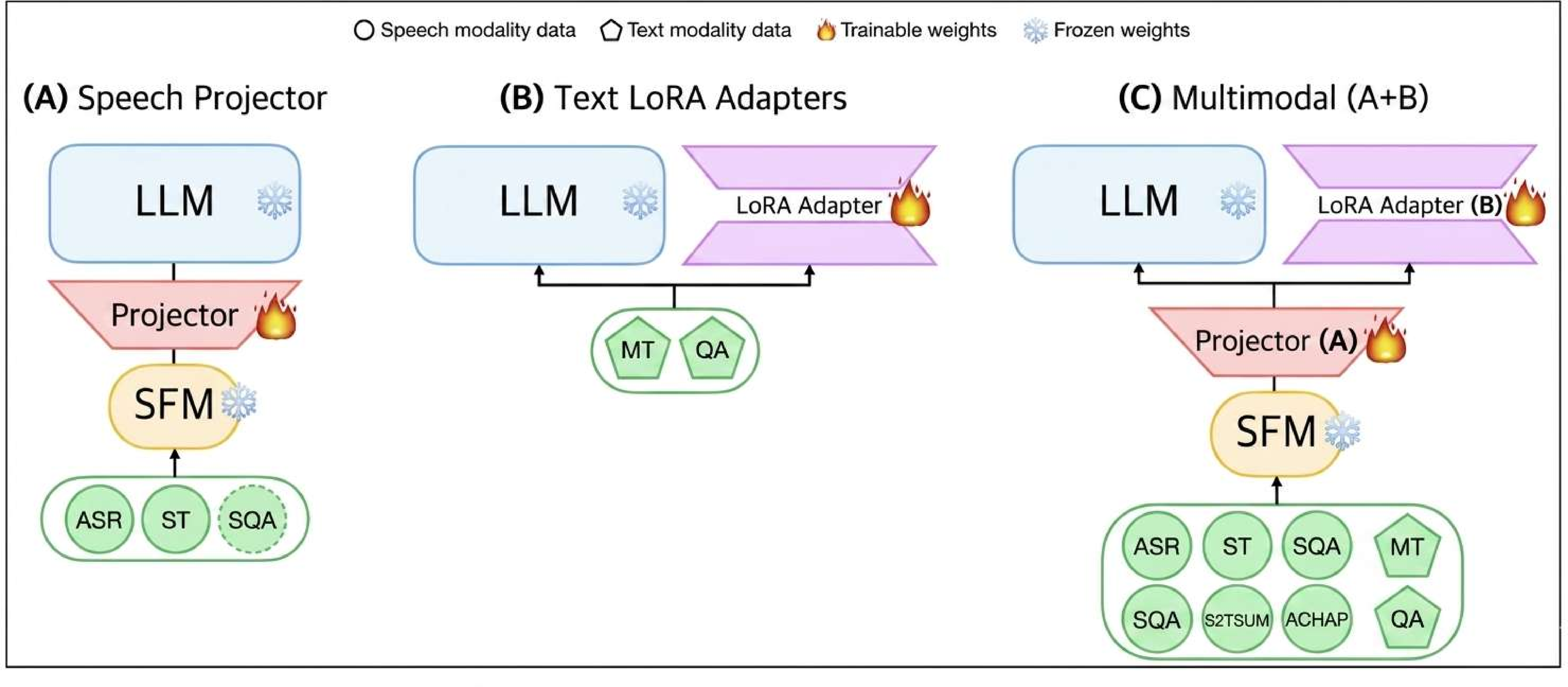
Our model follows [1] and is illustrated in Figure 1. A frozen SeamlessM4T-v2-large encoder [2] produces 1024-dim frame representations. A trainable projector downsamples by 3\(\times\) via frame averaging, passes
through a 4-layer Transformer encoder [20], and projects to the LLM hidden size. A LoRA-adapted [21] Qwen3-4B-Instruct [3] generates the response, with speech embeddings prepended at a
<|speech|> placeholder.
3.0.0.2 Stage 1 — Projector Alignment.
Encoder and LLM are frozen; only the projector is trained (4 epochs, lr \(1\times10^{-4}\), constant, AdamW [22]). A.1 (ASR/ST): sampling 40% ASR, 18% ST-DE, 24% ST-ZH, 18% ST-IT (CoVoST 2 + EuroParlST). A.2 (ASR/ST/SQA): sampling 40% ASR, 10.5% ST-DE, 14% ST-ZH, 10.5% ST-IT, 25% SQA-EN (adds LibriSQA).
3.0.0.3 Stage 2 — Text-Only LoRA.
No audio; projector frozen; LLM adapted via LoRA for 1 epoch. Sampling: MT 60% (20% each DE/IT/ZH, from CoVoST 2 and EuroParlST transcripts) and QA 40% (10% each EN/DE/IT/ZH, LibriSQA + machine-translated). Three configurations:
V1: rank 8, \(\alpha\)=16, lr \(3\times10^{-4}\), attn+FF layers
V2: rank 16, \(\alpha\)=32, lr \(1\times10^{-5}\), cosine, all-linear
V3: rank 32, \(\alpha\)=64, lr \(2\times10^{-4}\), cosine, all-linear
3.0.0.4 Stage 3 — Multimodal Merge.
Both the A.1 projector and V1 LoRA adapters are fine-tuned jointly; the speech encoder remains frozen. Sampling: 20% ASR, 10% each ST-{DE,IT,ZH}, 10% SQA-EN, 5% each SQA-{DE,IT,ZH}, 10% S2TSum, 15% AChap. Each speech batch (ST, SQA) is immediately followed by a paired text-only batch (MT, QA) to prevent catastrophic forgetting. Projector lr: \(1\times10^{-5}\) (constant); LoRA lr: \(3\times10^{-4}\) (cosine); 2 epochs on 4\(\times\)H100.
4 Experiments↩︎
| ASR | ST COMET (\(\uparrow\)) | SQA BERTScore-F1 (\(\uparrow\)) | ||||||
|---|---|---|---|---|---|---|---|---|
| 3-5 (lr)6-9 Model | WER (\(\downarrow\)) | DE | IT | ZH | EN | DE | IT | ZH |
| SeamlessM4T-v2-large (base) | 21.49 | 0.674 | 0.723 | 0.638 | 0.153 | 0.151 | 0.158 | 0.125 |
| A.1 Projector (ASR/ST) | 28.90 | 0.698 | 0.727 | 0.763 | 0.186 | 0.185 | 0.186 | 0.186 |
| A.2 Projector (ASR/ST/SQA) | 37.94 | 0.661 | 0.709 | 0.732 | 0.267 | 0.296 | 0.251 | 0.289 |
| Stage 3 (A.1 + V1 LoRA) | 23.49 | 0.707 | 0.749 | 0.781 | 0.346 | 0.266 | 0.265 | 0.189 |
| MT (DE) | MT (ZH) | SQA | |||
|---|---|---|---|---|---|
| 2-3 (lr)4-5 Model | BLEU | COMET | BLEU | COMET | F1 |
| Qwen3-4B (base) | 25.48 | 0.824 | 2.03 | 0.865 | 0.482 |
| +Stage 2 LoRA (V1) | 31.69 | 0.852 | 13.18 | 0.880 | 0.652 |
| MT (DE) | MT (ZH) | SQA | |||
|---|---|---|---|---|---|
| 2-3 (lr)4-5 Config | BLEU | COMET | BLEU | COMET | F1 |
| V1 (r=8, \(\alpha\)=16) | 31.69 | 0.852 | 13.18 | 0.880 | 0.652 |
| V2 (r=16, \(\alpha\)=32) | 30.94 | 0.851 | 13.97 | 0.880 | 0.650 |
| V3 (r=32, \(\alpha\)=64) | 32.58 | 0.853 | 15.34 | 0.880 | 0.600 |
(a) MCIF Benchmark Results (constrained, short audio)
(b) Stage-2 Text Eval (1k CoVoST-2, not MCIF-comparable)
(c) Stage-2 LoRA Rank Ablation
4.0.0.1 Setup.
Stages 1–2 train on one H200 GPU; Stage 3 on 4\(\times\)H100 80GB (DDP). Audio longer than 15 seconds is excluded due to memory constraints. Main evaluation uses the official mcif_eval tool; Stage 2 is
separately evaluated on a 1k CoVoST 2 text subset (not MCIF-comparable).
4.0.0.2 Stage 1 & 3 Results (MCIF).
Table ¿tbl:tab:main? (a) shows MCIF results. Stage 1 improves ST and SQA over the SeamlessM4T-v2-large baseline at the cost of higher WER—consistent with [1]. A.2 boosts English SQA (0.267 vs.) but further degrades ASR. Stage 3 recovers ASR (23.49 WER), achieves the best ST COMET across all pairs (EN–ZH: 0.781), and strongly improves English SQA (0.346). Cross-lingual SQA remains lower due to sparse multilingual supervision.
4.0.0.3 Stage 2: Text Evaluation & LoRA Ablation.
Since Stage 2 is text-only (no audio), its results are evaluated on the 1k CoVoST 2 text subset and are not comparable to MCIF. Table ¿tbl:tab:main? (b) shows the gain from LoRA (V1) over the base Qwen3-4B [23], [24]; Table ¿tbl:tab:main? (c) ablates LoRA rank. V3 (rank 32) achieves the highest MT scores; V1 (rank 8) yields the best SQA F1 and is selected for Stage 3.
5 Conclusion↩︎
We re-implemented the NAVER LABS three-stage instruction-following pipeline [1] for the IWSLT 2026 constrained setting, adapting it to SeamlessM4T-v2-large and Qwen3-4B-Instruct. Our Stage 3 model achieves COMET 0.781 on EN–ZH ST and BERTScore-F1 0.346 on English SQA on MCIF, with consistent improvements over projector-only baselines. The 100k synthetic dataset released alongside our code provides a natural extension point for richer Stage 3 fine-tuning or future reinforcement learning [25] with task-specific rewards and LLM-as-judge criteria [26].
Limitations↩︎
Audio longer than 15 seconds is excluded due to GPU memory constraints, potentially limiting performance on longer utterances. Cross-lingual SQA relies on machine-translated QA pairs, which may introduce noise. Stage 2 ablation numbers are evaluated on a text-only subset and are not directly comparable to MCIF results.
6 Synthetic Dataset: Task Definitions and Examples↩︎
Each of the 100k synthetic examples (10k per task) is paired with a natural-language instruction prompt; the model is trained to produce the target output. Tasks T1–T7 are text-grounded: Gemma-4-31B generates targets from reference transcripts. Tasks T8–T10 are audio-grounded: Gemma-4-E4B-it generates targets directly from speech audio. One example per task is shown below.
6.0.0.1 T1 — Keyword Extraction.
Definition: Extract the most salient keywords from the spoken utterance as a comma-separated list.
Input: “These data components in turn serve as the ‘building blocks’ of data exchanges.”
Output: data components, building blocks, data exchanges
6.0.0.2 T2 — Named Entity Recognition.
Definition: Identify and classify named entities (PER, ORG, LOC) present in the transcript.
Input: “Saunders was born in Farnborough, Hampshire, the son of a British Army officer.”
Output: PER:[Saunders], ORG:[British Army], LOC:[Farnborough, Hampshire]
6.0.0.3 T3 — Gist Summarization (EN).
Definition: Produce a one-sentence English summary of the spoken content.
Input: “...if you don’t want to look at all of the man pages, you just want to see a very short description of what a command does—type whatis followed by the command name...”
Output: The whatis command provides a one-line description of any Unix/Linux command, e.g.whatis sort or whatis cat.
6.0.0.4 T4 — Topic Labeling.
Definition: Assign a single short topic label (one to three words) to the utterance.
Input: “These data components in turn serve as the ‘building blocks’ of data exchanges.”
Output: data exchange
6.0.0.5 T5 — Numeric QA.
Definition: Generate a question–answer pair where the answer is a number explicitly mentioned in the utterance.
Input: “Only one referendum has been held at the national level in Guyana.”
Output: Q: How many national-level referendums have occurred in Guyana? A: 1 referendum
6.0.0.6 T6 — Gist Summarization (DE).
Definition: Produce a one-sentence German gist summary of the spoken content.
Input: “...if you don’t want to look at all of the man pages, you just want to see a very short description of what a command does...”
Output: Der Befehl whatis liefert eine einzeilige Beschreibung eines Unix-Kommandos, etwa whatis ls oder whatis sort.
6.0.0.7 T7 — Gist Summarization (ZH).
Definition: Produce a one-sentence Mandarin Chinese gist summary of the spoken content.
Input: “...if you don’t want to look at all of the man pages, you just want to see a very short description of what a command does...”
Output:
UTF8gbsn使用whatis命令可以快速查看Linux命令的简要描述。
6.0.0.8 T8 — Vocal Style Description (EN).
Definition: Describe the speaker’s vocal style, tone, and delivery in English, inferred directly from the speech audio (no transcript used).
Input: [audio: “These data components in turn serve as the ‘building blocks’ of data exchanges.”]
Output: The speaker has a measured, confident tone, speaking at a moderate pace with clear articulation.
6.0.0.9 T9 — Vocal Style Description (DE).
Definition: Describe the speaker’s vocal style in German, inferred directly from the speech audio.
Input: [audio: “These data components in turn serve as the ‘building blocks’ of data exchanges.”]
Output: Die Sprecherin klingt ruhig und professionell mit einem gleichmäßigen Sprechtempo und einer freundlichen, sachlichen Betonung.
6.0.0.10 T10 — Vocal Style Description (ZH).
Definition: Describe the speaker’s vocal style in Mandarin Chinese, inferred directly from the speech audio.
Input: [audio: “These data components in turn serve as the ‘building blocks’ of data exchanges.”]
Output:
UTF8gbsn声音听起来平稳而中速,带有平静的语调,情感色彩比较客观。