Narrative World Model: Narratology-Grounded Writer Memory for Long-Form Fiction
July 06, 2026
Abstract
Long-form fiction writers need memory that answers multi-hop questions about evolving story state: who knows a secret and when they learned it, whether an event preceded the narration that revealed it, whether a setup paid off, and how a relationship shifted. General-purpose retrieval and agent-memory systems represent entities and facts but not the narratological structure these questions turn on, so they surface the wrong evidence or none at all. We introduce the Narrative World Model (NWM), a writer-memory system that pairs a narratology-grounded typed temporal-state graph with query-conditioned hybrid retrieval. To measure memory rather than the answerer, we read every system through a single held-constant Opus 4.8 reader over only that system’s chapter-safe evidence, on a reproducible public corpus and a validated multi-hop benchmark, and we compare against the strongest existing temporal-knowledge-graph agent-memory framework, Graphiti/Zep [1]. NWM substantially and significantly outperforms this baseline on multi-hop narratological QA across both corpora, and far exceeds GraphRAG and flat retrieval. The advantage is representational rather than an artifact of extraction: it survives rebuilding the baseline with NWM’s own extractor, and traces to its narratology-grounded structure and query-conditioned retrieval, not to graph size or extractor quality.
1 Introduction↩︎
Long-form fiction generation exposes a gap between local fluency and durable narrative state. A model can write an appealing scene while forgetting who knows a secret, where an object is, whether a promise paid off, or how a relationship changed. Chapter \(N{+}1\) must respect finalized chapters \(1\ldots N\) while advancing the story.

A writer-facing narrative memory system must do more than surface nearby text. Rolling summaries discard details that later become plot-critical. RAG [2], [3] retrieves relevant prose, but a passage may say where an object was before it moved. Graph retrieval can expose entities and events, but generic graphs do not necessarily track who knows what, the difference between event order and reveal order, relationship deltas, unresolved promises, or dramatic function. These approaches can miss the current, typed narrative state a writer needs even when the source prose exists.
These failures concentrate on multi-hop narratological queries: who knew a fact at chapter \(n\) and when they learned it, whether an event preceded the narration that revealed it, whether a setup planted earlier paid off, and what dramatic function a beat serves. Answering such a query requires evidence from two or more distinct chapters and a representation that types narratological structure rather than generic entities.
We therefore ask: does a narratology-grounded memory system provide better chapter-safe evidence for multi-hop story-state questions than generic search, source-chunk RAG, GraphRAG, or the strongest existing temporal-knowledge-graph agent-memory framework, Graphiti/Zep [1]? We propose Narrative World Model (NWM), which publishes finalized chapters into typed memory records, global registries, a temporal knowledge graph (KG), and a recursive language-model QA (RLM QA) verifier. In a scoring protocol over two corpora, each system answers nuanced writer questions from only its own chapter-filtered memory or retrieval evidence, isolating memory/retrieval behavior from generator behavior.
This paper makes the following contributions.
A writer-facing multi-hop narrative-memory QA protocol and a validated 176-item multi-hop slice built by curation, a single-passage hardness filter that discards questions a top-1 retrieved chunk can answer, and independent adjudication by a stronger model than the generator.
The NWM system: a narratology-grounded typed temporal-state graph with query-conditioned hybrid retrieval, with its publish/update flow, schema registries, temporal KG, and RLM QA.
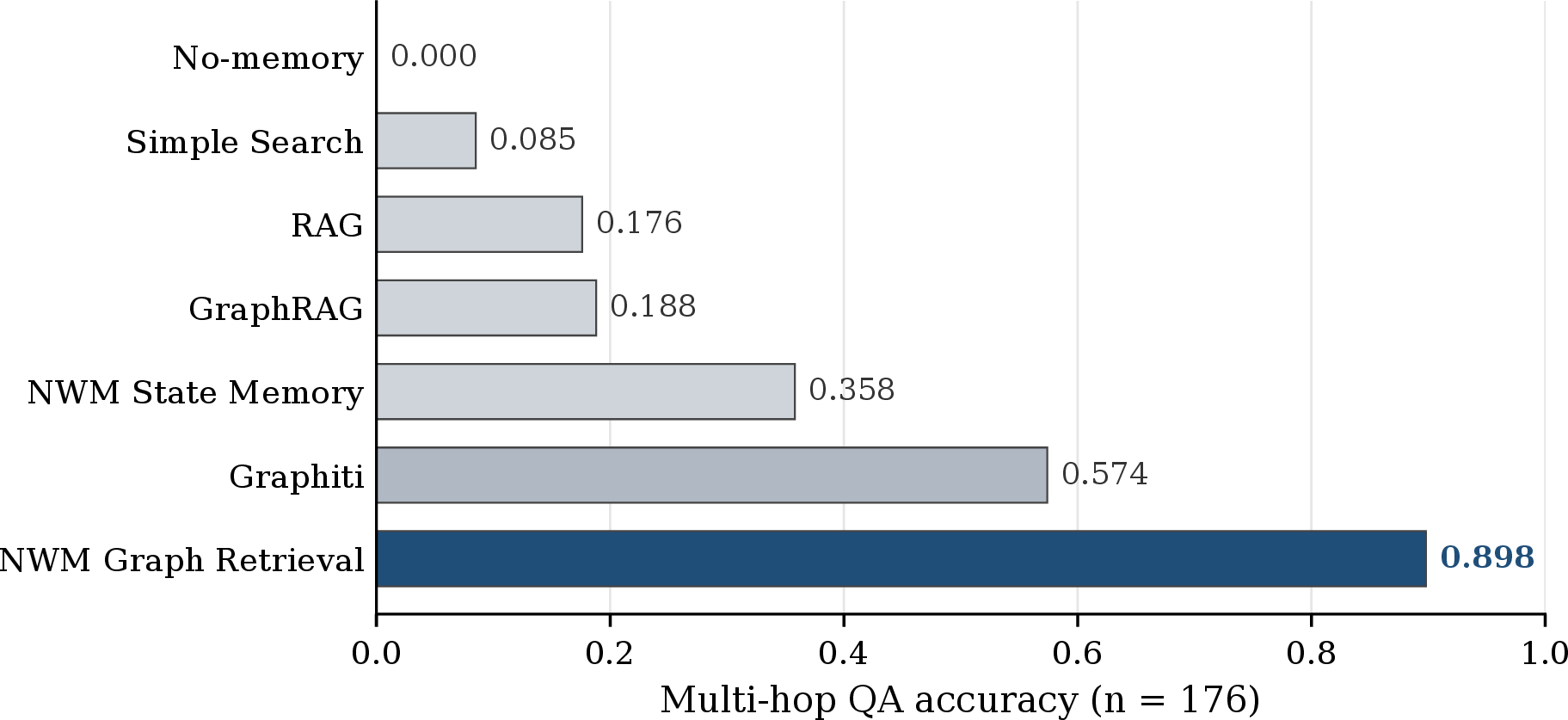
NWM Graph Retrieval significantly beats Graphiti, the strongest existing temporal-KG framework, on two corpora under a held-constant Opus 4.8 reader: \(0.898\) versus \(0.574\) on the private multi-hop slice (paired McNemar \(64\)–\(7\), \(p<10^{-5}\)) and \(0.625\) versus \(0.516\) on the public 576-item set (\(p=0.0001\)), both far above GraphRAG and RAG.
An extractor-fairness control showing the gain is representational: Graphiti is extracted with NWM’s own Sonnet 4.5 model, and re-ingesting it with a cheaper extractor does not change its accuracy (\(p=0.89\)). A cross-system abstention analysis is the operative ablation.
A reproducible public protocol and benchmark, including a 110-item public multi-hop subset.
2 Related Work↩︎
2.0.0.1 Long-form story generation and revision.
Neural story generation has long used intermediate representations to control global structure. Hierarchical Neural Story Generation decomposes generation into higher-level representations and lower-level realization [4]; Plan-and-Write uses an explicit storyline as a control signal [5]; Re3 and DOC use recursive prompting, revision, and detailed outlines to improve coherence [6], [7]. These systems control intended structure. NWM addresses a different object: accepted state after prose is finalized, and whether that state is actually available to the next continuation.
2.0.0.2 Retrieval and long-term memory.
RAG conditions generation on external evidence [2], and REALM treats retrieval as latent memory [3]. Long-running memory systems aim to carry information across interactions [8]–[11], and production agent-memory frameworks such as Mem0 [12] extract and consolidate salient facts across sessions, with a graph variant that captures relational structure. Even when a large context is available, models use the middle unevenly [13]. These systems carry generic facts or conversational state; NWM differs in its unit of state: rather than prose chunks or generic facts, it stores typed, versioned, chapter-scoped narrative state and exposes the latest causally valid slice.
2.0.0.3 Knowledge graphs and narrative QA.
Knowledge graphs represent relational facts for lookup and traversal [14]; GraphRAG-style systems build retrieval over source-derived entity/event graphs [15], and more recent graph-structured retrievers such as HippoRAG [16] and LightRAG [17] couple entity graphs with dense retrieval to support multi-document reasoning. For fiction the relevant graph is instead temporal and narrative-specific. Multi-hop QA benchmarks such as HotpotQA [18], 2WikiMultiHopQA [19], and MuSiQue [20] establish that questions requiring evidence from two or more passages form a distinct, harder regime than single-passage retrieval; they motivate our multi-hop slice, though they target encyclopedic facts rather than evolving narrative state. NarrativeQA established QA over stories as a test of narrative understanding [21]. Our RLM QA layer follows the recursive-decomposition spirit of Recursive Language Models [22] but specializes it to evidence-backed narrative-state verification.
2.0.0.4 Narratology and temporal graph reasoning.
Narratology distinguishes who sees from who speaks, story-event order from discourse order, and event function within an arc [23], [24]. Writer-facing craft taxonomies also track dramatic situations and motivation/reaction beats [25], [26]. Temporal-KG methods model time-scoped facts and query-relevant graph neighborhoods [27], [28], while temporal KGQA benchmarks test questions over time-scoped relations [29]. The closest agent-memory framework is Graphiti/Zep [1], a bi-temporal knowledge graph that records when a fact was true and when it was ingested, and serves it as time-scoped evidence for agents. NWM is closest to this line in its use of temporal edges and graph neighborhoods, but Graphiti’s edges are generic time-scoped facts, whereas NWM’s schema types are narrative-specific: knowledge boundaries, reveal order, promise/payoff status, focalized observer, and dramatic function are first-class writer-memory fields rather than generic entity relations. We use Graphiti as our strongest baseline.
3 Narrative World Model↩︎
3.1 Causal Publish Flow↩︎
NWM treats memory as a record of finalized prose, not future intent. Let \(C_n\) be accepted chapter prose, \(M_n\) world state after chapter \(n\), and \(O_{n+1}\) the next scaffold: \[\begin{align} M_n &= \mathrm{Publish}(C_n, M_{n-1}), \\ X_{n+1} &= \mathrm{Retrieve}(M_n, O_{n+1}), \end{align}\] where \(X_{n+1}\) is the retrieved memory packet for chapter \(n{+}1\) writer queries and continuation support. The causal constraint is strict: a query or continuation may use updates completed through chapter \(n\), never future scaffolds. Publishing stores a prose digest, extracts typed memory records, merges registries, projects graph indexes, and exposes the completed state; republishing an edited chapter invalidates downstream edges from that chapter.
\(\mathrm{Publish}\) is an extraction step, not a copy: an extractor (Claude Sonnet 4.5) reads the accepted prose and emits the typed records of §3.2 directly, each stamped with its source chapter and evidence span and merged into cumulative registries (see Appendix 10).
3.2 Schema Updates and Global Registries↩︎
Instead of storing only summaries or prose chunks, NWM extracts a public writer-memory structure. Implementations may add bookkeeping, but the writer-facing retrieval state is this evidence-backed typed memory:
NWM writer-memory structure
| Memory record | Writer-visible fields |
|---|---|
| Chapter digest | chapter id, source-grounded summary, evidence spans |
| Scene/event | location, participants, event order, reveal order, source chapter |
| Character state | goal, knowledge/unknowns, status, location, relationship deltas |
| Relationship state | character pair, relation type, polarity/status, validity |
| Object state | object, owner, location, condition, last evidence |
| Plot/promise | thread id, structural role, open/closed status, promised payoff |
| Narrative function | focalized observer, dramatic beat, turn/reversal, reader knowledge |
| World fact | fact, scope, valid chapter range, evidence |
Each record is chapter-scoped and evidence-backed, and merges into cumulative registries (characters, relationships, locations, objects, active threads, promises, world facts) that expose the latest causally valid slice for chapter \(n{+}1\). The writer query interface needs current slices for relevant entities, not all prior chapters; thus a registry retains an old-but-current object location that recent summaries omit.
Two properties make these records more than generic facts: every record is evidence-backed (it stores its source chapter and supporting span), and the narratological fields are first-class typed slots (focalized observer, reveal order vs.event order, epistemic knowledge/unknowns, open/closed promise-payoff status, dramatic function) rather than prose that happens to mention a craft concept. These are the fields a generic entity/edge graph lacks (see Appendix 10).
3.3 Temporal Knowledge Graph↩︎
The KG projects schema state into temporal relations: characters know facts, objects are located at places, relationships change, threads resolve, and events cause later events. Each edge stores source chapter, evidence, validity interval, and confidence. A vector retriever returns a relevant mention; the graph returns the latest valid state as of chapter \(n\) while preserving history.
Edges are typed by the narrative relation they assert (knowledge, location, relationship-polarity change, thread resolution, causation), carrying the §3.2 semantics into the graph, and each edge’s validity interval makes the graph temporal rather than a flat snapshot. A query for state “as of chapter \(n\)” selects the latest edge valid at \(n\) for each entity or relation while older edges remain as history, returning an old-but-still-current state a rolling summary cannot (see Appendix 10).
3.4 Recursive Language-Model QA↩︎
RLM QA is a recursive verifier over NWM, not a new base model. It decomposes a narrative question, queries schema and graph state, gathers evidence, and reports a support trace. It assembles pre-continuation constraints and checks candidate chapters for unsupported state changes.
3.5 Query-Conditioned Hybrid Retrieval↩︎
Retrieval turns the store into a chapter-safe evidence packet for a writer query \(q\) at checkpoint \(n\): it restricts to records whose source chapter is \(\leq n\), ranks entity/seed nodes by a hybrid of BM25 [30] and dense vectors [31] fused by reciprocal-rank fusion [32], expands each anchor’s one-hop typed neighborhood, and truncates to a bounded heterogeneous packet that is the only evidence the reader sees (full four-stage description in Appendix 10.1). This is what distinguishes NWM Graph Retrieval from NWM State Memory, which serializes all state up to \(n\) with no query-specific step: conditioning, not store contents, is the operative difference between the two NWM conditions.
3.6 Extraction and Baseline Independence↩︎
The primary comparison deliberately separates baseline extraction from NWM extraction. Simple search and source-chunk RAG index only chapter chunks; GraphRAG builds its own entity/event graph directly from chapter text; Graphiti [1] ingests the same chapter episodes into its bi-temporal knowledge graph and retrieves time-scoped facts; and the NWM rows use NWM’s own current-state memory and graph-retrieval conditions. No external baseline reads NWM schemas, registries, graph state, or other NWM-derived memory records. Every row is answered by the same held-constant Opus 4.8 answerer over its own chapter-filtered evidence and evaluated with the same token-normalized support rule; baseline construction itself may use an independent LLM extractor.
To separate the contribution of the representation from the contribution of the extraction model, Graphiti is extracted with NWM’s own model (Sonnet 4.5), so the comparison is not confounded by extraction quality. As a robustness check, we also re-ingest Graphiti with a cheaper extractor (GPT-4.1-mini); if a cheaper extractor changed Graphiti’s accuracy, the comparison would be sensitive to extraction quality, whereas if it does not, the gap is representational. Both ingests are read by the same Opus 4.8 answerer as every other row, holding the answerer and the representation constant while varying only the extractor.
4 Evaluation: Narrative Memory QA↩︎
4.1 Protocol↩︎
We evaluate over two corpora. A public corpus of 12 public-domain books (six genres, \(\geq 20\) chapters each) makes the protocol reproducible. A private corpus of five production-style serialized books of 50 chapters each is a production-scale check; it is not redistributable.
External baselines use only chapter text and never consume NWM schemas, registries, graph state, or other NWM-derived memory records: Simple Search is lexical retrieval over chapter chunks; RAG uses 360-word source chunks with 80-word overlap, BGE-large dense embeddings [31], BM25 [30], and reciprocal-rank fusion [32]; GraphRAG builds per-book source-derived entity/event graphs with an independent LLM extractor and retrieves seed nodes plus local graph neighborhoods per question; and Graphiti [1] ingests chapter episodes into a bi-temporal knowledge graph and retrieves time-scoped facts, extracted with Sonnet 4.5 to match NWM’s extractor (a cheaper-extractor re-ingest is reported as a robustness check in §4).
The NWM rows evaluate two retrieval conditions over the same published memory: direct current-state memory and question-conditioned graph retrieval. Every system is filtered by book and chapter so it cannot read future chapters, and every row is answered by the same held-constant Opus 4.8 answerer over its own chapter-filtered evidence.
4.1.0.1 Private multi-hop benchmark.
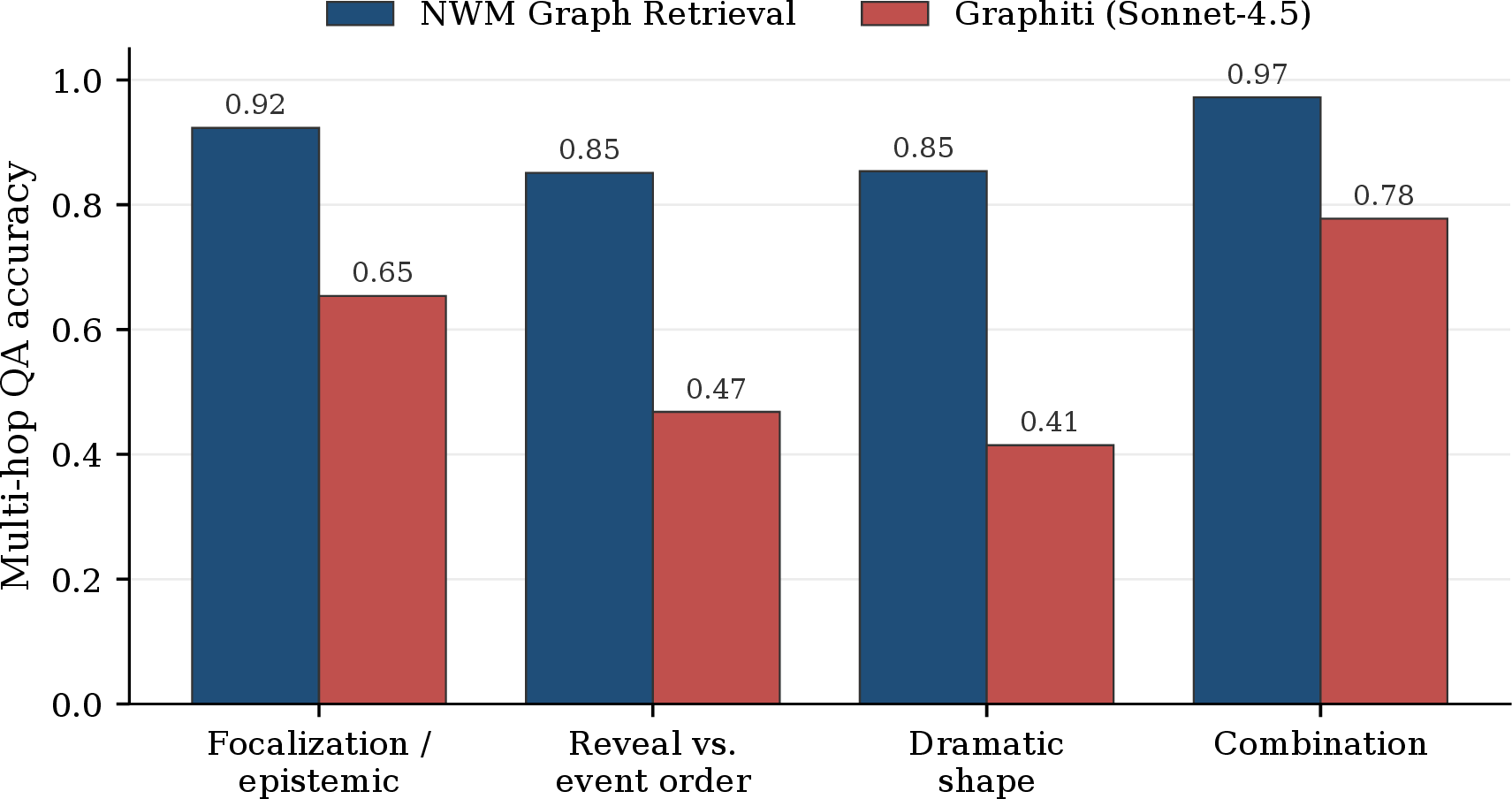
On the private corpus we curated a multi-hop benchmark: 176 validated multi-hop questions, each requiring evidence from at least two distinct chapters, plus 96 matched single-hop control questions. Items are balanced across four narratological families: focalization/epistemic (who knows what, and when they learned it), reveal-order-versus-event-order, dramatic-shape/setup-payoff, and combination. Questions were generated from chapter text with a strong language model, then filtered by a single-passage hardness check that keeps a question only if a top-1 retrieved 360-word chunk cannot support its answer, and finally adjudicated for genuine multi-hopness and answer correctness by a separate, stronger model than the generator. This curation isolates questions that demand cross-chapter reasoning over typed narrative state.
4.1.0.2 Public multi-hop subset.
On the public corpus we used the frozen 576-question source-written set and defined a 110-question multi-hop subset as those questions whose gold evidence cites at least two distinct chapters.
4.1.0.3 NWM retrieval conditions.
NWM State Memory is the direct current-state condition: all typed memory items published up to the checkpoint are merged and serialized into a bounded evidence context, without an additional query-specific graph search step, testing whether the published memory itself contains enough evidence. NWM Graph Retrieval is the question-conditioned graph condition: the query ranks relevant temporal-graph nodes and relations, expands local graph neighborhoods, and packages compact evidence (plus recursive verification traces) for the same answerer, combining structured current-state memory and query-conditioned graph retrieval rather than a single vector index.
4.1.0.4 Answerers and scoring.
All rows are answered by the same held-constant Opus 4.8 answerer over only the system’s chapter-filtered evidence, so the reported differences compare each system’s memory representation, extraction, retrieval, and evidence packaging under one answer model; the answerer must abstain when evidence is insufficient and return evidence ids. Final correctness for all rows is then computed with a token-normalized support check against the reference answers, accepting direct answer-string support or overlap on answer-bearing content tokens. Thus score measures evidence support for writer questions, not generated-continuation behavior or privileged store access. Because the same Anthropic family both adjudicates and reads the benchmark, we replicate the held-constant reader with Google Gemini 3.1 Pro on the full multi-hop set: the system ranking and the NWM-versus-Graphiti result hold (Appendix 18).
4.1.0.5 Query taxonomy.
Queries span latest character state, knowledge boundary, relationship constraint, object location/state, event grounding, promise/payoff, temporal ordering, world-rule constraint, narratological function, and source-needle detail. The taxonomy is motivated by narratology and writing-craft categories such as focalization, event function, dramatic turns, and promise/payoff, not by the serialized NWM schema alone.
4.1.0.6 Public memory-QA comparison.
The public 576-question set is curated from chapter text with GPT-5.5-assisted curation; each item stores evidence spans, required chapters, checkpoint, category, and curator provenance. The public corpus makes the protocol reproducible while the private five-book corpus tests the same systems on longer, production-style serialized stories; in both settings, accuracy gains require useful evidence from the evaluated memory or retrieval system rather than from the answerer alone.
4.1.0.7 Metrics.
We report item-weighted QA accuracy under a deterministic token-coverage rule: the gold answer’s salient content tokens must be at least half-covered by the evidence-supported answer. We report Wilson 95% confidence intervals [33] and paired exact McNemar tests between systems on identical items, which control for item difficulty and isolate where one representation answers what another misses.
5 Results↩︎
All numbers below are produced by the evaluation implementation. The private multi-hop comparison is the headline result; the public corpus replicates the ordering on redistributable data. These are narrative-memory retrieval results, not full-story continuation outcomes.
5.1 Private Multi-Hop Comparison↩︎
| Memory source | Overall | Multi-hop | Control |
|---|---|---|---|
| No Memory | 0.000 | 0.000 | 0.000 |
| Simple Search | 0.107 | 0.085 | 0.146 |
| RAG (BGE+BM25+RRF) | 0.184 | 0.176 | 0.198 |
| GraphRAG | 0.199 | 0.188 | 0.219 |
| NWM State Memory | 0.294 | 0.358 | 0.177 |
| Graphiti | 0.496 | 0.574 | 0.354 |
| NWM Graph Retrieval | 0.893 | 0.898 | 0.885 |
6pt
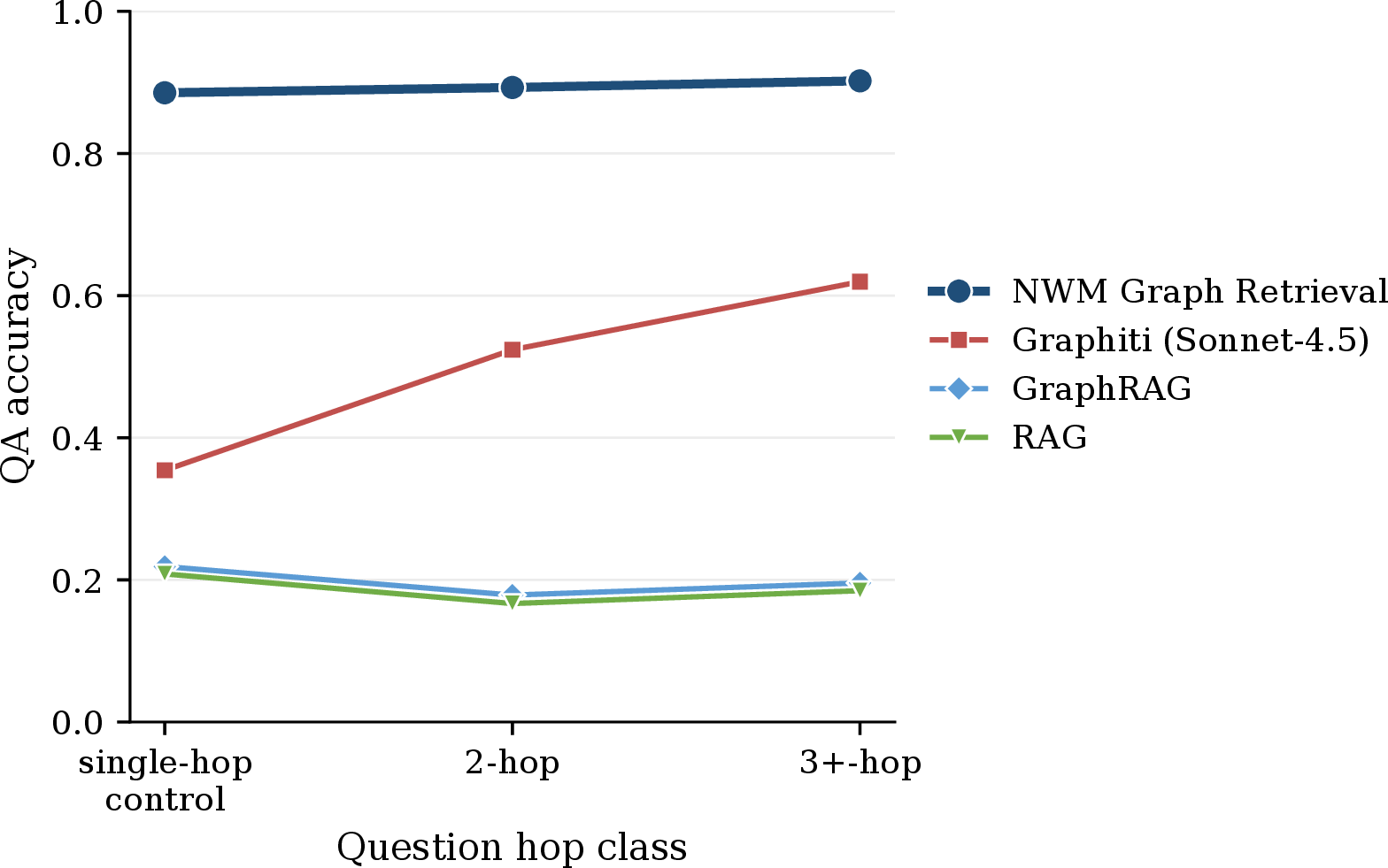
Table 1 is the headline comparison. NWM Graph Retrieval reaches \(0.898\) on the 176 multi-hop items, against \(0.574\) for the extractor-matched Graphiti. The paired exact McNemar test between NWM Graph Retrieval and Graphiti is \(64\) to \(7\), \(p<10^{-5}\). Direct NWM State Memory, which serializes current state without a query-conditioned graph search, reaches only \(0.358\) multi-hop and does not beat Graphiti; against NWM Graph Retrieval the paired test is \(101\) to \(6\), \(p<10^{-5}\). The advantage appears only when the query ranks graph nodes and expands local neighborhoods. NWM Graph Retrieval also leads on the single-hop control (\(0.885\)), showing the gain is not specific to multi-hop items (per-system bars in Figure 2, Appendix 10).
5.2 Public Comparison↩︎
| Memory source | Full (576) | Multi-hop (110) |
|---|---|---|
| RAG | 0.314 | 0.291 |
| GraphRAG | 0.351 | 0.355 |
| NWM State Memory | 0.464 | 0.573 |
| Graphiti | 0.516 | 0.582 |
| NWM Graph Retrieval | 0.625 | 0.709 |
6pt
Table 2 replicates the ordering on redistributable data. NWM Graph Retrieval reaches \(0.625\) on the full 576-item set and \(0.709\) on the 110-item multi-hop subset, above Graphiti at \(0.516\) and \(0.582\) and far above GraphRAG and RAG. The paired exact McNemar test between NWM Graph Retrieval and Graphiti is \(156\) to \(93\) on the full set (\(p=0.0001\)) and \(30\) to \(16\) on the multi-hop subset (\(p=0.054\)); the subset test is underpowered at \(n=110\).
5.2.0.1 Extractor fairness.
The advantage is representational, not an artifact of NWM’s extractor. Graphiti is extracted with NWM’s own model (Sonnet 4.5), so the comparison is not confounded by extraction quality. As a robustness check, re-ingesting Graphiti with a cheaper extractor (GPT-4.1-mini) yields a sparser fact graph (Appendix 3)— entities rise from \(443\) to \(491\) while fact edges fall from \(3{,}600\) to \(2{,}226\) across the ingested chapter episodes—yet statistically indistinguishable accuracy (\(0.585\) versus \(0.574\); paired exact McNemar \(p=0.89\)), confirming the gap is representational, not an extraction artifact. Matching or cheapening the extractor does not close the gap to NWM Graph Retrieval.
5.2.0.2 Representation ablation.
The cross-system comparison is itself the ablation. On the \(64\) private multi-hop items that NWM Graph Retrieval answered and Graphiti missed, Graphiti abstained on all \(64\), and in every case the gold fact was absent from Graphiti’s retrieved evidence. These were narratological-structure questions, dramatic irony, reveal order, setup and payoff, and knowledge-boundary shifts, for which Graphiti’s generic entity/edge schema has no representation (per-family case studies in Appendix 19). The gap is not extraction quality but the absence of narratological structure in the representation.
Representation-size footprints (Table 3, Appendix 10) further show NWM’s typed graph is smaller than the source GraphRAG graph yet answers far more multi-hop questions: typing of narrative structure, not graph density or extractor, is the driver (per-family breakdown in Figure 3).
6 Discussion↩︎
The results admit a single mechanistic reading: the advantage is where the relevant narrative structure is represented and query-conditioned retrieval surfaces it, not where the graph is larger or the extractor is stronger.
6.0.0.1 Why structured narrative memory wins on multi-hop.
A multi-hop narratological query is answered not by one fact but by composing evidence about typed temporal units across chapters: an epistemic boundary that shifts, a reveal whose discourse position differs from its story position, a promise opened and discharged. NWM decomposes chapters into exactly these units—revelations, character/arc/object deltas, and scene beats, with validity intervals—so query-conditioned retrieval assembles the cross-chapter structure the query presupposes. A generic entity/edge graph [1], [15] has no such units. The failure mode confirms this: Graphiti almost always abstained rather than erring, with the gold fact simply absent from its evidence—the signature of representational absence, not reasoning error.
6.0.0.2 Retrieval conditioning is the operative mechanism.
Structure in the store is necessary but not sufficient: the same typed memory dumped as serialized current state (NWM State Memory) badly underperforms query-conditioned NWM Graph Retrieval and does not even beat Graphiti. This is mechanical, not a budget handicap: at an equal evidence budget, State Memory fills the window with a positional chapter prefix while query-conditioned retrieval fills it with ranked, query-relevant records—so \(83\%\) of its misses are present-but-truncated and only \(2\%\) absent (Appendix 15). Two controls bound the gain: an evidence oracle given the gold chapters answers all \(176\) items (a strict superset of NWM), so residual errors are retrieval- not reader-limited, and dumping all prior chapters (\({\sim}80\)k tokens) does not beat the retrieved slice (Appendix 16); and untyping NWM—stripping type labels from the packet and re-embedding the graph so retrieval re-seeds—never lowers accuracy (Appendix 17). The hop-count interaction reinforces this (Figure 4); removing the conditioning (State Memory) or representing the structure generically (cross-system) collapses the advantage.
These results show NWM supplies the chapter-safe evidence a writer question needs—a necessary precondition for NWM-conditioned generation, the writer-loop study we discuss in Section 7.
7 Toward Generation and Writer-Workflow Evaluation↩︎
The next step is whether NWM-conditioned generation is better. A generation evaluation would place NWM inside the writing loop: continue story worlds for \(10\)–\(15\) chapters under matched memory conditions, then score contradictions, entity/character/relationship consistency, harder composite QA, writer correction burden, and blind pairwise human preference, testing whether KG/RLM verification changes temporal disambiguation, contradiction detection, and how retrieved memory shapes prose.
8 Limitations↩︎
8.0.0.1 Isolating the typing.
The cross-system comparison shows a generic schema (Graphiti) abstains on narratological-structure questions, but it varies many factors at once. Two within-NWM controls isolate the labels: stripping the type labels from the reader’s packet, and re-embedding the graph untyped so retrieval re-seeds, both leave accuracy unchanged (Appendix 17); packet field-masking is uninformative because the reader recovers masked content from surviving rows. The lever is thus the narrative decomposition and query-conditioned retrieval, not the type labels. We do not isolate narratological from generic fine-grained decomposition, nor confirm the retrieval-side null at the production-vector level (its embed endpoint is access-gated); both are future work.
8.0.0.2 Statistical power.
The public multi-hop subset is underpowered at \(n=110\), where the NWM-versus-Graphiti advantage (\(30\) to \(16\)) is suggestive but not significant (\(p=0.054\)). The private multi-hop slice (\(n=176\), \(p<10^{-5}\)) and the full public set (\(n=576\), \(p=0.0001\)) carry the significant results.
8.0.0.3 Benchmark design.
The private multi-hop benchmark is narratology-tilted by design, balanced across focalization/epistemic, reveal-order, dramatic-shape, and combination families to stress exactly the structure NWM types. This is the intended contribution, disclosed so the result is read as a comparison on narratological multi-hop questions rather than arbitrary story QA.
8.0.0.4 Automatic scoring.
The scorer is deterministic but not a human-equivalence claim: a token-coverage rule can penalize paraphrases and accept shallow matches, so we report evidence-support accuracy under a fixed rule; human or LLM-judge agreement would strengthen it.
8.0.0.5 Data and workflow scope.
The public corpus is reproducible; the five-book private corpus is production-style but not redistributable. All question writing and external-baseline construction are separate from NWM’s memory records. The no-memory row is an evidence-free abstention control, not a closed-book recall probe; conditioned generation remains future work (Section 7).
8.0.0.6 Baseline configuration.
GraphRAG is one concrete chapter-level configuration (source-only extraction, per-book stores, seed-node retrieval, local expansion), not Microsoft GraphRAG’s global community-summary mode; Graphiti runs in its default configuration, extractor-matched to NWM. The claim is a comparison against these reproducible configurations, not every possible graph-RAG or temporal-KG system.
9 Conclusion↩︎
Narratology-grounded writer memory significantly outperforms the strongest existing temporal-knowledge-graph framework on multi-hop story-state QA. Under a held-constant Opus 4.8 reader, NWM Graph Retrieval scored \(0.898\) versus Graphiti \(0.574\) on a validated 176-item private multi-hop slice (paired McNemar \(64\)–\(7\), \(p<10^{-5}\)) and \(0.625\) versus \(0.516\) on the public 576-item set (\(p=0.0001\)), far above GraphRAG and RAG. The gain is representational: Graphiti uses NWM’s own Sonnet 4.5 extractor, and re-ingesting it with a cheaper extractor leaves its accuracy unchanged (\(p=0.89\)), and on the multi-hop items NWM answers and Graphiti misses, Graphiti abstains on all \(64\) because its generic schema cannot represent narratological structure. NWM-conditioned generation is future work.
Code and Data Availability↩︎
The public benchmark is built from Project Gutenberg texts, and the evaluation harness—question curation, the held-constant reader protocol, retrieval baselines, and scoring—is reproducible on that corpus. The internal corpus, its multi-hop benchmark, and the production Narrative World Model backend are proprietary and are withheld; the private results are reported over anonymized books (Book A–E) with blinded titles and character names.
10 Additional Method Details↩︎
This appendix expands the method summaries in §3 and collects the supporting figures and tables relocated from the body. The body retains the terse §3.1–3.4 prose and the schema table; the fuller descriptions below add no new claims.
10.0.0.1 Extraction at publish (expands §3.1).
\(\mathrm{Publish}\) is an extraction step, not a copy. When a chapter is finalized, an extractor (Claude Sonnet 4.5) reads the accepted prose and emits the typed memory records of §3.2 directly, rather than a free-text summary: each emitted record is tied to the chapter that produced it and carries the evidence span that licenses it. Records do not overwrite the store; they merge into the cumulative registries, keyed by the entity, relationship, object, or thread they describe, so that a single entity accretes a chapter-ordered history of typed states. The causal cutoff is a property of the store, not of a single query: it is enforced at write time, because every record is stamped with its source chapter, and again at read time, because retrieval restricts to records stamped at or before the checkpoint. Editing and republishing a chapter re-runs extraction for that chapter and invalidates the downstream edges that depended on the superseded state, so a correction propagates forward rather than leaving stale assertions in the graph.
10.0.0.2 Evidence-backed narratological fields (expands §3.2).
Two properties make these records more than generic facts, and both are visible in the writer-memory structure (§3.2). First, every record is evidence-backed: it stores the source chapter it was extracted from and the evidence span that supports it, so a downstream answer can cite where a state was established rather than asserting it unsupported. Second, the narratological fields are first-class typed slots, not prose that happens to mention a craft concept. A focalized observer names through whose perception a scene is rendered; reveal order is stored separately from event order, so the chapter in which the reader learns a fact is distinguished from the chapter in which the underlying event occurred; character knowledge and unknowns record an epistemic boundary, the set of facts a character does and does not yet hold at a checkpoint; a plot or promise record carries an open-versus-closed payoff status, marking whether a setup planted earlier has yet been discharged; and a narrative function record names the dramatic beat or turn a scene performs. These are the fields a generic entity/edge graph lacks: it can record that two entities are related, but not who is licensed to know it, when it was revealed as opposed to when it happened, or what arc function its disclosure serves.
10.0.0.3 Narrative-typed temporal edges (expands §3.3).
Edges in the KG are typed by the narrative relation they assert rather than by a generic association. An edge records that a character knows a fact, that an object is located at or owned by a place or agent, that a relationship has changed polarity, that a thread has resolved, or that one event causes a later event; the same edge type therefore carries the narratological semantics of §3.2 into the graph. Each edge stores its source chapter, its evidence, a validity interval over chapters, and a confidence. The validity interval is what makes the graph temporal rather than a flat snapshot: a fact that held from the chapter it was established until the chapter it was superseded is a closed interval, while a fact that still holds is left open.
10.0.0.4 State as of a checkpoint (expands §3.3).
Because edges carry chapter-scoped validity, a query for state “as of chapter \(n\)” is answered by selecting, among the edges valid at \(n\), the latest one for each entity or relation, while older edges remain in the graph as history rather than being discarded. This is what a rolling summary cannot do: it lets the store return an old-but-still-current state (for example, an object’s last known location) even when more recent chapters do not mention it, and it lets a later query reconstruct the same entity’s earlier state without re-reading the prose.
10.1 Query-Conditioned Hybrid Retrieval (expands §3.5)↩︎
The publish flow builds the store; retrieval is what turns it into a chapter-safe evidence packet for a specific writer query. Given a writer query \(q\) and a checkpoint chapter \(n\), \(\mathrm{Retrieve}(M_n, q)\) proceeds in four stages.
Causal restriction. Retrieval first restricts the searchable store to records and edges whose source chapter is at most \(n\), so no candidate evidence can originate in a future chapter. This is the same cutoff enforced at write time, re-applied as a hard filter at read time.
Hybrid node ranking. Within that restricted store, entity nodes and seed nodes are ranked against \(q\) by a hybrid score that combines a lexical signal (BM25 [30]) with a dense-vector signal over embedded node text [31]; the two rankings are merged by reciprocal-rank fusion [32] so neither signal dominates. The result is a small set of top-ranked entity and seed nodes that anchor the query in the graph.
One-hop graph expansion. Each anchor node’s one-hop neighborhood is expanded to pull in the typed edges incident to it (and their endpoints), bounded by a neighbor limit. This is the step that converts a ranked set of nodes into connected typed structure: it surfaces the knowledge, location, relationship-delta, reveal, and thread-resolution edges that a node-only ranking would leave implicit.
Bounded packet assembly. The ranked vector hits, the expanded graph nodes, and the expanded graph edges are merged, re-ranked, and truncated to a size-bounded evidence packet. The packet is therefore heterogeneous by construction, ranked entity/seed vector hits together with the graph nodes and typed edges they induce, and it is the only evidence the held-constant reader sees for that query. RLM QA (§3.4) may optionally decompose the query and verify the assembled evidence before the reader answers.
10.1.0.1 Why conditioning matters.
The contrast with NWM State Memory makes the role of conditioning explicit. NWM State Memory serializes all typed memory items published up to \(n\) into a single bounded context, with no query-specific search step; it tests whether the published state, taken whole, contains the answer. Query-conditioned hybrid retrieval instead uses \(q\) to decide which parts of the store to surface and then follows the graph one hop from those parts. The two share the same underlying store and the same causal cutoff, and differ only in conditioning. A multi-hop narratological query needs a few specific typed edges from different chapters, an epistemic boundary established early, a reveal recorded later, a relationship delta in between, and these are easy to bury when the entire state is serialized at once but easy to surface when the query ranks the relevant nodes and the graph supplies their typed neighborhoods. Conditioning, not store contents, is therefore the operative difference between the two NWM conditions.
10.2 Extended Discussion: Implications for Long-Form Generation↩︎
These results establish that NWM supplies the chapter-safe evidence a writer question needs; they do not by themselves establish that NWM-conditioned generation is better, a separate, necessary-but-not-sufficient step. Answering correctly is a precondition for using the answer to constrain the next chapter, but the writer-loop study (Section 7) is where one would measure whether better evidence yields more consistent continuations. We expect the regime where structured memory matters most to be the production regime of very long serialized stories: as story length grows, full-context prompting degrades both in cost and in the model’s uneven use of long contexts [13], while a query-conditioned typed store returns a bounded, chapter-safe slice whose size is set by the query rather than the story. The margins here are on memory QA over corpora up to fifty chapters per book; the gap to full-context prompting should, if anything, widen as stories lengthen beyond what a single context can faithfully hold.
| Representation | Nodes / Entities | Edges |
|---|---|---|
| NWM temporal graph (public) | 7,136 | 16,951 |
| Source GraphRAG graph (public) | 18,345 | 72,768 |
| Hybrid RAG source chunks (public) | 2,347 | — |
| Graphiti (cheaper extractor) (private) | 491 | 2,226 |
| Graphiti (matched extractor) (private) | 443 | 3,600 |
Table 3 quantifies representation size. NWM’s typed graph is smaller than the independently built source GraphRAG graph while answering far more multi-hop questions (Tables 1 and 2), and Graphiti’s denser matched-extractor graph does not close the gap. Read together, these two facts separate what is represented from how much: if accuracy tracked graph size, the larger GraphRAG and denser Graphiti graphs would lead, yet the smaller narratology-typed graph wins. The result therefore points to narrative-structured decomposition and query-conditioned retrieval, not graph density or extractor, as the driver.
11 Memory-QA Examples↩︎
Table 4 shows twenty representative questions from the public 576-item memory-QA set used in Table 2. Gold answers are abbreviated for space; the released evaluation set contains the full question, answer, evidence spans, curator id, book id, and checkpoint for every item.
| Slice | Book | Example question | Gold answer |
|---|---|---|---|
| Continuity | pg9746 | Why does Juliet Byrne not know who her birth parents are by the opening chapters? | She was adopted by Lady Byrne and Sir Arthur, and Lady Byrne kept her parentage secret. |
| Continuity | pg2883 | Who narrates the investigation in the opening chapters? | Herbert Burroughs, a young but already experienced detective. |
| Continuity | pg26514 | Who is the narrator of the adventure? | Mark Strong, owner of the yacht Celsis and friend of Roderick and Mary. |
| Continuity | pg25186 | By checkpoint 5, who is secretly watching the Indian fleet and village? | Henry Ware and his four forest-runner comrades are watching from cover. |
| Continuity | pg1214 | Why is Harmony left alone in the old lodge at the start? | Scatch and the Big Soprano leave Vienna, while Harmony stays for music study. |
| Narratology | pg9746 | How is Gimblet characterized when he first appears? | A celebrated, observant private detective who loves strange and inexplicable cases. |
| Narratology | pg2883 | How does the opening use Fleming Stone to define the detective ideal? | Stone’s brilliant deductions set a standard that Burroughs admires but cannot match. |
| Narratology | pg26514 | How is Martin Hall characterized in the opening chapters? | Comic and foolish on the surface, but his private request and manuscript reveal courage. |
| Narratology | pg25186 | What mood does the opening river description establish? | A vast, ancient, ominously quiet wilderness mood. |
| Narratology | pg1214 | What mood does the old stucco house create in chapter 1? | Faded grandeur mixed with poverty, cold, and loneliness. |
| Arc | pg9746 | What is the main inciting turn for Juliet by checkpoint 5? | The solicitors’ letter pulls Juliet from adopted life toward a family revelation. |
| Arc | pg2883 | What event launches Burroughs into the case? | He is sent to West Sedgwick to investigate Joseph Crawford’s murder. |
| Arc | pg26514 | What launches the main pursuit arc? | Hall’s request, disappearance, and manuscript push Mark toward Captain Black. |
| Arc | pg25186 | What arc function does the passing fleet serve in chapter 1? | It launches the surveillance plot by leading the five to the Wyandot village. |
| Arc | pg1214 | What arc function does Scatchy’s under-pillow gift serve? | It forces Harmony’s stay-or-return decision and makes independence precarious. |
| Needle | pg9746 | What color was the envelope Lord Ashiel had Higgs bring to Gimblet? | Blue. |
| Needle | pg2883 | What kind of bag is found on Crawford’s desk? | A gold-mesh woman’s bag. |
| Needle | pg26514 | At what Paris hotel do Mark, Roderick, and Mary stay? | The Hotel Scribe. |
| Needle | pg25186 | What crops are named in the cleared land around the Wyandot village? | Corn and pumpkins. |
| Needle | pg1214 | What instrument does Harmony carry and study? | The violin. |
3pt
Table 5 shows representative questions from the private five-book corpus used for the multi-hop benchmark in Table 1. To preserve the confidentiality of the production corpus, the five serialized books are de-identified as Books A–E with their genre, and character names are replaced by fixed neutral pseudonyms; the questions and gold answers are otherwise written from chapter text rather than NWM memory.
| Slice | Book | Ch. | Representative internal question | Gold answer |
|---|---|---|---|---|
| Continuity | Book A (drama) | 10 | At the chapter 10 checkpoint, what leverage does Vera use to draw Dana to the Hotel Finest bar at 8pm? | Vera claims she can tell Dana where her abandoned child is. |
| Continuity | Book B (urban fantasy) | 20 | After biting Lena, what secrecy problem does Reyes identify before she wakes up? | He worries Lena may remember, and that exposure of his rare ability would draw private companies and the military before he can protect himself. |
| Continuity | Book C (dark fantasy) | 20 | By chapter 20, why is Sable’s True Name dangerous to reveal? | Because the Shadow Bond would bind him to anyone who knows his True Name and recites it aloud. |
| Continuity | Book D (paranormal romance) | 20 | After Lorne questions her about the forest, what does Selene conclude about her hidden secret? | Lorne has not discovered it; her secret and her life are still safe for now. |
| Continuity | Book E (business drama) | 20 | What investment deal does Ellison close with Hale for Nova TV in chapter 20? | Ellison invests fifty million dollars for thirty percent of Nova TV’s shares. |
| Narratology | Book A (drama) | 35 | How does Mara’s arrival reframe Dana’s family standing in front of Royce’s household? | Mara’s poise immediately outclasses the Royce household, and Royce drops his arrogance to ingratiate himself. |
| Narratology | Book D (paranormal romance) | 10 | What does the narration reveal during the dragon fight that Selene herself does not notice? | Her father arrives with Eclipse warriors, and another group arrives with a young man who shifts into a massive golden dragon. |
| Narratology | Book E (business drama) | 35 | What reversal does Carver experience after Rourke explains Ellison’s status in chapter 35? | Carver realizes Ellison is someone even Rourke cannot afford to offend, so he becomes worried about insulting him. |
| Arc | Book A (drama) | 10 | What separate 8pm plans are being set up at Hotel Finest in chapter 10? | Aldo is staging a bar surprise while Cleo uses a walk with Mrs. Vane as cover to meet Cassian at the first-floor cafe. |
| Arc | Book B (urban fantasy) | 35 | How does Reyes’s blood bank change the Drall fight from a skill mismatch into a winnable fight? | It heals Reyes mid-fight, letting him take damage recklessly and keep pressing Drall until the blood swipes break through. |
| Arc | Book C (dark fantasy) | 50 | Why do Nessa, Sable, and Cael decide they must attack the bone-scythe monster before morning in chapter 50? | They are trapped on the cliffs until morning; once sunrise lets the monster see them, they lose surprise, so they choose to strike first. |
| Arc | Book D (paranormal romance) | 50 | What immediate political outcome has Selene engineered by chapter 50? | The Alphas Summit has been cancelled, keeping Luna Coriel and Linus out of danger. |
| Needle | Book A (drama) | 10 | Where exactly does Cassian tell Cleo to meet him? | At Table 28 in the cafe on the first floor. |
| Needle | Book C (dark fantasy) | 50 | What object saves Sable from being swept away by the rising sea during the storm? | Nessa’s golden rope. |
| Needle | Book E (business drama) | 35 | What does Alina realize Ellison’s plain black card actually is in chapter 35? | It is the legendary Apex Club black card, the club’s highest-level membership card, with only three in existence. |
2pt
12 Private Multi-Hop QA Examples↩︎
Table 6 shows eight representative items from the 176-question private multi-hop benchmark used in Table 1, two from each of the four narratological families. Each question requires evidence from at least two distinct chapters (the Chapters column lists the gold required chapters). Book titles and character names are anonymized; gold answers are abbreviated to roughly one line.
| Family | Book | Chapters | Question | Gold answer (abbreviated) |
|---|---|---|---|---|
| Focalization / epistemic | Book A (drama) | 26, 38 | How does a side character’s knowledge of the twin secret evolve from confusion to partial understanding? | At first he is baffled because the child playing with him and the child doing homework both seem to be the same boy; after seeing both children he understands that the protagonist is the boy’s biological mother and why the twins keep the truth secret for now. |
| Focalization / epistemic | Book B (progression fantasy) | 11, 12 | How does the protagonist keep a peer from confirming a suspicion the peer already holds about the protagonist’s hidden ability? | The peer already suspects a hidden ability after seeing the protagonist throw an opponent with surprising ease; when the protagonist feels his wounds healing he insists the peer leave, since watching the wound close would confirm it. |
| Reveal vs.event order | Book A (drama) | 1, 11 | How does an antagonist’s chapter-11 confession reframe the earlier explanation of the protagonist’s childhood obesity? | Chapter 1 first explains the obesity as an accidental incorrect hormone prescription, but the antagonist later reveals it was deliberate sabotage meant to weaken the protagonist’s marriage prospects. |
| Reveal vs.event order | Book B (progression fantasy) | 1, 18 | How is the nature of the protagonist’s inherited book withheld at first and then reinterpreted by chapter 18? | In chapter 1 the system’s wording is cut off when the protagonist passes out; only by chapter 18 does he reinterpret the accumulated signs and ask whether he has been transformed into a supernatural being. |
| Dramatic shape | Book E (drama) | 1, 5 | How does the story reverse a love interest’s chapter-1 dismissal of the protagonist by chapter 5? | In chapter 1 she rejects him as too poor; in chapter 5 it is publicly revealed that he secretly bought the high-end restaurant, leaving her shocked and unable to grasp what she misjudged. |
| Dramatic shape | Book D (romance/fantasy) | 3, 9 | What reversal occurs in the governess’s narrative function between Chapters 3 and 9? | In Chapter 3 the governess is the protagonist’s abusive tormentor; by Chapter 9 she becomes a desperate mother begging the protagonist—the girl she despises—for help saving her son, and the protagonist answers with sympathy rather than gratification. |
| Combination | Book B (progression fantasy) | 7, 8 | How do chapters 7 and 8 turn a roommate’s “fate” claim into dramatic irony? | Chapter 7 marks the roommate with a power-level-5 wrist number; in chapter 8 he calls the shared room assignment “fate,” but a separate scene reveals someone forced a student to swap rooms and that the attacker bore a 5, so the reader can suspect engineered manipulation. |
| Combination | Book A (drama) | 2, 11, 12 | How does a suitor’s airport mistake set up his later humiliation at the bar? | At the airport he fails to recognize the now-glamorous protagonist and denies any tie to the “ugly lady”; later he courts the same woman under an alias, only for her to reveal it is merely her middle name and that she is the very person he scorned. |
3pt
13 Qualitative Case Study↩︎
We illustrate the representation gap with a single discordant item from the dramatic-shape family in Book D (romance/fantasy), spanning chapters 3 and 9, on which NWM Graph Retrieval answered correctly and Graphiti (extractor-matched, Sonnet 4.5) abstained. This item is one of the 64 private multi-hop questions in the NWM-wins cell of the paired McNemar test against Graphiti; Graphiti abstained on every one of those 64.
13.0.0.1 Question.
What reversal occurs in the governess’s narrative function between Chapters 3 and 9?
13.0.0.2 Gold answer.
In Chapter 3 the governess functions as the protagonist’s abusive tormentor, threatening to beat her and wishing she had drowned her. By Chapter 9 she becomes a desperate mother begging the protagonist—the girl she despises—for help saving her son, and the protagonist responds with sympathy rather than gratification.
13.0.0.3 NWM Graph Retrieval (correct).
Query-conditioned retrieval over the NWM temporal graph surfaced two chapter-anchored scene-beat nodes that together encode the role reversal: an early beat in which the governess is the powerful abuser, and a chapter-9 beat in which she is an injured, helpless supplicant begging for help with her abducted son. Reading only these chapter-safe rows, the held-constant answerer recovered the dramatic-function shift: “The governess shifts from being the protagonist’s mocking, powerful abuser to an injured, helpless supplicant who begs her for help saving her abducted son, reversing their power dynamic.” The narratological link—a single character’s dramatic function inverting across chapters— was carried by the graph’s typed scene/situation structure, not by any one surface fact.
13.0.0.4 Graphiti (abstained).
Graphiti’s retrieval returned a single entity/fact edge for the same query, and the answerer responded “Not enough evidence is available to answer from the retrieved context” and abstained. Graphiti’s generic entity/relationship schema records that the governess and the protagonist co-occur and interact, but has no representation of a character’s evolving narrative role; the chapter-3-versus-chapter-9 functional reversal was simply absent from its retrieved evidence. This pattern is typical of the discordant cases: across the 64 multi-hop items NWM answered and Graphiti missed, Graphiti abstained on all 64, and in every case the gold fact was missing from its retrieved evidence altogether.
14 Benchmark Construction Details↩︎
The private multi-hop benchmark was built over the five production-style serialized books (50 chapters each) in three stages.
14.0.0.1 Curation.
Candidate questions were generated from chapter text with a strong language model (GPT-5.5, high-reasoning setting), instructed to target the four narratological families—focalization/epistemic state, reveal order versus event order, dramatic shape (setup and payoff), and combinations of these—and to require evidence that spans more than one chapter.
14.0.0.2 Single-passage hardness filter.
Each candidate was passed through a single-passage hardness check: the question was retained only if a top-1 retrieved 360-word chunk could not support the answer. This removes questions that a flat passage retriever could solve from one local window and biases the surviving set toward genuinely multi-chapter reasoning.
14.0.0.3 Independent adjudication.
The surviving questions were adjudicated by a separate, stronger model than the generator (Opus 4.8) for two properties: genuine multi-hopness (the gold answer demonstrably depends on evidence from at least two distinct chapters) and answer correctness against the cited evidence spans. Items failing either check were dropped or flagged.
14.0.0.4 Final set.
The procedure yielded 176 validated multi-hop questions plus 96 matched single-hop control questions, balanced across the four narratological families (focalization/epistemic 52, reveal-vs.-event-order 47, dramatic-shape 41, combination 36 among the multi-hop items). The control questions are single-chapter by construction and are used to confirm that systems are not simply rewarded for verbosity: a system must still abstain when the chapter-filtered evidence is insufficient. Every released item carries its full question, gold answer, evidence spans with chapter anchors, narratological family, hop count, and the curator and adjudicator identifiers.
15 State Memory: A Sufficient Store, Truncated↩︎
NWM State Memory serializes the same typed store NWM Graph Retrieval draws on, yet scores only \(0.358\) multi-hop. The cause is delivery, not representation. The serialized current-state context is large—median \({\sim}228\)k characters (\({\sim}57\)k tokens), chapter-ordered—while the held-constant reader applies the same evidence budget to every system (\(12\)k characters, \({\sim}3\)k tokens). All \(176\) State Memory contexts therefore overflow and are truncated to a positional prefix (roughly chapters 1–3), discarding \({\sim}95\%\) of the store. On the discordant set (State Memory wrong, Graph Retrieval right; \(n{=}101\)):
| Where is the gold fact? | count | % |
|---|---|---|
| present, within the \(12\)k budget (reader miss) | 15 | 14.9 |
| present but past the truncation cut | 84 | 83.2 |
| absent from the store | 2 | 2.0 |
Only \(2\%\) of misses are genuine representation gaps; \(83\%\) are facts the store contains but positional truncation drops. Query-conditioned retrieval spends the identical budget on ranked, query-relevant records instead of a chapter prefix, which is why the same store yields \(0.898\) when queried and \(0.358\) when dumped. The mechanism is ranking under a fixed, shared budget—not memory content, model, or a budget handicap.
16 Evidence Oracle (Reader Upper Bound)↩︎
Given the full text of the gold cited chapters, the held-constant Opus 4.8 reader answers all \(176\) multi-hop items correctly (\(1.000\); zero abstentions), on every narratology family. To fit the gold chapters untruncated we raise the reader’s render budget to \(60\)k characters (median gold evidence \({\sim}14\)k characters); model, scorer, and decoding are otherwise identical to the main runs. The oracle is a strict superset of NWM Graph Retrieval (paired exact McNemar: \(0\) items NWM-only, \(18\) items oracle-only, \(p\approx8\times10^{-6}\)): it fixes every NWM failure and breaks none. Two conclusions follow: the benchmark is answerable by the reader when the evidence is present, and NWM’s residual \({\sim}10\)-point gap is attributable to retrieval not surfacing the right chapters (concentrated in reveal-order and dramatic-shape), not to reader capability.
16.0.0.1 Full-context (all prior chapters).
As a companion upper bound we give the reader the full text of all chapters up to the checkpoint (median \({\sim}80\)k tokens) instead of the gold chapters or a retrieved slice.
| Reader receives | Acc | vs.NWM (exact McNemar) | tokens |
|---|---|---|---|
| gold chapters (oracle) | 1.000 | \(b{=}18, c{=}0\), \(p\approx8\times10^{-6}\) | \({\sim}14\)k |
| NWM retrieved slice | 0.898 | — | \({\sim}12\)k |
| all prior chapters | 0.852 | \(b{=}22, c{=}14\), \(p{=}0.24\) | \({\sim}80\)k |
Dumping every prior chapter is not a substitute for retrieval: all-prior-context is statistically indistinguishable from NWM’s retrieved slice (\(p{=}0.24\)) despite \({\sim}7\times\) more tokens, and far short of the gold-only oracle—the evidence is present but the reader cannot surface it (needle dilution / lost-in-the-middle), worst on the long-range dramatic-shape family. Both upper bounds are reachable only because our chapters and gold evidence fit a single context window. As serialized stories lengthen, the gold evidence itself outgrows any reader’s window, and even within it long-context quality decays through lost-in-the-middle [13] and context rot [34]—so the oracle itself degrades and full-context prompting becomes infeasible, exactly where a bounded, query-sized retrieval like NWM’s is necessary rather than merely competitive. Quantifying this crossover as stories scale past the window is future work.
17 Typing Ablations: Reader-Side and Retrieval-Side↩︎
To separate NWM’s narratological type labels from the content its retrieval surfaces, we hold retrieval fixed (identical hits, ranks, and scores from the faithful prod-vector run) and strip the typed scaffolding the reader sees:
relation/type labels and typed key=value tags are removed or collapsed to generic relations, while the descriptive snippet content is preserved (a flattened variant additionally inlines the remaining typed metadata as plain prose).
| Condition (retrieval held fixed) | Multi-hop acc | McNemar \(p\) vs.full |
|---|---|---|
| NWM Graph Retrieval (full typed) | 0.898 | — |
| type labels stripped (untyped) | 0.909 | 0.62 |
| typed records flattened to prose | 0.926 | 0.12 |
Removing the type labels does not lower accuracy (both variants are statistically indistinguishable from the full packet and trend slightly higher, plausibly because dropping verbose scaffolding frees budget for content). The held-constant reader thus does not depend on reading the narratological type labels: once query-conditioned retrieval has surfaced the right records, their content carries the answer. This rules out a reader-side packaging artifact.
That is a reader-side test only—retrieval still used the fully typed graph. We therefore also untype retrieval: we collapse all relation types to a single generic edge and strip the narratological type tokens from the node text used for embedding, then re-embed and re-seed so the retrieved set genuinely changes (top-\(10\) seed overlap falls from a Jaccard of \(1.0\) to a mean of \(0.31\), with \(0/176\) items keeping an identical seed set).
| Condition (re-embedded, same pipeline) | Multi-hop acc | McNemar vs.typed |
|---|---|---|
| typed graph | 0.807 | — |
| untyped graph (re-seeded) | 0.886 | \(p=0.009\) |
Untyping does not reduce accuracy here either; it slightly raises it (\(p=0.009\)), consistent with type-name tokens acting as embedding-space noise that pulls seeds toward keyword matches and inflates context length. Two caveats: this run uses a local embedder (BGE) because the production vector endpoint is access-gated, so its absolute level (\(0.807\) typed) sits below the faithful prod-vector baseline (\(0.898\)) and only the within-pipeline typed-vs-untyped contrast is valid; and the direction, not the magnitude, is the robust claim. Across both ablations—reader-side (faithful) and retrieval-side (re-embedded)—removing the narratological type labels never lowers accuracy. The locus of NWM’s advantage is therefore the narrative decomposition (which units exist) and query-conditioned retrieval (which units surface), not the type labels on them. Whether the narratological decomposition specifically—versus any fine-grained decomposition—drives the gain is a further question that a generic fine-grained graph baseline would settle.
18 Reader-Family Robustness↩︎
Because the benchmark is adjudicated by an Anthropic model (Opus 4.8) that is also the scored reader, we re-run the held-constant reader with a different family, Google Gemini 3.1 Pro (gemini-3.1-pro-preview), over the same cached evidence
for every system—only the answer model changes (retrieval byte-identical; the reasoning-token budget is raised so the JSON is not truncated).
| System | Opus 4.8 reader | Gemini 3.1 Pro reader |
|---|---|---|
| NWM Graph Retrieval | 0.898 | 0.841 |
| Graphiti (Sonnet-4.5) | 0.574 | 0.432 |
| NWM State Memory | 0.358 | 0.295 |
| GraphRAG | 0.188 | 0.131 |
| RAG | 0.176 | 0.176 |
| Gold-chapter oracle | 1.000 | 0.994 |
The full system ranking is preserved and the central comparison is, if anything, more decisive under the cross-family reader (NWM vs Graphiti paired exact McNemar \(80\) to \(8\), \(p\approx5\times10^{-16}\), versus \(64\) to \(7\) under Opus). Absolute accuracies drop a modest, roughly uniform amount under the stricter reader, and the cross-family oracle answering \(175/176\) shows answerability is not an Anthropic-family artifact—so the same-family adjudication/reading loop does not explain the result. The only wrinkle is at the floor, where GraphRAG and RAG swap rank (both far below NWM and Graphiti).
19 Per-Family Representation Case Studies↩︎
We extend the case study of Section 13 with one discordant item from each of the four narratological families. Every item below sits in the NWM-wins cell of the paired comparison against Graphiti: NWM Graph Retrieval answered correctly and Graphiti (extractor-matched, Sonnet 4.5) abstained with the gold fact absent from its retrieved evidence. Together they make the representation gap concrete: NWM’s retrieval surfaces typed narrative nodes—revelations, arc and character deltas, scene beats—whose labels and chapter anchoring carry the answer, whereas Graphiti returns a flat list of generic entity–relationship edge-facts that never encode the cross-chapter narratological structure the question asks about.
19.1 Focalization / Epistemic State (Book A, drama)↩︎
19.1.0.1 Setup.
A side character watches one of a pair of identical twins who have secretly agreed to swap identities so each can spend time with a missing parent.
19.1.0.2 Question.
What mistaken conclusions does the father form while one twin is impersonating the other, and what earlier decision by the twins makes those conclusions unreliable?
19.1.0.3 Gold answer.
Because the twins agreed to switch places, the father is not actually observing the child he thinks he is: the impersonating twin’s wrong answers make him conclude the boy has forgotten basic lessons and even sees himself as a girl—inferences that are unreliable precisely because the observed child is the wrong twin.
19.1.0.4 NWM Graph Retrieval (correct).
Query-conditioned retrieval surfaced an ArcDelta node for the parent–child identity-swap arc together with chapter-anchored Revelation and Situation nodes spanning the impersonation chapters. The typed arc node binds the false observations to the twins’ swap decision, so the held-constant reader recovered that the father’s conclusions are mistaken because he is observing the wrong twin—a focalization gap between what the observer knows and what the reader knows.
19.1.0.5 Graphiti (abstained).
Graphiti returned generic edge-facts such as is_twin_of, mistaken_for, and mistook_for. These record that the twins look alike and that one was once confused for the other, but no edge links the deliberate swap to the father’s downstream false beliefs; there is no representation of who knows what when. The reader answered “Not enough evidence …” and abstained.
19.2 Reveal Order vs.Event Order (Book C, dark fantasy)↩︎
19.2.0.1 Setup.
The protagonist, Sable, climbs onto a black mass jutting from a starless sea and treats it as a safe platform.
19.2.0.2 Question.
What does Sable first think he has found in the starless sea, and what does low tide later reveal that object actually is?
19.2.0.3 Gold answer.
He first takes the black mass to be a small stone platform above the water; after low tide and further scouting it is revealed to be the top of the neck of a colossal, headless stone knight—an object whose true identity is disclosed to the reader only after the event of finding it.
19.2.0.4 NWM Graph Retrieval (correct).
Retrieval surfaced two chapter-anchored Revelation nodes (the find, then the disclosure) and an ObjectDelta node for the headless-statue object itself. The ObjectDelta encodes the object’s change of description across chapters, so the reader recovered both the initial misreading and the later reframing, exactly tracking the reveal-vs-event-order structure.
19.2.0.5 Graphiti (abstained).
Graphiti’s top edge-facts were unrelated found and has_attribute relations from much later chapters (e.g.the protagonist finding companions in a labyrinth). It has no node for the platform-that-is-actually-a-statue and no notion that an earlier description was later overturned, so the gold reveal was simply absent and the reader abstained.
19.3 Dramatic Shape (Book E, drama)↩︎
19.3.0.1 Setup.
A housemate, Rory, first lords social status over the protagonist Ellison, then learns Ellison is secretly wealthy. (We use a different dramatic-shape item from the governess example of Section 13.)
19.3.0.2 Question.
Across Chapters 3–5, how does Rory’s function change from a class-conscious antagonist to a failed supplicant?
19.3.0.3 Gold answer.
Rory first mocks Ellison’s ability to pay and abandons him during the restaurant crisis; once Ellison’s wealth is confirmed, Rory reverses, apologizes, asks to borrow money, and is coldly refused—a setup-and-payoff inversion of his narrative function.
19.3.0.4 NWM Graph Retrieval (correct).
Retrieval surfaced two chapter-anchored CharacterDelta nodes for Rory—one at the chapter-3 antagonist beat, one at the chapter-5 supplicant beat—plus the intervening scene beats. The typed character-delta structure encodes the change in Rory’s dramatic function directly, so the reader recovered the antagonist-to-supplicant reversal rather than any single surface fact.
19.3.0.5 Graphiti (abstained).
Graphiti returned isolated edge-facts such as refused_loan_request and unrelated protected / apologized_to edges from other characters and chapters. The single relevant fact (the refused loan) is present, but nothing connects it to Rory’s earlier antagonism or marks it as the payoff of a setup; with no representation of an evolving dramatic function the reader abstained.
19.4 Combination (Book B, progression fantasy)↩︎
19.4.0.1 Setup.
A silent, closed-eyed weapons teacher, Sergeant Vance, is introduced; later his hidden identity is disclosed, reframing both an accusation against the protagonist Reyes and Vance’s own private suspicion of him.
19.4.0.2 Question.
What is withheld when Vance first appears as the weapons teacher, and how does the later revelation about him reframe both the accusation against Reyes and Vance’s private suspicion of him?
19.4.0.3 Gold answer.
Vance is first presented only as a silent teacher; a classmate later reveals he is the “Blind swordsman” who senses auras. His aura-sense proves Reyes used no ability (refuting the cheating accusation) yet also shows Reyes’s aura is non-human, fueling Vance’s private suspicion of what Reyes is hiding—combining a delayed reveal with an epistemic split.
19.4.0.4 NWM Graph Retrieval (correct).
Retrieval combined a chapter-anchored Revelation node (Vance’s disclosed identity), the relevant scene beats, and CharacterDelta nodes for Vance across his introduction and reveal chapters. The typed nodes jointly carry the withheld-then-revealed identity and its double effect, so the reader recovered both the cleared accusation and the new private suspicion.
19.4.0.5 Graphiti (abstained).
Graphiti returned repeated is_teacher_of edges and an unrelated gives_gauntlets_to fact. It records that Vance teaches the class but encodes neither his withheld identity nor the way the reveal simultaneously clears one belief and seeds another; the combined reveal-plus-epistemic structure was absent and the reader abstained.