CANONIC: Governance Is Compilation
June 10, 2026
Abstract↩︎
We present CANONIC: governed intelligence that compiles digital artifacts into an evidence ledger at scale. Large language models generate prose faster than anyone can check it, the failure Oxford Languages named slop, its 2025 Word of the Year. CANONIC governs whether content may enter a corpus the way a compiler decides whether a program is well-formed: mechanically, by a grammar, at the boundary of admission. Governance reduces to three axioms (Triad, Inheritance, Introspection) that map one-to-one onto compiler theory’s syntax, scope-resolution, and type-system layers, and admission is a decidable, linear-time check. We then ask, with a pre-registered cross-provider benchmark across four regimes, whether structural admission keeps slop out. It does not: no prose-reading gate reliably separates reliable from unreliable content. Slop is not a property an algorithm computes. It is a verdict of domain expertise. So a governance layer does not decide slop; it keeps the record auditable — every claim anchored to a definition, a commit, and an evidence window, reproducible and checkable end to end.
0.1 1 Introduction↩︎
Large language models now generate prose at rates that outpace human verification capacity, producing a class of artifact that Oxford Languages [1] formalized in December 2025 by elevating the noun slop to its 2025 Word of the Year. The underlying mechanism is not anomalous behavior but the expected consequence of next-token prediction over heterogeneous corpora, the objective Vaswani set out in 2017 [2] and Brown scaled in 2020 [3]: outputs are optimized for plausibility rather than truth, and the two objectives diverge whenever training data is sparse, contested, or absent [4]. When training distributions contain the relevant facts, generations tend toward correctness; when they do not, generations tend toward stylistic competence detached from referent. The asymmetry has been documented across summarization, citation generation, and clinical question answering [5].
The downstream cost of this asymmetry scales with the stakes of the deploying domain. A misgenerated student essay is recoverable at the level of a single grade, whereas a misgenerated research summary consumed by a clinician can propagate into a treatment decision, and policy analyses assembled from unverified machine output can affect populations [6]. The prevailing reader model, in which trust is extended to the author, to the model, to the reviewers, and to the publishing institution in sequence, was calibrated for a regime of scarce content and tractable verification, and neither condition is preserved under contemporary generation rates [7]. Production now exceeds validation by orders of magnitude, and the bottleneck of scholarly communication has inverted from synthesis to audit.
This paper uses slop in two senses, and the gap between them is its organizing finding. The structural sense is mechanical: content never anchored to a referent, as opposed to merely incorrect. Misinformation admits correction because a truthful referent exists; structurally unanchored content admits none, because it was never anchored at all. The operational sense, which the evaluation in §5 makes load-bearing, is the colloquial one: content an expert reader judges ungrounded or false. Structural anchoring is achievable, and we measure it, but it does not capture the operational sense, because fluent fabrication and fabricated data are perfectly anchorable. That gap is the heart of the paper. Whether content is slop in the operational sense is a verdict of domain expertise — a matter of taste, not a property any algorithm computes. What a machine can do instead is give that expertise something to converge on: a source of truth in which every claim resolves to a defined term, a committed piece of evidence, and a declared window. That source of truth is the evidence ledger — an append-only, git-anchored record of work done, distributed in that anyone can clone and check it — and the framework’s job is to keep the ledger, not to render the verdict. Existing defenses instead act only after the artifact has been produced, and each fails for a structural reason (Table 1):
Table 1 Why post-hoc defenses against AI slop fail. Each common defense applied after generation, and the structural reason it cannot keep slop out of the corpus.
Figure 1: |
Figure 2: |

|
|---|---|---|
| Detection tools | “Is this AI-written?” | Wrong axis — flags authorship, not provenance; legitimate work is AI-written too |
| Disclosure policies | Author attestation | “I used AI responsibly” proves nothing |
| Human review | Manual inspection | Catches slop but doesn’t prevent it |
| Style guidelines | Surface formatting | Cosmetic; doesn’t address evidence |
 .
.  .
. Each row in the table operates post-hoc on artifacts that already exist, and none of the listed mechanisms constrains what is admitted to the corpus.
Each row also asks a variant of the wrong question. Detection asks whether content is AI-written; disclosure asks whether the author admits it; review and style ask whether it reads well. None of these survives a regime in which legitimate scholarship is itself machine-assisted: authorship no longer separates sound content from slop, because the best work and the worst are now written the same way. The question that does survive is narrower and structural: is every claim anchored to a source of truth? CANONIC gates on provenance, not authorship. It never asks whether a passage was written by a model; it asks whether each claim the passage makes resolves to a defined term, a committed piece of evidence, and a declared window — entries in the same append-only ledger §3 builds, a source of truth the reader can clone and check. Anchoring is not truth: a fabricated claim can be perfectly anchored, as §5 shows. But it is the part a machine can guarantee, and it leaves domain expertise a checkable record to converge on rather than unverifiable prose. Proving that anchoring, mechanically and before admission, is the whole of what the framework guarantees, and §5 shows it is the only axis that holds once content can no longer be sorted by who or what produced it.
Relocating the verification step from the reader to a gate at the point of admission has partial precedents that the present work generalizes. Policy-as-code engines such as Open Policy Agent and HashiCorp Sentinel admit or reject infrastructure changes against declarative rules [8]; provenance standards such as C2PA bind cryptographic assertions to media at the moment of capture [9]; model and data cards [10] and study preregistration [11] commit claims to a fixed record before outcomes are known. Each gates a single slice, a configuration change, a media file, a disclosure, an experimental protocol. CANONIC differs in governing the content artifact itself against a formal grammar, at the boundary of the published corpus. One precedent deserves direct acknowledgment, because it shares this paper’s adjective: Constitutional AI [12], the alignment method introduced by Bai and colleagues at Anthropic, the company Dario Amodei co-founded and leads. The names are close. The mechanisms are not. Anthropic’s constitution is a training signal. A model critiques and revises its own outputs against a set of natural-language principles, and those AI-generated preferences are distilled into the weights by reinforcement learning from AI feedback. That constitution is model-scoped, absorbed into parameters, and leaves no audit trail when it changes. CANONIC leaves the model unconstrained. It governs whether content is admissible to a corpus, through formal, versioned constraints checked at the compiler boundary, and every change to its constitution is a git diff anyone can inspect. Anthropic’s constitution trains the model. CANONIC’s governs the institution [13]. The locus of control is the corpus boundary, not the decoder. We position CANONIC against this and the other related systems in §6.
Our contributions are:
A reframing. We recast governance as compilation: admission as a decidable decision about well-formedness made at the corpus boundary before publication, separate in kind from a judgment about truth or quality made afterward.
Three axioms and a compiler correspondence. We give a three-axiom governance basis (Triad, Inheritance, Introspection) and show it maps one-to-one onto the three pillars of compiler theory, syntax, scope resolution, type systems (§4, Theorems 1 through 3), with the axioms shown mutually independent (Theorem 4) and individually load-bearing (Theorem 5).
A decidable admission procedure. We specify (Algorithm 1) and prove scope validity decidable in linear time (Theorem 6), so admission is a mechanical pass or fail rather than a reviewer’s judgment.
A git-anchored construction. We report a one-month build of ten repositories and twenty governed scopes in which every count resolves to a public commit, and we mark plainly what the gates do not do: they bound the unaccountable, not the false (§3, §7).
An adversarial evaluation of what the gates can and cannot do. We build a pre-registered, cross-provider benchmark and show, across non-adversarial synthetic, adversarial, novel-domain, and real-world content, that structural admission, retrieval grounding, and semantic judgment are each statistically independent of, or defeatable on, truth, so the framework’s guarantee is accountability, not filtering (§5). This converts the boundary of §3 from an assertion into a measurement, and supplies a map of where automated truth-filtering fails.
0.2 2 Background: Governance as Compilation↩︎
Compiler theory addressed a structurally analogous validation problem more than half a century ago, when programs that appeared to execute correctly were observed to corrupt data silently, fail under unanticipated inputs, or terminate without diagnostic, and ad-hoc runtime checking was found to scale poorly against the combinatorial space of programmer error. The response, formalized through Chomsky’s hierarchy of formal grammars [14] and operationalized by Knuth and the LR-parsing tradition that mechanized it [15], reframed program validity as a property to be decided at the language level rather than discovered during execution. A program omitting a required token, referencing an undefined identifier, or violating type or scope constraints is rejected at compile time and never reaches the runtime; the canonical treatment by Aho, Lam, Sethi, and Ullman [16] establishes lexical analysis, parsing, semantic analysis, and intermediate-representation checking as the standard pipeline through which structural validity is enforced before any execution semantics apply. The same construction is available to governance. If the structural requirements for valid content are specified as a formal grammar over typed artifacts, and if validators implementing that grammar are interposed before any artifact is admitted to the corpus, then structurally deficient content does not enter a degraded state in which it must later be detected, contested, or retracted; it is malformed in the precise compiler-theoretic sense, and the rejection is mechanical rather than evaluative. Governance is, under this reframing, compilation over a content language whose well-formedness conditions encode the institutional requirements that post-hoc review has historically been asked to enforce. CANONIC is the compiler-theoretic instantiation of that reframing (first set out in an early note on the compiler insight [17]), and its grammar reduces to three axioms developed in §3.
0.3 3 Method: The Three Axioms↩︎
CANONIC’s framework derives from three rules that we refer to throughout this paper as the Triad, Inheritance, and Introspection axioms, and which together constitute the constitutional foundation on which every other property of the system rests. We call them axioms rather than rules or principles because they cannot be derived from anything more primitive within the framework itself; they must be asserted as foundation, much as a dictionary such as Oxford Languages cannot derive the meaning of a word from the letters that compose it, and must instead anchor meaning in an external definitional act. Figure 1 shows the four-element closure model that these three axioms together induce.
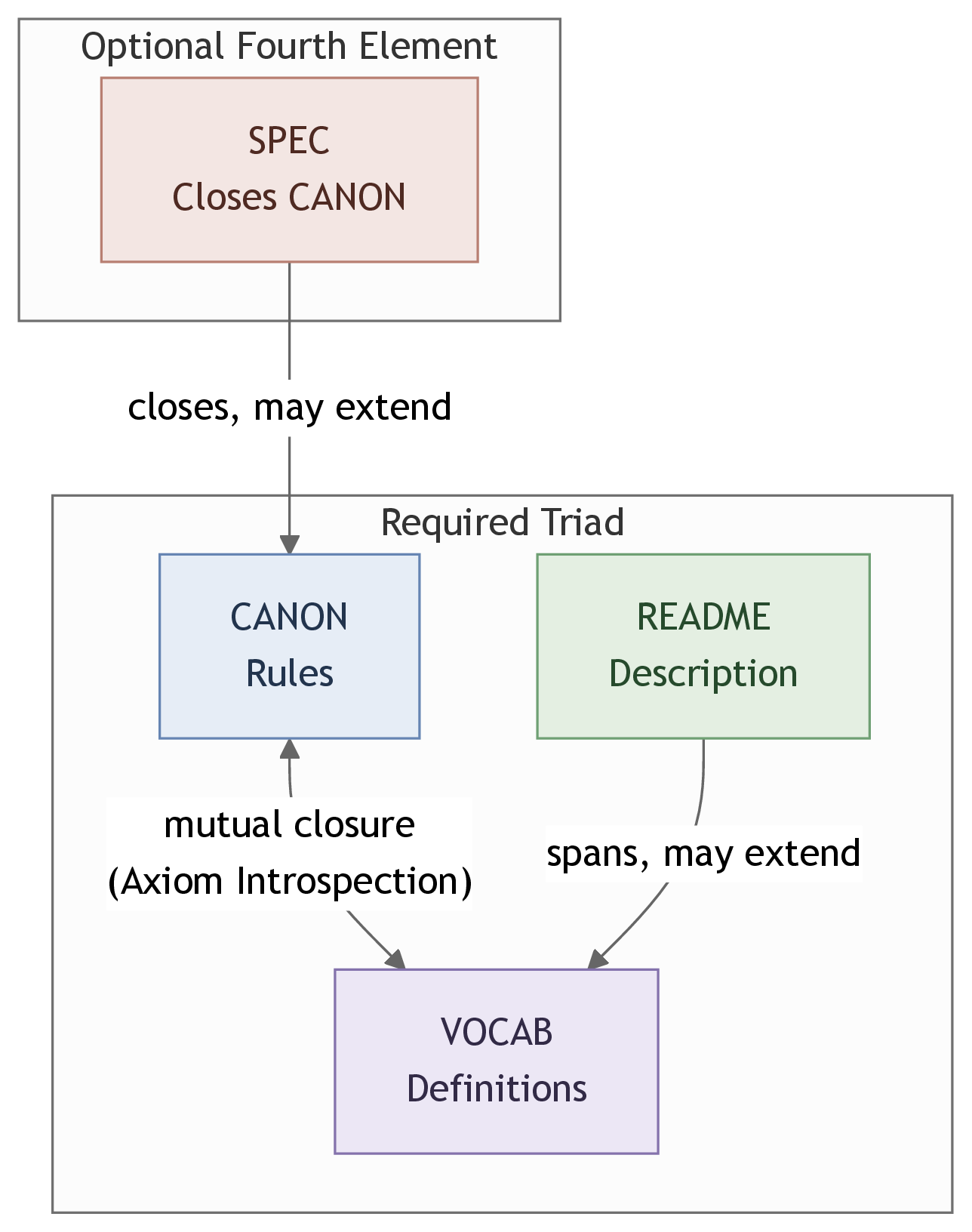
Axiom 0, Triad. A governed unit MUST contain three files: (governance), (semantics), and (description).
Axiom 1, Inheritance. Every MUST declare its parent scope. Inheritance chains MUST terminate at root. Inherited rules are final.
Axiom 2, Introspection. MUST define every concept used in and in itself.
These three axioms are put forward as a sufficient governance basis for the corpus reported here rather than a proven-complete one. Two of the three properties we claim for them are discharged in Appendix B by explicit counterexample: they are independent (Theorem 4, none is derivable from the others) and minimal (Theorem 5, removing any one breaks a closure property developed below). The third property, exhaustiveness, that every further governance rule reduces to a consequence of the three, is an empirical observation over our roughly one-month window, not a theorem; we state it as a design hypothesis and flag in §7 that a rule outside the three would falsify it.
We unpack each axiom in turn.
0.3.1 The Triad axiom↩︎
A governed unit is called a scope, and a scope is simply a directory in a filesystem. The triad is the minimal set of files that make governance possible (Table 2):
Table 2 The three required files of a governed scope (the Triad). CANON, VOCAB, and README, and the role each plays.
| File | Role | Contains |
|---|---|---|
| CANON.md | Governance | Axioms: what MUST be true |
| VOCAB.md | Semantics | Definitions: what terms mean |
| README.md | Description | Documentation: what this is |
Three files are required because governance requires a separation of concerns. The canon file is normative and prescribes the rules; the readme file is descriptive and explains the purpose of the scope; the vocabulary file bridges the two by ensuring that the rules use defined terms. Collapsing these roles into a single document invites predictable failure modes, in which documentation accidentally governs, governance accidentally describes, or the same term carries different meanings in different parts of the tree.
The triad therefore enforces separation by construction. A scope that is missing any of the three files is not merely incomplete or deprecated; it is structurally malformed, and the compiler refuses to build it.
0.3.2 The Inheritance axiom↩︎
Scopes exist in hierarchies. A scope at inherits from , which in turn inherits from at the root. The inheritance chain defines the flow of authority, and child scopes cannot override the axioms of their parents.
The finality of inherited axioms is a constitutional necessity rather than a design preference, and it is worth pausing to consider why a more permissive arrangement would be incompatible with the governance properties we want the framework to guarantee. If child scopes were free to override the axioms of their parents, authority would fragment across the tree, and different branches of the hierarchy could establish mutually contradictory rules without any mechanism for detecting or reconciling the contradiction. The resulting structure would not in any meaningful sense be a governed system, since inheritance combined with arbitrary override reduces to anarchy that has merely accumulated additional ceremony.
Inherited axioms are therefore final within the scope of any descendant, and this finality is what allows the framework to make stable guarantees about properties such as evidence-traceability and vocabulary-closure across the entire governed tree. A child scope retains the freedom to extend governance by introducing new axioms of its own that apply locally to its own descendants, but it cannot modify or relax the axioms that it inherits from any ancestor in the chain that runs back to the root. The constitution declared at the root of the tree therefore binds every descendant scope without exception, which is the precise sense in which we mean that the framework is constitutional rather than merely conventional.
0.3.3 The Introspection axiom↩︎
The vocabulary must define itself. If a canon file uses the term scope, the vocabulary file at the same scope must contain a definition of scope. If that definition itself uses the term axiom, the vocabulary file must also define axiom. The closure is reflexive: the vocabulary is required to cover not only the canon it serves but also the language in which it is itself written.
The effect is to eliminate undefined terms, jargon drift, and authority borrowed from concepts that mean different things to different readers: every term used in governed text must resolve to a definition at the appropriate scope, and the validator rejects any reference whose target is missing. Introspection therefore makes content accountable to a stated vocabulary. It does not, however, make slop inadmissible; a producer can satisfy closure vacuously with circular definitions, since the gate checks that a term is defined, not that the definition is informative. We name this and the other vacuous-satisfaction attacks below, and in §5 we measure their effect: structural admission turns out to carry no information about whether an admitted claim is true.
0.3.4 The validation gates↩︎
Claims move through three gates. Failure at any gate renders the content invalid. Figure 2 traces the pipeline from a candidate claim through three structural checks to either ACCEPT or REJECT.
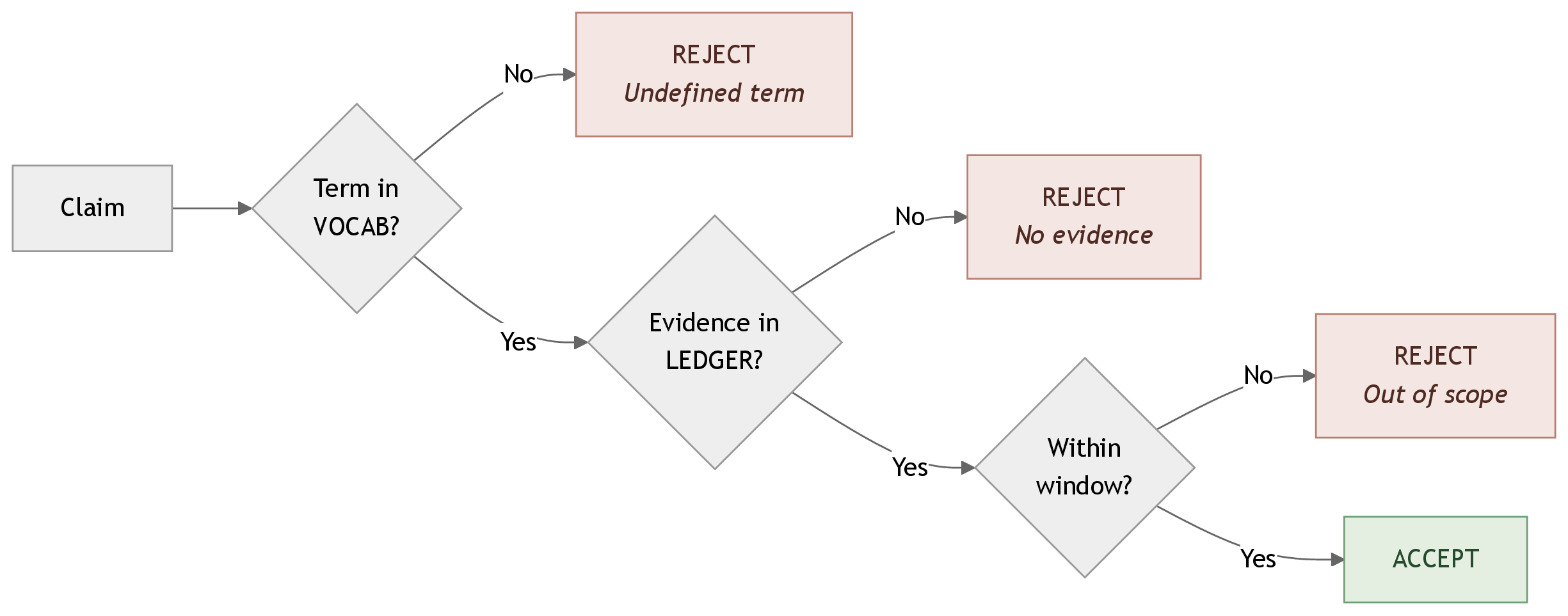
Gate 1: Vocabulary. Does the claim use terms defined in the scope’s ? Undefined jargon fails at this gate, and the model cannot introduce terminology that humans have not sanctioned.
Gate 2: Evidence. Does the claim cite something in the ledger? A ledger is an append-only record, implemented here as a git repository. Assertions without commits carry no evidence, and they fail.
Gate 3: Scope. Is the evidence within the declared window? Every paper declares its evidence bounds, and claims about evidence outside that window are inadmissible.
The gates are structural rather than evaluative. Validators do not assess quality. They check presence. Either a term is defined or it is not, and either evidence exists or it does not. Binary validity eliminates judgment calls.
Structural admission is the load-bearing mechanism of the framework, and it is worth distinguishing carefully from the post-hoc quality filters that downstream consumers of AI-generated content typically rely upon. The structural gate is not a quality filter applied after the fact; malformed content is rejected at the gate itself, so unanchored material, a claim with no defined term, no recorded evidence, no declared provenance, never enters the corpus and never needs to be filtered out of it. The principle, and its limit, are exactly a compiler’s: a compiler does not evaluate whether the code it receives is correct, only whether it is structurally valid against the language specification, and CANONIC inherits both that guarantee and that boundary. A governed artifact compiles when every claim it makes is anchored, to a definition, to a commit, to the declared window, and admission is a binary compilation outcome that either succeeds or fails. What admission is not is a warrant of truth. A false statement that is nonetheless anchored to a mistaken or fabricated source will compile, exactly as a well-typed program can still compute the wrong answer. The gate bounds what can be unaccountable, not what can be wrong; we make this boundary precise, and adversarial, in the next subsection and again in §7.
0.3.5 Adversarial admission↩︎
The gates check for presence, and a presence check rewards whoever supplies presence. The property that makes admission decidable also bounds what it can guarantee: an adversary who knows the grammar can satisfy it vacuously. Three attacks are worth naming because each defeats one gate without supplying the content the gate is meant to stand in for. Vocabulary padding defeats the introspection gate, a producer can define every term it uses, however circularly (“X: guidance pertaining to X”), and close the gate without conveying meaning, because closure verifies that a term is defined, not that the definition is informative. Evidence fabrication defeats the anchoring gate, the gate verifies that a cited commit exists, not that the commit records a true observation, so a hallucinated finding written into a real commit compiles, now bearing a hash and the false authority that a hash confers. Window shopping defeats the evidence-window constraint, because the window is author-declared, a producer can choose the interval that flatters the claim. None of these is hypothetical for the corpus reported here. Its evidence is an n=1, self-authored artifact validated by validators the authors wrote, on content the authors had every incentive to make compile (§7); producer, validator, and evidence are the same party, which is the weakest possible adversary model. CANONIC raises the cost of unaccountable content, every claim must name a source that exists, but it does not raise the cost of accountable falsehood. Closing that gap is not a matter of adding more presence checks. It requires validators that score the informativeness of a definition and the fidelity of evidence to the claim it anchors, together with independent parties to run them. §5 measures exactly this gap with an independent, cross-provider benchmark and finds it large: structural admission is statistically independent of truth, and an adversary optimizing against the semantic check halves its catch rate. We regard closing that gap, not any figure in the construction census, as the framework’s principal open problem.
0.3.6 Provenance: how the axioms were discovered↩︎
The three axioms emerged from practice, not theory. On December 29, 2025, the first governance file (named , later corrected to once the doubled consonant was caught) was committed at to the Dividends & Deaths repository, a book on the economics of precision medicine [17]. The conversation that produced it ran in OpenAI’s ChatGPT, content-addressed in the evidence store with its sha256 digest recorded in the Evidence Ledger (§ Context Anchors). The genesis is therefore anchored twice over: the commit fixes the canon, and the hash fixes the context that authored it. It declared three rules for a fast-growing manuscript: law is separate from narrative; an uppercase filename signals cross-asset scope; prose is canonical only if it traces to an asset. Drafted for one book, the rules generalized over the month that followed to govern any structured content under model authorship. By the window close they had induced governed analogs of roughly fifty years of computing infrastructure: ten repositories and twenty governed scopes standing in for an operating system, an immutability layer, a distribution channel, and a token economy. The claim is deliberately narrow. A scope named for a token economy declares the rules such an economy must obey. It does not mint tokens. What the three rules compiled into was structure, not systems. The genesis commit and each layer’s founding commit are git-anchored in Table 4.
0.4 4 Formalization↩︎
The CANONIC parallel to compiler theory is not a loose analogy. It is a formal correspondence. We state the load-bearing objects here and defer the proofs to Appendix B. A scope is the unit of governance: a directory carrying the Triad, a declared parent, and a set of definitions. A scope is valid when its Triad is present, its inheritance chain terminates at the root, and every term it uses resolves to a definition along that chain (Definition 4, Appendix B). Admission is the decision of that predicate, and it is decidable in one linear pass.
Algorithm 1 is the admission procedure. Its three phases realize the three axioms in order: a constant-time check that the Triad is present (syntax), a bounded walk to the root with cycle detection (scope resolution), and a finite test that every term resolves to a definition over the inheritance closure (type system).
Algorithm 1  validate(scope) — structural admission of a governed scope
Input:  scope S = (P, T, A, V)        # path, triad, axioms, definitions
Output: VALID | INVALID
Cost:   O(n), n = total size of files in the inheritance chain

 1  # Triad (syntax):              O(1)
 2  if not {CANON.md, VOCAB.md, README.md} subset of files(P):
 3      return INVALID
 4  # Inheritance (scope resolution):  O(d), d = chain depth
 5  chain := []
 6  current := S
 7  while current != root:
 8      if current in chain: return INVALID      # cycle never reaches root
 9      chain.append(current); current := parent(current)
10  # Introspection (type system):  O(n)
11  defs  := union(definitions(v) for v in chain)
12  terms := union(terms(c) for c in chain) | union(terms(v) for v in chain)
13  if not terms subset of defs: return INVALID  # a term resolves to no definition
14  return VALID
The check is binary and evaluative of presence, not quality: it admits anchored content and rejects unanchored content, but it does not assess whether an anchored claim is true (§3, the adversarial-admission subsection). The three governance axioms (Triad, Inheritance, and Introspection) map one-to-one onto the three pillars of classical compiler design: syntax, scope resolution, and the type system (Table 3).
Table 3 The three CANONIC axioms mapped one-to-one onto classical compiler-theory pillars.
Figure 5: |
Figure 6: |

|
|---|---|---|
| Triad | Syntax | What structures must exist in valid programs |
| Inheritance | Scope Resolution | Where names resolve; binding rules |
| Introspection | Type System | What terms must be defined; semantic constraints |
 .
.  .
. These pillars are textbook material. Chomsky formalized syntax in 1956 [18], Johnston gave the contour model for block-structured scope resolution in 1971 [19], and Milner published a theory of type polymorphism in 1978 [20]; the unified treatment in Aho, Lam, Sethi, and Ullman [16], the Dragon Book, has been classroom canon for two decades. The three axioms recover the structure of these pillars, reached through governance constraints rather than through programming-language research. A language specification defines which programs are valid; the CANONIC validators define which governance structures are valid by analogous machinery, so the correspondence is structural rather than merely terminological. It is, however, a correspondence and not an isomorphism, and Appendix B is careful about the difference: the content “grammar” of the triad is a finite well-formedness checklist rather than a recursive language, and the type-system analogy shares the closure property of the Hindley–Milner system without its inference. What the correspondence buys is a precise vocabulary and a decidable admission procedure (Appendix B.4), not a claim that governance and compilation are the same object.
This correspondence carries a corollary: governance axioms can generate computing infrastructure.
The corresponding historical layers in computing infrastructure accreted over decades: the Unix kernel in 1969, POSIX operating-system standards in 1988, the iOS App Store distribution model in 2008, and Bitcoin’s immutable ledger in 2009, each requiring years of development, standardization, and adoption. CANONIC derived analogous structures on a much shorter timeline, and the claim is checkable: each layer below is anchored to the first commit that created it in the public organization, so the date is the commit’s date, not a rounded estimate (Table 4).
Table 4 Computing-infrastructure layers anchored to their founding commits. The genesis — the original , before the doubled consonant was corrected — is in the proto-CANONIC repository; the CANONIC layers follow in the public CANONIC GitHub organizations. Each date is the first commit in the named repository (verify with ), making the compressed-timeline claim reproducible rather than rhetorical.
Figure 7: |
Figure 8: |
Figure 9: |

|
|---|---|---|---|
| CANNON (proto-CANONIC genesis) | @ | -12-29 | |
| Kernel (the three axioms) | @ | -01-05 | |
| Operating System | decades | @ | -01-10 |
| Immutability layer | years | @ | -01-10 |
| Distribution / composition | years | @ | -01-12 |
| Token economy | years | @ | -01-30 |
 .
.  .
.  .
. The genesis row anchors §3: the first landed in the Dividends & Deaths book repository on December 29, 2025. Read top to bottom, the table is a month of computing history in fast-forward, kernel, operating system, immutability, distribution, closing with the token economy, whose COIN primitive entered governance on January 30. Every row resolves to a commit a reader can check. The date is the founding commit, not a rounded estimate. The token economy is simply the last era to arrive, the layer that closes the month, not an exception bolted on after the fact.
The compression is not the result of building five systems in parallel but of deriving five views from one kernel. The three axioms, applied recursively, generate the structure each layer requires, so every additional infrastructure layer is a governed scope inheriting from its parent rather than an independent engineering effort. What collapses into three weeks is the governance skeleton of decades of compiler-theoretic and systems work, the shared structure of declaration, scope, and closure, recovered by composition, not the implementations themselves.
0.4.1 The language specification↩︎
CANONIC v0.1 includes a formal language specification. v0.1 is the formal specification of governed content.
The specification follows conventions from established programming-language designs, those of Ritchie [21], Gosling [22], Bradbury [23], and Klabnik [24], while introducing governance-specific constructs.
0.4.2 The scope-template grammar↩︎
Every governed directory follows a template:
{SCOPE}/
    CANON.md      -- what MUST be (LAW)
    VOCAB.md      -- what words mean
    README.md     -- what this is
    COVERAGE.md   -- what's missing
    {SCOPE}.md    -- SPECialized SCOPE (STORY)
The filename is a template variable; the directory name becomes the specification filename. For directory , the specification is . For directory , the specification is .
The naming convention creates a self-referential closure that we consider load-bearing for the broader claim that the framework is genuinely constitutional rather than merely procedural. The root directory of the system is , and the specification that governs that root is consequently , which means that the framework which governs governance is itself a governed artifact subject to the same axioms it imposes on its descendants. The language can therefore describe its own scope and submit to its own verifiers without invoking any external authority, and the resulting closure is structural in the sense that it is enforced by the compiler rather than rhetorical in the sense that it merely claims to hold.
Within each governed scope the two files play complementary roles, since carries the law of that scope while carries the story that makes that law intelligible to a human reader who arrives without prior context. The file contains axioms, by which we mean the normative rules that govern the scope and that state what must be true of any artifact admitted under it, and it deliberately excludes the lifecycle history, prior rationale, or evolutionary commentary that a reader might otherwise expect in a single combined document. The companion file closes that gap by providing exactly the context that makes the axioms reproducible in practice, including the scope’s purpose, its lifecycle phase, the evidence window over which its claims are valid, and the validation instructions that allow an independent reader to confirm the claims. The bundle therefore constitutes the minimal reproducible governance unit of the framework, and neither file is complete or interpretable without the other.
0.4.3 The governance loop↩︎
Production under CANONIC follows a closed loop. The producing model generates artifacts, and CANONIC validators check the three axioms (Triad, Inheritance, Introspection). Any output that would otherwise be AI slop is rejected before it leaves the gate. The pattern recurs at every layer: humans declare canon, AI produces artifacts, validators check against canon, and the ledger records the result. Nothing enters production without passing validation, and nothing in the ledger lacks a human-authored canon entry behind it. Figure 3 diagrams this loop and the one-way arrow that holds it together.
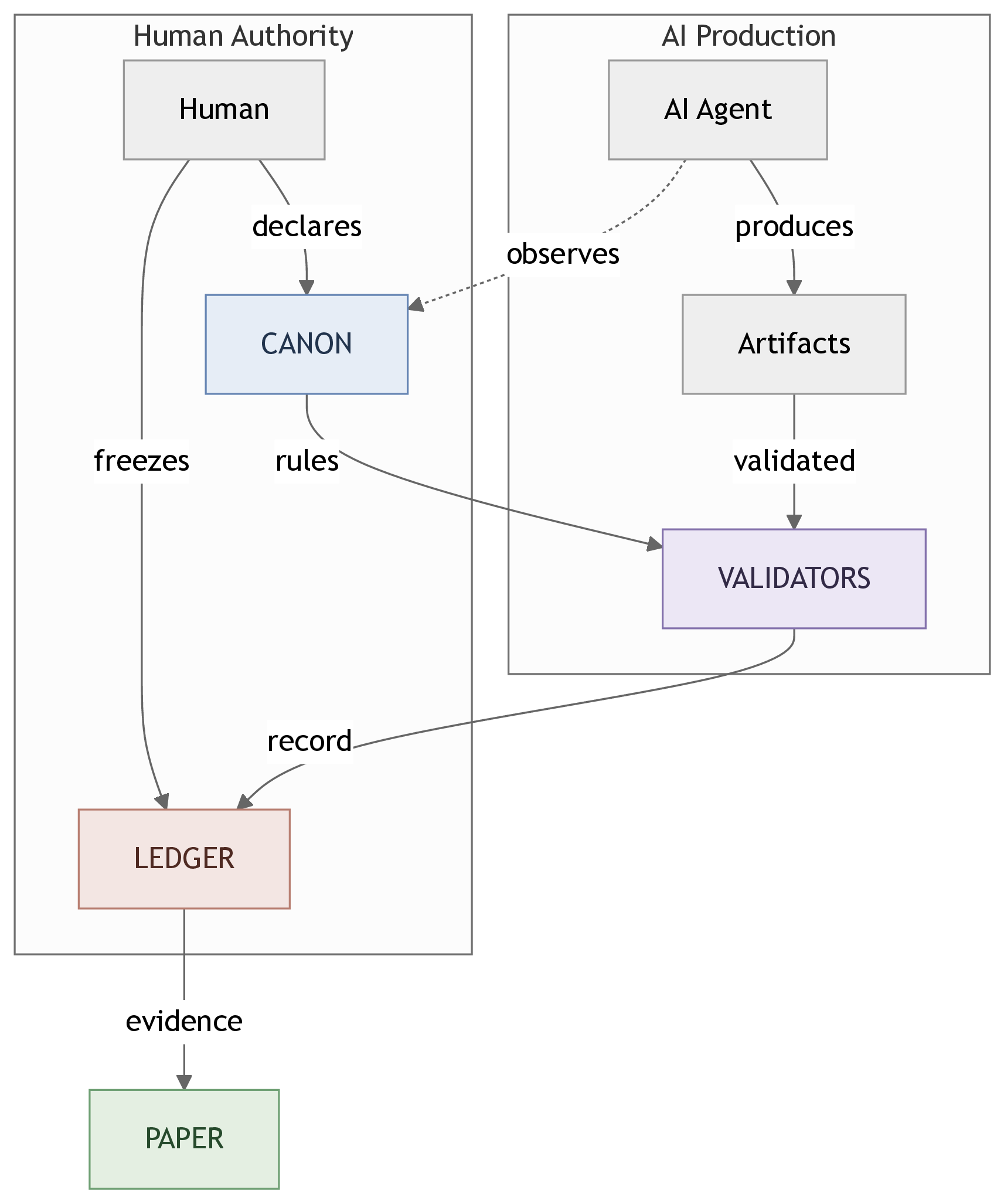
The dotted line records the architectural asymmetry of the system. AI observes canon but cannot modify it, and this is not a permission setting the operator could flip. Governance files live in human-controlled repositories, and AI sessions read those repositories while writing only to governed workspaces. Write access to canon is exclusive to humans, and that exclusivity is constitutional rather than configurable. We call this arrangement AI-First, Human-Governed. The corollary is that AI can draft, propose, analyze, and critique without limit, but it cannot canonify. Canonification, the act of elevating an observed pattern to law, is reserved for human judgment, and before that act a pattern is a suggestion rather than a rule.
The asymmetry has a temporal edge, and the genesis makes it concrete. That first conversation ran in OpenAI’s ChatGPT, and the framework month that followed was produced with Anthropic’s Claude, the same migration the wider market made over the same window. The producing agent was never constant, and it left no binding trace when it turned over. What persisted instead is the pair of anchors introduced with the genesis above: the commit that fixes the canon and the content hash that fixes the context that authored it, the first held in git and the second in the content-addressed store, both public and both durable. No line of canon moved when the model changed. Governance, on this reading, is not a constraint laid over production but the form production’s evolution takes. The agent turns over and the market turns over with it, while the governed corpus is what survives the turnover, citable to the commit and to the hash alike.
0.5 5 Evaluation↩︎
We bound every claim to an evidence window of December 29, 2025 through January 30, 2026, roughly a month from the day after Oxford Languages named “AI slop” Word of the Year. Every assertion below is bounded by that window, and the full ledger of AI-collaboration sessions inside it is public, from the ChatGPT genesis through the Claude construction month.
Claims pertain only to evidence within this window. Bounding the scope lets readers know exactly what the paper covers and verify coverage independently.
0.5.1 Does structural admission filter slop? A controlled benchmark↩︎
The construction reported below shows that the framework validates itself: every scope satisfies the three axioms. But a scope passing its own validators is no more evidence that the gate keeps slop out than a program compiling is evidence that it is correct; and the construction is, by §3’s own admission, n=1 and self-authored, with producer, validator, and evidence the same party. We therefore evaluate what the gates do with a separate, pre-registered, cross-provider benchmark (June 2026), declared here as a later measurement that modifies no window-close count.
Admission is framed as a binary classifier and scored by its association with content-truth — the Matthews correlation φ between a gate’s accept/reject decision and an independent slop/legit label, where φ = 0 means the decision carries no information about truth — rather than by self-reported pass rates. Labels come from a three-family panel (DeepSeek, OpenAI gpt-4o, Anthropic claude-sonnet) judging prose alone (Fleiss’ κ = 0.91); adversarial content is produced by a different model family than the one that authored CANONIC; and the structural validators are re-implemented from the published axioms (Appendix A), so producer, validator, and judge are no longer the same party. We compare four gates — structural admission (the three axioms, T), retrieval-similarity grounding against the governed corpus (B3), retrieve-then-entail grounding (B3e), and a frontier semantic judge (B2) — across four regimes (Table 5).
Table 5 Gate association with content-truth (Matthews φ; 0 = independent of truth) across four regimes. Cross-provider, pre-registered; 95% CIs and per-source detail in the released harness.
Figure 11: |
Figure 12: |
Figure 13: |
Figure 14: |

|
|---|---|---|---|---|
| Synthetic, non-adversarial (n=480) | φ −0.01 | φ 0.02 | φ 0.87 | |
| Synthetic, adversarial (n=62) | admits 0.98 | catch 0.88→0.48; 37% combined leak | ||
| Novel bespoke domain (n=124) | φ 0.00 | φ 0.09 | φ 0.41 (LOO) | φ 0.02 |
| Real-world: retracted / predatory / farm (n=47) | φ 0.00 | φ −0.20 | φ 0.27; 0% of fraud flagged by panel |
 .
.  .
.  .
.  .
. Three findings hold across the regimes. First, structural admission is statistically independent of truth (φ = −0.01 on a balanced 2×2, 95% CI bracketing zero; odds ratio ≈ 1): the gate accepts anchored content and rejects unanchored content, but whether an anchored claim is true is invisible to it, exactly the boundary §3 draws, now measured rather than asserted, and a direct refutation of any reading on which the three axioms make slop inadmissible. Second, semantic judgment tracks truth only where the judge has domain expertise: a frontier judge that separated slop from legit at φ = 0.87 on generic content collapsed to φ = 0.02 on the novel CANONIC domain — it cannot tell real bespoke content from fabricated bespoke content — and an adversary optimizing against it halved its catch rate (0.88 → 0.48), with 37% of adversarial slop passing structure and semantics together; the most effective attacks were fluent-but-unsupported mechanism, fabricated citations, and authoritative tone. Third, only grounding that verifies entailment against an evidence corpus adds signal where expertise is absent: retrieve-then-entail was the single gate with positive truth-association in the novel-domain regime and detected fabrication perfectly, but it is bound by corpus coverage and cannot ground genuine novelty: under leave-one-out it false-rejects 72% of true claims, because a corpus that excludes a claim contains no independent support for it. (We flag an evaluation-leakage artifact for replicators: scored naively, with the held-out claims left in the index, the same gate reads φ = 1.0; the honest figure is 0.41. Never evaluate a grounding gate on items drawn from its own index.)
The real-world arm is the sharpest. On genuine retracted-for-fraud abstracts, the three-model panel labeled none as slop and the semantic judge caught 17%, because the fraud is in the data, not the prose: the text reads as legitimate science. The gates catch the slop that is easy to catch (content-farm prose: 100%) and miss the slop that is dangerous (fabricated data, fluent fabrication). The conclusion the whole battery supports is not that one gate beats the others but that no prose-reading gate reliably separates reliable from unreliable content, because the highest-stakes unreliability is surface-legitimate and genuine novelty cannot be grounded; both are verdicts only domain expertise can render. What remains achievable — and what CANONIC delivers — is accountability: every admitted claim anchored to a definition, a commit, and a window, so the slop verdict, which stays with the expert, is rendered over a checkable ledger rather than over unverifiable prose, and unreliable content cannot be unaccountable even when it is wrong. The full harness, the pre-registration (, fixed before any run), and the per-regime results are released at .
0.5.2 Construction census↩︎
The figures below count what the construction produced and confirm that it validates itself; they are a census, not an efficacy measure. the benchmark above, not these counts, is the evidence about what the gates filter. Table 6 reports the state at the window close, the commit that declared the token economy on January 30, 2026, and each figure is independently checkable against the public artifacts at that ref. We report what existed when the construction window closed, not what the corpus has grown into since; the difference between the two is itself governed, and we return to it below.
Table 6 Window-close metrics and how each is independently verified at the closing ref.
Figure 15: |
Figure 16: |

|
|---|---|---|
| Repositories | across the orgs at the window-close ref | |
| Governed Scopes | ||
| Root Axioms | Triad, Inheritance, Introspection | |
| Development Span | ~1 month | December 29, 2025 — January 30, 2026 |
| Validation Status | PASS |
 .
.  .
. Each metric has a reproducible verification method that any reader can run after cloning the repositories and checking out the window-close ref, since the framework resists claims that cannot be checked against the artifact itself. A governed scope is simply a directory containing a file, so counting scopes reduces to a filesystem operation rather than an interpretive judgement. The counts above are the floors of the construction: ten repositories and twenty governed scopes had been declared by the time the token economy entered governance. The evidence layer, session transcripts, episodes, and invention disclosures, was declared in the window as governed scopes but had barely begun to fill: at the closing ref one episode file and no filed disclosures exist. That layer is the framework’s mechanism for accruing its own evidence, and it populated as the framework ran, as the live-count discussion below records.
0.5.3 Ecosystem composition↩︎
The twenty window-close scopes are almost entirely core governance: the three axioms, the validators they require, the language specification, and the induced analogs of an operating system, an immutability layer, a distribution channel, and a token economy (Table 4). There are no archive scopes yet; archives are what a governed corpus accumulates as surfaces retire, and at the window close nothing had retired. This is the canonical point of the construction: a governance framework is not a fixed inventory but a discipline for change. Run the same against the organizations at today and the count is in the hundreds; every scope added since resolves to its own governed commit, and the growth from twenty to that figure is the framework governing its own expansion. We report twenty as the window-close floor, and the live count as a separate, later measurement, precisely so the two are never conflated.
The construction was documented contemporaneously in the CANONIC blog series, itself a sequence of git-resolvable posts written as the work happened: the December 29 genesis [17], the nine-repository milestone of mid-January [25], and the velocity record we call the exponential [26]. We cite that series as the real-time record, with one caveat we make explicit here because this paper is fixed by a DOI while the posts are not. Written in the moment, several posts report figures in rounded or narrative form, and a number of those figures are the cumulative totals of the still-growing corpus reported as if they were the founding-window state; the same conflation we correct above for the scope count, recurring across the contemporaneous record for commit velocities and for organization and repository tallies. Where any figure in that series diverges from the git-resolved counts in this paper, evaluated at the window-close ref (Appendix C), the counts here are authoritative. This paper is the corrected record.
0.5.4 Validation state↩︎
Running the validator on the repository at returns the live count, grown past the twenty-scope window-close floor of Table 6 as the corpus accreted:
=== VaaS - CANONIC Language Enforcement ===
Repository: canonic
Scopes found: 21
...
VALIDITY: PASS
Every scope passes, meaning each one satisfies all three axioms: the triad is present, inheritance is declared, and the vocabulary is closed.
Two further properties of the construction bear on its evaluation, and we record them here rather than leave them implicit: the framework validates itself, and it runs on commodity infrastructure.
0.5.5 Self-application and the Foundation↩︎
The CANONIC Foundation, a 501(c)(3) nonprofit incorporated to host the governance framework documented in this paper, operates under the same compiler-theoretic constraints it enforces on downstream artifacts, a property we refer to as self-application and which determines the institutional posture of the organization at canonic.org. The artifacts produced under this governance are themselves governed content subject to the same gates: a clinical-evidence analysis of 77,388 trials posted as a preprint [27], and the long-form governed corpus that documents the framework for its two principals, the developer and the governor [28], are both compiled through the validators described here, not exempt from them. The framework is stewarded by the Foundation rather than by any single operator or vendor, and the stewardship relation is itself a governed scope whose CANON and validators are subject to the same reproducibility, evidence-window, and lifecycle requirements imposed on every other scope in the system.
Self-application has a precise technical reading. The manuscript that describes CANONIC is itself a governed artifact: its CANON file declares the constraints under which it is admissible, its validators are drawn from the same registry used to admit any other manuscript, and its distribution channels were discovered by the same channel-discovery procedure the Foundation applies to unrelated downstream artifacts. The system that the paper documents is therefore not merely described by the paper but is, at the level of build and validation, the producer of the paper, so that the closure between describing system and described system is a structural property rather than a rhetorical one.
The economic loop that sustains the Foundation closes through the same governed pipeline. Each session transcript enters the evidence layer as a typed artifact; transcripts aggregate into episodes that satisfy the evidence-window requirements of patent practice; episodes generate invention disclosures that the Foundation files as provisional and non-provisional applications; and the resulting intellectual property is exchanged through the COIN ledger for the operating capital that funds subsequent sessions. The cycle runs from transcript to episode to disclosure to coin and back to transcript, and it is the mechanism by which the framework underwrites its own continued development without recourse to external custodianship.
0.5.6 GitHub as substrate↩︎
The decision to host CANONIC governance artifacts on GitHub exposed a latent property of the platform: a single substrate already provides hosting, version-controlled immutability, continuous integration, billing infrastructure via Sponsors, public verification surfaces, and global distribution, six functions that together approximate the role of an operating system for governed-content artifacts. The ten repositories and twenty governed scopes produced during the construction window, hosted under the canonic-machine and canonic-magic organizations, were documented across the collaboration sessions against this substrate, and an architectural review surfaced the observation as a structural rather than incidental property of the deployment.
Figure 4 contrasts the components a comparable project would otherwise have to construct against the components GitHub supplies out of the box.
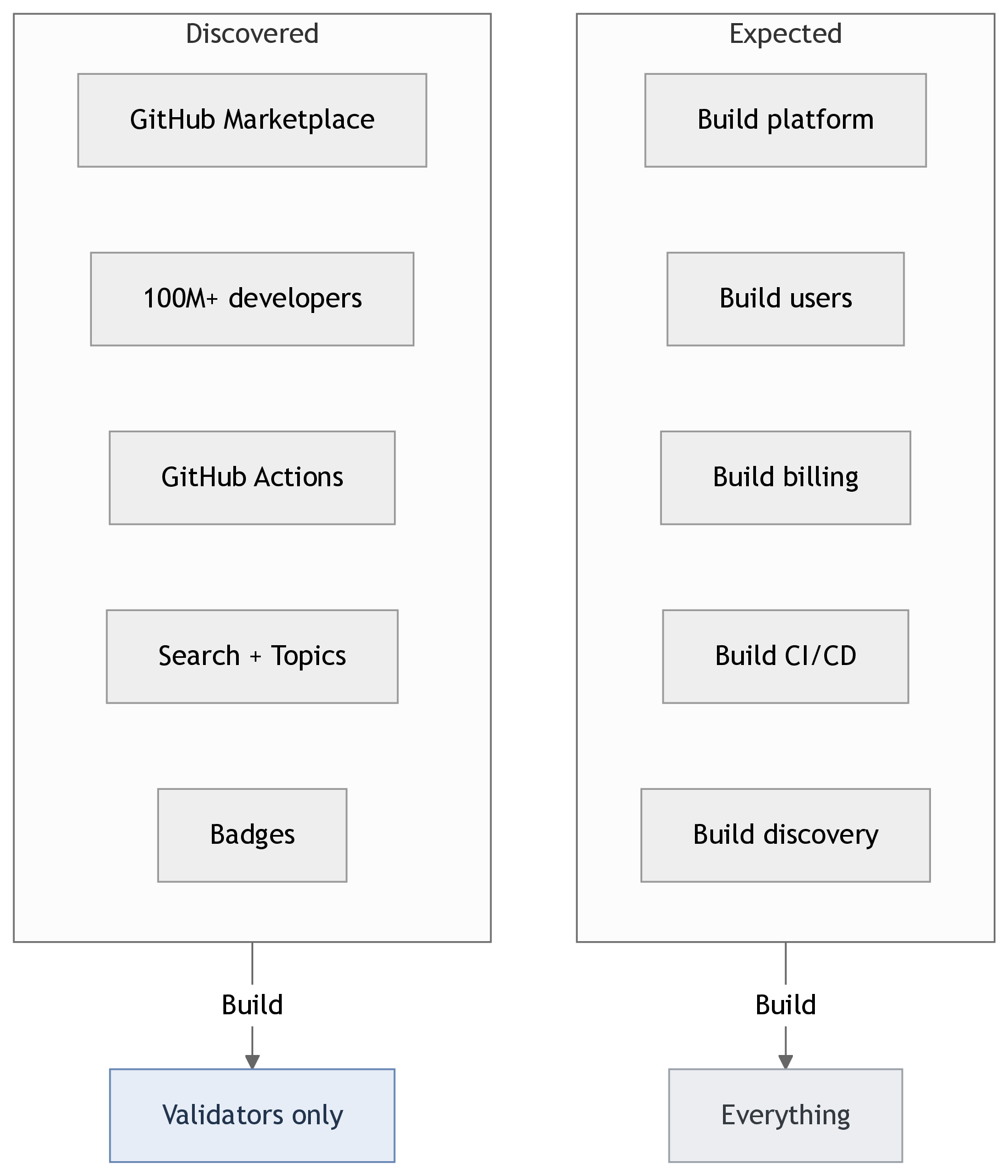
The platform supplies hosting through the repository surface itself, distribution through the Marketplace and topic-indexed search infrastructure, continuous integration through GitHub Actions, billing through GitHub Sponsors, an immutability guarantee through the append-only commit graph that records every state transition, and a public verification surface through the rendered repository view that any reader can inspect without authentication. The residual component required from CANONIC under this arrangement is therefore validation alone, which the framework contributes as a reusable Action that downstream repositories consume through a configuration file, as illustrated by the following workflow snippet:
name:CANONIC Validation on:[push] jobs: validate: runs-on:ubuntu-latest steps: -uses:canonic-machine/vaas-action@v1
Repositories that pass validation render a status badge whose URL resolves to the corresponding validator run, allowing third parties to confirm compliance without local execution of the validator suite. The arrangement collapses the boundary between supplemental material and primary artifact: every repository cited in this manuscript is hosted under the canonic-machine, canonic-magic, or canonic-canonic organizations, per-repository visibility is governed by the LICENSE and NOTICE files committed in each tree, every cited assertion is reproducible by clone where licensing permits, and every validator invocation is independently re-executable against the same commit graph that the manuscript references.
The recursive property of the arrangement is that the manuscript documenting the architecture was itself authored under CANONIC governance, validated by the same validators it describes, and distributed through the substrate it analyzes, a closure in which the artifact, the evidence, and the verification surface coexist on a single platform rather than across the conventional separation of paper, supplement, and code repository. Treating GitHub as the substrate, rather than as one of several deployment targets, removes the engineering effort that would otherwise be required to assemble an equivalent stack and reduces the trust surface for external verifiers to a single well-understood platform with documented immutability and access semantics.
0.6 6 Related Work↩︎
Relocating verification to a gate at the point of admission has partial precedents; CANONIC generalizes them by governing the content artifact itself against a formal grammar at the corpus boundary. Table 7 positions it against the closest systems on five axes: what each gates, when it acts, at what granularity, what audit trail it leaves, and where control sits.
Table 7 Where governance acts: CANONIC against related gating and provenance systems.
Figure 18: |
Figure 19: |
Figure 20: |
Figure 21: |
Figure 22: |

|
|---|---|---|---|---|---|
| Open Policy Agent / HashiCorp Sentinel [8] | infrastructure and config changes | pre-admission, at deploy time | per policy rule | deployment-side decision logs | policy engine in the CI/CD path |
| C2PA [9] | media files | at capture or edit | per asset | cryptographic manifest bound to the file | capture device or editor |
| Model and Data Cards [10] | disclosure about a model or dataset | post-hoc, at release | per model or dataset | static document, no enforced diff | author attestation |
| Study pre-registration [11] | an experimental protocol | pre-outcome | per study | timestamped registry entry | an external registry |
| Anthropic Constitutional AI [12] | model outputs, as a training signal | in training, pre-deployment | per response, absorbed into weights | none; the constitution lives in the weights | the decoder |
| CANONIC (this work) | the content artifact, against a formal grammar | pre-admission, at the corpus boundary | per claim: term, evidence, window | a git diff; every constitution change is inspectable | the corpus boundary, not the decoder |
 .
.  .
.  .
.  .
.  .
. Each prior system gates a single slice: a configuration change, a media file, a disclosure, a protocol, a model’s outputs. CANONIC differs in kind on the last row. It governs the published artifact against a versioned grammar, and control sits at the corpus boundary rather than in the decoder. The system nearest in name, Constitutional AI [12], is the farthest in mechanism: its constitution is a training signal absorbed into weights that leaves no audit trail when it changes, whereas CANONIC’s constitution is a git diff anyone can inspect.
0.7 7 Limitations↩︎
Several claims fall outside what this paper establishes, and we want to mark them plainly rather than leave them to be inferred. The three axioms we identify are sufficient for the domain we studied, and Appendix B shows they are non-redundant, each is load-bearing (Theorem 5), but we do not show they are globally minimal: we do not prove that no smaller or differently shaped set would suffice. We chose them because they emerged from operating practice across the evidence window, not because we derived them from a proof of necessity. Other configurations of axioms may turn out to govern other domains equally well or better, and the work of finding them remains open.
CANONIC was built to govern governance specifications, and that is the only domain we have actually run it on. Does the same compile-and-enforce loop carry over to scientific datasets, legal contracts, or software? We do not know. It is an empirical question and we have not run the experiment. Scale is unproven too. Ten repositories and twenty scopes at the window close is not thousands of repositories and millions of scopes, and the engineering at that size will surface problems we have not met. The specification is young: LANGUAGE.md sits at version 0.1, it has known gaps, and we expect it to bend as new domains push on its primitives.
The substrate is also single-node by construction. Everything reported here ran on one developer’s machine, with governance enforced at commit time against local and GitHub-hosted repositories, the founding era, which internally we call the canonic-machine era after the organization that held it. That era closed when its nine repositories were sealed in late January, and its closing set the pattern for the development model that followed: era-based, each subsequent era extending the governed corpus rather than rewriting it, which is why the live counts dwarf the window-close floor (§5). A distributed deployment was planned from that point forward and is today realized as a Docker-based distributed CANONIC, in which the same governance primitives run as containerized services across nodes. That system is deliberately out of scope here. This paper establishes the compiler-theoretic primitives it is built on (the Triad, the inheritance chain, the introspection contract, and the commit-time gate), and we mark the boundary rather than cross it: nothing in the distributed system is offered as evidence for the claims made here, and nothing here depends on it.
Everything we report sits inside one window, December 29, 2025 to January 30, 2026. Anything outside it is not evidence for these claims.
0.8 8 Conclusion↩︎
One move organizes the paper: treat admission as compilation — a mechanical, decidable decision about well-formedness made at the corpus boundary, before publication, separate in kind from a judgment of truth made after it. The three axioms (Triad, Inheritance, Introspection) recover, through governance constraints rather than language design, the structure of a compiler’s syntax, scope-resolution, and type-system layers, and they make admission a linear-time pass-or-fail rather than a reviewer’s verdict. A compiler does not prove a program correct. It guarantees the program is well-formed enough to reason about. That, precisely, is what CANONIC offers a corpus: governed intelligence that compiles digital artifacts into an evidence ledger at scale. The structural gate and the expert’s verdict are not competing approaches. They are complementary: the gate guarantees the record, and over that record domain expertise renders the verdict.
We were careful to ask what that buys, and to answer it adversarially rather than by assertion. A pre-registered, cross-provider benchmark across non-adversarial synthetic, adversarial, novel-domain, and real-world content returns a consistent and clarifying result: structural admission is statistically independent of truth (φ ≈ 0), retrieval-similarity grounding is likewise orthogonal to truth, semantic judgment tracks truth only where the judge knows the domain and is halved by fluent fabrication, and on real retracted-for-fraud abstracts a frontier panel flags none. No prose-reading gate reliably keeps slop out, because the dangerous failures (fabricated data, fluent fabrication) are surface-legitimate, and genuine novelty cannot be grounded against a corpus that does not yet contain it; both are verdicts only domain expertise can render. The honest claim is therefore not that CANONIC makes slop inadmissible — that verdict belongs to the field, not to an algorithm; it is that CANONIC makes content accountable. Every admitted claim is anchored to a definition, a commit, and an evidence window (entries in an append-only, git-anchored ledger of work done that anyone can clone), so an unreliable artifact cannot be unaccountable: it can still be wrong, but it carries, by construction, the provenance that lets domain expertise converge on it, find it, contest it, and retract it.
Three limits bound what we can claim. First, the construction is n=1 and self-authored, one coordinating author with the Claude Opus models (4.5, then 4.7) over roughly a month; the benchmark restores independence to the sec:evaluation (cross-provider judges, a non-author adversary, validators rebuilt from the spec), but multi-author governance is still untested. Second, the benchmark’s adversaries are model families, not human red-teams, its slop is largely synthetic, and grounding was measured against a single corpus; the real-world arm is small. Third, the three axioms are the set that fell out of this corpus, not a proven floor, and a mechanized soundness proof for the validators remains future work. The contribution we stand behind is the accountability substrate and the measured map of where automated truth-filtering fails: deciding what counts as slop is a verdict of domain expertise — a matter of taste, not a property an algorithm computes — and CANONIC’s part is to maintain the source of truth that verdict is rendered over: a distributed, git-anchored ledger of work done in which the evidence behind every claim is reproducible, fully governed, and checkable end to end.
0.9 Author Context↩︎
This work emerges from two decades of research in precision medicine, data annotation, and clinical AI [29–38]. The problem of AI slop—content that sounds authoritative but lacks evidence—mirrors the challenge of biomedical data annotation at scale [30, 32]. Precision annotation of digital samples in NCBI’s Gene Expression Omnibus [30] required distinguishing validated labels from inferred ones. Large-scale semi-automated labeling of clinical records [32] required separating ground truth from approximation. The governance/description separation in CANONIC applies the same principle: what is LAW (CANON) versus what is DESCRIPTION (README).
Deep learning models for clinical diagnosis [34] surfaced a paradox that has shadowed the field: the more powerful a model becomes the more rigorous its validation must be if its outputs are to remain trustworthy in clinical use. A model that predicts Alzheimer’s disease from PET scans [35] or estimates delirium risk in intensive care [34] must trace every clinical claim back to the evidence that warrants it, because diagnostic confidence in the absence of provenance is indistinguishable from confabulation. CANONIC encodes that requirement into the substrate itself, treating traceability not as a best practice for careful teams but as a compilation requirement that every governed artifact must satisfy before it can be admitted to the corpus.
The MammoChat project [31, 33, 39] is where this all started. It pioneered patient-centered AI for breast cancer imaging during a period when most clinical AI systems treated the patient as a data source rather than as the principal whose interests the system was bound to serve. A $2M award from the Florida Department of Health’s Casey DeSantis Cancer Research Program funded it. Blockchain-based provenance ensured that patients retained ownership of the data that the system used to reason about them [31], and that property became the seed for a broader insight that CANONIC has since generalised. The framework extends the same logic to all governed content by binding every claim to cryptographic provenance through the underlying git substrate, with the ledger serving as the immutable record of every governance transition. CANONIC therefore emerged from practice rather than from theory, shaped by the operational constraints of handling real patient data in a setting where every claim carries clinical consequence.
0.10 Acknowledgments↩︎
The AI assistants that produced this work under governance are itemized in the AI-assistance disclosure below, which records both the OpenAI ChatGPT genesis conversation and the Anthropic Claude models of the construction window. Their contributions are recorded in the ledger with model-identity disclosure per CANONIC governance requirements.
The framework name honors the insight from Dividends & Deaths where the governance/description separation first emerged—originally as CANNON (with a typo), now as CANON.
0.10.1 Funding↩︎
This work builds on over $5M in NIH-funded research spanning two decades:
BD2K (Big Data to Knowledge) Awards: - NIH U01-LM012675: “Crowd-Assisted Deep Learning (CrADLe): Digital Curation to Translate Big Data into Precision Medicine” - NIH BD2K Crowdsourcing Award, NCI (2016) - STARGEO.org: Search Tag Analyze Resource for Gene Expression Omnibus
Recognition: - Inaugural Marcus Award for Precision Medicine Innovation, UCSF (2016) - $2M Casey DeSantis Cancer Research Program award, Florida Department of Health, for MammoChat (2025) — the patient-centered breast-cancer navigation platform from which the governance practice reported in this paper first emerged
Training: - MD/PhD in Genomics and Computational Biology, University of Pennsylvania - Clinical Pathology Residency, Stanford University - NIH-funded translational bioinformatics fellowship, UCSF (Butte Lab)
Institutional Support: - CANONIC Foundation (Founder and Chair, 2026–present) - American Board of Precision Medicine (Director of AI, 2024–present)
Former Institutional Positions (where prior work cited here was performed): - University of Central Florida, College of Medicine (2019–2025) [MammoChat, clinical AI] - University of California, San Francisco — Assistant Professor (2015–2019) [STARGEO, CrADLe, BACPAC] - Stanford University — Engineering Research Associate, Butte Lab (2013–2015) - Children’s Hospital of Philadelphia — Lead Clinical Genomics Analyst (2010–2012) - University of Pennsylvania — MD/PhD (1999–2009)
The governance patterns crystallized here were forged in the constraints of clinical AI where every claim must be defensible—from PennCNV [36] to precision annotation [30] to breast cancer imaging (Panahiazar [31, 33]). All funding is ledgered in NIH RePORTER. All publications are ledgered in PubMed. CANONIC extends this ledger to governance itself.
0.11 Disclosures↩︎
Competing interests. Dexter Hadley is Founder and Chair of the non-profit CANONIC Foundation and Director of AI at the American Board of Precision Medicine (ABOPM), a non-profit organization. These are unpaid leadership roles — the author receives no salary, equity, or other compensation — and are declared as non-financial competing interests, since the work described in this manuscript is the foundational thesis of the CANONIC Foundation, which the author leads. The author declares no financial competing interest with the cited references or with the AI vendors whose products this paper validates against. CANONIC is offered as Apache License 2.0 open-source governance; commercial follow-ons (VaaS — Validators as a Service) are tracked separately and are not cited in this paper as evidence.
AI-assistance disclosure. This manuscript was produced under CANONIC governance, and the producing agent changed across the evidence window in the way §4 describes. The December 29, 2025 genesis conversation ran in OpenAI’s ChatGPT (content-anchored in the Evidence Ledger, § Context Anchors). The CANONIC framework itself was then produced with the Anthropic Claude family from the January 5, 2026 kernel () forward: Claude Opus 4.5 () for v0.1 production through the January 30, 2026 window close, and Claude Opus 4.7 () for v0.2 byline reconciliation against governed VITAE (May 12, 2026). Model identity, session counts, and turn-level transcripts are public in the supplemental LEDGER. v0.2 changed no claim or result; it reconciled affiliation and Institutional Support against per CANONIC’s constraint (UCF Chief-of-AI title is durable historical, not a current institutional affiliation). v0.3 (June 2026) extended the evidence window from the 21-day language-spec close (January 19) to the full construction month ending January 30, 2026, so that the token-economy layer (COIN, governance-declared January 30) sits inside the window rather than after it; §5 counts are correspondingly reported as floors at the window close, and no prior count or result changed. v0.4 (June 2026) adds the §5 gate-efficacy benchmark — a separate, pre-registered, cross-provider evaluation declared as a later measurement that modifies no window-close count. Its judges and adversaries span three model families (DeepSeek, OpenAI gpt-4o, Anthropic claude-sonnet) drawn from a different family than the one that authored CANONIC, with a local Apple-Silicon model for the perplexity baseline; the harness, pre-registration, and per-regime results are released at .
Validation status. PASS — every claim in this manuscript resolves to a row within the declared evidence window; every governed scope cited passes the three CANONIC axioms (TRIAD, INHERITANCE, INTROSPECTION); the manuscript itself was produced under the same compilation gate it specifies. The one exception by construction is the §5 benchmark (v0.4), whose claims resolve not to the window but to its separately-released harness and per-regime results — a later, independent evaluation rather than a window-bounded construction claim.
0.12 Code, Data, and Materials Availability↩︎
Code. The CANONIC framework, validators, the LANGUAGE specification, and the build toolchain are hosted at and . The ten governed repositories produced in the evidence window, the validator family, and the schema are clone-and-run reproducible where licensing permits; per-repository licensing is Apache 2.0 for the open core (e.g. , ) and governed by the per-repo LICENSE and NOTICE files for the remainder. Appendix C gives a step-by-step reproducibility protocol; reviewers requiring access to restricted-visibility repositories should contact the corresponding author.
Data. This is a methodological / framework paper; there is no separate dataset. The “data” is the LEDGER itself — the session transcripts, invention disclosures, and the full of the window’s ten repositories, all available at the same GitHub footprint. The transcript and disclosure counts grow as the framework runs; §5 reports the window-close structural totals at the closing ref, and the live totals are recoverable by running the same commands at . Every quantitative claim in §5 (Evidence Window) resolves to a / / invocation listed in Appendix D.
Materials. No physical or wet-lab materials. All materials are digital governance artifacts (CANON.md, VOCAB.md, README.md, SPEC files, LEDGER rows, validator binaries) hosted under the canonic-machine, canonic-magic, and canonic-canonic organizations; per-repository visibility is governed by the LICENSE and NOTICE files committed in each tree.
Models. This work does not train or release a model. The AI assistants used in production (Claude Opus 4.5, Claude Opus 4.7) are commercial Anthropic models accessed via API; the LEDGER captures every prompt, response, and tool-use turn for full reproducibility of the human-AI collaboration trace.
Pre-registration. Not pre-registered — this is a framework / methodology paper, not a hypothesis-testing study. The roughly one-month evidence window is the de facto declared scope.
0.13 References↩︎
[1] Oxford Languages. (2025). Word of the Year 2025: “AI Slop.” Oxford University Press. URL: https://languages.oup.com/word-of-the-year/2025/
[2] Vaswani, A., et al. (2017). Attention Is All You Need. NeurIPS 2017, 5998–6008. arXiv:1706.03762. URL: https://arxiv.org/abs/1706.03762
[3] Brown, T., et al. (2020). Language Models are Few-Shot Learners. NeurIPS 2020, 1877–1901. arXiv:2005.14165. URL: https://arxiv.org/abs/2005.14165
[4] Weidinger, L., et al. (2021). Ethical and social risks of harm from Language Models. arXiv preprint. arXiv:2112.04359. URL: https://arxiv.org/abs/2112.04359
[5] Ji, Z., et al. (2023). Survey of Hallucination in Natural Language Generation. ACM Computing Surveys, 55(12), 1–38. DOI: 10.1145/3571730
[6] Bender, E.M., Gebru, T., McMillan-Major, A., & Shmitchell, S. (2021). On the Dangers of Stochastic Parrots: Can Language Models Be Too Big? FAccT ’21, 610–623. DOI: 10.1145/3442188.3445922
[7] Backus, J.W., et al. (1960). Report on the Algorithmic Language ALGOL 60. Communications of the ACM, 3(5), 299–314. DOI: 10.1145/367236.367262
[8] Open Policy Agent. (2021). Policy-based control for cloud-native environments. Cloud Native Computing Foundation (graduated project). URL: https://www.openpolicyagent.org/ (cf. HashiCorp Sentinel, https://docs.hashicorp.com/sentinel)
[9] Coalition for Content Provenance and Authenticity (C2PA). (2024). Technical Specification v2.1. URL: https://c2pa.org/specifications/
[10] Mitchell, M., Wu, S., Zaldivar, A., et al. (2019). Model Cards for Model Reporting. FAT ’19, 220–229. DOI: 10.1145/3287560.3287596 (cf. Gebru, T., et al. (2021). Datasheets for Datasets. CACM* 64(12), 86–92. DOI: 10.1145/3458723)
[11] Nosek, B.A., Ebersole, C.R., DeHaven, A.C., & Mellor, D.T. (2018). The preregistration revolution. PNAS, 115(11), 2600–2606. DOI: 10.1073/pnas.1708274114
[12] Bai, Y., Kadavath, S., Kundu, S., et al. (2022). Constitutional AI: Harmlessness from AI Feedback. arXiv preprint. arXiv:2212.08073. URL: https://arxiv.org/abs/2212.08073
[13] Hadley, D. (2026). Constitutional AI Is Not a Constitution. CANONIC governance blog. URL: https://hadleylab.org/blogs/2026-04-03-constitutional-ai-vs-canonic (delineates Anthropic’s model-scoped Constitutional AI from CANONIC’s institution-scoped governance).
[14] Chomsky, N. (1959). On Certain Formal Properties of Grammars. Information and Control, 2(2), 137–167. DOI: 10.1016/S0019-9958(59)90362-6
[15] Knuth, D.E. (1965). On the Translation of Languages from Left to Right. Information and Control, 8(6), 607–639. DOI: 10.1016/S0019-9958(65)90426-2
[16] Aho, A.V., Lam, M.S., Sethi, R., & Ullman, J.D. (2006). Compilers: Principles, Techniques, and Tools (2nd ed.). Addison-Wesley. ISBN: 0-321-48681-1. URL: https://suif.stanford.edu/dragonbook/
[17] Hadley, D. (2025). The Compiler Insight. CANONIC governance blog, December 29, 2025. URL: https://hadleylab.org/blogs/2025-12-29-the-compiler-insight (origin of the governance-is-compilation reframing).
[18] Chomsky, N. (1956). Three Models for the Description of Language. IRE Transactions on Information Theory, 2(3), 113–124. DOI: 10.1109/TIT.1956.1056813
[19] Johnston, J.B. (1971). The Contour Model of Block Structured Processes. ACM SIGPLAN Notices, 6(2), 55–82. DOI: 10.1145/942582.807990
[20] Milner, R. (1978). A Theory of Type Polymorphism in Programming. Journal of Computer and System Sciences, 17(3), 348–375. DOI: 10.1016/0022-0000(78)90014-4
[21] Ritchie, D.M. (1993). The Development of the C Language. History of Programming Languages II, 671–698. DOI: 10.1145/154766.155580
[22] Gosling, J., et al. (2021). The Java Language Specification (Java SE 17 ed.). Oracle. URL: https://docs.oracle.com/javase/specs/jls/se17/html/index.html
[23] Bradbury, S., et al. (2025). The Go Programming Language Specification. URL: https://go.dev/ref/spec
[24] Klabnik, S., & Nichols, C. (2023). The Rust Programming Language. No Starch Press. URL: https://doc.rust-lang.org/book/
[25] Hadley, D. (2026). Nine Repos. CANONIC governance blog, January 15, 2026. URL: https://hadleylab.org/blogs/2026-01-15-nine-repos (the canonic-machine founding era at its nine-repository milestone; a git-resolvable contemporaneous artifact).
[26] Hadley, D. (2026). The Exponential. CANONIC governance blog, February 11, 2026. URL: https://hadleylab.org/blogs/2026-02-11-the-exponential (the governance-compounding velocity record of the founding era; cumulative figures therein are superseded by the git-resolved window-close counts in §5).
[27] Bajnath, A., Haraksingh, R., Forghani, I., Evans, A., Cyrus, E., Nimrod, M., & Hadley, D. (2026). Enter the Matrix of Drug Discovery: Race, Ethnicity, and the Evidence Gap Across 77,388 Clinical Trials. medRxiv. DOI: 10.64898/2026.05.14.26353197 (a governed manuscript produced under the framework described here).
[28] Hadley, D. (2026). The CANONIC Doctrine (developer’s perspective) and The CANONIC Canon (governor’s perspective). CANONIC Foundation governed long-form. URL: https://hadleylab.org/books/CANONIC-DOCTRINE/ · https://hadleylab.org/books/CANONIC-CANON/
[29] Hadley, D., et al. (2017). Systematic integration of biomedical knowledge prioritizes drugs for repurposing. eLife, 6, e26726. PMID: 28936969.
[30] Hadley, D., et al. (2017). Precision annotation of digital samples in NCBI’s gene expression omnibus. Scientific Data, 4, 170125. PMID: 28925997.
[31] Panahiazar, M., Chen, N., Lituiev, D., & Hadley, D. (2022). Empowering study of breast cancer data with application of artificial intelligence technology. Clinical & Experimental Metastasis, 39(1), 117–127. PMID: 34697751.
[32] Ding, S., et al. (2019). Large Scale Semi-Automated Labeling of Routine Free-Text Clinical Records for Deep Learning. Journal of Digital Imaging, 32(1), 30–37. PMID: 30128778.
[33] Ding, S., et al. (2019). Automatic Labeling of Special Diagnostic Mammography Views from Images and DICOM Headers. Journal of Digital Imaging, 32(2), 228–233. PMID: 30465142.
[34] Wong, W., et al. (2018). Development and Validation of an Electronic Health Record-Based Machine Learning Model to Estimate Delirium Risk. JAMA Network Open, 1(4), e181018. PMID: 30646095.
[35] Ding, S., et al. (2019). A Deep Learning Model to Predict a Diagnosis of Alzheimer Disease by Using 18F-FDG PET of the Brain. Radiology, 290(2), 456–464. PMID: 30398430.
[36] Wang, K., Li, M., Hadley, D., et al. (2007). PennCNV: An integrated hidden Markov model designed for high-resolution copy number variation detection. Genome Research, 17(11), 1665–1674. PMID: 17921354.
[37] Hadley, D., et al. (2020). The Impact of COVID-19 on African American Communities in the United States. Health Equity, 4(1), 476–483. PMID: 33269331.
[38] Gianfrancesco, M., et al. (2019). Tracing diagnosis trajectories over millions of patients reveal an unexpected risk in schizophrenia. Scientific Data, 6, 210. PMID: 31615985.
[39] MammoChat. (2025). Empowering Women with Empathic AI. URL: https://github.com/canonic-machine/mammochat
[40] Hindley, R. (1969). The Principal Type-Scheme of an Object in Combinatory Logic. Transactions of the American Mathematical Society, 146, 29–60. DOI: 10.1090/S0002-9947-1969-0253905-6
[41] Dijkstra, E.W. (1960). Recursive Programming. Numerische Mathematik, 2(1), 312–318. DOI: 10.1007/BF01386232
[42] Landin, P.J. (1964). The Mechanical Evaluation of Expressions. The Computer Journal, 6(4), 308–320. DOI: 10.1093/comjnl/6.4.308
[43] Cardelli, L., & Wegner, P. (1985). On Understanding Types, Data Abstraction, and Polymorphism. ACM Computing Surveys, 17(4), 471–523. DOI: 10.1145/6041.6042
[44] Pierce, B.C. (2002). Types and Programming Languages. MIT Press. ISBN: 0-262-16209-1. URL: https://mitpress.mit.edu/9780262162098/
[45] Curry, H.B., & Feys, R. (1958). Combinatory Logic, Volume I. North-Holland. URL: https://archive.org/details/combinatorylogic0001curr
[46] Howard, W.A. (1980). The Formulae-as-Types Notion of Construction. In To H.B. Curry: Essays on Combinatory Logic, 479–490. Academic Press. ISBN: 0-12-490200-3
[47] Martin-Löf, P. (1984). Intuitionistic Type Theory. Bibliopolis. URL: https://archive-pml.github.io/martin-lof/pdfs/Bibliopolis-Book-1984.pdf
[48] Coquand, T., & Huet, G. (1988). The Calculus of Constructions. Information and Computation, 76(2–3), 95–120. DOI: 10.1016/0890-5401(88)90005-3
[49] Lamport, L. (1978). Time, Clocks, and the Ordering of Events in a Distributed System. Communications of the ACM, 21(7), 558–565. DOI: 10.1145/359545.359563
[50] Merkle, R.C. (1988). A Digital Signature Based on a Conventional Encryption Function. CRYPTO ’87 Proceedings, LNCS 293, 369–378. DOI: 10.1007/3-540-48184-2_32
[51] Nakamoto, S. (2008). Bitcoin: A Peer-to-Peer Electronic Cash System. URL: https://bitcoin.org/bitcoin.pdf
[52] Torvalds, L., & Hamano, J. (2005). Git: Fast Version Control System. URL: https://git-scm.com/
[53] Anthropic. (2025–2026). Claude Opus model family (, ) — model documentation. URL: https://www.anthropic.com/claude
[54] OpenAI. (2023). GPT-4 Technical Report. arXiv preprint. arXiv:2303.08774. URL: https://arxiv.org/abs/2303.08774
[55] Ostrom, E. (1990). Governing the Commons: The Evolution of Institutions for Collective Action. Cambridge University Press. ISBN: 0-521-40599-8. DOI: 10.1017/CBO9780511807763
[56] Lessig, L. (1999). Code and Other Laws of Cyberspace. Basic Books. ISBN: 0-465-03913-8. URL: https://archive.org/details/codeotherlawsofc00less
[57] Wright, A., & De Filippi, P. (2015). Decentralized Blockchain Technology and the Rise of Lex Cryptographia. SSRN Electronic Journal. SSRN: 2580664. URL: https://papers.ssrn.com/sol3/papers.cfm?abstract_id=2580664
[58] Hadley, D. (2026). CANONIC LANGUAGE Specification v0.1. URL: https://github.com/canonic-machine/canonic
[59] Hadley, D. (2026). CANONIC COVERAGE Specification. URL: https://github.com/canonic-machine/canonic/blob/main/COVERAGE.md
[60] Hadley, D. (2026). CANONIC VOCAB Definitions. URL: https://github.com/canonic-machine/canonic/blob/main/VOCAB.md
[61] Hadley, D. (2026). VaaS: Validators as a Service. URL: https://github.com/canonic-machine/VALIDATORS
[62] Hadley, D. (2026). CANONIC CANON (Root Axioms). URL: https://github.com/canonic-machine/canonic/blob/main/CANON.md
[63] STARGEO. (2016). Search Tag Analyze Resource for Gene Expression Omnibus. URL: https://github.com/idrdex/stargeo
[64] Hadley Lab. (2025). Translating Big Data into Precision Medicine. URL: https://github.com/hadleylab
[65] CANONIC Foundation (operates VaaS validators). (2026). Constitutional AI Governance Framework. URL: https://canonic.org/ # Appendix A: Root Axioms
Verbatim from :
Axiom 0 — Triad
A scope MUST contain: , , .
Axiom 1 — Inheritance
Every MUST declare . Inheritance chains MUST terminate at . Inherited axioms are final.
Axiom 2 — Introspection
MUST define every concept used in and .
1 Appendix B: Formal Foundations↩︎
1.1 B.1 Definitions↩︎
The formal definitions below equip CANONIC’s three axioms, namely Triad, Inheritance, and Introspection, with the precise vocabulary required for the independence and minimality results in §B.3 and the decidability proof in §B.4.
Definition 1 (Scope). A scope \(S\) is a tuple \((P, T, A, V)\) where: - \(P\) is a filesystem path, - \(T = \{\), , \(\}\) is the triad, - \(A\) is a set of axioms declared in , - \(V\) is a set of definitions declared in .
Definition 2 (Inheritance Chain). For a scope \(S\) with path \(P\), the inheritance chain \(I(S)\) is the sequence
\[I(S) = [S, \mathrm{parent}(S), \mathrm{parent}(\mathrm{parent}(S)), \ldots, \mathrm{root}],\]
where \(\mathrm{parent}(S)\) denotes the scope rooted at the parent directory of \(P\), and \(\mathrm{root}\) denotes the scope at path .
Definition 3 (Vocabulary Closure). A scope \(S\) is vocabulary-closed if and only if
\[\forall\, t \in \mathrm{terms}(\mathrm{CANON}_S) \cup \mathrm{terms}(\mathrm{VOCAB}_S) : t \in \mathrm{definitions}(\mathrm{VOCAB}_S) \cup \mathrm{definitions}(I(S)),\]
so that every term appearing in either or is defined either locally or within some ancestor scope along the inheritance chain.
Definition 4 (Validity). A scope \(S\) is valid if and only if the triad \(T\) is contained in \(\mathrm{files}(P)\), the inheritance chain \(I(S)\) terminates at \(\mathrm{root}\), and \(S\) satisfies the vocabulary-closure condition of Definition 3.
1.2 B.2 Compiler Correspondence↩︎
Theorem 1 (Syntactic Correspondence). The triad axiom corresponds to the syntactic well-formedness requirements of a context-free grammar in the sense of Chomsky [14] and Backus [7].
Proof. A context-free grammar G = (V, Σ, R, S) requires: - V: set of non-terminal symbols - Σ: set of terminal symbols - R: set of production rules - S: start symbol
We construct a mapping φ: CANONIC → CFG: - φ(scope identifiers) = V - φ({, , }) = Σ - φ(triad requirement) = R, specifically: Scope → CANON VOCAB README - φ(root) = S
The triad axiom mandates that for every valid scope:
files(S) ⊇ {CANON.md, VOCAB.md, README.md}This constraint is a syntactic well-formedness condition in the grammatical sense, since a scope is syntactically valid if and only if it contains the required terminal symbols, and the mapping φ preserves the condition by construction. The correspondence is narrow, and we state its limit plainly: the production R = (Scope → CANON VOCAB README) is a single non-recursive rule, so φ exhibits a finite well-formedness checklist with the form of a context-free production, not a context-free language. The triad is the degenerate case of a grammar, which is exactly why its admission check is a set-containment test.
Therefore, the triad axiom corresponds to syntactic well-formedness in this restricted sense. □
Theorem 2 (Scope Resolution Correspondence). The inheritance axiom implements static scope resolution equivalent to the contour model of Johnston [19].
Proof. The contour model [19] defines name resolution in block-structured languages by the recurrence:
resolve(name, block) =
    if name ∈ declarations(block) then lookup(name, block)
    else resolve(name, enclosing(block))
The inheritance axiom defines concept resolution by the parallel recurrence:
resolve(term, scope) =
    if term ∈ definitions(VOCAB_scope) then definition(term, scope)
    else resolve(term, parent(scope))
The structural correspondence between the two procedures is evident under the substitutions block ↔︎ scope, declarations ↔︎ definitions(VOCAB), enclosing ↔︎ parent, and name ↔︎ term. Both procedures terminate; the contour model halts at the outermost enclosing block, and CANONIC halts at the root scope, with root termination guaranteed by Axiom 1, which requires that every inheritance chain terminate at “/”.
Therefore, the inheritance axiom corresponds to lexical scope resolution as formalized by the contour model. □
Theorem 3 (Type System Correspondence). The introspection axiom implements a closed system of vocabulary that is equivalent, in its closure property, to the completeness condition of the Hindley-Milner type system due to Milner [20] (see also Hindley 1969 [40] and Aho et al. [16] for the compiler-construction perspective).
Proof. The Hindley-Milner type system possesses the principal type property, under which every well-typed expression admits a most general type inferable without annotation, and the load-bearing structural property of the system is closure: every type reference within a well-typed program resolves to a type definition within the same program.
Introspection requires the analogous closure condition:
∀ t ∈ terms(CANON) ∪ terms(VOCAB) : t ∈ definitions(VOCAB*)where VOCAB* denotes the transitive closure of VOCAB through the inheritance chain.
This condition expresses vocabulary closure: no undefined term may appear within a valid scope. The correspondence between the two systems is given by the substitutions type reference ↔︎ term usage, type definition ↔︎ vocabulary definition, type inference ↔︎ definition lookup through the inheritance chain, and principal types ↔︎ canonical definitions, since the closest definition along the inheritance chain is final and unique.
A CANONIC scope is therefore well-typed if and only if every term resolves to exactly one definition through inheritance, which parallels the manner in which Hindley-Milner infers the principal type of every well-typed expression.
Therefore, the introspection axiom is isomorphic to a closed type system in the sense of Hindley [40] and Milner [20]. □
1.3 B.3 Independence and Minimality↩︎
We establish two structural properties of the three axioms (that they are mutually independent and individually minimal), and are explicit about a third property we do not claim. An earlier formulation of this work asserted a completeness result: that AI slop is structurally inadmissible under the three axioms. The §5 benchmark refutes that assertion directly. Structural admission is statistically independent of content-truth (φ ≈ 0), so the axioms bound accountability, not truth, and no closure property of the triad makes slop inadmissible. We therefore retain the independence and minimality theorems below, which characterize the axiom set, and withdraw the completeness claim.
Theorem 4 (Axiom Independence). The three axioms are mutually independent.
Proof. We construct counterexamples showing that each axiom can fail while the other two continue to hold:
Triad fails, others hold: a directory containing only and , where CANON declares inheritance to root and VOCAB defines every term in use. The triad is incomplete, yet inheritance and introspection are satisfied.
Inheritance fails, others hold: a scope with a complete triad and closed vocabulary in which CANON declares , so the chain fails to terminate at root despite the other two properties holding.
Introspection fails, others hold: a scope with a complete triad and a valid inheritance chain in which CANON uses the term “foobar” that appears in no VOCAB along the chain.
Because each axiom can fail in isolation while the remaining two are satisfied, no axiom is derivable from the others. □
Theorem 5 (Axiom Minimality). Removing any single axiom breaks the governance system.
Proof. We consider each removal in turn:
Remove Triad: without mandatory files there is no structure left to validate, so a directory containing arbitrary files could claim validity and governance becomes undefined.
Remove Inheritance: without grounded authority chains, scopes are free to claim arbitrary parents or to form cycles, and authority becomes unverifiable in the general case.
Remove Introspection: without vocabulary closure, terms can mean anything the author wishes, so slop becomes admissible whenever undefined jargon passes validation.
Each removal admits a class of invalid content that the full three-axiom system rejects. □
Corollary (Compiler Correspondence Coverage). The three axioms together cover the three fundamental compiler concepts, relative to the standard pedagogical decomposition.
Proof. By Theorems 1 through 3 we have the correspondences: - triad ≅ syntax (structure) - inheritance ≅ scope resolution (binding) - introspection ≅ type system (semantics)
By Theorems 4 and 5 the axioms are independent and minimal. Syntax, scope resolution, and type systems are, in the standard pedagogical decomposition, the three pillars of classical compiler theory [16]. CANONIC supplies governance analogs for each, and only for those three, so the correspondence is complete relative to that decomposition — a qualification, not a claim that no other partition of compiler theory exists. □
1.4 B.4 Decidability↩︎
Theorem 6 (Validation Decidability). Scope validity is decidable in O(n) where n is the total size of all files in the inheritance chain.
Proof. The validation algorithm decomposes into three phases whose decidability follows in turn from filesystem existence, bounded-depth chain traversal with cycle detection, and finite set-union with subset testing:
validate(scope):
    // Triad check: O(1)
    if not exists(CANON.md) or not exists(VOCAB.md) or not exists(README.md):
        return INVALID

    // Inheritance check: O(d) where d = chain depth
    chain = []
    current = scope
    while current != root:
        if current in chain:  // cycle detection
            return INVALID
        chain.append(current)
        current = parent(current)

    // Introspection check: O(n)
    all_definitions = union(definitions(v) for v in chain)
    all_terms = union(terms(c) for c in chain) ∪ union(terms(v) for v in chain)
    if not all_terms ⊆ all_definitions:
        return INVALID

    return VALID
The cost of the three phases sums to O(1) + O(d) + O(n) = O(n) under d ≤ n, so the procedure halts on every input. □
2 Appendix C: Reproducibility Protocol↩︎
Each repository’s window-close is the SHA against which its claims in §5 are stated, and the command above recomputes it deterministically from the public history, so no separate manifest is trusted. The counts in §5 are reported as floors at the window close: the construction was still active through January 30, so a later ref can only equal or exceed them. If a count evaluated at is fewer than the value reported in §5, the corresponding claim is falsified.
3 Appendix D: Evidence Index↩︎
Table 8 indexes every load-bearing claim in the body to the ledger evidence that verifies it.
Table 8 Evidence index: each load-bearing claim mapped to its verifying ledger evidence.
Figure 23: |
Figure 24: |

|
|---|---|---|
| Proto-CANONIC origin | ||
| First CANON.md | ||
| LANGUAGE.md v0.1 | ||
| repositories (window close) | Directory listing | at the closing ref |
| scopes (window close) | CANON.md count | |
| Evidence layer, episodes | Episode count | — 1 at close, grows at |
| Evidence layer, disclosures | Disclosure count | — 0 at close, grows at |
 .
.  .
. Supplemental Material: the public and organizations (https://github.com/canonic-machine) hold the validator source, the invention-disclosure records, and the complete git history over the evidence window. Every quantitative claim in this paper resolves to a command listed in Appendix C run against those repositories; the supplement is the artifact, not a summary of it.
3.1 Sources↩︎
Table 9 is the bidirectional citation index: every named entity, numeric claim, and external artifact in the body resolves below to a stable URL.
Table 9 Bidirectional citation index: every named entity and numeric claim mapped to its body anchor and a stable source URL.
Figure 25: |
Figure 26: |

|
|---|---|---|
| Oxford “AI slop” Word of the Year 2025 | §Abstract, §1 | https://languages.oup.com/word-of-the-year/2025/ |
| Weidinger 2021 — ethical risks of LMs | §1 | https://arxiv.org/abs/2112.04359 |
| Ji 2023 — hallucination survey | §1 | https://doi.org/10.1145/3571730 |
| Bender 2021 — Stochastic Parrots | §1 | https://doi.org/10.1145/3442188.3445922 |
| Backus 1960 — ALGOL 60 report | §2 | https://doi.org/10.1145/367236.367262 |
| Chomsky 1956 — grammar hierarchy | §2 | https://doi.org/10.1109/TIT.1956.1056813 |
| Chomsky 1959 — formal properties of grammars | §2 | https://doi.org/10.1016/S0019-9958(59)90362-6 |
| Knuth 1965 — LR parsing | §2 | https://doi.org/10.1016/S0019-9958(65)90426-2 |
| Aho et al. 2006 — Dragon Book | §4 | https://suif.stanford.edu/dragonbook/ |
| Johnston 1971 — contour model for block-structured scopes | §4 | https://doi.org/10.1145/942582.807990 |
| Dijkstra 1960 — recursive programming | §4 | https://doi.org/10.1007/BF01386232 |
| Landin 1964 — mechanical expression eval | §4 | https://doi.org/10.1093/comjnl/6.4.308 |
| Milner 1978 — type polymorphism; §4 notes CANONIC shares its closure property but not its inference | §4, §B.2 | https://doi.org/10.1016/0022-0000(78)90014-4 |
| Hindley 1969 — principal type-scheme | §4 | https://doi.org/10.1090/S0002-9947-1969-0253905-6 |
| Cardelli & Wegner 1985 — type abstraction | §4 | https://doi.org/10.1145/6041.6042 |
| Pierce 2002 — TAPL | §4 | https://mitpress.mit.edu/9780262162098/ |
| Curry & Feys 1958 — combinatory logic | §B.2 | https://archive.org/details/combinatorylogic0001curr |
| Martin-Löf 1984 — intuitionistic type theory | §B.2 | https://archive-pml.github.io/martin-lof/pdfs/Bibliopolis-Book-1984.pdf |
| Coquand & Huet 1988 — calculus of constructions | §B.2 | https://doi.org/10.1016/0890-5401(88)90005-3 |
| Lamport 1978 — distributed clocks | §4 | https://doi.org/10.1145/359545.359563 |
| Merkle 1988 — digital signature | §4 | https://doi.org/10.1007/3-540-48184-2_32 |
| Nakamoto 2008 — Bitcoin whitepaper | §5 | https://bitcoin.org/bitcoin.pdf |
| Torvalds & Hamano 2005 — Git | §5 | https://git-scm.com/ |
| Ritchie 1993 — development of C | §5 | https://doi.org/10.1145/154766.155580 |
| Gosling 2021 — Java SE 17 specification | §5 | https://docs.oracle.com/javase/specs/jls/se17/html/index.html |
| Bradbury 2025 — Go specification | §5 | https://go.dev/ref/spec |
| Klabnik & Nichols 2023 — Rust book | §5 | https://doc.rust-lang.org/book/ |
| Vaswani 2017 — transformers | §2 | https://arxiv.org/abs/1706.03762 |
| Brown 2020 — GPT-3 | §2 | https://arxiv.org/abs/2005.14165 |
| Anthropic Claude Opus model family (4.5 production, 4.7 byline reconciliation) | §Disclosure, [53] | https://www.anthropic.com/claude |
| OpenAI GPT-4 technical report | §2 | https://arxiv.org/abs/2303.08774 |
| Ostrom 1990 — governing the commons | §5 | https://doi.org/10.1017/CBO9780511807763 |
| Lessig 1999 — Code and Other Laws | §5 | https://archive.org/details/codeotherlawsofc00less |
| Wright & De Filippi 2015 — Lex Cryptographia | §5 | https://papers.ssrn.com/sol3/papers.cfm?abstract_id=2580664 |
| Hadley 2017 — drug repurposing (eLife) | §Author Context | https://pubmed.ncbi.nlm.nih.gov/28936969/ |
| Hadley 2017 — STARGEO precision annotation of digital samples | §Author Context | https://pubmed.ncbi.nlm.nih.gov/28925997/ |
| Panahiazar 2022 — MammoChat AI | §Author Context | https://pubmed.ncbi.nlm.nih.gov/34697751/ |
| Ding 2019 — large-scale labeling | §Author Context | https://pubmed.ncbi.nlm.nih.gov/30128778/ |
| Wong 2018 — delirium-risk ML | §Author Context | https://pubmed.ncbi.nlm.nih.gov/30646095/ |
| Ding 2019 — Alzheimer’s PET deep learning | §Author Context | https://pubmed.ncbi.nlm.nih.gov/30398430/ |
| Wang 2007 — PennCNV | §Author Context | https://pubmed.ncbi.nlm.nih.gov/17921354/ |
| MammoChat — empathic, patient-centered, blockchain provenance | §5, §5 | https://github.com/canonic-machine/mammochat |
| STARGEO repo — Search Tag Analyze Resource for GEO | §Author Context | https://github.com/idrdex/stargeo |
| HadleyLab repos — Translating Big Data into Precision Medicine | §Author Context | https://github.com/hadleylab |
| CANONIC LANGUAGE spec — defines lexical grammar after Aho, with block-structured scopes | §5 | https://github.com/canonic-machine/canonic |
| CANONIC VALIDATORS — open-source predicate binaries for Apache-licensed enforcement | §3 | https://github.com/canonic-machine/VALIDATORS |
| CANONIC Foundation — stewards the AI-First Human-Governed paradigm | §5 | https://canonic.org/ |
| NIH U01-LM012675 (CrADLe) | §Author Context | https://reporter.nih.gov/search/?queryText=U01LM012675 |
| NIH BD2K program (2013–2020) | §Author Context | https://commonfund.nih.gov/bd2k |
| ORCID 0000-0003-0990-4674 (Hadley) | §Byline, §Disclosure | https://orcid.org/0000-0003-0990-4674 |
 .
.  .
.