Life Cycle Assessment of Pre-training the Lucie 7B Open-Source Large Language Model on the Jean Zay Supercomputer
June 09, 2026
Abstract
The environmental impact of training large language models (LLMs) is increasingly scrutinised, yet most published estimates focus on operational energy and disclose little about manufacturing (embodied) emissions, water consumption, or the underlying high-performance computing (HPC) infrastructure. We present a life cycle assessment (LCA) of the pre-training of Lucie 7B, an open-source multilingual Foundation Model developed by the OpenLLM-France consortium and trained on the NVIDIA H100 partition of the Jean Zay supercomputer operated by IDRIS (CNRS). The assessment is framed by the AFNOR SPEC 2314 “Frugal AI” reference and applies the Labos 1point5 methodology for greenhouse gas (GHG) accounting in computing. The study scope extends from data preparation to model validation, and integrates the full life cycle of the hardware infrastructure: manufacturing (including raw-material extraction), use (compute, temporary storage, system administration, cooling), and end-of-life.
We report (i) an annual footprint of 417.5 t CO2eq for the Jean Zay H100 partition, split almost equally between manufacturing and operation; (ii) an effective intensity of 36.7 g CO2eq per H100 GPU-hour; (iii) a total training footprint of 21 t CO2eq for Lucie 7B (574 564 H100 GPU-hours), inclusive of amortised hardware manufacturing; (iv) on-site water consumption of approximately 76 m3 for the training campaign and an annual Water Usage Effectiveness (WUE) of 0.07 l −1 for IDRIS; (v) a heat-reuse factor (ERF) of 0.37 thanks to waste-heat recovery into the urban heating network. The study contributes one of the few publicly documented LCAs of an LLM training campaign that explicitly couples operational data with embodied emissions decomposed by subsystem (compute, storage, power chain, cooling), and discusses the implications for the design of frugal-by-construction AI systems in Europe.
Keywords: Life Cycle Assessment; Large Language Models; Pre-training; Embodied carbon; Water footprint; HPC; Frugal AI; AFNOR SPEC 2314; Jean Zay; Open-source AI.
1 Introduction↩︎
The rapid scaling of deep learning models, and in particular of large language models (LLMs), has placed their environmental footprint at the center of academic, industrial, and regulatory debate [1]–[3]. Strubell et al. [1] first popularised the question for natural language processing, motivating a stream of work on operational energy use and CO2eq emissions of training [2]–[4]. Subsequent contributions have extended the analytical perimeter to inference [5], data-centre water use [6], [7], embodied (manufacturing) emissions of computing hardware [8]–[10], and end-to-end carbon modelling of model training and serving [11]. In parallel, methodological frameworks specifically targeting digital and AI systems have been proposed at the European level — most notably the AFNOR SPEC 2314 “General Reference Framework for Frugal AI” [12] — and tools such as the Labos 1point5 GHG estimator for computing [13] have provided reproducible per-CPU/per-GPU emission factors grounded in actual French HPC operations.
Despite this growing literature, publicly documented life cycle assessments (LCAs) of LLM training campaigns remain scarce. The most complete prior study is the work of Luccioni et al.on BLOOM-176B [14], which combines operational measurements with an explicit, if partial, accounting of hardware manufacturing. Patterson et al. [2], [3] disclose detailed operational figures for Google models (T5, GShard, GPT-3, Switch Transformer) but exclude embodied emissions. Touvron et al. [4] disclose energy and operational CO2eq for the LLaMA family, again restricted to operations. Faiz et al. [11] propose an end-to-end parametric model (LLMCarbon) that includes embodied emissions through the ACT framework [8], but rely on modelled rather than measured infrastructure data. To our knowledge, no public LCA of an LLM training campaign has so far combined (a) measured operational data from a fully identified European HPC system, (b) explicit decomposition of embodied carbon by subsystem (compute, storage, power chain, cooling), (c) water use, and (d) the multi-criteria framing imposed by the AFNOR SPEC 2314 [12] reference.
This paper addresses that gap. We report an LCA of the pre-training of Lucie 7B, an open-source Foundation Model released by the OpenLLM-France consortium [15], trained on the NVIDIA H100 partition of the Jean Zay supercomputer hosted by IDRIS (CNRS). The analysis follows the AFNOR SPEC 2314 reference [12] and the Labos 1point5 methodology [13], extended to include manufacturing and end-of-life of the relevant hardware. We restrict the scope to the data-preparation-through-validation phases of the AFNOR SPEC 2314 life cycle, and explicitly defer the analysis of inference and downstream educational services to a forthcoming companion report.
The contributions of this work are threefold. First, we provide reproducible figures for the annual environmental footprint of an identified European HPC partition (Jean Zay H100), with a per-GPU-hour intensity that integrates manufacturing amortisation. Second, we apply this footprint to the documented training campaign of an open-source 7-billion-parameter LLM, yielding a fully traceable training-campaign footprint that includes embodied carbon. Third, we discuss the implications of two infrastructural choices — Direct Liquid Cooling at warm-water regime, and waste-heat recovery into the urban heating network — that materially affect both water and energy balances and that are systematically under-reported in the LLM literature.
The remainder of the paper is organised as follows. Section 2 details the methodology and scope. Section 3 describes the case study (Lucie 7B and the Jean Zay H100 partition). Section 4 presents the LCA results: embodied and operational carbon, annual infrastructure footprint, training-campaign footprint, water use, and ancillary indicators. Section 5 discusses the embodied-vs-operational split, the role of waste-heat recovery, and the comparability of our results with the prior literature. Section 6 enumerates the limitations of this v1 report and the work programme for a v2.
2 Methodology↩︎
2.1 Frameworks↩︎
The assessment follows the AFNOR SPEC 2314:2024 reference for frugal AI [12], which structures the life cycle of an AI system (“SIA”) into seven phases — data, design, training, validation, deployment, use, and end-of-life — and prescribes a multi-criteria scope. For greenhouse gas accounting at the HPC infrastructure layer, we apply the Labos 1point5 methodology [13], which provides per-CPU and per-GPU emission factors derived from a bottom-up analysis of actual French HPC centres [16]. We rely on the methodology rather than on the published 2020 figures, because Labos 1point5 figures predate the H100 generation; the IDRIS team performed an updated computation for this study using the same methodology, applied to the 2024–2025 Jean Zay H100 configuration. The framework is consistent in spirit with ISO 14040/14044 [17], although a full ISO-compliant critical review has not been conducted at this stage.
2.2 Goal and scope↩︎
The goal of the study is to quantify the environmental impact of the pre-training of Lucie 7B, including the share attributable to the manufacturing of the underlying HPC infrastructure. The functional scope spans the AFNOR SPEC 2314 phases from data acquisition to model validation. Inference and downstream services are excluded from this v1 report and will be addressed in v2 once empirical inference workloads are available.
As a consequence of the open-source nature of the model — released under terms compatible with the Open Source Initiative AI definition [18] — the SIA can be re-used and modified by unknown third parties, which structurally limits the analytical reach of any single LCA. We therefore restrict the analysis to the impacts under the responsibility of the OpenLLM-France consortium during pre-training and validation.
2.3 System boundaries↩︎
Following the Arcep/Ademe taxonomy of digital footprint [19], the analysis focuses on the data-centre tier (\(\approx\)16 % of digital GHG emissions in France in 2020), and acknowledges that the terminal (\(\approx\)79 %) and network (\(\approx\)5 %) tiers fall outside the scope of training. Within the data-centre tier, the boundary includes: compute nodes (CPUs and GPUs), temporary storage (SSD and HDD), system administration of compute and storage platforms, the secured power chain (UPS and distribution), and cooling (servers and UPSs). It excludes: building construction and maintenance (amortised as over 50 years old), maintenance labour, and personnel activity (technical and administrative), all due to lack of data. Transport of equipment is considered negligible. Following Labos 1point5 [13], waste-heat recovery is excluded from the GHG perimeter; we report it separately as an ancillary indicator (Section 4.7).
2.4 Functional units↩︎
Two functional units (FUs) are used. The infrastructure-level FU is one hour of intensive compute on one NVIDIA H100 GPU at IDRIS, including the proportional share of storage, power, cooling, and embodied emissions. The campaign-level FU is the full pre-training of Lucie 7B, defined by the GPU-hour budget consumed during the training campaign on Jean Zay. Comparisons with other models are reported in Section 5.2 with explicit reservations: the absence of a normalisation by model performance and by training tokens limits the strict comparability across campaigns.
2.5 Environmental indicators↩︎
The AFNOR SPEC 2314 reference prescribes two high-priority and four medium-priority indicators. We retain: climate change (kg CO2eq); abiotic resource depletion — minerals and metals (kg Sb eq); water consumption and withdrawal (m3); and we report energy consumption (Wh) as a primary auxiliary indicator. The remaining medium-priority indicators (ocean acidification, fine-particulate emissions, ionising radiation) are qualitatively assessed and considered marginal for the scope of this study; their full quantification is left for v2. This scope reduction is a known limitation discussed in Section 6.
2.6 Allocation↩︎
Allocation between research projects sharing the Jean Zay H100 partition is performed on a GPU-hour basis. Lucie 7B consumed 574 564 H100 GPU-hours, allocated against an effective annual partition capacity (cf.Section 3.2). The allocation is transparent for compute, and propagated to storage, power, and cooling proportionally to the partition share. Storage hardware is allocated linearly to the partition by capacity.
2.7 Equipment lifetimes and amortisation↩︎
Manufacturing emissions are amortised over technical lifetimes that reflect actual IDRIS practice. GPUs and compute nodes are used in intensive computing for 5 to 6 years (85 %–94 % of time at Jean Zay) and then re-used in less intensive configurations for several additional years. We adopt a 10-year amortisation window for compute (6 years intensive + 4 years extended use), 9 years for storage (with 50 % effective extension via re-conditioning, as observed for the N1 storage of the previous Jean Zay extension), 25 years for the power chain, and 20 years for the cooling system. These choices are documented in Section 4.1.
3 Case Study Setup↩︎
3.1 The Lucie 7B model↩︎
Lucie 7B is a 7-billion-parameter open-source Foundation Model developed by the OpenLLM-France consortium [15]. It is distributed under terms aligned with the Open Source Initiative AI definition [18], and is qualified as a general-purpose AI system in the sense of Article 3-63 of the EU AI Act [20], without falling into the systemic-risk category. Pre-training was conducted on a multilingual corpus, with substantial coverage of French and other European languages (English, German, Spanish and Italian).
3.2 The Jean Zay H100 partition↩︎
The Jean Zay supercomputer is operated by IDRIS, the major CNRS centre for high-performance scientific computing, and is part of the GENCI national HPC ecosystem (with TGCC and CINES). The fourth Jean Zay extension — installed in 2024, officially inaugurated on 13 May 2025 — adds a partition based on Eviden BullSequana XH3000 racks, comprising 14 racks, 364 dual-socket compute nodes (Intel Sapphire Rapids 48-core, 512 GB RAM), and 1 456 NVIDIA H100 80 GB SXM5 GPUs (4 GPUs per node). The partition reaches 125.9 PFLOP/s peak and provides up to 12.75 million H100 GPU-hours per year to the scientific community. Cooling is provided by a Direct Liquid Cooling (DLC) loop with 30 °C/36 °C inlet/outlet warm-water regime; waste heat is partially recovered for urban heating.
3.3 Training campaign↩︎
The Lucie 7B pre-training campaign ran for approximately three months on the Jean Zay H100 partition and consumed 574 564 H100 GPU-hours, corresponding to roughly 5 % of the partition annual budget. Tokenisation of the training corpus (\(\approx\)2.3 trillion tokens after multiple passes) was performed on Jean Zay CPU resources prior to the GPU-hosted pre-training.
4 Results↩︎
4.1 Embodied (manufacturing) emissions↩︎
Manufacturing emissions are estimated bottom-up by subsystem, drawing on Labos 1point5 figures [13], [16] for compute, storage, power, and cooling, and on the NVIDIA H100 product carbon footprint [21] for the GPU dies and modules. The latter is acknowledged to follow a partial scope (Section 6). The corresponding totals for the H100 partition are shown in Table 1.
| Subsystem | Manuf.(t ) | Lifetime |
|---|---|---|
| Compute (364 dual-CPU nodes + 1 456 H100 GPUs) | 748 | 10 years |
| Storage (SSD 7.6 PB + HDD 39 PB) | 541 | 9 years |
| Power chain | 268 | 25 years |
| Cooling system (warm-water DLC) | 612 | 20 years |
| Total (capital) | 2 169 | — |
Per-node compute manufacturing is decomposed as 1400 kg CO2eq for the dual-CPU host node and \(4 \times \SI{164}{\kilo\gram}\) CO2eq for the H100 GPUs, totalling 2056 kg CO2eq per node. For storage, the 2020 Jean Zay reference values are linearly extrapolated to the current configuration (7.6 PB SSD across N1 and N2+ tiers, 39 PB HDD), yielding 430 t CO2eq for SSD (servers + media) and 111 t CO2eq for HDD. The power chain and cooling system are unchanged from the 2020 baseline and their values are reused.
Two flow-related sources are accounted for at the partition level: refrigerant fugitive emissions (R134a, \(\SI{14}{\kilo\gram}\text{/year} \times \SI{1430}{\kilo\gram}\,CO\textsubscript{2}eq{}/\text{kg} = \SI{15}{\tonne}\,CO\textsubscript{2}eq{}\text{/year}\)) and emergency diesel consumption (\(\approx\SI{900}{\litre}\text{/year}\), 2.8 t CO2eq/year). Replacement of R134a by a fluid compliant with the “bringing a substantial contribution to climate change mitigation” classification of EU Taxonomy on sustainable investment [22] is planned within 18 months of this report.
Annualised manufacturing emissions for the H100 partition, including fluid leakage and diesel, are detailed in Table 2.
| Item | Annualised (t /year) | Comment |
|---|---|---|
| Compute (10 y) | 74.8 | with GPU/memory re-use |
| Storage (9 y) | 60.1 | with N1 re-conditioning |
| Power chain (25 y) | 10.7 | |
| Cooling (20 y) | 30.6 | |
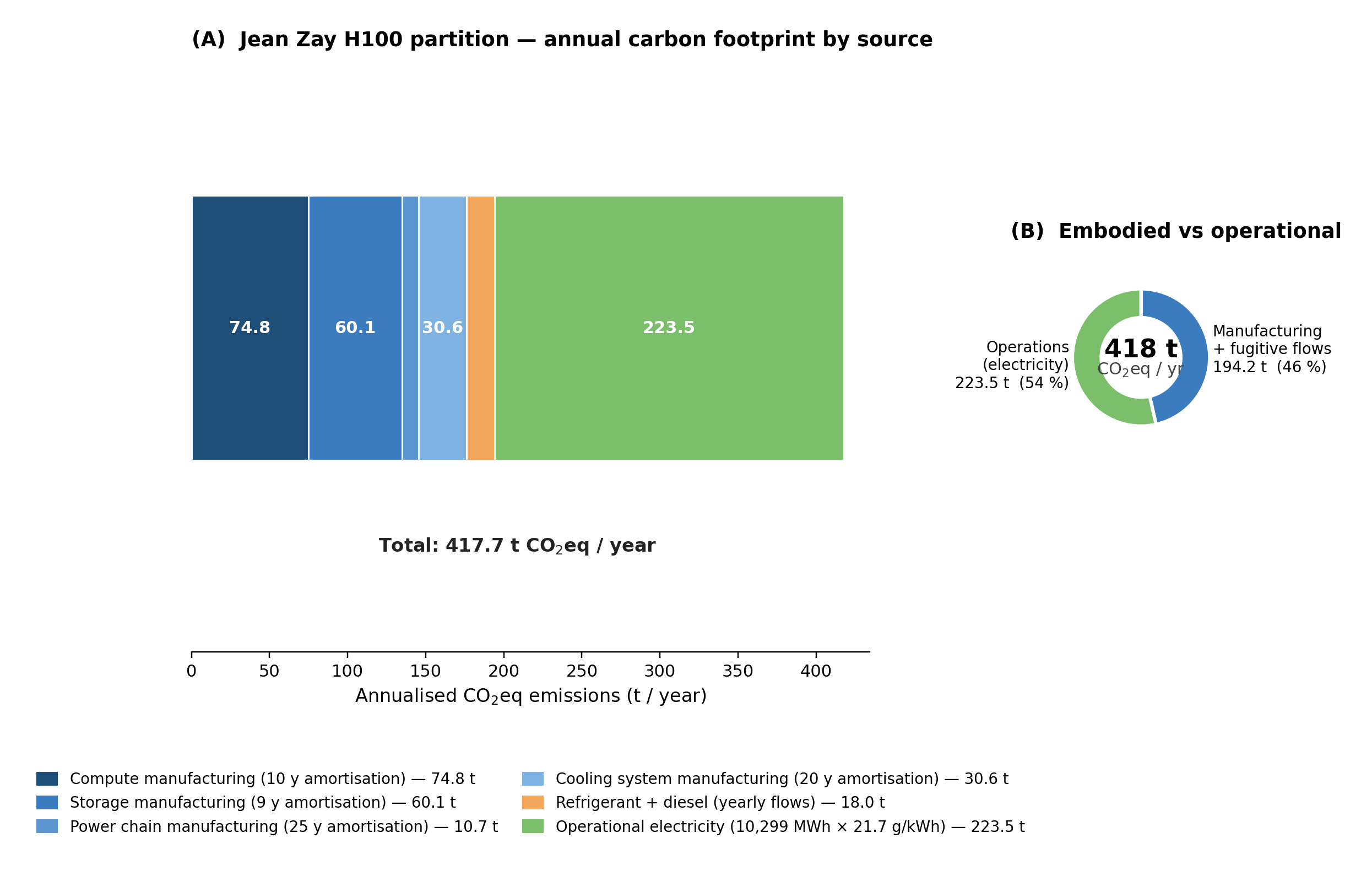
| Refrigerant + diesel | 18.0 | yearly flows, no amortisation |
| Total annualised | 194.2 |
4.2 Operational emissions↩︎
Operational emissions are computed from monitored electricity consumption of the H100 partition at IDRIS over the last 273 days of 2025, scaled to a yearly basis. Total Jean Zay electricity consumption is 21864 MW h/year, decomposed as: compute partitions 15127 MW h, storage infrastructure 935 MW h, technical infrastructure (power conditioning and cooling) 5803 MW h. The H100 partition specifically draws 8512 MW h/year for compute and storage; the proportional share of technical infrastructure is 1787 MW h/year (PUE = 1.21), bringing the total H100 partition electricity to 10299 MW h/year.
With a French electricity emission factor of 21.7 g CO 2 eq −1 in 2024 [23], operational emissions of the H100 partition reach 223.5 t CO2eq/year. The 2025 emission factor is lower (19.6 g CO 2 eq −1 according to RTE), which will mechanically reduce the operational figure for following campaigns of the project.
4.3 Annual infrastructure footprint and per-GPU-hour intensity↩︎
Aggregating manufacturing and operational emissions, the total annual carbon footprint of the Jean Zay H100 partition is:
\[194.2 + 223.5 = \SI{417.5}{\tonne}\,CO\textsubscript{2}eq{}\,/\,\text{year}\]
with manufacturing and operations contributing nearly equal shares (46 % and 54 % respectively). Applying the Labos 1point5 methodology, this total is divided by the effective annual GPU-hour budget of the partition (\(\approx\)11.39 million GPU-hours, corresponding to \(\approx\)88 % average utilisation of the 12.75 million nominal hours) to yield a partition-level intensity of:
\[\boxed{\SI{36.7}{\gram}\,CO\textsubscript{2}eq{}\text{ per H100 GPU-hour (LCA-inclusive)}}\]
Figure 1 visualises the decomposition.
4.4 Lucie 7B training-campaign footprint↩︎
Multiplying the per-GPU-hour intensity by the 574 564 H100 GPU-hours consumed by the Lucie 7B campaign yields a training-campaign footprint of:
\[\boxed{\SI{21.1}{\tonne}\,CO\textsubscript{2}eq{}\text{ for the Lucie 7B pre-training (LCA-inclusive)}}\]
This figure includes the amortised share of manufacturing emissions of the entire H100 partition allocated to the campaign, in addition to operational electricity. Tokenisation of the training corpus is treated separately (Section 4.6) and contributes negligibly to the total.
4.5 Water consumption↩︎
Water at IDRIS is used for adiabatic cooling of the warm-water DLC loop and for refrigeration of ancillary equipment. Total annual withdrawal of municipal water is 3000 m3, of which 1500 m3 are consumed by evaporation; the remainder is returned to the wastewater network after blowdown. The annual Water Usage Effectiveness (WUE) is:
\[\mathrm{WUE} = \frac{1.5 \times 10^6\,\si{\litre}}{21\,864 \times 10^3\,\si{\kwh}} = \SI{0.07}{\litre\per\kwh}\]
This compares favourably with the 0.25–0.30 l −1 range reported in the 2025 ARCEP survey of French data centres [24]. IDRIS is not located in a hydric-stress zone.
Allocating to Lucie 7B at the 5 % share of partition GPU-hours yields:
\[\boxed{\approx\SI{76}{\cubic\metre}\text{ of on-site water consumption attributable to Lucie 7B pre-training}}\]
As a complementary indicator, the off-site water intensity associated with French electricity production (Energy Water Intensity Factor, EWIF) is reported by EDF at 0.86 l −1 in 2024 [25]. Off-site water has not been added to the headline figure in this v1; its inclusion is discussed in Section 6 and planned for v2 to comply with the dual on-site/off-site accounting framework proposed by Li et al. [6], [7].
4.6 Data preparation↩︎
Tokenisation of 120 billion tokens required 20 hours on 40 CPU cores; processing the full 2.3-trillion-token training corpus thus required 383 hours on 40 CPU cores, i.e. 333 CPU-hours. With an emission factor of 1.1 g CO 2 eq −1 [13], this phase emits \(\approx\)15 kg CO2eq, which is negligible compared with the GPU-hosted pre-training. Tokeniser training itself is sub-marginal (a few CPU-hours).
4.7 Ancillary indicators (ERF, REF, ERE)↩︎
Three additional indicators, formalised by The Green Grid [26] and partly recognised by EU Regulation 2024/1364 [27], complement the picture. The Energy Reuse Factor (ERF) — ratio of useful waste heat re-used to total energy consumed — is 0.37 at Jean Zay; equivalently, \(\approx\)6500 MW h/year of useful heat is recovered into a district heating network, equivalent to the heating demand of \(\approx\)1 500 newly built dwellings. In winter operation, up to 80 % of the partition energy is reused as heat. The Renewable Energy Factor (REF) inherits the French electricity mix at 27.8 % renewable in 2024. The Energy Reuse Effectiveness (ERE), a heat-recovery-aware analogue of PUE, is 0.93 for the H100 partition.
5 Discussion↩︎
5.1 Embodied/operational split↩︎
A central finding of this study is that, on a low-carbon electricity grid such as the French one (21.7 g CO 2 eq −1), the embodied (manufacturing) component is not dominated by operations: at the partition level, the split is approximately 46/54. This contrasts with results obtained on higher-carbon grids — where operations typically dwarf embodied — and is consistent with the qualitative position taken by Wu et al. [10] and Gupta et al. [8] that embodied carbon becomes the bottleneck on clean grids. For Jean Zay specifically, the implication is that further mitigation will increasingly depend on hardware-side levers (lifetime extension, re-use, lower-carbon GPU manufacturing) rather than electricity decarbonisation alone.
5.2 Comparability with prior literature↩︎
Direct numerical comparison with prior published LLM training footprints requires care. Reported LLaMA-2 7B operational figures from Touvron et al. [28] (\(\approx\)31 t CO2eq) reflect operations only, on a different grid (US-based), with A100 rather than H100 GPUs, and across a different number of training tokens; they are not framed as functional units in the LCA sense. The 21.1 t CO2eq we report for Lucie 7B is LCA-inclusive (operations + amortised manufacturing) but on a low-carbon grid, with newer-generation GPUs, and again with a distinct training corpus and target performance. We therefore refrain from headline-level efficiency claims and limit the comparison to a contextual data point. A full normalised comparison — per training token, per FLOP, or per benchmark performance unit — is left for v2 and would benefit from coordinated disclosure across LLM developers.
5.3 Heat recovery as a systemic differentiator↩︎
The ERF of 0.37 achieved by Jean Zay translates into approximately 6500 MW h/year of useful heat injected into the urban heating system. Although excluded from the GHG perimeter under the Labos 1point5 convention, this avoided heat displaces \(\approx\)1 500 dwellings worth of heating energy, with a non-trivial system-level carbon benefit. We argue that ERF and ERE deserve to be reported alongside PUE and WUE in any LCA of HPC-hosted training campaigns, since they capture an integration with surrounding infrastructure that hyperscale-only metrics miss.
5.4 Frugal-by-construction infrastructure↩︎
Two infrastructural choices materially shape the results: warm-water Direct Liquid Cooling (30 °C inlet) and waste-heat recovery. The DLC regime drives the favourable WUE (0.07 l −1) and limits the cooling power overhead (PUE = 1.21), while heat recovery turns part of the operational waste into useful output. Both choices were design decisions of the GENCI/IDRIS infrastructure long predating the Lucie 7B campaign, and they illustrate the importance of accounting for infrastructure-level decisions when reasoning about model-level frugality. The AFNOR SPEC 2314 reference [12] is explicit on this point and provides a useful structuring of efficiency vs.frugality of services delivered.
6 Limitations and Future Work↩︎
This is a v1 report and we list its limitations transparently.
6.0.0.1 Inference and downstream services.
The study covers only the AFNOR SPEC 2314 phases up to model validation; inference and downstream educational services (planned within OpenLLM-France) are excluded and will be addressed in v2 once the per-prompt processing time and serving infrastructure are stabilised.
6.0.0.2 Indicator scope.
The indicator scope is reduced to climate change, water, and (qualitatively) abiotic resources for the v1; ocean acidification, fine-particulate emissions, and ionising radiation are flagged as marginal but not formally quantified. A v2 should at minimum quantify abiotic resource depletion (kg Sb eq) for compute and storage subsystems, drawing on inventories such as Ligozat et al. [9] and Wu et al. [10].
6.0.0.3 Off-site water footprint.
The water footprint reported here is restricted to on-site cooling. The off-site EWIF associated with electricity generation (\(\approx\)0.86 l −1 for the French mix in 2024 [25]) is documented but not added to the headline figure. The dual on-site/off-site accounting proposed by Li et al. [6], [7] should be implemented in v2.
6.0.0.4 GPU embodied emissions.
The embodied figure for the H100 GPU (164 kg CO2eq) is taken from the NVIDIA product carbon footprint [21], whose scope is acknowledged to be partial. Triangulation against the ACT model [8] and bottom-up estimates from foundry-level inventories should be included in v2 with an explicit sensitivity analysis.
6.0.0.5 Amortisation sensitivity.
The amortisation windows (10 y for compute, 9 y for storage, 25 y for the power chain, 20 y for cooling) reflect IDRIS practice but are admittedly point estimates; a sensitivity analysis with ranges of \(\pm\)2–3 years is straightforward and should be reported. Likewise, the Labos 1point5 methodology suggests an overall \(\pm\)20 % uncertainty, which we have not formally propagated.
6.0.0.6 Failed runs and exploration.
The GPU-hour figure used for Lucie 7B (574 564 h) corresponds to the documented training campaign; failed runs and hyperparameter exploration prior to the final campaign are not separately accounted for. In line with practice in the field, this likely under-estimates the true campaign-wide footprint by an unknown factor; we encourage future work in the community to disclose run-level instrumentation logs.
6.0.0.7 ISO critical review.
While we apply the AFNOR SPEC 2314 reference, we have not commissioned the formal third-party critical review procedure foreseen by ISO 14071. The framework alignment is therefore methodological rather than strictly ISO-certified.
7 Conclusion↩︎
We have presented a v1 life cycle assessment of the pre-training of Lucie 7B, an open-source Foundation Model trained on the NVIDIA H100 partition of the Jean Zay supercomputer. The study quantifies an annual partition footprint of 417.5 t CO2eq, an LCA-inclusive intensity of 36.7 g CO2eq per H100 GPU-hour, and a training-campaign footprint of 21.1 t CO2eq for Lucie 7B, with associated on-site water consumption of \(\approx\)76 m3. The near-equal split between embodied and operational emissions on the French grid argues for an increased focus on hardware-side mitigation levers in low-carbon HPC contexts. Two design decisions of the underlying infrastructure — warm-water DLC and waste-heat recovery into urban heating — make a measurable difference to both water and useful-energy balances, and we suggest that ERF and ERE be reported as standard indicators alongside PUE and WUE in LLM environmental disclosures. The limitations enumerated in Section 6 will be addressed in a v2 report integrating inference, sensitivity analysis, dual on-site/off-site water accounting, and broader indicator coverage.
Acknowledgements↩︎
The authors thank the IDRIS technical and scientific staff for the operational data on the Jean Zay H100 partition, the Labos 1point5 collective for the methodological foundations of HPC GHG accounting, and the OpenLLM-France consortium members for their contribution to the design and training of the Lucie 7B model. The training campaign was performed using HPC resources from GENCI–IDRIS (Grant 2024-GC011015444).
This work was supported by Bpifrance, as part of the OpenLLM-France project.
Licence↩︎
This report is released under the Creative Commons Attribution-ShareAlike 4.0 International (CC BY-SA 4.0) licence.