Claim-Level Rubric Rewards for Video Caption Reinforcement Learning
January 01, 1970
Abstract
In this paper, we introduce Claim-Level Rubric Rewards (CuRe), a structured reward framework designed to address the reward-design bottleneck in reinforcement learning for dense video captioning. Existing reward designs generally fall into two categories: holistic response-level judgment across heterogeneous criteria, or alignment-based evaluation against reference captions. However, both paradigms suffer from fundamental limitations. Holistic rewards struggle to ensure factual accuracy and are prone to stylistic reward hacking, while reference-based rewards overly rely on rigid textual alignment, failing to preserve the completeness and diversity inherent to open-ended generation tasks. To address these challenges, CuRe reformulates reward modeling as fine-grained claim-level verification. Specifically, CuRe decomposes captions into category-aware atomic claims through a structured rubric, converting holistic evaluation into simpler and more reliable claim-level verification. To reward captions that are both faithful and informative, we further introduce a reference-anchored calibration mechanism that leverages reference claims as salience anchors and visual grounding as factual evidence. This encourages reward-level mode seeking toward vital content, while assigning bounded credit to visual grounded details absent from the reference, preserving descriptiveness without drifting into verbosity. Integrated into the standard GRPO paradigm, CuRe consistently improves both accuracy and completeness. Across captioning, re-captioning, and caption-to-QA tasks, our 30B-A3B model consistently outperforms its same-scale models and surpasses substantially larger baselines on multiple benchmarks.
1 Introduction↩︎
Video captioning represents a fundamental capability in video understanding. It serves as an essential data source for video-language alignment, a cornerstone for advanced reasoning [1], [2], and a critical enabler for downstream tasks ranging from controllable video generation [3] to content recommendation. In pursuit of models capable of generating detailed and faithful descriptions, the prevailing paradigm relies on Supervised Fine-Tuning (SFT) using high-quality corpora distilled from proprietary models or human annotation [4], [5]. Despite its ubiquity, this approach suffers from distinct bottlenecks. Beyond the exorbitant cost of data curation, SFT inherently suffers from exposure bias [6], [7]: the model is trained exclusively on teacher-generated prefixes and scarcely learns to recover from its own deviations at inference, with errors compounding over dense captions. Moreover, the paradigm tends to capture the teacher’s style and confidence rather than its factual grounding [8].
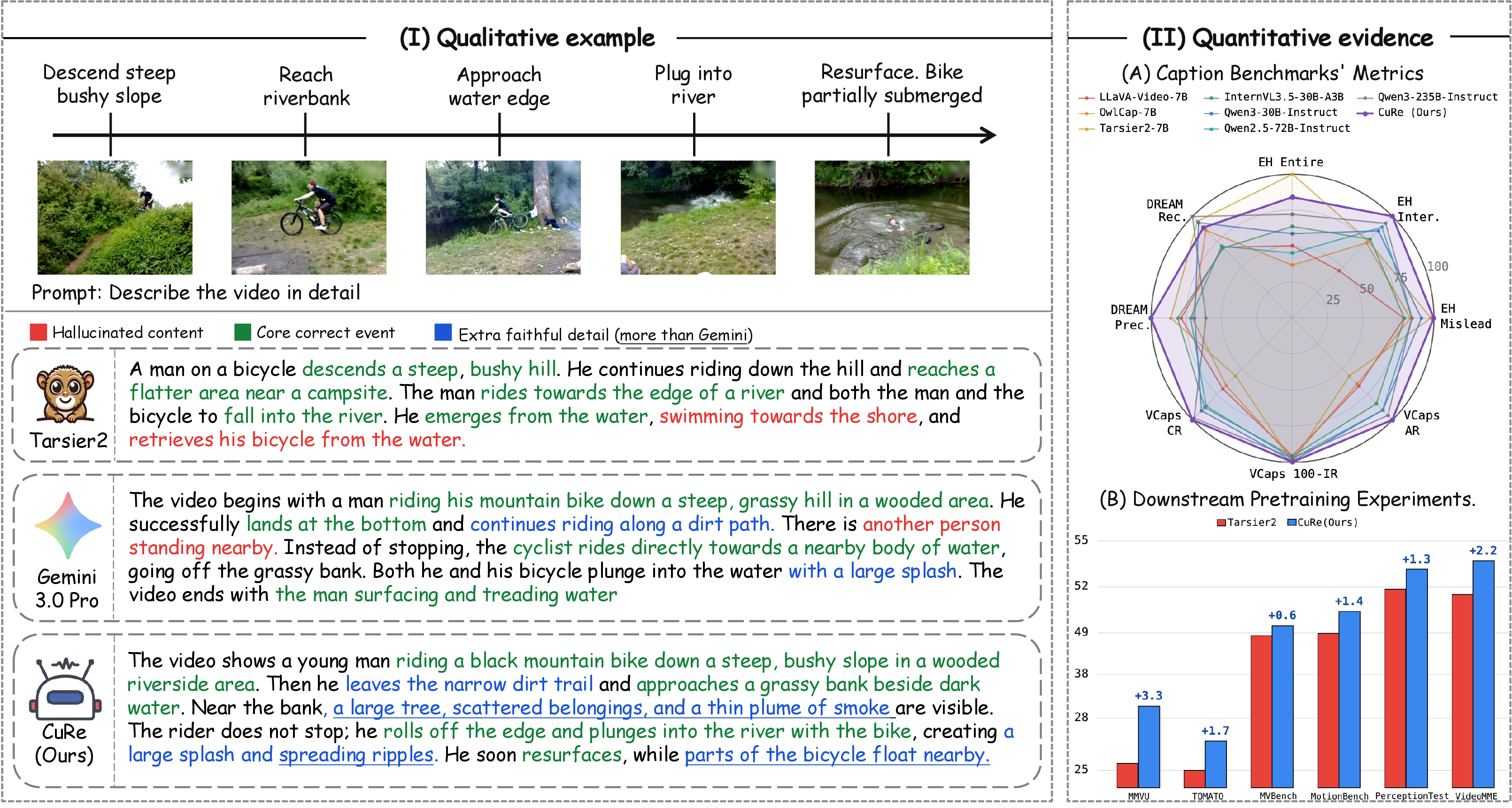
Reinforcement Learning (RL) offers a viable alternative by optimizing the captioner against reward signals derived from its own rollouts. Current approaches design rewards along two axes: holistic scoring, which prompts a reward model to directly evaluate the generated text against coarse criteria [9], [10], and reference-grounded matching, which aligns the rollout against a ground-truth reference via lexical metrics (e.g., ROUGE, CIDEr) [11], [12] or model judgments [13], [14]. While these methods report consistent gains over their SFT counterparts, two fundamental challenges remain largely unaddressed: (i) Lack of Rubric Guidance: Holistic scoring collapses multifaceted visual dimensions (e.g., motion, interaction) into a single scalar. This coarse-grained feedback strains the reward model’s reasoning capacity and invites reward hacking, where the model exploits stylistic preferences rather than factual grounding. (ii) Rigid Reference Alignment: Given the open-ended nature of video description, anchoring rewards strictly to reference text cannot faithfully reflect factual correctness. Valid descriptions that capture the video’s semantics but deviate from the reference’s specific phrasing are often heavily penalized.
To bridge these gaps, we propose Claim-Level Rubric Rewards (CuRe), a comprehensive reward framework that redefines fine-grained evaluation feedback for video captioning. First, CuRe operationalizes a fine-grained Rubric that systematically decomposes captions across diverse visual categories and resolves them into atomic claims. By projecting captions into this rubric matrix, CuRe converts an otherwise intractable holistic judgment into simpler, visual atomic verifications, significantly lowering the task complexity for the validator and ensuring comprehensive feedback coverage. Second, to achieve robust rollout evaluation, we couple the aforementioned visual verification with one-time matching to reference claims through a reference-anchored calibration mechanism. Instead of forcing rigid alignment, the reference claims anchor full credit for matched claims, while unmatched but video-supported residual claims receive only attenuated credit, thereby diluting the relative incentive for non-essential or verbose descriptions. This mechanism induces reference-anchored mode seeking at the reward layer, encouraging the model to discover faithful, informative descriptive patterns while circumventing reward hacking.
We validate CuRe on public captioning and video hallucination benchmarks, demonstrating that our reward-trained Qwen3-VL captioner significantly improves both descriptive density and factual faithfulness over its SFT counterpart. Furthermore, re-captioning three pretraining datasets with CuRe consistently boosts downstream performance across most metrics. Finally, a Prism-style caption-to-QA evaluation [15] confirms that the CuRe-trained captioner outperforms substantially larger open-source baselines and rivals the advanced proprietary models.
Our key contributions can be summarized as follows:
We propose CuRe, a structured reward design that decomposes video captions into category-specific, atomic claims. By evaluating these fine-grained claims individually, CuRe provides precise feedback and ensures comprehensive reward coverage.
We design a reference-anchored calibration mechanism that matches supported rollout claims once against reference claims and assigns attenuated credit to video-supported residuals, effectively encouraging the model to generate faithful, informative descriptions instead of verbose trivial patterns.
Extensive experiments demonstrate that CuRe simultaneously improves factual faithfulness and descriptive density, outperforming much larger open-source models and boosting downstream training performance.
2 Related Work↩︎
2.1 Video Captioning↩︎
Video captioning has shifted from producing concise summaries to generating detailed, multi-axis descriptions. Early paradigms predominantly rely on supervised fine-tuning, leveraging either human-annotated datasets [16]–[18] or distilled corpora from proprietary models [5], [19]. To further scale up supervision, recent methods employ fine-tuned captioners to self-generate massive training data to explore the model capacity limits [4], [20], [21]. More recently, reinforcement learning (RL) has emerged as a promising alternative. Several pioneering works [13], [22], [23] have integrated advanced RL paradigms (e.g., PPO, DPO, and GRPO) into video captioning task. However, these methods depend on coarse-grained, caption-level feedback, such as global preferences or holistic model evaluations. Such feedback requires substantial reasoning from the judge model and can induce reward hacking.
2.2 Rubric Rewards for Reinforcement Learning↩︎
Rubric-based rewards have recently emerged as an effective paradigm for reinforcement learning on open-ended generation tasks, where holistic scalar rewards often fail to capture diverse quality dimensions. Instead of relying on single-score judgments, rubric rewards decompose evaluation into explicit and independently assessable criteria, providing more structured supervision signals for policy optimization. Recent works explore rubric generation and scalable reward construction for open-ended RL, including Chain-of-Rubrics in RM-R1 [24], dynamically generated checklist rewards in RaR [25], and scalable rubric synthesis frameworks such as OpenRubrics, Auto-Rubric, and RLCER [26]–[28]. More recently, rubric-guided RL has been extended to multimodal generation, where RubiCap applies rubric-based rewards to dense image captioning [29]. Our work further extends rubric rewards to dense video captioning by introducing category-typed atomic visual claims as fine-grained scoring units, enabling more precise visual credit assignment for open-ended video description.
3 Methodology↩︎
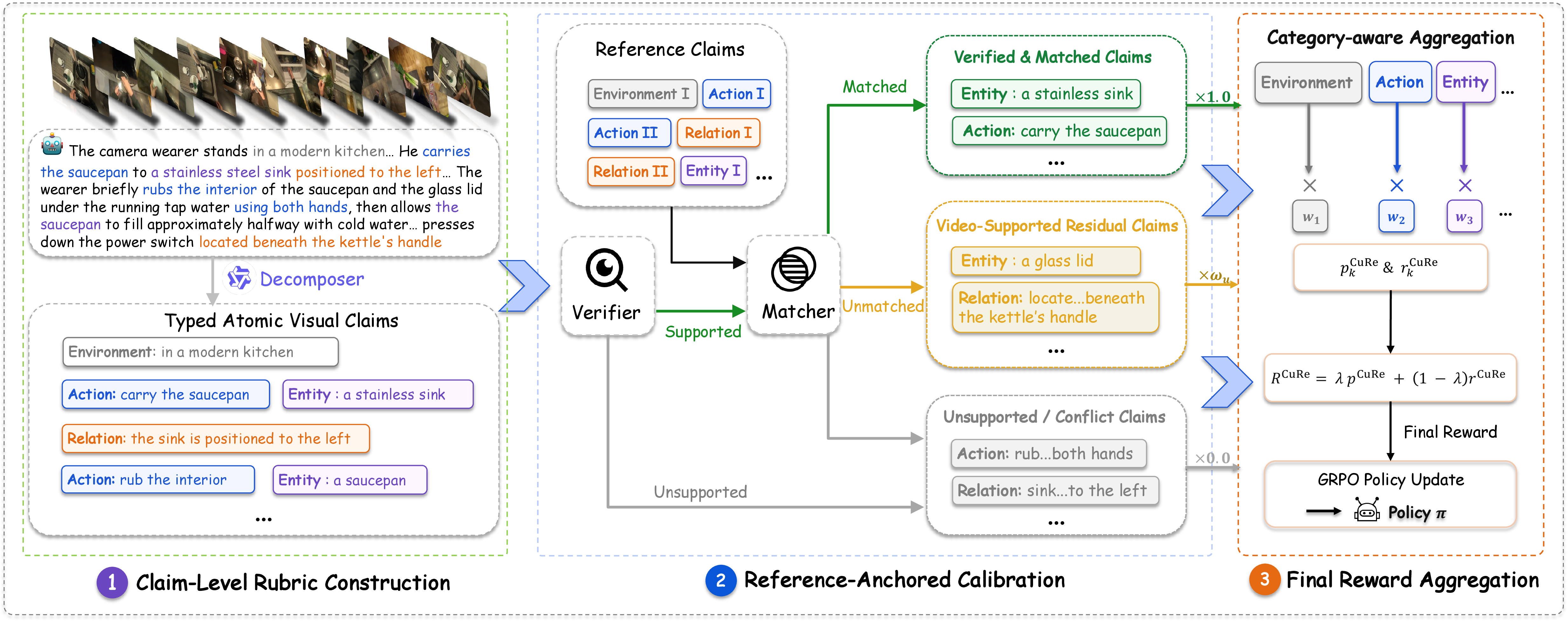
Our goal is to build a rubric reward system for video captioning that provides more precise and interpretable feedback than holistic caption-level scoring, encouraging captions that are both factually faithful and descriptively dense. To this end, we propose CuRe, a three-stage claim-level reward pipeline, as illustrated in Figure 2. First, we decompose rollout captions and reference captions into category-specific atomic visual claims, verify candidate claims against the video, and establish matches between candidate claims and reference ones (§3.1). Second, we introduce an adaptive reward calibration stage that balances visual factual grounding with reference-claim alignment when assigning credit (§3.2). Finally, we aggregate the calibrated category-wise scores into a single scalar and combine it with a length-control penalty to form the final reward (§3.3).
3.1 Claim-Level Rubric Construction↩︎
CuRe first decomposes each caption into atomic, verifiable visual claims. Given a video \(x\) and a model-rollout caption \(y\), an LLM-based decomposer [30] projects the caption into a set of typed candidate claims: \[\mathcal{C} = \operatorname{Decompose}(y) = \{(c_i, k_i)\}_{i=1}^{n}, \label{eq:claim-decomposition}\tag{1}\] where \(c_i\) is an atomic visual claim, \(k_i \in \mathcal{K}\) denotes its visual category under the schema illustrated in Appendix 9, and \(n\) is the number of extracted claims. We also decompose a reference caption \(y^\star\) generated by an advanced proprietary VLM [31], yielding the reference claim set \(\mathcal{C}^{\star} = \operatorname{Decompose}(y^\star)\).
CuRe then verifies and matches claims within each visual category. For a category \(k\), let \(\mathcal{C}_k\) and \(\mathcal{C}_k^\star\) denote the candidate and reference claims assigned to \(k\), respectively. A VLM [30] video verifier checks each candidate claim in \(\mathcal{C}_k\) against the video and retains the supported subset: \[\mathcal{S}_k = \{c \in \mathcal{C}_k \mid v(x,c)=1\}, \label{eq:supported-subset}\tag{2}\] where \(v(x,c)\) is the VLM verifier indicating whether claim \(c\) is supported by video \(x\). The supported claims are then matched to reference claims within the same category: \[\mathcal{M}_k = \{(c, c^\star) \in \mathcal{S}_k \times \mathcal{C}_k^\star \mid m(c,c^\star)=1\}, \label{eq:teacher-matching}\tag{3}\] where \(m(c,c^\star)\) indicates that the two claims are semantically aligned, and each claim can appear in at most one matched pair. We introduce basic claim-level precision and recall scores: \[p_k = \frac{|\mathcal{S}_k|}{|\mathcal{C}_k|}, \qquad r_k = \frac{|\mathcal{M}_k|}{|\mathcal{C}_k^\star|}. \label{eq:base-pr}\tag{4}\] Here, precision measures factual grounding of the generated caption, while recall measures how much reference content is recovered by grounded candidate claims.
3.2 Reference-Anchored Calibration↩︎
The base claim-level scores in Eq. 4 provide a simple starting point for measuring factual grounding and reference coverage. However, reference claims provide asymmetric evidence: they are reliable anchors for salient, high-confidence content, but should be treated as a partial view rather than a complete account of the video’s grounded evidence. This motivates reference-anchored calibration, which assigns preferential credit to reference-matched claims while allowing verified residual claims to contribute in a controlled manner.
For precision, CuRe replaces uniformly support-based credit with reference-aware credit. Reference-matched supported claims receive full credit, while unmatched supported claims receive attenuated credit \(w_u \in [0,1]\): \[p_k^{\mathrm{CuRe}} = \frac{ |\mathcal{M}_k| + w_u\left(|\mathcal{S}_k|-|\mathcal{M}_k|\right) }{ |\mathcal{C}_k| }. \label{eq:cure-precision}\tag{5}\] This favors claims aligned with salient reference content, while retaining discounted credit for additional details grounded in the video.
For recall, CuRe avoids treating the reference claims as a closed coverage target. Unmatched supported claims may expand the effective target, but only through bounded attenuated credit: \[r_k^{\mathrm{CuRe}} = \frac{ |\mathcal{M}_k| + w_u \min\left(|\mathcal{S}_k|-|\mathcal{M}_k|,\; \delta_k\right) }{ |\mathcal{C}_k^\star| + w_u \min\left(|\mathcal{S}_k|-|\mathcal{M}_k|,\; \delta_k\right) }, \label{eq:cure-recall}\tag{6}\] where \(\delta_k = |\mathcal{C}_k^\star|-|\mathcal{M}_k|\) is the coverage bound. The cap operation restricts residual credit by this bound, preventing recall-side reward hacking through verbose unmatched claims while still allowing faithful evidence beyond the reference to contribute. Without this cap operation, our experiments show that the video captioner may exploit the recall metric by generating correct yet redundant visual details that are not covered by the reference caption.
3.3 Final Reward Aggregation↩︎
After obtaining calibrated per-category scores, CuRe aggregates precision and recall over their respective active categories. Specifically, precision and recall are computed over non-empty candidate categories \(\mathcal{K}_{\mathrm{cand}} = \{k \in \mathcal{K} : |\mathcal{C}_{k}| > 0\}\) and non-empty reference categories \(\mathcal{K}_{\mathrm{ref}} = \{k \in \mathcal{K} : |\mathcal{C}_{k}^{\star}| > 0\}\), respectively. By weighting with category priors \(\omega_k\), the aggregated metrics are defined as: \[p^{\mathrm{CuRe}} = \frac{\sum_{k \in \mathcal{K}_{\mathrm{cand}}} \omega_k p_{k}^{\mathrm{CuRe}}}{\sum_{k \in \mathcal{K}_{\mathrm{cand}}} \omega_k}, \qquad r^{\mathrm{CuRe}} = \frac{\sum_{k \in \mathcal{K}_{\mathrm{ref}}} \omega_k r_{k}^{\mathrm{CuRe}}}{\sum_{k \in \mathcal{K}_{\mathrm{ref}}} \omega_k}. \label{eq:aggregated-pr}\tag{7}\] Notably, \(p^{\mathrm{CuRe}}\) is set to \(0\) when \(\mathcal{K}_{\mathrm{cand}}=\varnothing\), ensuring that empty captions do not receive vacuous precision credit. We define the overall CuRe reward as a weighted combination of the aggregated precision and recall: \[R^{\mathrm{CuRe}} = \lambda\,p^{\mathrm{CuRe}} + (1 - \lambda)\, r^{\mathrm{CuRe}}, \label{eq:cure-reward}\tag{8}\] where \(\lambda \in [0,1]\) is a hyperparameter that controls preference between conservative and informative captioning tendencies. Moreover, to discourage over-generation, we incorporate a length penalty \(\Omega\) into the final reward, with details provided in Appendix 8.
For training, we adopt the standard GRPO [32] framework with CuRe as the reward function. For each video, the policy model samples a group of eight captions, which are scored by evaluating its candidate claims against the video and reference claims, together with the length-control penalty. This claim-level reward provides fine-grained and coverage-aware feedback, steering optimization toward captions that are factually faithful and descriptively dense, rather than verbose but trivial.
4 Experiments↩︎
| Model | EventHallusion (Description) | VCapsBench | DREAM-1K | |||||||
| Entire\(\uparrow\) | Inter.\(\uparrow\) | Mislead.\(\uparrow\) | Overall\(\uparrow\) | AR\(\uparrow\) | IR\(\downarrow\) | CR\(\uparrow\) | Prec.\(\uparrow\) | Rec.\(\uparrow\) | F1\(\uparrow\) | |
| Seed 2.0 Pro [33] | 64.22 | 76.17 | 96.84 | 77.83 | 60.37 | 14.59 | 70.68 | 32.97 | 50.80 | 39.99 |
| Gemini 3.0 Pro [31] | 65.13 | 68.39 | 98.04 | 74.59 | 70.29 | 15.44 | 83.13 | 42.67 | 39.26 | 40.89 |
| LLaVA-Video-7B [19] | 27.50 | 32.60 | 75.50 | 41.40 | 45.11 | 17.46 | 54.65 | 37.90 | 28.40 | 32.50 |
| OwlCap-7B [14] | 20.18 | 51.81 | 80.00 | 49.87 | 43.82 | 15.79 | 52.04 | 34.10 | 35.30 | 34.70 |
| Tarsier2-7B [4] | 54.60 | 53.10 | 93.70 | 63.30 | 38.51 | 13.89 | 44.73 | 41.50 | 38.80 | 40.10 |
| InternVL3.5-30B-A3B [34] | 34.86 | 54.40 | 75.79 | 54.16 | 56.85 | 17.43 | 68.86 | 39.07 | 28.17 | 32.74 |
| Qwen3-VL-30B-A3B-Instruct [30] | 32.11 | 60.10 | 87.37 | 58.94 | 61.26 | 14.30 | 71.49 | 33.35 | 38.32 | 35.66 |
| Tarsier-34B [20] | 38.50 | 40.40 | 83.20 | 50.10 | - | - | - | 41.40 | 32.40 | 36.30 |
| Qwen2.5-VL-72B-Instruct [35] | 24.77 | 62.69 | 81.05 | 56.68 | 61.20 | 16.02 | 67.81 | 34.72 | 28.90 | 31.54 |
| Qwen3-VL-235B-A22B-Instruct [30] | 39.45 | 65.28 | 81.05 | 61.96 | 64.80 | 16.09 | 77.23 | 29.48 | 40.77 | 34.22 |
| 45.87 | 69.95 | 95.79 | 69.52 | 67.77 | 13.78 | 78.60 | 48.21 | 36.26 | 41.39 | |
4.0pt
In this section, we evaluate CuRe from three perspectives: direct caption quality on open-ended captioning benchmarks (§4.2), downstream task performance after CuRe-enhanced pretraining (§4.3), and caption-to-QA evaluation across multiple benchmarks (§4.4). We further analyze the contribution of each reward component through ablations (§4.5) and provide qualitative examples in §4.6.
4.1 Experimental Setup↩︎
4.1.0.1 Implementation Details.
We initialize the policy captioner from Qwen3-VL-30B-A3B-Instruct [30] and post-train it on a Gemini-3.0-Pro-distilled caption corpus drawn from open-source web videos [4]. The captioner is first trained with a 78,144-sample video caption dataset as SFT warmstart, and then optimized on a deduplicated 8,000-video subset with GRPO. In the reward runtime, Qwen3-VL-235B-A22B-Instruct decomposes only the rollout captions, verifies rollout claims against the video, and performs the one-to-one matcher under task-specific prompts (Appendix 13). Gemini-3.0-Pro [31] provides the reference captions and their decomposed reference claims \(\mathcal{C}^{\star}\). We then perform one semantic match between supported rollout claims and these reference claims. We set \(w_u = 0.5\) and \(\lambda = 0.7\), and refer to Appendix 8 for detailed training settings. None of the SFT or GRPO videos overlap with our evaluation benchmarks.
4.1.0.2 Baselines.
To show the leading performance of CuRe, we compare our captioner not only with open-source video captioners such as Tarsier [4], [20], OwlCap [14], and LLaVA-Video, but also with general-purpose VLMs including InternVL3.5, Qwen2.5-VL, and Qwen3-VL [30]. We also include proprietary models, including Seed 2.0 Pro and Gemini 3.0 Pro, as reference baselines to assess how far CuRe narrows the gap between open-source video captioners and leading proprietary VLMs.
4.2 Caption Quality Evaluation↩︎
In this part, we evaluate CuRe on public video captioning benchmarks to assess the quality of the generated captions.
4.2.0.1 Settings.
We evaluate caption quality on three benchmarks. EventHallusion [36] probes event hallucination under Entire, Interleave, and Misleading settings, where GPT-based description matching judges whether generated captions are consistent with the target event. We report its description-level scores. VCapsBench [37] evaluates captions through text-only QA over human-verified video questions with ternary answers, reporting Accuracy Rate (AR), Inconsistency Rate (IR, lower is better), and Coverage Rate (CR). DREAM-1K [20] uses AutoDQ to extract events from generated and reference descriptions and compute event-level precision, recall, and F1.
4.2.0.2 Results and analysis.
Among open-source models, CuRe achieves the strongest overall direct-captioning performance as shown in Table 1. On EventHallusion, CuRe obtains the best overall score of 69.5, improving over its same-sized Qwen3-VL-30B-A3B-Instruct baseline by 10.6 points and surpassing the previous open-source best, Tarsier2-7B, by 6.2 points. On VCapsBench, CuRe ranks first among open-source models on all three axes, indicating that its captions are both more answerable and less inconsistent. It also outperforms the much larger Qwen3-VL-235B-A22B-Instruct and the proprietary Seed 2.0 Pro across all VCapsBench metrics. On DREAM-1K, CuRe achieves the best precision and F1 among open-source models, while its recall is 4.5 points lower than Qwen3-VL-235B-A22B-Instruct. Overall, CuRe demonstrates remarkable performance gain on factual faithfulness (EventHallusion Overall, VCapsBench IR, DREAM-1K Prec.), while the descriptive density (VCapsBench CR, DREAM-1K Rec.) is competitive with leading baseline models. This suggests that CuRe favors faithful and discriminative event descriptions rather than increasing recall through potentially noisier detail coverage.
4.3 Downstream Evaluation via CuRe Pretraining↩︎
| Stage-2 Data Source | Caption Source | MMVU | MVBench | MotionBench | PerceptionTest | TOMATO | VideoMME | |||
|---|---|---|---|---|---|---|---|---|---|---|
| 8-11 | Overall | Long | Medium | Short | ||||||
| Molmo2-Cap (104k) | Original | 38.10 | 45.10 | 47.98 | 48.99 | 22.64 | 52.15 | 42.33 | 49.33 | 64.78 |
| Recap. | 37.40 | 48.83 | 49.38 | 52.30 | 26.08 | 54.07 | 44.22 | 50.89 | 67.11 | |
| Tarsier2-Recap (585k) | Original | 25.40 | 48.85 | 49.00 | 51.84 | 25.00 | 51.52 | 40.78 | 48.78 | 65.00 |
| Recap. | 28.70 | 49.48 | 50.42 | 53.15 | 26.68 | 53.70 | 42.56 | 51.67 | 66.89 | |
| LLaVA-Video-Caption (178k) | Original | 31.20 | 49.08 | 48.86 | 52.68 | 22.57 | 52.30 | 39.00 | 51.56 | 66.33 |
| Recap. | 37.30 | 48.73 | 50.32 | 53.25 | 24.93 | 54.37 | 42.22 | 52.00 | 68.89 | |
3.6pt
In this part, we apply model-generated video captions in end-to-end VLM pretraining and show the final benchmark score as a proxy of caption quality evaluation. This setup highlights the practical value of CuRe for modern VLM data engineering.
4.3.0.1 Settings.
We initialize the model with a Qwen3-4B [38] language backbone, the Qwen3 vision encoder [30], and a randomly initialized projector, and train it with a three-stage protocol following ShareGPT4V [5], [39] and CapRL [10]. Stage-1 performs image-text alignment on BLIP-3-KALE [40]; Stage-2 continues caption pretraining on a candidate caption corpus; and stage-3 applies SFT on a fixed VideoQA mixture from Molmo2-AMA [41] and LLaVA-Video [19]. We reannotate Molmo2-Cap, Tarsier2-Recap [4], and LLaVA-Video-Caption with CuRe, and compare the final VLM performance trained with the original and reannotated corpora in Stage-2. Additional training details are provided in Appendix 11.
4.3.0.2 Benchmarks.
We evaluate downstream video-language performance on six complementary benchmarks: MMVU for expert-level video understanding and reasoning [42], MVBench for temporal perception and cognition [43], MotionBench for fine-grained motion understanding [44], TOMATO for visual temporal reasoning [45], and VideoMME, PerceptionTest for broad real-world video understanding covering diverse domains, video lengths, and perception-to-reasoning question types [46], [47].
4.3.0.3 Results and analysis.
As shown in Table 2, replacing the original Stage-2 captions with CuRe-generated captions consistently improves downstream video-language learning across different caption corpora. Averaged over all evaluation benchmarks, CuRe brings gains of 2.18, 1.75, and 2.04 points on Molmo2-Cap, Tarsier2-Recap, and LLaVA-Video-Caption, respectively. These improvements are broad rather than concentrated on a single benchmark: CuRe outperforms the original captions on 25 out of 27 reported metrics, with the only regressions appearing on MMVU for Molmo2-Cap and MVBench for LLaVA-Video-Caption.
Since the Stage-3 VideoQA mixture and the remaining training recipe are fixed within each paired comparison, the observed improvements isolate the contribution of Stage-2 caption quality. The consistent gains across three corpora with different source videos, scales, and annotating models further indicate that CuRe provides stronger video-language supervision, rather than merely overfitting to a particular evaluator.
4.4 Caption-to-QA Prism Evaluation↩︎
| Captioner | VideoMME | MMVU | MVBench | MotionBench | TOMATO | PerceptionTest | |||||
|---|---|---|---|---|---|---|---|---|---|---|---|
| 2-5 (lr)6-8 (lr)9-9 (lr)10-10 (lr)11-11 (lr)12-12 | Overall | Short | Medium | Long | MCQ | Open | Overall | Overall | Overall | Score | Overall |
| Seed 2.0 Pro | 66.63 | 74.67 | 68.00 | 57.22 | 78.24 | 55.73 | 69.80 | 56.23 | 53.19 | 35.58 | 65.75 |
| Gemini 3.0 Pro | 68.52 | 75.11 | 69.67 | 60.78 | 77.28 | 58.13 | 70.10 | 59.13 | 50.85 | 35.31 | 63.73 |
| Tarsier2-7B | 33.19 | 40.44 | 30.78 | 28.33 | 73.12 | 42.93 | 61.80 | 35.70 | 33.00 | 11.39 | 37.51 |
| OwlCap-7B | 44.56 | 53.78 | 41.56 | 38.33 | 67.84 | 44.00 | 58.90 | 45.10 | 37.01 | 21.77 | 52.58 |
| Qwen3-VL-30B-A3B-Instruct | 52.04 | 61.00 | 51.33 | 43.78 | 72.48 | 45.87 | 62.50 | 51.32 | 41.02 | 21.50 | 60.05 |
| Qwen3.6-35B-A3B | 61.15 | 73.11 | 65.67 | 44.67 | 75.04 | 49.87 | 65.60 | 53.60 | 45.02 | 21.90 | 61.72 |
| Qwen3-VL-235B-A22B-Instruct | 53.81 | 61.33 | 53.56 | 46.56 | 73.12 | 48.53 | 63.90 | 47.80 | 43.18 | 23.05 | 61.26 |
| 65.44 | 73.67 | 66.33 | 56.33 | 77.44 | 51.73 | 67.80 | 54.43 | 47.86 | 22.91 | 63.56 | |
3.4pt
We further adopt the Prism framework [15] for caption quality evaluation, which judges whether CuRe captions retain enough information to serve as a video proxy in various video question answering (VQA) scenarios.
4.4.0.1 Settings.
Prism evaluates caption utility via a two-stage VQA pipeline: each captioner first generates a video caption, and a fixed QA model, Seed 2.0 Pro, answers benchmark questions using only that caption. Official benchmark evaluators compute the final scores, measuring how much task-relevant information each caption exposes to the same answerer. We use the same set of benchmarks as introduced in Section 4.3 to evaluate the video caption quality on comprehensive VQA tasks.
4.4.0.2 Results and analysis.
Table 3 shows that CuRe delivers the strongest open-source caption-to-QA utility under the Prism protocol. Averaged over the six benchmark Overall scores, CuRe obtains 53.67, surpassing the same-sized Qwen3-VL-30B-A3B-Instruct by 5.60 points and the much larger Qwen3-VL-235B-A22B-Instruct by 4.83 points. CuRe ranks first among open-source captioners on 10 out of 11 reported columns, indicating that CuRe-generated captions preserve more useful information for varying video QA scenarios.
The improvement is particularly pronounced on long-form video understanding. On VideoMME Long, CuRe outperforms Qwen3-VL-235B-A22B-Instruct by 9.77 points and Qwen3.6-35B-A3B by 11.66 points, nearly matching the proprietary Seed 2.0 Pro captioner. This suggests that the claim-level reward optimization helps produce informative descriptions over extended temporal contexts.
We observe remaining performance gaps on TOMATO, indicating that fine-grained motion understanding and temporal-relation reasoning are still challenging for caption-only transfer. Nevertheless, the overall pattern supports the goal of our reward objective: CuRe improves captions as faithful proxies for downstream QA, rather than simply optimizing for caption-specific surface quality or evaluator preference.
4.5 Ablation Study↩︎
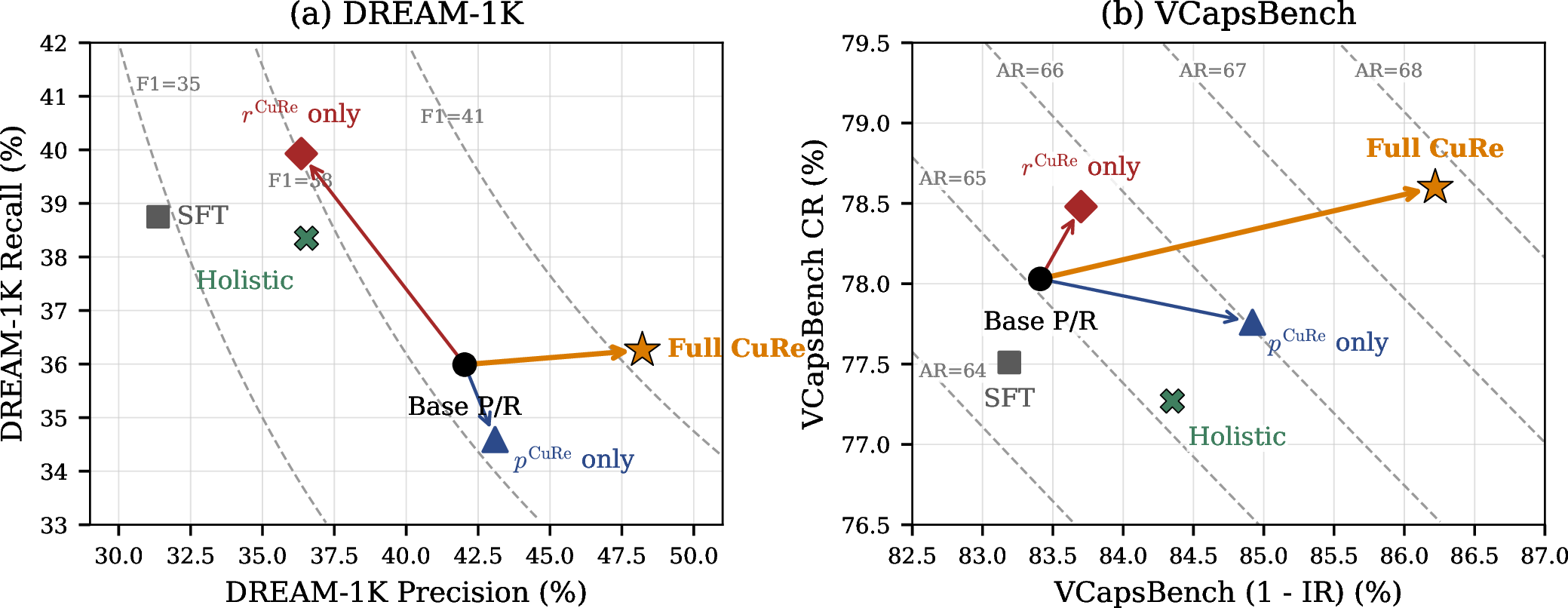
Table 4 ablates the reward design of CuRe on DREAM-1K and VCapsBench. We include SFT as the no-RL baseline and compare GRPO variants that start from the same SFT checkpoint and use the same rollout and optimization setup. Holistic reward uses a whole-caption scalar reward without claim decomposition, testing whether response-level feedback is sufficient. The claim-level rows then isolate Base P/R in Eq. 4 , the precision-only and recall-only CuRe variants, and the full CuRe reward in Eqs. 5 –8 . This setup separates whole-caption feedback from claim-level precision and recall credit; Figure 3 gives the corresponding precision–recall view.
| Method | Training | RL reward | DREAM-1K | VCapsBench | ||||
|---|---|---|---|---|---|---|---|---|
| 4-6(lr)7-9 | P\(\uparrow\) | R\(\uparrow\) | F1\(\uparrow\) | AR\(\uparrow\) | IR\(\downarrow\) | CR\(\uparrow\) | ||
| SFT | SFT only | – | 31.37 | 38.75 | 34.67 | 64.48 | 16.81 | 77.51 |
| Holistic reward | SFT + GRPO | Whole-caption | 36.53 | 38.35 | 37.42 | 65.18 | 15.65 | 77.27 |
| Base P/R | SFT + GRPO | Claim P/R | 42.03 | 35.99 | 38.78 | 65.08 | 16.59 | 78.03 |
| Precision-only | SFT + GRPO | Claim precision | 43.09 | 34.59 | 38.38 | 66.03 | 15.08 | 77.76 |
| Recall-only | SFT + GRPO | Claim recall | 36.35 | 39.93 | 38.06 | 65.69 | 16.30 | 78.48 |
| SFT + GRPO | Claim precision + recall | 48.21 | 36.26 | 41.39 | 67.77 | 13.78 | 78.60 | |
3.8pt
4.5.0.1 Claim-level reward decomposition provides a more selective training signal.
Holistic reward improves over SFT, raising DREAM-1K F1 from 34.67 to 37.42 and reducing VCapsBench IR from 16.81 to 15.65. This result indicates that response-level RL feedback is useful. Its gains are uneven, however: DREAM-1K recall decreases from 38.75 to 38.35, and VCapsBench CR decreases from 77.51 to 77.27. Full CuRe changes this pattern. Compared with Holistic reward, it improves DREAM-1K precision by 11.68 points and F1 by 3.97 points, and improves all three VCapsBench metrics, with AR increasing by 2.59 points, IR decreasing by 1.87 points, and CR increasing by 1.33 points. The only trade-off is DREAM-1K recall, which drops by 2.09 points. This pattern suggests that whole-caption scalar feedback can improve the SFT warm start, but claim-level decomposition makes the reward more selective for faithful and informative captions.
4.5.0.2 Precision and recall calibration address complementary failure modes.
Within claim-level RL, Base P/R provides the control without CuRe calibration. Precision-only training improves precision-side behavior relative to Base P/R, increasing DREAM-1K precision from 42.03 to 43.09 and reducing VCapsBench IR from 16.59 to 15.08. The same row loses DREAM-1K recall and VCapsBench CR, which indicates that factual selectivity alone does not preserve coverage. Recall-only training moves in the other direction: it reaches the highest DREAM-1K recall at 39.93 and raises VCapsBench CR to 78.48, but it remains weaker than full CuRe on DREAM-1K precision and F1 and on VCapsBench AR and IR. Full CuRe combines both sides, giving the best DREAM-1K precision and F1 and the best VCapsBench AR, IR, and CR. It does not maximize DREAM-1K recall, but it improves over Base P/R on recall while raising precision by 6.18 points and F1 by 2.61 points. These results indicate that factual faithfulness and descriptive coverage require different reward pressure, and the full CuRe reward balances them better than either single-side variant.
4.6 Qualitative Analysis↩︎
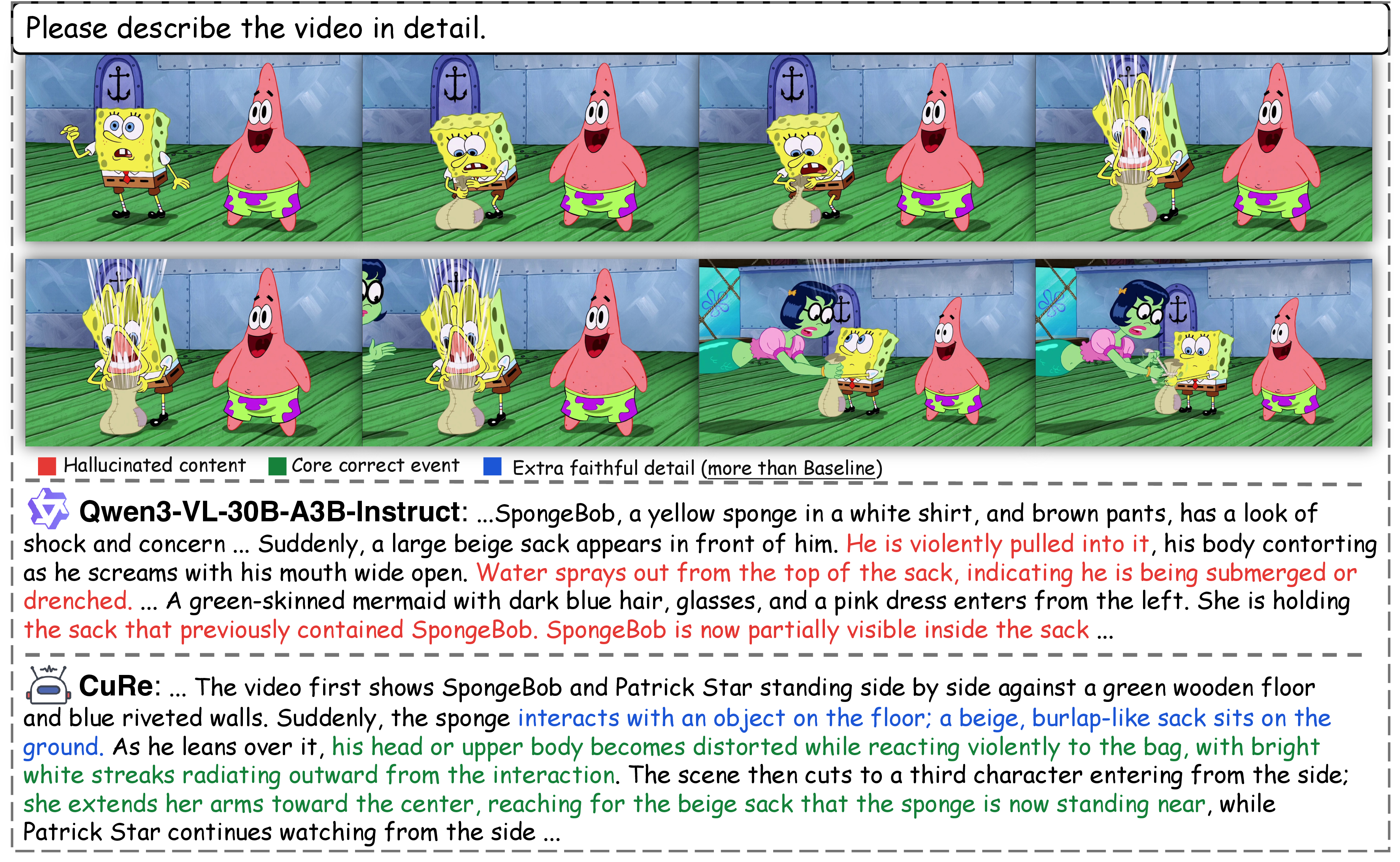
Figure 4 shows the precision–coverage trade-off in one held-out DREAM-1K video. Both captions find the central sack interaction, so the difference is not basic scene recognition. The baseline turns the cartoon impact lines around the sack into unsupported causal content: water sprays out, and SpongeBob is being submerged or drenched. It also treats the later sack as the same sack that previously contained SpongeBob. These details fit a plausible story, but they are not directly supported by the sampled frames.
CuRe describes the same event through visible relations. It names the burlap-like sack on the floor, the distorted reaction near the sack, and the later reaching action toward the sack. Rather than shortening the description, the caption changes the evidence type: inferred causes become verifiable visual claims. This matches the reward design in §3.2: unsupported claims receive no credit, while video-supported residual details can still receive bounded credit when they fall outside the reference caption. The case mirrors the pattern in Table 1 and Table 4: CuRe raises factual precision without suppressing informative detail.
5 Conclusion↩︎
We presented CuRe, a claim-level rubric reward whose reference-anchored calibration mechanism induces teacher-anchored mode seeking at the reward layer. Empirically, this scoring scheme yields captions that simultaneously gain factual faithfulness and descriptive density over supervised and reference-bound RL baselines. The resulting captioner provides stronger pretraining supervision and, under caption-to-QA evaluation, serves as a video proxy that outperforms much larger open-source captioners. The pattern across these three families suggests that claim-level rubric design offers a viable alternative to whole-caption rewards and may extend to other open-ended generation tasks. While the calibration mechanism currently uses a single reference-caption source, the framework supports multi-source or ensemble references, and stronger treatment of partial references remains a direction for future work.
6 Limitations↩︎
Despite the empirical gains of CuRe, our current instantiation remains compute-intensive. The reward stack calls a large VLM for claim decomposition, verification, and matching during training, which limits the breadth of verifier variants, reference-caption sources, and multi-run evaluations we can afford. This cost is a limitation of the present implementation rather than of the claim-level reward interface itself; developing cheaper or more specialized verifiers is an important direction for future work.
Our empirical scope also bounds the claims. The experiments cover Caption Quality Evaluation, CuRe-Annotated Caption for VLM Pretraining, and Prism Evaluation, but each setting still fixes some design choices: the main policy uses one backbone, the pretraining study uses one downstream learner, and Prism uses one fixed QA model. The consistent gains across these settings suggest that claim-level rubric rewards transfer within the evaluated regimes, but they do not establish universality across all backbones, verifiers, answerers, or video domains.
7 Ethical Considerations↩︎
This work improves dense video captioning, which can turn visual content into searchable text. This is useful for video-language research and data engineering, but it may also increase privacy risks when videos contain people, locations, private settings, or visible text. The captioner is not designed or evaluated for person identification, tracking, surveillance, or high-stakes decision making. Applications involving people or sensitive scenes should therefore add privacy review, content filtering, and human oversight.
Although CuRe aims to make dense captions more faithful and informative, generated captions remain model-produced annotations rather than ground truth. They may still hallucinate, omit context, or reflect biases in the source videos, reference-caption generators, and evaluators. When recaptions are reused for training or evaluation, such errors can propagate into downstream models or benchmarks. Benchmark gains should therefore not be read as evidence that CuRe behaves uniformly across all communities, languages, activities, or recording conditions. If artifacts derived from this work are released, they should include clear intended-use guidance and restrictions against surveillance and high-stakes automated decision-making.
8 Post-Training and Reward Runtime↩︎
§4.1 describes the two-stage post-training pipeline at a high level. Table 5 records the full configuration needed to reproduce each stage, and Table 6 specifies the reward runtime that drives GRPO training.
| Stage | Parameter | Value |
|---|---|---|
| Supervised Fine-Tuning (SFT) | ||
| Data | 78,144 Gemini-3.0-Pro distilled video caption samples | |
| Optimization | 1 epoch; peak LR \(4{\times}10^{-6}\); cosine decay; AdamW (\(\beta_1{=}0.9\), \(\beta_2{=}0.999\)) | |
| Video budget | 2 fps; max 512 frames; dynamic resolution (max 1,024 visual tokens per video) | |
| GRPO Reinforcement Learning | ||
| Data | Disjoint 8,000-video subset (no overlap with SFT or evaluation) | |
| Rollout group size | \(G=8\) captions per video | |
| Rollout sampling | Temperature 1.0; top-\(p\) = 1.0; max 8,192 response tokens | |
| Actor LR / schedule | \(2{\times}10^{-6}\) \(\to\) \(2{\times}10^{-7}\); cosine decay; 5 warmup steps | |
| Batch size | Train 64, mini-batch 64, per-GPU micro-batch 1 | |
| Sequence limits | 24,576 prompt tokens; 8,192 response tokens | |
| KL control | Low-variance KL loss; \(\beta = 0.005\); not added to reward | |
| Video budget | 2 fps; max 256 frames; dynamic resolution | |
| Training duration | 125 steps; \(\approx\)62.5 hours on 32\(\times\)H20 (\(\approx\)2,000 GPU-hours) | |
| Infrastructure | ||
| Hardware | 32 NVIDIA H20 GPUs | |
| Parallelism (actor) | TP=4, CP=2, EP=4, PP=1 (Megatron) | |
| Parallelism (rollout) | TP=4 (vLLM); GPU memory utilization 0.55 | |
| Framework | verl 0.7.0 [48]; vLLM 0.11.0 [49] | |
| Software | PyTorch 2.8.0; Transformers 4.57.3; Python 3.12 | |
| Data Integrity | ||
| Leakage control | SFT and GRPO videos are excluded from all evaluation benchmarks | |
4pt
| Role | Model | Temp | max_tok | Contract |
|---|---|---|---|---|
| Reference caption \(y^\star\) | Gemini-3.0-Pro | default | 8,192 | Generates the reference description for each training video |
| Rollout claims \(\mathcal{C}\) | Qwen3-VL-235B | 0.3 | 4,096 | Decomposes each policy caption into atomic visual claims |
| Reference claims \(\mathcal{C}^{\star}\) | Gemini-3.0-Pro | default | 8,192 | Decomposes each reference caption into atomic visual claims |
| Video verifier | Qwen3-VL-235B | 0.3 | 4,096 | Labels each claim as supported, conflicting, or uncertain |
| Semantic matcher | Qwen3-VL-235B | 0.3 | 4,096 | Returns one-to-one semantic alignments within each category |
| Reward Aggregation Hyperparameters | ||||
| Precision weight \(\lambda\) | 0.7 (Eq. [eq:cure-reward]) | |||
| Residual credit \(w_u\) | 0.5 (Eqs. [eq:cure-precision]–[eq:cure-recall]) | |||
| Over-generation guard \((\eta, \tau, \kappa)\) | \((0.2,\; 1.5,\; 1.0)\) (Eq. [eq:overgen-regularizer]) | |||
| Reward Video Processing | ||||
| Frame sampling | 2 fps; max 128 frames; dynamic resolution from 256\(\times\)256 to 768\(\times\)768 | |||
3pt
8.0.0.1 Length-control regularizer.
At reward time, we compute the generated-to-reference claim ratio \(\rho = |\mathcal{C}| / |\mathcal{C}^{\star}|\) and subtract a bounded penalty \[\Omega = \eta \cdot \min\!\biggl(1,\; \frac{\max(0,\, \rho - \tau)}{\kappa} \biggr), \label{eq:overgen-regularizer}\tag{9}\] where \(\tau\) is the tolerance threshold, \(\kappa\) controls the penalty growth rate, and \(\eta\) is the maximum penalty. This saturated penalty suppresses verbose captions with excessively low-credit or redundant claims while maintaining stable optimization.
8.0.0.2 Hyperparameter selection.
All hyperparameters were selected based on preliminary experiments on a held-out subset. No systematic search (grid, random, or Bayesian) was performed due to the cost of online 235B reward calls. The category priors \(\omega_k\) in Appendix 9 reflect domain knowledge about which visual dimensions dense captions most often underdescribe. All main results and ablations are single training runs; we do not report standard deviations.
9 Claim Schema and Category Priors↩︎
All claim-level operations use the same ten visual categories. The category names serve as labels for decomposition, verification, matching, and aggregation; the weights are priors for aggregating per-category precision and recall against reference claims.
| Category | \(\omega_k\) | Scope |
|---|---|---|
| Action & Interaction | 1.8 | Motion, behavior, interaction |
| Entity | 1.2 | People, animals, objects |
| Relation | 1.2 | Spatial or part-whole relations |
| Attribute | 1.0 | Color, size, shape, material, count |
| Environment | 1.0 | Scene, place, weather, background |
| Camera | 0.8 | Viewpoint, shot type, camera motion |
| Lighting | 0.8 | Light source, brightness, time of day |
| Emotion & Atmosphere | 0.8 | Mood conveyed by visible content |
| Text | 0.8 | Visible text, signs, subtitles |
| Visibility | 0.8 | Blur, occlusion, partial visibility |
| Default for unrecognized categories: \(1.0\) | ||
5pt
Action & Interaction receives the highest prior (\(\omega_k = 1.8\)) because dense video captions most often underdescribe actions and interactions. Static attribute categories receive the baseline weight of \(1.0\).
10 Evaluation and Reporting Protocols↩︎
This section details the evaluation protocols corresponding to the experimental subsections in the main text. §10.1 covers caption quality evaluation (cf.§4.2), §10.2 covers Prism evaluation (cf.§4.4), and §10.3 covers the training and reward-design ablation (cf.§4.5). The downstream pretraining protocol is documented separately in §11.
10.1 Caption Quality Evaluation↩︎
Table 8 records the three direct caption evaluations used in Table 1. All entries are reported as percentages. Proprietary systems are included as reference upper bounds and are excluded from open-source bolding.
| Benchmark | What is scored | Metrics | Notes |
|---|---|---|---|
| EventHallusion | Description-level caption quality on Entire, Interleave, and Misleading subsets | Entire, Interleave, Misleading, Overall | Higher is better for all scores |
| VCapsBench | Caption factuality and coverage via text-only QA | Accuracy Rate (AR), Inconsistency Rate (IR), Coverage Rate (CR) | Lower is better for IR; higher for AR and CR |
| DREAM-1K | Caption-level event precision and recall via AutoDQ extraction | Precision, Recall, F1 | Evaluates faithfulness and density jointly |
4pt
Table 9 documents baseline grouping and result sourcing.
| Group | Models | Source | Notes |
|---|---|---|---|
| Proprietary references | Seed 2.0 Pro, Gemini 3.0 Pro | API-queried | Excluded from open-source bolding |
| Open-source captioners | Tarsier-34B, Tarsier2-7B, OwlCap-7B, LLaVA-Video-7B | Reproduced | Official code + default prompts |
| General-purpose VLMs | InternVL3.5-30B-A3B, Qwen2.5-VL-72B-Instruct, Qwen3-VL-30B-A3B-Instruct, Qwen3-VL-235B-A22B-Instruct, Qwen3.6-35B-A3B | Reproduced | Default captioning prompt |
| Qwen3-VL-30B-A3B-Instruct + CuRe post-training | This work | Included in open-source set |
4pt
10.2 Prism Evaluation↩︎
The Prism-style protocol evaluates whether a caption preserves enough information for a text-only QA model to answer benchmark questions. Table 10 separates the two stages.
| Stage | Variable | Input and output |
|---|---|---|
| Stage 1 captioning | Captioner row in Table [tbl:tab:prism95model95benchmark95results] | The captioner receives the video and the caption prompt in Figure [fig:prompt-direct-caption]; it outputs a text caption |
| Stage 2 QA | Fixed QA model | Seed 2.0 Pro receives only the generated caption, benchmark question, and answer options, using Figure [fig:prompt-prism-qa] |
| Scoring | Fixed benchmark evaluator | The benchmark official answer key or evaluator scores the Stage 2 answer |
4pt
The reported benchmarks are VideoMME, MMVU, MVBench, MotionBench, TOMATO, and PerceptionTest. VideoMME reports Overall plus Short, Medium, and Long splits; MMVU reports MCQ, Open, and Overall; the remaining benchmarks report Overall.
10.3 Reward Granularity and Reward-Component Ablation↩︎
Table 11 defines the rows in Table 4. All RL rows start from the same SFT initialization and use the same rollout setup; only the reward changes.
| Row | Training | RL reward | Purpose |
|---|---|---|---|
| SFT | SFT only | – | Measures the warmstarted captioner before RL post-training |
| Holistic reward | SFT + GRPO | Whole-caption scalar reward without claim decomposition | Tests whether response-level RL feedback is sufficient without claim-level rubric structure |
| Base P/R | SFT + GRPO | Claim P/R, Eq. [eq:base-pr] | Tests the basic claim-level control without CuRe calibration |
| Precision-only | SFT + GRPO | Claim precision, \(R=p^{\mathrm{CuRe}}\) using Eqs. [eq:aggregated-pr] and [eq:cure-precision] | Isolates the precision-side selective-credit term |
| Recall-only | SFT + GRPO | Claim recall, \(R=r^{\mathrm{CuRe}}\) using Eqs. [eq:aggregated-pr] and [eq:cure-recall] | Isolates the recall-side bounded reference-target expansion term |
| Full | SFT + GRPO | Claim precision + recall, Eq. [eq:cure-reward], with Eq. [eq:overgen-regularizer] | Combined precision-recall reward used by the main model |
3.5pt
11 CuRe-Annotated Caption for VLM Pretraining↩︎
This section gives the training details for the downstream pretraining utility study in Table 2. Following the ShareGPT4V [5], [39] and CapRL [10] pretraining paradigm, we use three stages: initial visual-language alignment, caption-data further pretraining, and instruction SFT. The study is designed as a controlled data-quality test: within each paired row, the model architecture, Stage 1 alignment, Stage 3 SFT, and evaluation suite are fixed, and only the Stage 2 caption source changes.
11.0.0.1 Model architecture.
The downstream learner uses a Qwen3-VL-4B-Instruct vision encoder, a Qwen3-4B Base language backbone, and a randomly re-initialized multimodal projector (Kaiming normal initialization). The vision encoder is kept pretrained, we load base weights rather than instruction-tuned weights to avoid instruction-tuning bias, and the projector is left to be aligned in Stage 1.
11.0.0.2 Training setting.
Stage 1 performs initial alignment on BLIP-3-Kale image-caption data. Only the projector is trainable while the ViT and LLM are frozen. Stage 2 performs further pretraining on video-caption data with all modules unfrozen. For each Stage 2 corpus, we train on either the original captions or on CuRe-generated recaptions. The reported paired corpora are Molmo2-Cap, Tarsier2-Recap, and LLaVA-Video-Caption. Stage 3 performs VideoQA instruction SFT starting from the corresponding Stage 2 checkpoint, using the same merged VideoQA data (Molmo2-AskModelAnything 20K + LLaVA-Video-178K Stage-3 80K) for every paired comparison.
11.0.0.3 Controlled comparisons.
Table 12 lists the hyperparameters for the three stages. The paired comparisons in Table 2 keep these settings fixed within each corpus pair. We report MMVU, MVBench, MotionBench, PerceptionTest, TOMATO, and VideoMME accuracies. When computing the average gain, we average benchmark-level overall columns; the VideoMME duration splits are diagnostic and are not counted as separate benchmarks.
| Stage | Trainable modules | Data | Optimization | Length / video budget |
|---|---|---|---|---|
| Initial Alignment | Projector / aligner only; ViT and LLM frozen | BLIP-3-Kale image-caption JSONL | 1 epoch; LR \(1{\times}10^{-3}\); min LR \(1{\times}10^{-4}\); warmup 0.05; global / micro batch 512 / 64 | Max length 8,192; image max token 1,024 |
| Further Pretraining | ViT, LLM, and projector / aligner all unfrozen | One Stage 2 caption corpus per run; original captions or recaptions | 1 epoch; LR \(4{\times}10^{-5}\); min LR \(2{\times}10^{-6}\); warmup 0.03; global / micro batch 64 / 1 | Max length 64,000; video max token 1,024; 2 fps; at most 512 frames |
| VideoQA SFT | ViT, LLM, and projector / aligner all unfrozen | Molmo2-AskModelAnything 20K + LLaVA-Video-178K Stage-3 80K by default | 1 epoch; LR \(1{\times}10^{-5}\); min LR \(2{\times}10^{-6}\); warmup 0.03; global / micro batch 128 / 1 | Max length 64,000; same video budget as Stage 2 |
2.6pt
12 Qualitative Analysis↩︎
Figure 4 and Appendix Cases 1–2 show three representative side-by-side caption comparisons on held-out DREAM-1K videos. Figure 4 compares CuRe against its same-size baseline (Qwen3-VL-30B-A3B-Instruct); Appendix Cases 1–2 compare CuRe against the much larger Qwen3-VL-235B-A22B-Instruct. Captions are excerpts from each model’s output; “…” indicates omitted unrelated text. Red marks hallucinated or unsupported baseline content; blue marks visually supported details that CuRe adds.
Figure 5: 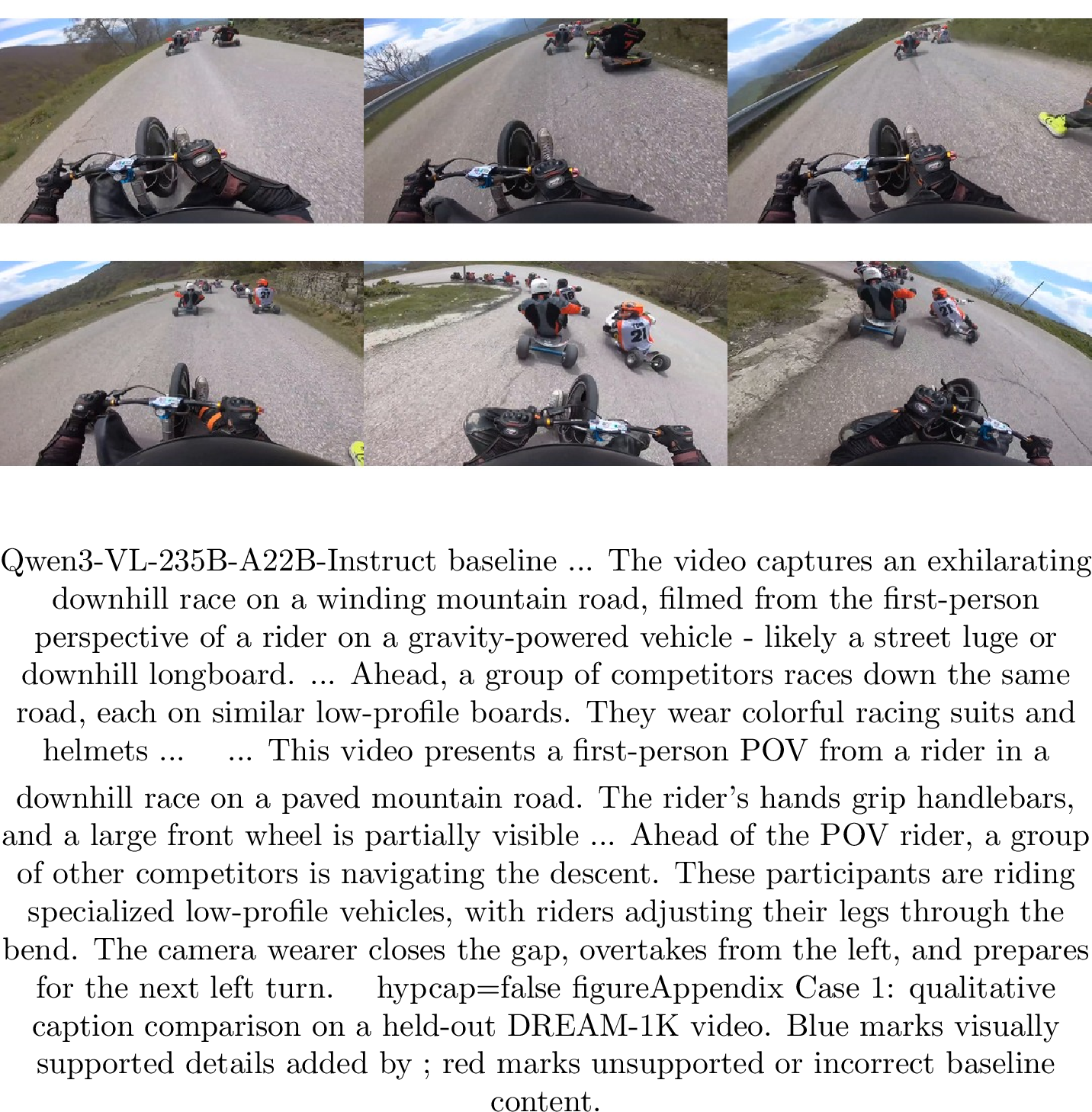 .
.
Figure 6: 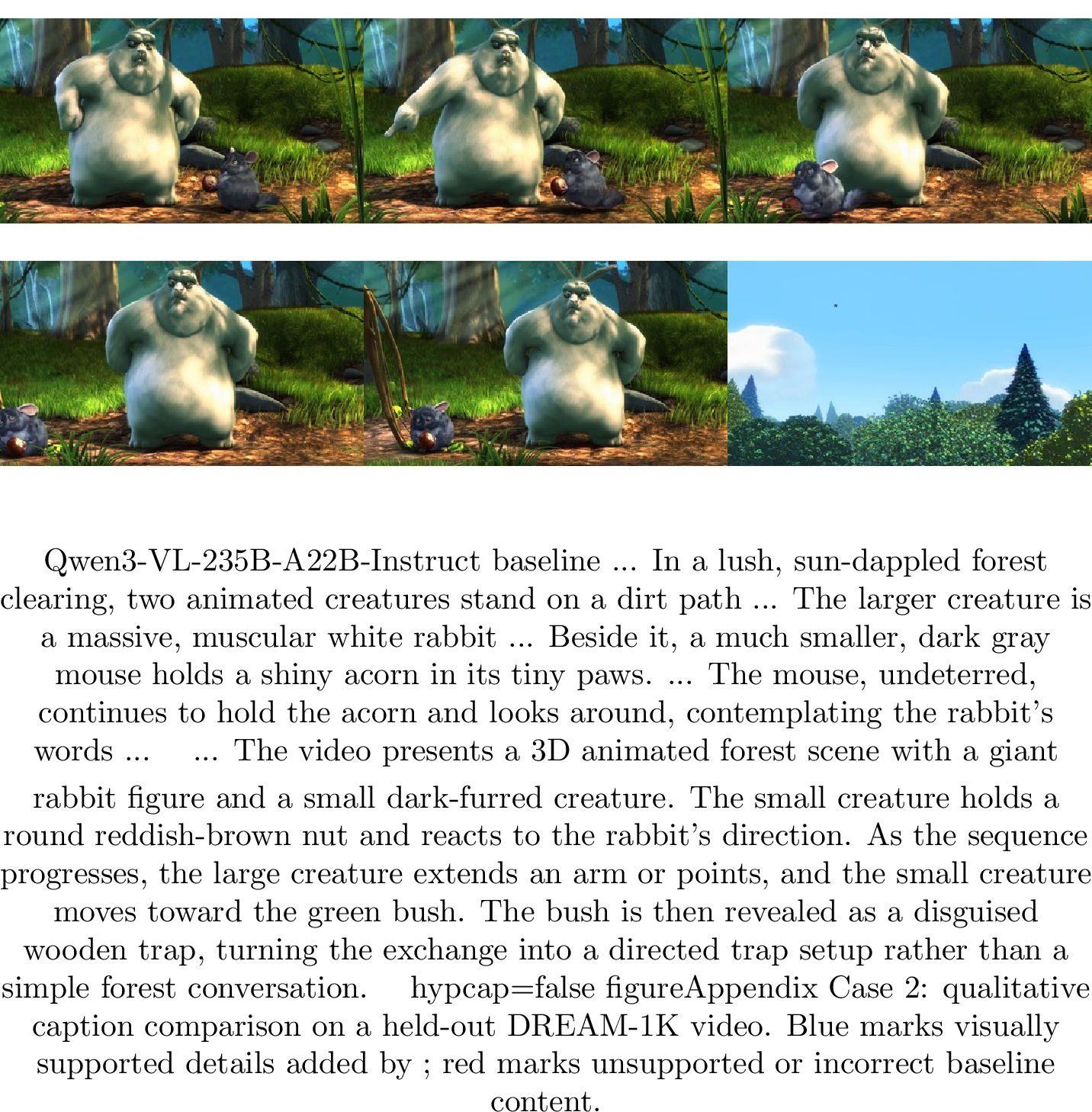 .
.
13 Prompt Templates↩︎
This section lists the prompt contracts used in reward training and evaluation. Prompts are grouped into reward-training prompts (§13.1) used by the online reward runtime, and evaluation prompts (§13.2) used for direct caption and Prism-style evaluation.
13.1 Reward Training Prompts↩︎
The reward prompts reproduce the English templates used by the claim decomposer, video verifier, and matcher roles in Table 6. Placeholders such as {caption} denote values filled at runtime. Figure [fig:prompt-decompose] shows the shared claim-schema decomposition prompt used for rollout claims and precomputed Gemini reference claims; Figure [fig:prompt-verify] shows video-only claim verification; Figure [fig:prompt-match] shows the per-category one-to-one matcher.
13.2 Evaluation Prompts↩︎
The evaluation prompts are short and shared across direct caption evaluation and Prism-style caption-to-QA. Figure [fig:prompt-direct-caption] shows the caption-only prompt used for direct caption evaluation and Prism Stage 1; Figure [fig:prompt-prism-qa] shows the caption-conditioned QA prompt used by the fixed Stage 2 answerer.
14 Data Privacy and Content Screening↩︎
14.0.0.1 Public benchmarks.
EventHallusion, VCapsBench, DREAM-1K, VideoMME, MMVU, MVBench, MotionBench, TOMATO, and PerceptionTest are publicly released research benchmarks distributed under their respective terms. We use them without modification and do not perform additional screening beyond what their creators applied.
14.0.0.2 Training videos.
All training videos are sourced from publicly available datasets and web platforms that permit research use. We did not collect new video data from human subjects. The videos are used solely for model training and evaluation; we do not attempt to identify, track, or profile individuals appearing in the videos.