A Comprehensive Study of Implementation Bugs in Multi-modal Agents
July 06, 2026
Abstract
Multi-Modal Agents (M-agents), empowered by Large Language Models (LLMs), excel in various complex, open-world scenarios such as autonomous driving and robotics. However, their unique requirements to interact with dynamic and diverse multi-modal environments introduce novel implementation challenges beyond those faced by traditional agents. Outdated perception, untrustworthy planning and inapplicable execution could cause traffic accident and financial loss. Despite growing study on agent issues, there has not been a systematic study focusing on M-agent-specific implementation bugs.
To address this gap, we conducted the first systematic study of implementation bugs in M-agents. We collected 34 representative M-agents from diverse sources and, through meticulous filtering, identified 158 M-agent-specific bugs from 1,268 issue reports. Using a top-down strategy, we developed a comprehensive taxonomy that classifies bugs by global symptoms, functionality component-level symptoms, and root causes. We then implemented MATester, an automatic proof-of-concept bug identifier by analyzing runtime inter-component outputs. When applied to 12 extra M-agents, MATester successfully covered 61.4% of known open issues and discovered 31 additional bugs, demonstrating the practical usefulness of our study. Our work provides a comprehensive reference and guideline for classification, prevention and fix of M-agent bugs.
Multi-modal Agent, Large Language Model, Implementation Bug, Empirical Study
1 Introduction↩︎
Owing to the rapid advancement of large language models (LLMs), intelligent agents have emerged as a prominent paradigm with capabilities including reasoning [1], [2], program synthesis [3]–[5], and counseling [6]. Multi-modal agents (M-agents) further extend this paradigm by interacting with high-dimensional, real-time and heterogeneous environments, enabling deployment in open-world safety-critical scenarios such as autonomous driving [7]–[9], robotics [10]–[13], and GUI automation [14]–[17]. However, implementation flaws in M-agents’ functional components may lead to severe consequences. For instance, outdated environmental perception in autonomous driving can result in traffic accidents [18]. Unconstrained execution of unverified plans in GUI automation manifests as unexpected behaviors, potentially leading to financial losses [19] and privacy violations [20].
Nevertheless, existing empirical studies primarily focus on single-modal agents, emphasizing aspects such as security [21], compliance [22], code-level implementation defects [23] and general module-level issues [24]. Many works concentrate on specific application domains, like software engineering [25], [26], code generation [27] and search [28], or agent architectures like multi-agents [29] and platform-orchestrated agent [30]. Although they study bugs from multiple perspectives, there is still a lack of systematic investigation dedicated to M-agents, particularly with respect to multi-modal environment interaction bugs.
Compared with single-modal agents, M-agents exhibit three distinctive characteristics: (1) perception: M-agents must distill and fuse real-time multi-modal information for LLM processing, whereas single-modal agents handle text directly; (2) execution: M-agents dynamically adapt action types and parameters to heterogeneous environments, while single-modal agents execute relatively fixed actions; (3) multi-modality: representations across modalities may introduce cross-modal conflicts. These features substantially complicate M-agents and motivate us to conduct the first systematic study of M-agent-specific implementation bugs.
Our study proceeds in three stages. 1) To construct a representative dataset, we initially identified 86 M-agents from GitHub, top-tier publications, and surveys. We then performed a coarse-grained text-based filtering by examining associated papers and project documentation, followed by a fine-grained manual code inspection to retain only M-agents with complete functionality components. The manual process is conducted by at least two authors separately to mitigate bias. After that, we collected 1,268 raw reports and manually identified 130 M-agent-specific reports covering 158 distinct bugs. 2) We then classified bugs using a top-down strategy across three dimensions: 6 categories of end-user-observable global symptoms, 16 categories of developer-oriented functionality-component-level symptoms, and 7 categories of root causes. Inconsistent perception and inapplicable actions caused by mishandling object dynamism, object informativeness and tool application scenarios are reported in 14.7% and 50% of M-agents, respectively. Cross-modal issues span multiple components. 3) Finally, to demonstrate the practical utility of our taxonomy, we implemented MATester, a preliminary bug detector. MATester automatically identifies both symptoms by analyzing runtime inter-component outputs. We applied MATester to 12 extra M-agents, where it successfully uncovered 61.4% of existing open issues and identified 31 unreported bugs. These results validate the effectiveness of MATester and highlight the practical value of our proposed taxonomy.
To sum up, this paper has the following three contributions.
To the best of our knowledge, we present the first systematic study of agent-specific implementation bugs in M-agents. Using a step-by-step filtering strategy, we collect 34 M-agents with 1,268 raw issue reports and identify 158 M-agent-specific implementation bugs. This dataset offers a benchmark for future M-agent testing.
We propose a taxonomy of M-agent implementation bugs using a top-down analysis strategy. Specifically, the bugs are categorized along three dimensions: global-level symptoms, functionality-component-level symptoms, and root causes. The taxonomy provides a guideline for understanding, prevention and fix of M-agent bugs.
We implement MATester, an automated bug detector for M-agents, to validate our proposed concepts. Based on our findings, MATester automatically detects symptoms in 12 extra M-agents. It successfully covers 61.4% of existing open issues and uncovers 31 previously unknown bugs, which demonstrate the applicability of our taxonomy.
2 Multi-modal LLM Agents↩︎
M-agents are built upon LLMs, leverage external tools to accomplish tasks, and interact with multi-modal environments. Owing to the advanced reasoning, cross-modal processing, and tool-use capabilities, they have been deployed in complex real-world scenarios, including autonomous driving [7]–[9], robotics [10]–[13], and GUI automation [14]–[17].
Fig. 1 illustrates the architecture and workflow of a typical M-agent. Multi-modal environments often contain dynamic and diverse information that LLMs cannot directly process, so the Perceptor firstly distills it into compact snapshot. The snapshot is forwarded to the Planner, which generates plans. These plans are subsequently transferred into concrete actions and executed by the Executor. This procedure continues iteratively until the task is complete. Because the workflow is sequential, failures in any components can propagate downstream, ultimately causing global failure.
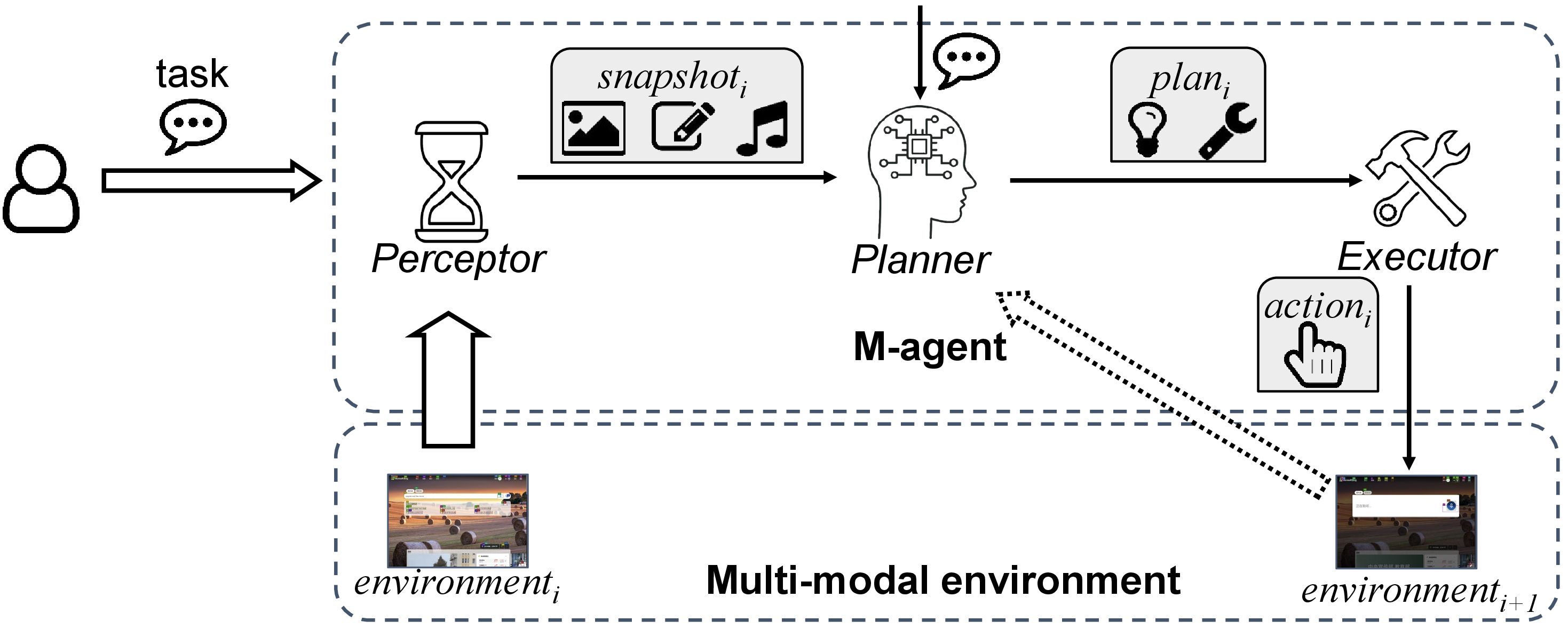
For clarity of presentation, we denote the inter-component outputs as snapshot, plan, and action, using subscripts to distinguish interaction rounds. Specifically, \(snapshot_i\) denotes the Perceptor’s output in round \(i\). The labels \(environment_i\) and \(environment_{i+1}\) denote the environment state before and after executing \(action_i\), respectively.
3 Study Design↩︎
3.1 Overview↩︎
The overview of this study is shown in Fig. 2. To investigate M-agent bugs, we curated an up-to-date collection of M-agents, gathered their issue reports, and focused on agent-specific bugs (Section 3.2). We constructed a top-down taxonomy analyzing symptoms from a global (end-user) and a functionality-component (developer) perspective, and identified root causes to guide future development (Section 3.3). Finally, we formulated research questions on the distribution, relationships and applicability of the taxonomy, and implemented MATester to validate our findings (Section 3.4).
3.2 Data Collection and Processing↩︎
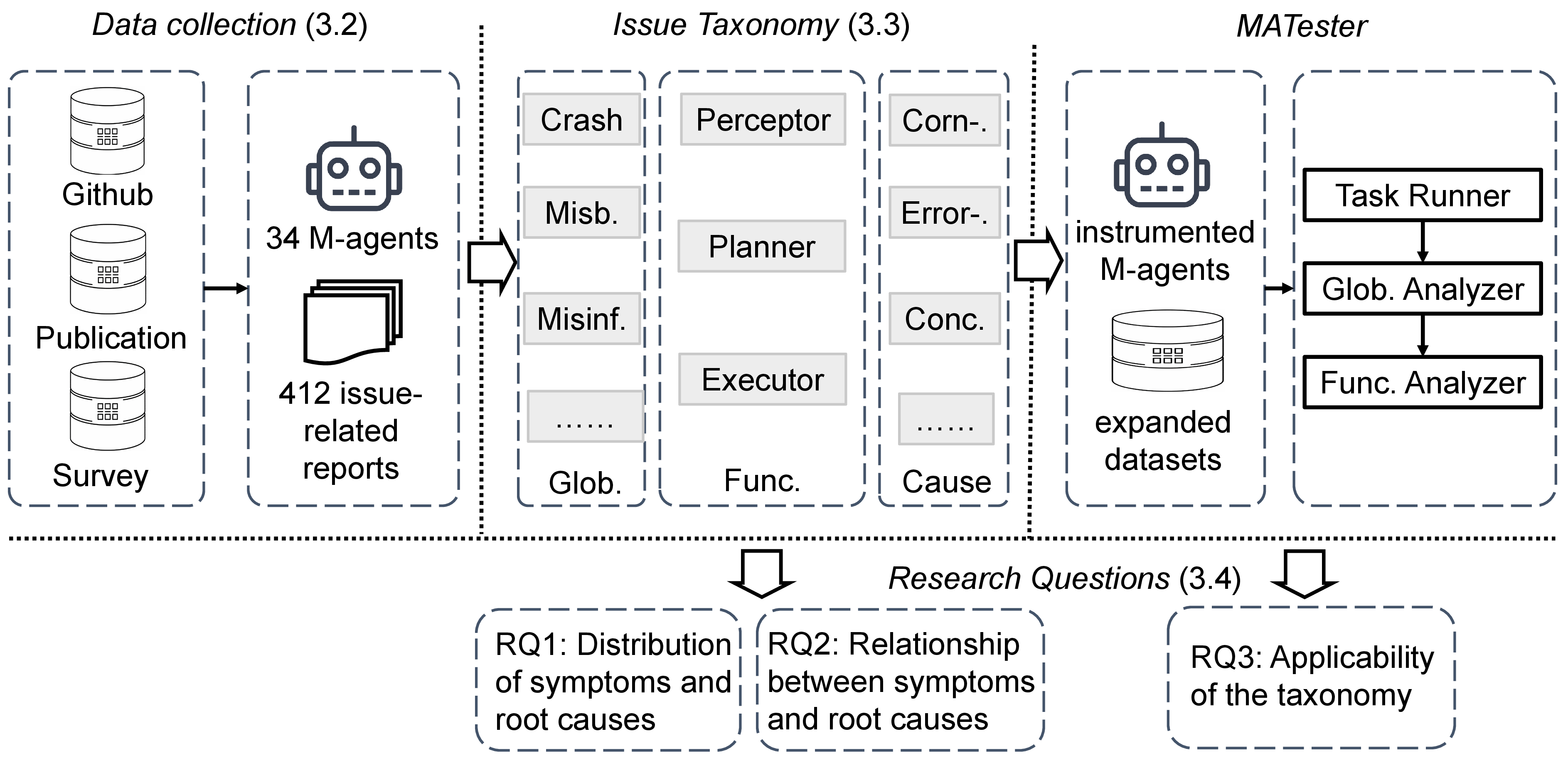
To the best of our knowledge, there is currently no comprehensive and up-to-date list of M-agents. Prior to studying bugs, we therefore conducted a systematic search to curate a representative set of M-agents from multiple sources. We then collected issue reports from their code repositories using automated keyword-based searches, followed by rigorous manual inspection and labeling to identify true issue reports.
3.2.1 M-agents Collection↩︎
To collect M-agents developed in both industrial and academic settings, we gathered candidates from three sources: GitHub repositories, top-tier publications, and recent survey papers. In particular, the survey by [31] provides a comprehensive list of M-agents published prior to February 2024. Given that more than two years have elapsed since the publication of this survey, we further expanded the collection by systematically searching recent publications in leading conferences and journals, including ACL, CHI, CVPR, ICCV, NeurIPS, ICLR, ICSE, FSE, ISSTA, TPAMI, JMLR, TSE and TOSEM, covering the period from 2023 to 2025. All results were collected before December 30, 2025.
Following prior studies [23], [32], we employed the Quasi-Gold Standard (QGS) approach [33] via automated keyword searches, snowballing, and manual screening. As shown in Table 1, keywords on LLMs, multi-modality, and agents were used for initial selection from GitHub and top-tier venues. GitHub repositories with less than 5 stars or forks were excluded. For publications, we applied both backward and forward snowballing [34] to capture overlooked related work.
| Type | Large Language Model | Multi-Modal | Agent |
|---|---|---|---|
| Keywords | |||
| Model, Language Model, | |||
| ChatGPT, AI | |||
| modal, Visual, Vision, | |||
| Audio, Speech | |||
| Embody, Robot |
After automated screening, we performed coarse-grained text-based manual filtering by examining topics, descriptions, and README files of GitHub repositories, and titles, keywords, and abstracts of papers, against the criteria in Table [tab: M-agent-requirement]. Specifically, we excluded: (1) tools that evaluate M-agents rather than implement an M-agent; (2) claimed conversational agents, functioning similarly to LLMs; and (3) agents that accept only text input. This yielded 84 M-agents: 25 from GitHub, 31 from surveys, and 30 from top-tier conferences.
| Requirements of a M-agent |
|---|
| R1: It claims to be implemented on a Large Language Model. |
| R2: It should be able to process multi-modal environmental information. |
| R3: It is an agent, at least taking actions to achieve its goal. |
Finally, we conducted fine-grained code-based manual filtering to retain runnable M-agents with complete functionality modules. We excluded candidates: (1) lacking an implementation artifact; (2) missing essential files affecting execution; (3) relying on unavailable dependencies; (4) lacking core functionality modules; or (5) whose code semantics violate Table [tab: M-agent-requirement]. This yielded 46 M-agents. Three-fourths (34) of M-agents were used to construct the taxonomy, while the remaining one-fourth (12) was used to evaluate its extensibility.
3.2.2 Bugs Collection↩︎
Following prior empirical studies [35]–[37], we collected closed issues and merged pull requests from selected M-agents’ GitHub repositories. To balance issue numbers across repositories with varying activity levels, we applied differentiated strategies. For recently created repositories with fewer than 50 closed reports, or repositories inactive for over a year, we also included open reports. For actively maintained repositories, we collected reports within a 15-month window [37]. This yielded a raw dataset of 1,268 items.
To ensure that the issues that we collected are true bugs, we adopted a semi-automatic two-step filtering process. We first applied an automated filter by searching for bug-relevant keywords, namely “error”, “fix”, “bug”, “issue”, “fault”, “wrong”, “mistake” and “fail”, within issue or pull request titles and tags. This step yielded 263 candidate issues. To complement the automated filtering, a manual inspection of the remaining issues is conducted. Two authors independently reviewed the titles and contents of these issues and reached agreement on 96.5% of them. Disagreements were subsequently resolved through discussion to reach consensus. Through this process, we identified an additional 149 bug-related issues, resulting in a total of 412 bug-related issues for further analysis.
3.2.3 Classification and Labeling↩︎
We classified bugs in two stages. First, we categorized each issue by bug type, then annotated agent-specific implementation bugs with global- and functionality-component-level symptoms and root causes, using prior studies [35]–[40] as an initial coding framework. The first author reviewed 11.0% of issues to validate and refine the taxonomy. All authors then met to consolidate the taxonomy. A second author independently re-labeled the same 11.0% subset, achieving an inter-rater agreement of 0.42, measured using Cohen’s Kappa [41]. After resolving disagreements, both authors labeled the remainder independently (Kappa = 0.84), and a final consensus meeting resolved remaining discrepancies. The labeling produced 130 implementation issue reports covering 158 unique bugs, 6 global-level symptoms, 16 functionality-component-level symptoms, and 7 root causes.
3.3 Bug Taxonomy↩︎
3.3.1 Global Level Symptoms↩︎
We summarized the global-level symptoms, which characterize the observable behaviors of M-agents from an end-user perspective when bugs occur. The identified global-level symptoms are described below.
Report error and crash (Crash). This symptom characterizes the unexpected termination of M-agents during task execution, typically accompanied by error reports.
Misbehave during execution without crash (Misbehave). This symptom describes incorrect agent behavior without causing a system crash. Specifically, the agent performs actions that are irrelevant to the given task or inapplicable to the environment, ultimately resulting in task failure.
Can not respond (Unrespond). This symptom indicates that M-agents become unresponsive for an extended period.
Mis-notify the exit (Mis-signal). This symptom characterizes the proactive exit of M-agents before the task completion.
Behave inconsistently under the same setting (Diverge). This symptom characterizes inconsistent behavior, whereby an M-agent exhibits different execution outcomes when performing the same task under identical environmental conditions. Notably, this is a result-oriented rather than an action-oriented symptom: if an M-agent follows different actions to complete the same task but lead to identical outcomes, the behavior is not considered inconsistent.
User interface provides wrong information (Misinform). This symptom denotes inconsistency between the M-agent’s behavior and the feedback it provides to users.
3.3.2 Functionality Component Level Symptoms↩︎
Since an M-agent comprises three core functionality components, functionality-component-level symptoms are correspondingly categorized according to these components.
Perceptor. The Perceptor transforms the multi-modal environment information into a snapshot for the Planner’s LLM. When it fails, the following symptoms arise.
The snapshot does not exist (Missing-S).
The snapshot has wrong format (Malformed-S). M-agents’ snapshots are typically multi-modal or non-textual. This inherent complexity makes them more susceptible to formatting issues. Moreover, non-textual snapshots are typically stored as files. Therefore, bugs related to file names and file paths may also lead to this symptom.
The snapshot’s content is wrong or incomplete compared with the environment (Wrong-S). The environmental heterogeneity may affect the Perceptor’s ability to recognize specific objects (incomplete), while the dynamic feature may cause outdated snapshots (wrong). We further split it into two sub-symptoms “same (SM) / different (DM)” according to modality consistency of snapshots and environments.
Available objects are labeled in the snapshot, but labels are wrong or incomplete (Mislabeled-S). Due to the diversity of objects in multi-modal environments, Perceptors normally label accessible objects to assist the LLMs in identifying them. However, these labels may be inaccurate: accessible objects are missed (incomplete), or environmental features, like the background, are marked (wrong).
Two environments are the same, but their snapshots are different (Inconsistent-S). Environments are the same if they contain the same objects with the same position, outlook and available actions. Due to the dynamic environment and instable agent behavior, the Perceptor may generate different snapshots for the same environment. We further split it into two sub-symptoms “same (SM) / different (DM)” according to modality consistency of snapshots and environments.
Planner. The Planner constructs a prompt from the snapshot and the task, then queries the LLM for the next plan. Bugs may arise in both prompt construction and plan generation.
The prompt misses necessary information (Wrong-PR). A complete prompt should include at least the following information: environmental information (the snapshot), task specification, available tools and expected output formats.
The plan does not exist (Missing-P).
The plan has wrong format (Malformed-P). The plan should satisfy the output format specified in the prompt.
The plan is internally contradictory (Conflict-P). It mainly exhibits two types of forms. The LLM may “act” (i.e., invoke available tools) differently from it “thinks” (i.e., expresses its thought in natural language). Tool invocations may also exhibit parameter or behavior conflicts.
The plan does not satisfy constraints given by the snapshot (Inapplicable-P). The snapshots are often multi-modal or non-textual, which brings challenges to object identification and action extraction. Therefore, LLM-generated plans may contain wrong actions or unsupported parameters. We further split it into sub-symptoms “same (SM) /different (DM)” based on modality consistency of plans and snapshots.
The plan is not related to the task (Irrelevant-P). The plan should facilitate task completion. We further classify it into two types, representing “when” (Wrong-Stop) and “what” (Wrong-Step) decisions respectively.
The plan cannot correctly decide the task termination
The plan cannot lead to task completion
The tasks, snapshots and prompts are nearly the same, but their plans are different and finally result in different execution results (Inconsistent-P). Multi-modal inputs could amplify the inherent uncertainty of LLMs [42], making them likely to produce different plans given the same input. However, the randomness of the plan should not affect the execution results. This symptom is classified into sub-symptoms “same (SM) /different (DM)” based on modality consistency of plans and snapshots.
Executor. The Executor component translates textual plans into concrete actions by invoking off-the-shelf or custom-defined APIs to advance task execution. It is the Executor’s responsibility to decide when and how to interact with the multi-modal and dynamic environment. When the Executor encounters bugs, they manifest as the following symptoms.
The action does not exist (Missing-A). This symptom is identified if M-agents do nothing following correct plans.
The action is different from the plan (Wrong-A). Given a correct plan, the action should follow its instruction.
The action is not applicable to the environment (Inapplicable-A). Since the environment is constantly changing, plans made on outdated snapshots may not be applicable to the current environment. It is identified if the action follows the plan’s instruction, but is not applicable to the environment. It is classified into two types.
The plan is wrong, the action sticks to the plan and causes crashes (Wrong-P&A). Normally, an action following a wrong plan is not identified as an Executor-related bug unless the M-agent crashes, because only the wrong action is the direct cause of Crash.
The plan and the invoked tool are correct, but the tool runs unexpectedly (Wrong-API).
The reflection on the action’s result is wrong (Wrong-R). This symptom is identified if the reflection of the action’s influence on the environment is different from the fact.
3.3.3 Root Cause↩︎
Root causes constitute another category of M-agent analysis in this work. Below, we only introduce the major categories that are independent of the scenario. The specific root causes will be introduced in Section 4.
Concurrency. It refers to situations in which multiple components access shared resources without proper synchronization. We observed two representative scenarios. The first is a data race, where the environment undergoes internal changes (i.e., a write to the environment) after \(snapshot_i\) is captured (i.e., a read of the environment), rendering \(action_i\) inapplicable to the updated environment. In this case, no happens-before relationship exists between the environment write and the snapshot read. The second scenario is an atomicity violation, in which \(snapshot_{i+1}\) is captured after \(action_i\) is executed, but the environment has not yet transitioned to a stable state \(environment_{i+1}\) under the effect of \(action_i\). Consequently, \(snapshot_{i+1}\) does not accurately represent \(environment_{i+1}\), thereby adversely affecting subsequent stages of the agent’s workflow.
Corner-case gaps. It arises when functionality modules fail to correctly handle edge cases, which typically stem from rare yet valid inputs. Based on the locations of corner cases, we further categorize the overlooked factors into task processing, plan comprehension, snapshot generation, LLM query, and tool understanding and invocation. For example, the Perceptor may ignore “dynamic objects”, and the Executor may invoke tools with limited “applicable scenarios” and operate on unauthorized objects. The detailed classification is introduced and analyzed in Section 4.
Error-case gaps. It refers to situations in which functionality modules lack robustness to minor errors, allowing small deviations to propagate into more severe failures. Similar to corner-case gaps, the overlooked factors are also divided under different phases: plan comprehension, snapshot generation, LLM query, and tool understanding and invocation. For example, facing an “unexpected environment”, the invoked tool may access unavailable objects or perform unsupported actions, causing Misbehave or Crash. The detailed classification is presented in Section 4.
Lack of persistent memories for task execution experience (No persistent memory). It captures bugs arising from the absence of a memory mechanism in M-agents that conduct user-specified tasks, which adversely affects behavioral consistency. When equipped with memory, M-agents can leverage prior successes and failures to inform subsequent decision making. In contrast, a task-oriented M-agent treats repeated instances of the same task as entirely new, independent executions. Moreover, LLMs inherently exhibit a degree of stochasticity, so the lack of memory further affects the reproduction of previously successful behaviors.
LLM’s limitation. LLMs exhibit inherent limitations, including hallucination, inconsistency, and instability. In M-LLMs, such inconsistency may manifest across different modalities.
Unsuitable LLM parameters (Bad parameters). The behavior of the underlying LLM is highly sensitive to configuration parameters, including prompt design, temperature setting, and maximum token limits. Prompts that omit critical information or exceed model constraints can significantly impair plan generation. An inappropriate temperature setting may lead to overly rigid or constraint-violating behaviors, while an insufficient maximum token limit can result in truncated or incomplete outputs.
Incorrect code semantics (Incorrect semantics). We observed two representative forms of such errors. Variables associated with the \(i\)-th interaction round are incorrectly updated for the \((i+1)\)-th round. In anther case, the implemented code semantics deviate substantially from the intended behavior implied by comments or function names. This root cause does not follow a systematic pattern and is likely attributable to careless or erroneous implementations.
3.4 Research Questions↩︎
Our study aims to answer the following research questions.
RQ1: What is the proportion and the distributions of agent-specific implementation bugs? It characterizes the reliability landscape of M-agents by quantifying how frequently agent-specific bugs occur and how they are distributed, revealing that such problems are systematic rather than isolated.
RQ2: What is the relationship between these symptoms? It analyzes how agent-specific bugs manifest and propagate across functionality components, revealing symptom co-occurrence and causal relationships to enable more effective diagnosis and repairing strategies.
RQ3: Is our taxonomy applicable to undiscovered bugs? It evaluates whether the taxonomy generalizes to undiscovered bugs, validating it as a predictive and diagnostic tool rather than a purely descriptive framework.
4 Experimental Results↩︎
4.1 RQ1: Distribution↩︎
We collected 412 reports and classified them into various bug types. The agent-specific implementation bugs are further analyzed for global symptoms, functionality component-level symptoms, and root causes.
Distribution of bug types. Table 3 shows the distribution of bug types. Implementation bugs account for the largest proportion of about 38.3%. They are further classified into agent-specific and irrelevant bugs. Irrelevant bugs refer to bugs of assistive functionalities, such as dataset processing and log management. We observe that the number of issues containing agent-specific implementation bugs is 4.6 times that of irrelevant implementation bugs. The first column also reports that there are 158 bugs found in agent-specific implementation issue reports.
Dependency, configuration, version, and other non-implementation-bugs account for the remaining categories and are not directly linked to M-agent behavior. Symptoms and root causes are thus identified solely from agent-specific implementation bugs.
| bug | ||||||||
| (specif.) | ||||||||
| bug | ||||||||
| (irrel.) | ||||||||
| -ency | ||||||||
| bug | ||||||||
| -system | ||||||||
| bug | ||||||||
| bug | ||||||||
| issue | ||||||||
| bug | ||||||||
| bug | ||||||||
| a | ||||||||
| bug | ||||||||
| 130 / 158 | 28 | 57 | 28 | 45 | 12 | 24 | 25 | 63 |
FINDING 1: Agent-specific implementation bugs account for the largest proportion among all the bug types. They are directly related to M-agent’s behavior, and potentially reveal the issues in its functionality components.
Distribution of global level symptoms of agent-specific implementation bugs. Table 4 shows the distribution of global level symptoms. Crash is the most common, accounting for over half of all bugs. Misbehave follows at 36.7%. Runtime symptoms (Unrespond, Mis-signal) and functionality symptoms (Diverge, Misinform) are also observed.
| Glob. | ||||||
|---|---|---|---|---|---|---|
| Num. | 83 | 58 | 5 | 3 | 5 | 4 |
| Perc. | 38.2% | 35.3% | 8.8% | 8.8% | 8.8% | 8.8% |
Compared with single-modal agents, M-agents are more deployed in real-life scenarios, causing more severe consequences. Crash directly interrupts tasks and is observed in autonomous driving, GUI automation, and robotics, leading to outcomes like traffic accidents. Misbehave can cause financial leakage or privacy violations (e.g., inserting wrong account IDs or phone numbers into text boxes). Diverge and Misinform indicate unstable or untrustworthy agent behavior.
FINDING 2: Crash and Misbehave are the most common global symptoms, accounting for 52.5% and 36.7% of M-agent-specific bugs, respectively. Crash causes traffic accidents in autonomous driving. Misbehave manifests as unexpected tokens inserted into text boxes of mobile apps, further causing financial or privacy leakage.
Distribution of functionality component level symptoms in agent-specific implementation bugs. Table ¿tbl:tab:32functionality95component95symptom? shows the distribution of functionality component level symptoms classified by different functionality components, along with the percentage of M-agents with specific symptoms.
The multifacetedness, complexity and dynamism of the multi-modal environments pose challenges to acquire complete, accurate and real-time snapshots and identify interactive objects, resulting in the prevalence of Wrong-S and Mislabeled-S. Wrong-S is discovered in 9 cases and revealed in 14.7% of M-agents. Mislabeled-S is found in 10 cases.
Among the two subcategories of Wrong-S, DM is supported by more cases than SM because cross-modality environmental perception is more challenging. In addition, even SM perception in M-agents is more prone to errors due to the involvement of non-textual modality object identification and understanding. Identifying and labeling objects in M-agents are necessary especially when the environments contain complex backgrounds or distracting elements, making Mislabeled-S a unique M-agent symptom. Its prevalence stems from M-agents’ failure to recognize dynamically generated objects, which are common in multi-modal environments. M-agents that percept based solely on static layouts often miss dynamically generated objects.
FINDING 3-1: Wrong-S is the most severe Perceptor symptom. Its two subcategories are evenly distributed, indicating that both cross-modality and non-textual intra-modality environment perception are challenging. Due to the diversity of the multi-modal environments, Wrong-S is also common as Perceptors could overlook specific object types.


In the Planner, Missing-P, Malformed-P, Inapplicable-P, and Irrelevant-P each appear in over 14 cases, with Inapplicable-P and Irrelevant-P affecting over 20% of M-agents.
The popularity of Inapplicable-P demonstrates the difficulty of understanding the constraints implied in the snapshots. Among the subcategories, SM has more cases than DM, but we also observe that SM planners are more common than DM planners. LLMs in the DM planner must identify operable objects, locate positions, predict action ranges, and generate correct tool-calling parameters. However, the operable objects, positions and action ranges are not explicitly given as prompts, instead, they are implied in the non-textual modality snapshot, bringing challenges to DM planning. LLMs in the SM planner also perform action range prediction and parameter generation despite the summarization of operable objects in the snapshot. Among the subcategories of Irrelevant-P, Wrong-Step is more frequent than Wrong-Stop. Its popularity reflects the struggling of M-agents to decompose the general task into multiple unit steps and identify the task end.
FINDING 3-2: Inapplicable-P and Irrelevant-P are the most common symptoms in the Planner. Their popularity demonstrate the difficulty in figuring out the constraints implied in the non-textual modality snapshots, decomposing the task into small steps and judging the termination of the task.
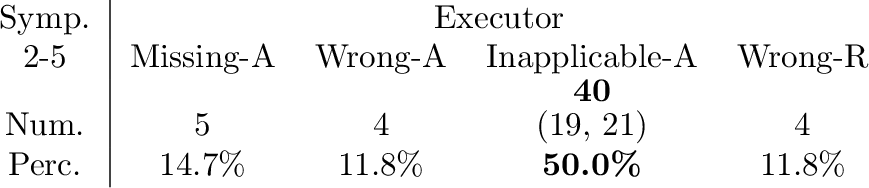
Inapplicable-A dominates the Executor symptoms, accounting for about 76.9%. The popularity of Inapplicable-A indicates that generating effective and correct actions under complex and dynamic multi-modal environments is difficult. Inapplicable-A is further classified into Wrong-P&A and Wrong-API. They are almost equally distributed. The popularity of Wrong-P illustrates that many M-agents are designed to follow LLM-generated plans without extra correctness checking. On the other hand, the commonality of wrong-API symptoms arises from the mismatch between APIs and specific objects. Multi-modal environments are heterogeneous, meaning that objects may have different permissions or interaction interfaces. Wrong-APIs may work on specific, common objects and fail on others.
FINDING 3-3: Inapplicable-A is the major Executor symptom. Its popularity implies the difficulty to generate environment-compatible actions. Its subcategory Wrong-P&A reflects that M-agents follow LLM-generated plans without extra checking. Wrong-API demonstrates that self-defined APIs may fail on special objects.
Distribution of root causes in agent-specific implementation bugs. Table 5 displays the distribution of root causes and percentage of M-agents with specific root causes. Corner-case gaps and Error-case gaps are the major root causes, exhibited in 40 and 38 reports, respectively.
To figure out the major factors that are overlooked by M-agent developers, Fig. 3 further presents the distribution of factors related to Corner-cases and Error-cases, shown by 3 (a) and 3 (b), respectively. In Corner-case gaps, snapshot generation dominates the distribution, and its common subclasses include file path, object dynamism, file size, and object informativeness. Unlike textual snapshots, non-textual snapshots are mostly saved in files, causing problems when tracking relative file paths or handling LLM-incompatible file sizes. Additionally, while textual snapshots explicitly list operable objects, operable objects in non-textual snapshots are embedded into the background. Perceptors are required but may fail to identify specific objects, such as dynamically generated or running objects, or objects with few functional descriptions.
Further more, plan comprehension and tool invocation are the most common components where Error-cases occur, followed by LLM query. Wrong format and unexpected environments are the most frequent factors. Ignorance of wrong format suggests the lacking of format checkers to verify the validness of the LLM generated outputs. The unexpected environments involve various objects with different action ranges, access permissions and subsequent behavior, making it difficult to select appropriate tools and set correct parameters at first try. However, certain tools fail immediately when executed in incompatible environments, yet many M-agents lack explicit mechanisms for handling and analyzing such errors.
LLM’s limitation (29.4%) and Incorrect semantics (35.9%) are also major root causes. Concurrency, which represents the uncertain sequencing between environment changes and M-agent perceptions or executions, leads to unstable snapshots and inapplicable actions. No persistent memory causes inconsistent behavior across identical situations.
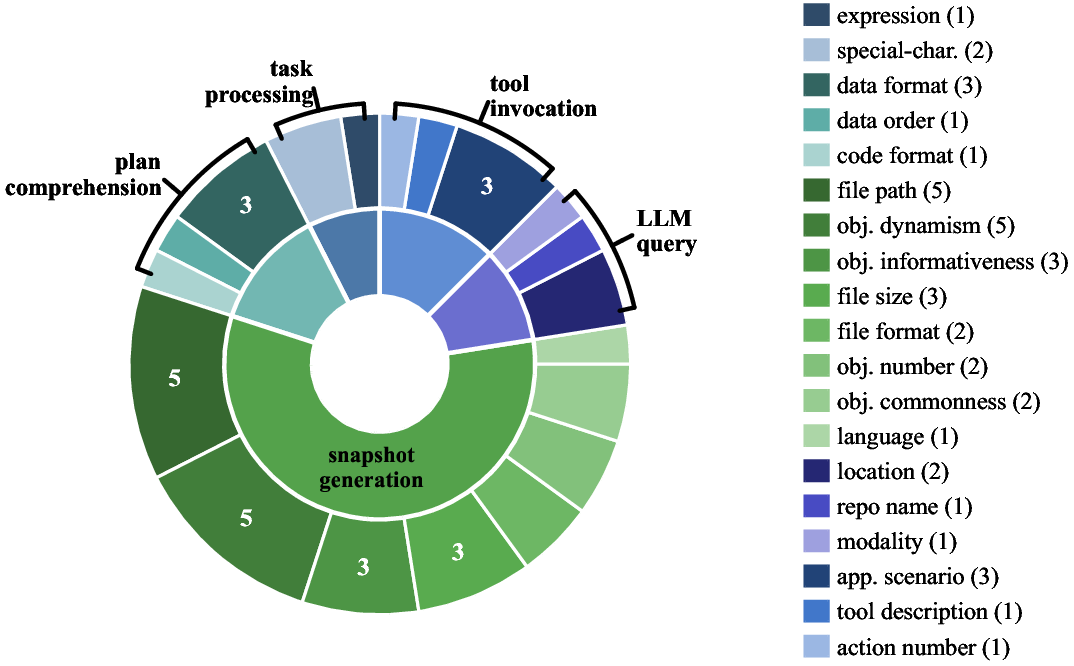
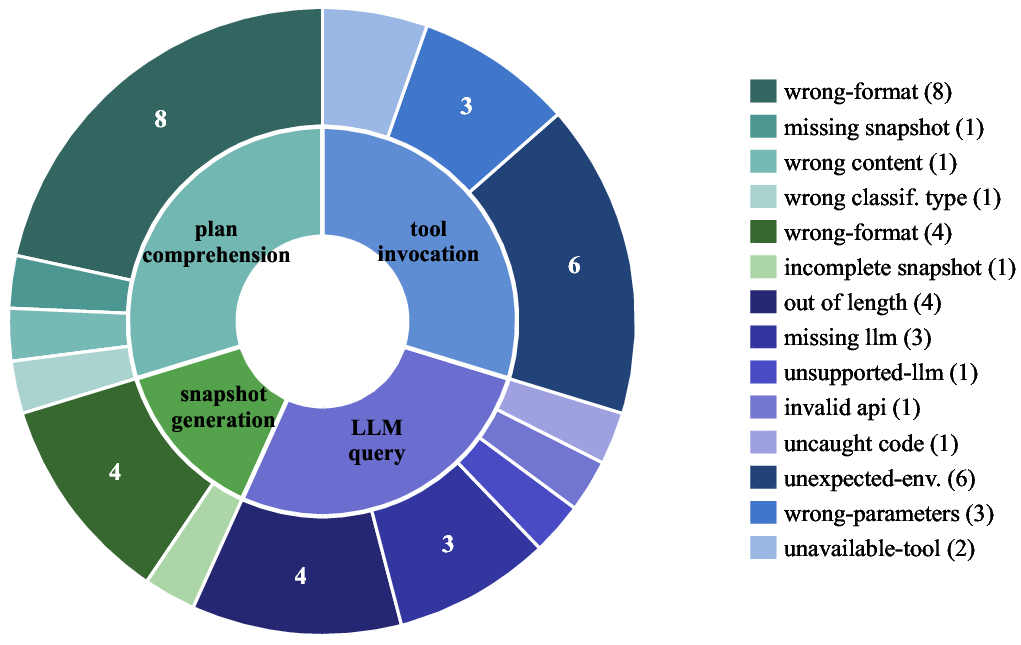
Figure 3: Factors related to Corner-cases and Error-cases distributed by components.. a — Factors related to Corner-cases, b — Factors related to Error-cases
| Root. | |||||||
| mem. | |||||||
| limit. | |||||||
| param. | |||||||
| semat. | |||||||
| Num. | 1 | 40 | 38 | 2 | 33 | 17 | 27 |
| Perc. | 2.9% | 26.5% | 17.6% | 5.9% | 29.4% | 11.8% | 35.9% |
FINDING 4: Corner-case gaps and Error-case gaps are the major root causes and cover over 24% of agent-specific implementation bugs. The dynamism and diversity of the multi-modal environments bring new factors that are overlooked by M-agent developers, such as the ignorance of dynamically generated or running objects and mishandling of object permissions and action ranges.
4.2 RQ2: Relationship↩︎
Relationship between the global level symptom and the functionality component level symptom. Fig. 4 shows the relationship between the global level symptom and the functionality component related symptoms. Although common global level symptoms like Crash and Misbehave can be related to multiple functionality component level symptoms, we can still observe patterns from the magnitude of the values. Below, we analyze the results from the perspective of the Perceptor, Planner and Executor, respectively.
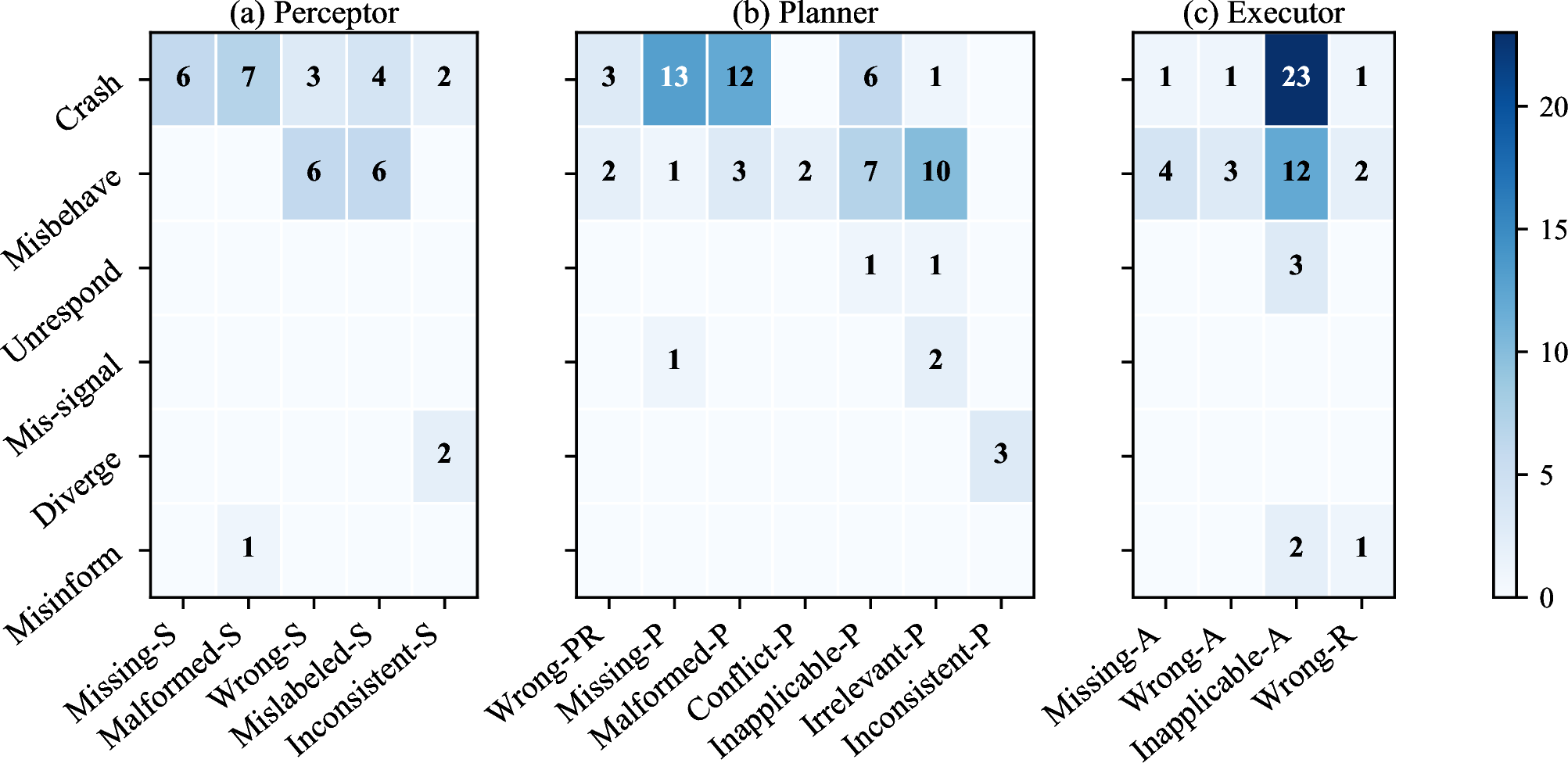
In the Perceptor, Missing-S and Malformed-S are the most common causes of Crash, supported by over 6 cases. This connection may be less common in single textual-modal agents, because even if a text snapshot contains missing content or formatting errors, the LLM can usually still parse and process the remaining text. In contrast, multi-modal artifacts such as images or audio files are more susceptible to failures caused by missing file paths or unsuccessful loading, which can prevent the M-agent from accessing the content and even lead to crashes.
In addition, Wrong-S and Mislabeled-S generate comprehensible but semantically wrong snapshots, showing incomplete or outdated environments, or mistakenly marking the uncontrollable objects. Both of them potentially lead to the Planners’ misunderstanding of the environment, and further influence task completion correctness (Misbehave). Diverge is only resulted from Inconsistent-S in the Perceptor, because inconsistent snapshots naturally cause inconsistent behavior. The most likely Perceptor related symptom of Misinform is Malformed-S. Malformed-S may be incomprehensible to Planners but comprehensible to the users. Displaying it on the UI without extra feedback misleads users to believe the perception is successful.
FINDING 5-1: Crash is likely to be resulted from Missing-S and Malformed-S. Different from text snapshots, snapshots in image or audio formats are saved in files, making them more susceptible to failures caused by missing file paths or unsuccessful loading, which directly prevent LLMs from accessing the snapshots. Furthermore, Misbehave is connected to Wrong-S and Mislabeled-S, because they generate readable but factually incorrect snapshots, affecting the environmental comprehension.
In Planner related symptoms, Missing-P and Malformed-P are most likely to cause Crash, supported by around 12 cases. The Executor is unable to extract valid actions from missing or malformed plans. If the Executor relies on a strict format-matching strategy, it may fail to find the expected content, resulting in errors and ultimately causing a crash. Inapplicable-P and Irrelevant-P are highly related to Misbehave because these plans are not executable in the environment or irrelevant to task completion, and often lead to behavioral deviations. They also cause Unrespond: Executors may be unable to proceed with the subsequent workflow, ultimately resulting in an unresponsive state. Mis-signal is linked to Irrelevant-P (the termination signal is part of the plan), and Diverge is caused by Inconsistent-P as local inconsistencies may lead to overall inconsistencies in execution results.
FINDING 5-2: In Planner related symptoms, Crash is related to Missing-P and Malformed-P because a part of Executors adopt template-matching strategies, and they may raise errors when encountering plans that do not match the expected format. Misbehave is connected to Inapplicable-P and Irrelevant-P. We also observe that Unrespond and Mis-signal are resulted from Planner symptoms.
In Executor related symptoms, Crash, Misbehave and Unrespond are highly connected to Inapplicable-A, supported by 23, 12 and 3 cases, respectively. The type of global symptoms depends on the different manifestations of Inapplicable-A. In text-based environments, actions are typically applied to a well-defined object (e.g., code). In contrast, in multi-modal environments, the objects are more diverse and dynamic, so an action may attempt to access a non-existent object. In such cases, Crash most likely happens. In other cases, the Inapplicable-A may call wrong implemented API and Misbehave is more prone to occur. Misinform is related to Inapplicable-A and Wrong-R because users may be incorrectly informed that the Inapplicable-A is successfully executed.
FINDING 5-3: Crash, Misbehave and Unrespond are all connected to Inapplicable-A in the Executor. The implementation of the actions determines which global level symptoms occur. For example, actions can access unavailable objects in the dynamic and diverse multi-modal environments and cause Crash. Otherwise, if Inapplicable-A calls wrong-implemented APIs, Misbehave happens.
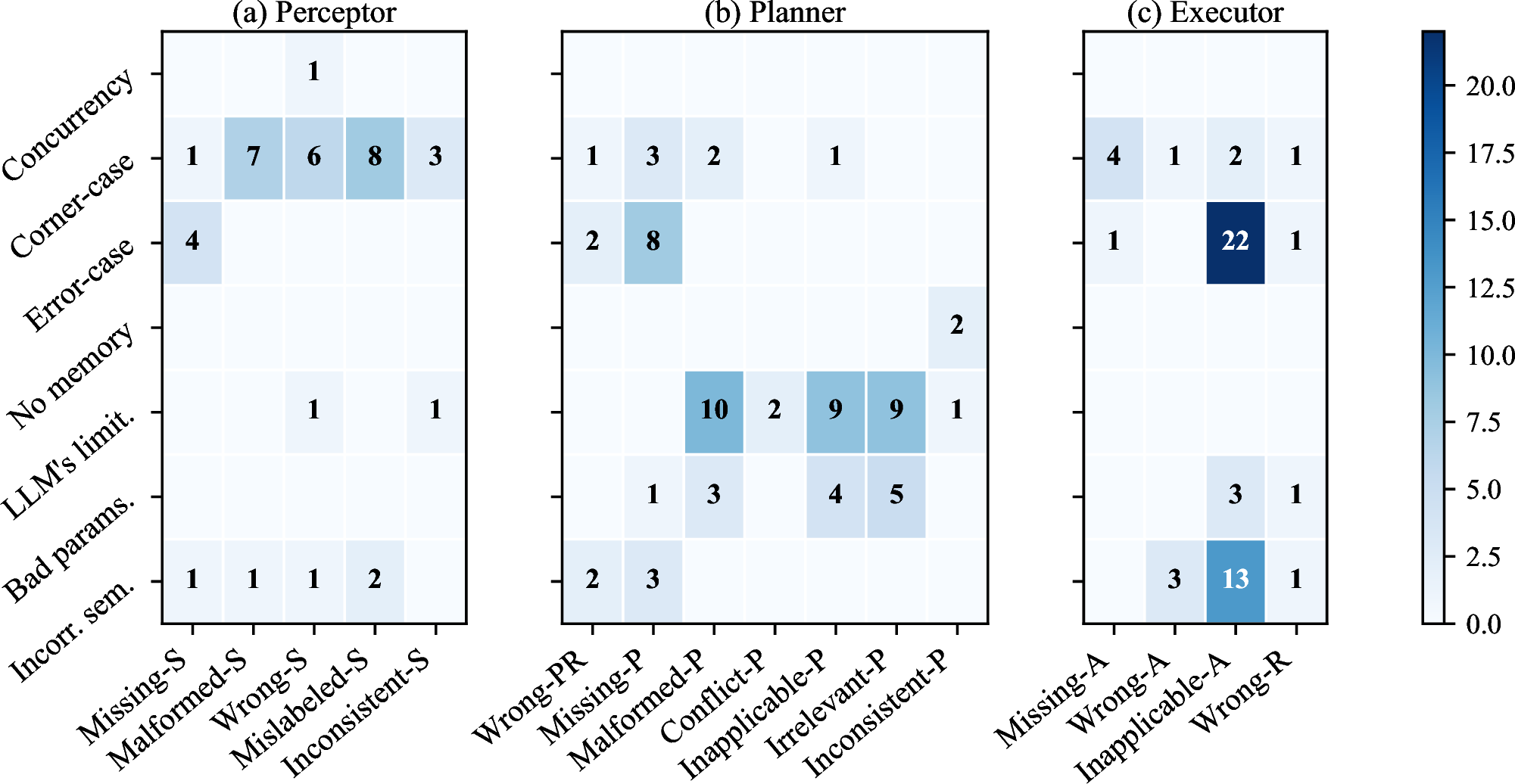
Relationship between the functionality component level symptom and the root cause. Fig. 5 illustrates the relationship between root causes and functionality component level symptoms. In the Perceptor, Malformed-S, Wrong-S and Mislabeled-S are all related to Corner-case gaps, each relationship supported by over 3 cases. After further analyzing the subcategories of Corner-case, we find that all 23 Perceptor symptoms caused by Corner-case gaps can be attributed to the snapshot generation component within Perceptor. Only 2 Malformed-S cases need to be traced back to the earlier task processing stage. In these 2 exceptional cases, we find that the task name is directly used as part of the snapshot filename without any sanitization. As a result, the filename contains special characters from the task name that are not permitted in filenames. Additionally, Wrong-S and Mislabeled-S are mostly resulted from bad handling of object dynamism and object informativeness.
FINDING 6-1: Malformed-S, Wrong-S and Mislabeled-S are connected to Corner-case gaps because of mishandling object informativeness or object dynamism in the snapshot generation or ignoring special characters when using task content as the snapshot filename.
In Planner symptoms, Malformed-P, Conflict-P, Inapplicable-P and Irrelevant-P are all connected to LLM’s Limitation. Due to internal limitations like hallucinations, LLM-generated plans may violate output format, environmental constraints, or task descriptions. Wrong-PR traces to Error-case gaps (unhandled prompt length overflow in the LLM query component), and Missing-P also stems from Error-case gaps (e.g., invalid API, unsupported LLM, missing LLM). Inconsistent-P is connected to No persistent memory, as memory records history needed to maintain behavioral consistency.
FINDING 6-2: Malformed-P, Conflict-P, Inapplicable-P and irrelevant-P are connected to LLM’s Limitation because LLM-generated plan is not trustworthy, no matter in output format, internal logic, environment applicability or task relation. Wrong-PR is highly related to Error-case gaps as wrong prompts can be caused by unhandled length excess. Inconsistent-P is connected to No persistent memory as memory maintains behavior consistency.
In Executor symptoms, Missing-A is related to Corner-case gaps. Limited support for diverse data formats and tools with incomplete descriptions cause inappropriate generation of actions. Wrong-A is caused by Incorrect semantics due to incorrect plan-to-action parsing. Inapplicable-A is caused by both Error-case gaps (unchecked access to unavailable objects in unexpected environments) and Incorrect semantics (incorrect API implementations).
FINDING 6-3: Missing-A is related to Corner-case gaps due to mishandling of plans with diverse formats and tools with incomplete descriptions. Wrong-A is likely to be caused by Incorrect semantics owing to incorrect parsing from plans to actions. Finally, Inapplicable-A is highly connected to Error-case gaps and Incorrect semantics, manifesting as ignoring unavailable object access, and inconsistent API implementation and description.
4.3 RQ3: Applicability↩︎
4.3.1 Implementation of MATester↩︎
We demonstrate the usefulness of our finding by implementing a preliminary tester called MATester based on our taxonomy in Section 3.3. MATester can automatically identify global level symptom and localize the functionality component level symptom based on the M-agent’s inter-component outputs.
We manually instrumented each M-agent to emit formatted inter-component outputs (environments, snapshots, prompts, plans, actions, and reflects) each round, plus a summary file on termination. Test datasets were constructed by mutating original tasks and randomly varying initial environments to assess Planner generality and Executor adaptability.
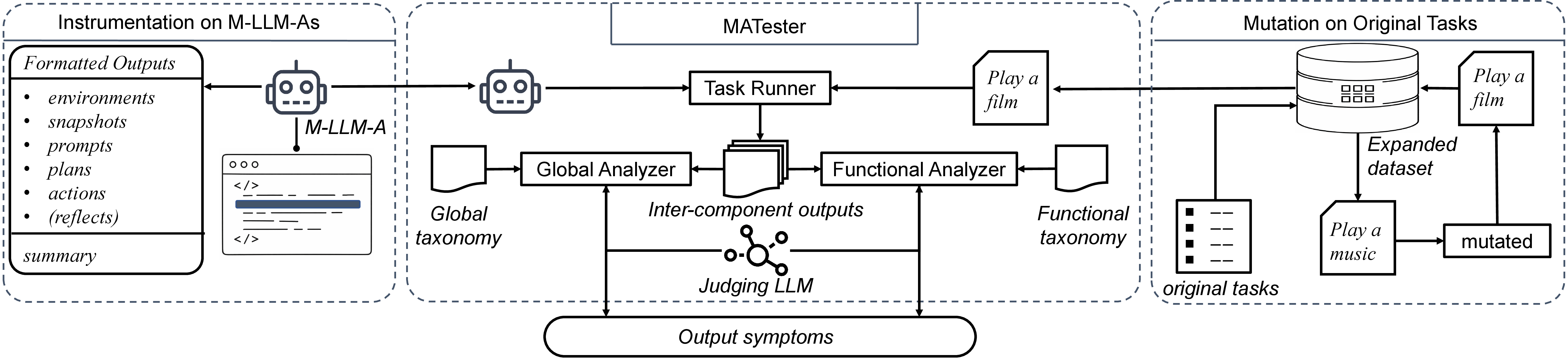
MATester tests an M-agent in three steps as shown in Fig. 6. First, the Task Runner invokes the agent and enforces time and round limits. Then the Global Analyzer identifies global symptoms: Crash and Unrespond are detected from error reports and hanging time; Diverge is detected by running similar tasks twice and comparing outcomes; Misbehave and Mis-signal are judged by a LLM that checks task completeness and misbehavior against the environment and task description.
If a global symptom is found, the Functional Analyzer localizes component-level symptoms (Section 3.3.2). For each component, it first checks output existence and format (detecting Missing-S, Malformed-S, etc.), then uses the judging LLM to compare snapshot/plan/action contents against the environment and task, detecting semantic symptoms such as Missing-S, Mislabeled-S, and Inconsistent-S. The core of this comparison is identifying missing, wrong, or conflicted information across multiple modalities, which is suited to the M-LLM’s cross-modal reasoning capability.
4.3.2 Settings of MATester↩︎
Implementation. The judging LLM is GPT-4o, a multi-modal LLM, enabling inter-modality and cross-modality consistency checks. Each task is queried 3 times and the majority verdict is used. Temperature is set to 0.2 for stable results.
Benchmarks. The benchmark consists of seven randomly selected M-agents from GitHub, manually instrumented for reproducibility.
Testcases. Test cases specify goal-oriented tasks tailored to each agent’s functionality, using original tasks augmented with ChatGPT-generated mutations. The test suite comprises 65 tasks spanning four application scenarios.
Constraints. The M-agents assigned with a specific task should finish the task in 5 minutes and 20 rounds. These constraints are set with reference to human completion time. Humans require about 10 steps to complete each of these tasks. Agents that cannot conduct a task in 20 steps are considered as incompetent. Normally, 20 consecutive rounds are finished in 3 minutes. Agents that cannot conduct 20 rounds in 5 minutes are mostly unresponsive. In addition, each task is run at least twice. For M-agents without additional assigned tasks, such as autonomous driving M-agents, they are forced to stop after running for 5 minutes. These M-agents run for at least 20 times and each time the environment is randomly initialized.
The applicability evaluation was run on the Ubuntu 20.04.3 machine with Intel\(^\circledR\) Core\(^\text{TM}\) i7-10700 Processor CPU@2.9GHz and 16GB RAM. The source code, datasets and case studies are available at our website [43].
4.3.3 MATester’s Discovery↩︎
MATester discovers 266 bugs in total. After deduplication, 41 unique bugs remain. Manual validation following the procedure in Section 3.2.3 finds one mis-classified symptom, giving a 97.6% accuracy rate. The 40 confirmed unique bugs cover 61.4% of open issues and include 31 new bugs, demonstrating the effectiveness of MATester. Table 7 shows the symptom distribution of unique bugs. Crash and Misbehave dominate. All components are covered with at least 19 reports. Wrong-S, Irrelevant-P, and Inapplicable-A are the leading symptoms in the Perceptor, Planner, and Executor respectively, consistent with our study.
| id | #1 | #2 | #3 | #4 | #5 | #6 | #7 | #8 | #9 | #10 | #11 | #12 | summary |
|---|---|---|---|---|---|---|---|---|---|---|---|---|---|
| total | 20 | 45 | 61 | 53 | 18 | 20 | 9 | 16 | 3 | 7 | 7 | 7 | 266 (sum.) |
| unique | 6 | 4 | 7 | 4 | 5 | 1 | 3 | 2 | 1 | 3 | 2 | 2 | 40 (sum.) |
| new | 6 | 1 | 3 | 4 | 5 | 1 | 3 | 2 | 1 | 3 | 1 | 1 | 31 (sum.) |
| cover. | - | 66.7% | 61.5% | - | - | - | - | - | - | - | 50% | 57.1% | 61.4% (ave.) |
| Glob. | Func. | |||||||
|---|---|---|---|---|---|---|---|---|
| Crash | Misb. | Unresp. | Mis-sig. | Diverge | Misinf. | Percept. | Plann. | Execut. |
| 14 | 15 | 3 | 6 | 2 | 0 | 27 | 29 | 14 |
FINDING 7: MATester’s discovery covers 61.4% of open issues and includes 31 new bugs. The findings are consistent with our study. Wrong-S, Irrelevant-P, Inapplicable-A are the most common symptoms in the three components, respectively.
5 Discussion↩︎
5.1 Existing Adopted Strategies to Mitigate M-agent Bugs↩︎
We observe that developers adopt ad-hoc mitigation strategies that are often insufficient. For instance, using LLMs to handle dynamic objects still produces Wrong-S and Inconsistent-S due to LLMs’ instability, causing Misbehave and Diverge. Similarly, setting a default fallback action to avoid Missing-A can perpetuate mistakes and lead to Misbehave. These strategies are too simple to resolve the underlying bugs, and can introduce side effects. Our study reveals that symptoms stem from multiple interacting root causes, requiring more rigorous and agent-specific designs.
5.2 Suggestions to Developers and Users↩︎
To developers. For the Perceptor, support diverse objects, especially dynamic objects and less informative objects. Combine static layout analysis with visual observer to capture both static and dynamic objects. For the Planner, remain skeptical of LLM outputs. Validate format, environmental constraints, task relevance, and use self-reflection and memory to improve consistency. For the Executor, establish a complete error-handling workflow. Verify action format and object availability before execution, and feed errors back to the Planner. Ensure API semantics match their names and descriptions.
To users. M-agents are unreliable in safety-critical scenarios and may report actions inconsistently with what they actually perform. Users should exercise caution to avoid financial or privacy leakage, and verify agent behavior directly rather than relying on its self-reported feedback.
5.3 Threats to Validity↩︎
Three threats may affect validity. First, our manual classification and labeling process may introduce subjectivity despite inter-annotator agreement checks. Second, the selected M-agents and issues may not cover all application scenarios. New design paradigms may yield undiscovered symptoms and root causes. Third, MATester analyzes inter-component outputs and may miss intra-component bugs. Future work will apply static source-code analysis to address this gap.
6 Related Work↩︎
Multi-modal LLM-based Agents. M-agents have emerged as a promising research topic. One of the most popular directions is GUI automation. Typical research include WebWISE [14], AutoDroid [15], MM-Navigator [16], Auto-GUI [17], Appagent [44], DroidBot-GPT [45], MobileGPT [46], Assistgui [47] and WebExperT [48]. M-agents are also developed in open-world environments, such as MP5 [10], JARVIS-1 [11], Emma-Alfworld [12], MC-Planner [13], Octopus [49], STEVE [50] and LLM-REGRESS [51]. Other widely studied areas include autonomous driving [7]–[9], navigation [52], [53], visual generation [54]–[56] and audio generation [57]–[59].
Bug Study on LLM-based Agents. The development of agents brings new concerns. Several empirical studies have been conducted to summary and analyze their security [21], compliance [22], code-level implementation defects [23] and general module-level bugs [24]. Specifically, Rahardja et al. [23] analyzed 201 agent bugs and introduced a taxonomy. This taxonomy is at the code level, related to dependency, configuration and initialization. Cemri et al. [24] summarized bugs at the general module level, related to memory, reflection, planning, action and system. There are also studies of agents in specific application domains, such as Software Engineering Agents [25], [26], Code Generation Agents [27] and Search Agents [28]. Compared with them, we focused on M-agents. We classified and analyzed common bugs happened when interacting with the real-time and heterogeneous multi-modal environments. We proposed three levels of symptoms and root causes, and analyzed commonly ignored factors.
7 Conclusion↩︎
M-agents have been widely applied to real-world safety-critical scenarios. Their interaction environments are mostly real-time and heterogeneous, bringing challenges to the design of M-agents. In this paper, we proposed the first study on the bugs in M-agents. Specifically, we analyzed 34 M-agents and summarized a top-down taxonomy to include end-user-observable global symptoms, developer-oriented component symptoms and root causes. Guided by the taxonomy, we implemented MATester to automatically identify bugs. When applying to 12 extra M-agents, MATester covers 61.4% of open issues and discovers 31 new bugs, which proves the usefulness of our findings. This paper provides a guidance for further development and usage of M-agents.