HunyuanOCR-1.5: Making Lightweight OCR VLMs Faster and Better
July 06, 2026
Abstract
We present HunyuanOCR-1.5, a lightweight and end-to-end OCR-specialized vision-language model. HunyuanOCR targets a broad range of text-centric visual tasks, unifying document parsing, text spotting, information extraction, text-image translation, and multi-image document understanding within a single end-to-end VLM. Building upon the validated lightweight architecture of HunyuanOCR-1.0, HunyuanOCR-1.5 does not redesign the model backbone, but instead performs a systematic upgrade around two goals: making the model faster and better. For efficiency, we adapt DFlash inference acceleration to OCR decoding, significantly reducing the decoding latency of long structured outputs such as dense documents, tables, and formulas while preserving the output distribution. Powered by DFlash, HunyuanOCR-1.5 achieves a 6.37\(\times\) speedup in Transformer inference and a 2.14\(\times\) speedup under vLLM, delivering the fastest inference speed among all lightweight OCR VLMs. For capability, we propose Agentic Data Flow, an agent-driven data construction system that transforms model weaknesses into executable data requirements and autonomously performs material search, quality verification, and data pipeline development. Through this framework, we significantly enhance the model’s long-tail capabilities across ancient-script OCR, fine-grained chart and table parsing, multi-image text-centric QA, low-resource multilingual parsing, and document hallucination evaluation. Crucially, HunyuanOCR-1.5 stands as the top-tier end-to-end OCR solution on OmniDocBench v1.6, paired with unrivaled inference efficiency and new performance milestones across the aforementioned long-tail domains. Combined with an upgraded pretraining and post-training recipe, HunyuanOCR-1.5 further extends the capability boundary of the model in high-resolution, long-context, and multi-task scenarios. We characterize these upgrades through a capability-oriented evaluation, and experiments show that HunyuanOCR-1.5 achieves both faster inference and broader OCR capability coverage while retaining the deployment advantages of a lightweight end-to-end model. We will release the model weights and training code to the community to promote the research, reproduction, and real-world application of OCR-specialized vision-language models.
1 Introduction↩︎
Visual text serves as the most ubiquitous and dense carrier of human knowledge. For decades, Optical Character Recognition (OCR) [1], [2] has been the foundational technology for digitizing this information, traditionally functioning as a simple text transcription tool. However, as the demand for machine intelligence grows, this narrow definition is no longer sufficient. Modern applications require a comprehensive interface capable of supporting diverse text-centric visual tasks, ranging from document parsing [3]–[5] and information extraction to visual question answering [6], text-image translation [7], [8], and multi-image document understanding [9], [10].
To tackle these complex tasks, traditional cascaded pipelines relying on disjointed modules for detection, recognition, and downstream processing often struggle with error propagation and architectural redundancy. In contrast, the development of vision-language models (VLMs) [11]–[27] has paved the way for an elegant, end-to-end alternative. Driven by this trend, the community is developing OCR-specialized VLMs. These models are expected to tackle OCR as a unified visual-text understanding problem, where fine-grained perception, layout modeling, structured generation, and semantic reasoning are jointly performed within a single architecture.
However, most existing OCR-specialized VLMs are still primarily designed around document parsing, with the objective often restricted to converting a single page into structured outputs such as Markdown, HTML, or LaTeX. While document parsing is indeed one of the core OCR capabilities, the demands of real-world OCR go far beyond it, including text spotting in open scenarios, structured field extraction, question answering grounded in textual images, multilingual text-image translation, and reasoning across multiple pages or images. Fundamentally, a true OCR-specialized model should not be reduced to a mere document parser, but should be a unified end-to-end model covering diverse OCR tasks.
HunyuanOCR-1.0 [28] has validated the feasibility of this philosophy: a lightweight, end-to-end OCR-specialized VLM that achieves leading performance across document parsing, text spotting, information extraction, visual question answering, and text-image translation. It demonstrated the effectiveness of unifying OCR capabilities within a compact architecture and highlighted the crucial role of high-quality OCR data and task-oriented training strategies in building practical OCR systems. Building on this foundation, HunyuanOCR-1.5 does not pursue a redesign of the model architecture, but instead addresses a more deployment-oriented question: on top of the validated HunyuanOCR framework, how can the model become faster and better?
Faster: DFlash-based inference acceleration. End-to-end OCR is often accompanied by long autoregressive decoding [29]. In scenarios such as dense documents, tables, formulas, and long structured outputs, the decoding overhead becomes a major bottleneck in practical deployment [30]. To this end, HunyuanOCR-1.5 introduces a speculative decoding [31]–[35] framework based on DFlash [36] for inference acceleration: a lightweight block-diffusion [37]–[39] draft model drafts multiple candidate tokens in parallel, which are then verified by the target model in a single pass. While preserving the output distribution of the target model, this significantly improves decoding efficiency for long outputs, achieving a \(6.37\times\) speedup with Transformers and a \(2.14\times\) speedup with vLLM in our evaluation, making the model more practical in real-world deployment environments that demand both accuracy and speed. Beyond server-grade deployment with vLLM [40], HunyuanOCR-1.5 also supports PC-side inference through llama.cpp [41], enabling deployment on CPUs, consumer GPUs, and laptops.
Better: Agentic data flow and refined training recipes. Driven by comprehensive upgrades on both the data and training sides, HunyuanOCR-1.5 establishes itself as the SOTA end-to-end OCR solution on OmniDocBench v1.6. To achieve this capability boundary extension, we propose Agentic Data Flow on the data side, an agent-driven data-construction system that translates model weaknesses into executable data requirements [42]–[44]. Different from conventional pipelines that rely entirely on manually written scripts and manually collected materials, Agentic Data Flow allows agents to deeply participate in material search, tool-based verification, sample cleaning, and data pipeline development, and to iterate in a closed loop with algorithm engineers. In HunyuanOCR-1.5, this system is used for targeted data construction of long-tail capabilities such as low-resource OCR, ancient-script OCR [4], and multi-image QA [9], [10].
On the training side, we systematically upgrade the training recipe around capability boundary extension. In the pretraining stage, we revisit and re-plan Stage3 of HunyuanOCR-1.0, incorporating the new capability data produced by Agentic Data Flow, multi-image data, and historical OCR data, while increasing the maximum image resolution to 4K and extending the context window to 128K, so that the model can robustly adapt to high-resolution documents, long contexts, and multi-page or multi-image inputs. In the post-training stage, we refine the SFT data and introduce new high-quality training data and further explore RL across different OCR tasks to amplify the gains brought by reinforcement learning.
To systematically characterize the practical benefits of these upgrades, HunyuanOCR-1.5 is evaluated from a capability-oriented perspective rather than relying on a single benchmark. The evaluation covers both inherited and newly added capabilities, including end-to-end document parsing [3], text spotting, multilingual OCR, ancient-script recognition [4], text-image translation [7], [8], multi-image QA [9], [10], information extraction, and hallucination-related reliability. This evaluation perspective is aligned with the design goal of HunyuanOCR-1.5: extending HunyuanOCR into a faster and more comprehensive unified end-to-end OCR-specialized VLM. In addition, we plan to release all the model weights and training code of HunyuanOCR-1.5 to the community, providing infrastructure for reproducing, fine-tuning, and extending OCR-specialized VLMs, and further promoting research and applications in OCR perception, document understanding, and multi-task modeling.
The main contributions of this report are summarized as follows:
We present HunyuanOCR-1.5, an upgraded lightweight end-to-end OCR-specialized VLM that further extends diverse OCR task capabilities on top of HunyuanOCR-1.0, and we plan to release the model weights and training code to support community reproduction, fine-tuning, and capability extension.
We adapt DFlash to HunyuanOCR inference and support PC-side deployment through llama.cpp, significantly improving the decoding efficiency of long structured OCR outputs while enabling both server-grade and local OCR deployment.
We propose Agentic Data Flow and systematically upgrade the training recipe: an agent-driven data system produces long-tail capability data such as low-resource OCR, ancient-script OCR, and multi-image QA; in pretraining, we re-plan Stage3 and extend to 4K resolution and a context of 128K; and in post-training, we improve the capability ceiling through high-quality SFT data and task-specific RL exploration.
2 Related Work↩︎
General vision-language models. Recent general VLMs have demonstrated strong multimodal perception and reasoning abilities and have shown promising OCR-related capabilities in diverse visual scenarios. Representative models, such as GPT-4o [11], Gemini [12]–[16], Qwen-VL [17]–[20], and InternVL [21]–[27], can recognize text in natural images, documents, charts, and screenshots and further perform text-centric question answering or reasoning based on visual content. However, these models are primarily designed as general-purpose multimodal assistants rather than OCR-specialized systems. As a result, they often require large model sizes and high inference costs, and their performance may become unstable in OCR-intensive scenarios that require fine-grained text perception, dense document parsing, strict reading order preservation, or faithful structured output. In addition, general VLMs are not explicitly optimized for deployment-oriented OCR workloads, especially high-resolution long-document parsing and large-scale production serving.
OCR-specific vision-language models. To address the limitations of general VLMs in OCR-centric scenarios, recent works have explored OCR-specific vision-language models [28], [45], [46]. Most existing OCR expert VLMs are primarily designed for document parsing [47]–[50], aiming to convert page-level document images into structured outputs such as Markdown, HTML, or LaTeX. In addition to large OCR expert models, recent lightweight designs have also shown promising results. For example, UniRec-0.1B [51] optimizes a compact 0.1B-parameter model for text blocks and formula blocks, demonstrating competitive OCR performance under a highly lightweight setting. According to their modeling paradigm, OCR-specific VLMs can be roughly divided into modular and end-to-end approaches. Modular methods usually cascade a layout analysis model before OCR recognition: a page-level document is first decomposed into block-level regions, and each block is then parsed by an OCR VLM. Such designs can reduce the difficulty of local parsing through region-level cropping, but the overall pipeline still depends on the preceding layout analysis results and may suffer from errors in region detection, reading-order recovery, and cross-block relation modeling. In contrast, end-to-end OCR-specific models directly model page-level documents and parse the entire page image within a unified framework, with representative examples including dots.ocr [52] and DeepSeek-OCR [53]. This paradigm avoids explicit layout splitting and the associated error propagation, allowing the model to jointly capture text, tables, formulas, charts, and reading order in the full-page context. Therefore, end-to-end modeling is more beneficial for improving the native OCR capability of VLMs. We argue that an OCR-specialized VLM should not be defined only as a document parsing model but should support a broader range of OCR-related tasks, including text spotting, information extraction, document question answering, text-image translation, and multi-image understanding. HunyuanOCR [28] follows the lightweight end-to-end OCR-specific VLM paradigm, and HunyuanOCR-1.5 further extends this direction by keeping the validated architecture unchanged while improving capability boundaries through data construction, training recipe upgrades, and system-level inference acceleration.
Multi-token prediction. Autoregressive decoding [29] is a key latency bottleneck for long-output OCR scenarios such as document parsing, table reconstruction, and formula transcription. Speculative decoding accelerates generation through a draft-then-verify paradigm [54], where candidate tokens proposed by a lightweight draft model are verified by the target model while preserving the original output distribution. However, many speculative methods still rely on autoregressive drafting, so the draft cost grows with the number of proposed tokens. Recent parallel drafting methods, such as multi-head prediction [35], [55] and diffusion-based generation, aim to predict multiple future tokens simultaneously. Among them, DFlash [36] trains a block-diffusion draft model conditioned on target-model hidden states, enabling an entire candidate block to be proposed in one parallel forward pass and then verified by the target model. This makes DFlash well-suited for HunyuanOCR-1.5, where OCR-centric generation often produces long and structured outputs.
3 Model Design↩︎
3.1 Model Architecture↩︎
HunyuanOCR-1.5 follows the compact, fully end-to-end architecture of HunyuanOCR-1.0 [28], comprising a native-resolution visual encoder, an adaptive MLP connector, and a lightweight language model (Fig. 1). The pivotal upgrade in the model backbone lies in the visual encoder: built upon Hunyuan-ViT [56], [57], we extend the maximum input image resolution from 2K to 4K. This crucial scaling allows the model to preserve native aspect ratios and spatial layouts while capturing finer structural details, which is instrumental for processing highly dense documents, over-sized tables, and complex charts.
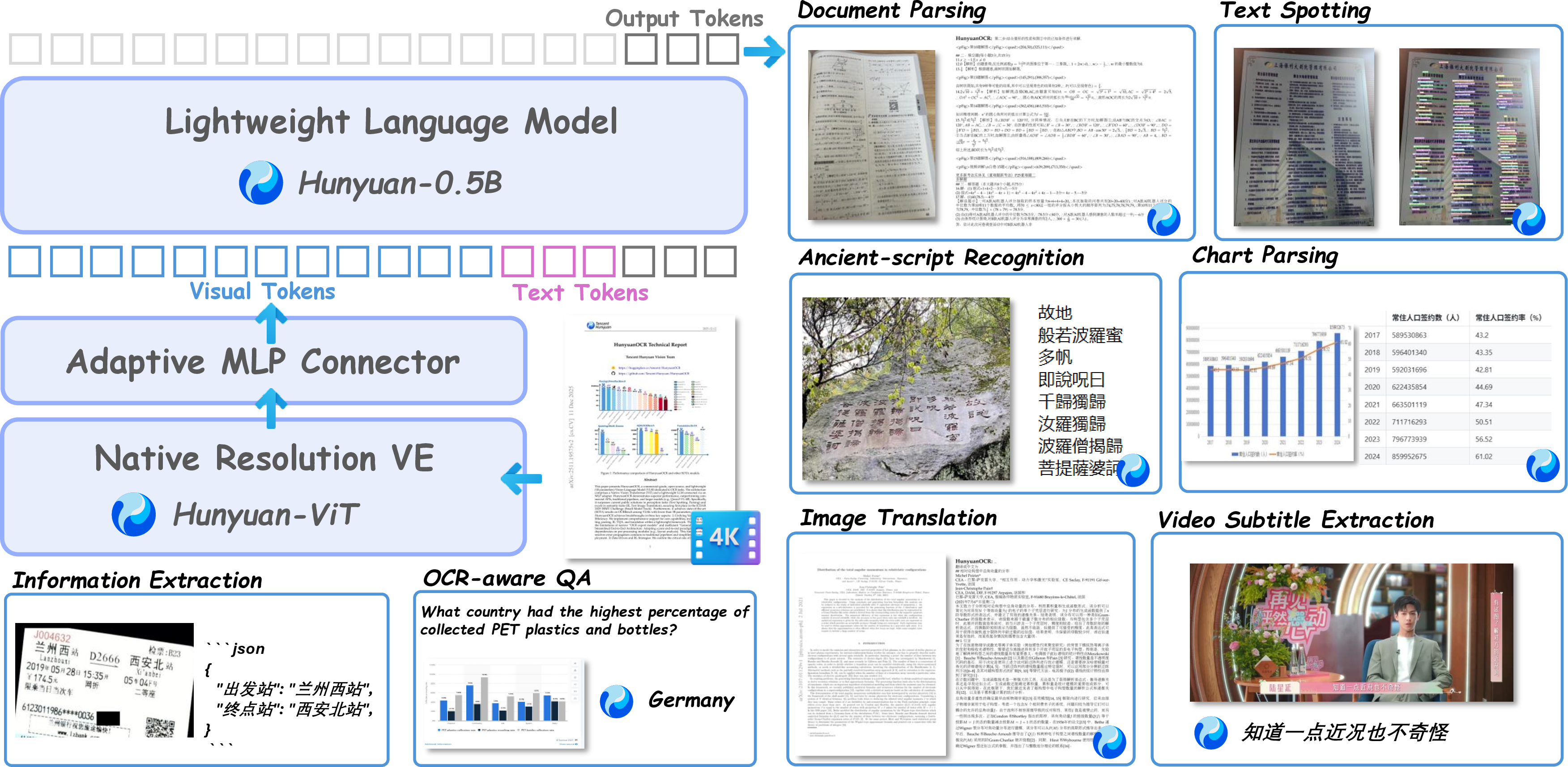
The remaining components maintain their validated lightweight configurations to ensure deployment efficiency. The adaptive MLP connector compresses high-resolution visual features into compact tokens while preserving layout sensitivity. Concurrently, the language component, a lightweight Hunyuan-0.5B model with XD-RoPE [58], processes these tokens to autoregressively generate structured OCR outputs. Through this streamlined formulation, HunyuanOCR-1.5 directly maps multi-modal inputs into diverse OCR-centric outputs (e.g., Markdown documents, HTML tables, LaTeX formulas, and chart descriptions) without relying on any task-specific post-processing modules.
3.2 Multi-token Prediction↩︎
Autoregressive decoding [29] is a major efficiency bottleneck for end-to-end OCR-centric VLMs, especially in document parsing scenarios [47]–[50] that require long structured outputs, such as dense tables, multi-column documents, and long formulas. Although speculative decoding [31]–[35] reduces latency by drafting multiple candidate tokens and verifying them with the target model, many existing methods still generate draft tokens autoregressively, making the draft cost grow with the number of candidates. To address this limitation, HunyuanOCR-1.5 adopts DFlash [36], which uses a lightweight block-diffusion draft model to predict a block of candidate tokens in one parallel forward pass. Given a block size \(B\), the draft model proposes \(\hat{\mathbf{y}}_{1:B}\) at once, and the target model verifies the block in parallel and accepts the longest valid prefix, preserving the output distribution of the target model.
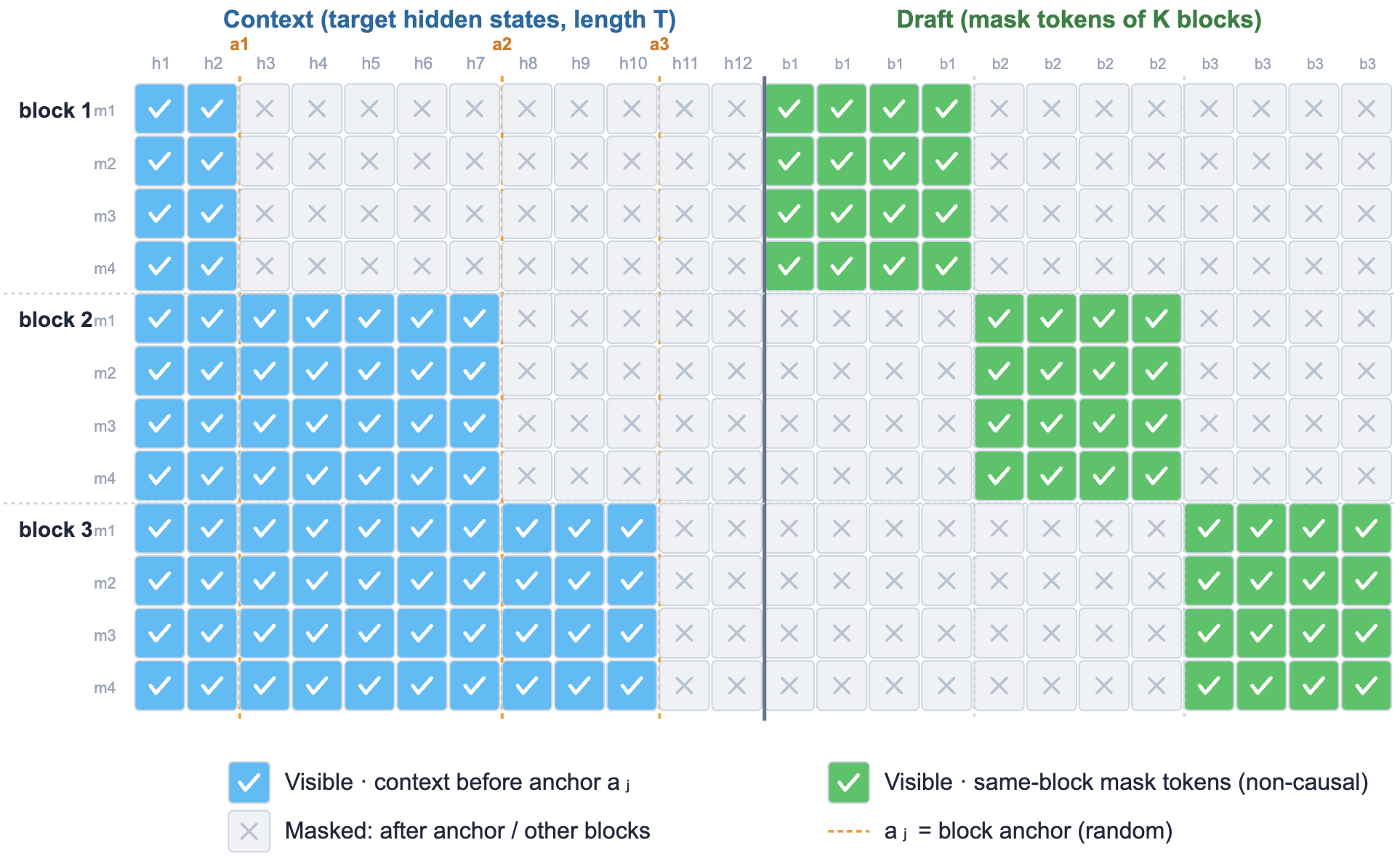
During training, the HunyuanOCR-1.5 target model is frozen, and only the DFlash draft model is optimized. For each training sequence, we first run the target model once and cache its hidden states as conditional representations. We then randomly sample \(n\) anchor positions, each corresponding to an independent block-drafting task. These \(n\) blocks are concatenated and trained in a single forward pass with a FlexAttention [59] block-diagonal mask, where each block can attend to the target hidden states before its anchor and to the mask tokens within the same block, while different blocks remain isolated, as shown in Fig. 2. We use ground-truth continuation tokens as labels and optimize a position-weighted next-token cross-entropy loss:
\[w^{(j)}_{k} = \mathbb{I}[k>0]\cdot\mathbb{I}[\mathrm{valid}] \cdot \exp\!\left(-\max(k-1,0)/\gamma\right),\]
\[\mathcal{L}_{\mathrm{DFlash}} = \frac{1}{Z} \sum_{j=1}^{n} \sum_{k=1}^{B-1} w^{(j)}_{k} \left[ -\log p_{\theta}\!\left( y^{(j)}_{k} \mid \mathbf{h}_{<a_j},\, \mathbf{m}^{(j)}_{1:B} \right) \right], \quad Z = \sum_{j=1}^{n}\sum_{k=1}^{B-1} w^{(j)}_{k},\]
where \(a_j\) is the \(j\)-th anchor position, \(\mathbf{h}_{<a_j}\) denotes the target hidden states before the anchor, \(\mathbf{m}^{(j)}_{1:B}\) denotes the mask-token queries of the draft block, and \(y^{(j)}_{k}\) is the ground-truth continuation token. The weight excludes the anchor token and invalid positions, while the exponential decay reduces the loss weight for farther positions that are harder to predict. In our implementation, the DFlash draft model has approximately 90.7M parameters, uses block size \(B=16\), samples \(n=16\) anchors per sequence, sets \(\gamma=7.0\), and is implemented as a 5-layer Transformer initialized from the last 5 decoder layers of the target model.
DFlash accelerates inference by trading otherwise underutilized computation for fewer autoregressive decoding steps. In single-request or low-concurrency scenarios, standard AR decoding is often memory-bandwidth-bound, leaving substantial compute idle. DFlash uses this idle compute to draft a token block in parallel, so that each target-model verification step can advance multiple tokens. This is particularly effective for OCR outputs with strong local regularity, such as HTML tables, formulas, and structured Markdown parsing results, where future tokens are more predictable and the effective accepted length is longer. As shown in Sec. 6.1, DFlash substantially improves inference speed, especially for long and structured OCR outputs.
The acceleration of DFlash [36] can be interpreted as trading idle computation for lower decoding latency. In single-request or low-concurrency inference scenarios, target-model autoregressive decoding is often constrained by memory bandwidth, leaving a considerable amount of compute underutilized. DFlash leverages this idle compute to produce a block of draft tokens through a lightweight parallel forward pass, allowing the target model to verify multiple candidate tokens within one forward pass. Therefore, the effective number of accepted tokens per target forward pass increases. Empirically, this property is particularly beneficial for OCR outputs with strong local regularity, such as tables, formulas, and structured document parsing results, where candidate tokens are more predictable, and the accepted prefix length tends to be longer. As shown in the Experiment section, the acceleration ratio increases with output length and becomes more significant for highly structured OCR generation tasks.
4 Training Recipe↩︎
The training recipe of HunyuanOCR-1.5 follows the staged training paradigm of HunyuanOCR [28], while shifting the objective from building general OCR capabilities to extending capability boundaries and improving task ceilings. Overall, we structure the training pipeline of HunyuanOCR-1.5 into three main phases: pretraining (4.1), supervised fine-tuning (SFT, 4.2), and reinforcement learning (RL, 4.3).
The pretraining stage mainly injects newly constructed capability-expansion data into the model and improves its adaptation to complex inputs through resolution and context-window extension. The subsequent SFT and RL stages collaboratively focus on capability ceiling improvement, pushing the upper bound of each OCR task while enhancing output stability and mitigating hallucinations in document scenarios. Specifically, SFT establishes a clean and highly structured foundation by refining the training data and unifying the prompt interface. Building upon this high-quality basis, RL further pushes the capability ceilings using verifiable rewards and judge-based supervision, forming a complementary optimization pipeline.
4.1 Pretraining: Revisiting Stage3 for Capability Boundary Extension↩︎
In the pretraining stage, we do not redesign the full pretraining procedure of HunyuanOCR-1.0. Instead, we reuse its first two stages and only re-plan the third stage (Stage3). Two upgrades are applied to Stage3: (a) we inject new capability-expansion data to broaden what the model can recognize, and (b) we enlarge the input specification so that the model can handle high-resolution and long-context inputs.
Data upgrade. Stage3 now mixes three sources: the new capability data produced by Agentic Data Flow ([sec:agentic_data_flow]), multi-image understanding data, and historical OCR data from HunyuanOCR-1.0. The new data target the model’s weak spots, covering low-resource OCR, ancient-script OCR, multi-image document understanding, hard cases, and long-tail layouts, and thus drive capability expansion. The historical OCR data are kept to preserve existing strengths in general OCR, document parsing, and structured output. Training on both jointly lets the re-planned Stage3 expand new capabilities without regressing on old ones.
Input specification. We also raise the maximum image resolution to 4K and extend the context window to 128K. This lets the model take in far more demanding inputs, such as dense documents, multi-page and multi-image contexts, and long structured outputs. As a result, HunyuanOCR-1.5 pushes its capability boundary toward high-resolution, long-context, and multi-image scenarios while keeping the architecture unchanged.
4.2 SFT: Building a High-Quality Foundation for the RL Stage↩︎
As the first step toward capability ceiling improvement, the SFT stage prepares a clean, well-organized, and interface-consistent training set for the subsequent RL stage. This preparation consists of three parts: refining the data quality, splitting the data between SFT and RL, and unifying the prompt design across tasks.
Data refinement. We start from the post-training data of HunyuanOCR-1.0 and clean it thoroughly, removing annotation errors, format inconsistencies, image-text mismatches, ambiguous task objectives, and low-quality duplicated samples. We then enrich the data pool with the new capability data produced by Agentic Data Flow, user-provided hard cases, and high-quality data for the newly introduced capabilities, with careful manual annotation and verification for key samples. Through this process, the SFT data are upgraded from the general task coverage of HunyuanOCR-1.0 to a high-quality training set oriented toward capability ceiling improvement and robustness in complex scenarios.
Data splitting for SFT and RL. We divide the curated data into two disjoint portions. One portion is used for supervised fine-tuning in the current stage, while the other, consisting mainly of high-difficulty samples, is reserved for the subsequent RL stage. This split lets SFT establish broad task competence while keeping the most challenging samples for RL to push the capability ceiling.
Unified prompt design. Finally, we unify the prompt design across tasks, routing each task capability to its own specialized prompt. This reduces instruction ambiguity, gives each task a clear and consistent interface, and thereby provides well-defined task boundaries for the subsequent RL stage.
4.3 Reinforcement Learning↩︎
Reinforcement learning (RL) has emerged as a powerful paradigm for large language models (LLMs) and multimodal large language models (MLLMs), with success in mathematical reasoning [60] and image segmentation [61]. This is largely attributed to RL’s ability to align model outputs with verifiable metrics [62] or human preferences [63], [64]. HunyuanOCR [28] has already validated this potential in the OCR domain: through high-quality RL data and an ability-adaptive reward design, it achieves stable and effective training, showing that RL can substantially improve lightweight OCR models across diverse tasks.
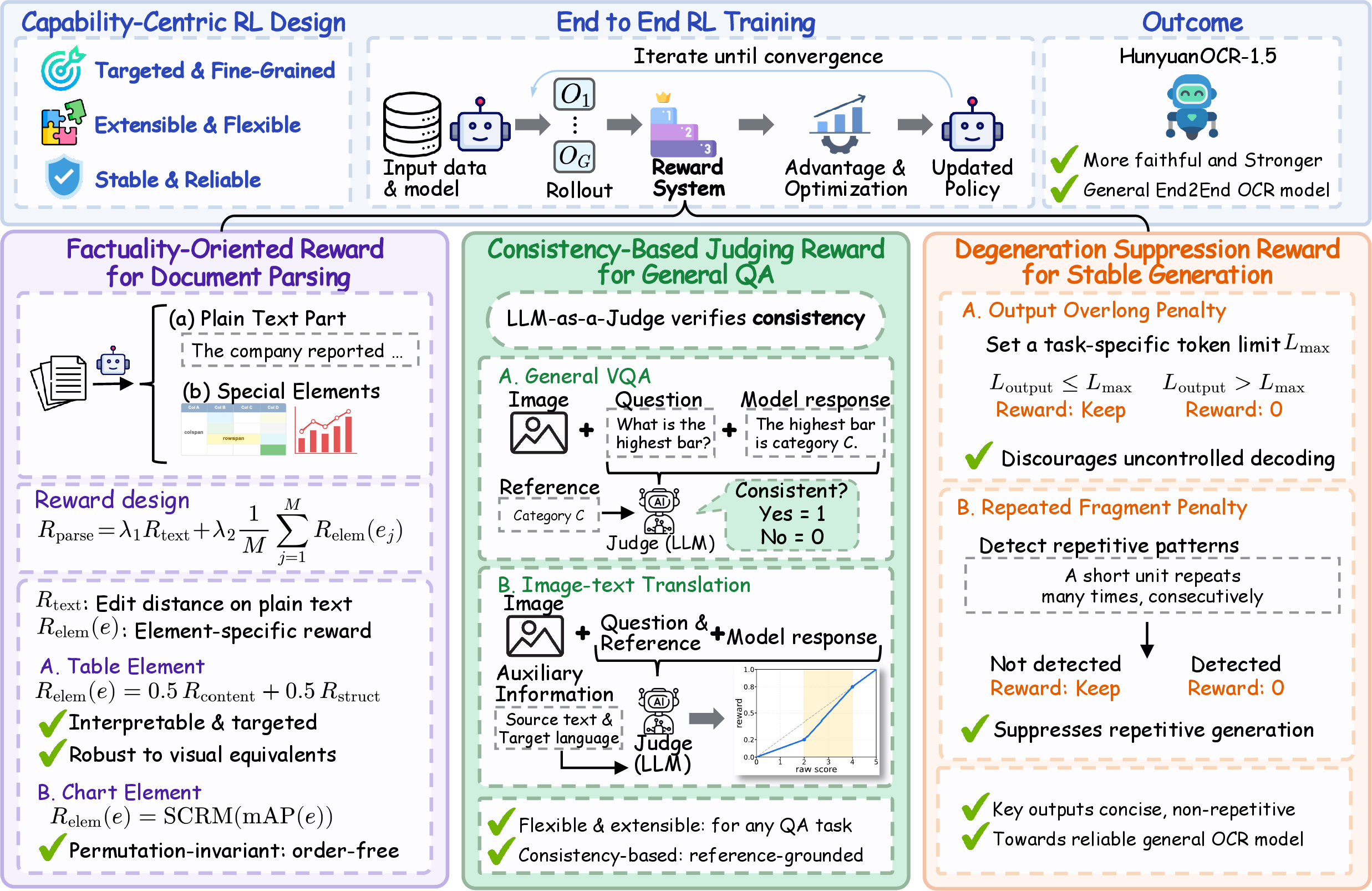
HunyuanOCR-1.5 pushes this direction further. As shown in 3, we build a reward system tailored to the capabilities an OCR model must acquire, providing fine-grained, discriminative signals. Concretely, it consists of three complementary components: (i) a capability-routed, structure-aware rule reward that targets the factual fidelity of document parsing; (ii) a consistency-based judging reward for general question answering that flexibly scores arbitrary QA tasks and can be easily extended; and (iii) a degeneration-suppression reward that detects overlong and repetitive outputs to keep generation stable. Together, these components drive HunyuanOCR-1.5 toward a more faithful, stronger, and more comprehensive general OCR model.
4.3.1 Training Strategy↩︎
Data curation. Following HunyuanOCR [28], we curate the RL data with an emphasis on quality, diversity, and difficulty balance. Starting from the SFT policy, we perform N=16 on-policy rollouts for each candidate query and estimate its difficulty based on the rollout outcomes. Queries that are already solved consistently by the policy are discarded, retaining only informative examples with non-trivial reward variance for RL training.
Optimization. We adopt IcePop [65], a GRPO-style policy optimization variant, as our main reinforcement learning framework to mitigate the training–inference mismatch. Let \(\pi_{\mathrm{infer}}\) and \(\pi_{\mathrm{train}}\) denote the same policy as executed by the inference and training engines. In each iteration, for a query \(q\), IcePop samples a group of \(G\) responses \(\{o_1,o_2,\ldots,o_G\}\) from the old inference policy \(\pi_{\mathrm{infer}}(\cdot\mid q;\theta_{\mathrm{old}})\), while the update is computed with \(\pi_{\mathrm{train}}(\cdot;\theta)\). To suppress unstable updates from train–inference discrepancies, we compute a token-level calibration ratio between the two policies and only retain tokens whose ratio lies in a prescribed interval. Since our implementation adopts a token-mean loss [66], we normalize over all valid tokens that pass the IcePop mask, instead of first averaging each response by its length \(|o_{i}|\):
\[\begin{align} \mathcal{J}_{\mathrm{IcePop}}^{\mathrm{tok}}(\theta) & = \mathbb{E}_{q,\{o_i\}_{i=1}^{G}} \left[ \frac{1}{Z} \sum_{i=1}^{G}\sum_{t=1}^{|o_i|} a_{i,t}s_{i,t} \left( \mathcal{L}^{\mathrm{PG}}_{i,t}(\theta) - \gamma\,\mathbb{D}_{\mathrm{KL},i,t} \right) \right], \tag{1} \\[0.2em] \mathcal{L}^{\mathrm{PG}}_{i,t}(\theta) & = c_{i,t} \min\!\left( r_{i,t}(\theta) A_{i}, \operatorname{clip}\!\left(r_{i,t}(\theta),1-\epsilon,1+\epsilon\right) A_i \right), \tag{2} \\[0.2em] Z & = \sum_{i=1}^{G}\sum_{t=1}^{|o_i|} a_{i,t}s_{i,t}, \tag{3} \\[0.2em] r_{i,t}(\theta) & = \frac{ \pi_{\mathrm{train}}(o_{i,t}\mid q,o_{i,<t};\theta) }{ \pi_{\mathrm{train}}(o_{i,t}\mid q,o_{i,<t};\theta_{\mathrm{old}}) }, \tag{4} \\[0.2em] c_{i,t} & = \frac{ \pi_{\mathrm{train}}(o_{i,t}\mid q,o_{i,<t};\theta_{\mathrm{old}}) }{ \pi_{\mathrm{infer}}(o_{i,t}\mid q,o_{i,<t};\theta_{\mathrm{old}}) }, \quad s_{i,t}=\mathbf{1}\!\left[\alpha_{\mathrm{m}}\le c_{i,t}\le\beta_{\mathrm{m}}\right]. \tag{5} \end{align}\]
Here \(a_{i,t}\in\{0,1\}\) is the valid-token mask, \(A_{i}\) is the group-relative advantage of response \(o_{i}\), and \(\mathbb{D}_{\mathrm{KL},i,t}\) is the token-level KL term. The bounds \(\alpha_{\mathrm{m}}\) and \(\beta_{\mathrm{m}}\) control the acceptable train–inference ratio region; tokens outside it have \(s_{i,t}=0\) and do not contribute to the update. The hyperparameters \(\epsilon\) and \(\gamma\) control PPO-style clipping and KL strength. If no token in a mini-batch satisfies the IcePop mask, the update is skipped.
4.3.2 Factuality-Oriented Reward for Document Parsing↩︎
The first and most fundamental component targets factual fidelity, since a reliable OCR model must faithfully transcribe what is visually present rather than hallucinate plausible content. For text spotting, we follow the rule-based reward of HunyuanOCR [28]. Document parsing, however, requires a dedicated design: it converts a document image into a structured representation that may contain plain text, tables, and charts. Tables and charts are structured elements whose correctness is not well captured by the edit-distance criterion used for plain text, so a single text-level metric yields coarse and sometimes misleading signals.
To provide a fine-grained, structure-aware reward, we parse the output and reference into a plain-text part and a set of special elements, each a table or a chart. The parsing reward is then computed as:
\[R_{\text{parse}} = \lambda_{1}\, R_{\text{text}} + \lambda_{2}\, \frac{1}{M}\sum_{j=1}^{M} R_{\text{elem}}(e_j)\,, \label{eq:parsing95reward}\tag{6}\]
where \(R_{\text{text}}\) is the text reward based on normalized edit distance, \(\{e_{1}, \dots, e_{M}\}\) are the \(M\) special elements parsed from the reference, \(R_{\text{elem}}(e_j)\) is the element-specific score defined below, and \(\lambda_1,\lambda_2\) balance the two terms. Averaging over the \(M\) special elements keeps the reward well scaled.
Table. Table content is usually expressed in HTML with structure-specific tags for rows, columns, and cell merging, so it requires a dedicated reward rather than plain text matching. TEDS and TEDS-S [67] are the standard metrics for table parsing and are natural reward candidates, but both have limitations in an RL setting. As a structural reward, TEDS-S is computed in a rather black-box manner, making it hard for the model to identify which structural part of the output is wrong and to optimize accordingly. As a content reward, TEDS relies on character-level edit distance, which produces inaccurate scores in cases that are visually equivalent but expressed differently, such as mathematical formulas. We therefore improve both terms: we replace the TEDS-S score with a 1D-probe structural reward \(R_{\text{struct}}\), and enhance the TEDS-based content reward with an anchor-guided destylization mechanism to obtain \(R_{\text{content}}\) [68]. The score of a table element is
\[R_{\text{elem}}(e) = 0.5\,R_{\text{content}} + 0.5\,R_{\text{struct}}\,.\]
Chart. Chart content is typically represented in a Markdown-style table, where the row and column orderings usually do not affect correctness and even transposing rows and columns expresses the same chart. A reward that is sensitive to such orderings would penalize correct predictions, so charts also require a dedicated design. We first convert both the prediction and the reference into a tabular CSV form and then apply SCRM (Structuring Chart-oriented Representation Metric) [69] to compute the mean Average Precision (AP) between them, which serves as the score \(R_{\text{elem}}(e)\) of the chart element [5]. This makes the reward invariant to order permutations while remaining sensitive to the underlying chart semantics.
4.3.3 Consistency-Based Judging Reward for General QA↩︎
Beyond factual parsing, we extend the model toward broader capabilities through a consistency-based judging reward for general question answering. Instead of designing a bespoke metric for every task, this component uses an LLM-as-a-judge to verify the consistency between the model response and a high-quality reference. Its key advantage is flexibility and extensibility: it can score arbitrary QA tasks, and can incorporate additional annotation fields to support more fine-grained evaluation of specific downstream tasks.
Visual question answering. For general VQA, the reward is binary: the judge assigns \(1\) if the model’s answer is semantically consistent with the reference and \(0\) otherwise, focusing on factual correctness while tolerating minor stylistic variations. This provides a clear and robust supervision signal for answer correctness.
Translation. Translation is a representative case where additional annotation fields enable more precise judging. We provide the judge with auxiliary metadata such as the source-language text and the target-language label, and let it assign a soft score in the range \([0,5]\) based on consistency with the reference translation. The score is normalized to \([0,1]\) via a debiased mapping that expands the resolution of mid-range scores, making the reward more sensitive to subtle quality differences and better able to capture improvements.
4.3.4 Degeneration Suppression Reward for Stable Generation↩︎
The third component keeps generation stable by explicitly suppressing degenerate outputs. In OCR settings, degeneration typically appears as overlong outputs, repeated fragments, or cyclic generation patterns when the model encounters uncertain or out-of-distribution inputs, which severely undermines reliability in real-world deployment. To address this, we introduce two complementary penalties during training.
Overlong output penalty. For each task, we set an appropriate upper bound on the output length according to its expected format and maximal valid response length. Since excessive length is a common indicator of repeated or drifting generation, we directly assign a reward of zero to rollouts that exceed the predefined token limit, discouraging uncontrolled decoding and encouraging concise, task-aligned outputs.
Repeated fragment detection and penalty. For rollouts within the length limit, we further detect repetitive patterns, which are a common failure mode of long OCR outputs, where a short unit of at most max_unit tokens repeats consecutively at least min_repeats times at the end of the sequence. Such rollouts also receive a zero reward. This penalty suppresses repetitive generation and improves the stability of model outputs.
Overall, the three reward components form a coherent and layered design: the factuality-oriented reward secures faithful parsing of structured documents, the consistency-based judging reward extends the model toward general and open-ended capabilities, and the degeneration-suppression reward stabilizes generation throughout. Together they provide fine-grained, discriminative, and extensible optimization signals that drive HunyuanOCR-1.5 toward a more faithful, stronger, and more comprehensive general OCR model.
5 Evaluation Tree↩︎
Rather than relying on a single or isolated benchmark, HunyuanOCR-1.5 is evaluated through a capability-oriented OCR evaluation tree. This evaluation design mainly answers two questions: (a) whether the core OCR capabilities established in HunyuanOCR-1.0 [28], such as document parsing, general OCR-aware QA, text spotting, and information extraction, are further strengthened; and (b) whether newly introduced capabilities, including low-resource languages, ancient scripts, multi-image understanding, and faithful seen-text parsing, are effectively incorporated into the model boundary.
Along an orthogonal dimension, all evaluation sources are categorized by their origin into open-source and in-house benchmarks. Only Spotting, IE, and Video Subtitle Extraction rely on in-house and real-world production benchmarks, while all remaining dimensions are evaluated on open-source benchmarks.
5.1 OCR Capability Evaluation Tree↩︎
The evaluation tree is organized into three groups by evaluation purpose. The first group verifies that the fundamental OCR capabilities inherited from HunyuanOCR-1.0 are preserved and further strengthened. The second group examines whether the newly extended boundary capabilities, such as long-tail languages, ancient scripts, multi-image understanding, and structured element parsing, are effectively incorporated into the model. The third group targets output reliability, focusing on the model’s seen-text preservation ability and its hallucination risk in long OCR sequences. The following subsection details the specific dimensions within each group and their corresponding benchmarks.
5.2 Evaluation Dimensions and Benchmark Mapping↩︎
We first organize the evaluation dimensions into several capability groups and then provide the benchmark mapping for each group. This organization highlights what types of OCR capabilities are evaluated before specifying how each capability is measured.
Basic OCR and document understanding. This group evaluates the fundamental capabilities of OCR model. End-to-end document parsing is evaluated by OmniDocBench [3], following the latest official evaluation protocol, which measures structured parsing of mainstream printed and scanned documents, including body text, tables, formulas, and reading order. General OCR capability is evaluated by OCRBench [6], focusing on OCR-aware QA across scene text recognition, document question answering, information extraction, formula recognition, and chart understanding. Text spotting is evaluated by an in-house Spotting Benchmark, which measures text localization and recognition across document images, scene text, artistic text, handwriting, advertisements, cards and receipts, screenshots, street views, and video frames.
Long-tail capability expansion. This group evaluates whether HunyuanOCR-1.5 effectively extends its capability boundary to long-tail languages and scripts. Low-resource multilingual parsing is evaluated by MORE [70], which covers parsing across 149 languages and focuses on low-resource languages and rare writing systems. Ancient script recognition is evaluated by Chronicles-OCR [4], which measures recognition ability on the seven historical forms of Chinese characters, historical documents, and ancient-script images.
Structured visual element parsing. This group evaluates structured visual element parsing beyond plain text recognition. Table parsing is evaluated by TableVerse-5K [68], which measures table structure and content reconstruction. Chart parsing is evaluated by ChartArena [5], which evaluates chart text, structure, and semantic parsing.
Cross-page and cross-lingual understanding. This group evaluates capabilities that go beyond single-page OCR. Multi-image QA is evaluated by DUDE [9], which measures multi-page document understanding, cross-page information retrieval, multi-image content comparison, and evidence aggregation. Text image translation is evaluated by DoTA [7] and MMTIT [8]. DoTA focuses on English document image translation into Chinese, while MMTIT evaluates multilingual text image translation from 14 non-Chinese and non-English languages into Chinese or English across multiple scenarios.
Application-oriented and reliability evaluation. This group evaluates practical OCR applications and output faithfulness. Information extraction is evaluated by an in-house IE Benchmark [28] covering cards, receipts, forms, and related structured field extraction scenarios. Video subtitle extraction is evaluated by an in-house Video Subtitle Extraction Benchmark [28], measuring subtitle recognition from video frames, temporal text consistency, and robustness to dynamic backgrounds and compression noise. Document hallucination is evaluated by CHAOS-Bench, short for Comprehensive Hallucination Assessment for OCR Sequences. CHAOS-Bench evaluates faithfulness with a controlled WYSIWYG protocol. For each document page, we modify one character in 2 to 3 selected words in the rendered image, turning them into meaningless perturbed words. Degenerate edits and modified strings that remain dictionary-valid words are removed. Given the set of perturbed words \(\mathcal{P}_i\) on page \(i\) and the model output \(O_i\), a hit \(\mathbb{1}_{\mathrm{hit}}(w,O_i)\) is counted when word \(w \in \mathcal{P}_i\) appears in \(O_i\) as a case-insensitive whole-word match. The page-level recall is computed as: \[R_{i} = \frac{1}{|\mathcal{P}_i|}\sum_{w\in\mathcal{P}_i}\mathbb{1}_{\mathrm{hit}}(w,O_i).\] The final score is the page-averaged recall over all \(N\) pages: \[\mathrm{Recall}_{\mathrm{page}} = \frac{1}{N}\sum_{i=1}^{N}R_i.\] This metric directly measures whether the model preserves visually observed words when visual evidence conflicts with language priors.
Based on this evaluation tree, the experimental results in the next section are reported from two complementary perspectives. We first highlight the boundary capability evaluations that are newly introduced or strengthened in HunyuanOCR-1.5, including Chronicles-OCR, ChartArena, TableVerse-5K, DUDE, MORE, and CHAOS-Bench. We then analyze the changes on existing evaluation dimensions inherited from HunyuanOCR-1.0, including OmniDocBench, Spotting, text image translation, IE, Video Subtitle Extraction, and OCRBench. This organization keeps the capability taxonomy in the evaluation tree while making the result discussion focus on what is newly monitored and what is preserved or improved from the previous version.
| Capability Group | Evaluation Dimension | Benchmark | Source |
|---|---|---|---|
| Basic OCR and doc understanding | End-to-end document parsing | OmniDocBench [3] | |
| General OCR-aware QA | OCRBench [6] | ||
| Text spotting | Spotting Benchmark | In-house | |
| Long-tail ability expansion | Multilingual parsing | MORE [70] | |
| Ancient-script recognition | Chronicles-OCR [4] | ||
| Structured visual element parsing | Table parsing | TableVerse-5K [68] | |
| Chart parsing | ChartArena [5] | ||
| Cross-page and cross-lingual understanding | Multi-image QA | DUDE [9] | |
| Text image translation | DoTA [7] | ||
| Text image translation | MMTIT [8] | ||
| Practical applications and reliability | Information extraction | IE Benchmark | In-house |
| Video subtitle extraction | Video Subtitle Extraction Benchmark | In-house | |
| Document hallucination | CHAOS-Bench |
4pt
6 Experimental Results↩︎
6.1 Inference Speed with DFlash↩︎
We evaluate the inference speed of HunyuanOCR-1.5 with standard autoregressive (AR) decoding and DFlash-accelerated decoding on OmniDocBench [3]. Unless otherwise specified, we report per-sample metrics: \[\mathrm{Latency} = \frac{1}{N}\sum_{i=1}^{N} t_i\,,\quad \mathrm{Token/s} = \frac{\sum_{i=1}^{N} c_i}{\sum_{i=1}^{N} t_i}\,,\quad \mathrm{Page/s} = \frac{N}{\sum_{i=1}^{N} t_i}\,,\] where \(t_{i}\) and \(c_{i}\) denote the latency and generated tokens of the \(i\)-th sample. The speedup is computed by comparing DFlash with AR under the same metric.
Overall speed. We first compare AR decoding and DFlash decoding under single-request inference. As shown in ¿tbl:tab:dflash95overall95speed?, DFlash significantly accelerates HunyuanOCR-1.5 under both Transformers [71] and vLLM [40]. In vLLM, DFlash reduces the average latency from 3.032s to 1.408s, improves throughput from 466.9 token/s to 1002.3 token/s, and achieves a \(2.14\times\) speedup. The gain is even larger under Transformers, whose AR baseline is closer to naive token-by-token decoding and therefore benefits more from speculative decoding. These results show that DFlash effectively reduces the decoding latency of long OCR outputs while preserving the original end-to-end generation paradigm.
8pt
lccc ccc cc [-1.0mm] Framework & & & [-1.0mm] Speedup & [-1.0mm]
(lr)2-4 (lr)5-7 & Latency (s) \(\downarrow\) & TPS & Page/s & Latency (s) \(\downarrow\) & TPS & Page/s & &
Transformers & 34.850 & 40.9 & 0.029 & 5.474 & 245.7 & 0.183 & 6.37\(\times\) & 8.89
vLLM & 3.032 & 466.9 & 0.330 & 1.408 & 1002.3 & 0.706 & 2.14\(\times\) & 8.36
Comparison with SOTA OCR systems. We further compare HunyuanOCR-1.5 with DFlash against representative OCR systems, including two-stage pipeline methods and end-to-end OCR VLMs. The evaluation is conducted on the same OmniDocBench test set under single-request inference, where each system is assigned one accelerator instance with comparable compute capacity. For two-stage systems, GLM-OCR [72] and PaddleOCR-VL-1.6 [73], we report the full page-level pipeline latency, including layout analysis, region-level OCR/VLM inference, and result merging. Since different systems use different tokenizers, prompts, and output formats, cross-model token/s is not directly comparable; we mainly compare average latency and page throughput.
As shown in 2, HunyuanOCR-1.5 with DFlash achieves the fastest end-to-end inference speed among all evaluated systems, reaching 1.408s per page and 0.706 page/s. It is about \(1.17\times\) faster than GLM-OCR and \(1.24\times\) faster than PaddleOCR-VL-1.6, while keeping a unified end-to-end OCR VLM formulation without explicit layout decomposition or region-wise cascaded inference. Compared with other OCR VLMs, including Unlimited-OCR [74], DeepSeek-OCR-2 [75], and dots.ocr [52], HunyuanOCR-1.5 with DFlash reduces average latency by \(2.60\times\), \(3.88\times\), and \(5.08\times\), respectively.
| \(\downarrow\) | \(\uparrow\) | ||||
|---|---|---|---|---|---|
| dots.ocr [52] | End-to-end | Auto-regressive | 7.154 | 0.136 | 0.41\(\times\) |
| DeepSeek-OCR 2 [75] | End-to-end | Auto-regressive | 5.460 | 0.179 | 0.54\(\times\) |
| Unlimited-OCR [74] | End-to-end | Auto-regressive | 3.659 | 0.255 | 0.77\(\times\) |
| HunyuanOCR-1.5 | End-to-end | Auto-regressive | 3.032 | 0.330 | 1.00\(\times\) |
| PaddleOCR-VL-1.6 [73] | Two-stage | Cascade | 1.744 | 0.562 | 1.71\(\times\) |
| GLM-OCR [72] | Two-stage | Cascade | 1.649 | 0.604 | 1.83\(\times\) |
| HunyuanOCR-1.5 | End-to-end | DFlash |
Speedup versus output length. We analyze DFlash speedup across different output length ranges in ¿tbl:tab:dflash95length95speed?. The speedup consistently increases as the output sequence becomes longer. In vLLM, DFlash improves from \(1.31\times\) on 0–256 token outputs to \(2.30\times\) on 2048+ token outputs; in Transformers, the speedup increases from \(4.56\times\) to \(6.67\times\). This matches the nature of speculative decoding: longer outputs require more decoding steps, so each parallel draft-and-verify iteration amortizes more target-model forward passes. Short outputs are instead dominated by prefill and fixed overheads, limiting the attainable speedup.
ll ccc c c c cc [-1.0mm] Framework & [-1.0mm] & & & [-1.0mm] Speedup & [-1.0mm]
(lr)3-5 (lr)6-8 & & Latency (s) \(\downarrow\) & TPS & Page/s & Latency (s) \(\downarrow\) & TPS & Page/s & &
& [0, 256] & 7.298 & 28.1 & 0.137 & 1.602 & 126.1 & 0.624 & 4.56\(\times\) & 8.43
& (256, 512] & 11.014 & 35.7 & 0.091 & 2.069 & 191.6 & 0.483 & 5.32\(\times\) & 8.29
& (512, 1024] & 19.932 & 38.3 & 0.050 & 3.448 & 231.3 & 0.290 & 5.78\(\times\) & 9.15
& (1024, 2048] & 34.905 & 40.8 & 0.029 & 5.294 & 276.8 & 0.189 & 6.59\(\times\) & 9.26
& \((2048, +\infty)\) & 93.756 & 42.9 & 0.011 & 14.054 & 239.2 & 0.071 & 6.67\(\times\) & 8.34
& [0, 256] & 0.950 & 217.9 & 1.052 & 0.723 & 286.4 & 1.383 & 1.31\(\times\) & 9.23
& (256, 512] & 1.156 & 341.8 & 0.865 & 0.746 & 529.5 & 1.340 & 1.55\(\times\) & 8.39
& (512, 1024] & 1.926 & 395.9 & 0.519 & 1.086 & 702.4 & 0.921 & 1.77\(\times\) & 9.38
& (1024, 2048] & 3.071 & 466.5 & 0.326 & 1.435 & 998.6 & 0.697 & 2.14\(\times\) & 9.50
& \((2048, +\infty)\) & 6.660 & 514.3 & 0.150 & 2.901 & 1183.0 & 0.345 & 2.30\(\times\) & 8.65
Speedup by content type. We further categorize pages into text, formula, and table pages according to the official OmniDocBench layout annotations [3]. As shown in ¿tbl:tab:dflash95content95speed?, both Transformers and vLLM show the same trend: table pages obtain the largest speedup, followed by formula pages and text pages. This is because table outputs usually contain highly regular HTML structures, making future tokens easier to predict and yielding longer effective accepted prefixes.
ll ccc ccc cc [-1.0mm] Framework & [-1.0mm] & & & [-1.0mm] Speedup & [-1.0mm]
(lr)3-5 (lr)6-8 & & Latency (s) \(\downarrow\) & TPS & Page/s & Latency (s) \(\downarrow\) & TPS & Page/s & &
& Text & 36.357 & 40.6 & 0.028 & 6.455 & 206.8 & 0.155 & 5.63\(\times\) & 7.68
& Formula & 36.753 & 41.3 & 0.027 & 5.987 & 237.8 & 0.167 & 6.14\(\times\) & 8.59
& Table & 32.253 & 41.0 & 0.031 & 4.129 & 319.3 & 0.242 & 7.81\(\times\) & 10.40
& Text & 3.034 & 450.8 & 0.330 & 1.675 & 818.4 & 0.597 & 1.81\(\times\) & 8.02
& Formula & 2.626 & 464.7 & 0.381 & 1.277 & 955.4 & 0.783 & 2.06\(\times\) & 9.04
& Table & 2.881 & 465.1 & 0.347 & 1.207 & 1110.3 & 0.829 & 2.39\(\times\) & 10.45
Throughput under concurrency. Finally, we evaluate DFlash under different vLLM concurrency levels. As shown in 3, system throughput increases as concurrency grows, indicating improved GPU utilization from continuous batching. DFlash maintains more than \(1.8\times\) speedup from concurrency 1 to 32, with the highest speedup of \(2.26\times\) at concurrency 4. The speedup gradually decreases at higher concurrency because the GPU becomes increasingly saturated, leaving less idle compute for speculative decoding.
| \(\downarrow\) | \(\downarrow\) | ||||||
|---|---|---|---|---|---|---|---|
| \(c=1\) | 3.032 | 466.9 | 0.330 | 1.408 | 1002.3 | 0.706 | 2.14\(\times\) |
| \(c=2\) | 3.761 / 2 | 707.4 | 0.532 | 1.785 / 2 | 1493.5 | 1.121 | 2.11\(\times\) |
| \(c=4\) | 5.915 / 4 | 900.0 | 0.676 | 2.615 / 4 | 2039.7 | 1.529 | 2.26\(\times\) |
| \(c=6\) | 7.625 / 6 | 1047.5 | 0.787 | 3.526 / 6 | 2262.8 | 1.702 | 2.16\(\times\) |
| \(c=8\) | 9.433 / 8 | 1127.6 | 0.848 | 4.452 / 8 | 2390.7 | 1.797 | 2.12\(\times\) |
| \(c=16\) | 15.657 / 16 | 1360.9 | 1.022 | 8.395 / 16 | 2539.8 | 1.906 | 1.87\(\times\) |
| \(c=32\) | 29.138 / 32 | 1462.6 | 1.098 | 16.162 / 32 | 2633.9 | 1.980 | 1.80\(\times\) |
6.2 Boundary Capability Evaluation↩︎
We first focus on the boundary capabilities of HunyuanOCR-1.5. Here, boundary capabilities include both newly introduced task abilities, such as ancient-script parsing, document-level multi-image QA, and output faithfulness evaluation, and previously supported abilities that are further monitored and strengthened with more fine-grained benchmarks, such as complex table parsing and structured chart parsing. Through Chronicles-OCR, ChartArena, TableVerse-5K, DUDE, MORE, and CHAOS-Bench, this section characterizes the capability boundary of HunyuanOCR-1.5 from long-tail scripts, complex structures, multi-image understanding, and reliability perspectives.
12pt
cll ccc & Model & Size & Think-mode & Archaic Average & Mature Average
[-0.8em] & InternVL3.5-8B [27] & 8B & & 0.07 & 0.39
& InternVL3.5-A28B [27] & 241B-A28B & & 0.13 & 0.56
& Qwen3-VL-8B [20] & 8B & & 0.18 & 0.65
& Qwen3-VL-A22B [20] & 235B-A22B & & 0.19 & 0.66
& Qwen3.5-9B [76] & 9B & & 0.09 & 0.60
& Qwen3.5-A17B [76] & 397B-A17B & & 0.22 & 0.73
& Gemma 4 31B it [77] & 31B & & 0.04 & 0.35
& MiniCPM-V 4.5 [78] & 8B & & 0.03 & 0.40
& Ovis2.6-30B-A3B [79] & 30B-A3B & & 0.11 & 0.51
& GLM-4.5V [80] & 108B-A12B & & 0.06 & 0.43
& Kimi K2.5 [81] & 1T & & 0.28 & 0.71
(lr)1-6 [-0.6em] & GPT-5 [82] & - & & 0.06 & 0.41
& Seed1.8 [83] & - & & 0.21 & 0.67
& Seed2.0 Pro [84] & - & & 0.18 & 0.71
& Seed2.0 Pro [84] & - & & 0.26 & 0.72
& MiMo-V2-Omni [85] & - & & 0.09 & 0.55
& Gemini 2.5 Pro [14] & - & & 0.08 & 0.52
& Gemini 3.1 Pro [16] & - & & 0.18 & 0.68
& Claude Opus 4.7 [86] & - & & 0.10 & 0.50
(lr)1-6 [-1.0em] & DeepSeek-OCR [53] & 3B-A0.5B & & 0.01 & 0.24
& dots.ocr [52] & 3B & & 0.05 & 0.47
& GLM-OCR [72] & 9B & & 0.06 & 0.38
& PaddleOCR-VL [45] & 0.9B & & 0.05 & 0.41
& Unlimited-OCR [74] & 3B-A0.5B & & 0.01 & 0.21
& HunyuanOCR-1.5 & 1B & & 0.54 & 0.79
Chronicles-OCR. Chronicles-OCR evaluates ancient-script parsing, which is one of the key directions strengthened in HunyuanOCR-1.5. As shown in ¿tbl:tab:Chronicles95OCR95results?, HunyuanOCR-1.5 achieves SOTA performance within a 1B model, demonstrating substantially improved recognition ability on the seven historical forms of Chinese characters, historical documents, and ancient-script images. This result verifies that the data construction and training strategy for ancient scripts effectively improve the model’s perception of historical glyphs.
ChartArena. ChartArena provides a fine-grained evaluation of structured chart parsing. While the HunyuanOCR series already had basic chart parsing ability, HunyuanOCR-1.5 further improves its parsing of chart text, legends, axes, visual element relations, and chart semantics. As shown in ¿tbl:tab:ChartArena95results?, HunyuanOCR-1.5 reaches a performance level comparable to 8B-scale models with only a 1B model, indicating strong capability in structured chart understanding and semantic recovery.
Comparison of table parsing results on TableVerse-5K. We report TEDS and TEDS-S scores for table structure and content reconstruction.
TableVerse-5K. TableVerse-5K evaluates table element parsing in complex table scenarios. Compared with table subsets in general document parsing benchmarks, this benchmark focuses more on table structure, cell content, row-column relations, and table reconstruction under complex layouts. As shown in ¿tbl:tab:TableVerse955K95results?, HunyuanOCR-1.5 achieves the best performance among expert OCR models on TableVerse-5K, showing that the model further enhances its capability in table structure parsing and complex table reconstruction.
DUDE. DUDE evaluates document-level multi-image QA, where the model needs to retrieve information, aggregate evidence, and answer questions across multiple pages or images. This task goes beyond conventional single-image OCR and single-page document parsing, and is used here to examine whether an OCR-specialized VLM can extend toward document-level multi-image understanding. HunyuanOCR-1.5 achieves 54.64 on the DUDE validation set, which is close to the 56.41 result of the general multimodal model Qwen3.5-0.8B. This result indicates that, after multi-image data construction and training adaptation, HunyuanOCR-1.5 has acquired a certain degree of document-level multi-image QA capability and reaches a comparable level to a general-purpose VLM in this setting.
4.5pt
cll ccccccc & & & & Text\(\uparrow\) & Formula\(\uparrow\) & Table\(\uparrow\) & Code\(\uparrow\) & Catalog\(\uparrow\) &
[-0.6mm] & Qwen3-VL [20] & 2B & 83.56 & 92.02 & 65.45 & 65.21 & 92.38 & 93.76 & 92.53
& Qwen2.5-VL [19] & 3B & 83.93 & 89.36 & 84.48 & 68.27 & 86.69 & 92.54 & 82.23
& Gemini 3 [15] & - & 91.61 & & 90.27 & 81.02 & 93.05 & & 95.63
(lr)1-10 [-2.0mm] & MinerU 2.5 [87] & 1.2B & 48.85 & 27.12 & 73.29 & 33.83 & 72.41 & 21.61 &
64.81
& DeepSeek-OCR [53] & 3B-A570M & 82.91 & 85.27 & 75.67 & 61.63 & 92.26 & 88.26 & 94.36
& dots.ocr [52] & 3B & 84.31 & 94.45 & 90.77 & 39.81 & 95.38 & 88.26 &
& Unlimited-OCR [74] & - & 84.90 & 86.75 & & 50.89 & 97.45 & 85.95 & 96.17
& GLM-OCR [72] & - & 85.75 & 87.31 & 89.29 & & 95.83 & 67.12 & 92.48
& PaddleOCR-VL [45] & 0.9B & 87.96 & 90.99 & 91.11 & 61.11 & 96.29 & 93.04 & 95.19
& PaddleOCR-VL-1.6 [73] & 0.9B & 89.88 & 90.28 & 89.16 & 76.46 & 97.47 & 92.86 & 93.05
& & 1.0B & & & & & & &
MORE. MORE evaluates low-resource multilingual parsing across 149 languages, focusing on low-resource languages and long-tail writing systems. As shown in ¿tbl:tab:MORE95results?, HunyuanOCR-1.5 achieves SOTA performance among OCR expert models on MORE. This result demonstrates that the low-resource language data produced by Agentic Data Flow effectively improves multilingual perception, and further validates the value of systematic data construction for low-resource OCR capability expansion.
| Model | Size | Page-avg Recall\(\uparrow\) |
|---|---|---|
| dots.ocr [52] | 3B | 3.02 |
| GLM-OCR [72] | - | 5.75 |
| PaddleOCR-VL-1.6 [73] | 0.9B | 5.95 |
| DeepSeek-OCR 2 [75] | 3B | 6.33 |
| MinerU2.5Pro [88] | 1.2B | 6.33 |
| HunyuanOCR-1.5 | 1B |
10pt
CHAOS-Bench. CHAOS-Bench is introduced in this work to evaluate output faithfulness and the model’s adherence to the seen-text principle. It modifies characters in selected words from academic paper images to create meaningless words, and then checks whether the model preserves these visually observed meaningless words in its parsed output. As shown in 4, HunyuanOCR-1.5 achieves the best result among compared models, with a page-average recall of 14.15. However, the absolute recall remains low, indicating that faithfully preserving visually observed but semantically invalid text is still a challenging problem for current OCR-centric VLMs. This result suggests that HunyuanOCR-1.5 is less biased toward language priors than existing models, but also highlights the need for further research on hallucination suppression and seen-text faithful generation.
Overall, these boundary capability evaluations show that the improvements of HunyuanOCR-1.5 are reflected not only in conventional OCR metrics, but also in more fine-grained boundary scenarios and reliability-oriented evaluations. Results on ancient scripts, low-resource languages, complex tables, structured charts, multi-image QA, and output faithfulness collectively demonstrate that Agentic Data Flow, the upgraded training recipe, and post-training optimization effectively promote the systematic improvement of HunyuanOCR-1.5 in both strengthened existing abilities and newly expanded capability boundaries.
6.3 Updates on Existing Benchmarks↩︎
6pt
cll cccccc & Model & Size & Overall\(\uparrow\) & TextEdit\(\downarrow\) & FormulaCDM\(\uparrow\) & TableTEDS\(\uparrow\) &
TableTEDS_S\(\uparrow\) & OrderEdit\(\downarrow\)
[-1.8mm] & InternVL3.5-241B [27] & 241B & 83.76 & 0.130 & 89.95 & 74.35 & 79.78 & 0.215
& Kimi K2.5 [81] & 1T & 84.53 & 0.107 & 83.50 & 80.76 & 84.00 & 0.211
& GPT-5.2 [82] & - & 86.59 & 0.114 & 88.21 & 82.95 & 87.93 & 0.193
& Qwen3-VL-235B [20] & 235B-A22B & 89.78 & 0.063 & 92.55 & 83.07 & 86.75 & 0.166
& Gemini 3 Flash [15] & - & 92.62 & 0.066 & 95.16 & 89.29 & 93.51 & 0.172
& Gemini 3 Pro [15] & - & 92.91 & 0.064 & & 89.15 & 92.96 & 0.165
& Ovis2.6-30B-A3B [79] & 30B-A3B & 93.70 & & 95.17 & 89.44 & 92.40 & 0.135
(lr)1-9 [-2.8mm] & Mistral OCR [89] & - & 85.66 & 0.097 & 89.91 & 76.78 & 80.93 & 0.171
& olmOCR [90] & 7B & 85.74 & 0.139 & 88.10 & 83.00 & 87.17 & 0.216
& OCRVerse [91] & 4B & 88.60 & 0.063 & 89.61 & 82.44 & 86.27 & 0.163
& DeepSeek-OCR 2 [75] & 3B & 90.25 & 0.050 & 91.84 & 83.89 & 87.75 & 0.144
& dots.ocr [52] & 3B & 90.77 & 0.048 & 89.95 & 87.18 & 90.58 & 0.138
& HunyuanOCR [28] & 1B & 92.03 & 0.048 & 88.60 & 92.37 & 93.99 & 0.138
& FireRed-OCR [92] & 2B & 93.26 & 0.037 & 95.44 & 88.04 & 91.06 & 0.131
& ABot-OCR [93] & 2B & 93.30 & 0.037 & 94.86 & 88.69 & 91.87 & 0.137
& Logics-Parsing-v2 [49] & 4B & 93.33 & 0.041 & 95.65 & 88.42 & 91.98 & 0.137
& Qianfan-OCR [94] & 4B & 93.90 & 0.040 & 95.08 & 90.53 & 93.31 & 0.130
& Unlimited-OCR [74] & 3B-A0.5B & 93.92 & 0.042 & 95.79 & 90.16 & 93.32 &
& HunyuanOCR-1.5 & 1.0B & 94.74 & 0.039 & 94.50 & & &
After evaluating boundary capabilities, we further analyze the performance of HunyuanOCR-1.5 on existing evaluation dimensions already covered by HunyuanOCR-1.0. This part focuses on whether HunyuanOCR-1.5 can further improve or stably maintain its core OCR abilities, including end-to-end document parsing, text spotting, text image translation, information extraction, video subtitle extraction, and general OCR-aware QA.
| Art | Doc | Game | Hand | Ads | Receipt | Screen | Scene | Video | |||
|---|---|---|---|---|---|---|---|---|---|---|---|
| PaddleOCR [95] | 53.38 | 32.83 | 70.23 | 51.59 | 56.39 | 57.38 | 50.59 | 63.38 | 44.68 | 53.35 | |
| BaiduOCR [96] | 61.90 | 38.5 | 78.95 | 59.24 | 59.06 | 66.70 | 63.66 | 68.18 | 55.53 | 67.38 | |
| Gemini 2.5 Pro [14] | 23.44 | 21.79 | 35.16 | 10.02 | 38.49 | 29.89 | 20.80 | 17.59 | 18.33 | 18.90 | |
| Qwen3-VL-2B-Ins. [20] | 29.68 | 29.43 | 19.37 | 20.85 | 50.57 | 35.14 | 24.42 | 12.13 | 34.90 | 40.10 | |
| Qwen3-VL-235B-A22B-Ins. [20] | 53.62 | 46.15 | 43.78 | 48.00 | 68.90 | 64.01 | 47.53 | 45.91 | 54.56 | 63.79 | |
| Seed-2.0-Vision [84] | 56.32 | 44.77 | 45.85 | 61.70 | 66.89 | 61.87 | 55.73 | 52.05 | 46.53 | 71.49 | |
| Gemini 3.1 Pro [16] | 59.53 | 46.83 | 54.89 | 62.62 | 63.37 | 63.96 | 54.53 | 64.29 | 55.30 | 70.02 | |
| Qwen3.5 A17B [76] | 59.76 | 44.92 | 52.56 | 58.16 | 71.54 | 67.42 | 55.98 | 62.58 | 56.11 | 68.56 | |
| PaddleOCR-VL-1.6 [73] | 61.95 | 41.36 | 72.20 | 58.56 | 70.61 | 65.24 | 61.85 | 63.63 | 54.60 | 69.52 | |
| HunyuanOCR [28] | 70.92 | 73.63 | 73.54 | 77.10 | 63.51 | 64.56 | |||||
| HunyuanOCR-1.5 | 53.21 | 75.03 | 74.51 | 76.09 |
3pt
OmniDocBench. For end-to-end document parsing, HunyuanOCR-1.5 achieves an Overall score of 94.74 on OmniDocBench v1.6, reaching the SOTA performance among end-to-end OCR expert models, as shown in ¿tbl:tab:OmniDocBench95results?. This result shows that HunyuanOCR-1.5 further improves full-page document parsing while preserving the lightweight end-to-end architecture, with strong performance on structured parsing dimensions such as text, tables, and reading order. It is worth noting that HunyuanOCR-series models tend to parse multi-line formulas in a unified manner, using begin/end-style LaTeX syntax to represent the complete formula. However, the current OmniDocBench matching protocol splits independent multi-line formulas into single-line units before matching. This GT matching strategy is not fully aligned with complete multi-line formula outputs from end-to-end models, and may underestimate their actual formula parsing capability. This observation suggests that the evaluation protocol for long and multi-line formulas still has room for further refinement.
Spotting Benchmark. For text spotting, HunyuanOCR-1.5 further improves over HunyuanOCR-1.0 on the in-house Spotting Benchmark, as shown in 5. In addition to regular text localization and recognition, HunyuanOCR-1.5 introduces negative-sample handling: when an input image contains no text, the model avoids producing hallucinated detection boxes and instead returns that no text is present. On an internal negative set of 1,000 text-free images, HunyuanOCR-1.5 achieves a no-text handling accuracy of 99.8%, substantially outperforming HunyuanOCR-1.0 at 78.1%. This ability is important for real-world OCR systems, where inputs do not always contain valid textual content.
| MMTIT | DoTA | |||
|---|---|---|---|---|
| 3-4 (rl)5-5 | other2en | other2zh | en2zh | |
| Qwen3-VL-8B-Instruct [20] | 8B | 75.09 | 75.63 | 79.86 |
| Qwen3-VL-4B-Instruct [20] | 4B | 70.38 | 70.29 | 78.45 |
| Qwen3-VL-2B-Instruct [20] | 2B | 66.30 | 66.77 | 73.49 |
| PP-DocTranslation | - | 52.63 | 52.43 | 82.09 |
| HunyuanOCR [28] | 1B | 73.38 | 73.62 | 83.48 |
| HunyuanOCR-1.5 | 1B | |||
0.2cm
Text Image Translation. We continue to monitor text image translation with DoTA and MMTIT, as shown in 6. DoTA mainly evaluates English-to-Chinese translation for printed document images, where HunyuanOCR-1.5 preserves a capability level close to HunyuanOCR-1.0, indicating no clear degradation on the existing document translation setting. In contrast, MMTIT covers more languages and more diverse visual scenarios. Under this more challenging multilingual and multi-scenario setting, HunyuanOCR-1.5 is further optimized to improve its adaptability to multilingual text image translation.
| Model | IE | OCRBench | ||
|---|---|---|---|---|
| 2-4 (lr)5-5 | Cards | Receipts | Video Subtitles | Acc. |
| DeepSeek-OCR [53] | 10.04 | 40.54 | 5.41 | 430 |
| PP-ChatOCR [97] | 57.02 | 50.26 | 3.1 | - |
| Qwen3-VL-2B-Instruct [20] | 67.62 | 64.62 | 3.75 | 858 |
| Seed-1.6-Vision [98] | 70.12 | 67.5 | 60.45 | 881 |
| Qwen3-VL-235B-A22B-Instruct [20] | 75.59 | 78.4 | 50.74 | 920 |
| Gemini 2.5 Pro [14] | 80.59 | 80.66 | 53.65 | 872 |
| HunyuanOCR [28] | 92.29 | 92.53 | 92.87 | 860 |
| HunyuanOCR-1.5 | 861 | |||
14pt
IE, Video Subtitle Extraction, and OCRBench. For information extraction, video subtitle extraction, and OCRBench, HunyuanOCR-1.5 largely maintains the capabilities established by HunyuanOCR-1.0, as shown in 7. Information extraction and video subtitle extraction correspond to practical OCR applications such as structured field extraction and subtitle recognition from video frames, while OCRBench monitors general OCR-aware QA ability. These results indicate that HunyuanOCR-1.5 expands its boundary capabilities without sacrificing its existing core OCR abilities.
Overall, HunyuanOCR-1.5 shows further improvements on end-to-end document parsing and text spotting, preserves its printed-document translation capability while improving multilingual and multi-scenario translation adaptability, and maintains strong performance on information extraction, video subtitle extraction, and general OCR-aware QA. These results demonstrate that the capability boundary expansion of HunyuanOCR-1.5 is achieved without compromising the practical OCR abilities established in HunyuanOCR-1.0.
7 Conclusion and Future Work↩︎
We present HunyuanOCR-1.5, a lightweight end-to-end OCR-specialized VLM that advances HunyuanOCR-1.0 toward two goals: faster inference and broader OCR capabilities. Without redesigning the validated backbone, HunyuanOCR-1.5 integrates DFlash speculative decoding for long structured OCR generation, achieving substantial speedups under both Transformers and vLLM while also supporting PC-side deployment via llama.cpp. Meanwhile, Agentic Data Flow, together with upgraded pretraining and post-training recipes, extends the model toward 4K-resolution perception, 128K-context understanding, multi-image QA, low-resource multilingual OCR, ancient-script recognition, chart/table parsing, and more faithful document generation. Through a capability-oriented evaluation tree, HunyuanOCR-1.5 demonstrates top-tier end-to-end document parsing performance, strong long-tail capability gains, and leading inference efficiency among compared OCR systems. We will release the model weights and training code to support reproducible research, user-side fine-tuning, and real-world deployment. Future work will further reduce high-resolution visual token redundancy, expand Agentic Data Flow toward continuous data-model co-evolution, and improve reliability for long and visually complex OCR generation.