Reference-Induced Consensus for Selective
Posed-Reference Visual Localization
January 01, 1970
Abstract
We present RIC-Loc (Reference-Induced Consensus localization), a scene-training-free posed-reference localizer that is SfM-point-map-free in its main estimator: it uses known reference poses, but not precomputed SfM 3D map points, query-to-map 2D–3D matches, or query-to-map PnP. A frozen VGGT pass predicts local camera poses, depth, and query-reference tracks for a query and selected references. Each reference induces one map-frame \(\mathrm{SE}(3)\) query-pose hypothesis, robust consensus estimates the pose, and the preserved hypothesis structure yields two reliability scores: spatial dispersion and a track-conditioned covariance score. On the covariance-eligible set, the two scores are complementary for held-out, ground-truth-free failure detection across indoor, outdoor, and large-scale low-texture benchmarks: the joint policy is strongest in textured scenes and the covariance score in the low-texture regime, and the hypothesis-derived scores consistently outperform the standard retrieval-score gap and random rankings. Without per-scene training the consensus estimator remains accurate—competitive with structure-based localization indoors and improving over a comparable feed-forward baseline—giving an effective selective operating regime for posed-reference localization. Code is available at https://github.com/SNU-DLLAB/ric_loc.
1 Introduction↩︎
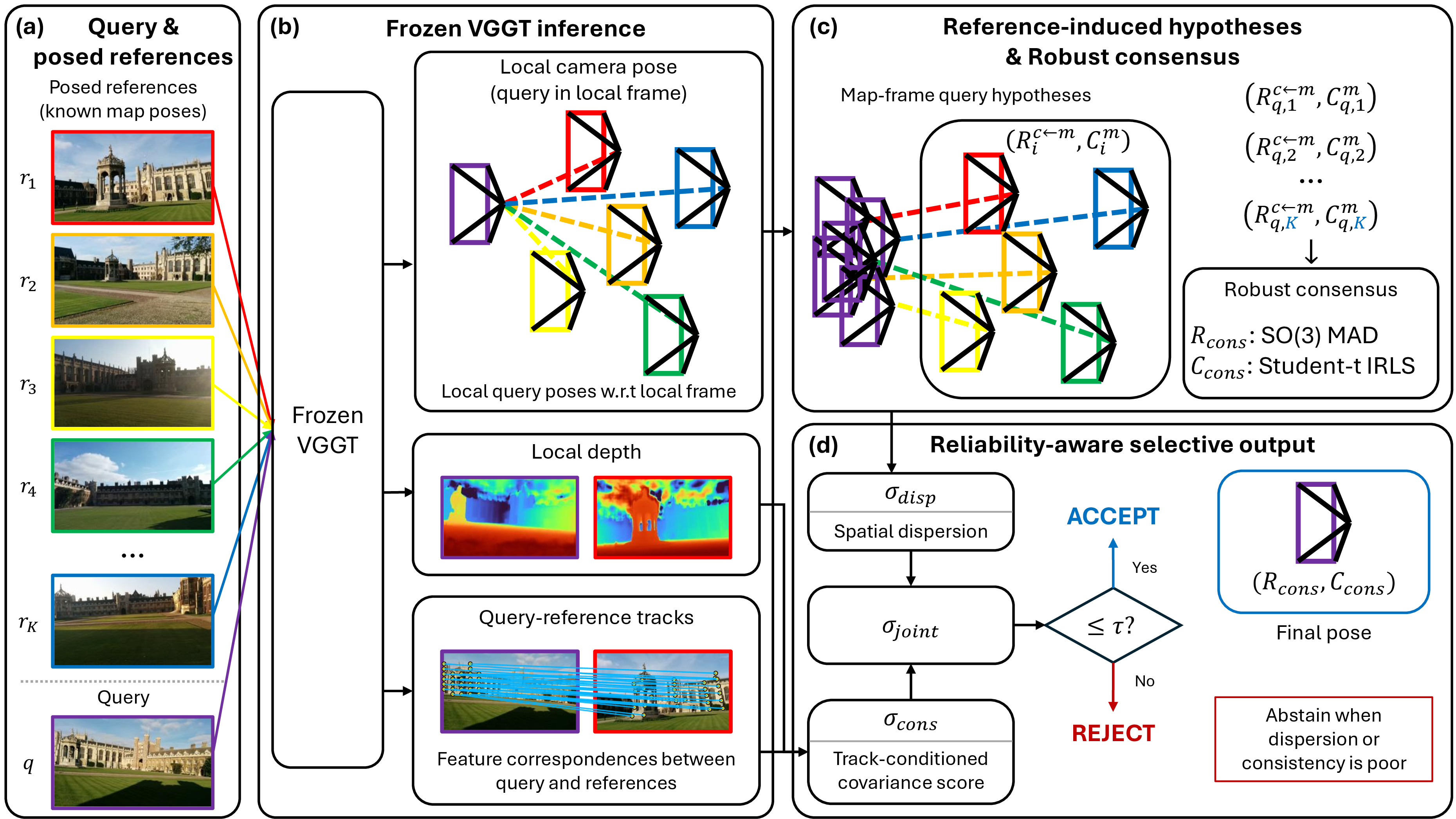
Feed-forward multi-view geometry models such as VGGT [1] and DUSt3R [2] predict local geometry, camera poses, and correspondences in a single forward pass. Their outputs are not directly grounded in the coordinate frame of a deployed map. Posed references provide that grounding: reference selection defines the hypothesis set, and each reference can lift the query from the feed-forward local frame into a map-frame \(\mathrm{SE}(3)\) hypothesis.
Localization also needs rejection. Returning no pose delays a downstream task, but accepting a wrong pose can seed tracking, map updates, or downstream AR and robot actions from a false global state. We therefore treat pose estimation and rejection as coupled outputs of the same reference-induced hypothesis structure. Collapsing selected references into a single aligned pose can discard disagreement and track-support patterns that are informative for failure detection.
We present RIC-Loc (Reference-Induced Consensus localization; 1), a scene-training-free posed-reference localizer. A frozen VGGT processes a query and selected posed references, producing local poses, depth, and query-reference tracks. Each reference induces one query-pose hypothesis \((R_{q,i},C_{q,i})\) in the map frame; robust \(\mathrm{SO}(3){}\times\mathbb{R}^3\) consensus estimates \((R_{\mathrm{cons}},C_{\mathrm{cons}})\). The preserved hypotheses also yield two reliability scores. The spatial-dispersion score \(\sigma_{\mathrm{disp}}\) is the root-mean-square spread of the lifted center hypotheses about \(C_{\mathrm{cons}}\), whereas the track-conditioned covariance score \(\sigma_{\mathrm{cons}}\) uses VGGT track support and local observability propagated through the lifting model rather than hypothesis dispersion alone. Their normalized fusion is used for selective localization and evaluated through risk–coverage curves.
We make three contributions.
A hypothesis-preserving, SfM-point-map-free posed-reference scheme that induces one map-frame \(\mathrm{SE}(3)\) query-pose hypothesis per reference without precomputed SfM map points, query-to-map 2D–3D matching, or PnP.
Robust consensus localization over these hypotheses with no per-scene model training.
Complementary reliability scores from the preserved hypothesis structure, evaluated by failure-detection AUROC and risk–coverage.
We validate the consensus pose and the joint selective policy on indoor, outdoor, and large-scale indoor benchmarks, and show that the lift-and-consensus procedure is not specific to VGGT, transferring to other feed-forward front-ends under the identical posed-reference protocol.
2 Related Work↩︎
Feed-forward multi-view geometry models predict geometry and cameras without per-scene optimization: DUSt3R [2] regresses dense pointmaps for an image pair, MASt3R [3] adds a metric matching head, and VGGT [1] predicts poses, depth, point maps, and correspondences for many views in one forward pass, building on self-supervised transformer features [4]. We use VGGT as a frozen local-geometry front-end for a query and its posed references; its camera output is not the final pose, which is instead grounded in the map frame by the known reference poses.
A large body of learned localizers amortize localization into learned scene or map representations. Absolute pose regression maps an image to a global pose—PoseNet [5] and its uncertainty-aware [6] and geometry-aware [7] variants—while map-relative regression [8] conditions a scene-agnostic regressor on a scene-specific map representation. Scene-coordinate methods learn pixel-to-3D mapping and solve pose with robust PnP, from DSAC’s differentiable RANSAC [9] to the fast ACE [10] and larger-scale GLACE [11]. These are accurate, but the deployed map is encoded in learned scene-specific weights or map representations.
Structure-based pipelines instead match a query against an explicit SfM reconstruction [12]: classical systems use prioritized 2D–3D matching [13], while hierarchical localization [14] pairs global retrieval [15] with local features and learned matchers [16]–[18] to form 2D–3D matches for PnP; PixLoc [19] instead refines coarse poses by feature-metric alignment to a 3D model. Such explicit-map systems are strong on outdoor, urban-driving, and large indoor localization benchmarks [20]–[22] but rely on precomputed 3D maps and query-to-map matching or alignment. Closer to us, query-reference relative-pose methods avoid an explicit query-to-map point map: Reloc3r [23] regresses query-reference relative poses and aggregates the induced absolute poses, and MicKey [24] predicts metric relative pose from learned correspondences. Aggregating relative or reference-induced motions connects to motion and rotation averaging [25], [26] and \(\mathrm{Sim}(3)\) alignment [27]; our point estimator belongs to this lift-and-average family, and we compare against its matched variants in 5.
Localization also needs to know when to abstain. Uncertainty modeling ranges from Bayesian pose regression [6] to selective prediction [28] and distribution-free conformal prediction [29] and learn-then-test risk control [30]. We do not regress a parametric posterior; reliability comes from the preserved hypothesis structure—spatial dispersion of the lifted centers and a track-conditioned covariance score—and gates failures without query ground truth.
RIC-Loc thus occupies a distinct point in this space: it needs no per-scene training or scene-specific model, and its main estimator uses no SfM point map, query-to-map matching, or PnP. Unlike query-reference relative-pose methods—whether regression-based or correspondence-based [23], [24]—it uses VGGT as a frozen local-geometry front-end rather than a black-box pose predictor, and the reference-induced map-frame hypotheses are preserved rather than collapsed into one aligned pose. This design lets the same reference-indexed state yield both the consensus pose and two ground-truth-free reliability scores, positioning RIC-Loc as a hypothesis-preserving, selectively-gated posed-reference localizer built on feed-forward multi-view geometry.
3 Method↩︎
RIC-Loc takes a query image \(q\), a COLMAP-format [12] posed-reference map (used only as a container for calibrated reference images and their known poses; any sparse 3D points are ignored), global retrieval descriptors, and a frozen VGGT [1], which predicts query-local depth, tracks, local geometry, and the intrinsics used for reprojection. We use \(m\) for the map frame, \(v\) for VGGT’s shared local frame, and \(c\) for a camera frame. Rotations are written by direction: \(R^{a\leftarrow b}\) maps vectors from frame \(b\) to frame \(a\). For a reference image \(i\), the known map pose is \((R_i^{c\leftarrow m},C_i^m)\), with the COLMAP world-to-camera convention \[\label{eq:colmap95convention} x_i^c = R_i^{c\leftarrow m}(x^m-C_i^m), \qquad C_i^m = -(R_i^{c\leftarrow m})^\top t_i^{c\leftarrow m}.\tag{1}\] VGGT predicts local poses \((R_i^{c\leftarrow v},C_i^v)\) and \((R_q^{c\leftarrow v},C_q^v)\) in the shared frame \(v\).
Localization is organized around the reference-induced map-frame \(\mathrm{SE}(3)\) hypothesis set \[\label{eq:hyp95distribution} \mathcal{H}_q(S_q) = \left\{ (R_{q,i}^{c\leftarrow m},C_{q,i}^m,w_i) \right\}_{i\in S_q},\tag{2}\] where \(S_q\) is the active reference set and the subscript \((q,i)\) marks the query pose induced by reference \(i\). Lifting yields one hypothesis per reference, robust consensus estimates the candidate pose, and the same reference-indexed structure with its track support yields the reliability scores for rejection.
3.1 Overview↩︎
1 summarizes the pipeline. We retrieve a ranked pool \(P_q\) of \(L=20\) MegaLoc [31] images and pass only its top \(K=8\) subset \(S_q\) to VGGT. Each active reference \(i\in S_q\) carries a fixed initial weight \(w_i^{\mathrm{init}}\) combining VGGT track confidence with a retrieval prior (worse rank or larger distance \(\to\) smaller weight; Supplementary Sec. 8). This frozen \(L{=}20\), \(K{=}8\) setting is used throughout; selection uses no 3D map points or query ground truth.
A single frozen VGGT forward pass processes \([q,r_1,\ldots,r_K]\) with \(r_i\in S_q\). Its camera, depth, and track heads provide the local poses, query geometry, and query-reference correspondences used below; the final pose comes only after reference-induced lifting and consensus.
We estimate a similarity transform from VGGT local reference centers to known map reference centers, \[\label{eq:align} C_i^m \approx sR_S^{m\leftarrow v}C_i^v+t_S^m,\tag{3}\] using \(w_i^{\mathrm{init}}\)-weighted Umeyama [27] inside RANSAC [32], followed by robust refinement. This transform also defines the direct \(\mathrm{Sim}(3)\) alignment baseline \[\label{eq:align95pose} C_{\mathrm{align}}^m=sR_S^{m\leftarrow v}C_q^v+t_S^m, \qquad R_{\mathrm{align}}^{c\leftarrow m} = R_q^{c\leftarrow v}(R_S^{m\leftarrow v})^\top,\tag{4}\] used for comparison only: the proposed estimator keeps the shared scale \(s\) but estimates the query center from reference-induced hypotheses rather than taking \(C_{\mathrm{align}}^m\).
3.2 Reference-induced SE(3) hypothesis set↩︎
Each reference defines a reference-specific orientation anchor from VGGT’s local frame to the map frame, \[\label{eq:anchor} A_i^{m\leftarrow v} = (R_i^{c\leftarrow m})^\top R_i^{c\leftarrow v}.\tag{5}\] Using this anchor, reference \(i\) induces one map-frame query-pose hypothesis with rotation \[\label{eq:lift95rot} R_{q,i}^{c\leftarrow m} = R_q^{c\leftarrow v}(A_i^{m\leftarrow v})^\top = R_q^{c\leftarrow v}(R_i^{c\leftarrow v})^\top R_i^{c\leftarrow m},\tag{6}\] and center \[\label{eq:lift95center} C_{q,i}^m = C_i^m+sA_i^{m\leftarrow v}(C_q^v-C_i^v).\tag{7}\] 6 transfers the VGGT query-reference relative orientation through the known reference rotation. 7 expresses the local query-reference displacement in the map frame, scales it by the shared \(\mathrm{Sim}(3)\) scale, and anchors it at the known reference center. The global \(\mathrm{Sim}(3)\) rotation \(R_S^{m\leftarrow v}\) is not re-applied in 7 : the reference-specific anchor already carries reference \(i\)’s map orientation. Thus the per-reference lift does not collapse to the direct alignment baseline of 4 .
Query-seeded VGGT tracks visible in both views provide local geometric support for each lifted hypothesis. For reference \(i\), let \(\mathcal{T}_i\) be the retained tracks after validity, depth, and visibility filtering. Let \(x_{ij}\) be the reference observation, \(X_{qj}^{c_q}\) the query-camera 3D point from VGGT depth, and \(\hat{x}_{ij}\) its projection into reference \(i\) under the VGGT query-to-reference transform \(T_{i\leftarrow q}\). The reprojection uses VGGT-predicted intrinsics mapped to image pixel coordinates. With residual \(e_{ij}=x_{ij}-\hat{x}_{ij}\), the confidence-weighted Gauss–Newton information matrix is \[\label{eq:info95matrix} H_i = \sum_{j\in\mathcal{T}_i} J_{ij}^{\top}W_{ij}J_{ij}, \qquad J_{ij} = \frac{\partial e_{ij}}{\partial \xi_i},\tag{8}\] where \(\xi_i\in\mathfrak{se}(3)\) perturbs \(T_{i\leftarrow q}\) by left multiplication, \(\exp(\xi_i^\wedge)T_{i\leftarrow q}\). The weights \(W_{ij}\) combine VGGT track confidence with a robust MAD pixel scale. We use the damped inverse as a local observability approximation, \[\label{eq:relative95cov} \Sigma_{\mathrm{rel},i} \simeq (H_i+\lambda I)^{-1},\tag{9}\] using fixed conditioning safeguards. This damped inverse captures local observability around the VGGT-predicted relative pose and is used for relative weighting and failure ranking. Define \[u_i^m=A_i^{m\leftarrow v}(C_q^v-C_i^v).\] The first-order center-lift Jacobian is \[\label{eq:lift95jacobian} G_i = s \left[ (R_i^{c\leftarrow m})^\top \quad -[u_i^m]_\times (R_i^{c\leftarrow m})^\top \right],\tag{10}\] and the lifted center covariance is \[\label{eq:lift95cov} \Sigma_{C,i} = G_i\Sigma_{\mathrm{rel},i}G_i^\top.\tag{11}\] Scale variance is estimated robustly from reference-center ratios and added once to the consensus covariance as a common-mode term. The construction is a first-order factorized approximation of the lifted-center covariance. 10 follows by first-order differentiation of the lifted map-frame displacement under the left perturbation of \(T_{i\leftarrow q}\); see Supplementary Sec. 9. References with too few usable tracks receive an inflated isotropic covariance, so covariance-weighted consensus can down-weight them rather than discard them. If fewer than two covariance-bearing hypotheses remain after this fallback, center estimation falls back to scalar center consensus and \(\sigma_{\mathrm{cons}}\) is unavailable.
3.3 Robust SE(3) consensus↩︎
Repeated structures, viewpoint gaps, and front-end degeneracy can produce outlying hypotheses. We therefore estimate rotation and center with separate robust consensus procedures over the reference-induced hypothesis set.
For rotation, let \(q_i\) be the sign-consistent unit quaternion corresponding to \(R_{q,i}^{c\leftarrow m}\). We first compute a weighted chordal mean \[\label{eq:quat95mean95initial} A = \sum_{i\in S_q}w_i^{\mathrm{init}}q_iq_i^\top, \qquad q^{(0)} = \operatorname{eigvec}_{\max}(A),\tag{12}\] where \(w_i^{\mathrm{init}}\) combines the MegaLoc retrieval prior with VGGT track confidence; the fixed formula is listed in Supplementary Sec. 8 and uses no map-point support. Geodesic residuals \[e_i^R=d_{\mathrm{SO}(3)}(R_{q,i}^{c\leftarrow m},R(q^{(0)}))\] define a robust MAD inlier set \[\label{eq:rot95mad95threshold} \tau_R = \max(\tau_{\min},m_R+\kappa_R\operatorname{MAD}_R), \qquad \mathcal{I}_R = \{i\in S_q:e_i^R\le\tau_R\},\tag{13}\] with \(m_R,\operatorname{MAD}_R\) the median/MAD of \(\{e_i^R\}\) and fixed \(\tau_{\min},\kappa_R\). Recomputing the chordal mean on \(\mathcal{I}_R\) yields \[\label{eq:rcons} A_{\mathcal{I}_R} = \sum_{i\in\mathcal{I}_R}w_i^{\mathrm{init}}q_iq_i^\top, \qquad q_{\mathrm{cons}} = \operatorname{eigvec}_{\max}(A_{\mathcal{I}_R}), \qquad R_{\mathrm{cons}}=R(q_{\mathrm{cons}}).\tag{14}\]
For center estimation, let \(\mathcal{U}_q\subseteq S_q\) be the set of references with usable, possibly inflated, center covariance. The rotation inlier mask \(\mathcal{I}_R\) and center set \(\mathcal{U}_q\) are kept separate because rotation residuals and track-derived center covariances provide different failure-ranking cues. The center objective is \[\label{eq:ccons95opt} C_{\mathrm{cons}}^m = \mathop{\mathrm{arg\,min}}_C \sum_{i\in\mathcal{U}_q} \rho\left( (C-C_{q,i}^m)^\top\Sigma_{C,i}^{-1}(C-C_{q,i}^m) \right).\tag{15}\] For the three-dimensional Student-\(t\) loss, \[\rho(d^2) = \frac{\nu+3}{2}\log(1+d^2/\nu).\] IRLS with fixed convergence settings uses \[\label{eq:student95t95weights} \omega_i = \frac{\nu+3}{\nu+m_i^2}, \qquad m_i^2 = (C_{\mathrm{cons}}^m-C_{q,i}^m)^\top \Sigma_{C,i}^{-1} (C_{\mathrm{cons}}^m-C_{q,i}^m),\tag{16}\] and yields \[\label{eq:ccons} C_{\mathrm{cons}}^m = \left( \sum_{i\in\mathcal{U}_q} \omega_i\Sigma_{C,i}^{-1} \right)^{-1} \left( \sum_{i\in\mathcal{U}_q} \omega_i\Sigma_{C,i}^{-1}C_{q,i}^m \right).\tag{17}\] This stage performs robust aggregation of the reference-induced hypotheses; we use it as a point estimator and a ranking signal rather than a calibrated \(\mathrm{SE}(3)\) posterior. If \(|\mathcal{U}_q|<2\), the estimator can still produce a scalar center-consensus fallback pose, but the query is not used for covariance-score ranking. Its \(\sigma_{\mathrm{joint}}\) input is unavailable, so the runtime gate rejects it and full-set analyses rank it as least reliable.
The estimator outputs the candidate pose \(R_{\mathrm{final}}=R_{\mathrm{cons}}\), \(C_{\mathrm{final}}^m=C_{\mathrm{cons}}^m\), with \(t_{\mathrm{final}}^{c\leftarrow m}=-R_{\mathrm{final}}C_{\mathrm{final}}^m\). The selective stage either accepts this candidate or rejects it; it does not replace it with another pose.
3.4 Reliability and selective localization↩︎
We extract two complementary reliability scores from the preserved hypotheses and their track support.
The covariance-derived reliability score \(\sigma_{\mathrm{cons}}\) is based on the aggregate covariance approximation \[\label{eq:agg95cov} \Sigma_{\mathrm{agg}} = \left( \sum_{i\in\mathcal{U}_q} \omega_i\Sigma_{C,i}^{-1} \right)^{-1}.\tag{18}\] We inflate it by the weighted Mahalanobis residual-consistency factor \[\label{eq:phi} \phi=\max(1,Q/\mathrm{dof}),\quad Q=\sum_{i\in\mathcal{U}_q}\omega_i m_i^2,\quad \mathrm{dof}=\max(3|\mathcal{U}_q|-3,1),\tag{19}\] and add the common-mode scale term: \[\label{eq:sigcons} \Sigma_{\mathrm{cons}} = \phi\Sigma_{\mathrm{agg}} + \mathrm{var}_s \frac{\partial C_{\mathrm{cons}}^m}{\partial s} \Big(\frac{\partial C_{\mathrm{cons}}^m}{\partial s}\Big)^{\top}, \qquad \sigma_{\mathrm{cons}} = \sqrt{\lambda_{\max}(\Sigma_{\mathrm{cons}})}.\tag{20}\] The resulting \(\sigma_{\mathrm{cons}}\) is a track-conditioned, covariance-derived reliability score for the center consensus, computed from local reprojection geometry and hypothesis aggregation. It quantifies the weakest-direction uncertainty of the center consensus and serves as a center-reliability ranking signal (calibration analysis in Supplementary 12).
The spatial-dispersion signal is the root-mean-square spread of the center hypotheses about the consensus, \[\label{eq:sigdisp} \sigma_{\mathrm{disp}} = \sqrt{ \frac{1}{|\mathcal{U}_q|} \sum_{i\in\mathcal{U}_q} \lVert C_{q,i}^m-C_{\mathrm{cons}}^m\rVert^2 }.\tag{21}\] This measures physical disagreement among lifted centers and provides failure-ranking cues associated with baseline, viewpoint, and triangulation degeneracy. The two signals are complementary: \(\sigma_{\mathrm{disp}}\) measures spread of the lifted hypotheses, while \(\sigma_{\mathrm{cons}}\) is a track-conditioned covariance-derived score propagated through the lifting model.
To combine them across scenes with different scales and textures, we use held-out normalization: we compute medians \(\tilde{\sigma}_{\mathrm{cons}}\) and \(\tilde{\sigma}_{\mathrm{disp}}\), and define the joint reliability score \[\label{eq:sigjoint} \sigma_{\mathrm{joint}}(q) = \max\left( \frac{\sigma_{\mathrm{cons}}(q)}{\tilde{\sigma}_{\mathrm{cons}}}, \frac{\sigma_{\mathrm{disp}}(q)}{\tilde{\sigma}_{\mathrm{disp}}} \right).\tag{22}\] If \(\sigma_{\mathrm{cons}}\) is unavailable, \(\sigma_{\mathrm{joint}}\) is also unavailable and the localizer rejects the query. Otherwise, the localizer accepts the pose when \(\sigma_{\mathrm{joint}}(q)\le\tau_{\mathrm{joint}}\) and rejects it otherwise. We report risk–coverage trade-offs by sweeping \(\tau_{\mathrm{joint}}\), rather than committing to a single tuned threshold. The held-out medians align score scales across scenes; the calibration scope is stated in the Limitations.
4 Experiments↩︎
4.1 Setup and protocol↩︎
We evaluate on four benchmarks: 7-Scenes [33] (\(n=17{,}000\) indoor RGB-D queries), Cambridge Landmarks [5] (\(n=1{,}918\) city-scale queries over all five scenes including GreatCourt), 12-Scenes [34] (\(n=5{,}641\) queries over all twelve scenes), and NAVER Gangnam Station [35] (B1: \(2{,}620\) queries; B2: \(916\) queries, with low-texture repetitive structure). We report median translation/rotation error and strict success at \(5\,\text{cm}/5^{\circ}\) for 7-Scenes and 12-Scenes, \(0.25\,\text{m}/2^{\circ}\) for Cambridge and NAVER, plus the three NAVER tiers. Unless otherwise stated, AUROC and risk–coverage use strict failure, meaning not strict-correct; catastrophic rate is a secondary safety metric, with catastrophic failure defined as \(e_t>5\,\text{m}\) or \(e_R>20^{\circ}\) (tightened to \(0.5\,\text{m}/10^{\circ}\) on 7-Scenes).
RIC-Loc and the feed-forward baseline Reloc3r-512 [23] use the same frozen \(L{=}20\), \(K{=}8\) reference protocol with fixed hyperparameters (3.1; full values in Supplementary 6); hloc [14] (SuperPoint+LightGlue) is a structure-based context baseline with its own SfM point map and 2D–3D/PnP pipeline. Fusion normalization (22 ) uses held-out queries—leave-one-scene-out on 7-Scenes/Cambridge and cross-building on NAVER. We report selective metrics on 7-Scenes, Cambridge, and NAVER, with 12-Scenes as an additional accuracy benchmark; selective curves rank covariance-eligible queries (\(47.3\%\) and \(74.7\%\) of NAVER-B2/B1, \(100\%\) and \(98.8\%\) on 7-Scenes/Cambridge); full-set behavior (ineligible queries treated as least reliable or as failures) is reported separately.
4.2 Selective localization↩︎
The objective is to rank failures before returning the candidate pose, using the dispersion and covariance scores from the preserved hypotheses under a unified joint policy.
1 measures how well each ground-truth-free signal separates strict failures from successes: we compare \(\sigma_{\mathrm{cons}}\), \(\sigma_{\mathrm{disp}}\), and their fusion \(\sigma_{\mathrm{joint}}\) (22 ) against scalar center dispersion, Sim(3) conditioning, the top-1\(-\)top-2 retrieval-score gap, and a random baseline. The retrieval gap is place-recognition confidence and does not affect RIC-Loc’s pose or scoring (Supplementary Sec. 10); held-out fusion medians give AUROC within \(0.5\) pp of in-sample, so the ranking is robust to score-scale fitting.
| Confidence signal | 7-Scenes | Cambridge | NAVER-B2 | NAVER-B1 |
|---|---|---|---|---|
| (, median-norm.fusion) | 0.822 | 0.767 | 0.791 | 0.781 |
| (, covariance score) | 0.778 | 0.764 | 0.806 | 0.813 |
| (, spatial dispersion) | 0.762 | 0.741 | 0.618 | 0.692 |
| center dispersion (scalar) | 0.756 | 0.751 | 0.650 | 0.717 |
| Sim(3) conditioning | 0.638 | 0.715 | 0.653 | 0.732 |
| retrieval-score gap (top-1\(-\)top-2) | 0.529 | 0.540 | 0.516 | 0.546 |
| random baseline | 0.500 | 0.500 | 0.500 | 0.500 |
| covariance-eligible (%) | 100 | 98.8 | 47.3 | 74.7 |
4pt
The two hypothesis-derived signals are complementary: the joint score is strongest on 7-Scenes and Cambridge (\(0.822/0.767\)), while \(\sigma_{\mathrm{cons}}\) leads in the low-texture NAVER corridors (\(0.806/0.813\)). Because both signals are preserved, the gate defaults to the joint score, with \(\sigma_{\mathrm{cons}}\) the single-signal choice in the low-texture regime; a paired bootstrap of the joint-vs-\(\sigma_{\mathrm{cons}}\) difference is in 13. All hypothesis-derived scores outperform the retrieval gap and random on every split; the retrieval gap is near-random (AUROC \(0.52\)–\(0.55\)), confirming retrieval confidence does not predict pose failure. A naive consensus-inlier-count baseline is likewise near-random (Supplementary 16).
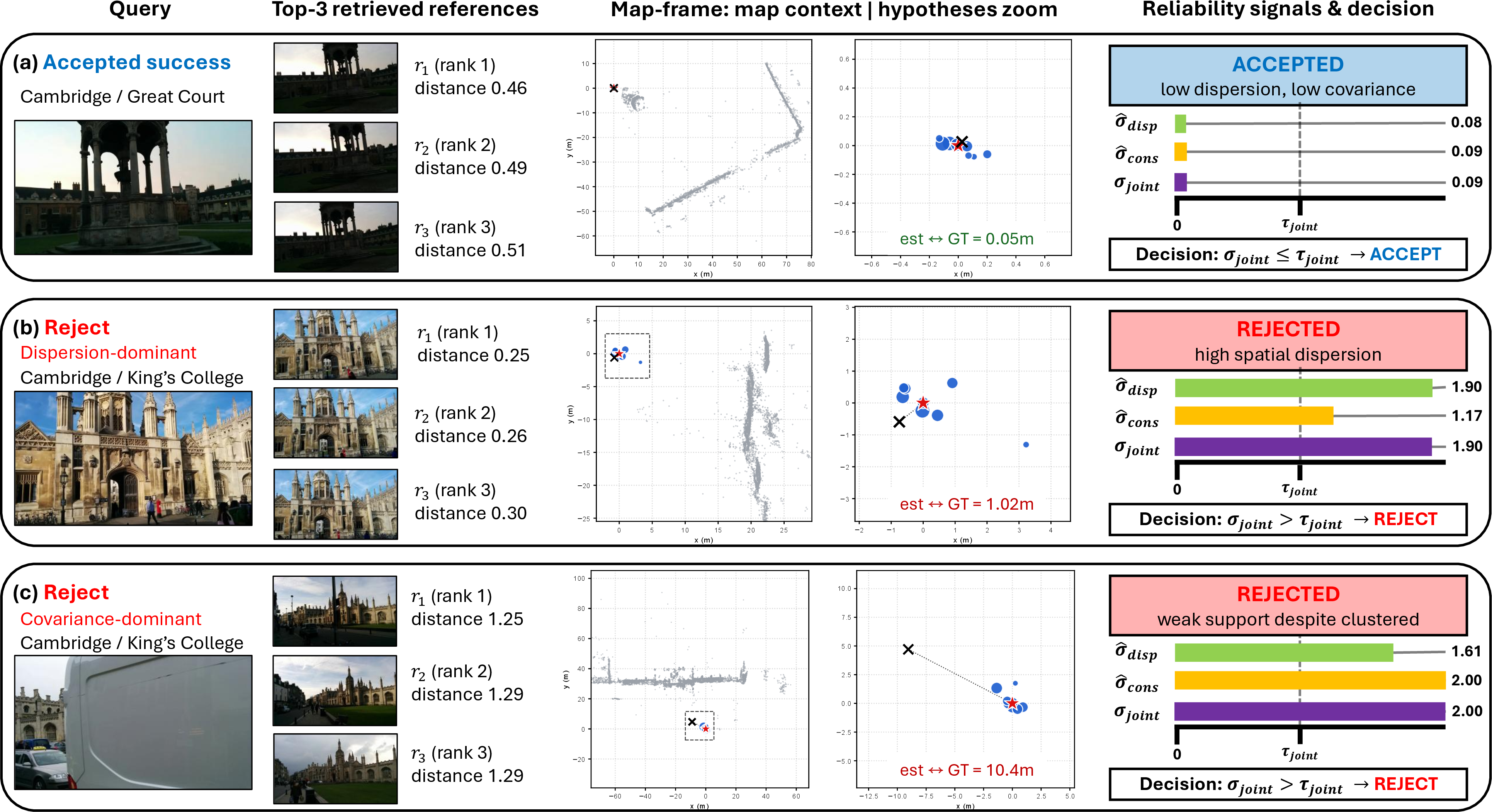
2 visualizes this complementarity through representative joint-gate decisions: one rejected case is dominated by spatial spread, while another is dominated by the track-conditioned covariance score despite a more clustered hypothesis pattern.
We then sweep the accepted set by lowest \(\sigma_{\mathrm{joint}}\) in 2 and 3. At the reported coverages, rejection lowers strict risk and catastrophic rate on every selective-evaluation split (7-Scenes strict-risk \(0.235\!\to\!0.146\) at \(0.80\) coverage; NAVER catastrophic B2 \(0.256\!\to\!0.133\), B1 \(0.145\!\to\!0.017\)). AURC improves over random (\(0.087/0.489/0.298/0.270\) vs.\(0.235/0.685/0.492/0.458\)), with the same joint-vs-\(\sigma_{\mathrm{cons}}\) split across scenes as in 1.
| Coverage | 7-Scenes (risk/cat.) | Cambridge (risk/cat.) | NAVER-B2 (risk/cat.) | NAVER-B1 (risk/cat.) |
|---|---|---|---|---|
| Cov 1.0 (no rejection) | 0.235 / 0.002 | 0.685 / 0.012 | 0.492 / 0.256 | 0.458 / 0.145 |
| Cov 0.8 | 0.146 / 0.000 | 0.628 / 0.000 | 0.393 / 0.133 | 0.353 / 0.017 |
| Cov 0.7 | 0.113 / 0.000 | 0.593 / 0.000 | 0.356 / 0.106 | 0.318 / 0.005 |
| Cov 0.5 | 0.066 / 0.000 | 0.501 / 0.000 | 0.255 / 0.028 | 0.240 / 0.003 |
| AURC \(\sigjoint\) () | 0.087 | 0.489 | 0.298 | 0.270 |
| AURC random / oracle | 0.235 / 0.030 | 0.685 / 0.322 | 0.492 / 0.148 | 0.458 / 0.126 |
6pt


Figure 3: Risk–coverage by signal on the covariance-eligible set: accepted-set strict risk vs. coverage (lower is better), queries accepted in increasing score order. \(\sigma_{\mathrm{joint}}\) (thick) and \(\sigma_{\mathrm{cons}}\) run below the scalar and retrieval baselines over the operating range, with \(\sigma_{\mathrm{joint}}\) strongest on 7-Scenes/Cambridge and \(\sigma_{\mathrm{cons}}\) in the low-texture NAVER buildings (cf.1). The oracle ranks by true translation error; random is the base failure rate..
The preserved hypotheses also outperform black-box confidence: on NAVER the covariance score ranks catastrophic failures more accurately than Reloc3r [23] self-agreement (catastrophic-failure AUROC \(0.92/0.97\) vs.\(0.88/0.80\) on B2/B1).
4.2.0.1 Full-set selective behavior.
The selective gains hold over the entire query stream: ranking the full query set with ineligible queries (\(52.7\%/25.3\%\) of NAVER-B2/B1) placed least-reliable raises full-set \(\sigma_{\mathrm{cons}}\) AUROC to \(0.941/0.893\) (B2/B1) and cuts full-set strict risk at \(0.5\) coverage (\(0.760\!\to\!0.520\) B2, \(0.595\!\to\!0.280\) B1). The NAVER gain thus goes beyond the eligibility filter: \(\sigma_{\mathrm{cons}}\) exceeds scalar dispersion among eligible queries and a gate-only ranker over the full stream (NAVER-B1 \(0.893\) vs.\(0.713\) AUROC; paired bootstrap, Supplementary 14). We report the within-eligible numbers of 1 as the deployable operating point.
4.3 Accuracy on benchmarks↩︎
3 reports accuracy on 7-Scenes, Cambridge, and 12-Scenes. On 7-Scenes, RIC-Loc has the lowest median translation (\(2.9\) cm) and rotation (\(0.83^{\circ}\)) among the compared methods and the highest strict success (\(0.765\), above structure-based hloc \(0.662\) and Reloc3r-512 \(0.670\)), without per-scene training. On Cambridge, rotation is precise (\(0.40^{\circ}\), ahead of Reloc3r-512), and against the like-for-like SfM-point-map-free Reloc3r-512 RIC-Loc improves both translation (\(40.0\) vs.\(55.6\) cm) and strict success (\(0.311\) vs.\(0.233\), full-set). The structure-based hloc reference remains stronger on outdoor translation (discussed in the Limitations). On 12-Scenes, RIC-Loc improves over the comparable feed-forward Reloc3r-512 baseline (\(0.957\) vs.\(0.750\) strict), approaching the structure-based hloc upper bound (\(0.985\)); per-scene results are in Supplementary 17. Finally, the black-box VGGT baseline (\(C_{\mathrm{align}}\), 5) reaches only \(0.674/0.211\) strict on 7-Scenes/Cambridge versus RIC-Loc’s \(0.765/0.315\), isolating the gain from the hypothesis-preserving lift.
| Benchmark | metric | hloc [14] | Reloc3r-512 [23] | |
|---|---|---|---|---|
| 7-Scenes [33] | median \(t\)/\(R\) | 2.9/0.83 | 3.6/1.19 | 3.6/0.93 |
| strict | 0.765 | 0.662 | 0.670 | |
| Cambridge [5] | median \(t\)/\(R\) | 40.0/0.40 | 15.6/0.21 | 55.6/0.57 |
| (5 scenes) | strict | 0.311 | 0.688 | 0.233 |
| 12-Scenes [34] | median \(t\)/\(R\) | 1.3/0.51 | 0.9/0.42 | 2.3/0.70 |
| (12 scenes) | strict | 0.957 | 0.985 | 0.750 |
6pt
4.4 Large-scale indoor evaluation↩︎
We evaluate on the NAVER Gangnam Station large-scale indoor benchmark [35], which contains low-texture repetitive structure and large viewpoint changes. 4 compares RIC-Loc with MASt3R [3], DUSt3R [2], and Reloc3r [23] using the same reference subsets to isolate the pose-estimation stage.
RIC-Loc is strongest at the tight \(0.25\,\text{m}/2^{\circ}\) threshold on both buildings (B2 \(24.0\%\) vs.MASt3R \(15.6\%\) and DUSt3R \(6.8\%\); B1 \(40.5\%\) vs.MASt3R \(8.2\%\) and DUSt3R \(11.7\%\)), pairing this tight-threshold accuracy with the strongest selective rejection under these repetitive low-texture corridors. At the looser \(1\,\text{m}/5^{\circ}\) tier, RIC-Loc’s eligibility gate declines part of the low-texture tail, so the always-emitting baselines can cover more of that tail.
4pt
4.5 Ablations↩︎
4.5.0.1 Estimator.
5 fixes retrieval, references, and the single frozen VGGT pass, holds rotation at \(R_{\mathrm{cons}}\), and varies only the center estimator. The main gain comes from replacing the direct Sim(3)-aligned query center \(C_{\mathrm{align}}\) with per-reference lifted centers: strict success improves from \(0.674\) to \(0.765\) on 7-Scenes, from \(0.211\) to \(0.315\) on Cambridge, and from \(0.353\) to \(0.508\) on NAVER-B2 (covariance-eligible set; the NAVER-B2 gain persists full-set, \(16.7\%\!\to\!24.0\%\)). The lift, not the aggregation, drives the indoor and outdoor gain. Covariance weighting is the operating choice because it delivers the largest accuracy gain in the hardest, low-texture NAVER regime (\(0.436\!\to\!0.508\)) while trading under \(2\) pp against the other aggregators on 7-Scenes and Cambridge (\(0.765\)–\(0.784\)/\(0.315\)–\(0.326\)), and it uniquely yields the covariance-derived reliability score used in selective localization. With the selective results (4.2), the ablation supports the central claim: the lift improves the estimator, and preserving the hypothesis structure enables rejection.
| Center estimator (\(\Rcons\) fixed) | 7-Scenes | Cambridge | NAVER-B2 | isolates |
|---|---|---|---|---|
| Direct Sim(3), black-box VGGT (\(\Calign\)) | 0.674 | 0.211 | 0.353 | direct-alignment center |
| Plain lift-and-average\(^\dagger\) | 0.769 | 0.320 | 0.411 | late-fusion baseline |
| Retrieval-weighted avg.\(^\dagger\) | 0.784 | 0.322 | 0.436 | retrieval prior |
| Robust consensus only\(^\dagger\) | 0.771 | 0.326 | 0.427 | robust averaging |
| Robust \(+\) covariance (\(\Ccons\)) | 0.765 | 0.315 | 0.508 | covariance weighting |
6pt
4.5.0.2 Backbone transfer.
As a transfer diagnostic rather than a primary benchmark comparison, the same reference-induced lift-and-consensus procedure also improves DUSt3R and MASt3R raw \(\mathrm{Sim}(3)\) outputs under the matched posed-reference protocol on every reported split (Supplementary Tab. 7).
4.5.0.3 Efficiency.
At \(K=8\), RIC-Loc runs in \(1.9\)–\(3.4\) s per query across the evaluated datasets (per-stage medians in Supplementary 12) on a single \(24\) GB RTX 4090, with \(13.1\) GB peak memory and no per-scene training; accuracy and failure ranking are stable across the reference count \(K\) (Supplementary 6).
5 Conclusion↩︎
We presented RIC-Loc, a scene-training-free posed-reference localizer with an SfM-point-map-free main estimator. Our formulation centers on reference-induced hypothesis preservation. Reference selection determines the hypothesis set, with each posed reference inducing one map-frame \(\mathrm{SE}(3)\) pose hypothesis for the query. Robust consensus then estimates the final pose, while the preserved reference-indexed structure provides ground-truth-free reliability signals for selective localization.
Experiments show that this lift-and-consensus design improves over matched feed-forward baselines, is competitive on indoor posed-reference benchmarks, and produces informative empirical risk–coverage trade-offs from hypothesis-derived dispersion and covariance scores. The ablations indicate that the main gain comes from replacing direct \(\mathrm{Sim}(3)\) alignment with reference-induced hypotheses, while the preserved hypothesis structure supplies reliability cues that retrieval confidence and scalar dispersion alone miss. These results support RIC-Loc as a hypothesis-preserving interface between feed-forward multi-view geometry, robust map-frame pose consensus, and selective rejection.
5.0.0.1 Limitations and future work.
(i) Outdoor accuracy. Without an explicit 3D map or query-to-map PnP, outdoor translation trails structure-based SfM/PnP localization (Cambridge, 3; still ahead of the like-for-like Reloc3r-512). Geometry-aware reference selection within the posed-image database—for viewpoint diversity, predicted track support, and hypothesis conditioning rather than fixed top-\(K\) retrieval—is a natural next step. (ii) Approximate uncertainty. The track-conditioned covariance is first-order: its \(K\) hypotheses share one VGGT pass yet are aggregated as if independent, so it is over-confident in absolute scale (\(\approx4\)–\(6\times\), 8) and omits rotation; we use \(\sigma_{\mathrm{cons}}\) only as a monotone failure-ranking signal, and a calibrated, rotation-aware version would add guaranteed risk control. (iii) Coverage. On low-texture repetitive scenes covariance eligibility can be limited (NAVER-B2 \(47.3\%\)), capping deployable coverage; covariance-free fallback ranking for ineligible queries is an important direction. (iv) Cost and assumptions. Inference is dominated by the frozen VGGT pass (\(1.9\)–\(3.4\) s, 12), heavier than retrieval-PnP; RIC-Loc also needs held-out median scales and assumes calibrated posed references.
Supplementary Material
This supplement records implementation details, active-reference weights, the center-lift Jacobian, the retrieval-score-gap diagnostic, and backbone transfer. It then presents additional covariance, selection, eligibility, significance, runtime, ranking-behavior, and per-scene analyses. All reported numbers are computed from the same evaluation outputs used in the main paper.
6 Implementation Details and Fixed Hyperparameters↩︎
Except for the explicitly labeled sensitivity sweep, the main-experiment hyperparameters below are fixed across scenes and datasets (no per-scene tuning).
Retrieval and active-set sizes: MegaLoc [31] retrieval pool \(L=20\); active-reference count \(K=8\) (the top-\(K\) subset passed to VGGT). Sensitivity to \(K\) is reported in 7.
Initial active-reference weights: the fixed \(w_i^{\mathrm{init}}\) (with \(\sigma_0=0.05\) and the confidence/rank/distance clips) are given in full in 8.
Alignment: RANSAC \(\mathrm{Sim}(3)\) (Umeyama, scale estimated): \(2000\) iterations, inlier threshold \(0.30\) m, minimum \(5\) inliers; on failure, a fallback pass uses \(6000\) iterations, \(0.40\) m, and minimum \(4\) inliers. The refit is a confidence-weighted Umeyama with IRLS robust reweighting. The alignment RANSAC seed is fixed at \(42\).
Rotation consensus: quaternion-chordal weighted mean (leading eigenvector of \(\sum_i w_i\,q_i q_i^{\top}\)); robust inlier gate at \(\max(\tau_{\min},\mathrm{med}+\kappa_R\,1.4826\,\mathrm{MAD})\), with \(\tau_{\min}=5^{\circ}\) and \(\kappa_R=2.5\).
Robust center consensus: Student-\(t\) IRLS with \(\nu=5\), at most \(20\) iterations, and convergence tolerance \(10^{-7}\).
Covariance construction: information damping \(\lambda=10^{-6}\); eigenvalues are clamped to \([10^{-8},10^{6}]\) when inverting the relative-pose information and to \([10^{-12},10^{12}]\) for the aggregate inverse-information approximation; the robust pixel-scale floor is \(\sigma_{\mathrm{pix},\min}=1\) px. A reference with fewer than \(6\) tracks uses the inflated isotropic fallback \(\Sigma_{C,i}=(10^{4})^2 I_3\). A query is covariance-eligible when the required track and reconstruction outputs are present, at least two covariance-bearing hypotheses remain after this fallback, and the resulting reliability score is finite. This covariance path applies no separate same-space eligibility gate; ineligible queries count as failures in full-set recall.
Scale uncertainty: with \(N_h\) retained covariance-bearing hypotheses, \(\mathrm{var}_s=(1.4826\,\mathrm{MAD}(\{s_{ij}\}))^2/N_h\) for at least two valid ratios, and \(0\) otherwise, where \(s_{ij}=\lVert C_i^m-C_j^m\rVert/\lVert C_i^v-C_j^v\rVert\) over reference pairs (no SfM 3D map points).
Selective normalization: \(\sigma_{\mathrm{joint}}\) is the maximum of \(\sigma_{\mathrm{cons}}/\mathrm{med}(\sigma_{\mathrm{cons}})\) and \(\sigma_{\mathrm{disp}}/\mathrm{med}(\sigma_{\mathrm{disp}})\). The medians are estimated on held-out data: leave-one-scene-out on 7-Scenes and Cambridge, and cross-building on NAVER. A held-out-free rank-fusion variant closely matches the held-out joint on 7-Scenes/Cambridge, while \(\sigma_{\mathrm{cons}}\) alone is stronger on the low-texture NAVER buildings; see 13.
Runtime: per-query wall-clock on a single \(24\) GB GPU at batch size \(1\) with a frozen VGGT (no gradients); median per-stage timings are reported in 15.
7 Sensitivity to the number of active references \(K\)↩︎
6 reports a sensitivity run over the active-reference count \(K\) on 7-Scenes (\(850\)-query subset). The sweep also increases selection-pool capacities with \(K\), so it is not an isolated causal ablation of \(K\). Point accuracy improves across the sweep (median translation \(3.08\!\to\!2.75\) cm, strict success \(0.748\!\to\!0.796\) over \(K{=}4\!\to\!16\)), while rank-fused failure-detection AUROC remains in \([0.795,0.835]\). This indicates that the observed reliability ranking is not tied to one reference-count setting. We use \(K=8\) as the fixed default for all main experiments.
| \(K\) | med \(t\) (cm) | med \(R\) (\(^{\circ}\)) | strict@\(5\,\text{cm}/5^{\circ}\) | AUROC \(\sigcons\) | AUROC \(\sigjoint\) |
|---|---|---|---|---|---|
| 4 | 3.08 | 0.84 | 0.748 | 0.805 | 0.817 |
| 6 | 3.07 | 0.85 | 0.759 | 0.761 | 0.795 |
| 8 | 2.92 | 0.85 | 0.762 | 0.790 | 0.821 |
| 12 | 2.87 | 0.80 | 0.793 | 0.745 | 0.805 |
| 16 | 2.75 | 0.78 | 0.796 | 0.783 | 0.835 |
6pt
8 Active-Reference Weights↩︎
We retrieve a ranked candidate pool \(P_q\) of \(L=20\) map images with MegaLoc. MegaLoc returns squared-L2 distances \(d_i\) in ascending order, so smaller values indicate better retrieval matches. Only the top \(K=8\) subset \(S_q\subset P_q\) is passed to VGGT. For active reference \(i\in S_q\), let \(N_q=|P_q|\), \(r_i\) be its retrieval rank, \(\bar c_i=\operatorname{clip}_{[0.05,1]}(c_i)\) its mean visible-track confidence, and \(d_{\min},d_{\max}\) the distance extrema over \(P_q\). Define \(D_q=\max(d_{\max}-d_{\min},10^{-12})\) and \(n_q=\max(N_q-1,1)\). The fixed initial weight is (\(\sigma_0=0.05\)) \[\begin{align} \delta_i&=\frac{d_i-d_{\min}}{D_q},\qquad u_i=\operatorname{clip}_{[0,2]}\!\left(\sqrt{\frac{r_i-1}{n_q}}+ \operatorname{clip}_{[0,1]}(\delta_i)\right),\\ w_i^{\mathrm{init}}&=\left[\sigma_0^2+\sigma_0^2\frac{1-\bar c_i}{\bar c_i} +\sigma_0^2u_i^2\right]^{-1}. \end{align}\] Thus smaller MegaLoc distances and better ranks yield larger weights. Pool-level statistics only parameterize weights for active references \(i\in S_q\); unselected images do not pass through VGGT and do not supply lifted hypotheses, track covariances, consensus summands, or reliability terms. The weights use no SfM 3D map-point support.
9 Center-Lift Jacobian Derivation↩︎
We derive the Jacobian used to propagate the local relative-pose approximation into the lifted map-frame query center in 10 . The differentiated quantity is the lifted displacement from reference center \(C_i^m\) to query center \(C_{q,i}^m\), \[C_{q,i}^m-C_i^m =sA_i^{m\leftarrow v}(C_q^v-C_i^v) =s u_i^m, \qquad u_i^m=A_i^{m\leftarrow v}(C_q^v-C_i^v).\] The relative transform \(T_{i\leftarrow q}\) is perturbed on the left as \(\exp(\xi_i^\wedge)T_{i\leftarrow q}\), with \(\xi_i=(\delta\rho_i^\top,\delta\theta_i^\top)^\top\in\mathfrak{se}(3)\). Thus \(\delta\rho_i\) and \(\delta\theta_i\) are expressed in reference camera coordinates. Mapping them to the map frame uses \((R_i^{c\leftarrow m})^\top\). To first order, the induced center change is \[\delta C_{q,i}^m \simeq s(R_i^{c\leftarrow m})^\top\delta\rho_i -s[u_i^m]_\times(R_i^{c\leftarrow m})^\top\delta\theta_i =G_i\xi_i,\] where \[G_i =s\left[ (R_i^{c\leftarrow m})^\top \quad -[u_i^m]_\times(R_i^{c\leftarrow m})^\top \right] \in\mathbb{R}^{3\times6}.\] The first block maps a translational perturbation into the map frame. The second block follows from the infinitesimal rotation of the lever arm: for a map-frame perturbation \(\delta\theta_i^m=(R_i^{c\leftarrow m})^\top\delta\theta_i\), the change is \(\delta\theta_i^m\times u_i^m=-[u_i^m]_\times\delta\theta_i^m\). This derivation drops terms of order \(\mathcal{O}(\|\xi_i\|^2)\) and is therefore a first-order approximation.
10 Retrieval-Score Gap Diagnostic↩︎
The place-recognition confidence reported in main-paper 1 is the standard top-1\(-\)top-2 MegaLoc gap: MegaLoc returns squared-L2 distances in ascending order, so the gap is \(g_q=d_2-d_1\) over the two best matches (larger \(\Rightarrow\) more confident), scored with a failure-oriented sign. Its failure-detection AUROC is near-random (\(0.529/0.540/0.516/0.546\) on 7-Scenes/Cambridge/NAVER-B2/B1). An alternative pool-tail margin \(d_{L-1}-d_L\) (separation at the bottom of the pool) is likewise near-random (\(0.545/0.561/0.466/0.524\)), so retrieval-score separation does not predict pose failure in either form. The diagnostic is computed separately from the ranked \(L=20\) pool and does not affect the RIC-Loc pose estimate, \(w_i^{\mathrm{init}}\), \(\sigma_{\mathrm{disp}}\), \(\sigma_{\mathrm{cons}}\), or \(\sigma_{\mathrm{joint}}\).
11 Backbone Transfer↩︎
Table 7 reports a backbone-transfer diagnostic. We substitute DUSt3R [2] and MASt3R [3] for VGGT while retaining the same references and map-lift protocol. Here, raw denotes the plain \(\mathrm{Sim}(3)\) black-box output, whereas \(+\)RIC-Loc applies the reference-induced lift and robust consensus. Both variants use each backbone’s global-aligner poses. The matched results improve strict success for both backbones on all four reported benchmark splits. They are not directly comparable to the native MASt3R pipeline in main-paper Tab. 4.
| Backbone | 7-Scenes | Cambridge | NAVER-B2 | NAVER-B1 | |
|---|---|---|---|---|---|
| DUSt3R [2] | raw | 0.150 | 0.020 | 0.032 | 0.067 |
| \(+\) | 0.370 | 0.097 | 0.069 | 0.113 | |
| MASt3R [3] | raw | 0.258 | 0.029 | 0.044 | 0.134 |
| \(+\) | 0.487 | 0.111 | 0.096 | 0.189 |
6pt
12 Additional Track-Conditioned Covariance Details↩︎
Using the center-lift Jacobian derived in Supplementary Sec. 9, the per-reference covariance used for weighting is \[\Sigma_{C,i} \;=\; G_i\,\Sigma_{\mathrm{rel},i}\,G_i^{\top}. \label{eq:supp95SigmaCi}\tag{23}\]
12.0.0.1 Track information.
\(\Sigma_{\mathrm{rel},i}=(H_i+\lambda I)^{-1}\) is obtained from the query-seeded tracks of reference \(i\) by Gauss–Newton accumulation of reprojection residuals, \(H_i=\sum_j J_j^{\top}W_j J_j\), where \(J_j\in\mathbb{R}^{2\times6}\) is the per-track pose Jacobian, and \(W_j=(c_j/\sigma_{\mathrm{pix}}^2)I_2\) weights track \(j\) by its VGGT confidence \(c_j\) over a robust MAD residual scale \(\sigma_{\mathrm{pix}}=\max(1.4826\,\mathrm{MAD}(\lVert r\rVert),\sigma_{\min})\). For PSD safety the information eigenvalues are floored at \(10^{-8}\) and the resulting \(\Sigma_{\mathrm{rel},i}\) eigenvalues capped at \(10^{6}\) (the asymmetric clamp of Sec. 6).
12.0.0.2 Common-mode scale variance.
The shared scale variance is estimated robustly from the pairwise reference-center ratios, without SfM 3D map points: \[s_{ab}=\frac{\lVert C_a^m-C_b^m\rVert}{\lVert C_a^v-C_b^v\rVert},\qquad \mathrm{var}_s=\frac{\big(1.4826\,\mathrm{MAD}(s_{ab})\big)^2}{N_h}, \label{eq:supp95vars}\tag{24}\] for \(N_h\) retained covariance-bearing hypotheses when at least two valid ratios exist; otherwise \(\mathrm{var}_s=0\).
12.0.0.3 Robust consensus and final score.
The map-frame center is fused by Student-\(t\) IRLS over the retained covariance-bearing hypotheses \(\mathcal{U}_q\). Let \(N_h=|\mathcal{U}_q|\), \(\mathrm{Info}_k=\Sigma_{C,k}^{-1}\), and \(\omega_k=(\nu+3)/(\nu+m_k^2)\), where \(m_k^2=(C_{\mathrm{cons}}-C_{q,k})^{\top}\mathrm{Info}_k(C_{\mathrm{cons}}-C_{q,k})\) and \(\nu=5\). This gives \(C_{\mathrm{cons}}=A^{-1}b\), with \(A=\sum_{k\in\mathcal{U}_q}\omega_k\mathrm{Info}_k\) and \(b=\sum_{k\in\mathcal{U}_q}\omega_k\mathrm{Info}_k C_{q,k}\), and the aggregate inverse-information approximation \(\Sigma_{\mathrm{agg}}=A^{-1}\). A reduced \(\chi^2\) of the weighted residuals, \(\chi^2_{\mathrm{red}}=\tfrac{1}{\,\mathrm{dof}\,}\sum_{k\in\mathcal{U}_q}\omega_k m_k^2\), with \(\mathrm{dof}=\max(3N_h-3,1)\), inflates this aggregate covariance approximation. The scale variance is then added once as a common-mode aggregate term, yielding the scalar score \[\sigma_{\mathrm{cons}}\;=\; \sqrt{\;\lambda_{\max}\!\Big(\phi\,\Sigma_{\mathrm{agg}} \;+\; \mathrm{var}_s\,\tfrac{\partialC_{\mathrm{cons}}}{\partial s}\big(\tfrac{\partialC_{\mathrm{cons}}}{\partial s}\big)^{\top}\Big)}, \qquad \phi=\max(1,\chi^2_{\mathrm{red}}). \label{eq:supp95signew}\tag{25}\] This is an aggregate covariance approximation used for failure ranking, not a calibrated posterior, probability, or confidence region. The ablation comparator \(\sigma_{\mathrm{disp}}\) is the information-blind RMS dispersion \(\sigma_{\mathrm{disp}}=\sqrt{\tfrac{1}{N_h}\sum_{k\in\mathcal{U}_q}\lVert C_{q,k}-C_{\mathrm{cons}}\rVert^2}\). The center-lift Jacobian is verified numerically by finite differences.
12.0.0.4 Calibration of the implied covariance.
\(\sigma_{\mathrm{cons}}\) is used as a ranking score, not as a calibrated covariance. 8 quantifies this: standardizing the consensus-center error by the predicted scale, \(\lVert C_{\mathrm{gt}}-C_{\mathrm{cons}}\rVert/\sigma_{\mathrm{cons}}\), has median \(4.0\)–\(5.8\) (a calibrated \(3\)-DoF Gaussian would give \(\approx1.6\) using the largest-axis \(\sigma\)), and only \(35\)–\(40\%\) of true centers fall within the \(3\sigma_{\mathrm{cons}}\) radius (nominal \(\approx97\%\)). The first-order, information-additive covariance is thus over-confident in absolute scale by \(\approx4\)–\(6\times\), as expected since the \(N_h\) retained hypotheses share one VGGT pass, depth, and scale yet are aggregated as if independent. This does not affect the selective use of \(\sigma_{\mathrm{cons}}\): as a monotone failure-ranking signal it is effective (main-paper 1; calibration-in-ranking in 16), which is why we present it as a ranking score rather than a posterior. A rotation-reliability term and a properly correlated covariance are left to future work.
| Dataset | median \(\lVert e\rVert/\sigcons\) | \(<\!1\sigcons\) | \(<\!2\sigcons\) | \(<\!3\sigcons\) |
|---|---|---|---|---|
| 7-Scenes | 4.04 | 5.4% | 19.4% | 35.2% |
| Cambridge | 3.99 | 8.2% | 22.2% | 37.1% |
| NAVER-B2 | 5.78 | 27.0% | 30.9% | 39.7% |
| NAVER-B1 | 5.30 | 23.3% | 29.7% | 36.3% |
6pt
13 Open-world selection without held-out normalization↩︎
The main-paper \(\sigma_{\mathrm{joint}}\) uses leave-one-scene-out / cross-building held-out medians to align the scales of \(\sigma_{\mathrm{cons}}\) and \(\sigma_{\mathrm{disp}}\). 9 shows this normalization is optional: a fully held-out-free rank-based fusion \(\max(\mathrm{rank}(\sigma_{\mathrm{cons}}),\mathrm{rank}(\sigma_{\mathrm{disp}}))\) matches the held-out joint within \(0.5\) pp on 7-Scenes/Cambridge, and on the low-texture NAVER buildings the single scale-free signal \(\sigma_{\mathrm{cons}}\) (AUROC is invariant to any monotone rescaling, hence needs no normalization at all) already exceeds the held-out joint. These results suggest that a deployment with zero held-out data can use rank fusion, or \(\sigma_{\mathrm{cons}}\) alone in low-texture regimes, without relying on held-out scale normalization.
| Selection score | 7-Scenes | Cambridge | NAVER-B2 | NAVER-B1 |
|---|---|---|---|---|
| (held-out norm., main paper) | 0.822 | 0.767 | 0.791 | 0.781 |
| (rank fusion, no held-out) | 0.818 | 0.768 | 0.748 | 0.766 |
| alone (scale-free) | 0.778 | 0.764 | 0.806 | 0.813 |
6pt
14 Covariance-eligibility breakdown↩︎
A query is covariance-eligible when the covariance consensus produces finite reliability signals from at least two covariance-bearing hypotheses, including inflated weak hypotheses when needed; ineligible queries count as failures in full-set recall. 10 records post-hoc diagnostic annotations from the evaluation outputs. The listed same-space annotations describe many failed cases, but they are not a separate eligibility gate in the covariance implementation.
| Dataset | Eligible % | Ineligible % | Dominant cause |
|---|---|---|---|
| 7-Scenes | 100.0 | 0.0 | — |
| Cambridge | 98.8 | 1.2 | same-space / align fail |
| NAVER-B2 | 47.3 | 52.7 | same-space fail (score \(0\)) |
| NAVER-B1 | 74.7 | 25.3 | same-space fail (score \(0\)) |
6pt
15 Statistical significance and runtime↩︎
11 reports \(95\%\) bootstrap confidence intervals (\(2000\) query resamples) for the held-out-free rank-fusion variant and strict-success rate; all AUROC intervals exclude the \(0.5\) chance level. 12 gives the median per-stage runtime: the frozen VGGT forward pass dominates, while reference selection and the consensus/covariance computation are negligible.
| Dataset | joint AUROC | AUROC | strict success |
|---|---|---|---|
| 7-Scenes | [0.811, 0.825] | [0.769, 0.786] | [0.759, 0.772] |
| Cambridge | [0.744, 0.791] | [0.742, 0.787] | [0.294, 0.335] |
| NAVER-B2 | [0.702, 0.791] | [0.764, 0.847] | [0.462, 0.554] |
| NAVER-B1 | [0.744, 0.786] | [0.794, 0.832] | [0.521, 0.564] |
5pt
| Dataset | preproc. | retrieval | selection | VGGT | align | refine | total |
|---|---|---|---|---|---|---|---|
| 7-Scenes | 23 | 33 | 17 | 1212 | 409 | 146 | 1859 |
| Cambridge | 38 | 86 | 14 | 1739 | 339 | 161 | 2428 |
| NAVER-B2 | 48 | 271 | 18 | 2074 | 862 | 0 | 3266 |
| NAVER-B1 | 43 | 665 | 10 | 2045 | 432 | 76 | 3429 |
5pt
13 reports (i) the full-set selective AUROC, where covariance-ineligible queries are ranked least-reliable and counted as failures (so the score reflects the whole query stream, not just the eligible subset), and (ii) a paired bootstrap test of the joint-vs-\(\sigma_{\mathrm{cons}}\) AUROC difference on the eligible set (\(2000\) resamples). The full-set convention places covariance-ineligible queries last; the eligible fractions (\(47.3\%\)/\(74.7\%\) on B2/B1) are the deployable coverage ceiling and are stated alongside the eligible-set numbers in the main paper. The paired test shows the joint score’s advantage over \(\sigma_{\mathrm{cons}}\) is significant only on 7-Scenes, not separable on Cambridge, and significantly negative on both NAVER buildings, supporting \(\sigma_{\mathrm{cons}}\) as the single-signal default in low-texture regimes. (\(\Delta\) uses the held-out-free rank fusion of 13; the held-out joint of the main paper shows the same ordering.)
| Dataset | eligible % | full-set AUROC (\(\sigjoint\)/\(\sigcons\)) | \(\Delta(\sigjoint-\sigcons)\) 95% CI |
|---|---|---|---|
| 7-Scenes | 100.0 | 0.818 / 0.778 | \([+0.034,+0.047]\)* |
| Cambridge | 98.8 | 0.772 / 0.768 | \([-0.012,+0.020]\) ns |
| NAVER-B2 | 47.3 | 0.923 / 0.941 | \([-0.087,-0.028]\)* |
| NAVER-B1 | 74.7 | 0.865 / 0.893 | \([-0.062,-0.034]\)* |
5pt
14 isolates the failure-ranking value of \(\sigma_{\mathrm{cons}}\) beyond the eligibility filter. We compare against a gate-only ranker (rank purely by covariance eligibility, ineligible last) on the full query stream, and against scalar dispersion \(\sigma_{\mathrm{disp}}\) under fixed eligibility. On the full stream \(\sigma_{\mathrm{cons}}\) exceeds the gate-only ranker on every dataset (paired bootstrap of the difference is significant everywhere; e.g.NAVER-B1 \(0.893\) vs.\(0.713\)), separating the primary gain from the eligibility filter. Under fixed eligibility, \(\sigma_{\mathrm{cons}}\) outperforms \(\sigma_{\mathrm{disp}}\) significantly on 7-Scenes/NAVER-B2/B1 (tied on Cambridge), confirming the covariance score adds discriminative value over a simpler dispersion signal. Full-stream strict risk at \(0.5\) coverage also drops well below the gate-only ranker (e.g.NAVER-B1 \(0.280\) vs.\(0.460\); 7-Scenes \(0.094\) vs.\(0.234\)).
| full-stream AUROC | within-elig. | \(\Delta\) 95% CI | ||||
|---|---|---|---|---|---|---|
| 2-4(lr)5-5(lr)6-7 Dataset | gate-only | \(\sigcons\) | \(\sigdisp\) | \(\sigcons\)/\(\sigdisp\) | \(\sigcons{-}\)gate | \(\sigcons{-}\sigdisp\) |
| 7-Scenes | 0.500 | 0.778 | 0.762 | 0.778/0.762 | \([{+}0.27,{+}0.29]\)* | \([{+}0.01,{+}0.03]\)* |
| Cambridge | 0.509 | 0.768 | 0.745 | 0.764/0.741 | \([{+}0.24,{+}0.28]\)* | \([{-}0.00,{+}0.05]\) ns |
| NAVER-B2 | 0.847 | 0.941 | 0.883 | 0.806/0.618 | \([{+}0.08,{+}0.11]\)* | \([{+}0.13,{+}0.24]\)* |
| NAVER-B1 | 0.713 | 0.893 | 0.823 | 0.813/0.692 | \([{+}0.17,{+}0.19]\)* | \([{+}0.10,{+}0.15]\)* |
4pt
16 Empirical ranking behavior of \(\sigma_{\mathrm{cons}}\)↩︎
\(\sigma_{\mathrm{cons}}\) is an approximate covariance-derived ranking signal, not a calibrated probability. 15 bins queries into \(\sigma_{\mathrm{cons}}\) deciles (low to high). Failure rates generally increase with \(\sigma_{\mathrm{cons}}\), with finite-sample nonmonotonicity on some splits, and Spearman correlations remain positive (\(+0.41\) to \(+0.54\)). The score is thus well-ordered for selective ranking even though it is not a calibrated probability.
| Dataset | D1 | D2 | D3 | D4 | D5 | D6 | D7 | D8 | D9 | D10 | Spearman |
|---|---|---|---|---|---|---|---|---|---|---|---|
| 7-Scenes | .03 | .09 | .09 | .11 | .15 | .19 | .25 | .31 | .47 | .65 | \(+.41\) |
| Cambridge | .30 | .49 | .54 | .58 | .64 | .74 | .85 | .86 | .93 | .94 | \(+.43\) |
| NAVER-B2 | .18 | .25 | .30 | .16 | .28 | .47 | .81 | .65 | .84 | 1.0 | \(+.53\) |
| NAVER-B1 | .17 | .17 | .22 | .24 | .30 | .39 | .56 | .66 | .86 | .99 | \(+.54\) |
3.2pt
17 Naive consensus-inlier-count baseline↩︎
A natural ground-truth-free confidence is the size of the robust consensus (the analog of PnP/RANSAC inlier count). 16 shows this is near-random for pose-failure ranking (AUROC \(0.50\)–\(0.56\)): with \(K{=}8\) hypotheses the inlier count takes only values in \(\{5,6,7,8\}\) and rarely discriminates. This helps explain why the propagated covariance score \(\sigma_{\mathrm{cons}}\) (\(0.76\)–\(0.81\)) provides a stronger failure-ranking signal.
| Signal | 7-Scenes | Cambridge | NAVER-B2 | NAVER-B1 |
|---|---|---|---|---|
| consensus-inlier count | 0.501 | 0.507 | 0.503 | 0.564 |
| (ours) | 0.778 | 0.764 | 0.806 | 0.813 |
6pt
18 Per-scene 12-Scenes results↩︎
17 expands the 12-Scenes block of the main paper to all twelve scenes (median translation in cm / strict success at \(5\,\text{cm}/5^{\circ}\)). RIC-Loc achieves higher strict success than the comparable SfM-point-map-free Reloc3r-512 baseline on every scene and lower median translation on most scenes; the structure-based hloc upper bound is shown for context.
| Scene | hloc | Reloc3r-512 | |
|---|---|---|---|
| apt1_kitchen | 1.34 / 0.982 | 0.66 / 1.000 | 3.25 / 0.560 |
| apt1_living | 1.34 / 1.000 | 0.92 / 1.000 | 1.94 / 0.787 |
| apt2_bed | 2.06 / 0.939 | 0.94 / 0.991 | 12.28 / 0.237 |
| apt2_kitchen | 1.29 / 0.979 | 0.76 / 1.000 | 2.34 / 0.708 |
| apt2_living | 2.08 / 0.791 | 1.13 / 0.994 | 7.47 / 0.406 |
| apt2_luke | 1.57 / 0.920 | 1.36 / 0.972 | 3.71 / 0.649 |
| office1_gates362 | 1.69 / 0.985 | 1.24 / 1.000 | 1.64 / 0.975 |
| office1_gates381 | 0.62 / 0.968 | 0.67 / 0.975 | 1.46 / 0.948 |
| office1_lounge | 2.32 / 0.886 | 1.62 / 0.971 | 3.32 / 0.681 |
| office1_manolis | 1.25 / 0.983 | 0.80 / 1.000 | 2.37 / 0.807 |
| office2_5a | 1.39 / 0.940 | 1.32 / 0.912 | 2.53 / 0.730 |
| office2_5b | 1.40 / 0.980 | 1.01 / 1.000 | 3.22 / 0.704 |
| scene mean | 1.53 / 0.946 | 1.04 / 0.985 | 3.79 / 0.683 |
| pooled (\(5641\) q) | 1.33 / 0.957 | 0.95 / 0.985 | 2.32 / 0.750 |
5pt