G2VD: Generalizable AI-Generated Video Detection via Counterfactual Intervention and Causal Disentanglement
July 06, 2026
Abstract
The rapid advancement of AI-generated videos poses increasing security risks and calls for robust detectors with strong cross-domain generalization. Although existing methods achieve promising results under in-domain evaluation, their performance often degrades substantially when tested on unseen generators. A key reason is shortcut learning, where detectors rely on domain-specific spurious cues, such as generator-dependent fingerprints and generation styles, instead of intrinsic forgery traces. To address this issue, we propose G2VD, a Generalizable AI-Generated Video Detection framework based on counterfactual intervention and causal disentanglement. First, G2VD introduces a counterfactual intervention pipeline (CFIPipeline) that generates controlled counterfactual samples via variational autoencoders (VAEs), followed by frequency-domain and pixel-domain alignment, thereby encouraging the detector to focus on generator-intrinsic cues. Building on this intervention process, we further design a causal disentanglement classifier consisting of two domain-anchored branches with distinct classification objectives, combined with an HSIC-based independence constraint to encourage the separation of task-relevant cues from domain-specific bias. Across four public datasets, G2VD shows strong average cross-domain performance and consistent gains over matched backbones. On the challenging GenVidBench cross-domain setting, it exceeds 90% accuracy and reaches an AUC close to 0.95. Notably, this performance is obtained using only 10% of the original training data. The code is available at https://github.com/dumeng98/G2VD.
AI-generated video detection, domain generalization, causal representation learning, counterfactual intervention, feature disentanglement.
1 Introduction↩︎
Modern AI video generation models, such as Sora [1], Stable Video Diffusion [2], CogVideoX [3], HunyuanVideo [4], and Wan [5], have made it increasingly accessible to synthesize highly realistic videos from simple text or image inputs. While these technologies offer substantial creative potential, they also introduce serious security risks, including misinformation dissemination, identity fraud, and public opinion manipulation. As a result, developing reliable AI-generated video detectors with strong cross-domain generalization has become increasingly urgent.
Existing detection methods have achieved promising performance under in-domain evaluation, but often degrade substantially on videos produced by unseen generators [6], [7]. Early deepfake detectors mainly focus on facial forgeries by exploiting spatial artifacts [8], [9], blending boundaries [10], reconstruction discrepancies [11], and temporal inconsistencies [12], [13]. With the rise of general-purpose video generators, recent efforts extend detection to arbitrary-content videos by adapting strong video backbones [14]–[17] or modeling frame-level and spatio-temporal anomalies [18]–[20]. Large-scale benchmarks such as GenVideo and GenVidBench further reveal the brittleness of existing detectors under generator-level distribution shifts [7], [20]. More recently, MLLM-based detectors have also reframed authenticity verification as visual reasoning with explanatory outputs [21], yet their judgments still depend on predefined criteria and become less reliable once synthesized videos are locally coherent along those explicit cues. In other words, these methods still struggle to capture generator-intrinsic forgery cues that remain stable across unseen generators.
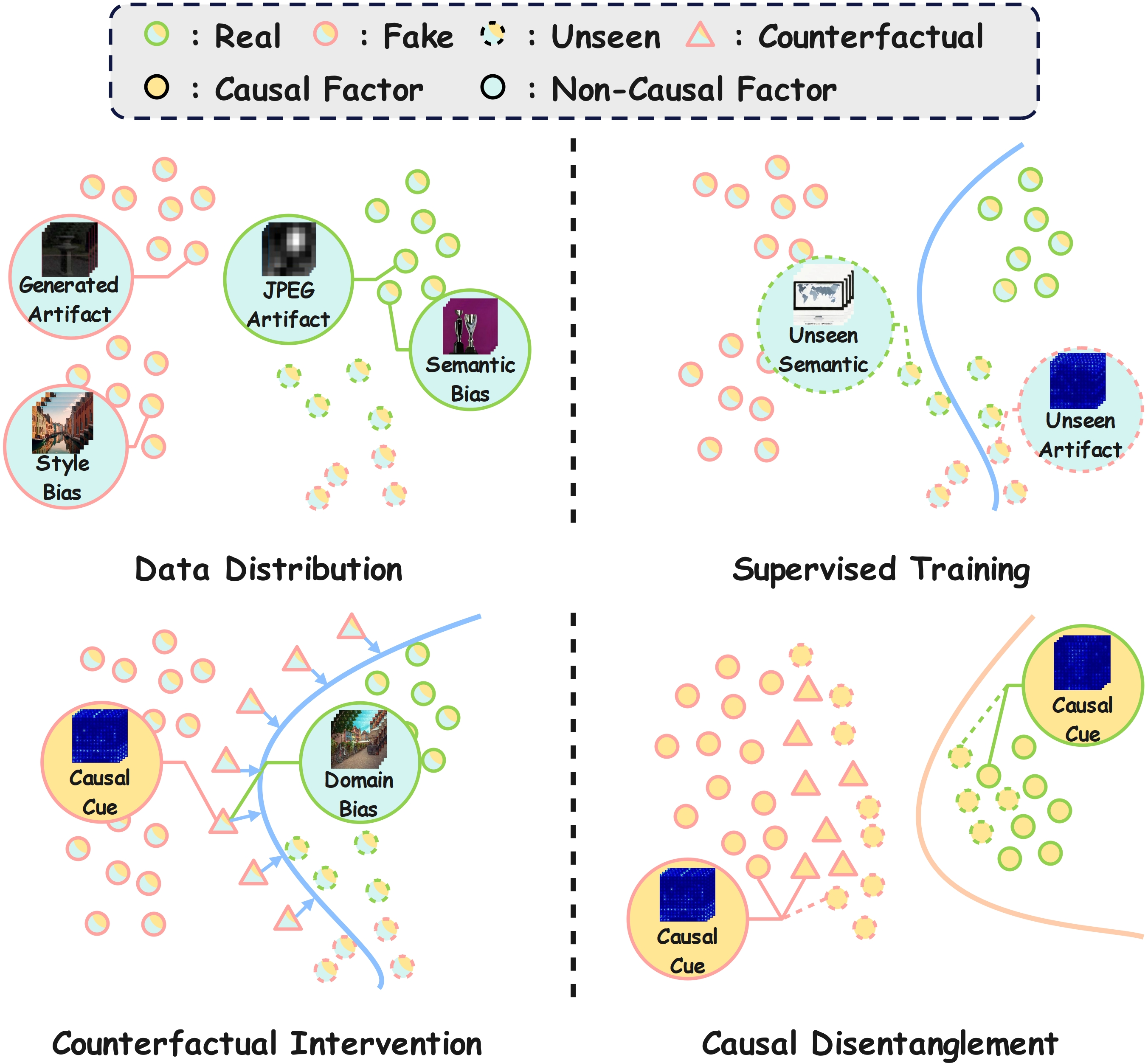
A major reason for this generalization failure is shortcut learning [22]. When trained on limited source domains, detectors tend to exploit domain-specific spurious correlations, such as generator-dependent fingerprints, compression patterns, and generation styles, rather than the intrinsic forgery traces shared across different generators. As illustrated in the left of Fig. 1, the learned representations entangle causal forgery cues with non-causal domain biases, so that the resulting decision boundary fits well on seen generators but quickly deteriorates once these non-causal correlations no longer hold under distribution shift [23], [24]. Although recent efforts attempt to mitigate this issue through data augmentation strategies [25], [26] or common feature mining, they largely rely on heuristic designs and lack a principled mechanism to separate task-relevant evidence from domain-specific bias. In this sense, the core challenge is not only to build a stronger classifier, but to align the learned evidence with generator-intrinsic traces instead of source-specific shortcuts.
To address this challenge, we revisit AI-generated video detection from a causal perspective and propose G2VD, a Generalizable AI-Generated Video Detection framework built upon counterfactual intervention and causal disentanglement. We formulate the task under a structural causal model (SCM) [27], which treats generator-intrinsic traces that support authenticity prediction as causal factors and domain-specific cues that merely correlate with labels as non-causal factors. Under this formulation, reliable cross-generator generalization requires the detector to rely on the former while remaining invariant to the latter [28], [29]. Guided by this view, G2VD first constructs counterfactual samples through a counterfactual intervention pipeline (CFIPipeline) based on VAE reconstruction, frequency-domain alignment, and pixel-domain alignment. It then employs a causal disentanglement classifier with two domain-anchored branches and an HSIC-based independence constraint [30] to encourage the separation of causal and non-causal representations.
Our main contributions are summarized as follows:
By rethinking AI-generated video detection from a causal representation learning perspective, we attribute cross-generator generalization failure to the entanglement between causal forgery cues and non-causal domain biases.
We propose G2VD, a generalizable AI-generated video detection framework. By integrating counterfactual intervention and domain-anchored causal disentanglement, G2VD reduces shortcut learning and learns more transferable forgery cues.
Extensive experiments on four public datasets demonstrate that G2VD achieves superior cross-domain generalization over existing methods with limited training data, while validating the effectiveness of the proposed components.
2 Related Work↩︎
2.1 AI-Generated Video Detection↩︎
Early studies on AI-generated video detection mainly focused on facial forgeries arising from face swapping and reenactment. Building upon FaceForensics++ [8], prior work has explored blending boundaries [10], multi-attentional cues [9], reconstruction discrepancies [11], frequency-aware clues [31], up-sampling fingerprints [32], lip-sync inconsistencies [33], and temporal incoherence [12], [13]. Other detectors address multi-identity scenarios [34], thumbnail-based temporal layouts [35], or spatial-temporal decoupling [36], [37]. However, these methods are mainly designed for face manipulation and do not naturally generalize to arbitrary content generated by modern video generation models.
The emergence of powerful generators such as Sora [1], Stable Video Diffusion [2], and CogVideoX [3] extends the detection task beyond facial manipulation. A common paradigm fine-tunes strong video backbones, such as TimeSformer [14], VideoMAE [15], ViViT [16], and XCLIP [17], for binary authenticity classification. DeCoF [18], Bai et al. [19], and D3 [38] further model frame consistency, spatio-temporal anomalies, or second-order temporal features. At a larger scale, DeMamba and GenVidBench introduce million-scale and cross-generator benchmarks that expose the limited generalization of existing detectors [7], [20]. Recent MLLM-based detectors also provide explanatory reasoning [21], but their conclusions still depend heavily on explicit criteria such as motion, lighting, texture, and physical plausibility. Motivated by this observation, our work remains within the foundation-model paradigm and aims to extract deeper generator-intrinsic cues rather than rely on enumerated surface heuristics.
2.2 Causal Representation Learning↩︎
Causal representation learning aims to identify high-level causal factors and exploit them as stable predictors under distribution shifts [28]. The SCM and do-calculus [27] provide a formal basis for interventions and counterfactual reasoning. Building on this view, invariant risk minimization [39] learns predictors that remain optimal across environments, while CIRL [29] simulates interventions on factorized feature dimensions. Causal and counterfactual reasoning have also been used to reduce contextual or language bias in visual tasks [40], [41]. Despite these advances, causal formulations remain underexplored in AI-generated video detection, where causal factors correspond to generator-intrinsic traces embedded in the synthesis process and thus require a task-specific operationalization. We therefore formulate the task under an SCM framework and instantiate causal factor isolation through explicit counterfactual intervention, which in turn calls for an effective mechanism to disentangle the resulting representations.
2.3 Feature Disentanglement↩︎
Feature disentanglement decomposes entangled representations into complementary subspaces so that task-relevant signals are not dominated by task-irrelevant variations [42]. Common strategies encourage the separation between target-related and nuisance components through adversarial objectives [43], mutual-information regularization [44], or independence criteria such as HSIC [30]. In forgery detection, UCF [23] separates manipulation-common and manipulation-specific components, while LSDA [24] uses latent-space augmentation to transcend forgery specificity. These methods are effective but largely rely on empirical priors such as style versus content or specific versus common. By contrast, our framework aligns the disentanglement objective with the causal/non-causal axis motivated by the SCM, using a dual-branch classifier and an HSIC-based independence constraint.
3 Method↩︎
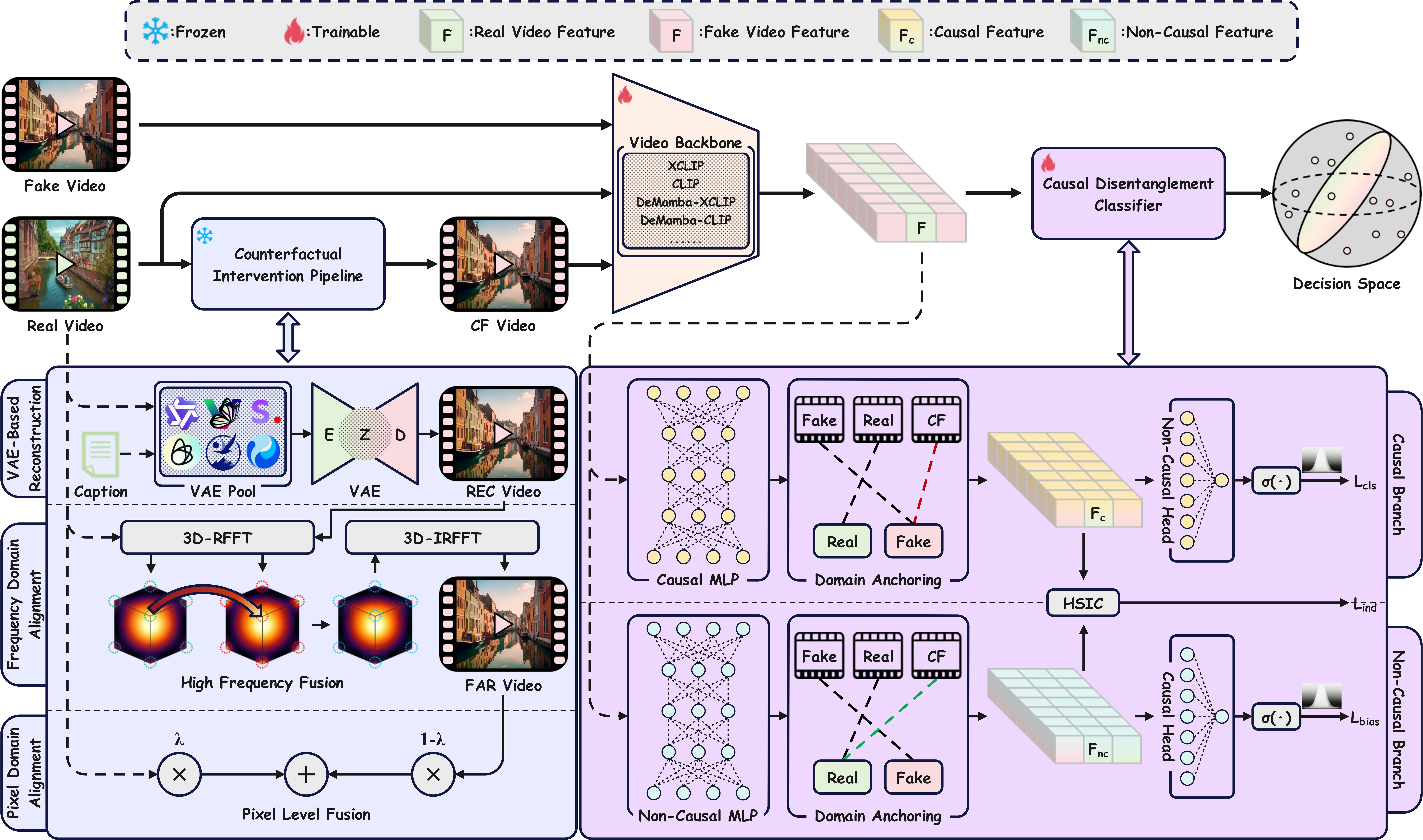
To improve cross-domain generalization, G2VD integrates counterfactual intervention with causal disentanglement learning. As shown in Fig. 2, it contains three modules: the CFIPipeline, a video backbone, and a causal disentanglement classifier. The CFIPipeline constructs counterfactual samples via VAE-based reconstruction with frequency-domain and pixel-domain alignment, weakening the correlation between non-causal factors and labels. The backbone extracts video-level representations from original and counterfactual inputs, and the classifier uses two domain-anchored branches and an HSIC-based independence constraint to assign causal and non-causal evidence to different subspaces.
3.1 AI-Generated Video Detection from the Causal View↩︎
Inspired by prior causality-based formulations for domain generalization [29], we describe our task using the following SCM: \[\left\{ \begin{align} X &:= f(S, U, V_1), \quad S \perp\!\!\!\perp U \perp\!\!\!\perp V_1, \\ Y &:= h(S, V_2) = h(g(X), V_2), \quad V_1 \perp\!\!\!\perp V_2, \end{align} \right.\] where \(X\) and \(Y\) denote the input video and label. \(S\) represents causal factors that influence both \(X\) and \(Y\), such as stable forensic patterns introduced by generation, whereas \(U\) denotes non-causal factors that affect only \(X\), such as semantic bias, source bias, or generation style. \(V_1\) and \(V_2\) are independent noise terms, and \(f\), \(g\), and \(h\) correspond to generation, feature extraction, and classification. Thus, for any distribution \(P(X, Y) \in \mathcal{P}\), given \(S\), there exists a common conditional distribution \(P(Y \mid S)\) that reflects a stable causal mechanism. If \(S\) can be reasonably approximated, optimizing \(h\) allows the model to capture task-relevant evidence beyond the i.i.d.assumption.
In practice, limited training data introduces source and semantic biases that encourage shortcut learning, where the detector relies on domain-specific representations instead of intrinsic causal cues. We abstract real and fake videos as \[\begin{cases} X_r := f(S_r, U_r), & \text{Real}, \\ X_f := f(S_f, U_f), & \text{Fake}, \end{cases}\] where noise variables are omitted for simplicity. Features associated with \(U_r\) and \(U_f\) can be salient in the training domain and may yield confident predictions, but they usually exhibit poor transferability. G2VD therefore aims to learn representations related to the causal factors \(S\) while reducing the influence of non-causal factors \(U\).
3.2 Counterfactual Intervention Pipeline↩︎
CFIPipeline constructs counterfactual samples \(X_{cf}\) by reconstructing \(X_r\) with video VAEs to introduce generator-like reconstruction traces, while aligning the result with \(X_r\) in frequency and pixel spaces to retain non-causal factors \(U_r\) as much as possible. This creates a controlled intervention where task-relevant traces and source-related factors are deliberately recombined. The resulting training data are formulated as \[\begin{cases} X_r := f(S_r, U_r), & \text{Real}, \\ X_f := f(S_f, U_f), & \text{Fake}, \\ X_{cf} := f(S_f, U_r), & \text{Fake}, \end{cases} \label{eq:3}\tag{1}\] where \(X_{cf}\) is labeled as fake because it contains generator-like reconstruction traces while approximately preserving the non-causal factors of real samples. Since non-causal features associated with \(U_r\) and \(U_f\) are no longer consistently tied to labels, the detector is encouraged to focus on task-relevant factors \(S_r\) and \(S_f\). CFIPipeline contains three stages: VAE-based reconstruction, frequency-domain alignment, and pixel-domain alignment.
3.2.1 VAE-based Reconstruction↩︎
Modern video generation pipelines commonly use VAEs to encode videos into a latent space and decode them back. This reconstruction can introduce synthesis-related traces beyond specific scene categories. Accordingly, CFIPipeline first reconstructs the real video \(X_r\) through a VAE as \[X_{rec} = \mathcal{D}(\mathcal{E}(X_r, t)),\] where \(\mathcal{E}(\cdot)\) and \(\mathcal{D}(\cdot)\) denote the VAE encoder and decoder, respectively, and \(t\) is an optional text condition for conditional VAEs.
To avoid overfitting to one reconstruction bias, we build a VAE pool from different video generation frameworks and randomly sample one VAE for each training batch, exposing the detector to diverse reconstruction traces and reducing reliance on a single generator-specific shortcut.
3.2.2 Frequency-Domain Alignment↩︎
Real and fake videos usually exhibit attenuated high-frequency components due to standard compression codecs (e.g., H.264), whereas \(X_{rec}\) is relatively uncompressed, causing frequency-domain mismatch [26]. We therefore align \(X_{rec}\) with \(X_r\) so that compression discrepancy is less likely to dominate the learned evidence.
To align the high-frequency components while preserving the structural patterns introduced by reconstruction, we perform an amplitude-only intervention in the frequency domain based on the real-valued Fast Fourier Transform (RFFT): \[\mathbf{\mathcal{F}}_{r} = \mathrm{RFFT}(X_{r}), \quad \mathbf{\mathcal{F}}_{rec} = \mathrm{RFFT}(X_{rec}),\] where \(\mathbf{\mathcal{F}}_{r}\) and \(\mathbf{\mathcal{F}}_{rec}\) denote the frequency-domain representations of \(X_{r}\) and \(X_{rec}\), respectively.
We adopt amplitude-only modification because the phase spectrum encodes spatial structure, whereas real-world compression mainly affects the magnitude distribution of high-frequency components. The frequency representations are decomposed as \[A_{r} = |\mathcal{F}_{r}|, \quad A_{rec} = |\mathcal{F}_{rec}|, \quad \Phi_{rec} = \angle \mathcal{F}_{rec},\] where \(A_{r}\) and \(A_{rec}\) denote the amplitude spectra of \(\mathcal{F}_{r}\) and \(\mathcal{F}_{rec}\), respectively, and \(\Phi_{rec}\) denotes the phase spectrum of \(\mathcal{F}_{rec}\).
Next, a high-pass mask \(M_{high}\) is applied to fuse the high-frequency components of the amplitude spectra: \[A_{fused} = M_{high} \odot A_{r} + (1 - M_{high}) \odot A_{rec}.\] Here \(M_{high}\) selects the high-frequency region most affected by compression, so the aligned reconstruction inherits realistic attenuation from \(X_r\) while preserving reconstruction-induced traces from \(X_{rec}\).
Finally, the fused amplitude \(A_{fused}\) is recombined with the preserved phase spectrum and transformed back to the spatial domain, yielding the frequency-aligned reconstruction \(X_{far}\): \[X_{far} = \mathrm{IRFFT}\left(A_{fused} \odot e^{i \Phi_{rec}}\right).\]
3.2.3 Pixel-Domain Alignment↩︎
To mitigate residual appearance discrepancies after frequency alignment, such as color shifts or brightness deviations, we further introduce pixel-level fusion.
Thus, the final counterfactual sample \(X_{cf}\) is obtained through linear interpolation: \[X_{cf} = \lambda X_{r} + (1-\lambda)X_{far},\] where \(X_{far}\) denotes the frequency-aligned reconstruction and \(\lambda \in [0,1]\) controls the intervention strength. This operation injects realistic low-level statistics from \(X_r\) while preserving reconstructed structural patterns in \(X_{far}\), making \(X_{cf}\) visually coherent.
3.3 Causal Disentanglement Classifier↩︎
Counterfactual samples provide causal supervision, but extracted features may still remain entangled. We therefore introduce a causal disentanglement classifier with two domain-anchored branches assigned distinct classification objectives, together with an HSIC constraint to reduce their dependence. The branch objectives define the semantic role of each subspace, while HSIC discourages residual information sharing.
3.3.1 Causal Branch↩︎
The causal branch consists of a lightweight MLP followed by a linear classification head. Given the video-level feature \(F\) extracted by the backbone, the causal MLP projects it into the causal representation \(F_c\): \[F_c = \mathrm{MLP}_c(F).\]
Domain anchoring follows (1 ): \(X_r\) is assigned to the real class (\(Y=0\)), while \(X_f\) and \(X_{cf}\) are assigned to the fake class (\(Y=1\)). Thus, samples sharing forgery semantics have the same label despite different non-causal appearances. The causal branch is optimized by the BCE loss: \[\begin{align} \mathcal{L}_{cls} = - \big[ & Y \log\big(\sigma(h_c(F_c))\big) \\ & + (1-Y)\log\big(1-\sigma(h_c(F_c))\big) \big], \end{align}\] where \(h_c(\cdot)\) denotes the causal classification head, \(\sigma(\cdot)\) denotes the sigmoid activation function, and \(Y \in \{0,1\}\) is the ground-truth label.
Since \(X_f\) and \(X_{cf}\) share causal factors but differ in non-causal factors, minimizing \(\mathcal{L}_{cls}\) discourages shortcut reliance and drives the branch toward task-relevant representations.
3.3.2 Non-Causal Branch↩︎
The non-causal branch captures domain-specific bias information, such as semantic or style-related cues that help in-domain fitting but fail under domain shift. Its representation is defined as \[F_{nc} = \mathrm{MLP}_{nc}(F).\]
The key distinction of the non-causal branch lies in its domain-anchoring scheme, which defines a classification objective different from that of the causal branch: \[\begin{cases} X_r := f(S_r, U_r), & \text{Real}, \\ X_f := f(S_f, U_f), & \text{Fake}, \\ X_{cf} := f(S_f, U_r), & \text{Real}. \end{cases} \label{eq:13}\tag{2}\] Here \(X_{cf}\) is assigned to the real class, in contrast to its fake label in the causal branch. Samples sharing non-causal factors are therefore anchored to the same label regardless of their causal differences, and the branch is optimized by \[\begin{align} \mathcal{L}_{bias} = - \big[ & Y' \log\big(\sigma(h_{nc}(F_{nc}))\big) \\ & + (1-Y')\log\big(1-\sigma(h_{nc}(F_{nc}))\big) \big], \end{align}\] where \(h_{nc}(\cdot)\) denotes the classification head of the non-causal branch, and \(Y' \in \{0,1\}\) is the label defined by the above domain-anchoring rule.
Because \(X_r\) and \(X_{cf}\) share non-causal factors but differ in causal factors, minimizing \(\mathcal{L}_{bias}\) encourages this branch to absorb domain-specific bias information. This complementary objective makes the separation between the two branches more controllable.
3.4 Objective Function↩︎
To reduce shared information between \(F_c\) and \(F_{nc}\), we introduce HSIC [30] as an independence loss: \[\mathcal{L}_{ind} = \mathrm{HSIC}(F_c, F_{nc}).\] HSIC is a kernel-based dependence measure that captures nonlinear dependence between mini-batch representations without an adversarial discriminator. Minimizing \(\mathcal{L}_{ind}\) therefore discourages the two branches from encoding overlapping information.
The overall objective of G2VD is formulated as a linearly weighted combination of all loss terms: \[\mathcal{L}_{total} = w_{cls} \mathcal{L}_{cls} + w_{bias} \mathcal{L}_{bias} + w_{ind} \mathcal{L}_{ind},\] where \(w_{cls}\), \(w_{bias}\), and \(w_{ind}\) are loss weights. The classification losses assign distinct semantic roles to the two branches: \(\mathcal{L}_{cls}\) anchors the causal branch to task-relevant forgery cues, whereas \(\mathcal{L}_{bias}\) anchors the non-causal branch to domain-specific bias information. Meanwhile, \(\mathcal{L}_{ind}\) suppresses residual shared information that cannot be removed by classification objectives alone. Through joint optimization, the detector progressively separates causal and non-causal representations, improving cross-domain generalization.
4 Experiments↩︎
This section describes the experimental protocol and then evaluates G2VD through cross-domain comparison, ablation studies, robustness evaluation, and feature separability analysis.
| Method | HD-VG | CogVideo | Mora | MuseV | SVD | Avg. ACC | AUC | AP | F1 |
|---|---|---|---|---|---|---|---|---|---|
| F3Net [31] | |||||||||
| FTCN [12] | |||||||||
| MINTIME [34] | |||||||||
| NPR [32] | |||||||||
| STIL [13] | |||||||||
| TALL [35] | |||||||||
| TimeSformer [14] | |||||||||
| VideoMAE [15] | |||||||||
| ViViT [16] | |||||||||
| CLIP [45] | |||||||||
| XCLIP [17] | |||||||||
| DeMamba-CLIP [20] | |||||||||
| DeMamba-XCLIP [20] | |||||||||
| G2VD-CLIP | |||||||||
| G2VD-XCLIP | |||||||||
| G2VD-DeMamba-CLIP | |||||||||
| G2VD-DeMamba-XCLIP |
1.8pt
| Method | Gen2 | HotShot | Lavie | ModelScope | MoonValley | MorphStudio | Show1 | Sora | VC1 | WildScrape | Avg. ACC |
|---|---|---|---|---|---|---|---|---|---|---|---|
| F3Net [31] | |||||||||||
| FTCN [12] | |||||||||||
| MINTIME [34] | |||||||||||
| NPR [32] | |||||||||||
| STIL [13] | |||||||||||
| TALL [35] | |||||||||||
| TimeSformer [14] | |||||||||||
| VideoMAE [15] | |||||||||||
| ViViT [16] | |||||||||||
| CLIP [45] | |||||||||||
| XCLIP [17] | |||||||||||
| DeMamba-CLIP [20] | |||||||||||
| DeMamba-XCLIP [20] | |||||||||||
| G2VD-CLIP | |||||||||||
| G2VD-XCLIP | |||||||||||
| G2VD-DeMamba-CLIP | |||||||||||
| G2VD-DeMamba-XCLIP |
1.3pt
4.1 Experimental Setting↩︎
4.1.1 Datasets↩︎
To comprehensively evaluate cross-domain generalization, we conduct experiments on four publicly available datasets: GenVidBench [7], GenVideo [20], GVD [19], and GVF [18].
GenVidBench contains two evaluation pairs. Pair1 consists of 20,131 real videos from Vript, along with 13,500 generated videos from each of four text-to-video (T2V) generators, namely Pika, VideoCrafter2, ModelScope, and T2V-Zero. Pair2 consists of 13,800 real videos from HD-VG-130M, together with 13,800 generated videos from each of two T2V models, Mora and CogVideo, as well as two image-to-video (I2V) models, MuseV and SVD.
For GenVideo, we evaluate on its validation split, which contains 8,588 fake videos produced by a diverse set of T2V models, including ModelScope, MorphStudio, MoonValley, HotShot, Show1, Lavie, and Sora, while the WildScrape subset consists of videos collected from external online sources.
GVD is a multi-generator benchmark containing 11,618 videos from 11 generation models. Its T2V subset covers MoonValley, VideoCrafter1, Pika, NeverEnds, Emu, VideoPoet, HotShot, and Sora, while the I2V subset includes MoonValley, Pika, and NeverEnds. The diversity of generators and generation modes makes GVD well suited for evaluating heterogeneous synthesis pipelines.
GVF provides 964 prompt-aligned real-fake pairs for each of 9 T2V generators. These generators include four open-source models, namely T2V-Zero, ModelScope, ZeroScope, and Show1, as well as five commercial models, namely Pika, Gen2, Sora, Veo, and Kling. Its prompt-aligned construction provides a controlled setting for assessing whether detectors rely on generation artifacts rather than semantic discrepancies.
Notably, the generated videos in Pair2 of GenVidBench are synthesized from text prompts derived from corresponding real videos or generated under the I2V setting using sampled real frames. The high semantic and spatio-temporal similarity between real and fake videos, especially for MuseV and SVD, makes Pair2 challenging.
4.1.2 Evaluation Metrics↩︎
We report Mean Top-1 Accuracy (ACC), AUC, AP, and F1; for GenVideo, GVD, and GVF, we summarize the released evaluation splits by source-level and dataset-level ACC.
4.1.3 Baselines↩︎
We compare G2VD with 12 baselines from two groups: pretrained video backbones fine-tuned for binary authenticity classification, including TimeSformer [14], ViViT [16], VideoMAE [15], CLIP [45], XCLIP [17], and DeMamba [20]; and representative forgery detectors, including F3Net [31], NPR [32], STIL [13], MINTIME [34], FTCN [12], and TALL [35]. To examine whether the proposed design is backbone agnostic, G2VD is instantiated with CLIP, XCLIP, and DeMamba under matched training settings.
4.1.4 Implementation Details↩︎
The CFIPipeline uses a pool of 14 video VAEs, including 10 lightweight TAE variants [46] associated with representative video generators [2]–[5], [47], [48] and 4 pretrained VideoVAE+ variants [49]. All experiments are implemented in PyTorch on 4 NVIDIA A800 GPUs (80 GB). For each video, a continuous 2-second clip is randomly sampled and downsampled to 8 frames (16 for VideoMAE and 32 for ViViT), with all frames resized to \(224 \times 224\). We randomly sample 10% of Pair1 in GenVidBench for training, use a held-out subset for validation, and test on Pair2 and the remaining datasets. During training, the frozen CFIPipeline generates counterfactual samples online, while the backbone and classifier are jointly fine-tuned. All formal experiments are conducted with four random seeds, i.e., 40, 41, 42, and 43.
4.2 Experimental Results↩︎
| Method | Emu | HotShot | MV-I2V | MV-T2V | NE-I2V | NE-T2V | Pika-I2V | Pika-T2V | Sora | VC1 | VideoPoet | Avg. ACC |
|---|---|---|---|---|---|---|---|---|---|---|---|---|
| F3Net [31] | ||||||||||||
| FTCN [12] | ||||||||||||
| MINTIME [34] | ||||||||||||
| NPR [32] | ||||||||||||
| STIL [13] | ||||||||||||
| TALL [35] | ||||||||||||
| TimeSformer [14] | ||||||||||||
| VideoMAE [15] | ||||||||||||
| ViViT [16] | ||||||||||||
| CLIP [45] | ||||||||||||
| XCLIP [17] | ||||||||||||
| DeMamba-CLIP [20] | ||||||||||||
| DeMamba-XCLIP [20] | ||||||||||||
| G2VD-CLIP | ||||||||||||
| G2VD-XCLIP | ||||||||||||
| G2VD-DeMamba-CLIP | ||||||||||||
| G2VD-DeMamba-XCLIP |
1.1pt
| Method | Gen2 | Kling | ModelScope | Pika | Show1 | Sora | T2V-Zero | Veo | ZeroScope | Avg. ACC |
|---|---|---|---|---|---|---|---|---|---|---|
| F3Net [31] | ||||||||||
| FTCN [12] | ||||||||||
| MINTIME [34] | ||||||||||
| NPR [32] | ||||||||||
| STIL [13] | ||||||||||
| TALL [35] | ||||||||||
| TimeSformer [14] | ||||||||||
| VideoMAE [15] | ||||||||||
| ViViT [16] | ||||||||||
| CLIP [45] | ||||||||||
| XCLIP [17] | ||||||||||
| DeMamba-CLIP [20] | ||||||||||
| DeMamba-XCLIP [20] | ||||||||||
| G2VD-CLIP | ||||||||||
| G2VD-XCLIP | ||||||||||
| G2VD-DeMamba-CLIP | ||||||||||
| G2VD-DeMamba-XCLIP |
1.4pt
Tables 1–4 report the main cross-domain evaluation results at both the generation-source and dataset levels. Unless otherwise specified, all values are reported as mean \(\pm\) standard deviation over multiple seeds. The best and second-best results in each column are highlighted in bold and underline, respectively.
1) Cross-domain evaluation results on GenVidBench: As shown in Table 1, G2VD achieves the best performance on the challenging GenVidBench setting, where real and generated videos are highly similar in content and spatio-temporal structure. G2VD-CLIP obtains the best mean accuracy of 91.92%, with 0.9495 AUC, 0.9824 AP, and 0.9496 F1. Compared with the best non-G2VD method, NPR, G2VD-CLIP improves mean accuracy by 15.70 pp. It also gains 0.1046 AUC and 0.0874 F1 over the strongest non-G2VD scores. The other G2VD variants remain strong as well, reaching 89.31%–91.64% mean accuracy. Several baselines also skew toward one side of the decision space. For example, NPR performs well on several generated sources but obtains only 9.01% accuracy on the real HD-VG subset. Since the GenVidBench Pair1 training split contains substantially more fake than real videos, this imbalance can naturally amplify a bias toward the generated class. This pattern indicates that G2VD mitigates such one-sided predictions and achieves stronger overall discrimination, although improving real-video calibration remains important.
2) Cross-domain evaluation results on GenVideo: Table 2 reports the results on GenVideo, which contains AI-generated videos from diverse generators. G2VD-DeMamba-CLIP achieves the best mean accuracy of 97.55%, outperforming the best non-G2VD baseline, NPR, by 1.43 pp. Relative to matched backbones, G2VD improves CLIP from 93.58% to 96.72%, XCLIP from 93.30% to 96.39%, DeMamba-CLIP from 93.74% to 97.55%, and DeMamba-XCLIP from 92.96% to 96.71%. These gains indicate that the method helps different backbones in a similar way rather than depending on a single feature extractor. The source-level results also show clear gains on several challenging generators, such as HotShot, Lavie, Show1, and VC1, while NPR’s stronger scores on sources such as Sora and WildScrape are consistent with the source-level bias pattern already observed on GenVidBench.
3) Cross-domain evaluation results on GVD: The GVD results are summarized in Table 3. G2VD-DeMamba-CLIP achieves 97.91% mean accuracy and ranks second overall, while G2VD-DeMamba-XCLIP also reaches 97.19%. Relative to their backbone baselines, G2VD improves CLIP by 2.90 pp, XCLIP by 1.90 pp, DeMamba-CLIP by 1.80 pp, and DeMamba-XCLIP by 1.82 pp. NPR obtains the highest mean accuracy on GVD, but this result should be interpreted together with the class-bias behavior discussed above on GenVidBench. By contrast, G2VD remains competitive on GVD while achieving much stronger AUC and F1 on GenVidBench, which better reflects reliable cross-domain generalization.
4) Cross-domain evaluation results on GVF: Table 4 further evaluates generalization on GVF, which covers prompt-aligned videos from multiple generators. G2VD-DeMamba-CLIP achieves the best mean accuracy of 99.36%, and G2VD-CLIP ranks second with 98.95%. Relative to the best non-G2VD result, G2VD-DeMamba-CLIP improves mean accuracy by 0.66 pp. More importantly, the gains over matched backbones remain consistent: G2VD-CLIP improves CLIP by 3.47 pp, G2VD-XCLIP improves XCLIP by 4.52 pp, G2VD-DeMamba-CLIP improves DeMamba-CLIP by 4.13 pp, and G2VD-DeMamba-XCLIP improves DeMamba-XCLIP by 4.61 pp. The source-level results show that G2VD lifts the harder sources, such as Kling and Show1, while keeping near-saturated performance on easier ones.

Overall, the results across the four datasets demonstrate that G2VD not only achieves the strongest performance on the most challenging GenVidBench setting, but also provides consistent backbone-agnostic gains across diverse generators. To further summarize the source-level trend, Fig. 3 compares each backbone detector with its G2VD counterpart. The G2VD curves generally expand outward from the matched backbone curves, especially on the difficult sources in GenVidBench, GenVideo, and GVF, indicating that G2VD improves both dataset-level accuracy and source-level coverage.
4.3 Ablation Studies↩︎
To validate the contribution of each component, we compare three checkpoint-aligned variants: w/o CFI&CD, which removes both the CFIPipeline and causal disentanglement classifier; w/o CD, which keeps CFIPipeline but removes the causal disentanglement classifier; and the full G2VD. Table 5 shows that directly fine-tuning a backbone captures some generator-related artifacts on the three generated-video datasets, but remains insufficient for GenVidBench, where real and generated videos are highly similar. The w/o CFI&CD variant obtains only 61.42%–66.85% accuracy on GenVidBench across different backbones.
| Backbone | Variant | GVB | GenV | GVD | GVF |
|---|---|---|---|---|---|
| CLIP | w/o CFI & CD | ||||
| w/o CD | |||||
| G2VD | |||||
| XCLIP | w/o CFI & CD | ||||
| w/o CD | |||||
| G2VD | |||||
| DeMamba-CLIP | w/o CFI & CD | ||||
| w/o CD | |||||
| G2VD | |||||
| DeMamba-XCLIP | w/o CFI & CD | ||||
| w/o CD | |||||
| G2VD |
1.6pt
Introducing CFIPipeline brings the dominant improvement. Averaged over four backbones, w/o CD improves GenVidBench accuracy from 63.52% to 85.15% and raises the average accuracy on the other three datasets from 94.19% to 96.89%. This indicates that counterfactual intervention weakens generator-specific shortcut correlations and guides the detector toward more transferable forgery cues. The causal disentanglement classifier further improves the average GenVidBench accuracy to 90.62%, with consistent gains across all backbones; on the other datasets, the gain is smaller but remains positive in most cases. Overall, CFIPipeline supplies the main intervention effect, while the disentanglement classifier sharpens the boundary by separating task-relevant cues from domain-specific bias.
4.4 Experimental Analysis↩︎

4.4.1 Robustness Evaluation↩︎
To examine whether G2VD relies on fragile low-level artifacts, we evaluate its performance under Gaussian blur and JPEG compression on GenVidBench. For brevity, Fig. 4 shows the CLIP-based variants as a representative case. Stronger perturbations degrade all variants because useful forgery evidence may be removed, yet G2VD remains consistently stronger than the w/o CFI&CD and w/o CD variants. Starting from 91.92% under the ideal setting, G2VD decreases to 80.56% at \(\sigma=2.0\) and 62.94% at \(Q=60\), indicating relative robustness under blur but also revealing that severe JPEG compression remains a clear limitation.
4.4.2 Feature Separability Analysis↩︎
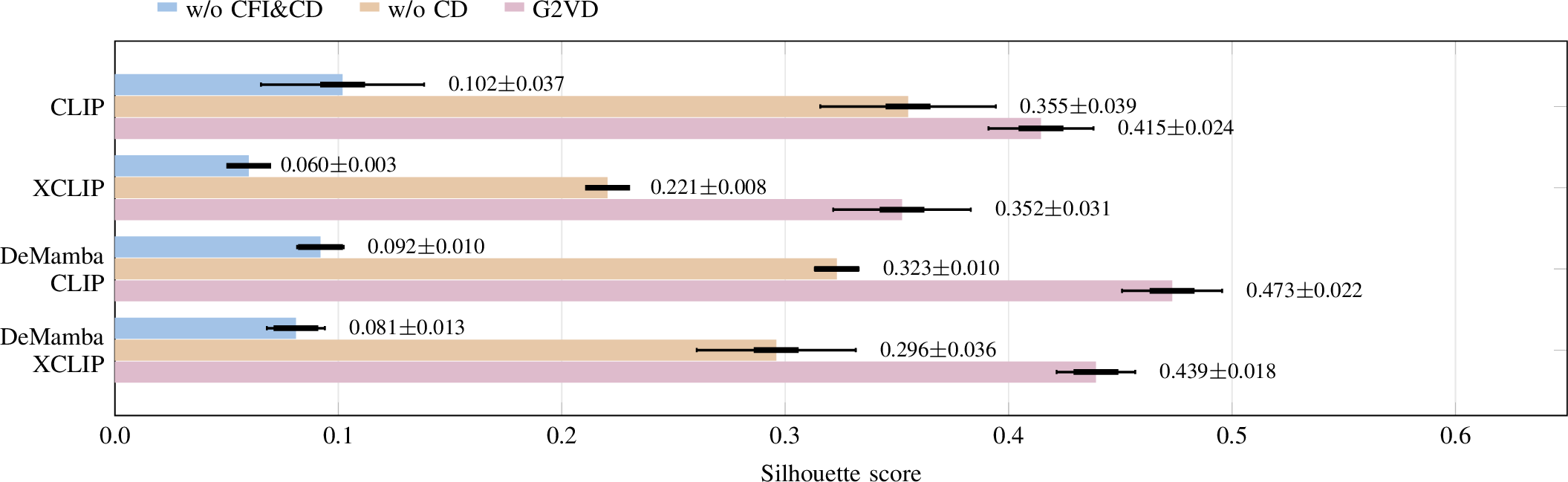
To quantitatively examine whether the learned representation becomes more discriminative, we compute the silhouette score [50] on GenVidBench before the final t-SNE projection. As shown in Fig. 5, the w/o CFI&CD variant yields weak separability across all backbones, with scores below 0.11. Introducing CFIPipeline substantially increases the scores to 0.221–0.355, showing that counterfactual intervention reshapes the representation space and makes real and generated videos easier to separate. The full G2VD further improves the scores over w/o CD for every backbone, reaching 0.415 for CLIP, 0.352 for XCLIP, 0.473 for DeMamba-CLIP, and 0.439 for DeMamba-XCLIP. The trend matches Table 5 and suggests that causal disentanglement induces a more structured, less shortcut-dependent feature space.
4.4.3 Feature Distribution Visualization↩︎
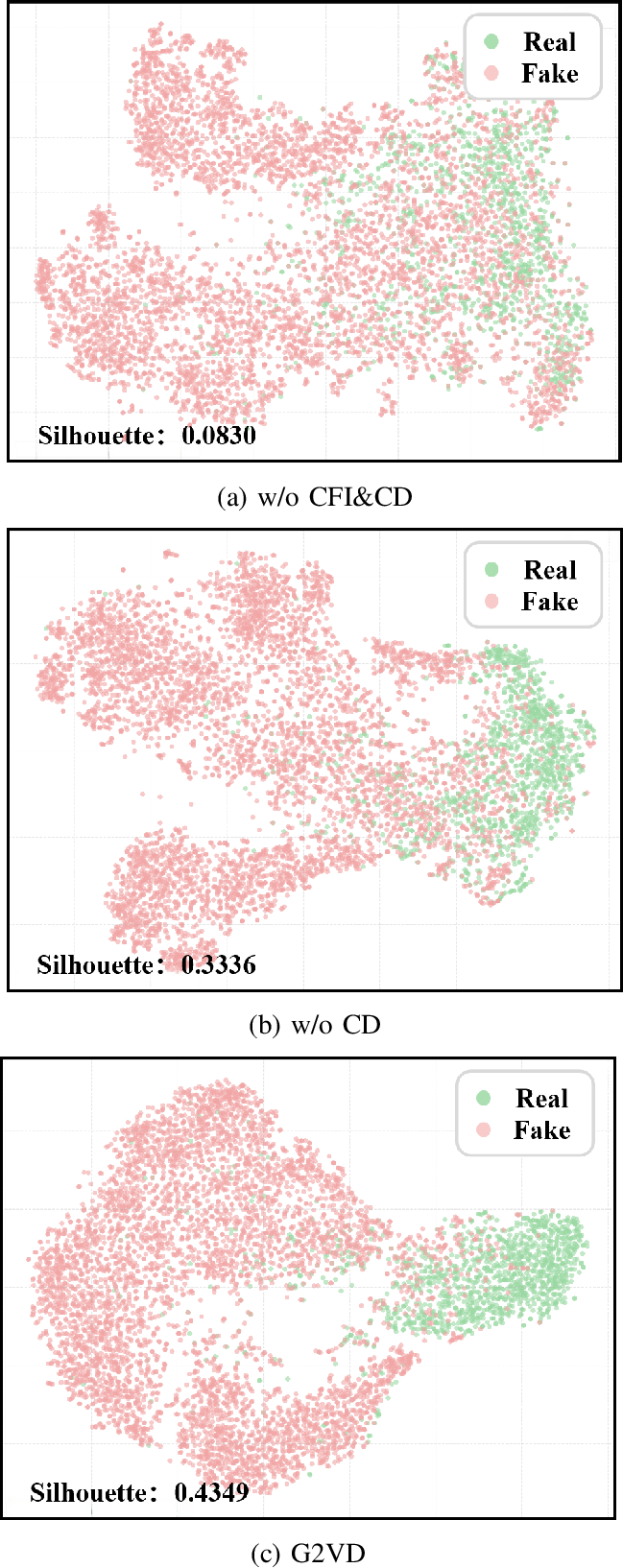
In addition to the quantitative separability score, feature distribution visualization provides an intuitive view of how the representation space evolves across variants. We apply standardized t-SNE to the same feature space and compare w/o CFI&CD, w/o CD, and G2VD under an identical sampling protocol. Fig. 6 shows representative CLIP-based t-SNE results from seed 42. The w/o CFI&CD variant exhibits substantial real-fake overlap, CFIPipeline produces more structured clusters, and the full G2VD yields clearer class separation. This qualitative trend is consistent with the multi-backbone silhouette scores in Fig. 5, supporting that G2VD learns a more separable and less domain-biased representation.
4.4.4 Limitation↩︎
Although G2VD improves cross-domain generalization, its resistance to strong post-processing perturbations remains limited, especially under heavy JPEG compression where subtle forensic traces can be severely distorted. In addition, the stronger sensitivity to generation-related cues may introduce false alarms in certain real videos, particularly when they contain compression artifacts, unusual motion patterns, or reconstruction-like noise that resembles AI-generated traces. These observations suggest that future work should further explore robustness-aware training, confidence calibration, and hard real-video mining to improve reliability in open-world deployment.
5 Conclusion↩︎
In this paper, we proposed G2VD, a generalizable AI-generated video detection framework that addresses cross-generator generalization from a causal perspective. G2VD constructs counterfactual samples through VAE-based intervention with frequency-domain and pixel-domain alignment, and further introduces a causal disentanglement classifier with two domain-anchored branches and an HSIC-based independence constraint to separate task-relevant forgery cues from non-causal domain information. Extensive experiments on four public datasets show that G2VD consistently improves cross-domain detection over existing baselines and matched backbone variants, achieving over 90% accuracy with an AUC approaching 0.95 on the challenging GenVidBench setting while using only 10% of the original training data. Ablation studies, robustness evaluation, separability analysis, and t-SNE visualization further verify the effectiveness of CFIPipeline and causal disentanglement in learning more transferable representations. While severe post-processing and false alarms on artifact-rich real videos remain open challenges, our results suggest that causal intervention and disentanglement provide a promising direction for robust AI-generated video detection. Future work will further improve perturbation robustness, calibration, and open-world reliability.
Acknowledgments↩︎
This work was supported by the Top Talent Cultivation Program of Henan Province under Grant 244500510012.
References↩︎
Meng Du, Hongchang Chen, Ran Li, Junjie Zhang, Qi Ouyang, and Shuxin Liu are with Information Engineering University, Zhengzhou 450003, China (e-mail: dm_csy@alumni.nudt.edu.cn; liushuxin11@126.com). *Corresponding author: Shuxin Liu.↩︎