CertMix: Certified, Data-Efficient Metamaterial Design by Affine Mixing of Aligned Neural-Implicit Weight Spaces
July 05, 2026
Abstract
Inverse design of mechanical metamaterials—finding a periodic unit cell whose homogenized elastic properties meet a prescribed target—is central to architected-material engineering, yet current learning-based methods are data-hungry, confined to interpolation, and provide no guarantee that the generated design meets specification. We introduce CertMix, a data-efficient framework that represents each exemplar unit cell as a small periodic neural implicit field (a SIREN signed-distance decoder) overfit from a shared anchor, so that the exemplar weight vectors become aligned and directly comparable. Our key observation is that, in this aligned weight space, the homogenized elasticity tensor is approximately linear in the mixing coefficients; consequently, designing a cell with target properties reduces to a small constrained affine mixing problem solved with a differentiable periodic homogenizer in the loop. Allowing negative coefficients enables extrapolation beyond the exemplar range, a linearity-mismatch trust region keeps blends valid, and a split-conformal calibration converts the mismatch signal into a distribution-free certificate on the achieved-property error. From as few as 50 exemplars, CertMix attains a scaled property error of \(10^{-4}\), roughly two to three orders of magnitude below conditional generative baselines trained on 1000 cells; it remains accurate far outside the exemplar range, is \(57\times\) faster than per-target topology optimization while avoiding checkerboards and enclosed voids, and extends to spatially graded fields, \(3\)D triply-periodic surfaces, and a certified running-shoe midsole application.
1 Introduction↩︎
A mechanical metamaterial derives its effective behaviour from the geometry of a periodic unit cell rather than its base chemistry: by patterning a solid into a lattice one can realize a target stiffness, a prescribed anisotropy, or a counter-intuitive negative Poisson’s ratio (auxetic response) [1]–[3]. The practical bottleneck is the inverse problem: given a desired homogenized elasticity tensor \(\mathbf{C}_{\!H}^{*}\), find a manufacturable unit-cell geometry that realizes it.
Two families of methods dominate. Topology optimization (TO) solves a PDE-constrained optimization per target [4]–[6], including the inverse-homogenization formulation that tailors a periodic cell to prescribed constitutive parameters [7]. TO is accurate but expensive (a full solve per target) and frequently returns checkerboards or enclosed voids that are not manufacturable without heavy filtering [8], [9]. Learned generative models—conditional VAEs, GANs, and diffusion models—amortize design across targets [10]–[13], but they typically require \(10^3\)–\(10^4\) simulated cells, are confined to the convex hull of their training distribution, and offer no guarantee that a generated cell meets its target once measured.
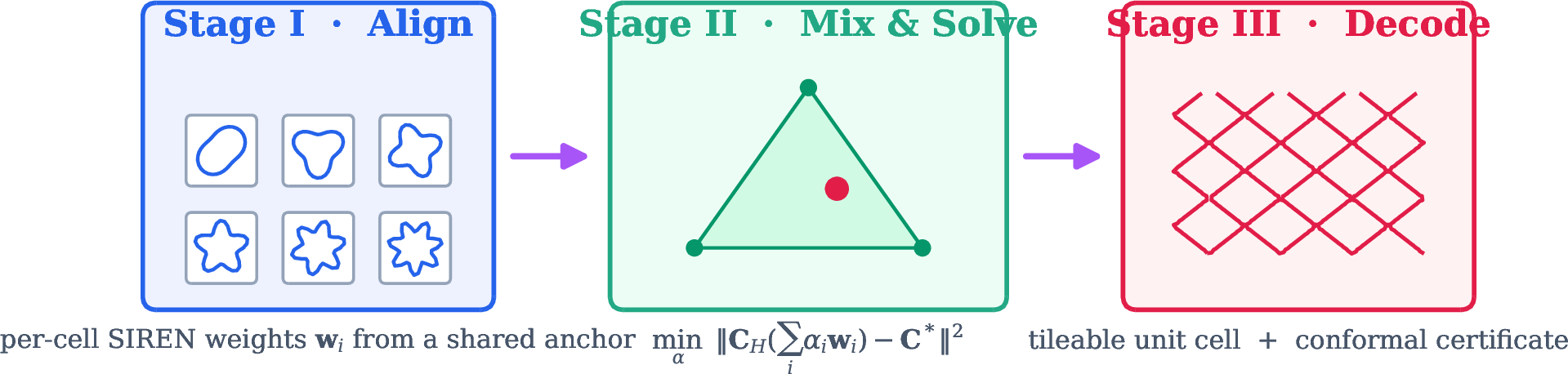
We take a different route inspired by recent weight-space shape models that control geometric parameters by mixing the weights of aligned neural implicit decoders [14], [15]. Our central scientific claim is that, once per-exemplar signed-distance decoders are aligned by overfitting from a shared anchor, the physical homogenized property is approximately linear in the weight-space mixing coefficients. This turns property-controlled design into a tiny constrained linear-blending problem that we solve with an exact, differentiable periodic homogenizer in the loop (Fig. 1).
1.0.0.1 Contributions.
We show empirically that PDE-homogenized elastic properties are approximately linear in the coefficients of an aligned neural-implicit weight space, and that a cheap linearity-mismatch signal predicts when a blend is trustworthy (Spearman \(0.855\); failure-flag AUC \(0.962\)).
We formulate property-controlled metamaterial design as a constrained affine mixing problem with a differentiable periodic homogenizer in the loop, giving exact self-adjoint gradients at no extra solve cost, and a two-stage (convex-then-affine) solver with a trust region for robust extrapolation.
We attach a split-conformal certificate to the achieved-property error, yielding a distribution-free coverage guarantee, and add exact manufacturability checks.
We extend the method to spatially graded mixing fields, to \(3\)D triply-periodic surfaces, and to a certified personalized running-shoe midsole, and report comprehensive comparisons against retrieval, cVAE, diffusion, learned weight regression, and per-target topology optimization.
2 Related Work↩︎
2.0.0.1 Neural implicit shape representations.
Coordinate networks that map a point to occupancy or signed distance [16], [17] represent geometry compactly and continuously. Periodic activations [18] and Fourier features [19] capture high-frequency detail; we use a period-lifted SIREN so that decoded cells tile seamlessly by construction. Surveys of neural fields [20] document their breadth.
2.0.0.2 Weight-space learning.
Treating a trained network’s weights as data underlies hypernetworks [21], functa [22], and architectures equivariant to the permutation symmetries of weight space [23]. Alignment from a shared initialization is what makes naive weight interpolation meaningful, echoing linear mode connectivity modulo permutation [24]. LAMP [14] and related work [15] mix aligned SDF weights to control geometric macro-parameters, validated by a learned surrogate. CertMix differs by controlling physical homogenized properties through an exact PDE solver in the loop, by adding spatially graded fields, and by replacing heuristic safety scores with a conformal certificate.
2.0.0.3 Inverse design of metamaterials.
Numerical homogenization [25] and inverse-homogenization TO [7] are the classical tools. Learned inverse designers include IH-GAN for cellular structures [10], generative truss-metamaterial models [11], and diffusion-based designers [12], [13]. These require large labeled datasets and interpolate; CertMix is data-efficient, extrapolates, and certifies.
2.0.0.4 Conformal prediction.
Split-conformal methods [26]–[28] provide finite-sample, distribution-free coverage. We use them to bound the achieved-property error, turning a heuristic validity signal into a guarantee.
3 Method↩︎
3.1 Aligned neural-implicit exemplars↩︎
Each exemplar unit cell \(k\) is represented by a periodic SIREN \(s_{\mathbf{w}}:[0,1]^2\!\to\!\mathbb{R}\) with weights \(\mathbf{w}\in\mathbb{R}^{D}\) that predicts a signed distance (solid where \(s<0\)). Periodicity is enforced by lifting the input coordinate before the first layer, \[\gamma(\mathbf{x}) = \bigl[\cos 2\pi x,\;\sin 2\pi x,\;\cos 2\pi y,\;\sin 2\pi y\bigr], \label{eq:lift}\tag{1}\] so that any decoded field tiles seamlessly—a property the graded-structure stage relies on. We overfit every exemplar from one shared anchor initialization \(\mathbf{w}^{0}\), optionally with a proximal pull \(\rho\|\mathbf{w}-\mathbf{w}^{0}\|_2^2\). This aligns the weight vectors \(\{\mathbf{w}_i\}_{i=1}^{N}\) so that they occupy a common, comparable region of weight space; without this alignment, weight interpolation is meaningless (Sec. Ablations confirms a \(400\times\) degradation).
3.2 Differentiable periodic homogenization↩︎
Given a weight vector \(\mathbf{w}\), we decode a signed-distance field on an \(N_H\times N_H\) grid, convert it to a smooth density by a differentiable Heaviside \[\rho(\mathbf{x}) = \sigma\!\bigl(-s_{\mathbf{w}}(\mathbf{x})/\beta\bigr), \qquad E_e = E_{\min} + (E_0-E_{\min})\,\rho_e, \label{eq:density}\tag{2}\] and compute the homogenized plane-stress elasticity tensor \(\mathbf{C}_{\!H}\in\mathbb{R}^{3\times3}\) by periodic homogenization using bilinear quadrilateral elements and the energy / mutual-energy formulation [25]. With periodic boundary conditions, the induced displacement fields \(\boldsymbol{\chi}^{(j)}\) for the three unit test strains solve \(K\boldsymbol{\chi}^{(j)} = f^{(j)}\), and \[C_{H,ij} = \sum_{e} E_e\, q^{(e)}_{ij}, \qquad q^{(e)}_{ij} = (\boldsymbol{u}^{0}_i - \boldsymbol{\chi}_i)_e^{\!\top} K_e^{0}\,(\boldsymbol{u}^{0}_j - \boldsymbol{\chi}_j)_e, \label{eq:CH}\tag{3}\] where \(K_e^{0}\) is the unit-modulus element stiffness and \(\boldsymbol{u}^{0}_j\) are the affine unit-strain modes. Because each element modulus enters \(K\) linearly, the sensitivity is self-adjoint and available in closed form, \[\frac{\partial C_{H,ij}}{\partial E_e} = q^{(e)}_{ij}, \label{eq:sens}\tag{4}\] requiring no additional linear solves. We wrap Eqs. 3 –4 as a custom autograd operator, making the map \(\mathbf{w}\mapsto\mathbf{C}_{\!H}\) end-to-end differentiable. Engineering constants follow from the compliance \(\mathbf{S}=\mathbf{C}_{\!H}^{-1}\): \(E_x = 1/S_{11}\), \(E_y = 1/S_{22}\), \(\nu_{xy} = -S_{12}/S_{11}\), and \(G = C_{H,33}\). A \(3\)D trilinear-hexahedral analog with an algebraic-multigrid solver handles triply-periodic surfaces.
3.3 Property-controlled affine mixing↩︎
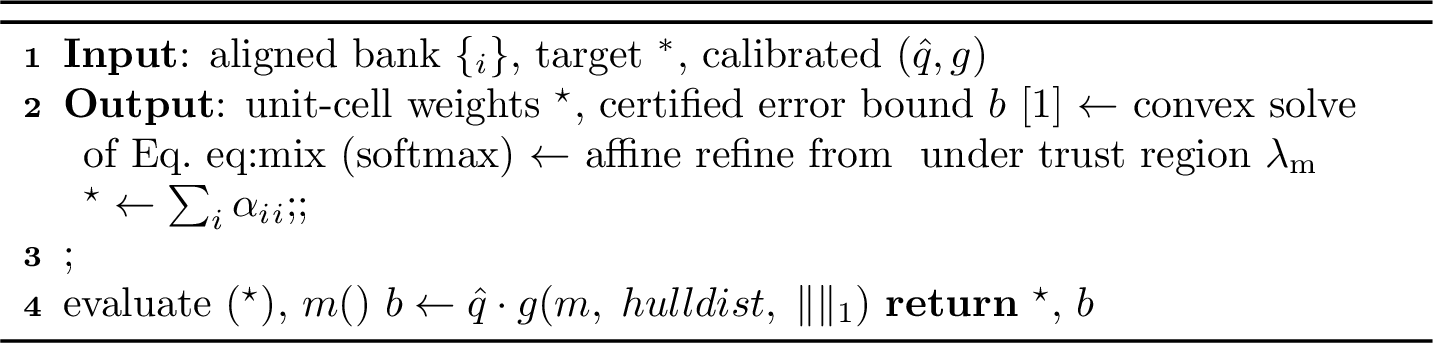
Let \(F(\boldsymbol{\alpha}) = \sum_{i=1}^{N}\alpha_i\,\mathbf{w}_i\) be the blended weight vector. Property-controlled design solves \[\begin{align} \min_{\boldsymbol{\alpha}}\quad & \bigl\| \mathbf{C}_{\!H}\!\bigl(F(\boldsymbol{\alpha})\bigr) - \mathbf{C}_{\!H}^{*} \bigr\|_{\mathrm{sc}}^{2} \;+\; \lambda_{\mathrm{m}}\,m(\boldsymbol{\alpha}) \;+\; \lambda_{1}\,\|\boldsymbol{\alpha}\|_{1} \\ \text{s.t.}\quad & \textstyle\sum_{i}\alpha_i = 1, \end{align} \label{eq:mix}\tag{5}\] where \(\|\cdot\|_{\mathrm{sc}}\) is a per-property standardized (scaled) \(L_2\) norm over the controlled entries of \(\mathbf{C}_{\!H}\). The affine constraint \(\sum_i\alpha_i=1\) keeps blends on the affine hull of the exemplars; permitting \(\alpha_i<0\) lets the design leave the convex hull, which is precisely what enables extrapolation. The linearity mismatch \[m(\boldsymbol{\alpha}) = \Bigl\| s_{F(\boldsymbol{\alpha})} - \textstyle\sum_i \alpha_i\, s_{\mathbf{w}_i} \Bigr\|_1 \label{eq:mismatch}\tag{6}\] measures how far the decoded field of the blended weights departs from the linear blend of the exemplar fields; it acts as a differentiable trust region keeping the solve inside the locally linear regime.
3.3.0.1 Two-stage solve.
We first solve a convex restriction with \(\boldsymbol{\alpha}=\mathrm{softmax}(\boldsymbol{z})\) (guaranteed feasible), then refine with a free affine parameterization initialized at the convex optimum under a strong mismatch penalty. Since the affine feasible set contains the convex one and we keep the better of the two, affine refinement can only improve on the convex solution. Optimization uses Adam [29]; each iteration performs one homogenization solve and uses the closed-form gradient of Eq. 4 .
3.4 Spatially graded mixing fields↩︎
Replacing the single coefficient vector by a smooth field \(\boldsymbol{\alpha}(\mathbf{x}) = \mathrm{softmax}\bigl(\mathrm{bilinear}(\mathbf{Z},\mathbf{x})\bigr)\) over macro-grid logits \(\mathbf{Z}\) yields functionally graded structures: each macro cell is homogenized with its centre coefficients to match a prescribed property field, and a smoothness penalty on \(\mathbf{Z}\) regularizes the field. Because every macro cell is decoded from the same aligned, periodic network, the implicit fields agree at shared boundaries, so the global structure is continuous by construction—interfaces are \(9\)–\(23\times\) smoother than tiling distinct cells.
3.5 Split-conformal property certificate↩︎
To turn validity into a guarantee we calibrate a split-conformal bound [27], [28]. On a calibration set we fit a log-linear scale model \(g(\cdot)\) of the achieved error from cheap features (mismatch, hull distance, \(\|\boldsymbol{\alpha}\|_1\)), form nonconformity scores \(r = \mathrm{err}/g\), and take the quantile \[\hat{q} = \mathrm{Quantile}_{\lceil (n+1)(1-\delta)\rceil / n}\bigl(\{r_i\}\bigr). \label{eq:conformal}\tag{7}\] At test time the certified error bound for a new design is \(\hat{q}\, g(\cdot)\), which holds with probability \(\ge 1-\delta\) under exchangeability.
4 Experiments↩︎
4.0.0.1 Setup.
Unless noted, the exemplar bank is procedurally generated from five \(2\)D periodic families (grid, cross-brace, perforated plate, honeycomb spanning conventional\(\leftrightarrow\)re-entrant/auxetic, and chiral), each decoded by a \(3\)-layer periodic SIREN. All methods—ours, generative baselines, and TO—are scored by the same exact homogenizer at in-loop resolution \(N_H=64\), verified for resolution independence at \(N_H=128\). The controlled property set is \(\{E_x,\nu_{xy}\}\) (all of \([E_x,E_y,\nu_{xy},G]\) reported); error is the per-property standardized \(L_2\) distance to target. Experiments run on a CPU-only laptop. The homogenizer passes five validation gates (analytic solid tensor to \(10^{-15}\); rank-1 laminate matching the Backus average to \(1.4\%\); auxetic honeycomb giving \(\nu_{xy}<0\); autograd vs.finite-difference agreement to \(<10^{-7}\); \(3\)D isotropy of a solid and gyroid).
4.1 Weight-space property linearity↩︎
Figure 3 plots the homogenized \(E_x\) along pairwise mixing paths. Inside the interpolation regime \(\alpha\in[0,1]\) the property tracks the exact linear reference closely (mean relative error \(0.041\)), and it bends only mildly outside it (\(0.108\)). Over \(400\) random blends, the linearity mismatch \(m(\boldsymbol{\alpha})\) ranks strongly with the true property error (Spearman \(0.855\)) and flags large-error blends with AUC \(0.962\)—comparable to the surrogate-based safety metric of [14] but grounded in the real PDE error rather than learned labels. This validates both the affine formulation and the mismatch trust region.
![Figure 3: Homogenized property along pairwise weight-mixing paths stays near the exact-linear reference inside [0,1] and bends gently outside. The mismatch signal predicts true error (Spearman 0.855, AUC 0.962).](/article/2607.04123/figures/fig_linearity.png "fig:")
4.2 Data efficiency↩︎
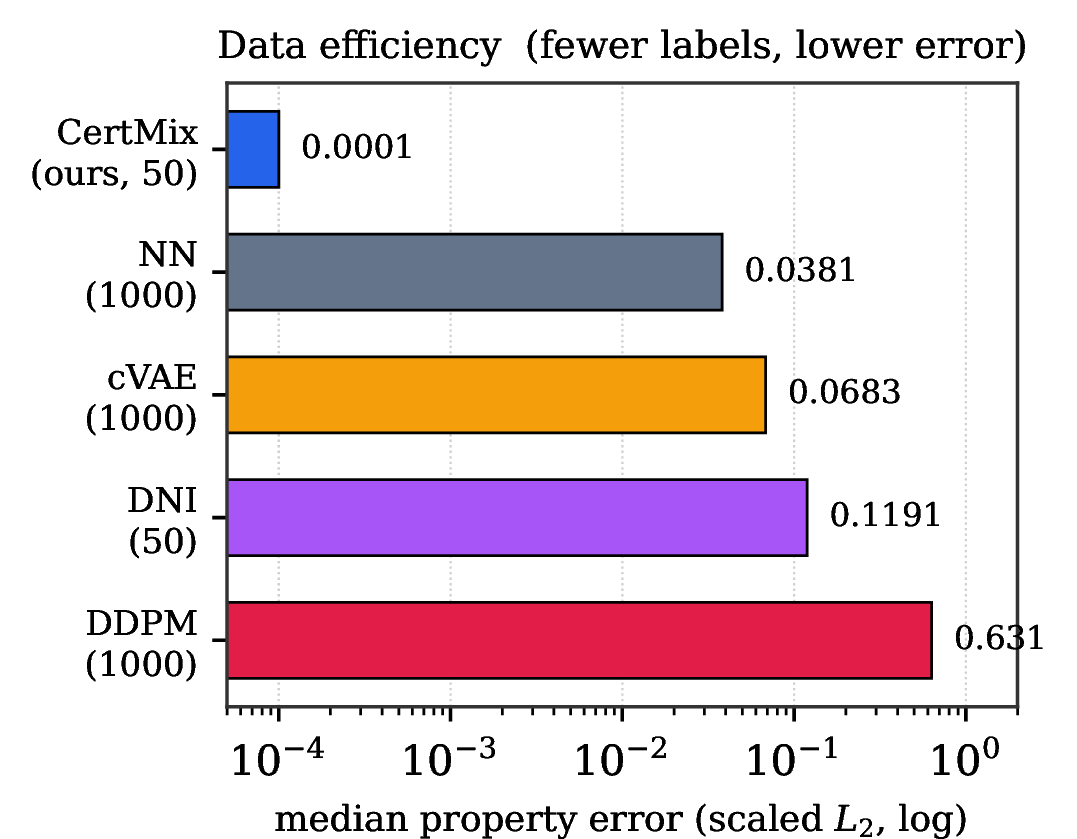
Table 1 and Fig. 4 compare CertMix (50 exemplars) against nearest-exemplar retrieval, a conditional VAE [30], a classifier-free guided DDPM [31], [32], and a learned weight-regression network (DNI). Generative baselines receive a generous best-of-eight sampling budget. CertMix reaches a median scaled error of \(\mathbf{0.0001}\) from \(50\) cells—about \(680\times\) below the best cVAE trained on \(1000\) cells and three orders of magnitude below the diffusion model.
| Method | Train cells | Median error \(\downarrow\) |
|---|---|---|
| CertMix (ours) | 50 | 0.0001 |
| Nearest exemplar | 1000 | 0.0381 |
| Conditional VAE | 1000 | 0.0683 |
| Learned weights (DNI) | 50 | 0.1191 |
| Conditional diffusion | 1000 | 0.6310 |
4.3 Certified extrapolation↩︎
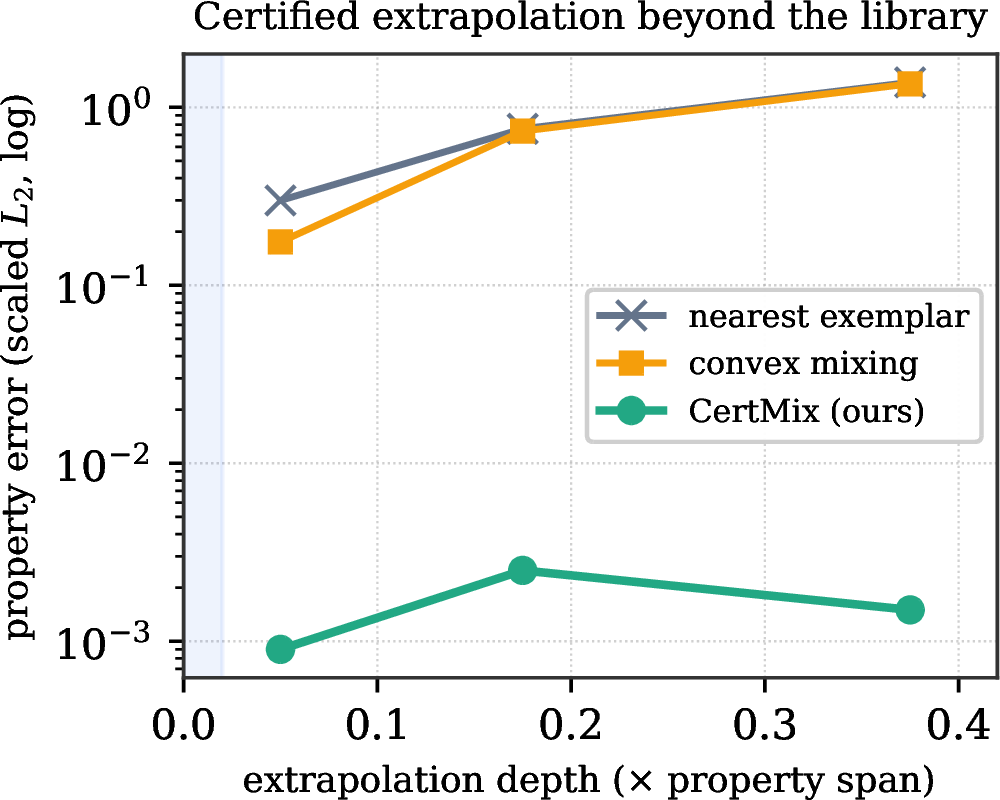
We target properties drawn from an extended parameter box lying outside the bank’s convex hull, laddered by extrapolation depth (as a fraction of the property span). Figure 5 shows that convex mixing and nearest-exemplar retrieval diverge with depth, whereas the two-stage affine solve stays on target. At \(25\)–\(50\%\) depth CertMix attains error \(0.0015\) versus \(1.36\) for convex mixing—roughly a \(900\times\) reduction. An ablation confirms the trust region is essential: raw affine without it reaches a max error of \(1.31\), versus \(0.026\) for the two-stage solve.
The split-conformal certificate (Eq. 7 ) achieves \(\mathbf{95.8\%}\) empirical coverage at a target of \(90\%\), with a failure-flag AUC of \(0.795\) and recall \(1.00\) at the chosen tolerance.
4.4 Functionally graded structures↩︎
With a spatially varying mixing field, CertMix produces continuous graded parts. For a Poisson-ratio grading (auxetic transition \(\nu_{xy}:-0.26\!\to\!+0.83\) with \(E_x\) held fixed) the per-cell property error is \(0.0052\) (median) and the interface seam mismatch is \(9\times\) smoother than nearest-exemplar tiling; a global tension test recovers the target column-\(\nu\) profile with Pearson \(r=0.997\). A cross-topology transition (grid\(\to\)honeycomb) yields \(23\times\) smoother seams.
4.5 Comparison to topology optimization↩︎
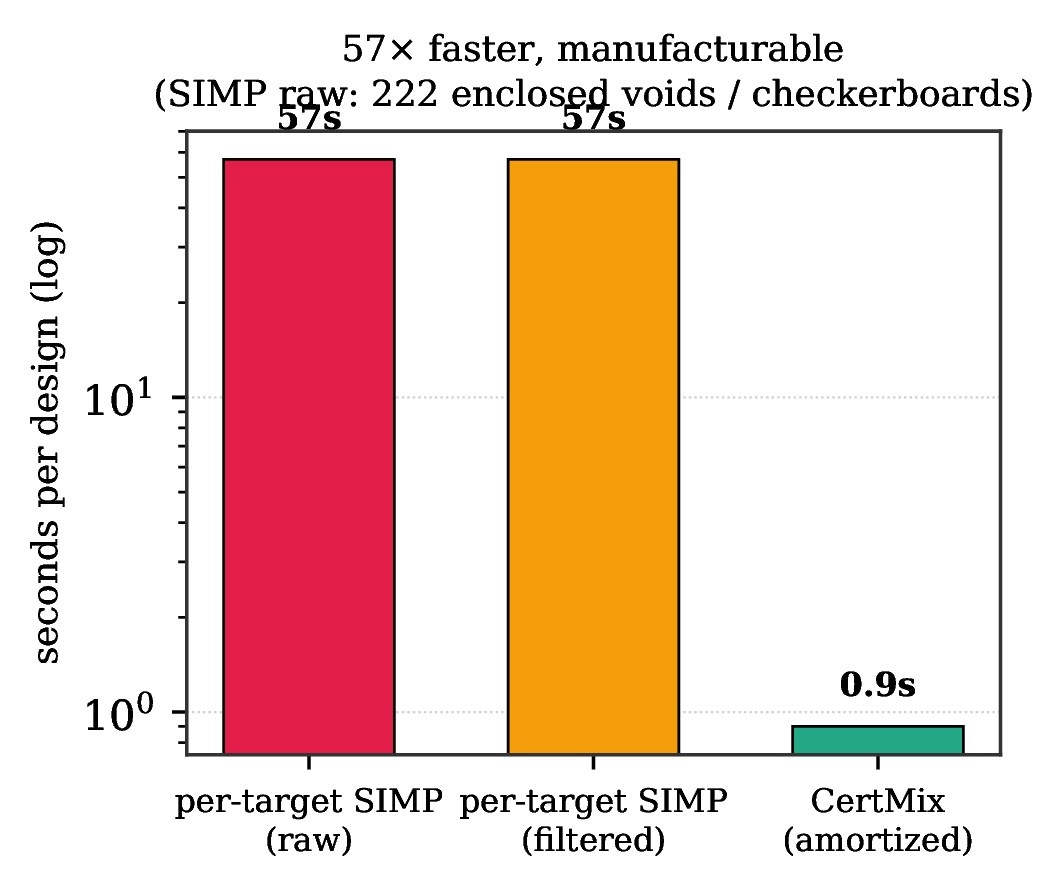
Against per-target inverse-homogenization TO (SIMP), CertMix matches or beats the converged property error while being amortized: \(57\times\) faster per design (Fig. 6), with \(0\) enclosed voids and no minimum-feature violation, whereas raw SIMP produces checkerboards (\(222\) enclosed voids) and filtered SIMP fails to converge on several targets.
4.6 Ablations↩︎
Shared anchor is decisive: anchored alignment yields median error \(0.0013\) versus \(0.536\) for independent initialization (\(\sim\!400\times\)). The trust-region weight \(\lambda_{\mathrm{m}}\) trades property accuracy against mismatch as expected; in-loop resolution \(N_H=64\) suffices for resolution-independent design (verified at \(N_H=128\)); and the bank spans \(10\)–\(50\) cells with graceful degradation.
4.7 Application: certified personalized midsoles↩︎
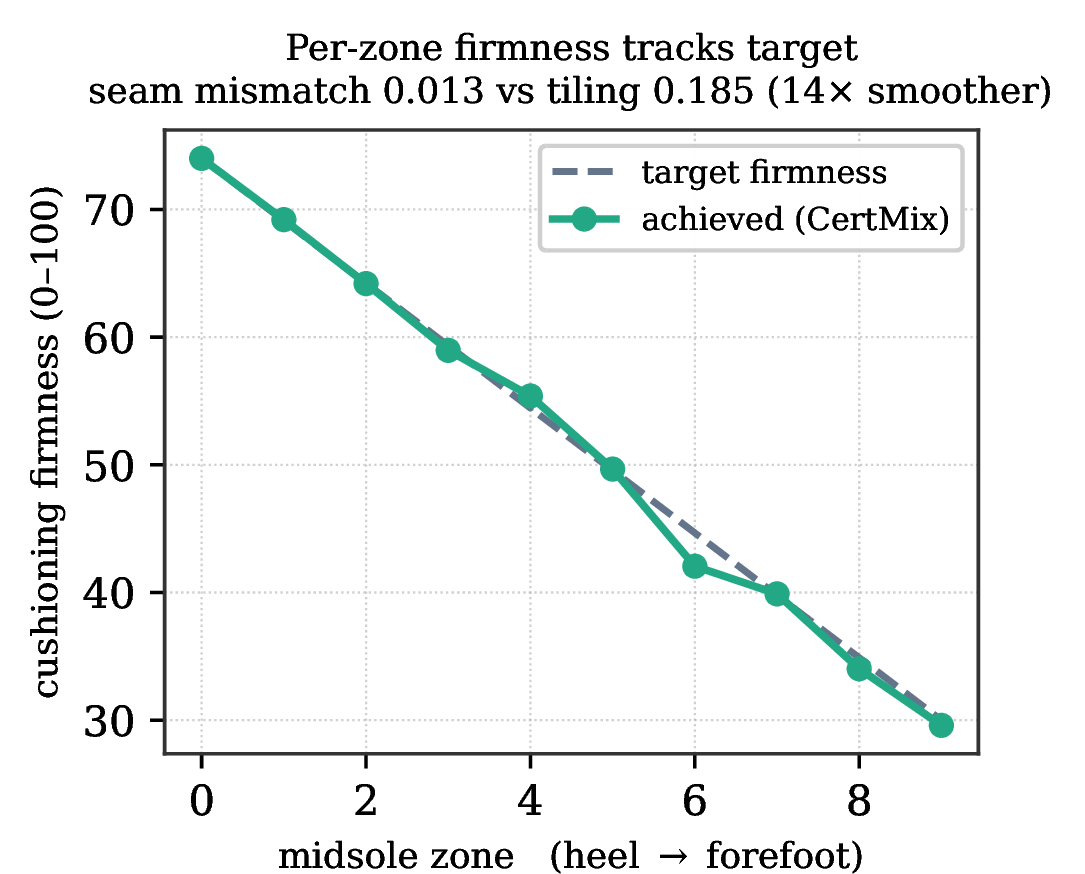
Re-parameterizing the controlled property as the vertical compression stiffness \(E_{\mathrm{v}}= C_{H,22}\)—the effective modulus footwear science uses for cushioning firmness [33]—CertMix designs functionally graded running-shoe midsoles over a \(100\)-cell library spanning a \(90\times\) firmness range (Fig. 7). Personalizing per-zone firmness to runner body weight attains median error \(0.0001\) versus \(0.0119\) for the nearest catalog cell; a graded heel-to-forefoot midsole tracks its target firmness profile with median error \(0.004\) and \(14\times\) smoother seams than tiling, and is exported as a printable STL. For runners requiring support firmer than any catalog pattern, negative coefficients extrapolate up to \(190\%\) beyond the catalog band while the conformal certificate still holds at the target coverage.
5 Conclusion↩︎
CertMix casts property-controlled metamaterial design as constrained affine mixing in an aligned neural-implicit weight space, exploiting the near-linearity of PDE-homogenized properties in weight-space coordinates. With a differentiable homogenizer in the loop, a linearity-mismatch trust region, and a split-conformal certificate, it is data-efficient, extrapolative, fast, manufacturable, and certified—and extends to graded fields, \(3\)D surfaces, and a footwear application. Limitations include the linear-elastic property regime (large-strain energy return is future work) and the reliance on a procedurally generated exemplar bank; scaling to richer \(3\)D families and nonlinear responses are natural next steps.