Finite-Blocklength ISAC Multiple Access:
A Source-Channel Coding Perspective
July 05, 2026
Abstract
Future networks must serve massive populations of devices that sense and communicate simultaneously under short-packet constraints, yet the fundamental limits of integrated sensing and communication (ISAC) in the finite-blocklength multiple-access regime remain largely undiscovered. This paper closes this gap from a source-channel coding perspective. We prove that satisfying a sensing-distortion constraint is information-theoretically equivalent to a source-coding requirement, which collapses sensing and communication into the joint recovery of a single effective payload within a coded multiple-access framework. Building on this equivalence, we derive a finite-blocklength achievability bound together with a Fano-sum many-user converse and a genie-aided single-user converse, yielding a tight characterization of the minimum energy per bit and the rate-sensing tradeoff. Numerical results reveal that the energy price of sensing fidelity grows almost linearly in dB per decade of distortion tightening and is significantly amplified by the multiple-access load, and that joint encoding of the effective payload strictly outperforms an optimized orthogonal two-phase scheme, demonstrating a genuine integration gain of ISAC at finite blocklength.
ISAC, finite-blocklength, sensing distortion, source coding, many-access channel, multiple access, tradeoffs.
1 Introduction↩︎
Integrated sensing and communication (ISAC) is reshaping wireless network design and advancing cognitive networks [1], [2]. While ISAC-oriented transceiver designs have demonstrated substantial integration gains in downlink settings [3], attention has recently shifted to the uplink, where receivers either jointly decode messages and retrieve sensing information from the transmitted signals [4], [5], or sequentially decode one user’s message before sensing the state of another [6]. A prominent trend in uplink ISAC is the transition toward message decoding-oriented sensing, reflecting the practical reality that uplink systems operate with encoded finite-blocklength transmissions and thus inherently call for multiple-access design, particularly at the initial access stage. Existing work has characterized single-user ISAC tradeoffs in which sensing parameters are estimated from feedback signals after message decoding [7], and more recently [8] studied uplink ISAC multiple access based solely on communication-signal-enabled sensing. Nevertheless, a fundamental analytical framework for uplink-only, feedback-free ISAC under varying access density, a setting that faithfully captures practical uplink operation, remains absent, and it is unclear how the sensing fidelity, the decoding reliability, and the energy budget jointly scale when many short-packet users access the channel simultaneously.
In this paper, we close this gap by revisiting the classical Gaussian multiple-access channel (MAC) in the finite-blocklength regime and reformulating uplink transmission as a joint sensing-and-communication problem from a source-channel coding perspective, which enables a unified treatment of reliability, sensing performance, and energy efficiency. Our main contributions are summarized as follows.
We prove that distortion-constrained sensing over finite blocklengths is information-theoretically equivalent to a source-coding problem under both mutual-information and joint rate-distortion interpretations, which folds the sensing target into a sensing-equivalent payload.
We formulate joint sensing-and-communication recovery in terms of an effective information load, yielding a tight characterization of energy efficiency, namely the minimum energy [9] required to meet prescribed decoding-error and sensing-distortion targets, and rendering the rate-sensing tradeoff analytically tractable.
We derive finite-blocklength achievability bounds together with single-user and many-user converse bounds, and demonstrate both analytically and numerically that they tightly sandwich the fundamental limits across a wide range of access densities.
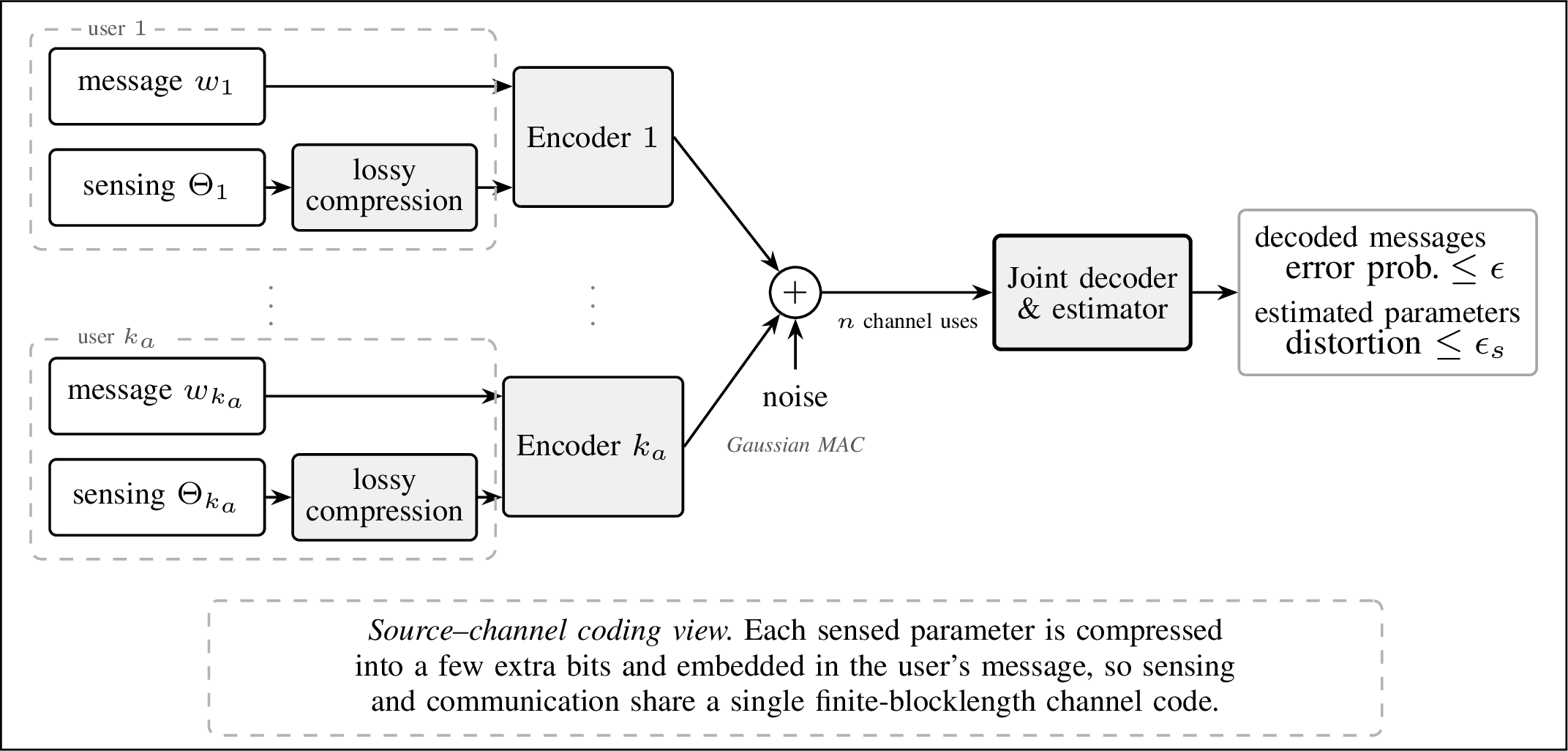
The remainder of this paper is organized as follows: Section 2 presents the information-theoretic system model. Section 3 establishes the source-coding equivalence and derives the achievability and converse bounds for the standard \(k_a\)-user ISAC MAC. Section 4 provides numerical results, and Section 5 concludes the paper.
2 Information-Theoretic Modeling↩︎
We consider an uplink joint communication-and-remote-sensing system in which \(k_a\) active users transmit over an \(n\)-dimensional real AWGN multiple-access channel (MAC). Each user \(k\) holds two pieces of information: a digital message \(w_k\in\mathcal{W}\) carrying \(b\) bits (so \(|\mathcal{W}|=2^b\)), and a locally acquired sensing parameter \(\Theta_k\in\mathcal{T}\subseteq\mathbb{R}^d\), drawn i.i.d.across users and independent of the messages. Since the channel input of each user depends on both quantities, the received signal is \[Y=\sum_{k=1}^{k_a} X_k(w_k,\Theta_k)+Z, \label{eq:received95signal}\tag{1}\] where \(Y\in\mathbb{R}^n\), \(X_k\in\mathbb{R}^n\) is the transmitted vector of user \(k\) subject to the block-energy constraint \(\|X_k\|_2^2\le p\), and \(Z\sim\mathcal{N}(0,I_n)\) is AWGN. The parameter \(\Theta_k\) is known at encoder \(k\) but not at the receiver. Under this convention, the communication-oriented energy-per-bit ratio is \[\frac{e_b}{n_0} = \frac{p}{2b}.\]
Upon observing \(Y\), the receiver must (i) recover each message \(w_k\) reliably, and (ii) reconstruct each \(\Theta_k\) within a mean-squared-error target, \[\mathbb{E}\big[\|\Theta_k-\widetilde{\Theta}_k\|_2^2\big]\le \epsilon_s. \label{eq:sensing95distortion}\tag{2}\] The system is thus a joint lossless-message and lossy-source transmission problem over a MAC.
The remainder of this section establishes a single, simple takeaway: from a converse perspective, the sensing task behaves exactly like an additional digital payload. Concretely, we show in three steps that
Meeting the distortion target \(\epsilon_s\) forces the receiver to acquire at least \(b_s\) bits of information about \(\Theta_k\), where \(b_s\) is determined by rate-distortion theory (Proposition 1);
Because the message and the sensing parameter are independent, the two information requirements add up, yielding a total budget of \(b+b_s\) bits per user (Proposition 2);
This additivity is exactly the joint rate-distortion function of the pair \((w,\Theta)\). The quantity \(b+b_s\) then serves as the effective per-user payload in the finite-blocklength analysis of the next section.
2.0.0.1 Sensing Accuracy as a Source-Coding Requirement
The intuition is the following: if the receiver can reproduce \(\Theta\) within distortion \(\epsilon_s\), then the channel output \(Y\) must already “contain” as much information about \(\Theta\) as the best lossy compressor operating at that distortion, i.e., no estimator can do better than what rate-distortion theory permits.
Formally, for squared-error distortion \(\mathcal{D}_s(\Theta,\widetilde{\Theta})=\|\Theta-\widetilde{\Theta}\|_2^2\), the minimum number of bits needed to describe \(\Theta\) within average distortion \(\epsilon_s\) is the rate-distortion function [10]–[12] \[\mathcal{R}_{\Theta}(\epsilon_s) = \inf_{\mathbb{P}_{\widetilde{\Theta}|\Theta}:\, \mathbb{E}[\mathcal{D}_s(\Theta,\widetilde{\Theta})]\le \epsilon_s} \mathcal{I}(\Theta;\widetilde{\Theta}), \label{eq:rd95sensing}\tag{3}\] where \(\mathcal{I}(\cdot;\cdot)\) is mutual information in bits. We call \(b_s\triangleq \mathcal{R}_{\Theta}(\epsilon_s)\) the sensing-equivalent number of bits 4 . \[b_s\triangleq \mathcal{R}_{\Theta}(\epsilon_s). \label{eq:bs95def}\tag{4}\]
Proposition 1 (Sensing as a Source-Coding Requirement). If an estimator \(\widetilde{\Theta}=\mathcal{G}_s(Y)\) satisfies \(\mathbb{E}\big[\|\Theta-\widetilde{\Theta}\|_2^2\big]\le \epsilon_s\), then \(\mathcal{I}(\Theta;Y)\ge b_s\).
Since \(\widetilde{\Theta}\) is computed from \(Y\) alone, \(\Theta\to Y\to\widetilde{\Theta}\) forms a Markov chain, and the data-processing inequality gives \(\mathcal{I}(\Theta;Y)\ge\mathcal{I}(\Theta;\widetilde{\Theta})\). Because \(\widetilde{\Theta}\) meets the distortion constraint, it is feasible for the infimum in 3 , whence \(\mathcal{I}(\Theta;\widetilde{\Theta})\ge\mathcal{R}_{\Theta}(\epsilon_s)=b_s\).
Remark 1. Proposition 1 is a converse statement: it does not require the transmitter to quantize \(\Theta\) into an explicit \(b_s\)-bit index, nor does it presuppose source-channel separation. It only says that any architecture meeting the sensing target must deliver at least \(b_s\) bits of information about \(\Theta\) through the channel.
As a running example, if \(\Theta\sim\mathcal{N}(0,\sigma_{\theta}^2 I_d)\), the classical quadratic-Gaussian rate-distortion function [11], [12] gives the closed form \[b_s = \mathcal{R}_{\Theta}(\epsilon_s) = \frac{d}{2}\, \log_2^+\! \left( \frac{d\sigma_{\theta}^2}{\epsilon_s} \right), \label{eq:gaussian95rd}\tag{5}\] where \(\log_2^+(x)=\max\{\log_2 x,0\}\). As expected, a more stringent sensing accuracy (smaller \(\epsilon_s\)) translates into a larger sensing-equivalent payload \(b_s\), i.e., a heavier burden on the joint decoder.
2.0.0.2 Additivity of Communication and Sensing Information
We now show that the two information requirements do not interfere with each other: under the independence \(w\perp\!\!\!\perp\Theta\), the receiver must extract \(b\) bits for the message and \(b_s\) bits for the sensing parameter, and these requirements are additive. Intuitively, knowing the message tells the receiver nothing about the sensing parameter, so neither task can “subsidize” the other. Note that the lossless message itself fits the same rate-distortion language: viewing \(w\) as a uniform discrete source with zero-distortion requirement, \(\mathcal{R}_{w}(0)=\mathcal{H}(w)=b\).
Proposition 2. Suppose \(w\perp\!\!\!\perp\Theta\). If a joint decoder recovers \(w\) with error probability \(p_e\) and estimates \(\Theta\) with mean-squared error at most \(\epsilon_s\), then \[\mathcal{I}(w,\Theta;Y) \ge b+b_s-\mathcal{H}_2(p_e)-p_e b, \label{eq:joint95lower95bound}\qquad{(1)}\] where \(\mathcal{H}_2(\cdot)\) is the binary entropy function; in particular, \(\mathcal{I}(w,\Theta;Y)\ge b+b_s-o(1)\) as \(p_e\to0\).
By the chain rule, \(\mathcal{I}(w,\Theta;Y)=\mathcal{I}(w;Y)+\mathcal{I}(\Theta;Y|w)\), and we bound the two terms separately. Communication term. Fano’s inequality [12], [13] yields \(\mathcal{H}(w|Y)\le\mathcal{H}_2(p_e)+p_e b\), and since \(\mathcal{H}(w)=b\), \[\mathcal{I}(w;Y)\ge b-\mathcal{H}_2(p_e)-p_e b. \label{eq:comm95lower95bound}\tag{6}\]
Sensing term. Let \(\widetilde{\Theta}\) be the decoder’s sensing estimate. Since \(\widetilde{\Theta}\) is a function of \(Y\), the conditional data-processing inequality gives \(\mathcal{I}(\Theta;Y|w)\ge\mathcal{I}(\Theta;\widetilde{\Theta}|w)\). The key observation is that, by \(w\perp\!\!\!\perp\Theta\), conditioning on \(w=a\) does not alter the distribution of \(\Theta\), so the rate-distortion function \(\mathcal{R}_{\Theta}(\cdot)\) applies unchanged under each conditioning event. Writing \(d_a=\mathbb{E}[\|\Theta-\widetilde{\Theta}\|_2^2\,|\,w=a]\), the distortion constraint reads \(\mathbb{E}_w[d_w]\le\epsilon_s\), and therefore \[\mathcal{I}(\Theta;\widetilde{\Theta}|w) \ge \mathbb{E}_{w}\!\left[\mathcal{R}_{\Theta}(d_w)\right] \ge \mathcal{R}_{\Theta}\!\left(\mathbb{E}_{w}[d_w]\right) \ge \mathcal{R}_{\Theta}(\epsilon_s)=b_s, \label{eq:sensing95lower95bound}\tag{7}\] where the second inequality is Jensen’s inequality applied to the convex function \(\mathcal{R}_{\Theta}(\cdot)\), and the last holds because \(\mathcal{R}_{\Theta}(\cdot)\) is non-increasing. Combining 6 and 7 with the chain rule completes the proof.
Remark 2. Proposition 2 is architecture-independent: it applies to arbitrary joint decoding rules and does not rely on source-channel separation. Its operational message is that, at the level of converse bounds, each active user effectively carries a payload of \(b+b_s\) bits.
2.0.0.3 Equivalent Joint Rate-Distortion Interpretation
The additivity in Proposition 2 admits a clean source-coding restatement. Defining the joint source \(S=(w,\Theta)\) with reconstruction \(\widetilde{S}=(\hat{w},\widetilde{\Theta})\), distortion measures \(\mathcal{D}_c(w,\hat{w})=\mathrm{1}\{w\neq\hat{w}\}\) and \(\mathcal{D}_s(\Theta,\widetilde{\Theta})=\|\Theta-\widetilde{\Theta}\|_2^2\), the joint rate-distortion function factorizes: \[\mathcal{R}_{w,\Theta}(0,\epsilon_s) = \mathcal{R}_{w}(0)+\mathcal{R}_{\Theta}(\epsilon_s) = b+b_s. \label{eq:rd95additivity}\tag{8}\]
The proof of 8 is standard and is only sketched here: the lower bound follows from the chain rule and the data-processing inequality, mirroring the proof of Proposition 2. The upper bound follows by choosing the product reconstruction law \(\mathbb{P}_{\hat{w},\widetilde{\Theta}|w,\Theta} =\mathbb{P}_{\hat{w}|w}\,\mathbb{P}_{\widetilde{\Theta}|\Theta}\) with each factor achieving its individual rate-distortion function, which is feasible precisely because \(w\perp\!\!\!\perp\Theta\) and the two distortion constraints are separable. We emphasize that 8 is conceptual: it characterizes the minimum information rate compatible with both tasks, rather than mandating a separate quantize-and-transmit implementation. With the effective payload \(b+b_s\) in hand, the next section quantifies the channel-side cost of delivering it over the unsourced MAC at finite blocklength.
3 Achievability and Converse Bounds for the Standard \(k_a\)-User ISAC MAC↩︎
This section quantifies the channel-side cost of delivering the effective payload identified in the previous section over a standard \(k_a\)-user MAC [14], in which each active user has its own codebook. The development consists of three parts:
A random-coding achievability bound (finite-blocklength form in 28 , asymptotic exponent in 32 ), in which the sensing requirement enters only by enlarging the decoding search space from \(2^b\) to \(2^{b+b_s}\);
Two converse bounds: One based on Fano’s inequality and the MAC sum capacity, and the other on a genie-aided single-user reduction; and
Combination of derived bounds into a minimum-required energy-per-bit 44 for a target pair \((\epsilon,\epsilon_s)\) of communication error and sensing distortion.
Recall from 4 that \(b_s=\mathcal{R}_{\Theta}(\epsilon_s)\), so the effective payload per active user is \(b_{\mathrm{e}}\triangleq b+b_s\), carried by the effective index set \(\mathcal{U}=\mathcal{W}\times\mathcal{V}_s\), where \(\mathcal{V}_s\) is a sensing source-code index set with \(|\mathcal{V}_s|=2^{b_s}\). Hence \[|\mathcal{U}| = 2^{b+b_s} = 2^{b_{\mathrm{e}}}. \label{eq:effective95search95space}\tag{9}\] (Integer-rounding effects in \(2^{b_s}\) are ignored throughout; replacing \(2^{b_s}\) by \(\lceil 2^{b_s}\rceil\) does not affect any asymptotic conclusion.) The key tension in the ISAC setting is that the search space grows to \(2^{b+b_s}\) while the physical block-energy budget remains the communication budget \(p\). To keep this distinction explicit, let \(p'\triangleq p/n\) denote the per-channel-use energy, and for the random-coding ensemble choose \[0<\bar p<p,~ \bar p' \triangleq \frac{\bar p}{n}, \label{eq:pbar95prime95def}\tag{10}\] where \(p,\bar p\) are block energies and \(p',\bar p'\) their per-channel-use counterparts. The effective system spectral efficiency is \[s_{\mathrm{e}} = \frac{k_a(b+b_s)}{n}. \label{eq:effective95spectral95efficiency}\tag{11}\] In the many-user asymptotic regime we set \(k_a=\mu n\) with user density \(\mu\), so that \(s_{\mathrm{e}}=\mu(b+b_s)\).
3.0.0.1 Random-Coding Achievability Bound
For each user \(k=1,\ldots,k_a\), generate an independent Gaussian codebook \(\mathcal{C}_k=\{C_k(u):u\in\mathcal{U}\}\) with \(C_k(u)\sim\mathcal{N}(0,\bar p'I_n)\). Since a Gaussian codeword does not automatically satisfy the block-energy constraint, the transmitted vector is defined through truncation: \[X_k(u) = \begin{cases} C_k(u), & \|C_k(u)\|_2^2\le p,\\[1mm] 0, & \|C_k(u)\|_2^2>p, \end{cases} \label{eq:truncated95codeword95jsac}\tag{12}\] so that \(\|X_k(u)\|_2^2\le p\) holds deterministically. The receiver applies the nearest-neighbor decoder over the ordered effective index tuple: \[(\hat{u}_1,\ldots,\hat{u}_{k_a}) = \operatorname*{arg\,min}_{(\widetilde{u}_1,\ldots,\widetilde{u}_{k_a})\in\mathcal{U}^{k_a}} \left\| Y-\sum_{k=1}^{k_a}C_k(\widetilde{u}_k) \right\|_2^2. \label{eq:nn95decoder95standard95jsac}\tag{13}\] After \(\hat{u}_k=(\hat{w}_k,\hat{v}_k)\) is decoded, \(\hat{w}_k\) is the communication estimate, and the sensing estimate is obtained by applying the sensing source decoder to \(\hat{v}_k\).
3.0.0.2 Energy-Truncation Error
Because each user has its own codebook, there is no codeword-collision component; the only measure-change penalty stems from truncation. Writing \(\|C_k(u_k)\|_2^2=\bar p'\sum_{i=1}^{n}g_i^2\) with \(g_i\sim\mathcal{N}(0,1)\) i.i.d., the event \(\|C_k(u_k)\|_2^2>p\) is equivalent to \(\frac{1}{n}\sum_{i=1}^{n}g_i^2>p/\bar p\), and the union bound over the \(k_a\) active users gives \[p_0^{(n)} \le k_a \mathbb{P} \left[ \frac{1}{n}\sum_{i=1}^{n}g_i^2 > \frac{p}{\bar p} \right] = k_a\, \frac{\Gamma\!\left(\frac{n}{2},\frac{np}{2\bar{p}}\right)}{\Gamma\!\left(\frac{n}{2}\right)}, \label{eq:truncation95component95jsac}\tag{14}\] where the equality uses the fact that \(\sum_{i=1}^{n}g_i^2\) follows a chi-square distribution with \(n\) degrees of freedom, and \(\Gamma(s,x)=\int_{x}^{\infty}t^{s-1}e^{-t}\mathrm{d}t\) is the upper incomplete Gamma function.
3.0.0.3 Per-User Decoding Error
Define the effective per-user decoding error probability [15] as \[\epsilon_{\mathrm{e}}^{(n)} = \frac{1}{k_a} \sum_{k=1}^{k_a} \mathbb{P}[\hat{u}_k\neq u_k], \label{eq:effective95error95probability}\tag{15}\] indicating error when not all bits are restored, and, for \(t=1,\ldots,k_a\), the event \[\mathcal{F}_t = \left\{ \sum_{k=1}^{k_a} \mathrm{1}\{\hat{u}_k\neq u_k\} = t \right\}, \label{eq:Ft95standard95jsac}\tag{16}\] so that, under the non-truncated Gaussian ensemble, \[\epsilon_{\mathrm{e}}^{(n)} = \sum_{t=1}^{k_a} \frac{t}{k_a} \mathbb{P}[\mathcal{F}_t]; \label{eq:error95decomposition95standard95jsac}\tag{17}\] the truncation penalty \(p_0^{(n)}\) will be added back at the end. To bound \(\mathbb{P}[\mathcal{F}_t]\), fix an erroneous user set \(\mathcal{S}_0\subseteq\{1,\ldots,k_a\}\) with \(|\mathcal{S}_0|=t\), and define the true and false codeword sums \(A=\sum_{k\in\mathcal{S}_0}C_k(u_k)\) and \(B=\sum_{k\in\mathcal{S}_0}C_k(\widetilde{u}_k)\) with \(\widetilde{u}_k\neq u_k\). By independence of the codebooks, \(A,B\sim\mathcal{N}(0,v_tI_n)\) with \(v_t=t\bar p'=t\bar p/n\). The pairwise nearest-neighbor error event is \[\|A-B+Z\|_2^2 < \|Z\|_2^2. \label{eq:pairwise95error95jsac}\tag{18}\] Conditioning on \((A,Z)\) and applying a Chernoff bound with parameter \(\lambda>0\), followed by averaging over \(B\sim\mathcal{N}(0,v_tI_n)\), yields \[\begin{align} &\mathbb{P} \left[ \|A-B+Z\|_2^2<\|Z\|_2^2 \mid A,Z \right] \\ &\le (1+2v_t\lambda)^{-n/2} \exp \left\{ \lambda\|Z\|_2^2 - \frac{\lambda}{1+2v_t\lambda} \|A+Z\|_2^2 \right\}. \end{align} \label{eq:pairwise95chernoff95jsac}\tag{19}\] For a fixed \(\mathcal{S}_0\), each erroneous user independently selects one wrong effective index from its own codebook, so the number of false ordered choices is \[(2^{b+b_s}-1)^t \le 2^{t(b+b_s)}. \label{eq:false95choices95jsac}\tag{20}\] A note on units (bits or nats): \(b\) and \(b_s\) are measured in bits, whereas all unsubscripted logarithms in the exponent analysis are natural, so exponents and rates are in nats per channel use. A factor \(\log 2\) therefore appears whenever \(b\) or \(b_s\) enters the random-coding exponent and the converse bounds are stated entirely in base-2 and require no conversion. Define \[\label{eq:r195r295jsac} r_1^{(n)} = \frac{(b+b_s)\log 2}{n}, \quad r_2^{(n)}(t) = \frac{1}{n}\log\binom{k_a}{t},\tag{21}\] so that \(tr_1^{(n)}\) is the exponent associated with the false ordered choices and \(r_2^{(n)}(t)\) that of selecting the \(t\) erroneous users. For \(0\le\rho,\rho_1\le1\) and \(v>0\), define \[\begin{align} \nu &= \frac{\rho\lambda}{1+2v\lambda}, \\ a(\rho,\lambda;v) &= \frac{\rho}{2}\log(1+2v\lambda) + \frac{1}{2}\log(1+2v\nu), \tag{22}\\ c(\rho,\lambda;v) &= \rho\lambda - \frac{\nu}{1+2v\nu}, \tag{23} \end{align}\] and the Gaussian distance exponent \[\begin{align} &\mathcal{E}_0(\rho,\rho_1;v) =\\ &\max_{\lambda>0:\;1-2\rho_1c(\rho,\lambda;v)>0} \left\{ \rho_1a(\rho,\lambda;v) + \frac{1}{2} \log \left( 1-2\rho_1c(\rho,\lambda;v) \right) \right\}, \end{align} \label{eq:E095jsac}\tag{24}\] whose maximizing \(\lambda\) admits the closed form \[\lambda^{\star} = \frac{ v-1+ \sqrt{ (v-1)^2 + 4v \frac{1+\rho\rho_1}{1+\rho} } }{ 4v(1+\rho\rho_1) }. \label{eq:lambda95star95jsac}\tag{25}\] Applying Gallager’s \(\rho\)-trick to the false ordered choices and the \(\rho_1\)-trick to the erroneous user sets, exactly as in [15], gives \[\mathbb{P}[\mathcal{F}_t] \le \exp \left\{ -n\mathcal{E}_n(t;\bar p) \right\}, \label{eq:Ft95bound95jsac}\tag{26}\] where \[\mathcal{E}_n(t;\bar p) = \max_{0\le\rho,\rho_1\le1} \left[ -\rho\rho_1 t r_1^{(n)} -\rho_1r_2^{(n)}(t) + \mathcal{E}_0 \left( \rho,\rho_1; \frac{t\bar p}{n} \right) \right]. \label{eq:finite95n95exponent95jsac}\tag{27}\] Combining 17 , 14 , and 26 yields the finite-\(n\) random-coding achievability bound \[\epsilon_{\mathrm{e}}^{(n)} \le \sum_{t=1}^{k_a} \frac{t}{k_a} \exp \left\{ -n\mathcal{E}_n(t;\bar p) \right\} + p_0^{(n)}. \label{eq:finite95n95achievability95jsac}\tag{28}\]
Passing to the many-user regime \(k_a=\mu n\) with \(t=\theta k_a\), \(0\le\theta\le1\), the quantities in 21 converge as \[\begin{align} t r_1^{(n)} &\longrightarrow \theta\mu(b+b_s)\log 2, \tag{29}\\ r_2^{(n)}(t) &\longrightarrow \mu h(\theta), \tag{30}\\ \frac{t\bar p}{n} &\longrightarrow \theta\mu\bar p, \tag{31} \end{align}\] where \(h(\theta)=-\theta\log\theta-(1-\theta)\log(1-\theta)\) is the binary entropy function in nats. The asymptotic random-coding exponent is therefore \[\begin{align} &\mathcal{E}(\theta;\bar p) =\\ &\max_{0\le\rho,\rho_1\le1} \left[ -\rho\rho_1\theta\mu(b+b_s)\log 2 -\rho_1\mu h(\theta) + \mathcal{E}_0 \left( \rho,\rho_1; \theta\mu\bar p \right) \right]. \end{align} \label{eq:asymptotic95exponent95jsac}\tag{32}\] For a target effective per-user decoding error probability \(\epsilon\), define \[\mathcal{E}_{\min}(\bar p,\epsilon) = \min_{\epsilon\le\theta\le1} \mathcal{E}(\theta;\bar p). \label{eq:Emin95jsac}\tag{33}\] If there exists \(0<\bar p<p\) such that \(\mathcal{E}_{\min}(\bar p,\epsilon)>0\), then the standard \(k_a\)-user ISAC MAC is asymptotically achievable with effective per-user decoding error probability no larger than \(\epsilon\).
Remark 3. In 32 , the sensing requirement affects the achievable exponent only through the false-search-space term \(\theta\mu(b+b_s)\log 2\), whereas the energy term inside \(\mathcal{E}_0(\cdot)\) remains \(\theta\mu\bar p\), determined by the physical block energy alone. Sensing thus increases the number of effective alternatives to be decoded without providing additional transmit energy.
3.0.0.4 Converse Bound Based on Fano’s Inequality and Sum Capacity
Let \(p_{\mathrm{e},k}=\mathbb{P}[\hat{w}_k\neq w_k]\) and assume \(\frac{1}{k_a}\sum_{k=1}^{k_a}p_{\mathrm{e},k}\le\epsilon\), together with the per-user sensing constraint \(\mathbb{E}[\|\Theta_k-\widetilde{\Theta}_k\|_2^2]\le\epsilon_s\) for all \(k\). Write \(w^{k_a}=(w_1,\ldots,w_{k_a})\) and \(\Theta^{k_a}=(\Theta_1,\ldots,\Theta_{k_a})\). By the chain rule, \[\mathcal{I}(w^{k_a},\Theta^{k_a};Y) = \mathcal{I}(w^{k_a};Y) + \mathcal{I}(\Theta^{k_a};Y|w^{k_a}). \label{eq:chain95converse95jsac}\tag{34}\] For the communication term, applying Fano’s inequality user-by-user, \(\mathcal{H}(w_k|Y)\le\mathcal{H}_2(p_{\mathrm{e},k})+p_{\mathrm{e},k}b\), and then the concavity of \(\mathcal{H}_2(\cdot)\) together with \(\frac{1}{k_a}\sum_k p_{\mathrm{e},k}\le\epsilon\) gives \[\begin{align} \mathcal{I}(w^{k_a};Y) &\ge k_ab - \sum_{k=1}^{k_a} \left[ \mathcal{H}_2(p_{\mathrm{e},k}) + p_{\mathrm{e},k}b \right] \\ &\ge k_a \left[ (1-\epsilon)b - \mathcal{H}_2(\epsilon) \right]. \end{align} \label{eq:comm95fano95lower95jsac}\tag{35}\] For the sensing term, the parameters \(\Theta_k\) are i.i.d.across users and independent of all messages, so conditioning on \(w^{k_a}\) leaves their distribution unchanged; repeating the conditional rate-distortion argument in the proof of Proposition 2 for each user (via the chain rule over \(k\)) yields \[\mathcal{I}(\Theta^{k_a};Y|w^{k_a}) \ge k_ab_s. \label{eq:sensing95info95lower95jsac}\tag{36}\] Combining 34 –36 , \[\mathcal{I}(w^{k_a},\Theta^{k_a};Y) \ge k_a \left[ (1-\epsilon)b + b_s - \mathcal{H}_2(\epsilon) \right]. \label{eq:joint95info95lower95jsac}\tag{37}\] On the other hand, the data-processing inequality gives \(\mathcal{I}(w^{k_a},\Theta^{k_a};Y)\le\mathcal{I}(X_1,\ldots,X_{k_a};Y)\), and under the per-channel-use energy constraint \(p'=p/n\) the AWGN MAC sum mutual information is upper bounded by \[\mathcal{I}(X_1,\ldots,X_{k_a};Y) \le \frac{n}{2} \log_2 \left( 1+\frac{k_ap}{n} \right). \label{eq:sum95capacity95jsac}\tag{38}\] With \(k_a=\mu n\), 37 and 38 give \[\mu \left[ (1-\epsilon)b + b_s - \mathcal{H}_2(\epsilon) \right] \le \frac{1}{2} \log_2(1+\mu p), \label{eq:fano95sum95converse95jsac}\tag{39}\] or equivalently \[p \ge p_{\mathrm{fano}} \triangleq \frac{1}{\mu} \left[ 2^{ 2\mu \left[ (1-\epsilon)b + b_s - \mathcal{H}_2(\epsilon) \right] } - 1 \right]_+. \label{eq:p95fano95lower95jsac}\tag{40}\]
Remark 4. The Fano penalty applies only to the lossless message \(w_k\) and hence multiplies \(b\); the sensing part contributes its full \(b_s\) bits through the rate-distortion requirement. As \(\epsilon\to0\), 39 reduces to \(\mu(b+b_s)\le\frac{1}{2}\log_2(1+\mu p)\), matching the effective-payload interpretation of Section 2.0.0.1.
3.0.0.5 Converse Bound: Single-User Case
A second converse follows from a genie-aided reduction. Since the average per-user error probability is at most \(\epsilon\), some user \(j\) satisfies \(p_{\mathrm{e},j}\le\epsilon\). Revealing all other users’ effective indices and transmitted vectors to the receiver, their contributions can be subtracted from \(Y\): \[\widetilde{Y} = Y-\sum_{k\neq j}X_k = X_j(w_j,\Theta_j)+Z, \label{eq:single95user95reduction95jsac}\tag{41}\] reducing user \(j\) to a single-user real AWGN channel with block energy at most \(p\), over which \(b+b_s\) effective bits must be conveyed. Since the genie can only help, any feasible standard-MAC ISAC scheme must satisfy the single-user finite-energy converse: with \(\mathcal{Q}(x)=\mathbb{P}[g>x]\), \(g\sim\mathcal{N}(0,1)\), and \(\mathcal{Q}^{-1}\) its inverse, \[b+b_s \le -\log_2 \mathcal{Q} \left( \sqrt{p} + \mathcal{Q}^{-1}(1-\epsilon) \right), \label{eq:single95user95energy95converse95jsac}\tag{42}\] or equivalently \[p \ge p_{\mathrm{energy}} \triangleq \left( \left[ \mathcal{Q}^{-1} \left( 2^{-(b+b_s)} \right) - \mathcal{Q}^{-1} \left( 1-\epsilon \right) \right]_+ \right)^2. \label{eq:p95energy95lower95jsac}\tag{43}\]
3.0.0.6 Final Converse Bound
Both converses must hold simultaneously, so any standard \(k_a\)-user ISAC MAC scheme meeting the targets \((\epsilon,\epsilon_s)\) requires \(p\ge\max\{p_{\mathrm{fano}},p_{\mathrm{energy}}\}\) with \(p_{\mathrm{fano}}\) and \(p_{\mathrm{energy}}\) given in 40 and 43 . Since the physical budget is still the communication block energy, the minimum-required energy-per-bit is \[\frac{e_b}{n_0} \ge \frac{1}{2b} \max \left\{ p_{\mathrm{fano}}, p_{\mathrm{energy}} \right\}. \label{eq:final95ebn095lower95jsac}\tag{44}\]
4 Numerical Results↩︎
We evaluate the proposed ISAC bounds for a Gaussian remote source with \(d=4\) and \(\sigma_\theta^2=1\), whose sensing-equivalent rate \(b_s\) is given by 5 . In all figures the energy efficiency is normalized to the communication payload as \(e_b/n_0 = p/(2b)\), and the sensing fidelity is treated as a constraint folded into the effective payload \(b_e=b+b_s\).
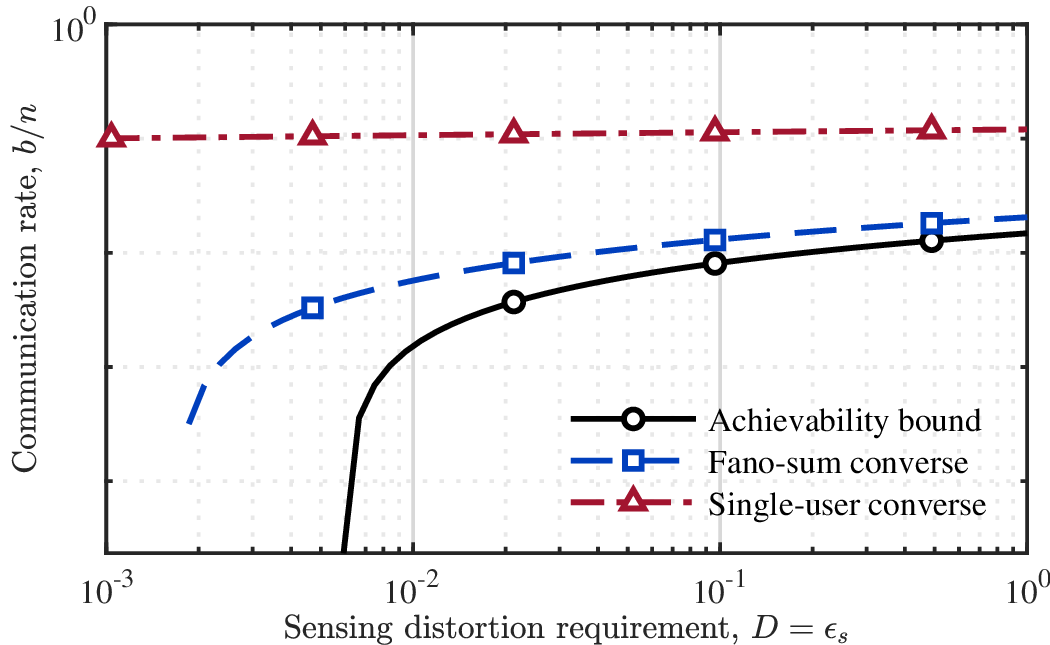
Fig. 2 illustrates the communication–sensing tradeoff for \(n=1000\), \(k_a=100\), \(\epsilon=0.1\), and \(e_b/n_0=0\) dB. As the prescribed distortion \(D\) decreases, \(b_s\) grows according to the Gaussian rate-distortion function, and the achievable communication rate \(b/n\) decreases monotonically. This directly reflects the relation \(b_e=b+b_s\), where stricter sensing fidelity consumes a larger share of the fixed effective information load.
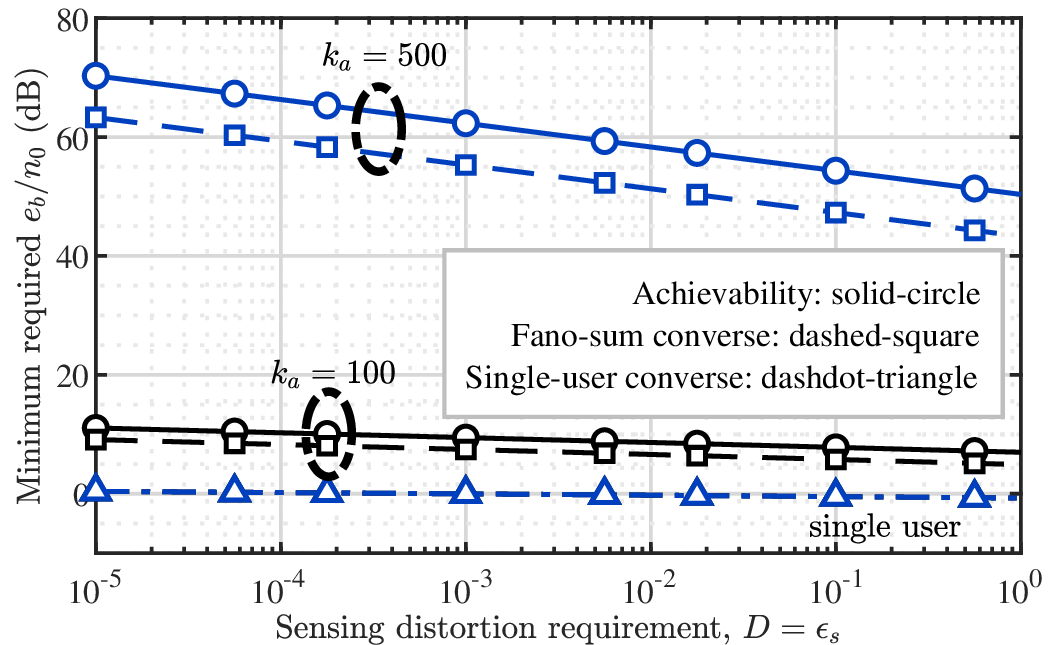
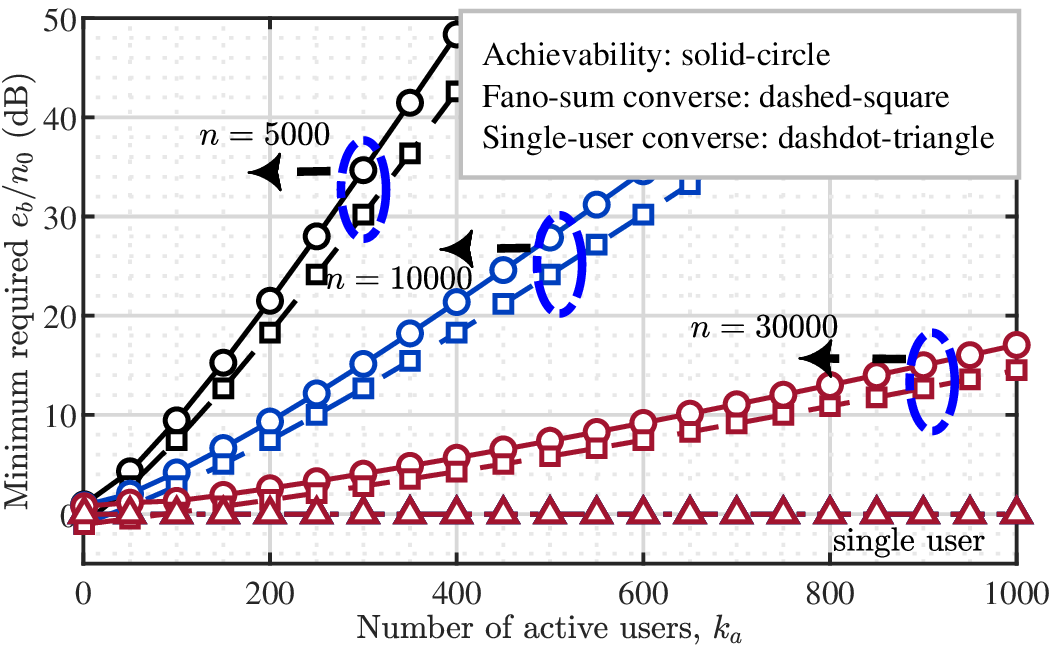
Fig. 3 plots the minimum required \(e_b/n_0\) versus the number of active users \(k_a\) for \(D=10^{-3}\), \(b=100\), \(\epsilon=0.1\), and \(n\in\{5000,10^4,3\times10^4\}\). The required energy increases monotonically with \(k_a\), while larger blocklengths substantially reduce it, and the achievability curves lie strictly above the converses. The Fano-sum converse tightly tracks the multi-user loading trend, whereas the genie-aided single-user converse remains nearly independent of \(k_a\), consistent with its single-user origin.
Fig. 4 quantifies the energy price of sensing fidelity by plotting the minimum required \(e_b/n_0\) versus \(D\) for \(n=5000\), \(b=100\), \(\epsilon=0.1\), and \(k_a\in\{100,500\}\). Since \(b_s\) grows logarithmically in \(1/D\), the required energy increases almost linearly per decade of distortion tightening. The slope is strongly load-dependent. Tightening \(D\) from \(1\) to \(10^{-5}\) costs about \(20\) dB for \(k_a=500\) but only about \(4\) dB for \(k_a=100\), showing that the energy cost of sensing accuracy is amplified by multiple-access interference. The single-user converse is nearly flat, which confirms that this amplification is a genuinely multi-user effect.
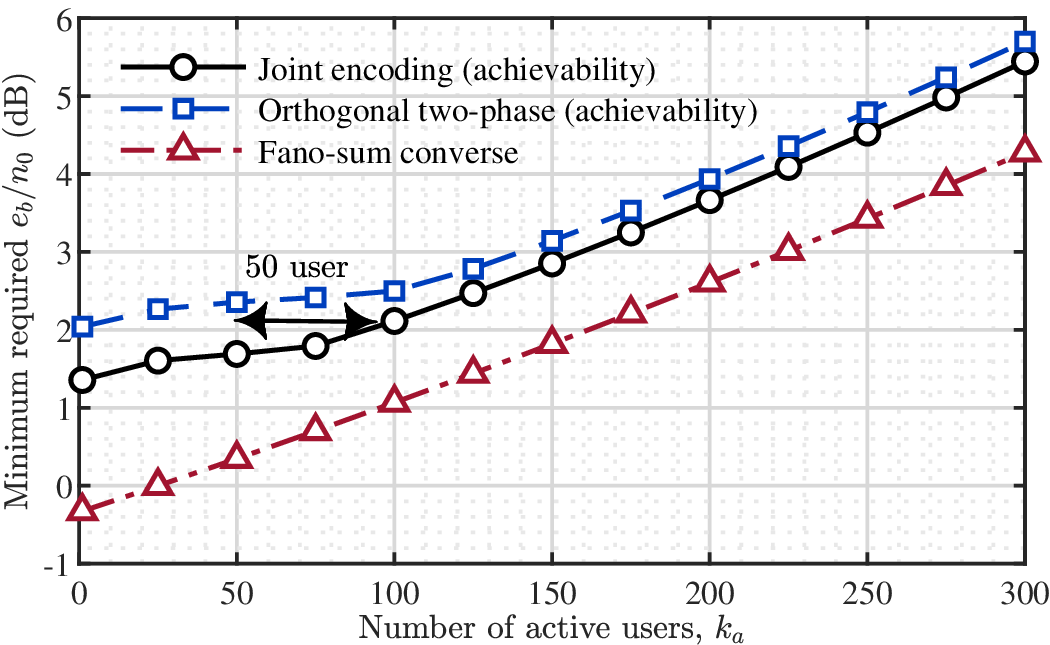
Fig. 5 compares the proposed joint encoding, in which a single codeword carries \(b_e=b+b_s\) over the entire blocklength, against an orthogonal two-phase baseline. In the baseline, the frame is split into a communication phase of \(\alpha n\) channel uses carrying \(b\) bits and a sensing report phase of \((1-\alpha)n\) channel uses carrying \(b_s\) bits, each designed for a target error \(\epsilon/2\) so that the union bound meets the overall target \(\epsilon\). The minimum energy of each phase is computed from the same achievability bound, and the total energy is then minimized over the time split \(\alpha\). Even against this optimized baseline, joint encoding saves about \(0.7\) dB at small \(k_a\) and about \(0.3\) dB at \(k_a=300\). The gain stems from coding over the full blocklength, which avoids the dispersion penalty of two shortened sub-blocks, and from a single shared error budget instead of the split \(\epsilon/2\) targets. Both achievability curves remain above the Fano-sum converse, and the joint scheme stays uniformly closer to it, indicating that integrating sensing and communication into one codeword is strictly more energy-efficient than time-sharing.
5 Conclusion↩︎
We developed a finite-blocklength ISAC framework for Gaussian multiple-access channels by proving that sensing-distortion constraints are equivalent to source-coding requirements, which folds the fidelity/distortion target into a sensing-equivalent payload and reduces ISAC to recovering the effective load. We derived an achievability bound, a Fano-sum many-user converse, and a genie-aided single-user converse. Numerical results show that stricter sensing accuracy reduces the achievable rate, the energy price of fidelity is amplified by multiple-access interference, and joint encoding strictly outperforms optimized orthogonal time-sharing, quantifying the integration gain of ISAC in the short-packet regime.
References↩︎
Zhentian Zhang, and Zaichen Zhang are with the National Mobile Communications Research Laboratory, Southeast University, Nanjing, 210096, China and Hao Jiang is with the School of Cyber Science and Engineering, Southeast University, Nanjing 210096, P. R. China (e-mail: zhentianzhangzzt@gmail.com, zczhang.seu.edu.cn, jiang.hao@seu.edu.cn ).↩︎
Kaitao Meng is with the Department of Electrical and Electronic Engineering, University of Manchester, Manchester, UK (email: kaitao.meng@manchester.ac.uk).↩︎