TileLens: Efficiently Using Large-Granularity Memory Systems with Transparent Two-Dimensional Memory Layout
July 04, 2026
Abstract
Large Language Model (LLM) inference is bottlenecked by the capacity and bandwidth of GPU High-Bandwidth Memory (HBM). Recent proposals, such as High-Bandwidth Flash (HBF) and RoMe, offer higher capacity or bandwidth than HBM, but require a minimum access granularity of kilobytes (e.g., 4 KB). We show that these Large-Granularity Memory Systems (LGMS) can degrade the performance of tiled matrix-multiplication, which is the dominant operation in LLM inference, by up to an order of magnitude. The root cause of the slowdown is read amplification, where memory requests fetch far more data than the tile actually needs. This waste stems from a fundamental mismatch between the two-dimensional nature of compute tiles and the one-dimensional memory layout, leading to each request spilling well beyond the tile boundaries.
To mitigate read amplification, we propose to use tile-major layout for LGMS. Rather than storing data as an one-dimensional strip, tile-major layout reshapes each contiguous memory block into a two-dimensional rectangle, aligning memory granularity with tile boundaries. To ease the adoption of tile-major layout on GPUs, we propose TileLens, lightweight software and hardware extensions that collectively cover major classes of GPU kernels. TileLens-SW extends GPU DSLs so that DSL-based kernels (e.g., CUTLASS, FlashAttention) can adopt tile-major in global memory by changing only the layout descriptor. TileLens-HW extends the Tensor Memory Accelerator (TMA) for transparent tile-major support in TMA-based kernels (e.g., cuBLAS, DeepGEMM) without code changes. We evaluate TileLens on a cycle-level simulator using matrix-multiplication kernels from Qwen-3 30B and Llama-3.1 70B. Combining a tile-major layout with an adaptive hardware prefetcher, TileLens achieves near-HBM performance on HBF-augmented GPUs with a 5 \(\mu\)s HBF NAND read latency, reducing the geomean slowdown from 1.61–6.49\(\times\) with conventional layouts to within 1% of an HBM-only baseline.
1 Introduction↩︎
The rapid adoption of Large Language Models (LLMs) is pushing the limits of current GPU memory systems. Model sizes have grown to require up to terabytes of GPU memory [1]–[4]. Moreover, emerging capabilities such as reasoning, multimodality, and agentic behavior require larger per-user state. LLM inference is dominated by matrix multiplications that read model weights and user state for each generated token with little data reuse. As a result, GPU memory capacity and bandwidth are the main bottlenecks for LLM inference performance [5].
New GPU memory technologies have been proposed to address these bottlenecks by providing higher capacity or bandwidth than the current HBM (High-Bandwidth Memory). High-Bandwidth Flash (HBF) [5]–[8] is an emerging technology that stacks NAND flash memory dies in a manner similar to HBM, offering 8–16\(\times\) the capacity with comparable bandwidth. RoMe [9] reclaims the bandwidth consumed by the address and command buses for data transfers by increasing the HBM access granularity to 4 KB. Both proposals require a minimum access granularity of kilobytes, much larger than the 32 B granularity of HBM. However, the impact of employing such Large-Granularity Memory Systems (LGMS) on GPUs for LLM inference has not been well studied.
We show that using LGMS on GPUs results in read amplification during matrix multiplication (matmul), where each memory access fetches more data than what is useful for computation. Matmul kernels on GPUs split matrices into two-dimensional (2-D) tiles and schedule the tiles across CTAs (cooperative thread array, or thread block) [10]–[12]. The width of the 2-D compute tile is typically 64–512 bytes, which is much smaller than the kilobyte-scale granularity of LGMS. Thus, in LGMS, each access fetches a one-dimensional strip that extends far beyond the two-dimensional compute tile.
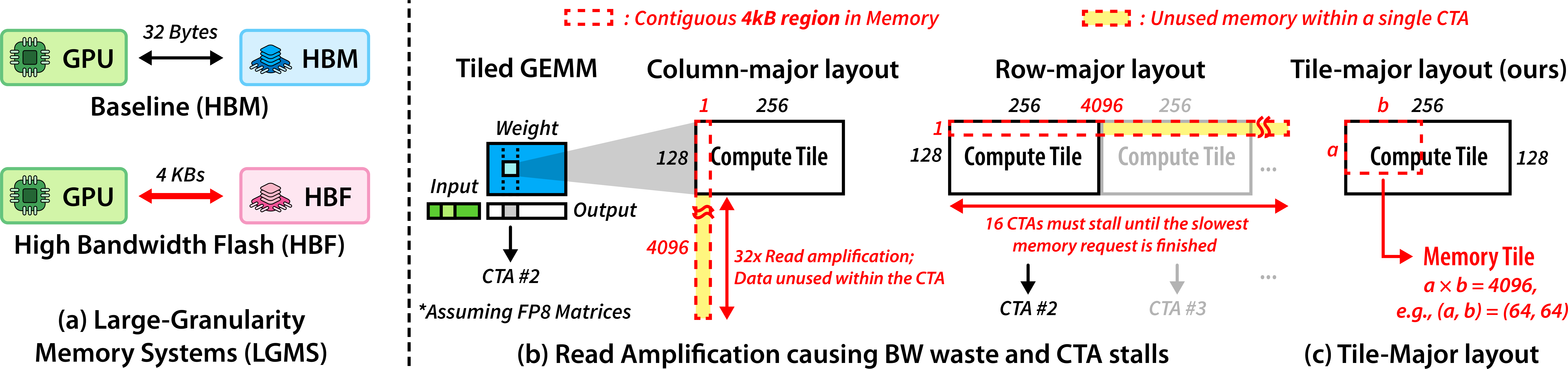
Read amplification degrades matmul performance by up to an order of magnitude with conventional layouts, as shown in Figure 1-(b). Matrices are stored in column- or row-major layout, where an entire column or row is contiguous in memory. In column-major layout, each CTA accesses columns of the weight matrix that are not used by other CTAs, and read amplification directly wastes bandwidth. Caching the excess data is infeasible: on an H200 GPU with \(32\times\) amplification, hundreds of megabytes of data must be buffered to avoid wasting bandwidth. In row-major layout, overfetched data may be reused by other CTAs, but this sharing introduces a straggler problem. Without read amplification, each CTA can proceed as soon as its own memory requests arrive. With shared memory requests among CTAs (Figure 1-(b)), however, no CTA in the group can proceed until all outstanding requests have arrived. The slowest straggler request thus delays all dependent CTAs, serializing execution that would otherwise overlap.
The root cause of read amplification is the conflict between the 1-D global memory layout in current GPUs and the 2-D tiled matmuls on LGMS. Our insight is that if the contiguous memory block is two-dimensional and fits within a compute tile, read amplification can be eliminated. The goal of this paper is to design a low-cost architectural support for GPUs that maintains the benefits of LGMS without the read amplification penalty. We mainly focus on HBF, where high read latency amplifies the performance impact of read amplification, posing a more demanding challenge.
To this end, we propose to use tile-major layout for LGMS to mitigate read amplification. Tile-major layout reshapes the contiguous unit of memory from a 1-D strip to a 2-D rectangle. We decouple the memory layout from the compute tile by introducing the concept of memory tiles: rectangular units of data that are contiguous in global memory. For example, Figure 1-(c) shapes a 4 KB FP8 region as a \(64 \times 64\) memory tile that fits within the compute tile. As long as the compute tile dimensions are multiples of the memory tile dimensions, read amplification is eliminated in tile-major layout.
However, the vast configurability of tile-major layouts poses a challenge to their adoption. Unlike row- or column-major, tile-major is not a single but a family of configurable layouts parameterized by the memory tile dimensions. Because the correctness of a GPU kernel depends on the global memory layout it assumes, separate code is required for different memory tile shapes. To address this, we propose TileLens, lightweight software and hardware extensions that collectively cover all major classes of GPU kernels with transparent support for multiple memory tile configurations.
TileLens-SW extends GPU DSLs to support tile-major in global memory. While the layout abstraction of GPU DSLs can represent arbitrary layouts, their code generation only supports row- or column-major layouts in global memory. The DSL layouts were not utilized for global memory because HBM’s access granularity is fine enough that simple row- or column-major layouts already achieve high bandwidth utilization. We extend the DSL to support tile-major global memory layouts by viewing a tiled two-dimensional matrix as a four-dimensional tensor and loading tiles with the corresponding four-dimensional coordinates and tile dimensions. Through this change, kernel libraries built on DSL frameworks (e.g., CUTLASS [11]) and high-performance kernels (e.g., FlashAttention [13]) can adopt a tile-major layout by changing only the layout descriptor, without modifying the compute logic.
Next, we propose TileLens-HW to support kernels that do not use the DSL and to provide additional flexibility in tile sizes. Our insight is that if a dedicated hardware converts logical tensor indices into memory addresses, minimal changes will allow it to transparently support tile-major layout. Because kernels will interact with the hardware only through logical tensor indices, most of the code can be agnostic to the global memory layout. Such hardware exists across GPU and accelerator architectures, including NVIDIA Tensor Memory Accelerator (TMA) [14], AMD shim DMA [15], and Intel 2D block loads [16]. We demonstrate our approach on the TMA, widely used to load matmul weights on recent NVIDIA GPUs. TileLens-HW extends the TMA hardware to support tile-major layout, enabling a single kernel that uses the TMA (e.g., cuBLAS [10], DeepGEMM [17]) to simultaneously support multiple tile-major layouts.
We modify the TMA so we can pass the memory tile dimensions to the TMA descriptor as a runtime argument. With the information, additional hardware logic computes the address for the given tile-major layout as if the TMA was called for row- or column-major layout. Through TileLens-HW, a single GPU kernel or binary can support multiple memory tile configurations simultaneously, without rewriting the code or recompilation. Because TMA is essential for high-performance kernels on recent NVIDIA GPUs, TileLens covers most of the optimized kernels. Kernels that do not use TMA can adopt a tile-major layout by modifying their address computation (Section 3.2).
While tile-major layout addresses read amplification on LGMS, integrating HBF into a GPU system requires additional microarchitectural changes. To address HBF’s limited write endurance, we only allocate weight matrices to HBF while keeping KV cache and activations on HBM. For HBF to coexist with HBM, we propose a mixed-granularity L2 cache. To effectively hide microsecond-scale read latency of HBFs, 4 KB-granularity miss status holding registers (MSHRs) are added to track more concurrent HBF requests, while an adaptive stride prefetcher fills the bandwidth to hide HBF latencies that are orders of magnitude longer than HBM latencies. We evaluate on a cycle-level simulator and show tile-major brings HBF-augmented GPU performance from a 1.61–6.49\(\times\) geomean slowdown to within 1% of an HBM-only system.
Contribution. This paper makes the following contributions.
To the best of our knowledge, this is the first paper to analyze the read amplification problem that occurs on GPUs with LGMS. We show that read amplification degrades the performance of matmul kernels by an order of magnitude.
We propose using tile-major layout for LGMS. This layout maps a contiguous memory region into 2-D memory tiles, enabling the use of LGMS without read amplification.
We propose TileLens, which addresses the configurability challenge of tile-major layouts by extending GPU DSLs (TileLens-SW) and TMA (TileLens-HW) to transparently support tile-major layouts regardless of memory tile shape and size.
We evaluate TileLens on matmul kernels from the Qwen-3 30B [18] and Llama-3.1 70B [3] and show that TileLens avoids the performance loss due to read amplification in LGMS.
2 Background and Motivation↩︎
2.1 LLM Inference↩︎
LLM inference consists of two phases: prefill and decode. The decode phase generates output tokens autoregressively, and the model weights and per-user state (KV cache) must be read for each generated token. As recent reasoning workloads produce increasingly long outputs, the decode phase dominates end-to-end latency [19].
GPU memory capacity and bandwidth are the two main bottlenecks for LLM inference. During the decode phase, model weights are read but reused only once per token, making memory bandwidth the bottleneck for latency. Increasing the batch size improves throughput by amortizing load across tokens, but a larger batch also increases the KV cache size, making memory capacity the bottleneck for further throughput gains.
2.2 Emerging Memory Systems for GPUs↩︎
Several memory systems have recently been proposed to overcome the capacity and bandwidth limitations of GPU HBM for LLM inference. These systems share a common architectural consequence: a minimum read granularity of kilobytes (e.g., 4 KB), far larger than HBM’s 32 B. We refer to them collectively as Large-Granularity Memory Systems (LGMS).
HBF. High-Bandwidth Flash (HBF) [6] stacks NAND flash dies, copackaged with GPUs via a silicon interposer. HBF provides memory bandwidth comparable to HBM (\({\sim}\)1.6 TB/s per stack for Gen1) while offering 8–16\(\times\) the capacity per stack due to the higher density of NAND flash cells. Its minimum access granularity is on the order of kilobytes, constrained by factors such as NAND page size and ECC requirements. HBF also exhibits read latency on the order of microseconds (1–10 \(\mu\)s), significantly higher than HBM’s \({\sim}\)100 ns.
RoMe. RoMe [9] increases the access granularity of HBM from 32 B to 4 KB. Fewer commands per unit of data frees up address (command) pins to carry data, increasing data bandwidth by 12.5%.
2.3 Matrix Multiplication on GPUs↩︎
Most of the time in LLM decode is spent on matrix multiplications, where for an input matrix of size \(M \times K\), the weight matrix of size \(K \times N\) is read from GPU global memory to compute the \(M \times N\) output matrix (Figure 2). Mixture-of-experts (MoE) models route tokens to each expert’s weight matrix, but each expert performs the same matmul, so the same memory access pattern applies.
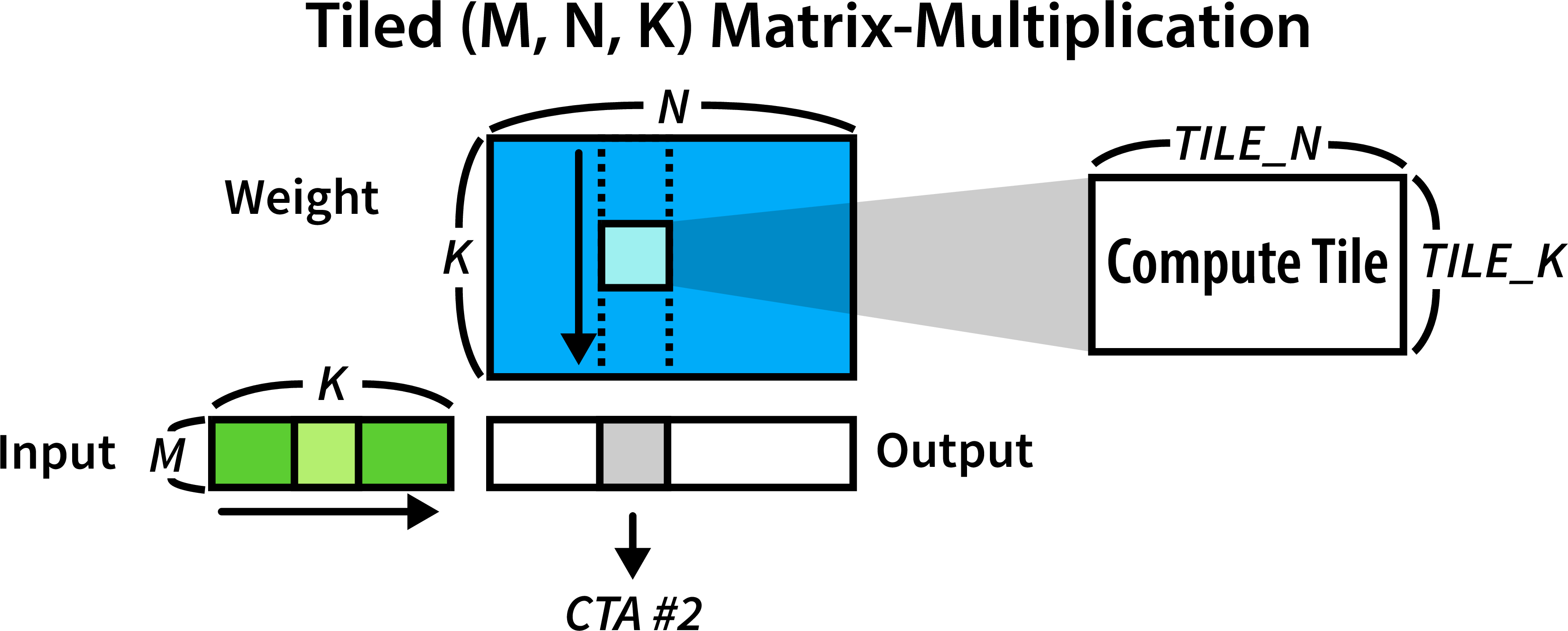
Tiled Matrix Multiplication. GPU matmul implementations [10]–[12] partition the matrices into compute tiles as shown in Figure 2, each assigned to a cooperative thread array (CTA) for parallel execution. At each iteration over the \(K\) dimension, a tile of the weight matrix is loaded from GPU global memory into on-chip scratchpad memory to compute a partial matmul. Compute tile dimensions typically range from 32 to 512 elements per side.
2.4 Data Layout in GPU Memory System↩︎
Row-major and column-major are the two standard global memory layouts used for matrix multiplication, as shown in Figure 3. In row-major, elements in the same row are contiguous in memory; in column-major, elements in the same column are contiguous. For weight matrices in LLM inference deployments, column-major, the layout that keeps the K-dimension in Figure 2 contiguous, is the dominant choice [20]. Widely used frameworks such as PyTorch default to column-major, and certain quantization formats in NVIDIA GPUs require column-major weights [11], [21].

2.5 Challenges of Employing LGMS↩︎
We show that LGMS causes severe read amplification in tiled matrix multiplication. Because the weight matrix is stored in a one-dimensional layout (row- or column-major), each 4 KB access returns a contiguous strip along a single dimension, most of which falls outside the two-dimensional compute tile boundary (Figure 1-(b)). This read amplification degrades performance through (1) wasted memory bandwidth and (2) straggler-induced CTA stalls.
Bandwidth waste. When the extra data from read amplification is not reused, it is discarded, directly wasting memory bandwidth. Retaining it on-chip for future reuse is infeasible at the required scale: on an NVIDIA H200 GPU with 132 SMs, a \(32\times\) amplification factor over 128 KB of shared memory per SM produces 528 MB of amplified data per iteration, far exceeding the 50 MB L2 cache size.
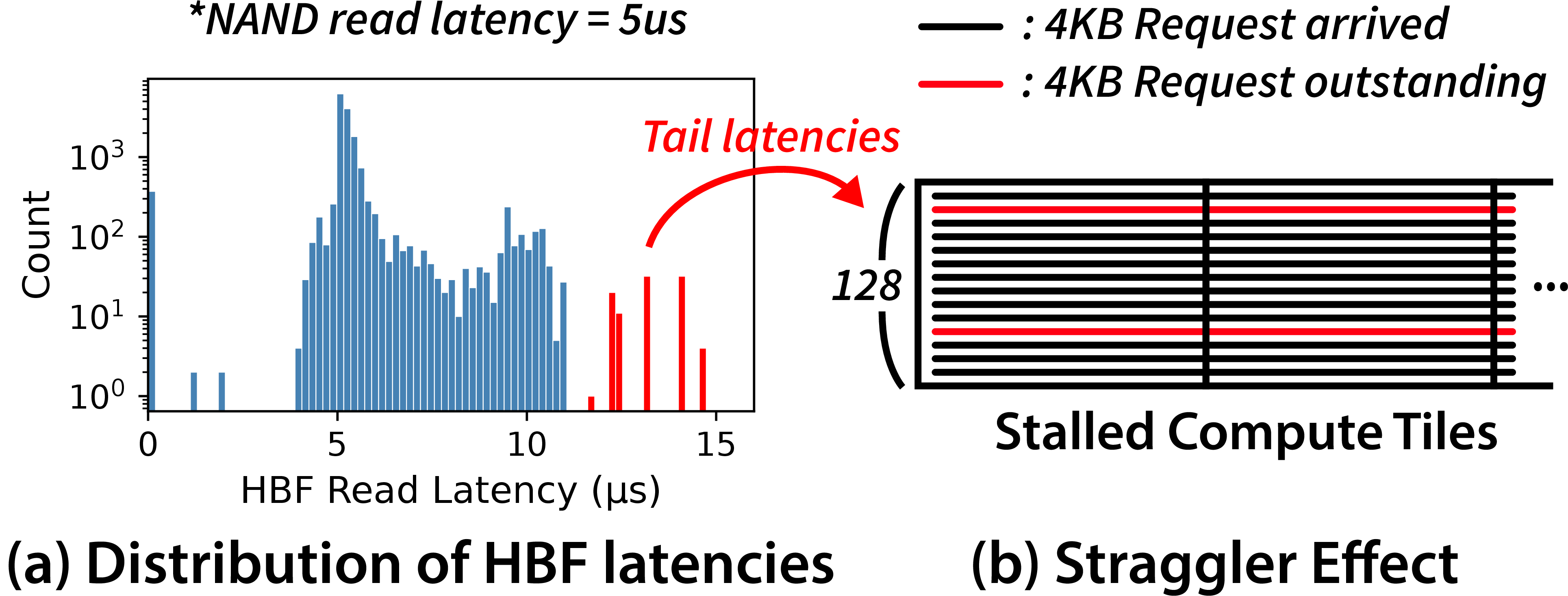
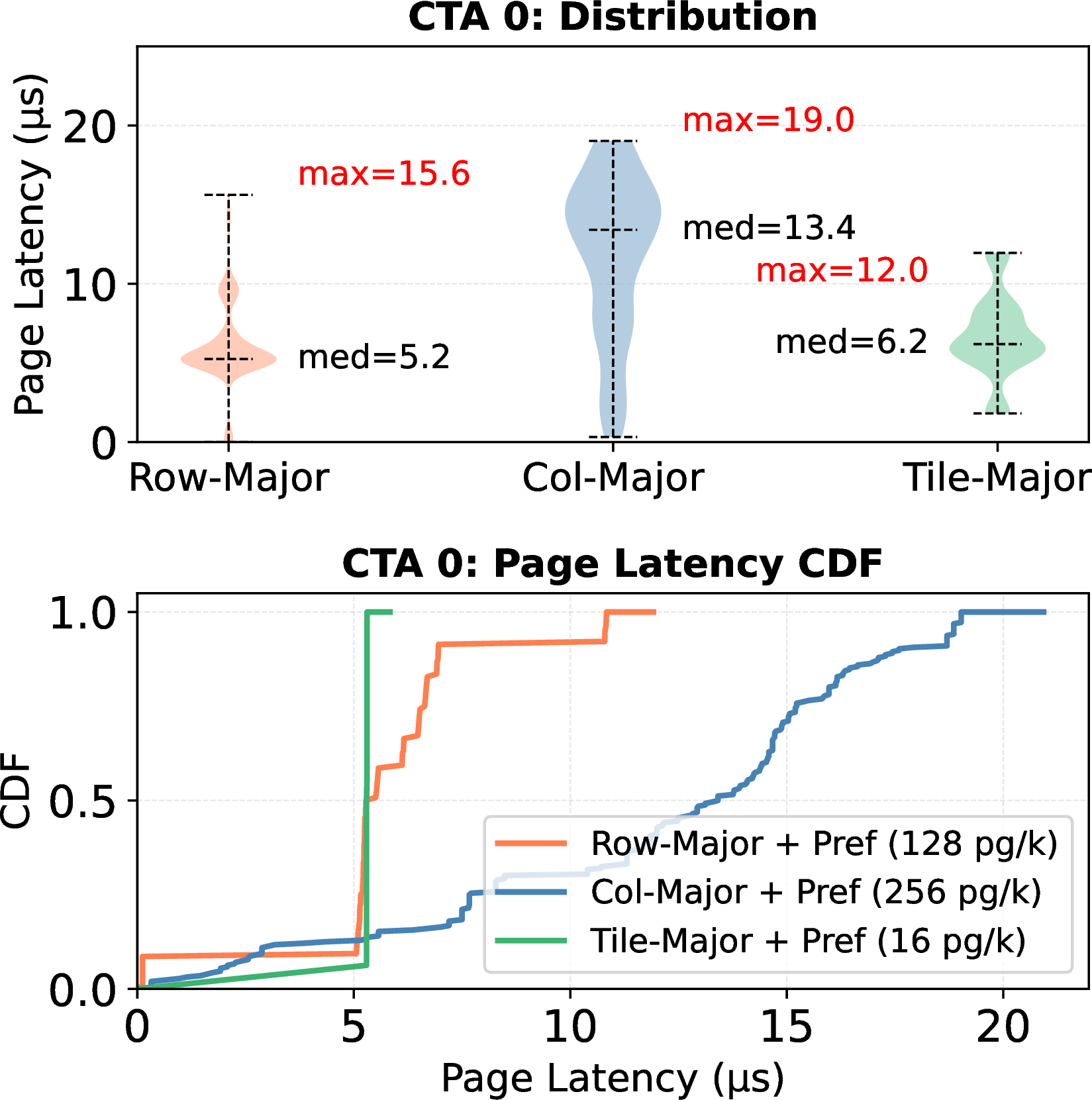
CTA stalls due to straggler accesses. A single compute tile requires multiple 4 KB memory requests, and the CTA cannot begin computation until all of them complete. As Figure 4 shows, LGMS access latencies exhibit a long tail: the slowest outstanding request determines each CTA’s execution time.
This effect compounds across CTAs. When multiple CTAs share 4 KB requests due to overlapping tile regions, the straggler request becomes an implicit synchronization point: all dependent CTAs stall until it completes, even though they are otherwise independent. As shown in Figure 5, this implicit synchronization serializes CTA execution and stretches the total kernel runtime.
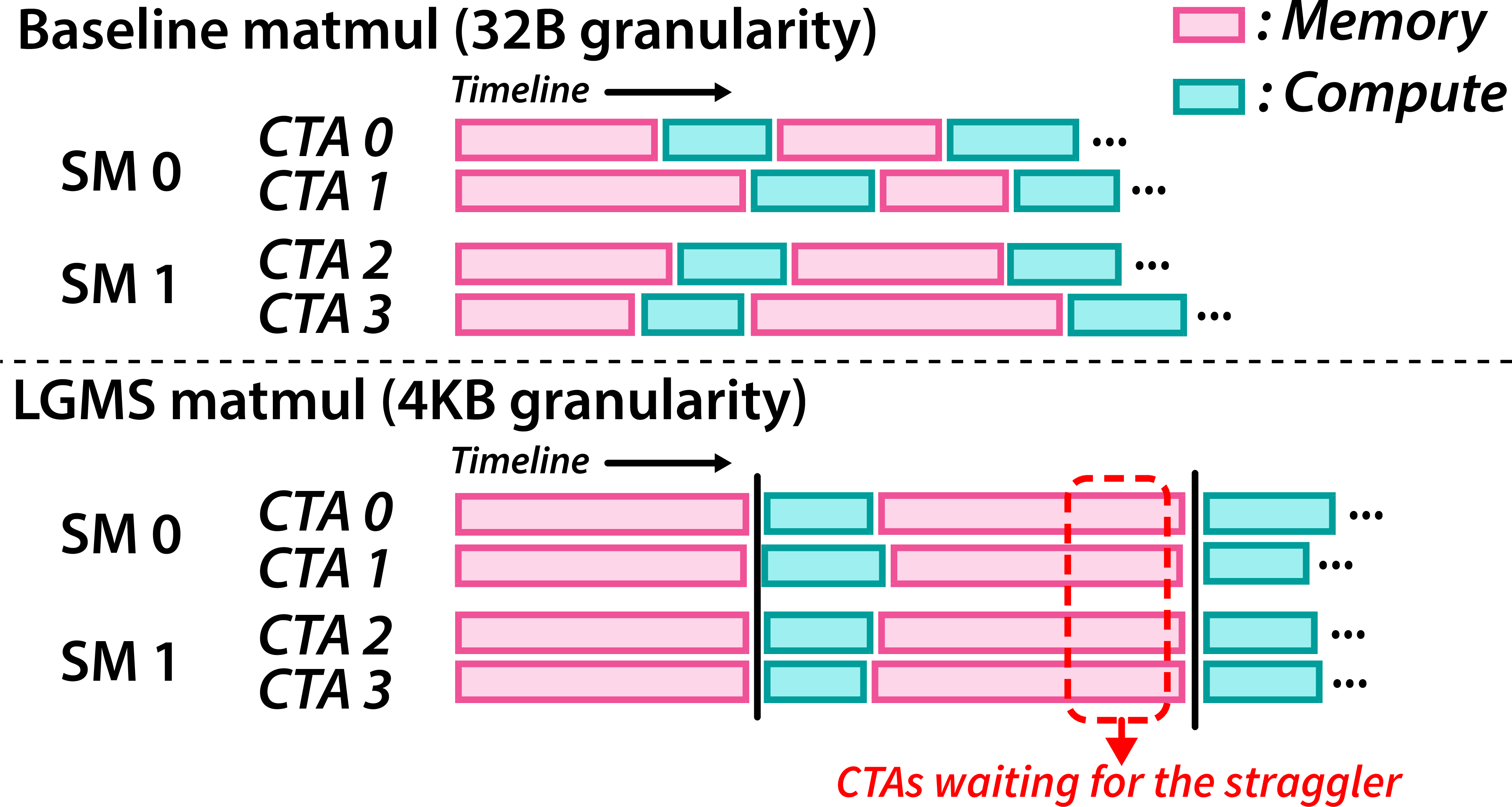
Figure 6 quantifies the impact of stragglers on Qwen-3 30B fused_moe with a \(128 \times 256\) FP16 compute tile on a simulated HBF system. The simulation setup is shown in
Section 6.2. Column-major layout suffers \(10.1\times\) read amplification, which increases stall cycles by \(14.8\times\) and degrades execution time
by \(11.2\times\) relative to an HBM baseline. Row-major layout reduces read amplification to \(3.9\times\) through reusing the rows across CTAs, but straggler-induced stalls still degrade
execution time by \(3.3\times\).

2.6 Goal of the Paper↩︎
Existing works that propose LGMS for GPUs [7]–[9] focus on scaling memory capacity and bandwidth but do not address read amplification arising from tiled matmul access patterns. This paper does not advocate for any specific LGMS technology; rather, we identify read amplification as a general consequence of large access granularity and propose a solution that applies to any LGMS. Our goal is to obtain the capacity and bandwidth benefits of LGMS while eliminating read amplification, with only lightweight changes to GPU software and hardware for practical adoption. We focus more on HBF as its longer access latency combined with the read amplification makes the problem more challenging.
3 Tile-Major Data Layout↩︎
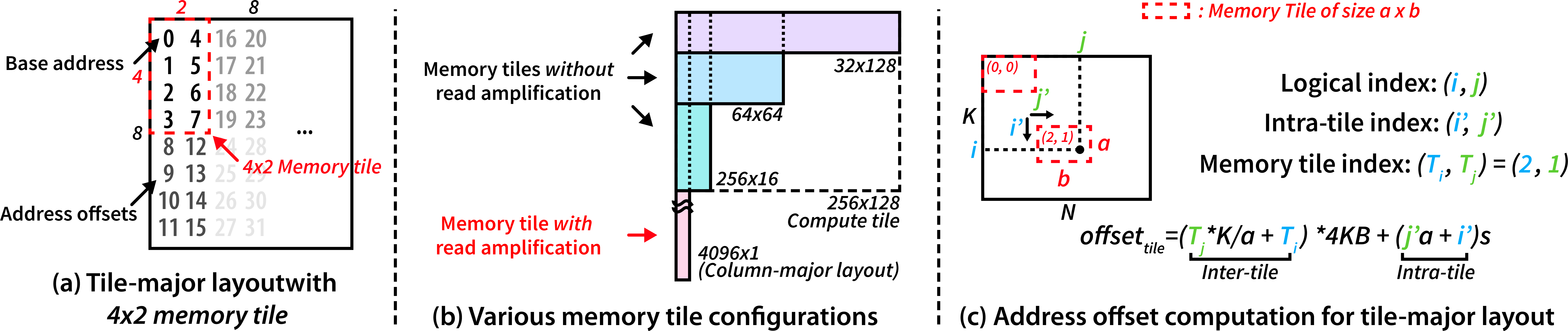
Read amplification arises because the one-dimensional global memory layout produces 4 KB strips that do not align with two-dimensional compute tiles. Therefore we propose to use tile-major layout, which reshapes the contiguous unit of global memory from a one-dimensional strip into a two-dimensional rectangle that fits within a compute tile. We call this rectangular unit the memory tile (Figure 7-(a)).
3.1 Decoupling Memory Tile and Compute Tile↩︎
A contiguous 4 KB region can be shaped as any \(h \times w\) rectangle satisfying \(h \times w \times s = 4096\), where \(s\) is the element size in bytes. For FP8 (\(s = 1\)), row-major corresponds to the extreme \((1, 4096)\) and column-major to \((4096, 1)\); both extend far beyond compute tile boundaries, causing read amplification. By selecting a shape that fits within a compute tile, e.g., \((64, 64)\), every byte in each 4 KB fetch is consumed by the kernel, eliminating read amplification.
However, the memory layout is static (fixed at allocation time), while the compute tile shape varies across kernels (e.g., \(128 \times 128\) vs.\(256 \times 64\)). Matching the memory tile exactly to one kernel’s compute tile would not work for others. Tile-major layout avoids this mismatch by decoupling the memory tile from the compute tile, as shown in Figure 7-(b). The memory tile \(a \times b\) is chosen small enough to divide evenly into many compute tile sizes: for example, a \(64 \times 64\) FP8 memory tile fits within compute tiles of \(64 \times 64\), \(128 \times 128\), \(256 \times 256\), and so on. An \(M \times N\) matrix is viewed as a grid of \((M/a) \times (N/b)\) memory tiles, each packed contiguously in physical memory.
3.2 Address Translation↩︎
We use column-major as the baseline in our explanation; the same approach applies to row-major, with rows and columns swapped. In column-major layout, element \((i, j)\) of a \(K \times N\) matrix has byte offset \((j \cdot K + i) \cdot s\) from the matrix base address, where \(s\) is the element size in bytes. As illustrated in Figure 7-(c), for a memory tile \(a \times b\) (where \(a \cdot b \cdot s = 4096\)), we decompose \((i, j)\) into inter-tile index \((T_i, T_j)\) indicating which memory tile an element belongs to, and intra-tile index \((i', j')\) indicating its position within that tile: \[T_i = \lfloor i/a \rfloor, \quad i' = i \bmod a, \quad T_j = \lfloor j/b \rfloor, \quad j' = j \bmod b. \label{eq:tile95indices}\tag{1}\]
The tile-major byte offset from the matrix base address is: \[\text{offset}_\text{tile} = \underbrace{(T_j \cdot \tfrac{K}{a} + T_i)}_{\text{linear memory tile index}} \cdot \underbrace{a \cdot b \cdot s}_{4\text{\,KB}} \;+\; \underbrace{(j' \cdot a + i') \cdot s}_{\text{intra-tile col-major offset}} \label{eq:tilemajor95offset}\tag{2}\] The first term computes how many 4KB tiles are between the matrix base address and the tile base address (memory tiles ordered column-major); the second term locates the element inside the tile. Because \(a\) and \(b\) are always powers of two (\(a \cdot b \cdot s = 4096 =2^{12}\)), decomposing \((i, j)\) into inter/intra tile coordinates requires only bit shifts and masks (e.g., \(T_i = i \gg \log_2 a\), \(i' = i \;\&\; (a{-}1)\)).
3.3 Memory Alignment Requirements↩︎
We assume the memory allocator aligns the matrix base address to the LGMS granularity and that virtual-to-physical address translation is also aligned to the LGMS granularity. GPUs use huge pages on the order of MB to reduce TLB pressure, and even the largest memory granularity of tens of KB will fit. We also assume that the weight matrix dimensions are evenly divisible by the corresponding memory tile dimensions. We analyzed the dimensions used in recent LLMs (Qwen [18], Deepseek [4], Llama [3], Minimax [22], GPT-OSS [23]), and their dimensions are at least a multiple of 256. If the alignment is not satisfied, weights can be padded.
3.4 Challenges of Adopting Tile-Major Layout↩︎
Unlike row- or column-major, tile-major is not a single layout but a family of layouts parameterized by the memory tile dimensions \((a, b)\). Figure 7-(b) shows three valid memory tile shapes with the same total size. Moreover, the large memory granularity makes GPU kernel performance sensitive to the shape of the memory tile, turning it into an additional tunable parameter. Currently, the correctness of a kernel depends on the global memory layout it is assuming, and a separate kernel needs to be written for each memory tile shape. If GPU software and hardware allowed kernels transparent to the global memory layout, such effort can be eliminated. The transparent support would also enable legacy kernels that assume row/column major to use tile-major without changes, minimizing the overhead of transitioning to LGMS based GPUs.
4 TileLens: Transparent Tile-Major Layout↩︎
We propose TileLens, lightweight extensions to GPU software and hardware that transparently enable tile-major layout in GPU global memory. Our observation is that transparent tile-major remapping requires minimal changes if there is a dedicated hardware which computes memory addresses from logical coordinates of a tensor. Because such address computation unit will enable most code to remain agnostic to the global memory layout, they would be a natural transition point for tile-major.
Fortunately the address computation hardware already exists across GPU and accelerator architectures, including NVIDIA Tensor Memory Accelerator (TMA) [14], AMD shim DMA [15], and Intel 2D block loads [16]. We demonstrate our approach on the TMA, widely used to load matmul weights on recent NVIDIA GPUs. However the same approach can be employed on other similar accelerators to transparently support tile-major with minimal overhead.
We present three adoption paths: TileLens-SW enables DSL-based kernels to use tile-major by changing only the layout descriptor (Section 4.2); TileLens-HW extends the TMA hardware such that non-DSL kernels including low level binaries to gain transparent support (Section 4.3); and kernels that use neither TMA nor the DSL can adopt tile-major layout by modifying their address computation, either in source code or through compiler-based binary instrumentation (Section 4.4).
4.1 Tensor Memory Accelerator (TMA)↩︎
As GPU compute throughput and memory bandwidth grew, the computation of global memory addresses from logical indices began to limit matmul performance [24]. The TMA, introduced in the NVIDIA Hopper architecture [14], is a dedicated hardware that handles address computation and data movement asynchronously with the GPU core, allowing better overlap of data transfer and matmul compute. Such overlap is essential for high-performance matmul kernels, which is why it is widely used [25].
Figure 8 illustrates the input and operation of the TMA. Before kernel launch, the host creates a TMA descriptor that specifies the global tensor’s (1) base address, (2) dimensions (e.g. \((K, N)\)), (3) stride for each dimension (e.g. \((1, K)\)), and (4) data type. During kernel execution, the TMA load is issued with (1) logical coordinates of the tile base \((i, j)\), (2) tile dimensions \((u, v)\), and (3) shared memory destination address. The TMA computes global memory addresses for data in the tile, issues memory requests, writes the returned data to shared memory, and signals the core when done.
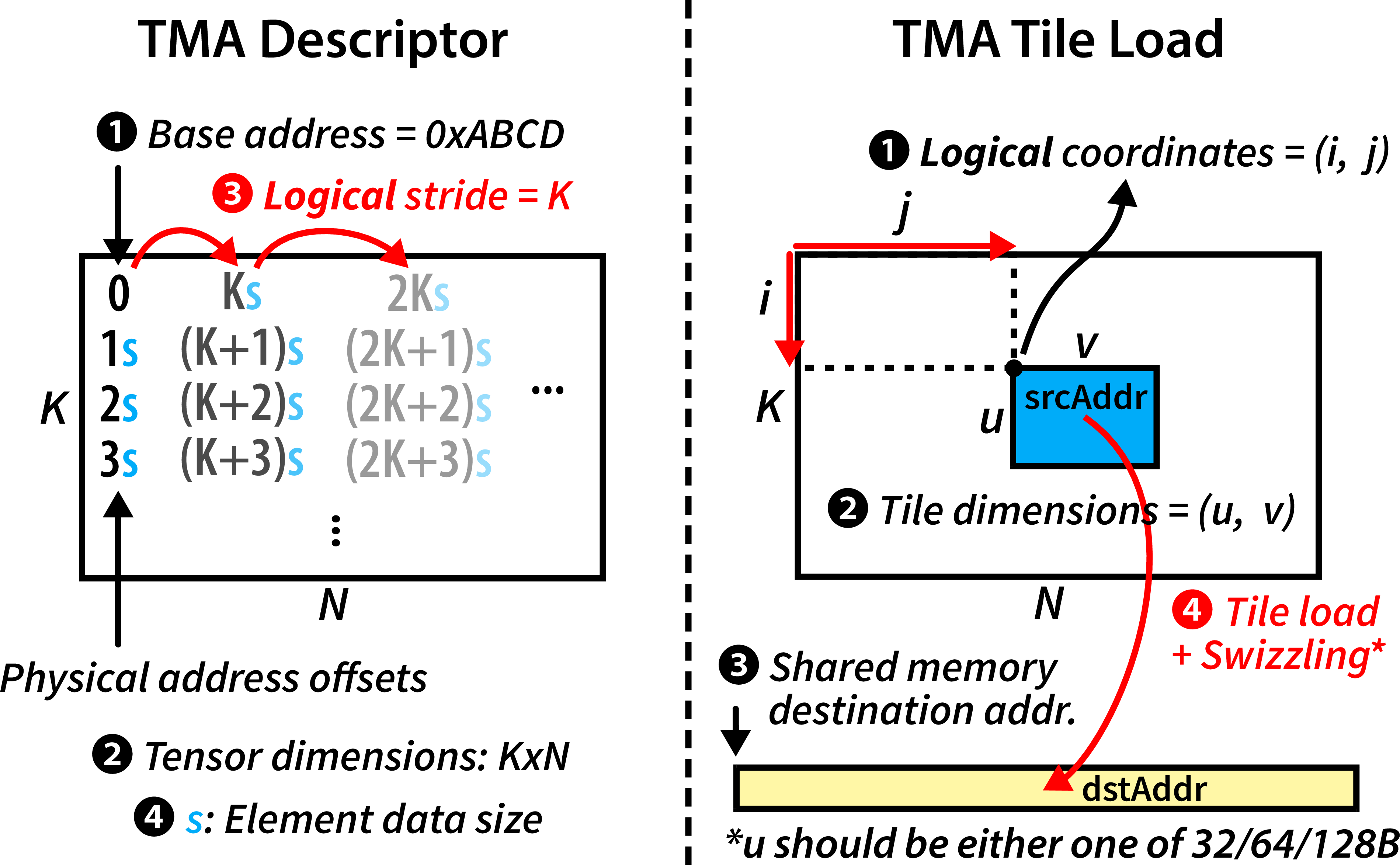
Tensor Strides and Address. Stride specifies how much the memory address changes when the corresponding coordinate is incremented by one. In Figure 8-Left, the stride is \(K\) in the horizontal dimension. Given a set of coordinates (\(i_1, i_2, ...\)) and corresponding strides (\(s1, s2, ...\)), the memory address is the sum of each coordinate multiplied by its stride (\(i_1s_1+i_2s_2+...\)), plus the base address. Note that the dimension order does not matter here as long as the strides are correctly paired to the coordinates, and strides need not be monotonically increasing for higher dimensions. TMA assumes the first dimension is contiguous (stride=1), so for an \(N\)-dimensional tensor, \(N{-}1\) stride values are specified in the descriptor.
4.2 TileLens-SW: Tile-Major via DSL Extension↩︎
GPU DSLs such as CuTe [11] provide layout abstractions that decouple compute logic from memory layout, allowing kernels to support different layouts by changing only the DSL layout descriptor. While the CuTe layout descriptor can express a wide range of layouts, including tile-major layouts, its internal code-generation logic only supports 1-D global memory layout, i.e., row- or column-major.
This restriction was never a problem with HBM, where its 32 B granularity fit within a compute tile with just linear layouts. Global memory did not need such flexibility; the layout abstractions were instead used for on-chip data arrangement in registers and shared memory, where layout choices traditionally affected performance. On LGMS, the restriction becomes problematic because kernels require tile-major ordering in GPU global memory.
TileLens-SW extends CuTe to support tile-major in global memory by viewing a tiled \(K \times N\) matrix as a four-dimensional tensor:
\[\begin{align} \text{shape} &= (a,\; b,\; K/a,\; N/b), \nonumber \\ \text{stride} &= (1,\; a,\; ab,\; Kb), \label{eq:4d95layout} \end{align}\tag{3}\] where \(a \cdot b \cdot s = 4096\) for a 4 KB granularity memory. The two additional dimensions separate the intra-tile and inter-tile indices. The third-dimension stride of \(ab = 4096/s\) elements corresponds to exactly one 4 KB memory tile, so adjacent tiles are contiguous in memory and aligned to the memory granularity.
At runtime, the 2-D matrix coordinates \((i,j)\) are converted to 4-D coordinates \((i', j', T_i, T_j)\) via Equation 1 , and the TMA descriptor and load calls are updated accordingly. CuTe-based kernels thus adopt a tile-major layout by changing only the layout descriptor, without modifying the compute logic.
4.3 TileLens-HW: Tile-Major Aware TMA↩︎
In this section, we propose TileLens-HW, an extension to address computation hardware like TMA to provide transparent tile-major support for non-DSL kernels. With TileLens-HW all kernels that utilize TMA can be switched to use tile-major by only providing a different TMA descriptor at runtime. Our insight is that because TMA operates on logical tensor indices rather than memory addresses, the index-to-address mapping is fully contained within the TMA. Thus it is a natural place to apply tile-major remapping.
TileLens-HW adds two fields to the TMA descriptor: (1) the contiguous dimension of the global matrix \(K\), and (2) the memory tile dimensions \((a, b)\), with \(a \cdot b \cdot s = 4096\) for 4 KB access granularity. Our TMA extension uses these fields to perform tile-major address remapping internally, so a single kernel binary supports different memory tile configurations without
recompilation. We only modify the TMA’s source address (srcAddr) computation logic.
Challenges of Supporting Tile-Major in TMA. Transparently supporting tile-major through hardware is challenging because programmers can view the same tensor in multiple ways. TMA must produce correct tile-major addresses regardless of the view. For example, for a single 2-D matrix, the programmer can choose to view it as a higher-dimensional tensor in multiple ways. Consider an FP8 \(384 \times 128\) matrix in column-major shown in Figure 9, and the kernel wants to load a \(128 \times 64\) tile at logical coordinates \((256, 64)\). This load can be expressed as any of the following:
2D: \((384, 128)\) tensor, \((256, 64)\) coordinates, \((128, 64)\) tile.
3D: \((128, 128, 3)\) tensor, \((0, 64, 2)\) coordinates, \((128, 64, 1)\) tile.
4D: \((128, 64, 3, 2)\) tensor, \((0, 0, 2, 1)\) coordinates, \((128, 64, 1, 1)\) tile.
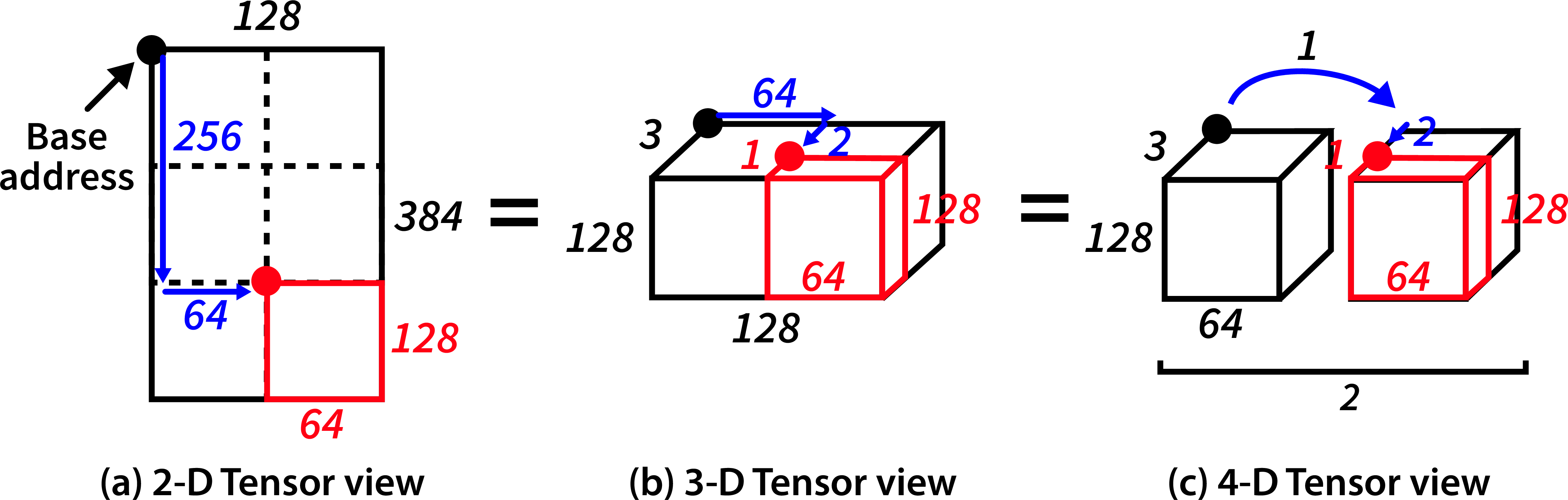
Moreover, except for the contiguous first dimension, the programmer is free to reorder the remaining dimensions, along with their strides, tile sizes, and coordinates. Kernels routinely use the different views to simplify coordinate computation from the CTA index and iteration count. For a hardware solution to be viable, tile-major remapping must handle all these representations with minimal overhead, without a separate circuit for each combination.
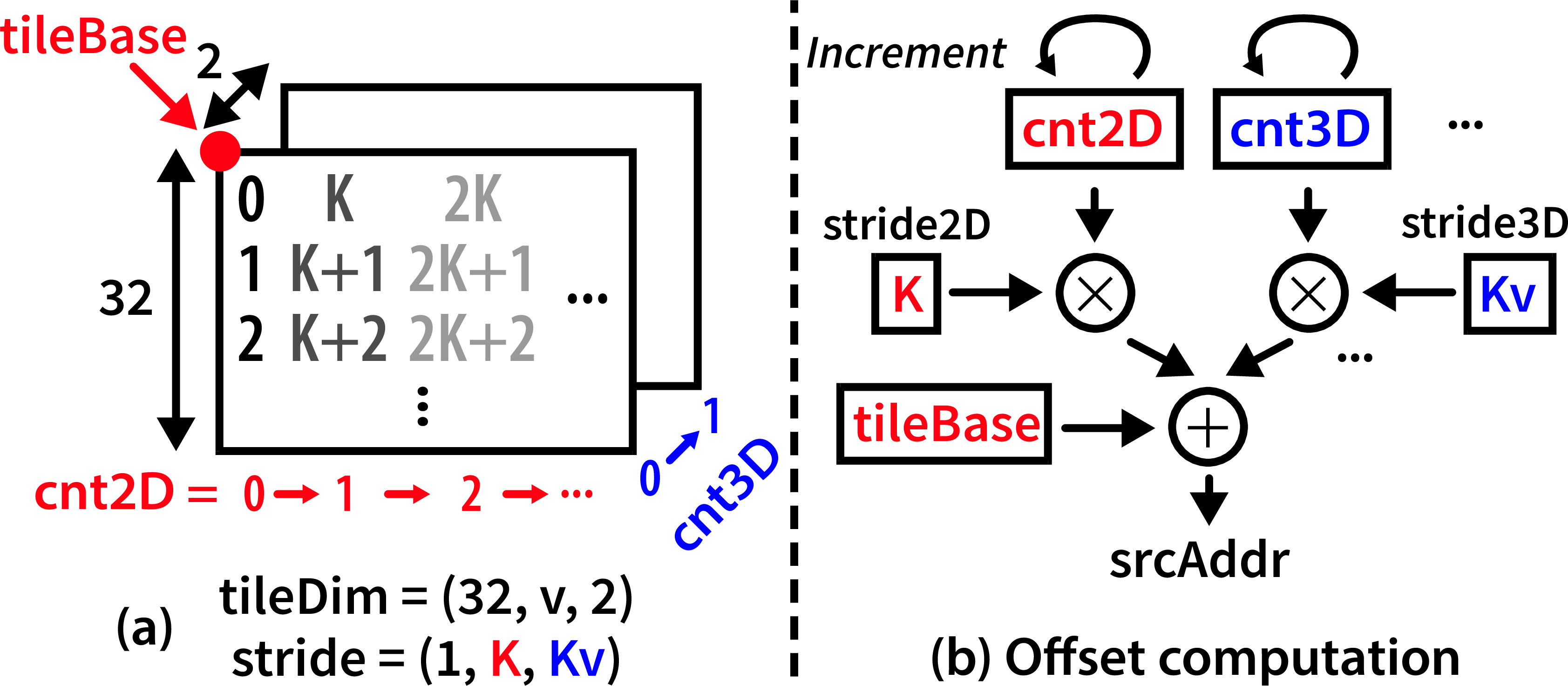
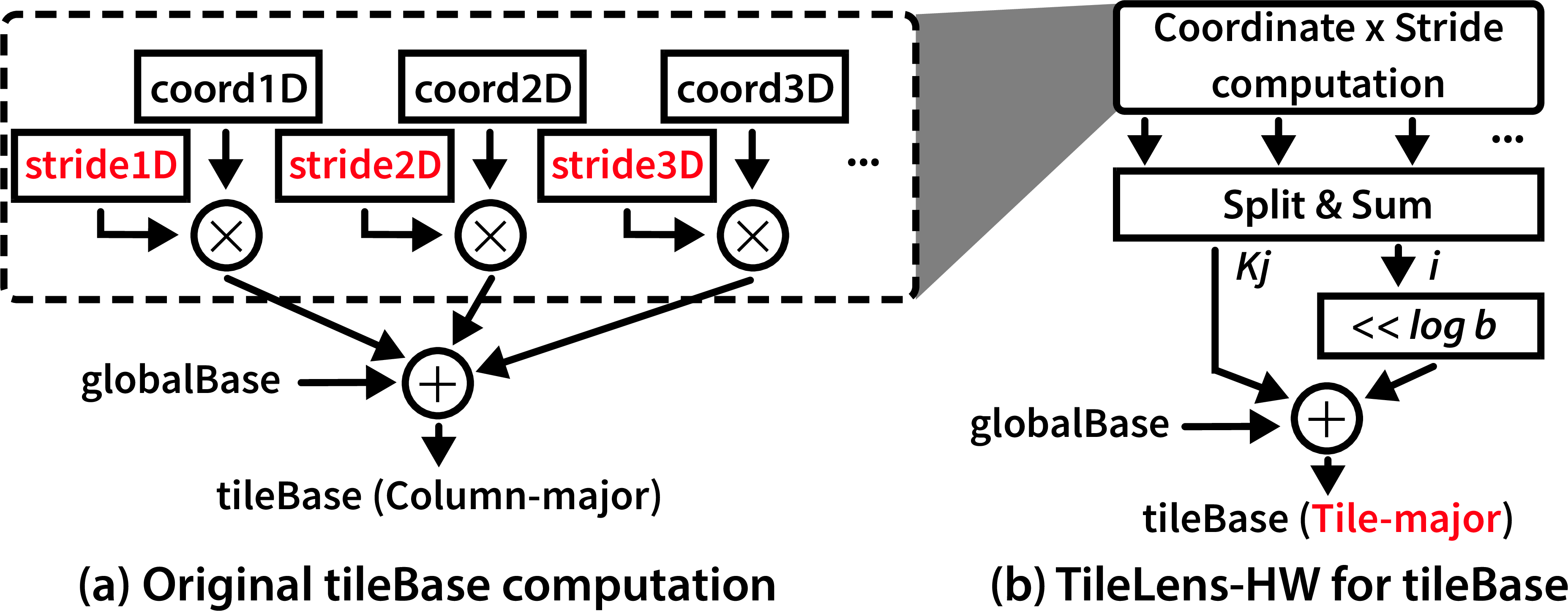
TMA Microarchitecture. While the exact microarchitecture of TMA is not publicly documented, we assume a simple counter-based hardware similar to DMA engines that support multi-dimensional data transfer [26], [27]. We model the TMA operation as two phases. In the first phase, TMA computes the tile base
address (tileBase) from the coordinates and strides (Figure 11-(a)). In the second phase, a hardware unit with incrementing counters generates source and destination addresses (src/dstAddr) and
issues memory requests (Figure 10-(a, b)). The counters represent the coordinates within the TMA tile, and the source address is a sum of the counters multiplied by corresponding strides, plus tilebase. The
destination address simply increments in the coordinate order (simplifying swizzling).
Invariants in TMA calls. Two invariants in TMA calls enable a hardware extension with minimal overhead. First, the contiguous dimension \(u\) of every TMA tile is a power of two in bytes (e.g., 32 B, 64 B, or 128 B), except for special cases of sub-byte types (e.g., FP6 on Blackwell) [28]. The reason is for shared memory swizzling, where TMA uses bit permutations within a power-of-two width. Usage of swizzling is essential for matmul performance [25]. Since the memory tile dimensions \(a\) and \(b\) are also powers of two, one divides the other, guaranteeing alignment in the contiguous dimension.
Second, regardless of how the programmer views a column-major \(K \times N\) matrix, stepping from one column to the next always requires skipping at least \(K\) elements. Any valid tensor view must therefore encode this skip as a stride \(\geq K\) in at least one dimension; we call this the leading stride. This invariant gives the hardware a simple rule for decomposing arbitrary multidimensional coordinates into row and column indices. Dimensions with stride \(\geq K\) contribute to the column index, and the rest to the row index.
TileLens-HW. TileLens-HW adds two fields to the TMA descriptor: (1) the memory tile dimensions \((a, b)\), both powers of two, where \(a\) is the contiguous dimension,
and (2) the leading stride \(K\), which identifies the column dimension as described above. Using these fields, the TMA engine performs tile-major remapping during its two phases: tileBase address computation
and counter-based srcAddr generation within the tile. We describe the required modifications to each phase under two cases.
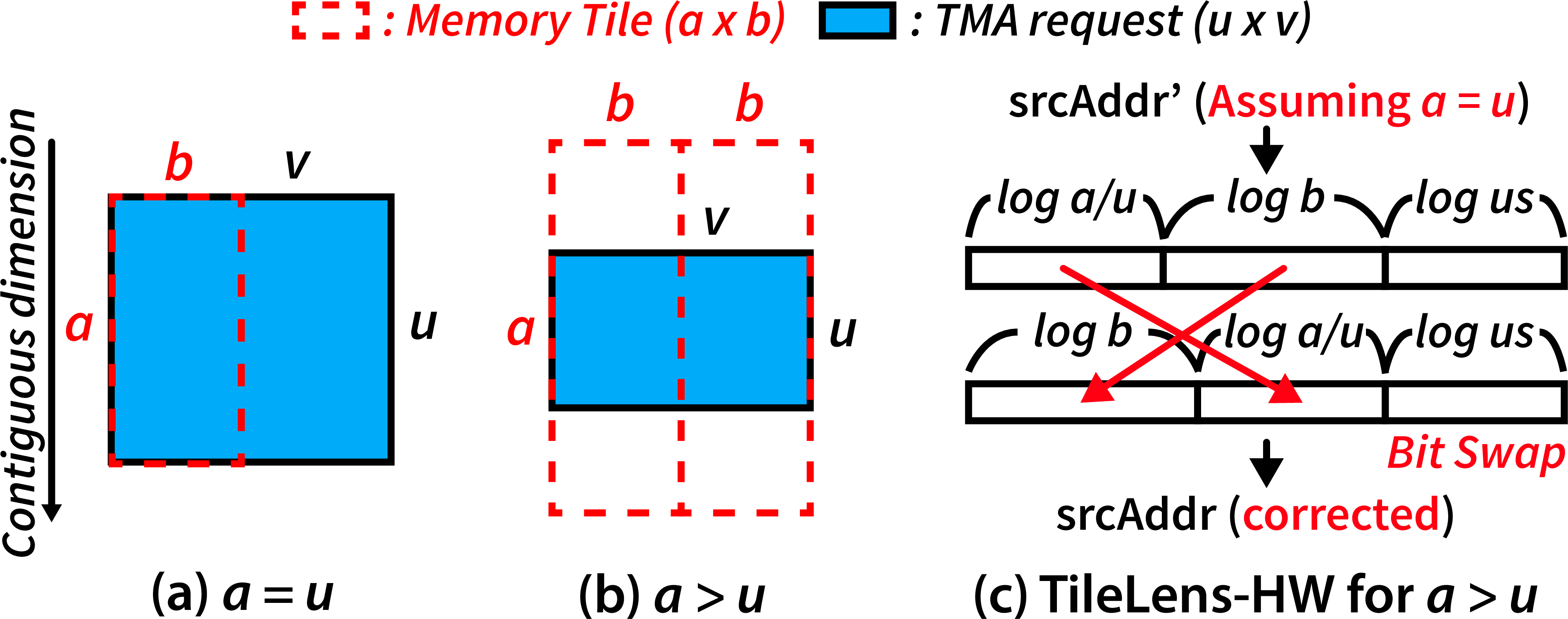
Case 1: Aligned Tiles. In the simplest case, the memory tile and TMA tile have the same contiguous width (\(a = u\)), and the TMA tile spans an integer number of memory tiles in the non-contiguous dimension (\(v\) is a multiple of \(b\)), as shown in Figure 12-(a).
To compute tileBase, we use the leading stride to split the multidimensional coordinates into row index \(i\) and column index \(j\) (Figure 7-(c)): dimensions with a stride smaller than the leading stride contribute to \(i\), and the rest contribute to \(j\). In hardware, this is a split and sum
unit (Figure 11-(b)), where each coordinate\(\times\)stride product is routed to a different addition tree based on a comparison with the leading stride. The sum of coordinate\(\times\)stride products with strides smaller than \(K\) is i, the rest is \(Kj\). The rest of the tileBase computation hardware is entirely reused.
Because memory tiles evenly divide the global matrix (\(K\) and \(N\) are multiples of \(a\) and \(b\), respectively), \(i\) and \(j\) are always aligned to memory tile boundaries, and Equation 2 simplifies to:
\[\texttt{tileBase} = \text{offset}_{\text{tile}}=(K \cdot j \;+\; i \cdot b) \cdot s. \label{eq:tilebase95simple}\tag{4}\]
The only difference from the column-major offset (\(\text{offset}_\text{col} = (K \cdot j + i) \cdot s\)) is that \(i\) is multiplied by \(b\), which reduces to a single variable bit-shift (\(\ll \log_2 b\)) (Figure 11).
With tileBase, the TMA generates srcAddr for each memory request within the TMA tile. In a standard column-major load, a single counter steps \(v\) times with a stride of \(K\) to traverse the non-contiguous dimension. In tile-major, however, rows within a memory tile are only \(a\) elements apart, and after \(b\) rows the counter
must jump to the next memory tile, \(b \cdot K\) elements away.
We handle this strided behavior by splitting the dimension with stride \(K\) into two nested counters: \[\text{strides:~} (1,\; \ldots,\; \underbrace{a,\; b \cdot K}_{\text{replaces } K},\; \ldots), \quad \text{tile:~} (u,\; \ldots,\; \underbrace{b,\; v/b}_{\text{replaces } v},\; \ldots) \label{eq:counter95reconfig}\tag{5}\] The inner counter steps \(b\) times with stride \(a\) (within one memory tile), and the outer counter steps \(v/b\) times with stride \(b \cdot K\) (advancing to the next memory tile). The rest of the TMA operation is identical: we only change the initialization.
Case 2: Wide Memory Tile (\(a > u\)). When the memory tile is wider than the TMA tile in the contiguous dimension (\(u < a\), but \(u\) divides \(a\)), the engine computes tileBase and counter strides as in Case 1, as if the memory tile size is \(u \times b\) and not \(a \times b\). The only correction needed is a bit permutation after srcAddr computation. Because both \(u\) and \(a\) are powers of two, the correction from the
assumed \(u \times b\) sub-tile to the actual \(a \times b\) memory tile reduces to a bit permutation within the intra-tile offset.
For example, if the TMA tile is \(32 \times 32\) but the memory tile is \(128 \times 32\) (4 KB), the 12-bit offset changes from \((\textit{sub-tile}_2 \mid \textit{col}_5 \mid \textit{row}_5)\) to \((\textit{col}_5 \mid \textit{sub-tile}_2 \mid \textit{row}_5)\), where subscripts denote bit widths.
Note that Case2 does not necessarily lead to read amplification. For example, if the contiguous dimension of a compute tile is wider than 128B, optimized kernels (e.g. cuBLAS [10]) issue multiple TMA loads within the compute tile to apply shared memory swizzling.
Hardware Overhead. The overhead of our extension is minimal. The extensions are the split and sum unit (Figure 11-(b)), stride and tile dimension converter (Equation 5 ), bit permutation (Figure 12-(c)), and the control logic to appropriately apply the conversion. The split and sum logic is the most dominant, requiring up to five (TMA supports up to 5-D) additional 32-bit comparators, adders, and routing logic. The total additional hardware is estimated to be 3-4K gates, similar to a single 32-bit multiplier.
Default Tile-Major for LGMS Allocations. The hardware extension enables a deployment path that requires no kernel code changes for legacy kernels. The only required change is allocating in tile-major, and passing the descriptor with the memory tile dimension and leading stride at runtime. With minimal modifications to the GPU system software, even such changes could be unnecessary by using tile-major by default for HBF and having a default memory tile size. The leading stride can be specified when the user changes the allocation function to use HBF or other LGMS.
4.4 Adoption for Non-TMA/Non-DSL Kernels↩︎
Kernels that use neither TMA nor a DSL can adopt tile-major layout by modifying their address-computation code directly. The tile coordinate decomposition (Section 3.2) operates on logical indices \((i, j)\) and reduces to bit shifts and masks, adding minimal overhead per memory access. When only the compiled binary is available (e.g., cuDNN, cuBLAS), a binary instrumentation pass can inject address remapping instructions before each global memory access.
5 System Support for HBF-Augmented GPUs↩︎
Tile-major layout addresses the read amplification problem common to all LGMS. Adopting HBF technology on GPUs, however, requires addressing additional system-level challenges: long read latency, limited write endurance, and coexistence with HBM in a hybrid memory hierarchy. To evaluate the end-to-end feasibility of an HBF-augmented GPU, we provide solutions in this section to address such challenges. These solutions provide a complete system baseline for a fair evaluation on an HBF-augmented GPU.
5.1 Allocation and Data Placement↩︎
In a hybrid HBM+HBF memory system, tensors have distinct access characteristics, and we place each tensor accordingly. Model weights are read-only during inference, making them natural candidates for HBF. On the other hand, activation and KV cache accesses involve both reads and writes, and we store these only on HBM. The choice between HBM and HBF is thus made per tensor at allocation time. Each matmul reads its weight operand from HBF and its input activations from HBM. TileLens does not affect endurance, as tile-major layout changes only the arrangement of the weights written at load time, not the amount of data written.
5.2 Mixed-Granularity L2 Cache & MSHR↩︎
In a HBM+HBF hybrid system, the L2 cache must handle two different access granularities: 32 B for HBM and 4 KB for HBF. When an HBF read returns a full 4 KB block, we always insert the full 4 KB block into L2. With tile-major, the entire 4 KB block is useful, and the 4 KB insertion improves hit rates for subsequent accesses within the same tile. Without tile-major the policy pollutes the L2, but otherwise leaves the memory bandwidth underutilized.
The MSHR structures must also be adapted. 128 B MSHR entries are quickly populated due to the microsecond-scale HBF latencies. We partition the MSHR and track HBF requests at 4 KB granularity, increasing the trackable HBF pages by \(32\times\).
5.3 Adaptive Prefetching for HBF↩︎
Even with a tile-major layout, HBF’s read latency remains over 100\(\times\) longer than HBM’s. To hide this latency, the memory controller must keep enough requests in flight to saturate the HBF bus.
We add a hardware stride prefetcher to the memory controller. In a tiled matmul kernel, each CTA iterates along the K dimension in fixed-size steps, so the stride is the compute tile size along K. For each demand access, the prefetcher speculatively issues \(d\) additional read requests at stride offsets ahead of the current position. The goal is to choose \(d\) so that the total number of in-flight requests saturates the HBF bus throughout kernel execution.
At any point during execution, the GPU issues one wave of demand requests per K-iteration, accessing \(p_{\text{wave}} = N_{\text{SM}} C_{\text{SM}} p_{\text{tile}}\) requests, where \(N_{\text{SM}}\) is the number of SMs, \(C_{\text{SM}}\) is the number of CTAs per SM, and \(p_{\text{tile}}\) is the number of requests per compute tile.
To saturate a bus with bandwidth \(B\) over a NAND read latency of \(L\) cycles, we need \(p_{\text{wave}} (d+1) \geq BL\), giving:
\[d = \min\left(\left\lfloor \frac{BL}{p_{\text{wave}}} \right\rfloor, \frac{K}{\texttt{TILE\_K}}\right) \label{eq:prefetch95degree}\tag{6}\]
The degree is capped at \(K / \texttt{TILE\_K}\), the number of K-iterations per tensor, to prevent prefetching beyond the tensor boundary. In practice, we multiply the first term by \(2\times\) to compensate for NAND plane collisions, which empirically prevent all in-flight requests from being serviced simultaneously.
The degree adapts dynamically as thread blocks retire. As blocks complete execution, \(p_{\text{wave}}\) decreases and \(d\) increases automatically, ensuring that the remaining blocks issue enough prefetches to keep the bus saturated. This is critical at the end of a kernel, where a few straggler blocks would otherwise underutilize the HBF bus. Because \(d\) depends only on hardware parameters and \(p_{\text{wave}}\), it requires no convergence period and reacts immediately when a block retires.
This prefetcher is not a general-purpose mechanism: it exploits the fact that tiled GEMM has a known, fixed access stride equal to the compute tile size. Designing a prefetcher that handles irregular access patterns on LGMS is an interesting direction, but it is orthogonal to this work; we leave it for future work.
6 Evaluation↩︎
6.1 GPU-HBF System Configurations↩︎
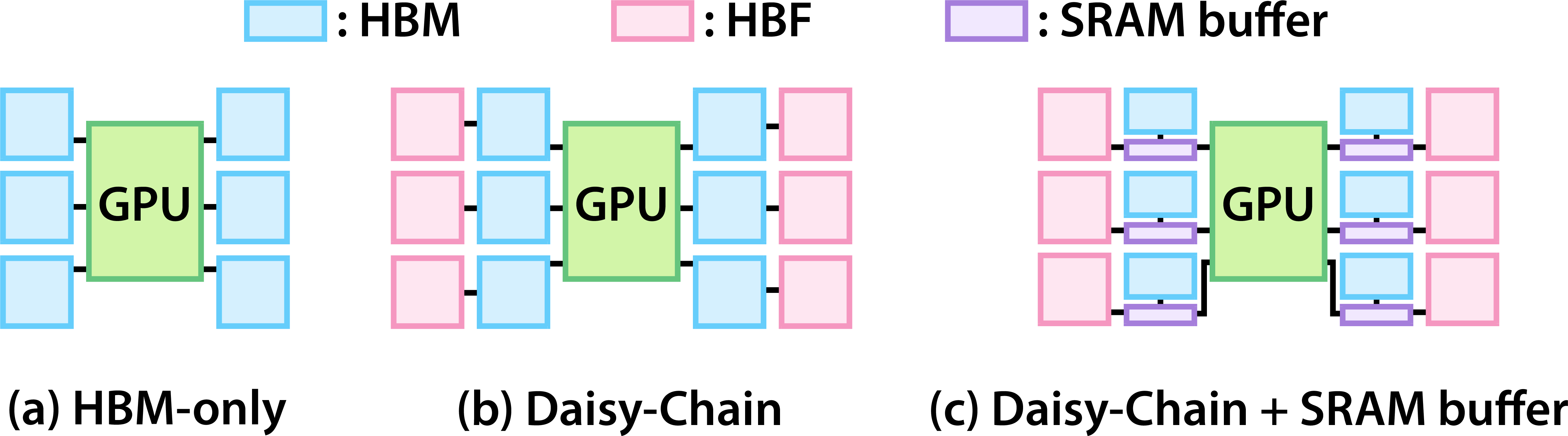
GPU System. We evaluate tile-major layout on an H200-class GPU under three memory configurations (Figure 13): HBM-only as the baseline, and a daisy-chained HBM+HBF system with and without the SRAM buffer used in H\(^3\) [7]. In the HBM only configuration there are 6 HBM3e stacks. In the daisy-chained configuration there are 6 HBF stacks, connected to 6 HBM stacks which are time-sharing the data bus. The daisy-chain design follows, which also places a 40MB SRAM latency-hiding buffer on the HBM base die. We also evaluate a configuration without the SRAM buffer, where the GPU L2 is used as a staging area for data from HBF with 4 KB insertions. All configurations derive their timing parameters from NVIDIA H200 and HBM3E specifications [29].
When we employ the SRAM buffer in the daisy-chained configuration, our prefetcher targets two tiers: prefetches with a smaller degree (distance 1 through \(d\)) fill the L2 cache, while far prefetches (distance \(d{+}1\) through \(2d\)) fill the SRAM buffer.
Memory Stacks. We use HBM3e with 16 channels per stack with 64B granularity (32B per pseudo-channel). The 6 HBM3e stacks provide a total data bandwidth of 4.915 TB/s. We assume HBF also has 16 channels per stack with the same total bandwidth, but with 4 KB granularity. All data buses run at 3200 MHz (6.4 Gbps per pin), with 64 pins per channel. HBM row buffer hit and miss latencies are 14 ns and 42 ns, respectively. For HBF latency, we sweep the NAND page read latency across 1, 2, 5, 10, and 20 μs to cover the range of current and projected flash technologies [5]–[8]. The total internal bandwidth of HBF is set to \(2.5\times\) the bus bandwidth to model concurrent NAND plane access [30], [31].
6.2 Methodology↩︎
Simulator. We use Macsim [32], a cycle-level GPU simulator, extended with DRAM, RoMe, and HBF memory models. Kernel traces are collected from an NVIDIA H200 GPU using a SASS-level tracer built on NVBit [33]. The simulated GPU configuration in Table 1 matches the H200’s 132 SMs, shared memory, and L2 cache size.
| SMs | 132 @ 2.0 GHz |
| Warp Scheduler | 4 warps per SM / Round Robin |
| L1 cache per SM | 256 KB (4-way, 30-cycle hit) |
| L2 cache (total) | 50 MB (16-way, 270-cycle hit) |
Workloads. We evaluate on matmul kernels from two representative LLM models: Qwen-3 30B [18], which uses mixture-of-experts
(MoE, kernel named fused_moe), and Llama-3.1 70B [3], which uses dense feed-forward layers. Each model uses a fixed
BF16 compute tile for weight: \(128 \times 256\) for Qwen and \(64 \times 128\) for Llama. Traces are collected with batch sizes of 16, 64, and 256 for both models. All configurations remain
memory-bound for Qwen due to MoE routing, whereas Llama transitions to compute-bound at a batch size of 256. Larger models in the same family scale by adding layers or experts while reusing the same kernel structure and similar tile configurations, so
per-kernel behavior is representative across model sizes.
TileLens-HW Performance Modeling. The tile-major remapping in TileLens-HW adds a multiplexer for dimension classification and four bit-shifts and one addition for the tile base address computation, totaling approximately 5–7 additional cycles. TMA 2D loads already incur roughly 170 cycles of overhead on top of regular global memory load latency for descriptor processing and address generation [34]. Moreover, high-performance kernels overlap TMA loads with computation, so the additional latency is fully hidden in practice. We therefore do not model any additional TileLens-HW latency in our simulation.
Summary. We evaluate the performance impact of three global memory layouts on LGMS: column-major, row-major, and tile-major with \((64, 32)\) memory tile size. Section 6.3 presents the main results as normalized execution time across memory configurations and layouts. Sections 6.4 and 6.5 break down the sources of degradation: bandwidth utilization and straggler-induced stalls, respectively. Sections 6.6 and 6.7 present analyses of HBF read latency and memory tile shape. Section 6.8 evaluates RoMe.
6.3 Kernel Execution Latency per Layout↩︎
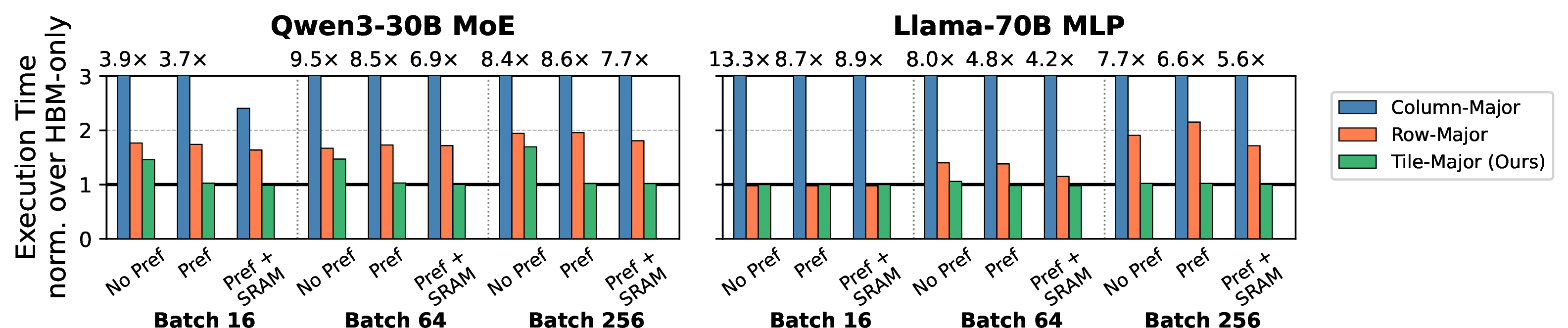
We compare three system configurations: no prefetching (No Pref), adaptive prefetching (Pref), and adaptive prefetching with the H\(^3\) SRAM buffer (Pref+SRAM). Tile-major layouts consistently outperform linear layouts across LGMS configurations with an adaptive prefetcher (Figure 14), even without SRAM buffers.
Column-major layout suffers 3–10\(\times\) slowdown across all HBF configurations, even with the SRAM buffer. Row-major layout reduces amplification but still incurs a geometric mean (geomean) slowdown of 1.61\(\times\) under HBF due to straggler effects. Tile-major layout with adaptive prefetching reduces the geomean slowdown to 1.01\(\times\) at 5 \(\mu\)s NAND latency; adding an SRAM buffer yields a comparable 1.00\(\times\), indicating that the prefetcher alone is sufficient to hide HBF latency. Without prefetching, tile-major can underperform row-major at high latencies (e.g., Qwen results), as read amplification in the row-major layout serves as implicit prefetching. Tile-major eliminates this overfetching, so every CTA issues its own demand requests to HBF, unless the prefetcher proactively issues requests ahead of demand to hide HBF latency.
6.4 Bandwidth Utilization↩︎
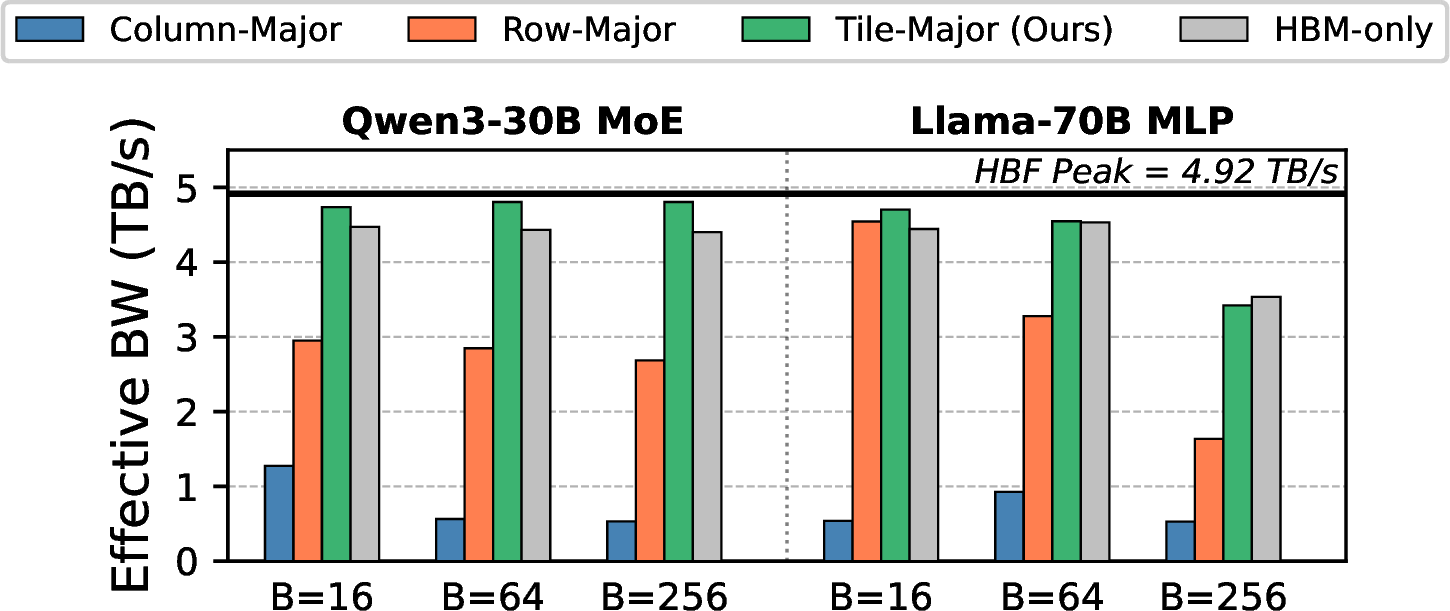
Figure 15 shows the effective memory bandwidth during the runtime of the MoE and Dense models. Column-major layout saturates the memory bus with amplified reads, but most fetched data falls outside the compute tile and is evicted from L2 before reuse, reducing effective bandwidth to 11–26% of peak (a 3.9–9.3\(\times\) waste). With row-major, as part of the fetched data is reused by other CTAs before eviction, effective bandwidth is higher than with column-major layout. However, straggler-induced synchronization prevents CTAs from issuing enough concurrent requests to saturate the bus, limiting effective utilization to 33-92% on HBF. Tile-major layout achieves 70–98% bandwidth utilization across all HBF configurations, matching or exceeding the HBM baseline. The adaptive prefetcher sometimes pushes utilization above the HBM-only baseline, which lacks a prefetcher; the exception is Llama at batch size 256, where the kernel becomes compute-bound.
6.5 Straggler-Induced CTA Stalls↩︎
To quantify the straggler effect, we measure the average latency from when a CTA issues all memory requests for a compute tile to when the last request arrives. We break this latency into two phases: (1) the period before any request arrives (queueing), and (2) the period between the first and last arrival (straggler wait). Figure 16 shows this breakdown for the Qwen’s MoE kernel with row- and tile-major layouts on 5 \(\mu\)s HBF. The kernel uses a \(128 \times 256\) BF16 compute tile, where each row forms a 512 B contiguous strip.
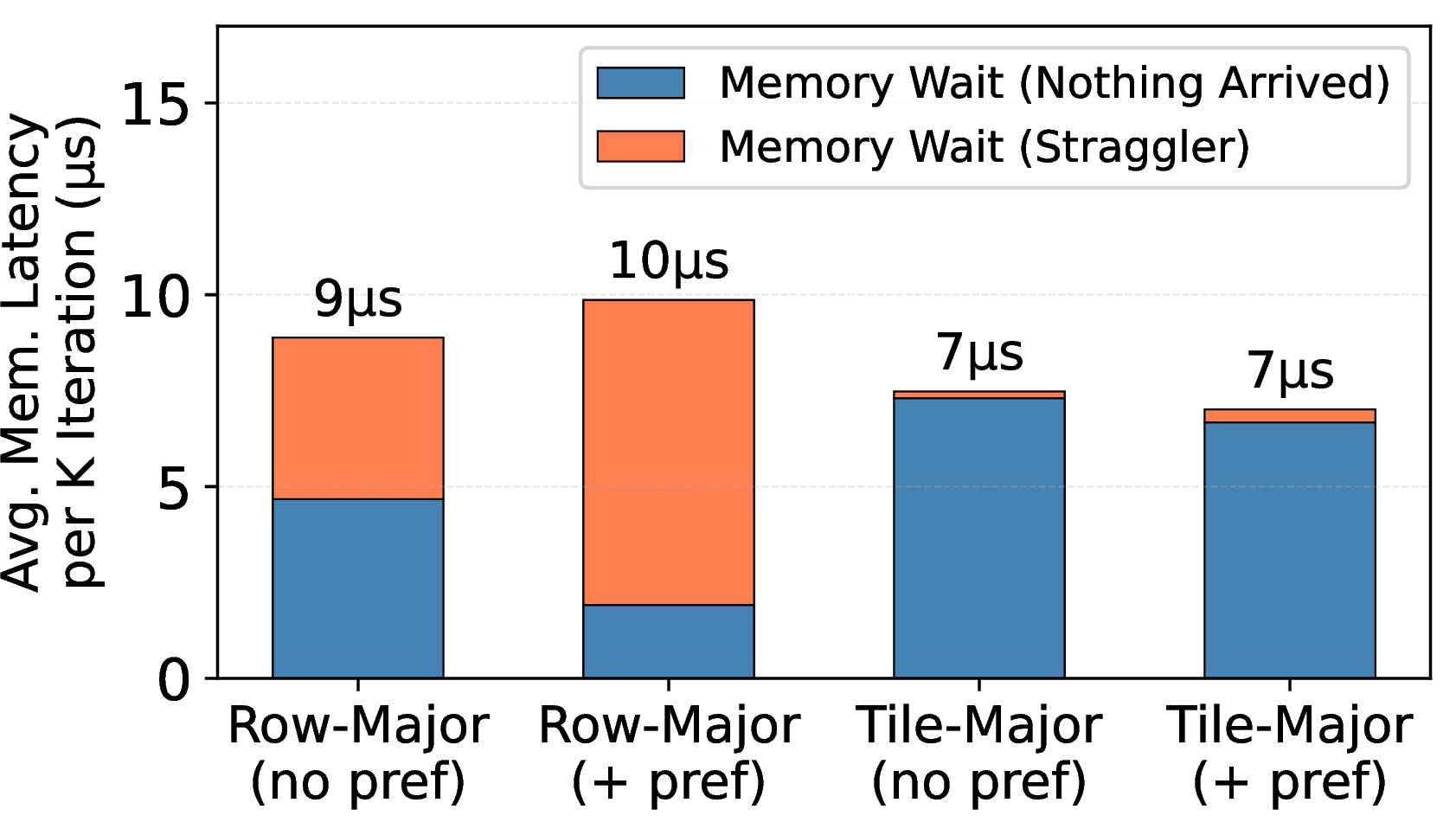
In the row-major layout, the queueing phase (blue) is shorter because another CTA may have already issued a request for the same 4 KB block. However, row-major requires 128 outstanding requests per compute tile, whereas tile-major requires only 16. Although the additional 112 requests (448 KB) could transfer in \(\sim\)0.09 \(\mu\)s at 4.9 TB/s, the observed latency increase is 3.2 \(\mu\)s. This gap is explained by the straggler effect: with 8\(\times\) more outstanding requests, the probability that the slowest request falls in the tail of the latency distribution increases substantially.
Figure 17 (top) shows the per-request latency distribution for each layout. Tile-major and row-major exhibit similar median latencies, but row-major has a longer tail due to bursty request patterns and higher queueing contention. Column-major suffers the worst tail latency because read amplification floods the memory controller with concurrent requests. The CDF (bottom) visualizes this straggler effect: row-major exhibits a long tail extending to 15 \(\mu\)s, whereas tile-major concentrates nearly all arrivals around 5 \(\mu\)s.
6.6 HBF Latency Sensitivity↩︎
Figure 18 shows kernel execution time as we sweep HBF page read latency from 1 to 20 \(\mu\)s at a batch size of 64. Column-major layout suffers 8–10\(\times\) slowdown across all latencies, as read amplification dominates regardless of HBF speed. At 1–2 \(\mu\)s, the difference between row-major and tile-major is small because the latency is short enough to tolerate the additional outstanding requests. Beyond 5 \(\mu\)s, row-major degrades significantly as straggler delays compound and CTAs can no longer sustain enough memory-level parallelism to hide the access latency. Tile-major with prefetching maintains near-HBM performance up to 10 \(\mu\)s; at 20 \(\mu\)s, the slowdown increases to 3–4\(\times\), indicating the prefetcher’s coverage limit.

6.7 Memory Tile Shape Sensitivity↩︎
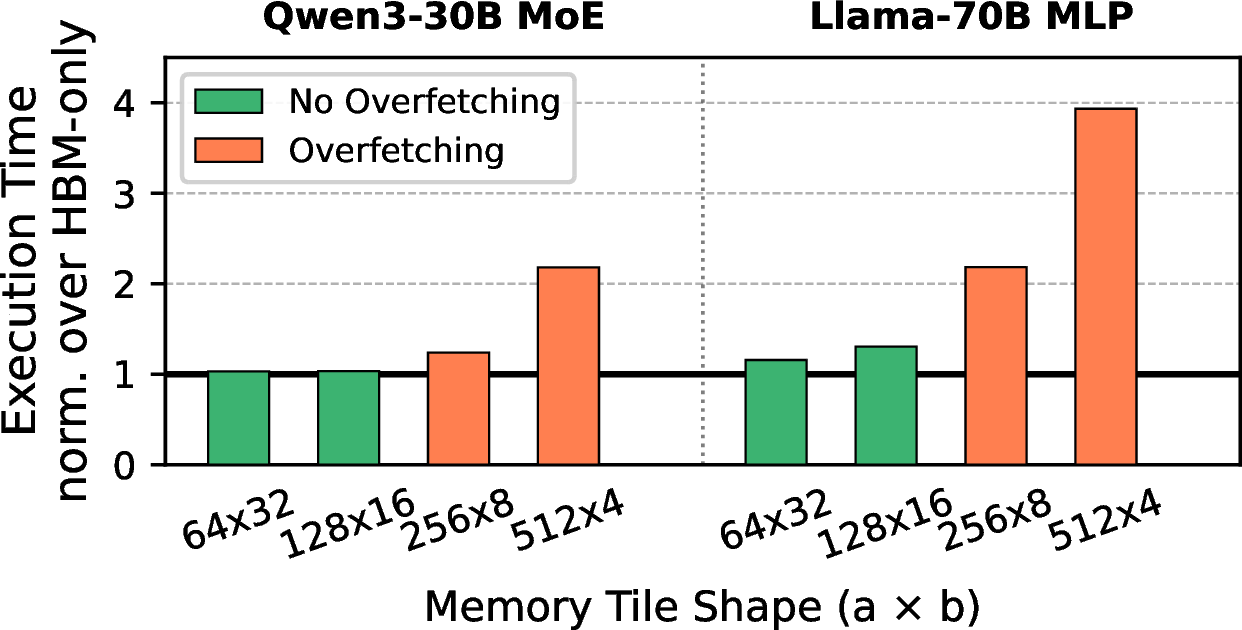
Figure 19 shows kernel execution time as the memory tile shape varies for a fixed \(128 \times 256\) BF16 compute tile on 5 \(\mu\)s HBF with prefetching. We sweep tile widths from 64 elements (matching the GPU’s 128 B cache line for BF16) up to 512, keeping the memory tile area fixed at 4 KB. As the tile becomes narrower and taller, each 4 KB request extends further beyond the compute tile boundary, increasing both read amplification and the number of outstanding requests per tile. Even when the amplified data fits within the L2 cache, performance degrades because the straggler effect depends on the number of outstanding requests, not on whether the data is cached. The optimal shape is one that fits entirely within the compute tile, at which point read amplification is eliminated regardless of cache capacity.
6.8 RoMe↩︎
In this section, we evaluate memory layouts on RoMe [9]. We assume RoMe increases the number of HBM3e channels from 16 to 18 per stack (12.5% higher bandwidth), yielding 5.53 TB/s total bandwidth across six stacks, with a 4 KB access granularity. Memory latency is derived from HBM3e timings and bus transfer time as described in the original paper. Because RoMe latency remains at the scale of DRAM, no prefetcher is used.
Figure 20 shows the execution time of matmul kernels. Column-major layout shows up to 10\(\times\) slowdown due to bandwidth waste, confirming that large access granularity requires the kernel to be aware of the global memory layout even with DRAM scale latencies.
However there is a minimal difference between row-major and tile-major, each showing 1.02–1.13\(\times\) and 1.05–1.12\(\times\) speedup against HBM-only. The straggler effect does not appear as the low latency of HBM can be easily hidden even with a smaller degree of memory-level parallelism (MLP). But as the NAND latency increases, and the headroom in the required MLP for high bandwidth utilization reduces, the straggler effect significantly degrades performance.

7 Related Work↩︎
Address remapping for spatial locality. Impulse [35] adds configurable address remapping at the CPU memory controller for improved spatial locality. Akin et al. [36] propose bit-shuffle remapping in 3D-stacked DRAM for data reorganization. GS-DRAM [37] enables strided access across DRAM chips using a single command, at the cost of aliasing and additional tag bits. These works target cache-line-level (32–128 B) spatial locality on CPU DRAM, whereas tile-major targets 4 KB page utilization on large-granularity GPU memory with no aliasing or cache modifications.
GPU data layout optimization. ASTA [38] reorganizes data into tiled blocks for AoS-to-SoA coalescing on standard GPU memory. Rhu et al. [39] dynamically select access granularity to reduce over-fetching. Piccolo [40] and CODA [41] optimize data layout to coalesce and avoid bank conflicts. These works address spatial locality within the existing memory hierarchy; tile-major targets the access granularity mismatch introduced by LGMS. NVIDIA’s CuTe DSL [11] can represent tile-major layouts as hierarchical shape-stride pairs; our TileLens-SW leverages this property to adopt a tile-major layout with only a layout descriptor change, rather than a kernel rewrite.
Tiled memory layout in GPU texture units. GPU texture memory uses tile-based layouts such as Morton/Z-order curves to improve 2D spatial locality for texture sampling [42], targeting 64–128 B cache lines for element-wise graphics accesses. Tile-major layout follows the same principle of matching layout to access dimensionality, but targets 4 KB pages and uses axis-aligned rectangular tiles so each page belongs to a single compute tile, unlike Morton/Z-order layouts whose bit-interleaved addressing spans multiple tile boundaries.
Large-granularity memory systems for GPUs. H\(^3\) [7], HAVEN [8], and RoMe [9] explore alternative GPU memory architectures, while ZnG [43] and BaM [44] use SSD-class flash over PCIe for data analytics. But HAVEN assumes sequential flash-friendly accesses, H\(^3\) does not address tiled-GEMM read amplification, and RoMe increases access granularity to 4 KB without considering its mismatch with 2D compute tiles. ZnG and BaM also target millisecond-latency external flash, not co-packaged microsecond-latency HBF.
HBF for LLM inference. Recent works study HBF for LLM inference at the system level: Son et al. [45] analyze the throughput benefits and endurance challenges of using HBF as the main GPU memory. Kyung et al. [46] show that the write-once, read-many access pattern of the KV cache allows storing it in HBF despite the limited write endurance. Park et al. [47] propose a custom base die that manages an HBM+HBF pool, hiding HBF latencies with layer-wise prefetching and buffered write-back. However, these studies evaluate HBF at the system level, using roofline-style analytical models to assess serving throughput, rather than a microarchitectural performance model. To the best of our knowledge, this is the first paper to analyze and address the read amplification problem on HBF-based GPUs.
GPU prefetching. Prior GPU prefetching work focuses on what to prefetch in irregular DRAM-backed workloads [48]–[50]. With tile-major layout, accesses become deterministic, so the problem shifts to how aggressively to prefetch.
8 Conclusion↩︎
We identified read amplification as a fundamental performance problem in large-granularity memory systems (LGMS) and especially HBF for GPU-based LLM inference, arising from the mismatch between 1-D memory layouts and 2-D compute tiles. We proposed tile-major layout, which reshapes each contiguous 4 KB memory region to fit within a compute tile, eliminating read amplification.
To adopt tile-major on existing GPUs, we presented TileLens: TileLens-SW extends the CuTe DSL to support tile-major in software, and TileLens-HW extends the TMA engine for transparent hardware support. Evaluated on dense and MoE LLM kernels from Llama-3.1 70B and Qwen-3 30B, tile-major layout with adaptive prefetching effectively eliminates read amplification, bringing HBF-augmented GPU performance from a 1.61–6.49\(\times\) geomean slowdown to within 1% of an HBM-only baseline at 5\(\mu\)s NAND latency.
References↩︎
*Equal contribution.↩︎