Was It Never Collected, or Rewritten Away?
A Commit-Provenance Dataset Separating Ingestion Gaps from Upstream History Edits across the World of Code
July 02, 2026
Abstract
Any global mirror of open-source version control is incomplete, but the reasons a commit is missing are not interchangeable: a project may have force-pushed it away (so it no longer exists upstream), or the mirror may never have ingested it (a true
collection gap). We release a commit-provenance dataset that separates these two cases at scale by comparing two views of the same commit graph: the GHArchive event stream as a historical witness of what GitHub advertised at push time, and the World of
Code (WoC) V2604 object database, an accumulated union of periodic fetches that never deletes a commit once collected, as what the corpus has gathered to date. Walking each reference’s PushEvent chain reconstructs force-push
events structurally (a before that is not the prior head breaks the fast-forward chain; no recorded flag is needed and none exists across eras), and joining every advertised commit against WoC membership yields a three-way label.
Over \(1{,}118{,}116{,}350\) advertised commits, \(53.35\%\) are present in WoC, \(6.47\%\) are rewritten (absent now and orphaned by a
later force-push on the same reference, an upstream history edit and a correct absence), and \(40.18\%\) are never-ingested (absent and never force-push orphaned, the candidate collection gap). About one
missing-commit case in fifteen is therefore a rewrite the project itself erased rather than a mirror gap. We also release the force-push witness (\(166{,}710{,}831\) events over \(19{,}926{,}250\) repositories) and a per-project rollup (\(78{,}125{,}788\) repositories; force-pushing observed in \(25.47\%\), a rewritten commit in \(12.85\%\)). We treat the \(40\%\) never-ingested share as an upper bound on the collection gap and state the five reasons it overcounts. The dataset makes mirror-completeness reporting honest,
flags rewritten commits as same-patch duplicate sources for contribution counting, and corrects a \(10.82\%\) corpus-wide undercount that history editing imposes on commit-based productivity, for which we release a
per-project correction factor. All artifacts are released as a self-contained, independently hosted replication package keyed to the WoC V2604 collection.
1 Introduction↩︎
Every corpus that mirrors open-source version control at scale is incomplete, and every such corpus reports a count of commits it expected but does not hold. That count conflates two phenomena that have opposite implications for an analyst. A commit can be missing because the upstream project rewrote its history, force-pushing, rebasing, squashing, or running a history filter, so the commit no longer exists anywhere and its absence is correct. Or a commit can be missing because the mirror never ingested it, a genuine collection gap that bounds what any study built on the corpus can observe. A raw missing-commit number cannot distinguish the two, so it overstates the collection gap by however much upstream rewriting contributes, and it silently hides rewritten commits that, when present elsewhere as re-created SHAs, inflate contribution counts.
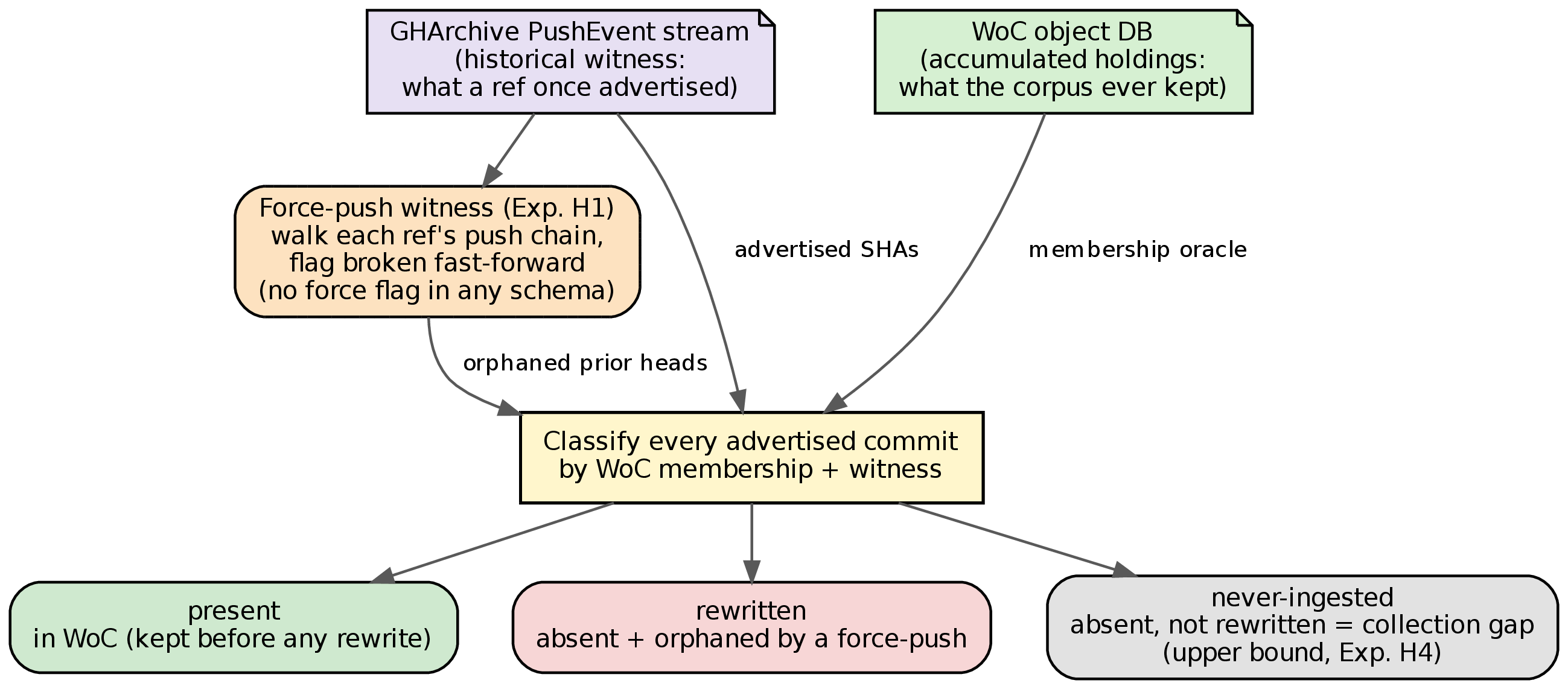
The two phenomena can be separated because two independent views of the same commit graph exist. GHArchive [1] is an append-only log of GitHub’s
public event stream; each PushEvent records what a reference advertised at the moment of a push, including the commit SHAs involved. World of Code [2], [3] is an accumulated object database: it grows by periodic fetches of public repositories, never deletes an object once collected, and so holds the union of
everything it has ever observed, with the recency of that observation varying from one repository to the next. The historical witness says what was once advertised; the accumulated database says what the corpus has ever gathered and kept. Comparing them,
commit by commit, classifies every absence (Figure 1). Because WoC retains a commit even after the upstream project rewrites it away, a rewritten commit that WoC fetched before the rewrite stays present, which
keeps the present class large and the inferred gap conservative.
This paper releases that classification for the WoC V2604 collection, together with the intermediate force-push witness that drives it, and documents both its construction and its empirical results as an experiment log (Exps. H1–H5). Our
contributions are the released artifacts and the findings about them:
A force-push witness reconstructed from the GHArchive
PushEventstream alone, with no reliance on a recorded force flag (which is absent in every schema era), by walking each reference’s push chain and flagging a broken fast-forward (Exp. H1).A three-way commit-provenance map labeling every advertised commit present / rewritten / never-ingested against WoC membership, the central data contribution (Exp. H2).
Project-level and stream-level incidence of force-pushing and of each provenance class, quantifying how common history rewriting is and how much commit volume it actually erases (Exp. H3).
A completeness correction and a caveat budget: the never-ingested share is an upper bound on the collection gap, and we account for the three reasons it overcounts so downstream users can read it correctly (Exp. H4).
A productivity correction derived from the rewritten class: a commit-count productivity measure read off the current visible history undercounts real output by \(10.82\%\) corpus-wide, and we release a per-project correction factor that restores it (Exp. H5).
The dataset is a drop-in join key for any WoC-scale study: per-project counts join the project summary, and per-commit labels join the commit tables by SHA. Because it is built from an external historical witness rather than the mirror’s own holdings, it measures the mirror against something the mirror cannot see by introspection.
2 Related Work↩︎
The corpus we measure is World of Code [2], [3], a mirror of the universe of public version-control data, organized as commit, tree, blob, and relation maps. Like every mirror it is incomplete, and the perils of treating any GitHub-derived corpus as complete are well documented: Kalliamvakou et al. [4] show that much GitHub activity is invisible or misleading in the recorded metadata, and that declared structure need not match observed history. GHTorrent [5], [6] mirrors GitHub’s event API and is itself subject to the same gap-versus-edit ambiguity for any commit it lacks. Our contribution is to resolve that ambiguity for a specific corpus by triangulating against an independent historical witness.
That witness is GHArchive [1], the public archive of GitHub’s event timeline. Prior mining work uses GHArchive mostly as a source of activity events
(stars, forks, issues, pushes) treated as facts about the present. We instead use the PushEvent stream as a temporal record of what each reference once advertised, and exploit the difference between that record and the current object database.
Reconstructing force-pushes from the push chain, rather than from a recorded flag, is necessary because no force indicator is present across the schema eras we span.
The closest sibling construction is the shared-commit deforking map for World of Code [7] and its GHArchive-validated successor [8]: both reason about commit sharing across repositories, and both confront the same completeness question from the project-graph side. That companion paper
validates a commit-based deforking map against GitHub’s declared fork graph reconstructed from the GHArchive ForkEvent stream, the fork-graph view of the same ingestion-completeness question this paper addresses at the commit level. Where
deforking asks which repositories are the same project, this dataset asks which advertised commits the mirror holds and why the rest are absent. The rewritten class is also relevant to repository deduplication work [9]: a rewritten commit re-created with a new SHA after a rebase is a same-patch duplicate, the commit-level analogue of the repository-level duplication
those resources remove.
3 Construction↩︎
The dataset is built from two inputs: the GHArchive PushEvent stream (the historical witness) and the WoC V2604 commit tables, the accumulated union of everything the corpus has fetched and retained up to that watermark.
Construction runs entirely on the analytics cluster with the corpus conventions (;-separated, gzip-compressed, LC_ALL=C sorted), in four stages.
3.0.0.1 Extraction.
For every month of the GHArchive mirror, a pre-filter selects PushEvent records and emits one row per push, created_at;repo;ref;before;head;forced;ncommits;commit_shas, carrying the repository as its raw GitHub
owner/repo name. Normalization to the WoC key (lowercase, /\(\rightarrow\)_) is deferred to the rollup, where it lets the per-project counts join existing project signals. The
PushEvent schema shifts across eras, and the extractor handles each transparently: before and head are present from 2015 onward; the per-commit commits[] array is present 2015–2025 and stripped in 2026
(recent months carry only reference and head/before identifiers); the 2011–2014 timeline carries a shas[] array and a head but no before. A recorded forced flag is absent in every era, so force-pushing is
recovered structurally rather than read from the event. The advertised head is present in all eras, so the membership test that drives the provenance label works corpus-wide; the per-commit array, where present, only enlarges the set of
advertised SHAs.
3.0.0.2 Force-push reconstruction.
Pushes are resharded by repository hash and, within each (repository, reference), ordered by time. A normal push extends the reference, so its before equals the previous push’s head (a fast-forward chain). A force-push breaks
that chain: the new before is not the prior head. Each break is recorded in forcepush.gz as repo;ref;time;prior_head;new_before, and the set of orphaned prior_head SHAs is carried forward as
the witnesses of upstream rewrites. For example, three pushes on one reference with before/head pairs \((\varnothing, A)\), \((A, B)\), \((A, C)\) read as follows. The second extends the first, since its before equals the standing head \(A\), a fast-forward. The third declares before\({=}A\) while the reference already stood at \(B\), so the chain breaks: \(B\) is orphaned as a rewrite witness, and the commits unique to \(B\) were advertised and then erased from the reference’s history.
3.0.0.3 Provenance join.
The union of all advertised SHAs (each push’s head, plus the commits[] fan-out where present) is resharded by SHA first byte to match the WoC commit tables and joined against WoC membership. Each advertised SHA receives one of
three labels, written to prov.b{0..127}.gz as sha;repo;class: present if the SHA is in WoC; rewritten if it is absent and appears among the orphaned prior_head set (an upstream history edit covered
it); never if it is absent and was never orphaned by a force-push.
3.0.0.4 Rollup.
Per-commit labels are aggregated per repository into P2compaction.gz, repo;nForcePush;nRewritten;nNever;nPresent, which drops in beside the fork and star popularity signals in the project summary. A post-build quality sweep
tests every released file (pigz -t on the witness, rollup, and all 128 provenance shards: zero corrupt) and confirms the rollup row count, following the corpus rule that a present file is not assumed complete until verified.
4 Force-Push Witness (Exp. H1)↩︎
Walking the push chains yields forcepush.gz: \(166{,}710{,}831\) force-push events spread over \(19{,}926{,}250\) repositories and \(25{,}288{,}938\) distinct (repository, reference) pairs. A reference that is ever force-pushed is force-pushed about \(6.6\) times on average, so force-pushing recurs on the references where it
happens rather than being a one-time event. Reconstructing the witness from the chain structure, with no reliance on a recorded flag, is what makes the dataset span the full timeline: the same procedure labels a 2012 push and a 2026 push, even though only
one of them would carry per-commit SHAs and neither carries a force indicator.
One benign source of chain breaks is the witness itself rather than the project. GHArchive has its own missing hours and months, and a gap in the event stream can leave a reference’s recorded before pointing at a head the archive never
logged, mimicking a force-push. Such a spurious break orphans a commit that was in fact a normal tip, which an accumulating mirror almost always already holds, so at the provenance join the orphan matches WoC membership and is labeled present
rather than rewritten. Spurious breaks therefore do not inflate the rewritten share or the headline gap; the only residual risk is the rare orphan that WoC never collected, which would count as rewritten rather than never, and that case is bounded
by the archive’s small gap rate.
5 Three-Way Commit Provenance (Exp. H2)↩︎
The central result classifies every commit any PushEvent ever advertised against WoC membership. Table 1 reports the split over \(1{,}118{,}116{,}350\) advertised
commits.
| class | commits | share |
|---|---|---|
| present (in WoC) | \(596{,}497{,}408\) | \(53.35\%\) |
| rewritten (force-push orphan) | \(72{,}357{,}948\) | \(6.47\%\) |
| never-ingested (candidate gap) | \(449{,}260{,}994\) | \(40.18\%\) |
| advertised total | \(1{,}118{,}116{,}350\) | \(100\%\) |
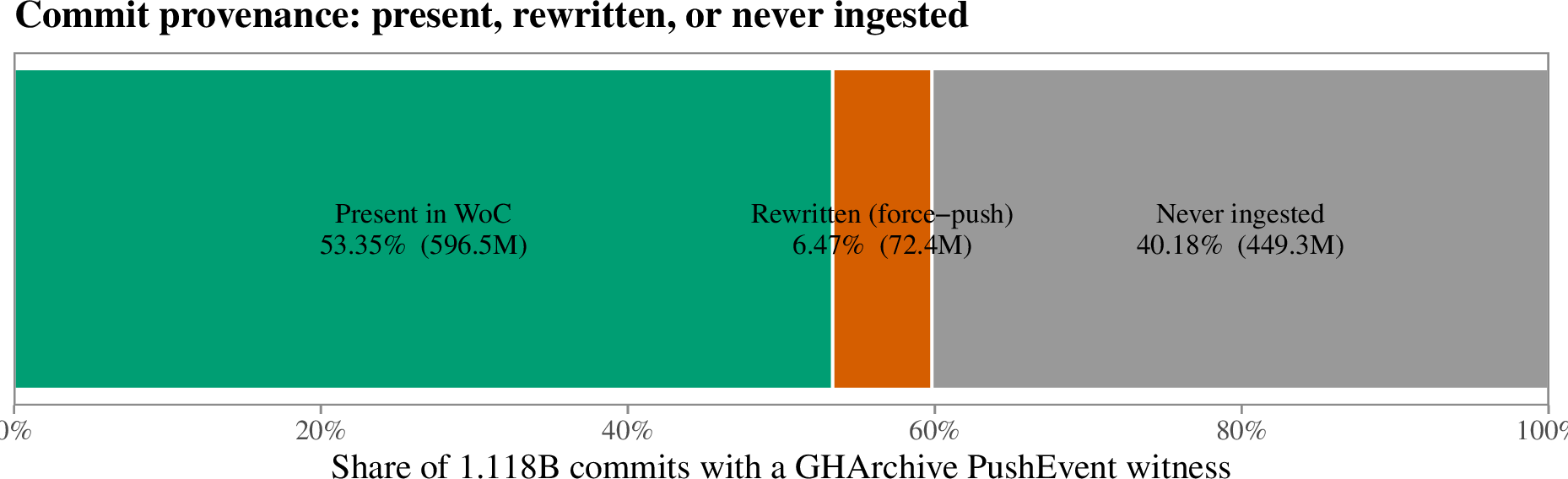
A little over half of advertised commits are present (Figure 2). Of the absent remainder, the dataset separates the two reasons an analyst cares about: \(72{,}357{,}948\) commits (\(6.47\%\) of all advertised) were rewritten away upstream, and \(449{,}260{,}994\) (\(40.18\%\)) are candidate collection gap. Roughly one absent commit in fifteen is therefore a rewrite the project itself erased, not a mirror failure. Without the GHArchive witness these two would be a single “missing” bucket, and the collection gap would read as \(46.65\%\) rather than its true upper bound of \(40.18\%\).
6 Project- and Stream-Level Incidence (Exp. H3)↩︎
The per-project rollup covers \(78{,}125{,}788\) repositories, one row per repository ever seen in a PushEvent. Table 2 reports how many carry each phenomenon. Force-pushing
is common at the project level: a quarter of all repositories ever observed pushing have force-pushed at least once. But it erases only a small slice of commit volume (\(6.47\%\) from Table 1), so most force-pushes rewrite a short tip rather than deep history.
| repositories with… | count | share |
|---|---|---|
| a force-push | \(19{,}897{,}479\) | \(25.47\%\) |
| any rewritten commit | \(10{,}036{,}933\) | \(12.85\%\) |
| any never-ingested commit | \(46{,}226{,}356\) | \(59.17\%\) |
| any present commit | \(31{,}827{,}928\) | \(40.74\%\) |
The force-push project count from the rollup (\(19{,}897{,}479\)) sits \(28{,}771\) below the distinct-repository count in the witness (\(19{,}926{,}250\)). The gap is repositories whose force-push rows carry no advertised SHA that survived into the provenance keying, a rounding-level discrepancy rather than a defect.
7 Completeness Correction and Caveat Budget (Exp. H4)↩︎
The dataset’s practical use is to make completeness reporting honest, so the \(40.18\%\) never-ingested figure must be read correctly. It is an upper bound on the true collection gap, for five reasons that all push it high rather than low.
Watermark. Membership is tested against the
V2604snapshot. Commits pushed after the watermark are correctly labeled never with respect to that snapshot but are not a collection gap; a later watermark would reclassify them.Pre-2015 blind spot. The 2011–2014 timeline carries no
before, so the force-push chain cannot be walked there. A commit rewritten away in that era cannot be reclassified as rewritten and falls into never. The never bucket therefore absorbs old-timeline rewrite orphans that, on a complete witness, would be rewritten.Resolved-table oracle. Membership is tested against the resolved commit table rather than the fuller raw object-presence oracle, a choice made to keep construction on the analytics cluster. A commit present in the raw object database but absent from the resolved table reads as absent here, making never conservative-high.
Retrieval-cadence lag. WoC fetches each repository periodically, so per-repository observation recency varies. A commit pushed not long before the watermark, on a repository WoC has not re-fetched since, is live upstream yet not yet collected, so it reads as never though a later fetch would gather it. This is a timing artifact, not a permanent gap, and it inflates never.
Non-force-push history loss. History can disappear with no
before/headfingerprint to witness it: a branch or whole repository deleted, or a repository made private, removes commits without leaving a broken fast-forward in the push chain. Such orphans carry no rewrite evidence and fall into never, so never absorbs upstream history edits that left no structural trace.
All five move probability mass from present or rewritten into never, so the true collection gap is at most \(40.18\%\) and the rewrite share is at least \(6.47\%\). For an analyst this is the actionable correction: the headline missing-commit number overstates what the mirror could ever have collected, and a measurable slice of the apparent gap is upstream history that no longer exists to be collected. A second use follows from the rewritten class directly: a rewritten commit re-created with a fresh SHA after a rebase or squash is a same-patch duplicate, so contribution and provenance analyses can use the rewritten labels to avoid counting a rebased commit and its replacement as two distinct contributions.
8 Editing Impact on Measured Productivity (Exp. H5)↩︎
The rewritten class corrects a bias in commit-based productivity, a use that follows directly from the provenance labels. A productivity measure read off the current visible history counts only the commits a reference still reaches, the present commits; commits a later force-push orphaned are invisible to it, so per-project commit output is undercounted by exactly the rewritten share of a project’s true output. Aggregated over the corpus, a naive current-history count sees the \(596{,}497{,}408\) present commits where the reachable-plus-rewritten total is \(668{,}855{,}356\) (Table 1), an editing-induced undercount of \(10.82\%\): roughly one commit in nine of all real output is masked by history editing alone. This is separate from the collection gap, which concerns commits the mirror never held rather than output a project produced and then erased. Excluding the \(440{,}594\) force-pushes that straddle a GHArchive outage (Section 4), which a conservative reading drops as archive artifacts rather than genuine rewrites, lowers the figure only to \(10.76\%\); the correction is thus robust to how archive gaps are treated.
The loss is concentrated rather than diffuse. Restricting to the \(40{,}584{,}004\) repositories with a defined edit rate (at least one present or rewritten commit; repositories whose entire advertised history is never-ingested have no visible output to correct and are excluded), three-quarters saw no editing at all, but among those that did the visible count understates true output by \(37.95\%\). More pointedly, \(8{,}689{,}485\) of them (\(21.41\%\)) have an empty visible history despite real prior output: every commit they ever advertised was later force-pushed away, so a current-history productivity read is exactly zero for a repository that did produce commits. Only the rewritten witness recovers them.
We release the per-project correction as P2prodCorr.gz (project;visible;true_gap;true_raw;undercount_gap;corr_factor_gap): multiplying any per-project commit-productivity metric by corr_factor_gap (or adding back
true_gap\(-\)visible) restores the commits history editing removed, with corr_factor_gap\({=}\infty\) marking the empty-history repositories above. The
correction recovers commit count, not author attribution: an orphaned commit is not re-attributed to its developer here, which would require joining the orphaned SHAs back to their authors, a follow-on left to the per-commit provenance shards.
9 Limitations↩︎
Beyond the caveat budget of Exp. H4, two scope limits bound the dataset. First, GHArchive only records public activity at the moment it occurred: a repository made public after a history rewrite shows only its post-rewrite state, so the rewrite
is invisible to the witness. Second, the witness covers commits an event stream advertised; commits that reached WoC through channels GitHub never emitted a PushEvent for (other forges, direct ingestion) are present in WoC but never appear in
the advertised universe, so they are outside the classification rather than mislabeled. Both limits are conservative for the headline claim: they can only hide rewrites or shrink the advertised universe, not inflate the rewritten share.
10 Availability↩︎
All artifacts are released as a single self-contained bundle; no World of Code account is required to obtain or use them (artifact schemas, keys, and row counts are summarized in Table 3): the per-project rollup
P2compaction.gz, the force-push witness forcepush.gz, the per-commit provenance shards prov.b{0..127}.gz, and the per-project productivity correction P2prodCorr.gz (Exp. H5), each
;-separated, gzip-compressed, and LC_ALL=C sorted, together with a replication package that regenerates them from the WoC commit tables and the GHArchive PushEvent mirror. Because the witness and provenance files are
multi-gigabyte, the data artifacts are hosted as a Hugging Face dataset (which scales past the per-file limits of a code host and mints a citable DataCite DOI), with the replication code mirrored on GitHub and cross-linked from the dataset card. We will
also offer the identical bundle to the World of Code maintainers, so that existing WoC users could obtain it through the channels they already use, should the maintainers choose to adopt it. The data is released under CC-BY-4.0 and the replication code under the MIT license. (Hugging Face dataset: TODO/woc-history-rewrite-v2604; DOI to be minted on camera-ready.)
| artifact | schema (columns) | key | sharding | rows |
|---|---|---|---|---|
| P2compaction.gz | repo;nForcePush;nRewritten;nNever;nPresent | repo | single file | \(78{,}125{,}788\) |
| forcepush.gz | repo;ref;time;prior_head;new_before | repo | single file | \(166{,}710{,}831\) |
| prov.b{0..127}.gz | sha;repo;class (present/rewritten/never) | sha | 128 SHA-byte shards | \(1{,}118{,}116{,}350\) |
| P2prodCorr.gz | project;visible;true_gap;true_raw;undercount_gap;corr_factor_gap | project | single file | \(40{,}584{,}004\) |
11 Conclusion↩︎
A mirror’s missing-commit count answers the wrong question, because it merges commits the mirror failed to collect with commits the upstream project erased. By comparing the GHArchive push witness against the World of Code object database, we label every advertised commit present, rewritten, or never-ingested, and find that roughly one missing case in fifteen is an upstream history edit rather than a collection gap. The released provenance map, force-push witness, per-project rollup, and productivity correction let any WoC-scale study report completeness honestly, treat rewritten commits as the same-patch duplicates they are, and recover the \(10.82\%\) of commit output that history editing hides from a current-history productivity count, turning an external event stream into a measurement the mirror cannot make of itself.