SLFS: a Flexible, Low-Cost Distributed File System
Using Serverless Designs
July 01, 2026
Abstract
Large-scale distributed file systems must provision resources for peak demand, yet file access patterns fluctuate significantly, leaving substantial capacity idle during off-peak periods. Existing scaling mechanisms operate at the granularity of entire servers and take minutes to hours, making them unable to track the rapid, fine-grained load variations that file systems commonly experience. Serverless computing, with its millisecond-granularity elasticity and pay-per-use pricing, offers a compelling alternative. We present SLFS, the first distributed file system built with serverless functions for both data and metadata operations. SLFS implements file services on top of key-value stores, keeping function operations simple and short, and introduces a novel multi-threaded, short-lived server design that overcomes the cold-start problem while maintaining low cost. A policy-enforcing coordinator efficiently maps files to function instances, scales the system elastically, and controls function lifetimes to balance performance and cost. SLFS can flexibly run on diverse storage backends—from cloud-native services like S3 to user-managed key-value stores—enabling configurable cost-performance trade-offs. Our evaluation shows that SLFS mitigates cold starts by 580\(\times\) compared to the base serverless design and outperforms \(\lambda\)FS, EFS, and Ceph at up to 63%, 68%, and 63% lower cost, respectively.
1 Introduction↩︎
Large-scale distributed file systems are composed of hundreds of server nodes where some nodes handle file operations while others focus on storing data [1]–[6]. In practice, file system load fluctuates significantly: not all files are actively accessed at any given time, and access patterns shift unpredictably across time of day, workload phase, and tenant activity. Yet, to meet peak demand and maintain acceptable latency, operators must provision resources for worst-case load, leaving substantial capacity idle during off-peak periods. This over-provisioning translates directly into wasted cost. Existing distributed file systems offer scaling mechanisms, but these operate at the granularity of entire servers or storage nodes—adding or removing a node involves data migration, rebalancing, and reconfiguration that can take minutes to hours [2], [7]. Such coarse-grained scaling cannot track the rapid, fine-grained load variations that file systems commonly experience.
Serverless computing offers a compelling alternative. In the serverless model, users register function images and the framework dynamically launches, auto-scales, and terminates function instances on demand, charging only for the resources consumed during execution [8]–[10]. This model provides two key benefits for fluctuating workloads. First, elasticity: function instances can scale from zero to thousands and back in seconds, matching demand at a granularity far finer than server-level scaling. Second, cost efficiency: because the pricing model charges per millisecond of execution, applications with idle intervals between bursts of activity pay only for the time they are active, unlike VMs that incur cost whether busy or idle. These properties have already enabled serverless designs for data analytics [11], [12], machine learning [13], [14], and video encoding [15], hinting at the potential of serverless computing to host a broader class of backend services.
Distributed file systems are natural candidates to benefit from these properties. Most file operations are simple and short-lived—translating file offsets to block addresses, reading or writing a few blocks—and many applications issue file I/Os with intervals that leave the file system idle. Capturing these operations in serverless functions can bring fine-grained elasticity [16] and, when idle intervals are reflected in the workload, significant cost savings compared to always-on server deployments. For example, consider a multi-tenant platform where a media pipeline generates bursts of small-file writes during upload windows then goes idle for hours, a nightly analytics job reads terabytes once per day, and a web application sporadically accesses configuration files. Today, these tenants either share an over-provisioned file system—paying for peak capacity at all times—or each deploys a dedicated cluster, multiplying operational overhead. A serverless file system can instead scale each file’s serving capacity independently, from zero to many concurrent function instances, charging only for the I/O actually performed. \(\lambda\)FS [16] explores this direction by extending HopsFS [17] to delegate file metadata service to serverless functions. However, \(\lambda\)FS keeps function instances alive even during idle periods to cache metadata, forgoing the cost benefits of the serverless model.
In this paper, we propose, to our knowledge, the first serverless file system, SLFS, which uses serverless functions to manage both file data and metadata. Serverful storage systems exist for serverless applications [18]–[21], but SLFS uses serverless functions as its main building blocks and can be used by both serverless and non-serverless applications. \(\lambda\)FS only handles metadata using functions and is intended for large file accesses like its predecessors, HopsFS and HDFS. In contrast, SLFS is designed from scratch for generic files, employs simple metadata designs suited to the serverless environment, places both file data and metadata operations on serverless functions, and adds mechanisms to efficiently utilize functions at low cost.
A key design decision in SLFS is to implement file operations on top of key-value stores, keeping the computation within serverless functions simple and short. Rather than managing complex on-disk structures such as inodes and block bitmaps inside ephemeral functions, SLFS uses hash-based mappings from file paths and block numbers to key-value pairs, similar to how Ceph [2] uses hashing to map objects directly to storage nodes without centralized metadata lookups. This design is a natural fit for the serverless model: functions perform straightforward key-value gets and puts, avoiding the heavyweight state and long-running logic that would conflict with short function lifetimes. However, unlike Ceph, SLFS does not manage the key-value backend itself; it delegates management complexity such as replication and load balancing to the storage backend. Thus, SLFS can run on any storage system with key-value APIs, taking advantage of existing cloud key-value services [22]–[24] as well as users’ own key-value store implementations [25]–[27]. The backend choice can be diversified depending on performance, cost, management, and other requirements.
The financial cost of operating SLFS is configurable and significantly cheaper than using a cloud-native file system or \(\lambda\)FS. Cloud providers charge higher rates to store and access data in a file system than in a simple key-value store or a block store, but there are still application demands for file services. SLFS targets such applications, and our analysis of Azure traces [28] under various SLFS configurations reveals that the operational cost of SLFS is cheaper than that of cloud-native file systems (2.2). \(\lambda\)FS reduces cost compared to open-source file systems such as HDFS [7] and HopsFS [17], but SLFS reduces cost further by dynamically controlling function lifetime while maintaining high performance ([subsec:eval:cold] [subsec:eval:cost]).
Despite these advantages, realizing a serverless file system is non-trivial and entails unique challenges that stem from the serverless environment. Like any serverless application, SLFS must deal with the cold start problem [8]. Depending on the serverless platform, starting a function from a cold state (i.e., starting from scratch) can take a few seconds, and even from a warm state (i.e., starting from a paused sandbox with a loaded function image) can take over 100s of milliseconds [29]. To mitigate cold starts and save function invocation costs, SLFS introduces a novel function instance design as a short-lived multi-threaded server. This design induces hot starts (i.e., processing requests with a fully active function instance) and keeps the instance busy even when waiting for an I/O response.
Supporting atomicity and isolation over weakly consistent backend storage systems is another significant challenge in the serverless environment [19], [20], [30]. SLFS dynamically assigns a dedicated function instance for each file for isolation: that is, a file is encapsulated in a function instance and is mutated by calls defined in the instance, following an object-oriented design [31]. This design also facilitates a file cache within function instances. SLFS leverages atomic commit features of backend key-value stores for consistent updates and uses the two-phase commit protocol when the backend lacks native atomic commit support. SLFS provides single-file atomicity, and atomic multi-file operations such as rename.
Because most serverless frameworks do not fully support inbound networking of function instances, mapping a file to a function and forwarding the file request to the dedicated function is challenging. SLFS adds a coordinator to control the request flow to the functions. The coordinator enforces SLFS policies, mitigates cold starts, load-balances requests across function instances, and scales the system.
We demonstrate through evaluation that SLFS is efficient, flexible, scalable, and cost-effective. We compare SLFS against InfiniCache [32], \(\lambda\)FS [16], AWS Elastic File System (EFS) [33], and Ceph [2] and show that SLFS delivers comparable or better performance at lower cost. SLFS takes advantage of various storage backends while mitigating cold starts by 580\(\times\) compared to default serverless configurations, improving performance significantly, and reducing cost by up to 63%, 68%, and 63% compared to \(\lambda\)FS, EFS, and Ceph, respectively.
SLFS proposes a new way of constructing a distributed file system using the serverless paradigm, offering a cost-effective alternative to existing cloud file services [2], [33]–[35]. This paper makes the following contributions:
We propose the first serverless file system that uses serverless functions for handling both metadata and data.
We present a novel short-lived-server-based function instance design, a coordinator design, and policies for the serverless file system to reduce cold starts, save cost, and scale. These designs are not limited to SLFS and can be applied to other serverless systems and applications.
We implement SLFS, deploy it in the public cloud, and evaluate it under various scenarios to demonstrate its strengths and weaknesses against other systems.
2 Background and Motivation↩︎
2.1 Cold Start Problem↩︎
Serverless computing allows the convenience of on-demand execution of functions by launching the code and the runtime environment, usually in a container. The trade-off for this approach is that if the function has not been executed for a while, it takes a long time to fetch the image of the container and start the runtime environment. Mitigating the delays from this cold start problem is an active research area. There are solutions such as creating a lighter-weight sandbox [36], using snapshots of the container to reduce the start-up time [37]–[39], and predicting the task invocation patterns [40], [41] to keep the container in a warm state (i.e., loaded but in a dormant state) for quick reuse. Some cloud providers offer a service to keep the function instance warm (e.g., Azure Durable functions and SnapStart [42], [43]) at a higher price. SLFS can benefit from these but proposes a more proactive methodology and policy to keep the function hot while maintaining a low cost (Section 5).
2.2 Motivation and Cost Analysis↩︎
![Figure 1: Cost comparison [44] of SLFS under different configurations and a cloud native file system, EFS.](/article/2607.01486/figs/new-awsprice.png "fig:")
One of the main reasons users migrate their services to a serverless environment is the cost-effectiveness from the fine-grained resource management. While serverless computing in general is considered cheaper than serverful computing, this is not always true. The cloud vendors charge slightly higher unit price for the same amount of resource usage in serverless functions than in VMs. Thus, using serverless functions non-stop is not cost-effective and only the applications with some idle periods could benefit from serverless designs. Storage accesses in the cloud exhibit such idle patterns and we conduct a cost analysis.
Figure 1 compares the cost [44] of using a serverless file system (i.e., SLFS) over a key-value store (i.e., S3 standard) and block stores (i.e., EBS volumes: gp2 SSD, gp3 SSD, sc1 HDD, and st1 HDD) with a cloud provider’s backend file service (i.e., EFS) in the Amazon cloud. We evaluate the cost based on the trace in the Azure function BLOB dataset [28]. The trace captures over 44.3 million data accesses from serverless applications for two weeks on 1.9 TB of data.
Analyzing this trace, we find that the median application’s inter-quartile I/O interval exceeds 2,000 seconds, meaning that for more than half of the applications, a dedicated server would sit idle for over 30 minutes between bursts of activity. During these idle intervals, a serverless file system incurs zero function cost, whereas a traditional file system consumes provisioned resources. This workload characteristic is the key enabler of SLFS’s cost advantage.
Serverless functions (i.e., Lambda) are necessary to implement file system APIs over EBS and S3, so function invocation costs are considered. We conservatively assume that each I/O request triggers the function to run for 300 milliseconds based on our measurement running production workloads on SLFS (8.4). EBS volumes require mountable virtual machines (VMs). Although EBS volumes are internally replicated, we consider user-managed triple replication and add the cost of 9 VMs (t3.medium instances), each equipped with a 687 GB EBS drive. SLFS extends the serverless framework with a coordinator (Section 3.3) and we include the cost of running it as 3 separate VMs (t3.medium). EFS migrates a file that is not accessed for 30 days to cold storage. However, all files in the Azure trace are accessed within 14 days so we only consider standard storage. For all configurations, both data storing and data accessing (i.e., reads and writes) costs are included, assuming that the applications are running in the same cloud region. The data access cost for SLFS includes the data transfer cost across different services. We project monthly costs on different storage settings.
The figure shows that using the cloud-provided file service is the most costly, whereas using more primitive or slower storage services costs less. Compared to EFS, serverless file systems using S3, st1-HDD-based EBS, and gp2-SSD-based EBS are 68%, 37%, and 12% cheaper, respectively. The function invocation cost for SLFS is tiny in the figure; this justifies using serverless functions in SLFS to host real workloads. Overall, EFS charges a significantly higher rate for storing data, while SLFS offers various cost-effective options. We further analyze the cost of SLFS, EFS, and other systems relative to performance in 8.7.
3 SLFS Design Overview↩︎
In this section, we introduce the high-level design of SLFS. Then, we dive into detailed designs of SLFS and policies to overcome unique challenges in the following sections.
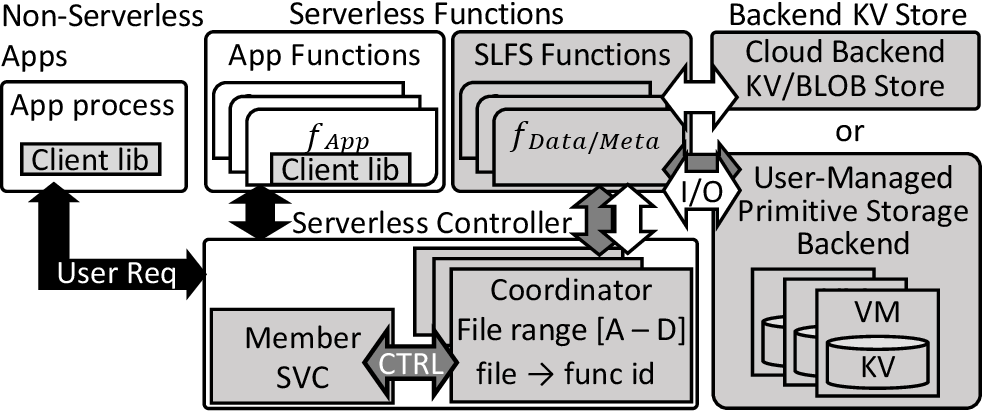
The design of SLFS is illustrated in Figure 2. SLFS is composed of the grey boxes in the figure. Main computations to support the file operations are designed as serverless functions: the data function (\(f_{Data}\)) is responsible for accessing data files, whereas the metadata function (\(f_{Meta}\)) handles metadata operations. The file data is broken into fixed-size blocks and stored as key-value pairs inside the backend storage services. SLFS is designed to run on any cloud- or user-managed key-value stores. Similar to the Ceph [2] file system, SLFS uses the hash key of a file path and a block number to map the block of the file to a key-value pair location. \(f_{Data}/f_{Meta}\) operations are designed to be minimal for low-cost function invocations.
The coordinator orchestrates the function accesses. File requests first go through the coordinator. The coordinator initializes the function instance dedicated to the file and establishes direct connections between the function and the client. The coordinator is the only serverful component in SLFS, which is similar to a proxy in other serverless system designs [16], [32], [45]. We augment this design to avoid cold start, control concurrency, load-balance requests, and save SLFS costs. The coordinator information is managed by the membership service natively in the serverless framework. The coordinator also scales up and down and the membership service in the serverless framework manages its information.
3.1 Client Libraries and SLFS APIs↩︎
The client library retrieves the coordinator information from the membership service and establishes connections to \(f_{Data}/f_{Meta}\) with the help of the coordinator (3.4).
SLFS and the client library offer relaxed POSIX-compliant APIs similar to existing production and open-source distributed file systems [1], [7], [33]. The APIs include most file operations including open, close, read, write, delete, and rename and metadata operations.
The open call registers the file to the coordinator, and the coordinator assigns and launches \(f_{Data}/f_{Meta}\) for the file. The close call ensures that any outstanding I/O for the file is completed and deregisters the file unless other users are accessing it. The file-to-function mapping can be dynamically changed by the coordinator, and long-term inactive files need remapping to a new function. Directories are implemented as files containing a list of files. Readdir reads the directory file and makedir creates a new directory file. Files and directories can be renamed, but this entails an overhead of copying the file and directory to new locations because the hash of the file path indexes files.
SLFS guarantees per-file atomicity for multi-block operations, serialized access for concurrent operations on the same file, and atomic multi-file operations such as rename; we specify these guarantees precisely in 4.3.
3.2 Data and Metadata Functions↩︎
A key design goal for SLFS functions is to keep operations simple and fast so that function invocations remain short and inexpensive. To achieve this, SLFS implements file operations on top of key-value stores using hash-based indexing: read and write requests are translated into block-granularity key-value accesses, where the hash of a file path and block number directly maps to a key-value pair location without traversing any sophisticated metadata structures. This design is critical in the serverless environment. Serverless functions are short-lived and not well-suited for caching inode-like metadata, and accessing a persistent backend store for such metadata over the network can cause huge delays. Indeed, our early prototype design with inodes was unusably slow and we had to switch to the hash-based design. In contrast, \(\lambda\)FS [16] caches file metadata in function instances and extends the function lifetime to the maximum to overcome this problem, but it incurs high costs and performs poorly when writing metadata (8.5).
Building on this simple operation model, we propose a novel design for the function instance: a short-lived concurrent server that executes simple tasks while keeping the function invocation cost low. Unlike regular serverless functions that terminate after processing a single request, our function instances run as multi-threaded servers that accept and process multiple requests concurrently during their lifetime. The data function (\(f_{Data}\)) handles file read and write requests by performing key-value gets and puts based on the hash key. The metadata function (\(f_{Meta}\)) is similar but is dedicated to directory accesses; directory files are managed the same as regular files, but \(f_{Meta}\) implements directory-specific operations. Because these operations are lightweight, they are well-suited to be processed concurrently within the server-based function instance, keeping the instance busy even when individual threads are waiting for backend I/O responses. The lifetime of each instance is controlled by a policy that balances cost and performance: the instance stays alive long enough to exploit temporal locality and induce hot starts, but terminates when idle to avoid unnecessary cost (5).
The \(f_{Data}\) and \(f_{Meta}\) encapsulate file and directory instances as in object-oriented (OO) style designs. Each function instance knows how to mutate and access a file or directory, and SLFS assigns at most one dedicated function instance per file or directory. Thus, accessing the function instance becomes analogous to accessing a file/directory object. The OO design cleanly isolates files/directories and facilitates concurrency control (4.3). A similar OO function instance design was proposed by LambdaObject [31], but SLFS further extends the idea. First, read-only files can be mapped to multiple functions for concurrent reads. Second, SLFS maps multiple files to one function instance, since operations are the same across all files/directories. This facilitates function instance reuse to avoid cold start and improves function utilization. The load can also be dynamically distributed to different functions to optimize performance and cost ([subsec:coldstart] [sec:policy]).
Leveraging the file-to-dedicated-function mapping, a strongly consistent write-through LRU cache is kept in each function (6). With the cache, the function does not always have to access the backend store for reads. The cache is designed to use excess memory in the function instance which would otherwise be wasted.
3.3 Coordinators↩︎
The coordinator maps a file to a function instance. This mapping policy determines the performance and cost of SLFS and keeps concurrent file accesses safe (5).
Upon opening a file, the coordinator checks if the file is already open. If not, the coordinator maps the file to an existing function or starts a new one to map the file. The mapping information is kept until no user accesses the file or the function terminates. Between the open and close of a file, different functions can service the file requests, but the coordinator ensures that at most one function instance serves the file at any given moment.
The coordinator can scale up or down depending on the load. SLFS uses consistent hashing like Chord [46], [47] to assign files to coordinators. However, unlike Chord, all coordinator information is kept in a centralized membership service in the serverless framework for consistent member updates and one-hop request delivery to the coordinator.
3.4 Data and Control Flow Separation↩︎
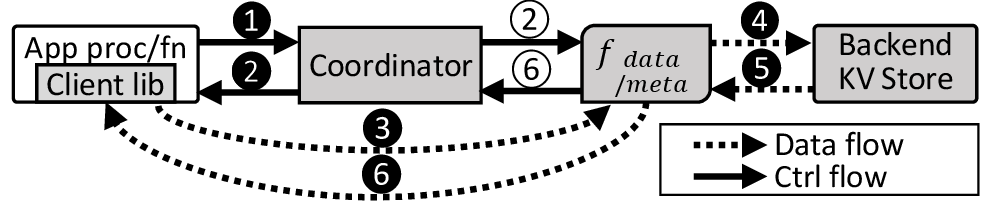
Although requests to SLFS start by contacting the coordinator, the coordinator is mainly responsible for handling the control flow, and the data flow bypasses the coordinator. We allow clients to directly communicate with \(f_{Data}\) and \(f_{Meta}\) so as not to overload the serverful coordinator (Figure 3). For SLFS operations, the coordinator tells the client about the function instance in charge of the file that the client is trying to access ((myanchor) 1; and (myanchor) 2;). If a new function instance is needed to process the client request, the coordinator starts a new function instance ((myanchor) 2;) before returning to the client. Next, the client directly contacts the function instance for the file access ((myanchor) 3;) and the instance performs corresponding key-value accesses ((myanchor) 4; and (myanchor) 5;). The function instance returns the result of the file access to the client ((myanchor) 6;) and also notifies the coordinator about its status (e.g., number of queued requests) so that the coordinator can make policy-based decisions for SLFS ((myanchor) 6;).
While open source serverless frameworks allow inbound connection to function instances, some commercial platforms prohibit this. As a workaround, one can use TCP/NAT hole punching [48], [49].
3.5 Storage Backend↩︎
SLFS is designed to work with key-value storage backends. The condition for safety (see Section 4.3) is that the key-value store should provide read-my-writes and bounded staleness, or stronger guarantees [50]: users must always see their own updates, and an update must become visible to everyone after a bounded time. Most cloud storage systems, such as S3 [22], fulfill this requirement. To further demonstrate a more general use case of SLFS, we also consider even more primitive storage building blocks based on standalone VM-based key-value storage servers (Section 7).
4 Detailed Designs↩︎
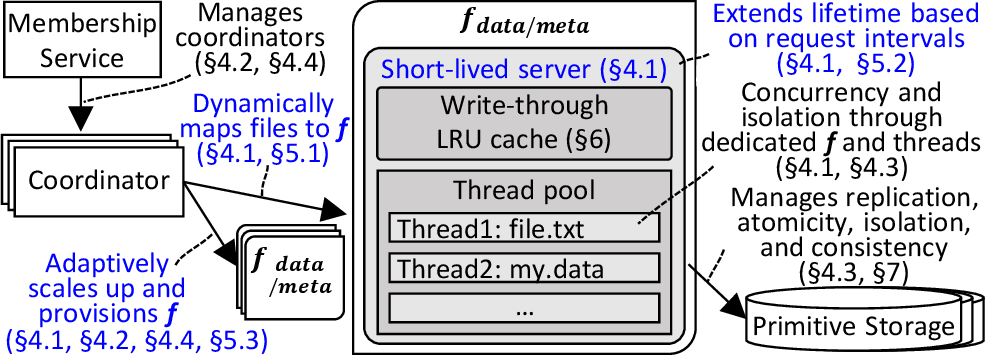
We describe the detailed SLFS designs to answer the following questions for realizing a practical serverless file system: 1) how to avoid cold starts; 2) how to lower the financial cost; 3) how to scale the components; 4) how to maintain consistency and 5) how to handle failures. Figure 4 illustrates the detailed relationships and roles of SLFS components.
4.1 Avoiding Cold and Even Warm Starts↩︎
Cold-starting a function instance can take a few seconds, and even warm-starting an instance can take 100s of milliseconds [29]. The recent AWS SnapStart feature reduces the start-up time to a few milliseconds [43] with a warm snapshot of a function instance, but for fast file accesses, it is best to even avoid the warm start. We propose a novel short-lived multi-threaded server-based function design for SLFS to induce a hot start.
Function Instances as Short-Lived Servers. We design \(f_{Data}/f_{Meta}\) as short-lived servers to reduce the file access latency. Unlike regular serverless function instances that terminate right after processing a request, SLFS functions wait for new incoming requests for a short period leveraging the temporal locality of file accesses. If there is another request to the same file within a short interval, the instance can be immediately reused; this leads to a hot start. The limitations are that cold or warm starts are unavoidable under infrequent I/Os, and extra costs could incur for idling. Thus, the function lifetime policy is designed to keep the cost low while inducing hot starts (Section 5.2).
Multiple Files Per Function Instance. If a function instance is only mapped to a single file, the frequency of the instance reuse will be low, and new file accesses will entail cold starts. To better utilize a function, we assign multiple files per function (Section 5.1) and make the instance multi-threaded. For security reasons, however, only the files of the same application/user share a function.
Concurrently handling different file requests in the same function instance saves function invocation costs: e.g., cold-starting one instance prepares multiple file requests to be processed immediately. Without concurrent request processing, functions could idle while waiting for I/O responses from the backend storage, but our design keeps the function busy and reduces the overall function execution time. As long as the user frequently accesses any file the utilization of the function instance can increase, and cold and warm starts can be avoided. Thus, for example, scanning through a list of files or recursively reading file lists in directories (e.g., find or ls -R) is handled efficiently using only a few functions.
Provisioning Replacement Functions.
Even though the \(f_{Data}/f_{Meta}\) can handle multiple requests for different files without having to terminate after processing a request, it has a limited lifetime set by the serverless framework [51], [52]. In case there is a need to process I/O requests beyond the function’s lifespan, each instance keeps track of its duration. The function instance notifies the coordinator when it is close to the termination time set by the framework. Then the coordinator launches a replacement function early enough to hide the cold start. Later, the old function terminates with notifications to the coordinator and connected clients, and the coordinator directs requests to the new function.
4.2 Scaling Up and Down↩︎
For any serverless application, scaling up and down is important for both performance and cost. The scalability of SLFS is only bounded by the backend storage that SLFS relies on.
Scaling Coordinators.
The coordinator scales up and down depending on the user load. When the number of open files a coordinator manages increases, the coordinator spawns a new coordinator server to partition the range of files it manages. The existing coordinator reorganizes the file to function mapping, function instances that manage files for the new coordinator connect to the new coordinator, and the new coordinator updates its file to function mapping. The new coordinator becomes active after its information is registered with the membership service. Due to the consensus-based membership service (i.e., Zookeeper [53]) the function instance mapping and the hand-off of a partition take place consistently and then clients of SLFS are notified of the changes through the client library.
When the load on the coordinators goes below a watermark, SLFS merges adjacent coordinator nodes through the membership service similar to the scaling up procedure. Overall, scaling up a coordinator is much more costly than scaling a function instance, so SLFS triggers the merger when the load is kept below the watermark for an extended period.
Scaling Data and Metadata Functions. Because we map multiple files to a function instance, SLFS should opportunely launch new instances as the load increases. SLFS monitors the request queue length and starts new functions if the queue length exceeds a threshold. It considers the cold start latency and proactively provisions function instances for the best performance (Section 5.3). For scaling down, the function lifetime policy (Section 5.2) terminates the function without creating a replacement and adjusts to the load.
4.3 Maintaining Consistency↩︎
Guarantees.
Before describing the mechanisms, we summarize the guarantees SLFS provides to clients: (1) reads and writes to a file spanning multiple blocks are atomic; (2) concurrent accesses to the same file are serialized; (3) multi-file operations such as rename are atomic; and (4) completed writes are durable.
File Consistency.
SLFS uses a mix of soft-update [54], [55] and lock-based two-phase commit [56], [57] to guarantee file consistency. SLFS does not employ an explicit index such as the inode, and locations of file blocks are derivable by a hash function. The only persistent index-like metadata is the directory file, and files synchronize through the directory. For example, the directory is updated after a file is created, and the file is deleted after the directory entry of the file is removed. If the operation fails halfway, there could be orphaned files, which can later be garbage collected, but inconsistent states are not revealed to the user. Thus, the directory information acts as the ground truth for what is in the file system. Note that concurrent updates to the directory file are safe because a dedicated \(f_{Meta}\) serializes the concurrent operations for each directory file. For multi-directory/file updates (e.g., rename), one of the functions registers the transaction with the coordinator and works as a transaction coordinator to drive the two-phase commit protocol [56] over the functions that own the relevant files.
For atomic reads and writes to multiple blocks of the same file, we leverage the transactions or atomicity features [58], [59] supported by the backend key-value stores. In case no such features are supported, SLFS uses the two-phase commit to atomically read or write multiple blocks. This feature is activated when SLFS runs on top of our custom backend key-value stores (7).
Replicated Consistency.
Depending on the backend key-value store and its replicated consistency semantics, stale versions of a file can be exposed. However, as long as the backend key-value store supports read-my-writes or stronger semantics [50], [60], SLFS can service the up-to-date state of all files it manages and preserve consistency across different key-value pairs. Note that the weak consistency guarantees such as read-my-writes are often defined per user basis but the user of the key-value store in our context is the entire SLFS which directly interacts with the key-value store. Such consistency guarantees for the entire SLFS extend strongly to individual end users. For example, under read-my-writes, an end user’s completed write becomes immediately visible to another end user even though they are different users, because SLFS as a single user of the key-value store reads and writes on behalf of all end users. All backend stores used for SLFS in this paper, including Amazon S3 and our own key-value store implementation, satisfy this requirement.
4.4 Handling Failures↩︎
Similar to most serverless applications, SLFS functions are stateless, and critical states are maintained in the persistent backend store. We assume the backend store is durable (e.g., due to triple replication) and the membership service is highly available (e.g., backed by Paxos-like protocols [53], [61]). With these assumptions, SLFS can tolerate the failure of data and metadata functions and coordinators and maintain consistency.
Failures of Data and Metadata Functions. \(f_{Data}\) and \(f_{Meta}\) are stateless worker functions managed by the coordinator. If they fail, the coordinator can detect the failure, reassign the files of the failed function to other functions, and redirect the file requests accordingly. If the coordinator is unsure whether a function instance has failed or not, it can ask the serverless framework to terminate the suspected instance and switch to a new one. Any queued requests in the failed function will be returned as failed I/O or timeout, and users are responsible for re-executing them. SLFS guarantees the atomicity of file I/O requests, so function failures do not cause inconsistencies. Still, SLFS needs to abort or complete incomplete I/O operations involving two-phase commits which follows the two-phase commit recovery protocol of checking transaction intention records left behind in the backend key-value stores.
Failures of Coordinators. The coordinator manages states that outlive the \(f_{Data}\) and \(f_{Meta}\), and handling its failure is more complicated than that of function instances. SLFS uses the heartbeat mechanism to detect failures using the membership service where the coordinators are registered. If the failure is detected, a replacement coordinator is registered, and an epoch number is incremented. Functions of the failed coordinator can continue processing requests but they terminate when they cannot communicate with the coordinator; the new coordinator starts operating after all old functions terminate.
Recovery of In-Flight Transactions.
Multi-file transactions in SLFS (e.g., rename) use two-phase commit, where one function instance acts as the transaction driver. To enable recovery under failures, the driver writes a transaction intention record containing the participant list, transaction ID, and current state to a well-known key prefix in the backend key-value store before sending prepare messages to participants. Each participant records its vote (commit or abort) in the backend store as well.
This design enables recovery even under simultaneous failure of the coordinator and the driving function. When a new coordinator starts after a failure, it scans the backend store for pending intention records. For each pending transaction, the new coordinator determines the outcome: if all participants have voted to commit and a commit record exists, the transaction is completed by ensuring all participants apply the update; otherwise, the transaction is aborted and participants roll back. This follows the standard two-phase commit recovery protocol [56]. The overhead of this mechanism is one additional key-value write (the intention record) per multi-file transaction. In our workloads, multi-file transactions are rare, so the overhead is negligible.
5 SLFS Policies↩︎
SLFS maintains internal policies to make decisions for 1) how to map a file to a function instance, 2) how long the function instance should wait for new requests, and 3) when to launch new function instances. The policies affect and consider the performance and the cost of running SLFS.
5.1 File-to-Function Mapping↩︎
SLFS file requests go through the coordinator, so the coordinator keeps track of how many files are opened and how many I/O requests for each file are queued in the function. We have explored random and greedy policies to map a file to a function. The greedy policy assigns files to the function with the shortest request queue size. Based on an analysis using the Azure serverless I/O trace, we find that the greedy policy is simple yet works the best in general and use it for SLFS. Even after the initial assignment, the file-to-function mapping can change dynamically. The coordinator periodically monitors the load on each file and remaps the heavily accessed files to the least loaded or a new function instance.
5.2 Function Lifetime↩︎
An extended function lifetime trades off function running cost for low latency. Keeping the function hot all the time as in \(\lambda\)FS [16] yields the best performance, but this nullifies the purpose of the demand-based serverless design. While other systems mathematically predict the load to keep the function instance warm [40], [41], [52], SLFS maintains the functions hot for a shorter period with higher sensitivity.
Our policy is, therefore, simpler and uses a moving average of request arrival intervals of the last \(N\) requests for each function. The function instance waits for \(T_{ext}\), the average interval with an added error margin \(\epsilon\), after it processes all queued requests. However, if the request arrival intervals are very short, reflecting close-to-zero intervals to \(T_{ext}\) does not make sense. Thus, we only consider intervals greater than a threshold \(T_{min}\). To reduce the effect of outliers, we provide a safety threshold using the coefficient of variation (standard deviation / mean). If the coefficient is too high, we revert to a default \(T_{default}\) until the spread gets smaller.
5.3 Launching New Functions↩︎
Because the serverless pricing model charges for the duration of a function, the price for serially invoking the same number of functions is the same as concurrently invoking them. SLFS functions internally parallelize and pipeline tasks and extend their own lifetime, so opportunely launching new functions is critical to improve performance and save costs.
SLFS starts a new function instance 1) when a function instance is about to be terminated by the serverless framework due to the maximum run time limit, and 2) when there are not enough function instances to handle the load. In the former case, the SLFS coordinator starts a replacement function while the terminating function is running to switch and hide the cold start latency. For the latter case, SLFS profiles the steady-state performance of \(f_{Data}\) and \(f_{Meta}\) and measures the maximum load that the functions can handle without sacrificing performance. The coordinator monitors the load based on the function’s feedback and launches new functions. If a burst of requests arrives, the coordinator starts multiple functions proportional to the load in parallel. In this case, cold or warm starts are unavoidable. However, the multi-threaded design of the function handles the load more efficiently with a smaller number of instances than regular serverless applications that start an instance per request.

6 Caching↩︎
We implement a write-through least recently used (LRU) block cache inside each function to increase the performance and memory utilization (Figure 5). SLFS places the cache inside the function instance for three reasons. 1) SLFS function instances usually underutilize allocated memory, so the cache comes almost for free. 2) SLFS files are mapped to dedicated function instances, so there is little cache contention, and 3) a single copy of cached data can serve all requests to a specific file without cache consistency concerns. The write-through approach by the dedicated function retains durability and consistency. Two levels of hashing using file names and block numbers index the cached data.
A unique challenge in the serverless environment is that a function instance with cached data frequently terminates. Before the instance terminates, it sends the information about the cached blocks (not the data) of each file (2nd-level hash table) to the coordinator. When the coordinator remaps the file to a new function instance, this cache information is sent to the new instance. Then, the new instance prefetches recently accessed \(K\) blocks of the file from the backend key-value store into its cache for continued caching. The cached block information that is temporarily stored in the coordinator is small. However, the coordinator keeps a cap and evicts the block information at file granularity based on the LRU policy. Note that the typical cache information size per function is only a few hundred bytes, and the cache can operate without the information transfer.
7 Primitive Storage Backends (PSB)↩︎
Compared to a cloud-provided file service, SLFS users can flexibly employ different backend storage systems while maintaining the serverless elasticity. As a demonstration, we run SLFS over a primitive storage backend (PSB).
We configure a set of VM nodes that run LevelDB on a mounted virtual block device. Each node runs a server layer that interfaces with the LevelDB [62] for key-value accesses. These storage nodes run independently, but SLFS ties them together as a distributed file system.
SLFS controls where each key-value pair corresponding to a block of a file is stored. In this design, individual storage nodes are managed as a Chord-like consistent hash ring. Each storage node stores key-value pairs that fall under a specific key range, and the hash value of the file block directly maps to a key-value pair in one of the storage nodes. We made the block placement configurable such that the blocks from the same file are stored either on the same node or on different nodes. SLFS controls the number of file replicas and how each file is replicated. We use the client-driven chain-replication scheme [63], [64] to ensure that file blocks are replicated consistently over multiple nodes. This ordered replication scheme makes it easy to recover from potential failures. SLFS replicates updates to different files concurrently, and blocks of the same file are replicated in a pipeline for performance. These schemes for the PSB are implemented as an added feature of \(f_{Data}\) and \(f_{Meta}\). Note that the PSB design is an example, and users can have their custom design or use existing key-value stores.
| Name | # files | # I/Os | Accessed | R:W | Interval | |
|---|---|---|---|---|---|---|
| r1 | 01qqaww4 | 2 | 732.7 K | 18.8 MB | 100:0 | 0.09 s |
| r2 | 7xjpt3h0 | 87.5 K | 86.7 K | 1.7 GB | 100:0 | 11.66 s |
| r3 | 66wi1vut | 2.9 K | 2.9 K | 113.1 MB | 100:0 | 875.12 s |
| w1 | 0insggn2 | 4.1 M | 8.2 M | 56.2 GB | 0:100 | 0.08 s |
| w2 | kla1jqcy | 149.6 K | 149.6 K | 216.1 MB | 0:100 | 28.87 s |
| w3 | u1q65cm8 | 1.3 K | 1.3 K | 158.0 MB | 0:100 | 139.26 s |
| b1 | 7agnu66h | 3.7 K | 6.0 K | 1.7 GB | 20:80 | 1.00 s |
| b2 | j03uywqk | 1.8 K | 2.8 K | 7.5 MB | 64:36 | 12.11 s |
| b3 | xlxky5ax | 24 | 6.5 K | 1.1 GB | 50:50 | 117.89 s |
8 Evaluation↩︎
In this section, we evaluate the basic performance and scalability of SLFS, how well SLFS avoids cold and warm starts, and the performance and cost of SLFS against other systems.
Implementation and Basic Configurations.
We implement SLFS on OpenWhisk [65] running with Docker containers [66]. We use the Zookeeper included in the OpenWhisk package as the SLFS membership service. All of the SLFS components, including the user library, coordinator, \(f_{Data}\), \(f_{Meta}\), and PSB, are implemented in 12.6K lines of C++ code. \(f_{Data}\) and \(f_{Meta}\) are integrated as a single Docker image for easy reuse of the function instance.
We evaluate SLFS using 32 VM nodes with 2 vCPUs and 4GB DRAM. We use 7 VMs to host components related to the serverless framework, which include the OpenWhisk controller, Zookeeper, and coordinators, 16 VMs to run OpenWhisk workers and Docker-based function instances, and 9 VMs to set up the backend storage. We use function instances with 256 MB memory and run PSB or Cassandra key-value store [67] on the 9 storage VMs. For both PSB and Cassandra setups, all VMs play the same role and store key-value pairs. Both setups maintain three data copies across different nodes by default. Unless mentioned otherwise, SLFS runs on the PSB with 3 coordinator nodes and is evaluated on a public research cloud.
Baselines.
We use open-sourced \(\lambda\)FS [68] to evaluate the cold-start frequency and cost for running the Azure workload (8.4) and the performance of metadata operations (8.5). We allocate the same amount of hardware resources to \(\lambda\)FS as SLFS for the serverless framework, function instances, and storage nodes, respectively, but the main differences are: 1) individual \(\lambda\)FS function instances use a larger amount of vCPU and RAM (i.e., 2 GB minimum) due to its inherent design and 2) the storage resources are divided into metadata and data stores where the metadata is stored in MySQL Cluster NDB [69] and the data blocks are stored as files in each node’s local file system. \(\lambda\)FS is the closest system to SLFS, but unfortunately, \(\lambda\)FS only focuses on improving metadata operations and does not support data operations well. Through personal communications with the \(\lambda\)FS authors, we have confirmed that all experiments in the \(\lambda\)FS paper do not include data operations and persistent data access considerably slows down \(\lambda\)FS (e.g., 21\(\times\) slower than SLFS in 11). Thus, we do not use \(\lambda\)FS for heavy performance evaluation in 8.6.
We use the Ceph file system [2] and AWS EFS [33] to compare the performance and cost against SLFS ([subsec:e2e] [subsec:eval:cost]) While EFS has little to configure, Ceph requires exploring different configurations. Based on the same storage setting of 9 VMs as SLFS we experimented with different Ceph settings to optimize for performance. For Ceph at this scale, rather than distributing monitor (MON) and metadata servers (MDS) to separate VMs we found that collocating them with object storage daemons (OSD) within the same VM yielded the best performance. We used 225 placement groups and collocated 2 MONs and 3 MDSes within 9 VMs and the Ceph balancer tool returned a good score for this configuration.
Finally, we compare SLFS against InfiniCache [32] to evaluate the effectiveness of our caching scheme (8.3).
Workloads. We use the Azure function BLOB dataset [28], [70], YCSB [71] benchmark, IOzone file system benchmark [72], a uniform random workload, and \(\lambda\)FS benchmark [73] and report the mean of at least three experiments.
The Azure dataset contains 14-day traces of 855 applications. We analyze the trace to find representative applications that access files. We collect the I/O intervals for each application trace and take the inter-quartile range (IQR) as a descriptive statistic. We use the IQR because it is not as sensitive to outliers and accurately captures the most probable range where a time interval can fall. The IQR intervals of applications above the 45th %tile exhibit over 2,000 seconds, making them uninteresting for our evaluation. Thus, we focus on the applications below the 45th %tile and categorize applications into three groups: 1) 0-15th %tile, 2) 15-30th %tile, and 3) 30-45th %tile. Within each group, we choose the applications with read-only (r), write-only (w), and balanced read-write ratios (b) with a large amount of I/O requests and byte accesses. We name each application by the read-write ratios and group names (e.g., r1 is a read-only workload from the 0-15th %tile group). The selected applications and their characteristics are in Table 1.
We built an emulator to replay the trace in two modes: one that issues requests following the I/O interval in the trace and the other that issues I/O requests sequentially as quickly as possible. We use the former to evaluate the cold/warm/hot start and caching effects and the latter for performance.
8.1 Basic Performance↩︎
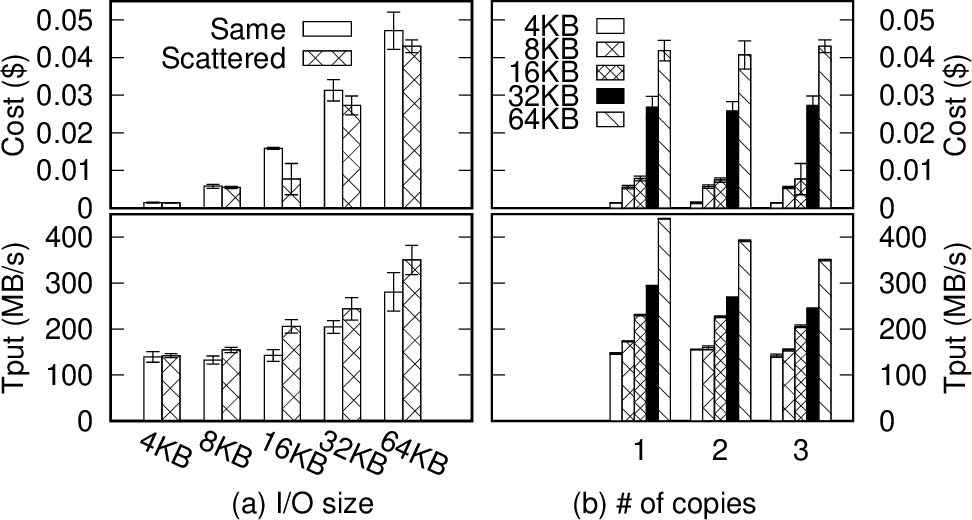
When using the PSB, SLFS supports placing the blocks from the same file on the same PSB node or scattering them across different nodes. Also, SLFS can configure the number of replicas that users maintain. We evaluate the performance and cost of these settings using 512 concurrent clients issuing 2 million requests that span multiple blocks using the YCSB-A workload (Zipfian distribution of 50:50 reads and writes).
Figure 6a shows that regardless of the I/O size, the throughput of scattering a file’s blocks to different PSB nodes scales better and achieves higher throughput at a lower cost (i.e., the duration of all individual functions converted into the AWS Lambda cost [74]). The data function can access different PSB nodes much faster in parallel in contrast to accessing blocks in a single PSB node. Thus, we choose the scatter data layout for the remainder of the evaluation.
Next, we experiment with different numbers of file copies from 1 to 3 (Figure 6b). As expected, creating more copies requires extra bandwidth and cost. Still, the throughput decrease and the cost increase between having 1 and 3 copies are only 12% and 1% on average, respectively. Thus, we use 3 copies for all other experiments, but this experiment shows that SLFS can trade off availability for cost and performance.
8.2 Elasticity and Scalability↩︎
Scaling Function Instances Up and Down.
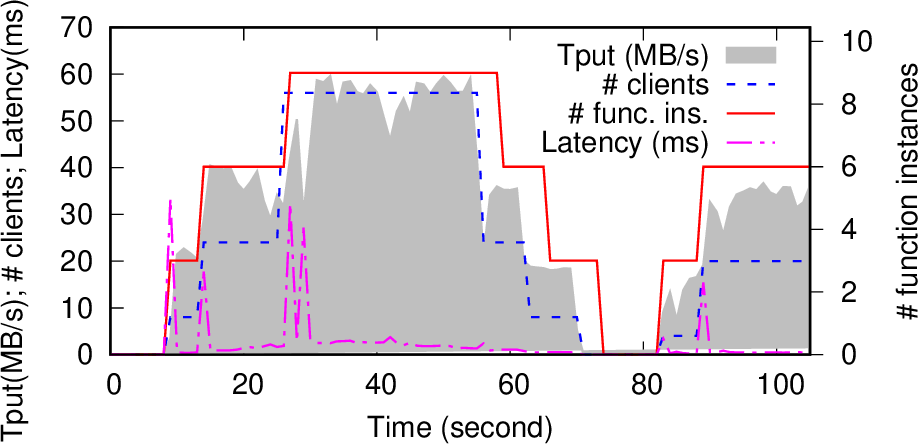
To evaluate how well SLFS scales up and down elastically, we dynamically change the amount of uniform random I/O loads with a 4KB request size on SLFS by controlling the number of concurrent clients. Figure 7 shows that the SLFS policy effectively scales the number of function instances to match the increasing and decreasing load trend. Function instances start from a cold state at the beginning of the execution so the latency spikes when new instances are added (10, 15, and 30 second marks). Still, the number of function instances closely and proportionally reflects the number of concurrent clients. The function instances stay up until slightly after the client load decreases, but they quickly adjust to the decreased load ( 55-80 second marks). When scaling back up (83 second mark), the latency does not spike much due to warm instances. This experiment demonstrates that SLFS scales up and down (even to zero at 75-83 second marks) quickly depending on the load and satisfies the serverless elasticity while maintaining the server-based function instance design.
Coordinator Scaling and Flow Separations.
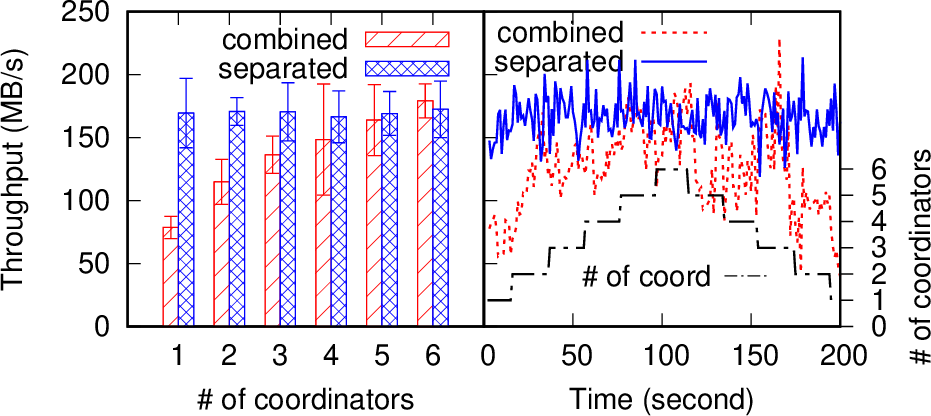
We manage a serverful implementation of coordinators and measure the performance under different numbers of coordinators. As a comparison, we use a baseline without the data flow separation introduced in Section 3.4 (Figure 8). In the baseline, all data goes through the coordinator. We measure the performance under the uniform random workload with a fixed number of coordinators (left) and while the coordinator scales up and down dynamically (right). Without the data flow separation, the coordinator can become the bottleneck as the data passes through it. When clients bypass the coordinator and directly interact with the functions, having a single coordinator can saturate the backend storage. The dynamic scaling of the coordinator demonstrates that coordinators can smoothly hand off files they are managing to different coordinators without disrupting the system execution.
8.3 Caching Comparison with InfiniCache↩︎
To evaluate the effectiveness of the SLFS caching scheme, we compare against our implementation of the InfiniCache [32] design, which we place on a cacheless SLFS. Our InfiniCache baseline runs multiple long-running function instances to host the maximum amount of cache memory that SLFS uses during runtime. The instances cache a disjoint set of data in memory. When an instance reaches its max lifetime (5 minutes in OpenWhisk), the instance terminates, and the cached data is discarded. The coordinator serves the role of InfiniCache proxy so the network hops for read/write operations stay the same as SLFS.
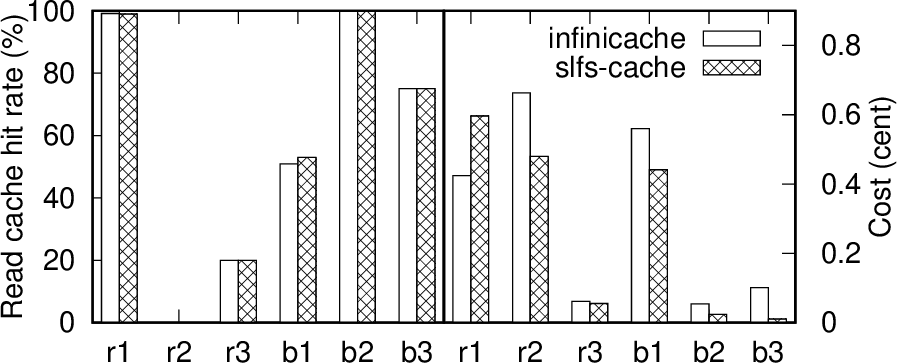
We run 1-hour sub-traces of the Azure trace that match the IQR interval with the full trace and replay them while observing the trace timestamp. Because SLFS uses the write-through policy, we only evaluate the traces that include read requests (Figure 9). The SLFS cache hit rate is comparable to InfiniCache. However, because SLFS passes the recently accessed data information to new instances, it exhibits a better hit rate when InfiniCache loses a chunk of cached data due to an instance termination (i.e., “b1”).
Because InfiniCache requires running separate cache instances, the cost of running InfiniCache with SLFS is generally more expensive. “r1” is an exception as it consists of short-interval read-only requests with nearly 100% cache hit rates. Requests are mostly served from the cache without touching the backend store, and InfiniCache leverages the hot start supported by OpenWhisk. However, SLFS extends the function lifetime to inject hot starts and adds costs. All data in “r2” is read once, resulting in 0% cache hit rate.
To quantify the performance improvement from introducing the cache, we measure the end-to-end run time of SLFS with and without the cache. We replay the r1-3 and b1-3 traces as quickly as possible and run YCSB-A and IOZone 50/50 random read/rewrite benchmarks similar to experiments in 8.6. On average, the cache improved performance by 22.68% across all workloads.
8.4 Cold, Warm, and Hot Starts↩︎
We evaluate how SLFS reuses the server-based function instances using the policies to prevent cold and even warm starts. Using the Azure trace, we measure the frequency of cold, warm, and hot starts in SLFS. We ran the experiment for 12 hours for each trace. We select the 12-hour range that best represents the overall request arrival interval IQR of the full trace and replay it while observing the trace timestamp. For the baselines we use the default serverless function design and \(\lambda\)FS. The default serverless function design follows a regular serverless function usage pattern: it terminates a function immediately after processing one request, and an independent function processes new requests. OpenWhisk keeps functions hot for 10 seconds and warm for 5 minutes, and the instances are reused based on this policy. \(\lambda\)FS always keeps function instances alive for the maximum allowed duration to retain cached metadata in the function and does not consider SLFS-like dynamic function lifetime control. Each function instance of \(\lambda\)FS runs for 5 minutes and processes multiple concurrent user requests during its lifetime.
Frequency.
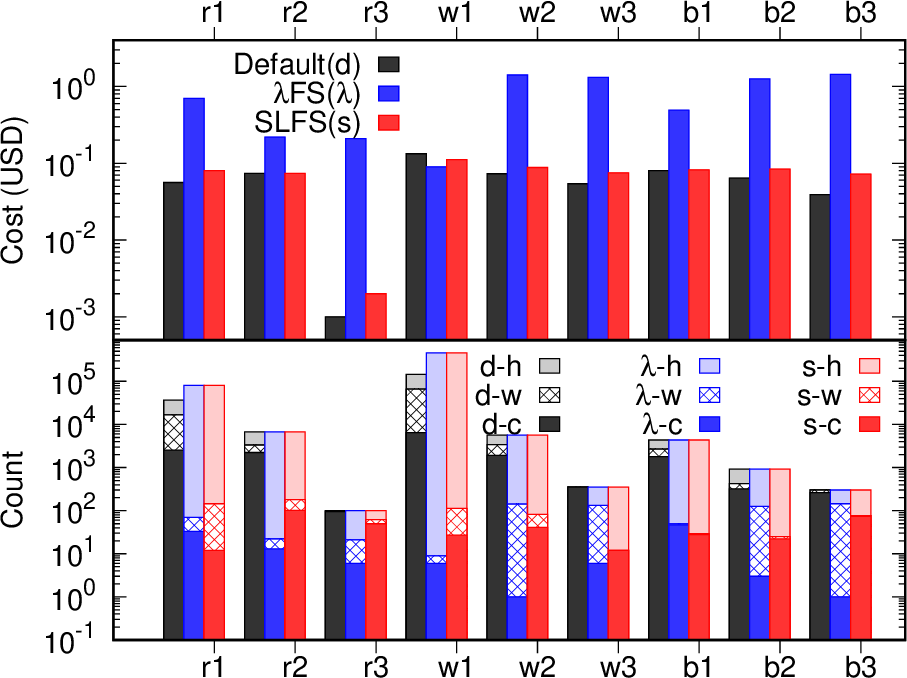
Figure 10 shows the result, where the y-axis displays the count in a log scale. The server design of SLFS functions avoids cold and even warm starts significantly compared to the default baseline: maximum 580\(\times\) for “w1”, on average 100\(\times\), and on median 29.5\(\times\). The Azure trace was collected on a commercial cloud-scale storage system, and the default baseline could not keep up with the replay speed of some traces in our cluster. The default design completed only 45.4% and 31.8% of the requests for the short-interval “r1” and “w1” traces, respectively, whereas SLFS successfully completed all I/Os showing the effectiveness of the SLFS function design. Compared to \(\lambda\)FS, which keeps the function instance alive for the maximum allowed duration, SLFS exhibits a comparable number of hot starts: on average 3% less than \(\lambda\)FS. Note that the initialization time of a \(\lambda\)FS function, even under warm start, takes much longer than the cold start time of the SLFS function instance to set up the long-running server, establish connections with the persistent database, and initialize the in-memory database. Also, to keep \(\lambda\)FS up to speed, we omit \(\lambda\)FS data requests which do not use function instances and do not affect the cost measurement.
Cost. Comparing the monetary cost for function invocations, SLFS extends the function duration and incurs an extra cost for most cases compared to the default baseline: on average, the function invocation cost of SLFS is 33.9% higher. If we project the cost to the full trace duration of 2 weeks, the maximum extra cost is only $0.92. This translates to an SLFS function running for, on average, 289 ms per I/O request which is also reflected in our cost comparison in 1. However, \(\lambda\)FS which yields comparable hot start results to SLFS costs significantly more than SLFS as its function instance always runs until the maximum allowed duration: on average \(\lambda\)FS costs 21 times higher than SLFS. This clearly shows the need and effectiveness of the function lifetime management of SLFS.
8.5 Metadata Operations under \(\lambda\)FS Benchmark↩︎
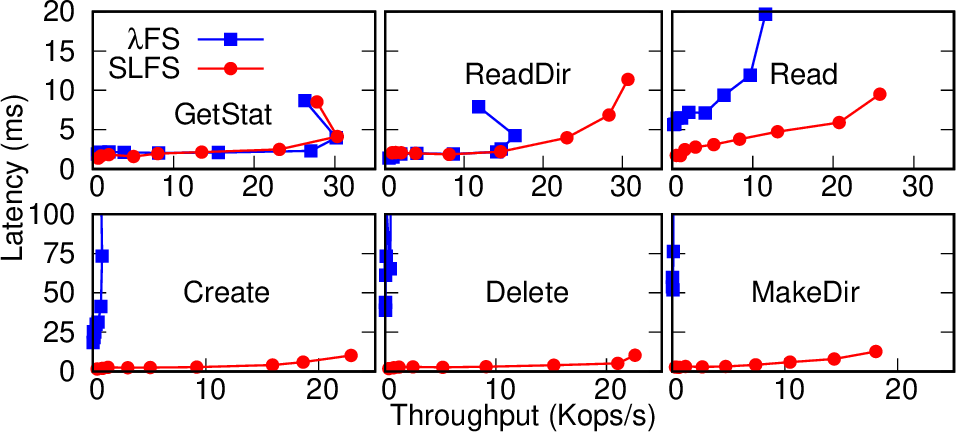
We use \(\lambda\)FS benchmark [73] to saturate the throughput to compare the performance of file system metadata operations of \(\lambda\)FS and SLFS in the Amazon Cloud.
For read-only metadata operations (Figure 11, top row), \(\lambda\)FS and SLFS perform similarly for GetStat, but SLFS scales better for reading directories (ReadDir) and reading empty files (Read). Even though \(\lambda\)FS function instances work as concurrent servers, finer-grained function instance management in SLFS makes operations more concurrent and scalable. For metadata operations involving updates (Figure 11, bottom row), SLFS significantly outperforms \(\lambda\)FS for all operations: \(\lambda\)FS scales up to only less than 1 Kops/s, whereas SLFS scales to approximately 20 Kops/s for all operations. One of the significant performance bottlenecks in \(\lambda\)FS is the MySQL Cluster NDB for persisting metadata updates. SLFS is designed to work with simple key-value interfaces, which can scale better under the same hardware configuration.
8.6 End-to-End Runtime for Azure Workloads↩︎
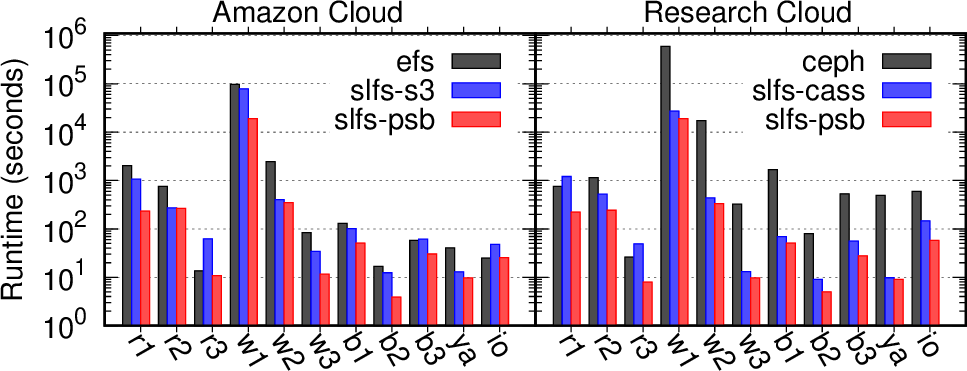
We compare the performance of SLFS against EFS [33] and Ceph [2] in the Amazon and a public research cloud, respectively (Figure 12, the y-axis is in a log scale). We replay the Azure traces to their full length as quickly as possible and run the YCSB-A workload and the IOZone file system benchmark (“ya” and “io”, respectively). IOZone issues concurrent 50 to 50 random reads and rewrites to large files.
Comparisons with EFS. In the Amazon cloud (12-left), we run SLFS on S3 (standard) and PSBs (with gp2 EBS volumes) and against EFS (standard store, general purpose mode). The experiment shows that SLFS on PSB outperforms EFS, on average, by 4.27\(\times\), 6.43\(\times\), and 3.02\(\times\) for read-only (r1-3), write-only (w1-3), and read-write workloads (b1-3, ya, and io), respectively. EFS is closed-source, but its documentation [75] partly explains why it exhibits high overhead especially for write-intensive workloads. Accessing small files continuously adds cumulative latency and reduces the throughput. Additionally, small writes entail metadata modification and significantly degrade the performance (e.g., “w1” and “w2”). SLFS avoids accessing block indexing data structures through hash-based indexes. As a result, SLFS outperforms EFS on average by 4.19\(\times\).
Comparing SLFS on S3 and PSB, the PSB backend, which is more expensive, leads to 2.73\(\times\) higher performance. Still, the cheapest SLFS configuration on S3 runs, on average, 1.99\(\times\) faster than EFS.
Comparisons with Ceph. In a public research cloud (12-right), we conduct a similar experiment, where we run SLFS on open-source Cassandra and PSBs. The overall trend is similar to the experiment performed in the Amazon cloud and SLFS on PSB exhibits very similar results to running in the Amazon cloud. Ceph runs the slowest with larger gaps to SLFS when there are more writes: i.e., SLFS on PSB outperforms Ceph by 2.42\(\times\), 16.98\(\times\), and 23.73\(\times\) for read-only, write-only, and mixed workloads respectively. A closer look at Ceph and the block drives provided by the research cloud reveals that the drives are very sensitive to random I/O as they are Cinder volumes backed by another backend Ceph cluster and Ceph’s architecture requires metadata updates through monitor and metadata server daemons for each file operation. While we collocated these daemons to minimize overhead, small random writes still require frequent coordination. In contrast, SLFS’s hash-based indexing eliminates explicit metadata updates for most operations, avoiding this coordination overhead and PSB uses the log-structured LevelDB which is less vulnerable to small random writes. For similar reasons, Cassandra-based SLFS performs worse than PSB-based SLFS, but outperforms Ceph significantly.
Despite the positive performance results from two different environments, we do not intend to argue strongly that SLFS is faster than EFS and Ceph considering the design differences and EFS and Ceph being stable production systems with more features. However, we claim that SLFS can be a scalable and cost-effective alternative to cloud-native or open-source file systems. Also, this experiment shows the flexibility of SLFS that can run on different backend stores with different cost and performance characteristics.
8.7 Cost Comparisons↩︎
The unit cost of running serverless functions is generally more expensive than running a VM: i.e., running a function instance non-stop for an hour is more expensive than renting a VM with the same amount of resources for an hour. For this reason, the cost benefit of a serverless system becomes apparent when request intervals are reflected in the workload. Therefore, experiments in [subsec:eval:meta] [subsec:e2e], which feed in a large continuous stream of I/O workloads, demonstrate the peak performance of SLFS, but cannot represent a scenario for cost comparisons of running the system in production.
Comparisons with EFS and \(\lambda\)FS. Hence, we compare the cost of running EFS and \(\lambda\)FS against SLFS based on the Azure workload following the marked timestamps. 1 considers all costs involved in maintaining the system while processing user requests for one month under the same hardware configurations we used for the experiments. The function invocation cost for SLFS is derived from the experiments in 8.4. Depending on the configuration, SLFS can be 12% to 68% cheaper than EFS. While SLFS provides such flexibility, even the cheapest SLFS setup performs better than EFS (12).
10 shows that the function invocation cost of \(\lambda\)FS is 21 times higher than SLFS for representative workloads. Even considering other hardware costs, which can be the same as SLFS as in our experiment, the total cost of \(\lambda\)FS becomes dominated by the function invocation cost. Analyzing the same way as in 1, the total cost of \(\lambda\)FS becomes 31% to 70% more expensive (not in the figure but ranging from $1,767 to $2,289 depending on the EBS setting) than the EFS cost. Comparing matching EBS configurations, the total cost of SLFS is 48% to 63% cheaper than \(\lambda\)FS, making SLFS the most cost-effective and performant option.
Comparisons with Ceph and Cost per Performance. Based on the configurations we choose under the same storage node setting (i.e., 9VMs) as SLFS, Ceph exhibits minimal hardware configuration and incurs constant hardware cost only for the storage VMs. Still, projecting the cost in 1 assuming the Amazon cloud deployment, Ceph becomes more expensive than SLFS on S3 even with the cheapest EBS volume type (i.e., Ceph costs $537 on HDD-sc1 which is between SLFS-S3-std and SLFS-HDD-sc1 in 1).
Since the Ceph price can be low, we further compare the price per work done based on the experiment in 12 considering the compute cost (i.e., cost for functions and VMs) given the same storage setting. For SLFS on Cassandra, SLFS on PSB, and Ceph, the total price incurred based on the Amazon pricing model [44] to run the Azure trace used in the figure is $0.62, $0.48, and $1.31, respectively. Thus, Ceph is 2.09\(\times\) to 2.72\(\times\) more expensive than SLFS to do the same work, and this is due to lower performance and extended duration to complete the work. Compared to Ceph, SLFS is more economical and provides more diverse cost configurations.
9 Related Work↩︎
Serverless In-Memory and Persistent Storage Systems.
InfiniCache [32] builds a distributed in-memory cache out of serverless function instances. SLFS uses the coordinator and InfiniCache uses the proxy to relay the request to function instances. However, SLFS further extends the role of the coordinator to make policy-based decisions for hot starts and better resource management. InfiniCache does not offer data durability and heavily relies on warm function containers over which InfiniCache has little control. InfiniStore [45] extends InfiniCache with a serverless memory abstraction and persistence using a cloud object store to tolerate failures. However, it does not support file abstractions and lacks the fine-grained function control of SLFS.
\(\lambda\)FS augments HDFS-based HopsFS [17] with the InfiniCache idea to cache only metadata in a long-lived function instance. Its coordination service and name nodes resemble the coordinator and \(f_{Data}/f_{Meta}\) of SLFS but SLFS is more general and supports features not in \(\lambda\)FS. SLFS handles both file data and metadata through finely managed functions, dynamically controls function lifetime for performance and cost, and is portable to different backends.
Cold Start and Function Lifetime Management.
Cold start problems are largely tackled by exploring lightweight mechanisms to start the function instance [36]–[39] and keeping function instances warm based on predicted request patterns [40], [41], [52]. The SLFS solution is closer to the latter but extends the hot function state for a short controlled period to avoid both cold and warm starts; this is complementary to existing approaches and opens up new opportunities to even avoid warm starts.
Support for Stateful Serverless Computing.
Pocket [18] is an ephemeral storage system for short-lived serverless tasks, Boki [19] realizes a distributed shared log for serverless functions to coordinate, and Cloudburst [76] extends the auto-scaling key-value store Anna [77] with HydroCache [78] to collocate data and computation with a causal consistency guarantee. Similar to these systems, SLFS improves the accessibility of state across different serverless functions over persistent backend storage systems. Beldi [20] implements a serverless transactional key-value store with exactly-once semantics. Like Beldi, SLFS leverages the atomic commit features provided by the backend storage system and distributed transactions for consistent updates. SLFS does not guarantee exactly-once semantics, which is beyond what most file systems provide, but Beldi’s approach applies complementarily. Among all these systems, SLFS is the only file service leveraging serverless functions.
Decomposed File Systems.
There are serverful distributed [2], [79] and local [80]–[83] file systems designed on top of key-value stores. While local file systems leverage key-value stores for more efficient indexing and fast metadata access, distributed file systems use them for modularity of design and ease of system management. FUSE-based file systems on cloud backend key-value stores [84]–[86] are designed to leverage low-cost cloud key-value stores. While SLFS also uses key-value stores to delegate the complexity of fine-grained data management and to utilize low-cost cloud backend stores, SLFS goes further to achieve utmost elasticity and even lower costs through serverless designs. Existing systems may be able to leverage container as a service at best without code modification for elasticity, but due to a heavier code footprint and larger image size, their startup time would be nearly a minute [87] to tens of seconds [88], [89], so they cannot be as elastic as SLFS.
CNFS [90], a cloud-native file system, advocates for designing storage systems around cloud primitives. CNFS is a local, hierarchical, copy-on-write file system that migrates data and metadata across cloud storage volumes and offloads background tasks such as migration and compression to remote CPU workers. While CNFS shares the high-level vision of decomposing file system functionality across cloud services, it focuses on local file system design principles and does not leverage the serverless computing model. SLFS is a fully distributed file system that uses serverless functions and proposes designs and methodologies to fully leverage the serverless environment.
10 Conclusions↩︎
We presented SLFS, the first distributed file system mainly designed with the serverless paradigm. SLFS can run on cloud-native and users’ custom key-value stores and adjust to users’ needs. SLFS implements file operations using serverless functions. The function instances are designed as novel short-lived multi-threaded servers that dramatically avoid cold and warm starts at a low cost. SLFS makes policy-based decisions to scale the system elastically and uses residual function instance memory for caching. Our evaluation in the cloud with Azure workloads shows that SLFS performs better than \(\lambda\)FS, EFS, and Ceph at a significantly lower cost.