Fully Unsupervised Detection of Physical Contacts on Subsea Cables via State-of-Polarization Monitoring
January 01, 1970
We present a fully unsupervised Fast-Slow DSVDD detector for continuous State-of-Polarization monitoring on a deployed subsea cable. Trained without event labels, it ranks all five confirmed trawler contacts within the top 13 of 122,174 recordings and surfaces additional corroborated cable-contact events. ©2026 The Author(s)
1 Introduction↩︎
Subsea fibre-optic cables carry over 97% of intercontinental data traffic, and trawler fishing and anchor dragging are leading causes of cable damage, with dragged-anchor incidents alone accounting for 30–40% of offshore cable faults [1]. das and sop fibre sensing technologies mitigate these risks by monitoring vibrations and physical disturbances along the cable [2]. das localises approaching trawlers [3], but suffers from saturation effects and limited dynamic range for strong signals such as direct impacts [4]. sop monitoring provides a complementary approach [5], [6]: it can be extracted directly from existing coherent receivers at no marginal hardware cost, does not saturate during strong motions, is compatible with inline amplifiers [7], and produces unique signatures for distinct physical impacts [8].
A recent long-term field trial on the Lowestoft–Lista subsea cable established that sop responds to real trawler contacts, anchor drags, and environmental forces over multi-month observation periods [9]. However, this was performed manually by visual correlation of sop waveforms, and does not scale to network-wide real-time monitoring. Furthermore, sop monitoring through live transmission systems is impacted by environmental and equipment noise, within which physical contacts are rare and subtle. This motivates a ml approach over classical thresholding. However, the absence of labelled event data from real field trials has largely confined existing ml-based sop detection to controlled settings: Supervised classifiers trained on labelled examples achieve high accuracy on short sequences with predefined event types [10]–[13], and semi-supervised methods relax this to one-class fits on labelled baselines [14], but both evaluate on controlled testbed scenarios rather than continuous deployed data. Automated detection on deployed cables has been demonstrated in terrestrial settings [7], [15], [16] but relies on supervised training.
In this work, we transition from manual and supervised approaches to fully unsupervised event detection on continuous long-duration sop data from a deployed subsea cable. We use 92 days of continuous sop recordings from the Lowestoft–Lista cable (Tampnet, North Sea)-the same system used in our previous field trial [9], comprising 122,174 one-minute recordings at 44.1 kHz. We evaluate a deep one-class detection model under unsupervised conditions: no trawler labels are used at any stage of training, model selection, or hyperparameter tuning. The model ranks all ground-truth confirmed trawler contacts within the top 13 of the full 122,174 archive, where lower ranks indicate recordings judged more anomalous by the detector. Beyond the 5 logged events, the framework produces additional recordings not previously identified during manual reviews of sop data. Post-hoc review against the das and ais records confirmed crossings in which the vessel disabled its ais transponder during cable crossing.
These results demonstrate fully unsupervised detection on continuous deployed cable as a low-cost practical approach, while uncovering significant events missed by manual monitoring even under diverse event characteristics.
2 Field Trial and Data Pipeline↩︎
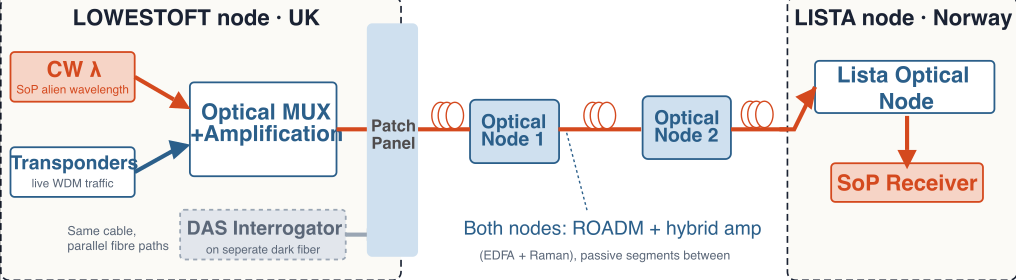
Data was acquired from the Tampnet subsea communication system connecting Lowestoft, U.K., to Lista, Norway (Fig. 1) using the same configuration as [9]. A cw laser was injected as an alien wavelength at Lowestoft, multiplexed with live traffic through an amplified wdm transmission system spanning passive submarine cable segments. At Lista, the cw wavelength was demultiplexed to a pbs unit measuring the relative \(S_1\) Stokes parameter at \(44.1\) kHz with 16-bit resolution. das was operated on a parallel dark fibre from Lowestoft, covering 120 km of the cable without passing through inline amplifiers; das data is not used in the detection framework but provides independent corroboration for events discussed in Section 4.
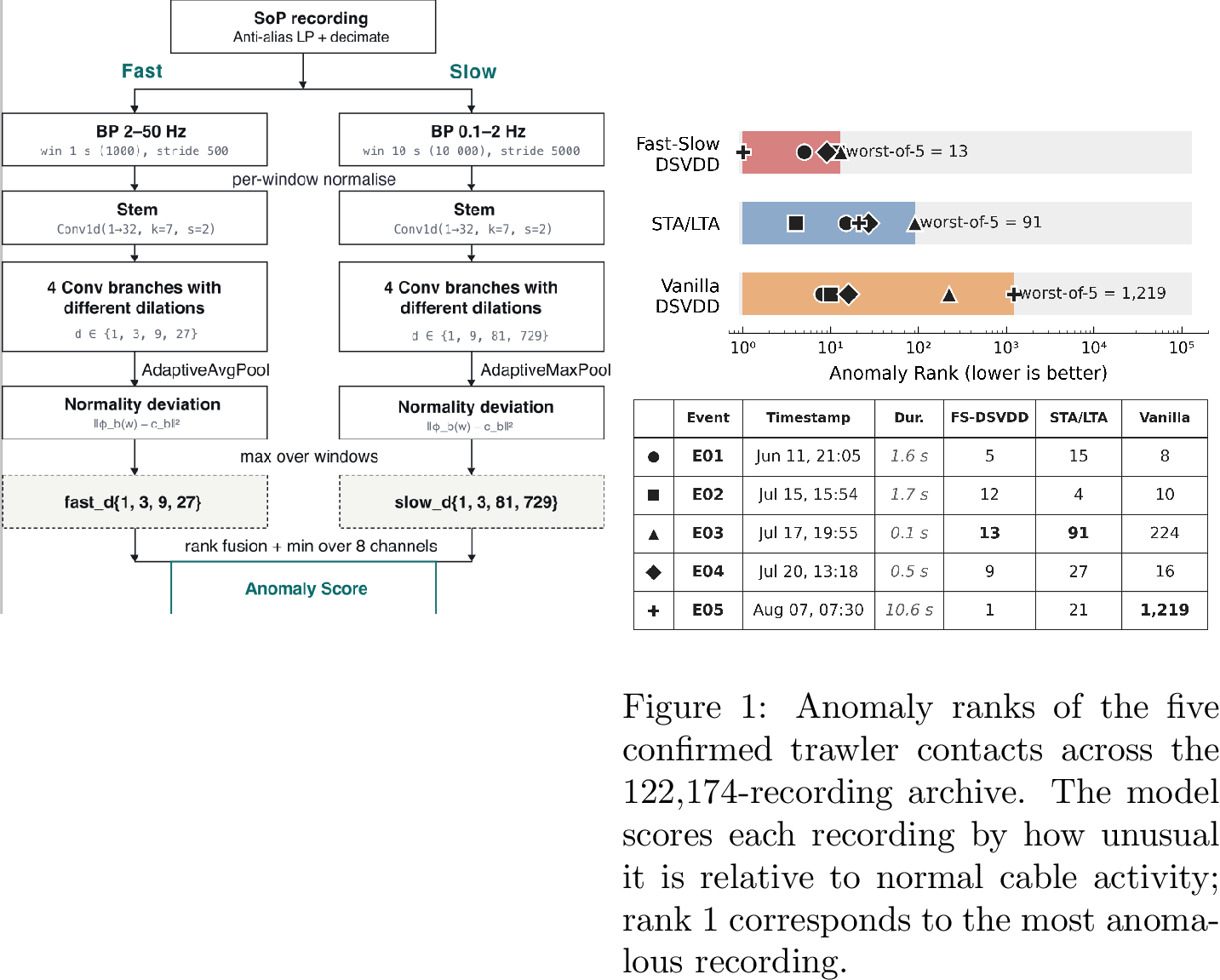
We analyse 92 days of continuous recordings from this system (June–August 2025), comprising 122,174 one-minute stereo FLAC files. The sensing observable is \(S_1 = V_1 - V_2\), the differential output of the two pbs channels. During this period, five trawler physical contacts were confirmed by manual cross-referencing of sop transients, das waterfall signatures, and ais vessel-tracking records. These five events, spanning from sub-second (E1, 0.5 s) to sustained (E5, 10.6 s), are summarised in Fig. 4 and its accompanying table. These five events constitute the sole ground-truth for all detection results; no labels are used to train, select, or tune any model.
3 Detection Framework↩︎
Physical contact events on subsea cables are rare, brief, and unlabelled in operational settings. In our 92-day archive, five confirmed trawler contacts occupy a combined \(\approx\)25 seconds of signal across 122,174 one-minute recordings, corresponding to a class prevalence below 0.004%. Supervised classification is infeasible at this label scarcity, while semi-supervised approaches assume a stationary reference distribution that months of deployed-cable data cannot provide. Standard unsupervised anomaly detectors such as one-class SVMs, Isolation Forests, autoencoders, and dsvdd [17] operate at a single temporal scale. The sop signal in this setting, however, contains two physically different anomaly regimes: trawler contacts produce impulsive transients in the 2–100 Hz band lasting 0.5–10 seconds [9], while environmental and equipment dynamics produce slower variations below 2 Hz. A single-scale detector must therefore prioritise one regime at the expense of the other. Reliable detection requires a model that learns normal behaviour separately at the characteristic timescales of both regimes.
We extend dsvdd to a dual-head architecture, with each head designed for a distinct regime (Fig. 2). The fast head bandpass filters the input to 2–50 Hz and operates on 1-second windows to capture impulsive transients, while the slow head filters to 0.1–2 Hz and operates on 10-second windows for slower dynamics. Within each head, four parallel dilated convolutional branches provide multi-resolution coverage. The dilation schedules are matched to the regime: the fast head uses \({1,3,9,27}\) and the slow head \({1,9,81,729}\), spanning receptive fields from milliseconds to the full 10-second window. Each branch is associated with a 32-dimensional hypersphere centre, giving eight detection channels. The fast head applies average pooling across 119 overlapping windows, whereas the slow head applies max pooling across 11 windows so that a single anomalous segment can dominate the output. These responses are aggregated into recording-level anomaly scores and fused into a single archive-wide ranking.
Each head is trained on 200,000 uniformly sampled windows from the archive using an unsupervised dsvdd objective that encourages embeddings of training windows to lie close to a fixed hypersphere centre. For branch \(b\), with encoder \(\phi_b\) and centre \(c_b\), the anomaly score assigned to a window \(x\) is the squared embedding distance \(d_b(x) = \| \phi_b(x) - c_b \|^2\), which is minimised during training over unlabelled archive windows using Adam (\(lr = 10^{-4}\), 8 epochs). At inference, each branch assigns a recording-level score given by \(\max_w d_b(w)\) across that recording’s windows. The final anomaly rank of a recording is then defined as the minimum across the eight branch-specific ranks. A recording is therefore flagged if it appears anomalous in any one detection channel.
4 Results↩︎
We compare Fast-Slow dsvdd against two baselines: an sta/lta trigger (STA = 50 ms, LTA = 5 s, bandpass 0.5–20 Hz on \(S_1\)), representative of classical transient-detection approaches [18]; and vanilla dsvdd, a single-head, single-scale variant of our architecture operating on 1-second windows without the fast-slow band split.
We evaluate each method by sorting the full 122,174-recording archive by anomaly score and reporting the ranks of the five confirmed trawler events. Rank 1 corresponds to the recording the method considers most anomalous, so lower ranks indicate better detection performance. A method that places all five events within the top \(K\) requires an operator to review at most \(K\) recordings to achieve complete detection. Each ground-truth event is matched to its containing recording using a \(\pm 10\) s containment interval around the logged timestamp. We summarise performance using the worst-of-5 metric, defined as the highest anomaly rank among the five confirmed events.
Fig. 4 and the accompanying table summarise the per-event anomaly ranks together with the corresponding event durations. Fast-Slow dsvdd places all five confirmed trawler contacts within the top 13 of the archive, with the sustained 10.6-second event E05 ranked 1st and the sub-second, hardest-to-detect event E03 ranked 13th. sta/lta achieves worst-of-5 = 91, with its failure concentrated on the shortest events, including E03 at rank 91. Vanilla dsvdd achieves worst-of-5 = 1,219, failing on E05 (rank 1,219), the sustained contact that its fixed 1-second window scale cannot resolve. The remaining four events are ranked within the top 30 by both baselines, indicating that simpler methods can recover short impulsive contacts, but not with the same consistency across event durations. What distinguishes Fast-Slow dsvdd is consistent performance across the full range of event morphologies, from sub-second impulses to multi-second sustained contacts.
At the operating point where all five trawler contacts are recovered, Fast-Slow dsvdd produces 13 alarms over 92 days, approximately one per week. This represents a review burden that is operationally tractable for monitoring. The proposed fast-slow design therefore provides consistent unsupervised detection across both short impulsive and sustained trawler-contact events.
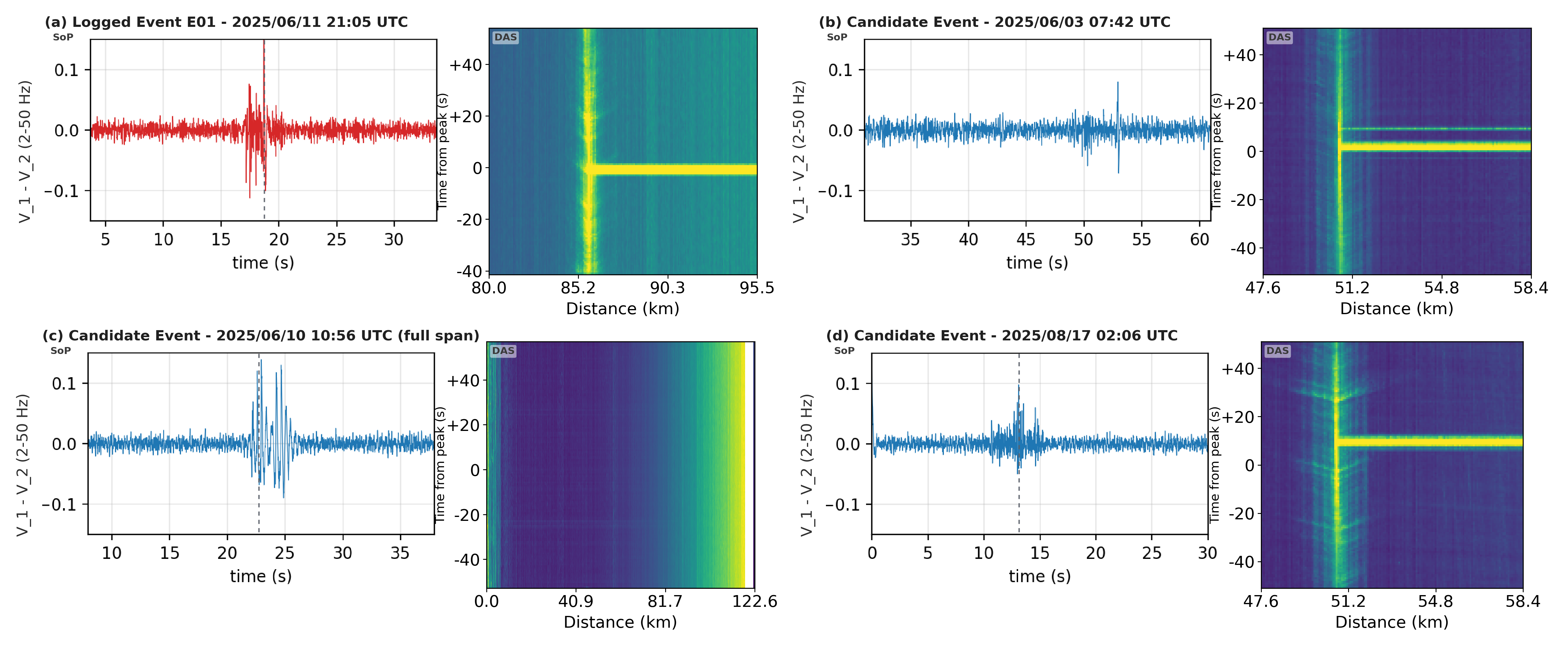
Discovery: The model’s highest-ranked recordings included three additional candidate events, on 3rd June, 10th June, and 17th August 2025, that were absent from the event log and had not been identified during manual sop review. Figure 3 compares these detections with a logged trawler-contact event. Post-hoc review against concurrent das and ais records confirmed physical cable-interaction signatures for the 10th June and 17th August events. No corresponding das signature was observed for the 10th June event throughout 120 km, suggesting that it occurred outside the das-covered cable span in this experiment. These findings show that the proposed framework can surface previously undetected events of physical contact from continuous sop monitoring.
5 Conclusions↩︎
We demonstrated fully unsupervised detection of physical contact events on a deployed subsea cable using continuous sop monitoring. The proposed Fast-Slow dsvdd model recovered all five confirmed trawler contacts within the top 13 of a 122,174-recording archive and also surfaced additional corroborated candidate events. These results establish sop-based monitoring as a practical low-cost basis for automated screening of long-duration subsea cable recordings.
6 Acknowledgements↩︎
This work was supported by the European Union’s Horizon Europe research and innovation programme (Grant No. 10113933) ICON project, CELTIC-NEXT SUSTAINET-ADVANCED (C2024/3-3), Taighde Éireann – Research Ireland under Grant No. 18/RI/5721 (OpenIreland Research Infrastructure), 13/RC/2106_P2 (ADAPT centre).
References↩︎
This paper is a preprint of a paper accepted in ECOC 2026 and is subject to Institution of Engineering and Technology Copyright. A copy of record will be available at IET Digital Library↩︎