The Decode-Work Law:
Margin-Governed, Provably-Exact Spatial Joins over Compressed Geometry
January 01, 1970
Abstract
Filter-and-refine spatial joins have always avoided touching exact geometry for certified candidate pairs, but the field never modeled the decompression cost of the pairs that survive the filter. When geometry is stored in a compressed, progressively-decodable multiresolution codec, the join’s true cost is bytes decoded. We study provably-exact polygon intersection joins over a Douglas–Peucker level-of-detail (LOD) ladder, certified by a two-sided Hausdorff-margin test, and make two contributions. First, a reproducible mechanism and harness: on real U.S.Census TIGER water polygons, our progressive certificate join returns the exact result while decoding \(3.4\)–\(16.8\times\) (median \(5.9\times\)) fewer vertices than naive decompress-then-refine, and about \(4.9\times\) fewer than the single-approximation multi-step baseline of [1], with zero correctness violations across \(31\) workloads. Second, a characterization we call the decode-work law: decode work is governed by each pair’s signed-clearance margin—how close it is to the predicate-flip boundary—independent of object size, because the certificate descends the ladder only until its resolution beats the margin. The law is clean on controlled geometry (held-out \(R^2=0.87\), size-independent) and directional on real data (\(R^2\approx0.55\)). We are explicit about what does not hold: a near-boundary-vertex predictor is the wrong model (we pre-registered one and rejected it), a selectivity regime forecaster did not materialize, and the worst case is the trivial \(\Omega(v)\) read bound on adversarially interleaved boundaries. We contribute the mechanism, budget-honest decode accounting, and an open harness; we do not claim a new index.
1 Introduction↩︎
Spatial joins—report all pairs \((r,s)\in R\times S\) satisfying a topological predicate such as intersects—are a workhorse of geographic data systems [2]. The dominant architecture is filter-and-refine [3], [4]: a cheap minimum-bounding-rectangle (MBR) filter produces candidate pairs, and an expensive exact geometric refinement decides each candidate. Modern stores keep geometry compressed: delta/varint coordinate codecs (TWKB), columnar layouts (GeoArrow, GeoParquet, SpatialParquet [5]), and progressively-decodable multiresolution encodings. In this setting the refinement step’s true cost is not comparisons or wall-clock but bytes decoded: an exact predicate needs coordinates, and decoding dominates.
Filter-and-refine already avoids exact geometry for pairs it can certify early—the classic multi-step join of [1] certifies hits and false-hits from conservative and progressive object approximations before touching exact geometry. What the literature never did is model the decode cost of the survivors: how many coordinate bytes must a provably-exact join actually decode, and what governs that number? This paper answers that question empirically and gives the answer a name.
We encode each geometry as a Douglas–Peucker [6] LOD ladder \(\tilde{g}_0,\dots,\tilde{g}_k=g\), level \(\ell\) carrying a guaranteed Hausdorff error bound \(\eta_\ell\) (monotone decreasing, \(\eta_k=0\)). A candidate pair is certified DISJOINT when the \(\eta\)-dilated coarse geometries are disjoint, INTERSECT when the \(\eta\)-eroded coarse geometries overlap, and otherwise descends the ladder—decoding more vertices—until it certifies. The certificate is the Hausdorff-margin instantiation of Brinkhoff’s false-area test; our questions are about its decode cost.
1.0.0.1 Contributions.
A provably-exact compressed-domain join with measured teeth. On real TIGER water polygons, the progressive certificate join decodes \(3.4\)–\(16.8\times\) (median \(5.9\times\)) fewer vertices than naive decompress-then-refine and \(\approx4.9\times\) fewer than a single-approximation Brinkhoff baseline, at set-equality with a full-precision oracle (Section 4). The multi-level ladder—not a single intermediate approximation—is the source of the gain.
The decode-work law. Decode work is governed by the per-pair signed-clearance margin \(m\), independent of object size: the certificate must descend until \(\eta_\ell<|m|\), so near-tangent pairs cost \(\Omega(v)\) and robustly-decided pairs cost almost nothing (Section 5). Clean on controlled geometry (\(R^2=0.87\), size-independent), directional on real data (\(R^2\approx0.55\)).
Honest negatives and a reusable harness. We pre-registered a near-boundary band-vertex predictor and rejected it; a selectivity-based regime forecaster did not materialize; the worst case is the trivial read bound. All numbers regenerate from one command.
We deliberately do not propose a new index or a new codec, and we do not claim a general decompression-sensitive complexity model—that program is owned by [7] and the compact-data-structures literature [8]; we merely instrument in it.
2 Problem and model↩︎
Let \(R,S\) be collections of polygons with vertices quantized to a fixed grid; the quantized geometry is the data of record for both the compressed store and the exact oracle, so certificate pruning can only ever be a sound approximation of the exact stored polygon (no lossy rounding gap). For a geometry \(g\) the LOD ladder keeps a subset of \(g\)’s exact vertices at each level (a property of Douglas–Peucker), with \(\eta_\ell=\mathrm{HausdorffDistance}(g,\tilde{g}_\ell)\) and \(\eta_k=0\). Decoding to level \(\ell\) costs the cumulative vertices/bytes of that level.
2.0.0.1 Two-sided certificate.
For a candidate pair \((r,s)\) at levels \((\ell_r,\ell_s)\) define the outer \(O_g=\tilde{g}_\ell\oplus B(\eta_\ell)\) (a sound superset, \(g\subseteq O_g\)) and inner \(I_g=\tilde{g}_\ell\ominus B(\eta_\ell)\) (an inner approximation). Then \(O_r\cap O_s=\varnothing\) certifies DISJOINT and \(I_r\cap I_s\neq\varnothing\) certifies INTERSECT; otherwise the pair is ambiguous and we descend the coarser side. At \(\eta=0\) the test is the exact predicate. Soundness of the outer test is immediate; the inner (erosion) test is verified empirically on every run by the correctness gate (set-equality against the full-precision oracle) and the adversarial control, and the pre-registration mandates halt-and-harden on any violation—no violation occurred.
2.0.0.2 Signed-clearance margin.
The quantity that turns out to govern decode is the pair’s margin \[m(r,s)=\begin{cases}+\,\mathrm{inradius}(r\cap s) & \text{if } r\cap s\neq\varnothing \text{ (overlap depth)}\\ -\,\mathrm{dist}(r,s) & \text{if disjoint (gap)}. \end{cases}\] \(|m|\) measures how far the pair is from the predicate-flip boundary. Because a level-\(\ell\) certificate can only resolve features coarser than \(\eta_\ell\), the pair certifies at the first level with \(\eta_\ell<|m|\). The metric of interest is the decoded fraction \(\varphi_{\mathrm{pair}}=\text{decoded vertices}/(|r|+|s|)\) and the certifying depth.
2.0.0.3 Decode accounting (fairness).
Every method starts from the same MBR candidate set, so the measured delta is purely refinement depth. We count all bytes a method reads, including LOD headers. The naive-refine baseline decodes all vertices of every MBR survivor then tests exactly; the Brinkhoff [1] baseline is the two-level special case (one coarse approximation, then exact). Ground truth is always full precision.
3 Experimental setup↩︎
Real data. U.S.Census TIGER/Line 2023 AREAWATER (public domain) [9] for three geographically diverse counties—Jefferson,
LA (FIPS 22051), St.Louis, MN (27137), King, WA (53033)—water polygons carrying tens to \(\sim\)6,700 vertices (median \(\approx\)85–109). The workload is \(\texttt{AREAWATER}\bowtie\mathrm{translate}(\texttt{AREAWATER},
\delta)\) with the translation \(\delta\) swept as a fraction \(\{0.1,0.25,0.5,1.0\}\) of the median polygon diagonal—a controlled real-geometry self-join (a standard spatial-join
stress pattern [2]) that sweeps the margin regime while preserving real vertex-count heterogeneity. Synthetic control.
Independently-placed rough blobs with varied vertex counts (so the size-independence test can be isolated) plus adversarial interlocking-comb fixtures and a hand-checked known-answer fixture. Apparatus. Single-thread Python with
Shapely 2.1/GEOS 3.13 as the exact oracle; a custom Douglas–Peucker LOD ladder and delta/varint decode counter; fully deterministic (seeds only in synthetic generation). One command regenerates every number and figure.
3.0.0.1 Pre-registration.
Hypotheses, decision rules, and negative controls were frozen before any confirmatory run. We pre-registered a primary predictor (a near-boundary band-vertex count), rejected it on the pilot, and logged an amendment reframing the predictor to the margin before the confirmatory run; both the failure and the reframe are reported (Section 5).
4 Results: the teeth↩︎
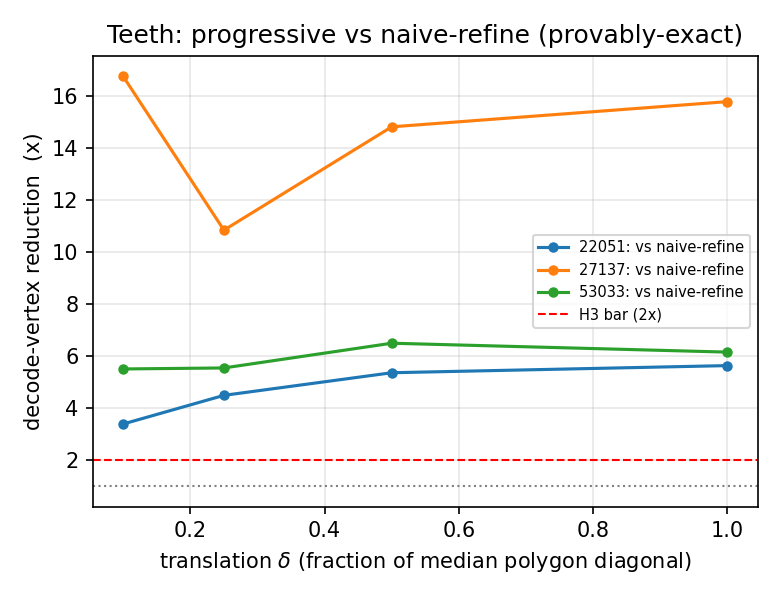
Table 1 and Figure 1 report decode reduction on the real TIGER workloads. Across all \(12\) county\(\times\delta\) workloads the progressive join decodes a median \(5.9\times\) fewer vertices than naive decompress-then-refine (range \(3.4\)–\(16.8\times\)) and a median \(4.9\times\) fewer than the single-approximation Brinkhoff baseline, decoding only \(6\)–\(29\%\) of vertices (\(\varphi_{\mathrm{pair}}\)) for a provably-exact result. Every workload returns exactly the oracle’s pair set (correctness column). The multi-level ladder is decisive: it roughly quintuples Brinkhoff’s single-approximation savings, because most decode budget is spent on the small population of near-tangent pairs that a single coarse approximation cannot resolve.
| County (FIPS) | vs.naive-refine | vs.Brinkhoff’94 | decoded frac.\(\phip\) | correct |
|---|---|---|---|---|
| Jefferson, LA (22051) | \(3.4\)–\(5.6\times\) | \(3.0\)–\(5.1\times\) | \(0.18\)–\(0.29\) | ✔ |
| St.Louis, MN (27137) | \(10.9\)–\(16.8\times\) | \(7.2\)–\(11.3\times\) | \(0.06\)–\(0.09\) | ✔ |
| King, WA (53033) | \(5.5\)–\(6.5\times\) | \(4.0\)–\(4.8\times\) | \(0.15\)–\(0.18\) | ✔ |
| overall (12 workloads) | median \(5.9\times\) | median \(4.9\times\) | \(0.06\)–\(0.29\) | 31/31 |
5 Results: the decode-work law↩︎
5.0.0.1 Margin governs decode; size does not.
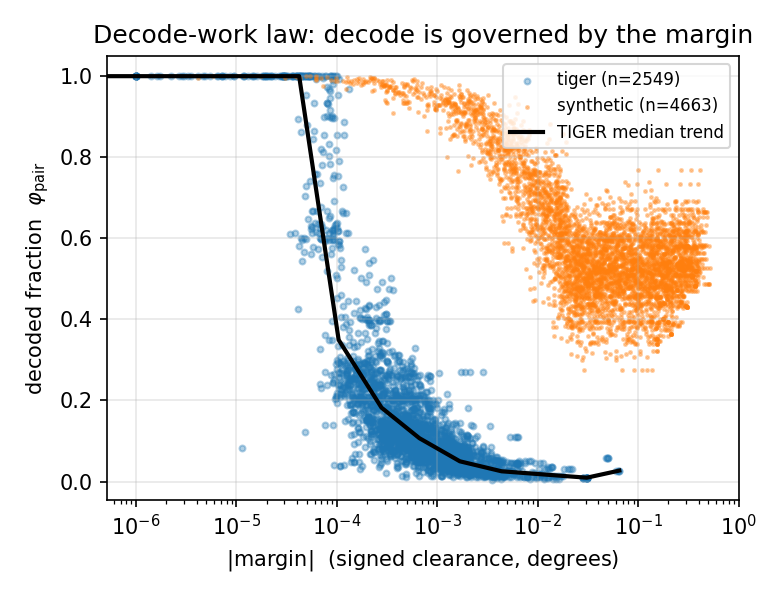
Figure 2 plots the per-pair decoded fraction \(\varphi_{\mathrm{pair}}\) against \(|m|\). The relationship is a clean collapse: near-tangent pairs (\(|m|\!\to\!0\)) decode essentially everything, robustly-decided pairs (\(|m|\) large) decode almost nothing. On controlled synthetic geometry a quadratic-in-\(\log_{10}|m|\) fit predicts the certifying depth with held-out \(R^2=0.87\), and after controlling for margin the standardized partial effect of object size is \(\beta_{\text{size}}=0.002\)—decode depth is margin-governed and size-independent, the instance-optimal invariant [10]. On real TIGER geometry the law is directional but weaker: best held-out \(R^2\approx0.55\), with the decoded fraction size-independent (\(\beta_{\text{size}}=0.07\)). Real multi-scale water boundaries add noise the controlled setting does not; we report the gap rather than paper over it.
5.0.0.2 What the law is not (rejected predictor).
We pre-registered a different predictor—the count of exact vertices lying near the other polygon’s boundary (an “\(\eta\)-band”). It was rejected on the pilot (held-out \(R^2\approx0.06\), wrong-signed): it proxies overlap robustness, which anti-correlates with decode, because a deep robust overlap has many near-boundary vertices yet certifies instantly. The margin is the correct, non-circular, geometry-only predictor, and we froze the reframe before the confirmatory run.
5.0.0.3 Regime and worst case.
The regime axis on real data is the margin (equivalently \(\delta\)), not selectivity: a selectivity-based forecaster we pre-registered did not materialize because translated self-joins hold selectivity near one, yet the decoded fraction genuinely spans \(0.06\)–\(0.29\) across the sweep. On adversarial interlocking-comb fixtures the certificate cannot prune—decoded fraction \(0.99\)—matching the trivial \(\Omega(v)\) read bound (and the \(\Omega(n\log n+K)\) reporting bound of [11] for the within-pair variant). Average, redundant geometry is cheap; adversarial geometry is not.
6 Related work↩︎
Multi-step spatial joins. [1] and its companion introduced conservative and progressive object approximations, certifying hits/false-hits before exact geometry; the false-area test is our \(\eta\)-margin certificate. Our delta is (i) a continuum of LOD levels rather than one intermediate approximation, which we benchmark and beat \(\approx4.9\times\), and (ii) modeling the decode cost rather than filter yield. Compressed-domain refinement. APRIL [12] refines intersection joins over a secondary raster-interval approximation; compact-structure joins [8], [13] operate over in-memory self-indexes for point/distance joins. We differ by operating on the native progressively-decodable geometry codec and by deriving a decode-cost law with boundary semantics. Bounded-error approximations. [14] advocate distance-bounded approximate answers; we return provably-exact results and use the bound only to decide decode depth. Complexity framing. [7] formalize decompress-and-solve versus compressed-size complexity; we instrument in that model rather than extend it, and frame our result as instance-optimal [10]. Columnar/scan pushdown [5] pushes filters, not join refinement, into the encoded domain.
7 Limitations and honest negatives↩︎
(1) The margin law is only partially predictive on real geometry (\(R^2\approx0.55\), below the \(\ge0.80\) we pre-registered)—a directional characterization, not a tight
predictor. (2) Our pre-registered band-vertex predictor was rejected; the paper reports the failure and the reframe. (3) The selectivity-based regime forecaster did not hold; the real regime axis is the margin. (4) The worst case is the trivial \(\Omega(v)\) read bound—we prove no hardness result. (5) Scope: single-thread, polygon intersects (contains/within-\(\epsilon\) are sanity-only), a self-join-under-translation real
workload (cross-county AREAWATER yields no candidates because TIGER clips water at county lines), and no new index or codec. (6) The inner-erosion certificate’s soundness is established empirically (zero violations across \(31\) workloads including adversarial), not proved in closed form.
8 Conclusion↩︎
The cost of a provably-exact spatial join over compressed geometry is the number of coordinate bytes it must decode, and that number is governed by how close each candidate pair sits to the predicate-flip boundary—its signed-clearance margin—not by how big the polygons are. A progressive certificate join that descends a multiresolution ladder only as deep as the margin demands decodes \(3.4\)–\(16.8\times\) less than decompress-then-refine on real data, exactly. We contribute the mechanism, the decode-work law (clean on controlled geometry, directional on real), budget-honest accounting, and an open one-command harness. Predicate-aware codecs whose error levels are designed jointly with the join, and a recall-free lower bound on decode versus margin, are natural next steps we do not claim here.
8.0.0.1 Reproducibility.
Code, data pointers, pre-registration, and one-command reproduction: https://github.com/samyama-ai/spatial-join-on-compressed.