Synthesizing Compound Pulse Gadgets for Hamiltonian Simulation on Trapped-Ion Platforms
July 01, 2026
Abstract
Standard gate-level transpilation introduces significant physical noise and overhead for high-precision quantum algorithms, such as the Quantum Singular Value Transformation (QSVT), on near-term trapped-ion hardware. Current compilers treat quantum operations as discrete units, forcing the physical control layer to execute highly fragmented laser pulses. To address this hardware-software disconnect, this work introduces a holistic pulse synthesis strategy that bypasses discrete gate-stitching to compile algorithms directly into continuous compound pulse gadgets. As a proof-of-concept, we target Hamiltonian simulation of the \(H_2\) molecule, block-encoding the problem into a QSVT circuit to approximate the time-evolution operator \(U = e^{-i H t}\) across 3 computational ions (2 system, 1 ancilla). We utilize the Gradient Ascent Pulse Engineering (GRAPE) algorithm to generate these compound gadgets and evaluate our methodology using noisy Lindblad master equation simulations. Preliminary observations indicate that the proposed strategy achieves significant temporal compression, reducing the total pulse schedule duration compared to standard compilers. Furthermore, synthesizing operations holistically eliminates the control-layer latency associated with discrete pulse lookup overhead. By streamlining the physical control schedule, this methodology offers a promising pathway to execute operations faster, highlighting the potential for compound gadgets to increase the computational depth achievable within fundamental \(T_2\) decoherence limits.
Quantum Singular Value Transformation (QSVT), Hamiltonian Simulation, Trapped-Ion Hardware, Quantum Control, Analog Pulse Shaping, Open-System Dynamics.
1 Introduction↩︎
Standard gate-level transpilation introduces significant overhead, severely bottlenecking high-precision algorithms like the Quantum Singular Value Transformation (QSVT) [1], [2]. QSVT provides a unified mathematical paradigm for executing optimal quantum algorithms by interleaving a block-encoded non-unitary matrix \(U_A\) with parameterized projector rotations \(R_\phi\) to apply polynomial transformations to the embedded singular values [3]–[5]. While mathematically elegant and theoretically optimal [6], QSVT produces exceptionally deep circuits. Current compiler stacks [7] treat these dense, alternating blocks as discrete mathematical abstractions, resulting in massive circuit depth that is at odds with the short decoherence limits of near-term hardware.
Mapping these discrete operations to trapped-ion hardware forces the physical control layer to execute sharp, highly fragmented laser pulses. Trapped-ion systems encode discrete-variable (DV) logic in atomic energy levels while utilizing continuous-variable (CV) motional modes (phonons) for multi-qubit entangling operations like Mølmer-Sørensen (MS) gates. This exposes computations to \(T_2\) dephasing and anomalous motional heating. Standard discrete transpilation exacerbates heating by executing highly discontinuous square waves that require massive peak laser power and sub-microsecond optical switching. These sharp time-domain edges leak broadband frequency noise to outside the computational subspace, rapidly degrading the quantum state [8].
While advanced synthesis frameworks like BQSKit [7] excel at algebraic unitary resynthesis to minimize discrete gate counts, they ultimately rely on executing fragmented schedules of isolated operations. Much of current optimal control research also remains focused on optimizing these individual gate primitives in isolation [9], [10]. This leaves a significant gap between algorithmic theory and physical execution.
This work bridges that gap. We introduce a holistic compilation methodology targeting the physical control layer directly. Bypassing discrete gate representations, we utilize numerical optimal control (GRAPE) to synthesize entire multi-qubit QSVT algorithmic blocks into continuous, hardware-native pulse gadgets. As a proof-of-concept, we target a 3-ion Hamiltonian simulation of the \(H_2\) molecule [11], [12]. By synthesizing these operations holistically, we strictly minimize the pulse schedule duration and investigate the viability of executing deep algorithms without triggering catastrophic motional heating.
In summary, we introduce a pulse-level compilation strategy, supported by the following core contributions:
Compound Pulse Gadgets: We propose a generalized compilation methodology that bypasses discrete gate abstractions, synthesizing high-level algorithmic specifications directly into physical control schedules. We demonstrate this technique by targeting Hamiltonian simulation of the \(H_2\) molecule via QSVT, pairing interleaved unitaries into continuous compound pulse gadgets.
Temporal Compression: We demonstrate that our gadget-based GRAPE optimization strategy significantly reduces the total algorithmic execution duration. By compiling directly to continuous physical waveforms, we eliminate the temporal bloat inherent to discrete modular gate-stitching. This temporal compression highlights a promising pathway to increase the computational depth achievable within fundamental hardware decoherence limits.
Elimination of Lookup Overhead: We show that synthesizing a few high-level operations (unitaries) holistically removes the need to issue a large number of sequential gate-primitive memory lookups during schedule generation. By bypassing this fragmented assembly process, our methodology drastically reduces control-layer latency, providing a highly hardware-efficient execution paradigm evaluated through noisy environmental simulations.
2 Methodology↩︎
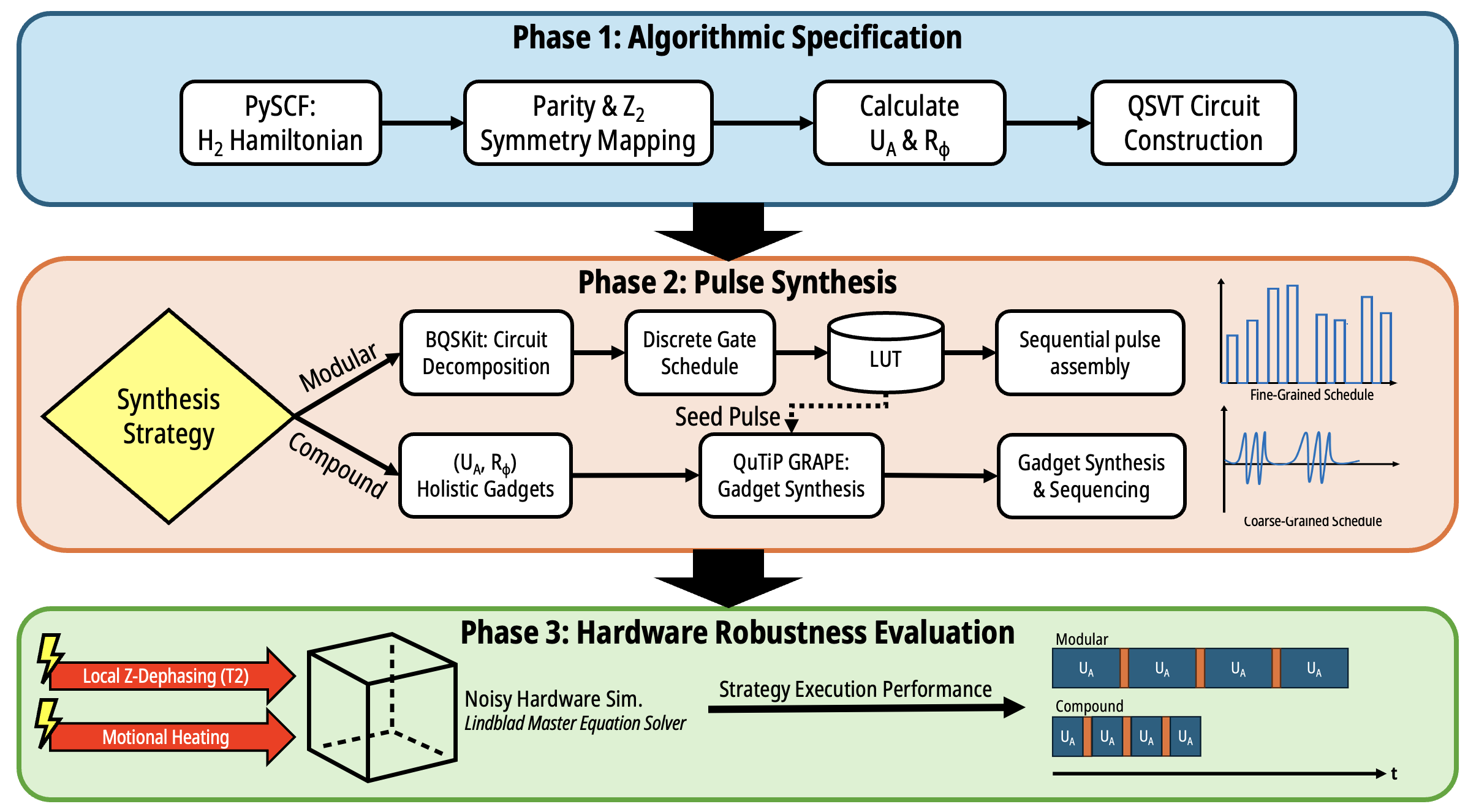
The objective of this work is to evaluate the efficiency and viability of our compound pulse gadget synthesis methodology on trapped-ion platforms. We evaluate this approach using a QSVT circuit that performs Hamiltonian simulation of the \(H_2\) molecule. Our strategy is designed to bridge the gap between high-level algorithmic specifications and low-level physical control schedules. Our methodology (see Figure 1) is split into three main phases: algorithmic specification, pulse synthesis, and hardware robustness evaluation.
2.1 Algorithmic Specification and Strategy Design↩︎
The proposed methodology serves as the central orchestration layer for translating high-level quantum algorithms into physical control signals. We target Hamiltonian simulation to approximate the time-evolution operator \(U = e^{-i H t}\). To construct the target problem, our approach utilizes the PySCF chemistry driver [11] alongside Qiskit [12] to compute the Hamiltonian for the \(H_2\) molecule (STO-3G basis), which is then mapped from 4 spin-orbitals to 2 logical qubits via tapering by symmetry exploitation.
We block-encode this normalized 2-qubit Hamiltonian into a larger unitary \(U_A\), which requires one additional ancilla qubit for signal processing. Consequently, the final algorithm is mapped to exactly 3 computational trapped ions. Using a specified target error bound, \(\epsilon\), the methodology then calculates the necessary QSVT phase angles \(\phi\).
For the \(H_2\) Hamiltonian, the resulting QSVT polynomial is of degree 4. The logical circuit manifests as a sequence of interleaved block-encodings \(U_A\) and projector-controlled phase shifts \(R_\phi\).
To transition this mathematical operator sequence into a physical instruction stream, it is crucial to define the target computational subspace. Trapped-ion hardware consists of both discrete-variable (DV) internal atomic states and continuous-variable (CV) collective motional modes. While our strategy strictly compiles DV quantum logic (qubits), it avoids executing this logic via standard discrete-time gates. Instead, the technique deploys continuous physical control waveforms that actively suppress unwanted excitations in the CV motional bath. To evaluate this approach, we coordinate the compilation through two distinct synthesis strategies: Modular and Compound.
2.2 Pulse Synthesis Strategies↩︎
Before detailing the specific compilation methods, it is critical to establish the physical boundaries of the synthesis environment. Both the modular baseline and the proposed compound strategy generate pulse schedules under a noiseless assumption. The optimizers focus strictly on achieving the target discrete-variable (DV) unitary logic in an ideal vacuum. Environmental noise and ambient continuous-variable (CV) heating are purposely excluded from the synthesis phase to ensure the matrix exponentials remain computationally tractable.
2.2.1 Modular Synthesis Strategy (Baseline)↩︎
To establish a baseline, we simulate a standard transpilation approach. The target unitaries are decomposed into a discrete schedule of 144 native trapped-ion operations (RXX entangling gates and RZ/RX single-qubit rotations) using the BQSKit compiler [7].
To translate this logical schedule into physical control signals, we utilize a pre-calculated Mølmer-Sørensen (MS) gate primitive. This physical RXX waveform is generated using pulse optimization software provided by the Duke Quantum Center [13]. The gate primitive is synthesized based on empirical trapped-ion hardware parameters and robust modulation schemes [8], derived under an ideal noiseless assumption. This optimized MS waveform, along with generated single-qubit RX control waves, is stored in a Look-Up Table (LUT). Notably, RZ rotations are compiled as virtual gates, executed instantaneously via software phase tracking rather than physical laser pulses. The full physical control sequence is then constructed by retrieving the required waveforms from the LUT and stitching them sequentially according to the BQSKit instruction schedule. Even with 0-duration virtual Z-rotations, this strategy treats every physical operator in isolation. For a single QSVT block, this results in highly fragmented control signals and significant execution bloat as the classical controller processes 144 sequential memory lookups.
2.2.2 Compound Gadget Synthesis Strategy↩︎
This strategy represents the core contribution of this work. Instead of treating operators as discrete units, our methodology pairs the interleaved \((U_A, R_\phi)\) blocks into holistic compound pulse gadgets.
To synthesize the physical control waveforms for these gadgets, the pipeline utilizes the Gradient Ascent Pulse Engineering (GRAPE) algorithm via the QuTiP software [14], [15]. Operating exclusively within the noiseless physical model, the L-BFGS-B numerical optimizer searches for a continuous drive waveform that enacts the target DV unitary. Crucially, the optimizer generates these schedules dynamically, bypassing the physical limitations and fragmented assembly process of the modular baseline. The synthesized compound gadgets are then sequenced to form the complete, temporally compressed physical execution track for the QSVT algorithm.
2.3 Preliminary Robustness Evaluation↩︎
Pulse synthesis is performed in a frictionless, noiseless environment. To verify that the synthesized pulse schedules are physically viable, we conduct a preliminary experimental evaluation using a noisy Lindblad master equation [14], [15] . This experimental setup is designed to stress-test the generated control schedules against realistic environmental noise without requiring immediate physical hardware access.
This methodology models a trapped-ion chain consisting of 3 computational ions coupled to a single shared motional mode. To maintain computational tractability while providing sufficient mathematical headroom, the bosonic Fock space of the shared continuous-variable (CV) mode is appropriately truncated. To capture realistic environmental noise, we inject local Z-dephasing (\(T_2\) noise) and motional anomalous heating into the noisy simulation.
To evaluate the systems-level advantages of our strategy, both compilation approaches are tasked with executing the identical logical QSVT block. Rather than constraining the simulations to an arbitrary physical time window, we allow the discrete baseline and the compound gadget strategy to run for the full duration required by their respective physical control schedules. This experimental setup allows us to directly measure the temporal compression achieved by holistic synthesis, and to evaluate how shrinking the physical execution window naturally improves state preservation against the static \(T_2\) noise floor.
3 Results and Discussion↩︎
While these performance gains are explicitly demonstrated for a 3-ion Hamiltonian simulation of the \(H_2\) molecule, we hypothesize that the underlying benefits observed (temporal compression and reduced lookup latency) will scale to more complex Hamiltonians. Validating this work against larger molecules like \(LiH\) is an objective for future work.
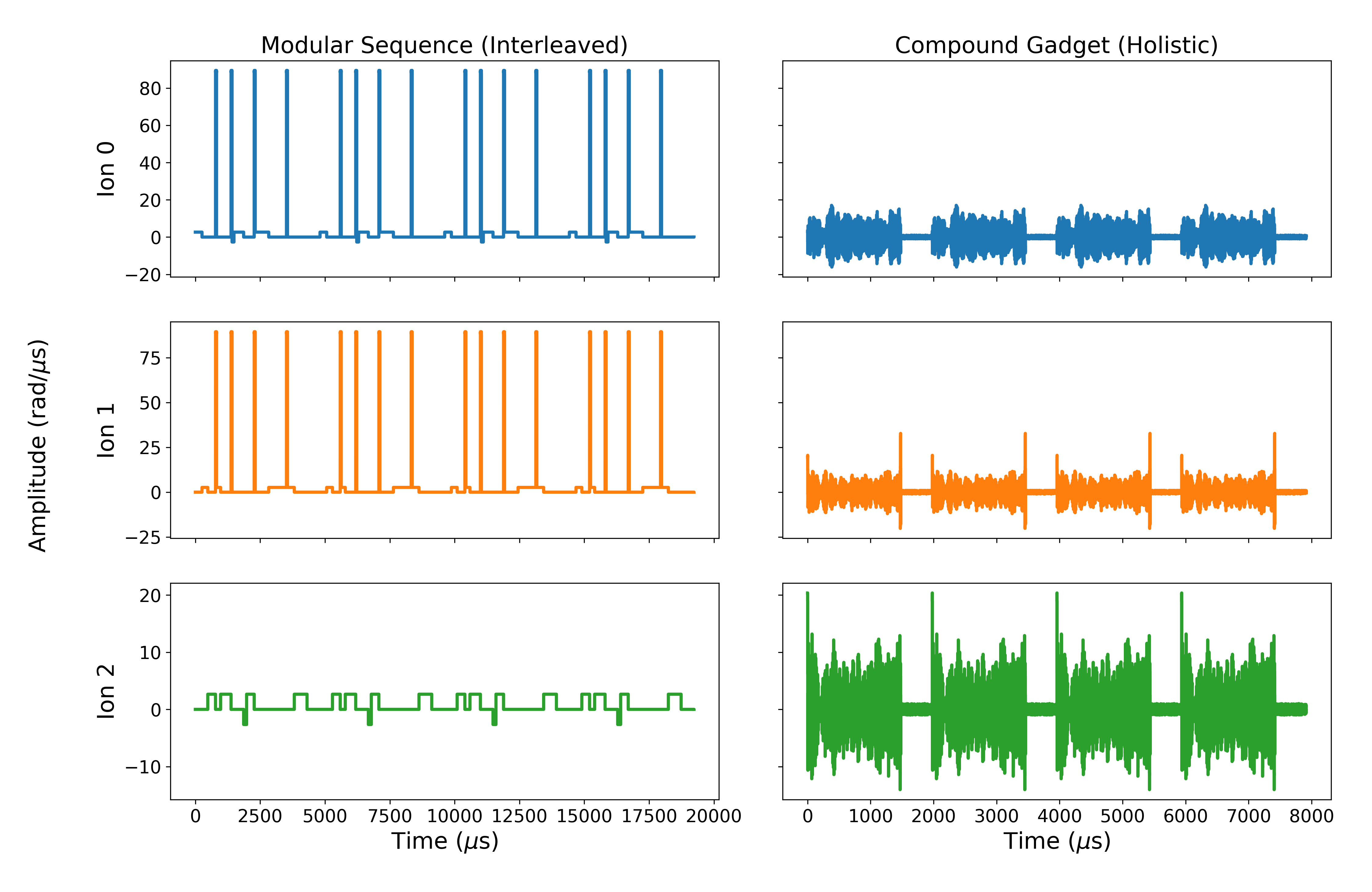
Observation 1: Compound pulse gadgets achieve significant temporal compression. As illustrated in Figure 2, the standard modular baseline is severely bottlenecked by the sequential execution of isolated gate primitives. By synthesizing the QSVT block holistically, the compound gadget strategy significantly compresses the total execution window. Because our methodology compresses the same logical operations into a much shorter physical duration, it drastically increases the computational depth achievable within the fundamental \(T_2\) decoherence ceiling. Ultimately, this temporal compression allows the hardware to execute significantly more algorithmic blocks in the time than it would take the modular baseline to complete a single fragmented schedule.
Observation 2: Holistic synthesis eliminates discrete pulse lookup overhead. Rather than executing a highly fragmented schedule of discrete gates, our methodology elevates the compilation boundary to the algorithmic block level. We synthesize a holistic, temporally compressed pulse gadget for the \((U_A,R_\phi)\) unit. The classical controller then executes a coarse-grained schedule, sequencing these gadgets at the algorithmic boundaries. This reduces the classical instruction overhead from hundreds of discrete gate fetches down to just \(d\) macro-block fetches (where \(d\) is the QSVT polynomial degree), vastly minimizing control-layer latency while preserving the temporal compression of the internal block.
Ultimately, these preliminary findings suggest that pushing compilation directly to the pulse-level provides a highly hardware-efficient methodology. By maximizing temporal compression and eliminating lookup latency, this compound pulse synthesis strategy makes the schedules robust to baseline hardware noise, establishing a clear pathway to increase computational depth and execute larger algorithmic blocks on current trapped-ion systems.

4 Conclusion and Future Work↩︎
In this work, we introduced a pulse-level compilation methodology that bypasses standard discrete gate-stitching and synthesizes QSVT algorithms directly into continuous compound pulse gadgets. By targeting Hamiltonian simulation for the \(H_2\) molecule on trapped-ion hardware, our preliminary experiments demonstrate that holistic pulse synthesis achieves significant temporal compression compared to a discrete modular baseline. Furthermore, this strategy drastically streamlines the physical instruction schedule, eliminating the control-layer latency associated with sequential memory lookups. By discarding the rigid abstractions of discrete gates, our methodology generates highly efficient physical control schedules that maximize computational depth before the system reaches the static hardware noise floor.
Building upon this proof-of-concept, future research will actively scale this compilation strategy to process significantly deeper algorithmic circuits. We plan to deploy the GRAPE optimization pipeline on an institutional computing cluster to utilize computational accelerator resources for synthesizing larger continuous compound gadgets. To address the exponential scaling bottleneck of holistic synthesis for wider systems, we also intend to explore unitary partitioning and cutting paradigms to subdivide massive algorithmic blocks into computationally tractable optimal control targets. We also plan to investigate time-optimal control boundaries within the numerical optimizer to push temporal compression to its theoretical limits and maximize the number of algorithmic blocks that can be executed within strict \(T_2\) decoherence windows. Additionally, we aim to augment the compiler’s cost function with constraints to ensure the generated schedules remain robust against complex hardware-specific noise channels without relying on discrete error suppression. Finally, we will transition from simulated robustness evaluations to empirical hardware validation, testing the systems-level advantages of our compiler directly on physical trapped-ion processors.
Acknowledgments↩︎
This work was supported in part by OSI-2531350, OMA-2120757 and PHY-2325080. Yuan Liu and Frank Mueller were also supported in part by the U.S. Department of Energy, Office of Science, Advanced Scientific Computing Research, under contract number DE-SC0025384.